(frequency division
multiple access)
What is FDMA ?
• FDMA (frequency division multiple access) is the
division of the frequency band allocated for wireless
cellular telephone communication into 30 channels,
each of which can carry a voice conversation or, with
digital service, carry digital data.
• FDMA is a basic technology in the analog Advanced
Mobile Phone System (AMPS), the most widely-
installed cellular phone system in North America.
• With FDMA, each channel can be assigned to only one
user at a time.
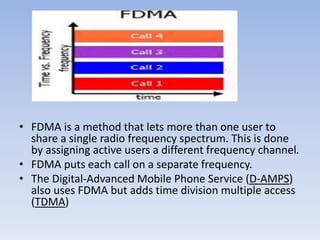
• FDMA is a method that lets more than one user to
share a single radio frequency spectrum. This is done
by assigning active users a different frequency channel.
• FDMA puts each call on a separate frequency.
• The Digital-Advanced Mobile Phone Service (D-AMPS)
also uses FDMA but adds time division multiple access
(TDMA)
• Frequency division Multiple Access (FDMA) is a
technology whereby the total amount of
spectrum is divided in a number of channels.
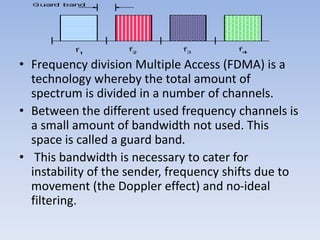
• Between the different used frequency channels is
a small amount of bandwidth not used. This
space is called a guard band.
• This bandwidth is necessary to cater for
instability of the sender, frequency shifts due to
movement (the Doppler effect) and no-ideal
filtering.
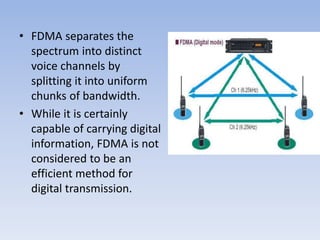
• FDMA separates the
spectrum into distinct
voice channels by
splitting it into uniform
chunks of bandwidth.
• While it is certainly
capable of carrying digital
information, FDMA is not
considered to be an
efficient method for
digital transmission.
FDMA
• All channels in a cell are available to all the mobiles. Channel
assignment is carried out on a first-come first- served basis.
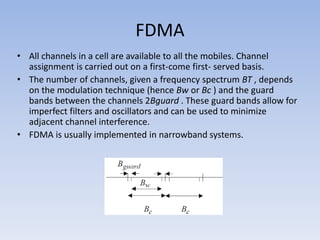
• The number of channels, given a frequency spectrum BT , depends
on the modulation technique (hence Bw or Bc ) and the guard
bands between the channels 2Bguard . These guard bands allow for
imperfect filters and oscillators and can be used to minimize
adjacent channel interference.
• FDMA is usually implemented in narrowband systems.
Single-carrier FDMA
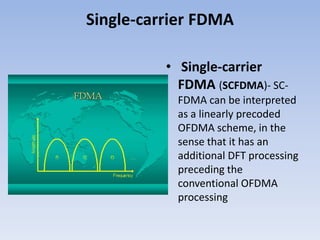
• Single-carrier
FDMA (SCFDMA)- SC-
FDMA can be interpreted
as a linearly precoded
OFDMA scheme, in the
sense that it has an
additional DFT processing
preceding the
conventional OFDMA
processing
Main features
• Continuous transmission : the channels, once assigned, are
used on a non-time-sharing basis
• Narrow bandwidth : Analog cellular systems use 25-30 kHz.
Digital FDMA systems can make use of low bit rate speech
coding techniques to reduce the channel band even more.
• Low overhead : Carry overhead messages for control,
synchronization purposes
• Simple hardware at mobile unit and BS : (1) no digital
processing needed to combat ISI (2) ease of framing and
synchronization.
Main Features
• In FDMA all users share the satellite transponder or frequency
channel simultaneously but each user transmits at single frequency.
• FDMA can be used with both analog and digital signal.
• FDMA requires high-performing filters in the radio hardware, in
contrast to TDMA and CDMA.
• FDMA is not vulnerable to the timing problems that TDMA has.
• Due to the frequency filtering, FDMA is not sensitive to near-far
problem which is pronounced for CDMA.
Thank You

Fdma1

  • 1.
  • 2.
    What is FDMA? • FDMA (frequency division multiple access) is the division of the frequency band allocated for wireless cellular telephone communication into 30 channels, each of which can carry a voice conversation or, with digital service, carry digital data. • FDMA is a basic technology in the analog Advanced Mobile Phone System (AMPS), the most widely- installed cellular phone system in North America. • With FDMA, each channel can be assigned to only one user at a time.
  • 3.
    • FDMA isa method that lets more than one user to share a single radio frequency spectrum. This is done by assigning active users a different frequency channel. • FDMA puts each call on a separate frequency. • The Digital-Advanced Mobile Phone Service (D-AMPS) also uses FDMA but adds time division multiple access (TDMA)
  • 4.
    • Frequency divisionMultiple Access (FDMA) is a technology whereby the total amount of spectrum is divided in a number of channels. • Between the different used frequency channels is a small amount of bandwidth not used. This space is called a guard band. • This bandwidth is necessary to cater for instability of the sender, frequency shifts due to movement (the Doppler effect) and no-ideal filtering.
  • 5.
    • FDMA separatesthe spectrum into distinct voice channels by splitting it into uniform chunks of bandwidth. • While it is certainly capable of carrying digital information, FDMA is not considered to be an efficient method for digital transmission.
  • 6.
    FDMA • All channelsin a cell are available to all the mobiles. Channel assignment is carried out on a first-come first- served basis. • The number of channels, given a frequency spectrum BT , depends on the modulation technique (hence Bw or Bc ) and the guard bands between the channels 2Bguard . These guard bands allow for imperfect filters and oscillators and can be used to minimize adjacent channel interference. • FDMA is usually implemented in narrowband systems.
  • 7.
    Single-carrier FDMA • Single-carrier FDMA(SCFDMA)- SC- FDMA can be interpreted as a linearly precoded OFDMA scheme, in the sense that it has an additional DFT processing preceding the conventional OFDMA processing
  • 8.
    Main features • Continuoustransmission : the channels, once assigned, are used on a non-time-sharing basis • Narrow bandwidth : Analog cellular systems use 25-30 kHz. Digital FDMA systems can make use of low bit rate speech coding techniques to reduce the channel band even more. • Low overhead : Carry overhead messages for control, synchronization purposes • Simple hardware at mobile unit and BS : (1) no digital processing needed to combat ISI (2) ease of framing and synchronization.
  • 9.
    Main Features • InFDMA all users share the satellite transponder or frequency channel simultaneously but each user transmits at single frequency. • FDMA can be used with both analog and digital signal. • FDMA requires high-performing filters in the radio hardware, in contrast to TDMA and CDMA. • FDMA is not vulnerable to the timing problems that TDMA has. • Due to the frequency filtering, FDMA is not sensitive to near-far problem which is pronounced for CDMA.
  • 10.