Fédération Dentaire 
Internationale 
Resource faculties:- 
• Dr. Ashish Shrestha 
Associate professor & Head 
• Dr. Tarakant Bhagat 
Assistant professor 
Presenter: Deepak Kumar Mishra 
Roll no.: 438 
DEPARTMENT OF PUBLIC HEALTH 
DENTISTRY,CODS,BPKIHS
Contents 
• Introduction 
• History 
• Mission 
• General assembly 
• Council 
• Projects 
• Vision 2020 
• Members 
• Election 
• Annual world dental congress 
• Geographic and regional organisations 
• Journals 
• references
Introduction
Introduction 
• The FDI World Dental Federation was 
founded in Paris in 1900 as the Fédération 
Dentaire Internationale (FDI). 
• It has continued to be the main 
organization representing dentists 
worldwide and ever since it was formed 
has organized a yearly global meeting to 
bring dentists together to discuss issues. 
• One of the missions of the FDI is "to 
promote optimal oral and general health 
for all people".
Introduction 
• Health directly correlates with the 
quality of life of both individuals and 
society, and also with economic and 
social development of countries as a 
whole. 
• FDI strongly believes proper wellness 
is a key factor for a successful and 
productive society.
Introduction 
• The FDI is a federation of National 
Dental Associations and as such, its 
main roles are to bring together the 
world of dentistry, to represent the 
dental profession of the world and to 
stimulate and facilitate the exchange of 
information across all borders with the 
aim of optimal oral health for all 
peoples.
Introduction 
• The FDI develops, supports and 
promotes programs aimed at the 
prevention of oral diseases and the 
improvement of general health
History
History 
• The idea of forming an international 
dental federation was first discussed at a 
meeting of the Copenhagen dental 
society, held in Copenhagen in 1894. 
• In 1900 during a congress in Paris, the 
Federation Dentaire Internationale (FDI) 
was created in order to “forward dental 
education”.
History 
• It was founded in Paris in 1900 by a group of six enlightened 
dentists, led by Dr Charles Godon of France, under the name 
‘Fédération Dentaire Internationale’ (hence ‘FDI’). 
• Its objective was to organize regular dental congresses to 
advance the science and art of dentistry and focus discussion 
on issues such as dental education, oral hygiene and public 
dental health. 
• FDI celebrated its 100th Annual World Dental Congress in 
Hong Kong in 2012.
Mission
Mission 
• The missions of world dental federation are: 
1. The voice of dentistry :To be the worldwide, 
authoritative and independent voice of the dental 
profession 
2. Optimal Oral health: To promote optimal oral and 
general health for all peoples 
3. Member support : To support the Member 
Associations in enhancing the ability of their 
members to provide oral health care to the public 
4. Information transfer : To advance and promote 
the ethics, art, science and practice of dentistry
The voice of dentistry 
• Aims: 
• To recruit and retain an increasing majority of National Dental 
Associations as Regular and Associate Members. 
• To recruit and retain increasing numbers of Individual Members 
• To recruit and retain an increasing number of International Dental 
Associations as Affiliate Members.To bring together the national 
and international leaders of the worldwide dental profession. 
• To ensure a democratic process and representation within the 
organisation
The voice of dentistry 
• To represent the world-wide profession of dentistry 
in relation to international, inter-governmental, 
governmental, voluntary and other organisations. 
• To analyse trends and developments of importance 
to oral health and oral health care world-wide. 
• To develop, adopt and encourage pro-active 
programmes to progressively develop oral health 
and oral health care
The voice of dentistry 
• To foster and ensure the highest 
standards of competence and integrity. 
• To ensure a quality review process and 
regular evaluations of all policies, 
programmes and activities of the 
organisation.
Optimal Oral health 
Aims: 
• To develop, support and promote programmes aimed at the 
prevention of oral diseases and the improvement of general 
and oral health. 
• To provide expertise and advice on (oral) health promotion 
programmes, suitable for various situations 
• To develop collaboration with Member Associations, inter-governmental, 
governmental and voluntary organizations 
involved in the promotion of general and oral health. 
• To promote the delivery of best possible oral health care
Member support 
Aims: 
• To provide a world forum to exchange knowledge of and 
experiences in all aspects of oral health and oral health care. 
• To encourage active participation and cooperation through 
consultation and through the democratic process of the World 
Dental Parliament. 
• To respond effectively and efficiently to the main concerns of 
the Member Associations. 
• To provide all possible support to facilitate Member 
Associations in achieving their goals.
Member support 
• To promote the highest possible standard of undergraduate, 
postgraduate and continuing education worldwide. 
• To provide advice to Member Associations and their Members 
relevant to the practice of dentistry. 
• To provide the membership with efficient and effective 
management and administration of the organisation. 
• To increase the resources of the organisation and to work 
towards the long-term financial stability of the organisation.
Information transfer 
Aims: 
• To provide an effective structure and efficient 
working mechanisms for the collection, analysis 
and presentation of up-to-date, scientifically 
sound information relevant to oral health and oral 
health care. 
• To develop and foster partnerships with other 
health and oral health care organisations. 
• To further enhance the educational opportunities 
and values of the Annual World Dental Congress.
Information transfer 
• To provide, support and encourage continuing education 
programmes for the dental team. 
• To develop, interchange and disseminate quality information 
related to all aspects of oral health and oral health care. 
• To provide a comprehensive information and communication 
system for making relevant information available to Members, 
the media and governments. 
• To ensure that all information, provided by the organisation, is 
of highest possible standard
General Assembly
General Assembly 
• The FDI General Assembly is the supreme legislative and 
governing body of the FDI. 
• The General Assembly sets FDI policies, the Strategic 
Plan, FDI Missions and Aims and monitors progress on 
the achievement. 
• The Assembly meets once a year, to approve the annual 
budget, receive the reports and take necessary action on 
reports of the Council, elects Regular, Associate, Affiliate 
and Supporting Members, Committee and Council 
members and the Speaker. 
• The General Assembly also elects Members of the List of 
Honour and award FDI Awards.
General Assembly 
• Voting members: 
• Delegates of Regular Members 
• Non-voting members with the right to speak: 
• Council Members, 
• Chairmen of Standing Committees, 
• Alternate delegates of Regular Members, 
• one representative from each Associate and 
Affiliate Member, 
• two representatives from each Regional 
Organisation.
General Assembly 
• Non-voting members with previlege to attend: 
• Members of the List of Honour, 
• Past Presidents, 
• Executive Directors Emeritus, 
• Individual Members and representatives from 
Supporting Members and from organisations 
in official relations with the FDI; with no 
automatic right to speak 
• although the Speaker may allow the privilege 
of the floor.
Powers and Duties of the General 
Assembly 
• Be the supreme legislative and governing body of the 
FDI. 
• Set FDI policies, the Strategic Plan, FDI Missions and 
Aims and shall monitor progress on the achievement of 
the Missions and Aims. 
• Have the power to enact, amend or repeal the Articles 
and Regulations. 
• Have the power to dissolve the FDI. 
• Elect Regular, Associate, Affiliate and Supporting 
Members.
Powers and Duties of the General 
Assembly 
• Elect the Directors of the FDI and the Speaker. 
• Elect the Members of the List of Honour and 
award FDI Awards. 
• Approve the annual budget and establish the 
annual subscription of the Regular Members. 
• Receive and take necessary action on reports 
of the Council.
Council
Council 
• FDI Council is composed of FDI 
Presidents, President-Elect, Treasurer 
and 10 Councilors, who are elected by 
the General Assembly and serve as the 
directors of FDI World Dental 
Federation.
Council 
• Composition: 
• Voting members: 
• The President, 
• President-elect, 
• Treasurer and ten Councillors 
• Non-voting members: 
• The Speaker of the General Assembly and 
• the Executive Director
Current council members 
President 
Tin Chun Wong 
Hong Kong SAR 
President elect 
Patrick Hescot 
France 
Treasurer 
Kathryn Kell
Current council members 
• 
Speaker 
Gerhard Seeberger 
Italy 
Member 
Ihsane Ben Yahya 
Morocco 
Member 
Edoardo Cavalle 
Italy
Current council members 
• 
Member 
Ashok Dhoble 
India 
Member 
Jaime Edelson 
Mexico 
Member 
Kim Chuan How 
Malaysia
Current council members 
Member 
Takashi Inoue 
Japan 
Member 
Alvaro Roda 
Uruguay 
Member 
Kathy Roth 
United States of America
Current council members 
Member 
Nermin Yamalik 
Turkey 
Ex-Officio Member 
Jean-Luc Eiselé 
Switzerland 
FDI Supporting Staff 
Djerdana (Gina) Ivosevic 
Switzerland
Powers and Functions 
• The Council shall: 
• Have the power to initiate, conduct, delegate, 
monitor and co-ordinate all business of the FDI 
• Direct the Executive Director in the management and 
administration of the FDI and the maintenance of all 
property 
• Approve a contract determining the conditions of 
employment of the Executive Director. 
• Assume the powers transferred to it in a period of 
emergency.
Powers and Functions 
• Nominate candidates for the List of Honour 
• After obtaining the advice and consent of the 
Regular or Associate Member Associations of the 
nominees, elect Members of Standing Committees 
• Receive and review reports from Members, Regional 
Organisations, Standing Committees, Working 
Groups, Task Teams and Sections and make 
recommendations to the General Assembly. 
• Determine the place and time and direct the 
organisation of Annual World Dental Congresses 
and the organisation of other educational 
programmes of the FDI.
Powers and Functions 
• Direct the management of the FDI publications. 
• Prepare annual budgets for approval by the General 
Assembly and provide oversight for the financial 
stability of the organisation. 
• Provide for an annual audit by a chartered 
accountant 
• Establish rules for FDI Awards
Council Committees 
• Executive committee 
Finance Committee 
Remuneration Committee
Council Committees 
• Executive committee 
The Executive Committee consists of 
three members: the President, the 
President-Elect and the Treasurer, with 
the Executive Director as an ex officio 
member. The Executive Committee acts 
on behalf of Council between Council 
meetings and is to report actions taken 
to Council.
Council Committees 
• Finance Committee 
The Finance Committee is composed of 
the Treasurer and three other members of 
Council, with the Executive Director as an 
ex officio member. The task of the 
Committee is to prepare the annual 
budget for the consideration of Council 
and to make recommendations to Council 
about the financial affairs of FDI World 
Dental Federation.
Council Committees 
• Remuneration Committee 
The Remuneration Committee is 
responsible for the appraisal of the 
Executive Director's performance and for 
negotiating the remuneration package. 
This committee also makes 
recommendations regarding allowances 
and per diems for members of Council, 
Standing Committees, Working Groups 
and Task Teams.
Standing Committees 
• The FDI has five Standing Committees, each 
with a particular sphere of activity and 
expertise. They are accountable and report to 
the Council. 
• The committees are: 
• Communication and Member Support 
Committee 
Dental Practice Committee 
Education Committee 
Public Health Committee 
Science Committee
Standing Committees 
• Communication and Member Support Committee 
The Communications & Member Support Committee monitors 
and advises Council on matters concerning internal and 
external communications and member relations 
• Dental Practice Committee 
The Dental Practice Committee contributes to the development 
of position statements, analysis and transfer of information in 
relation to the practice of dentistry, the dental profession and 
others. The work of the Committee has been focused on five 
broad areas, which are: - Quality of Care and Training 
Standards - Practice Management - Work Force - Ethics and 
Dental Legislation – Technology
Standing Committees 
• Education Committee 
The main responsibilities of the Education Committee are the 
overall planning and monitoring of the Scientific Programme of 
the Annual World Dental Congress and Continuing Education 
activities of FDI World Dental Federation, and to address 
relevant and timely issues within the area of dental education 
• Public Health Committee 
The Public Health Committee (previously the World Dental 
Development and Health Promotion Committee), established in 
2001, is the nexus for oral health development activities within 
the FDI and aims at developing and co-ordinating strategic 
programmes.
Standing Committees 
• . It also promotes initiatives and actions for the 
improvement of oral and general health for 
disadvantaged populations and is responsible for 
the management of the World Dental Development 
Fund. As a result of the Governance Review, the 
former Special Committees for Tobacco and Oral 
Health Promotion have been integrated into the 
World Dental Development and Health Promotion 
Committee.
Standing Committees 
• Science Committee 
The Science Committee's role and 
responsibilities are to contribute to the 
development of position statements, 
analysis and transfer of scientific 
information to the dental professions 
and others
Projects
World oral health day 
• World Oral Health Day is celebrated throughout the 
world on 20th March. 
• Each year a wide range of awareness-raising 
activities organized by dentists, dental students, 
National Dental Associations (NDAs) and corporate 
partners 
• The theme for World Oral Health Day 2015 is “ SMILE 
FOR LIFE”. 
• Everybody can take part in this initiative: health 
associations, specialist groups, member 
organizations and partners, governmental groups, 
students, teachers, the general public.
Live.Learn.Laugh 
• Unique global partnership between the FDI World 
Dental Federation and Unilever Oral Care 
• aims to measurably improve oral health on a global 
scale through encouraging twice daily brushing with 
a fluoride toothpaste. 
• Founded in 2004, the first phase of the partnership 
reached at least one million people through 40 
diverse oral health improvement projects in 37 
countries. 
• In 2010, the partners entered a second phase of 
activity and decided to focus on one consistent goal, 
for even greater impact.
Global Caries Initiative (GCI) 
• launched by FDI World Dental Federation in 
2009 
• Goal is: 
“to improve oral health through the 
implementation of a new paradigm for 
managing dental caries and its consequences, 
one that is based on our current knowledge of 
the disease process and its prevention, so as 
to deliver optimal oral and thus general health 
and well being to all peoples by 2020.”
Global Caries Initiative (GCI) 
• The priority areas identified in 2009 
were: 
• The eradication of early childhood caries in 
children under three years of age 
• The primary and secondary prevention of caries 
and health promotion activities 
• The definition of a common language in cariology
Global Caries Initiative (GCI) 
• First stage: development of a caries classification matrix 
• most significant achievement of GCI phase 1 was the 
development of the FDI Caries Matrix2, which aims to 
facilitate the dialogue between all stakeholders. 
• The Caries Matrix acts as a bridge between WHO Basic 
Methods (DMFT)3 and new approaches to caries 
management 
• It recognises “enamel caries” or white spots and “non 
cavitated dentine enamel”, which were not included 
within the traditional model, but can now be managed, 
through the Caries Matrix, by preventive measures and 
tools
Global Caries Initiative (GCI) 
• Second stage: implementation of the strategy 
• In March 2012 the FDI Council established the GCI Task Team 
with a mandate to ensure the GCI to achieve its extremely 
ambitious goals 
• Creation of a dedicated website: www.globalcariesinitiative.org 
To enable and support phase 2. 
• FDI has been working with Dental Tribune International to 
deliver a professional communication and education platform 
to facilitate activities at a global level and support the 
implementation of GCI at a national level by FDI member dental 
associations 
• Furthermore, the GCI website is set to become a hub for 
content sharing and knowledge transfer through hosting or 
linking to external material provided by NDAs, other 
professional organisations and corporate partners
Global Caries Initiative (GCI) 
• Third stage: optimisation and 
implementation of community outreach 
• implement collective and individual 
dental health promotion activities that 
will help combat tooth decay at all 
stages of life through its worldwide 
network.
World Dental Development Fund 
• The FDI World Dental Development Fund (WDDF) was 
established in 1999 as a program of the World Dental 
Development and Health Promotion Committee 
(WDDHPC) which is the present Public Health Committee 
(PHC) 
• The aim of the WDDF is to improve oral health globally, 
primarily through the establishment of innovative 
prevention and access program in disadvantaged 
populations 
• The FDI strongly encourages more member National 
Dental Associations to develop relevant projects and to 
apply for support through the WDDF in order to bring 
about more substantial positive impact to oral health 
globally
How to apply for WDDF? 
• The World Dental Development Fund takes 
applications on a continuous basis. Applications are 
reviewed by the FDI Public Health Committee. Before 
applying for a grant it is advised to contact the FDI 
Head Office and inquire informally whether the 
objectives of your project proposal are in line with 
the objectives of the Fund
The Oral Health Atlas 
• The Atlas is a summary of key oral health issues, 
including oral diseases, risk factors, prevention, 
treatment, workforce, strategies, major 
stakeholders, history and future, research and 
education, oral health score card. 
• highlights oral health as a neglected area of health 
for individuals and health systems, and suggests 
realistic individual and population-wide solutions. 
• It is a comprehensive sourcebook with 
information on oral health, or lack thereof, and its 
relation to other factors such as government, 
health policies, economies, wellbeing of 
populations and diseases, such as HIV/AIDS and 
diabetes
Vision 2020 
• Five elements to Vision 2020 
Vision 2020 comprises five chief elements, analyzed 
according to threat and opportunity. 
- 1. to meet the increasing need and demand for oral 
healthcare 
- 2. to expand the role of healthcare professionals. 
- 3. to shape a responsive educational model 
- 4. to mitigate the impacts of socio-economic dynamics. 
- 5. to foster fundamental and translational research and 
technology.
Vision 2020 
• Aspirational and inspirational 
• Vision 2020 is aspirational and inspirational; it is not meant to 
be operational. It provides avenues which will need to be 
further explored and discussed: specific strategies, tactical 
approaches, implementation tools or ready-to-use formulae, 
will depend largely on local needs and circumstances 
• A continuous process 
• Vision 2020 is the beginning of a continuous process aimed at 
generating discussion and collaboration between FDI and all its 
partners. It is the result of a year-long reflection within FDI 
World Dental Federation, a non-governmental organization 
based in Geneva, Switzerland, representing over one million 
dentists worldwide
Members
Members 
• Regular Members (National dental 
associations) 
• Associate Members (National dental 
associations) 
• Affiliate Members (International dental 
associations) 
• Supporting Members (Not-for-profit 
international organisations and national 
organisations with an international role) 
• Individual Members (Members of FDI 
Regular and Associate Members)
Members 
• Regular Membership 
• Regular Members are national dental associations, 
which are recognized by the FDI as principal 
associations and significant representatives of the 
legal and certified dental profession in their own 
countries and which have fulfilled the requirements 
of membership 
• Membership of the association should be open to all 
dentists in the country and the association’s 
missions and goals should be in line with those of 
the FDI
Members 
• 
In countries with more than one national dental 
association, Regular Membership may be granted 
to more than one national dental association from 
the same country, provided a National Committee 
is agreed and maintained. 
• Otherwise, only one national dental association 
can be the Regular Member of that country. 
• Applications from other national dental 
associations from the same country will be 
referred to Associate Membership
Regular Membership Benefits 
• The right of representation by Delegates and 
Alternates in the General Assembly based on 
membership 
• Delegates will have the right to speak and 
vote. Alternates will have the right to speak. 
• The right to nominate members for election to 
all positions within the FDI. 
• The right to approve the nomination of their 
members for election to positions in the FDI. 
• The right to use the FDI logo as prescribed.
Regular Membership Benefits 
• The right to attend the Congresses and other 
programmes of the FDI under conditions designated 
by the Council. 
• The right to receive other membership benefits as 
designated by the Council. 
• The right to receive information about the FDI and 
the FDI programmes through the publications and 
other media of the Regular and Associate Members. 
• The right to be eligible for election to the FDI Council 
and Committees
Associate Membership 
• Associate Members are national dental associations 
which are recognized by the FDI as significant 
representatives of the legal and certified dental 
profession in their own countries and which have 
fulfilled the requirements of membership but for 
reasons acceptable to the FDI, do not wish to hold 
regular membership 
• This category of membership is not open to 
associations that are the sole representative national 
dental associations in that country. Such 
associations belong to the category of Regular 
Members.
Associate Membership Benefits 
• The right of attendance of one representative to the 
General Assembly with the right to speak, but without the 
right to vote. 
• The right to attend the Congresses and other 
programmes of the FDI under conditions designated by 
the Council. 
• The right to receive other membership benefits as 
designated by the Council. 
• The right to receive information about the FDI and the FDI 
programmes through the publications and other media of 
the Regular and Associate Members. 
• The right to be eligible for election to the FDI Council and 
Committees. 
• The use of the FDI logo as prescribed
Affiliate Membership 
• Affiliate Members are not-for-profit international dental 
associations representing dental organisations whose 
missions are in line with those of the FDI. 
• Affiliate Members must be able to demonstrate that they 
have significant international membership and interests, 
that membership is open to all qualifying organisations 
from all countries and that they provide services, 
programmes or resources to their member organisations. 
• This category is for organisations primarily representing 
dentists and not for industry or commercial organisations 
or for organisations representing members with 
commercial interests
Affiliate Membership Benefits 
• The right of attendance of one 
representative to the General Assembly 
with the right to speak but without the 
right to vote. 
• At least one meeting annually with 
representatives from the FDI Council 
and senior staff. 
• The use of the FDI logo as prescribed
Supporting Membership 
• Supporting Members of the FDI are not-for-profit 
international organisations and national 
organisations with an international role, which 
have objectives in, or are related to the field of 
dentistry. 
• Supporting Members have direct or indirect 
involvement in the dental profession and with 
members of the dental team, but do not qualify for 
one of the above membership categories. 
• The organisation’s missions should be in line with 
those of the FDI.
Supporting Membership Benefits 
• The right of attendance of one 
representative to the General Assembly 
without the automatic right to speak or 
the right to vote. 
• At least one meeting annually with 
representatives from the FDI Council 
and senior staff. 
• The use of the FDI logo as prescribed.
Individual membership 
• In 2001, the FDI General Assembly 
made a ruling which states that if a 
person is a member of any Regular or 
Associate Member Associations of the 
FDI, he or she is automatically an 
individual member of the FDI.
Process for applying 
• All the applications should be submitted before the 
Council mid-year meeting. 
• All the documents may be presented in English, French, 
German or Spanish 
• The application should be accompanied by: 
• the constitution of the association, 
• documents attesting to the legal and professional status 
of the association and documents verifying the number 
of current members of the association. 
• a letter of intent in relation to paragraphs 1.1.3 and 1.1.5 
of the FDI Constitution is also required in case where 
there is an existing Regular Member from that country
Process for applying 
• Applications for Regular Membership are 
received by the Council, reviewed and 
evaluated in relation to paragraphs 1.1.1, 1.1.2, 
1.1.3 and 1.1.4 of the FDI Constitution and then 
submitted to the General Assembly with a 
Council recommendation. 
• If another member already exists in the 
country, Council will have to obtain their 
written recommendation on the application, 
before a recommendation is made to the 
General Assembly.
Process for applying 
• Membership will start after approval by a two-thirds 
(2/3) vote of the General Assembly present and 
voting and after receipt of the first annual 
subscription fee
Elections
Elections 
• Nomination process 
• All Regular Members and Regional Organisations are 
entitled to submit nominations for Members of 
Council and Standing Committees 
• Each nomination must be supported by the Regular 
Member Association of the nominee in writing.
Eligibility criteria for Standing 
Committees 
• For Standing Committee nominations: 
• Members of the five Standing Committees should 
preferably have a good working knowledge of 
English and should have a significant standing in 
their national association and/or the international 
dental community 
• Communications & Member Support Committee 
• Members of the Communications & Member Support 
Committee should ideally have: 
• Documented knowledge and experience of working 
within a national or international organisation; 
preferably within the dental field
Eligibility criteria for Standing 
Committees 
• Documented knowledge and 
experience of writing, printing and/or 
publishing 
• Knowledge and experience in 
communications, marketing and/or 
public relations
Dental Practice Committee 
• Members of the Dental Practice Committee should 
ideally have: 
• Documented knowledge and experience of clinical 
dental practice 
• Knowledge in areas relevant to the practice of 
dentistry, such as dental and professional 
legislation, ethics, practice management, working 
within a dental team, education, community oral 
health, etc… 
• Experience in policy formulation, management and 
advocacy in the field of dental practice
Education Committee 
• Documented knowledge and experience of 
organising continuing education programmes for 
dental practitioners, lecturing experience and 
knowledge of educational methods 
• A record of attendance/participation of international 
dental congresses 
• Contacts (network) of internationally renowned 
dental scientists and speakers
Science Committee 
• Post graduate qualifications 
• A substantial record of publications in 
scientific journals 
• Experience in the management of 
scientific projects 
• Knowledge of the principles and 
practice of evidence-based dentistry 
• Contacts (network) of internationally 
renowned dental scientists
Public Health Committee 
• Documented knowledge and work experience in 
oral health promotion with special emphasis on 
developing countries or deprived communities 
• In depth knowledge in as many areas as possible 
relevant to dental public health, such as 
prevention, fluorides, oral cancer, tobacco, 
nutrition, risk factors and behavioural aspects, 
community oral health etc 
• Documented experience in aspects of oral health 
development projects, such as developing, 
implementing, managing and evaluating projects
Public Health Committee 
• Experience in policy formulation and advocacy at 
highest levels in the field of (dental) public health 
and/or in high level decision making in international 
or national (dental) organisations 
• Experience of living and/or working in a developing 
country 
• Contacts (network) of internationally renowned 
dental scientists or key health decision makers
Nomination process 
• Nominations should be accompanied by 
the following documents: 
• 1. The nomination form 
2. A curriculum vitae (CV)/Personal record 
3. A written presentation/letter of motivation 
(for Council: no more than 500 words; for 
Standing Committees: no more than 350 
words)
Nomination process 
• All nominations that met the criteria will be made available to 
Regular Members 60 days prior to the meeting 
• Presentations are to be submitted in English. 
• However, in addition to the documents in English, 
Associations/Organisations are allowed to provide translated 
versions in one of the other FDI languages (French, German 
and Spanish) at their own cost. 
• The written presentations will be reproduced in the General 
Assembly documentation exactly as received. 
• No editing or translation will be done by the FDI.
Nomination process 
• Every nominee or his/her representative 
will have the opportunity to make a three 
minute verbal presentation: 
• For Council 
• During General Assembly 
• For Standing Committees 
During Open Forum 2
Annual World Dental Congress 
(AWDC)
Annual World Dental Congress 
(AWDC) 
• The purpose of a World Dental Congress shall be to 
provide a scientific programme, a trade exhibition 
and an international forum for the review and 
discussion of the advancement of oral health, oral 
health care and all other subjects which will advance 
the objectives of the FDI and to provide an 
opportunity for the strengthening of relations 
between the dental organisations, people and 
countries of the world
Annual World Dental 
Congress (AWDC) 
• The main elements of the Congress are: 
• A Scientific Programme 
• The General Assembly and other business meetings 
of the FDI - the FDI World Dental Parliament 
• The World Oral Forum 
• The FDI World Dental Exhibition 
• A Social Programme
Annual World Dental 
Congress (AWDC) 
• The Scientific Sessions: 
• FDI and its Education Committee will design, in 
collaboration with the local committee, the scientific 
program in order to create a more diverse and 
international scientific program and broaden a new 
audience of International speakers 
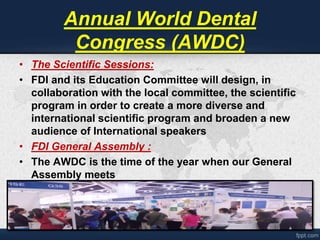
• FDI General Assembly : 
• The AWDC is the time of the year when our General 
Assembly meets
Annual World Dental 
Congress (AWDC) 
• Over 300 FDI delegates get together during 5 days 
to debate and take decisions that will influence the 
future of Dentistry. 
• It is also during the AWDC that our 5 standing 
committees get together to further progress on the 
projects they work on throughout the rest of the 
year and the place for the annual meeting of the 
FDI Sections and Regional Organizations. 
• Key Opinion Leaders from the World Dental 
community get together in a single location once a 
year at the AWDC.
Annual World Dental 
Congress (AWDC) 
• The World Oral Health Forum WOHF: 
• The 2012 Hong Kong congress was the birth place of our 
very first World Oral Health Forum. 
• During the WOHF the FDI organizes a number of sessions 
with speakers from various backgrounds to debate on 
global topics related to the future of oral health 
• The sessions is about one hour long and consist of short 
presentations by panelists (no slides). There was enough 
time for discussion and Q/A 
• Each of these sessions is addressing global issues 
relevant to dentists, but also more generally to the 
society
Annual World Dental 
Congress (AWDC) 
• The Exhibition: 
• Each year, the Exhibition is the host of National 
Pavilions where smaller companies who would 
traditionally not exhibit at such events, use the 
opportunity to explore, with limited risks, a new 
market. 
• A Regional Promotion Tool: 
• AWDC is a fantastic window of opportunity for the 
promotion of the hosting region. 
• Many international and regional visitors and FDI 
delegates take the opportunity of the congress to 
stay a few more days to visit the region
Geographic areas and regional 
organisations
Geographic areas and 
regional organisations 
• Geographic areas 
• The FDI Geographic Areas are: Africa, Asia- Pacific, 
Europe, Latin America and North America. 
• Regional Organisations 
• There shall be only one Regional Organisation for 
each Geographic Area.
Geographic areas and 
regional organisations 
• Functions: 
• To develop policies, reports and resolutions for submission to 
the Council and the General Assembly. 
• To co-operate with the various agencies of the FDI in promoting 
the FDI’s objectives in the region. 
• To encourage co-operation amongst the national dental 
organisations of the region in the fields of research, education, 
practice and public health in the interest of improved oral and 
general health of the populations of the region. 
• To nominate candidates for election to Council. 
• To carry out such other functions as it seems fit or that may be 
assigned to it by these Articles and Regulations.
Journals
Journals 
• International Dental Journal 
Editor-in-Chief: Stephen Hancocks, OBE 
• The International Dental Journal (IDJ) is the main 
scientific publication of FDI World Dental Federation. 
It features peer-reviewed, scientific articles relevant 
to international oral health issues and has a rapidly 
increasing impact factor 
• 
The IDJ also includes practical, informative articles 
aimed at clinicians. It is illustrated in full colour. 
• Published 6 times per year
FDI-related journals 
• Community Dental Health: 
• The official journal of the British 
Association for the Study of Community 
Dentistry and the European Association 
of Dental Public Health. It is published 
quarterly and includes papers, articles 
and news on many aspects of community 
and public health dentistry.
FDI-related journals 
• European Journal of Prosthodontics and 
Restorative Dentistry: 
• published quarterly and includes clinical and research 
articles in subjects such as prosthodontics, operative 
dentistry, implantology, endodontics, periodontics and 
dental materials. 
• Journal of the International Academy of 
Periodontology 
• published quarterly and includes news, comments and 
scientific reports on all aspects of periodontology.
References: 
• http://www.fdiworldental.org

Fdi

  • 1.
    Fédération Dentaire Internationale Resource faculties:- • Dr. Ashish Shrestha Associate professor & Head • Dr. Tarakant Bhagat Assistant professor Presenter: Deepak Kumar Mishra Roll no.: 438 DEPARTMENT OF PUBLIC HEALTH DENTISTRY,CODS,BPKIHS
  • 3.
    Contents • Introduction • History • Mission • General assembly • Council • Projects • Vision 2020 • Members • Election • Annual world dental congress • Geographic and regional organisations • Journals • references
  • 4.
  • 5.
    Introduction • TheFDI World Dental Federation was founded in Paris in 1900 as the Fédération Dentaire Internationale (FDI). • It has continued to be the main organization representing dentists worldwide and ever since it was formed has organized a yearly global meeting to bring dentists together to discuss issues. • One of the missions of the FDI is "to promote optimal oral and general health for all people".
  • 6.
    Introduction • Healthdirectly correlates with the quality of life of both individuals and society, and also with economic and social development of countries as a whole. • FDI strongly believes proper wellness is a key factor for a successful and productive society.
  • 7.
    Introduction • TheFDI is a federation of National Dental Associations and as such, its main roles are to bring together the world of dentistry, to represent the dental profession of the world and to stimulate and facilitate the exchange of information across all borders with the aim of optimal oral health for all peoples.
  • 8.
    Introduction • TheFDI develops, supports and promotes programs aimed at the prevention of oral diseases and the improvement of general health
  • 9.
  • 11.
    History • Theidea of forming an international dental federation was first discussed at a meeting of the Copenhagen dental society, held in Copenhagen in 1894. • In 1900 during a congress in Paris, the Federation Dentaire Internationale (FDI) was created in order to “forward dental education”.
  • 12.
    History • Itwas founded in Paris in 1900 by a group of six enlightened dentists, led by Dr Charles Godon of France, under the name ‘Fédération Dentaire Internationale’ (hence ‘FDI’). • Its objective was to organize regular dental congresses to advance the science and art of dentistry and focus discussion on issues such as dental education, oral hygiene and public dental health. • FDI celebrated its 100th Annual World Dental Congress in Hong Kong in 2012.
  • 13.
  • 15.
    Mission • Themissions of world dental federation are: 1. The voice of dentistry :To be the worldwide, authoritative and independent voice of the dental profession 2. Optimal Oral health: To promote optimal oral and general health for all peoples 3. Member support : To support the Member Associations in enhancing the ability of their members to provide oral health care to the public 4. Information transfer : To advance and promote the ethics, art, science and practice of dentistry
  • 16.
    The voice ofdentistry • Aims: • To recruit and retain an increasing majority of National Dental Associations as Regular and Associate Members. • To recruit and retain increasing numbers of Individual Members • To recruit and retain an increasing number of International Dental Associations as Affiliate Members.To bring together the national and international leaders of the worldwide dental profession. • To ensure a democratic process and representation within the organisation
  • 17.
    The voice ofdentistry • To represent the world-wide profession of dentistry in relation to international, inter-governmental, governmental, voluntary and other organisations. • To analyse trends and developments of importance to oral health and oral health care world-wide. • To develop, adopt and encourage pro-active programmes to progressively develop oral health and oral health care
  • 18.
    The voice ofdentistry • To foster and ensure the highest standards of competence and integrity. • To ensure a quality review process and regular evaluations of all policies, programmes and activities of the organisation.
  • 19.
    Optimal Oral health Aims: • To develop, support and promote programmes aimed at the prevention of oral diseases and the improvement of general and oral health. • To provide expertise and advice on (oral) health promotion programmes, suitable for various situations • To develop collaboration with Member Associations, inter-governmental, governmental and voluntary organizations involved in the promotion of general and oral health. • To promote the delivery of best possible oral health care
  • 20.
    Member support Aims: • To provide a world forum to exchange knowledge of and experiences in all aspects of oral health and oral health care. • To encourage active participation and cooperation through consultation and through the democratic process of the World Dental Parliament. • To respond effectively and efficiently to the main concerns of the Member Associations. • To provide all possible support to facilitate Member Associations in achieving their goals.
  • 21.
    Member support •To promote the highest possible standard of undergraduate, postgraduate and continuing education worldwide. • To provide advice to Member Associations and their Members relevant to the practice of dentistry. • To provide the membership with efficient and effective management and administration of the organisation. • To increase the resources of the organisation and to work towards the long-term financial stability of the organisation.
  • 22.
    Information transfer Aims: • To provide an effective structure and efficient working mechanisms for the collection, analysis and presentation of up-to-date, scientifically sound information relevant to oral health and oral health care. • To develop and foster partnerships with other health and oral health care organisations. • To further enhance the educational opportunities and values of the Annual World Dental Congress.
  • 23.
    Information transfer •To provide, support and encourage continuing education programmes for the dental team. • To develop, interchange and disseminate quality information related to all aspects of oral health and oral health care. • To provide a comprehensive information and communication system for making relevant information available to Members, the media and governments. • To ensure that all information, provided by the organisation, is of highest possible standard
  • 24.
  • 26.
    General Assembly •The FDI General Assembly is the supreme legislative and governing body of the FDI. • The General Assembly sets FDI policies, the Strategic Plan, FDI Missions and Aims and monitors progress on the achievement. • The Assembly meets once a year, to approve the annual budget, receive the reports and take necessary action on reports of the Council, elects Regular, Associate, Affiliate and Supporting Members, Committee and Council members and the Speaker. • The General Assembly also elects Members of the List of Honour and award FDI Awards.
  • 27.
    General Assembly •Voting members: • Delegates of Regular Members • Non-voting members with the right to speak: • Council Members, • Chairmen of Standing Committees, • Alternate delegates of Regular Members, • one representative from each Associate and Affiliate Member, • two representatives from each Regional Organisation.
  • 28.
    General Assembly •Non-voting members with previlege to attend: • Members of the List of Honour, • Past Presidents, • Executive Directors Emeritus, • Individual Members and representatives from Supporting Members and from organisations in official relations with the FDI; with no automatic right to speak • although the Speaker may allow the privilege of the floor.
  • 30.
    Powers and Dutiesof the General Assembly • Be the supreme legislative and governing body of the FDI. • Set FDI policies, the Strategic Plan, FDI Missions and Aims and shall monitor progress on the achievement of the Missions and Aims. • Have the power to enact, amend or repeal the Articles and Regulations. • Have the power to dissolve the FDI. • Elect Regular, Associate, Affiliate and Supporting Members.
  • 31.
    Powers and Dutiesof the General Assembly • Elect the Directors of the FDI and the Speaker. • Elect the Members of the List of Honour and award FDI Awards. • Approve the annual budget and establish the annual subscription of the Regular Members. • Receive and take necessary action on reports of the Council.
  • 32.
  • 33.
    Council • FDICouncil is composed of FDI Presidents, President-Elect, Treasurer and 10 Councilors, who are elected by the General Assembly and serve as the directors of FDI World Dental Federation.
  • 34.
    Council • Composition: • Voting members: • The President, • President-elect, • Treasurer and ten Councillors • Non-voting members: • The Speaker of the General Assembly and • the Executive Director
  • 35.
    Current council members President Tin Chun Wong Hong Kong SAR President elect Patrick Hescot France Treasurer Kathryn Kell
  • 36.
    Current council members • Speaker Gerhard Seeberger Italy Member Ihsane Ben Yahya Morocco Member Edoardo Cavalle Italy
  • 37.
    Current council members • Member Ashok Dhoble India Member Jaime Edelson Mexico Member Kim Chuan How Malaysia
  • 38.
    Current council members Member Takashi Inoue Japan Member Alvaro Roda Uruguay Member Kathy Roth United States of America
  • 39.
    Current council members Member Nermin Yamalik Turkey Ex-Officio Member Jean-Luc Eiselé Switzerland FDI Supporting Staff Djerdana (Gina) Ivosevic Switzerland
  • 40.
    Powers and Functions • The Council shall: • Have the power to initiate, conduct, delegate, monitor and co-ordinate all business of the FDI • Direct the Executive Director in the management and administration of the FDI and the maintenance of all property • Approve a contract determining the conditions of employment of the Executive Director. • Assume the powers transferred to it in a period of emergency.
  • 41.
    Powers and Functions • Nominate candidates for the List of Honour • After obtaining the advice and consent of the Regular or Associate Member Associations of the nominees, elect Members of Standing Committees • Receive and review reports from Members, Regional Organisations, Standing Committees, Working Groups, Task Teams and Sections and make recommendations to the General Assembly. • Determine the place and time and direct the organisation of Annual World Dental Congresses and the organisation of other educational programmes of the FDI.
  • 42.
    Powers and Functions • Direct the management of the FDI publications. • Prepare annual budgets for approval by the General Assembly and provide oversight for the financial stability of the organisation. • Provide for an annual audit by a chartered accountant • Establish rules for FDI Awards
  • 43.
    Council Committees •Executive committee Finance Committee Remuneration Committee
  • 44.
    Council Committees •Executive committee The Executive Committee consists of three members: the President, the President-Elect and the Treasurer, with the Executive Director as an ex officio member. The Executive Committee acts on behalf of Council between Council meetings and is to report actions taken to Council.
  • 45.
    Council Committees •Finance Committee The Finance Committee is composed of the Treasurer and three other members of Council, with the Executive Director as an ex officio member. The task of the Committee is to prepare the annual budget for the consideration of Council and to make recommendations to Council about the financial affairs of FDI World Dental Federation.
  • 46.
    Council Committees •Remuneration Committee The Remuneration Committee is responsible for the appraisal of the Executive Director's performance and for negotiating the remuneration package. This committee also makes recommendations regarding allowances and per diems for members of Council, Standing Committees, Working Groups and Task Teams.
  • 47.
    Standing Committees •The FDI has five Standing Committees, each with a particular sphere of activity and expertise. They are accountable and report to the Council. • The committees are: • Communication and Member Support Committee Dental Practice Committee Education Committee Public Health Committee Science Committee
  • 48.
    Standing Committees •Communication and Member Support Committee The Communications & Member Support Committee monitors and advises Council on matters concerning internal and external communications and member relations • Dental Practice Committee The Dental Practice Committee contributes to the development of position statements, analysis and transfer of information in relation to the practice of dentistry, the dental profession and others. The work of the Committee has been focused on five broad areas, which are: - Quality of Care and Training Standards - Practice Management - Work Force - Ethics and Dental Legislation – Technology
  • 49.
    Standing Committees •Education Committee The main responsibilities of the Education Committee are the overall planning and monitoring of the Scientific Programme of the Annual World Dental Congress and Continuing Education activities of FDI World Dental Federation, and to address relevant and timely issues within the area of dental education • Public Health Committee The Public Health Committee (previously the World Dental Development and Health Promotion Committee), established in 2001, is the nexus for oral health development activities within the FDI and aims at developing and co-ordinating strategic programmes.
  • 50.
    Standing Committees •. It also promotes initiatives and actions for the improvement of oral and general health for disadvantaged populations and is responsible for the management of the World Dental Development Fund. As a result of the Governance Review, the former Special Committees for Tobacco and Oral Health Promotion have been integrated into the World Dental Development and Health Promotion Committee.
  • 51.
    Standing Committees •Science Committee The Science Committee's role and responsibilities are to contribute to the development of position statements, analysis and transfer of scientific information to the dental professions and others
  • 52.
  • 54.
    World oral healthday • World Oral Health Day is celebrated throughout the world on 20th March. • Each year a wide range of awareness-raising activities organized by dentists, dental students, National Dental Associations (NDAs) and corporate partners • The theme for World Oral Health Day 2015 is “ SMILE FOR LIFE”. • Everybody can take part in this initiative: health associations, specialist groups, member organizations and partners, governmental groups, students, teachers, the general public.
  • 55.
    Live.Learn.Laugh • Uniqueglobal partnership between the FDI World Dental Federation and Unilever Oral Care • aims to measurably improve oral health on a global scale through encouraging twice daily brushing with a fluoride toothpaste. • Founded in 2004, the first phase of the partnership reached at least one million people through 40 diverse oral health improvement projects in 37 countries. • In 2010, the partners entered a second phase of activity and decided to focus on one consistent goal, for even greater impact.
  • 56.
    Global Caries Initiative(GCI) • launched by FDI World Dental Federation in 2009 • Goal is: “to improve oral health through the implementation of a new paradigm for managing dental caries and its consequences, one that is based on our current knowledge of the disease process and its prevention, so as to deliver optimal oral and thus general health and well being to all peoples by 2020.”
  • 57.
    Global Caries Initiative(GCI) • The priority areas identified in 2009 were: • The eradication of early childhood caries in children under three years of age • The primary and secondary prevention of caries and health promotion activities • The definition of a common language in cariology
  • 58.
    Global Caries Initiative(GCI) • First stage: development of a caries classification matrix • most significant achievement of GCI phase 1 was the development of the FDI Caries Matrix2, which aims to facilitate the dialogue between all stakeholders. • The Caries Matrix acts as a bridge between WHO Basic Methods (DMFT)3 and new approaches to caries management • It recognises “enamel caries” or white spots and “non cavitated dentine enamel”, which were not included within the traditional model, but can now be managed, through the Caries Matrix, by preventive measures and tools
  • 59.
    Global Caries Initiative(GCI) • Second stage: implementation of the strategy • In March 2012 the FDI Council established the GCI Task Team with a mandate to ensure the GCI to achieve its extremely ambitious goals • Creation of a dedicated website: www.globalcariesinitiative.org To enable and support phase 2. • FDI has been working with Dental Tribune International to deliver a professional communication and education platform to facilitate activities at a global level and support the implementation of GCI at a national level by FDI member dental associations • Furthermore, the GCI website is set to become a hub for content sharing and knowledge transfer through hosting or linking to external material provided by NDAs, other professional organisations and corporate partners
  • 60.
    Global Caries Initiative(GCI) • Third stage: optimisation and implementation of community outreach • implement collective and individual dental health promotion activities that will help combat tooth decay at all stages of life through its worldwide network.
  • 61.
    World Dental DevelopmentFund • The FDI World Dental Development Fund (WDDF) was established in 1999 as a program of the World Dental Development and Health Promotion Committee (WDDHPC) which is the present Public Health Committee (PHC) • The aim of the WDDF is to improve oral health globally, primarily through the establishment of innovative prevention and access program in disadvantaged populations • The FDI strongly encourages more member National Dental Associations to develop relevant projects and to apply for support through the WDDF in order to bring about more substantial positive impact to oral health globally
  • 62.
    How to applyfor WDDF? • The World Dental Development Fund takes applications on a continuous basis. Applications are reviewed by the FDI Public Health Committee. Before applying for a grant it is advised to contact the FDI Head Office and inquire informally whether the objectives of your project proposal are in line with the objectives of the Fund
  • 64.
    The Oral HealthAtlas • The Atlas is a summary of key oral health issues, including oral diseases, risk factors, prevention, treatment, workforce, strategies, major stakeholders, history and future, research and education, oral health score card. • highlights oral health as a neglected area of health for individuals and health systems, and suggests realistic individual and population-wide solutions. • It is a comprehensive sourcebook with information on oral health, or lack thereof, and its relation to other factors such as government, health policies, economies, wellbeing of populations and diseases, such as HIV/AIDS and diabetes
  • 66.
    Vision 2020 •Five elements to Vision 2020 Vision 2020 comprises five chief elements, analyzed according to threat and opportunity. - 1. to meet the increasing need and demand for oral healthcare - 2. to expand the role of healthcare professionals. - 3. to shape a responsive educational model - 4. to mitigate the impacts of socio-economic dynamics. - 5. to foster fundamental and translational research and technology.
  • 67.
    Vision 2020 •Aspirational and inspirational • Vision 2020 is aspirational and inspirational; it is not meant to be operational. It provides avenues which will need to be further explored and discussed: specific strategies, tactical approaches, implementation tools or ready-to-use formulae, will depend largely on local needs and circumstances • A continuous process • Vision 2020 is the beginning of a continuous process aimed at generating discussion and collaboration between FDI and all its partners. It is the result of a year-long reflection within FDI World Dental Federation, a non-governmental organization based in Geneva, Switzerland, representing over one million dentists worldwide
  • 69.
  • 70.
    Members • RegularMembers (National dental associations) • Associate Members (National dental associations) • Affiliate Members (International dental associations) • Supporting Members (Not-for-profit international organisations and national organisations with an international role) • Individual Members (Members of FDI Regular and Associate Members)
  • 71.
    Members • RegularMembership • Regular Members are national dental associations, which are recognized by the FDI as principal associations and significant representatives of the legal and certified dental profession in their own countries and which have fulfilled the requirements of membership • Membership of the association should be open to all dentists in the country and the association’s missions and goals should be in line with those of the FDI
  • 72.
    Members • Incountries with more than one national dental association, Regular Membership may be granted to more than one national dental association from the same country, provided a National Committee is agreed and maintained. • Otherwise, only one national dental association can be the Regular Member of that country. • Applications from other national dental associations from the same country will be referred to Associate Membership
  • 73.
    Regular Membership Benefits • The right of representation by Delegates and Alternates in the General Assembly based on membership • Delegates will have the right to speak and vote. Alternates will have the right to speak. • The right to nominate members for election to all positions within the FDI. • The right to approve the nomination of their members for election to positions in the FDI. • The right to use the FDI logo as prescribed.
  • 74.
    Regular Membership Benefits • The right to attend the Congresses and other programmes of the FDI under conditions designated by the Council. • The right to receive other membership benefits as designated by the Council. • The right to receive information about the FDI and the FDI programmes through the publications and other media of the Regular and Associate Members. • The right to be eligible for election to the FDI Council and Committees
  • 75.
    Associate Membership •Associate Members are national dental associations which are recognized by the FDI as significant representatives of the legal and certified dental profession in their own countries and which have fulfilled the requirements of membership but for reasons acceptable to the FDI, do not wish to hold regular membership • This category of membership is not open to associations that are the sole representative national dental associations in that country. Such associations belong to the category of Regular Members.
  • 76.
    Associate Membership Benefits • The right of attendance of one representative to the General Assembly with the right to speak, but without the right to vote. • The right to attend the Congresses and other programmes of the FDI under conditions designated by the Council. • The right to receive other membership benefits as designated by the Council. • The right to receive information about the FDI and the FDI programmes through the publications and other media of the Regular and Associate Members. • The right to be eligible for election to the FDI Council and Committees. • The use of the FDI logo as prescribed
  • 77.
    Affiliate Membership •Affiliate Members are not-for-profit international dental associations representing dental organisations whose missions are in line with those of the FDI. • Affiliate Members must be able to demonstrate that they have significant international membership and interests, that membership is open to all qualifying organisations from all countries and that they provide services, programmes or resources to their member organisations. • This category is for organisations primarily representing dentists and not for industry or commercial organisations or for organisations representing members with commercial interests
  • 78.
    Affiliate Membership Benefits • The right of attendance of one representative to the General Assembly with the right to speak but without the right to vote. • At least one meeting annually with representatives from the FDI Council and senior staff. • The use of the FDI logo as prescribed
  • 79.
    Supporting Membership •Supporting Members of the FDI are not-for-profit international organisations and national organisations with an international role, which have objectives in, or are related to the field of dentistry. • Supporting Members have direct or indirect involvement in the dental profession and with members of the dental team, but do not qualify for one of the above membership categories. • The organisation’s missions should be in line with those of the FDI.
  • 80.
    Supporting Membership Benefits • The right of attendance of one representative to the General Assembly without the automatic right to speak or the right to vote. • At least one meeting annually with representatives from the FDI Council and senior staff. • The use of the FDI logo as prescribed.
  • 81.
    Individual membership •In 2001, the FDI General Assembly made a ruling which states that if a person is a member of any Regular or Associate Member Associations of the FDI, he or she is automatically an individual member of the FDI.
  • 82.
    Process for applying • All the applications should be submitted before the Council mid-year meeting. • All the documents may be presented in English, French, German or Spanish • The application should be accompanied by: • the constitution of the association, • documents attesting to the legal and professional status of the association and documents verifying the number of current members of the association. • a letter of intent in relation to paragraphs 1.1.3 and 1.1.5 of the FDI Constitution is also required in case where there is an existing Regular Member from that country
  • 83.
    Process for applying • Applications for Regular Membership are received by the Council, reviewed and evaluated in relation to paragraphs 1.1.1, 1.1.2, 1.1.3 and 1.1.4 of the FDI Constitution and then submitted to the General Assembly with a Council recommendation. • If another member already exists in the country, Council will have to obtain their written recommendation on the application, before a recommendation is made to the General Assembly.
  • 84.
    Process for applying • Membership will start after approval by a two-thirds (2/3) vote of the General Assembly present and voting and after receipt of the first annual subscription fee
  • 85.
  • 86.
    Elections • Nominationprocess • All Regular Members and Regional Organisations are entitled to submit nominations for Members of Council and Standing Committees • Each nomination must be supported by the Regular Member Association of the nominee in writing.
  • 87.
    Eligibility criteria forStanding Committees • For Standing Committee nominations: • Members of the five Standing Committees should preferably have a good working knowledge of English and should have a significant standing in their national association and/or the international dental community • Communications & Member Support Committee • Members of the Communications & Member Support Committee should ideally have: • Documented knowledge and experience of working within a national or international organisation; preferably within the dental field
  • 88.
    Eligibility criteria forStanding Committees • Documented knowledge and experience of writing, printing and/or publishing • Knowledge and experience in communications, marketing and/or public relations
  • 89.
    Dental Practice Committee • Members of the Dental Practice Committee should ideally have: • Documented knowledge and experience of clinical dental practice • Knowledge in areas relevant to the practice of dentistry, such as dental and professional legislation, ethics, practice management, working within a dental team, education, community oral health, etc… • Experience in policy formulation, management and advocacy in the field of dental practice
  • 90.
    Education Committee •Documented knowledge and experience of organising continuing education programmes for dental practitioners, lecturing experience and knowledge of educational methods • A record of attendance/participation of international dental congresses • Contacts (network) of internationally renowned dental scientists and speakers
  • 91.
    Science Committee •Post graduate qualifications • A substantial record of publications in scientific journals • Experience in the management of scientific projects • Knowledge of the principles and practice of evidence-based dentistry • Contacts (network) of internationally renowned dental scientists
  • 92.
    Public Health Committee • Documented knowledge and work experience in oral health promotion with special emphasis on developing countries or deprived communities • In depth knowledge in as many areas as possible relevant to dental public health, such as prevention, fluorides, oral cancer, tobacco, nutrition, risk factors and behavioural aspects, community oral health etc • Documented experience in aspects of oral health development projects, such as developing, implementing, managing and evaluating projects
  • 93.
    Public Health Committee • Experience in policy formulation and advocacy at highest levels in the field of (dental) public health and/or in high level decision making in international or national (dental) organisations • Experience of living and/or working in a developing country • Contacts (network) of internationally renowned dental scientists or key health decision makers
  • 94.
    Nomination process •Nominations should be accompanied by the following documents: • 1. The nomination form 2. A curriculum vitae (CV)/Personal record 3. A written presentation/letter of motivation (for Council: no more than 500 words; for Standing Committees: no more than 350 words)
  • 95.
    Nomination process •All nominations that met the criteria will be made available to Regular Members 60 days prior to the meeting • Presentations are to be submitted in English. • However, in addition to the documents in English, Associations/Organisations are allowed to provide translated versions in one of the other FDI languages (French, German and Spanish) at their own cost. • The written presentations will be reproduced in the General Assembly documentation exactly as received. • No editing or translation will be done by the FDI.
  • 96.
    Nomination process •Every nominee or his/her representative will have the opportunity to make a three minute verbal presentation: • For Council • During General Assembly • For Standing Committees During Open Forum 2
  • 98.
    Annual World DentalCongress (AWDC)
  • 99.
    Annual World DentalCongress (AWDC) • The purpose of a World Dental Congress shall be to provide a scientific programme, a trade exhibition and an international forum for the review and discussion of the advancement of oral health, oral health care and all other subjects which will advance the objectives of the FDI and to provide an opportunity for the strengthening of relations between the dental organisations, people and countries of the world
  • 100.
    Annual World Dental Congress (AWDC) • The main elements of the Congress are: • A Scientific Programme • The General Assembly and other business meetings of the FDI - the FDI World Dental Parliament • The World Oral Forum • The FDI World Dental Exhibition • A Social Programme
  • 101.
    Annual World Dental Congress (AWDC) • The Scientific Sessions: • FDI and its Education Committee will design, in collaboration with the local committee, the scientific program in order to create a more diverse and international scientific program and broaden a new audience of International speakers • FDI General Assembly : • The AWDC is the time of the year when our General Assembly meets
  • 102.
    Annual World Dental Congress (AWDC) • Over 300 FDI delegates get together during 5 days to debate and take decisions that will influence the future of Dentistry. • It is also during the AWDC that our 5 standing committees get together to further progress on the projects they work on throughout the rest of the year and the place for the annual meeting of the FDI Sections and Regional Organizations. • Key Opinion Leaders from the World Dental community get together in a single location once a year at the AWDC.
  • 103.
    Annual World Dental Congress (AWDC) • The World Oral Health Forum WOHF: • The 2012 Hong Kong congress was the birth place of our very first World Oral Health Forum. • During the WOHF the FDI organizes a number of sessions with speakers from various backgrounds to debate on global topics related to the future of oral health • The sessions is about one hour long and consist of short presentations by panelists (no slides). There was enough time for discussion and Q/A • Each of these sessions is addressing global issues relevant to dentists, but also more generally to the society
  • 104.
    Annual World Dental Congress (AWDC) • The Exhibition: • Each year, the Exhibition is the host of National Pavilions where smaller companies who would traditionally not exhibit at such events, use the opportunity to explore, with limited risks, a new market. • A Regional Promotion Tool: • AWDC is a fantastic window of opportunity for the promotion of the hosting region. • Many international and regional visitors and FDI delegates take the opportunity of the congress to stay a few more days to visit the region
  • 105.
    Geographic areas andregional organisations
  • 106.
    Geographic areas and regional organisations • Geographic areas • The FDI Geographic Areas are: Africa, Asia- Pacific, Europe, Latin America and North America. • Regional Organisations • There shall be only one Regional Organisation for each Geographic Area.
  • 107.
    Geographic areas and regional organisations • Functions: • To develop policies, reports and resolutions for submission to the Council and the General Assembly. • To co-operate with the various agencies of the FDI in promoting the FDI’s objectives in the region. • To encourage co-operation amongst the national dental organisations of the region in the fields of research, education, practice and public health in the interest of improved oral and general health of the populations of the region. • To nominate candidates for election to Council. • To carry out such other functions as it seems fit or that may be assigned to it by these Articles and Regulations.
  • 108.
  • 109.
    Journals • InternationalDental Journal Editor-in-Chief: Stephen Hancocks, OBE • The International Dental Journal (IDJ) is the main scientific publication of FDI World Dental Federation. It features peer-reviewed, scientific articles relevant to international oral health issues and has a rapidly increasing impact factor • The IDJ also includes practical, informative articles aimed at clinicians. It is illustrated in full colour. • Published 6 times per year
  • 110.
    FDI-related journals •Community Dental Health: • The official journal of the British Association for the Study of Community Dentistry and the European Association of Dental Public Health. It is published quarterly and includes papers, articles and news on many aspects of community and public health dentistry.
  • 111.
    FDI-related journals •European Journal of Prosthodontics and Restorative Dentistry: • published quarterly and includes clinical and research articles in subjects such as prosthodontics, operative dentistry, implantology, endodontics, periodontics and dental materials. • Journal of the International Academy of Periodontology • published quarterly and includes news, comments and scientific reports on all aspects of periodontology.
  • 113.