Muhammad Yaqoob Marri
 Careful assessment of the periodontal tissues
is an essential component of patient
management.
 The BPE is a simple and rapid screening tool
that is used to indicate the level of
examination needed and to provide basic
guidance on treatment need. the BPE does
not provide a diagnosis.
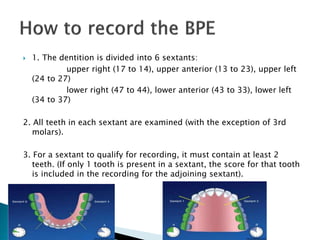
 1. The dentition is divided into 6 sextants:
upper right (17 to 14), upper anterior (13 to 23), upper left
(24 to 27)
lower right (47 to 44), lower anterior (43 to 33), lower left
(34 to 37)
2. All teeth in each sextant are examined (with the exception of 3rd
molars).
3. For a sextant to qualify for recording, it must contain at least 2
teeth. (If only 1 tooth is present in a sextant, the score for that tooth
is included in the recording for the adjoining sextant).
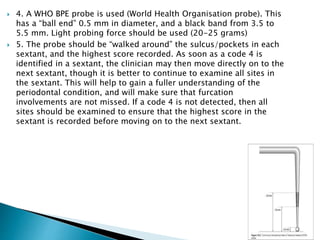
 4. A WHO BPE probe is used (World Health Organisation probe). This
has a “ball end” 0.5 mm in diameter, and a black band from 3.5 to
5.5 mm. Light probing force should be used (20-25 grams)
 5. The probe should be “walked around” the sulcus/pockets in each
sextant, and the highest score recorded. As soon as a code 4 is
identified in a sextant, the clinician may then move directly on to the
next sextant, though it is better to continue to examine all sites in
the sextant. This will help to gain a fuller understanding of the
periodontal condition, and will make sure that furcation
involvements are not missed. If a code 4 is not detected, then all
sites should be examined to ensure that the highest score in the
sextant is recorded before moving on to the next sextant.
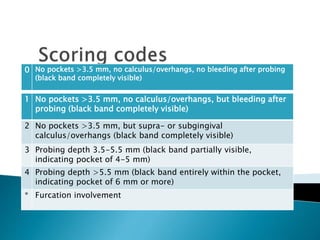
1 No pockets >3.5 mm, no calculus/overhangs, but bleeding after
probing (black band completely visible)
2 No pockets >3.5 mm, but supra- or subgingival
calculus/overhangs (black band completely visible)
3 Probing depth 3.5-5.5 mm (black band partially visible,
indicating pocket of 4-5 mm)
4 Probing depth >5.5 mm (black band entirely within the pocket,
indicating pocket of 6 mm or more)
* Furcation involvement
0 No pockets >3.5 mm, no calculus/overhangs, no bleeding after probing
(black band completely visible)
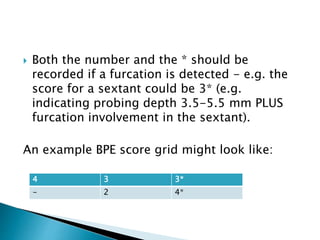
 Both the number and the * should be
recorded if a furcation is detected - e.g. the
score for a sextant could be 3* (e.g.
indicating probing depth 3.5-5.5 mm PLUS
furcation involvement in the sextant).
An example BPE score grid might look like:
4 3 3*
- 2 4*
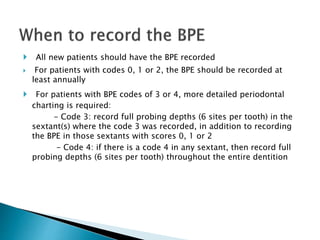
 All new patients should have the BPE recorded
 For patients with codes 0, 1 or 2, the BPE should be recorded at
least annually
 For patients with BPE codes of 3 or 4, more detailed periodontal
charting is required:
- Code 3: record full probing depths (6 sites per tooth) in the
sextant(s) where the code 3 was recorded, in addition to recording
the BPE in those sextants with scores 0, 1 or 2
- Code 4: if there is a code 4 in any sextant, then record full
probing depths (6 sites per tooth) throughout the entire dentition
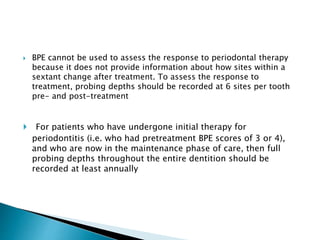
 BPE cannot be used to assess the response to periodontal therapy
because it does not provide information about how sites within a
sextant change after treatment. To assess the response to
treatment, probing depths should be recorded at 6 sites per tooth
pre- and post-treatment
 For patients who have undergone initial therapy for
periodontitis (i.e. who had pretreatment BPE scores of 3 or 4),
and who are now in the maintenance phase of care, then full
probing depths throughout the entire dentition should be
recorded at least annually
 Interpreting the BPE score depends on many factors that are unique
to each patient. The clinician should use their skill, knowledge and
judgement when interpreting BPE scores. General guidance is
indicated below. The BPE scores should be considered together with
other factors when making decisions about whether to refer (as
outlined in the companion BSP document “Referral Policy and
Parameters of Care”).
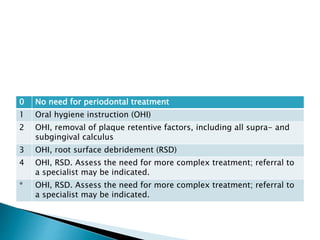
0 No need for periodontal treatment
1 Oral hygiene instruction (OHI)
2 OHI, removal of plaque retentive factors, including all supra- and
subgingival calculus
3 OHI, root surface debridement (RSD)
4 OHI, RSD. Assess the need for more complex treatment; referral to
a specialist may be indicated.
* OHI, RSD. Assess the need for more complex treatment; referral to
a specialist may be indicated.
 As a general rule, radiographs to assess alveolar bone levels should
be obtained for teeth or sextants where BPE codes 3 or 4 are found.
The BPE was first developed by the British Society of Periodontology in
1986. Previous versions of this document were produced in 1986,
1994 and 2000. The main changes in this 2011 version are (i) that *
should now be used to denote only the presence of a furcation, and
(ii) that both the BPE code and the * should be recorded for each
sextant where furcation involvement is found.
 A furcation involvement, also called a furcationinvasion, is defined as
an area of bone loss at branching point of a tooth root. The bone loss
results from periodontal (gum) disease
 The prsence of furcation involment is detected by periodontal probe
Classification of furcations
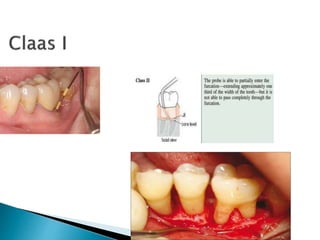
class I: this is early stage and indicateds a suprabony pocket with
minimal bone resorbtion in furcation. The probe enters horizontally
approximatley 1 or 2 mm and the arch of furcation can be detected
Class II:the bone resorbtion extends further itno furcation but not
completely through it .the probe penetrate more than 1 or 2 mm
horizontally into the furcation
Class III:the bone resorbtion extends completely through the furcation.this
allows the probe to penetrate from one surface of a tooth to another
through the furcation
Basic periodontal examination

Basic periodontal examination

  • 1.
  • 2.
     Careful assessmentof the periodontal tissues is an essential component of patient management.  The BPE is a simple and rapid screening tool that is used to indicate the level of examination needed and to provide basic guidance on treatment need. the BPE does not provide a diagnosis.
  • 3.
     1. Thedentition is divided into 6 sextants: upper right (17 to 14), upper anterior (13 to 23), upper left (24 to 27) lower right (47 to 44), lower anterior (43 to 33), lower left (34 to 37) 2. All teeth in each sextant are examined (with the exception of 3rd molars). 3. For a sextant to qualify for recording, it must contain at least 2 teeth. (If only 1 tooth is present in a sextant, the score for that tooth is included in the recording for the adjoining sextant).
  • 4.
     4. AWHO BPE probe is used (World Health Organisation probe). This has a “ball end” 0.5 mm in diameter, and a black band from 3.5 to 5.5 mm. Light probing force should be used (20-25 grams)  5. The probe should be “walked around” the sulcus/pockets in each sextant, and the highest score recorded. As soon as a code 4 is identified in a sextant, the clinician may then move directly on to the next sextant, though it is better to continue to examine all sites in the sextant. This will help to gain a fuller understanding of the periodontal condition, and will make sure that furcation involvements are not missed. If a code 4 is not detected, then all sites should be examined to ensure that the highest score in the sextant is recorded before moving on to the next sextant.
  • 5.
    1 No pockets>3.5 mm, no calculus/overhangs, but bleeding after probing (black band completely visible) 2 No pockets >3.5 mm, but supra- or subgingival calculus/overhangs (black band completely visible) 3 Probing depth 3.5-5.5 mm (black band partially visible, indicating pocket of 4-5 mm) 4 Probing depth >5.5 mm (black band entirely within the pocket, indicating pocket of 6 mm or more) * Furcation involvement 0 No pockets >3.5 mm, no calculus/overhangs, no bleeding after probing (black band completely visible)
  • 6.
     Both thenumber and the * should be recorded if a furcation is detected - e.g. the score for a sextant could be 3* (e.g. indicating probing depth 3.5-5.5 mm PLUS furcation involvement in the sextant). An example BPE score grid might look like: 4 3 3* - 2 4*
  • 7.
     All newpatients should have the BPE recorded  For patients with codes 0, 1 or 2, the BPE should be recorded at least annually  For patients with BPE codes of 3 or 4, more detailed periodontal charting is required: - Code 3: record full probing depths (6 sites per tooth) in the sextant(s) where the code 3 was recorded, in addition to recording the BPE in those sextants with scores 0, 1 or 2 - Code 4: if there is a code 4 in any sextant, then record full probing depths (6 sites per tooth) throughout the entire dentition
  • 8.
     BPE cannotbe used to assess the response to periodontal therapy because it does not provide information about how sites within a sextant change after treatment. To assess the response to treatment, probing depths should be recorded at 6 sites per tooth pre- and post-treatment  For patients who have undergone initial therapy for periodontitis (i.e. who had pretreatment BPE scores of 3 or 4), and who are now in the maintenance phase of care, then full probing depths throughout the entire dentition should be recorded at least annually
  • 9.
     Interpreting theBPE score depends on many factors that are unique to each patient. The clinician should use their skill, knowledge and judgement when interpreting BPE scores. General guidance is indicated below. The BPE scores should be considered together with other factors when making decisions about whether to refer (as outlined in the companion BSP document “Referral Policy and Parameters of Care”).
  • 10.
    0 No needfor periodontal treatment 1 Oral hygiene instruction (OHI) 2 OHI, removal of plaque retentive factors, including all supra- and subgingival calculus 3 OHI, root surface debridement (RSD) 4 OHI, RSD. Assess the need for more complex treatment; referral to a specialist may be indicated. * OHI, RSD. Assess the need for more complex treatment; referral to a specialist may be indicated.
  • 11.
     As ageneral rule, radiographs to assess alveolar bone levels should be obtained for teeth or sextants where BPE codes 3 or 4 are found. The BPE was first developed by the British Society of Periodontology in 1986. Previous versions of this document were produced in 1986, 1994 and 2000. The main changes in this 2011 version are (i) that * should now be used to denote only the presence of a furcation, and (ii) that both the BPE code and the * should be recorded for each sextant where furcation involvement is found.
  • 12.
     A furcationinvolvement, also called a furcationinvasion, is defined as an area of bone loss at branching point of a tooth root. The bone loss results from periodontal (gum) disease  The prsence of furcation involment is detected by periodontal probe Classification of furcations class I: this is early stage and indicateds a suprabony pocket with minimal bone resorbtion in furcation. The probe enters horizontally approximatley 1 or 2 mm and the arch of furcation can be detected Class II:the bone resorbtion extends further itno furcation but not completely through it .the probe penetrate more than 1 or 2 mm horizontally into the furcation Class III:the bone resorbtion extends completely through the furcation.this allows the probe to penetrate from one surface of a tooth to another through the furcation