2
Guided By:
Dr. Ashish Saxena
Professor and HOD
Presented By:
Dr. Hage Monju
MDS 1st year
CASE HISTORY AND EXAMINATION OF
CHILDREN
CONTENTS:
 Introduction
 Objectives
 Personal Details.
 Chief Complain .
 History Of Present Illness
 Dental History.
 Medical History.
 Family History.
 Natal History.
 Diet History.
 Clinical Examination.
 Provisional Diagnosis.
 Investigations.
 Final Diagnosis.
 Treatment Planning.
 Prognosis.
 Follow Up.
 Complete Record.
3
INTRODUCTION:
 Successful dental care for children is best achieved
after thorough examination , thoughtful diagnosis
and formulation of a proper treatment plan.
 The interest, warmth and compassion exhibited by
dentist are important factors in establishing rapport
with and in obtaining meaningful history .
 A kind and considerate approach is most important
in securing and gaining the confidence of the
patient.
 Indicate the patient that you are a friend who is
keenly interested in him/her as a professional to
make them healthy.
4
OBJECTIVES:
 To provide information regarding etiology and establish
diagnosis of oral conditions
 To reveal any medical problem necessitating precaution
modification during appointments so as to ensure that dental
procedure do not harm the patient and also to prevent
emergency situation
 Evaluation of other possible undiagnosed problem
 Discovery of communicable disease
 Gives an insight into emotional and psychological factor
 For effective treatment planning
 Record maintenance for future reference and periodic follow
up
 Act as a evidence in legal matters
5
[source: Textbook of Public health dentistry (c.m. marya.)]
DEFINITION
A history can be considered to be a planned professional
conversation that enables the patient to communicate
their symptoms, feeling and fears to the clinician so that
the nature of the patient’s real and suspected illness and
mental attitudes may be determined.
Source: Textbook of oral medicine and radiology-peeyush shivhare
Case History is defined as planed professional conversation
that enables a patient to communicate his/her feelings, fear
and sequence of events leading to the problem for which the
patient seeks professional assistance, to the clinician so that
patients’ real or suspected illness and mental attitude of the
patient can be determined.
A Case history is a planned professional conversation that
enables the patient to communicate their symptoms, feeling
and fears to the clinician so that the nature of the patient’s
real and suspected illness and mental attitudes may be
determined.
Source: Textbook of public health dentistry ( C.M. Marya)
Source: Textbook of oral medicine (anil ghom)
PERSONAL DETAILS
OPD NUMBER:
 Reference
 Record maintenance
 Medico legal issues
 Billing purposes
DATE:
 Reference.
 Record maintenance
NAME:
 Identification.
 Communication.
 Building rapport with patient.
 Psychological benefit; specially in case of pediatric patient if called by nickname
8
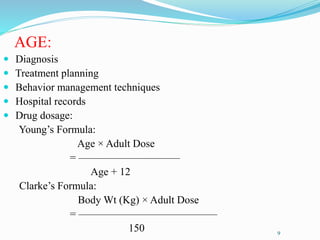
AGE:
 Diagnosis
 Treatment planning
 Behavior management techniques
 Hospital records
 Drug dosage:
Young’s Formula:
Age × Adult Dose
= —————————–
Age + 12
Clarke’s Formula:
Body Wt (Kg) × Adult Dose
= —————————————
150 9
SEX:
Female:
 Iron Deficiency Anemia
 Juvenile Periodontitis
 Erosion
 Sjogren’s Syndrome.
Male:
 Attrition
 Herpes Simplex
 Ameloblastic Fibro-odontoma
 Stomatitis Nicotina Palati
 Hemophilia.
10
EDUCATION:
 Socioeconomic status
 Intelligent quotient(IQ) for effective communication
 Attitude towards general and oral health
11
12
ADDRESS :
• recall
• Future correspondence
• Chart out appointments
• Diagnosis of endemic diseases
eg . fluorosis , caries, filariasis common in orissa, leprosy in west
bengal, carcinoma of the palate seen in srikakulam ( AP)
OCCUPATION:
 Its an indicator of socioeconomic status
 Predilection of diseases in different occupation
eg .Cobblers/carpenters= localised abrasion.
Bakers/candy makers=dental caries.
13
RELIGION:
 Festive periods when patients reluctant to undergo
treatment.
 Predilection of diseases in specific religions.
14
CHIEF COMPLAIN:
 Its the problem the patient/caregiver describes in his/her own
words.
 For two complaints sequential order must be followed with severe
one noted first.
 Must include the onset and duration of the disease
15
HISTORY OF PRESENT ILLNESS:
Detailed Elaboration Of Chief Complain:
 Date of onset
 Mode of onset
 Duration
 Progress
 Aggravating factors
 Relieving factor 16
PAST DENTAL HISTORY:
Past Dental Experience:
 Frequency of visits to a Dentist
 Frequency of preventive/oral prophylaxis
 Experience Of Local Anaesthesia.
Eg .LA Allergy, Past Orthodontic therapy, Past surgical
procedures
17
MEDICAL HISTORY:
 Relationship between systemic and oral health:
 Cardiovascular system . Eg. Congenital heart disease, blood
pressure, rheumatic fever.
 Medication used to treat systemic conditions can produce changes
in oral health .Eg. Tetracycline therapy.
 Systemic diseases may have oral manifestations Eg.Syphilis
patients having peg shaped lateral incisors.
 Hematological disorders 18
FAMILY HISTORY:
 Genetic predilection of disease
eg. Has any member in family suffered from A similar
problem.
 Siblings :size of family gives an idea about socioeconomic
status.
Eg. Number, age
 Whether the patient can afford for the time and treatment to
know the child psychology which has on effect on his behavior.
19
PRENATAL HISTORY:
 Drug intake during pregnancy.(immunization status)
 Whether received antiserum D vaccination or not in case Rh
+ve (father) and Rh-ve (mother)
 Illness during pregnancy.( any infections and systemic
condition)
 Trauma during pregnancy
20
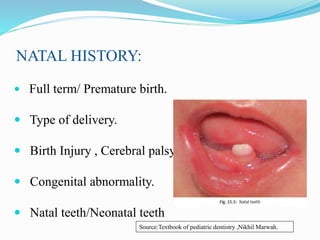
NATAL HISTORY:
 Full term/ Premature birth.
 Type of delivery.
 Birth Injury , Cerebral palsy.
 Congenital abnormality.
 Natal teeth/Neonatal teeth
Source:Textbook of pediatric dentistry ,Nikhil Marwah.
POST NATAL HISTORY:
 Feeding:
Eg Breast Fed/Bottle Fed/Combination.
 Contents:
Eg. Amount Of Sugar If Added.
 Frequency.
 Any Hospitalisation /Major Illness.
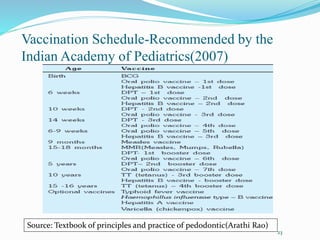
 Vaccination:
Eg. Polio ,BCG.
22
23
Vaccination Schedule-Recommended by the
Indian Academy of Pediatrics(2007)
Source: Textbook of principles and practice of pedodontic(Arathi Rao)
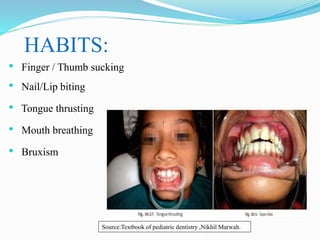
HABITS:
• Finger / Thumb sucking
• Nail/Lip biting
• Tongue thrusting
• Mouth breathing
• Bruxism
Source:Textbook of pediatric dentistry ,Nikhil Marwah.
DIET HISTORY:
DIET CHART:
 No. Of sugar exposures.
 Quantity of sugar added.
 Type of diet :
veg/non-veg
balanced/unbalanced. 25
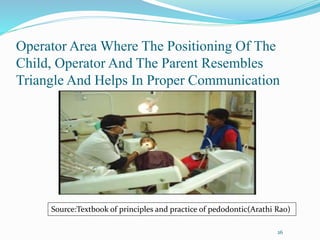
Operator Area Where The Positioning Of The
Child, Operator And The Parent Resembles
Triangle And Helps In Proper Communication
26
Source:Textbook of principles and practice of pedodontic(Arathi Rao)
CLINICAL EXAMINATION:
GENERAL EXAMINATION: :
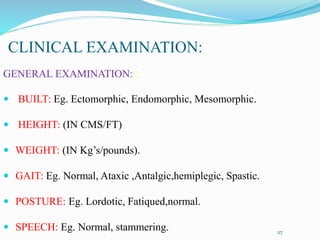
 BUILT: Eg. Ectomorphic, Endomorphic, Mesomorphic.
 HEIGHT: (IN CMS/FT)
 WEIGHT: (IN Kg’s/pounds).
 GAIT: Eg. Normal, Ataxic ,Antalgic,hemiplegic, Spastic.
 POSTURE: Eg. Lordotic, Fatiqued,normal.
 SPEECH: Eg. Normal, stammering. 27
EXTRAORAL EXAMINATION:
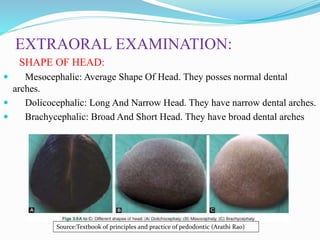
SHAPE OF HEAD:
 Mesocephalic: Average Shape Of Head. They posses normal dental
arches.
 Dolicocephalic: Long And Narrow Head. They have narrow dental arches.
 Brachycephalic: Broad And Short Head. They have broad dental arches
Source:Textbook of principles and practice of pedodontic (Arathi Rao)
29
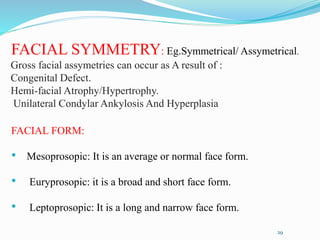
Gross facial assymetries can occur as A result of :
Congenital Defect.
Hemi-facial Atrophy/Hypertrophy.
Unilateral Condylar Ankylosis And Hyperplasia
FACIAL SYMMETRY: Eg.Symmetrical/ Assymetrical.
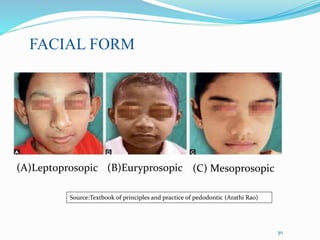
FACIAL FORM:
• Mesoprosopic: It is an average or normal face form.
• Euryprosopic: it is a broad and short face form.
• Leptoprosopic: It is a long and narrow face form.
30
FACIAL FORM
(C) Mesoprosopic
Source:Textbook of principles and practice of pedodontic (Arathi Rao)
(A)Leptoprosopic (B)Euryprosopic
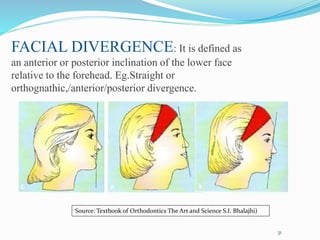
FACIAL DIVERGENCE: It is defined as
an anterior or posterior inclination of the lower face
relative to the forehead. Eg.Straight or
orthognathic,/anterior/posterior divergence.
31
Source: Textbook of Orthodontics The Art and Science S.I. Bhalajhi)
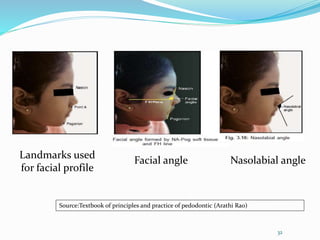
Landmarks used
for facial profile
Facial angle Nasolabial angle
32
Source:Textbook of principles and practice of pedodontic (Arathi Rao)
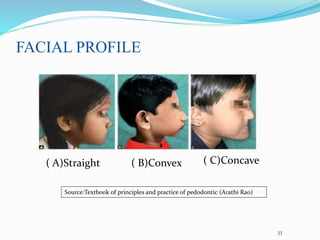
FACIAL PROFILE
33
( A)Straight ( B)Convex ( C)Concave
Source:Textbook of principles and practice of pedodontic (Arathi Rao)
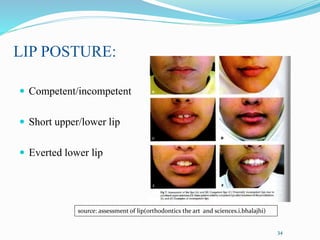
LIP POSTURE:
34
34
 Competent/incompetent
 Short upper/lower lip
 Everted lower lip
source: assessment of lip(orthodontics the art and sciences.i.bhalajhi)
FUNCTIONAL EXAMINATION:
 TMJ:
Eg. Deviation , Clicking Sound.
 Vitals:
Eg. Pulse,respiratory Rate, Temperature,Blood Pressure.
 Lymphnodes.
Eg. Submandibular,cervical.
 Mastication:
Eg. Parafunctions Such As Bruxism And Clenching Also Give
Rise To Masseter Pain ,Lateral Interferences.
 Deglutition: check for any abnormality
35
36
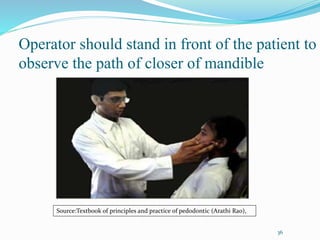
Operator should stand in front of the patient to
observe the path of closer of mandible
Source:Textbook of principles and practice of pedodontic (Arathi Rao),
37
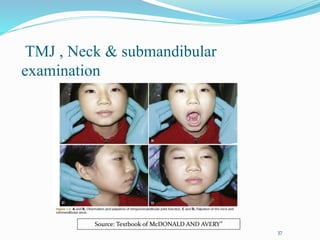
TMJ , Neck & submandibular
examination
Source: Textbook of McDONALD AND AVERY”
INTRAORAL EXAMINATION:
SOFT TISSUE EXAMINATION:-
 LIPS:
Eg.Everted/Normal/Flaccid,competent/Incompetent.
 MUCOSA:
Eg. Pigmented/Colour/Texture.
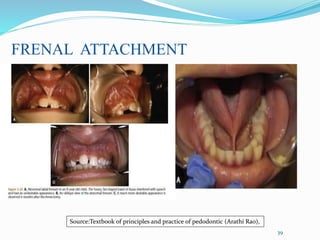
 FRENUM ATTACHMENT:
Eg.High/Normal/Low.
 GINGIVA:
Eg. Colour/Texture,size/Shape,consistency/Contour.
 TONGUE:
Eg.Microglossia/Aglossia/Macroglossia,
Fissured/Normal/Pigmentation /Tongue Tie/ Geographic Tongue.
39
FRENAL ATTACHMENT
Source:Textbook of principles and practice of pedodontic (Arathi Rao),
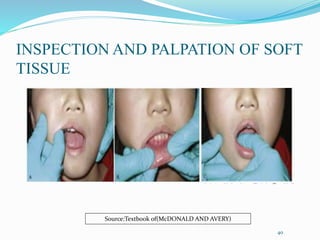
INSPECTION AND PALPATION OF SOFT
TISSUE
40
Source:Textbook of(McDONALD AND AVERY)
HARD TISSUE EXAMINATION:
 TEETH PRESENT:
41
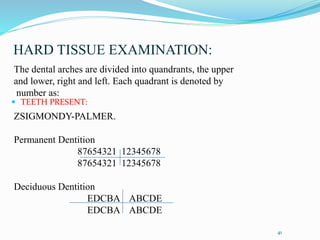
The dental arches are divided into quandrants, the upper
and lower, right and left. Each quadrant is denoted by
number as:
ZSIGMONDY-PALMER.
Permanent Dentition
87654321 12345678
87654321 12345678
Deciduous Dentition
EDCBA ABCDE
EDCBA ABCDE
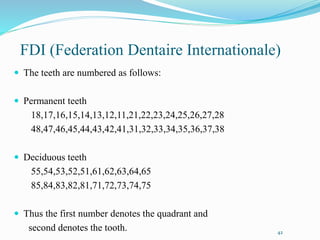
FDI (Federation Dentaire Internationale)
 The teeth are numbered as follows:
 Permanent teeth
18,17,16,15,14,13,12,11,21,22,23,24,25,26,27,28
48,47,46,45,44,43,42,41,31,32,33,34,35,36,37,38
 Deciduous teeth
55,54,53,52,51,61,62,63,64,65
85,84,83,82,81,71,72,73,74,75
 Thus the first number denotes the quadrant and
second denotes the tooth. 42
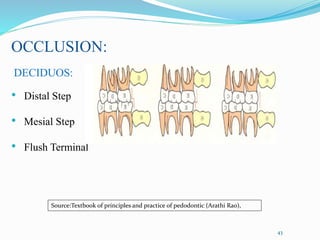
OCCLUSION:
DECIDUOS:
• Distal Step
• Mesial Step
• Flush Terminal
43
Source:Textbook of principles and practice of pedodontic (Arathi Rao),
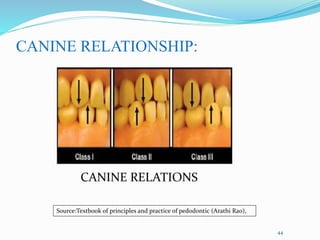
CANINE RELATIONSHIP:
44
Source:Textbook of principles and practice of pedodontic (Arathi Rao),
CANINE RELATIONS
45
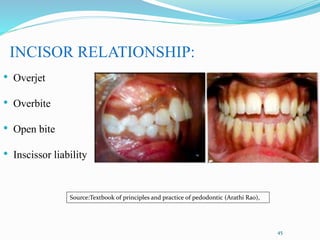
INCISOR RELATIONSHIP:
• Overjet
• Overbite
• Open bite
• Inscissor liability
Source:Textbook of principles and practice of pedodontic (Arathi Rao),
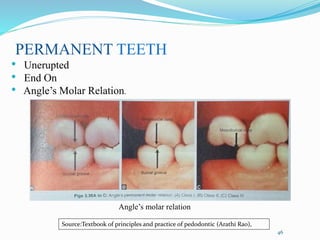
Angle’s molar relation
46
Source:Textbook of principles and practice of pedodontic (Arathi Rao),
PERMANENT TEETH
• Unerupted
• End On
• Angle’s Molar Relation.
47
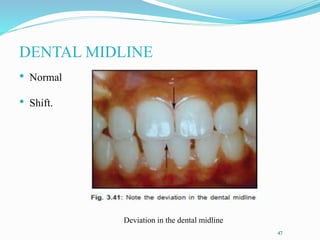
DENTAL MIDLINE
• Normal
• Shift.
Deviation in the dental midline
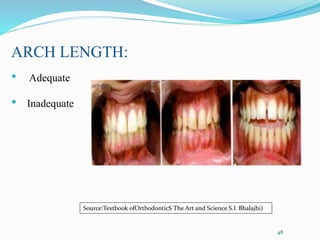
ARCH LENGTH:
• Adequate
• Inadequate
48
Source:Textbook ofOrthodonticS The Art and Science S.I. Bhalajhi)
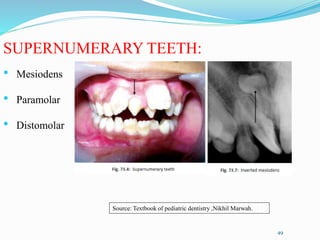
SUPERNUMERARY TEETH:
• Mesiodens
• Paramolar
• Distomolar
49
Source: Textbook of pediatric dentistry ,Nikhil Marwah.
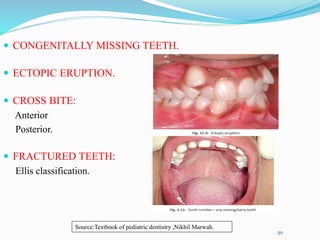
 CONGENITALLY MISSING TEETH.
 ECTOPIC ERUPTION.
 CROSS BITE:
Anterior
Posterior.
 FRACTURED TEETH:
Ellis classification.
50
Source:Textbook of pediatric dentistry ,Nikhil Marwah.
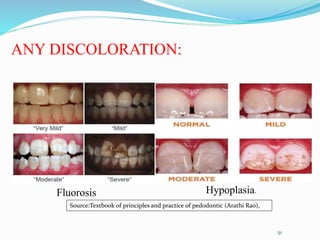
ANY DISCOLORATION:
51
Source:Textbook of principles and practice of pedodontic (Arathi Rao),
Hypoplasia.
Fluorosis
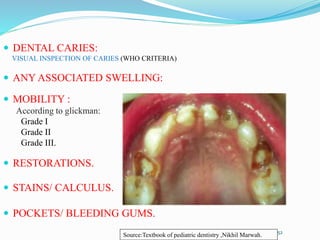
 DENTAL CARIES:
VISUAL INSPECTION OF CARIES (WHO CRITERIA)
 ANY ASSOCIATED SWELLING:
 MOBILITY :
According to glickman:
Grade I
Grade II
Grade III.
 RESTORATIONS.
 STAINS/ CALCULUS.
 POCKETS/ BLEEDING GUMS.
52
Source:Textbook of pediatric dentistry ,Nikhil Marwah.
Provisional diagnosis:
Provisional diagnosis is a general diagnosis based on clinical impression
without any laboratory investigation.
BASED ON CLINICAL EVALUATION
 Fabrication of differential diagnosis.
 Differential diagnosis is the process of listing out two or more diseases,
having similar signs and symptoms of which only one could be
attributed to the patient’s suffering.
53
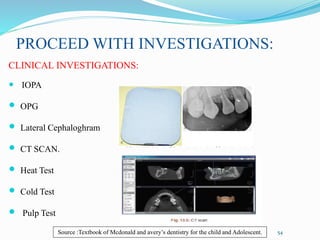
PROCEED WITH INVESTIGATIONS:
CLINICAL INVESTIGATIONS:
 IOPA
 OPG
 Lateral Cephaloghram
 CT SCAN.
 Heat Test
 Cold Test
 Pulp Test
54
Source :Textbook of Mcdonald and avery’s dentistry for the child and Adolescent.
LABORATORY INVESTIGATIONS:
 Biopsy.
 Blood tests:
Eg: Hb , CBC
55
FINAL DIAGNOSIS:
 Final diagnosis is a confirmed diagnosis based on all available data.
 Its the diagnosis made after investigations.
 Helps in the fabrication of treatment plan.
56
TREATMENT PLANNING;
 Medical Treatment; Referral To Physician
 Systemic Treatment; Premedication , Therapy For Oral Infection
 Preparatory Treatment; Oral Prophylaxis, Caries Control, Orthodontic
Consultation, Oral Surgery, Endodontic Therapy.
 Corrective Treatment; Operative Dentistry, Prosthetic Dentistry, orthodontic
Therapy.
 Alternate Treatment Plan;
 Revisions Of Treatment Plan;
 Periodic Recall Examination And Maintainance Treatment;
57
PROGNOSIS:
DEFINITION:
The prognosis is a prediction of the probable course, duration , and
outcome of a disease based on a general knowledge of the pathogenesis
of the disease and the presence of risk factors for the disease.
 Predictable Treatment Outcome.
 Result Of The Treatment.
.
58
COMPLETE RECORDS:
 Study models.
 X-rays: IOPA/Bitewing/ OPG.
 Cephalograms.
 Photoggraphs- intraoral/ extraoral
59
CONCLUSION:
One can treat and cure only those diseases or signs and symptoms
that are diagnosed in the first place. This art and science of the
patient evaluation is the key to treatment planning.
Accurate diagnosis can only be achieved by systematic and
methodical collection and evaluation of data.
A clinician can be successful in rendering a comprehensive
treatment by means of updating his knowledge timely.
Nevertheless the role of examination, diagnosis and treatment
planning still play the pivotal role in rendering the same even with
the constant development of the science and technology. All the
latest techniques do not yield the desired results if these three
fundamentals are ignored. 60
REFERENCES:
Textbook of kerr. Ash. Millard -oraldiagnosis.
Textbook of pedodontic, shobha tandon.
Textbook of pediatric dentistry ,Nikhil Marwah.
Textbook of malcolma lynch , oral medicine and radiology- peeyush
shivhare.
Textbook of pediatric dentistry s.G. Damle.
Textbook of pediatric dentistry arathi rao.
61
Textbook of oral medicine and radiology ANIL GHOM.
Textbook of public health dentistry (c.m. marya.)
Textbook of carranza’s clinical and periodontology.
Textbook of Orthodontics The Art and Science S.I.Bhalajhi.
Textbook of Mcdonald and avery’s dentistry for the child and
Adolescent.(jeffery A.Dean, DDS,MSD)
62
63

CASE HISTORY

  • 2.
    2 Guided By: Dr. AshishSaxena Professor and HOD Presented By: Dr. Hage Monju MDS 1st year CASE HISTORY AND EXAMINATION OF CHILDREN
  • 3.
    CONTENTS:  Introduction  Objectives Personal Details.  Chief Complain .  History Of Present Illness  Dental History.  Medical History.  Family History.  Natal History.  Diet History.  Clinical Examination.  Provisional Diagnosis.  Investigations.  Final Diagnosis.  Treatment Planning.  Prognosis.  Follow Up.  Complete Record. 3
  • 4.
    INTRODUCTION:  Successful dentalcare for children is best achieved after thorough examination , thoughtful diagnosis and formulation of a proper treatment plan.  The interest, warmth and compassion exhibited by dentist are important factors in establishing rapport with and in obtaining meaningful history .  A kind and considerate approach is most important in securing and gaining the confidence of the patient.  Indicate the patient that you are a friend who is keenly interested in him/her as a professional to make them healthy. 4
  • 5.
    OBJECTIVES:  To provideinformation regarding etiology and establish diagnosis of oral conditions  To reveal any medical problem necessitating precaution modification during appointments so as to ensure that dental procedure do not harm the patient and also to prevent emergency situation  Evaluation of other possible undiagnosed problem  Discovery of communicable disease  Gives an insight into emotional and psychological factor  For effective treatment planning  Record maintenance for future reference and periodic follow up  Act as a evidence in legal matters 5 [source: Textbook of Public health dentistry (c.m. marya.)]
  • 6.
    DEFINITION A history canbe considered to be a planned professional conversation that enables the patient to communicate their symptoms, feeling and fears to the clinician so that the nature of the patient’s real and suspected illness and mental attitudes may be determined. Source: Textbook of oral medicine and radiology-peeyush shivhare
  • 7.
    Case History isdefined as planed professional conversation that enables a patient to communicate his/her feelings, fear and sequence of events leading to the problem for which the patient seeks professional assistance, to the clinician so that patients’ real or suspected illness and mental attitude of the patient can be determined. A Case history is a planned professional conversation that enables the patient to communicate their symptoms, feeling and fears to the clinician so that the nature of the patient’s real and suspected illness and mental attitudes may be determined. Source: Textbook of public health dentistry ( C.M. Marya) Source: Textbook of oral medicine (anil ghom)
  • 8.
    PERSONAL DETAILS OPD NUMBER: Reference  Record maintenance  Medico legal issues  Billing purposes DATE:  Reference.  Record maintenance NAME:  Identification.  Communication.  Building rapport with patient.  Psychological benefit; specially in case of pediatric patient if called by nickname 8
  • 9.
    AGE:  Diagnosis  Treatmentplanning  Behavior management techniques  Hospital records  Drug dosage: Young’s Formula: Age × Adult Dose = —————————– Age + 12 Clarke’s Formula: Body Wt (Kg) × Adult Dose = ————————————— 150 9
  • 10.
    SEX: Female:  Iron DeficiencyAnemia  Juvenile Periodontitis  Erosion  Sjogren’s Syndrome. Male:  Attrition  Herpes Simplex  Ameloblastic Fibro-odontoma  Stomatitis Nicotina Palati  Hemophilia. 10
  • 11.
    EDUCATION:  Socioeconomic status Intelligent quotient(IQ) for effective communication  Attitude towards general and oral health 11
  • 12.
    12 ADDRESS : • recall •Future correspondence • Chart out appointments • Diagnosis of endemic diseases eg . fluorosis , caries, filariasis common in orissa, leprosy in west bengal, carcinoma of the palate seen in srikakulam ( AP)
  • 13.
    OCCUPATION:  Its anindicator of socioeconomic status  Predilection of diseases in different occupation eg .Cobblers/carpenters= localised abrasion. Bakers/candy makers=dental caries. 13
  • 14.
    RELIGION:  Festive periodswhen patients reluctant to undergo treatment.  Predilection of diseases in specific religions. 14
  • 15.
    CHIEF COMPLAIN:  Itsthe problem the patient/caregiver describes in his/her own words.  For two complaints sequential order must be followed with severe one noted first.  Must include the onset and duration of the disease 15
  • 16.
    HISTORY OF PRESENTILLNESS: Detailed Elaboration Of Chief Complain:  Date of onset  Mode of onset  Duration  Progress  Aggravating factors  Relieving factor 16
  • 17.
    PAST DENTAL HISTORY: PastDental Experience:  Frequency of visits to a Dentist  Frequency of preventive/oral prophylaxis  Experience Of Local Anaesthesia. Eg .LA Allergy, Past Orthodontic therapy, Past surgical procedures 17
  • 18.
    MEDICAL HISTORY:  Relationshipbetween systemic and oral health:  Cardiovascular system . Eg. Congenital heart disease, blood pressure, rheumatic fever.  Medication used to treat systemic conditions can produce changes in oral health .Eg. Tetracycline therapy.  Systemic diseases may have oral manifestations Eg.Syphilis patients having peg shaped lateral incisors.  Hematological disorders 18
  • 19.
    FAMILY HISTORY:  Geneticpredilection of disease eg. Has any member in family suffered from A similar problem.  Siblings :size of family gives an idea about socioeconomic status. Eg. Number, age  Whether the patient can afford for the time and treatment to know the child psychology which has on effect on his behavior. 19
  • 20.
    PRENATAL HISTORY:  Drugintake during pregnancy.(immunization status)  Whether received antiserum D vaccination or not in case Rh +ve (father) and Rh-ve (mother)  Illness during pregnancy.( any infections and systemic condition)  Trauma during pregnancy 20
  • 21.
    NATAL HISTORY:  Fullterm/ Premature birth.  Type of delivery.  Birth Injury , Cerebral palsy.  Congenital abnormality.  Natal teeth/Neonatal teeth Source:Textbook of pediatric dentistry ,Nikhil Marwah.
  • 22.
    POST NATAL HISTORY: Feeding: Eg Breast Fed/Bottle Fed/Combination.  Contents: Eg. Amount Of Sugar If Added.  Frequency.  Any Hospitalisation /Major Illness.  Vaccination: Eg. Polio ,BCG. 22
  • 23.
    23 Vaccination Schedule-Recommended bythe Indian Academy of Pediatrics(2007) Source: Textbook of principles and practice of pedodontic(Arathi Rao)
  • 24.
    HABITS: • Finger /Thumb sucking • Nail/Lip biting • Tongue thrusting • Mouth breathing • Bruxism Source:Textbook of pediatric dentistry ,Nikhil Marwah.
  • 25.
    DIET HISTORY: DIET CHART: No. Of sugar exposures.  Quantity of sugar added.  Type of diet : veg/non-veg balanced/unbalanced. 25
  • 26.
    Operator Area WhereThe Positioning Of The Child, Operator And The Parent Resembles Triangle And Helps In Proper Communication 26 Source:Textbook of principles and practice of pedodontic(Arathi Rao)
  • 27.
    CLINICAL EXAMINATION: GENERAL EXAMINATION::  BUILT: Eg. Ectomorphic, Endomorphic, Mesomorphic.  HEIGHT: (IN CMS/FT)  WEIGHT: (IN Kg’s/pounds).  GAIT: Eg. Normal, Ataxic ,Antalgic,hemiplegic, Spastic.  POSTURE: Eg. Lordotic, Fatiqued,normal.  SPEECH: Eg. Normal, stammering. 27
  • 28.
    EXTRAORAL EXAMINATION: SHAPE OFHEAD:  Mesocephalic: Average Shape Of Head. They posses normal dental arches.  Dolicocephalic: Long And Narrow Head. They have narrow dental arches.  Brachycephalic: Broad And Short Head. They have broad dental arches Source:Textbook of principles and practice of pedodontic (Arathi Rao)
  • 29.
    29 Gross facial assymetriescan occur as A result of : Congenital Defect. Hemi-facial Atrophy/Hypertrophy. Unilateral Condylar Ankylosis And Hyperplasia FACIAL SYMMETRY: Eg.Symmetrical/ Assymetrical. FACIAL FORM: • Mesoprosopic: It is an average or normal face form. • Euryprosopic: it is a broad and short face form. • Leptoprosopic: It is a long and narrow face form.
  • 30.
    30 FACIAL FORM (C) Mesoprosopic Source:Textbookof principles and practice of pedodontic (Arathi Rao) (A)Leptoprosopic (B)Euryprosopic
  • 31.
    FACIAL DIVERGENCE: Itis defined as an anterior or posterior inclination of the lower face relative to the forehead. Eg.Straight or orthognathic,/anterior/posterior divergence. 31 Source: Textbook of Orthodontics The Art and Science S.I. Bhalajhi)
  • 32.
    Landmarks used for facialprofile Facial angle Nasolabial angle 32 Source:Textbook of principles and practice of pedodontic (Arathi Rao)
  • 33.
    FACIAL PROFILE 33 ( A)Straight( B)Convex ( C)Concave Source:Textbook of principles and practice of pedodontic (Arathi Rao)
  • 34.
    LIP POSTURE: 34 34  Competent/incompetent Short upper/lower lip  Everted lower lip source: assessment of lip(orthodontics the art and sciences.i.bhalajhi)
  • 35.
    FUNCTIONAL EXAMINATION:  TMJ: Eg.Deviation , Clicking Sound.  Vitals: Eg. Pulse,respiratory Rate, Temperature,Blood Pressure.  Lymphnodes. Eg. Submandibular,cervical.  Mastication: Eg. Parafunctions Such As Bruxism And Clenching Also Give Rise To Masseter Pain ,Lateral Interferences.  Deglutition: check for any abnormality 35
  • 36.
    36 Operator should standin front of the patient to observe the path of closer of mandible Source:Textbook of principles and practice of pedodontic (Arathi Rao),
  • 37.
    37 TMJ , Neck& submandibular examination Source: Textbook of McDONALD AND AVERY”
  • 38.
    INTRAORAL EXAMINATION: SOFT TISSUEEXAMINATION:-  LIPS: Eg.Everted/Normal/Flaccid,competent/Incompetent.  MUCOSA: Eg. Pigmented/Colour/Texture.  FRENUM ATTACHMENT: Eg.High/Normal/Low.  GINGIVA: Eg. Colour/Texture,size/Shape,consistency/Contour.  TONGUE: Eg.Microglossia/Aglossia/Macroglossia, Fissured/Normal/Pigmentation /Tongue Tie/ Geographic Tongue.
  • 39.
    39 FRENAL ATTACHMENT Source:Textbook ofprinciples and practice of pedodontic (Arathi Rao),
  • 40.
    INSPECTION AND PALPATIONOF SOFT TISSUE 40 Source:Textbook of(McDONALD AND AVERY)
  • 41.
    HARD TISSUE EXAMINATION: TEETH PRESENT: 41 The dental arches are divided into quandrants, the upper and lower, right and left. Each quadrant is denoted by number as: ZSIGMONDY-PALMER. Permanent Dentition 87654321 12345678 87654321 12345678 Deciduous Dentition EDCBA ABCDE EDCBA ABCDE
  • 42.
    FDI (Federation DentaireInternationale)  The teeth are numbered as follows:  Permanent teeth 18,17,16,15,14,13,12,11,21,22,23,24,25,26,27,28 48,47,46,45,44,43,42,41,31,32,33,34,35,36,37,38  Deciduous teeth 55,54,53,52,51,61,62,63,64,65 85,84,83,82,81,71,72,73,74,75  Thus the first number denotes the quadrant and second denotes the tooth. 42
  • 43.
    OCCLUSION: DECIDUOS: • Distal Step •Mesial Step • Flush Terminal 43 Source:Textbook of principles and practice of pedodontic (Arathi Rao),
  • 44.
    CANINE RELATIONSHIP: 44 Source:Textbook ofprinciples and practice of pedodontic (Arathi Rao), CANINE RELATIONS
  • 45.
    45 INCISOR RELATIONSHIP: • Overjet •Overbite • Open bite • Inscissor liability Source:Textbook of principles and practice of pedodontic (Arathi Rao),
  • 46.
    Angle’s molar relation 46 Source:Textbookof principles and practice of pedodontic (Arathi Rao), PERMANENT TEETH • Unerupted • End On • Angle’s Molar Relation.
  • 47.
    47 DENTAL MIDLINE • Normal •Shift. Deviation in the dental midline
  • 48.
    ARCH LENGTH: • Adequate •Inadequate 48 Source:Textbook ofOrthodonticS The Art and Science S.I. Bhalajhi)
  • 49.
    SUPERNUMERARY TEETH: • Mesiodens •Paramolar • Distomolar 49 Source: Textbook of pediatric dentistry ,Nikhil Marwah.
  • 50.
     CONGENITALLY MISSINGTEETH.  ECTOPIC ERUPTION.  CROSS BITE: Anterior Posterior.  FRACTURED TEETH: Ellis classification. 50 Source:Textbook of pediatric dentistry ,Nikhil Marwah.
  • 51.
    ANY DISCOLORATION: 51 Source:Textbook ofprinciples and practice of pedodontic (Arathi Rao), Hypoplasia. Fluorosis
  • 52.
     DENTAL CARIES: VISUALINSPECTION OF CARIES (WHO CRITERIA)  ANY ASSOCIATED SWELLING:  MOBILITY : According to glickman: Grade I Grade II Grade III.  RESTORATIONS.  STAINS/ CALCULUS.  POCKETS/ BLEEDING GUMS. 52 Source:Textbook of pediatric dentistry ,Nikhil Marwah.
  • 53.
    Provisional diagnosis: Provisional diagnosisis a general diagnosis based on clinical impression without any laboratory investigation. BASED ON CLINICAL EVALUATION  Fabrication of differential diagnosis.  Differential diagnosis is the process of listing out two or more diseases, having similar signs and symptoms of which only one could be attributed to the patient’s suffering. 53
  • 54.
    PROCEED WITH INVESTIGATIONS: CLINICALINVESTIGATIONS:  IOPA  OPG  Lateral Cephaloghram  CT SCAN.  Heat Test  Cold Test  Pulp Test 54 Source :Textbook of Mcdonald and avery’s dentistry for the child and Adolescent.
  • 55.
    LABORATORY INVESTIGATIONS:  Biopsy. Blood tests: Eg: Hb , CBC 55
  • 56.
    FINAL DIAGNOSIS:  Finaldiagnosis is a confirmed diagnosis based on all available data.  Its the diagnosis made after investigations.  Helps in the fabrication of treatment plan. 56
  • 57.
    TREATMENT PLANNING;  MedicalTreatment; Referral To Physician  Systemic Treatment; Premedication , Therapy For Oral Infection  Preparatory Treatment; Oral Prophylaxis, Caries Control, Orthodontic Consultation, Oral Surgery, Endodontic Therapy.  Corrective Treatment; Operative Dentistry, Prosthetic Dentistry, orthodontic Therapy.  Alternate Treatment Plan;  Revisions Of Treatment Plan;  Periodic Recall Examination And Maintainance Treatment; 57
  • 58.
    PROGNOSIS: DEFINITION: The prognosis isa prediction of the probable course, duration , and outcome of a disease based on a general knowledge of the pathogenesis of the disease and the presence of risk factors for the disease.  Predictable Treatment Outcome.  Result Of The Treatment. . 58
  • 59.
    COMPLETE RECORDS:  Studymodels.  X-rays: IOPA/Bitewing/ OPG.  Cephalograms.  Photoggraphs- intraoral/ extraoral 59
  • 60.
    CONCLUSION: One can treatand cure only those diseases or signs and symptoms that are diagnosed in the first place. This art and science of the patient evaluation is the key to treatment planning. Accurate diagnosis can only be achieved by systematic and methodical collection and evaluation of data. A clinician can be successful in rendering a comprehensive treatment by means of updating his knowledge timely. Nevertheless the role of examination, diagnosis and treatment planning still play the pivotal role in rendering the same even with the constant development of the science and technology. All the latest techniques do not yield the desired results if these three fundamentals are ignored. 60
  • 61.
    REFERENCES: Textbook of kerr.Ash. Millard -oraldiagnosis. Textbook of pedodontic, shobha tandon. Textbook of pediatric dentistry ,Nikhil Marwah. Textbook of malcolma lynch , oral medicine and radiology- peeyush shivhare. Textbook of pediatric dentistry s.G. Damle. Textbook of pediatric dentistry arathi rao. 61
  • 62.
    Textbook of oralmedicine and radiology ANIL GHOM. Textbook of public health dentistry (c.m. marya.) Textbook of carranza’s clinical and periodontology. Textbook of Orthodontics The Art and Science S.I.Bhalajhi. Textbook of Mcdonald and avery’s dentistry for the child and Adolescent.(jeffery A.Dean, DDS,MSD) 62
  • 63.

Editor's Notes

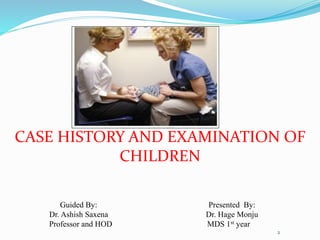
  • #3 Lap top position of child , Two adults sit with knees touching using their laps as a table on which to rest the child. The adults on the right holds the child’s legs and arms , while the adult on the left performs the oral hygiene procedures.
  • #7 Ideally the patient’s history should be taken in a consultation room or a private office in which the décor and the furnishing are quite different from those of the dental operatory . The friendly atmosphere is an important factor in helping the patient to talk freely about his/her problems.
  • #9 Registration number helps the investigator in identification of the patient ,record maintenance , billing purposes, medicolegal aspects. knowing the complete name of the patient while recording history leads to identification, communication,establish rapport with patient,also to record maintenance, psychological benefit; specially in case of pediatric patient if called by nickname. Sence of importance and acceptance to the patient. Information of patient such gender and religion. Such as in mizo….. Christian names
  • #10 There is predilection of certain diseases at different age levels. Neonatal(at birth):cleft lip &palate, ankyloglossia,teratoma,hemophilia,facial hemiatrophy etc. in children and young adults: papilloma, juvenile periodontitis,scarlet fever etc. at old age :attrition /abrasion, periodontitis pulp stones, root resorption. T/T planning: correlation comparison of chronological age with dental age wil help to decide the line of treatment.
  • #11 similar to age , certain dental and systemic diseases also show sex predilection. Some diseases are more specific to females while some are to males. Along with sex predilection of diseases, gender also helps to analyze the 1)t/t planning in case of orthodontic patients as timing of growth spurts is different in males and females. 2)esthetic:girls are more concious about their esthetics. 3)dosage of drug:females require low dosage of drug as their body weight is less. 4)most of the times, sex is lnked to occupation and in turn , related to occupation hazards.
  • #12 Education level of THE person is recorded to determine : socioeconomic status, intelligent quotient (IQ) for effective communication , attitude towards general and oral health.
  • #13 Full postal address should be taken in order for communication and to ascertain geographic distribution.1)for future correspondence/recall.2) socioeconomic status ,for eg. Diseases such as diabetes, hypertension and dental caries are more prevalent in high socioeconomic status persons and diseases such as TB, chronic generalised periodontitis are more commonly found in low socioeconomic strata.3)prevalence of diseases in a particular area:… 4) for hospital records/ administrative purposes.
  • #14 Thus, occupation can be an important factor in determining the source or cause of the disease for the further t/t of disease. It helps in planning appointments for the patient as per their occupation and also determines their affordability in relation to money and time for the treatment. It also tells about the socioeconomic status of the patient’s and his ability to afford the nutritious food and use of healthy oral hygiene practices.
  • #16 This is concerned about what made the patient to visit the dentist or what they are seeking from treatment . It is better to ask the child about his chief complaint before involving the parent which helps to establish a good rapport with the child. But, it is mandatory to get an answer from the parent also regarding the child’s complaint.
  • #17 It is the elaboration/detailed description of the chief complaint. Several complain need to be evaluated regarding the chief complaint like .. duration, severity, nature, aggravating or relieving factors, associated symptoms, diurnal variation, postural variation, any medications, or treatment received for the same . gives an insight toward the possible cause and nature of disease/condition. Hint towards the possible disease /condition
  • #18 Helps in formulation of treatment plan . Knowledge about patient’s habits . Helps to evaluate attitude of parents toward dentistry. In addition, the survey of the previous dental records and radiographs may give important information for the treatment and also previous dental records help in medicolegal purposes also
  • #19 Various diseases or functional disturbances may directly or indirectly cause or predispose to oral problems and may effect the delivery of oral care. A comprehensive medical history should commence with information relating to pregnancy and birth, the neonatal period, and early childhood. Details about the previous hospitalization , operations illness and traumatic injuries should be recorded along with the information related to the previous and current medical treatment. Respiratory system(eg asthma, upper respiratory tract infections.
  • #20 It provides the relevant information about the social background of the child and his family. It also should include such factors like no. of children in family, the child’s attendance in the school, performance in the class, the housing conditions, and the parent’s occupation. It also should include the occurrence of any genetic diseases, oral, or general. Furthermore, questions regarding family history must be neither offensive nor intrusive.
  • #22 Forceps delivery- predisposed factor for TMJ disorder
  • #27 Operator area where the positioning of the child , operator and the parent resembles triangle and helps in proper communication
  • #50 odontomas , hyperdontia.