Synthesis for understanding
and evaluating vision systems
               Eero Simoncelli
        Howard Hughes Medical Institute,
          Center for Neural Science, and
     Courant Institute of Mathematical Sciences
               New York University


    Frontiers in Computer Vision Workshop
             MIT, 21-24 Aug 2011
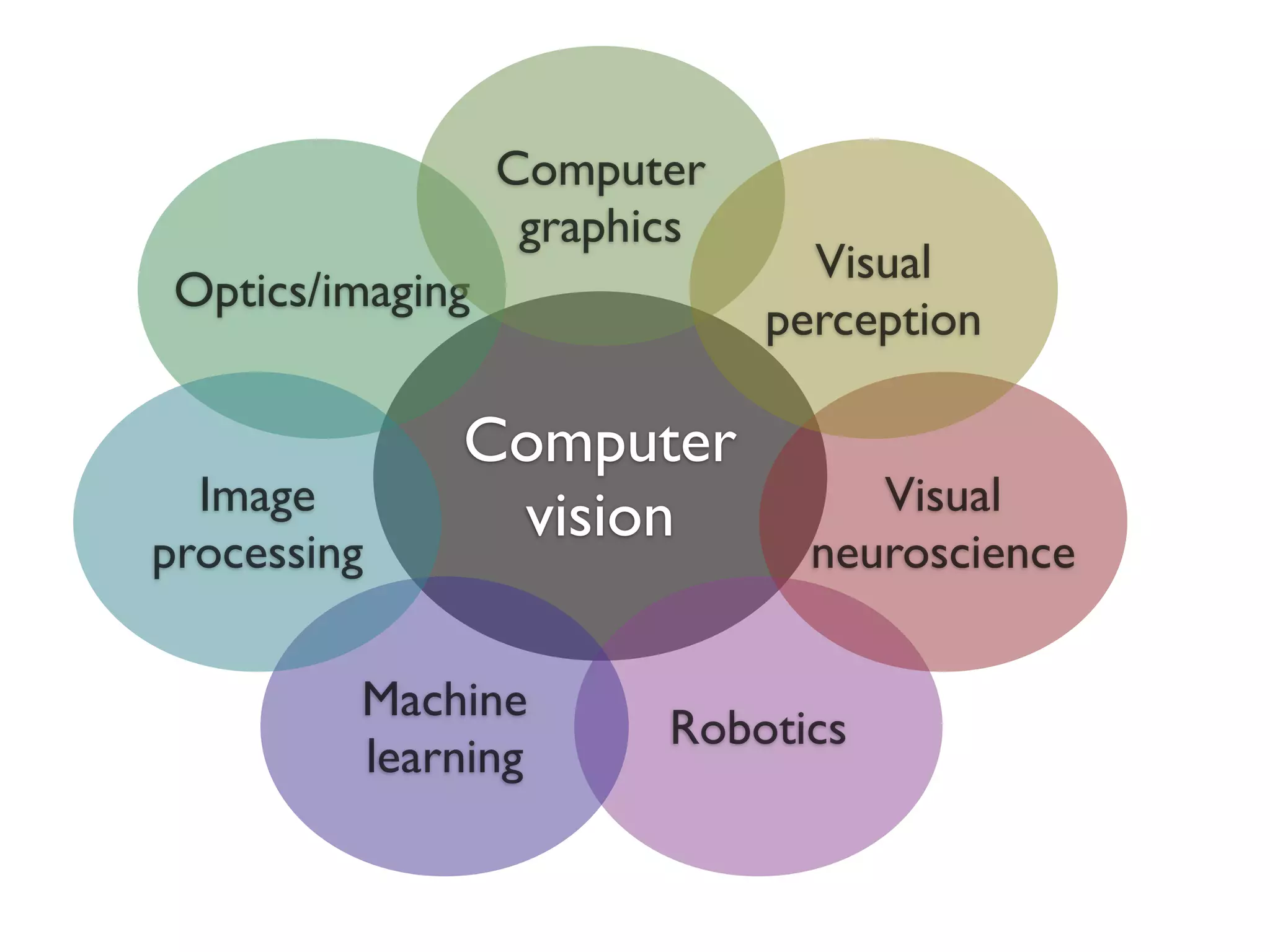
Computer
                   graphics
                                Visual
 Optics/imaging
                              perception

              Computer
  Image                            Visual
               vision
processing                      neuroscience

         Machine
                         Robotics
         learning
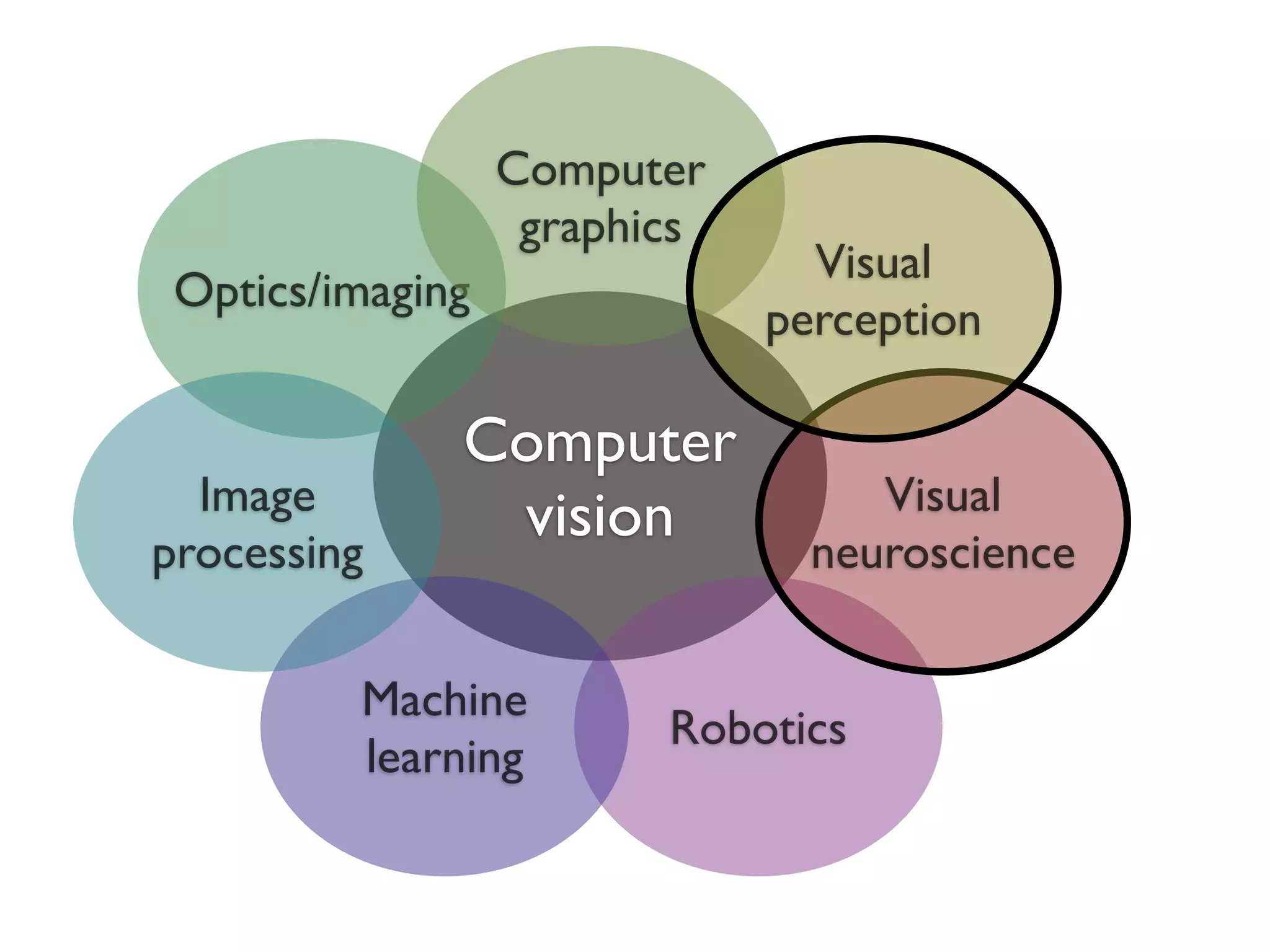
Computer
                   graphics
                                Visual
 Optics/imaging
                              perception

              Computer
  Image                            Visual
               vision
processing                      neuroscience

         Machine
                         Robotics
         learning
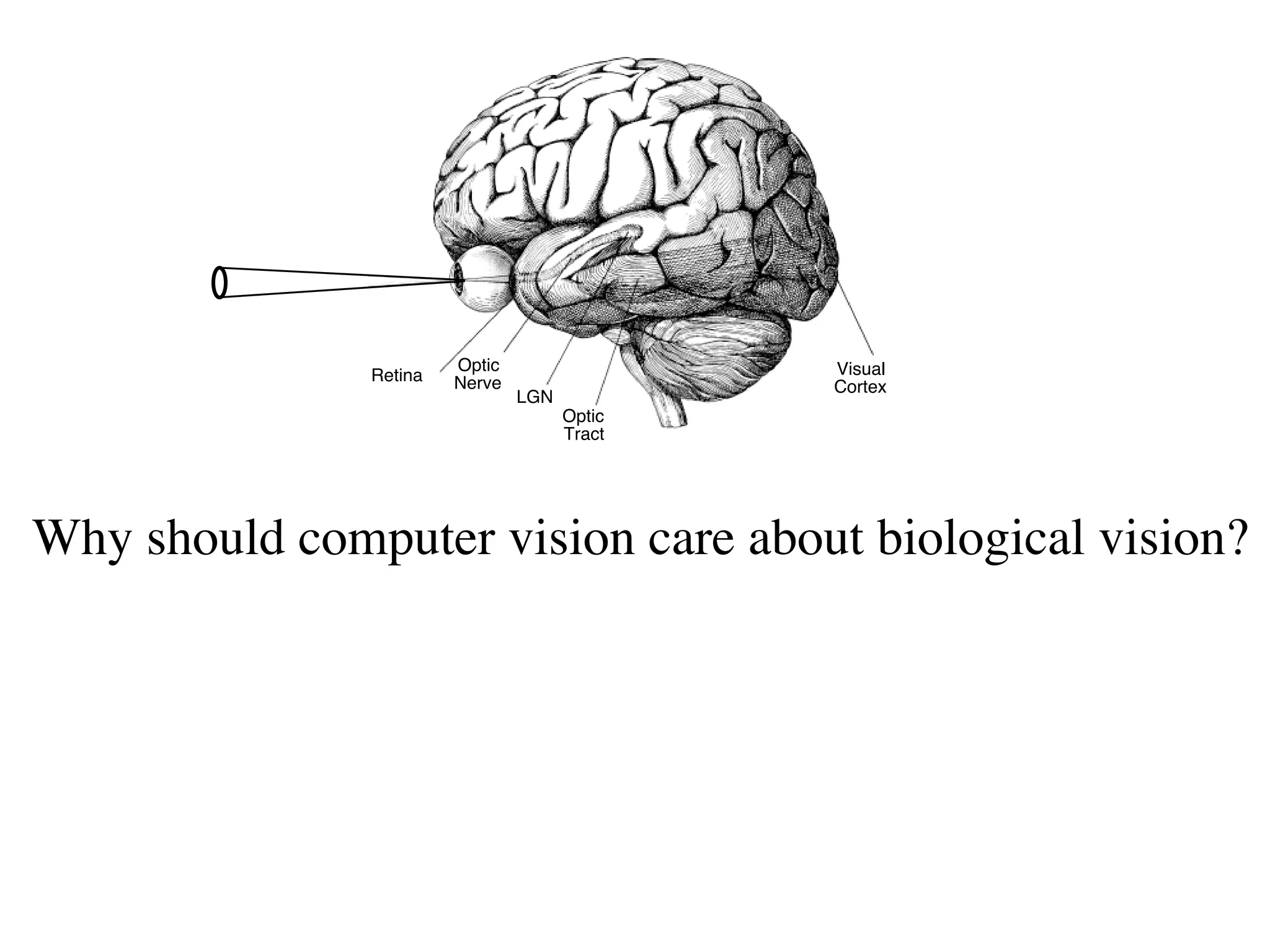
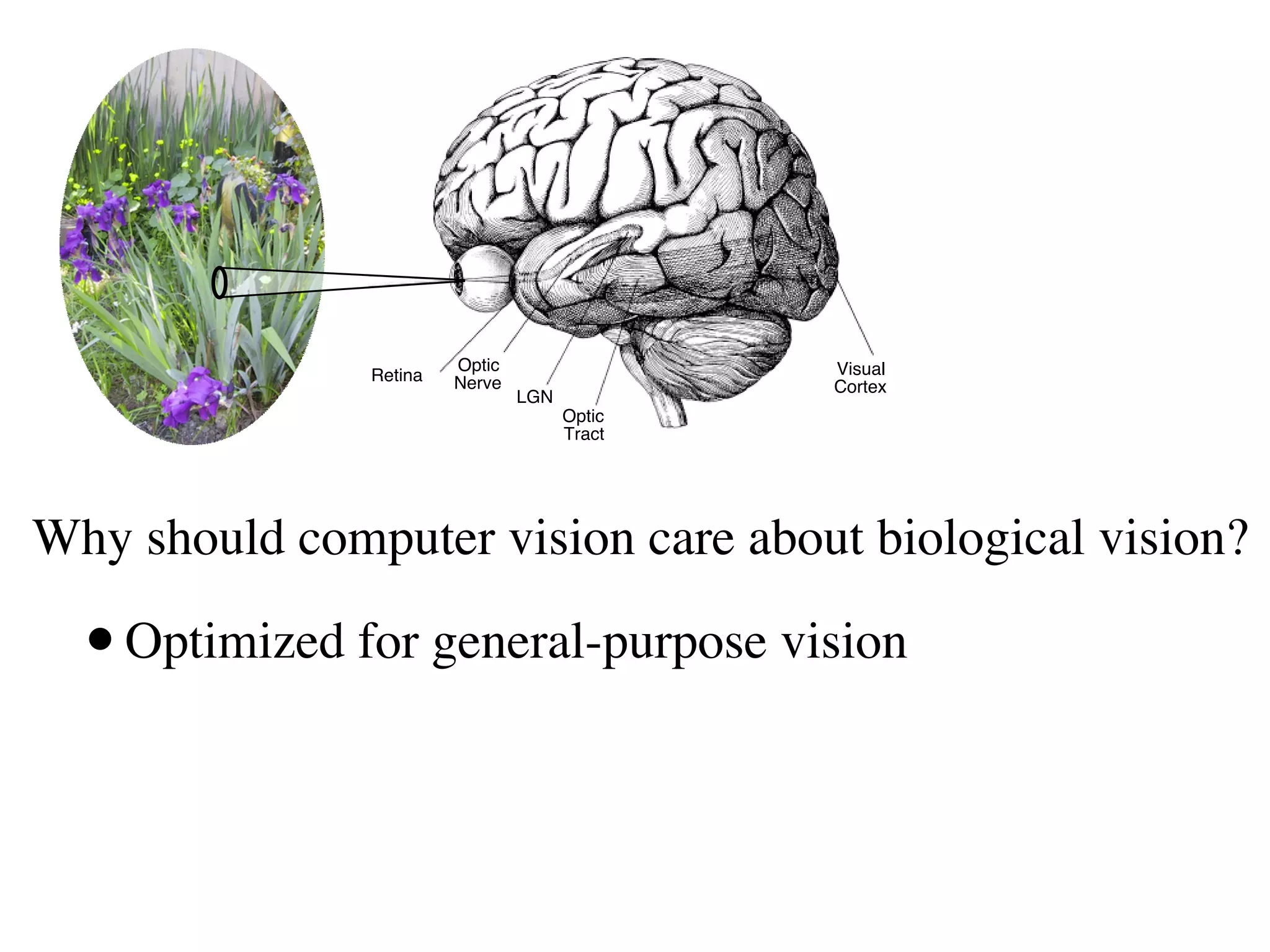
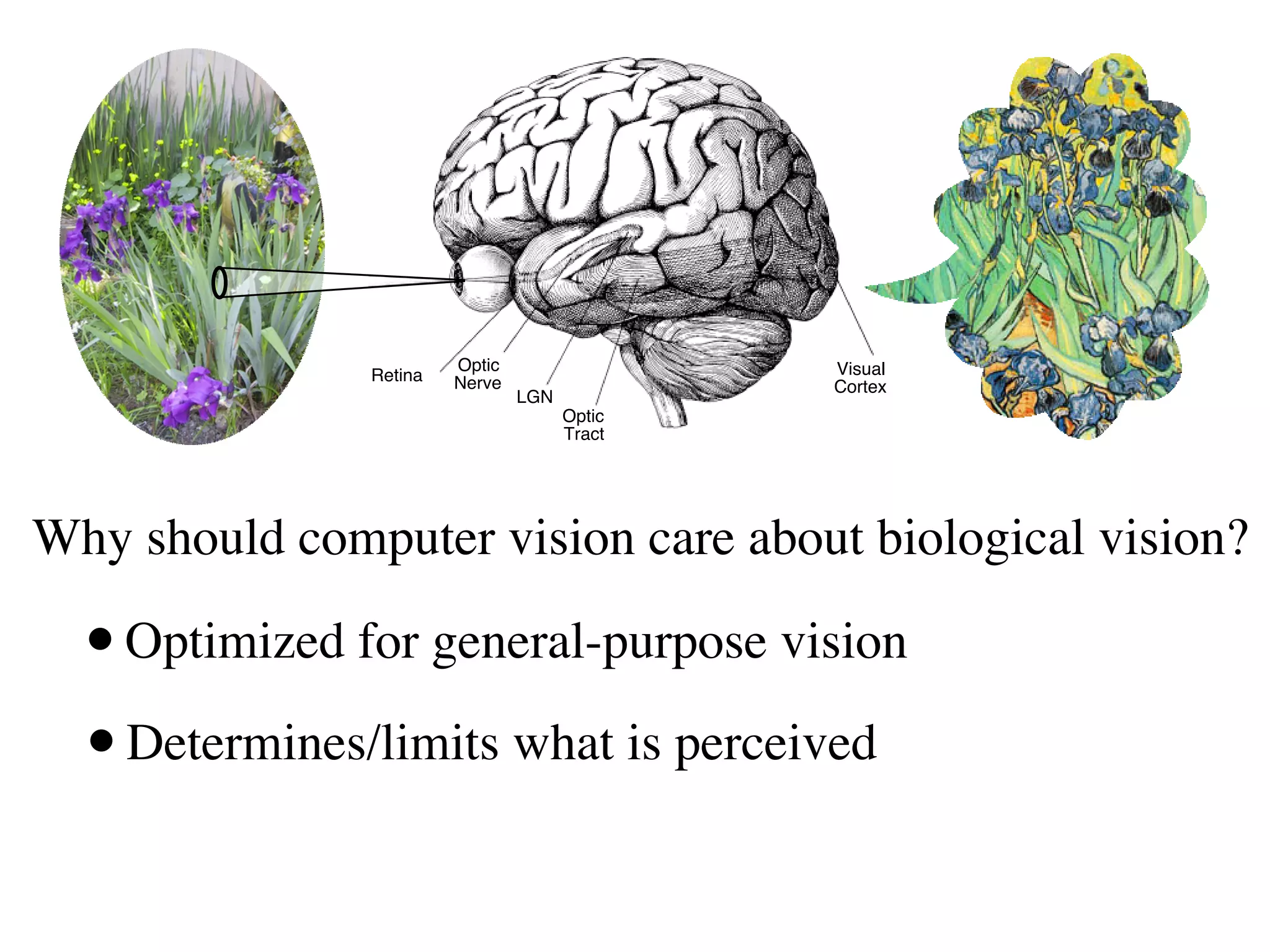
Optic                 Visual
               Retina   Nerve                 Cortex
                                LGN
                                      Optic
                                      Tract


Why should computer vision care about biological vision?
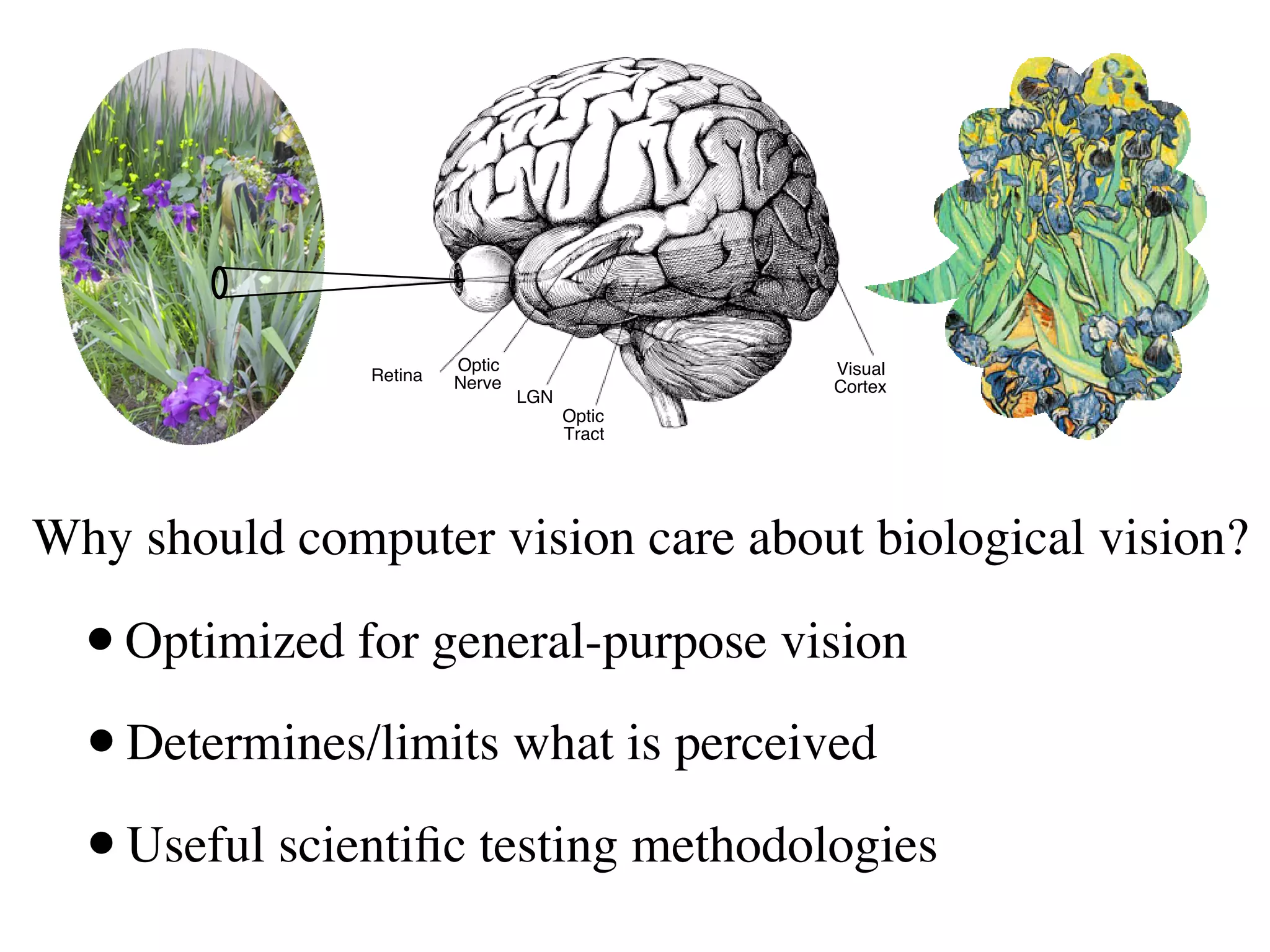
Optic                 Visual
               Retina   Nerve                 Cortex
                                LGN
                                      Optic
                                      Tract


Why should computer vision care about biological vision?

  • Optimized for general-purpose vision
Optic                 Visual
               Retina   Nerve                 Cortex
                                LGN
                                      Optic
                                      Tract


Why should computer vision care about biological vision?

  • Optimized for general-purpose vision
  • Determines/limits what is perceived
Optic                 Visual
               Retina   Nerve                 Cortex
                                LGN
                                      Optic
                                      Tract


Why should computer vision care about biological vision?

  • Optimized for general-purpose vision
  • Determines/limits what is perceived
  • Useful scientific testing methodologies
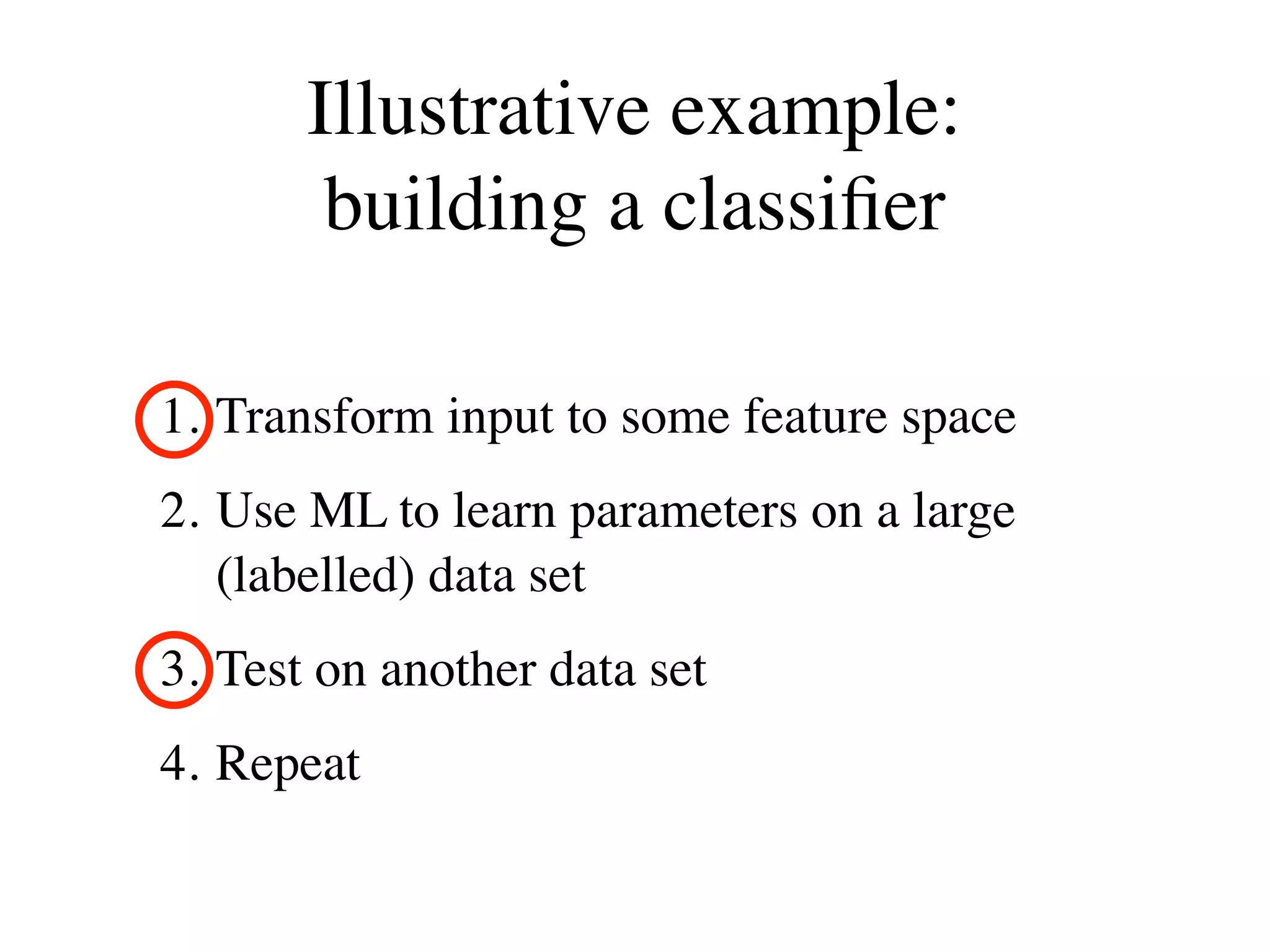
Illustrative example:
        building a classifier

1. Transform input to some feature space
2. Use ML to learn parameters on a large
   (labelled) data set
3. Test on another data set
4. Repeat
Illustrative example:
        building a classifier

1. Transform input to some feature space
2. Use ML to learn parameters on a large
   (labelled) data set
3. Test on another data set
4. Repeat
Which features?


                  [Adelson & Bergen, 1985]
Which features?
Oriented filters: capture stimulus-dependency of neural
responses in primary visual cortex (area V1)

            Simple cell


           Complex cell          +


                                       [Adelson & Bergen, 1985]
Which features?
Oriented filters: capture stimulus-dependency of neural
responses in primary visual cortex (area V1)

            Simple cell


           Complex cell          +


                                       [Adelson & Bergen, 1985]
Which features?
Oriented filters: capture stimulus-dependency of neural
responses in primary visual cortex (area V1)

            Simple cell


           Complex cell          +


                                       [Adelson & Bergen, 1985]
Retinal image


The normalization model of simple cells
                                                          Firing
                                                           rate


   Retinal image

                       Other cortical cells

RC circuit implementation


                                                          Firing
   Retinal image                                           rate


                                   Other cortical cells


                                               [Carandini, Heeger, and Movshon, 1996]
Retinal image


The normalization model of simple cells
                                                          Firing
                                                           rate


   Retinal image

                       Other cortical cells

RC circuit implementation


                                                          Firing
   Retinal image                                           rate


                                   Other cortical cells


                                               [Carandini, Heeger, and Movshon, 1996]
Dynamic retina/LGN model


              [Mante, Bonin & Carandini 2008]
2-stage MT model
                    Input: image intensities                 Input: V1 afferents

                                                 1
      Linear
   Receptive                  ...                                   ...
       Field


 Half-squaring                                                      ...
  Rectification               ...                    2                                    2
                                                 1


                                                 +                                    +

    Divisive                  ...                                   ...
Normalization


                  Output: V1 neurons tuned for           Output: MT neurons tuned for
                   spatio-temporal orientation               local image velocity


                                                                   [Simoncelli & Heeger, 1998]
2-stage MT model
                    Input: image intensities                 Input: V1 afferents

                                                 1
      Linear
   Receptive                  ...                                   ...
       Field


 Half-squaring                                                      ...
  Rectification               ...                    2                                    2
                                                 1


                                                 +                                    +

    Divisive                  ...                                   ...
Normalization


                  Output: V1 neurons tuned for           Output: MT neurons tuned for
                   spatio-temporal orientation               local image velocity


                                                                   [Simoncelli & Heeger, 1998]
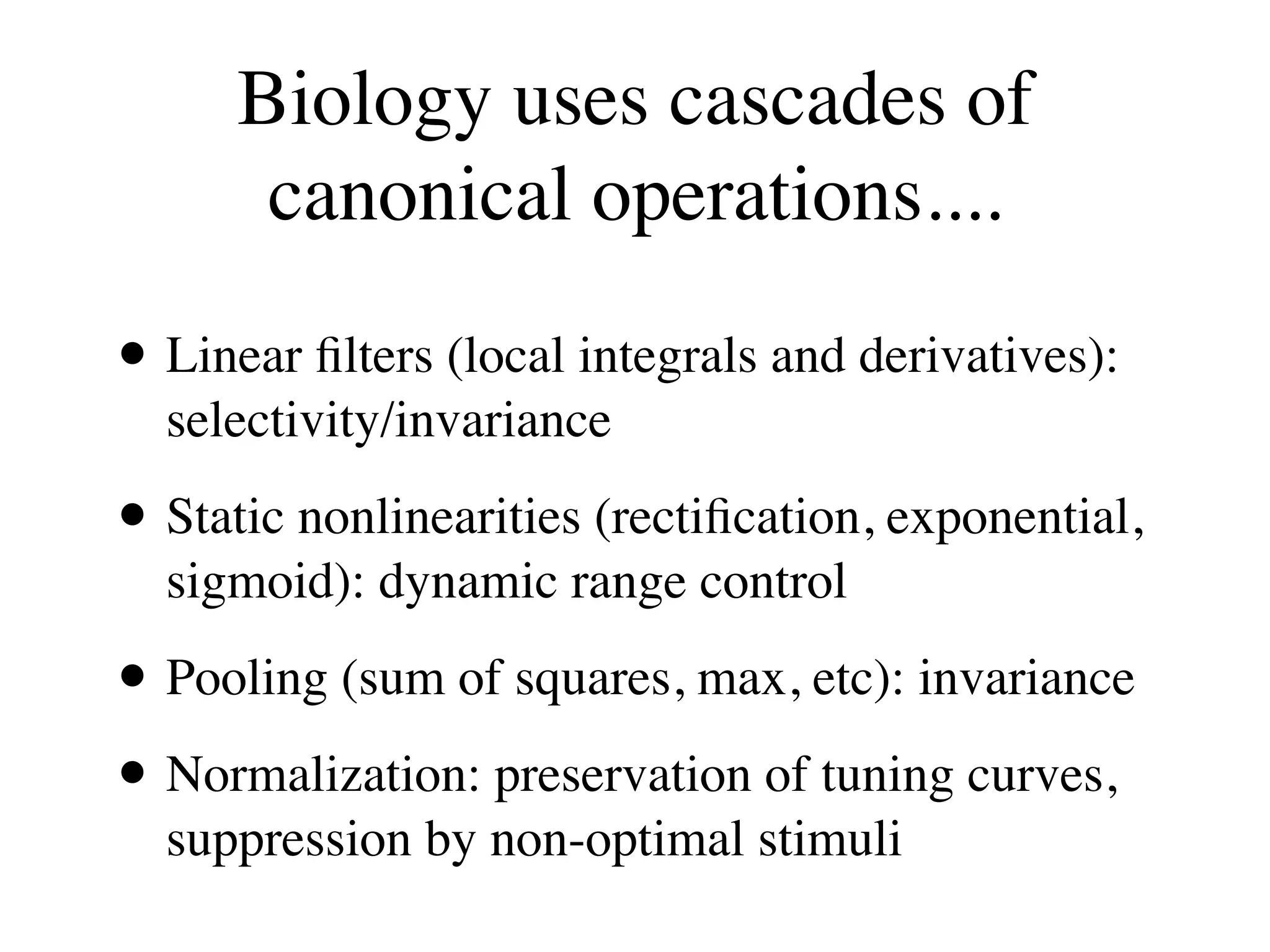
Biology uses cascades of
       canonical operations....

• Linear filters (local integrals and derivatives):
  selectivity/invariance

• Static nonlinearities (rectification, exponential,
  sigmoid): dynamic range control

• Pooling (sum of squares, max, etc): invariance
• Normalization: preservation of tuning curves,
  suppression by non-optimal stimuli
Improved object recognition?
“In many recent object recognition systems, feature extraction
stages are generally composed of a filter bank, a non-linear
transformation, and some sort of feature pooling layer [...]
We show that using non-linearities that include rectification
and local contrast normalization is the single most important
ingredient for good accuracy on object recognition
benchmarks. We show that two stages of feature extraction
yield better accuracy than one....”


- From the abstract of
“What is the Best Multi-Stage Architecture for Object Recognition?”
Kevin Jarrett, Koray Kavukcuoglu, Marc’Aurelio Ranzato and Yann LeCun
ICCV-2009
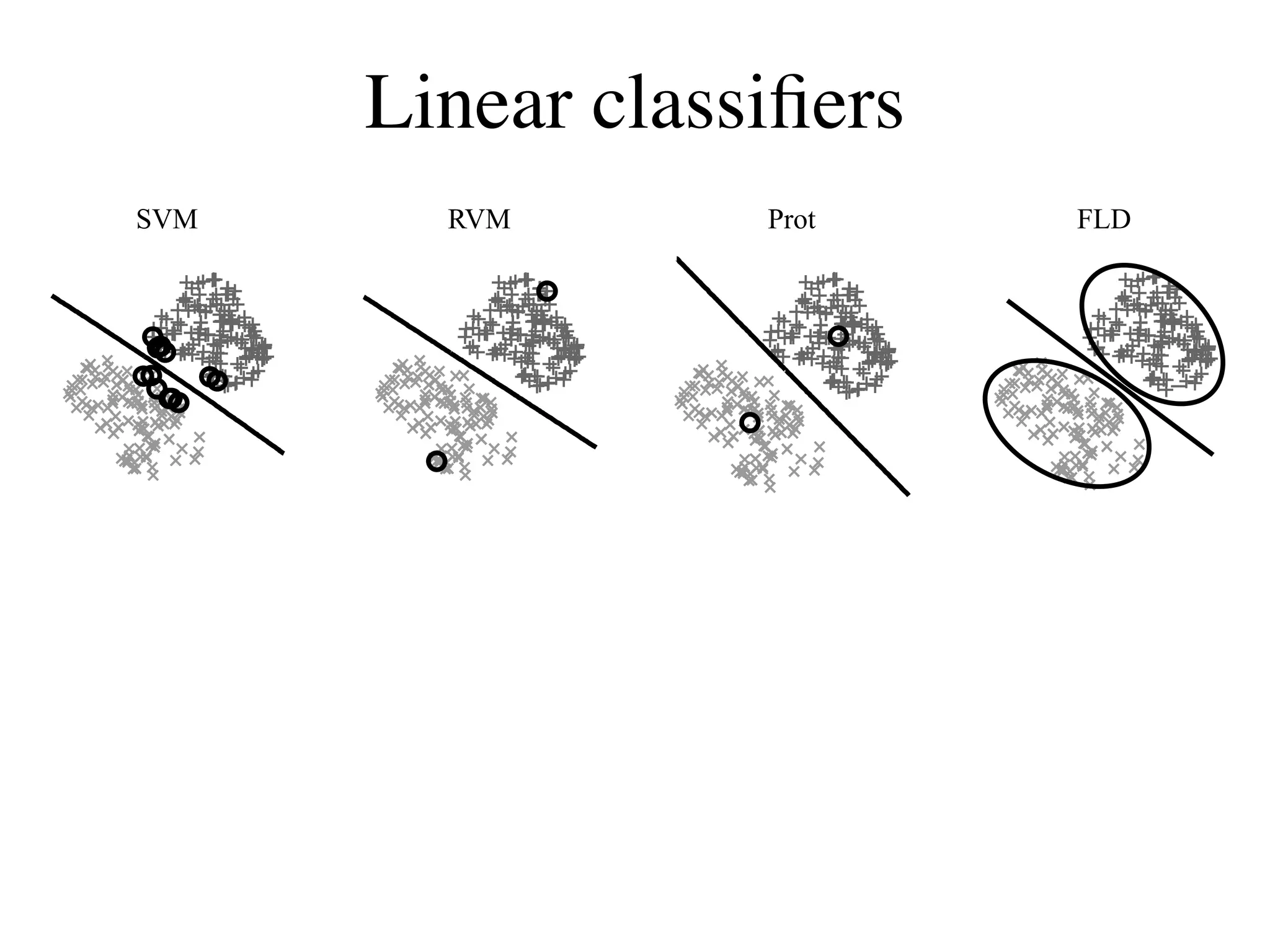
Using synthesis to test models I:
     Gender classification


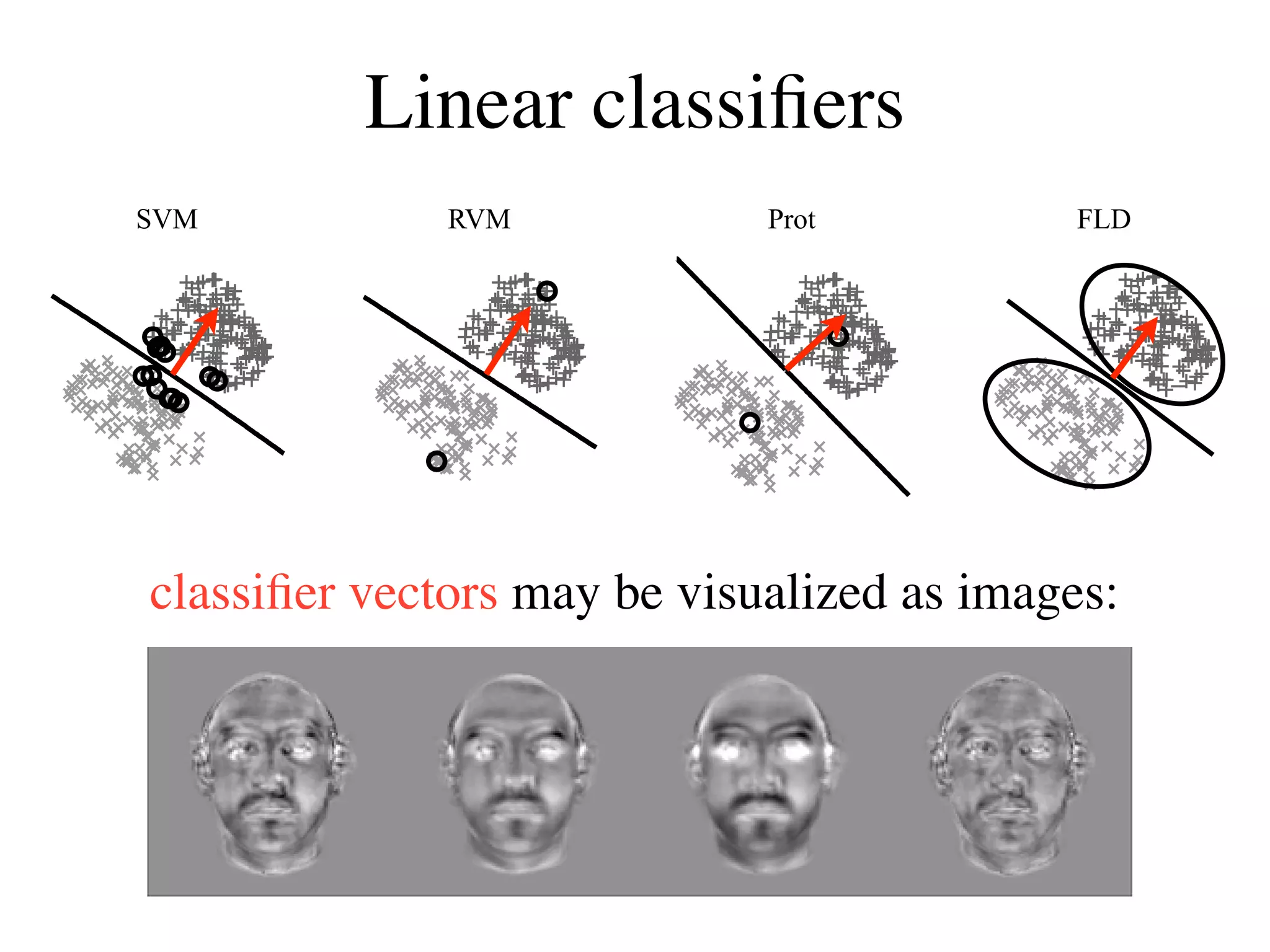
• 200 face images (100 male, 100 female)
• Labeled by 27 human subjects
• Four linear classifiers trained on subject data
                                   [Graf & Wichmann, NIPS*03]
Linear classifiers
SVM     RVM       Prot    FLD
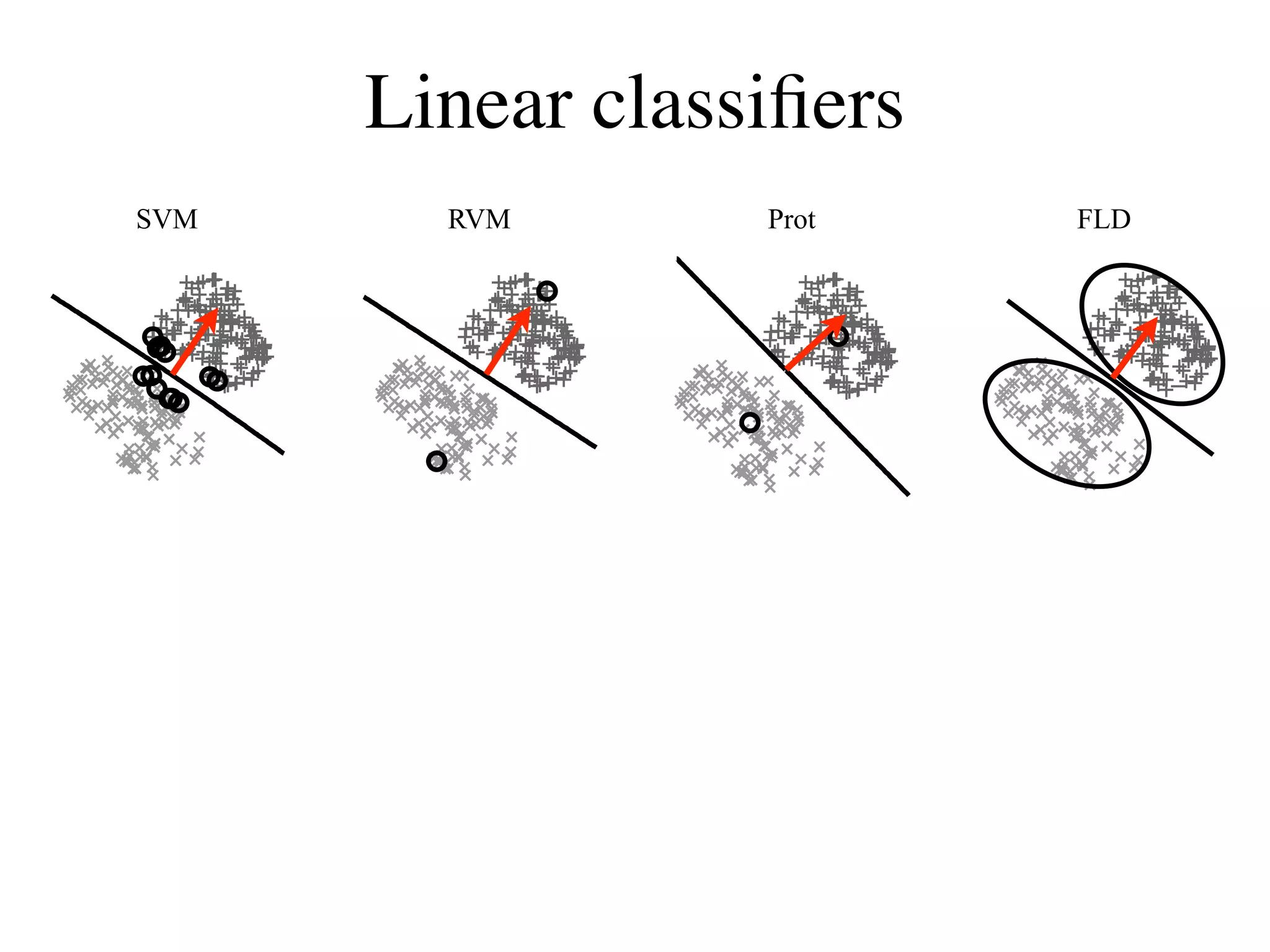
Linear classifiers
SVM     RVM       Prot    FLD
Linear classifiers
    SVM           RVM            Prot            FLD


          SVM      RVM         Prot        FLD         trained
                                                       on

!                                                      true
W                                                      data
    classifier vectors may be visualized as images:

!                                                      subj
W                                                      data
Validation by “gender-morphing”
        Subtract classifier                     Add classifier
       !=−21   !=−14   !=−7       !=0         !=7       !=14       !=21


SVM


RVM


Prot


FLD


                       [Wichmann, Graf, Simoncelli, Bülthoff, Schölkopf, NIPS*04]
Human subject responses
                            Perceptual validation
                100
                          SVM
                          RVM
       % Correct


                          Proto
                          FLD


                   50

                          0.25        0.5         1.0        2.0        4.0        8.0

                                 Amount of classifier image added/subtracted
                                              (arbitrary units)

                                            [Wichmann, Graf, Simoncelli, Bülthoff, Schölkopf, NIPS*04]
rates of an IT population of 200 neurons, despite variation     evidence suggests that the ventral stream transfor
in object position and size [19]. It is important to note that   (culminating in IT) solves object recognition by unta

       Using synthesis to test models II:
using ‘stronger’ (e.g. non-linear) classifiers did not substan-
tially improve recognition performance and the same
                                                                 object manifolds. For each visual image striking the e
                                                                 total transformation happens progressively (i.e. st


       Ventral stream
       representation


                                                                                        [DiCarlo  Cox, 2007]
F
a                                                                                                re
                                                                                                 fie
                                                              V4                                 fie
Receptive field size (deg)
                             25                                                    V2            V
                             20                                                                  (1
                                                                                                 ec
                             15                                                                  d
                             10
                                                                                                 (b
                                                                                  V1
                                                                                                 si
                             5                                                                   T
                                                                                                 o
                             0
                                                                                                 b
                                  0     5   10 15 20 25 30 35 40 45 50                           et
                                      Eccentricity, receptive center (deg)
                                          Receptive field field center (deg)                      ec
                                                                                                 la
b                                                                      [Gattass et. al., 1981;
                                                                                                 o
                                                                        Gattass et. al., 1988]   th
V1        V4


               V2
                          IT


V1   V2                  V4                     IT
               [Freeman  Simoncelli, Nature Neurosci, Sep 2011]
2

    1


           1
        Canonical computation                 Ventral stream
                                              “complex” cell


        Ventral stream
                          V1 cells
        receptive fields


                                                                   +


                                [Freeman  Simoncelli, Nature Neurosci, Sep 2011]
2

    1


           1
        Canonical computation                 Ventral stream
                                              “complex” cell


        Ventral stream
                          V1 cells
        receptive fields
                                                                           3.1
                                                                           1.4
                                                                   +      12.5
                                                                            .
                                                                            .
                                                                            .


                                [Freeman  Simoncelli, Nature Neurosci, Sep 2011]
2

    1


           1
        Canonical computation                 Ventral stream
                                              “complex” cell


        Ventral stream
                           V1 cells
        receptive fields
                                                                           3.1
                                                                           1.4
                                                                   +      12.5
                                                                            .
                                                                            .
                                                                            .


    How do we test this?

                                [Freeman  Simoncelli, Nature Neurosci, Sep 2011]
Model
    model
    Original image     responses                    model
                                                  Synthesized image


                          3.1
                          1.4
                         12.5
                           .
                           .                250
                           .
                                            150

                                            25

                                            170

                                            40
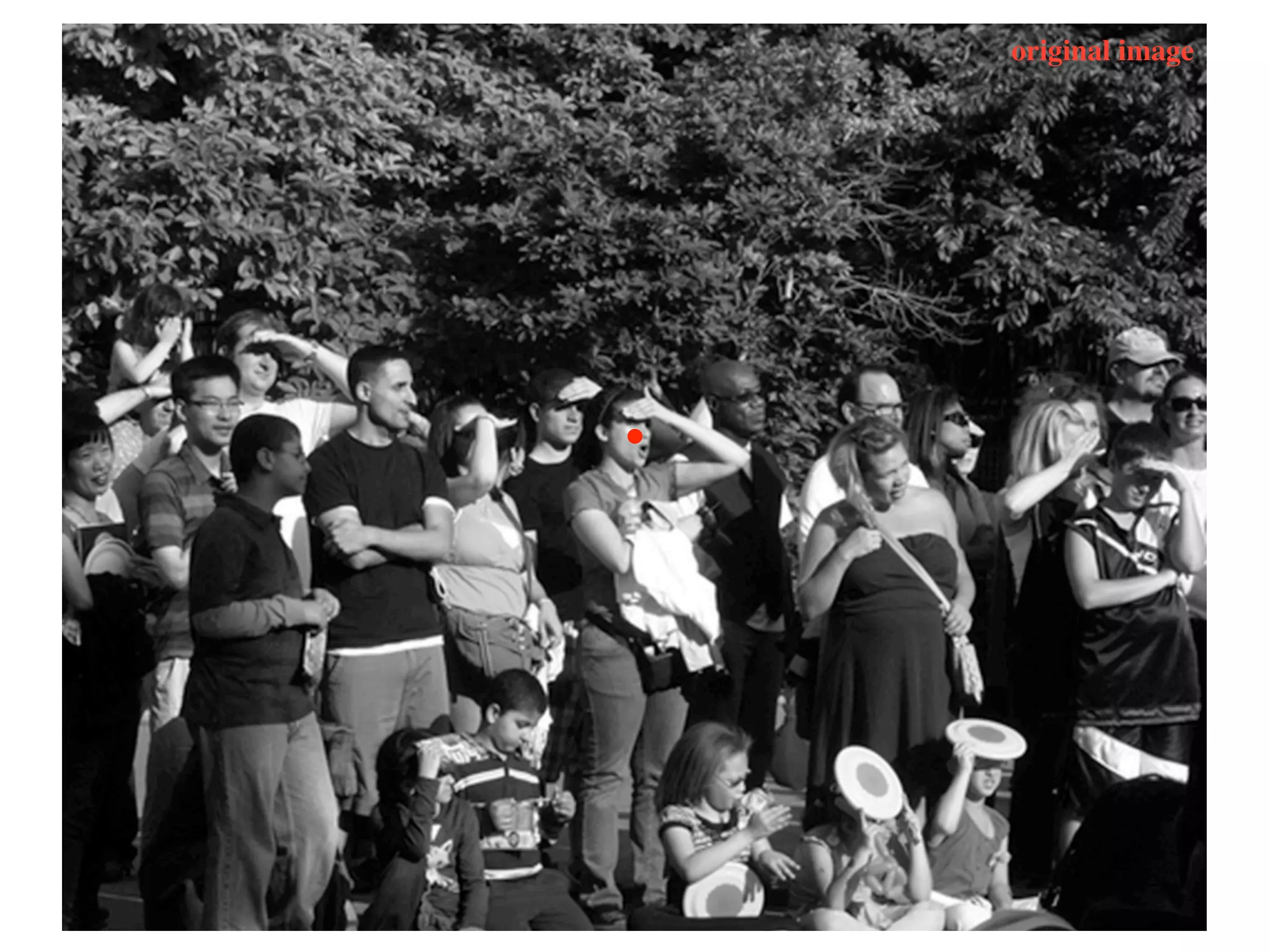
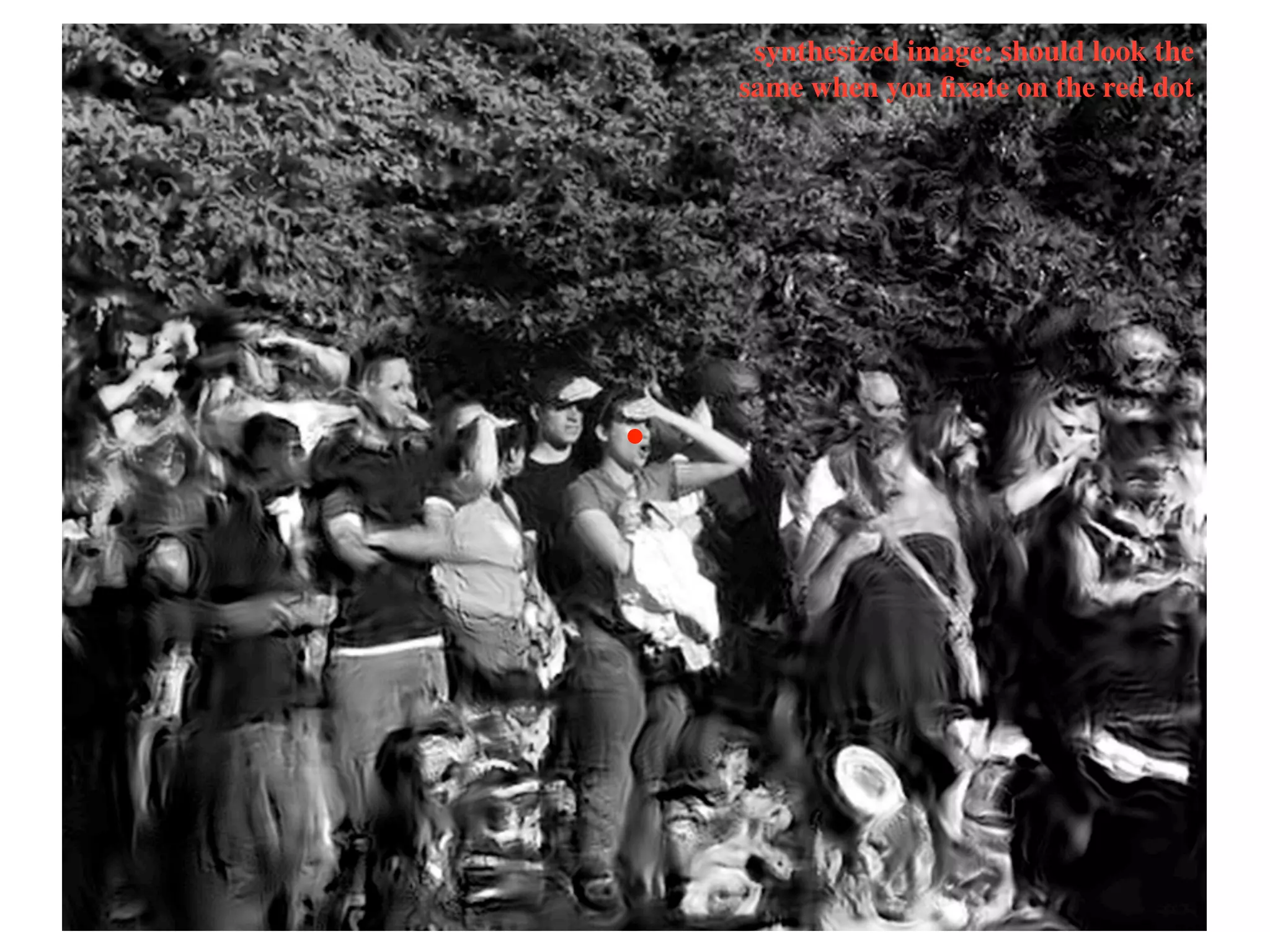
Idea: synthesize random samples from the equivalence
class of images with identical model responses
Scientific prediction: such images should look the same
(“Metamers”)
                            [Freeman  Simoncelli, Nature Neurosci, Sep 2011]
Model
    Original image     responses                Synthesized image


                          3.1
                          1.4
                         12.5
                           .
                           .
                           .


Idea: synthesize random samples from the equivalence
class of images with identical model responses
Scientific prediction: such images should look the same
(“Metamers”)
                            [Freeman  Simoncelli, Nature Neurosci, Sep 2011]
Model
    Original image     responses                Synthesized image


                          3.1
                          1.4
                         12.5
                           .
                           .
                           .


Idea: synthesize random samples from the equivalence
class of images with identical model responses
Scientific prediction: such images should look the same
(“Metamers”)
                            [Freeman  Simoncelli, Nature Neurosci, Sep 2011]
original image
synthesized image: should look the
same when you fixate on the red dot
Reading
a


b
        [Freeman  Simoncelli, Nature Neurosci, Sep 2011]
Camouflage
c


         [Freeman  Simoncelli, Nature Neurosci, Sep 2011]
Cascades of linear filtering, squaring/products,
averaging over local regions....
Cascades of linear filtering, squaring/products,
averaging over local regions....

   Can this really lead to object recognition?
Cascades of linear filtering, squaring/products,
averaging over local regions....

   Can this really lead to object recognition?


“Perhaps texture, somewhat redefined, is the
primitive stuff out of which form is
constructed”
                            - Jerome Lettvin, 1976

Fcv bio cv_simoncelli

  • 1.
    Synthesis for understanding andevaluating vision systems Eero Simoncelli Howard Hughes Medical Institute, Center for Neural Science, and Courant Institute of Mathematical Sciences New York University Frontiers in Computer Vision Workshop MIT, 21-24 Aug 2011
  • 2.
    Computer graphics Visual Optics/imaging perception Computer Image Visual vision processing neuroscience Machine Robotics learning
  • 3.
    Computer graphics Visual Optics/imaging perception Computer Image Visual vision processing neuroscience Machine Robotics learning
  • 4.
    Optic Visual Retina Nerve Cortex LGN Optic Tract Why should computer vision care about biological vision?
  • 5.
    Optic Visual Retina Nerve Cortex LGN Optic Tract Why should computer vision care about biological vision? • Optimized for general-purpose vision
  • 6.
    Optic Visual Retina Nerve Cortex LGN Optic Tract Why should computer vision care about biological vision? • Optimized for general-purpose vision • Determines/limits what is perceived
  • 7.
    Optic Visual Retina Nerve Cortex LGN Optic Tract Why should computer vision care about biological vision? • Optimized for general-purpose vision • Determines/limits what is perceived • Useful scientific testing methodologies
  • 8.
    Illustrative example: building a classifier 1. Transform input to some feature space 2. Use ML to learn parameters on a large (labelled) data set 3. Test on another data set 4. Repeat
  • 9.
    Illustrative example: building a classifier 1. Transform input to some feature space 2. Use ML to learn parameters on a large (labelled) data set 3. Test on another data set 4. Repeat
  • 10.
    Which features? [Adelson & Bergen, 1985]
  • 11.
    Which features? Oriented filters:capture stimulus-dependency of neural responses in primary visual cortex (area V1) Simple cell Complex cell + [Adelson & Bergen, 1985]
  • 12.
    Which features? Oriented filters:capture stimulus-dependency of neural responses in primary visual cortex (area V1) Simple cell Complex cell + [Adelson & Bergen, 1985]
  • 13.
    Which features? Oriented filters:capture stimulus-dependency of neural responses in primary visual cortex (area V1) Simple cell Complex cell + [Adelson & Bergen, 1985]
  • 14.
    Retinal image The normalizationmodel of simple cells Firing rate Retinal image Other cortical cells RC circuit implementation Firing Retinal image rate Other cortical cells [Carandini, Heeger, and Movshon, 1996]
  • 15.
    Retinal image The normalizationmodel of simple cells Firing rate Retinal image Other cortical cells RC circuit implementation Firing Retinal image rate Other cortical cells [Carandini, Heeger, and Movshon, 1996]
  • 16.
    Dynamic retina/LGN model [Mante, Bonin & Carandini 2008]
  • 17.
    2-stage MT model Input: image intensities Input: V1 afferents 1 Linear Receptive ... ... Field Half-squaring ... Rectification ... 2 2 1 + + Divisive ... ... Normalization Output: V1 neurons tuned for Output: MT neurons tuned for spatio-temporal orientation local image velocity [Simoncelli & Heeger, 1998]
  • 18.
    2-stage MT model Input: image intensities Input: V1 afferents 1 Linear Receptive ... ... Field Half-squaring ... Rectification ... 2 2 1 + + Divisive ... ... Normalization Output: V1 neurons tuned for Output: MT neurons tuned for spatio-temporal orientation local image velocity [Simoncelli & Heeger, 1998]
  • 19.
    Biology uses cascadesof canonical operations.... • Linear filters (local integrals and derivatives): selectivity/invariance • Static nonlinearities (rectification, exponential, sigmoid): dynamic range control • Pooling (sum of squares, max, etc): invariance • Normalization: preservation of tuning curves, suppression by non-optimal stimuli
  • 20.
    Improved object recognition? “Inmany recent object recognition systems, feature extraction stages are generally composed of a filter bank, a non-linear transformation, and some sort of feature pooling layer [...] We show that using non-linearities that include rectification and local contrast normalization is the single most important ingredient for good accuracy on object recognition benchmarks. We show that two stages of feature extraction yield better accuracy than one....” - From the abstract of “What is the Best Multi-Stage Architecture for Object Recognition?” Kevin Jarrett, Koray Kavukcuoglu, Marc’Aurelio Ranzato and Yann LeCun ICCV-2009
  • 21.
    Using synthesis totest models I: Gender classification • 200 face images (100 male, 100 female) • Labeled by 27 human subjects • Four linear classifiers trained on subject data [Graf & Wichmann, NIPS*03]
  • 22.
  • 23.
  • 24.
    Linear classifiers SVM RVM Prot FLD SVM RVM Prot FLD trained on ! true W data classifier vectors may be visualized as images: ! subj W data
  • 25.
    Validation by “gender-morphing” Subtract classifier Add classifier !=−21 !=−14 !=−7 !=0 !=7 !=14 !=21 SVM RVM Prot FLD [Wichmann, Graf, Simoncelli, Bülthoff, Schölkopf, NIPS*04]
  • 26.
    Human subject responses Perceptual validation 100 SVM RVM % Correct Proto FLD 50 0.25 0.5 1.0 2.0 4.0 8.0 Amount of classifier image added/subtracted (arbitrary units) [Wichmann, Graf, Simoncelli, Bülthoff, Schölkopf, NIPS*04]
  • 27.
    rates of anIT population of 200 neurons, despite variation evidence suggests that the ventral stream transfor in object position and size [19]. It is important to note that (culminating in IT) solves object recognition by unta Using synthesis to test models II: using ‘stronger’ (e.g. non-linear) classifiers did not substan- tially improve recognition performance and the same object manifolds. For each visual image striking the e total transformation happens progressively (i.e. st Ventral stream representation [DiCarlo Cox, 2007]
  • 28.
    F a re fie V4 fie Receptive field size (deg) 25 V2 V 20 (1 ec 15 d 10 (b V1 si 5 T o 0 b 0 5 10 15 20 25 30 35 40 45 50 et Eccentricity, receptive center (deg) Receptive field field center (deg) ec la b [Gattass et. al., 1981; o Gattass et. al., 1988] th
  • 29.
    V1 V4 V2 IT V1 V2 V4 IT [Freeman Simoncelli, Nature Neurosci, Sep 2011]
  • 30.
    2 1 1 Canonical computation Ventral stream “complex” cell Ventral stream V1 cells receptive fields + [Freeman Simoncelli, Nature Neurosci, Sep 2011]
  • 31.
    2 1 1 Canonical computation Ventral stream “complex” cell Ventral stream V1 cells receptive fields 3.1 1.4 + 12.5 . . . [Freeman Simoncelli, Nature Neurosci, Sep 2011]
  • 32.
    2 1 1 Canonical computation Ventral stream “complex” cell Ventral stream V1 cells receptive fields 3.1 1.4 + 12.5 . . . How do we test this? [Freeman Simoncelli, Nature Neurosci, Sep 2011]
  • 33.
    Model model Original image responses model Synthesized image 3.1 1.4 12.5 . . 250 . 150 25 170 40 Idea: synthesize random samples from the equivalence class of images with identical model responses Scientific prediction: such images should look the same (“Metamers”) [Freeman Simoncelli, Nature Neurosci, Sep 2011]
  • 34.
    Model Original image responses Synthesized image 3.1 1.4 12.5 . . . Idea: synthesize random samples from the equivalence class of images with identical model responses Scientific prediction: such images should look the same (“Metamers”) [Freeman Simoncelli, Nature Neurosci, Sep 2011]
  • 35.
    Model Original image responses Synthesized image 3.1 1.4 12.5 . . . Idea: synthesize random samples from the equivalence class of images with identical model responses Scientific prediction: such images should look the same (“Metamers”) [Freeman Simoncelli, Nature Neurosci, Sep 2011]
  • 36.
  • 38.
    synthesized image: shouldlook the same when you fixate on the red dot
  • 39.
    Reading a b [Freeman Simoncelli, Nature Neurosci, Sep 2011]
  • 40.
    Camouflage c [Freeman Simoncelli, Nature Neurosci, Sep 2011]
  • 41.
    Cascades of linearfiltering, squaring/products, averaging over local regions....
  • 42.
    Cascades of linearfiltering, squaring/products, averaging over local regions.... Can this really lead to object recognition?
  • 43.
    Cascades of linearfiltering, squaring/products, averaging over local regions.... Can this really lead to object recognition? “Perhaps texture, somewhat redefined, is the primitive stuff out of which form is constructed” - Jerome Lettvin, 1976