BIGINELLI REACTION
 BY JAGDISH CHANDRA JAT
 M.Sc. Chemistry
 Registration No.- 17mscchm01
 Department of Chemical Sciences
 Central university of Punjab, Bathinda.
Introduction..
 Developed in 1893 by Italian chemist, Pietro Biginelli.
 A Classical non- isocyanide based multicomponent process
(3-CR).
 Involves an acid catalysed cyclo condensation of beta-keto
esters, aldehyde and urea (or thiourea) in alcohols gives
Dihydropyrimidinones.
 These are interesting compounds with a potential for
pharmaceutical application.
 Several DHPMs have been found to exhibit a broad
spectrum of biological activities.
 The Biginelli dihydropyrimidine synthesis is one of the most
important and oldest multicomponent reactions.
Discovery
 The discovery of Biginelli reaction is based on the
combination of earlier work done by Behrend and Schiff.
 Developed in 1893 by Italian chemist, Pietro Biginelli.
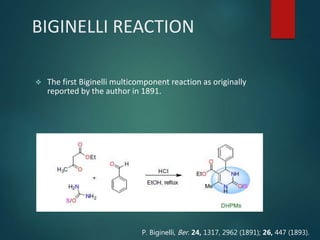
 In 1893, Pietro Biginelli investigated the reaction of ethyl
acetoacetate and urea in the presence of benzaldehyde
under reflux conditions in ethanol and
 showed that the Cycloadduct, i.e., DHPM, is obtained.
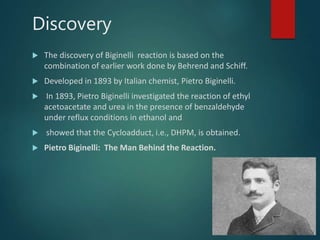
 Pietro Biginelli: The Man Behind the Reaction.
Why Biginelli..
 Variable reaction yields
 Single pot reaction
 Limited substrate scope
 Reaction times
 Experimentally simple
 Readily available starting materials
 Eco-friendly
 100% yield
 Resource effective.
BIGINELLI REACTION
 The first Biginelli multicomponent reaction as originally
reported by the author in 1891.
P. Biginelli, Ber. 24, 1317, 2962 (1891); 26, 447 (1893).
MECHANISM…
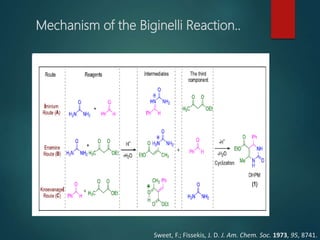
Three mechanisms involving protonated intermediates have
been proposed.
The first mechanism, the so-called iminium route, involves
condensation between aldehyde and urea to give rise to an
iminium intermediate, which undergoes a nucleophilic
addition with a β keto ester leading to DHPM.
The second mechanism involving ‘enamine route’ is based
on condensation between urea and β keto ester leading to a
protonated enamine intermediate, which subsequently
reacts with aldehyde to give rise to the DHPM.
The third mechanism involves a Knoevenagel type reaction
mechanism. The reaction between aldehyde and β keto ester
results in the formation of a carbenium ion intermediate,
which reacts with urea to afford the DHPM.
Mechanism of the Biginelli Reaction..
Sweet, F.; Fissekis, J. D. J. Am. Chem. Soc. 1973, 95, 8741.
Route 1
Route 2
Route 3
Kappe, C. O. J. Org. Chem.1997, 62, 7201
Different proposal for mechanistic studies
 In 1933, Folkers and Johnson made the first attempt .
the DHPM, was achieved only via the iminium route. ,
with some similarities to the Mannich Condensation.
 In 1973, Sweet and Fissekis proposed the second
proposal. the reaction takes place via carbenium ion
intermediate produced by the Knoevenagel pathway
 In 1997, Kappe made his proposal involving ‘enamine
route’.
Different proposal for mechanistic studies
Kappe, C. O. J. Org. Chem.1997, 62, 7201
RECENT ADVANCES…
Atwal Modifications-
 Atwal and co-workers make an advancement to the original
Biginelli reaction.
 that can withstand high product yields.
 the preparation of previously inaccessible
dihydropyrimidines.
 This modification increases the substrate scope of the
Biginelli reaction.
Goss, J. M.; Schaus, S. E. J. Org. Chem.2008, 73, 7651.
Solid-phase approach-
 Solid-phase synthesis provides high product yields by the use of a
large excess (E) of reagents.
 by-products’ are easily washed away which are non-resin bound.
 Several building blocks of polymer-supported have been explored,
comprising attachment of the linker to the urea and β keto ester
components.
 The first example of a solid-phase Biginelli reaction using a resin
bound urea was provided by Wipf and Cunningham.
Wipf, P.; Cunningham, A. Tet. Lett.1995, 36, 7819.
Flourous phase synthesis-
 Curran and co-workers have introduced fluorous-phase
chemistry toward the synthesis of dihydropyrimidines.
 Fluorous-phase policies are based on the ability for highly
fluorinated compounds to partition into a fluorinated
solvent.
 the fluorous methodology requires the synthesis of
fluorinated ureas.
Studer, A.; Jeger, P.; Wipf, P.; Curran, D. P. J. Org. Chem.1997, 62, 2917
Enantioenriched dihydropyrimidines-
 Dihydropyrimidines are intrinsically chiral
molecules.
 The influence of the absolute configuration at the
stereogenic center at C4 on biological activity is
well documented.
 the R enantiomer of dihydropyrimidine SQ 32926,
is an antihypertensive agent, which is >400-fold
more potent than the S enantiomer.
A.) Resolution-
 Atwal and co-worker’s resolved racemic Separation by
fractional crystallization,
 followed by cleavage of the chiral amine gave (R)-34
in 99:1 e.r. SQ 3292634
Atwal, K. S. and co-workers J. Med. Chem.1991, 34, 806.
B.) ASSYMETRIC SYNTHESIS-
 Zhu and coworkers reported the first of these methods in 2005
 to give synthetically useful enantiomeric ratios.
 Zhu found that the use of chiral ytterbium catalyst, allowed for
dihydropyrimidines to be synthesized in high yield and more
enantioselectivity.
 The ytterbium catalyst is recoverable and can be recycled several times
without diminishing the product e.r.
Huang, Y.; Yang, F.; Zhu, C. J. Am. Chem. Soc.2005, 127, 16386.
First example
Comments: Organocatalytic Application of Ionic Liquids: [bmim][MeSO4] as a
Recyclable Organocatalyst in the Multicomponent Reaction for the
Preparation of Dihydropyrimidinones and –thiones
S. R. Roy, P. S. Jadhavar, K. Seth, K. K. Sharma, A. K. Chakraborti, Synthesis, 2011, 2261-2267.
Reference: J org chem 65 (20) 6777-6779 Oct 2000
Second example
Comments: Use of beta-keto carboxylic acids for the Biginelli
cyclocondensation. They used oxalacetic acid and investigated two different
sets of rxn conditions. In method A: cat H2SO4, EtOH , heat In method B: cat
trifluoroacetic acid, in refluxing dichloroethane Yields were generally higher
with method B - conditions are advantageous for the N-acyliminium ion
formation, a transient species believed to be a key intermediate in the rxn
pathway.
Third example
Reference: J org chem 67 (20) 6979 - 6994
Comments: Here the rxn was studied under different rxn conditions varying
the solvent from EtOH to THF, the rxn temp and the cat present from
HCL(aq), InCl3. They found the optimum conditions to be using CuCl(l),
AcOH and BF3.Et2O in THF at 65degrees for 24hrs. This yielded 65% of
product.
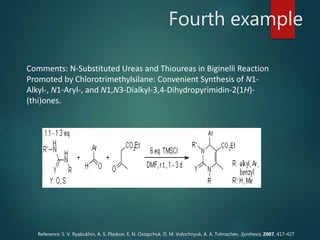
Comments: N-Substituted Ureas and Thioureas in Biginelli Reaction
Promoted by Chlorotrimethylsilane: Convenient Synthesis of N1-
Alkyl-, N1-Aryl-, and N1,N3-Dialkyl-3,4-Dihydropyrimidin-2(1H)-
(thi)ones.
Fourth example
Reference: S. V. Ryabukhin, A. S. Plaskon, E. N. Ostapchuk, D. M. Volochnyuk, A. A. Tolmachev, Synthesis, 2007, 417-427
Comments: Ferric chloride/tetraethyl orthosilicate as an efficient
system for synthesis of dihydropyrimidinones by Biginelli reaction.
Fifth example
References: I. Cepanec, M. Litvić, A. Bartolinčić, M. Lovrić, Tetrahedron, 2005, 61, 4275-4280
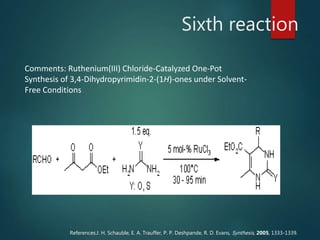
Comments: Ruthenium(III) Chloride-Catalyzed One-Pot
Synthesis of 3,4-Dihydropyrimidin-2-(1H)-ones under Solvent-
Free Conditions
Sixth reaction
References:J. H. Schauble, E. A. Trauffer, P. P. Deshpande, R. D. Evans, Synthesis, 2005, 1333-1339.
Comments: N-Bromosuccinimide as an Almost Neutral Catalyst
for Efficient Synthesis of Dihydropyrimidinones Under Microwave
Irradiation.
Seventh reaction
References: H. Hazarkhani, B. Karimi, Synthesis, 2004, 1239-1242.
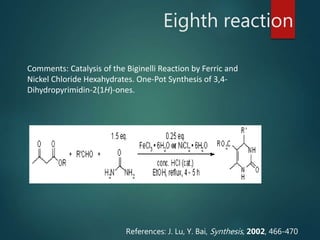
Comments: Catalysis of the Biginelli Reaction by Ferric and
Nickel Chloride Hexahydrates. One-Pot Synthesis of 3,4-
Dihydropyrimidin-2(1H)-ones.
Eighth reaction
References: J. Lu, Y. Bai, Synthesis, 2002, 466-470
APPLICATIONS…
Pharmacology-
 As mentioned earlier, the product of Biginelli reaction, i.e.,
the DHPMs, are of principal importance insofar as their
pharmacological applications are concerned.
 Fatima et al. have reviewed significant pharmacological
properties of over 100 Biginelli adducts.
 which are known to be encouraging anticancer, anti-
inflammatory, antimicrobial, and antioxidant agents etc.
1. ANTIHYPERTENSIVE AGENTS
2. ANTI-HIV AGENTS
3. ANTITUMOR ACTIVITY
4. ANTI-MALARIALS
P. Biginelli, Ber. 24, 1317, 2962 (1891); 26, 447 (1893).
Calcium channel modulation-
 the interesting features of the DHPMs, is that they are aza-analogs
of dihydropyridines (DHPs) of ‘nifedipine’ type.
 It belongs to a well-known class of cardiovascular drugs.
 that act as calcium channel modulators.
 Khanina and co-workers in 1978 first discovered The
cardiovascular activity of the Biginelli compound
Goss, J. M.; Schaus, S. E. J. Org. Chem.2008, 73, 7651.
Natural product synthesis…
 These compounds are obtained from the marine/natural sources.
 A variety of alkaloids containing the DHPM core have been isolated from various
marine sources.
 Some of the alkaloids that are structurally characterized by a unique fused tricyclic
guanidinium core are crambescidins, batzelladines, monanchocidins.
 The crambescidin alkaloids have been found to exhibit cytotoxicities against several
tumour cell lines, antifungal activity against Candida albicans, antiviral activity
against herpes simplex virus (HSV), anti-HIV activity, inhibition of HIV-1 envelope
mediated cell fusion etc.
 Among several batzelladine alkaloids batzelladines A and B were the first low
molecular weight natural products reported to inhibit the binding of HIV gp-120 to
human CD4, which is a critical step in the life cycle of the AIDS virus.
 Some of the batzelladine alkaloids are known to inhibit protein–protein
interactions. For example, batzelladines F and G induce dissociation of the protein
tyrosine kinase p56 from its complex with CD4.
1. CRAMBESCIDIN ALKALOIDS
2. BATZELLADINE ALKALOIDS
3. MONANCHOCIDIN ALKALOIDS
Huang, Y.; Yang, F.; Zhu, C. J. Am. Chem. Soc.2005, 127, 16386.
Inorganic catalysis…
 Indium(III) chloride mediated catalysis
 Heavy metal catalysis
Materials chemistry-
1.Functional polymers
2. Adhesives
3. Fabric dyes
Ren, X.; Yang, B.; Zhao, Y.; Zhang, X.; Wang, X.; Wei, Y.; Tao, L. Polymer 2015, 64, 210.
Conclusions…
 Introduction
 Discovery
 Mechanistic studies
 Recent advances
 Reaction conditions
 Examples
 Applications
References…
 P. Biginelli, Ber. 24, 1317, 2962 (1891); 26, 447 (1893).
 H. E. Zaugg, W. B. Martin, Org. React. 14, 88 (1965);
 D. J. Brown, The Pyrimidines (Wiley, New York, 1962) p 440; ibid., Suppl.
I, 1970, p 326,
 F. Sweet, Y. Fissekis, J. Am. Chem. Soc. 95, 8741 (1973).
 Synthetic applications: M. V. Fernandez et al., Heterocycles 27, 2133 (1988);
 K. Singh et al., Tetrahedron 55, 12873 (1999);
 A. S. Franklin et al., J. Org. Chem. 64, 1512 (1999).
 Modified conditions: C. O. Kappe et al., Synthesis 1999, 1799; J. Lu, H.
Ma.Synlett 2000, 63.
 Use of cycloalkanones as starting material: Y.-L. Zhu et al., Eur. J. Org.
Chem. 2005, 2354.
 Ren, X.; Yang, B.; Zhao, Y.; Zhang, X.; Wang, X.; Wei, Y.; Tao, L. Polymer 2015,
64, 210.
 Biginelli, P. Gazz. Chim. Ital. 1893, 23, 360.
THANKS...

BIGINELLI REACTION

  • 1.
    BIGINELLI REACTION  BYJAGDISH CHANDRA JAT  M.Sc. Chemistry  Registration No.- 17mscchm01  Department of Chemical Sciences  Central university of Punjab, Bathinda.
  • 2.
    Introduction..  Developed in1893 by Italian chemist, Pietro Biginelli.  A Classical non- isocyanide based multicomponent process (3-CR).  Involves an acid catalysed cyclo condensation of beta-keto esters, aldehyde and urea (or thiourea) in alcohols gives Dihydropyrimidinones.  These are interesting compounds with a potential for pharmaceutical application.  Several DHPMs have been found to exhibit a broad spectrum of biological activities.  The Biginelli dihydropyrimidine synthesis is one of the most important and oldest multicomponent reactions.
  • 3.
    Discovery  The discoveryof Biginelli reaction is based on the combination of earlier work done by Behrend and Schiff.  Developed in 1893 by Italian chemist, Pietro Biginelli.  In 1893, Pietro Biginelli investigated the reaction of ethyl acetoacetate and urea in the presence of benzaldehyde under reflux conditions in ethanol and  showed that the Cycloadduct, i.e., DHPM, is obtained.  Pietro Biginelli: The Man Behind the Reaction.
  • 4.
    Why Biginelli..  Variablereaction yields  Single pot reaction  Limited substrate scope  Reaction times  Experimentally simple  Readily available starting materials  Eco-friendly  100% yield  Resource effective.
  • 5.
    BIGINELLI REACTION  Thefirst Biginelli multicomponent reaction as originally reported by the author in 1891. P. Biginelli, Ber. 24, 1317, 2962 (1891); 26, 447 (1893).
  • 6.
    MECHANISM… Three mechanisms involvingprotonated intermediates have been proposed. The first mechanism, the so-called iminium route, involves condensation between aldehyde and urea to give rise to an iminium intermediate, which undergoes a nucleophilic addition with a β keto ester leading to DHPM. The second mechanism involving ‘enamine route’ is based on condensation between urea and β keto ester leading to a protonated enamine intermediate, which subsequently reacts with aldehyde to give rise to the DHPM. The third mechanism involves a Knoevenagel type reaction mechanism. The reaction between aldehyde and β keto ester results in the formation of a carbenium ion intermediate, which reacts with urea to afford the DHPM.
  • 7.
    Mechanism of theBiginelli Reaction.. Sweet, F.; Fissekis, J. D. J. Am. Chem. Soc. 1973, 95, 8741.
  • 8.
    Route 1 Route 2 Route3 Kappe, C. O. J. Org. Chem.1997, 62, 7201
  • 9.
    Different proposal formechanistic studies  In 1933, Folkers and Johnson made the first attempt . the DHPM, was achieved only via the iminium route. , with some similarities to the Mannich Condensation.  In 1973, Sweet and Fissekis proposed the second proposal. the reaction takes place via carbenium ion intermediate produced by the Knoevenagel pathway  In 1997, Kappe made his proposal involving ‘enamine route’.
  • 10.
    Different proposal formechanistic studies Kappe, C. O. J. Org. Chem.1997, 62, 7201
  • 11.
    RECENT ADVANCES… Atwal Modifications- Atwal and co-workers make an advancement to the original Biginelli reaction.  that can withstand high product yields.  the preparation of previously inaccessible dihydropyrimidines.  This modification increases the substrate scope of the Biginelli reaction. Goss, J. M.; Schaus, S. E. J. Org. Chem.2008, 73, 7651.
  • 12.
    Solid-phase approach-  Solid-phasesynthesis provides high product yields by the use of a large excess (E) of reagents.  by-products’ are easily washed away which are non-resin bound.  Several building blocks of polymer-supported have been explored, comprising attachment of the linker to the urea and β keto ester components.  The first example of a solid-phase Biginelli reaction using a resin bound urea was provided by Wipf and Cunningham. Wipf, P.; Cunningham, A. Tet. Lett.1995, 36, 7819.
  • 13.
    Flourous phase synthesis- Curran and co-workers have introduced fluorous-phase chemistry toward the synthesis of dihydropyrimidines.  Fluorous-phase policies are based on the ability for highly fluorinated compounds to partition into a fluorinated solvent.  the fluorous methodology requires the synthesis of fluorinated ureas. Studer, A.; Jeger, P.; Wipf, P.; Curran, D. P. J. Org. Chem.1997, 62, 2917
  • 14.
    Enantioenriched dihydropyrimidines-  Dihydropyrimidinesare intrinsically chiral molecules.  The influence of the absolute configuration at the stereogenic center at C4 on biological activity is well documented.  the R enantiomer of dihydropyrimidine SQ 32926, is an antihypertensive agent, which is >400-fold more potent than the S enantiomer.
  • 15.
    A.) Resolution-  Atwaland co-worker’s resolved racemic Separation by fractional crystallization,  followed by cleavage of the chiral amine gave (R)-34 in 99:1 e.r. SQ 3292634 Atwal, K. S. and co-workers J. Med. Chem.1991, 34, 806.
  • 16.
    B.) ASSYMETRIC SYNTHESIS- Zhu and coworkers reported the first of these methods in 2005  to give synthetically useful enantiomeric ratios.  Zhu found that the use of chiral ytterbium catalyst, allowed for dihydropyrimidines to be synthesized in high yield and more enantioselectivity.  The ytterbium catalyst is recoverable and can be recycled several times without diminishing the product e.r. Huang, Y.; Yang, F.; Zhu, C. J. Am. Chem. Soc.2005, 127, 16386.
  • 17.
    First example Comments: OrganocatalyticApplication of Ionic Liquids: [bmim][MeSO4] as a Recyclable Organocatalyst in the Multicomponent Reaction for the Preparation of Dihydropyrimidinones and –thiones S. R. Roy, P. S. Jadhavar, K. Seth, K. K. Sharma, A. K. Chakraborti, Synthesis, 2011, 2261-2267.
  • 18.
    Reference: J orgchem 65 (20) 6777-6779 Oct 2000 Second example Comments: Use of beta-keto carboxylic acids for the Biginelli cyclocondensation. They used oxalacetic acid and investigated two different sets of rxn conditions. In method A: cat H2SO4, EtOH , heat In method B: cat trifluoroacetic acid, in refluxing dichloroethane Yields were generally higher with method B - conditions are advantageous for the N-acyliminium ion formation, a transient species believed to be a key intermediate in the rxn pathway.
  • 19.
    Third example Reference: Jorg chem 67 (20) 6979 - 6994 Comments: Here the rxn was studied under different rxn conditions varying the solvent from EtOH to THF, the rxn temp and the cat present from HCL(aq), InCl3. They found the optimum conditions to be using CuCl(l), AcOH and BF3.Et2O in THF at 65degrees for 24hrs. This yielded 65% of product.
  • 20.
    Comments: N-Substituted Ureasand Thioureas in Biginelli Reaction Promoted by Chlorotrimethylsilane: Convenient Synthesis of N1- Alkyl-, N1-Aryl-, and N1,N3-Dialkyl-3,4-Dihydropyrimidin-2(1H)- (thi)ones. Fourth example Reference: S. V. Ryabukhin, A. S. Plaskon, E. N. Ostapchuk, D. M. Volochnyuk, A. A. Tolmachev, Synthesis, 2007, 417-427
  • 21.
    Comments: Ferric chloride/tetraethylorthosilicate as an efficient system for synthesis of dihydropyrimidinones by Biginelli reaction. Fifth example References: I. Cepanec, M. Litvić, A. Bartolinčić, M. Lovrić, Tetrahedron, 2005, 61, 4275-4280
  • 22.
    Comments: Ruthenium(III) Chloride-CatalyzedOne-Pot Synthesis of 3,4-Dihydropyrimidin-2-(1H)-ones under Solvent- Free Conditions Sixth reaction References:J. H. Schauble, E. A. Trauffer, P. P. Deshpande, R. D. Evans, Synthesis, 2005, 1333-1339.
  • 23.
    Comments: N-Bromosuccinimide asan Almost Neutral Catalyst for Efficient Synthesis of Dihydropyrimidinones Under Microwave Irradiation. Seventh reaction References: H. Hazarkhani, B. Karimi, Synthesis, 2004, 1239-1242.
  • 24.
    Comments: Catalysis ofthe Biginelli Reaction by Ferric and Nickel Chloride Hexahydrates. One-Pot Synthesis of 3,4- Dihydropyrimidin-2(1H)-ones. Eighth reaction References: J. Lu, Y. Bai, Synthesis, 2002, 466-470
  • 25.
    APPLICATIONS… Pharmacology-  As mentionedearlier, the product of Biginelli reaction, i.e., the DHPMs, are of principal importance insofar as their pharmacological applications are concerned.  Fatima et al. have reviewed significant pharmacological properties of over 100 Biginelli adducts.  which are known to be encouraging anticancer, anti- inflammatory, antimicrobial, and antioxidant agents etc.
  • 26.
    1. ANTIHYPERTENSIVE AGENTS 2.ANTI-HIV AGENTS 3. ANTITUMOR ACTIVITY 4. ANTI-MALARIALS P. Biginelli, Ber. 24, 1317, 2962 (1891); 26, 447 (1893).
  • 27.
    Calcium channel modulation- the interesting features of the DHPMs, is that they are aza-analogs of dihydropyridines (DHPs) of ‘nifedipine’ type.  It belongs to a well-known class of cardiovascular drugs.  that act as calcium channel modulators.  Khanina and co-workers in 1978 first discovered The cardiovascular activity of the Biginelli compound Goss, J. M.; Schaus, S. E. J. Org. Chem.2008, 73, 7651.
  • 28.
    Natural product synthesis… These compounds are obtained from the marine/natural sources.  A variety of alkaloids containing the DHPM core have been isolated from various marine sources.  Some of the alkaloids that are structurally characterized by a unique fused tricyclic guanidinium core are crambescidins, batzelladines, monanchocidins.  The crambescidin alkaloids have been found to exhibit cytotoxicities against several tumour cell lines, antifungal activity against Candida albicans, antiviral activity against herpes simplex virus (HSV), anti-HIV activity, inhibition of HIV-1 envelope mediated cell fusion etc.  Among several batzelladine alkaloids batzelladines A and B were the first low molecular weight natural products reported to inhibit the binding of HIV gp-120 to human CD4, which is a critical step in the life cycle of the AIDS virus.  Some of the batzelladine alkaloids are known to inhibit protein–protein interactions. For example, batzelladines F and G induce dissociation of the protein tyrosine kinase p56 from its complex with CD4.
  • 29.
    1. CRAMBESCIDIN ALKALOIDS 2.BATZELLADINE ALKALOIDS 3. MONANCHOCIDIN ALKALOIDS Huang, Y.; Yang, F.; Zhu, C. J. Am. Chem. Soc.2005, 127, 16386.
  • 30.
    Inorganic catalysis…  Indium(III)chloride mediated catalysis  Heavy metal catalysis
  • 31.
    Materials chemistry- 1.Functional polymers 2.Adhesives 3. Fabric dyes Ren, X.; Yang, B.; Zhao, Y.; Zhang, X.; Wang, X.; Wei, Y.; Tao, L. Polymer 2015, 64, 210.
  • 32.
    Conclusions…  Introduction  Discovery Mechanistic studies  Recent advances  Reaction conditions  Examples  Applications
  • 33.
    References…  P. Biginelli,Ber. 24, 1317, 2962 (1891); 26, 447 (1893).  H. E. Zaugg, W. B. Martin, Org. React. 14, 88 (1965);  D. J. Brown, The Pyrimidines (Wiley, New York, 1962) p 440; ibid., Suppl. I, 1970, p 326,  F. Sweet, Y. Fissekis, J. Am. Chem. Soc. 95, 8741 (1973).  Synthetic applications: M. V. Fernandez et al., Heterocycles 27, 2133 (1988);  K. Singh et al., Tetrahedron 55, 12873 (1999);  A. S. Franklin et al., J. Org. Chem. 64, 1512 (1999).  Modified conditions: C. O. Kappe et al., Synthesis 1999, 1799; J. Lu, H. Ma.Synlett 2000, 63.  Use of cycloalkanones as starting material: Y.-L. Zhu et al., Eur. J. Org. Chem. 2005, 2354.  Ren, X.; Yang, B.; Zhao, Y.; Zhang, X.; Wang, X.; Wei, Y.; Tao, L. Polymer 2015, 64, 210.  Biginelli, P. Gazz. Chim. Ital. 1893, 23, 360.
  • 34.