ASHRAE Research: Improving the Quality of Life
The American Society of Heating, Refrigerating and Air-Condi-
tioning Engineers is the world’s foremost technical society in the
fields of heating, ventilation, air conditioning, and refrigeration. Its
members worldwide are individuals who share ideas, identify the
need for and support research, and write the industry’s standards for
testing and practice. The result of these efforts is that engineers are
better able to keep indoor environments safe and productive while
protecting and preserving the outdoors for generations to come.
One of the ways that ASHRAE supports its members’ and indus-
try’s need for information is through ASHRAE Research. Thou-
sands of individuals and companies support ASHRAE Research
annually, enabling ASHRAE to report new data about material
properties and building physics and to promote the application of
innovative technologies.
The chapters in ASHRAE Handbooks are updated through the
experience of members of ASHRAE technical committees and
through results of ASHRAE Research reported at ASHRAE meet-
ings and published in ASHRAE special publications and in ASH-
RAE Transactions.
For information about ASHRAE Research or to become a mem-
ber contact, ASHRAE, 1791 Tullie Circle, Atlanta, GA 30329; tele-
phone: 404-636-8400; www.ashrae.org.
The 2000 ASHRAE Handbook
The 2000 ASHRAE Handbook—HVAC Systems and Equipment
describes both the combinations of equipment and the components
or assemblies that perform a particular function either individually
or in combination. The information helps the system designer select
and operate equipment, although it does not describe how to design
components.
Major topic areas include
• Air-conditioning and heating systems
• Air-handling equipment
• Heating equipment
• General HVAC components
• Unitary equipment
Most of the chapters in this Handbook update material in the
1996 ASHRAE Handbook to reflect current technology. The follow-
ing chapters contain major revisions or new material.
• Chapters 1 through 5 are reorganized and tightened for clarity.
Chapter 2, Building Air Distribution, contains expanded cover-
age on VAV systems, including more information on terminal
units. Chapter 4, Central Cooling and Heating, is a new chapter
that introduces central plant equipment and options.
• Chapter 7, Cogeneration Systems and Engine and Turbine Drives,
has more information on combustion turbine inlet air cooling as
well as updates for other sections.
• Chapter 9, Design of Small Forced-Air Heating and Cooling Sys-
tems, includes revised duct fitting data and new information on
duct efficiency testing. In addition, information on system perfor-
mance from Chapter 28, Furnaces, was moved to this chapter and
clarified and updated to be consistent with emerging duct effi-
ciency technology.
• Chapter 11, District Heating and Cooling, includes new informa-
tion on the effect of moisture on underground pipe insulation, cal-
culation of undisturbed soil temperatures, cathodic protection of
direct buried conduits, and leak detection. Also, the information
on consumer interconnections and metering is expanded.
• Chapter 13, Condenser Water Systems, has additional informa-
tion on water hammer, freeze protection, water treatment, over-
pressure, and free cooling.
• Chapter 16, Duct Construction, refers to new flexible duct, fiber
reinforced plastic duct, acoustical rating of duct liner, and blanket
duct insulation standards.
• Chapter 19, Evaporative Air Cooling Equipment, contains more
information on humidification and dehumidification.
• Chapter 22, Desiccant Dehumidification and Pressure Drying
Equipment, has been expanded, particularly the section on liquid
desiccant systems.
• Chapter 23, Air-Heating Coils, provides a broader scope of the
types of heating coils and their selection and application.
• Chapter 24, Air Cleaners for Particulate Contaminants, discusses
the new ASHRAE Standard 52.2 for testing of air-cleaning
devices and includes new sections on residential air cleaners and
bioaerosols.
• Chapter 25, Industrial Gas Cleaning and Air Pollution Control,
received a substantial update and includes revised information on
electrostatic precipitators and fabric filters,
• Chapter 26, Automatic Fuel-Burning Equipment, is updated and
now discusses low oxides of nitrogen emission from oil-fired
equipment.
• Chapter 27, Boilers, includes new information on increasing
boiler efficiency and on wall hung boilers for residential use.
• Chapter 36, Cooling Towers, has more information about (1) a
combined flow coil/fill evaporative cooling tower, (2) precau-
tions about using variable frequency drives. and (3) the increased
use and acceptance of thermal performance certification.
• Chapter 40, Motors, Motor Controls, and Variable-Speed Drives,
includes a significant new section on variable-speed drives.
• Chapter 43, Heat Exchangers, is a new chapter that provides an
overview of the topic.
• Chapter 44, Air-to-Air Energy Recovery, contains new informa-
tion on ideal air-to-air energy exchange, rating of performance,
comparison of devices, and twin tower enthalpy recovery loops.
• Chapter 46, Room Air Conditioners, Packaged Terminal Air Con-
ditioners, and Dehumidifiers, combines information from two
previous chapters.
• Chapter 47, Engine-Driven Heating and Cooling Equipment, is a
new chapter that includes information on engine-driven chillers,
air conditioners, heat pumps, and refrigeration equipment. The
chapter also includes and updates information from an old chapter
on unitary heat pumps.
This Handbook is published both as a bound print volume and in
electronic format on a CD-ROM. It is available in two editions—
one contains inch-pound (I-P) units of measurement, and the other
contains the International System of Units (SI).
Look for corrections to the 1997, 1998, and 1999 Handbooks on
the Internet at http://www.ashrae.org. Any changes in this volume
will be reported in the 2001 ASHRAE Handbook and on the ASH-
RAE web site.
If you have suggestions for improving a chapter or you would
like more information on how you can help revise a chapter, e-mail
ashrae@ashrae.org; write to Handbook Editor, ASHRAE, 1791
Tullie Circle, Atlanta, GA 30329; or fax 404-321-5478.
Robert A. Parsons, ASHRAE Handbook Editor
1.1
CHAPTER 1
HVAC SYSTEM ANALYSIS AND SELECTION
Selecting a System .......................................................................................................................... 1.1
HVAC Systems and Equipment ....................................................................................................... 1.3
Space Requirements ........................................................................................................................ 1.4
Air Distribution ............................................................................................................................... 1.5
Piping .............................................................................................................................................. 1.6
System Management ....................................................................................................................... 1.6
N HVAC SYSTEM maintains desired environmental condi-
Ations in a space. In almost every application, a myriad of
options are available to the design engineer to satisfy this basic goal.
In the selection and combination of these options, the design engi-
neer must consider all criteria defined here to achieve the functional
requirements associated with the goal.
HVAC systems are categorized by the method used to control
heating, ventilation, and air conditioning in the conditioned area.
This chapter addresses the procedures associated with selecting the
appropriate system for a given application. It also describes and
defines the design concepts and characteristics of basic HVAC sys-
tems. Chapters 2 through 5 of this volume describe specific systems
and their attributes, based on their heating and cooling medium and
commonly used variations.
SELECTING A SYSTEM
The design engineer is responsible for considering various sys-
tems and recommending one or two that will satisfy the goal and
perform as desired. It is imperative that the design engineer and the
owner collaborate on identifying and rating the criteria associated
with the design goal. Some criteria that may be considered are
• Temperature, humidity, and space pressure requirements
• Capacity requirements
• Redundancy
• Spatial requirements
• First cost
• Operating cost
• Maintenance cost
• Reliability
• Flexibility
• Life cycle analysis
Because these factors are interrelated, the owner and design
engineer must consider how these criteria affect each other. The rel-
ative importance of factors, such as these, differs with different
owners and often changes from one project to another for the same
owner. For example, typical concerns of owners include first cost
compared to operating cost, the extent and frequency of mainte-
nance and whether that maintenance requires entering the occupied
space, the expected frequency of failure of a system, the impact of
a failure, and the time required to correct the failure. Each of these
concerns has a different priority, depending on the owner’s goals.
Additional Goals
In addition to the primary goal to provide the desired environ-
ment, the design engineer must be aware of and account for other
goals the owner may require. These goals may include
• Supporting a process, such as the operation of computer
equipment
• Promoting a germ-free environment
• Increasing sales
• Increasing net rental income
• Increasing the salability of a property
The owner can only make appropriate value judgments if the
design engineer provides complete information on the advantages
and disadvantages of each option. Just as the owner does not usually
know the relative advantages and disadvantages of different sys-
tems, the design engineer rarely knows all the owner’s financial and
functional goals. Hence, the owner must be involved in the selection
of a system.
System Constraints
Once the goal criteria and additional goal options are listed,
many constraints must be determined and documented. These con-
straints may include
• Performance limitations (i.e., temperature, humidity, and space
pressure)
• Available capacity
• Available space
• Availability utility source
• Building architecture
• Construction budget
Few projects allow detailed quantitative evaluation of all alter-
natives. Common sense, historical data, and subjective experience
can be used to narrow choices to one or two potential systems.
Heating and air conditioning loads often contribute to the con-
straints, narrowing the choice to systems that will fit in the available
space and be compatible with the building architecture. Chapter 28
of the 1997 ASHRAE Handbook—Fundamentals describes methods
used to determine the size and characteristics of the heating and air
conditioning loads. By establishing the capacity requirement the
size of equipment can be determined, and the choice may be nar-
rowed to those systems that work well on projects within a size
range.
Loads vary over time due to the time of day/night, changes in the
weather, occupancy, activities, and solar exposure. Each space with
a different use and/or exposure may require a different control zone
to maintain space comfort. Some areas with special requirements
may need individual systems. The extent of zoning, the degree of
control required in each zone, and the space required for individual
zones also narrow the system choices.
No matter how efficiently a particular system operates or how
economical it is to install, it can only be considered if it (1) main-
tains the desired building space environment within an acceptable
tolerance under all conditions and occupant activities and (2) phys-
ically fits into the building without being objectionable.
The preparation of this chapter is assigned to TC 9.1, Large Building Air-
Conditioning Systems.
1.2 2000 ASHRAE Systems and Equipment Handbook (SI)
Cooling and humidity control are often the basis of sizing
HVAC components and subsystems, but the system may also be
determined based on the ventilation criteria. For example, if large
quantities of outside air are required for ventilation or to replace air
exhausted from the building, only systems that transport large air
volumes need to be considered.
Effective delivery of heat to an area may be an equally impor-
tant factor in the selection. A distribution system that offers high
efficiency and comfort for cooling may be a poor choice for heating.
This performance compromise may be small for one application in
one climate, but may be unacceptable in another that has more strin-
gent heating requirements.
HVAC systems and the associated distribution systems often
occupy a significant amount of space. Major components may
also require special support from the structure. The size and appear-
ance of terminal devices (i.e., diffusers, fan-coil units, radiant pan-
els, etc.) have an affect on the architectural design because they are
visible in the occupied space.
Other architectural factors that limit the selection of some sys-
tems include
• Acceptable noise levels in the occupied space
• Space available to house equipment and its location relative to the
occupied space
• Space available for horizontal and/or vertical distribution pipes
and ducts
• Acceptability of components visible in the occupied space.
Construction budget constraints can also influence the choice
of HVAC systems. Based on historical data, some systems may be
economically out of reach for an owner’s building program.
Narrowing the Choices
Chapters 2 through 5 cover building air distribution, in-room
terminal systems, central cooling and heating, and decentralized
cooling and heating. Each chapter briefly summarizes the positive
and negative features of various systems. One or two systems that
best satisfy the project goal can usually be identified by comparing
the criteria, other factors and constraints, and their relative impor-
tance. In making subjective choices, notes should be kept on all
systems considered and the reasons for eliminating those that are
unacceptable.
Each selection may require combining a primary system with a
secondary system (or distribution system). The primary system
converts energy from fuel or electricity into a heating and/or cooling
media. The secondary system delivers heating, ventilation, and/or
cooling to the occupied space. The two systems, to a great extent,
are independent, so several secondary systems may work with a par-
ticular primary system. In some cases, however, only one secondary
system may be suitable for a particular primary system.
Once subjective analysis has identified one or two HVAC sys-
tems (sometimes only one choice may remain), detailed quantitative
evaluations must be made. All systems considered should provide
satisfactory performance to meet the owner’s essential goals. The
design engineer should provide the owner with specific data on each
system to make an informed choice. The following chapters in the
ASHRAE Handbooks should be consulted to help narrow the
choices:
• Chapter 8, 1997 ASHRAE Handbook—Fundamentals covers
physiological principles, comfort, and health.
• Chapter 30, 1997 ASHRAE Handbook—Fundamentals covers
methods for estimating annual energy costs.
• Chapter 34, 1999 ASHRAE Handbook—Applications covers
methods for energy management.
• Chapter 35, 1999 ASHRAE Handbook—Applications covers
owning and operating cost.
• Chapter 37, 1999 ASHRAE Handbook—Applications covers
mechanical maintenance.
• Chapter 46, 1999 ASHRAE Handbook—Applications covers
sound and vibration control.
Selection Report
As the last step of selection, the design engineer should prepare
a summary report that addresses the following:
• The goal
• Criteria for selection
• Important factors
• Other goals
A brief outline of each of the final selections should be provided.
In addition, those HVAC systems deemed inappropriate should be
noted as having been considered but not applicable to meet the
owner’s primary HVAC goal.
Table 1 Sample HVAC System Selection Matrix (0 to 10 Score)
Goal: Furnish and install an HVAC system that provides moderate space temperature
control with minimum humidity control at an operating budget of 220 kW/m2 per year
Categories System #1 System #2 System #3 Remarks
1. Criteria for Selection:
• 24°C space temperature with ±2°C control during occupied cycle
• 20% relative humidity with ± 5% rh control during heating season.
• First cost
• Equipment life cycle
2. Important Factors:
• First class office space stature
• Individual tenant utility metering
3. Other Goals:
• Engineered smoke control system
• ASHRAE Standard 62 ventilation rates
• Direct digital control building automation
4. System Constraints:
• No equipment on the first floor
• No exterior louvers below the perimeter windows
5. Other Constraints:
• No perimeter finned tube radiation
TOTAL SCORE
HVAC System Analysis and Selection 1.3
The report should include an HVAC system selection matrix that
identifies the one or two suggested HVAC system (primary and sec-
ondary when applicable) selections, system constraints, and other
constraints. In completing this matrix assessment, the engineer
should have the owner’s input to the analysis. This input can also be
applied as weighted multipliers.
Many grading methods are used to complete an analytical matrix
analysis. Probably the simplest grading method is to rate each item
Excellent/Very Good/Good/Fair/Poor. A numerical rating system
such as 0 to 10, with 10 equal to Excellent and 0 equal to Poor, can
provide a quantitative result. The HVAC system with the highest
numerical value then becomes the recommended HVAC system to
accomplish the goal.
The system selection report should include a summary that pro-
vides an overview followed by a more detailed account of the
HVAC system analysis and system selection. This summary should
highlight the key points and findings that led to the recommenda-
tion(s). The analysis should refer to the system selection matrix
(such as in Table 1) and the reasons for scoring.
A more detailed analysis, beginning with the owner’s goal,
should immediately following the summary. With each HVAC sys-
tem considered, the design engineer should note the criteria associ-
ated with each selection. Issues such as close temperature and
humidity control may eliminate some HVAC systems from being
considered. System constraints and other constraints, noted with
each analysis, should continue to eliminate HVAC systems. Advan-
tages and disadvantages of each system should be noted with the
scoring from the HVAC system selection matrix. This process
should reduce the HVAC selection to one or two optimum choices
to present to the owner. Examples of installations for other owners
should be included with this report to endorse the design engineer’s
final recommendation.This third party endorsement allows the
owner to inquire about the success of these other HVAC systems.
HVAC SYSTEMS AND EQUIPMENT
HVAC systems may be central or decentralized. In addressing
the primary equipment location, the design engineer may locate this
equipment in a central plant (either inside or outside the building)
and distribute the air and/or water for HVAC needs from this plant.
The other option is to decentralize the equipment, with the primary
equipment located throughout the building, on the building, or adja-
cent to the building.
Central System Features
Some of the criteria associated with this concept are as follows:
Temperature, humidity, and space pressure requirements. A
central system may be able to fulfill any or all of these design
parameters.
Capacity requirements. A central system usually allows the
design engineer to consider HVAC diversity factors that reduce the
installed equipment capacity. In turn, this offers some attractive first
cost and operating cost benefits.
Redundancy. A central system can accommodate standby
equipment of equal size or of a preferred size that decentralized con-
figurations may have trouble accommodating.
Spatial requirements. The equipment room for a central system
is normally located outside the conditioned area—in a basement,
penthouse, service area, or adjacent to or remote from the building.
A disadvantage with this approach may be the additional cost to
furnish and install secondary equipment for the air and/or water
distribution. A second consideration is the access and physical
constraints throughout the building to furnish and install this sec-
ondary distribution network of ducts and/or pipes.
First cost. A central system may not be the least costly when
compared to decentralized HVAC systems. Historically, central sys-
tem equipment has a longer equipment service life to compensate
for this shortcoming. Thus, a life cycle cost analysis is very impor-
tant when evaluating central versus decentralized systems.
Operating cost. A central system usually has the advantage of
larger, more energy efficient primary equipment when compared to
decentralized system equipment.
Maintenance cost. The equipment room for a central system
provides the benefit of maintaining its HVAC equipment away from
the occupants in an appropriate service work environment. Access
to the building occupant workspace is not required, thus eliminating
disruption to the space environment, product, or process. Another
advantage may be that because of its larger capacity, there is less
HVAC equipment to service.
Reliability. Central system equipment can be an attractive ben-
efit when considering its long service life.
Flexibility. Redundancy can be a benefit when selecting standby
equipment that provides an alternative source of HVAC or backup.
Among the largest central systems are those HVAC plants serv-
ing groups of large buildings. These plants provide improved diver-
sity and generally operate more efficiently with lower maintenance
costs than individual central plants. The economics of these larger
central systems require extensive analysis. The utility analysis con-
siders multiple fuels and may also include gas and steam turbine-
driven equipment. Multiple types of primary equipment using mul-
tiple fuels and types of HVAC generating equipment (i.e., centrifu-
gal and absorption chillers) may be installed in combination in one
plant. Chapter 12, Chapter 13, and Chapter 14 provide design
details for central plants.
Decentralized System Features
Some of the criteria associated with this concept are as follows:
Temperature, humidity, and space pressure requirements. A
decentralized system may be able to fulfill any or all of these design
parameters.
Capacity requirements. A decentralized system usually
requires each piece of equipment to be sized for the maximum
capacity. Depending on the type and location of the equipment,
decentralized systems cannot take as much benefit of equipment
sizing diversity when compared to the central system diversity fac-
tor potential.
Redundancy. A decentralized system may not have the benefit
of backup or standby equipment. This limitation may need review.
Space requirements. A decentralized system may or may not
have in equipment rooms. Due to the space restrictions imposed on
the design engineer or architect, equipment may be located on the
roof and/or the ground adjacent to the building.
First cost. A decentralized system probably has the best first cost
benefit. This feature can be enhanced by phasing in the purchase of
decentralized equipment on an as-needed basis (i.e., purchasing
equipment as the building is being leased/occupied).
Operating cost. A decentralized system can emphasize this as a
benefit when strategically starting and stopping multiple pieces of
equipment. When comparing energy consumption based on peak
energy draw, decentralized equipment may not be as attractive when
compared to larger, more energy efficient central equipment.
Maintenance cost. A decentralized system can emphasize this
as a benefit when equipment is conveniently located and the equip-
ment size and associated components (i.e., filters) are standardized.
When equipment is located on a roof, maintainability may be diffi-
cult because it is difficult to access during bad weather.
Reliability. A decentralized system historically has reliable
equipment, although the estimated equipment service life may be
less than that of centralized equipment.
Flexibility. A decentralized system may be very flexible because
it may be placed in numerous locations.
1.4 2000 ASHRAE Systems and Equipment Handbook (SI)
Primary Equipment
The type of central and decentralized equipment selected for
large buildings depends on a well-organized HVAC analysis and
selection report. The choice of primary equipment and components
depends on factors presented in the selection report with such fac-
tors as those presented in the section on Selecting a System. Primary
HVAC equipment includes heating equipment, air and water deliv-
ery equipment, and refrigeration equipment.
Many HVAC designs recover internal heat from lights, people,
and equipment to reduce the size of the heating plant. In large build-
ings with core areas that require cooling while perimeter areas
require heating, one of several heat reclaim systems can heat the
perimeter to save energy. Chapter 8 describes some heat recovery
arrangements, Chapter 33 describes solar energy equipment, and
Chapter 44 introduces air-to-air energy recovery. In the 1999 ASH-
RAE Handbook—Applications, Chapter 34 covers energy manage-
ment and Chapter 39 covers building energy monitoring.
The search for energy savings has extended to cogeneration or
total energy systems, in which on-site power generation has been
added to the HVAC project. The economics of this function is
determined by gas and electric rate differentials and by the ratio of
electric to heating demands for the project. In these systems, waste
heat from generators can be transferred to the HVAC equipment
(i.e., to drive the turbines of centrifugal compressors, to serve an
absorption chiller, etc.). Chapter 7 covers cogeneration or total
energy systems.
Thermal storage is another energy savings concept, which pro-
vides the possibility of off-peak generation of air conditioning with
chilled water or ice. Thermal storage of hot water can be used in
heating. Many electric utilities impose severe charges for peak sum-
mer power use or offer incentives for off-peak use. The storage
capacity installed to level the summer load may also be available for
use in winter, thus making heat reclaim a viable option. Chapter 33
of the 1999 ASHRAE Handbook—Applications has more informa-
tion on thermal storage.
With ice storage, colder supply air can be provided than that
available from a conventional air conditioning. This colder air
allows the use of smaller fans and ducts, which reduces first cost and
operating cost that can offset the energy cost required to make ice.
Similarly, the greater water temperature difference from hot water
thermal storage allows smaller pumps and pipe to be used.
Heating Equipment
Steam boilers or hot water boilers are the primary means of heat-
ing a space. These boilers are (1) used both for heating and process
heating; (2) manufactured to produce high or low pressure; and (3)
fired with coal, oil, electricity, gas, and sometimes, waste material.
Low-pressure boilers are rated for a working pressure of either 100
or 200 kPa for steam and 1100 kPa for water, with a temperature
limit of 120°C. Package boilers, with all components and controls
assembled as a unit, are available. Electrode or resistance-type elec-
tric boilers that generate either steam or hot water are also available.
Chapter 27 has further information.
Where steam or hot water is supplied from a central plant, as on
university campuses and in downtown areas of large cities, the util-
ity service entering the building must conform to the utility’s stan-
dards. The utility provider should be contacted at the system
analysis and selection phase of the project to determine availability,
cost, and the specific requirements of the service.
When the primary heating equipment is selected, the fuels con-
sidered must ensure maximum efficiency. Chapter 26 discusses the
design, selection, and operation of the burners for different types of
primary heating equipment. Chapter 17 of the 1997 ASHRAE Hand-
book—Fundamentals describes types of fuel, fuel properties, and
proper combustion factors.
Air Delivery Equipment
Primary air delivery equipment for HVAC systems are classified
as packaged equipment, manufactured and custom manufactured
equipment, or field fabricated equipment. Most ventilation equip-
ment for large systems use centrifugal or axial fans; however, plug
or plenum fans are becoming more popular. Centrifugal fans are fre-
quently used in packaged and manufactured HVAC equipment.
Axial fans are more often part of a custom unit or a field-fabricated
unit. Both types of fans can be used as industrial process and high-
pressure blowers. Chapter 18 describes fans, and Chapters 16
through 25 provide information about ventilation components.
Refrigeration Equipment
The section on Refrigeration Equipment in Chapter 4 summa-
rizes the primary refrigeration equipment for HVAC systems
designed to maintain desired environmental conditions in a space.
SPACE REQUIREMENTS
In the initial phase of a building’s design, the engineer seldom
has sufficient information to render the HVAC design. As noted in
the section on Space Requirements in Chapter 4, the final design is
usually a compromise between what the engineer recommends and
what the architect can accommodate. At other times, final design
and space requirements may be dictated by the building owner who
may have a preference for a central or decentralized system. The
following paragraphs discuss some of these requirements.
Equipment Rooms
The total mechanical and electrical space requirements range
between 4 and 9% of the gross building area with most buildings
falling within the 6 to 9% range. These ranges include space for
HVAC, electrical, plumbing, and fire protection equipment. These
percentages also include vertical shaft space for mechanical and
electrical equipment.
Most facilities should be centrally located to (1) minimize long
duct, pipe, and conduit runs and sizes; (2) simplify shaft layouts;
and (3) centralize maintenance and operation. A central location
also reduces pump and fan motor power, which reduces building
operating costs. But, for many reasons, not all the mechanical and
electrical facilities can be centrally located in the building. In any
case, the equipment should be kept together whenever possible to
minimize space requirements, centralize maintenance and opera-
tion, and simplify the electrical system.
Equipment rooms generally require clear ceiling height ranging
from 3 to 5 m, depending on equipment sizes and the complexity of
air and/or water distribution.
The main electrical transformer and switchgear rooms should be
located as close to the incoming electrical service as practical. If
there is an emergency generator, it should be located considering (1)
proximity to emergency electrical loads and sources of combustion
and cooling air and fuel, (2) ease of properly venting exhaust gases
to the outdoors, and (3) provisions for noise control.
HVAC Facilities
The heating equipment room houses the boiler(s) and may also
house a boiler feed unit, chemical treatment equipment, pumps, heat
exchangers, pressure-reducing equipment, control air compressors,
and miscellaneous equipment. The refrigeration equipment room
houses the chiller(s) and may also house chilled water and con-
denser water pumps, heat exchangers, air-conditioning equipment,
control air compressors, and miscellaneous equipment. The design
of these rooms needs to consider (1) the size and weight of the
equipment; (2) installation and replacement when locating and
arranging the room to accept this large equipment; and (3) applica-
ble regulations relative to combustion air and ventilation air criteria.
HVAC System Analysis and Selection 1.5
In addition, ASHRAE Standard 15, Safety Code for Mechanical
Refrigeration should be consulted for special equipment room
requirements.
Most air-conditioned buildings require a cooling tower or con-
denser unit. If the cooling tower or air-cooled or water-cooled con-
denser is located on the ground, it should be at least 30 m away from
the building (1) to reduce tower noise in the building, (2) to keep
discharge air and moisture carry-over from fogging the building’s
windows and discoloring the facade of the building, and (3) to keep
discharge air and moisture carry-over from contaminating outdoor
air being introduced into the building. Cooling towers should be
kept the same distance from parking lots to avoid staining car fin-
ishes with water treatment chemicals. Chapter 35 and Chapter 36
have further information on this equipment.
It is often economical to locate the heating plant and/or refriger-
ation plant at an intermediate floor or on the roof. The electrical ser-
vice and structural costs are higher, but these may be offset by
reduced costs for heating piping, condenser and chilled water pip-
ing, energy consumption, and a chimney through the building. Also,
the initial cost of equipment may be less because the operating pres-
sure is lower.
Applicable regulations relative to both gas and fuel oil systems
must be followed. Gas fuel may be more desirable than fuel oil. Fuel
oil storage has specific environmental and safety concerns. In addi-
tion, the cost of oil leak detection and prevention may be substantial.
Oil pumping presents added design and operating problems.
Energy recovery systems can reduce the size of the heating
plant and/or refrigeration plant. Well-insulated buildings and elec-
tric and gas utility rate structures may encourage the design engi-
neer to consider several energy conservation concepts such as
limiting demand, free cooling and thermal storage.
Fan Rooms
The fan rooms house the HVAC fan equipment and may include
other miscellaneous equipment. The room must have space for re-
moval of the fan shaft and coil. Installation, replacement, and main-
tenance of this equipment should be considered when locating and
arranging the room.
Fan rooms may be placed in a basement that has an airway for
intake of outdoor air. In this situation the placement of air intake
louver(s) is a concern because of debris from leaves and snow may
fill the area. Also, if parking areas are close to the building, the qual-
ity of outdoor air may be compromised.
Fan rooms on the second floor and above, have easier access for
outdoor air, exhaust air, and equipment replacement. The number of
fan rooms required depends largely on the total floor area and
whether the HVAC system is centralized or decentralized. Buildings
with large floor areas may have multiple decentralized fan rooms on
each floor or a large central fan unit serving the entire area. High-
rise buildings may also opt for decentralized fan rooms for each
floor; or they may have a more central concept with one fan room
serving the lower 10 to 20 floors, one serving the middle floors of
the building, and one at the roof serving the top floors.
Life safety is a very important factor in fan room location. Chap-
ter 51 of the 1999 ASHRAE Handbook—Applications discusses fire
and smoke management. In addition, state and local codes have
additional fire and smoke detection and damper criteria.
Vertical Shafts
Vertical shafts provide space for air distribution and water and
steam (pipe) distribution. Air distribution includes HVAC supply
air, return air, and exhaust air ductwork. If the shaft is used as a
return air plenum, close coordination with the architect is necessary
to insure that the shaft is airtight. Pipe distribution includes hot
water, chilled water, condenser water, and steam supply and con-
densate return. Other mechanical and electrical distribution found in
vertical shafts are electric conduits/closets, telephone cabling/clos-
ets, plumbing piping, fire protection piping, pneumatic tubes, and
conveyers.
Vertical shafts should be clear of stairs and elevators on at least
two sides to permit access to ducts, pipes, and conduit that enter and
exit the shaft while allowing maximum headroom at the ceiling. In
general, duct shafts having an aspect ratio of 2:1 to 4:1 are easier to
develop than large square shafts. The rectangular shape also makes
it easier to go from the equipment in the fan rooms to the shafts.
In multistory buildings a vertical distribution system with mini-
mal horizontal branch ductwork is desirable because it is (1) usually
less costly; (2) easier to balance; (3) creates less conflict with pipes,
beams, and lights; and (4) enables the architect to design lower
floor-to-floor heights. These advantages also hold for vertical water
and steam pipe distribution systems.
The number of shafts is a function of building size and shape. In
larger buildings, it is usually more economical in cost and space to
have several small shafts rather than one large shaft. Separate
HVAC supply air, return air, and exhaust air duct shafts may be
desired to reduce the number of duct crossovers. The same can be
said for steam supply and condensate return pipe shafts because the
pipe must be pitched in the direction of flow. From 10% to 15%
additional shaft space should be allowed for future expansion and
modifications. This additional space may also reduce the initial
installation cost.
Equipment Access
Properly designed mechanical and electrical equipment rooms
must allow for the movement of large, heavy equipment in, out, and
through the building. Equipment replacement and maintenance can
be very costly if access is not planned properly.
Because systems vary greatly, it is difficult to estimate space
requirements for refrigeration and boiler rooms without making
block layouts of the system selected. Block layouts allow the engi-
neer to develop the most efficient arrangement of the equipment
with adequate access and serviceability. Block layouts can also be
used in preliminary discussions with the owner and architect. Only
then can the engineer obtain verification of the estimates and pro-
vide a workable and economical design.
AIR DISTRIBUTION
Ductwork should deliver conditioned air to an area as directly,
quietly, and economically as possible. Structural features of the
building generally require some compromise and often limit the
depth of the space available for ducts. Chapter 9 discusses air dis-
tribution design for small heating and cooling systems. Chapter 32
of the 1997 ASHRAE Handbook—Fundamentals discusses space
air distribution and duct design.
The designer must coordinate duct design with the structure as
well as other mechanical, electrical, and communication systems. In
commercially developed projects, a great effort is made to reduce
floor-to-floor dimensions. The resultant decrease in the available
interstitial space for ductwork is a major design challenge. In insti-
tutional buildings, higher floor-to-floor heights are required due to
the sophistication and complexity of the mechanical, electrical, and
communication distribution systems.
Air Terminal Units
In some instances, such as in low velocity, all-air systems, the
air may enter from the supply air ductwork directly into the condi-
tioned space through a grille or diffuser. In medium and high veloc-
ity air systems, an intermediate device normally controls air
volume, reduces duct pressure, or both. Various devices are avail-
able, including (1) a fan-powered terminal unit, which uses an inte-
gral fan to accomplish the mixing rather than depending on the
induction principle; (2) a variable air volume (VAV) terminal unit,
1.6 2000 ASHRAE Systems and Equipment Handbook (SI)
which varies the amount of air delivered to the space (this air may
be delivered to low-pressure ductwork and then to the space, or the
terminal may contain an integral air diffuser); (3) an all-air induc-
tion terminal unit, which controls the volume of primary air,
induces return air, and distributes the mixture through low-velocity
ductwork to the space; and (4) an air-water induction terminal,
which includes a coil in the induced airstream. Chapter 17 has
more information about air terminal units.
Insulation
In new construction and renovation upgrade projects, HVAC
supply air ductwork should be insulated in accordance with energy
code requirements. ASHRAE Standard 90.1, Section 9.4, and
Chapter 32 of the 1997 ASHRAE Handbook—Fundamentals have
more information about insulation and the calculation methods.
Ceiling Plenums
Frequently, the space between the suspended ceiling and the
floor slab above it is used as a return air plenum to reduce the dis-
tribution ductwork. Refer to existing regulations before using this
approach in new construction or a renovation because most codes
prohibit combustible material in a ceiling return air plenum.
Some ceiling plenum applications with lay-in panels do not work
well where high-rise elevators or the stack effect of a high-rise
building create a negative pressure. If the plenum leaks to the low-
pressure area, the tiles may lift and drop out when the outside door
is opened and closed.
Raised floors with a plenum space directly below are another
way to provide horizontal air distribution and/or a return air plenum.
The return air temperature in a return air plenum directly below
a roof deck is substantially higher during the air conditioning season
than in a ducted return. This can be an advantage to the occupied
space below because the heat gain to the space is reduced. Con-
versely, return air plenums directly below a roof deck have substan-
tially lower return air temperatures during the heating season than a
ducted return and may require supplemental heat in the plenum.
PIPING
Piping should deliver refrigerant, hot water, chilled water, con-
denser water, condensate drains, fuel oil, gas, steam, and condensate
to and from HVAC equipment as directly, quietly, and economically
as possible. Structural features of the building generally require
mechanical and electrical coordination to accommodate pipe pitch,
draining of low points in the system, and venting of high point in the
system. Chapters 33 of the 1997 ASHRAE Handbook—Fundamen-
tals covers pipe distribution and pipe design.
Pipe Systems
HVAC piping systems can be divided into two parts; (1) the pip-
ing in the central plant equipment room and (2) the piping required
to deliver refrigerant, hot water, chilled water, condenser water,
condensate drain, fuel oil, gas supply, steam supply, and condensate
return to and from HVAC and process equipment throughout the
building. Chapters 10 through 14 discuss piping for various heating
and cooling systems. Chapters 1 through 4 and 32 of the 1998 ASH-
RAE Handbook—Refrigeration discuss refrigerant piping practices.
The major piping in the central plant equipment room includes
refrigerant, hot water, chilled water, condenser water, condensate
drains, fuel oil, gas supply, steam supply, and condensate return
connections.
Insulation
In new construction and renovation upgrade projects, HVAC
piping may or may not be insulated based on existing code criteria.
ASHRAE Standard 90.1 and Chapters 24 and 33 of the 1997
ASHRAE Handbook—Fundamentals have information regarding
insulation and the calculation methods.
SYSTEM MANAGEMENT
System management is an important factor in choosing the opti-
mum HVAC system. It can be as simple as a time clock to start and
stop the equipment or as sophisticated as a computerized facility
management software system serving large centralized HVAC mul-
tiple systems, decentralized HVAC systems, a large campus, etc.
Automatic Controls
Basic HVAC system management is available in electric, pneu-
matic, or electronic temperature control systems. Depending on the
application, the design engineer may recommend a simple and basic
management strategy as a cost-effective solution to an owner’s heat-
ing, ventilation, and refrigeration needs. Chapter 45 of the 1999
ASHRAE Handbook—Applications and Chapter 37 of the 1997
ASHRAE Handbook—Fundamentals discuss automatic control in
more detail.
The next level of HVAC system management is direct digital
control either with or without pneumatic control damper and valve
actuators. This automatic control enhancement may include energy
monitoring and energy management software. The configuration
may also be accessible by the building manager via telephone
modem to a remote computer at an off-site location. Chapter 40 of
the 1999 ASHRAE Handbook—Applications covers building oper-
ating dynamics.
Using computer technology and associated software the design
engineer and the building manager can provide complete facility
management. This comprehensive building management system
may include HVAC system control, energy management, operation
and maintenance management, fire alarm system control, and other
reporting and trending software. This system may also be integrated
and accessible from the owner’s information technology computer
network and the Internet.
System Management Interface
Today, system management includes the purchasing of auto-
matic controls that come prepackaged and prewired on the HVAC
equipment. In the analysis and selection of a system, the design
engineer needs to include the merits of purchasing prepackaged
automation versus traditional building automation systems. Current
HVAC controls and their capabilities need to be compatible with
other new and existing automatic controls. Chapter 38 of the 1999
ASHRAE Handbook—Applications discusses computer applica-
tions and ASHRAE Standard 135 discusses interfacing building
automation systems.
Other interfaces to be considered include the interface and com-
patibility of other mechanical and electric control and management
systems. Building systems, such as the fire alarm, medical gas sys-
tems, and communication systems are just three of the management
interfaces that an owner may want to work in unison with the HVAC
control system. Predictive and preventive maintenance using com-
puterized maintenance management software (CMMS) also en-
hances the management and should be considered.
STANDARDS
ASHRAE Standard 15-1994. Safety code for mechanical refrigeration.
ASHRAE/IESNA Standard 90.1-1999. Energy efficient design of new
buildings except low-rise residential buildings.
ASHRAE Standard 135-1995. BACnet—A data communication protocol
for building automation and control networks.
2.1
CHAPTER 2
BUILDING AIR DISTRIBUTION
ALL-AIR SYSTEMS ................................................................... 2.1
AIR-HANDLING UNITS ........................................................... 2.3
Air-Handling Unit Processes .................................................... 2.4
Air-Handling Unit Components ................................................ 2.6
Air-Handling Unit Concerns ..................................................... 2.8
AIR DISTRIBUTION ................................................................. 2.9
Single-Duct Systems .................................................................. 2.9
Dual-Duct Systems .................................................................. 2.11
Multizone Systems ................................................................... 2.12
Special Systems ........................................................................ 2.12
Terminal Units ......................................................................... 2.13
Air Distribution System Controls ............................................ 2.14
ALL-AIR SYSTEMS
N ALL-AIR SYSTEM provides complete sensible and latent
Acooling, preheating, and humidification capacity in the air sup-
plied by the system. No additional cooling or humidification is
required at the zone, except in the case of certain industrial systems.
Heating may be accomplished by the same airstream, either in the
central system or at a particular zone. In some applications, heating
is accomplished by a separate heater. The term zone implies the pro-
vision of, or the need for, separate thermostatic control, while the
term room implies a partitioned area that may or may not require
separate control.
The basic all-air system concept is to supply air to the room at
such conditions that the sensible heat gain and latent heat gain in the
space, when absorbed by the supply air flowing through the space,
will bring the air to the desired room conditions. Since the heat gains
in the space will vary with time, a mechanism to vary the energy
removed from the space by the supply air is necessary. There are
two such basic mechanisms: vary the amount of supply air delivered
to the space, either by varying the flow rate or supplying air inter-
mittently, or vary the temperature of the air being delivered to the
space, either by modulating the temperature or conditioning the air
intermittently.
All-air systems are classified in two categories:
• Single-duct systems, which contain the main heating and cooling
coils in a series flow air path; a common duct distribution system
at a common air temperature feeds all terminal apparatus. Either
capacity varying mechanism (varying temperature or varying
volume) can be used with single-duct systems.
• Dual-duct systems, which contain the main heating and cooling
coils in parallel flow or series-parallel flow air paths with either
(1) a separate cold and warm air duct distribution system that
blends the air at the terminal apparatus (dual-duct systems), or (2)
a separate supply air duct to each zone with the supply air blended
to the required temperature at the main unit mixing dampers (mul-
tizone). Dual-duct systems generally vary the supply air temper-
ature by mixing two airstreams of different temperatures, but can
also vary the volume of supply air in some applications.
These categories may be further divided as follows:
Single duct
Constant volume
Single zone
Multiple-zone reheat
Bypass VAV
Variable air volume (VAV)
Throttling
Fan-powered
Reheat
Induction
Variable diffusers
Dual duct
Dual duct
Constant volume
Variable air volume
Dual conduit
Multizone
Constant volume
Variable air volume
Three-deck or Texas multizone
All-air systems may be adapted to many applications for comfort
or process work. They are used in buildings that require individual
control of multiple zones, such as office buildings, schools and uni-
versities, laboratories, hospitals, stores, hotels, and even ships. All-
air systems are also used virtually exclusively in special applica-
tions for close control of temperature and humidity, including clean
rooms, computer rooms, hospital operating rooms, research and
development facilities, as well as many industrial/manufacturing
facilities.
All-air systems have the following advantages:
• The location of the central mechanical room for major equipment
allows operation and maintenance to be performed in unoccupied
areas. In addition, it allows the maximum range of choices of fil-
tration equipment, vibration and noise control, and the selection
of high quality and durable equipment.
• Keeping piping, electrical equipment, wiring, filters, and vibra-
tion and noise-producing equipment away from the conditioned
area minimizes service needs and reduces potential harm to occu-
pants, furnishings, and processes.
• These systems offer the greatest potential for use of outside air
for economizer cooling instead of mechanical refrigeration for
cooling.
• Seasonal changeover is simple and adapts readily to automatic
control.
• A wide choice of zoning, flexibility, and humidity control under
all operating conditions is possible, with the availability of simul-
taneous heating and cooling even during off-season periods.
• Air-to-air and other heat recovery may be readily incorporated.
• They permit good design flexibility for optimum air distribution,
draft control, and adaptability to varying local requirements.
• The systems are well suited to applications requiring unusual
exhaust or makeup air quantities (negative or positive pressuriza-
tion, etc.).
• All-air systems adapt well to winter humidification.
• By increasing the air change rate and using high-quality controls,
it is possible for these systems to maintain the closest operating
condition of ±0.15 K dry bulb and ±0.5% rh. Today, some sys-
tems can maintain essentially constant space conditions.
The preparation of this chapter is assigned to TC 9.1, Large Building Air-
Conditioning Systems.
2.2 2000 ASHRAE Systems and Equipment Handbook (SI)
All-air systems have the following disadvantages:
• They require additional duct clearance, which reduces usable
floor space and increases the height of the building.
• Depending on layout, larger floor plans are necessary to allow
enough space for the vertical shafts required for air distribution.
• Ensuring accessible terminal devices requires close cooperation
between architectural, mechanical, and structural designers.
• Air balancing, particularly on large systems, can be more
difficult.
• Perimeter heating is not always available to provide temporary
heat during construction.
Heating and Cooling Calculations
Basic calculations for airflow, temperatures, relative humidity,
loads, and psychrometrics are covered in Chapters 6 and 28 of the
1997 ASHRAE Handbook—Fundamentals. The designer should
understand the operation of the various components of a system,
their relationship to the psychrometric chart, and their interaction
under various operating conditions and system configurations. The
HVAC designer should work closely with the architect to optimize
the building envelope design. Close cooperation of all parties dur-
ing design can result in reduced building loads, which often allows
the use of smaller mechanical systems.
Zoning—Exterior
Exterior zones are affected by varying weather conditions—
wind, temperature, and sun—and, depending on the geographic area
and season, may require both heating and cooling at different times.
While the engineer has many options in choosing a system, the sys-
tem must respond to these variations. The considerable flexibility to
meet such variations enables the greatest advantages from VAV sys-
tems to be realized. The need for separate perimeter zone heating is
determined by
• Severity of the heating load (i.e., geographic location).
• Nature and orientation of the building envelope.
• Effects of downdraft at windows and the radiant effect of the cold
glass surface (i.e., type of glass, area, height, and U-factor).
• Type of occupancy (i.e., sedentary versus transient).
• Operating costs (e.g., in buildings such as offices and schools that
are unoccupied for considerable periods, fan operating cost can
be reduced by heating with perimeter radiation during unoccu-
pied periods rather than operating the main supply fans or local
unit fans.)
Separate perimeter heating can operate with any all-air system.
However, its greatest application has been in conjunction with VAV
systems for cooling-only service. Care in design minimizes simul-
taneous heating and cooling. The section on Variable Air Volume
has further details.
Zoning—Interior
Interior spaces have relatively constant conditions because they
are isolated from external influences. Cooling loads in interior
zones may vary with changes in the operation of equipment and
appliances in the space and changes in occupancy, but usually inte-
rior spaces require cooling throughout the year. A VAV system has
limited energy advantages for interior spaces, but it does provide
simple temperature control. Interior spaces with a roof exposure,
however, may require similar treatment to perimeter spaces requir-
ing heat.
Space Heating
Although steam is an acceptable medium for central system pre-
heat or reheat coils, low-temperature hot water provides a simple
and more uniform means of perimeter and general space heating.
Individual automatic control of each terminal provides the ideal
space comfort. A control system that varies the water temperature
inversely with the change in outdoor temperature provides water
temperatures that produce acceptable results in most applications.
To produce the best results, the most satisfactory ratio can be set
after the installation is completed and actual operating conditions
are ascertained.
Multiple perimeter spaces on one exposure served by a central
system may be heated by supplying warm air from the central sys-
tem. Areas that have heat gain from lights and occupants and no heat
loss require cooling in winter, as well as in summer. In some sys-
tems, very little heating of the return and outdoor air is required
when the space is occupied. Local codes dictate the amount of out-
side air required (see ASHRAE Standard 62 for recommended opti-
mum outside air ventilation). For example, with return air at 24°C
and outside air at −18°C, the temperature of a 25% outdoor/75%
return air mixture would be 13°C, which is close to the temperature
of the air supplied to cool such a space in summer. In this instance,
a preheat coil installed in the minimum outdoor airstream to warm
the outdoor air can produce overheating, unless it is sized so that it
does not heat the air above 2 to 5°C. Assuming good mixing, a pre-
heat coil located in the mixed airstream, prevents this problem. The
outdoor air damper should be kept closed until room temperatures
are reached during warm-up. A return air thermostat can terminate
the warm-up period.
When a central air-handling unit supplies both perimeter and
interior spaces, the supply air must be cool to handle the interior
zones. Additional control is needed to heat the perimeter spaces
properly. Reheating the air is the simplest solution, but it is not
acceptable by most energy codes. An acceptable solution is to vary
the volume of air to the perimeter and combine it with a terminal
heating coil or a separate perimeter heating system, either base-
board, overhead air heating, or a fan-powered terminal unit with
supplemental heat. The perimeter heating should be individually
controlled and integrated with the cooling control. Resetting the
supply water temperature downward when less heat is required gen-
erally improves temperature control. For further information, refer
to Chapter 12 in this volume and Chapter 45 of the 1999 ASHRAE
Handbook—Applications.
Temperature Versus Air Quantity
Designers have considerable flexibility in selecting the supply
air temperature and corresponding air quantity within the limita-
tions of the procedures for determining heating and cooling loads.
ASHRAE Standard 55 also addresses the effect of these variables
on comfort. In establishing the supply air temperature, the initial
cost of lower airflow and low air temperature (smaller fan and duct
systems) must be calculated against the potential problems of dis-
tribution, condensation, air movement, and the presence of in-
creased odors and gaseous or particulate contaminants. Terminal
devices that use low-temperature air can reduce the air distribution
cost. These devices mix room and primary air to maintain reason-
able air movement in the occupied space. Because the amount of
outside air needed is the same for any system, the percentage in low-
temperature systems is high, requiring special care in design to
avoid freezing of preheat or cooling coils. Also, the low-tempera-
ture air supply reduces humidity in the space. Lower humidity dur-
ing cooling cycles costs more in energy because the equipment runs
longer. Also, if the humidity is too low, it may cause respiratory
problems.
Other Considerations
All-air systems operate by maintaining a temperature differential
between the supply air and the space. Any load that affects this dif-
ferential and the associated airflow must be considered. Among
these loads are the following:
Building Air Distribution 2.3
• All fans (supply, return, and supplemental) add heat. The effect of
these gains can be considerable, particularly in process work. If
the fan motor is in the airstream, the inefficiencies in the motor
must also be counted as heat gain to the air. If the fan is placed
after the cooling coil (draw-through,) the total pressure (static
plus velocity pressure) must be calculated. If the fan is placed
before the coil (blow-through), only the velocity pressure needs
to be considered, and the amount of supply air can be reduced.
The heat gain in medium-pressure systems is about 1 K per kilo-
pascal static pressure.
• The supply duct may gain or lose heat from the surroundings.
Most energy codes require that the supply duct be insulated,
which is usually good practice regardless of code requirements.
• Attempting to control humidity in a space can affect the quantity
of air and become the controlling factor in the selection of supply
airflow rate. VAV systems provide only limited humidity control,
so if humidity is critical, extra care must be taken in design.
First, Operating, and Maintenance Costs
As with all systems, the initial cost, or first cost, of an air-han-
dling system varies widely depending on location, condition of the
local economy, and preference of the contractor—even for identical
systems. For example, a dual-duct system is more expensive
because it requires essentially twice the amount of material for ducts
as that of a comparable single-duct system. Systems requiring
extensive use of terminal units are also comparatively expensive.
The operating cost depends on the system selected, the skill of the
designer in selecting and correctly sizing components, the effi-
ciency of the duct design, and the effect of the building design and
type on the operation. All-air systems have the greatest potential to
minimize operating cost.
Because an all-air system separates the air-handling equipment
from the occupied space, maintenance on major components in a
central location is more economical. Also, central air-handling
equipment requires less maintenance than other comparable equip-
ment. The many terminal units used in an all-air system do, how-
ever, require periodic maintenance. Because these units (including
reheat coils) are usually installed throughout a facility, maintenance
costs for these devices must be considered.
Energy
The engineer’s early involvement in the design of any facility
can have a considerable effect on the energy consumed by the build-
ing. If designed carefully, a system keeps energy costs to a mini-
mum. In practice, however, a system is usually selected based on a
low first cost or for the performance of a particular task. In general,
single-duct systems consume less energy than dual-duct systems,
and VAV systems are more energy efficient than constant air volume
systems. Savings from a VAV system come from the savings in fan
power and because the system does not overheat or overcool spaces,
nor does it cool and heat at the same time like a reheat system.
The air distribution system for an all-air system consists of two
major subsystems: (1) air-handling units that generate conditioned
air under sufficient positive pressure to circulate it through (2) a dis-
tribution system that carries air from the air-handling unit to the
space being conditioned. The air distribution subsystem often
includes means to control the amount or temperature of the air deliv-
ered to each space.
AIR-HANDLING UNITS
The basic secondary system is an all-air, single-zone, air-condi-
tioning system consisting of an air-handling unit and an air distribu-
tion system. The air-handling unit may be designed to supply a
constant air volume or a variable air volume for low-, medium-, or
high-velocity air distribution. Normally, the equipment is located
outside the conditioned area in a basement, penthouse, or service
area. It can, however, be installed in the area if conditions permit.
The equipment can be adjacent to the primary heating and refriger-
ation equipment or at considerable distance from it by circulating
refrigerant, chilled water, hot water, or steam for energy transfer.
Figure 1 shows a typical draw-through central system that sup-
plies conditioned air to a single zone or to multiple zones. A blow-
through configuration may also be used if space or other conditions
dictate. The quantity and quality of supplied air are fixed by space
requirements and determined as indicated in Chapters 27 and 28 of
the 1997 ASHRAE Handbook—Fundamentals. Air gains and loses
heat by contacting heat transfer surfaces and by mixing with air of
Fig. 1 Equipment Arrangement for Central System Draw-Through Unit
2.4 2000 ASHRAE Systems and Equipment Handbook (SI)
another condition. Some of this mixing is intentional, as at the out-
door air intake; other mixing is the result of the physical character-
istics of a particular component, as when untreated air passes
through a coil without contacting the fins (bypass factor).
All treated and untreated air must be well mixed for maximum
performance of heat transfer surfaces and for uniform temperatures
in the airstream. Stratified, parallel paths of treated and untreated air
must be avoided, particularly in the vertical plane of systems using
double inlet or multiple-wheel fans. Because these fans do not com-
pletely mix the air, different temperatures can occur in branches
coming from opposite sides of the supply duct.
Primary Equipment
Refrigeration. Either central station or localized equipment,
depending on the application, can provide cooling. Most large sys-
tems with multiple central air-handling units use a central refriger-
ation plant. Small, individual air-handling equipment can (1) be
supplied from central chilled water generators, (2) use direct expan-
sion cooling with a central condensing (cooling tower) system, or
(3) be air cooled and totally self-contained. The decision on whether
to provide a central plant or local equipment is based on factors sim-
ilar to those for air-handling equipment.
Heating. The criteria described for cooling are usually used to
determine whether a central heating plant or a local one is desirable.
Usually, a central, fuel-fired plant is more desirable for heating. In
small facilities, electric heating is a viable option and is often eco-
nomical, particularly where care has been taken to design energy-
efficient systems and buildings.
Air-Handling Equipment
Air-handling equipment is available as packaged equipment in
many configurations using any desired method of cooling, heating,
humidification, filtration, etc. In large systems (over 25 m3/s), air-
handling equipment is usually custom-designed and fabricated to
suit a particular application. Air handlers may be either centrally
located or decentralized.
Central Mechanical Equipment Rooms (MER). Usually the
type of facility determines where the air-handling equipment is
located. Central fan rooms today are more common in laboratory or
industrial facilities, where maintenance is kept isolated from the
conditioned space.
Decentralized Mechanical Equipment Rooms. Many office
buildings locate air-handling equipment at each floor. This not only
saves floor space for equipment but minimizes the space required
for distribution ductwork and shafts. The reduced size of equipment
as a result of duplicated systems allows the use of less expensive
packaged equipment and reduces the need for experienced operat-
ing and maintenance personnel.
Fans
Both packaged and built-up air-handling units can use any type
of fan. Centrifugal fans may be forward curved, backward inclined,
or airfoil, and single width-single inlet or double-width double inlet.
It is quite common for packaged air handlers to use multiple double-
width, double-inlet (DWDI) centrifugal fans on a common shaft
with a single drive motor. Plug fans—single-width, single-inlet
(SWSI) centrifugal fan wheels without a scroll—are sometimes
used on larger packaged air handlers to make them more compact.
Vaneaxial fans, both adjustable pitch and variable pitch during oper-
ation, are often used on very large air-handling units. Fan selection
should be based on efficiency and sound power level throughout the
anticipated range of operation as well as the ability of the fan to pro-
vide the required flow at the anticipated static pressure. Chapter 18
discusses fans and their selection.
AIR-HANDLING UNIT PROCESSES
Cooling
The basic methods used for cooling include
• Direct expansion, which takes advantage of the latent heat of the
fluid, as shown in the psychrometric diagram in Figure 2.
• Fluid-filled coil, where temperature differences between the fluid
and the air cause an exchange of energy by the same process as in
Figure 2 (see the section on Dehumidification).
• Direct spray of water in the airstream (Figure 3) in which an adi-
abatic process uses the latent heat of evaporation of water to
reduce dry bulb temperature while increasing moisture content.
Both sensible and latent cooling is also possible by spraying
chilled water. Air can be cooled and greatly humidified by spray-
ing heated water. A conventional evaporative cooler, uses the adi-
abatic process, by spraying or dripping recirculated water onto a
filter pad (see the section on Humidification). The wetted duct or
Fig. 2 Direct-Expansion or Chilled Water Cooling and
Dehumidification
Fig. 3 Water Spray Cooling
Building Air Distribution 2.5
supersaturated system is a variation on direct spray. In this sys-
tem, tiny droplets of free moisture are carried by the air into the
conditioned space where they evaporate, providing additional
cooling. This reduces the amount of air needed for a given space
load (Figure 4).
• Indirect evaporative cooling adiabatically cools outdoor air or
exhaust air from the conditioned space by spraying water, then
passes that cooled air through one side of a heat exchanger, while
the air to be supplied to the space is cooled by passing through the
other side of the heat exchanger. Chapter 19 has further informa-
tion on this method of cooling.
Chapter 6 of the 1997 ASHRAE Handbook—Fundamentals
detail the psychrometric process of these methods.
Heating
The basic methods used for heating include
• Steam, which uses the latent heat of the fluid
• Fluid-filled coils, which use temperature differences between the
warm fluid and the cooler air
• Electric heating, which also uses the temperature difference
between the heating coil and the air to exchange energy
The effect on the airstream for each of these processes is the
same and is shown in Figure 5. For basic equations, refer to Chapter
6 of the 1997 ASHRAE Handbook—Fundamentals.
Humidification
The methods used to humidify air include
• Direct spray of recirculated water into the airstream (air
washer) reduces the dry-bulb temperature while maintaining an
almost constant wet bulb in an adiabatic process [see Figure 3,
Paths (1) to (3)]. The air may also be cooled and dehumidified, or
heated and humidified by changing the temperature of the spray.
In one variation, the surface area of water exposed to the air is
increased by spraying water onto a cooling/heating coil. The coil
surface temperature determines the leaving air conditions.
Another method is to spray or distribute water over a porous
medium, such as those in evaporative coolers and commercial
greenhouses. This method requires careful monitoring of the
water condition to keep biological contaminants from the air-
stream (Figure 6).
• Compressed air that forces water through a nozzle into the air-
stream is essentially a constant wet-bulb (adiabatic) process. The
water must be treated to keep particulates from entering the air-
stream and contaminating or coating equipment and furnishings.
Many types of nozzles are available.
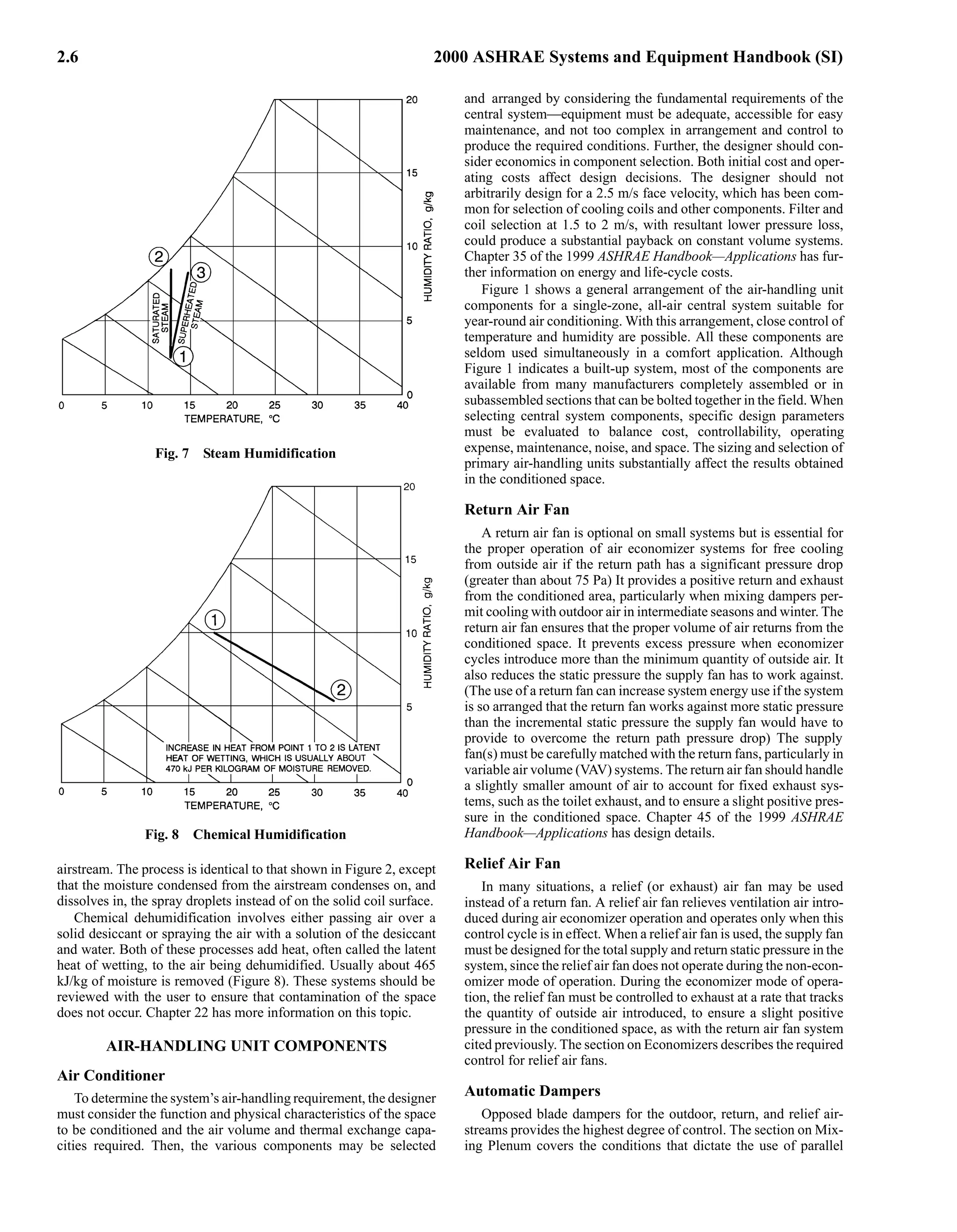
• Steam injection, which is a constant dry-bulb process (Figure 7).
However, as the steam injected becomes superheated, the leaving
dry-bulb temperature increases. If live steam is injected into the
airstream, the boiler water treatment chemical must be nontoxic
to the occupants and, if the air is supplying a laboratory, to the
research under way.
Dehumidification
Moisture condenses on a cooling coil when its surface tempera-
ture is below the dew point of the air, thus reducing the humidity of
the air. In a similar manner, air will also be dehumidified if a fluid
with a temperature below the airstream dew point is sprayed into the
Fig. 4 Water Spray Humidifier
Fig. 5 Steam, Hot Water, and Electric Heating
Fig. 6 Humidification
2.6 2000 ASHRAE Systems and Equipment Handbook (SI)
airstream. The process is identical to that shown in Figure 2, except
that the moisture condensed from the airstream condenses on, and
dissolves in, the spray droplets instead of on the solid coil surface.
Chemical dehumidification involves either passing air over a
solid desiccant or spraying the air with a solution of the desiccant
and water. Both of these processes add heat, often called the latent
heat of wetting, to the air being dehumidified. Usually about 465
kJ/kg of moisture is removed (Figure 8). These systems should be
reviewed with the user to ensure that contamination of the space
does not occur. Chapter 22 has more information on this topic.
AIR-HANDLING UNIT COMPONENTS
Air Conditioner
To determine the system’s air-handling requirement, the designer
must consider the function and physical characteristics of the space
to be conditioned and the air volume and thermal exchange capa-
cities required. Then, the various components may be selected
and arranged by considering the fundamental requirements of the
central system—equipment must be adequate, accessible for easy
maintenance, and not too complex in arrangement and control to
produce the required conditions. Further, the designer should con-
sider economics in component selection. Both initial cost and oper-
ating costs affect design decisions. The designer should not
arbitrarily design for a 2.5 m/s face velocity, which has been com-
mon for selection of cooling coils and other components. Filter and
coil selection at 1.5 to 2 m/s, with resultant lower pressure loss,
could produce a substantial payback on constant volume systems.
Chapter 35 of the 1999 ASHRAE Handbook—Applications has fur-
ther information on energy and life-cycle costs.
Figure 1 shows a general arrangement of the air-handling unit
components for a single-zone, all-air central system suitable for
year-round air conditioning. With this arrangement, close control of
temperature and humidity are possible. All these components are
seldom used simultaneously in a comfort application. Although
Figure 1 indicates a built-up system, most of the components are
available from many manufacturers completely assembled or in
subassembled sections that can be bolted together in the field. When
selecting central system components, specific design parameters
must be evaluated to balance cost, controllability, operating
expense, maintenance, noise, and space. The sizing and selection of
primary air-handling units substantially affect the results obtained
in the conditioned space.
Return Air Fan
A return air fan is optional on small systems but is essential for
the proper operation of air economizer systems for free cooling
from outside air if the return path has a significant pressure drop
(greater than about 75 Pa) It provides a positive return and exhaust
from the conditioned area, particularly when mixing dampers per-
mit cooling with outdoor air in intermediate seasons and winter. The
return air fan ensures that the proper volume of air returns from the
conditioned space. It prevents excess pressure when economizer
cycles introduce more than the minimum quantity of outside air. It
also reduces the static pressure the supply fan has to work against.
(The use of a return fan can increase system energy use if the system
is so arranged that the return fan works against more static pressure
than the incremental static pressure the supply fan would have to
provide to overcome the return path pressure drop) The supply
fan(s) must be carefully matched with the return fans, particularly in
variable air volume (VAV) systems. The return air fan should handle
a slightly smaller amount of air to account for fixed exhaust sys-
tems, such as the toilet exhaust, and to ensure a slight positive pres-
sure in the conditioned space. Chapter 45 of the 1999 ASHRAE
Handbook—Applications has design details.
Relief Air Fan
In many situations, a relief (or exhaust) air fan may be used
instead of a return fan. A relief air fan relieves ventilation air intro-
duced during air economizer operation and operates only when this
control cycle is in effect. When a relief air fan is used, the supply fan
must be designed for the total supply and return static pressure in the
system, since the relief air fan does not operate during the non-econ-
omizer mode of operation. During the economizer mode of opera-
tion, the relief fan must be controlled to exhaust at a rate that tracks
the quantity of outside air introduced, to ensure a slight positive
pressure in the conditioned space, as with the return air fan system
cited previously. The section on Economizers describes the required
control for relief air fans.
Automatic Dampers
Opposed blade dampers for the outdoor, return, and relief air-
streams provides the highest degree of control. The section on Mix-
ing Plenum covers the conditions that dictate the use of parallel
Fig. 7 Steam Humidification
Fig. 8 Chemical Humidification
Building Air Distribution 2.7
blade dampers. Pressure relationships between various sections
must be considered to ensure that automatic dampers are properly
sized for wide open and modulating pressure drops.
Relief Openings
Relief openings in large buildings should be constructed simi-
larly to outdoor air intakes, but they may require motorized or self-
acting backdraft dampers to prevent high wind pressure or stack
action from causing the airflow to reverse when the automatic
dampers are open. The pressure loss through relief openings should
be 25 Pa or less. Low-leakage dampers, such as those for outdoor
intakes, prevent rattling and minimize leakage. Relief dampers
sized for the same air velocity as the maximum outdoor air dampers
facilitate control when an air economizer cycle is used. The relief air
opening should be located so that the exhaust air does not short-cir-
cuit to the outdoor air intake.
Return Air Dampers
The negative pressure in the outdoor air intake plenum is a func-
tion of the resistance or static pressure loss through the outside air
louvers, damper, and duct. The positive pressure in the relief air ple-
num is, likewise, a function of the static pressure loss through the
exhaust or relief damper, the exhaust duct between the plenum and
outside, and the relief louver. The pressure drop through the return
air damper must accommodate the pressure difference between the
positive-pressure relief air plenum and the negative pressure outside
air plenum. Proper sizing of this damper facilitates both air balanc-
ing and mixing. An additional manual damper may be required for
proper air balancing.
Outdoor Air Intakes
Resistance through outdoor intakes varies widely, depending on
construction. Frequently, architectural considerations dictate the
type and style of louver. The designer should ensure that the louvers
selected offer minimum pressure loss, preferably not more than 25
Pa. High-efficiency, low-pressure louvers that effectively limit car-
ryover of rain are available. Flashing installed at the outside wall
and weep holes or a floor drain will carry away rain and melted
snow entering the intake. Cold regions may require a snow baffle to
direct fine snow particles to a low-velocity area below the dampers.
Outdoor dampers should be low-leakage types with special gas-
keted edges and special end treatment. Separate damper sections
with separate damper operators are strongly recommended for the
minimum outdoor air needed for ventilation. The maximum out-
door air needed for economizer cycles is then drawn through the
entire outside air damper.
Economizers
An economizer uses outside air to reduce the refrigeration
requirement. A logic circuit maintains a fixed minimum of ventila-
tion outside air. The air side economizer is an attractive option for
reducing energy costs when the climate allows. The air-side econo-
mizer takes advantage of cool outdoor air to either assist mechanical
cooling or, if the outdoor air is cool enough, provide total system
cooling. It is necessary to include some method of variable volume
relief when air-side economizers are employed, to exhaust the extra
outdoor air intake to outdoors. The relief volume may be controlled
by several different methods, including fan tracking (operating the
supply and return fans to maintain a constant difference in airflow
between them,) or relief air discharge dampers which modulate in
response to building space pressure. The relief system is off and
relief dampers are closed when the air-side economizer is inactive.
In systems with large return air static requirements, return fans or
exhaust fans may be necessary to properly exhaust building air and
take in outside air.
Advantages of Air-Side Economizers
• Substantially reduces compressor, cooling tower, and condenser
water pump energy requirements
• Has a lower air-side pressure drop than a water-side economizer
• Has a higher annual energy savings than a water-side economizer
• Reduces tower makeup water and related water treatment
Disadvantages of Air-Side Economizers
• Humidification may be required during winter operation
• Equipment room is generally placed along the building’s exterior
wall
• Installed cost may be higher than that for a water-side economizer
if the cost of providing the exhaust system requirements exceeds
the costs of piping, pump, and heat exchanger
Mixing Plenum
If the equipment is closely coupled to outdoor louvers in a wall,
the minimum outdoor air damper should be located as close as pos-
sible to the return damper connection. An outside air damper sized
for 7.5 m/s gives good control. Low-leakage outdoor air dampers
minimize leakage when closed during shutdown. The pressure dif-
ference between the relief plenum and outdoor intake plenum must
be measured through the return damper section. A higher velocity
through the return air damper—high enough to cause this loss at its
full open position—facilitates air balance and creates good mixing.
To create maximum turbulence and mixing, return air dampers
should be set so that any deflection of air is toward the outside air.
Parallel blade dampers may aid mixing. Mixing dampers should be
placed across the full width of the unit, even though the location of
the return duct makes it more convenient to return air through the
side. When return dampers are placed at one side, return air passes
through one side of a double-inlet fan, and cold outdoor air passes
through the other. If the air return must enter the side, some form of
air blender should be used.
Although opposed blade dampers offer better control, properly
proportioned parallel blade dampers are more effective for mixing
airstreams of different temperatures. If parallel blades are used,
each damper should be mounted so that its partially opened blades
direct the airstreams toward the other damper for maximum mixing.
Baffles that direct the two airstreams to impinge on each other at
right angles and in multiple jets create the turbulence required to
mix the air thoroughly. In some instances, unit heaters or propeller
fans have been used for mixing, regardless of the final type and con-
figuration of dampers. Otherwise, the preheat coil will waste heat,
or the cooling coil may freeze.
Filter Section
A system’s overall performance depends heavily on the filter.
Unless the filter is regularly maintained, system resistance increases
and airflow diminishes. Accessibility is the primary consideration
in filter selection and location. In a built-up system, there should be
at least 1 m between the upstream face of the filter bank and any
obstruction. Other requirements for filters can be found in Chapter
24 and in ASHRAE Standard 52.1.
Good mixing of outdoor and return air is also necessary for good
filter performance. A poorly placed outdoor air duct or a bad duct
connection to the mixing plenum can cause uneven loading of the
filter and poor distribution of air through the coil section. Because
of the low resistance of the clean areas, the filter gauge may not
warn of this condition.
Preheat Coil
The preheat coil should have wide fin spacing, be accessible for
easy cleaning, and be protected by filters. If the preheat coil is
located in the minimum outdoor airstream rather than in the mixed
airstream as shown in Figure 1, it should not heat the air to an exit
2.8 2000 ASHRAE Systems and Equipment Handbook (SI)
temperature above 2 to 7°C; preferably, it should become inopera-
tive at outdoor temperatures of 7°C. Inner distributing tube or inte-
gral face and bypass coils are preferable with steam. Hot water
preheat coils should have a constant flow recirculating pump and
should be piped for parallel flow so that the coldest air will contact
the warmest part of the coil surface first. Chapter 23 provides more
detailed information on heating coils.
Cooling Coil
In this section, sensible and latent heat are removed from the air.
In all finned coils, some air passes through without contacting the
fins or tubes. The amount of this bypass can vary from 30% for a
four-row coil at 3.5 m/s to less than 2% for an eight-row coil at 1.5
m/s. The dew point of the air mixture leaving a four-row coil might
satisfy a comfort installation with 25% or less outdoor air, a small
internal latent load, and sensible temperature control only. For close
control of room conditions for precision work, a deeper coil may be
required. Chapter 21 provides more information on cooling coils
and their selection.
Coil freezing can be a serious problem with chilled water coils.
Full flow circulation of chilled water during freezing weather, or
even reduced flow with a small recirculating pump, minimizes coil
freezing and eliminates stratification. Further, continuous full flow
circulation can provide a source of off-season chilled water in air-
and-water systems. Antifreeze solutions or complete coil draining
also prevent coil freezing. However, because it is difficult, if not
impossible, to drain most cooling coils completely, caution should
be exercised if this option is considered.
Reheat Coil
Reheat systems are strongly discouraged, unless recovered
energy is used (see ASHRAE Standard 90.1). Reheating is limited
to laboratory, health care, or similar applications where temperature
and relative humidity must be controlled accurately. Heating coils
located in the reheat position, as shown in Figure 1, are frequently
used for warm-up, although a coil in the preheat position is prefer-
able. Hot water heating coils provide the highest degree of control.
Oversized coils, particularly steam, can stratify the airflow; thus,
where cost-effective, inner distributing coils are preferable for
steam applications. Electric coils may also be used. Chapter 23 has
more information.
Humidifiers
Humidifiers may be installed as part of the central station air-
handling unit, or in terminals at the point of use, or both. Where
close humidity control of selected spaces is required, the entire sup-
ply airstream may be humidified to a lower humidity level in the air
handler, with terminal humidifiers located in the supply ducts serv-
ing just those selected spaces bringing them up to their required
humidity levels. For comfort installations not requiring close con-
trol, moisture can be added to the air by mechanical atomizers or
point-of-use electric or ultrasonic humidifiers. Proper location of
this equipment prevents stratification of moist air in the system.
In this application, the heat of evaporation should be replaced by
heating the recirculated water, rather than by increasing the size of
the preheat coil. Steam grid humidifiers with dew-point control usu-
ally are used for accurate humidity control. It is not possible to add
moisture to saturated air, even with a steam grid humidifier. Air in
a laboratory or other application that requires close humidity control
must be reheated after leaving a cooling coil before moisture can be
added. The capacity of the humidifying equipment should not
exceed the expected peak load by more than 10%. If the humidity is
controlled from the room or the return air, a limiting humidistat and
fan interlock may be needed in the supply duct. This prevents con-
densation and mold or mildew growth in the ductwork when tem-
perature controls call for cooler air. Humidifiers add some sensible
heat that should be accounted for in the psychrometric evaluation.
Chapter 20 has additional information.
Dehumidifiers
Many dehumidification systems are available. Dust can be a
problem with solid desiccants, and lithium contamination is a con-
cern with spray equipment. Chapter 21 discusses dehumidification
by cooling coils and Chapter 22 discusses desiccant dehumidifiers.
Odor Control
Most devices control odors and other contaminants with acti-
vated carbon or potassium permanganate as a basic filter medium.
Other systems use electronic control methods. Chapters 12 and 13
of the 1997 ASHRAE Handbook—Fundamentals have more infor-
mation on odor control.
Supply Air Fan
Either axial flow, centrifugal, or plug fans may be chosen as sup-
ply air fans for straight-through flow applications. In factory-fabri-
cated units, more than one centrifugal fan may be tied to the same
shaft. If headroom permits, a single-inlet fan should be chosen when
air enters at right angles to the flow of air through the equipment.
This permits a direct flow of air from the fan wheel into the supply
duct without abrupt change in direction and loss in efficiency. It also
permits a more gradual transition from the fan to the duct and
increases the static regain in the velocity pressure conversion. To
minimize inlet losses, the distance between the casing walls and the
fan inlet should be at least the diameter of the fan wheel. With a sin-
gle-inlet fan, the length of the transition section should be at least
half the width or height of the casing, whichever is longer. If fans
blow through the equipment, the air distribution through the down-
stream components needs analyzing, and baffles should be used to
ensure uniform air distribution. Chapter 18 has more information.
AIR-HANDLING UNIT CONCERNS
Outside Air Requirements
A common complaint regarding buildings is the lack of outside
air. This problem is especially a concern in VAV systems where out-
side air quantities are established for peak loads and are then
reduced in proportion to the air supplied during periods of reduced
load. A simple control added to the outside air damper can eliminate
this problem and keep the amount of outside air constant, regardless
of the operation of the VAV system. However, the need to preheat
the outside air must be considered if this control is added.
Another problem is that some codes require as little as 2.4 L/s per
person [about 0.25 L/(s·m2)] of outside air. This amount is far too
low for a building in which modern construction materials are used.
Higher outside air quantities may be required to reduce odors,
VOC’s, and potentially dangerous pollutants. ASHRAE Standard
62 provides information on ventilation for acceptable indoor air
quality. Air quality (i.e., the control or reduction of contaminants
such as volatile organic compounds, formaldehyde from furnish-
ings, and dust) must be reviewed by the engineer.
Heat recovery devices are becoming more popular as the
requirements for outside air increase. They are used extensively in
research and development facilities and in hospitals and laborato-
ries where HVAC systems supply 100% outside air. Many types are
available, and the type of facility usually determines which is most
suitable. Many countries with extreme climates provide heat
exchangers on outside/relief air, even for private homes. This trend
is now appearing in larger commercial buildings worldwide. Heat
recovery devices such as air-to-air plate heat exchangers can save
energy and reduce the required capacity of primary cooling and
heating plants by 20% and more under certain circumstances.
Building Air Distribution 2.9
The location of intake and exhaust louvers should be carefully
considered; in some jurisdictions, location is governed by codes.
Louvers must be separated enough to avoid short-circuiting of air.
Furthermore, intake louvers should not be near a potential source of
contaminated air such as a boiler stack or hood exhaust. Relief air
should also not interfere with other systems. If heat recovery
devices are used, intake and exhaust airstreams may need to run
together, such as through air-to-air plate heat exchangers.
Equipment Isolation
Vibration and sound isolation equipment is required for most
central fan installations. Standard mountings of fiberglass, ribbed
rubber, neoprene mounts, and springs are available for most fans
and prefabricated units. The designer must account for seismic
restraint requirements for the seismic zone in which the particular
project is located. In some applications, the fans may require con-
crete inertia blocks in addition to non-enclosed spring mountings.
Steel springs require sound-absorbing material inserted between the
springs and the foundation. Horizontal discharge fans operating at a
high static pressure frequently require thrust arrestors. Ductwork
connections to fans should be made with fireproof fiber cloth
sleeves having considerable slack, but without offset between the
fan outlet and rigid duct. Misalignment between the duct and fan
outlet can cause turbulence, generate noise, and reduce system effi-
ciency. Electrical and piping connections to vibration-isolated
equipment should be made with flexible conduit and flexible con-
nections. Special considerations are required in seismic zones.
Equipment noise transmitted through the ductwork can be
reduced by sound-absorbing units, acoustical lining, and other
means of attenuation. Sound transmitted through the return and
relief ducts should not be overlooked. Acoustical lining sufficient to
adequately attenuate any objectionable system noise or locally gen-
erated noise should be considered. Chapter 46 of the 1999 ASHRAE
Handbook—Applications, Chapter 7 of the 1997 ASHRAE Hand-
book—Fundamentals, and ASHRAE Standard 68 have further
information on sound and vibration control. Noise control, both in
the occupied spaces and outside near intake or relief louvers, must
be considered. Some local ordinances may limit external noise pro-
duced by these devices.
AIR DISTRIBUTION
Ductwork should deliver conditioned air to an area as directly,
quietly, and economically as possible. Structural features of the
building generally require some compromise and often limit depth.
Chapter 32 of the 1997 ASHRAE Handbook—Fundamentals
describes ductwork design in detail and gives several methods of
sizing duct systems. It is imperative that the designer coordinate
duct design with the structure. In commercially developed projects,
great effort is made to reduce floor-to-floor dimensions. The result-
ant decrease in the available interstitial space left for ductwork is a
major design challenge.
Room Terminals
In some instances, such as in low-velocity, all-air systems, the air
may enter from the supply air ductwork directly into the conditioned
space through a grille or diffuser. In medium and high-velocity air
systems, air terminal units normally control air volume, reduce duct
pressure, or both. Various types are available, including
1. A variable air volume (VAV) terminal unit, which varies the
amount of air delivered. This air may be delivered to low-pres-
sure ductwork and then to the space, or the terminal may contain
an integral air diffuser;
2. A fan-powered VAV terminal unit, which varies the amount of
primary air delivered, but also uses a fan to mix ceiling plenum
or return air with primary supply air before it is delivered to the
space;
3. An all-air induction terminal unit, which controls the volume of
primary air, induces ceiling plenum or space air, and distributes
the mixture through low-velocity ductwork to the space; and
4. An air-water induction terminal unit, which includes a coil or
coils in the induced airstream to condition the return air before it
mixes with the primary air and enters the space.
Chapter 17 has more information on room terminals and air ter-
minal units.
Ductwork Design
Chapter 32 of the 1997 ASHRAE Handbook—Fundamentals
covers calculation methods for duct design. The air distribution
ductwork and terminal devices selected must be compatible or the
system will either fail to operate effectively or incur high first, oper-
ating, and maintenance costs.
Duct Sizing. All-air duct systems can be designed for high or
low velocity. A high-velocity system has smaller ducts, which save
space but require higher pressures. In some low-velocity systems,
medium or high fan pressures may be required for balancing or to
overcome high pressure drops from terminal devices. In any vari-
able flow system, changing operating conditions can cause airflow
in the ducts to differ from design flow. Thus, varying airflow in the
supply duct must be carefully analyzed to ensure that the system
performs efficiently at all loads. This precaution is particularly true
with high-velocity air. Return air ducts are usually sized by the
equal friction method.
In many applications, the space between a hung ceiling and the
floor slab above it is used as a return air plenum, so that the return
air is collected at a central point. Governing codes should be con-
sulted before using this approach in new design, because most codes
prohibit combustible material in a ceiling space used as a return air
plenum. For example, the National Electrical Code Handbook
(NFPA 1996) requires that either conduit or PTFE insulated wire
(often called plenum rated cable) be installed in a return air plenum.
In addition, regulations often require that return air plenums be
divided into smaller areas by fire walls and that fire dampers be
installed in ducts, which increases first cost.
In research and some industrial facilities, return ducting must be
installed to avoid contamination and growth of biological contami-
nants in the ceiling space. Lobby ceilings with lay-in panels may not
work well as return plenums where negative pressure from high-rise
elevators or stack effects of high-rise buildings may occur. If the
plenum leaks to the low-pressure area, the tiles may lift and drop out
when the outside door is opened and closed. Return plenums
directly below a roof deck have substantially higher return air gain
than a ducted return, but have the advantage of reducing the heat
gain to or loss from the space.
Corridors should not be used for return air because they spread
smoke and other contaminants. While most codes ban returning air
through corridors, the method is still used in many older facilities.
All ductwork should be sealed. Energy waste due to leaks in the
ductwork and terminal devices can be considerable. The ductwork
installed in many commercial buildings can have leakage of 20% or
more.
SINGLE-DUCT SYSTEMS
Constant Volume
While maintaining constant airflow, single-duct constant volume
systems change the supply air temperature in response to the space
load (Figure 9).
Single-Zone Systems. The simplest all-air system is a supply
unit serving a single-temperature control zone. The unit can be
installed either in or remote from the space it serves, and it may
2.10 2000 ASHRAE Systems and Equipment Handbook (SI)
operate with or without distribution ductwork. Ideally, this system
responds completely to the space needs, and well-designed control
systems maintain temperature and humidity closely and efficiently.
Single zone systems often involve short ductwork with low pressure
drop and thus low fan energy, and single-zone systems can be shut
down when not required without affecting the operation of adjacent
areas, offering further energy savings. A return or relief fan may be
needed, depending on the capacity of the system and whether 100%
outdoor air is used for cooling as part of an economizer cycle. Relief
fans can be eliminated if provisions are made to relieve over pres-
surization by other means, such as gravity dampers.
Multiple-Zone Reheat. The multiple-zone reheat system is a
modification of the single-zone system. It provides (1) zone or
space control for areas of unequal loading; (2) simultaneous heating
or cooling of perimeter areas with different exposures; and (3) close
tolerance of control for process or comfort applications. As the
word reheat implies, heat is added as a secondary simultaneous pro-
cess to either preconditioned (cooled, humidified, etc.) primary air
or recirculated room air. Relatively small low-pressure systems
place reheat coils in the ductwork at each zone. More complex
designs include high-pressure primary distribution ducts to reduce
their size and cost and pressure reduction devices to maintain a con-
stant volume for each reheat zone.
The system uses conditioned air from a central unit generally at
a fixed cold air temperature that is low enough to meet the maxi-
mum cooling load. Thus, all supply air is always cooled the maxi-
mum amount, regardless of the current load. Heat is added to the
airstream in each zone to match the cooling capacity to the current
load in that zone. The result is very high energy use. However, the
supply air temperature from the unit can be varied, with proper con-
trol, to reduce the amount of reheat required and the associated
energy consumption. Care must be taken to avoid high internal
humidity when the temperature of air leaving the cooling coil is per-
mitted to rise during the spring and fall.
When a reheat system heats a space with an exterior exposure in
cold weather, the reheat coil must not only replace the heat lost from
the space, but also must offset the cooling of the supply air (enough
cooling to meet the peak load for the space), further increasing
energy consumption compared to other systems. If a constant vol-
ume system is oversized, the reheat cost becomes excessive.
Bypass. A variation of the constant volume reheat system is the
use of a bypass terminal unit instead of reheat. This system is essen-
tially a constant volume primary system with a VAV secondary sys-
tem. The quantity of room supply air is varied to match the space
load by dumping excess supply air into the return ceiling plenum or
return air duct, i.e., by bypassing the room. When bypass terminal
units dump to a return air plenum, the return air plenum temperature
is reduced and the plenum must be kept at a lower pressure than the
room so that cooler air does not spill into the room through the
return air grilles. A return fan is often used to create that negative
pressure. While this reduces the air volume supplied to the space,
the system air volume and fan energy remains constant. Refrigera-
tion or heating at the air-handling unit is reduced due to the lower
return air temperature. A bypass system is generally restricted to
small installations where a simple method of temperature control is
desired, a modest initial cost is desired, and energy conservation is
less important.
Variable Air Volume
A VAV system, as shown in Figure 10, controls temperature in a
space by varying the quantity of supply air rather than varying the
supply air temperature. A VAV terminal unit at the zone varies the
quantity of supply air to the space. The supply air temperature is
held relatively constant: while supply air temperature can be mod-
erately reset depending on the season, it must always be low enough
to meet the cooling load in the most demanding zone, and to main-
tain appropriate humidity. Variable air volume systems can be
applied to interior or perimeter zones, with common or separate
fans, with common or separate air temperature control, and with or
without auxiliary heating devices. The greatest energy saving asso-
ciated with VAV occurs at the perimeter zones, where variations in
solar load and outside temperature allow the supply air quantity to
be reduced. If the peak room load is not determined accurately, an
oversized VAV system will partially throttle at full load and may
become excessively noisy throttling at part loads.
Humidity control is a potential problem with VAV systems. If
humidity is critical, as in certain laboratories, process work, etc.,
systems may have to be limited to constant volume airflow. Partic-
ular care should be taken in areas where the sensible heat ratio
(ratio of sensible heat to sensible plus latent heat to be removed) is
low, such as in conference rooms. In these situations, the minimum
set point of the VAV terminal unit can be set at about 50% and
reheat added as necessary to keep humidity low during reduced
load conditions.
Other measures may also be used to maintain enough air circu-
lation through the room to absorb sufficient moisture to achieve ac-
ceptable humidity levels. The human body is more sensitive to
elevated air temperatures when there is little air movement. Mini-
mum air circulation can be maintained during reduced load by (1)
raising the supply air temperature of the entire system, which in-
creases space humidity, or supplying reheat on a zone-by-zone
basis; (2) providing auxiliary heat in each room independent of the
air system; (3) using individual zone recirculation and blending
varying amounts of supply and room air or supply and ceiling
plenum air with fan-powered VAV terminal units, or, if the design
Fig. 9 Constant Volume with Reheat and Bypass
Terminal Devices
Fig. 10 Variable Air Volume with Reheat, Induction and
Fan-Powered Devices
Building Air Distribution 2.11
permits, at the air-handling unit; (4) recirculating air with a VAV in-
duction unit, or (5) providing a dedicated recirculation fan to in-
crease airflow.
Variable Diffuser. The discharge aperture of this diffuser is
reduced to keep the discharge velocity relatively constant while
reducing the conditioned supply airflow. Under these conditions,
the induction effect of the diffuser is kept high, cold air mixes in the
space, and the room air distribution pattern is more nearly main-
tained at reduced loads. These devices are of two basic types—one
has a flexible bladder that expands to reduce the aperture, and the
other has a diffuser plate that physically moves. Both devices are
pressure-dependent, which must be considered in the design of the
duct -distribution system. They are either powered by the system or
pneumatically or electrically driven.
DUAL-DUCT SYSTEMS
A dual-duct system conditions all the air in a central apparatus and
distributes it to the conditioned spaces through two parallel mains or
ducts. One duct carries cold air and the other carries warm air. In each
conditioned space or zone, a valve mixes the warm and cold air in
proper proportion to satisfy the load of the space. A dual-duct system
uses more energy than a single-duct VAV system. Dual-duct systems
may be designed as constant volume or variable air volume. As with
other VAV systems, certain primary air configurations can cause high
relative humidity in the space during the spring and fall.
Constant Volume
Dual-duct constant volume systems are of two types:
Single Fan, No Reheat. This is similar to a single-duct system,
except that it contains a face-and-bypass damper at the cooling coil,
which is arranged to bypass a mixture of outdoor and recirculated
air as the internal heat load fluctuates in response to a zone thermo-
stat (Figure 11). A problem occurs during periods of high outdoor
humidity, when the internal heat load falls, causing the space
humidity to rise rapidly (unless reheat is added). It is identical in
concept to face-and-bypass cooling coils. This system has limited
use in most modern buildings because most occupants demand
more consistent temperature and humidity. In terms of energy use,
the single-fan, no reheat dual-duct system does not use any extra
energy for reheat, but fan energy is constant regardless of space load
since it is a constant volume system.
Single Fan, Reheat. This method is similar in effect to conven-
tional terminal reheat. There are two differences: reheat is applied at
a central point instead of at individual zones (Figure 12) and only
part of the supply air is cooled by the cooling coil, the other part
being heated by the hot deck coil. This uses less heating and cooling
energy than the terminal reheat system where all the air is cooled to
full cooling capacity, then all of it is reheated as required to match
the space load. Fan energy is constant since airflow is constant.
Variable Air Volume
Dual-duct VAV systems blend cold and warm air in various vol-
ume combinations. These systems may include single-duct VAV
terminal units connected to the cold air chamber of the air handler
(cold deck) for cooling only of interior spaces. This saves reheat
energy for the air for those cooling only zones because control is by
varying volume, not supply air temperature, which saves some fan
energy to the extent that the airflow to the interior zones is reduced
at lower loads.
Another VAV dual-duct variation uses terminal units that func-
tion like a single-duct VAV cooling terminal unit and a single-duct
VAV heating terminal unit in one physical package. This arrange-
ment allows the use of significant minimum airflow levels, provid-
ing temperature control by means of conventional dual-duct box
mixing at minimum airflow. This variation saves both heating and
cooling energy and fan energy because less air goes through each
coil, and the total air flow is reduced below full load.
Single fan. In this system, a single supply fan is sized for the
coincident peak of the hot and cold decks. Control of the fan is from
two static pressure controllers, one located in the hot deck and the
other in the cold deck. The duct requiring the highest pressure gov-
erns the airflow. Usually the cold deck is maintained at a fixed tem-
perature, although some central systems permit the temperature to
rise during warmer weather to save refrigeration. The temperature
of the hot deck is often adjusted higher during periods of low out-
side temperature and high humidity to increase the flow over the
cold deck for dehumidification. Other systems, particularly in lab-
oratories, use a precooling coil to dehumidify the total airstream or
just the outside air to limit humidity in the space. Return air quantity
can be controlled either by flow-measuring devices in the supply
and return duct or by static pressure controls that maintain space
static pressure.
Dual Fan. The volume of each supply fan is controlled indepen-
dently by the static pressure in its respective duct (Figure 13). The
return fan is controlled based on the sum of the hot and cold fan vol-
umes using flow-measuring stations. Each fan is sized for the antic-
ipated maximum coincident hot or cold volume, not the sum of the
instantaneous peaks. The cold deck can be maintained at a constant
temperature either with mechanical refrigeration when minimum
outside air is required or with an economizer when the outside air is
below the temperature of the cold deck set point. This operation does
not affect the hot deck, which can recover heat from the return air,
and the heating coil need operate only when heating requirements
cannot be met using return air. Outdoor air can provide ventilation air
via the hot duct when the outdoor air is warmer than the return air.
However, controls should be used to prohibit the introduction of
Fig. 11 Single Fan—No Reheat Fig. 12 Dual Duct—Single Fan
2.12 2000 ASHRAE Systems and Equipment Handbook (SI)
excessive amounts of outdoor air beyond the required minimum
when that air is more humid than the return air.
Dual Conduit. This method has two air supply paths—one off-
sets exterior transmission cooling or heating loads, and the other pro-
vides cooling throughout the year (Figure 14). The first airstream,
the primary air, operates as a constant volume system, and the air
temperature is varied to offset transmission only (i.e., it is warm in
winter and cool in summer). Often, however, the primary air fan is
limited to operating only during peak heating and cooling periods to
further save energy. When calculating the heating requirements for
this system, the cooling effect of the secondary air must be included,
even though the secondary system is operating at minimum flow.
The other airstream, or secondary air, is cool year-round and varies
in volume to match the load due to solar heating, lights, power, and
occupants. It serves both perimeter and interior spaces.
While Figure 14 shows the system with separate delivery paths
to the space from each conduit, a variation on the dual conduit sys-
tems uses dual-duct mixing boxes and a single delivery path to the
space. In this variation, the first airstream is always either return air
or heated air, never cooled air, and the other airstream has enough
capacity for the entire cooling load.
MULTIZONE SYSTEMS
The multizone system (Figure 11) supplies several zones from a
single, centrally located air-handling unit. Different zone require-
ments are met by mixing cold and warm air through zone dampers
at the air handler in response to zone thermostats. The mixed, con-
ditioned air is distributed throughout the building by single-zone
ducts. The return air is handled in a conventional manner. The mul-
tizone system is similar to the dual-duct system. In operation, it has
the same potential problem with high humidity levels. This system
can provide a smaller building with the advantages of a dual-duct
system, and it uses packaged equipment, which is less expensive.
Multizone packaged equipment is usually limited to about 12
zones, while built-up systems can include as many zones as can be
physically incorporated in the layout. From an energy standpoint, a
multizone system is somewhat more energy efficient than a terminal
reheat system because not all the air goes through the cooling coil,
which reduces the amount of reheat required. But a multizone sys-
tem uses essentially the same fan energy as terminal reheat, because
the airflow is constant.
Two common variations on the multizone system are called the
three-deck multizone and the Texas multizone. A three-deck multi-
zone system is similar to the standard multizone system, but neutral
deck (return air) zone dampers are installed in the air-handling unit
parallel with the hot deck and cold deck dampers. In the Texas mul-
tizone system, the hot deck heating coil is removed from the air han-
dler and replaced with an air resistance plate matching the pressure
drop of the cooling coil. Individual heating coils are placed only in
each perimeter zone duct. These heating coils are usually located in
the equipment room for ease of maintenance. This system is com-
mon in humid climates where the cold deck often produces 9 to
11°C air for humidity control. Supply air is then mixed with neutral
deck (return) air rather than heated air using the air-handling units’
zone dampers to maintain zone conditions. Heat is added only if the
zone served cannot be maintained by the delivery of return air alone.
These arrangements can save considerable reheat energy.
SPECIAL SYSTEMS
Primary/Secondary Systems
Some processes use two interconnected all-air systems (Figure
15). In these situations, space gains are very high and a large number
of air changes are required (e.g., in sterile or clean rooms or where
close-tolerance conditions are needed for process work). The pri-
mary systems supply the conditioned outside air requirements for
the process either to the secondary system or directly to the space.
The secondary system provides additional cooling and humidifica-
tion (and heating, if required) to offset space and fan power gains.
Normally, the secondary cooling coil is designed to be dry (i.e., sen-
sible cooling only) to reduce the possibility of bacterial growth,
which can create air quality problems.
Up Air System
In this system, also known as the displacement ventilation sys-
tem, air is supplied from the floor rather than from overhead. Spe-
cial terminal devices installed in a raised floor or as part of the
furniture provide individual control for computer workstations, for
example. This system is becoming common, particularly in Europe.
Wetted Duct/Supersaturated System
Some industries spray water into the airstream at central air-han-
dling units in sufficient quantities to create a controlled carryover
(Figure 16). This supercools the supply air, normally equivalent to
an oversaturation of about 1.4 g per kilogram of air and allows less
air to be distributed for a given space load. These are used where
high humidity is desirable, such as in the textile or tobacco industry,
and in climates where adiabatic cooling is sufficient.
Compressed Air and Water Spray System
This system is similar to the wetted duct system, except that the
water is atomized with compressed air. The nozzles are sometimes
Fig. 13 Variable Air Volume, Dual Duct, Dual Fan
Fig. 14 Dual Conduit System
Building Air Distribution 2.13
placed inside the conditioned space and independent of the cooling
air supply. Several types of nozzle are available, and the designer
should understand their advantages and disadvantages. Depending
on the type of nozzle, compressed air and water spray systems can
require large and expensive air compressors. The extra first cost
may or may not be offset by energy cost savings, depending on the
application.
Low-Temperature Systems
Because ice storage is being used to reduce peak electrical
demand, low-temperature systems (where air is supplied at as low
as 5°C) are sometimes used. Because the quantity of air supplied to
a zone is so small, special terminal units are used to maintain min-
imum airflow for comfort. These devices induce return or room air
to be mixed with the cold supply air to increase the air circulation
rate within the space.
Smoke Management
Air-conditioning systems are often used for smoke control dur-
ing fires. Controlled air flow can provide smoke-free areas for occu-
pant evacuation and fire fighter access. Space pressurization creates
a low-pressure area at the smoke source, surrounding it with high-
pressure spaces. For more information, see Chapter 51 of the 1999
ASHRAE Handbook—Applications. Design of Smoke Management
Systems (Klote and Milke 1992) also has detailed information on
this topic.
TERMINAL UNITS
Terminal units are the devices between the primary air distribu-
tion systems and the conditioned space. Air distribution systems
have two different types of terminal units: (1) supply outlets (regis-
ters or diffusers) and return inlets (grilles) and (2) terminal units.
The function of the register or diffuser is to deliver the supply air
throughout the conditioned space without occupants sensing a draft
and without creating excessive noise. The function of the terminal
unit is to control the quantity and/or temperature of the supply air to
maintain the desired conditions in the space. Both types of terminal
units are discussed in Chapter 17 of this volume and Chapter 31 of
the 1997 ASHRAE Handbook—Fundamentals. Terminal units are
discussed here briefly in terms of how they fit into the system con-
cept, but Chapter 17 in this volume should be consulted for more
complete information.
Constant Volume Reheat Terminal Units
Constant volume reheat terminal boxes are used mainly in termi-
nal reheat systems with medium- to high-velocity ductwork. The
unit serves as a pressure reducing valve and constant volume regu-
lator to maintain a constant supply air quantity to the space, and is
generally fitted with an integral reheat coil that controls temperature
in the space. The constant supply air quantity is selected to provide
cooling to match the peak load in the space, and the reheat coil is
controlled to raise the supply air temperature as necessary to main-
tain the desired space temperature at reduced loads.
VAV Terminal Units
VAV terminal units are available in many configurations, all of
which control the space temperature by varying the volume of cool
supply air from the air handler to match the actual cooling load.
VAV terminal units are fitted with automatic controls that are either
pressure dependent or pressure independent. Pressure dependent
units control damper position in response to room temperature and
the flow may increase and decrease as the pressure at that point in
the main duct varies.
Pressure independent units measure actual supply airflow and
control that flow in response to room temperature. Pressure depen-
dent units may sometimes be fitted with a velocity limit control that
overrides the room temperature signal to limit the measured supply
velocity to some selected maximum. Velocity limit control can be
used to prevent excess airflow through units nearest the air handler.
Excessive airflow at units close to the air handler can draw so much
supply air that units far from the air handler do not get enough air.
Throttling Unit Without Reheat. The throttling (or pinch-off)
box without reheat is essentially an air valve or damper that reduces
the supply airflow to the space in response to falling space temper-
ature. The unit usually includes some means of sound attenuation to
reduce the air noise created by the throttling action. It is the simplest
and least expensive of the VAV terminal units, but is suitable for use
only where no heat is required and the unit can go to the completely
closed position at reduced cooling loads. If this type of unit is set up
with a minimum position, it will always be providing cooling to the
space, whether the space needs it or not, and can overcool the space.
This approach offers the lowest fan energy use, because it mini-
mizes airflow to just the amount required by the cooling load.
Throttling Box With Reheat. This simple VAV system inte-
grates heating at the terminal unit with the same type of throttling
box. It is applied in interior and exterior zones where full heating
and cooling flexibility is required. These terminal units can be set to
maintain a predetermined minimum throttling ratio, which is estab-
lished as the lowest air quantity necessary to (1) offset the heating
load, (2) limit the maximum humidity, (3) provide reasonable air
movement in the space, and (4) provide required ventilation air. The
reheat coil is most commonly hot water or electric, but can be steam.
Fig. 15 Primary/Secondary System
Fig. 16 Supersaturated/Wetted Coil
2.14 2000 ASHRAE Systems and Equipment Handbook (SI)
Variable air volume with reheat permits airflow to be reduced as
the first step in control; heat is then initiated as the second step.
Compared to constant volume reheat, this procedure reduces oper-
ating cost appreciably because the amount of primary air to be
cooled and secondary air to be heated is reduced. Many types of
controls can provide control sequences with more than one mini-
mum airflow. This type of control allows the box to go to a lower
flow rate that just meets ventilation requirements at the lightest
cooling loads, and then increase to a higher flow rate when the heat-
ing coil is energized, further reducing the use of reheat energy. A
feature can be provided to isolate the availability of reheat during
the summer, except in situations where even low airflow would
overcool the space and should be avoided or where an increase in
humidity causes discomfort (e.g., in conference rooms when the
lights are turned off).
Because the reheat coil requires some minimum airflow to
deliver heat to the space, and because the reheat coil must absorb all
of the cooling capacity of that minimum airflow before it starts to
deliver heat to the space in cold weather, energy use can be signifi-
cantly higher than with throttling boxes that go fully closed.
Induction. The VAV induction system uses a terminal unit to
reduce cooling capacity by simultaneously reducing primary air and
inducing room or ceiling air (replaces the reheat coil) to maintain a
relatively constant room supply volume. This operation is the
reverse of the bypass box described previously. The primary air
quantity decreases with load, retaining the savings of VAV, while the
air supplied to the space is kept relatively constant to avoid the
effect of stagnant air or low air movement. VAV induction units
require a higher inlet static pressure, which requires more fan
energy, in order to achieve the velocities necessary for induction.
Fan-Powered. Fan-powered systems are available in either par-
allel or series airflow. In parallel flow units, the fan is located out-
side the primary airstream to allow intermittent fan operation. A
backdraft damper on the terminal fan prevents conditioned air from
escaping into the return air plenum when the terminal fan is off. In
series units, the fan is located in the primary airstream and runs con-
tinuously when the zone is occupied. These constant airflow fan
boxes in a common return plenum can help maintain indoor air qual-
ity by recirculating “unvitiated” air from overventilated zones to
zones with greater outdoor air ventilation requirements.
Fan-powered systems, both series and parallel, are often selected
because they maintain higher air circulation through a room at low
loads while still retaining the advantages of VAV systems. As the
cold primary air valve modulates from maximum to minimum (or
closed), the unit recirculates more plenum air. In a perimeter zone,
a hot water heating coil, electric heater, baseboard heater, or remote
radiant heater can be sequenced with the primary air valve to offset
external heat losses. Between heating and cooling operations, the
fan only recirculates ceiling air. This operation permits heat from
lights to be used for space heating for maximum energy saving.
During unoccupied periods, the main supply air-handling unit
remains off and individual fan-powered heating zone terminals are
cycled to maintain required space temperature, thereby reducing
operating cost during unoccupied hours.
Fans for fan-powered air-handling units operated in series are
sized and operated to maintain the minimum static pressures at the
unit inlet connections. This reduces the fan energy for the central air
handler, but the small fans in the fan-powered units are less efficient
than the large air handler fans. As a result, the series type fan pow-
ered unit (where those small fans operate continuously) may use
more fan energy than a throttling unit system. However, that extra
fan energy may be more than offset by the reduction in reheat
through the recovery of plenum heat and the ability to operate a
small fan to deliver heat during unoccupied hours only where heat
is needed.
Because fan-powered boxes involve an operating fan, they may
generate higher sound levels than throttling type boxes. Acoustical
ceilings generally are not very effective sound barriers, so extra care
should be taken in considering the sound level in critical spaces
below fan-powered terminal units.
Both parallel and series fan-powered terminal units may be pro-
vided with filters. The constant (series) fan VAV terminal can
accommodate minimum (down to zero) flow at the primary air inlet
while maintaining constant airflow to the space.
Both types of fan powered units and induction terminal units are
usually located in the ceiling plenum to recover heat from lights.
This allows these terminals to be used without reheat coils in inter-
nal spaces. Perimeter zone units are sometimes located above the
ceiling of an interior zone where heat from the lights maintains a
higher plenum temperature. Provisions must still be made for morn-
ing warm-up and night heating. Also, interior spaces with a roof
load must have heat supplied either separately in the ceiling or at the
terminal.
Terminal Humidifiers
Most projects requiring humidification use steam. This can be
centrally generated as part of the heating plant, where potential con-
tamination from the water treatment of the steam is more easily han-
dled and therefore of less concern. Where there is a concern, local
generators (e.g., electric or even gas) that use treated water are used.
Compressed air and water humidifiers are used to some extent, and
supersaturated systems are used exclusively for special circum-
stances, such as industrial processes. Spray-type washers and wet-
ted coils are also more common in industrial facilities. When using
water directly, particularly in recirculating systems, the water must
be treated to avoid the accumulation of dust during evaporation and
the buildup of bacterial contamination.
Terminal Filters
In addition to the air-handling unit filters, terminal filters may
used at the supply outlets to protect particular conditioned spaces
where an extra clean environment is desired. Chapter 24 discusses
this topic in detail.
AIR DISTRIBUTION SYSTEM CONTROLS
Controls should be automatic and simple for best operating
and maintenance efficiency. Operations should follow a natural
sequence—depending on the space need, one controlling thermostat
closes a normally open heating valve, opens the outdoor air mixing
dampers, or opens the cooling valve. In certain applications, an
enthalpy controller, which compares the heat content of outdoor air
to that of return air, may override the temperature controller. This
control opens the outdoor air damper when conditions reduce the
refrigeration load. On smaller systems, a dry-bulb control saves the
cost of the enthalpy control and approaches these savings when an
optimum changeover temperature, above the design dew point, is
established. Controls are discussed in more detail in Chapter 45 of
the 1999 ASHRAE Handbook—Applications.
Air-handling systems, especially variable air volume systems,
should include means to measure and control the amount of outside
air being brought in to assure adequate ventilation for acceptable
indoor air quality. Strategies used to assure adequate outside air ven-
tilation include
• Separate constant volume 100% outside air ventilation systems
• Direct measurement of the flow rate of outside air
• Modulating the return damper to maintain a constant pressure
drop across a fixed outside air orifice
• Fan tracking systems that maintain a constant difference in air-
flow between supply and return fans
• CO2 and/or VOC based demand controlled ventilation
A minimum outdoor air damper with separate motor, selected for
a velocity of 7.5 m/s, is preferred to one large outdoor air damper
Building Air Distribution 2.15
with minimum stops. A separate damper simplifies air balancing.
The proper selection of outside, relief, and return air dampers is crit-
ical for efficient operation. Most dampers are grossly oversized and
are, in effect, unable to control. One method of solving this problem
is to provide maximum and minimum dampers. A high enough
velocity across a wide open damper is essential to its providing
effective control.
A mixed air temperature control can reduce operating costs and
also reduce temperature swings from load variations in the condi-
tioned space. Chapter 45 of the 1999 ASHRAE Handbook—Appli-
cations shows control diagrams for various arrangements of central
system equipment. Direct digital control (DDC) is common, and
most manufacturers offer either a standard or an optional DDC
package for equipment including air-handling units, terminal units,
etc. These controls offer a considerable degree of flexibility. DDC
controls offer the additional advantage of the ability to record easily
actual energy consumption or other operating parameters of the var-
ious components of the system, which can be useful for optimizing
control strategies.
Constant Volume Reheat. This system typically uses two sub-
systems for control—one controls the discharge air conditions from
the air-handling unit, and the other maintains the space conditions
by controlling the reheat coil.
Variable Air Volume. Air volume can be controlled by duct-
mounted terminal units serving a number of air outlets in a control
zone or by units integral to each supply air outlet.
Pressure-independent volume regulator units control flow in
response to the thermostat’s call for heating or cooling. The required
flow is maintained regardless of fluctuation of the VAV unit inlet or
system pressure. These units can be field or factory adjusted for
maximum and minimum (or shutoff) air settings. They operate at
inlet static pressures as low as 50 Pa for maximum unit design vol-
ume.
Pressure-dependent devices control air volume in response to a
unit thermostatic (or relative humidity) device, but the flow varies
with the inlet pressure variation. Generally, airflow oscillates when
pressure varies. These thermostatic units do not regulate the flow
but position the volume-regulating device in response to the ther-
mostat. These units are the least expensive and should only be used
where there is no need for maximum or minimum limit control and
when the pressure is stable.
The type of controls available for VAV units varies with the ter-
minal device. Most use either pneumatic or electric controls and
may be either self-powered or system air actuated. Self-powered
controls position the regulator by using liquid- or wax-filled power
elements. System-powered devices use air from the air supplied to
the space to power the operator. Components for both control and
regulation are usually contained in the terminal device.
To conserve power and limit noise, especially in larger systems,
fan-operating characteristics and system static pressure should be
controlled. Many methods are available, including fan speed con-
trol, variable inlet vane control, fan bypass, fan discharge damper,
and variable pitch fan control. The location of the pressure-sensing
devices depends, to some extent, on the type of VAV terminal unit
used. Where pressure-dependent units without controllers are used,
the system pressure sensor should be near the static pressure mid-
point of the duct run to ensure minimum pressure variation in the
system. Where pressure-independent units are installed, pressure
controllers may be at the end of the duct run with the highest static
pressure loss. This sensing point ensures maximum fan power sav-
ings while maintaining the minimum required pressure at the last
terminal.
As the flow through the various parts of a large system varies, so
does the static pressure. Some field adjustment is usually required to
find the best location for the pressure sensor. In many systems, the
initial location is two-thirds to three-fourths of the distance from the
supply fan to the end of the main trunk duct. As the pressure at the
system control point increases due to the closing of terminal units,
the pressure controller signals the fan controller to position the fan
volume control, which reduces flow and maintains constant pres-
sure. Many present-day systems measure flow rather than pressure
and, with the development of economical DDC, each terminal unit
(if necessary) can be monitored and the supply and return air fans
modulated to exactly match the demand.
Dual-Duct. As dual-duct systems are generally more energy-
intensive than single-duct systems, their use is less widespread. The
use of DDC, with its ability to maintain set points and flow accu-
rately, can make dual-duct systems worthwhile for certain applica-
tions. They should be seriously considered as alternatives to single-
duct systems.
Personnel. The personnel operating and maintaining the air con-
ditioning and controls should be considered. In large research and
development or industrial complexes, experienced personnel are
available for maintenance. On small and sometimes even large com-
mercial installations, however, office managers are often responsi-
ble, so designs must be in accordance with their capabilities.
Valves. Most valves are sized reasonably well, although the
same problems can occur as with dampers. On large hydraulic
installations where direct blending is used to maintain the secondary
water temperature, the system must be accurately sized for proper
control. Many designers use variable flow for hydronic as well as air
systems, so the design must be compatible with the air system to
avoid operating problems.
Relief Fans. In many applications, relief or exhaust fans can be
started in response to a signal from the economizer control or to a
space pressure controller. The main supply fan must be able to han-
dle the return air pressure drop when the relief fan is not running.
REFERENCES
ASHRAE. 1992. Gravimetric and dust spot procedures for testing air clean-
ing devices used in general ventilation for removing particulate matter.
ANSI/ASHRAE Standard 52.1-1992.
ASHRAE. 1992. Thermal environmental conditions for human occupancy.
ANSI/ASHRAE Standard 55-1992.
ASHRAE. 1997. Laboratory method to determine the sound power in a duct.
ANSI/ASHRAE Standard 68-1997.
ASHRAE. 1999. Energy efficient design of new buildings except low-rise
residential. Standard 90.1-1999.
ASHRAE. 1999. Ventilation for acceptable indoor air quality. Standard 62-
1999.
Kirkpatrick, A.T. and J.S. Elleson. 1996. Cold air distribution system design
guide. ASHRAE.
Klote, J.H. and J.A. Milke. 1992. Design of smoke management systems.
ASHRAE.
Lorsch, H.G., ed. 1993. Air-conditioning systems design manual. ASHRAE.
NFPA. 1999. National electrical code handbook, 8th ed. National Fire Pro-
tection Association, Quincy, MA.
3.1
CHAPTER 3
IN-ROOM TERMINAL SYSTEMS
Exterior Zone Air-Conditioning Loads ..................................... 3.1
System Description .................................................................... 3.1
Induction Units .......................................................................... 3.2
Fan-Coil Units ........................................................................... 3.2
Primary Air Systems .................................................................. 3.5
Performance under Varying Load ............................................. 3.6
Changeover Temperature .......................................................... 3.7
Refrigeration Load .................................................................... 3.7
Two-Pipe Systems ...................................................................... 3.7
Three-Pipe Systems ................................................................. 3.10
Four-Pipe Systems ................................................................... 3.10
Secondary Water Distribution ................................................. 3.11
N-ROOM TERMINAL SYSTEMS condition spaces by distri-
Ibuting air and water sources to terminal units installed in habit-
able spaces throughout a building. In some systems the air is distrib-
uted to the space directly, not through the terminal unit. The air and
water are cooled or heated in central equipment rooms. The air sup-
plied is called primary or ventilation air; the water supplied is called
secondary water. Sometimes a separate electric heating coil is
included in lieu of a hot water coil. This chapter describes induction
units and fan-coil units used in in-room terminal unit systems.
In-room terminal unit systems are applied primarily to exterior
spaces of buildings with high sensible loads and where close control
of humidity is not required. In some cases they may be applied to
interior zones. They work well in office buildings, hospitals, hotels,
schools, apartment buildings, and research laboratories. In most cli-
mates, these systems are installed in exterior building spaces and are
designed to provide (1) all required space heating and cooling, (2)
outside air for ventilation, and (3) simultaneous heating and cooling
in different parts of the building during intermediate seasons.
EXTERIOR ZONE AIR-CONDITIONING LOADS
The variation in air-conditioning load for exterior building spaces
causes significant variations in space cooling and heating require-
ments, even in rooms that have the same exposure. Accordingly,
accurate environmental control in exterior building spaces requires
individual control. The following basic loads must be considered.
Internal Loads. Heat gain from lights is always a cooling load,
and in most buildings (other than residential) it is relatively constant
during the day. Lights may be turned off manually or automatically
when not required, which makes lighting loads more variable. Heat
gain from occupants is also a cooling load and is commonly the only
room load that contains a latent component. Heat gain from com-
puters and other equipment can vary greatly and is an important fac-
tor in building design.
External Loads. Solar heat gain is always a cooling load. It is
often the chief cooling load and is highly variable. For a given
space, solar gain always varies during the day. The magnitude and
rate of change of this load depend on building orientation, glass
area, capacity to store heat, and cloud cover. Constantly changing
shade patterns from adjacent buildings, trees, or exterior columns
and nonuniform overhangs cause significant variations in solar load
between adjacent offices on the same solar exposure.
Transmission load can be either a heat loss or a heat gain,
depending on the outdoor temperature.
Moderate pressurization of the building with ventilation air is
normally sufficient to offset summer infiltration provided it is uni-
formly positive. In winter, however, infiltration can cause a signif-
icant heat loss, particularly on the lower floors of high-rise
buildings. The magnitude of this component varies with the wind
and stack effect, as well as with the temperature difference across
the outside wall.
To perform successfully, an air-conditioning system must satisfy
these load variations on a room-by-room basis and fulfill all other
performance criteria, such as humidity control, filtration, air move-
ment, ventilation, and noise.
SYSTEM DESCRIPTION
An in-room terminal unit system includes central air-condition-
ing equipment, a duct and water distribution system, and a room ter-
minal. The terminal may be an induction unit or a fan-coil unit.
Larger spaces may be handled by several terminals. Generally, the
supply air volume is constant. (As noted in the first paragraph, sup-
ply air is called primary air or ventilation air to distinguish it from
room air or secondary air that has been recirculated.) The quantity
of primary air supplied to each space is determined by (1) the
amount of outside air required for ventilation and (2) if used for sen-
sible cooling, the required sensible cooling capacity at maximum
room cooling load. In some low cost units with a fan coil, air for
ventilation can be introduced through building apertures, which
eliminates the primary air system.
In the cooling season, the air is dehumidified sufficiently in the
central conditioning unit to maintain comfortable humidity condi-
tions and to prevent condensation on the room cooling coil from the
normal room latent load. In winter, moisture can be added centrally
to limit dryness. As the air is dehumidified, it is also cooled to offset
a portion of the room sensible loads. The air may be from outdoors,
or may be a mixture of outdoor and return air. A preheater is usually
required in areas with freezing weather. High-efficiency filters keep
the induction unit nozzles clean. Whether or not reheaters are
included in the air-handling equipment depends on the type of sys-
tem, as explained in the section on Primary Air Systems.
In the ideal in-room terminal unit design, the secondary cooling
coil is always dry; this greatly extends terminal unit life and elimi-
nates odors and the possibility of bacterial growth. The primary air
normally controls the space humidity. Therefore, the moisture con-
tent of the supply air must be low enough to offset the room latent
heat gain and to maintain a room dew point low enough to preclude
condensation on the secondary cooling surface. But even though
some systems operate successfully with little or no condensate, a
condensate drain is recommended for in-room terminal units.
In existing induction systems, the energy conservation technique
of raising the chilled water temperature on central air-handling
cooling coils can damage the terminal cooling coil, causing it to be
used constantly as a dehumidifier. Unlike fan-coil units, the induc-
tion unit is not designed or constructed to handle condensation.
Therefore, it is critical that an induction terminal operates dry.
The water side, in its basic form, consists of a pump and piping
to convey water to the heat transfer surface in each conditioned
space. The water can be cooled by direct refrigeration, but it is more
commonly cooled either by bleeding chilled water from the primary
The preparation of this chapter is assigned to TC 9.1, Large Building Air-
Conditioning Systems.
3.2 2000 ASHRAE Systems and Equipment Handbook (SI)
cooling system into the secondary water system or by transferring
heat through a water-to-water exchanger. To distinguish it from the
primary chilled water circuit, the water side is usually referred to as
the secondary water loop or system.
In-room terminals are categorized as two-pipe, three-pipe, or
four-pipe systems. They are basically similar in function and
include both cooling and heating capabilities for year-round air con-
ditioning. Sections at the end of this chapter discuss these piping
arrangements in detail. Chapter 12 discusses the arrangements of
the secondary water circuits and their control systems, which differ
depending on the type of secondary water.
INDUCTION UNITS
Figure 1 shows a basic arrangement for an induction unit termi-
nal. Centrally conditioned primary air is supplied to the unit plenum
at medium to high pressure. The acoustically treated plenum atten-
uates part of the noise generated in the unit and duct. A balancing
damper adjusts the primary air quantity within limits.
Medium- to high-velocity air flows through the induction noz-
zles and induces secondary air from the room through the secondary
coil. Thus the primary air provides the energy required to circulate
the secondary air over the coil in the terminal unit. This secondary
air is either heated or cooled at the coil, depending on the season, the
room requirement, or both. Ordinarily, the room coil does no latent
cooling, but a drain pan without a piped drain collects condensed
moisture from temporary latent loads such as at startup. This con-
densed moisture then re-evaporates when the temporary latent loads
are no longer present. Primary and secondary air is mixed and dis-
charged to the room.
A lint screen is normally placed across the face of the secondary
coil. Induction units are installed in custom enclosures designed for
the particular installation or in standard cabinets provided by the
manufacturer. These enclosures must permit proper flow of second-
ary air and discharge of mixed air without imposing excessive pres-
sure loss. They must also allow easy servicing.
Induction units are usually installed under a window at a perim-
eter wall, although units designed for overhead installation are
available. During the heating season, the floor-mounted induction
unit can function as a convector during off-hours, with hot water to
the coil and without a primary air supply. A number of induction
unit configurations are available, including units with low overall
height or with larger secondary coil face areas to suit particular
space or load needs.
Advantages
• Individual room temperature control allows the adjustment of
each thermostat for a different temperature at relatively low cost.
• Separate heating and cooling sources in the primary air and sec-
ondary water give the occupant a choice of heating or cooling.
• Less space is required for the distribution system when the air
supply is reduced by using secondary water for cooling and high-
velocity air. The return air duct is smaller and can sometimes be
eliminated or combined with the return air system for other areas,
such as the interior spaces.
• The size of the central air-handling apparatus is smaller than that
of an all air system because little air must be conditioned.
• Dehumidification, filtration, and humidification are performed in
a central location remote from conditioned spaces.
• Ventilation air supply is positive and may accommodate recom-
mended outside air quantities.
• Space can be heated without operating the air system via the sec-
ondary water system. Nighttime fan operation is avoided in an
unoccupied building. Emergency power for heating, if required,
is much lower than for most all-air systems.
• Components are long-lasting. Room terminals operated dry have
an anticipated life of 15 to 25 years. The piping and ductwork lon-
gevity should equal that of the building. Individual induction
units do not contain fans, motors, or compressors. Routine service
is generally limited to temperature controls, cleaning of lint
screens, and infrequent cleaning of the induction nozzles.
Disadvantages
• For most buildings, these systems are limited to perimeter space;
separate systems are required for other areas.
• More controls are needed than for many all-air systems.
• Secondary airflow can cause the induction unit coils to become
dirty enough to affect performance. Lint screens used to protect
these terminals require frequent in-room maintenance and reduce
unit thermal performance.
• The primary air supply usually is constant with no provision for
shutoff. This is a disadvantage in residential applications, where
tenants or hotel room guests may prefer to turn off the air condi-
tioning, or where management may desire to do so to reduce oper-
ating expense.
• A low primary chilled water temperature is needed to control
space humidity adequately.
• The system is not appropriate for spaces with high exhaust
requirements (e.g., research laboratories) unless supplementary
ventilation air is provided.
• Central dehumidification eliminates condensation on the second-
ary water heat transfer surface under maximum design latent
load. However, abnormal moisture sources (e.g., from open win-
dows or people congregating) can cause condensation that can
have annoying or damaging results.
• Energy consumption for induction systems is higher than for most
other systems due to the increased power required by the primary
air pressure drop in the terminal units.
• The initial cost for a four-pipe induction system is greater than for
most all-air systems.
FAN-COIL UNITS
Fan-coil unit systems include cooling as well as heating, nor-
mally move air by forced convection through the conditioned space,
filter the circulating air, and introduce outside ventilation air. Fan-
coil units with chilled water coils, heating coils, blowers, replace-
able air filters, drain pans for condensate, etc., are designed for these
purposes. These units are available in various configurations to fit
under window sills, above furred ceilings, in vertical pilasters built
into walls, etc. These units must be properly controlled by thermo-
stats for heating and cooling temperature control, by humidistats for
humidity control, by blower control or other means for regulating
air quantity, and they must have a method for adding ventilation air.
into the building.
Fig. 1 Induction Unit
In-Room Terminal Systems 3.3
Basic elements of fan-coil units are a finned-tube coil, filter, and
fan section (Figure 2). The fan recirculates air continuously from
the space through the coil, which contains either hot or chilled
water. The unit may contain an additional electric resistance, steam,
or hot water heating coil. The electric heater is often sized for fall
and spring to avoid changeover problems in two-pipe systems.
A cleanable or replaceable 35% efficiency filter, located
upstream of the fan, prevents clogging of the coil with dirt or lint
entrained in the recirculated air. It also protects the motor and fan,
and reduces the level of airborne contaminants in the conditioned
space. The fan-coil unit is equipped with an insulated drain pan. The
fan and motor assembly is arranged for quick removal for servicing.
Most manufacturers furnish units with cooling performance certi-
fied as meeting Air-Conditioning and Refrigeration Institute (ARI)
standards. The prototypes of the units have been tested and labeled
by Underwriters’Laboratories (UL), or Engineering Testing Labo-
ratories (ETL), as required by some codes.
Fan-coil units, with a dampered opening for connection to
apertures in the outside wall, are available. These units are not
suitable for commercial buildings because wind pressure allows
no control over the amount of outside air that is admitted. Also,
freeze protection may be required in cold climates. However they
are often used in residential construction because of simplicity of
operation, low first cost, and the operable windows can unbalance
a duct ventilation air system. Fan-coil units for the domestic mar-
ket are generally available in nominal sizes ranging from 0.1 to
0.6 m3/s, often with multispeed, high-efficiency fan motors.
Where units do not have individual outside air intakes, means
must be provided to introduce retreated outside air through a duct
system that engages each room or space.
Types and Location
Fan-coil units are available in many configurations. Figure 3
shows several vertical units. Low vertical units are available for
use under windows with low sills; however, in some cases, the low
silhouette is achieved by compromising such features as filter area,
motor serviceability, and cabinet style.
Floor-to-ceiling, chase-enclosed units are available in which the
water and condensate drain risers are part of the factory-furnished
unit. These units are used extensively in hotels and other residential
buildings. The supply and return air must be isolated from each
other to prevent air and sound interchange between rooms.
Vertical models or chase enclosed models located at the perime-
ter give better results in climates or buildings with high heating
requirements. Heating is enhanced by under-window or exterior
wall locations. Vertical units can be operated as convectors with the
fans turned off during night setback.
Horizontal overhead units may be fitted with ductwork on the
discharge to supply several outlets. A single unit may serve several
rooms (e.g., in an apartment house where individual room control is
not essential and a common air return is feasible). Units must have
larger fan motors designed to handle the higher pressure drops of
ductwork.
Horizontal models conserve floor space and usually cost less, but
when located in furred ceilings, they create problems such as con-
densate collection and disposal, mixing of return air from other
rooms, leakage of pans causing damage to ceilings, difficulty of
access for filter and component removal, and air quality concerns.
When outside air is introduced from a central ventilation system it
may be connected directly to the inlet plenums of horizontal units or
introduced directly into the space. If introduced directly, provisions
Fig. 2 Typical Fan-Coil Unit
Fig. 3 Typical Fan-Coil Unit Arrangements
3.4 2000 ASHRAE Systems and Equipment Handbook (SI)
should be made to ensure that this air is pretreated and held at a
temperature equal to the room temperature so as not to cause
occupant discomfort when the unit is off. One way to prevent air
leakage is to provide a spring-loaded motorized damper that closes
off the ventilation air whenever the unit’s fan is off. Coil selection
must be based on the temperature of the entering mixture of primary
and recirculated air, and the air leaving the coil must satisfy the room
sensible and latent cooling and heating requirements.
Selection
Some designers size fan-coil units for nominal cooling at the
medium speed setting when a three-speed control switch is pro-
vided. This method ensures quieter operation in the space and adds
a safety factor, in that capacity can be increased by operating at high
speed. Sound power ratings are available from many manufacturers.
Only the internal space heating and cooling loads need to be han-
dled by the terminal fan-coil units when outside air is pretreated by
a central system to a neutral air temperature of about 21°C. This pre-
treatment should reduce the size and cost of the terminal units. All
loads must be considered when outside air is introduced directly
through building apertures.
Wiring
Fan-coil conditioner fans are driven by small motors, generally
shaded pole or capacitor start with inherent overload protection.
Operating wattage of even the largest sizes rarely exceeds 300 W at
the high speed setting. Running current rarely exceeds 2.5 A.
Almost all motors on units in the United States are 120 V, single-
phase, 60 Hz current, and they provide multiple (usually three) fan
speeds and an off position. Other voltages and power characteristics
may be encountered, depending on location, and should be investi-
gated before determining the fan motor characteristics.
In planning the wiring circuit, required codes must be followed.
Wiring methods generally provide separate electrical circuits for
fan-coil units and do not connect them into the lighting circuit.
Separate electrical circuits connected to a central panel allow the
building operator to turn off unit fans from a central point during
unoccupied hours. While this panel costs more initially, it can lower
operating costs in buildings that do not have 24 hour occupancy. In
hot and humid climates care must be taken to avoid excess humidity
when units are off to avoid formation of mildew. Use of separate
electrical circuits allows a single remote thermostat to be mounted
in a well-exposed perimeter space to operate unit fans.
Piping
Even when outside air is pretreated, a condensate removal sys-
tem should be installed for fan-coil units. This precaution ensures
that moisture condensed from air from an unexpected open window
that bypasses the ventilation system is removed. Drain pans are an
integral feature of all units. Condensate drain lines should be over-
sized to avoid clogging with dirt and other materials, and provision
should be made for periodic cleaning of the condensate drains. Con-
densation may occur on the outside of the drain piping, which
requires that these pipes be insulated. Many building codes have
outlawed systems without condensate drain piping due to the dam-
age they could cause.
Capacity Control
Fan-coil unit capacity is usually controlled by coil water flow,
fan speed, or a combination of these. Water flow can be thermostat-
ically controlled by either return air or wall thermostats.
Fan speed control may be automatic or manual. Automatic
control is usually on-off with manual speed selection. Units are
available with variable-speed motors for modulated speed control.
Room thermostats are preferred where automatic fan speed control
is used. Return air thermostats do not give a reliable index of room
temperature when the fan is off. Residential fan-coil units have
manual three-speed fan control with the water temperature, both
heating and cooling, scheduled by outside temperature. On-off
speed control is poor because (1) alternating shifts in fan noise level
are more obvious than the sound of a constantly running fan, and (2)
air circulation patterns within the room are noticeably affected.
Maintenance
Room fan-coil units are equipped with either filters that should
be cleaned or replaced when dirty. Good filter maintenance
improves sanitation and provides full airflow, ensuring full capac-
ity. The frequency of cleaning varies with the application. Units in
apartments, hotels, and hospitals usually require more frequent fil-
ter service because of lint.
Fan-coil unit motors require periodic lubrication. Motor failures
are not common, but when they occur, the entire fan can be quickly
replaced with minimal interruption in the conditioned space. The
condensate drain pan and drain system should be cleaned or flushed
periodically to prevent overflow and microbial buildup. Drain pans
should be trapped to prevent any gaseous backup.
Water Distribution
Chilled and hot water must run to the fan-coil units. The piping
arrangement determines the quality of performance, ease of opera-
tion, and initial cost of the system.
Two-Pipe Changeover Without Central Ventilation. In this
system either hot or cold water is supplied through the same piping.
The fan-coil unit has a single coil. The simplest system with the
lowest initial cost is the two-pipe changeover fan coil with (1) out-
side air introduced through building apertures, (2) manual three-
speed fan control, and (3) hot and cold water temperatures sched-
uled by outdoor temperatures. This system is generally used in res-
idential buildings with operable windows and relies on the occupant
to control fan speed and open or close windows. The changeover
temperature is set at some predetermined set point. If a thermostat is
used to control water flow, it must reverse its action depending on
whether hot or cold water is available.
The two-pipe system can not simultaneously heat or cool, which
is required for most projects during intermediate seasons when
some rooms need cooling and others need heat. This problem can be
especially troublesome if a single piping zone supplies the entire
building. This deficiency may be partly overcome by dividing the
piping into zones based on solar exposure. Then each zone may be
operated to heat or cool, independent of the others. However, one
room may still require cooling while another room on the same solar
exposure requires heating—particularly if the building is partially
shaded by an adjacent building.
Another deficiency of the two-pipe changeover system is the
need for frequent changeover from heating to cooling, which com-
plicates the operation and increases energy consumption to the
extent that it may become impractical. For example, two-pipe
changeover system hydraulics must consider the water expansion
(and relief) that occurs during the cycling from cooling to heating.
For these reasons, the designer should consider the disadvan-
tages of the two-pipe system carefully; many installations of this
type waste energy and have been unsatisfactory in climates where
frequent changeover is required and where interior loads require
cooling simultaneously as exterior spaces require heat.
Two-Pipe Changeover With Partial Electric Strip Heat. This
arrangement provides simultaneous heating and cooling in interme-
diate seasons by using a small electric strip heater in the fan-coil
unit. The unit can handle heating requirements in mild weather, typ-
ically down to 4°C, while continuing to circulate chilled water to
handle any cooling requirements. When the outdoor temperature
drops sufficiently to require heating in excess of the electric strip
heater capacity, the water system must be changed over to hot water.
In-Room Terminal Systems 3.5
Two-Pipe Nonchangeover with Full Electric Strip Heat. This
system is not recommended for energy conservation, but it may be
practical in areas with a small heating requirement.
Four-Pipe Distribution
The four-pipe distribution of secondary water has cold water
supply, cold water return, warm water supply, and warm water
return pipes. The four-pipe system generally has the highest initial
cost, but it has the best fan-coil system performance. It provides (1)
all-season availability of heating and cooling at each unit, (2) no
summer/winter changeover requirement, (3) simpler operation, and
(4) use of any heating fuel, heat recovery, or solar heat. In addition,
it can be controlled to maintain a “dead band” between heating and
cooling so simultaneous heating and cooling cannot occur. For dis-
cussion of two, three, and four pipe systems with central ventilation
see later sections of this chapter.
Central Plant Equipment
Central equipment size is based on the block load of the entire
building at the time of the building peak load, not on the sum of indi-
vidual in-room terminal unit peak loads. Cooling load should
include appropriate diversity factors for lighting and occupant
loads. Heating load is based on maintaining the unoccupied build-
ing at design temperature, plus an additional allowance for pickup
capacity if the building temperature is set back at night.
If water supply temperature or quantities are to be reset at times
other than at peak load, the adjusted settings must be adequate for
the most heavily loaded space in the building. An analysis of indi-
vidual room load variations is required.
If the side of the building exposed to the sun or interior zone
loads require chilled water in cold weather, the use of condenser
water with a water-to-water heat exchanger should be considered.
Varying refrigeration loads require the water chiller to operate sat-
isfactorily under all conditions.
Ventilation
The only reason to use central fan equipment for an in-room ter-
minal unit system is to provide the correct amount of ventilation or
makeup air to the various spaces being served by terminal units.
Ventilation air is generally the most difficult factor to control and
represents a major load component. The designer must select the
method that meets local codes, performance requirements, cost con-
straints, and health requirements.
A central, outside air pretreatment system, which maintains neu-
tral air at about 21°C, best controls ventilation air with the greatest
freedom from problems related to the building’s stack effect and
infiltration. Ventilation air may then be introduced to the room
through the fan-coil unit, or directly into the room as shown in Fig-
ure 4. Any type of fan-coil unit in any location may be used if the
ventilation system has separate air outlets.
Ventilation air contributes significantly to the room latent cool-
ing load, so a dehumidifying coil should be installed in the central
ventilation system to reduce room humidities during periods of high
outside moisture content.
An additional advantage of the ventilation unit is that, if it is
sized for the internal latent load, the terminal cooling coil remains
dry, extending the life of the unit. However a piped condensate drain
is recommended. This neutral temperature removes the outside air
load from the terminal unit, so it can switch from heating to cooling
and vice versa without additional internal or external heat loads.
In buildings where fan-coil units only serve exterior zones and a
separate all-air system serves interior zones, it is possible to provide
exterior zone ventilation air through the interior zone system. This
arrangement can provide desirable room humidity control, as well
as temperature control of the ventilation air. In addition, ventilation
air held in the neutral zone of 21°C at 50% rh can be introduced into
any fan-coil unit without affecting the comfort conditions main-
tained by the terminal units.
Applications
Fan-coil systems are best applied where individual space tem-
perature control is needed. Fan-coil systems also prevent cross-con-
tamination from one room to another. Suitable applications are
hotels, motels, apartment buildings, and office buildings. Fan-coil
systems are used in many hospitals, but they are less desirable
because of the low-efficiency filtration and difficulty in maintaining
adequate cleanliness in the unit and enclosure.
Advantages
A major advantage of the fan-coil unit system is that the delivery
system (piping versus duct systems) requires less building space—
it requires a smaller or no central fan room and little duct space. The
system has all the benefits of a central water chilling and heating
plant, while retaining the ability to shut off local terminals in unused
areas. It gives individual room control with little cross-contamina-
tion of recirculated air from one space to another. Extra capacity for
quick pull down response may be provided. Because this system can
heat with low-temperature water, it is particularly suitable for solar
or heat recovery refrigeration equipment. For existing building ret-
rofit, it is often easier to install the piping and wiring for a fan-coil
unit system than the large ductwork required for an all-air system.
Disadvantages
Fan-coil unit systems require much more maintenance than cen-
tral all-air systems, and this work must be done in occupied areas.
Units that operate at low dew points require condensate pans and a
drain system that must be cleaned and flushed periodically. Conden-
sate disposal can be difficult and costly. It is also difficult to clean
the coil. Filters are small, low in efficiency, and require frequent
changing to maintain air volume. In some instances, drain systems
can be eliminated if dehumidification is positively controlled by a
central ventilation air system.
Rooms are often ventilated by opening windows or by outside
wall apertures, if not handled by a central system. Ventilation rates
are affected by stack effect and wind direction and speed.
Summer room humidity levels tend to be relatively high, partic-
ularly if modulating chilled water control valves are used for room
temperature control. Alternatives are two-position control with
variable-speed fans and the bypass unit variable chilled water tem-
perature control.
PRIMARY AIR SYSTEMS
Figure 5 illustrates the primary air system for in-room terminal
systems. The components are described in Chapter 2. Some primary
air systems operate with 100% outdoor air at all times. Systems
using return air should have provision for operating with 100% out-
Fig. 4 Ventilation from Separate Duct System
3.6 2000 ASHRAE Systems and Equipment Handbook (SI)
door air to reduce operating cost during certain seasons. In some
systems, when the quantity of primary air supplied exceeds the ven-
tilation or exhaust required, the excess air is recirculated by a return
system common with the interior system. A quality filter is desir-
able in the central air treatment apparatus. If it is necessary to main-
tain a given humidity level in cold weather, a humidifier can usually
be installed. Steam humidifiers have been used successfully. The
water sprays must be operated in conjunction with (1) the preheat
coil elevating the temperature of the incoming air or (2) heaters in
the spray water circuit.
The cooling coil is usually selected to provide primary air at a
dew point low enough to dehumidify the system totally. The air
leaves the cooling coil at about 10°C or less, and is almost com-
pletely saturated.
The supply fan should be selected at a point near maximum effi-
ciency to reduce power consumption, heating of the supply air, and
noise. Sound absorbers may be required at the fan discharge to
attenuate fan noise.
Reheat coils are required in a two-pipe system. Reheat is not
required for the primary air supply of four-pipe systems. Formerly,
many primary air distribution systems for induction units were
designed with 2.0 to 2.5 kPa (gage) static pressure. With energy use
restrictions, this is no longer economical. Good duct design and
elimination of unnecessary restrictions (for example, sound traps)
can result in primary systems that operate at 1.1 to 1.5 kPa (gage).
Primary air distribution systems servicing fan-coil systems can
operate at pressures 0.25 to 0.37 kPa lower. Careful selection of the
primary air cooling coil and induction units for reasonably low air
pressure drops is necessary to achieve a medium-velocity primary
air system. Distribution for fan-coil systems may be low velocity or
a combination of low- and medium-velocity systems. See Chapter
32 in the 1997 ASHRAE Handbook—Fundamentals for a discussion
of duct design. Variations in pressure between the first and last ter-
minals should be minimized to limit the pressure drop across bal-
ancing dampers.
Room sound characteristics vary depending on unit selection, air
system design, and the manufacturer. Units should be selected by
considering the unit manufacturer’s sound power ratings, the
desired maximum room noise level, and the acoustical characteris-
tics of the room. Limits of sound power level can then be specified
to obtain acceptable acoustical performance.
PERFORMANCE UNDER VARYING LOAD
Under peak load conditions, the psychrometrics of induction unit
and fan-coil unit systems are essentially identical for two-and four-
pipe systems. The primary air mixes with secondary air conditioned
by the room coil in an induction unit prior to delivery to a room.
Mixing also occurs in a fan-coil unit with a direct-connected air
supply. If the primary air is supplied to the space separately, as in
fan-coil systems with independent primary air supplies, the same
effect would occur in the space. The same room conditions result
from two physically independent processes as if the air was directly
connected to the unit.
During cooling, the primary air system provides a portion of
the sensible capacity and all of the dehumidification. The remain-
der of the sensible capacity is accomplished by the cooling effect
of the secondary water circulating through the unit cooling coils.
In winter, primary air is provided at a low temperature, and if
humidity control is provided, the air is humidified. All room
heating is supplied by the secondary water system. All factors
that contribute to the cooling load of perimeter space in the sum-
mer, with the exception of the transmission, add heat in the win-
ter. The transmission factor becomes negative when the outdoor
temperature falls below the room temperature. Its magnitude is
directly proportional to the difference between the room and out-
door temperatures.
For in-room terminal unit systems, it is important to note that in
applications where primary air enters at the terminal unit, the pri-
mary air is provided at summer design temperature in winter. For
systems where primary air does not enter at the terminal unit, the
primary air should be reset to room temperature in winter. A limited
amount of cooling can be accomplished by the primary air operating
without supplementary cooling from the secondary coil. As long as
internal heat gains are not high, this amount of cooling is usually
adequate to satisfy east and west exposures during the fall, winter,
and spring, because the solar heat gain is reduced during these sea-
sons. The north exposure is not a significant factor because the solar
gain is very low. For the south, southeast, and southwest exposures,
the peak solar heat gain occurs in winter, coincident with a lower
outdoor temperature (Figure 6).
In buildings with large areas of glass, the transmitted heat from
indoors to the outside, coupled with the normal supply of cool pri-
mary air, does not balance internal heat and solar gains until an out-
door temperature well below freezing is reached. Double-glazed
windows with clear or heat-absorbing glass aggravate this condition
because this type of glass permits constant inflow of solar radiation
during the winter. However, the insulating effect of the double glass
reduces the reverse transmission; therefore, cooling must be avail-
able at lower outdoor temperatures. In buildings with very high
internal heat gains from lighting or equipment, the need for cooling
from the room coil, as well as from the primary air, can extend well
into winter. In any case, the changeover temperature at which the
cooling capacity of the secondary water system is no longer
required for a given space is an important calculation.
Fig. 5 Primary Air System
Fig. 6 Solar Radiation Variations with Seasons
In-Room Terminal Systems 3.7
CHANGEOVER TEMPERATURE
For all systems using a primary air system for outdoor air, there
is an outdoor temperature, a balance temperature, at which second-
ary cooling is no longer required. The system can cool by using out-
door air at lower temperatures, and heating rather than cooling is
needed. For all-air systems operating with up to 100% outdoor air,
mechanical cooling is seldom required at outdoor temperatures
below 12°C. An important characteristic of in-room terminal unit
systems, however, is that secondary water cooling may continue to
be needed, even when the outdoor temperature is considerably less
than 10°C. This cooling may be provided by the mechanical refrig-
eration unit or by a thermal economizer cycle. Full-flow circulation
of the primary air-cooling coil below 10°C often provides all nec-
essary cooling while preventing coil freeze-up and reducing the
preheat requirement. Alternatively, secondary-water-to-condenser-
water heat exchangers function well. Some systems circulate con-
denser water directly. This system should be used with caution,
recognizing that the vast secondary water system is being operated
as an open recirculating system with the potential hazards that may
accompany improper water treatment.
The outdoor temperature at which the heat gain to every space
can be satisfied by the combination of cold primary air and the
transmission loss is termed the changeover temperature. Below
this temperature, cooling is not required.
The following empirical equation approximates the changeover
temperature at sea level, and it should be adjusted after installation
(Carrier 1965):
(1)
where
tco = temperature of changeover point, °C
tr = room temperature at time of changeover, normally 22°C
tp = primary air temperature at unit after system is changed over,
normally 13°C
Qp = primary air quantity, L/s
qis = internal sensible heat gain, W
qes = external sensible heat gain, W
∆qtd = heat transmission per degree of temperature difference between
room and outdoor air
In two-pipe changeover systems, the entire system is usually
changed from winter to summer operation at the same time, so the
room with the lowest changeover point should be identified. In
northern latitudes, this room usually has a south, southeast, or
southwest exposure because the solar heat gains on these exposures
reach their maximum during the winter months.
If the calculated changeover temperature is below approximately
9°C, an economizer cycle should operate to allow the refrigeration
plant to shut down.
Although the factors controlling the changeover temperature
of induction unit systems are understood by the design engineer,
the basic principles are often more difficult for system operators
to understand. Therefore, it is important that the concept and the
calculated changeover temperature are clearly explained in oper-
ating instructions given prior to operating the system. Some
increase from the calculated changeover temperature is normal in
actual operation. Also, a range or band of changeover tempera-
tures, rather than a single value, is a necessary to preclude fre-
quent change in the seasonal cycles and to grant some flexibility
in the operating procedure. The difficulties associated with oper-
ator understanding and the need to change over several times a
day in many areas have severely limited the acceptability of the
two-pipe changeover system.
REFRIGERATION LOAD
The design refrigeration load is determined by considering the
entire portion or block of the building served by the air-and-water
system at the same time. Because the load on the secondary water
system depends on the simultaneous demand of all spaces, the sum
of the individual room or zone peaks is not considered.
The peak load time is influenced by the outdoor wet-bulb tem-
perature, the period of building occupancy, and the relative amounts
of the east, south, and west exposures. Where the magnitude of the
solar load is about equal for each of the above exposures, the build-
ing peak usually occurs in midsummer afternoon when the west
solar load and outdoor wet-bulb temperature are at or near concur-
rent maximums.
At sea level, the refrigeration load equals the primary air-cooling
coil load plus the secondary system heat pickup:
qre = qs + 1200Qp(hea − hla) − 1200Qp(tr − ts) (2)
where
qre = refrigeration load, W
qs = block room sensible heat for all spaces at time of peak, W
hea = enthalpy of primary air upstream of cooling coil at time of peak,
kJ/kg
hla = enthalpy of primary air leaving cooling coil, kJ/kg
Qp = primary air quantity, m3/s
tr = average room temperature for all exposures at peak time, °C
ts = average primary air temperature at point of delivery to rooms, °C
Because the latent load is absorbed by the primary air, the result-
ant room relative humidity can be determined by calculating the
block room latent load of all spaces at the time of the peak load.
Then the rise in moisture content of the primary air at sea level is
(3)
where
W = moisture content rise per kg dry air, g
va = specific volume of air = 0.830 m3/kg at sea level
qL = block room latent load of all spaces at time of peak load, W
hfg = latent heat of vaporization = 2450 kJ/kg
Then a psychrometric analysis can be made.
The secondary water cooling load may be determined by sub-
tracting the primary air-cooling coil load from the total refrigeration
load.
TWO-PIPE SYSTEMS
With Central Ventilation
Two-pipe systems for induction and fan-coil systems derive their
name from the water distribution circuit, which consists of one sup-
ply and one return pipe. Each unit or conditioned space is supplied
with secondary water from this distribution system and with condi-
tioned primary air from a central apparatus. The system design and
the control of the primary air and secondary water temperatures
must be such that all rooms on the same system (or zone, if the sys-
tem is separated into independently controlled air and water zones)
can be satisfied during both heating and cooling seasons. The heat-
ing or cooling capacity of any unit at a particular time is the sum of
the primary air output plus the secondary water output of that unit.
The primary air quantity is fixed, and the primary air temperature
is varied in inverse proportion to the outside temperature to provide
the necessary amount of heating during summer and intermediate
seasons. During winter operation, the primary air is preheated and
supplied at approximately 10°C to provide a source of cooling. All
tco tr
qis qes 1.2Qp tr tp
–
( )
–
+
qtd
∆
-----------------------------------------------------------
-
–
=
W 1000
vaqL
hfgQp
-------------
- 0.34
qL
Qp
------
= =
3.8 2000 ASHRAE Systems and Equipment Handbook (SI)
room terminals in a given primary air reheater zone must be selected
to operate satisfactorily with the common primary air temperature.
The secondary water coil (cooling-heating) within each space is
controlled by a space thermostat and can vary from 0 to 100% of
coil capacity, as required to maintain space temperature. The sec-
ondary water is cold in summer and intermediate seasons and warm
in winter. All rooms on the same secondary water zone must operate
satisfactorily with the same water temperature.
Figure 7 shows the capacity ranges available from a typical two-
pipe system. On a hot summer day, loads varying from about 25 to
100% of the design space cooling capacity can be satisfied. On a
10°C intermediate season day, the unit can satisfy a heating require-
ment by closing off the secondary water coil and using only the out-
put of the warm primary air. A lesser heating or net cooling
requirement is satisfied by the cold secondary water coil output,
which offsets the warm primary air to obtain cooling. In winter, the
unit can provide a small amount of cooling by closing the secondary
coil and using only the cold primary air. Smaller cooling loads and all
heating requirements are satisfied by using the warm secondary
water.
Critical Design Elements
The most critical design elements of a two-pipe system are the
calculation of primary air quantities and the final adjustment of the
primary air temperature reset schedule. All rooms require a mini-
mum amount of heat from the primary air supply during the inter-
mediate season. The concept of the ratio of primary air to
transmission per degree (A/T ratio) to maintain a constant relation-
ship between the primary air quantity and the heating requirements
of each space fulfills this need. The A/T ratio determines the pri-
mary air temperature and changeover point. This concept is funda-
mental to proper design and operation of a two-pipe system.
Transmission per Degree. The relative heating requirement of
every space is determined by calculating the transmission heat flow
per degree temperature difference between the space temperature
and the outside temperature (assuming steady-state heat transfer).
This is the sum of (1) the glass heat transfer coefficient times the
glass areas, (2) the wall heat transfer coefficient times the wall area,
and (3) the roof heat transfer coefficient times the roof area.
Air-to-Transmission Ratio. The A/T ratio is the ratio of the pri-
mary airflow to a given space divided by the transmission per
degree of that space: A/T ratio = Primary air/Transmission per
degree.
Spaces on a common primary air zone must have approximately
the same A/T ratios. The design base A/T ratio establishes the pri-
mary air reheat schedule during intermediate seasons. Spaces with
A/T ratios higher than the design base A/T ratio tend to be over-
cooled during light cooling loads at an outdoor temperature in the 21
to 32°C range, while spaces with an A/T ratio lower than the design
ratio lack sufficient heat during the 5 to 15°C outdoor temperature
range when the primary air is warm for heating and the secondary
water is cold for cooling.
The minimum primary air quantity that satisfies the require-
ments for ventilation, dehumidification, and both summer and win-
ter cooling (as explained in the section on System Description) is
used to calculate the minimum A/T ratio for each space. If the sys-
tem will be operated with primary air heating during cold weather,
the heating capacity can also be the primary air quantity determinant
for two-pipe systems.
The design base A/T ratio is the highest A/T ratio obtained, and
the primary airflow to each space is increased, as required, to obtain
a uniform A/T ratio in all spaces. An alternate approach is to locate
the space with the highest A/T ratio requirement by inspection,
establish the design base A/T ratio, and obtain the primary airflow
for all other spaces by multiplying this A/T ratio by the transmission
per degree of all other spaces.
For each A/T ratio, there is a specific relationship between the
outdoor air temperature and the temperature of the primary air that
maintains the room at 22°C or more during conditions of minimum
room cooling load. Figure 8 illustrates this variation based on an
assumed minimum room load equivalent to 5 K times the transmis-
sion per degree. A primary air temperature over 50°C at the unit is
seldom used. The reheat schedule should be adjusted for hospital
rooms or other applications where a higher minimum room temper-
ature is desired, or where a space has no minimum cooling load.
Deviation from the A/T ratio is sometimes permissible. A mini-
mum A/T ratio equal to 0.7 of the maximum A/T is suitable, if the
building is of massive construction with considerable heat storage
effect (Carrier 1965). The heating performance when using warm
primary air becomes less satisfactory than that for systems with a
uniform A/T ratio. Therefore, systems designed for A/T ratio devi-
ation should be suitable for changeover to warm secondary water
for heating whenever the outdoor temperature falls below 5°C. A/T
ratios should be more closely maintained on buildings with large
glass areas, with curtain wall construction, or on systems with low
changeover temperature.
Changeover Temperature Considerations
Transition from summer operations to intermediate season oper-
ation is done by gradually raising the primary air temperature as the
outdoor temperature falls to keep rooms with small cooling loads
from becoming too cold. The secondary water remains cold during
both summer and intermediate seasons. Figure 9 illustrates the psy-
chrometrics of summer cycle operation near the changeover tem-
perature. As the outdoor temperature drops further, the changeover
temperature will be reached. The secondary water system can then
be changed over to provide hot water for heating.
If the primary airflow is increased to some spaces to elevate the
changeover temperature, the A/T ratio for the reheat zone will be
affected. Adjustments in the primary air quantities to other spaces
on that zone will probably be necessary to establish a reasonably
uniform ratio.
System changeover can take several hours and usually tempo-
rarily upsets room temperatures. Good design, therefore, includes
provision for operating the system with either hot or cold secondary
water over a range of 8 to 11 K below the changeover point. This
range makes it possible to operate with warm air and cold secondary
water when the outside temperature rises above the daytime change-
over temperature. Changeover to hot water is limited to times of
extreme or protracted cold weather.
Optional hot or cold water operation below the changeover point
is provided by increasing the primary air reheater capacity to pro-
vide adequate heat at a colder outside temperature. Figure 10 shows
Fig. 7 Capacity Ranges of In-Room Terminal
Operating on Two-Pipe System
In-Room Terminal Systems 3.9
temperature variation for a system operating with changeover. This
indicates the relative temperature of the primary air and secondary
water throughout the year and the changeover temperature range.
The solid arrows show the temperature variation when changing
over from the summer to the winter cycle. The open arrows show
the variation when going from the winter to the summer cycle.
Nonchangeover Design
Nonchangeover systems should be considered to simplify oper-
ation for buildings with mild winter climates, or for south exposure
zones of buildings with a large winter solar load. A nonchangeover
system operates on an intermediate season cycle throughout the
heating season, with cold secondary water to the terminal unit coils
and with warm primary air satisfying all the heating requirements.
Typical temperature variation is shown in Figure 11.
Spaces may be heated during unoccupied hours by operating the
primary air system with 100% return air. This feature is necessary,
because the nonchangeover design does not usually include the abil-
ity to heat the secondary water. In addition, cold secondary water
Note: These temperatures are required at the units, and
thermostat settings must be adjusted to allow for duct heat gains
or losses. Temperatures are based on
1. Minimum average load in the space, equivalent to 5 K
multiplied by the transmission per degree.
2. Preventing the room temperature from dropping below22°C.
These values compensate for the radiation and convection
effect of the cold outdoor wall.
Fig. 8 Primary Air Temperature Versus
Outdoor Air Temperature
Fig. 9 Psychrometric Chart, Two-Pipe System,
Off-Season Cooling
Fig. 10 Typical Changeover, System Variation
Fig. 11 Typical Nonchangeover System Variations
3.10 2000 ASHRAE Systems and Equipment Handbook (SI)
must be available throughout the winter. Primary air duct insulation
and observance of close A/T ratios for all units are essential for
proper heating during cold weather.
Zoning
A properly designed single-zone, two-pipe system can provide
good temperature control on all exposures during all seasons of the
year. Initial cost or operating cost can be improved by zoning in sev-
eral ways, such as the following:
• Zoning primary air to permit different A/T ratios on different
exposures
• Zoning primary air to permit solar compensation of primary air
temperature
• Zoning both air and water to permit a different changeover tem-
perature for different exposures
All spaces on the same primary air zone must have the same A/T
ratio. The minimum A/T ratios often are different for spaces on dif-
ferent solar exposures, thus requiring the primary air quantities on
some exposures to be increased if they are placed on a common
zone with other exposures. The primary air quantity to units serving
the north, northeast, or northwest exposures can usually be reduced
by using separate primary air zones with different A/ T ratios and
reheat schedules. Primary air quantity should never be reduced
below minimum ventilation requirements.
The peak cooling load for the south exposure occurs during the
fall or winter months when outside temperatures are lower. If
present or future shading patterns from adjacent buildings or
obstructions will not be present, primary air zoning by solar expo-
sure can reduce air quantities and unit coil sizes on the south. Units
can be selected for peak capacity with cold primary air instead of
reheated primary air. Primary air zoning and solar compensators
save operating cost on all solar exposures by reducing primary air
reheat and the secondary water refrigeration penalty.
Separate air and water zoning save operating cost by permitting
north, northeast, or northwest exposures to operate on the winter
cycle with warm secondary water at outdoor temperatures as high as
16°C during winter months. Systems with a common secondary
water zone must operate with cold secondary water to cool south
exposures. Primary airflow can be lower because of separate A/T
ratios, resulting in reheat and refrigeration cost savings.
Room Control
During summer, the thermostat must increase the output of the
cold secondary coil when the room temperature rises. During win-
ter, the thermostat must decrease the output of the warm secondary
coil when the room temperature rises. Changeover from cold water
to hot water in the unit coils requires changing the action of the
room temperature control system. Room control for nonchangeover
systems does not require the changeover action, unless it is required
to provide gravity heating during shutdown.
Evaluation
The following are characteristics of two-pipe in-room terminal
unit systems:
• Usually less expensive to install than four-pipe systems
• Less capable of handling widely varying loads or providing a
widely varying choiceofroom temperatures than four-pipe systems
• Present operational and control changeover problems, increasing
the need for competent operating personnel
• More costly to operate than four-pipe systems
Electric Heat for Two-Pipe Systems
Electric heat can be supplied with a two-pipe in-room terminal
unit system by a central electric boiler and hot water terminal coils
or by individual electric resistance heating coils in the terminal
units. One method uses small electric resistance terminal heaters for
intermediate season heating and a two-pipe changeover chilled
water/hot water system. The electric terminal heater heats when
outdoor temperatures are above 5°C, and cooling is available with
chilled water in the chilled water/hot water system. System or zone
reheating of the primary air is reduced greatly or eliminated entirely.
When the outdoor temperature falls below this point, the chilled
water/hot water system is switched to hot water, providing greater
heating capacity. Changeover is limited to a few times per season,
and simultaneous heating/cooling capacity is available, except in
extremely cold weather, when little, if any, cooling is needed. If
electric resistance terminal heaters are used, they should be pre-
vented from operating whenever the secondary water system is
operated with hot water.
Another method is to size electric resistance terminal heaters for
the peak winter heating load and to operate the chilled water system
as a nonchangeover cooling-only system. This avoids the operating
problem of chilled water/hot water system changeover. In fact, this
method functions like a four-pipe system, and, in areas where the
electric utility establishes a summer demand charge and has a low
unit energy cost for high winter consumption, it may have a lower
life-cycle cost than hydronic heating with fossil fuel.
THREE-PIPE SYSTEMS
Three-pipe air-and-water systems for induction and fan-coil unit
systems have three pipes to each terminal unit. These pipes are a
cold water supply, a warm water supply, and a common return.
These systems are rarely used today because they consume excess
energy. Existing three-pipe systems are ideal candidates for energy
conservation retrofit.
FOUR-PIPE SYSTEMS
Four-pipe systems have a cold water supply, cold water return,
warm water supply, and warm water return. The terminal unit usu-
ally has two independent secondary water coils: one served by hot
water, the other by cold water. The primary air is cold and remains
at the same temperature year-round. During peak cooling and heat-
ing, the four-pipe system performs in a manner similar to the two-
pipe system, with essentially the same operating characteristics.
Between seasons, any unit can be operated at any level from maxi-
mum cooling to maximum heating, if both cold and warm water are
being circulated. Any unit can be operated at or between these
extremes without regard to the operation of other units.
In-room terminal units are selected on their peak capacity. The
A/T ratio design concept for two-pipe systems does not apply to
four-pipe systems. There is no need to increase primary air quanti-
ties on north or shaded units beyond the amount needed for ventila-
tion and to satisfy cooling loads. The available net cooling is not
reduced by heating the primary air. Attention to the changeover
point is still important, because cooling of spaces on the south side
of the building may continue to require secondary water cooling to
supplement the primary air at low outdoor temperatures.
Because the primary air is supplied at a constant cool tempera-
ture at all times, it is sometimes feasible for fan-coil unit systems to
extend the interior system supply to the perimeter spaces, eliminat-
ing the need for a separate primary air system. The type of terminal
unit and the characteristics of the interior system are determining
factors.
Zoning
Zoning of primary air or secondary water systems is not required.
All terminal units can heat or cool at all times, as long as both hot
and cold secondary pumps are operated and sources of heating and
cooling are available.
In-Room Terminal Systems 3.11
Room Control
The four-pipe terminal usually has two completely separated
secondary water coils—one receiving hot water and the other
receiving cold water. The coils are operated in sequence by the same
thermostat; they are never operated simultaneously. The unit
receives either hot water or cold water in varying amounts or else no
flow is present, as shown in Figure 12A. Adjustable, dead-band
thermostats further reduce operating cost.
Figure 12B illustrates another unit and control configuration. A
single secondary water coil at the unit and three-way valves located
at the inlet and outlet admit water from either the hot or cold water
supply, as required, and divert it to the appropriate return pipe. This
arrangement requires a special three-way modulating valve, origi-
nally developed for one form of the three-pipe system. It controls
the hot or cold water selectively and proportionally but does not mix
the streams. The valve at the coil outlet is a two-position valve open
to either the hot or cold water return, as required.
When all aspects are considered, the two-coil arrangement pro-
vides a superior four-pipe system. The operation of the induction
and fan-coil unit controls is the same year-round.
Evaluation
Compared to the two-pipe system, the four-pipe air-and-water
system has the following characteristics:
• More flexible and adaptable to widely differing loads, responding
quickly to load changes
• Simpler to operate
• Operates without the summer-winter changeover and the primary
air reheat schedule
• Efficiency is greater and operating cost is lower, though initial
cost is generally higher
• Can be designed with no interconnection of the hot and cold water
secondary circuits, and the secondary system can be completely
independent of the primary water piping
SECONDARY WATER DISTRIBUTION
Secondary water system design applies to induction and fan-coil
systems. The secondary water system includes the portion of the
water distribution system that circulates water to room terminal
units when the cooling (or heating) of such water has been accom-
plished either by extraction from or heat exchange with another
source in the primary circuit. In the primary circuit, water is cooled
by flow through a chiller or is heated by a heat input source. Primary
water is limited to the cooling cycle and is the source of the second-
ary water cooling. Water flow through the unit coil performs sec-
ondary cooling when the room air (secondary air) gives up heat to
the water. The design of the secondary water system differs for two-
and four-pipe systems. Secondary water systems are discussed in
Chapter 12.
BIBLIOGRAPHY
Carrier Air Conditioning Company. 1965. Handbook of air conditioning
system design. McGraw-Hill, New York.
Menacker, R. 1977. Electric induction air-conditioning system. ASHRAE
Transactions 83(1):664.
McFarlan, A.I. 1967. Three-pipe systems: Concepts and controls. ASHRAE
Journal 9(8):37.
Fig. 12 Four-Pipe System Room Unit Control
4.1
CHAPTER 4
CENTRAL COOLING AND HEATING
Refrigeration Equipment ................................................................................................................ 4.1
Heating Equipment ......................................................................................................................... 4.2
Distribution ..................................................................................................................................... 4.2
Instrumentation ............................................................................................................................... 4.3
Space Requirements ........................................................................................................................ 4.3
Central Plant Loads ........................................................................................................................ 4.4
HE ENERGY used to heat and cool many buildings often
Tcomes from a central location in the facility. The energy input
may be any combination of electricity, oil, gas, coal, solar, geother-
mal, etc. This energy is typically converted into hot or chilled water
or steam that is distributed throughout the facility for heating and air
conditioning (cooling). Centralizing this function keeps the conver-
sion equipment in one location and distributes the heating and cool-
ing in a more readily usable form. Also, a central cooling and
heating plant provides higher diversity and generally operates more
efficiently with lower maintenance and labor costs than a decentral-
ized plant. However it does require space at a central location and a
potentially large distribution system.
This chapter addresses the design alternatives that should be
considered when centralizing the cooling and heating sources in a
facility. Distribution system options and equipment are discussed
when they relate to the central equipment, but more information on
distribution systems can be found in Chapters 10 through 14.
The economics of these systems require extensive analysis. Boil-
ers; gas, steam, and electric turbine-driven centrifugal refrigeration
units; and absorption chillers may be installed in combination in one
plant. In large buildings with core areas that require cooling and
perimeter areas require heating, one of several heat reclaim systems
may heat the perimeter to save energy. Chapter 8 gives details of
these combinations, and Chapters 12, 13, and 14 give design details
for central plants.
The choice of equipment for a central heating and cooling plant
depends on the following:
• Required capacity and type of use
• Cost and types of energy available
• Location and space for the equipment room
• A stack for any exhaust gases and its environmental impact
• Safety requirements for the mechanical room and surrounding
areas
• Type of air distribution system
• Owning and operating costs
Many electric utilities impose very high charges for peak power
use or, alternatively, offer incentives for off-peak use. This policy
has renewed interest in both water and ice thermal storage. The stor-
age capacity installed for summer load leveling may also be avail-
able for use in the winter, making heat reclaim a more viable option.
With ice storage, the low-temperature ice water can provide colder
air than that available from a conventional system that supplies air
at 10 to 13°C. The use of a higher water temperature rise and a lower
supply air temperature, lowers the required pumping and fan energy
and, in some instances, offsets the energy penalty due to the lower
temperature required to make ice.
REFRIGERATION EQUIPMENT
The major types of refrigeration equipment in large systems use
reciprocating compressors, helical rotary compressors, centrifugal
compressors, and absorption chillers. Chapter 34 has information
about compressors and Chapters 41 and 43 of the 1998 ASHRAE
Handbook—Refrigeration have information about refrigeration
equipment, including the size ranges of typical equipment.
These large compressors are driven by electric motors, gas and
diesel engines, and gas and steam turbines. The compressors may be
purchased as part of a refrigeration chiller that includes the com-
pressor, drive, chiller, condenser, and necessary safety and operat-
ing controls. Reciprocating and helical rotary compressor units are
frequently field assembled, and include air-cooled or evaporative
condensers arranged for remote installation. Centrifugal compres-
sors are usually included in packaged chillers.
Absorption chillers are water-cooled. They use a lithium bro-
mide/water or water/ammonia cycle and are generally available in
the following four configurations: (1) direct fired, (2) indirect gen-
erated by low-pressure steam or hot water, (3) indirect generated by
high-pressure steam or hot water, and (4) indirect generated by hot
exhaust gas. Small direct-fired chillers are single-effect machines
with capacities of 12 to 90 kW. Larger, direct-fired, double-effect
chillers in the 350 to 7000 kW range are also available.
Low-pressure steam at 100 kPa or low temperature hot water
heats the generator of single-effect absorption chillers with capaci-
ties from 180 to 5600 kW. Double-effect machines use high-pres-
sure steam up to 1000 kPa or high-temperature hot water at an
equivalent temperature. Absorption chillers of this type are avail-
able from 1200 to 7000 kW.
In large installations the absorption chiller is sometimes com-
bined with steam turbine-driven centrifugal compressors. Steam
from the noncondensing turbine is piped to the generator of the
absorption machine. When a centrifugal unit is driven by a gas tur-
bine or an engine, an absorption machine generator may be fed
with steam or hot water from the engine jacket. A heat exchanger
that transfers the heat of the exhaust gases to a fluid medium may
increase the cycle efficiency. Chapter 41 of the 1998 ASHRAE
Handbook—Refrigeration covers absorption air-conditioning and
refrigeration equipment in more detail.
Cooling Towers
Water from condensers is usually cooled by the atmosphere.
Either natural draft or mechanical draft cooling towers or spray
ponds are used to reject the heat to the atmosphere. Of these, the
mechanical draft tower, which may be of the forced draft, induced
draft, or ejector type, can be designed for most conditions because
it does not depend on the wind. Air-conditioning systems use towers
ranging from small package units of 20 to 1800 kW to field-erected
towers with multiple cells in unlimited sizes.
If the cooling tower is on the ground, it should be at least 30 m
away from the building for two reasons; (1) to reduce tower noise in
The preparation of this chapter is assigned to TC 9.1, Large Building Air-
Conditioning Systems.
4.2 2000 ASHRAE Systems and Equipment Handbook (SI)
the building and (2) to keep discharge air from fogging the build-
ing’s windows. Towers should be kept the same distance from park-
ing lots to avoid staining car finishes with water treatment
chemicals. When the tower is on the roof, its vibration and noise
must be isolated from the building. Some towers are less noisy than
others, and some have attenuation housings to reduce noise levels.
These options should be explored before selecting a tower. Ade-
quate room for airflow inside screens should be provided to prevent
recirculation.
The bottom of many towers, especially larger ones, must be set
on a steel frame 1 to 1.5 m above the roof to allow room for piping
and proper tower and roof maintenance. Pumps below the tower
should be designed for an adequate net positive suction pressure,
but they must be installed to prevent draining the piping on shut-
down.
The tower must be winterized if required for cooling at outdoor
temperatures below 2°C. Winterizing includes the ability to bypass
water directly into the tower basin or return line (either automati-
cally or manually, depending on the installation) and to heat the
tower pan water to a temperature above freezing. Heat may be
added by steam or hot water coils or by electric resistance heaters
in the tower pan. Also, an electric heating cable on the condenser
water and makeup water pipes and insulation on these heat-traced
sections is needed to keep the pipes from freezing. Special controls
are also required when a cooling tower is operated near freezing
conditions. Where the cooling tower will not operate in freezing
weather, provisions for draining the tower and piping must be
made. Draining is the most effective way to prevent the tower and
piping from freezing.
Careful attention must also be given to water treatment to mini-
mize the maintenance required by the cooling tower and refrigera-
tion machine absorbers and/or condenser.
Cooling towers may also cool the building in off-seasons by fil-
tering and directly circulating the condenser water through the
chilled water circuit, by cooling the chilled water in a separate heat
exchanger, or by using the heat exchangers in the refrigeration
equipment to produce thermal cooling. Towers are usually selected
in multiples so that they may be run at reduced capacity and shut
down for maintenance in cool weather. Chapter 36 includes further
design and application details.
Air-Cooled Condensers
Air-cooled condensers pass outdoor air over a dry coil to con-
dense the refrigerant. This process results in a higher condensing
temperature and, thus, a larger power input at peak condition; how-
ever, over 24 hours this peak time may be relatively short. The
air-cooled condenser is popular in small reciprocating systems
because of its low maintenance requirements. Chapter 35 has fur-
ther design and application details.
Evaporative Condensers
Evaporative condensers pass outdoor air over coils sprayed with
water, thus taking advantage of adiabatic saturation to lower the
condensing temperature. As with the cooling tower, freeze preven-
tion and close control of water treatment are required for successful
operation. The lower power consumption of the refrigeration sys-
tem and the much smaller footprint of the evaporative versus the
air-cooled condenser are gained at the expense of the cost of the
water used and increased maintenance cost. Chapter 35 includes
further design and application details.
HEATING EQUIPMENT
A boiler is the most common device used to add heat to the
working medium, which is then distributed throughout the facility.
Although steam is an acceptable medium for transferring heat
between buildings or within a building, low-temperature hot water
provides the most common and more uniform means of perimeter
and general space heating. The working medium may be either
water or steam, which can further be classified by its temperature
and pressure range. The term hot-water boiler applies to fuel-fired
units that heat water for heating systems. Water heaters differ in
that they usually do not have enough space in the top section for
use as a steam boiler, but in many respects a water heating boiler is
the same as a steam heating boiler of the same type of construc-
tion. Many steam heating boilers may serve as water heaters if
properly arranged, fitted, and installed. Steam and hot water boil-
ers use gas, oil, coal, electricity, and sometimes, waste material for
fuel. Chapter 27 has more information on boiler classification
(steam, water, pressure, temperature, fuel, materials, and condens-
ing/noncondensing).
Fuel Section
Functionally a boiler has two major sections. For all fuel burning
boilers, that fuel must first be burned in the combustion section of
the boiler. Control of both the fuel and air greatly effect the effi-
ciency of the combustion process. This is also the primary point at
which the heating capacity of the boiler is regulated. On smaller
boilers that only turn on or off, the air/fuel ratio is fixed and is not
actively controlled. A next step of regulation may have one or two
intermediate steps of fuel input, such a low fire-high fire, with the
air-fuel ratio fixed at each level of fuel input. A larger or proportion-
ally regulated boiler may have its fuel flow regulated to any level.
Then a complimentary air regulation method is also required to
ensure sufficient oxygen for efficient fuel combustion without
either heating excess air that is wasted up the exhaust stack, or cre-
ating hazardous or polluting compounds.
Heat Transfer Section
The second major section of the boiler is the heat transfer section
where heat from the combustion process is transferred to the work-
ing medium that will distribute the heat. The effectiveness of these
heat transfer surfaces depends on the temperature difference
between the fluid, water, or steam on one side and the gases on the
other side, and on the circulation rate of both the water and the hot
gases. Heating surfaces are classified as direct and indirect. Direct
surfaces are those upon which the light of the fire is present; they are
very effective in transferring heat to the boiler water because the
high furnace temperatures promote heat transfer both by radiation
and convection. Indirect heating surfaces are those in contact with
flue gases only and are progressively less effective from the stand-
point of heat transfer as the flue gases become cooled. Boiler man-
ufactures generally apply a combination of these heat transfer
surfaces for boilers. In fire tube boilers the products of combustion
flow inside tubes and the transfer medium (water) flows outside. In
water tube boilers the products of combustion flow outside tubes
and the transfer medium flows inside the tubes. Cast iron sectional
boilers transfer the heat from the combustion gases to the water
through cast iron sections. More types of construction are described
in Chapter 27.
Working Pressure
Pressures in the boiler also affect its classification. The combus-
tion section can be regulated at a slightly negative pressure relative
to the atmosphere to ensure that the combustion gases do not flow
anywhere except up the stack. In a natural draft boiler, the chim-
ney effect of the stack draws the combustion products up the stack.
Alternately, the boiler may use a fan to force air through the burner
and boiler in a forced draft arrangement. In this case the combus-
tion chamber and boiler itself are at a positive pressure relative to
the surrounding atmosphere. Chapter 26 has more information on
the operation of fuel burning equipment.
Central Cooling and Heating 4.3
The pressure of the working medium (steam or water) can be
low, medium, or high as described in Chapter 27. For hot water
boilers more so then steam boilers the location in the facility as
well as its elevation relative to the rest of the facility impacts the
working pressure. Pumping in or out of a water boiler can effect its
operating/dynamic pressure; and the boiler’s location, either in a
basement or on a roof, can effect its standby/static pressure.
DISTRIBUTION
The steam or hot water is the working medium of the heating sys-
tem that transfers the heat produced by the boiler to the areas where
it will be used. Steam typically is distributed by its inherent pres-
sure; but once it is condensed, it must rely on gravity or pumps to
return to the boiler. The issue of condensate traps and the return is
one of the important design and operational concerns for steam.
Chapter 10 covers steam systems in greater detail. If water is the
working medium, pumps distribute it from the boiler. The options
for water distribution are many and are covered in detail in Chapters
11 and 12.
Pumps
HVAC pumps are usually centrifugal pumps. Pumps for large,
heavy-duty systems have a horizontal split case with a double-suc-
tion impeller for easier maintenance and higher efficiency. End suc-
tion pumps, either close coupled or flexible connected, may be used
for smaller tasks. Pumps can be installed in-line or be base mounted.
Pumps are used to distribute or circulate the following fluids:
• Primary and secondary chilled water
• Primary and secondary hot water
• Condenser water
• Condensate
• Boiler feed
• Fuel oil
When pumps handle hot liquids or have a high inlet pressure
drop, the required net positive suction pressure must not exceed the
net positive suction pressure available at the pump. It is common
practice to provide spare pumps to maintain continuity in case of a
pump failure. The chilled water and condenser water system char-
acteristics may permit using one spare pump for both systems, if
they are properly valved and connected to both manifolds. Chapters
12 and 13 includes design recommendations, and Chapter 38 pro-
vides information on the selection of pumps.
Piping
HVAC piping systems can be divided into two parts—the piping
in the main equipment room and the piping required to deliver
chilled or hot water/steam to the air-handling equipment throughout
the building. The air-handling system piping follows procedures
detailed in Chapters 10 through 14.
The major piping in the equipment room includes fuel lines,
refrigerant piping, and steam and water connections. Chapter 10
includes more information on piping for steam systems, and Chap-
ter 12 has information on chilled and dual-temperature water sys-
tems. Chapter 33 of the 1997 ASHRAE Handbook—Fundamentals
gives details for sizing and installing these piping systems.
Chilled water systems may be designed for constant flow to cool-
ing coils with three-way valves or to coils with balancing valves.
Because flow is constant the load on the system is proportional to
the temperature difference across the main supply and return lines.
Multiple chillers on constant flow systems are generally piped in
series. Piping the chillers in parallel is not recommended because
under light load conditions it is difficult to maintain the design sup-
ply water temperature when return water through the inactive
chiller(s) is mixing with cold water from the active chiller(s).
Very few constant flow systems are designed today because of
the increased cost to continuously circulate the design flow and the
difficulty in controlling the supply water temperature.
Variable flow chilled water systems, serve cooling coils with
two-way modulating control valves so that the flow is proportional
to the coil load. In order to maintain a constant flow through the on-
line chiller(s), a primary-secondary pumping arrangement is gener-
ally used. Chapter 12 has more information on this technique.
The thermal load is proportional to the flow times the tempera-
ture difference across the secondary supply and return mains. For
this reason both flow and temperature must be measured accurately
to determine the load on the system. An accurate measurement of
the load is essential in order to operate the correct number of chillers
and/or boilers to optimize the system for peak efficiency. The tem-
perature sensors should be matched to 0.1°C and the flow sensor
should be accurate within 1% of the range.
The crossover line on primary-secondary systems may be sized
for the flow through the largest chiller rather than the total flow of
all chillers.
INSTRUMENTATION
All equipment must have adequate pressure gages, thermome-
ters, flowmeters, balancing devices, and dampers for effective per-
formance, monitoring, and commissioning. In addition, capped
thermometer wells, gage cocks, capped duct openings, and volume
dampers should be installed at strategic points for system balancing.
Chapter 36 of the 1999 ASHRAE Handbook—Applications indi-
cates the locations and types of fittings required.
Microprocessors and the related software to establish control
sequences are replacing pneumatic and electric relay logic. Output
signals are converted to pneumatic or electric commands to actuate
HVAC hardware.
A central control console to monitor the many system points and
overall system performance should be considered for any large,
complex air-conditioning system. A control panel permits a single
operator to monitor and perform functions at any point in the build-
ing to increase occupant comfort and to free maintenance staff for
other duties. Chapter 45 of the 1999 ASHRAE Handbook—Applica-
tions describes the design and application of controls.
The coefficient of performance for the entire chilled water plant
can now be monitored and allows the chilled water plant operator to
determine the overall operating efficiency of a plant.
All instrument operations where heat or cooling output are mea-
sured should have instrumentation whose calibration is traceable to
NIST, the National Institute of Standards and Technology.
SPACE REQUIREMENTS
In the initial phases of building design, the engineer seldom has
sufficient information to render the design. Therefore, most experi-
enced engineers have developed rules of thumb to estimate the
building space needed. The air-conditioning system selected, the
building configuration, and other variables govern the space
required for the mechanical system. The final design is usually a
compromise between what the engineer recommends and what the
architect can accommodate. The design engineer should keep the
owner and facility engineer informed, whenever possible, about the
HVAC analysis and system selection. Space criteria should satisfy
both the architect and the owner or the owner’s representative.
Where designers cannot negotiate a space large enough to suit the
installation, the judgement of the owners should be called upon.
Although few buildings are identical in design and concept,
some basic criteria apply to most building and help allocate space
that approximates the final requirements. These space requirements
are often expressed as a percentage of the total building floor area.
For example, the total mechanical and electrical space requirements
4.4 2000 ASHRAE Systems and Equipment Handbook (SI)
range from 4 to 9% of the gross building area, with most buildings
falling within the 6 to 9% range.
The arrangement and strategic location of the mechanical spaces
during planning impact the percentage of space required. The rela-
tionship of outdoor air intakes with respect to loading docks,
exhaust, and other contaminating sources should be considered dur-
ing architectural planning.
The main electrical transformer and switchgear rooms should be
located as close to the incoming electrical service as practical. If
there is an emergency generator, it should be located considering (1)
proximity to emergency electrical loads, (2) sources of combustion
and cooling air, (3) fuel sources, (4) ease of properly venting
exhaust gases to the outdoors, and (5) provisions for noise control.
The main plumbing equipment usually contains gas and domes-
tic water meters, the domestic hot water system, the fire protection
system, and such elements as compressed air, special gases, and
vacuum, ejector, and sump pumps. Some water and gas utilities
require a remote outdoor meter location.
The heating and air-conditioning equipment room houses (1) the
boiler, or pressure-reducing station, or both; (2) the refrigeration
ma-chines, including the chilled water and condensing water
pumps; (3) converters for furnishing hot or cold water for air con-
ditioning; control air compressors; (4) vacuum and condensate
pumps; and (5) miscellaneous equipment. For both chillers and
boilers, especially in a centralized application, full access is needed
on all sides for extended operation, maintenance, annual inspections
of tubes, and tube replacement and repair. Local codes and ASH-
RAE Standard 15 should be consulted for special equipment room
requirements. Many local jurisdictions require separation of refrig-
eration and fuel fired equipment.
It is often economical to locate the refrigeration plant at the top
of the building, on the roof, or on intermediate floors. These loca-
tions closer to the load allow the equipment to operate at a lower
pressure. The electrical service and structural costs will be greater,
but these may be offset because the energy consumption and the
condenser and chilled water piping cost may be less. The boiler
plant may also be placed on the roof, which eliminates the need for
a chimney through the building.
CENTRAL PLANT LOADS
The design cooling and heating loads are determined by consid-
ering the entire portion or block of the building served by the air-
and-water system at the same time. Because the load on the second-
ary water system depends on the simultaneous demand of all spaces,
the sum of the individual room or zone peaks is not considered.
The peak cooling load time is influenced by the outdoor wet-bulb
temperature, the period of building occupancy, and the relative
amounts of the east, south, and west exposures. Where the magni-
tude of the solar load is about equal for each of the above exposures,
the building peak usually occurs on a midsummer afternoon when
the west solar load and outdoor wet-bulb temperature are at or near
concurrent maximums.
If the side exposed to the sun or interior zone loads require
chilled water in cold weather, the use of condenser water with a
water-to-water heat exchanger should be considered. Varying
refrigeration loads require the water chiller to operate satisfactorily
under all conditions.
If water supply temperature or quantities are to be reset at times
other than at peak load, the adjusted settings must be adequate for
the most heavily loaded space in the building. An analysis of indi-
vidual room load variations is required.
The peak heating load may occur when the facility must be
warmed to occupancy conditions after an unoccupied weekend set-
back. The peak demand may also occur during unoccupied condi-
tions when the ambient environment is at its harshest and there is
little internal heat gain to assist the heating system. Another possi-
ble maximum may occur during occupied times if significant out-
door air must be preconditioned or some other process (maybe non-
HVAC) requires significant heat. The designer must analyze how
the facility will be used.
5.1
CHAPTER 5
DECENTRALIZED COOLING AND HEATING
System Characteristics .............................................................. 5.1
Economizers .............................................................................. 5.2
Through-the-Wall and Window-Mounted
Air Conditioners and Heat Pumps ........................................ 5.2
Interconnected Room-by-Room Systems ................................... 5.4
Residential and Light-Commercial Split Systems ...................... 5.6
Commercial Self-Contained (Floor-by-Floor)
Systems ................................................................................... 5.7
Commercial Outdoor Packaged Equipment .............................. 5.8
Industrial/Commercial Custom Packaged Systems ................... 5.9
ACKAGED UNIT SYSTEMS are applied to almost all classes
Pof buildings. They are especially suitable for smaller projects
with no central plant where low initial cost and simplified installa-
tion are important. These units are installed in office buildings,
shopping centers, manufacturing plants, hotels, motels, schools,
medical facilities, nursing homes, and other multiple-occupancy
dwellings. They are also suited to air conditioning existing build-
ings with limited life or income potential. Applications also include
facilities requiring specialized high performance levels, such as
computer rooms and research laboratories.
SYSTEM CHARACTERISTICS
These systems are characterized by several separate air-condi-
tioning units, each with an integral refrigeration cycle. The compo-
nents are factory designed and assembled into a package that
includes fans, filters, heating coil, cooling coil, refrigerant compres-
sor(s), refrigerant-side controls, air-side controls, and condenser.
The equipment is manufactured in various configurations to meet a
wide range of applications. Examples include window air condi-
tioners, through-the-wall room air conditioners, unitary air condi-
tioners for indoor and outdoor locations, air-source heat pumps, and
water-source heat pumps. Specialized packages for computer
rooms, hospitals, and classrooms are also available.
Commercial grade unitary equipment packages are available
only in pre-established increments of capacity with set performance
parameters, such as the sensible heat ratio at a given room condition
or the amount of airflow per kilowatt of refrigeration. Components
are matched and assembled to achieve specific performance objec-
tives. These limitations make the manufacture of low cost, quality-
controlled, factory-tested products practical. For a particular kind
and capacity of unit, performance characteristics vary among man-
ufacturers. All characteristics should be carefully assessed to ensure
that the equipment performs as needed for the application. Several
trade associations have developed standards by which manufactur-
ers may test and rate their equipment. Chapter 45 and Chapter 46
describe the equipment used in multiple-packaged unitary systems
and the pertinent industry standards.
Large commercial/industrial grade equipment can be custom
designed by the factory to meet specific design conditions and job
requirements. This equipment carries a higher first cost and is not
readily available in smaller sizes.
Self-contained units can use multiple compressors to control
refrigeration capacity. For variable air volume systems, compres-
sors are turned on or off or unloaded to maintain the discharge air
temperature. As airflow is decreased, the temperature of the air
leaving the unit can often be reset upward so that a minimum ven-
tilation rate can be maintained. Resetting the discharge air temper-
ature is a way of demand limiting the unit, thus saving energy.
Although the equipment can be applied as a single unit, this
chapter covers the application of multiple units to form a complete
air-conditioning system for a building. Multiple, packaged-unit sys-
tems for perimeter spaces are frequently combined with a central
all-air or floor-by-floor system. These combinations can provide
better humidity control, air purity, and ventilation than packaged
units alone. Air-handling systems may also serve interior building
spaces that cannot be conditioned by wall or window-mounted
units.
Advantages of Packaged Systems
• Heating and cooling capability can be provided at all times, inde-
pendent of the mode of operation of other spaces in the building.
• Manufacturer-matched components have certified ratings and
performance data.
• Assembly by a manufacturer helps ensure better quality control
and reliability.
• Manufacturer instructions and multiple-unit arrangements sim-
plify the installation through repetition of tasks.
• Only one unit conditioner and one zone of temperature control are
affected if equipment malfunctions.
• System is readily available.
• One manufacturer is responsible for the final equipment package.
• For improved energy control, equipment serving vacant spaces
can be turned off locally or from a central point, without affecting
occupied spaces.
• System operation is simple. Trained operators are not required.
• Less mechanical and electrical room space is required than with
central systems.
• Initial cost is usually low.
• Equipment can be installed to condition one space at a time as a
building is completed, remodeled, or as individual areas are occu-
pied, with favorable initial investment.
• Energy can be metered directly to each tenant.
Disadvantages of Packaged Systems
• Limited performance options may be available because airflow,
cooling coil size, and condenser size are fixed.
• A larger total building installed cooling capacity is usually
required because the diversity factors used for moving cooling
needs do not apply to dedicated packages.
• Temperature and humidity control may be less stable especially
with mechanical cooling at very low loads.
• Standard commercial units are not generally suited for large per-
centages of outside air or for close humidity control. Custom
equipment or special purpose equipment such as packaged units
for computer rooms or large custom units may be required.
• Energy use is usually greater than for central systems, if effi-
ciency of the unitary equipment is less than that of the combined
central system components.
• Low cost cooling by outdoor air economizers is not always
available.
• Air distribution control may be limited.
• Operating sound levels can be high.
• Ventilation capabilities are fixed by equipment design.
The preparation of this chapter is assigned to TC 9.1, Large Building Air-
Conditioning Systems.
5.2 2000 ASHRAE Systems and Equipment Handbook (SI)
• Overall appearance can be unappealing.
• Air filtration options may be limited.
• Discharge temperature varies because control is either on or off or
in steps.
• Maintenance may be difficult because of the many pieces of
equipment and their location.
ECONOMIZERS
Air-Side Economizers
The air-side economizer takes advantage of cool outdoor air to
either assist mechanical cooling or, if the outdoor air is cool enough,
provide total cooling. It requires a mixing box designed to allow
100% of the air to be drawn from outside. It can be field-installed
accessory that includes an outdoor air damper, relief damper, return
air damper, filters, actuator, and linkage. Controls are usually a fac-
tory-installed option.
Self-contained units usually do not include return air fans. A
variable-volume relief fan must be installed with the air-side econ-
omizer. The relief fan is off and discharge dampers are closed when
the air-side economizer is inactive.
Advantages of Air-Side Economizers
• Substantially reduces compressor, cooling tower, and condenser
water pump energy requirements.
• Has a lower air-side pressure drop than a water-side economizer.
• Reduces tower makeup water and related water treatment.
Disadvantages of Air-Side Economizers
• In systems with larger return air static pressure requirements,
return fans or exhaust fans are needed to properly exhaust build-
ing air and intake outside air.
• If the unit’s leaving air temperature is also reset up during the air-
side economizer cycle, humidity control problems may occur and
the fan may use more energy.
• Humidification may be required during winter operation.
Water-Side Economizer
The water-side economizer is another option for reducing energy
use. ASHRAE Standard 90.1 addresses its application. The water-
side economizer consists of a water coil located in the self-con-
tained unit upstream of the direct-expansion cooling coil. All econ-
omizer control valves, piping between the economizer coil, and the
condenser and economizer control wiring can be factory installed
(Figure 1).
The water-side economizer takes advantage of the low cooling
tower or evaporative condenser water temperature to (1) either pre-
cool the entering air, (2) assist mechanical cooling, or, (3) if the
cooling water is cold enough, provide total system cooling. If the
economizer is unable to maintain the supply air set point for vari-
able-air-volume units or zone set point for constant-volume units,
factory-mounted controls integrate economizer and compressor
operation to meet cooling requirements.
Cooling water flow is controlled by two valves (Figure 1), one at
the economizer coil inlet (A) and one in the bypass loop to the con-
denser (B). Two control methods are common—constant water flow
and variable water flow.
Constant water flow control allows constant condenser water
flow during unit operation. The two control valves are factory wired
for complementary control, where one valve is driven open while
the other is driven closed. This keeps water flow through the unit
relatively constant.
Variable modulating control allows variable condenser water
flow during unit operation. The valve in the bypass loop (B) is an
on-off valve and is closed when the economizer is enabled. Water
flow through the economizer coil is modulated by valve A, thus
allowing variable cooling water flow. As the cooling load increases,
valve A opens, increasing water flow through the economizer coil.
If the economizer is unable to satisfy the cooling requirements, fac-
tory-mounted controls integrate economizer and compressor oper-
ation. In this operating mode, valve A is fully open. When the self-
contained unit is not in the cooling mode, both valves are closed.
Reducing or eliminating cooling water flow reduces pumping
energy.
Advantages of Water-Side Economizers
• Reduces compressor energy by precooling entering air. Often the
building load can be completely satisfied with an entering con-
denser water temperature of less than 13°C. Because the wet-bulb
temperature is always less than or equal to the dry-bulb tempera-
ture, a lower discharge air temperature is often times available.
• Building humidification may not be required if return air contains
sufficient humidity to satisfy the winter requirement.
• No external wall penetration is required for exhaust or outdoor air
ducts.
• Mechanical equipment rooms can be centrally located in a
building.
• Controls are less complex than for air-side economizers, because
they often reside inside the packaged unit.
• Coil can be mechanically cleaned.
• More net usable floor area is available because large fresh air and
relief air ducts are unnecessary.
Disadvantages of Water-Side Economizers
• Cooling tower water treatment cost is greater.
• Air-side pressure drop may be increased.
• Condenser water pump may see slightly higher pressure.
• Cooling tower must be designed for winter operation.
• The increased operation (including winter operation) required of
the cooling tower may reduce its life.
THROUGH-THE-WALL AND WINDOW-MOUNTED
AIR CONDITIONERS AND HEAT PUMPS
A window air conditioner (air-cooled room conditioner), which
is further described in Chapter 46, is designed to cool or heat indi-
vidual room spaces. Window units are used where low initial cost,
quick installation, and other operating or performance criteria out-
weigh the advantages of more sophisticated systems. Room units
Fig. 1 Water-Side Economizer and Valves
Decentralized Cooling and Heating 5.3
are also available in through-the-wall sleeve mountings. Sleeve-
installed units are popular in low-cost apartments, motels, and
homes.
Window units may be used as auxiliaries to a central heating or
cooling system or to condition selected spaces when the central sys-
tem is shut down. In such applications, these units usually serve
only part of the spaces conditioned by the basic system. Both the
basic system and the window units should be sized to cool the space
adequately without the other operating.
A through-the-wall air-cooled room air conditioner is designed
to cool or heat individual room spaces. Design and manufacturing
parameters vary widely. Specifications range from appliance grade
through heavy-duty commercial grade, the latter known as pack-
aged terminal air conditioners (ARI Standard 310). With proper
maintenance, manufacturers project a life expectancy of 10 to 15
years for these units.
Advantages
• Initial cost is generally less than for a central system adapted to
heat or cool each room under the control of the room occupants.
• Because no energy is needed to transfer air or chilled water from
mechanical equipment rooms, the energy consumption may be
lower than for central systems. However, this advantage may be
offset by the lower efficiency of this type of equipment.
• Building space is conserved because ductwork and mechanical
rooms are not required.
• Installation is simple. It usually only requires a hole in the wall or
displacement of a window to mount the unit and connection to
electrical power.
• Generally, the system is well-suited to spaces requiring many
zones of individual temperature control.
• Designers can specify electric, hydronic, or steam heat or use an
air-to-air heat pump design.
• Service can be quickly restored by replacing a defective chassis
with a spare.
Disadvantages
• Equipment life is relatively short, typically 10 years; window
units are built to appliance standards, rather than building equip-
ment standards.
• May have relatively high energy use.
• Requires outside air; thus, cannot be used for interior rooms.
Packaged terminal air conditioners must be installed on the
perimeter of the building.
• The louver and wall box must stop wind-driven rain from collect-
ing in the wall box and leaking into the building. The wall box
should drain to the outside.
• Condensate removal can cause dripping on walls, balconies, or
sidewalks.
• Temperature control is usually two-position, which causes swings
in room temperature.
• Air distribution control is limited.
• Ventilation capabilities are fixed by equipment design.
• Overall appearance can be unappealing.
• Air filtration options are limited.
• Humidification, when required, must be provided by separate
equipment.
• Noise levels vary considerably and are not generally suitable for
critical applications.
• Routine unit maintenance is required to maintain capacity. Con-
denser and cooling coils must be cleaned, and filters must be
changed regularly.
Design Considerations
Units are usually furnished with individual electric controls.
However, when several units are used in a single space, the controls
should be interlocked to prevent simultaneous heating and cooling.
In commercial applications (e.g., motels), centrally operated
switches can de-energize units in unoccupied rooms.
A through-the-wall or window-mounted air-conditioning unit
incorporates a complete air-cooled refrigeration and air-handling
system in an individual package. Each room is an individual occu-
pant-controlled zone. Cooled or warmed air is discharged in
response to thermostatic control to meet room requirements. The
section on Controls describes how controls allow the use of individ-
ual room systems during off-schedule hours, but automatically
return all systems to normal schedule use.
Each packaged terminal air conditioner has a self-contained, air-
cooled direct-expansion cooling system; a heating system (electric,
hot water, or steam); and controls. Two general configurations are
shown—Figure 2 shows a wall box, an outdoor louver, heater sec-
tion, cooling chassis, and cabinet enclosure; Figure 3 shows a com-
bination wall sleeve cabinet, plus combination heating and cooling
chassis with outdoor louver.
A through-the-wall air conditioner or heat pump system is
installed in buildings requiring many temperature control zones such
as (1) office buildings, (2) motels and hotels, (3) apartments and dor-
mitories, (4) schools and other education buildings, and (5) areas of
nursing homes or hospitals where air recirculation is allowed.
These units can be used for renovation of existing buildings,
because existing heating systems can still be used. The equipment
Fig. 2 Packaged Terminal Air Conditioner with
Heating Section Separate from Cooling Chassis
Fig. 3 Packaged Terminal Air Conditioner with
Combination Heating and Cooling Chassis
5.4 2000 ASHRAE Systems and Equipment Handbook (SI)
can be used in both low- and high-rise buildings. In buildings where
a stack effect is present, use should be limited to those areas that
have dependable ventilation and a tight wall of separation between
the interior and exterior.
Room air conditioners are often used in parts of buildings prima-
rily conditioned by other systems, especially where spaces to be
conditioned are (1) physically isolated from the rest of the building
and (2) occupied on a different time schedule (e.g., clergy offices in
a church and ticket offices in a theater).
Ventilation air through each terminal may be inadequate in many
situation, particularly in high-rise structures because of the stack
effect. Chapter 25 of the 1997 ASHRAE Handbook—Fundamentals
explains combined wind and stack effects. Electrically operated
outdoor air dampers, which close automatically when the equip-
ment is stopped, reduce heat losses in winter.
Refrigeration Equipment
Room air conditioners are generally supplied with hermetic
reciprocating, or scroll compressors. Capillary tubes are used in
place of expansion valves in most units.
Some room air conditioners have only one motor to drive both
the evaporator and condenser fans. The unit circulates air through
the condenser coil whenever the evaporator fan is running, even
during the heating season. The annual energy consumption of a unit
with a single motor is generally higher than one with a separate
motor, even when energy efficiency ratio (coefficient of perfor-
mance) is the same for both. The year-round continuous flow of air
through the condenser increases dirt accumulation on the coil and
other components, which increases maintenance costs and reduces
equipment life.
Because through-the-wall conditioners are seldom installed with
drains, they require a positive and reliable means of condensate dis-
posal. Conditioners are available that spray the condensate in a fine
mist over the condenser coil. These units dispose of more conden-
sate than can be developed without any drip, splash, or spray. In heat
pumps, provision must be made for disposal of condensate gener-
ated from the outside coil during the defrost cycle.
Many air-cooled room conditioners experience evaporator icing
and become ineffective when the outdoor temperature falls below
about 18°C. Units that ice at a lower outdoor temperature may be
required to handle the added load created by the high lighting levels
and high solar radiation found in contemporary buildings.
Heating Equipment
The air-to-air heat pump cycle described in Chapter 45 of this
volume is available in through-the-wall room air conditioners.
Application considerations are quite similar to conventional units
without the heat pump cycle, which is used for space heating when
the outdoor temperature is above 2 to 5°C. Electric resistance ele-
ments supply heating below this level and during defrost cycles.
The prime advantage of the heat pump cycle is that it reduces the
annual energy consumption for heating. Savings in heat energy over
conventional electric heating ranges from 10 to 60%, depending on
the climate.
Controls
All controls for through-the-wall air conditioners are included as
a part of the conditioner. The following control configurations are
available:
Thermostat Control. Thermostats are either unit mounted or
remote wall mounted.
Guest Room Control for Motels and Hotels. This has provi-
sions for starting and stopping the equipment from a central point.
Office Building and School Controls. These controls (for occu-
pancies of less than 24 h) start and stop the equipment at preset
times with a time clock. The conditioners operate normally with the
unit thermostat until the preset cutoff time. After this point, each
conditioner has its own reset control, which allows the occupant of
the conditioned space to reset the conditioner for either cooling or
heating, as required.
Master/Slave Control. This type of control is used when multi-
ple conditioners are operated by the same thermostat.
Emergency Standby Control. Standby control allows a condi-
tioner to operate during an emergency, such as a power failure, so
that the roomside blowers can operate to provide heating. Units
must be specially wired to allow operation on emergency generator
circuits.
Acoustics
The noise from these units may be objectionable and should be
checked to ensure it meets sound level requirements.
INTERCONNECTED ROOM-BY-ROOM
SYSTEMS
Multiple-unit systems generally use single-zone unitary air con-
ditioners with a unit for each zone (Figure 4). Zoning is determined
by (1) cooling and heating loads, (2) occupancy considerations, (3)
flexibility requirements, (4) appearance considerations, and (5)
equipment and duct space availability. Multiple-unit systems are
popular for office buildings, manufacturing plants, shopping cen-
ters, department stores, and apartment buildings. Unitary self-con-
tained units are excellent for renovation.
A common condensing and heat source loop connects all units
together. Heat pumped into the loop by units in the cooling mode
can be reclaimed by units in a heat pump heating mode. During
moderate weather and in buildings with high diversity in cooling
and heating loads, these systems will tend to balance the building
load. Heat from warm areas are in effect moved to cooler areas of
the building. This minimizes the amount of auxiliary loop heating
and cooling required. Figure 5 shows a typical unit with some com-
monly used components.
Advantages
• Installation is simple. Equipment is readily available in sizes that
allow easy handling.
• Relocation of units to other spaces or buildings is practical, if
necessary.
Fig. 4 Multiple Packaged Units
Decentralized Cooling and Heating 5.5
• Units are available with complete, self-contained control systems
that include variable volume control, economizer cycle, night set-
back, and morning warm-up.
• Easy access to equipment facilitates routine maintenance.
Disadvantages
• Fans may have limited static pressure ratings.
• Integral air-cooled units must be located along outside walls.
• Multiple units and equipment closets or rooms may occupy rent-
able floor space.
• Close proximity to building occupants may create noise
problems.
• Discharge temperature may vary too much because of on-off or
step control.
Design Considerations
Unitary systems can be used throughout a building or to supple-
ment perimeter area packaged terminal units (Figure 6). Because
core areas frequently have little or no heat loss, unitary equipment
with water-cooled condensers can be applied with water-source heat
pumps serving the perimeter.
In this multiple-unit system, one unit may be used to precondi-
tion outside air for a group of units (Figure 7). This all-outdoor air
unit prevents hot, humid air from entering the conditioned space
under periods of light load. The outdoor unit should have sufficient
capacity to cool the required ventilation air from outdoor design
conditions to interior design dew point. Zone units are then sized to
handle only the internal load for their particular area.
Special-purpose unitary equipment is frequently used to cool,
dehumidify, humidify, and reheat to maintain close control of space
temperature and humidity in computer areas. Chapter 16 of the
1999 ASHRAE Handbook—Applications has more information.
Refrigeration Equipment
Compressors are usually hermetic, reciprocating, or scroll com-
pressors. Capillary tubes are used for expansion. Condensers are
water cooled and connected to a central loop. A cooling tower or
fluid cooler supplies supplemental cooling to the central loop as
required.
Heating Equipment
The heating cycle on interconnected systems primarily uses an
air-to-water heat pump. Supplemental heat to the loop is supplied
with a central boiler
Controls
Units under 70 kW of cooling are typically constant-volume
units. Variable-air-volume distribution is accomplished with a
bypass damper that allows excess supply air to bypass to the return
air duct. The bypass damper ensures constant airflow across the
direct-expansion cooling coil to avoid coil freeze-up due to low air
flow. The damper is usually controlled by the supply duct pressure.
Economizer Cycle. When the outdoor temperature permits,
energy use can be reduced in many locales by cooling with outdoor
air in lieu of mechanical refrigeration. Units must be located close
to an outside wall or outside air duct shafts. Where this is not pos-
sible, it may be practical to add an economizer cooling coil adjacent
to the preheat coil (Figure 5). Cold water is obtained by cooling the
condenser water through a winterized cooling tower. Chapter 36 has
further details.
Fig. 5 Unitary Packaged Unit with Accessories
Fig. 6 Multiroom, Multistory Office Building with Unitary
Core and Through-the-Wall Perimeter Air Conditioners
Fig. 7 Multiple-Packaged Units with Separate
Outdoor Air Makeup Unit
5.6 2000 ASHRAE Systems and Equipment Handbook (SI)
Acoustics
Because these units are typically located near the occupied
space, they can have a significant effect on acoustics. The designer
must study both the airflow breakout path and the unit’s radiated
sound power when selecting wall and ceiling construction sur-
rounding the unit. Locating units over non-critical work spaces such
as restrooms or storage areas around the equipment room helps
reduce noise in the occupied space.
RESIDENTIAL AND LIGHT-COMMERCIAL
SPLIT SYSTEMS
A split system consists of an indoor unit with air distribution and
temperature control with either a water-cooled condenser, integral
air-cooled condenser, or remote air-cooled condenser. These units
are commonly used in single-story or low-rise buildings, and resi-
dential applications where condenser water is not readily available.
Commercial split systems are well-suited to office environments
with variable occupancy schedules.
The indoor equipment is generally installed in service areas adja-
cent to the conditioned space. When a single unit is required, the
indoor unit and its related ductwork constitute a central air system,
as described in Chapter 4.
Typical components of a split-system air conditioner include an
indoor unit with evaporator coils, economizer coils, heating coils,
filters, valves, and a condensing unit with the compressors and con-
denser coils.
Advantages
• Unitary split-system units (Figure 8) allow air-handling equip-
ment to be placed close to the air-conditioning load, which allows
ample air distribution to the air-conditioned space with a mini-
mum amount of ductwork and fan power.
• Heat rejection through a remote air-cooled condenser allows the
final heat rejector to be located remote from the air-conditioned
space.
• A floor-by-floor arrangement can offer reduced fan power con-
sumption because the air handlers are located close to the air-con-
ditioned space.
• Large vertical duct shafts and fire dampers are eliminated.
• Commercial split systems generally reduce mechanical room
area. Equipment is generally located in the building interior near
elevators and other service areas and does not interfere with the
building perimeter.
Disadvantages
• The close proximity of the air handler to the air-conditioned space
requires special attention to unit inlet and outlet airflow and to
building acoustics around the unit.
• Ducting ventilation air to the unit and removing condensate from
the cooling coil should be considered. Separate outdoor air sys-
tems are commonly applied in conjunction with the split system.
• A unit that uses an air-side economizer must be located near an
outside wall or outdoor air shaft. Split-system units do not gener-
ally include return air fans.
• A separate method of handling and controlling relief air must be
incorporated if required.
Design Considerations
Building characteristics that favor split systems include
• Multiple floors or zones
• Renovation work
• Historic structures
• Multiple tenants per floor with variable schedules
• Common return air paths
The modest space requirements of split-system equipment make
it an excellent choice for renovations or for providing air condition-
ing to previously non-air-conditioned, historic structures. Control is
usually one- or two-step cool and one- or two-step or modulating
heat. Variable-air-volume operation is possible with a supply air
bypass. Some commercial units are capable of airflow modulation
with additional cooling modulation with a hot gas bypass.
Commercial split-system equipment can incorporate an integral
water-side economizer coil and controls, thus allowing an interior
location. In this configuration, the outdoor air shaft is reduced to
meet only ventilation and space pressurization requirements.
Refrigeration Equipment
Compressors supplied on these units are usually hermetic or
semihermetic reciprocating or scroll compressors. Smaller units
have capillary tubes while larger units system have thermostatic
expansion valves. Larger systems may also use multiple- or two-
speed compressors. Compressors are usually located in the remote
condensing unit instead of with the indoor equipment.
Heating Equipment
Heating systems available include electric resistance, indirect
fired gas, or air-to-air heat pumps. Larger systems may also have
available hot water or steam heating coils.
Controls
Commercial split-system units are available as constant-volume
equipment for use in atriums, public areas, and industrial applica-
tions. Unit options include fan modulation and variable-air-volume
control. When applied with variable-air-volume terminals, com-
mercial split systems provide excellent comfort and individual zone
control.
Acoustics
As with any unit with components in the occupied space, acous-
tics are a concern. Many commercial split-system units include a
factory-engineered acoustical discharge plenum, which facilitates a
smooth supply air discharge from the equipment room. This allows
lower fan power and lower sound power levels. This discharge
arrangement also reduces the size of the equipment room.
Fig. 8 Vertical Self-Contained Unit
Decentralized Cooling and Heating 5.7
COMMERCIAL SELF-CONTAINED
(FLOOR-BY-FLOOR) SYSTEMS
Commercial, self-contained systems provide central air distribu-
tion, refrigeration, and system control on a zone or floor-by-floor
basis. Typical components include compressors, water cooled con-
densers, evaporator coils, economizer coils, heating coils, filters,
valves, and controls (Figure 9). To complete the system, a building
needs cooling towers and condenser water pumps.
Advantages
• Units are well-suited for office environments with variable occu-
pancy schedules.
• The floor-by-floor arrangement can offer reduced fan power con-
sumption.
• Large vertical duct shafts and fire dampers are eliminated.
• Electrical wiring, condenser water piping, and condensate
removal are centrally located.
• Commercial self-contained systems generally require less mech-
anical room area.
• Equipment is generally located in the building interior near ele-
vators and other service areas and does not interfere with the
building perimeter.
• Integral water-side economizer coil and controls allow an interior
equipment location and eliminate large outdoor air and exhaust
ducts and relief fans.
• This equipment integrates refrigeration, air-handling, and con-
trols into a factory package, thus eliminating many field integra-
tion problems.
• An acoustical discharge plenum allows lower fan power and
lower sound power levels.
• Cost of operating cooling equipment after normal building hours
is reduced by operating only units in occupied areas.
Disadvantages
• Units must be located near an outside wall or outdoor air shaft to
incorporate an air-side economizer.
• A separate relief air system and controls must be incorporated if
an air-side economizer is used.
• Close proximity to building occupants requires careful analysis of
space acoustics.
• Filter options may be limited.
• Discharge temperature varies because of on-off or step control.
Design Considerations
Commercial self-contained units can serve either variable-air-
volume or constant-volume systems. These units contain one or two
fans—either forward curved (FC), backward inclined (BI), or airfoil
(AF)—inside the cabinet. The fans are commonly configured in a
draw-through arrangement.
The size and diversity of the zones served often dictate which
system is optimal. For comfort applications, variable-air-volume
self-contained units coupled with terminal boxes or fan powered
terminal boxes are popular for their energy savings, individual zone
control, and acoustic benefits. Constant-volume self-contained
units have a low installation cost and are often used in non-comfort
or industrial air-conditioning applications or in single-zone comfort
applications.
Unit airflow is reduced in response to terminal boxes closing.
Several common methods used to modulate the airflow delivered by
the fan to match system requirements include inlet guide vanes, fan
speed control, inlet/discharge dampers, and multiple speed fan
motors.
Appropriate outside air and exhaust fans and dampers work in
conjunction with the self-contained unit. Their operation must be
coordinated with the unit operation to maintain design air exchange
and building pressurization.
Refrigeration Equipment
Self-contained units may control capacity with multiple com-
pressors. For variable-air-volume systems, compressors are turned
on or off or unloaded to maintain discharge air temperature. Hot gas
bypass is many time incorporated to provide additional capacity
control. As system airflow decreases, the temperature of air leaving
the unit is often reset upward so that a minimum ventilation rate can
be maintained. Resetting the discharge air temperature limits the
unit's demand, thus saving energy. However, the increased air tem-
perature and volume will increase fan energy. Thermostatic or elec-
tronic expansion valves are used on these systems.
Heating Equipment
In many applications, heating is handled by perimeter radiation,
heating installed in the terminal boxes or other such systems when
floor by floor units are used. If heating is incorporated in these units
it is usually provided by hot water coils or electric resistance heat.
Controls
Self-contained units typically have built-in capacity controls for
refrigeration, economizers, and fans. Although units under 50 kW
of cooling tend to have basic on-off/automatic controls, many larger
systems have sophisticated microprocessor controls that monitor
and take action based on local or remote programming. These con-
trols provide for stand-alone operation, or they can be tied to a
building automation system.
A building automation system allows for more sophisticated unit
control by time-of-day scheduling, optimal start/stop, duty cycling,
demand limiting, custom programming, etc. This control can keep
the units operating at their peak efficiency by alerting the operator
to conditions that could cause substandard performance.
The unit’s control panel can sequence the modulating valves and
dampers of an economizer. A water-side economizer is located
upstream of the evaporator coil, and when condenser water temper-
ature is lower than entering air temperature to the unit, water flow is
directed through the economizer coil to either partially or fully meet
building load. If the coil alone cannot meet design requirements, but
Fig. 9 Commercial Self-Contained Unit
with Discharge Plenum
5.8 2000 ASHRAE Systems and Equipment Handbook (SI)
the entering condenser water temperature remains cool enough to
provide some useful precooling, the control panel can keep the
economizer coil active as stages of compressors are activated.
When entering condenser water exceeds entering air temperature to
the unit, the coil is valved off, and water is circulated through the
unit’s condensers only.
Typically, in an air-side economizer an enthalpy switch or dry-
bulb temperature energizes the unit to bring in outside air as the first
stage of cooling. An outside air damper modulates the flow to meet
a design temperature, and when outside air can no longer provide
sufficient cooling, compressors are energized.
A temperature input to the control panel, either from a discharge
air sensor or a zone sensor, provides information for integrated
economizer and compressor control. Supply air temperature reset is
commonly applied to variable-air-volume systems.
In addition to capacity controls, units have safety features for the
refrigerant-side, air-side, and electrical systems. Refrigeration pro-
tection controls typically consist of high and low refrigerant pres-
sure sensors and temperature sensors wired into a common control
panel. The controller then cycles compressors on and off or acti-
vates hot-gas bypass to meet system requirements.
Constant-volume units typically have high-pressure cut-out con-
trols, which protect the unit and ductwork from high static pressure.
Variable-air-volume units typically have some type of static pres-
sure probe inserted in the discharge duct downstream of the unit. As
terminal boxes close, the control modulates airflow to meet the set
point, which is determined by calculating the static pressure
required to deliver design airflow to a zone farthest from the unit.
Acoustics
Because self-contained units are typically located near occupied
space, their performance can significantly affect tenant comfort.
Units of less than 50 kW of cooling are often placed inside a closet
with a discharge grille penetrating the common wall to the occupied
space. Larger units have their own equipment room and duct sys-
tem. Three common sound paths to consider are:
• Fan inlet and compressor sound which radiates through the unit
casing to enter the space through the separating wall.
• Fan discharge sound is airborne through the supply duct and
enters the space through duct breakout and diffusers.
• Airborne fan inlet sound finds its way to the space through the
return air ducts.
Discharge air transition off the self-contained unit is often
accomplished with a plenum located on top of the unit. This plenum
facilitates multiple duct discharges that reduce the amount of air-
flow over a single occupied space adjacent to the equipment room
(Figure 9). Reducing the airflow in one direction reduces the sound
that breaks out from the discharge duct. A metre or so of internally
lined round duct immediately off the discharge plenum significantly
reduces noise levels in adjacent areas.
In addition to the airflow breakout path, the system designer
must study unit radiated sound power when determining equipment
room wall and door construction. A unit’s air-side inlet typically has
the highest radiated sound. The inlet space and return air ducts
should be located away from the critically occupied area to reduce
the effect of this sound path.
Selecting a fan that operates near its peak efficiency point helps
in the design of quiet systems. Fans are typically dominant in the
first three octave bands, and selections at high static pressures or
near the fan’s surge region should be avoided.
Units may be isolated from the structure with neoprene pads
or spring isolators. Manufacturers often isolate the fan and com-
pressors internally, which generally reduces external isolation
requirements.
COMMERCIAL OUTDOOR
PACKAGED EQUIPMENT
Outdoor packaged equipment consists of a complete system that
includes unitary equipment, ducted air distribution, and tempera-
ture control. The equipment is generally mounted on the roof, but it
can also be mounted at grade level. Rooftop units are designed as
central station equipment for single-zone, multizone, and variable-
air-volume applications.
Advantages
• The location of equipment allows for shorter duct runs, reduced
duct space requirements, and lower initial cost.
• Installation is simplified.
• Valuable building space for mechanical equipment is conserved.
• Suitable for floor-by-floor control in low-rise office buildings.
Disadvantages
• Maintenance or servicing of outdoor units is sometimes difficult.
• Frequent removal of panels for access may destroy the weather-
proofing of the unit, causing electrical component failure, rusting,
and water leakage.
• Corrosion of casings is a potential problem. Many manufacturers
prevent rusting with galvanized or vinyl coatings and other pro-
tective measures.
• Equipment life is reduced by outdoor installation.
• Depending on building construction, sound levels and transmitted
vibration may be excessive.
Design Considerations
Centering the rooftop unit over the conditioned space results in
reduced fan power, ducting, and wiring. Avoid installation directly
above spaces where noise level is critical.
All outdoor ductwork should be insulated. In addition, the duct-
work should be (1) sealed to prevent condensation in the insulation
during the heating season and (2) weatherproofed to keep it from
getting wet.
Use multiple single-zone, not multizone, units where feasible.
For large areas such as manufacturing plants, warehouses, gymna-
siums, and so forth, single-zone units are less expensive and provide
protection against total system failure.
Use units with return air fans whenever return air static pressure
loss exceeds 125 kPa or the unit introduces a large percentage of
outdoor air via an economizer.
Units are also available with relief fans for use with an econo-
mizer in lieu of continuously running a return fan. Relief fans can be
initiated by static pressure control.
In a rooftop application, the air handler is outdoors and needs to
be weatherproofed against rain, snow, and, in some areas, sand. In
cold climates, fuel oil does not atomize and must be warmed to burn
properly. Hot water or steam heating coils and piping must be pro-
tected against freezing. In some areas, enclosures are needed to
maintain units effectively during inclement weather. A permanent
safe access to the roof, as well as a roof walkway to protect against
roof damage, are essential.
Accessories such as economizers, special filters, and humidifiers
are available. Factory-installed and wired economizer packages are
also available. Other options offered are return and exhaust fans,
variable volume controls with hot-gas bypass or other form of coil
frost protection, smoke and fire detectors, portable external service
enclosures, special filters, and microprocessor-based controls with
various control options.
Rooftop units are generally mounted using integral frames or
light steel structures. Integral support frames are designed by the
manufacturer to connect to the base of the unit. No duct openings
are required for supply and return ducts. The completed installation
must adequately drain any condensed water. Light steel structures
Decentralized Cooling and Heating 5.9
allow the unit to be installed above the roof using separate, flashed
duct openings. Any condensed water can be drained through the
roof drains.
Refrigeration Equipment
The compressors in large systems are reciprocating, screw or
scroll compressors. Chapter 34 has information about compressors
and Chapters 41 and Chapter 43 of the 1998 ASHRAE Handbook—
Refrigeration discusses refrigeration equipment, including the gen-
eral size ranges of available equipment. Air-cooled or evaporative
condensers are built integral to the equipment.
Air-cooled condensers pass outdoor air over a dry coil to con-
dense the refrigerant. This results in a higher condensing tempera-
ture and, thus, a larger power input at peak conditions. However,
this peak time may be relatively short over a 24-hour period. The
air-cooled condenser is popular in small reciprocating systems
because of its low maintenance requirements.
Evaporative condensers pass air over coils sprayed with water,
thus taking advantage of adiabatic saturation to lower the condens-
ing temperature. As with the cooling tower, freeze prevention and
close control of water treatment are required for successful opera-
tion. The lower power consumption of the refrigeration system and
the much smaller footprint from the use of the evaporative versus
the air-cooled condenser are gained at the expense of the cost of the
water used and increased maintenance costs.
Heating Equipment
Natural gas, propane, oil, electricity, hot water, steam, and refrig-
erant gas heating options are available.
Controls
Multiple outdoor units are usually the single-zone, constant-vol-
ume, or variable-air-volume units. Zoning for temperature control
determines the number of units; each zone has a unit. The zones are
determined by the cooling and heating loads for the space served,
occupancy, allowable roof loads, flexibility requirements, appear-
ance, duct size limitations, and equipment size availability. Multiple
units are installed in manufacturing plants, warehouses, schools,
shopping centers, office buildings, and department stores. These
units also serve core areas of buildings whose perimeter spaces are
served by packaged terminal air conditioners. These systems are
usually applied to low-rise buildings of one or two floors, but have
been used for conditioning multistory buildings as well.
Most operating and safety controls are provided by the equip-
ment manufacturer. Although remote monitoring panels are
optional, they are recommended to allow operating personnel to
monitor performance.
Acoustics
Most unitary equipment is available with limited separate vibra-
tion isolation of the rotating equipment. Isolation of the entire unit
casing is not always required; however care should be taken when
mounting on light structures.
Outdoor noise from unitary equipment should be reduced to a
minimum. Sound power levels at all property lines must be evalu-
ated. Airborne noise can be attenuated by silencers in the supply and
return air ducts or by acoustically lined ductwork. Avoid installation
directly above spaces where noise level is critical.
INDUSTRIAL/COMMERCIAL CUSTOM
PACKAGED SYSTEMS
An outdoor unitary equipment system can be designed to cool or
heat an entire building. On large projects and highly demanding sys-
tems, the additional cost of a custom packaged unit can be justified.
These systems offer a large degree of flexibility and can be config-
ured to satisfy almost any requirement. Special features such as heat
recovery, service vestibules, boiler, chillers and space for other
mechanical equipment can be designed into the unit.
The equipment is generally mounted on the roof, but it can also
be mounted at grade level. Units usually ship in multiple pieces and
require field assembly on the roof.
These units can be designed as central station equipment for sin-
gle-zone, multizone, and variable-air-volume applications. Multi-
ple, separate air handlers can be incorporated into a single unit.
Advantages
• Equipment location allows for shorter duct runs, reduced duct
space requirements, lower installed cost, and ease of service
access.
• Construction costs are offset toward the end of the project because
the unit can be one of the last items installed.
• Field labor costs are reduced because most components are
assembled and tested in a controlled factory environment.
• A single source has responsibility for the design and operation of
all major mechanical systems in a building.
• Installation is simplified.
• Valuable building space for mechanical equipment is conserved.
Disadvantages
• Higher first cost than commercial equipment.
• Unit design must be coordinated with structural design because it
represents a significant building structural load.
• Overall appearance can be unappealing.
• Maintenance or servicing of outdoor units is sometimes more
difficult.
• Corrosion of casings is a potential problem. Many manufacturers
prevent rusting with galvanized or vinyl coatings and other pro-
tective measures.
• Equipment life is reduced by outdoor installation.
• Depending on building construction, sound levels and transmitted
vibration may be excessive.
Design Considerations
Centering the rooftop unit over the conditioned space results in
reduced fan power, ducting, and wiring. Avoid installation directly
above spaces where noise level is critical.
All outdoor ductwork should be insulated. In addition, the duct-
work should be (1) sealed to prevent condensation in the insulation
during the heating season and (2) weatherproofed to keep it from
getting wet.
Use units with return air fans whenever return air static pressure
loss exceeds 125 kPa or the unit introduces a large percentage of
outdoor air via an economizer.
Units are also available with relief fans for use with an econo-
mizer in lieu of continuously running a return fan. Relief fans can be
initiated by static pressure control.
In a rooftop application, the air handler is outdoors and must be
of a weatherproof design. In cold climates, fuel oil does not atomize
and must be warmed to burn properly. Hot water or steam heating
coils and piping must be protected against freezing. A permanent
safe access to the roof, as well as a roof walkway to protect against
roof damage, is essential.
Accessories such as economizers, special filters, and humidifiers
are available. Factory-installed and wired economizer packages are
also available. Other options offered are return and exhaust fans,
variable volume controls with hot-gas bypass or other form of coil
frost protection, smoke and fire detectors, portable external service
enclosures, special filters, and microprocessor-based controls with
various control options.
These units are generally mounted on integral support frames or
steel structures. Integral support frames are designed by the manu-
facturer to connect to the base of the unit. The installation must
5.10 2000 ASHRAE Systems and Equipment Handbook (SI)
allow any condensed water to drain adequately. Light steel struc-
tures allow the unit to be installed above the roof using separate,
flashed duct openings. Any condensed water can be drained through
the roof drains.
Because each unit is custom designed to a the specific applica-
tion, it may be desirable to require additional witnessed factory test-
ing to insure the performance and quality of the final product.
Refrigeration Equipment
The major types of refrigeration equipment used in large systems
are hermetic and semihermetic reciprocating, screw, and scroll
compressors. See Chapter 34 for information about compressors
and Chapter 41 and Chapter 43 of the 1998 ASHRAE Handbook—
Refrigeration for further discussion of refrigeration equipment,
including the general size ranges of available equipment.
Air-cooled or evaporative condensers are built integral to the
equipment. Air-cooled condensers pass outdoor air over a dry coil to
condense the refrigerant. This results in a higher condensing tem-
perature and, thus, a larger power input at peak condition; however,
over 24 hours this peak time may be relatively short. The major
advantage of air-cooled condensers are the low maintenance
requirements.
Evaporative condensers pass air over coils sprayed with water,
thus taking advantage of adiabatic saturation to lower the condens-
ing temperature. As with the cooling tower, freeze prevention and
close control of water treatment are required for successful opera-
tion. The lower power consumption of the refrigeration system and
the much smaller footprint from the use of the evaporative versus
the air-cooled condenser are gained at the expense of the cost of the
water used and increased maintenance costs.
Heating Equipment
Natural gas, propane, oil, electricity, hot water, steam, and refrig-
erant gas heating options are available. These can be incorporated
directly into the air-handling sections or a separate pre-piped boiler
and circulating systems can be used.
Controls
The equipment manufacturer provides all operating and safety
controls. Although remote monitoring panels are optional, they
are recommended to permit operating personnel to monitor
performance.
Acoustics
This equipment is available with several (optional) degrees of
internal vibration isolation of the rotating equipment. Isolation of
the entire unit casing is rarely required; however, care should be
taken when mounting on light structures. If external isolation is
required, it should be coordinated with the unit manufacture to
insure proper separation of internal verse external isolation
deflection.
Outdoor noise from unitary equipment should be reduced to a
minimum. Sound power levels at all property lines must be evalu-
ated. Special attenuated condenser sections are available where
required. Airborne noise can be attenuated by silencers in the supply
and return air ducts or by acoustically lined ductwork. Avoid instal-
lation directly above spaces where noise is critical.
REFERENCES
AHAM. 1992. Room air conditioners. Standard RAC-1. Association of
Home Appliance Manufacturers, Chicago, IL.
ARI. 1990. Packaged terminal air conditioners. Standard 310-90. Air-Con-
ditioning and Refrigeration Institute, Arlington, VA.
6.1
CHAPTER 6
PANEL HEATING AND COOLING
PRINCIPLES OF THERMAL RADIATION .............................. 6.1
General Evaluation ................................................................... 6.1
Heat Transfer by Panel Surfaces ............................................... 6.2
General Design Considerations ................................................ 6.5
Design of Panels ........................................................................ 6.7
PANEL HEATING AND COOLING SYSTEMS ....................... 6.10
Hydronic Panel Systems .......................................................... 6.10
Hydronic Metal Ceiling Panels ............................................... 6.12
Distribution and Layout .......................................................... 6.14
Electrically Heated Systems .................................................... 6.16
Air-Heated or Air-Cooled Panels ............................................ 6.19
Controls ................................................................................... 6.19
ANEL heating and cooling uses controlled-temperature sur-
Pfaces on the floor, walls, or ceiling; the temperature is main-
tained by circulating water, air, or electric current through a circuit
embedded in the panel. A controlled-temperature surface is called a
radiant panel if 50% or more of the heat transfer is by radiation to
other surfaces seen by the panel. Radiant panel systems may be
combined either with a central station air system of one-zone, con-
stant temperature, constant volume design or with dual-duct, reheat,
multizone or variable volume systems. These combined systems are
called hybrid HVAC systems.
This chapter covers controlled-temperature surfaces that are the
primary source of heating and cooling within the conditioned space.
For snow-melting applications see Chapter 49 of the 1999 ASHRAE
Handbook—Applications. Chapter 15 covers high-temperature sur-
face radiant panels over 150°C energized by gas, electricity, or high-
temperature water.
PRINCIPLES OF THERMAL
RADIATION
Thermal radiation (1) is transmitted at the speed of light; (2) trav-
els in straight lines and can be reflected; and (3) elevates the tem-
perature of solid objects by absorption but does not noticeably heat
the air through which it travels.
Thermal radiation is exchanged continuously between all bodies
in a building environment. The rate at which radiant heat is trans-
ferred depends on the following factors:
• Temperature (of the emitting surface and receiver)
• Emittance (of the radiating surface)
• Reflectance, absorptance, and transmittance (of the receiver)
• View factor between the emitting surface and receiver (viewing
angle of the occupant to the radiant source)
A critical factor is the structure of the body surface. In general,
rough surfaces have low reflectance and high emittance/absorp-
tance characteristics. Conversely, smooth or polished metal sur-
faces have high reflectance and low absorptance/emittance
characteristics.
One example of radiant heating is the feeling of warmth when
standing in the sun’s rays on a cool, sunny day. Some of the rays come
directly from the sunand include the entire electromagnetic spectrum.
Other rays from the sun are absorbed by or reflected from surround-
ing objects. This generates secondary rays that are a combination of
the wavelength produced by the temperature of the objects and the
wavelength of the reflected rays. If a cloud passes in front of the sun,
there is an instant sensation of cold. This sensation is caused by the
decrease in radiant heat received from the sun, although there is little,
if any, change in the ambient air temperature.
Thermal comfort, as defined in ASHRAE Standard 55, is “that
condition of mind which expresses satisfaction with the thermal
environment.” No system is completely satisfactory unless the three
main factors controlling heat transfer from the human body (radia-
tion, convection, and evaporation) result in thermal neutrality.
Maintaining correct conditions for human comfort by radiant heat
transfer is possible for even the most severe climatic conditions
(Buckley 1989). Chapter 8 of the 1997 ASHRAE Handbook—Fun-
damentals has more information on thermal comfort.
Panel heating and cooling systems provide an acceptable thermal
environment by controlling surface temperature in an occupied
space, thus affecting the radiant heat transfer. With a properly
designed system, a person should not be aware that the environment
is being heated or cooled. The mean radiant temperature (MRT)
has a strong influence on human comfort. When the temperature of
the surfaces comprising the building (particularly outside walls with
large amounts of glass) deviates excessively from the ambient tem-
perature, convective systems sometimes have difficulty in counter-
acting the discomfort caused by cold or hot surfaces. Heating and
cooling panels neutralize these deficiencies and minimize radiation
losses or gains by the body.
Most building materials have surfaces with relatively high emit-
tance factors and, therefore, absorb and reradiate radiant heat from
active panels. Warm ceiling panels are effective because radiant
heat is absorbed and reflected by the irradiated surfaces and not
transmitted through the construction. Glass is opaque to the wave-
lengths emitted by active panels and, therefore, transmits little of
the long-wave radiant heat to the outside. This is significant
because all surfaces in the room tend to assume temperatures that
result in an acceptable thermal comfort condition.
GENERAL EVALUATION
Principal advantages of radiant panel systems are the following:
• Comfort levels can be better than those of other conditioning sys-
tems because radiant loads are satisfied directly and air motion in
the space is at normal ventilation levels.
• Space-conditioning equipment is not needed at the outside walls;
this simplifies the wall, floor, and structural systems.
• Almost all mechanical equipment may be centrally located, sim-
plifying maintenance and operation.
• No space within the conditioned room is required for mechanical
equipment. This feature is especially valuable in hospital patient
rooms and other applications where space is at a premium, where
maximum cleanliness is essential, or where it is dictated by legal
requirements.
• Draperies and curtains can be installed at the outside wall without
interfering with the space-conditioning system.
• When four-pipe systems are used, cooling and heating can be
simultaneous, without central zoning or seasonal changeover.
• Supply air quantities usually do not exceed those required for
ventilation and dehumidification.
The preparation of this chapter is assigned to TC 6.5, Radiant Space Heat-
ing and Cooling.
6.2 2000 ASHRAE Systems and Equipment Handbook (SI)
• The modular panel provides flexibility to meet changes in
partitioning.
• A 100% outdoor air system may be installed with smaller penalties
in terms of refrigeration load because of reduced air quantities.
• A common central air system can serve both the interior and
perimeter zones.
• Wet surface cooling coils are eliminated from the occupied space,
reducing the potential for septic contamination.
• The panel system can use the automatic sprinkler system piping
(see NFPA Standard 13, Chapter 3, Section 3.6). The maximum
water temperature must not fuse the heads.
• Radiant panel heating and cooling and minimum supply air quan-
tities provide a draft-free environment.
• Noise associated with fan-coil or induction units is eliminated.
• Peak loads are reduced as a result of thermal energy storage in the
panel structure, exposed walls, and partitions.
• Panels can be coupled with other conditioning systems for heat
loss (gain) compensation for cold or hot floors, windows, etc.
Disadvantages are similar to those listed in Chapter 3 of the
1997 ASHRAE Handbook—Fundamentals. In addition:
• Response time can be slow if controls and/or heating elements are
not selected or installed correctly
• Improper installation of pipe or element spacing and/or incorrect
sizing of heat source can cause nonuniform surface temperatures
or insufficient heating capacity
HEAT TRANSFER BY PANEL SURFACES
A heated or cooled panel transfers heat to or from a room by radi-
ation and natural convection.
Radiation Transfer
The basic equation for a multisurface enclosure with gray, dif-
fuse isothermal surfaces is derived by radiosity formulation meth-
ods (Chapter 3 of the 1997 ASHRAE Handbook—Fundamentals).
This equation may be written as
(1)
where
qr = net radiation heat transferred by panel surface, W/m2
Jp = total radiosity that leaves panel surface, W/m2
Jj = radiosity from another surface in room, W/m2
Fpj = radiation angle factor between panel surface and another surface
in room (dimensionless)
n = number of surfaces in room other than panel
Equation (1) can be applied to simple and complex enclosures
with varying surface temperatures and emittances. The net radiation
transferred by the panels can be found by determining unknown Jj
if the number of surfaces is small. More complex enclosures require
computer calculations.
Radiation angle factors can be evaluated using Figure 6 in Chap-
ter 3 of the 1997 ASHRAE Handbook—Fundamentals. Fanger
(1972) shows room-related angle factors; they may also be devel-
oped from algorithms in ASHRAE’s Energy Calculations 1 (1976).
Several methods have been developed to simplify Equation (1)
by reducing a multisurface enclosure to a two-surface approxima-
tion. In the MRT method, the radiant interchange in a room is mod-
eled by assuming that the surfaces radiate to a fictitious surface that
has an area emittance and temperature giving about the same heat
transfer as the real multisurface case (Walton 1980). In addition,
angle factors do not need to be determined in the evaluation of a two-
surface enclosure. The MRT equation may be written as
(2)
where
σ = Stefan-Boltzmann constant = 5.67 × 10⁻⁸ W/(m2·K4)
Fr = radiation exchange factor (dimensionless)
Tp = effective temperature of heated (cooled) panel surface, K
Tr = temperature of fictitious surface (unheated or uncooled), K
The temperature of the fictitious surface is given by an area emit-
tance weighted average of all surfaces other than the panel:
(3)
where
Aj = area of surfaces other than panel
εj = thermal emittance other than panel (dimensionless)
When the emittances of an enclosure are nearly equal, and sur-
faces exposed to the panel are marginally unheated (uncooled),
then Equation (3) becomes the area-weighted average temperature
(AUST) of unheated (uncooled) surfaces exposed to the panels.
The radiation interchange factor for two-surface radiation heat
exchange is given by the Hottel equation:
(4)
where
Fp−r = radiation angle factor from panel to fictitious surface
(1.0 for flat panel)
Ap, Ar = area of panel surface and fictitious surface, respectively
εp, εr = thermal emittance of panel surface and fictitious surface,
respectively (dimensionless)
In practice, the thermal emittance εp of nonmetallic or painted
metal nonreflecting surfaces is about 0.9. When this emittance is
used in Equation (4), the radiation exchange factor F
r is about 0.87
for most rooms. Substituting this value in Equation (2), σF
r
becomes about 5 × 10⁻⁸. Min et al. (1956) showed that this constant
was 5.03 × 10⁻⁸ in their test room. The radiation equation for heat-
ing or cooling becomes
(5)
where
tp = effective panel surface temperature, °C
AUST = area-weighted average temperature of uncontrolled surfaces
in room, °C
Equation (5) establishes the general sign convention for this
chapter, which states that heating by the panel is positive and cool-
ing by the panel is negative.
Radiation exchange calculated from Equation (5) is given in
Figure 1. The values apply to ceiling, floor, or wall panel output.
Radiation removed by a cooling panel for a range of normally
encountered temperatures is given in Figure 2.
In many specific instances where normal multistory commercial
construction and fluorescent lighting are used, the room tempera-
ture at the 1.5 m level closely approaches the average uncooled sur-
face temperature (AUST). In structures where the main heat gain is
through the walls or where incandescent lighting is used, the wall
qr Jp Fpj Jj
j=1
n
∑
–
=
qr σF
r Tp
4 Tr
4
–
[ ]
=
Tr
AjεjTj
j p
≠
n
∑
Ajεj
j p
≠
n
∑
-----------------------
-
=
Fr
1
1
Fp r
–
-----------
-
1
εp
----
- 1
–
 
  Ap
Ar
-----
-
1
εr
---
- 1
–
 
 
+ +
-----------------------------------------------------------------------
=
qr 5 10
8
–
tp 273
+
( )
4
AUST 273
+
( )
4
–
[ ]
×
=
Panel Heating and Cooling 6.3
surface temperatures tend to rise considerably above the room air
temperature.
Convection Transfer
The convection coefficient qc is defined as the heat transferred by
convection between the air and the panel. Heat transfer convection
values are not easily established. Convection in panel systems is
usually natural; that is, air motion is generated by the warming or
cooling of the boundary layer of air. In practice, however, many fac-
tors, such as a room’s configuration, interfere with or affect natural
convection. Infiltration, the movement of persons, and mechanical
ventilating systems can introduce some forced convection that dis-
turbs the natural process.
Parmelee and Huebscher (1947) included the effect of forced
convection on heat transfer from panels as an increment to be added
to the natural convection coefficient. However, increased heat trans-
fer from forced convection should not be used because the incre-
ments are unpredictable in pattern and performance, and forced
convection does not significantly increase the total capacity of the
panel system.
Convection in a panel system is a function of the panel surface
temperature and the temperature of the airstream layer directly
below the panel. The most consistent measurements are obtained
when the air layer temperature is measured close to the region where
the fully developed stream begins, usually 50 to 65 mm below the
panels.
Min et al. (1956) determined natural convection coefficients 1.5 m
above the floor in the center of a 3.66 m by 7.47 m room (De =
4.91 m). Equations (6) through (11), derived from this research, can
be used to calculate heat transfer from panels by natural convection.
Natural convection from an all-heated ceiling
(6)
Natural convection from a heated floor or cooled ceiling
(7)
Natural convection from a heated or cooled wall panel
(8)
where
qc = heat transfer by natural convection, W/m2
tp = effective temperature of panel surface, °C
ta = temperature of air, °C
De = equivalent diameter of panel (4 × area/perimeter), m
H = height of wall panel, m
Schutrum and Humphreys (1954) measured panel performance
in furnished test rooms that did not have uniform panel surface tem-
peratures and found no variation in performance large enough to be
significant in heating practice. Schutrum and Vouris (1954) estab-
lished that the effect of room size was usually insignificant except
for very large spaces like hangars and warehouses. In these cases
Equations (6) and (7) should be used. Otherwise, Equations (6), (7),
and (8) can be simplified to the following by De = 4.91 m and H =
2.7 m:
Natural convection from an all-heated ceiling
(9a)
Natural convection from a heated ceiling may be enhanced by
leavingcold strips(unheated ceilingsections)between ceiling panels.
These strips help initiate the natural convection. In this case, Equation
(9a) may be replaced by Equation (9b) (Kollmar and Liese 1957):
(9b)
For large spaces such as aircraft hangars where panels are side
by side, Equation (9b) should be adjusted with the multiplier
(16.1/De)0.25.
Fig. 1 Radiation Heat Transfer from Heated Ceiling,
Floor, or Wall Panel
Fig. 2 Heat Removed by Radiation to Cooled Ceiling
or Wall Panel
qc 0.20
tp ta
–
( )
1.25
De
0.25
--------------------------
-
=
qc 2.42
tp ta
–
0.31
tp ta
–
( )
De
0.08
--------------------------------------------
-
=
qc 1.87
tp ta
–
0.32
tp ta
–
( )
H0.05
--------------------------------------------
-
=
qc 0.134 tp ta
–
( ) 0.25 tp ta
–
( )
=
qc 0.87 tp ta
–
( ) 0.25 tp ta
–
( )
=
6.4 2000 ASHRAE Systems and Equipment Handbook (SI)
Natural convection from a heated floor or cooled ceiling
(10)
Natural convection from a heated or cooled wall panel
(11)
There are no confirmed data for floor cooling, but Equation (9b)
may be used for approximate calculations. Under normal conditions
ta is the indoor air design temperature. In floor-heated or ceiling-
cooled spaces with large proportions of exposed fenestration, ta may
be taken as equal to AUST.
In cooling, tp is less than ta, so qc is negative. Figure 3 shows
heat transfer by natural convection at floor, wall, and ceiling heat-
ing panels as calculated from Equations (10), (11), (9a), and (9b),
respectively.
Figure 4 compares heat removal by natural convection at cooled
ceiling panel surfaces, as calculated by Equation (10), with data from
Wilkes and Peterson (1938) for specific panel sizes. An additional
curve illustrates the effect of forced convection on the latter data.
Similar adjustmentof the data from Minetal. (1956)isinappropriate,
but the effects would be much the same.
Combined Heat Transfer (Radiation and Convection)
The combined heat transfer from a panel surface can be deter-
mined by adding the radiant heat transfer qr as calculated by
Equation (5) (or from Figure 1 and Figure 2) to the convective
heat transfer qc as calculated from Equations (9a), (9b), (10), or
(11) or from Figure 3 or Figure 4, as appropriate.
Equation (5) requires the AUST for the room. In calculating the
AUST, the surface temperature of interior wall is assumed to be the
same as the room air temperature. The inside surface temperature tw
of outside walls and exposed floors or ceilings can be calculated
from the following heat transfer relationship:
(12)
or
(13)
where
h = inside surface conductance of exposed wall or ceiling
U = overall wall heat transfer coefficient of wall, ceiling, or floor,
W/(m2·K)
ta = room air temperature, °C
tu = inside surface temperature of outside wall, °C
to = outside air temperature, °C
From Table 1 in Chapter 24 of the 1997 ASHRAE Handbook—
Fundamentals:
h = 9.26 W/(m2·K) for a horizontal surface with heat flow up
h = 9.09 W/(m2·K) for a vertical surface (wall)
h = 8.29 W/(m2·K) for a horizontal surface with heat flow down
Figure 5 is a plot of Equation (13) for a vertical outdoor wall with
21°C room air temperature and h = 9.09 W/(m2·K). For rooms with
temperatures above or below 21°C, the values in Figure 5 can be
corrected by the factors plotted in Figure 6.
Tests by Schutrum et al. (1953a, 1953b) and simulations by Kal-
isperis (1985)based on a program developed by Kalisperis and Sum-
mers (1985) show that the AUST and room temperature are almost
equal, if there is little or no outdoor exposure. Steinman et al. (1989)
noted that this argument may not be appropriate for enclosures with
large glass areas or a high percentage of outside wall and/or ceiling
surface area. These cold surfaces have a lower AUST, which
increases the radiant heat transfer.
Fig. 3 Natural-Convection Heat Transfer at Floor,
Ceiling, and Wall Panel Surfaces
[Equations (9a), (9b), (10), and (11)]
Fig. 4 Heat Removal by Ceiling Cooling Panels with
Natural Convection [Equation (10)]
qc 2.13 tp ta
– 0.31 tp ta
–
( )
=
qc 1.78 tp ta
– 0.32
tp ta
–
( )
=
h ta tu
–
( ) U ta to
–
( )
=
tu ta
U
h
---
- ta to
–
( )
–
=
Panel Heating and Cooling 6.5
Figure 7 shows the combined radiation and convection transfer
for cooling, as given in Figure 2 and Figure 4. The data in Figure 7
do not include heat gains from sun, lights, people, or equipment;
these data are available from manufacturers.
In suspended-ceiling panel systems, heat transfers from the back
of the ceiling panel to the floor slab above (heating) and vice versa
(cooling). The ceiling panel surface temperature is affected because
of heat transfer to or from the panel and the slab by radiation and, to
a much smaller extent, by convection. The radiation component can
be approximated using Equation (5) or Figure 1. The convection
component can be estimated from Equation (9b) or (10) or from Fig-
ure 3 or Figure 4. In this case, the temperature difference is that
between the top of the ceiling panel and the midspace of the ceiling.
The temperature of the ceiling space should be determined by test-
ing, since it varies with different panel systems. However, much of
this heat transfer is nullified when insulation is placed over the ceil-
ing panel, which, for perforated metal panels, also provides acous-
tical control.
If lighting fixtures are recessed into the suspended ceiling space,
radiation from the top of the fixtures raises the overhead slab tem-
perature and transfers heat to the space by convection. This energy
is absorbed at the top of the cooled ceiling panels by radiation, in
accordance with Equation (5) or Figure 2, and by convection, gen-
erally in accordance with Equation (9b). The amount the top of the
panel absorbs depends on the system. Most manufacturers have
information available. Similarly, panels installed under a roof
absorb additional heat, depending on configuration and insulation.
GENERAL DESIGN CONSIDERATIONS
Radiant panel systems and hybrid HVAC systems are similar to
other air-water systems in the arrangement of the system compo-
nents. With radiant panel systems, room thermal conditions are
maintained primarily by direct transfer of radiant energy, rather than
by convection heating and cooling. The room heating and cooling
loads are calculated in the conventional manner. Manufacturers’ rat-
ings generally are for total performance and can be applied directly
to the calculated room load. With hybrid HVAC systems, the latent
load is assigned to a convective system, and a large portion of the
sensible load is assigned to a radiant panel system. In a hybrid sys-
tem, the room air temperature and the MRT can be controlled inde-
pendently (Kilkis et al. 1995).
Because the mean radiant temperature (MRT) in a panel-heated
space increases as the heating load increases, the controlled air tem-
perature during this increase may be lowered without affecting
comfort. In ordinary structures with normal infiltration loads, the
required reduction in air temperature is small, enabling a conven-
tional room thermostat to be used.
In panel heating systems, lowered night temperature can pro-
duce less satisfactory results with heavy panels such as concrete
floors. These panels cannot respond to a quick increase or decrease
in heating demand within the relatively short time required, result-
ing in a very slow reduction of the space temperature at night and a
correspondingly slow pickup in the morning. Light panels, such as
plaster or metal ceilings and walls, may respond to changes in
demand quickly enough for satisfactory results from lowered night
temperatures. Berglund et al. (1982) demonstrated the speed of
response on a metal ceiling panel to be comparable to that of con-
vection systems. However, very little fuel savings can be expected
even with light panels unless the lowered temperature is maintained
for long periods. If temperatures are lowered when the area is unoc-
cupied, a means of providing a higher-than-normal rate of heat
Fig. 5 Relation of Inside Surface Temperature to
Overall Coefficient of Heat Transfer
Fig. 6 Inside Surface Temperature Correction for
Exposed Wall Air Temperatures Other than 21°C
Fig. 7 Cooled Ceiling Panel Performance in
Uniform Environment with No Infiltration and
No Internal Heat Sources
6.6 2000 ASHRAE Systems and Equipment Handbook (SI)
input for rapid warm-up (e.g., fast-acting radiant ceiling panels) is
necessary.
Metal radiant heating panels, hydronic and electric, are applied
to building perimeter spaces for heating in much the same way as
finned-tube convectors. Metal panels are usually installed in the
ceiling and are integrated into the ceiling design. They provide a fast
response system (Watson et al. 1998).
Partitions may be erected to the face of hydronic panels but not
to the active heating portion of electric panels because of possible
element overheating and burnout. Electric panels are often sized to
fit the building module with a small removable filler or dummy
panel at the window mullion to accommodate future partitions.
Hydronic panels can run continuously. Hydronic panels also may be
cut and fitted in the field; however, modification should be kept to
a minimum to keep installation costs down.
Panel Thermal Resistance
Any hindrance in the panel to heat transfer from or to its surface
will reduce the performance of the system. Thermal resistance to the
flow of heat may vary considerably among different panels, depend-
ing on the type of bond between the tubing (wiring) and the panel
material. Factors such as corrosion or adhesion defects between
lightly touching surfaces and the method of maintaining contact
may change the bond with time. The actual thermal resistance of
any proposed system should be verified by testing. Specific resis-
tance and performance data, when available, should be obtained
from the manufacturer. Panel thermal resistances include
rt = thermal resistance of tube wall per unit tube spacing
in a hydronic system, m·K/W
rs = thermal resistance between tube (electric cable) and panel
per unit spacing, m·K/W
rp = thermal resistance of panel, m2·K/W
rc = thermal resistance of panel covers, m2·K/W
ru = characteristic panel thermal resistance, m2·K/W
For tube spacing M,
(14)
When the tubes (electric cables) are embedded in the slab, rs may be
neglected. However, if they are attached to the panel, rs may be sig-
nificant, depending on the quality of bonding. Table 1 gives typical
rs values for various ceiling panels.
The value of rp may be calculated if the characteristic panel
thickness xp and the thermal conductivity kp of the panel material are
known.
If the tubes (electric cables) are embedded in the panel,
(15a)
where Do = outside diameter of the tube (electric cable). Hydronic
floor heating by a heated slab and gypsum-plaster ceiling heating
are typical examples.
If the tubes are attached to the panel,
(15b)
Metal ceiling panels (see Table 1) and tubes under subfloor (see Fig-
ure 23) are typical examples.
Thermal resistance per unit spacing of a circular tube with an
inside diameter Di and thermal conductivity kt is
(16)
In an electric cable, rt = 0.
In metal pipes, rt is virtually the fluid-side thermal resistance:
(16a)
Table 6 in Chapter 3 of the 1997 ASHRAE Handbook—Fundamen-
tals may be used to calculate the forced-convection heat transfer
coefficient h. Table 2 gives values of kt for different tube and pipe
materials.
Effect of Floor Coverings
Panel coverings like carpets and pads on the floor can have a pro-
nounced effect on the performance of a panel system. The added
thermal resistance rc reduces the panel surface heat transfer. In order
to reestablish the required performance, the temperature of the
ru rtM rsM rp rc
+ + +
=
rp
xp Do 2
⁄
–
kp
------------------------
-
=
rp xp kp
⁄
=
rt
Do Di
⁄
( )
ln
2πkt
--------------------------
-
=
Table 1 Thermal Resistance of Ceiling Panels
Thermal Resistance
Type of Panel
rp ,
m2·K/W
rs ,
m·K/W
0.32
0.38
0.10
≤ 0.12
Table 2 Thermal Conductivity of Typical Tube Material
Material
Thermal Conductivity kt ,
W/(m·K)
Carbon steel (AISI 1020) 52
Copper (drawn) 390
Red brass (85 Cu-15 Zn) 159
Stainless steel (AISI 202) 17
Low-density polyethylene (LDPE) 0.31
High-density polyethylene (HDPE) 0.42
Cross-linked polyethylene (VPE or PEX) 0.38
Textile-reinforced rubber heat transfer hose
(HTRH)
0.29
Polypropylene block copolymer (PP-C) 0.23
Polypropylene random copolymer (PP-RC) 0.24
Polybutylene (PB) 0.23
xp
kp
----
-
xp
kp
----
-
xp
kp
----
-
xp Do
– 2
⁄
kp
------------------------ 0
≈
xp Do
– 2
⁄
kp
------------------------
rt 1 hDi
⁄
=
Panel Heating and Cooling 6.7
water must be increased (decreased in cooling). Thermal resistance
of a panel covering is
(17)
where
xc = thickness of each panel covering, m
kc = thermal conductivity of each panel covering, W/(m·K)
If the panel is covered by more than one cover, individual rc values
should be added. Table 3 gives typical rc values for floor coverings.
Where covered and bare floor panels exist in the same system, it
may be possible to maintain a high enough water temperature to sat-
isfy the covered panels and balance the system by throttling the flow
to the bare slabs. In some instances, however, the increased water
temperature required when carpeting is applied over floor panels
makes it impossible to balance floor panel systems in which only
some rooms have carpeting unless the piping is arranged to permit
zoning using more than one water temperature.
Panel Heat Losses or Gains
Heat transferred from the upper surface of ceiling panels, the
back surface of wall panels, the underside of floor panels, or the
exposed perimeter of any panel is considered a panel heat loss.
Panel heat losses are part of the building heat loss if the heat is trans-
ferred outside of the building. If the heat is transferred to another
heated space, the panel loss is a source of heat for that space instead.
In either case, the magnitude of panel loss should be determined.
Panel heat loss to space outside the room should be kept to a rea-
sonable amount by insulation. For example, a floor panel may over-
heat the basement below, and a ceiling panel may cause the
temperature of a floor surface above it to be too high for comfort
The heat loss from most panels can be calculated by using the
coefficients given in Table 4 in Chapter 24 of the 1997 ASHRAE
Handbook—Fundamentals. These coefficients should not be used
to determine the downward heat loss from panels built on grade
because the heat flow from them is not uniform (Sartain and Harris
1956; ASHAE 1956, 1957). The heat loss from panels built on grade
can be estimated from Figure 8 or Equation (6) in Chapter 27 of the
1997 ASHRAE Handbook—Fundamentals.
DESIGN OF PANELS
Panel surface temperature is controlled by either hydronic or
electric circuits. The required effective surface temperature tp for a
combined heat transfer q (where q = qr + qc) can be calculated by
using applicable heat transfer equations for qr and qc depending on
the position of the panel. At a given ta, AUST must be predicted
first. Figure 9 and Figure 10 can also be used to find tp when q and
AUST are known. The next step is to determine the required mean
water (brine) temperature tw in a hydronic system. It depends pri-
marily on tp, tube spacing M, and the characteristic panel thermal
resistance ru. Figure 9 provides design information for ceiling and
cooling panels, positioned either at the ceiling or on the floor.
The combined heat transfer for ceiling and floor panels used to
heat or cool rooms can be read directly from Figure 9. Here qu is the
combined heat transfer on the floor panel and qd is the combined
heat transfer on the ceiling panel. For an electric resistance heating
system, tw scales correspond to the skin temperature of the cable.
Table 3 Thermal Resistance of Floor Coverings
Description
Thermal Resistance rc,
m2·K/W
Bare concrete, no covering 0
Asphalt tile 0.009
Rubber tile 0.009
Light carpet 0.106
Light carpet with rubber pad 0.176
Light carpet with light pad 0.247
Light carpet with heavy pad 0.300
Heavy carpet 0.141
Heavy carpet with rubber pad 0.211
Heavy carpet with light pad 0.281
Heavy carpet with heavy pad 0.335
10 mm hardwood 0.095
16 mm wood floor (oak) 0.100
13 mm oak parquet and pad 0.120
Linoleum 0.021
Marble floor and mudset 0.031
Rubber pad 0.109
Prime urethane underlayment, 10 mm 0.284
1.5 kg/m3 waffled sponge rubber 0.137
Bonded urethane, 13 mm 0.368
Notes:
1. Carpet pad should be no more than 6 mm thick.
2. Total resistance of the carpet is more a function of thickness than of fiber type.
3. A general rule for approximating the R-value is 0.018 times the total carpet thick-
ness in millimetres.
4. Before carpet is installed, it should be established that the backing is resistant to
long periods of continuous heat up to 50°C.
rc xc kc
⁄
=
Fig. 8 Downward and Edgewise Heat Loss Coefficient
for Concrete Floor Slabs on Grade
6.8 2000 ASHRAE Systems and Equipment Handbook (SI)
Fig. 9 Design Graph for Heating and Cooling with Floor and Ceiling Panels
Panel Heating and Cooling 6.9
The following algorithm (TSI 1994) may also be used to design and
analyze panels:
(18)
where
td = mean skin temperature of tubing (electric cable), °C
q = combined heat transfer flux on panel surface, W/m2
ta = design indoor air temperature, °C
In floor-heated or ceiling-cooled spaces with large exposed
fenestration, ta may be replaced with AUST.
Do = outside diameter of tube or characteristic contact width of the
tube with the panel (see Table 1), m
M = on-center spacing of circuit, m
2W = net spacing between tubing (electric cables), M − Do, m
η = fin efficiency, dimensionless
(19a)
(19b)
The following equation, which includes transverse heat diffusion
in the panel and surface covers, may be used to calculate the fin
coefficient:
(20)
where
m = 2 + rc/2rp
n = number of layers with different materials, including panel and
surface covers
xi = characteristic thickness of each layer i, m
ki = thermal conductivity of each layer i, W/(m·K)
Fig. 10 Design Graph for Heating with Aluminum Ceilings and Wall Panels
td ta
tp ta
–
( )M
2Wη Do
+
------------------------
- q rp rc rsM
+ +
( )
+ +
≈
η
f W
( )
tanh
f W
------------------------
-
=
η 1 f W
⁄
≈ for f W 2
>
f
q
m tp ta
–
( ) kixi
i=1
n
∑
---------------------------------------
-
1 2
⁄
≈ for tp ta
≠
6.10 2000 ASHRAE Systems and Equipment Handbook (SI)
For a hydronic system, the required mean water (brine) temper-
ature is
(21)
where qb is the flux of back and perimeter heat losses (positive) in
a heated panel or gains (negative) in a cooled panel.
PANEL HEATING AND
COOLING SYSTEMS
The following are the most common forms of panels applied in
panel heating systems:
• Metal ceiling panels
• Embedded piping in ceilings, walls, or floors
• Electric ceiling panels
• Electrically heated ceilings or floors
• Air-heated floors
Residential heating applications usually consist of pipe coils or
electric elements embedded in masonry floors or plaster ceilings.
This construction is suitable where loads are stable and solar effects
are minimized by building design. However, in buildings where
glass areas are large and load changes occur faster, the slow
response, lag, and override effect of masonry panels are unsatisfac-
tory. Light metal panel ceiling systems respond quickly to load
changes (Berglund et al. 1982).
Radiant panels are often located in the ceiling because it is
exposed to all other surfaces and objects in the room. It is not likely
to be covered as are the floors, and higher surface temperatures can
be used. Also, its smaller mass enables it to respond more quickly to
load changes. Figure 10 gives design data for radiant ceiling and
wall panels up to 140°C.
Example 1. An in-slab, on-grade panel (see Figure 20) will be used for
both heating and cooling. M = 300 mm, ru = 0.09 m2·K/W, and rc/rp is
less than 4. ta is 20°C in winter and 24.5°C in summer.
AUST is expected to be 1 K less than ta in winter heating and 0.5 K
higher than ta in summer cooling.
What is the mean water temperature and effective floor temperature
(1) for winter heating when qu = 130 W/m2, and (2) for summer cooling
when −qu = 50 W/m2?
Solution:
Winter heating
To obtain the mean water temperature using Figure 9, start on the
left axis where qu = 130 W/m2. Proceed right to the intersect ru = 0.09
and then down to the M = 300 mm line. The reading is AUST + 31,
which is the solid line value because rc/rp < 4. As stated in the initial
problem statement, AUST = ta − 1 or AUST = 20 − 1 = 19°C. There-
fore the mean water would be tw = 31 + 19 = 50°C.
To obtain the effective floor temperature, start at qu = 130 W/m2 in
Figure 9 and proceed right to AUST = ta − 1 K. The solid line estab-
lishes 12 K as the difference between the panel and the room air tem-
peratures. Therefore, the effective floor temperature tp = ta + 12 or tp =
20 + 12 = 32°C.
Summer cooling
Using Figure 9, start at the left axis at −qu = 50 W/m2. Proceed to ru
= 0.09, and then up (for cooling) to M = 300 mm, which reads ta − 11 or
24.5 − 11 = 13.5°C mean water temperature for cooling.
To obtain the effective floor temperature at −qu = 50 W/m2, proceed
to AUST − ta = +0.5 K, which reads −5°C. Therefore, the effective
floor temperature is 24.5 − 5 = 19.5°C.
Example 2. An aluminum extrusion panel 0.127 mm thick with pipe spac-
ing of M = 150 mm is used in the ceiling for winter heating. If a ceiling
heat flux qd of 1260 W/m2 is required to maintain room temperature ta
at 20°C, what is the required heating element temperature td and effec-
tive panel surface temperature tp?
Solution:
Using Figure 10, enter the left axis heat flux qd at 1260 W/m2. Pro-
ceed to the ta = 20°C line and then up to the M = 150 mm line. The ceil-
ing heating element temperature td is 160°C. From the bottom axis of
Figure 10, the effective panel surface temperature tp is 129°C.
Special Cases
Figure 9 may also be used for panels with tubing not embedded
in the panel:
• xp is 0 if tubes are externally attached.
• In spring-clipped external tubing, Di is 0 and Do is the thickness
of the clip.
Warm air and electric heating elements are two design concepts
used in systems influenced by local factors. The warm air system
has a special cavity construction where air is supplied to a cavity
behind or under the panel surface. The air leaves the cavity through
a normal diffuser arrangement and is supplied to the room. Gener-
ally, these systems are used as floor radiant panels in schools and in
floors subject to extreme cold, such as in an overhang. Cold outdoor
temperatures and heating medium temperatures must be analyzed
with regard to potential damage to the building construction. Elec-
tric heating elements embedded in the floor or ceiling construction
and unitized electric ceiling panels are used in various applications
to provide both full heating and spot heating of the space.
HYDRONIC PANEL SYSTEMS
Design Considerations
Hydronic radiant panels can be used with two- and four-pipe dis-
tribution systems. Figure 11 shows the arrangement of a typical sys-
tem. It is common to design for a 10 K temperature drop for heating
across a given grid and a 3 K rise for cooling, but larger temperature
differentials may be used, if applicable.
Panel design requires determining panel area, panel type, supply
watertemperature,water flow rate, and panel arrangement.Panel per-
formance is directly related to room conditions. Air-side design also
must be established. Heating and cooling loads may be calculated by
tw q qb
+
( )Mrt td
+
=
Fig. 11 Primary/Secondary Water Distribution System
with Mixing Control
Panel Heating and Cooling 6.11
procedures covered in Chapters 24 through 29 of the 1997 ASHRAE
Handbook—Fundamentals. The procedure is as follows:
A. Cooling
1. Determine room design dry-bulb temperature, relative
humidity, and dew point.
2. Calculate room sensible and latent heat gains.
3. Select mean water temperature for cooling.
4. Establish minimum supply air quantity.
5. Calculate latent cooling available from air.
6. Calculate sensible cooling available from air.
7. Determine panel cooling load.
8. Determine panel area for cooling.
B. Heating
1. Designate room design dry-bulb temperature for heating.
2. Calculate room heat loss.
3. Select mean water temperature for heating.
4. Determine surface temperatures of unheated surfaces. Use Equa-
tion (13) to find surface temperatures of exterior walls and
exposed floors and ceilings. Interior walls are assumed to have
surface temperatures equal to the room air temperature.
5. Determine AUST of surfaces in room.
6. Determine surface temperature of heated radiant surface. Refer
to Figure 9 and Figure 10 if AUST does not greatly differ from
room air temperature. Use Equations (5), (9a), (9b), (10), and
(11) or refer to Figure 1 and Figure 3 otherwise.
7. Determine panel area for heating. Refer to Figure 9 and Figure
10 if AUST does not vary greatly from room air temperature.
Refer to manufacturers’ data for panel surface temperatures
higher than those given in Figure 9 and Figure 10.
8. Design the panel arrangement.
C. Both Heating and Cooling
1. Check thermal comfort requirements in the following steps [see
Chapter 8 of the 1997 ASHRAE Handbook—Fundamentals and
NRB (1981)].
(a) Determine occupant’s clothing insulation value and meta-
bolic rate (see Tables 4, 7, and 8 in Chapter 8 of the 1997
ASHRAE Handbook—Fundamentals).
(b) Determine the optimum operative temperature at the cold-
est point in the room (see Figure 15 in Chapter 8 of the 1997
ASHRAE Handbook—Fundamentals for other values).
(c) Determine the MRT at the coldest point in the room [see
Fanger (1972)].
(d) From the definition of operative temperature, establish the
optimum room design temperature at the coldest point in
the room. If the optimum room design temperature varies
greatly from the designated room design temperature, des-
ignate a new temperature.
(e) Determine the MRT at the hottest point in the room.
(f) Calculate the operative temperature at the hottest point in
the room.
(g) Compare the operative temperatures at the hottest and cold-
est points in the room. For light activity and normal cloth-
ing, the acceptable operative temperature range is 20 to
24°C [see NRB (1981) for other ranges]. If the range is not
acceptable, the heating system must be modified.
(h) Calculate radiant temperature asymmetry (NRB 1981).
Acceptable ranges are less than 10 K for windows and less
than 5 K for warm ceilings.
2. Determine water flow rate and pressure drop. Refer to manufac-
turers’ guides for specific products, or use the guidelines in
pages 33.1 through 33.6 of the 1997 ASHRAE Handbook—
Fundamentals. Chapter 12 of this volume also has information
on hydronic heating and cooling systems.
The supply and return manifolds need to be carefully designed. If
there are circuits of unequal coil lengths, the following equations
may be used (Hansen 1985; Kilkis 1998) for a circuit i connected to
a manifold with n circuits:
(22)
where
Leq = , m
Qi = flow rate in circuit i, L/s
Qtot =total flow rate in supply manifold, L/s
Li = coil length of circuit i, m
r = 1.75 for hydronic panels (Siegenthaler 1995)
The application, design, and installation of panel systems have
certain requirements and techniques:
1. As with any hydronic system, look closely at the piping system
design. Piping should be designed to ensure that water of the
proper temperature and in sufficient quantity is available to
every grid or coil at all times. Proper piping and system design
should minimize the detrimental effects of oxygen on the sys-
tem. Reverse-return systems should be considered to minimize
balancing problems.
2. Individual panels can be connected for parallel flow using
headers, or for sinuous or serpentine flow. To avoid flow irreg-
ularities within a header-type grid, the water channel or lateral
length should be greater than the header length. If the laterals in
a header grid are forced to run in a short direction, this problem
can be solved by using a combination series-parallel arrange-
ment. Serpentine flow will ensure a more even panel surface
temperature throughout the heating or cooling zone.
3. Noise from entrained air, high-velocity or high-pressure-drop
devices, or pump and pipe vibrations must be avoided. Water
velocities should be high enough to prevent separated air from
accumulating and causing air binding. Where possible, avoid
automatic air venting devices over ceilings of occupied spaces.
4. Design piping systems to accept thermal expansion adequately.
Do not allow forces from piping expansion to be transmitted to
panels. Thermal expansion of the ceiling panels must be con-
sidered.
5. In circulating water systems, plastic, rubber, steel, and copper
pipe or tube are used widely in ceiling, wall, or floor panel con-
struction. Where coils are embedded in concrete or plaster, no
threaded joints should be used for either pipe coils or mains.
Steel pipe should be the all-welded type. Copper tubing should
be soft-drawn coils. Fittings and connections should be mini-
mized. Changes in direction should be made by bending. Sol-
der-joint fittings for copper tube should be used with a
medium-temperature solder of 95% tin, 5% antimony, or capil-
lary brazing alloys. All piping should be subjected to a hydro-
static test of at least three times the working pressure. Maintain
adequate pressure in embedded piping while pouring concrete.
6. Placing the thermostat on a side wall where it can see the out-
side wall and the warm panel should be considered. The normal
thermostat cover reacts to the warm panel, and the radiant
effect of the panel on the cover tends to alter the control point
so that the thermostat controls 1 to 2 K lower when the outdoor
temperature is a minimum and the panel temperature is a max-
imum. Experience indicates that radiantly heated rooms are
more comfortable under these conditions than when the ther-
mostat is located on a back wall.
7. If throttling valve control is used, either the end of the main
should have a fixed bypass, or the last one or two rooms on the
mains should have a bypass valve to maintain water flow in the
Qi Leq Li
⁄
( )
1 r
⁄
Qtot
=
Li
1 r
⁄
–
i=1
n
∑
r
–
6.12 2000 ASHRAE Systems and Equipment Handbook (SI)
main. Thus, when a throttling valve modulates, there will be a
rapid response.
8. When selecting heating design temperatures for a ceiling panel
surface, the design parameters are as follows:
(a) Excessively high temperatures over the occupied zone
cause the occupant to experience a “hot head effect.”
(b) Temperatures that are too low can result in an oversized,
uneconomical panel and a feeling of coolness at the out-
side wall.
(c) Locate ceiling panels adjacent to perimeter walls and/or
areas of maximum load.
(d) With normal ceiling heights of 2.4 to 2.8 m, panels less than
1 m wide at the outside wall can be designed for 113°C sur-
face temperature. If panels extend beyond 1 m into the
room, the panel surface temperature should be limited to
the values as given in Figure 16. The surface temperature
of concrete or plaster panels is limited by construction.
9. Floor panels are limited to surface temperatures of less than
29°C in occupied spaces for comfort reasons. Subfloor temper-
ature may be limited to the maximum exposure temperature
specified by the floor covering manufacturer.
10. When the panel chilled water system is started, the circulating
water temperature should be maintained at room temperature
until the air system is completely balanced, the dehumidifica-
tion equipment is operating properly, and building humidity is
at design value.
11. When the panel area for cooling is greater than the area
required for heating, a two-panel arrangement (Figure 12) can
be used. Panel HC (heating and cooling) is supplied with hot or
chilled water year-round. When chilled water is used, the con-
trols function activate panel CO (cooling only), and both pan-
els are used for cooling.
12. To prevent condensation on the room side of cooling panels,
the panel water supply temperature should be maintained at
least 0.5 K above the room design dew-point temperature. This
minimum difference is recommended to allow for the normal
drift of temperature controls for the water and air systems, and
also to provide a factor of safety for temporary increase in
space humidity.
13. Selection of summer design room dew point below 10°C gen-
erally is not economical.
14. The most frequently applied method of dehumidification uses
cooling coils. If the main cooling coil is six rows or more, the
dew point of the leaving air will approach the temperature of
the leaving water. The cooling water leaving the dehumidifier
can then be used for the panel water circuit.
15. Several chemical dehumidification methods are available to
control latent and sensible loads separately. In one application,
cooling tower water is used to remove heat from the chemical
drying process, and additional sensible cooling is necessary to
cool the dehumidified air to the required system supply air tem-
perature.
16. When chemical dehumidification is used, hygroscopic chemi-
cal-type dew-point controllers are required at the central appa-
ratus and at various zones to monitor dehumidification.
17. When cooled ceiling panels are used with a variable air volume
(VAV) system, the air supply rate should be near maximum
volume to assure adequate dehumidification before the cooling
ceiling panels are activated.
Other factors to consider when using panel systems are
1. Evaluate the panel system to take full advantage in optimizing
the physical building design.
2. Select recessed lighting fixtures, air diffusers, hung ceilings, and
other ceiling devices to provide the maximum ceiling area pos-
sible for use as radiant panels.
3. The air-side design must be able to maintain humidity levels at or
below design conditions at all times to eliminate any possibility
of condensation on the panels. This becomes more critical if
space dry- and wet-bulb temperatures are allowed to drift as an
energy conservation measure, or if duty cycling of the fans is
used.
4. Do not place cooling panels in or adjacent to high-humidity
areas.
5. Anticipate thermal expansion of the ceiling and other devices in
or adjacent to the ceiling.
6. Design operable windows to discourage unauthorized opening.
HYDRONIC METAL CEILING PANELS
Metal ceiling panels can be integrated into a system that heats
and cools. In such a system, a source of dehumidified ventilation air
is required in summer, so the system is classed as an air-and-water
system. Also, various amounts of forced air are supplied year-
round. When metal panels are applied for heating only, a ventilation
system may be required, depending on local codes.
Ceiling panel systems are an outgrowth of the perforated metal,
suspended acoustical ceilings. These radiant ceiling systems are
usually designed into buildings where the suspended acoustical
ceiling can be combined with panel heating and cooling. The panels
can be designed as small units to fit the building module, which pro-
vides extensive flexibility for zoning and control; or the panels can
be arranged as large continuous areas for maximum economy. Some
ceiling installations require active panels to cover only a portion of
the room and compatible matching acoustical panels for the remain-
ing ceiling area.
Fig. 12 Split Panel Piping Arrangement for Two-Pipe and
Four-Pipe Systems
Panel Heating and Cooling 6.13
Three types of metal ceiling systems are available. The first con-
sists of light aluminum panels, usually 300 mm by 600 mm,
attached in the field to 15 mm galvanized pipe coils. Figure 13 illus-
trates a metal ceiling panel system that uses 15 mm pipe laterals on
150, 300, or 600 mm centers, hydraulically connected in a sinuous
or parallel flow welded system. Aluminum ceiling panels are
clipped to these pipe laterals and act as a heating panel when warm
water is flowing or as a cooling panel when chilled water is flowing.
The second type of panel consists of a copper coil secured to the
aluminum face sheet to form a modular panel. Modular panels are
available in sizes up to about 910 mm by 1520 mm and are held in
position by various types of ceiling suspension systems, most typi-
cally a standard suspended T-bar 600 mm by 1200 mm exposed grid
system. Figure 14 illustrates metal panels using a copper tube
pressed into an aluminum extrusion, although other methods of
securing the copper tube have proven equally effective.
Metal ceiling panels can be perforated so that the ceiling
becomes sound absorbent when acoustical material is installed on
the back of the panels. The acoustical blanket is also required for
thermal reasons, so that the reverse loss or upward flow of heat from
the metal ceiling panels is minimized.
The third type of panel is an aluminum extrusion face sheet with a
coppertubemechanicallyfastenedinto achannel housing on theback.
Extruded panels can be manufactured in almost any shape and size.
Extrudedaluminumpanelsareoftenusedaslong,narrowpanelsatthe
outside wall and are independent of the ceiling system. Panels 380 or
510 mm wide usually satisfy the heating requirements of a typical
office building. Lengths up to 6 m are available. Figure 15 illustrates
metal panels using a copper tube pressed into an aluminum extrusion.
Performance data for extruded aluminum panels vary with the
copper tube/aluminum contact and test procedures used. Hydronic
ceiling panels have a low thermal resistance and respond quickly to
changes in space conditions. Table 1 shows thermal resistance val-
ues for various ceiling constructions.
Metal radiant ceiling panels can be used with any of the all-air
cooling systems described in Chapter 2. Chapters 25 through 28 of
the 1997 ASHRAE Handbook—Fundamentals describe how to cal-
culate heating loads. Double glazing and heavy insulation in outside
walls have reduced transmission heat losses. As a result, infiltration
and reheat have become of greater concern. Additional design con-
siderations are as follows:
1. Perimeter radiant heating panels not extending more than 1 m
into the room may operate at higher temperatures, as described
under item 8d in the section on Hydronic Panel Systems.
2. Hydronic panels operate efficiently at low temperature and are
suitable for condenser water heat reclaim systems.
3. Locate ceiling panels adjacent to the outside wall and as close as
possible to the areas of maximum load. The panel area within
1 m of the outside wall should have a heating capacity equal to
or greater than 50% of the wall transmission load.
4. Ceiling system designs based on passing return air through per-
forated modular panels into the plenum space above the ceiling
are not recommended because much of the panel heat transfer is
lost to the return air system.
5. When selecting heating design temperatures for a ceiling panel
surface or mean water temperature, the design parameters are as
follows:
(a) Excessively high temperatures over the occupied zone will
cause the occupant to experience a “hot head effect.”
(b) Temperatures that are too low can result in an oversized,
uneconomical panel and a feeling of coolness at the out-
side wall.
(c) Give the technique in item 3 priority.
Fig. 13 Metal Ceiling Panels Attached to Pipe Laterals
Fig. 14 Metal Ceiling Panels Bonded to Copper Tubing
Fig. 15 Extruded Aluminum Panels with
Integral Copper Tube
6.14 2000 ASHRAE Systems and Equipment Handbook (SI)
(d) With normal ceiling heights of 2.4 to 2.8 m, panels less
than 1 m wide at the outside wall can be designed for
113°C surface temperature. If panels extend beyond 1 m
into the room, the panel surface temperature should be
limited to the values as given in Figure 16.
6. Allow sufficient space above the ceiling for installation and con-
nection of the piping that forms the radiant panel ceiling.
Metal radiant acoustic panels provide heating, cooling, sound
absorption, insulation, and unrestricted access to the plenum space.
They are easily maintained, can be repainted to look new, and have
a life expectancy in excess of 30 years. The system is quiet, com-
fortable, draft-free, and easy to control, and it responds quickly. The
system is a basic air-and-water system. First costs are competitive
with other systems, and a life-cycle cost analysis often shows that
the long life of the equipment makes it the least expensive in the
long run. The system has been used in hospitals, schools, office
buildings, colleges, airports, and exposition facilities.
Metal radiant panels can also be integrated into the ceiling design
to provide a narrow band of radiant heating around the perimeter of
the building. The radiant system offers advantages over baseboard
or overhead air in appearance, comfort, operating efficiency and
cost, maintenance, and product life.
DISTRIBUTION AND LAYOUT
Chapter 3 and Chapter 12 apply to radiant panels. Layout and
design of metal radiant ceiling panels for heating and cooling begin
early in the job. The type of ceiling chosen influences the radiant
design, and conversely, thermal considerations may dictate what
ceiling type to use. Heating panels should be located adjacent to the
outside wall. Cooling panels may be positioned to suit other ele-
ments in the ceiling. In applications with normal ceiling heights,
heating panels that exceed 70°C should not be located over the
occupied area. In hospital applications, valves should be located in
the corridor outside patient rooms.
One of the following types of construction is generally used:
1. Pipe or tube is embedded in the lower portion of a concrete slab,
generally within 25 mm of its lower surface. If plaster is to be
applied to the concrete, the piping may be placed directly on the
wood forms. If the slab is to be used without plaster finish, the
piping should be installed not less than 20 mm above the under-
surface of the slab. Figure 17 shows this method of construction.
The minimum coverage must comply with local building code
requirements.
2. Pipe or tube is embedded in a metal lath and plaster ceiling. If the
lath is suspended to form a hung ceiling, the lath and heating
coils are securely wired to the supporting members so that the
lath is below, but in good contact with, the coils. Plaster is then
applied to the metal lath, carefully embedding the coil as shown
in Figure 18.
3. Smaller diameter copper or plastic tube is attached to the under-
side of wire lath or gypsum lath. Plaster is then applied to the lath
to embed the tube, as shown in Figure 19.
4. Other forms of ceiling construction are composition board, wood
paneling, etc., with warm water piping, tube, or channels built
into the panel sections.
Fig. 16 Permitted Design Ceiling Surface Temperatures at
Various Ceiling Heights
Fig. 17 Coils in Structural Concrete Slab
Fig. 18 Coils in Plaster above Lath
Fig. 19 Coils in Plaster below Lath
Panel Heating and Cooling 6.15
Coils are usually the sinuous type, although some header or grid-
type coils have been used in ceilings. Coils may be plastic, ferrous,
or nonferrous pipe or tube, with coil pipes spaced from 110 to
230 mm on centers, depending on the required output, pipe or tube
size, and other factors.
Whereplasteringisappliedtopipecoils,astandardthree-coatgyp-
sum plastering specification is followed, with a minimum of 10 mm
of cover below the tubes when they are installed below the lath. Gen-
erally, the surface temperature of plaster panels should not exceed
50°C. This can be accomplished by limiting the water temperature in
the pipes or tubes in contact with the plaster to a maximum tempera-
ture of 60°C. Insulation should be placed above the coils to reduce
back loss, the difference between heat supplied to the coil and netuse-
ful output to the heated room.
To protect the plaster installation and to ensure proper air dry-
ing, heat must not be applied to the panels for two weeks after all
plastering work has been completed. When the system is started
for the first time, the water supplied to the panels should not be
higher than 10 K above the prevailing room temperature at that
time and not in excess of 32°C. Water should be circulated at this
temperature for about two days, then increased at a rate of about
3 K per day to 60°C.
During the air-drying and preliminary warm-up periods, there
should be adequate ventilation to carry moisture from the panels. No
paint or paper should be applied to the panels before these periods
have been completed or while the panels are being operated. After
paint and paper have been applied, an additional shorter warm-up
period, similar to first-time starting, is also recommended.
Hydronic Wall Panels
Although piping embedded in walls is not as widely used as floor
and ceiling panels, it can be constructed by any of the methods out-
lined for ceilings or floors. Its design is similar to other hydronic
panels [see Equations (18) to (21)]. Heat transfer at the surface of
wall panels is given by Equations (5) and (11).
Hydronic Floor Panels
Interest has increased in radiant floor heating with the introduc-
tion of nonmetallic tubing and new design, application, and control
techniques. Whichever method is used for optimum floor output
and comfort, it is important that the heat be evenly distributed over
the floor. Spacing is generally 100 to 300 mm on centers for the
coils. Wide spacing under tile or bare floors can cause uneven sur-
face temperatures.
Embedded Piping in Concrete Slab. Plastic, rubber, ferrous,
and nonferrous pipe and tube are used in floor slabs that rest on
grade. The coils are constructed as sinuous-continuous pipe coils or
arranged as header coils with the pipes spaced from 150 to 450 mm
on centers. The coils are generally installed with 40 to 100 mm of
cover above them. Insulation is recommended to reduce the perim-
eter and back losses. Figure 20 shows the application of pipe coils
in slabs resting on grade. Coils should be embedded completely and
should not rest on an interface. Any supports used for positioning
the heating coils should be nonabsorbent and inorganic. Reinforcing
steel, angle iron, pieces of pipe or stone, or concrete mounds can be
used. No wood, brick, concrete block, or similar materials should
support coils. A waterproofing layer is desirable to protect insula-
tion and piping.
Where coils are embedded in structural load-supporting slabs
above grade, construction codes may affect theirposition. Otherwise,
the coil piping is installed as described for slabs resting on grade.
The warm-up and start-up period for concrete panels are similar
to those outlined for plaster panels.
Embedded systems may fail sometime during their life. Ade-
quate valves and properly labeled drawings will help isolate the
point of failure.
Suspended Floor Piping. Piping may be applied on or under
suspended wood floors using several methods of construction. Pip-
ing may be attached to the surface of the floor and embedded in a
layer of concrete or gypsum, mounted in or below the subfloor, or
attached directly to the underside of the subfloor using metal panels
to improve heat transfer from the piping. An alternate method is to
install insulation with a reflective surface and leave an air gap of 50
to 100 mm to the subfloor. Whichever method is used for optimum
floor output and comfort, it is important that the heat be evenly dis-
tributed throughout the floor. Pipes are generally spaced 100 to 300
mm apart. Wide spacing under tile or bare floors can cause uneven
surface temperatures.
Figure 21 illustrates construction with piping embedded in con-
crete or gypsum. The thickness of the embedding material is gener-
ally 25 to 50 mm when applied to a wood subfloor. Gypsum products
specifically designed for floor heating can generally be installed 25
to 40 mm thick because they are more flexible and crack-resistant
than concrete. When concrete is used, it should be of structural qual-
ity to reduce cracking due to movement of the wood frame or shrink-
age. The embedding material must provide a hard, flat, smooth
surface that can accommodate a variety of floor coverings.
As illustrated in Figure 22, tubing may also be installed in the
subfloor. The tubing is installed on top of the rafters between the
subflooring members. Heat diffusion and surface temperature can
be improved uniformly by the addition of metal heat transfer plates,
Fig. 20 Coils in Floor Slab on Grade Fig. 21 Embedded Tube in Thin Slab
6.16 2000 ASHRAE Systems and Equipment Handbook (SI)
which spread the heat beneath the finished flooring. This construc-
tion is illustrated in Figure 22.
A third construction option is to attach the tube to the underside
of the subfloor with or without metal heat transfer plates. The con-
struction is illustrated in Figure 23.
Transfer from the hot water tube to the surface of the floor is the
important consideration in all cases. The floor surface temperature
affects the actual heat transfer to the space. Any hindrance between
the heated water tube and the floor surface reduces the effective-
ness of the system. The method that transfers and spreads heat
evenly through the subfloor with the least resistance produces the
best results.
ELECTRICALLY HEATED SYSTEMS
Several heating systems convert electrical energy to heat, which
raises the temperature of interior room surfaces. These systems are
classified by the temperature of the heated system. Higher temper-
ature surfaces require less area to maintain occupant comfort. Sur-
face temperatures are limited by the ability of the materials to
maintain their integrity at elevated temperatures. The maximum
effective surface temperature of radiant floor panels is limited to
what is comfortable to the feet of occupants.
Ceiling Systems
Prefabricated Electric Ceiling Panels. These panels are avail-
able in sizes 300 to 1800 mm wide by 600 to 3600 mm long by 13
to 50 mm thick. They are constructed with metal, glass, or semirigid
fiberglass board or vinyl. Heated surface temperatures range from
40 to 150°C, with corresponding power densities ranging from 270
to 1100 W/m2 for 120 to 480 V services.
A panel of gypsum board embedded with insulated resistance
wire is also available. It is installed as part of the ceiling or between
joists in contact with a ceiling. Power density is limited to 240 W/m2
to maintain the integrity of the board by keeping the heated surface
temperature below 40°C. Nonheating leads are furnished as part of
the panel.
Some panels can be cut to fit; others must be installed as received.
Panelsmay beeitherflush orsurfacemounted,andin somecases,they
are finished as part of the ceiling. Rigid 600 mm by 1200 mm panels
for lay-in ceilings (Figure 24) are about 25 mm thick and have a mass
of 2.6 to 11 kg.Typicalcharacteristicsofanelectricalradiantpanelare
listed in Table 4. Panels may also be (1) surface mounted on gypsum
board and wood ceilings or (2) recessed between ceiling joists. Panels
range in size from 1200 mm wide to 2400 mm long. Their maximum
power output is 1000 W/m2.
Electric Ceiling Systems. These systems are laminated conduc-
tive coatings, printed circuits, or etched elements nailed to the bot-
tom of ceiling joists and covered by 13 mm gypsum board. Power
density is limited to 190 W/m2. In some cases, the heating element
can be cut to fit available space. Manufacturers’ instructions specify
how to connect the system to the electric supply. Appropriate codes
should be followed when placing partitions, lights, and air grilles
adjacent to or near electric panels.
Electrical Cables Embedded in Ceilings. Electric heating cables
for embedded orlaminated ceiling panels are factory-assembled units
furnished in standard lengths of 25 to 550 m. These cable lengths can-
not be altered in the field. The cable assemblies are normally rated at
9 W/m and are supplied in capacities from 200 to 5000 W in roughly
200 W increments. Standard cable assemblies are available for 120,
208, and 240 V. Each cable unit is supplied with 2 m nonheating leads
for connection at the thermostat or junction box.
Fig. 22 Tube in Subfloor
Fig. 23 Tube under Subfloor
Fig. 24 Electric Heating Panels
Panel Heating and Cooling 6.17
Electric cables for panel heating have electrically insulated cov-
erings resistant to medium temperature, water absorption, aging
effects, and chemical action with plaster, cement, or ceiling lath
material. This insulation is normally a polyvinyl chloride (PVC)
covering, which may have a nylon jacket. The outside diameter of
the insulation covering is usually about 3 mm.
For plastered ceiling panels, the heating cable may be stapled to
gypsum board, plaster lath, or similar fire-resistant materials with
rust-resistant staples (Figure 25). With metal lath or other conduct-
ing surfaces, a coat of plaster (brown or scratch coat) is applied to
completely cover the metal lath or conducting surface before the
cable is attached. After the lath is fastened on and the first plaster
coat is applied, each cable is tested for continuity of circuit and for
insulation resistance of at least 100 kΩ measured to ground.
The entire ceiling surface is finished with a covering of thermally
noninsulating sand plaster about 13 to 19 mm thick or other approved
noninsulating material applied according to manufacturer’s specifi-
cations. The plaster is applied parallel to the heating cable rather than
across the runs. While new plaster is drying, the system should not be
energized, and the range and rate of temperature change should be
kept low by other heat sources or by ventilation until the plaster is
thoroughly cured. Vermiculite or other insulating plaster causes
cables to overheat and is contrary to code provisions.
For laminated drywall ceiling panels, the heating cable is placed
between two layers of gypsum board, plasterboard, or other ther-
mally noninsulating fire-resistant ceiling lath. The cable is stapled
directly to the first (or upper) lath, and the two layers are held apart
by the thickness of the heating cable. It is essential that the space
between the two layers of lath be completely filled with a noninsu-
lating plaster or similar material. This fill holds the cable firmly in
place and improves heat transfer between the cable and the finished
ceiling. Failure to fill the space between the two layers of plaster-
board completely may allow the cable to overheat in the resulting
voids and may cause cable failure. The plaster fill should be applied
according to manufacturer’s specifications.
Electric heating cables are ordinarily installed with a 150 mm
nonheating border around the periphery of the ceiling. A 200 mm
clearance must be provided between heating cables and the edges of
the outlet or junction boxes used for surface-mounted lighting fix-
tures. A 50 mm clearance must be provided from recessed lighting
fixtures, trim, and ventilating or other openings in the ceiling.
Heating cables or panels must be installed only in ceiling areas
that are not covered by partitions, cabinets, or other obstructions.
However, it is permissible for a single run of isolated embedded
cable to pass over a partition.
The National Electrical Code (NFPA Standard 70) requires that
all general power and light wiring be run above the thermal insula-
tion or at least 50 mm above the heated ceiling surface, or that the
wiring be derated.
In drywall ceiling construction, the heating cable is always
installed with the cable runs parallel to the joist. A 65 mm clearance
between adjacent cable runs must be left centered under each joist
for nailing. Cable runs that cross over the joist must be kept to a min-
imum. Where possible, these crossings should be in a straight line at
one end of the room.
For cable having a power density of 9 W/m, the minimum per-
missible spacing is 40 mm between adjacent runs. Some manufac-
turers recommend a minimum spacing of 50 mm for drywall
construction.
The spacing between adjacent runs of heating cable can be deter-
mined using the following equation:
(23)
where
M = cable spacing, mm
An = net panel heated area, m2
C = length of cable, m
Net panel area An in Equation (23) is the net ceiling area avail-
able after deducting the area covered by the nonheating border,
lighting fixtures, cabinets, and other ceiling obstructions. For sim-
plicity, Equation (23) contains a slight safety factor, and small light-
ing fixtures are usually ignored in determining net ceiling area.
Resistance of the electric cable must be adjusted according to its
temperature at design conditions (Ritter and Kilkis 1998):
(24)
where
R = electrical resistance of electric cable at standard temperature
(20°C), Ω/m
αe = thermal coefficient for material resistivity, °C −1
αo = thermal expansion coefficient, °C −1
td = surface temperature of electric cable at operating conditions [see
Equation (18)], °C
The 65 mm clearance required under each joist for nailing in dry-
wall applications occupies one-fourth of the ceiling area if the joists
are 400 mm on centers. Therefore, for drywall construction, the net
area An must be multiplied by 0.75. Many installations have a spac-
ing of 40 mm for the first 600 mm from the cold wall. Remaining
cable is then spread over the balance of the ceiling.
Electrically Heated Wall Panels
Cable embedded in walls similar to ceiling construction is used in
Europe. Because of possible damage from nails driven for hanging
pictures or from building alterations, most codes in the United States
prohibit such panels. Some of the prefabricated panels described in
the preceding section are also used for wall panel heating.
Electrically Heated Floors
Electric heating cable assemblies such as those used for ceiling
panels are sometimes used for concrete floor heating systems.
Because the possibility of cable damage during installation is
greater for concrete floor slabs than for ceiling panels, these assem-
blies must be carefully installed. After the cable has been placed, all
unnecessary traffic should be eliminated until the concrete covering
has been placed and hardened.
Table 4 Characteristics of Typical Electric Panel Heater
Resistor material Graphite or nichrome wire
Relative heat intensity Low, 540 to 1350 W/m2
Resistor temperature 80 to 180°C
Envelope temperature (in use) 70 to 150°C
Radiation-generating ratioa 0.7 to 0.8
Response time (heat-up) 240 to 600 s
Luminosity (visible light) None
Thermal shock resistance Excellent
Vibration resistance Excellent
Impact resistance Excellent
Resistance to drafts or windb Poor
Mounting position Any
Envelope material Steel alloy or aluminum
Color blindness Very good
Flexibility Good—wide range of power density,
length, and voltage practical
Life expectancy Over 10 000 h
aRatio of radiant output to power input (elements only).
bMay be shielded from wind effects by louvers, deep-drawn fixtures, or both.
M 1000An C
⁄
=
R′ R
1 αe td 20
–
( )
+
[ ]
1 αo td 20
–
( )
+
[ ]
-----------------------------------------
-
=
6.18 2000 ASHRAE Systems and Equipment Handbook (SI)
Preformed mats are sometimes used for electric floor slab heat-
ing systems. These mats usually consist of PVC-insulated heating
cable woven into or attached to metallic or glass fiber mesh. Such
mats are available as prefabricated assemblies in many sizes from
0.2 to 9 m2 and with power densities ranging from 160 to 270 W/m2.
When mats are used with a thermally treated cavity beneath the
floor, a heat storage system is provided, which may be controlled for
off-peak heating.
Mineral-insulated (MI) heating cable is another effective
method of slab heating. MI cable is a small-diameter, highly dura-
ble, flexible heating cable composed of solid electric-resistance
heating wire or wires surrounded by tightly compressed magne-
sium oxide electrical insulation and enclosed by a metal sheath. MI
cable is available in stock assemblies in a variety of standard volt-
ages, power densities, and lengths. A cable assembly consists of
the specified length of heating cable, waterproof hot-cold junc-
tions, 2 m cold sections, UL-approved end fittings, and connection
leads. Several standard MI cable constructions are available, such
as single conductor, twin conductor, and double cable. Custom-
designed MI heating cable assemblies can be ordered for specific
installations.
Other outer-covering materials that are sometimes specified for
electric floor heating cable include (1) silicone rubber, (2) lead, and
(3) tetrafluoroethylene (Teflon).
For a given floor heating cable assembly, the required cable spac-
ing is determined from Equation (23). In general, cable power den-
sity and spacing should be such that floor panel power density is not
greater than 160 W/m2. Check the latest edition of the National
Electrical Code (NFPA Standard 70) and other applicable codes to
obtain information on maximum panel power density and other
required criteria and parameters.
Floor Heating Cable Installation. When PVC-jacketed electric
heating cable is used for floor heating, the concrete slab is laid in
two pourings. The first pour should be at least 75 mm thick and,
where practical, should be insulating concrete to reduce downward
heat loss. For a proper bond between the layers, the finish slab
should be placed within 24 h of the first pour, with a bonding grout
applied. The finish layer should be at least 40 mm and no more than
50 mm thick. This top layer must not be insulating concrete. At least
25 mm of perimeter insulation should be installed as shown in Fig-
ure 26.
The cable is installed on top of the first pour of concrete no closer
than 50 mm from adjoining walls and partitions. Methods of fasten-
ing the cable to the concrete include the following:
1. Staple the cable to wood nailing strips fixed in the surface of the
rough slab. The predetermined cable spacing is maintained by
daubs of cement, plaster of paris, or tape.
2. In light or uncured concrete, staple the cable directly to the slab
using hand-operated or powered stapling machines.
3. Nail special anchor devices to the first slab to hold the cable in
position while the top layer is being poured.
Preformed mats can be embedded in the concrete in a continuous
pour. The mats are positioned in the area between expansion and/or
construction joints and electrically connected to a junction box. The
slab is poured to within 40 to 50 mm of the finished level. The sur-
face is rough-screeded and the mats placed in position. The final cap
is applied immediately. Because the first pour has not set, there is no
Fig. 25 Electric Heating Panel for Wet Plaster Ceiling
Panel Heating and Cooling 6.19
adhesion problem between the first and second pours, and a mono-
lithic slab results. A variety of contours can be developed by using
heater wire attached to glass fiber mats. Allow for circumvention of
obstructions in the slab.
MI electric heating cable can be installed in concrete slab using
either one or two pours. For single-pour applications, the cable is
fastened to the top of the reinforcing steel before the pour is started.
For two-layer applications, the cable is laid on top of the bottom
structural slab and embedded in the finish layer. Proper spacing
between adjacent cable runs is maintained by using prepunched
copper spacer strips nailed to the lower slab.
AIR-HEATED OR
AIR-COOLED PANELS
Several methods have been devised to warm interior room sur-
faces by circulating heated air through passages in the floor. In some
cases, the heated air is recirculated in a closed system. In others, all
or a part of the air is passed through the room on its way back to the
furnace to provide supplementary heating and ventilation. Figure 27
indicates one common type of construction. Compliance with appli-
cable building codes is important.
In principle, the heat transfer equations for the panel surface
and the design algorithm explained in the section on Design of
Panels apply. In these systems, however, the fluid (air) moving in
the duct has a virtually continuous contact with the panel. There-
fore, η ≈ 1, Do = 0, and M = 1. Equation (18) gives the required
surface temperature td of the plenum. The design of the air side can
be carried out by following the principles given in Chapters 25 and
32 of the 1997 ASHRAE Handbook—Fundamentals.
CONTROLS
Automatic controls for panel heating may differ from those for
convective heating because of the thermal inertial characteristics of
the panel and the increase in the mean radiant temperature within
the space under increasing loads. However, low-mass systems using
thin metal panels or thin underlay with low thermal heat capacity
may be successfully controlled with conventional control technol-
ogy using indoor sensors. Many of the control principles for hot
water heating systems described in Chapter 12 and Chapter 14 also
apply to panel heating. Because radiant panels do not depend on air-
side equipment to distribute energy, many control methods have
been used successfully; however, a control interface between heat-
ing and cooling should be installed to prevent simultaneous heating
and cooling.
High-mass panels such as concrete radiant slabs require a control
approach different from that for low-mass panels. Because of ther-
mal inertia, significant time is required to bring such massive panels
from one operating point to another, say from vacation setback to
standard operating conditions. This will result in long periods of
discomfort from low temperature, then possibly periods of uncom-
fortable and wasteful overshoot. Careful economic analysis may
reveal that a nighttime setback strategy is not warranted.
Once a slab is at operating conditions, the control strategy should
be to supply the slab with heat at the rate that heat is being lost from
thespace(MacClueret al. 1989). For hydronic slabs with constant cir-
culator flow rate, this means modulating the temperature difference
between the outgoing water and the returning water; this is accom-
plished via mixing valves, via fuel modulation, or, for constant ther-
malpowersources,viapulse-widthmodulation(on-offcontrol).Slabs
with embedded electric resistance cable can be controlled by pulse-
width modulators such as the common round thermostat with antici-
pator or its solid-state equivalent.
A related approach, outdoor reset control, has enjoyed wide
acceptance. An outdoor reset control measures the outdoor air tem-
perature, calculates the supply water temperature required for
steady operation, and operates a mixing valve or boiler to achieve
that supply water temperature. If the heating load of the controlled
space is primarily a function of the outdoor air temperature, or
indoor temperature measurement of the controlled space is imprac-
tical, then outdoor reset control alone is an acceptable control strat-
egy. When other factors such as solar or internal gains are also
significant, indoor temperature feedback should be added to the out-
door reset.
In all radiant panel applications, precautions must be taken to
prevent excessive temperatures. A manual boiler bypass or other
means of reducing the water temperature may be necessary to pre-
vent new panels from drying out too rapidly.
Cooling Controls
The panel water circuit temperature is typically controlled by
mixing, by heat exchange, or by using the water leaving the dehu-
midifier. Other considerations are listed in the section on General
Design Considerations. It is imperative to dry out the building space
before starting the panel water system, particularly after extended
down periods such as weekends. Such delayed starting action can be
controlled manually or by a device.
Panel cooling systems require the following basic areas of tem-
perature control: (1) exterior zones, (2) areas under exposed roofs,
to compensate for transmission and solar loads, and (3) each typical
interior zone, to compensate for internal loads. For optimum
results, each exterior corner zone and similarly loaded face zone
should be treated as a separate subzone. Panel cooling systems may
Fig. 26 Electric Heating Cable in Concrete Slab
Fig. 27 Warm Air Floor Panel Construction
6.20 2000 ASHRAE Systems and Equipment Handbook (SI)
also be zoned to control temperature in individual exterior offices,
particularly in applications where there is a high lighting load or for
corner rooms with large glass areas on both walls.
The temperature control of the interior air and panel water sup-
ply should not be a function of the outdoor weather. The normal
thermostat drift is usually adequate compensation for the slightly
lower temperatures desirable during winter weather. This drift
should be limited to result in a room temperature change of no
more than 0.8 K. Control of the interior zones is best accomplished
by devices that reflect the actual presence of the internal load ele-
ments. Frequently, time clocks and current-sensing devices are
used on lighting feeders.
Because air quantities are generally small, constant volume sup-
ply air systems should be used. With the apparatus arranged to sup-
ply air at an appropriate dew point at all times, comfortable indoor
conditions can be maintained throughout the year with a panel cool-
ing system. As with all systems, to prevent condensation on window
surfaces, the supply air dew point should be reduced during
extremely cold weather according to the type of glazing installed.
Electric Heating Slab Controls
For comfort heating applications, the surface temperature of a
floor slab is held to a maximum of 27 to 29°C. Therefore, when the
slab is the primary heating system, thermostatic controls sensing air
temperature should not be used to control temperature; instead, the
heating system should be wired in series with a slab-sensing ther-
mostat. The remote sensing thermostat in the slab acts as a limit
switch to control maximum surface temperatures allowed on the
slab. The ambient sensing thermostat controls the comfort level. For
supplementary slab heating, as in kindergarten floors, a remote
sensing thermostat in the slab is commonly used to tune in the
desired comfort level. Indoor-outdoor thermostats are used to vary
the floor temperature inversely with the outdoor temperature. If the
heat loss of the building is calculated for an outdoor temperature of
21 to −19°C, and the floor temperature range is held from 21 to
29°C with a remote sensing thermostat, the ratio of the change in
outdoor temperature to the change in slab temperature is 40:8, or
5:1. This means that a 5 K drop in outdoor temperature requires a
1 K increase in the slab temperature. An ambient sensing thermostat
is used to vary the ratio between outdoor and slab temperatures. A
time clock is used to control each heating zone if off-peak slab heat-
ing is desirable.
REFERENCES
ASHAE. 1956. Thermal design of warm water ceiling panels. ASHAE Trans-
actions 62:71.
ASHAE. 1957. Thermal design of warm water concrete floor panels. ASHAE
Transactions 63:239.
ASHRAE. 1976. Energy Calculations 1—Procedures for determining heat-
ing and cooling loads for computerized energy calculations.
ASHRAE. 1992. Thermal environmental conditions for human occupancy.
ANSI/ASHRAE Standard 55-1992.
Berglund, L., R. Rascati, and M.L. Markel. 1982. Radiant heating and con-
trol for comfort during transient conditions. ASHRAE Transactions (88):
765-75.
Buckley, N.A. 1989. Application of radiant heating saves energy. ASHRAE
Journal 31(9):17-26.
Fanger, P.O. 1972. Thermal comfort analysis and application in environ-
mental engineering. McGraw-Hill, New York.
Hansen, E.G. 1985. Hydronic system design and operation. McGraw-Hill,
New York.
Kalisperis, L.N. 1985. Design patterns for mean radiant temperature predic-
tion. Department of Architectural Engineers, Pennsylvania State Univer-
sity, University Park, PA.
Kalisperis, L.N. and L.H. Summers. 1985. MRT33GRAPH—A CAD pro-
gram for the design evaluation of thermal comfort conditions. Tenth
National Passive Solar Conference, Raleigh, NC.
Kilkis, ì.B. 1998. Equipment oversizing issues with hydronic heating sys-
tems. ASHRAE Journal 40 (1):25-31.
Kilkis, ì.B., A.S.R. Suntur, and M. Sapci. 1995. Hybrid HVAC systems.
ASHRAE Journal 37(12):23-28.
Kollmar, A. and W. Liese. 1957. Die Strahlungsheizung, 4th ed. R. Olden-
burg, Munich.
MacCluer, C.R., M. Miklavcic, and Y. Chait. 1989. The temperature stability
of a radiant slab-on-grade. ASHRAE Transactions 95(1):1001-09.
Min, T.C., L.F. Schutrum, G.V. Parmelee, and J.D. Vouris. 1956. Natural
convection and radiation in a panel heated room. ASHAE Transactions
62:337.
NFPA. 1999. Installation of sprinkler systems. Standard 13-99. National
Fire Protection Association, Quincy, MA.
NFPA. 1999. National Electrical Code. Standard 70-99.
NRB. 1981. Indoor climate. Technical Report No. 41. The Nordic Commit-
tee on Building Regulations, Stockholm, Sweden.
Parmelee, G.V. and R.G. Huebscher. 1947. Forced convection, heat transfer
from flat surfaces. ASHVE Transactions 53:245.
Ritter, T.L. and ì.B. Kilkis. 1998. An analytical model for the design of in-
slab electric heating panels. ASHRAE Transactions 104(1B):1112-15.
Sartain, E.L. and W.S. Harris. 1956. Performance of covered hot water floor
panels, Part I—Thermal characteristics. ASHAE Transactions 62:55.
Schutrum, L.F. and C.M. Humphreys. 1954. Effects of non-uniformity and
furnishings on panel heating performance. ASHVE Transactions 60:121.
Schutrum, L.F. and J.D. Vouris. 1954. Effects of room size and non-unifor-
mity of panel temperature on panel performance. ASHVE Transactions
60:455.
Schutrum, L.F., G.V. Parmelee, and C.M. Humphreys. 1953a. Heat exchang-
ers in a ceiling panel heated room. ASHVE Transactions 59:197.
Schutrum, L.F., G.V. Parmelee, and C.M. Humphreys. 1953b. Heat exchang-
ers in a floor panel heated room. ASHVE Transactions 59:495.
Siegenthaler, J. 1995. Modern hydronic heating. Delmar Publishers, Boston.
Steinman, M., L.N. Kalisperis, and L.H. Summers. 1989. The MRT-correc-
tion method—An improved method for radiant heat exchange. ASHRAE
Transactions 95(1):1015-27.
TSI. 1994. Fundamentals of design for floor heating systems (in Turkish).
Turkish Standard 11261. Turkish Standards Institute, Ankara.
Walton, G.N. 1980. A new algorithm for radiant interchange in room loads
calculations. ASHRAE Transactions 86(2):190-208.
Watson, R.D., K.S. Chapman, and J. DeGreef. 1998. Case study: Seven-
system analysis of thermal comfort and energy use for a fast-acting radi-
ant heating system. ASHRAE Transactions 104(1B):1106-11.
Wilkes, G.B. and C.M.F. Peterson. 1938. Radiation and convection from sur-
faces in various positions. ASHVE Transactions 44:513.
BIBLIOGRAPHY
Buckley, N.A. and T.P. Seel. 1987. Engineering principles support an adjust-
ment factor when sizing gas-fired low-intensity infrared equipment.
ASHRAE Transactions 93(1):1179-91
Chapman, K.S. and P. Zhang. 1995. Radiant heat exchange calculations in
radiantly heated and cooled enclosures. ASHRAE Transactions
101(2):1236-47.
Hogan, R.E., Jr., and B. Blackwell. 1986. Comparison of numerical model
with ASHRAE designed procedure for warm-water concrete floor-heat-
ing panels. ASHRAE Transactions 92(1B):589-601.
Jones, B.W. and K.S. Chapman. 1994. Simplified method to factor mean
radiant temperature (MRT) into building and HVAC system design.
Final Report of ASHRAE Research Project 657.
Kilkis, ì.B.1993. Computer-aided design and analysis of radiant floor heating
systems. Paper No. 80. Proceedings of Clima 2000, London (Nov. 1-3).
Kilkis, ì.B. 1993. Radiant ceiling cooling with solar energy: Fundamentals,
modeling, and a case design. ASHRAE Transactions 99(2):521-33.
Kilkis, ì.B., S.S. Sager, and M. Uludag. 1994. A simplified model for radiant
heating and cooling panels. Simulation Practice and Theory Journal
2:61-76.
For additional references on radiant heating, see the section on Bib-
liography in Chapter 15.
7.1
CHAPTER 7
COGENERATION SYSTEMS AND
ENGINE AND TURBINE DRIVES
Reciprocating Engines .............................................................. 7.1
Combustion Turbines ................................................................ 7.8
Steam Turbines ........................................................................ 7.12
Thermal Output and Recovery ................................................ 7.19
Electrical Systems ................................................................... 7.27
Cogeneration Regulatory Issues ............................................. 7.28
Distribution Systems ................................................................ 7.29
Cogeneration Utilization Systems ........................................... 7.30
Cogeneration System Concepts ............................................... 7.32
Design and Installation ........................................................... 7.35
Economic Feasibility ............................................................... 7.43
OGENERATION is the simultaneous production of electrical
Cor mechanical energy (power) and useful thermal energy from
a single energy stream, such as oil, coal, natural or liquefied gas,
biomass, or solar. By capturing and applying heat from an effluent
energy stream that would otherwise be rejected to the environment,
cogeneration systems can operate at efficiencies greater than those
achieved when heat and power are produced in separate or distinct
processes. Recovering this thermal energy for a useful purpose from
reciprocating engines or steam or combustion turbines can take the
following forms:
• Direct heating (e.g., a drying process)
• Indirect heating to generate a flow of steam or hot water for remote
heating devices or to generate shaft power in a steam turbine
• Extracting the latent heat of condensation from a recovered flow of
steam when the load served permits condensation (e.g., a steam-
to-water exchanger) instead of rejecting the latent heat to a cooling
tower (e.g., a full condensing turbine with a cooling tower)
Cogeneration can be a topping, bottoming, or combined cycle. In
a topping cycle, the fuel generates power first, and the resulting
thermal energy is recovered and productively used. In a bottoming
cycle, the power is generated last from the thermal energy left over
after the higher level thermal energy has been used to satisfy ther-
mal loads. A typical topping cycle recovers heat from the operation
of a prime mover and uses this thermal energy for the process (cool-
ing or heating). A bottoming cycle recovers heat from the process to
generate power. A combined cycle uses the thermal output from a
prime mover to generate additional shaft power (e.g., combustion
turbine exhaust generates steam for a steam turbine generator).
When a prime mover generates power, and the thermal output is
used productively, it is a cogeneration cycle; if the thermal energy is
wasted, it is not. The discussion in this chapter about the prime
mover and its driven device applies to both cases, the only differ-
ence being that one uses the available thermal energy (cogenera-
tion) while the other does not.
Isolated cogeneration systems, the electrical output of which is
used on site to satisfy all site power requirements, are referred to as
total energy systems. A cogeneration system that is actively tied
(paralleled) to the utility grid can, on a contractual basis or on a tariff
basis, exchange power with the public utility. This lessens the need
for redundant on-site generating capacity and allows operation at
maximum thermal efficiency when satisfying the facility’s thermal
load requires more electric power than the facility needs.
System feasibility and design depend on the magnitude, dura-
tion, and coincidence of electrical and thermal loads, as well as on
the selection of the prime mover and waste heat recovery system.
Integrating the design of the project’s electrical and thermal
requirements with the cogeneration plant is required for optimum
economic benefit. The basic components of the cogeneration plant
are (1) prime mover and its fuel supply system, (2) generator, (3)
waste heat recovery system, (4) control system, (5) electrical and
thermal transmission and distribution systems, and (6) connections
to building mechanical and electrical services.
The prime mover converts fuel or thermal energy to shaft energy.
The conversion devices normally used are reciprocating internal
combustion engines, combustion turbines, expansion turbines, and
steam boiler-turbine combinations.
This chapter describes prime movers for a variety of uses, includ-
ing generators and compressors for refrigerants and other gases.
Heat recovery, electrical power and control systems, design con-
cepts, plant auxiliaries, installation, feasibility, and utilization sys-
tems are also discussed. Thermal distribution systems are covered
in Chapter 11 and Chapter 12.
RECIPROCATING ENGINES
Reciprocating engines are the most common prime mover used
in smaller (i.e., under 15 MW) cogeneration plants. These engines
are available in sizes up to 20 MW and use all types of liquid and
gaseous fuels, including methane from landfills or sewage treatment
plant digesters. Internal combustion engines that use the diesel
(compression ignition) cycle can be fueled by a wide range of
petroleum products (up to No. 6 oil), although No. 2 diesel oil is the
most commonly used. Diesel cycle engines can also be fired with
gaseous fuel in combination with liquid fuel. In such dual-fuel
engines, the liquid acts as the ignition agent and is called pilot oil.
Spark ignition Otto cycle engines are produced in sizes up to
13 MW and use natural gas, liquefied petroleum gas (LPG), and
other gaseous and volatile liquid fuels. Engines usually operate in
the range of 360 to 1200 rpm, with some up to 1800 rpm. The spe-
cific operating speed selected depends on the size and brand of
machine, the generator, and the desired length of time between com-
plete engine overhauls. Engines are usually selected to provide a
minimum of 15 000 to 30 000 operating hours between minor over-
hauls, and up to 50 000 operating hours between major overhauls;
the higher operating hours correspond to the larger, lower speed
engines.
The engine components include the starter system; fuel input
systems; fuel-air mixing cycle; ignition system; combustion cham-
ber; exhaust gas collection and removal system; lubrication sys-
tems; and power transmission gear with pistons, connecting rods,
crankshafts, and flywheel. Some engines also increase power output
using turbochargers (engine exhaust, turbine-driven compressors)
that increase the mass flow of air delivered to the combustion cham-
ber. The engines are generally 20 to 40% efficient in converting fuel
to shaft energy.
The preparation of this chapter is assigned to TC 9.5, Cogeneration Systems.
7.2 2000 ASHRAE Systems and Equipment Handbook (SI)
The four-stroke diesel cycle engine, also known as a compres-
sion ignition (CI) engine, involves the following four piston strokes
for each power stroke:
Intake stroke—Piston travels from top dead center to bottom
dead center and takes fresh air into the cylinder. The intake valve is
open during this stroke.
Compression stroke—Piston travels from the cylinder bottom to
the top with all valves closed. As the air is compressed, its temper-
ature increases. Shortly before the end of the stroke, a measured
quantity of diesel fuel is injected into the cylinder. Combustion of
the fuel begins just before the piston reaches top dead center.
Power stroke—Burning gases exert pressure on the piston, push-
ing it to bottom dead center. All valves are closed until shortly
before the end of the stroke, when the exhaust valves are opened.
Exhaust stroke—Piston returns to top dead center, venting prod-
ucts of combustion from the cylinder through the exhaust valves.
A four-stroke Otto cycle engine, also known as a spark ignition
(SI) engine, operates through the same cycle with two variations.
First, a fuel-air mixture rather than pure air flows into the cylinder
during the intake stroke, and second, an externally supplied spark is
used to initiate combustion at the end of the compression stroke.
The two-stroke cycle (Figure 1) requires only two piston strokes
for each power stroke. The intake and compression functions of the
four-stroke cycle are combined into a single stroke, as are the power
and exhaust functions. The intake/compression stroke starts as the
piston nears bottom dead center, uncovering intake ports located in
the cylinder walls. When the intake port is uncovered in a CI engine,
a “scavenging” blower forces air into the cylinder. That intake air
forces the combustion products out of the cylinder through the
exhaust valves, which were opened at the end of the downward
stroke. When the upward moving piston passes the intake ports,
sealing them, the exhaust valves are closed and compression occurs.
When the piston approaches top dead center and the air temperature
is greater than the fuel’s ignition temperature, the fuel is injected
into the cylinder, where it initiates combustion. During the second
or power/exhaust stroke, the piston is forced toward the cylinder
bottom, and the intake/exhaust ports are opened to allow the
intake/exhaust function.
Two-stroke engines cost less than four-stroke engines of the
same capacity. However, two-stroke engines are less efficient, so
they reject more heat. As a result, the heat recovery system tends to
be larger and more costly than it would be for the four-stroke
engine. Moreover, the effective compression ratio of the two-stroke
engine is lower than that of a four-stroke engine of the same size.
The lower compression ratio is a result of the placement of the air
intake ports in the cylinder walls, which reduces the effective vol-
ume of the cylinder. Additionally, the scavenging blower is a para-
sitic load on the engine, and the opening of the intake port and
exhaust valve prior to the end of the power stroke causes a loss of
power. Two-stroke engines also require 40% more combustion air
than do four-stroke engines. In general, two-stroke engines are used
in standby or peak shaving duty where low efficiency is not as crit-
ical to project economics.
Pistons are usually arranged in an in-line or a V configuration.
However, a particularly interesting two-stroke design is the
opposed-piston engine (Figure 2). These engines contain two
crankshafts, one on top of the engine and the other at the bottom.
Each cylinder contains two pistons, and there are no cylinder
heads. Opposed-piston engines are especially compact and for this
reason are widely used for marine propulsion, especially subma-
rines, where space is limited. For marine and other stationary
applications, they are typically operated on diesel oil, but for
cogeneration applications, dual-fuel CI or SI operation is usually
the most cost-effective.
The cycle begins with the pistons at the outer end of their stroke
and a fresh charge of air in the cylinder. As the pistons move inward,
the air charge rapidly reaches a high temperature as it is com-
pressed. At approximately 9° before the lower piston reaches inner
dead center, injection of fuel oil begins. The high temperature of the
air charge causes the fuel oil to ignite, and combustion takes place
as the pistons pass through their inner centers. The pressure from
combustion forces the pistons apart, thereby delivering power to the
crankshafts.
The gases expand until nearly the end of the power stroke as the
lower piston begins to uncover the exhaust ports, allowing the
burned gases to escape to the atmosphere through the exhaust sys-
tem. At about the time the pressure in the cylinder has dropped to
almost atmospheric, the upper piston starts uncovering the inlet
ports. Scavenging air in the air receiver rushes into the cylinder
under pressure supplied by the blower.
The cylinder is swept clean of the remaining exhaust gases and
refilled with fresh air for the next compression stroke. This cycle is
Fig. 1 Two-Stroke Diesel Cycle Fig. 2 Opposed-Piston Engine
Cogeneration Systems and Engine and Turbine Drives 7.3
the same for both diesel and dual-fuel cycles except during fuel
admission and combustion. When gas is the primary fuel, shortly
after the lower piston covers the exhaust ports, gas is admitted and
continues to be admitted for approximately one-quarter revolution
of the crankshaft. After the combined air and gas charge is com-
pressed, a small amount of fuel oil (pilot oil) is injected into the cyl-
inder. Ignition of the pilot oil in turn ignites the air-gas charge, and
combustion occurs.
PERFORMANCE CHARACTERISTICS
Some of the more important performance characteristics of an
engine are its power rating, fuel consumption, and thermal output.
Manufacturers base their engine ratings on the engine duty: prime
power, standby operations, and peak shaving. Because a cogenera-
tion system is most cost-effective when operating at its baseload, the
rating at prime power is usually of greatest interest. Prime power
implies that the engine is the primary source of power. This rating is
based on providing extended operating life with minimum mainte-
nance. When used for standby, the engine produces continuously for
24 h per day for the length of the primary source outage. Peak power
implies an operation level for only a few hours per day to meet peak
demand in excess of the prime power capability.
Many manufacturers rate engine capacities according to ISO
Standard 3046-1. This standard specifies that continuous net brake
power under standard reference conditions (total barometric pres-
sure 100 kPa, corresponding to approximately 100 m above sea
level, air temperature 25°C, and relative humidity 30%) can be
exceeded by 10% for 1 h, with or without interruptions, within a
period of 12 h of operation. ISO Standard 3046-1 defines prime
power as power available for continuous operation under varying
load factors and 10% overload as previously described. The stan-
dard defines standby power as power available for operation under
normal varying load factors, not overloadable (for applications nor-
mally designed to require a maximum of 300 h of service per year).
However, the basis of the manufacturer’s ratings (ambient tem-
perature, altitude, and atmospheric pressure of the test conditions)
must be known to determine the engine rating at site conditions.
Various derating factors are used. Naturally aspirated engine output
typically decreases 3% for each 300 m increase in altitude, while
turbocharged engines lose 2% per 300 m. Output decreases 0.18%
per kelvin increase in ambient temperature, so it is important to
avoid the use of heated air for combustion. In addition, an engine
must be derated for those fuels with a heating value that is signifi-
cantly greater than the base specified by the manufacturer. For
cogeneration applications, natural gas is usually the fuel of choice.
Power rating is determined by a number of engine design char-
acteristics, the most important of which is displacement; but it also
depends on rotational speed, method of ignition, compression
ratio, aspiration, cooling system, jacket water temperature, and
intercooler temperature. Most engine designs are offered in a range
of displacements achieved by different bore and stroke, but with
the same number of cylinders in each case. Many larger engine
designs retain the same basic configuration, and displacement
increases are achieved by simply lengthening the block and adding
more cylinders.
Figure 3 illustrates the capacity of some typical SI natural gas
engine/generator sets operating at the prime power rating and at
1200 and 900 rpm. The lower value at each speed represents a
naturally aspirated design; the upper value represents either an
intercooled, turbocharged design or a naturally aspirated design
with a higher compression ratio.
Fuel consumption is the greatest contributor to operating cost
and should be carefully considered in the planning and design phases
of a cogeneration system. It is influenced by combustion cycle,
speed, compression ratio, and type of aspiration. It is often expressed
in terms of power (kW) for natural gas engines, but for purposes of
comparison, it may be expressed as a ratio of power or energy input
per unit of output, such as W/W, MJ/MJ, or kJ/kWh. The latter two
ratios are sometimes called the heat rate (of an engine).
The heat rates of several SI engines are shown in Figure 4. Heat
rate for an engine of a given size is affected by design and operating
factors other than displacement. The most efficient (lowest heat
rate) of these engines is naturally aspirated and achieves its in-
creased performance due to the slightly higher compression ratio.
The thermal-to-electric ratio is a measure of the useful thermal
output for the electrical power being generated. For most reciprocat-
ing engines, the recoverable thermal energy is that of the exhaust and
jacket. Figure 5 shows the thermal-to-electric ratio of the SI engines
shown in Figure 3 and Figure 4. In these example engines, all jacket
heat was recovered, and the exhaust gases were cooled to 163°C.
Figure 6 and Figure 7 show the capacities of a large four-stroke
and an opposed-piston engine. Capacity varies by the number of cyl-
inders, so performance characteristics relative to output are constant.
When the four-stroke engine operates at a heat rate of 11 280
kJ/kWh, the thermal-to-electric ratio is 4090 kJ/kWh. When the two-
stroke, opposed-piston engine operates at 720 rpm and a heat rate of
11 640 kJ/kWh, the thermal-to-electric ratio is 2490 kJ/kWh. The
large amount of air used to scavenge the exhaust gases from two-
stroke engines reduces their exhaust temperatures, thus reducing
their usefulness for cogeneration, in which exhaust gas heat recovery
is important.
Ideally, a cogeneration plant should operate at full output to
achieve maximum cost-effectiveness. In plants that must operate at
part load some of the time, part-load fuel consumption and thermal
output are important factors that must be considered in the overall
economics of the plant. Figure 8 shows the part-load heat rate and
Fig. 3 Capacity of Spark Ignition Engine
Fig. 4 Heat Rate of Spark Ignition Engines
7.4 2000 ASHRAE Systems and Equipment Handbook (SI)
thermal-to-electric ratio as a function of load for a 725 kW naturally
aspirated gas engine, assuming a final exhaust temperature of 190°C.
FUELS
Fuel Selection
Fuel specifications, grade, and characteristics have a marked
effect on engine performance. Fuel standards for internal combus-
tion engines are designated by the American Society for Testing and
Materials (ASTM) and are substantially different from those for
heating use.
Engines may be fueled with gasoline, natural gas, propane,
sludge gas, or diesel and heavier oils. Multifuel engines using diesel
oil as one of the fuels are available in sizes larger than 165 kW. A
small amount of diesel oil is used as the compression ignition agent
in gas-fueled engines.
Gasoline engines are generally not used because of fuel storage
hazards, fuel cost, and the higher maintenance required due to
deposits of combustion products on internal parts.
Methane-rich gas obtained from sewage treatment processes can
be used as a fuel for both engines and other heating services. The
fuel must be dried and cleaned prior to its injection into the engines.
Because of the lower heat content of methane-rich gas (approxi-
mately 22 to 26 MJ/m3), it is sometimes mixed with natural gas, and
the engine must be fitted with a larger carburetor.
Dual carburetors are often installed, with sewage gas as the pri-
mary fuel and natural gas as backup. The large amount of hydrogen
sulfide in the fuel requires the use of special materials, such as alu-
minum in the bearings and bushings and low-friction plastic in the
O rings and gaskets.
The final choice of fuel should be based on fuel availability, cost,
storage requirements, emissions requirements, and fuel rate. Except
for gasoline engines, maintenance costs tend to be similar for all
engines.
Fuel Heating Value
Fuel consumption data may be reported in terms of either high
heating value (HHV) or low heating value (LHV). HHV is used by
the gas utility industry and is the basis for evaluating most gaseous
fuel. Most natural gases have an LHV/HHV factor of 0.9 to 0.95.
This factor ranges from 0.87 for hydrogen to 1.0 for carbon monox-
ide. For fuel oils, LHV/HHV ranges from 0.96 (heavy oils) to 0.93
(light oils). The HHV is customarily used for oil (including pilot oil
in dual-fuel engines).
Many manufacturers base engine power ratings on an LHV of
approximately 34 MJ/m3 for natural gas. The LHV deducts the
energy necessary to keep the water produced during combustion in
the vapor state. This latent heat does no work on the piston. Manu-
facturers sometimes suggest derating engine output about 2% per
10% decrease in fuel heating value below the base specified by the
manufacturer. Additional power required to drive auxiliary equip-
ment like compressors, pumps, or generators should not be counted.
FUEL SYSTEMS
Fuel Oil Systems
Storage, handling, and cleaning of liquid fuels are covered in
Chapter 26. Most oil-fueled cogeneration is with No. 2 diesel fuel,
which is much simpler to handle than the heavier grades. Residual
oil is used only for large industrial projects with low-speed engines.
Fig. 5 Thermal-to-Electric Ratio of Spark Ignition Engines
Fig. 6 Capacity of Large Four-Stroke Dual-Fuel Engine
Fig. 7 Capacity of Opposed-Piston, Dual-Fuel Engine
Fig. 8 Part-Load Performance of 725 kW Gas Engine
Cogeneration Systems and Engine and Turbine Drives 7.5
The fuel injection system is the heart of the diesel cycle. Perfor-
mance functions are as follows:
• Meter a constant quantity to each cylinder at any load during each
combustion cycle.
• Inject fuel (1) with a precise and rapid beginning and ending at the
correct timing point in each cycle and (2) at a rate needed for con-
trolled combustion and pressure rise.
• Atomize the fuel and distribute it evenly through the air in the
combustion chamber.
The two methods for atomization are high-pressure air injec-
tion and mechanical injection. Older systems used air injection
until satisfactory mechanical injection systems were developed
that avoid the high initial cost and parasitic operating cost of the
air compressor.
Earlier mechanical injection pressurized a header to provide a
common fuel pressure near 35 MPa. A camshaft opened a spray
nozzle in each cylinder, with the length of spray time proportioned
to the load through a governor or throttle control. With this system,
a leaky valve allowed a steady drip into the cylinder throughout the
cycle, which caused poor fuel economy and smoking.
Currently, three injection designs are in use:
• Individual plunger pumps for each cylinder, with controlled
bypass, controlled suction, variable-suction orifice, variable
stroke, or port-and-helix metering
• Common high-pressure metering pump with a separate distribu-
tion line to each cylinder that delivers fuel to each cylinder in fir-
ing order sequence
• Common low-pressure metering pump and distributor with a
mechanically operated, high-pressure pump and nozzle at each
cylinder
Spark Ignition Gas Systems
Fuels vary widely in composition and cleanliness, from pipeline
natural gas requiring only a meter, a pressure regulating valve, and
safety devices to those from sewage or biomass, which may require
scrubbers and holding tanks in addition. The following are gas sys-
tem accessories.
Line-Type Gas Pressure Regulators. Turbocharged (and
aftercooled) engines, as well as many naturally aspirated units, are
equipped with line regulators designed to control the gas pressure to
the engine regulator, as shown in Table 1. The same regulators (both
line and engine) used on naturally aspirated gas engines may be
used on turbocharged equipment.
Line-type gas pressure regulators are commonly called serviceb
regulators (and field regulators). They are usually located just
upstream of the engine regulator to ensure that the required pressure
range exists at the inlet to the engine regulator. A remote location is
sometimes specified; authorities having jurisdiction should be con-
sulted. Although this intermediate regulation does not constitute a
safety device, it does permit initial regulation (by the gas utility at
the meter inlet) at a higher outlet pressure, thus allowing an extra
cushion of gas between the line regulator and the meter for both full
gas flow at engine start-ups and delivery to any future branches
from the same supply line. The engine manufacturer specifies the
size, type, orifice size, and other regulator characteristics based on
the anticipated gas-pressure range.
Engine-Type Gas Pressure Regulators. This engine-mounted
pressure regulator, also called a carburetor regulator (and some-
times a secondary regulator or a B regulator), controls the fuel pres-
sure to the carburetor. Regulator construction may vary with the fuel
used. The unit is similar to a zero governor.
Air-Fuel Control. The flow of air-fuel mixtures must be con-
trolled in definite ratios under all load and speed conditions required
of engines.
Air-Fuel Ratios. High-rated, naturally aspirated, spark ignition
engines require closely controlled air-fuel ratios. Excessively lean
mixtures cause excessive lubricating oil consumption and engine
overheating. Engines using pilot oil ignition can run at rates above
0.13 ppm/kW without misfiring. Air rates may vary with changes in
compression ratio, valve timing, and ambient conditions.
Carburetors. In these venturi devices, the airflow mixture is
controlled by a governor-actuated butterfly valve. This air-fuel con-
trol has no moving parts other than the butterfly valve. The motivat-
ing force in naturally aspirated engines is the vacuum created by the
intake strokes of the pistons. Turbocharged engines, on the other
hand, supply the additional energy as pressurized air and pressur-
ized fuel.
Ignition. An electrical system or pilot oil ignition may be used.
Electrical systems are either low-tension (make-and-break) or high-
tension (jump spark). Systems with breakerless ignition distribution
are also in use.
Dual-Fuel and Multifuel Systems
Engines using gas and pilot oil for diesel ignition are commonly
classified as dual-fuel engines, while those using natural gas (NG)
with LPG standby are called multifuel engines. Dual-fuel engines
operate either on full oil or on gas and pilot oil, with automatic
online switchover when appropriate, while NG/LPG multifuel
engines operate safely on one fuel or the other. In sewage gas sys-
tems, a blend with natural gas may be used to maintain a minimum
LHV or to satisfy fuel demand when sewage gas production is short.
JACKET WATER SYSTEM
Various jacket water circuits to control the engine’s operating
temperature while recovering its conducted thermal waste are
illustrated and described in the section on Engine Jacket Heat
Recovery on page 7.20. Ultimately, this heat is (1) recovered and
productively used, (2) carried away by an air-cooled radiator, (3)
dissipated in a cooling tower or raw water stream (e.g., groundwa-
ter), or (4) ejected into the engine room.
LUBRICATING SYSTEMS
All engines use the lubricating system to remove some heat from
the machine. Some configurations cool only the piston skirt with
oil; other designs remove more of the engine heat with the lubricat-
ing system. The operating temperature of the engine may be signif-
icant in determining the proportion of engine heat removed by the
lubricant. Between 5 and 10% of the total fuel input is converted to
heat that must be extracted from the lubricating oil; this may warrant
using oil coolant at temperatures high enough to permit economic
use in a process such as domestic water heating.
Radiator-cooled units generally use the same fluid to cool the
engine water jacket and the lubricant; thus, the temperature differ-
ence between the oil and the jacket coolant is not significant. If the
oil temperature rises in one area (such as around the piston skirts),
the heat may be transferred to other engine oil passages and then
removed by the jacket coolant. When the engine jacket temperatures
are much higher than the lubricant temperatures, the reverse process
occurs, and the oil removes heat from the engine oil passages.
Determining the lubricant cooling effect is necessary in the
design of heat exchangers and coolant systems. Heat is dissipated to
the lubricant in a four-cycle engine with a high-temperature (105 to
Table 1 Line Regulator Pressures
Line
Regulator
Turbocharged
Enginea
Naturally Aspirated
Enginea
Inlet 100 to 140 kPa (gage) 14 to 210 kPa (gage)
Outletb 80 to 100 kPa (gage)c 1.7 to 2.5 kPa (gage)
aOverall ranges—not the variation for individual installations.
bAlso inlet to engine regulator.
cTurbocharger boost plus 1.7 to 2.5 kPa.
7.6 2000 ASHRAE Systems and Equipment Handbook (SI)
120°C) jacket water coolant at a rate of about 90 to 105 W/kW out-
put; oil heat is rejected in the same engine at 40 to 50 W/kW. How-
ever, this engine uses more moderate (82°C) coolant temperatures
for both lubricating oil and engine jacket.
The characteristics of each lubricant, engine, and application are
different, and only periodic laboratory analysis of oil samples can
establish optimum lubricant service periods. The following factors
should be considered in selecting an engine:
• High-quality lubricating oils are generally required for operation at
temperatures between 70 and 93°C, with longer oil life expected at
lower temperatures. Moisture may condense in the crankcase if the
oil is too cool, which reduces the useful life of the oil.
• Copper piping should be avoided in oil-side surfaces in oil coolers
and heat exchangers to reduce the possibility of oil breakdown
caused by contact with copper.
• A full-flow filter provides better security against oil contamina-
tion than one that filters only a portion of circulated lubricating oil
and bypasses the rest.
COMPRESSED AIR SYSTEMS
Larger engines are frequently started with compressed air, either
by direct cylinder injection or by air-driven motors. In large plants,
one of the smallest of multiple compressors is usually engine driven
for a “black start” (dead plant start-up). The same procedure is true
for fuel oil systems when the main storage tank cannot gravity feed
the day tank. However, the storage tanks must have the capacity for
several starting procedures on any one engine, in case of repeated
failure to start.
Another start-up concept eliminates all auxiliary engine drives
and powers the motor-driven auxiliaries directly through a segre-
gated circuit served by a portable, engine-driven emergency gener-
ator. This circuit can be sized for the black start power and control
requirements as well as for emergency lighting and receptacles for
power tools and welding devices. For a black start, or after any major
damage causing a plant failure, this circuit can be used for required
repairs at the plant and at other buildings in a given complex.
EXHAUST GAS SYSTEMS
The exhaust stream from the engine can (1) exit directly to the
atmosphere through a silencer; (2) pass through a jacket water-
cooled exhaust manifold; (3) drive a jacket water-cooled turbo-
charger; or (4) flow through a heat recovery/silencer device. The
section on Reciprocating Engines under Heat Recovery on page
7.20 discusses these various methods of exhaust gas heat recovery.
SUPERCHARGERS
A supercharged engine is generally less costly than a larger, nat-
urally aspirated engine for a given engine output. The turbocharger
must match the engine to provide the required pressure ratio and
mass flow under all conditions of engine operation, while staying
out of the field of instability of any centrifugal blower.
Centrifugal blowers operate at 10 000 to 50 000 rpm to attain
pressure ratios up to 3:1 in a single stage. Gear trains for these
speeds are much more elaborate than for rotary blowers; therefore,
such blowers are normally driven by small exhaust gas turbines
called turbochargers.
Rotary blowers are positive displacement blowers using rotary
lobes that mesh together with small clearances and have no direct
contact with one another. They operate at 2000 to 6000 rpm and can
be directly driven by the engine or by a separate motor drive.
Turbochargers may be air or water cooled, and they have an
aftercooler on the discharge air side to avoid feeding hot, less
dense air to the engine. Larger ones may have their own lubricating
systems and oil cooler, while smaller ones operate with the main
engine oil.
In two-cycle naturally aspirated engines, the turbocharger
increases the output by about 50%, while in four-cycle engines the
increase can be from 30% to 150% or more, depending on the pres-
sure ratio. Aftercooling following compression can raise perfor-
mance approximately another 17%.
The turbocharger extends the optimum fuel consumption curve
because the usual limitation on larger gas-fueled engines is the
volume of combustion air that can be inserted in the available
combustion chamber. Many stationary reciprocating engines were
developed for use with diesel fuel. The energy ratings with the liq-
uid fuel are higher than with naturally aspirated gaseous fuel. Tur-
bocharging on diesel service applies more air pressure in the
cylinder so that larger quantities of the separately injected fuel can
be burned efficiently.
In gaseous fuel systems, the fuel must always have a pressure
high enough to enter the carburetor and mix with the combustion air,
which is at a boosted pressure. Because the gas and air mixture
ignite at a specific temperature-pressure relationship, the lower the
inlet air temperature is, the higher the compression ratio can be
before spontaneous combustion (preignition) occurs.
COMBUSTION AIR SYSTEMS
All internal combustion engines require clean, cool air for opti-
mum performance. Highly humid air does not hurt performance,
and it may even help by slowing combustion and reducing cylinder
pressure and temperature. Provisions must be made to silence air
noise, provide an adequate amount of air for combustion, and, in the
case of two-cycle engines, provide enough air to scavenge the com-
busted fuel.
Smaller engines generally use engine-mounted impingement fil-
ters, often designed for some silencing, while larger engines com-
monly use a cyclone filter or various oil-bath filters. Selection
considerations are (1) efficiency or dirt removal capacity; (2) air-
flow resistance (high intake pressure drop affects performance); (3)
ease, frequency, and cost of cleaning or replacement; and (4) first
cost. Many of the filter types and media commonly found in HVAC
systems are used, but they are designed specifically for engine use.
Air piping is designed for low pressure drop to maintain high engine
performance. A low pressure drop is more important for naturally
aspirated than for supercharged engines. For engine intakes, con-
ventional velocities range from 15 to 36 m/s, governed by the
engine manufacturer’s recommended pressure drop of approxi-
mately 1.4 kPa.
Evaporative coolers are sometimes used to cool the air before it
enters the engine intake, while a recirculated water coolant recovery
system is used for aftercooling.
INSTRUMENTS AND CONTROLS
Starting Systems
The start-stop control may include manual or automatic activa-
tion of the engine fuel supply, the engine cranking cycle, and estab-
lishment of the engine heat removal circuits. Stop circuits always
shut off the fuel supply, and, for spark ignition engines, the ignition
system is generally grounded as a precaution against incomplete
fuel valve closing.
Alarm and Shutdown Controls
The prime mover is protected from malfunction by alarms that
warn of unusual conditions and by safety shutdown under unsafe
conditions. The control system must protect against failure of (1)
speed control (underspeed or overspeed); (2) lubrication (low oil
pressure, high oil temperature); (3) heat removal (high coolant tem-
perature or lack of coolant flow); (4) combustion process (fuel, igni-
tion); (5) lubricating oil level; and (6) water level.
Cogeneration Systems and Engine and Turbine Drives 7.7
Controls for alarms preceding shutdown are provided as needed.
Monitored alarms without shutdown include lubricating oil and fuel
filter, lubricating oil temperature, manifold temperature, jacket
water temperature, etc. Automatic start-up of the standby engine
when an alarm/shutdown sequence is triggered is often provided.
Both a low-lubrication pressure switch and a high jacket water
temperature cutout are standard for most gas engines. Other safety
controls used include (1) an engine speed governor, (2) ignition cur-
rent failure shutdown (battery-type ignition only), and (3) the safety
devices associated with a driven machine. These devices shut down
the engine to protect it against mechanical damage. They do not
necessarily shut off the gas fuel supply unless they are specifically
set to do so.
Governors
A governor senses speed (and sometimes load), either directly or
indirectly, and acts by means of linkages to control the flow of gas
and air through engine carburetors or other fuel-metering devices to
maintain a desired speed. Speed control with electronic, hydraulic,
or pneumatic governors extends engine life by minimizing forces on
engine parts, permits automatic throttle response without operator
attention, and prevents destructive overspeeding. A separate over-
speed device, sometimes called an overspeed trip, prevents runaway
in the event of a failure that renders the governor inoperative. Both
constant and variable engine speed controls are available. For con-
stant speed, the governor is set at a fixed position, which can be reset
manually.
Gas Leakage Prevention
The first method of avoiding gas leakage due to engine regulator
failure is to install a solenoid shutdown valve with a positive cutoff
either upstream or downstream of the engine regulator. The second
method is a sealed combustion system that carries any leakage gas
directly to the outdoors (i.e., all combustion air is ducted to the
engine directly from the outdoors).
NOISE AND VIBRATION
Because engine exhaust must be muffled to reduce ambient noise
levels, most recovery units also act as silencers. Figure 9 illustrates
a typical noise curve. Figure 10 shows typical attenuation curves for
various silencers. Table 34 in Chapter 46 of the 1999 ASHRAE
Handbook—Applications lists acceptable noise level criteria for var-
ious applications. The section on Noise and Vibration Control on
page 7.39 has further information.
MAINTENANCE
Engines require periodic servicing and replacement of parts,
depending on usage and the type of engine. Transmission drives
require periodic gearbox oil changes and the operation and care of
external lubricating pumps. Log records should be kept of all ser-
vicing; checklists should be used for this purpose.
Table 2 shows ranges of typical maintenance routines for both
diesel and gas-fired engines, based on the number of hours run. The
actual intervals vary according to the cleanliness of the combustion
Fig. 9 Typical Reciprocating Engine Exhaust Noise Curves
Table 2 Recommended Engine Maintenance
Procedure
Hours Between Procedures
Diesel Engine Gas Engine
1. Take lubricating oil sample Once per month
plus once at each
oil change
Once per month
plus once at each
oil change
2. Change lubricating oil filters 350 to 750 500 to 1000
3. Clean air cleaners, fuel 350 to 750 350 to 750
4. Clean fuel filters 500 to 750 n.a.
5. Change lubricating oil 500 to 1000 1000 to 2000
6. Clean crankcase breather 350 to 700 350 to 750
7. Adjust valves 1000 to 2000 1000 to 2000
8. Lubricate tachometer, fuel
priming pump, and auxiliary
drive bearings
1000 to 2000 1000 to 2000
(fuel pump n.a.)
9. Service ignition system; adjust
breaker gap, timing, spark plug
gap, and magneto
n.a. 1000 to 2000
10. Check transistorized magneto n.a. 6000 to 8000
11. Flush lubrication oil piping
system
3000 to 5000 3000 to 5000
12. Change air cleaner 2000 to 3000 2000 to 3000
13. Replace turbocharger seals
and bearings
4000 to 8000 4000 to 8000
14. Replace piston rings, cylinder
liners (if applicable), connect-
ing rod bearings, and cylinder
heads; recondition or replace
turbochargers; replace gaskets
and seals
8000 to 12 000 8000 to 12 000
15. Same as item 14, plus recon-
dition or replace crankshaft;
replace all bearings
24 000 to 36 000 24 000 to 36 000
Fig. 10 Typical Attenuation Curves for Engine Silencers
7.8 2000 ASHRAE Systems and Equipment Handbook (SI)
air, the cleanliness of the engine room, the engine manufacturer’s
recommendations, the number of engine starts and stops, and lubri-
cating conditions indicated by the oil analysis. With some engines
and some operating conditions, the intervals between procedures
listed in Table 2 may be extended.
A preventive maintenance program should include inspections
for
• Leaks (a visual inspection, which is facilitated by a clean engine)
• Abnormal sounds and odors
• Unaccountable speed changes
• Condition of fuel and lubricating oil filters
Daily logs should be kept on all pertinent operating parameters,
such as
• Water and lubricating oil temperatures
• Individual cylinder compression pressures, which are useful in
indicating blowby
• Changes in valve tappet clearance, which indicate the extent of
wear in the valve system
Lubricating oil analysis is a low-cost method of determining the
physical condition of the engine and a guide to maintenance proce-
dures. Commercial laboratories providing this service are widely
available. The analysis should measure the concentration of various
elements found in the lubricating oil, such as bearing metals, sili-
cates, and calcium. It should also measure the dilution of the oil,
suspended and nonsuspended solids, water, and oil viscosity. The
laboratory can often assist in interpreting the readings and alert the
user to impending problems.
Lubricating oil manufacturers’ recommendations should be fol-
lowed. Both the crankcase oil and oil filter elements should be
changed at least once every six months.
COMBUSTION TURBINES
TYPES
Combustion gas turbines, although originally used for aircraft
propulsion, have been developed for stationary use as prime mov-
ers. Turbines are available in sizes from 40 kW to 130 MW (output)
and can burn a wide range of liquid and gaseous fuels. Turbines, and
some dual-fuel engines, are capable of shifting from one fuel to
another without loss of service.
Combustion turbines consist of an air compressor section to
boost combustion air pressure, a combination fuel-air mixing and
combustion chamber (combustor), and an expansion power turbine
section that extracts energy from the combustion gases.
In addition to these components, some turbines use regenerators
and recuperators as heat exchangers to preheat the combustion air
entering the combustion chamber with heat from the turbine dis-
charge gas, thereby increasing machine efficiency. Most turbines
are the single-shaft type, (i.e., air compressor and turbine on a com-
mon shaft). However, split-shaft machines that use one turbine stage
on the same shaft as the compressor and a separate power turbine
driving the output shaft are available.
Turbines rotate at speeds varying from 3600 to 60 000 rpm and
often need speed reduction gearboxes to obtain shaft speeds suitable
for generators or other machinery. Turbine motion is completely
rotary and relatively vibration-free. This feature, coupled with low
mass and high power output, provides an advantage over recipro-
cating engines with regard to space, foundation requirements, and
ease of start-up.
However, in smaller sizes, the combustion gas turbine has a heat
rate efficiency of 12 to 30%. Larger turbines approach a heat rate
efficiency above 35%, with advanced cycles above 50%.
Combustion turbines have the following advantages over other
internal combustion engine drivers:
• Small size, high power-to-mass ratio
• Ability to burn a variety of fuels, though more limited than recip-
rocating engines
• Ability to meet stringent pollution standards
• High reliability
• Available in self-contained packages
• Instant power—no warm-up required
• No cooling water required
• Vibration-free operation
• Easy maintenance
• Low installation cost
• Clean, dry exhaust
• Lubricating oil not contaminated by combustion oil
Gas Turbine Cycle
The basic gas turbine cycle (Figure 11) is the Brayton cycle
(open cycle), which consists of adiabatic compression, constant
pressure heating, and adiabatic expansion. Figure 11 shows that the
thermal efficiency of a gas turbine falls below the ideal value
because of inefficiencies in the compressor and turbine and because
of duct losses. Increases in entropy occur during the compression
and expansion processes, and the area enclosed by points 1, 2, 3, and
4 is reduced. This loss of area is a direct measure of the loss in effi-
ciency of the cycle.
Nearly all turbine manufacturers present gas turbine engine per-
formance in terms of power and specific fuel consumption. A com-
parison of fuel consumption in specific terms is the quickest way to
compare overall thermal efficiencies of gas turbines.
Components
Figure 12 shows the major components of the gas turbine unit,
which include the air compressor, the combustor, and the power tur-
bine. Atmospheric air is compressed by the air compressor. Fuel is
then injected into the airstream and ignited in the combustor, with
the leaving gases attaining temperatures between 1000 to 1300°C.
These high-pressure hot gases are then expanded through a turbine,
which provides not only the power required by the air compressor,
but also power to drive the load.
Gas turbines are available in two major classifications—single-
shaft (Figure 12) and split-shaft (Figure 13). The single-shaft tur-
bine has the air compressor, the gas-producer turbine, and the
power turbine on the same shaft. The split-shaft or dual-shaft tur-
bine has the section required for air compression on one shaft and
the section producing output power on a separate shaft. For a split-
shaft turbine, the portion that includes the compressor, combustion
Fig. 11 Temperature-Entropy Diagram for Brayton Cycle
Cogeneration Systems and Engine and Turbine Drives 7.9
chamber, and first turbine section is the hot gas generator or gas pro-
ducer. The second turbine section is the power turbine.
The turbine used depends on job requirements. Single-shaft
engines are usually selected when a constant-speed drive is
required, as in generator drives, and when starting torque require-
ments are low. A single-shaft engine can be used to drive centrifugal
compressors, but the starting system and the compressor match
point must be considered. Split-shaft engines allow for variable
speed at full load. Additional advantages of the split-shaft engine
are that it can easily be started with a high torque load connected to
the power output shaft, and the power turbine can be more optimally
configured to match load requirements.
FUELS AND FUEL SYSTEMS
The ability to burn almost any combustible fluid is a key advan-
tage of the gas turbine. Natural gas is the fuel of choice over other
gaseous fuels because it is readily available, has good combustion
characteristics, and is relatively easy to handle. A typical fuel gas
control system is a two-stage system that uses pressure control in
combination with flow control to achieve a turndown ratio of about
100:1. Other fuel gases include liquefied petroleum gases, which
are considered “wet” gases because they can form condensables at
normal gas turbine operating conditions; and a wide range of refin-
ery waste and coal-derived gases, which have a relatively high frac-
tion of hydrogen. Both of these features lead to problems in fuel
handling and preparation, as well as in gas turbine operation. Heat
tracing to heat the piping and jacketing of valves is required to pre-
vent condensation at start-up. Piping runs should be designed to
eliminate pockets where condensate might drop out and collect.
Distillate oil is the most common liquid fuel, and except for a
few installations where natural gas is not available, it is primarily
used as a backup and alternate start-up fuel. Crude oils are com-
mon as primary fuels in many oil-producing countries because of
their abundance. Both crude and residual oils require treatment for
sodium salts and vanadium contamination. The most common
multiple-fuel combination is natural gas and distillate. The com-
bustion turbine may be started on either fuel, and transfers from
one fuel to the other may be initiated by the operator at any time
after completion of the starting sequence without interrupting
operation.
Steam and demineralized water injection are currently used in
gas turbines for NOx abatement in quantities up to 2% of compres-
sor inlet airflow. An additional 3% steam may be injected indepen-
dently at the compressor discharge for power augmentation. The
required steam conditions are 2.1 to 2.4 MPa and a temperature that
is no more than 80 K above compressor discharge temperature, but
not less than 28 K of superheat. Steam contaminants should be
guarded against, and the steam supply system should be designed to
supply dry steam under all operating conditions.
LUBRICATING OIL SYSTEMS
Lubricating systems provide filtered and cooled oil to the gas tur-
bine, the driven equipment, and the gear reducer. Lubricating sys-
tems include a motor-driven, start-up/coast-down oil pump, a
primary oil pump mounted on and driven by the gear reducer, filters,
an oil reservoir, an oil cooler, and automatic controls. Along with
lubricating the gas turbine bearings, gear reducer, and driven equip-
ment bearings, the lubrication system provides hydraulic oil to the
gas turbine control system.
The start-up/coast-down oil pump circulates oil until the gas tur-
bine reaches a speed at which the primary pump can take over.
Where emergency alternating current (ac) power is not available in
case of lost outside power, an emergency direct current (dc) motor-
driven pump may be required to provide lubricant during start-up
and coast-down.
Oil filters serve the full flow of the pumps. Two filters are provided
so that one can be changed while the other remains in operation.
The oil reservoir is mounted in the base of the gas turbine’s sup-
porting structure. Heater systems in the reservoir maintain the oil
temperature above a minimum level. A combination mechanical/
coalescer filter in the reservoir’s vent removes oil from the vent.
The oil cooler can be either water cooled or air cooled, depending on
the availability of cooling water.
STARTING SYSTEMS
Starting systems can use pneumatic, hydraulic, or electric motor
starters. A pneumatic starting system uses either compressed air or
fuel gas to power a pneumatic starter motor or a starting subsystem
integrated directly with the rotating components. A hydraulic sys-
tem uses a hydraulic motor for starting. Hydraulic fluid is provided
to the hydraulic motor by either an ac motor-driven pump or a diesel
engine-driven pump. An electric motor system couples an electric
Fig. 12 Single-Shaft Turbine
Fig. 13 Split-Shaft Turbines
7.10 2000 ASHRAE Systems and Equipment Handbook (SI)
motor directly to the gas engine for starting. All systems use a one-
way clutch to couple the starter motor to the gas engine so that as the
engine accelerates above the start speed, the starter can shut down.
Black starts can be accomplished if a pneumatic or diesel/hydraulic
starting system is used.
EXHAUST GAS SYSTEMS
Exhaust systems of gas turbines used in cogeneration systems
consist of gas ducts, expansion joints, an exhaust silencer, a dump
(or bypass) stack, and a diverter valve (or damper). The exhaust
silencer is installed in a dump stack. The diverter valve is used to
modulate the flow of exhaust gas into the heat recovery equipment
or divert 100% of the exhaust gas to the dump stack when heat
recovery is not required.
COMBUSTION TURBINE INLET AIR COOLING
Combustion turbine inlet air cooling (CTIAC) systems increase
the capacity of turbine-generators by increasing the density of the
combustion air. Since the volumetric flow to most turbines is con-
stant, increasing the air density increases the mass flow rate. As the
inlet air temperature increases, as on hot summer days, the capacity
decreases (MacCracken 1994). Cooling inlet air increases the power
and typically decreases the heat rate, after all parasitic cooling
power usage is considered (Figure 14). Factors that affect CTIAC
installation and operation include the turbine type, climate, hours of
operation, ratio of airflow rate to power generated, ratio of genera-
tion increase with increased airflow, and monetary value of power
generated.
Cooling Methods
Some CTIAC designs are for turbines that operate only a few
hours per year, to demonstrate power reserve or provide peak
demand power. Peaking combustion turbines are operated when
utilities experience the greatest demand. Both inlet evaporative
cooling systems and thermal energy storage (TES) systems allow
CTIAC during turbine operation with no coincident parasitic power
usage except for pumps. TES systems allow the use of small-capac-
ity refrigeration systems, operated only during off-peak hours. Util-
ities and independent power producers may operate turbines at
baseload and experience a need for continuous cooling for a signif-
icant number of hours per year. For turbines operating continuously
or for several hours per day, fuel cost and availability are important
factors that favor on-line cooling systems such as direct refrigera-
tion without thermal storage.
The most prevalent CTIAC system is evaporative cooling using
wetted media, due to low installation and operating costs. Ideal
evaporative cooling occurs at a constant wet-bulb temperature,
cooling the air to near 100% relative humidity. The typical evapo-
rative cooling system allows the air-water vapor mixture to reach 85
to 95% of the difference between the dry-bulb air temperature and
the wet-bulb temperature. Evaporative cooling can be used before
or after indirect (secondary fluid) cooling. If a combination of sen-
sible cooling (cooling coils) and evaporative cooling is used, sensi-
ble cooling should be used first, and then evaporative cooling, to
reach the minimum temperature without latent cooling by the cool-
ing coils.
Chilled water or direct refrigeration can also be used. These pro-
cesses decrease the enthalpy (and temperature) of the air-water
vapor mixture. The water vapor content (humidity ratio) remains
constant as the mixture cools to near the dew-point temperature.
Continued cooling follows the cooling coil performance curve, low-
ering the humidity ratio by forcing part of the water vapor to con-
dense out from the mixture, while holding the mixture’s relative
humidity near 100%.
Chilled water systems can be used in conjunction with either ice
or chilled water TES (Ebeling 1994). From a cost standpoint, the
TES system is usually justified only for turbines that operate a few
hours per week or to increase reserve power. The TES system typi-
cally has a higher capital cost and uses more energy than a direct
refrigeration cooling system because of the secondary fluid loop,
the pumping required, and the increased size of cooling coils. The
chilled water system, however, requires less refrigerant piping and
inventory and is therefore less susceptible to refrigerant leakage.
Thermal storage allows the reduction of refrigeration equipment
size and on-peak parasitic energy usage, which can decrease costs.
Parasitic loads for a TES system that operates only a few hours per
week usually do not severely affect the economic value of a CTIAC
system.
A direct refrigerant cooling system consists of either a vapor
compression system or an absorption system where the liquid
refrigerant is used directly in air-cooling coils. The cooling process
is identical to that of a chilled water system. A direct system can
provide cooling during all hours of turbine operation but must be
sized to meet the peak cooling required; therefore, it is larger than a
TES system (Stewart 1997).
Advantages of CTIAC
Capacity Enhancement. Use of CTIAC for newer turbines,
with lower airflow rates per unit of power generated, is even more
economical than for older turbines. The lower flow rates require less
cooling capacity to lower inlet air temperatures and therefore
smaller evaporative coolers or refrigeration equipment, including
TES systems.
Heat Rate Improvement. Fuel mass flow rates increase with
inlet airflow and turbine output, but typically at a lower rate. CTIAC
systems may be used primarily for decreased heat rate and corre-
sponding fuel cost savings.
Turbine Life Extension. Turbines operating at lower inlet air
temperatures have extended life and reduced maintenance. Lower
and constant turbine inlet air temperatures reduce the wear on tur-
bines and turbine components.
Increased Combined-Cycle Efficiency. Lower inlet air temper-
atures result in lower exhaust gas temperatures, potentially decreas-
ing the capacity of the heat recovery steam generator to provide heat
to steam turbines and absorption equipment. However, the greater
airflow rate of a CTIAC system usually produces an overall increase
in capacity because the effect of increased exhaust mass flow rate
exceeds the effect of decreased temperature.
Fig. 14 Relative Turbine Power Output and Heat Rate
Versus Inlet Air Temperature
0.7
0.8
0.9
1.0
1.1
1.2
10 20 30 40 50
RELATIVE
TURBINE
CAPACITY,
HEAT
RATE
COMPRESSOR INLET AIR TEMPERATURE, °C
HEAT RATE
CAPACITY
RATING POINT 15°C
Cogeneration Systems and Engine and Turbine Drives 7.11
Delayed Capacity Addition. With the increased generation
capacity provided by a CTIAC system, the addition of actual or
reserve generation capacity can be delayed.
Baseload Efficiency Improvements. An ice or chilled water
TES system can help level the baseload of a power generation facil-
ity by storing energy using electric chiller equipment during off-
peak periods; this tends to increase the efficiency of power produc-
tion. Electric chillers operated at cooler nighttime temperatures are
more efficient and operate at reduced condenser temperatures,
which can also use less source energy.
When maximum power is desired every hour of the year, a con-
tinuous CTIAC system is justified in warm climates to maximize
turbine output and minimize heat rate.
Other Benefits. Other advantages include the following:
• Evaporative media filter the inlet air.
• CTIAC systems that reduce the air temperature below saturation
can produce a significant amount of condensed water, a poten-
tially valuable resource that can also provide makeup water for
cooling towers or evaporative condensers.
• CTIAC systems are simple, energized only when required.
• Emissions can decrease due to increased overall efficiency.
• A CTIAC system can match the inlet air temperature to the
required turbine generating capacity, allowing 100% open inlet
guide vanes, which eliminate inlet guide vane pressure loss pen-
alties.
Disadvantages
• CTIACsystemsrequireadditionalspaceandincreasemaintenance.
• Evaporative media or cooling coils pose a constant inlet air pres-
sure loss.
INSTRUMENTS AND CONTROLS
Control systems are typically microprocessor based. The con-
trol system sequences all systems during starting and running,
monitors performance, and protects the equipment. The operator
interface is a monitor and keyboard with analog gages provided for
redundancy.
Where operating the gas turbine engine at the unit’s maximum
rating is desirable, the load is controlled based on the temperature
of the combustion gases in the turbine section and on the ambient
air temperature. When the engine combustion gas temperature
reaches a set value, the control system begins to control the engine
so that the load (and therefore the temperature) does not increase
further. With changes in the ambient air temperature, the control
system adjusts the load to maintain the set temperature value in the
gas engine’s turbine section. Where maintaining a constant load
level is desirable, the control system allows the operator to dial in
any load, and the system controls the engine accordingly.
PERFORMANCE CHARACTERISTICS
The rating of a gas turbine is greatly affected by altitude, ambient
temperature, inlet pressure to the air compressor, and exhaust pres-
sure from the turbine. In most applications, filters and silencers
must be installed in the air inlet. Silencers, waste heat boilers, or
both are used on the exhaust. The pressure drop of these accessories
and piping losses must be considered when determining the power
output of the unit.
Gas turbine ratings are usually given at standard conditions
defined by the International Organization for Standardization
(ISO): 15°C, 60% rh, and sea level pressure at the inlet flange of the
air compressor and the exhaust flange of the turbine. Corrections for
other conditions must be obtained from the manufacturer, as they
vary with each model depending primarily on gas turbine efficiency.
Inlet air cooling has been used to increase capacity. The following
approximations may be used for design:
• Each 10 K rise in inlet temperature decreases power output by
9%.
• An increase of 300 m in altitude decreases power output by
approximately 3.5%.
• Inlet pressure loss in filter, silencer, and ducting decreases power
output by approximately 2% per kPa pressure loss.
• Discharge pressure loss in boiler, silencer, and ducting
decreases power output by approximately 1.2% per kPa pres-
sure loss.
Gas turbines operate with a wide range of fuels. For refrigeration
service, a natural gas system is usually provided with an option of a
standby No. 1 or 2 grade fuel oil system.
Figure 15 shows a typical performance curve for a 7.5 MW tur-
bine engine. For example, at an air inlet temperature of 30°C, the
engine develops its maximum power at about 82% of maximum
speed. The shaft thermal efficiency of the prime mover is 18 to
36% with exhaust gases from the turbine ranging from 430 to
530°C. If the exhaust heat can be used, overall thermal efficiency
can increase.
Figure 13B shows a regenerator that uses the heat of the exhaust
gases to heat the air from the compressor prior to combustion. Over-
all shaft efficiency can be increased to between 28 and 38% by using
a regenerator or recuperator.
If process heat is required, the exhaust can satisfy a portion of
that heat, and the combined system is a cogeneration system. The
exhaust can be used (1) directly as a source of hot air, (2) in a large
boiler or furnace as a source of preheated combustion air (the
exhaust contains about 16% oxygen), or (3) to heat a process or
working fluid such as the steam system shown in Figure 16. Overall
thermal efficiency is [(shaft energy + heat energy) × 100] ⁄ (fuel
energy). Thermal efficiencies of these systems vary from 50% to
greater than 90%. The exhaust of a gas turbine has about 5.7 to
11.3 MJ of available heat per watt.
Additionally, because of the high oxygen content, the exhaust
stream can support the combustion of an additional 40 MJ of fuel
per watt. This additional heat can then be used in general manufac-
turing processes.
Fig. 15 Turbine Engine Performance Characteristics
7.12 2000 ASHRAE Systems and Equipment Handbook (SI)
EMISSIONS AND NOISE
Emissions. Gas turbine power plants emit relatively low levels
of COx and NOx compared to other internal combustion engines;
however, for each application, the gas turbine manufacturer should
be consulted to ensure that applicable codes are met. Special care
should be taken if high-sulfur fuel is being used because gas turbine
exhaust stacks are typically not high, and dilution is not possible.
Noise. Gas turbine manufacturers have developed sound-atten-
uated enclosures that cover the turbine and gear package. Turbine
drivers, when properly installed with a sound-attenuated enclosure,
an inlet silencer, and an exhaust silencer, meet the strictest noise
standards. The turbine manufacturer should be consulted for
detailed noise level data and recommendations on the least expen-
sive method of attenuation for a particular installation.
MAINTENANCE
Industrial gas turbines are designed to operate for 12 000 to
30 000 h between overhauls, with normal maintenance. Normal
maintenance includes checking filters and oil level, inspecting
for leaks, and so forth, all of which can be done by the operator
with ordinary mechanics’ tools. However, factory-trained service
personnel are required to inspect engine components such as
combustors and nozzles. These inspections, depending on the
manufacturer’s recommendations, are required as frequently as
every 4000 h of operation.
Most gas turbines are maintained by condition monitoring and
inspection rather than by specific overhaul intervals (called predic-
tive maintenance). Gas turbines specifically designed for industrial
applications may have an indefinite life for the major housings,
shafts, and low-temperature components. Hot-section repair inter-
vals for combustor and turbine components can vary from 10 000 to
100 000 h. The total cost of maintaining a gas turbine includes (1)
cost of operator time, (2) normal parts replacement, (3) lubricating
oil, (4) filter changes (combustion inlet air, fuel, and lubricating oil),
(5) overhauls, and (6) factory service time (to conduct engine
inspections). The cost of all these items can be estimated by the
manufacturer and must be taken into account to determine the total
operating cost.
STEAM TURBINES
TYPES
Axial Flow Turbines
Conventional axial flow steam turbines direct steam axially
through the peripheral blades of one or more staged turbine wheels
(much like a pinwheel) one after another on the same shaft. Figure 17
shows basic types of axial turbines. NEMA Standard SM 24 defines
these and further subdivisions of their basic families as follows:
Noncondensing (back pressure) turbine. A steam turbine
designed to operate with an exhaust steam pressure at any level that
may be required by a downstream process, where all condensing
takes place.
Condensing turbine. A steam turbine with an exhaust steam
pressure below atmospheric pressure, such that steam is directly and
completely condensed.
Automatic extraction turbine. A steam turbine that has open-
ing(s) in the turbine casing for the extraction of steam and means for
directly regulating the extraction steam pressure.
Nonautomatic extraction turbine. A steam turbine that has
opening(s) in the turbine casing for the extraction of steam without
a means for controlling its pressure.
Induction (mixed pressure) turbine. A steam turbine with sep-
arate inlets for steam at two pressures, with an automatic device for
controlling the pressure of the secondary steam induced into the tur-
bine and means for directly regulating the flow of steam to the tur-
bine stages below the induction opening.
Induction-extraction turbine. A steam turbine with the capa-
bility of either exhausting or admitting a supplemental flow of
steam through an intermediate port in the casing, thereby maintain-
ing a process heat balance. Turbines of the extraction and induction-
extraction type may have several casing openings, each passing
steam at a different pressure.
The necessary rotative force for shaft power in a turbine may be
imposed on the turbine through the velocity of the steam, the pres-
sure energy of the steam, or both. If velocity energy is used, the
Fig. 16 Gas Turbine Refrigeration System
Using Exhaust Heat Fig. 17 Basic Types of Axial Flow Turbines
Cogeneration Systems and Engine and Turbine Drives 7.13
movable wheels are usually fitted with crescent-shaped blades. A
row of fixed nozzles in the steam chest increases the steam velocity
into the blades with little or no steam pressure drop across them and
causes wheel rotation. Such combinations of nozzles and velocity-
powered wheels are characteristic of an impulse turbine.
A reaction turbine uses alternate rows of fixed and moving
blades generally of an airfoil shape. Steam velocity increases in the
fixed nozzles and drops in the movable ones, while the steam pres-
sure drops through both.
The power capability of a reaction turbine is maximum when the
moving blades travel at about the velocity of the steam passing
through them; in the impulse turbine, maximum power is produced
with a blade velocity of about 50% of steam velocity. Steam velocity
is related directly to pressure drop. To achieve the desired relation-
ship between steam velocity and blade velocity without resorting to
large wheel diameters or high rotative speeds, most turbines include
a series of impulse or reaction stages or both, thus dividing the total
steam pressure drop into manageable increments. A typical com-
mercial turbine may have two initial rows of rotating impulse blad-
ing with an intervening stationary row (called a Curtis stage),
followed by several alternating rows of fixed and movable blading
of either the impulse or the reaction type. Most multistage turbines
use some degree of reaction.
Construction. Turbine manufacturers’ standards prescribe cas-
ing materials for various limits of steam pressure and temperature.
The choice between built-up or solid rotors depends on turbine
speed or inlet steam temperature. Water must drain from pockets
within the turbine casing to prevent damage caused by condensate
accumulation. Carbon rings or closely fitted labyrinths prevent
leakage of steam between pressure stages of the turbine, outward
steam leakage, and inward air leakage at the turbine glands. The ero-
sive and corrosive effect of moisture entering with the supply steam
must be considered. Heat loss is controlled by installation (often at
the manufacturer’s plant) of thermal insulation and protective metal
jacketing on the hotter portions of the turbine casing.
Radial Inflow Turbines
Radial inflow turbines have a radically different configuration
from axial flow machines. Steam enters through the center or eye of
the impeller and exits from the periphery, much like the path of fluid
through a compressor or pump; but in this case the steam actuates
the wheel, instead of the wheel actuating the air or the water.
Radial, multistage arrangements comprise separate, single-stage
wheels connected with integral reduction gearing in a factory-
assembled package. Induction, extraction, and moisture elimination
are accomplished in the piping between stages, giving the radial tur-
bine a greater tolerance of condensate.
LUBRICATION SYSTEMS
Small turbines often have only simple oil rings to handle bearing
lubrication, but most turbines for cogeneration service have a complete
pressure lubrication system. Basic components include a shaft-driven
oil pump, an oil filter, an oil cooler, a means of regulating oil pressure,
a reservoir, and interconnecting piping. Turbines having a hydraulic
governor may use oil from the lubrication circuit or, with certain types
of governors, use a self-contained governor oil system. To ensure an
adequate supply of oil to bearings during acceleration and deceleration
periods, many turbines include an auxiliary motor or turbine-driven oil
pump.Oilpressure-sensingdevicesact in two ways: (1)tostop the aux-
iliary pump once the shaft-driven pump has attained proper flow and
pressure or (2) to start the auxiliary pump if the shaft-driven pump fails
orlosespressurewhendecelerating. Insomeindustrialapplications, the
lubrication systems of the turbine and the driven compressor are
integrated. Proper oil pressure, temperature, and compatibility of
the lubricant qualities must be maintained.
INSTRUMENTS AND CONTROLS
Starting Systems
Unlike reciprocating engines and combustion turbines, steam
turbines do not require auxiliary starting systems. Steam turbines
are started through controlled opening of the main steam valve,
which is in turn controlled by the turbine governing system. Larger
turbines with multiple stages and/or split shafting arrangements are
started in a gradual manner to allow for controlled expansion and
thermal stressing. Many of these turbines are provided with electri-
cally powered turning gears that slowly rotate the shaft(s) during the
initial stages of start-up.
Governing Systems
The wide variety of available governing systems permits the
selection of a governor ideally matched to the characteristics of the
driven machine and the load profiles. The principal and most com-
mon function of a fixed-speed steam turbine governing system is to
maintain constant turbine speed despite load fluctuations or minor
variations in supply steam pressure. This arrangement assumes that
close control of the output of the driven component, such as a gen-
erator in a power plant, is primary to plant operation and that the
generator can adjust its capacity to varying loads.
Often it is desirable to vary the turbine speed in response to an
external signal. In centrifugal water chilling systems, for example,
reduced speed generally reduces steam rate at partial load. An elec-
tric, electronic, or pneumatic device responds to the system load or
the temperature of the fluid leaving the water chilling heat
exchanger (evaporator). To avoid compressor surge and to optimize
the steam rate, the speed is controlled initially down to some part
load, then controlled in conjunction with the compressor’s built-in
capacity control (e.g., inlet vanes).
Process applications frequently require placing an external sig-
nal on the turbine governing system to reset the speed control point.
Such external signals may be necessary to maintain a fixed com-
pressor discharge pressure, regardless of load or condenser water
temperature variations. Plants relying on a closely maintained heat
balance may control turbine speed to maintain an optimum pressure
level of steam entering, being extracted from, or exhausting from
the turbine. One example is the combination turbine absorption
plant, where control of pressure of the steam exhausting from the
turbine (and feeding the absorption unit) is an integral part of the
plant control system.
Components. The steam turbine governing system consists of
(1) a speed governor (mechanical, hydraulic, electrical, or elec-
tronic); (2) a speed control mechanism (relays, servomotors, pres-
sure- or power-amplifying devices, levers, and linkages); (3)
governor-controlled valve(s); (4) a speed changer; and (5) external
control devices, as required.
The speed governor responds directly to turbine speed and ini-
tiates action of the other parts of the governing system. The simplest
speed governor is the direct-acting flyball, which depends on
changes in centrifugal force for proper action. Capable of adjusting
speeds through an approximate 20% range, it is widely used on sin-
gle-stage, mechanical-drive steam turbines with speeds of up to
5000 rpm and steam pressure of up to 4 MPa.
The speed governor used most frequently on centrifugal water
chilling system turbines is the oil pump type. In its direct-acting
form, oil pressure, produced by a pump either directly mounted on
the turbine shaft or in some form responsive to turbine speed, actu-
ates the inlet steam valve.
The oil relay hydraulic governor, as shown in Figure 18, has
greater sensitivity and effective force. Here, the speed-induced oil
pressure changes are amplified in a servomotor or pilot-valve
relay to produce the motive effort required to reposition the steam
inlet valve or valves.
7.14 2000 ASHRAE Systems and Equipment Handbook (SI)
The least expensive turbine has a single governor-controlled
steam admission throttle valve, perhaps augmented by one or more
small auxiliary valves (usually manually operated), which close off
nozzles supplying the turbine steam chest for better part-load effi-
ciency. Figure 19 shows the effect of auxiliary valves on part-load
turbine performance.
For more precise speed governing and maximum efficiency
without manual valve adjustment, multiple automatic nozzle con-
trol is used (Figure 20). Its principal application is in larger turbines
where a single governor-controlled steam admission valve would be
too large to permit sensitive control. The greater power required to
actuate the multiple-valve mechanism dictates the use of hydraulic
servomotors. Speed changers adjust the setting of the governing
systems while the turbine is in operation. Usually, they comprise
either a means of changing spring tension or a means of regulating
oil flow by a needle valve. The upper limit of a speed changer’s
capability should not exceed the rated turbine speed. Such speed
changers, while usually mounted on the turbine, may sometimes be
remotely located at a central control point.
As stated previously, external control devices are often used
when some function other than turbine speed is controlled. In such
cases, a signal overrides the turbine speed governor’s action, and the
latter assumes a speed-limiting function. The external signal con-
trols steam admission either by direct inlet valve positioning or by
adjustment of the speed governor setting. The valve-positioning
method either exerts mechanical force on the valve-positioning
mechanism or, if power has to be amplified, regulates the pilot valve
in a hydraulic servomotor system.
Where more precise control is required, the speed governor
adjusting method is preferred. Although the external signal contin-
ually resets the governor as required, the speed governor always
provides ideal turbine speed control. Thus, it maintains the particu-
lar set speed, regardless of load or steam pressure variations.
Classification. The National Electrical Manufacturers Associa-
tion (NEMA) classifies steam turbine governors as shown in Table
3. Range of speed changer adjustment, expressed as a percentage
of rated speed, is the range through which the turbine speed may be
adjusted downward from rated speed by the speed changer, with the
turbine operating under the control of the speed governor and
Fig. 18 Oil Relay Governor
Fig. 19 Part-Load Turbine Performance Showing
Effect of Auxiliary Valves
Table 3 NEMA Classification of Speed Governors
Class
of
Gov-
ernor
Range of
Speed
Changer
Adjust-
ment, %
Maximum
Steady-State
Speed
Regulation,
%
Maximum
Speed
Variation,
% Plus
or Minus
Maximum
Speed
Rise, %
Trip
Speed,
% Above
Rated
Speed
A 10 to 65 10 0.75 13 15
B 10 to 80 6 0.50 7 10
C 10 to 80 4 0.25 7 10
D 10 to 90 0.50 0.25 7 10
Source: NEMA Standard SM 24.
Fig. 20 Multivalve Oil Relay Governor
Cogeneration Systems and Engine and Turbine Drives 7.15
passing a steam flow equal to the flow at rated power, output, and
speed. The range of the speed changer adjustment, expressed as a
percentage of rated speed, is derived from the following equation:
Steady-state speed regulation, expressed as a percentage of
rated speed, is the change in sustained speed when the power output
of the turbine is gradually changed from rated power output to zero
power output under the following conditions:
• Steam conditions (initial pressure, initial temperature, and ex-
haust pressure) are set at rated values and held constant.
• Speed changer is adjusted to give rated speed with rated power
output.
• Any external control device is rendered inoperative and blocked
in the open position to allow the free flow of steam to the gover-
nor-controlled valve(s).
The steady-state speed regulation, expressed as a percentage of
rated speed, is derived from the following equation:
Steady-state speed regulation of automatic extraction or mixed
pressure turbines is derived with zero extraction or induction flow
and with the pressure-regulating system(s) inoperative and blocked
in the position corresponding to rated extraction or induction pres-
sure(s) at rated power output.
Speed variation, expressed as a percentage of rated speed, is the
total magnitude of speed change or fluctuations from the speed set-
ting. It is defined as the difference in speed variation between the
governing system in operation and the governing system blocked to
be inoperative, with all other conditions constant. This characteris-
tic includes dead band and sustained oscillations. Expressed as a
percentage of rated speed, the speed variation is derived from the
following equation:
Dead band, also called wander, is a characteristic of the speed-
governing system. It is the insensitivity of the speed-governing sys-
tem and the total speed change during which the governing valve(s)
do not change position to compensate for the speed change.
Stability is a measure of the ability of the speed-governing sys-
tem to position the governor-controlled valve(s); thus, sustained
oscillations of speed are not produced during a sustained load
demand or following a change to a new load demand. Speed oscil-
lations, also called hunt, are characteristics of the speed-governing
system. The ability of a governing system to keep sustained oscil-
lations to a minimum is measured by its stability.
Maximum speed rise, expressed as a percentage of rated speed,
is the maximum momentary increase in speed obtained when the
turbine is developing rated power output at rated speed and the load
is suddenly and completely reduced to zero. The maximum speed
rise, expressed as a percentage of rated speed, is derived from the
following equation:
Protective Devices
In addition to speed-governing controls, certain safety devices
are required on steam turbines. These include an overspeed
mechanism, which acts through a quick-tripping valve indepen-
dent of the main governor valve to shut off the steam supply to
the turbine, and a pressure relief valve in the turbine casing.
Overspeed trip devices may act directly, through linkages to
close the steam valve, or hydraulically, by relieving oil pressure
to allow the valve to close. Also, the turbine must shut down if
other safety devices, such as oil pressure failure controls or any
of the driven system’s protective controls, so dictate. These
devices usually act through an electrical interconnection to close
the turbine trip valve mechanically or hydraulically. To shorten
the coast-down time of a tripped condensing turbine, a vacuum
breaker in the turbine exhaust opens to admit air on receiving the
trip signal.
PERFORMANCE CHARACTERISTICS
The topping cogeneration cycle steam turbine is typically either
a back pressure or an extraction condensing type that makes down-
stream, low-pressure thermal energy available for process use.
Bottoming cycles commonly use condensing turbines because
these yield more power, having lower grade throttle energy to
begin with.
The highest steam plant efficiency is obtainable with a back
pressure turbine when 100% of its exhaust steam is used for ther-
mal process. The only inefficiencies are the gear drive, alternator,
and inherent steam-generating losses. A large steam system top-
ping cycle using an efficient water-tube boiler, economizer, and
preheater can easily achieve an overall efficiency (fuel to end use)
of more than 90%.
Full condensing turbine heat rates (MJ/MJ or kJ/kWh) are the
highest in the various steam cycles because the turbine’s exhaust
condenses, rejecting the latent heat of condensation (2410 kJ/kg at
a condensing pressure of 7 kPa and 39°C) to a waste heat sink (e.g.,
a cooling tower or river).
Conversely, the incremental heat that must be added to a low-
pressure (e.g., 200 kPa) steam flow to produce high-pressure, super-
heated steam for a topping cycle is only a small percentage of its
latent heat of vaporization. For example, to produce 120°C, 200 kPa
saturated steam for a single-stage absorption chiller in a low-pres-
sure boiler requires 2706 kJ/kg, of which 2202 kJ/kg is the heat of
vaporization. To boost this to 315°C, 2200 kPa requires an addi-
tional 340 kJ/kg, which is only 15% of the latent heat at 200 kPa, for
an enthalpy of 3046 kJ/kg.
A low-pressure boiler generating 200 kPa steam to the absor-
ber, directly, has a 75% fuel-to-steam efficiency, which is 15%
lower than the 90% efficiency of a high-pressure boiler used in
the cogeneration cycle. Therefore, from the standpoint of fuel
cost, the power generated by the back pressure turbine is virtu-
ally free when its 200 kPa exhaust is discharged into the absorp-
tion chiller.
The potential power-generating capacity and size of the re-
quired turbine are determined by its efficiency and steam rate (or
water rate). This capacity is, in turn, the system’s maximum steam
load, if the turbine is sized to satisfy this demand. Efficiencies
range from 55 to 80% and are the ratio of actual to theoretical
steam rate, or actual to theoretical enthalpy drop from throttle to
exhaust conditions.
NEMA Standard SM 24 defines theoretical steam rate as the
quantity of steam per unit of power required by an ideal Ran-
kine cycle, which is an isentropic or reversible adiabatic pro-
cess of expansion. This can best be seen graphically on a
enthalpy-entropy (Mollier) chart. Expressed algebraically, the
steam rate is
Range (%)
Rated
speed
 
  Minimum
speed setting
 
 
–
Rated speed
-------------------------------------------------------------
- 100
×
=
Regulation (%)
Speed at zero
power output
 
  Speed at rated
power output
 
 
–
Speed at rated power output
----------------------------------------------------------------------------------
- 100
×
=
% Speed
Variation
Speed change
above set speed
 
  Speed change
below set speed
 
 
–
Rated speed
---------------------------------------------------------------------------------------------- 100
×
=
Speed rise (%)
Maximum speed at
zero power output
 
  Rated
speed
 
 
–
Rated speed
-----------------------------------------------------------------------------
- 100
×
=
7.16 2000 ASHRAE Systems and Equipment Handbook (SI)
(1)
where
wt = theoretical steam rate, kg/kWh
he = enthalpy of steam at exhaust pressure and inlet entropy, kJ/kg
hi = enthalpy of steam at throttle inlet pressure and temperature,
kJ/kg
3600 = kJ/kWh
This isentropic expansion through the turbine represents 100%
conversion efficiency of heat energy to power. An example is shown
on the Mollier chart in Figure 21 as the vertical line from 2200 kPa,
315°C, 3046 kJ/kg to 200 kPa, 120°C, 93% quality, 2560 kJ/kg.
On the other hand, zero efficiency is a throttling, adiabatic, non-
reversible horizontalline terminating at 200kPa,289°C,3046 kJ/kg.
An actual turbine process would lie between 0 and 100% efficiency,
such as the one shown at ha actual exhaust condition of saturated
steam at 200 kPa, 120°C, 2706 kJ/kg; the actual turbine efficiency is
(2)
and the actual steam rate is
(3)
where
wa = actual steam rate, kg/kWh
ha = enthalpy of steam at actual exhaust conditions, kJ/kg
3600 = kJ/kWh
For the case described,
As a cogeneration cycle, if the previously described absorption
chiller has a capacity of 8800 kW, which requires 20.4 Mg/h of
200 kPa saturated steam, it can be provided by the 69% efficient
turbine at an actual steam rate of 3600/340 = 10.6 kg/kWh; the
potential power generation is
The incremental turbine heat rate to generate this power is only
instead of a typical 9500 kJ/kWh (thermal efficiency of 38%) for an
efficient steam power plant with full condensing turbines and cool-
ing towers.
Turbine performance tests should be conducted in accordance
with the appropriate American Society of Mechanical Engineers
(ASME) Performance Test Code: PTC 6, PTC 6S Report, or PTC
6A. The steam rate of a turbine is reduced with higher turbine
speeds, a greater number of stages, larger turbine size, and a higher
difference in heat content between entering and leaving steam
wt
3600
hi he
–
---------------
=
Fig. 21 Isentropic Versus Actual Turbine Process
Ea
hi ha
–
hi he
–
---------------
-
=
wa
3600
hi ha
–
---------------
-
=
Ea 3046 2706
–
( ) 3046 2555
–
( )
⁄ 0.69 or 69%
= =
20.4 1000
×
( ) 10.6
⁄ 1925 kWh
=
340 20 400
×
( ) 1925
⁄ 3600 kJ/kWh
=
Fig. 22 Efficiency of Typical Multistage Turbines
Fig. 23 Effect of Inlet Pressure and
Superheat on Condensing Turbine
Cogeneration Systems and Engine and Turbine Drives 7.17
conditions. Often, one or more of these factors can be improved
with only a nominal increase in initial capital cost. Cogeneration
applications range, with equal flow turbines, from approximately
75 to 7500 kW and from 3000 to 10 000 rpm, with the higher
speeds generally associated with lower power outputs, and lower
speeds with higher power outputs. (Some typical characteristics of
turbines driving centrifugal water chillers are shown in Figure 15
and Figure 22 through Figure 26.)
While initial steam pressures for small turbines commonly fall in
the 700 to 1700 kPa (gage) range, wide variations are possible. Tur-
bines in the range of 1500 kW and above commonly have throttle
pressures of 2800 kPa (gage) or greater.
Back pressure associated with noncondensing turbines generally
ranges from 350 kPa (gage) to atmospheric, depending on the use
for the exhaust steam. Raising the initial steam temperature by
superheating improves steam rates.
NEMA Standards SM 23 and SM 24 govern allowable devia-
tions from design steam pressures and temperatures. Because of
possible unpredictable variations in steam conditions and load
requirements, turbines are selected for a power capability of 105 to
110% of design shaft output and speed capabilities of 105% of
design rpm.
Because no rigid standards prevail for the turbine inlet steam
pressure and temperature, fixed design conditions proposed by
ASME/IEEE should be used to size the steam system initially. These
values are 2800 kPa (gage) at 400°C, 4100 kPa (gage) at 440°C,
5900 kPa (gage) at 480°C, and 8600 kPa (gage) at 510 or 540°C.
Table 4 lists theoretical steam rates for steam turbines at common
conditions. If project conditions dictate different throttle/exhaust
conditions from the steam tables, theoretical steam rate tables or
graphical Mollier chart analysis may be used.
Steam rates for multistage turbines depend on many variables
and require extensive computation. Manufacturers provide simple
tables and graphs to estimate performance, and these data are good
guides for preliminary sizing of turbines and associated auxiliaries
for the complete system.
If the entire exhaust steam flow from a base-loaded back pres-
sure turbine is fully used, the maximum efficiency of a steam tur-
bine cogeneration cycle is achieved. However, if the facility’s
thermal/electrical load cannot absorb the fully loaded output of the
turbine, whichever profile is lower can be tracked, and the reduced
power output or steam flow has to be accepted unless the output
remaining is exported. The annual efficiency can still be high if the
machine operates at significant combined loads for substantial
periods. Straight steam condensing turbines offer no opportunity
for topping cycles but are not unusual in bottoming cycles because
the waste steam from the process can be most efficiently used by
full-condensing turbines when there is no other use for low-pres-
sure steam. Either back pressure or extraction condensing turbines
may be used as extraction turbines.
The steam in an extraction turbine expands part of the way
through the turbine until the pressure and temperature required by
the external thermal load are attained. The remaining steam contin-
ues through the low-pressure turbine stages; however, it is easier to
adjust for noncoincident electrical and thermal loads.
Fig. 24 Effect of Exhaust Pressure on
Noncondensing Turbine
Fig. 25 Single-Stage Noncondensing Turbine
Efficiency
Table 4 Theoretical Steam Rates For Turbines at Common Conditions, kg/kWh
Exhaust
Pressure, kPa
1000 kPa,
0 K
Superheat
1500 kPa,
0 K
Superheat
2000 kPa,
50 K
Superheat
3000 kPa,
168 K
Superheat
4000 kPa,
260 K
Superheat
4000 kPa,
200 K
Superheat
6000 kPa,
190 K
Superheat
6000 kPa,
270 K
Superheat
6 4.8 4.5 4.0 3.3 2.8 3.0 2.9 2.6
12 5.4 4.9 4.4 3.5 3.0 3.2 3.1 2.8
101.8 9.3 7.9 6.7 5.0 4.1 4.4 4.1 3.7
200 12.7 10.2 8.3 5.9 4.7 5.1 4.7 4.2
300 16.5 12.4 9.8 6.7 5.2 5.7 5.1 4.5
400 21.4 14.9 11.4 7.5 5.7 6.3 5.5 4.9
500 27.9 17.7 13.0 8.2 6.2 6.8 5.9 5.2
600 37.5 21.0 14.8 8.9 6.6 7.3 6.2 5.5
700 53.0 25.0 16.7 9.7 7.1 7.8 6.6 5.8
7.18 2000 ASHRAE Systems and Equipment Handbook (SI)
Because steam cycles operate at pressures exceeding those
allowed by ASME and local codes for unattended operation, their
use in cogeneration plants is limited to large systems where atten-
dants are required for other reasons or the labor burden of operating
personnel does not seriously affect overall economics.
Figure 26 shows the performance of a 1500 kW extraction con-
densing turbine, indicating the effect of various extraction rates on
total steam requirements as follows: at zero extraction and 1500 kW,
2.2 kg/s or a water rate of 5.29 kg/kWh is required. When 5.65 kg/s
is extracted at 700 kPa (gage), only 0.5 kg/s more (6.15 − 5.65) is
required at the throttle condition of 2800 kPa (gage) to develop the
same 1500 kW, chargeable to the generation of electric power. The
portion of input energy chargeable to the power is represented by the
sum of the enthalpy of this 0.5 kg/s at throttle conditions and the dif-
ference in enthalpy between the throttle and extraction conditions of
the extracted portion of steam.
In effect, as the extraction rate increases, the overall efficiency
increases. However at “full” extraction, a significant flow of “cool-
ing” steam must still pass through the final turbine stages for con-
densing. At this condition, a simple back pressure turbine would be
more efficient, if all of the exhaust steam could be used.
Full-condensing steam turbines have a maximum plant shaft
efficiency (power output as a percentage of input fuel to the
boiler) ranging from 20 to 36%, but they have no useful thermal
output. Therefore, with overall plant efficiencies no better than
their shaft efficiencies, they are unsuitable for topping cogenera-
tion cycles.
At maximum extraction, the heat/power ratio of extraction tur-
bines is relatively high. This high ratio makes it difficult to match
facility loads, except those with very high base thermal loads, if rea-
sonable annual efficiencies are to be achieved. As extraction rates
decrease, plant efficiency approaches that of a condensing turbine,
but can never reach it. Thus,the 2.2 kg/s (5.29 kg/kWh) illustrated for
Figure 26 at 1500 kW and zero extraction represents a steam-to-elec-
tric efficiency of 28.6%, but a fuel-to-electric efficiency of 25%, with
a boiler plant efficiency of 85%, developed as follows:
Isentropic ∆h from 2800 kPa (gage) steam to 6.8 kPa con-
densing pressure = 2380 kJ/kg output.
Actual ∆h = 3600/5.29 = 680 kJ/kg
Plant shaft efficiency= (100 × 0.85 × 680)/2380
= 24.3% (fuel input to electric output)
Radial inflow turbines are more efficient than single-stage
axial flow turbines of the same output. They are available up to
11 MW from several manufacturers, with throttle steam up to
14.5 MPa, wheel speeds up to 60 000 rpm, and output shaft
speeds as low as 3600 or 1800 rpm. It is these high wheel speeds
that yield efficiencies of 70 to 80%, compared with single-stage
axial turbines spinning at only 10 000 rpm with efficiencies of up
to 40%.
MAINTENANCE
Maintenance requirements for steam turbines vary greatly with
complexity of design, throttle pressure rating, duty cycle, and steam
quality (both physical and chemical). Typically, several common
factors can be attributed to operational problems with steam tur-
bines. First are problems resulting from solid particle erosion.
Turbines that undergo frequent cycling may see significant deterio-
ration of initial pressure stages. Solid particles from steam lines,
superheaters, or reheats can become dislodged and enter the turbine.
These solids, over time, erode the nozzle and blade materials and
initiate cracks and weakening of the rotating blades. Turbines sub-
ject to cyclical operation should be examined carefully every 18 to
36 months. Usually, nondestructive testing is used to establish mate-
rial loss trends and predictable maintenance requirements for sus-
tained planned outages.
Cycling duty as well as sustained operation at low loads can cre-
ate problems in the lower pressure section of the turbine. Chemicals
can concentrate in these sections and corrode the blades, especially
where steam becomes saturated. Both stress and corrosion fatigue
are common in lower pressure stages.
The best way to minimize both corrosion and erosion in steam
turbines is to maintain proper feedwater/steam chemistry. The
complexity of feedwater chemistry increases with steam pres-
sures. To protect steam turbines from unnecessary damage, both
mechanical and vapor carryover from the steam generator must be
minimized.
Turbine seals, glands, and bearings are also common areas of
deterioration and maintenance. Bearings require frequent examina-
tion, especially in systems that experience cyclical duty. Oil sam-
ples from the lubrication system should be taken regularly to
determine concentration of solid particle contamination and
changes in viscous properties. Filters and oil should be recycled
according to manufacturers recommendations and the operational
history of the turbine system.
Large multistage steam turbines usually contain instrumentation
that monitors vibration within the casing. As deposits build on the
blades, blade material erodes or corrodes; or as mechanical tolerance
of bearing surfaces increases, nonuniform rotation creates increasing
turbine vibration. Vibration instrumentation, consequently, is used to
determine maintenance intervals for turbines, especially those sub-
ject to extensive base-load operations where visual examination is
not feasible.
ECONOMICS
The thermal efficiency associated with the steam turbine
prime mover (specifically the Rankine cycle) is relatively low.
The cycle depends mostly on steam throttle conditions (tempera-
ture/pressure), regeneration, and condensing condition. Conse-
quently, the capital cost per unit of output is relatively high when
compared to combustion turbines or reciprocating engines. Fur-
thermore, plants that operate with the elevated steam pressures
required by turbines require attended operation, which adds to
overall operational costs. Consequently, the steam turbine prime
movers are not economically appealing in small cogeneration
applications (i.e., less than 15 to 20 MW). Exceptions may
include the following:
Fig. 26 Effect of Extraction Rate on Condensing Turbine
Actual ∆h
3600 kJ/kWh
Actual steam rate (kg/kWh)
------------------------------------------------------------------
=
Cogeneration Systems and Engine and Turbine Drives 7.19
• Applications where the fuel source is inexpensive, such as munic-
ipal waste, process gas, or waste streams in which incineration
with waste heat recovery can be applied
• District heating/cooling plants that have high process loads, ther-
mal loads, or both
THERMAL OUTPUT AND RECOVERY
THERMAL OUTPUT CHARACTERISTICS
Cogeneration provides an opportunity to use the fuel energy that
the prime mover does not convert into shaft energy. If the heat can-
not be used effectively, the plant efficiency is limited to that of the
prime mover. However, if the site heat energy requirements can be
met effectively by the normally wasted heat at the level it is avail-
able from the prime mover, this salvaged heat will reduce the nor-
mal fuel requirements of the site and increase overall plant
efficiency. The prime mover furnishes (1) mechanical energy from
the shaft and (2) unused heat energy that remains after the fuel or
steam has acted on the shaft. Shaft loads (generators, centrifugal
chillers, compressors, and process equipment) require a given
amount of rotating mechanical energy. Once the prime mover is
selected to provide the required shaft output, it has a fixed relation-
ship to heat availability and system efficiency, depending on the
prime mover fuels versus heat balance curves. The ability to use the
prime mover waste heat determines overall system efficiency and is
one of the critical factors in economic feasibility.
Reciprocating Engines
In all reciprocating internal combustion engines except small air-
cooled units, heat can be reclaimed from the jacket cooling system,
lubricating system, turbochargers, exhaust, and aftercoolers. These
engines require extensive cooling to remove excess heat not con-
ducted into the power train during combustion and the heat resulting
from friction. Coolant fluids and lubricating oil are circulated to
remove this engine heat. Some engines permit the coolant to reach
120°C at above atmospheric pressure, which allows the coolant to
flash into low-pressure steam [100 kPa (gage)] after it has left the
engine jacket (ebullient cooling).
Waste heat in the form of hot water or low-pressure steam is
recovered from the engine jacket manifolds and exhaust, and addi-
tional heat can be recovered from the lubrication system (see Figure
30 through Figure 34).
Provisions similar to those used with gas turbines are necessary
if supplemental heat is required, except an engine exhaust is rarely
fired with a booster because it contains insufficient oxygen. If elec-
trical supplemental heat is used, the additional electrical load is
reflected back to the prime mover, which reacts accordingly by pro-
ducing additional waste heat. This action creates a feedback effect,
which can stabilize system operation under certain conditions. The
approximate distribution of input fuel energy under selective con-
trol of the thermal demand for an engine operating at rated load is as
follows:
Shaft power 33%
Convection and radiation 7%
Rejected in jacket water 30%
Rejected in exhaust 30%
These amounts vary with engine load and design. Four-cycle engine
heat balance for naturally aspirated (Figure 27) and turbocharged
gas engines (Figure 28) show typical heat distribution. The exhaust
gas temperature for these engines is about 650°C at full load and
540°C at 60% load.
Two-cycle lower speed (900 rpm and below) engines operate at
lower exhaust gas temperatures, particularly at light loads, because
the scavenger air volumes remain high through the entire range of
Fig. 27 Heat Balance for Naturally Aspirated Engine
Fig. 28 Heat Balance for Turbocharged Engine
7.20 2000 ASHRAE Systems and Equipment Handbook (SI)
capacity. High-volume, lower temperature exhaust gas offers less
efficient exhaust gas heat recovery possibilities. The exhaust gas
temperature is approximately 370°C at full load and drops below
260°C at low loads. Low-speed engines generally cannot be ebul-
liently cooled because their cooling systems often operate at 75°C
and below.
Combustion Turbines
In the gas turbine cycle, the average fuel to electrical shaft effi-
ciency ranges from approximately 12% to above 35%, with the
remainder of the fuel energy discharged in the exhaust and through
radiation or internal coolants in large turbines. A minimum stack
exhaust temperature of about 150°C is required to prevent conden-
sation. Because the heat rate efficiency is lower, the quantity of heat
recoverable per unit of power is greater for a gas turbine than for a
reciprocating engine. This heat is generally available at the higher
temperature of the exhaust gas. The net result is an overall thermal
efficiency of 60% and higher. Because gas turbine exhaust contains
a large percentage of excess air, afterburners or boost burners may
be installed in the exhaust to create a supplementary boiler system.
This system can provide additional steam or level the steam produc-
tion during reduced turbine loads. Boost burning can increase cycle
efficiency to a maximum of 93%.
Absorption chillers capable of operating directly off turbine
exhausts with coefficients of performance of 1.14 or more are also
available. The conventional method of controlling steam or hot
water production in a heat recovery system at part load is to by-pass
a portion of the exhaust gases around the boiler tubes and out the
exhaust stack through a gas bypass valve assembly (Figure 29).
Steam Turbines
Steam turbine exhaust or extracted steam, reduced in both pres-
sure and temperature from throttle conditions as it generates the
prime mover shaft power, may be fed to heat exchangers, absorption
chillers, steam turbine-driven centrifugal chillers, pumps, or other
equipment. Its value as recovered energy is the same as that of the
fuel otherwise needed to generate the same steam flow at the con-
dition leaving the prime mover in an independent boiler plant cycle.
Heat/Power Ratio and Quality of Heat
Selection of the prime mover depends on the thermal and power
profiles required by the end user and on the contemporaneous rela-
tionship of these profiles. Ideally, the recoverable heat is fully used
as the prime mover follows the power load, but this ideal never
occurs over extended periods.
For maximum equipment use and least energy waste, the follow-
ing methods are used to produce only the power and thermal energy
that is required on site:
• Match the heat/power ratio of the prime mover to that of the user’s
hourly load profile.
• Store excess power as chilled water or ice when the thermal
demand exceeds the coincident power demand.
• Store excess thermal production as heat when the power demand
exceeds the heat demand. Either cool or heat storage must be able
to productively discharge most of its energy before it is dissipated
to the environment.
• Sell excess power or heat on a mutually acceptable contract basis
to a user outside of the host facility. Usually the buyer is the local
utility, but sometimes it is a nearby facility.
The quality of recovered energy is the second major determinant
in selecting the prime mover. If the quantity of high-temperature
(above 125°C) recoverable heat available from an engine’s exhaust
is significantly less than that demanded by end users, a combustion
or steam turbine may offer greater opportunity.
Low heat/power ratios of 1.4 to 4 MJ per kilowatt output of the
prime mover indicate the need for one with a high shaft efficiency
of 30 to 45% (shaft energy/fuel input). This efficiency is a good fit
for an engine because its heat output is available as 100 kPa (gage)
steam or 120°C water. Higher temperature/pressures are available,
but only from a exhaust gas recovery system, separated in that case
from the low-temperature jacket water system. However, for a typ-
ical case in which 30% of the fuel energy is in the exhaust, approx-
imately 50% of this energy is recoverable (with 150°C final
exhaust gas temperature); less than 50% is recoverable if higher
steam pressures are required.
Medium heat/power ratios of 5.5 to 15 MJ/kW can be provided
by combustion turbines, which are inherently low in shaft effi-
ciency. Smaller turbines, for example, are only 20 to 25% efficient,
with 75 to 80% of their fuel energy released into the exhaust.
High heat/power ratios of 11 to 55 MJ/kW, provided by various
steam turbine configurations make this prime mover highly
flexible for higher thermal demands. The designer can vary throt-
tle, exhaust and/or extraction conditions, and turbine efficiency to
attain the most desirable ratio for varying heat/power loads in
many applications; thus furnishing a wide variety of thermal
energy quality levels.
HEAT RECOVERY
Reciprocating Engines
Engine Jacket Heat Recovery. Engine jacket cooling passages
for reciprocating engines, including the water cooling circuits in the
block, heads, and exhaust manifolds, must remove about 30% of the
heat input to the engine. If the machine operates at above 82°C cool-
ant temperature, condensation of combustion products should pro-
duce no ill effects. Some engines have modified gaskets and seals to
enable satisfactory operation up to 120°C at 200 kPa. To avoid ther-
mal stress, the temperature rise through the engine jacket should not
exceed 8 K. Flow rates must be kept within the engine manufactur-
ers’ design limitations to avoid erosion from excessive flow or inad-
equate distribution within the engine from low flow rates.
Engine-mounted, water circulating pumps driven from an auxil-
iary shaft can be modified with proper shaft seals and bearings to
give good service life at the elevated temperatures. Configurations
that have a circulating pump for each engine increase reliability
because the remaining engines can operate if one engine pump
assembly fails. An alternative design uses an electric-drive pump
battery to circulate water to several engines and has a standby pump
Fig. 29 Typical Heat Recovery Cycle for Gas Turbine
Cogeneration Systems and Engine and Turbine Drives 7.21
assembly in reserve, interconnected so that any engine or pump can
be cut off without disabling the jacket water system.
Forced-circulation hot water, at 120°C and 200 kPa (gage), can
be used for many process loads, including water heating systems for
comfort and process loads, absorption refrigeration chillers, and
service water heating. Distribution of the engine jacket coolant must
be limited to reduce the risk of leaks, contamination, or other fail-
ures in downstream equipment that could prevent engine cooling.
One solution is to confine each engine circuit to its individual
engine, using a heat exchanger to transfer the salvaged heat to
another circuit that serves several engines via an extensive distribu-
tion system. An additional heat exchanger is needed in each engine
circuit to remove heat whenever the waste heat recovery circuit does
not extract all the heat produced (Figure 30). The reliability of this
approach is high, but because the salvage circuit must be at a lower
temperature than the engine operating level, it requires either larger
heat exchangers, piping, and pumps or a sacrifice of system effi-
ciency that might result from these lower temperatures.
Low-temperature limit controls prevent excessive system heat
loads from seriously reducing the operating temperature of the
engines. Engine castings may crack if they are suddenly cooled
because a large demand for heating temporarily overloads the sys-
tem. A heat storage tank is an excellent buffer for such occasions
becauseit can provideheatat averyhigh rateforshort periods to pro-
tect the machinery serving the heat loads. The heat level can be con-
trolled with supplementary heat input such as an auxiliary boiler.
Another method of protecting the engine heat recovery system
from instantaneous load is to flash the recovered heat into steam
(ebullient cooling system). These pressurized, reciprocating engine
cooling, heat recovery systems are also called high-temperature sys-
tems because they operate with a few degrees of temperature differ-
ential in the range of 100 to 120°C.
Engine builders have approved various conventionally cooled
models for ebullient cooling. Azeotropic antifreeze solutions should
be used to ensure constant coolant composition in boiling. However,
the engine power outputs are generally derated by the manufacturer
when the jackets are cooled ebulliently.
Ebullient cooling or hot water cooling equipment usually replaces
the radiator, the belt-driven fan, and the gear-driven water pump.
Many heat recovery systems use the jacket water in water-to-liquid
exchangers when the thermal loads are at temperature levels below
82°C, particularly when their load profiles can absorb most or all of
the jacket heat. Such systems are easier to design and have histori-
cally developed fewer problems than those with ebullient cooling.
Ebullient systems use the steam as the distribution fluid (Figure
31). By using a back pressure regulator, the steam pressure on the
engine can be kept uniform, and the auxiliary steam boilers can
supplement the distribution steam header. The same engine coolant
system using forced-circulation water at 112°C entering and 120°C
leaving the engine can produce steam at 112°C, 55 kPa (gage). The
engine cooling circuit is the same as in other high-temperature water
systems in that an adequate static pressure is maintained above the
circulating pump inlet to avoid cavitation at the pump, and flow is
restricted at the entrance to the steam flash chamber. The flow restric-
tion prevents flash steam, which can severely damage the engine.
A limited distribution system that distributes steam through
nearby heat exchangers can salvage heat without contaminating the
main engine cooling system. The salvage heat temperature is kept
high enough for most low-pressure steam loads. Returning conden-
sate must be treated to prevent engine oxidation. The flash tank can
accumulate the sediment from treatment chemicals.
Some engines can use natural-convection ebullient cooling, in
which water circulated by gravity flows to the bottom of the
engine. There, it is heated by the engine to form steam bubbles
(Figure 32). This heat lowers the density of the fluid, which then
rises to a separating chamber, or flash tank, where the steam is
released and the water is recirculated to the engine.
Maintaining the flash tank at a static pressure slightly above
that of the highest part of the engine causes a rapid flow of coolant
through the engine, so only a small temperature difference is
Fig. 30 Hot Water Heat Recovery
Fig. 31 Hot Water Engine Cooling with
Steam Heat Recovery (Forced Recirculation)
Fig. 32 Engine Cooling with Gravity Circulation and
Steam Heat Recovery
7.22 2000 ASHRAE Systems and Equipment Handbook (SI)
maintained between inlet and outlet. A constant back pressure
must be maintained at the steam outlet of the flash chamber to
prevent sudden lowering of the operating pressure. If the operat-
ing pressure changes rapidly, steam bubbles in the engine could
quickly expand, interfering with heat transfer and causing over-
heating at critical points in the engine. This method of engine
cooling is suitable for operation at up to 120°C, 100 kPa (gage)
steam, using components built to meet Section VIII of the ASME
Boiler and Pressure Vessel Code.
The engine coolant passages must be designed for gravity circu-
lation and must eliminate the formation of freely bubbling steam.
It is important to consider how coolant flows from the engine
heads and exhaust manifolds. Each coolant passage must vent
upward to encourage gravity flow and the free release of steam
toward the steam separating chamber. Engine heat removal is most
satisfactory when these circuits are used because fluid tempera-
tures are uniform throughout the machine. The free convection
cooling system depends less on mechanical accessories and is
more readily arranged for completely independent assembly of
each engine with its own coolant system than other engine cooling
systems.
Any system that generates steam from an engine has inherent
design hazards. It is preferable, when the downstream facility ther-
mal profiles and system arrangements permit, to use conventional
hot water heat recovery such as shown in Figure 30.
Lubricant Heat Recovery. Lubricant heat exchangers should
maintain oil temperatures at 88°C, with the highest coolant temper-
ature consistent with the economical use of the salvaged heat.
Engine manufacturers usually size their oil cooler heat transfer sur-
face on the basis of 54°C entering coolant water and without provi-
sion for additional lubricant heat gains that occur with high engine
operating temperatures. The cost of obtaining a reliable supply of
lower temperature cooling water must be compared with the cost of
increasing the size of the oil cooling heat exchanger and operating
at a cooling water temperature of 74°C. In applications where
engine jacket coolant temperatures are above 105°C and where
there is use for heat at 68 to 74°C, the heat from the lubricant can be
salvaged profitably.
The coolant should not foul the oil cooling heat exchanger.
Untreated water should not be used unless it is free of silt, calcium
carbonates, sand, and other contaminants. A good solution is a
closed-circuit, treated water system using an air-cooled heat trans-
fer coil with freeze-protected coolant. A domestic water heater can
be installed on the closed circuit to act as a reserve heat exchanger
and to salvage some useful heat when needed. Inlet air tempera-
tures are not as critical with diesel engines as with turbocharged
natural gas engines, and the aftercooler water on diesel engines can
be run in series with the oil cooler (Figure 33). A double-tube heat
exchanger can also be used to prevent contamination from a leak-
ing tube.
Turbocharger Heat Recovery. Turbochargers on natural gas
engines require medium fuel gas pressure (80 to 140 kPa) and rather
low aftercooler water temperatures (32°C or less) for high compres-
sion ratios and best fuel economy. Aftercooler water at 32°C is a
premium coolant in many applications because the usual sources are
raw domestic water and evaporative cooling systems such as cool-
ing towers. Aftercooler water at temperatures as high as 57°C can be
used, although the engine is somewhat derated. Using a domestic
water solution may be expensive because (1) the coolant is contin-
uously needed while the engine is running, and (2) the available heat
exchanger designs require a large amount of water even though the
load is less than 80 W/W (280 kJ/kWh). A cooling tower can be
used, but unless required for other reasons, it can increase initial
costs. Also, it requires winter freeze protection and water quality
control. If a cooling tower is used, the lubricant cooling load must
be included in the tower design load for periods when there is no use
for salvage lubricant heat.
Exhaust Gas Heat Recovery. Almost all heat transferred to the
engine jacket cooling system can be reclaimed in a standard jacket
cooling process or in combination with exhaust gas heat recovery.
However, only part of the exhaust heat can be salvaged due to the lim-
itations of heat transfer equipment and the need to prevent flue gas
condensation (Figure 34). Energy balances are often based on stan-
dard air at 15°C; however, exhaust temperature cannot easily be
reduced to this level.
A minimum exhaust temperature of 120°C was established by
the Diesel Engine Manufacturers Association (DEMA). Many heat
recovery boiler designs are based on a minimum exhaust tempera-
ture of 150°C to avoid condensation and acid formation in the
exhaust piping. Final exhaust temperature at part load is important
on generator sets that operate at part load most of the time. Depend-
ing on the initial exhaust temperature, approximately 50 to 60% of
the available exhaust heat can be recovered.
A complete heat recovery system, which includes jacket water,
lubricant, turbocharger, and exhaust, can increase the overall ther-
mal efficiency from 30% for the engine generator alone to approx-
imately 75%. Exhaust heat recovery equipment is available in the
same categories as standard fire-tube and water-tube boilers.
Other heat recovery silencers and boilers include coil-type water
heaters with integral silencers, water-tube boilers with steam sepa-
rators for gas turbine, and engine exhausts and steam separators for
high-temperature cooling of engine jackets. Recovery boiler design
should facilitate inspection and cleaning of the exhaust gas and
water sides of the heat transfer surface. Diesel engine units should
Fig. 33 Lubricant and Aftercooler System
Fig. 34 Exhaust Heat Recovery with Steam Separator
Cogeneration Systems and Engine and Turbine Drives 7.23
have a means of soot removal because soot deposits can quickly
reduce the heat exchanger effectiveness (Figure 35). These recovery
boilers can also serve other requirements of the heat recovery sys-
tem, such as surge tanks, steam separators, and fluid level regulators.
In many applications for heat recovery equipment, the demand
for heat requires some method of automatic control. In vertical
recovery boilers, control can be achieved by varying the water level
in the boiler. Figure 36 shows a control system using an air-operated
pressure controller with diaphragm or bellows control valves. When
steam production begins to exceed demand, the feed control valve
begins to close, throttling the feedwater supply. Concurrently, the
dump valvebegins to open, and the valvesreach an equilibrium posi-
tion that maintains a level in the boiler to match the steam demand.
This system can be fitted with an overriding exhaust temperature
controller that regulates the boiler output to maintain a preset mini-
mumexhaust temperature attheoutlet. Thistype of automaticcontrol
is limited to vertical boilers because the ASME Boiler and Pressure
Vessel Code does not permit horizontal boilers to be controlled by
varying thewater level.Instead, a control condenser, radiator, orther-
mal storage can be used to absorb excess steam production.
In hot water units, a temperature-controlled bypass valve can
divert the water or the exhaust gas to achieve automatic modulation
with heat load demand (Figure 37). If the water is diverted, precau-
tions must be taken to limit the temperature rise of the lower flow of
water in the recovery device, which could otherwise cause steam-
ing. The heat recovery equipment should not adversely affect the
primary function of the engine to produce work. Therefore, the
design of waste heat recovery boilers should begin by determining
the back pressure imposed on the engine exhaust gas flow. Limiting
back pressures vary widely with the make of engine, but the typical
value is 1.5 kPa (gage). The next step is to calculate the heat transfer
area that gives the most economical heat recovery without reducing
the final exhaust temperature below 150°C.
Heat recovery silencers are designed to adapt to all engines; effi-
cient heat recovery depends on the initial exhaust temperature.
Most designs can be modified by adding or deleting heat transfer
surface to suit the initial exhaust conditions and to maximize heat
recovery down to a minimum temperature of 150°C.
Figure 38 illustrates the effect of lowering the exhaust tempera-
ture below 150°C. This curve is based on a specific heat recovery
silencer design with an initial exhaust temperature of 540°C. Low-
ering the final temperature from 150°C to 94°C increases heat recov-
ery 14% but requires a 38% surface increase. Similarly, a reduction
from 150°C to 40°C increases heat recovery 29% but requires a
130% surface increase. Therefore, the cost of heat transfer surface is
a factor that must be considered when determining the final temper-
ature.
Another factor to consider is the problem of water vapor con-
densation and acid formation if the exhaust gas temperature falls
below the dew point. This point varies with fuel and atmospheric
conditions and is usually in the range of 50 to 65°C. This gives an
adequate margin of safety for the 150°C minimum temperature
recommended by DEMA. Also, it allows for other conditions that
could cause condensation, such as an uninsulated boiler shell or
Fig. 35 Effect of Soot on Energy Recovery from
Flue Gas Recovery Unit on Diesel Engine
Fig. 36 Automatic Boiler System with Overriding
Exhaust Temperature Control
Fig. 37 Combined Exhaust and Jacket Water
Heat Recovery System
Fig. 38 Effect of Lowering Exhaust Temperature below 150°C
7.24 2000 ASHRAE Systems and Equipment Handbook (SI)
other cold surface in the exhaust system, or part loads on an
engine.
The quantity of water vapor varies with the type of fuel and the
intake air humidity. Methane fuel, under ideal conditions and with
only the correct amount of air for complete combustion, produces
2.25 kg of water vapor for every kilogram of methane burned. Sim-
ilarly, diesel fuel produces 1.38 kg of water vapor per kilogram of
fuel. In the gas turbine cycle, these relationships would not hold true
because of the large quantities of excess air. The condensates
formed at low exhaust temperatures can be highly acidic. Sulfuric
acid from diesel fuels and carbonic acid from natural gas fuels can
cause severe corrosion in the exhaust stack as well as in colder sec-
tions of the recovery device.
If engine exhaust flow and temperature data are available, and
maximum recovery to 150°C final exhaust temperature is desired,
the basic exhaust recovery equation is
(4)
where
q = heat recovered, kW
= mass flow rate of exhaust, kg/s
te = exhaust temperature, °C
tf = final exhaust temperature, °C
(cp)e = specific heat of exhaust gas = 1.05 kJ/(kg·K)
Equation (4) applies to both steam and hot water units. To esti-
mate the quantity of steam obtainable, the total heat recovered q is
divided by the latent heat of steam at the desired pressure. The latent
heat value should include an allowance for the temperature of the
feedwater return to the boiler. The basic equation is
(5)
where
= mass flow rate of steam, kg/s
hs = enthalpy of steam, kJ/kg
hf = enthalpy of feedwater, kJ/kg
Similarly, the quantity of hot water can be determined by
(6)
where
= mass flow rate of water, kg/s
(cp)w = specific heat of water = 4.8 kJ/(kg·K)
to = temperature of water out, °C
ti = temperature of input water, °C
If the shaft power is known but engine data are not, the heat
available from the exhaust is about 400 J per kilowatt-hour output.
The exhaust recovery equations also apply to gas turbines, although
the rate of flow will be much greater. The estimate for gas turbine
boilers is 3 to 4 kJ per kilowatt-hour output. These values are rea-
sonably accurate for steam pressures in the range of 100 to 1000 kPa
(gage).
The normal procedure is to design and fabricate heat recovery
boilers to the ASME Boiler and Pressure Vessel Code (Section VIII)
for the working pressure required. Because the temperatures in most
exhaust systems are not excessive, it is common to use flange or
firebox quality steels for the pressure parts and low-carbon steels for
the nonpressure components. Wrought iron or copper can be used
for extended-fin surfaces to improve heat transfer capacities.
In special applications such as sewage gas engines, where exhaust
products are highly corrosive, wrought iron or special steels are used
to improve corrosion resistance. Exhaust heat may be used to make
steam, or it may be used directly for drying or other processes. The
steam provides space heating, hot water, and absorption refrigeration,
which may supply air conditioning and process refrigeration. Heat
recovery systems generally involve equipment specifically tailored
for the job, although conventional fire-tube boilers are sometimes
used. Exhaust heat may be recovered from reciprocating engines by a
muffler-type exhaust heat recovery unit. Table 5 gives the tempera-
tures normally required for various heat recovery applications.
In some engines, exhaust heat rejection exceeds jacket water
rejection. Generally, gas engine exhaust temperatures run from 370
to 650°C, as shown in Table 6. About 50 to 75% of the sensible heat
in the exhaust may be considered recoverable. The economics of
exhaust heat boiler design often limits the temperature differential
between exhaust gas and generated steam to a minimum of 55 K.
Therefore, in low-pressure steam boilers, the gas temperature can be
reduced to 150 to 175°C; the corresponding final exhaust tempera-
ture range in high-pressure steam boilers is 200 to 260°C.
Because higher airflows are required to purge the cylinders of
two-cycle engines, they have lower temperatures than four-cycle
engines. As a result, they are less desirable for heat recovery. Gas
turbines have even larger flow rates, but at high enough tempera-
tures to make heat recovery worthwhile when the recovered heat
can be efficiently used.
Combustion Turbines
The information in the preceding section on Exhaust Gas Heat
Recovery applies to combustion turbines as well.
Steam Turbines
Noncondensing Turbines. The back pressure or noncondensing
turbine is the simplest turbine. It consists of a turbine in which the
steam is exhausted at atmospheric pressure or higher. These tur-
bines are generally used when there is a process need for high-pres-
sure steam, and all steam condensation takes place downstream of
the turbine cycle and in the process. Figure 39 illustrates the steam
path for a noncondensing turbine. The back pressure steam turbine
operates on the enthalpy difference between steam inlet and exhaust
conditions. The noncondensing turbine’s Carnot cycle efficiency
q m
·
e cp
( )e
te tf
–
( )
=
m
·
e
q m
·
s hs hf
–
( )
=
m
·
s
q m
·
w cp
( )w
to ti
–
( )
=
m
·
w
Table 5 Temperatures Normally Required for
Various Heating Applications
Application Temperature, °C
Absorption refrigeration machines 90 to 120
Space heating 50 to 120
Water heating (domestic) 50 to 93
Process heating 66 to 120
Evaporation (water) 90 to 120
Residual fuel heating 100 to 165
Auxiliary power producers, with
steam turbines or binary expanders
90 to 175
Table 6 Full-Load Exhaust Mass Flows and
Temperatures for Various Engines
Types of Engines
Mass Flow,
g/(kW·s)
Temperature,
°C
Two-cycle
Blower-charged gas 2.7 370
Turbocharged gas 2.4 430
Blower-charged diesel 3.0 320
Turbocharged diesel 2.7 340
Four-cycle
Naturally aspirated gas 1.5 650
Turbocharged gas 1.7 650
Naturally aspirated diesel 2.0 400
Turbocharged diesel 2.2 450
Gas turbine, nonregenerative 3.0 to 8.1a 430 to 570a
aLower mass flows correspond to more efficient gas turbines.
Cogeneration Systems and Engine and Turbine Drives 7.25
tends to be lower than is possible with other turbines because the
difference between the turbine inlet and exhaust temperatures tends
to be lower. Because much of the steam’s heat, including the latent
heat of vaporization, is exhausted and then used in a process, the
back pressure cogeneration system process efficiency or total
energy efficiency can be very high. One potential application for
back pressure turbines is as a substitute for pressure reducing
valves; they provide the same function (pressure regulation), but
also produce a useful product—power.
The back pressure turbine has one major disadvantage in cogen-
eration applications. Because the process load is the heat sink for the
steam, the amount of steam passed through the turbine depends on
the heat load at the site. Thus, the back pressure turbine provides lit-
tle flexibility in directly matching electrical output to electrical
requirements; electrical output is controlled by the thermal load.
The direct linkage of the site steam requirements and electrical out-
put can result in electric utility charges for standby service or
increased supplemental service unless some measures are taken to
increase system flexibility.
Figure 40 illustrates several ways to achieve some flexibility in
performance when the electrical and thermal loads do not match the
capability of the back pressure turbine. Figure 40A shows the basic
arrangement of a noncondensing steam turbine and its relationship
to the facility. Figure 40B illustrates the addition of a pressure
reducing valve (PRV) to bypass some or all of the steam around the
turbine. Thus, if the process steam demand exceeds the capability of
the turbine, the additional steam can be provided through the PRV.
Figure 40C illustrates the use of a load condenser to permit the gen-
eration of electricity, even when there is no process steam demand.
The use of either of these techniques to match thermal and electrical
loads is very inefficient, and operating time at these off-design con-
ditions must be minimized by careful analysis of the coincident,
time-varying process steam and electrical demands.
Process heat recovered from the noncondensing turbine can be
easily estimated using steam tables combined with knowledge of
the steam flow, steam inlet conditions, steam exit pressure, and tur-
bine isentropic efficiency.
Extraction Turbines. Figure 41 illustrates the internal arrange-
ment of an automatic extraction turbine where steam is exhausted
from the turbine at one or more stations along the steam flow path.
Conceptually, the extraction turbine is a hybrid combination of con-
densing and noncondensing turbines. The advantage of this turbine
is that it allows extraction of the quantity of steam required at each
temperature or pressure needed by the industrial process. Multiple
extraction ports allow great flexibility in matching the cogeneration
cycle to the thermal requirements at the site. Extracted steam can
also be used in the power cycle for feedwater heating or powerhouse
pumps. Depending on cycle constraints and process requirements,
the extraction turbine’s final exit conditions can be either back pres-
sure or condensing.
A diaphragm in the automatic extraction turbine separates the
high-pressure section from the low-pressure section. All the steam
passes through the high-pressure section just as it does in a single
back pressure turbine. A throttle controls steam flow into the low-
pressure section. This throttle is controlled by the pressure in the
process steam line. If the pressure drops, the throttle closes, allow-
ing more steam to the process. If the pressure rises, the throttle
Fig. 39 Back Pressure Turbine
Fig. 40 Integration of Back Pressure Turbine with Facility
Fig. 41 Condensing Automatic Extraction Turbine
7.26 2000 ASHRAE Systems and Equipment Handbook (SI)
opens to allow steam to flow through the low-pressure section,
where additional power is generated.
An automatic extraction turbine (Figure 42) is uniquely designed
to meet the specific power and heat capability of a given site;
therefore, no simple relationship generally applies. For preliminary
design analyses, the procedures presented by Newman (1945) can
be used to estimate performance. The product of such an analysis is
a performance map similar to that shown in Figure 43 for a 5000 kW
generator. The performance map provides the steam flow to the tur-
bine as a function of generator output with extraction flow as a
parameter.
HEAT-ACTIVATED CHILLERS
Waste heat may be converted and used to produce chilled water
by several methods. The conventional method is to use hot water
(>93°C) or low-pressure steam [<100 kPa (gage)] in single-stage
absorption chillers. These single-stage absorbers have a COP of 0.6
or less; 1.7 kW of recovered heat can produce about 1 kW of cooling.
If a direct exhaust, two-stage absorption chiller is used, the equa-
tion to estimate cooling produced from recoverable heat is
(7)
where
q = cooling produced, kW
= mass flow of exhaust gas, kg/s
cp = specific heat of gas = 1.12 kJ/(kg·K)
t1 = exhaust temperature in, °C
t2 = exhaust temperature out = 190°C
1.14 = coefficient of performance
0.97 = connecting duct system efficiency
If it is available, the manufacturer’s COP rating should be used to
replace the assumed value.
For internal combustion engines, jacket water heat at 82 to 99°C
may be added to the recovered heat of the engine exhaust to produce
chilled water in a single-stage absorption machine. The equation to
estimate the cooling produced from the heat recovered from the
water is
(8)
where
= mass flow of water, kg/s
(cp)w = specific heat of water, 4.18 kJ/(kg·K)
t1 = water temperature out of engine, °C
t2 = water temperature returned to engine, °C
[Typically (t1 − t2) = 8 K.]
0.6 = COP
Heat may be recovered from engines and gas turbines as high-
pressure steam, depending on exhaust temperature. Steam pressures
from 100 to 1400 kPa (gage) are common. When steam is produced
at pressures over 300 kPa (gage), two-stage steam absorption chill-
ers can also be considered. The COP of a two-stage absorption
chiller is 1.14 or greater. The steam input required is 1.2 to 1.25
kg/kWh. This compares to 2.3 kg/kWh for the single-stage absorp-
tion machine using 100 kPa (gage) steam. Two-stage absorption
chillers can take advantage of the dual temperatures available from
the engine exhaust and jacket water.
The use of the engine exhaust heat to provide cooling is
described in the section on Exhaust Gas Heat Recovery, and some
absorption machines have been designed specifically for heat
recovery in cogeneration applications. These units use both the
jacket water and the exhaust gas directly. Ebullient cooling of the
engine is not required (Figure 44). These chillers range in capacity
from 175 to 700 kW.
Another type of absorption chiller uses gas engine or turbine
exhaust directly in a waste heat absorption chiller. These units are
available in sizes ranging from 350 to 5300 kW. Using oil/diesel
exhaust for this purpose has not been successful due to fouling and
corrosion problems in such direct-fired or waste exhaust-fired
chillers.
Fig. 42 Automatic Extraction Turbine
Cogeneration System
q m
·
ecp t1 t2
–
( ) 1.14 0.97
×
( )
=
m
·
e
q 0.6m
·
w cp
( )w
t1 t2
–
( )
=
m
·
w
Fig. 43 Performance Map of Automatic Extraction Turbine
Fig. 44 Exhaust Gas Chiller-Heater
Cogeneration Systems and Engine and Turbine Drives 7.27
ELECTRICAL SYSTEMS
UTILITY INTERFACING
All electric utility interfacing requires safety on the electric grid
and the ability to meet the operating problems of the electric grid
and its generating system. Additional control functions depend on
the desired operating method during loss of interconnection. For
example, the throttle setting on a single generator operating in par-
allel with the utility is determined by either the heat recovery re-
quirements or the power requirements, whichever governs, and its
exciter current, which is set by the reactive power flow through the
interconnection. When the interconnection with the utility is lost,
the generator control system must detect that loss, assume voltage
and frequency control, and immediately disconnect the intertie to
prevent an unsynchronized reconnection.
With the throttle control now determined solely by the electrical
load, the heat produced may not match the requirements for supple-
mental or discharge heat from the system. When the utility source is
reestablished, the system must be manually or automatically syn-
chronized, and the control functions restored to normal operation.
Loss of the utility source may be sensed through the following
factors: overfrequency, underfrequency, overcurrent, overvoltage,
undervoltage, or any combination of these. The most severe condi-
tion occurs when the generator is delivering all electrical require-
ments of the system up to the point of disconnection, whether it is on
the electric utility system or at the plant switchgear. Under such con-
ditions, the generator tends to operate until the load changes.
At this time, it either speeds up or slows down, allowing the over-
or underfrequency device to sense loss of source and to reprogram
the generator controls to isolated system operation. The intercon-
nection is normally disconnected during such a change and auto-
matically prevented from reclosing to the electric system until the
electric source is reestablished and stabilized and the generator is
brought back to synchronous speed. Additional utility interfacing
aspects are covered in following sections.
GENERATORS
Criteria influencing the selection of alternating current (ac) gen-
erators for cogeneration systems are (1) machine efficiency in con-
verting mechanical input into electrical output at various loads; (2)
electrical load requirements, including frequency, power factor,
voltage, and harmonic distortion; (3) phase balance capabilities; (4)
equipment cost; and (5) motor-starting current requirements.
Generator speed is a direct function of the number of poles and the
output frequency. For 60 Hz output, the speed can range from 3600
rpm for a two-pole machine to 900 rpm for an eight-pole machine. A
wide latitude exists in matching generator speed to prime mover
speed without reducing the efficiency of either unit. This range in
speed and resultant frequency suggests that electrical equipment with
improved operation at a special frequency might be accommodated.
Induction generators are similar to induction motors in con-
struction and control requirements. The generator draws excitation
current from the utility’s electrical system and produces power
when driven above its synchronous speed. In the typical induction
generator, full output occurs at 5% above synchronous speed.
In order to prevent large transient overvoltage in the induction
generator circuit, special precautions are required to prevent the
generator from being isolated from the electrical system while con-
nected to power factor correction capacitors. Also, an induction
generator cannot operate without excitation current from the utility;
only the synchronous generator has its own excitation.
Generator efficiency is a nonlinear function of the load and is
usually at its maximum at or near the rated load (see Figure 45).
The rated load estimate should include a safety factor to cover such
transient conditions as short-term peaking and equipment start-up.
Industrial generators are designed to handle a steady-state overload
of 20 to 25% for several hours of continuous operation. If sustained
overloads are possible, the generator ventilation system must be
able to relieve the temperature rise of the windings, and the prime
mover must be able to accommodate the overload.
Proper phase balance is extremely important. Driving three-
phase motors from the three-phase generator presents the best phase
balance, assuming that power factor requirements are met. Driving
single-phase motors and building lighting or distribution systems
may cause an unbalanced distribution of the single-phase loads that
leads to harmonic distortion, overheating, and electrical imbalance
of the generator. In practice, maximum phase imbalance can be held
within 5 to 10% by proper distribution system loading.
Voltage is regulated by using static converters or rotating dc gen-
erators to excite the alternator. Voltage regulation should be within
0.5% from full load to no load during static conditions. Good elec-
tronic three-phase voltage sensing is necessary to control the system
response to load changes and the excitation of paralleled alternators
to ensure reactive load division.
The system power factor is reflected to the generator and should
be no less than 0.8 for reasonable generator efficiency. To fall
within this limit, the planned electrical load may have to be ad-
justed so the combined leading power factor substantially offsets
the combined lagging power factor. Although more expensive, in-
dividual power factor correction at each load with properly sized
capacitors is preferred to total power factor correction on the bus.
On-site generators can correct some power factor problems, and for
those cogeneration systems interconnected to the grid, they im-
prove the power factor seen by the grid.
Generators operating in parallel with the utility system grid have
different control requirements than those that operate isolated from
the utility grid. A system that operates in parallel and provides
emergency standby power if a utility system source is lost must also
be able to operate in the same control mode as the system that nor-
mally operates isolated from the electric utility grid.
Control requirements for systems that provide electricity and
heat for equipment and electronic processors differ depending on
the number of energy sources and the type of operation relative to
the electric utility grid. Isolated systems generally use more than
one prime mover during normal operation to allow for load follow-
ing and redundancy.
Table 7 shows the control functions required for systems operat-
ing isolated from the utility grid and systems operating in parallel
Fig. 45 Typical Generator Efficiency
7.28 2000 ASHRAE Systems and Equipment Handbook (SI)
with the grid, both with single and with multiple prime movers. Fre-
quency and voltage are directly controlled in a single-engine iso-
lated system. The power is determined by the load characteristics
and is met by automatic adjustment of the throttle. Reactive power
is also determined by the load and is automatically met by the
exciter in conjunction with voltage control.
Inparallel operation,bothfrequencyandvoltagearedeterminedby
the utility service. The power output is determined by the throttle set-
ting, which responds to the system heat requirements if thermal track-
ing governs, or to system power load if that governs. Only the reactive
power flow is independently controlled by the generator controls.
When additional generators are added to the system, there must
be a means for controlling the power division between multiple
prime movers and for continuing to divide and control the reactive
power flow. All units require synchronizing equipment.
The generator system must be protected from overload, over-
heating, short-circuit faults, and reverse power. The minimum pro-
tection is a properly sized circuit breaker with a shunt-trip coil for
immediate automatic disconnect in the event of low voltage, over-
load, or reverse power. The voltage regulation control must prevent
overvoltage. Circuit breakers for low voltage (below 600V) may be
air-type, and circuit breakers for medium voltage (up to 12,000 V)
should be vacuum-type and should operate within 5 Hz.
Voltage must be held to close tolerances by the voltage regulator
from no load to full load. A tolerance of 0.5% is realistic for steady-
state conditions from no load to full load. The voltage regulator
must allow the system to respond to load changes with minimum
transient voltage variations. During parallel operation, the reactive
load must be divided through the voltage regulator to maintain equal
excitation of the alternators connected to the bus. True reactive load
sensing is of prime importance to good reactive load division. An
electronic voltage control responds rapidly and, if all three phases
are sensed, better voltage regulation is obtained even if the loads are
unbalanced on the phases. The alternator construction of a well-
designed voltage regulator dictates the transient voltage variation.
Engine sizing can be influenced by the control system’s accuracy
in dividing real load. If one engine lags another in carrying its share
of the load, the capacity that it lags is never used. Therefore, if the load
sharing tolerance is small, the engines can be sizedmore closely to the
power requirements. A load-sharing tolerance of less than 5% of unit
rating is necessary to use the engine capacity to good advantage.
A load-sharing tolerance of 5% is also true for reactive load shar-
ing and alternator sizing. If reactive load sharing is not close, a cir-
culating current results between the alternators. The circulating
current uses up alternator capacity, which is determined by the heat
generated by the alternator current. The heat generated, and thus the
alternator capacity, is proportional to the square of the current.
Therefore, a precise control system should be installed; the added
cost is justified by the possible installation of smaller engines and
alternators.
POWER QUALITY
Electrical energy can be delivered to the utility grid, directly to the
user, or to both. Generators for on-site power plants can deliver elec-
trical energy equal in quality to that provided by the electric utility in
terms ofvoltage regulation, frequency control, harmoniccontent, reli-
ability, and phase balance. They can be more capable than the utility
of satisfying stringent requirements imposed by user computer appli-
cations, medical equipment, high-frequency equipment, and emer-
gency power supplies because other end users on the utility grid can
create quality problems. The generator’s electrical interface should be
designed according to user or utility electrical characteristics.
COGENERATION REGULATORY
ISSUES
REGULATORY AUTHORITIES
In the interest of energy conservation, a number of laws were
developed in the United States to encourage the use of cogeneration
and renewable energy sources by removing or limiting barriers to
such plants.
United States Laws and Regulations
Public Utilities and Regulatory Policies Act (PURPA) man-
dates the following benefits for a qualifying cogenerator:
• Electric utilities must purchase power from cogenerators and
small power producers (SPPs) at the price that the utility avoids
by not producing it (avoided cost); and a utility must allow cogen-
erators to be paralleled (interconnected) with its grid if the cogen-
erator or SPP pays for it and complies with the utility’s safety and
protective requirements.
• The utility must provide supplemental power for facilities that do
not cogenerate 100% of their power, standby power for emergency
power during a cogenerator’s outage, and maintenance power at
nondiscriminatory rates during a planned outage for maintenance.
• Cogenerators and SPPs selling power to a utility are exempt from
the “rate of return” (allowable return on investment) of utility reg-
ulations of the Federal Energy Regulatory Commission (FERC)
and the Securities and Exchange Commission (SEC).
• Utilities may wheel (transmit) the cogenerated power over its grid
to a location remote from the cogeneration plant and, under cer-
tain conditions, can be ordered by FERC to wheel it.
Table 7 Generator Control Functions
Control Functions
Isolated Parallel
One Engine Two or More Engines One Engine Two or More Engines
Frequency Yes Yes No No
Voltage Yes Yes No No
Power No (Load following) Yes (Division of load) No Yes (Division of load)
Reactive kVAR No (Load following) Yes (Division of kVAR) Yes Yes
Heat t1 Supplement only Supplement only Load following Load following
Heat t2 − tx Reduce from t1
or supplement
Reduce from t1
or supplement
Reduce from t1
and load following
Reduce from t1
and load following
Cooling Remove excess heat
(tower, fan, etc.)
Remove excess heat
(tower, fan, etc.)
Normally no
(Emergency yes)
Normally no
(Emergency yes)
Synchronizing No Yes Yes Yes
Black start Yes Yes (one engine) Emergency use Emergency use (one engine)
Cogeneration Systems and Engine and Turbine Drives 7.29
Qualifying Facility. FERC extends these benefits if the cogen-
erator becomes a qualifying facility (QF) by meeting the following
qualifications:
• No more than 50% of a facility may be owned by an electric utility.
• At least 5% of its annual useful output must be useful thermal
energy.
• Its efficiency must be at least 45% for topping cycles, and if more
than 15% of its output is thermal, the minimum efficiency is
42.5%. There is no efficiency standard for bottoming cycles or for
renewable resource plants. FERC efficiency is defined as
(Power Output + Thermal Output/2) ⁄ LHV of Fuel Input
• A cogenerator’s retail power and steam rates may be regulated by
state bodies under a broad authority and subject to local sales or
gross receipts taxes.
• An SPP plant must be no greater than 80 MW unless powered by
waste products or renewable energy.
State Laws and Regulations
PURPA provides FERC with the obligation to encourage cogen-
eration through rule making. FERC further charges each state with
the responsibility of implementing PURPA rules. While these rules
require electric utilities to buy from QFs that are interconnected or
that wheel the power to the utility, FERC rules do not require pur-
chase of QF power if the purchase will result in the utility’s bearing
a cost greater than if it had generated the power itself.
During the design of a facility, the purchasing utility should be
consulted regarding its operation. For example, the facility may
need to be designed to reduce the generation output at times when
the purchasing utility is at reduced load.
While PURPA provides for rules that require all electric utilities
to purchase from QFs, there are local cooperatives and municipali-
ties in which the utility may ignore the purchase requirements due to
lack of jurisdiction.
PURPA regulations provide for the sale of the power at an
avoided cost. The methodologies and options for pricing vary from
state to state. The local utility or the state Public Service Commis-
sion or Utility Commission can also provide some assistance.
In order to obtain QF certification, an application must be sub-
mitted to FERC. This process is typically undertaken at the early
stages of the facility design. FERC may reject the certification if it
finds that the representations in the application for certification
were not obtained. For this reason, it is not uncommon to amend the
application with FERC when the design of the facility changes.
Emission Regulations
Number 6 fuel oil, particularly in developing countries, is some-
times used in internal combustion engines and combustion tur-
bines; but it can cause serious environmental pollution hazards,
especially because it has a high sulfur content. Air pollution control
authorities may require engine exhaust gases to be conditioned or
may require special engines or fuels. Turbines may need water
injection systems or selective catalyst reduction (SCR) systems.
Requirements are based on the best available control technology
(BACT). Typically the requirements become more stringent as the
technology becomes available. The permitting agency can provide
the most current requirements.
Reciprocating engines may be required to have catalytic convert-
ers or SCR. Boilers for steam turbine cogeneration normally require
low NOx burner design even if they are operating on high-quality
natural gas. In most cases, the cost involved with the monitoring and
control of emissions from larger systems is substantial. In addition,
many cogenerators sustain substantial costs in permitting related to
the emissions of the plant. Emissions trading allows one company
that has an excess of emissions to purchase emission credits from
another that is below its allocated emission level.
DISTRIBUTION SYSTEMS
Cogeneration system designers have a greater number of sys-
tems to choose from when the three major subsystems—production,
distribution, and utilization (by the end user)—are all new. Signifi-
cant limits are imposed on design choices when any one of these
three elements already exists, has a substantial remaining life
expectancy, and can carry out its assigned task(s) in a fairly efficient
manner. Only when replacement is cost-effective, or necessary for a
reason such as significant load increase, can options be broadened.
DESIGN CONSIDERATIONS
The geographical density of new or existing loads and the variety
and type of existing systems to be connected to the cogeneration
system have a profound effect on economic feasibility and choice of
distribution.
In a totally new multifunction or multibuilding complex for a
single owner or tenant who has total decision control, all energy sys-
tems can be designed for best compatibility with basic cogeneration
concepts and criteria. However, the design is more difficult for an
existing or new complex with multiple owners or tenants and
diverse energy systems. In that situation, the cogeneration devel-
oper must (1) trail the various needs to cost-effectively pick up all
possible services, (2) negotiate agreements with some of the occu-
pants to make their own provisions, or (3) establish criteria to be fol-
lowed by new facility participants.
In an industrial park or shopping center, for example, the devel-
oper might be required to serve one buyer with cooling and power
only while another may need heating and cooling but no power. Or
the developer may mandate that all buyers take all services and use
compatible building energy systems. An example might be that all
chilled water air handlers contain coils that meet the users’ require-
ments with a ∆t of 10 K (from 7 to 17°C). In any event, the devel-
oper’s choices of plant design and distribution means will be limited
by the extent or the variety of individual production, distribution,
and terminal criteria desired by each buyer.
Optimized cogeneration mandates that maximum use be made
of all forms of output energy from the production plant and from
any existing mechanical/electrical equipment and systems. The
prime mover outputs must be either in a form and quality of energy
compatible with systems to be serviced by its main output or in
some form suitable for conversion, such as from steam to absorp-
tion chilling.
OUTPUT ENERGY DISTRIBUTION MEDIA
Interconnects may have to be made to electrical systems of one
or more voltages; to low-, medium-, or high-pressure steam sys-
tems; to chilled water or secondary coolant systems; to low-,
medium-, or high-temperature hot water or thermal fluid systems;
or to thermal energy storage systems. Each variation should be
addressed in the planning stages.
Electrical
Electrical energy can produce work, heating, or cooling; it is the
most transmittable form of energy. As a cogeneration output, it can
be used to refrigerate or to supplement the prime mover’s thermal
output during periods of high thermal, low cooling demand.
Mechanical aspects of a cogeneration system must be coordinated
with electrical system designers who are familiar with power plant
switchgear and utility and building interface requirements. See the
section on Electrical Systems on page 7.27 for more information.
Steam
Engines and combustion and steam turbines can provide a range
of pressure/temperature characteristics encountered in almost all
steam systems. Their selection is basically a matter of choosing the
7.30 2000 ASHRAE Systems and Equipment Handbook (SI)
prime mover and heat recovery steam generator combination that
best suits the economic and physical goals.
Steam can also provide work, heating, or cooling, but with some-
what less range and flexibility than electric power. Distribution to
remote users is more expensive with steam than with electricity and
is less adaptable for remote production of work.
Economics limit the pressure and/or temperature (P/T) of steam
available from gas turbine exhaust because the incremental
cost/benefit ratio of increasing the heat recovery generator surface
to yield a higher P/T is limited by a relatively fixed exhaust gas tem-
perature, unless the turbine is refired with an auxiliary duct burner.
However, steam turbines are not similarly limited, except by throttle
conditions, because extraction can be accomplished from any point
in the P/T reduction process of the turbine. Chapter 10 and Chapter
11 have further information on steam systems.
Chilled Water
The entire output of any prime mover can be converted to refrig-
eration and then chilled water, serving the wide variety of terminal
units in conventional systems. In widely spread service distribution
systems, choices must be made whether to serve outlying facilities
with electric, steam, or hot water. All three can be used directly, for
building or process heating and/or cooling, or indirectly, through
heat exchangers and mechanical or thermally activated chillers
located at remote facilities.
Central chilled water production and distribution to existing
individual or multibuilding complexes is most practical if a chilled
water network already exists and all that is required is an intercon-
nect at or near the cogeneration plant. If the user building(s) already
have one or more types of chillers in good condition, cogeneration
and chilled water distribution may have diminished economic pros-
pects unless applied on a small scale to individual buildings.
If chilled water distribution is feasible, the central cogeneration
concept is easier to justify, and several techniques can be used to
improve the viability of a cogenerated chilled water system by sig-
nificantly reducing the owning and operating costs of piping and
pumping systems and their associated components (e.g., valves,
insulation, etc.). Such systems have been widely discussed, success-
fully developed, modified, and specified by many firms (Avery
et al. 1990; Mannion 1988; Becker 1975).
The following are cost reduction concepts that are embodied in
variable-flow water systems:
• Let the main pump(s) and the primary distribution system flow
rate match the instantaneous sum of the demand flows from all
cooling coils served by the primary loop. The chilled water
should not be pumped off the primary loop in such a way as to
circulate more chilled water through the secondary pump of the
outlying buildings than the flow that it draws from the primary
loop.
• Use two-way throttling control valves on all coils. Avoid three-
way control valves for coil control or for bypassing chilled water
supply into the chilled water return (e.g., end-of-line bypass to
maintain a constant pump flow or system pressure differential).
Valves must have suitable control characteristics for the system
and full shutoff capability at the maximum pressure differential
encountered.
• Select and circuit cooling coils for a large chilled water tempera-
ture difference (∆t as much as 13 K) while maintaining coil tube
velocities of 1.5 to 3 m/s and the required supply air conditions off
the coil. Such coils may require 8 to 10 rows, but the additional
pressure drop and cost are offset by the lower cost of the pump
and distribution piping of long distribution systems. A system
with ∆t of 12 K requires only one-third the flow rate required by
one with a ∆t of 4 K.
• Care must be exercised by the designer for successful implemen-
tation of these concepts. The Air-Conditioning Systems Design
Manual (ASHRAE 1993) has further design information.
Hot Water
Cogeneration thermal output is well adapted to low-,medium-, or
high-temperature water (LTW, MTW, HTW) distribution systems.
The major difference between chilled water and hot water systems
is that even LTW systems (up to 120°C) can be designed with a ∆t
as high as 55 K with low flow by using different series-parallel ter-
minal circuiting, as described in Chapter 12. This way, even equip-
ment that is limited to ∆t = 10 K (e.g., radiators, convectors) can be
adapted to large system temperature differences. For example,
besides those circuits given in Chapter 12, unit heaters can be piped
in series and parallel on a single hot water building loop without a
conventional supply and return line. Parallel runs of five heaters
each can drop in 10 Kincrements. The first group drops the temper-
ature from 120 to 110°C, the last from 75 to 65°C, and all are sized
at the 75 to 65°Crange. Fan cycling off each local thermostat main-
tains control despite the different temperatures.
Similarly, larger heaters with conventional small-row coils (not
metal cores) can be fitted with three-way modulating bypass valves,
sized for a 5 to 20 K drop, with the through-flow and bypass flow
from the first flowing to the second, and so forth, using only one pri-
mary loop.
Medium- (120 to 175°C) and high- (175°C and higher) temper-
ature water systems are designed with an even higher ∆t, but they
are not customarily connected directly to the primary loop. These
systems can be connected to steam generators in outlying buildings
that have steam distribution and steam terminal devices.
When a choice can be made, a prime mover’s thermal output
should be used according to the following priorities. Apply the out-
put first for useful work, second for an efficient form of thermal
conversion, and third for productive thermal use. For example, if a
combustion turbine’s exhaust can cost-effectively produce shaft
power or, if not, heat some process, it should be considered for these
functions rather than for a low-pressure absorption function, which
is the least efficient application.
For both hot water and chilled water distribution systems, a com-
mon approach is to lower the hot water supply temperature as the
ambient temperature rises and to raise chilled water supply temper-
ature as loads are reduced. Both techniques reduce pipe transmis-
sion and fuel or electrical costs for heating or cooling, and stabilize
valve control; but the impact of increased pumping costs is often
overlooked.
Below some part-load condition in both hot water and chilled
water systems, the cost of reducing flow by varying pump speed and
air volume may be more than the saving in energy. This is especially
true for chilled water systems, when the cascading effect of VAV fan
power reduction from lower supply air temperatures, together with
pumping savings, becomes more significant than the low-load
chiller savings from raising the chilled water system temperature.
Also, humidity control for the space limits how much the chilled
water temperature can rise.
These phenomena need to be examined in determining the part-
load condition at which hot water and chilled water system sched-
uling might be advantageously modified.
COGENERATION UTILIZATION
SYSTEMS
Good cogeneration planning responds to the requirements of the
end user and strives to use to the maximum the equipment and the
energy it produces. In order for cogeneration to be economically
feasible, the energy recovered must match the site requirements
well and avoid as much waste as possible. Depending on the design
Cogeneration Systems and Engine and Turbine Drives 7.31
and operating decisions, users may tie into the electric utility grid
for some or all of their electric energy needs.
The selection of prime movers is based partially on user thermal
requirements. For maximum heat recovery, the thermal load must
remove sufficient energy from the heat recovery medium to lower its
temperature to that required to cool the prime mover effectively. A
supplementary means for rejecting heat from the prime mover may
be required if the thermal load does not provide adequate cooling
during all modes of operation or as a backup to thermal load loss.
Internal combustion reciprocating engines have the lowest heat/
power ratio, yielding most of the heat at a maximum temperature of
90 to 120°C. This jacket water heat can be used by applications re-
quiring low-temperature heat or to preheat inlet air. Higher temper-
ature levels from the exhaust are limited to approximately one-third
the engine’s recoverable thermal energy.
Gas turbines can provide a larger quantity and a better quality of
heat per unit of power, while extraction steam turbines can provide
even greater flexibility in both the quantity and the quality (temper-
ature and pressure) of heat delivered. Externally fired prime mover
cycles, such as the Stirling cycle, gas turbines with steam injection
(Cheng cycle), and steam-operated absorption chillers for inlet air
cooling are also flexible in the quantity and quality of thermal
energy they can provide.
If a gas turbine plant is designed to serve a variety of loads (e.g.,
direct drying, steam generation for thermal heating or cooling, and
shaft power), it is even more flexible than one that serves only one
or two such loads. Of course, such diverse equipment service must
be economically justified.
AIR SYSTEMS
Large, central air handlers with deep and/or suitably circuited
coils that operate with a large cooling and heating ∆t are available to
reduce distribution piping and pumping costs. These units serve a
multiplicity of control zones or large single-zone spaces with air
distribution ductwork. Smaller units such as perimeter fan-coil units
directly condition spaces with small lengths of duct or no ductwork.
Thus, they are totally decentralized from the air side of the system.
The maximum ∆t through the coil is only 7 or 8 K.
Both central and decentralized air handlers can be coupled with
cogeneration in mildly cold climates in a two-pipe changeover con-
figuration with a small, intermediate season electric heating coil.
This arrangement can heat or cool different zones simultaneously
during the intermediate seasons. Chilled water is available to cool
any zone. Zones needing heat can cut off the coil and turn on the
electric heat. A four-pipe system is unnecessary in these conditions.
When the building’s balance point is reached (i.e., when all
zones need heat), the pumping system is changed over to hot water.
The concept applies best (and mostly) to perimeter zone layouts
and to large air handlers with economizer cycles that do not need
chilled water below the ambient changeover point (i.e., when econ-
omizer cooling can satisfy their loads). However, the application
must have a high enough thermal demand for process or other non-
space-heating loads to absorb the extra thermal energy produced by
the engine generator for this additional electric heating load.
If the predominant thermal load during this period is for space
heating and cooling (both being at a low demand level), it makes no
sense to exacerbate the already low heat/power ratio by designing
for more electrical load with no use for the heat generated. Hospi-
tals and apartment houses with high process heating demands are
examples of suitable applications, but single-function office build-
ings are not.
The significance of this cogeneration design is that the prime
mover’s electrical output can be swung from a motor-driven refrig-
eration load, which is less during intermediate seasons, to the elec-
tric heating function as long as the additional thermal energy can be
absorbed. This can work well with engine-generators and electric
refrigeration.
An absorption chiller might be a better match where the site’s
heat/power ratio is low, such as for an office building. But a mechan-
ical chiller without cogeneration may offer an even better return than
an absorption system.
HYDRONIC SYSTEMS
Hydronics, particularly in buildings with no need for process or
high-pressure steam, is a much more widely used transport medium
than steam. Information on the various types of terminals and sys-
tems may be found in Chapter 3. Loosely defined, hydronics covers
all liquid transport systems, including (1) chilled water, hot water,
and thermal fluids that convey energy to locations where space and
process heating or cooling occur; (2) domestic or service hot water;
(3) coolant for refrigeration or a process; (4) fresh or raw water for
potable or process purposes; and (5) wastewater.
From the standpoint of cogeneration design, all these applica-
tions are relevant, but some are not HVAC applications. Each appli-
cation may offer an opportunity to improve the cogeneration
system. For example, a four-pipe, two-coil system and a two-pipe,
common coil system offer similar options in plant design, with the
four-pipe system offering superior flexibility for individual control
of space conditions. All-electric, packaged terminal air conditioners
offer little opportunity for a sizable plant, unless a substantial ther-
mal demand (e.g., for process heat) exists in addition to the normal
comfort space-conditioning needs. Without the thermal demand, the
only option is to install a plant that generates a fraction of the total
electrical demand while satisfying service water heating require-
ments, for example, and to buy the bulk of the electricity required.
If the site’s heat/power ratio is so low that it cannot support the low-
est ratio prime mover for a large portion of the electrical demand,
then a smaller plant that can operate close to a base-loaded electric
generating condition might be considered.
The temperature required by the site loads also influences the fea-
sibility of cogeneration. If a temperature of about 45°C can satisfy
most of the site’s heating requirements (with air handlers, fan-coil
units, or multitiered finned radiators), a central motor-driven heat
pump might offer a more cost-effective alternative to a prime mover
in a cogeneration plant that produces more heat than required.
Even if refrigeration from the heat pump is not used, the heat
pump takes only 42% of the source fuel from the electric utility’s
boiler to produce the same heat energy as an 80% efficient on-site
boiler. The section on Economic Coefficient of Performance
(ECOP) on page 7.33 has further information. (ECOP is a dimen-
sionless performance index representing the energy output of a sys-
tem per unit energy input of the source fuel measured in the ratio of
costs of different energy streams per unit of energy.)
The heat pump is even more effective if there is a simultaneous
demand for both refrigeration and heating. To the extent that refrig-
eration is in excess of demand, it can be used instead of air handler
economizer cooling or for fan-coil units not equipped with econo-
mizers. If a cogeneration plant incorporates a heat pump, it may
produce too much heat for the site to absorb, thereby reducing the
heat pump utilization factor. More information on heat pumps may
be found in Chapter 8.
UNITARY AND PACKAGED
HVAC SYSTEMS
When a building has a predominance of self-contained HVAC
units for cooling and/or heat pump applications, as discussed in the
previous section on Hydronic Systems, cogeneration is not feasible
unless the site has another, substantial demand for heat.
7.32 2000 ASHRAE Systems and Equipment Handbook (SI)
SERVICE HOT WATER SYSTEMS
Service hot water systems can be a major and preferred user of
thermal energy from prime movers and can often constitute a fairly
level year-round load, when averaged over a 24 to 48 h period. Ser-
vice hot water use in hospitals, domiciliary facilities, etc., is usually
quite variable in a 24 h weekday or 48 h weekend profile; heat stor-
age permits expanded use of the thermal output and justification for
larger prime movers.
The service hot water demand often provides a strong case for con-
suming the entire thermal output with packages sized for the 24 h
demand, instead of for space cooling or heating. For the larger prime
movers with ebullient cooling, and particularly on sites with wide cli-
mate variations, the incremental benefits of using the thermal output
for space heating as well as for service hot water may not be great, and
the annual utilization factor of the incremental thermal output may be
relatively low.
DISTRICT HEATING/COOLING SYSTEMS
The high cost of a central plant and distribution system gener-
ally mandates that the economic returns develop soon after the
plant and distribution systems are complete. Because of the high
risk, the developer must have satisfactory assurance that there are
enough buyers for the product. Furthermore, the developer must
know what distribution media and quality are best for connection
to existing buyers and must install a system that is flexible enough
for future buyers.
Generally, the load on a district system tends to level out because
of the great diversity factor of the many loads and noncoincident
peaking. This variety also makes plant sizing and consumption esti-
mate aspects difficult. Statistical data from case studies and broad
assumptions may be the only source of information. Chapter 11 has
further information on district systems.
HYBRID, UNCONVENTIONAL
PROCESS SYSTEMS
Commercial and Industrial HVAC
Residential and domiciliary facilities without a high ratio of
occupants to ground floor area (e.g., single-family residences) are
less desirable for large cogeneration projects than those with a high
geographical load density or those that can use a substantial por-
tion of the plant output for comfort or process heating and cooling.
Most applications do not have heat/power ratios that match a
prime mover sized to meet the electrical peak demand. Without
a suitable market for excess electricity or heat, the only rational
option is to downsize the generator so that all the heat generated
is totally consumed by highly efficient equipment. Any electri-
cal demand not generated by the plant must be purchased, and
any shortage in thermal capacity must be purchased or generated
separately.
Desiccant Systems
Both solid and liquid desiccants are used for dehumidification
and process drying. All of them produce heat in the process, and
some or all of this heat must be removed. All reusable desiccants
must be reactivated with heat. Some or all of this cooling or heat-
ing requires an external energy source, which can be incorporated
in the cogeneration process. Chapter 22 has further information on
desiccants.
Impact of Other Conservation Measures
A feasibility study for cogeneration should be based on the pro-
jected baseload of the site. If actual consumption is substantially
lower as a result of other conservation measures, the savings will
not be as great as projected unless the excess energy can be sold to
others. On the other hand, a partial cogeneration installation is not
oversized for reduced demands, but it might not be economically
feasible because of the unfavorable economy of scale.
COGENERATION SYSTEM CONCEPTS
PACKAGED SYSTEMS
Packaged cogeneration systems are available from 6 to over
1000 kW. Both direct-drive engine-generators and engine-chillers
with heat recovery exchangers are available. Standard designs are
available, while some units are designed for specific applications.
Engine-Generators. The major advantage of these packages is
the relatively simple hookup to building services; but proper plan-
ning for economic matching of the output of the package and the
requirements of the facility still requires engineering skills. A stan-
dard package tends to eliminate the problems of interactions
between components.
Engine-Driven Compressors and Chillers. Coupling a recip-
rocating engine to a reciprocating or rotating compressor has inher-
ent torsional vibration effects that can be corrected. Such defects
can be more easily eliminated in the factory design and assembly
than on site. These defects do not occur when gas turbine prime
movers are used.
CUSTOM-ENGINEERED SYSTEMS
The high cost of engineering and the risk of technical, economic,
and environmental failure, as well as regulatory restraints, mandate
extraordinary care and skill to successfully design and build cus-
tom-engineered cogeneration systems.
LOAD PROFILING AND PRIME
MOVER SELECTION
The selection of a prime mover is determined by the facility’s
thermal or electrical load profile. The choice depends on (1) the
ability of the heat/power ratio of the prime mover to match the facil-
ity loads; (2) the decision whether to parallel with the public utility
or be totally independent; (3) the decision whether to sell excess
power to the utility; or (4) the desire to size to the thermal baseload.
No matter which basis is used to choose the prime mover, the
degree of use of the available heat determines the overall system
efficiency; this is the critical factor in economic feasibility. There-
fore, each prime mover’s heat/power characteristics must be ana-
lyzed over its range of operating loads to make the best choice.
Maximizing efficiency may not be as important as maximizing the
total economic value of the cogeneration system output at all loads.
Cogeneration systems paralleled with the utility grid can operate
at peak efficiency (1) if the electric generator can be sized to meet
the valley of the thermal load profile, operate at a base electrical
load (100% full load) at all times, and purchase the balance of the
site’s electric needs from the utility; or (2) if the electric generators
are sized for 100% of the site’s electrical demand and the heat recov-
ered can be fully used at that condition, with thermal demands in
excess of the recovered heat provided by supplementary means and
excess power sold to the utility.
The heat output to the primary process is determined by the
engine load. It must be balanced with actual requirements by being
supplemented or by having excess heat rejected through peripheral
devices such as cooling towers. Similarly, if more than one level of
heat is required, controls are needed to (1) reduce heat from a higher
level when it is required at the primary level, (2) supplement heat if
it is not available, or (3) reject heat when availability exceeds the
requirements.
In an isolated plant with more than one prime mover, controls
must be added to balance the power output of the prime movers
and to balance the reactive power flow between the generators.
Cogeneration Systems and Engine and Turbine Drives 7.33
Generally, an isolated system requires that the prime movers sup-
ply the needed electrical output, with the heat availability con-
trolled by the electrical output requirements. Any imbalance in
heat requirements results in burning supplemental fuels or wasting
surplus recoverable heat through the heat rejection system.
Supplemental firing and heat loss can be minimized during par-
allel operation of the generators and the electric utility system grid
by adjusting the prime mover throttle for the required amount of
heat. This procedure is called thermal load following. The amount
of electrical energy generated then depends on heat requirements;
imbalances between the thermal load and the electrical load are car-
ried by the electric utility either through absorption of excess gen-
eration or through the delivery of supplemental electrical energy to
the electrical system.
Similarly, electrical load tracking controls the electric output of
the generator(s) to follow the site’s electrical load, while using, sell-
ing, storing, or discarding (or any combination of these methods)
the thermal energy output. To minimize waste of thermal energy, the
plant can be sized to track the electrical load profile up to the gen-
erator capacity, which is selected for a thermal output that matches
the valley of the thermal profile. Supplemental electric power is
purchased and/or thermal energy generated by other means when
the thermal load exceeds the generator’s profile valley.
These tracking scenarios require either a fairly accurate set of
coincident electric and thermal profiles that are typical for a variety
of repetitious operating modes or a set of typical daily, weekend,
and holiday accumulated thermal consumption requirements for the
sizing of an appropriate thermal energy storage plant.
PEAK SHAVING
High electrical demand charges in many areas, ratchet rates
(minimum demand charge for 11 months = x% of the highest annual
peak, leading to an actual payment that in many months is more than
the metered charge), and utility capacity shortages have led to
demand side management (DSM) by utilities and their consumers.
COGENERATION SYSTEM PERFORMANCE
Power Plant Incremental Heat Rate
Typically, cogeneration power plants are rated against incre-
mental heat rates (and thus incremental thermal efficiency) by
comparing the incremental fuel requirements with the base case
energy needs of a particular site. For example, if a gas engine
generator with a design heat rate of 3 MJ/MJ (10.8 MJ/kWh or
33% thermal efficiency) provided steam or hot water through
waste heat recovery to a particular system that would save
1 MJ/MJ energy input, the incremental heat rate of the cogenera-
tion power plant would be only 2 MJ/MJ, which translates to a
thermal efficiency of 50%. If the same system is applied to
another site where only 0.5 MJ/MJ of the recovered heat can be
used (against the availability of 1 MJ/MJ), the incremental heat
rate for the same power plant rises to 2.5 MJ/MJ, with thermal
efficiency dropping to 40%.
Thus, the cogeneration power plant performance really depends
on the required heat/power ratio for a particular application, and it
is only according to this ratio that the type of cogeneration config-
uration should be chosen.
A system that requires 1000 kWh electrical energy and 32 kg/h
low-pressure steam at 200 kPa (gage) (heat/power ratio of about 0.5,
or 3.2 kg/h steam per kilowatt-hour) can be used to further illustrate
the above requirement for measuring cogeneration system perfor-
mance. In this example, a 1000 kW gas engine-generator cogener-
ation system provides a maximum of 700 kg/h steam, and the
balance of 2500 kg/h would have to be met by a conventional boiler
with 75% thermal efficiency. Thus, the total energy requirement for
this example cogeneration system is about 3.0 MW (34% efficient)
for the gas engine and 2.17 MW for the boiler input for a total of
5.17 MW.
Ifinsteadagasturbinecogenerationsystemwiththesamepowerand
heat requirements is used, the gas turbine-generator with a heat rate of
4 kW per kilowatt (thermal efficiency of 25%)would supply both 1000
kW of power and 3200 kg/h steam with only 4 MW fuel input. Thus,
the gas engine-generator, although having a very high cogeneration
thermal efficiency, is not suitable for the combination system because it
would use 1.17 MW (over 29%) more energy than the gas turbine for
the same total output.
Economic Coefficient of Performance (ECOP)
The normal procedure for evaluating COP does not provide a
workable method for comparing efficiencies of dissimilar energy
streams. Instead, each energy stream should be valued on the same
energy basis and at prevailing rates, with 1 kWh of electrical energy
taken as 3600 kJ and fuel input as the low heating value (LHV) in
kilojoules. Then a direct comparison by means of an economic coef-
ficient of performance (ECOP) can be made. Rates with step
charges based on the load factor must be carefully evaluated to be
sure the appropriate incremental cost is used.
For example, with energy from the utility at $0.08/kWh and nat-
ural gas supply at $0.100/m3 (LHV of 33.5 MJ/m3), electrical
energy costs $0.0222/MJ (0.08/3.6), and natural gas costs
$0.0030/MJ (0.100/33.5). Thus, the ECOP can be defined as all out-
put energy in desired output forms, converted in terms of economic
costs, divided by all energy input, again converted in terms of eco-
nomic costs of each energy stream. For this example, the electrical
energy costs (0.0222/0.0030) = 7.4 times more than the equivalent
energy from natural gas. This ratio is used to calculate the ECOP in
the following example.
Example 1. Calculate the ECOP of a 3500 kW low-pressure steam absorp-
tion chiller with motor auxiliaries totaling 18 kW. The on-site boiler
generates 0.7 g/(kW·s) (2.52 kg/kWh) at 100 kPa (gage) (2701 kJ/kg
enthalpy) at 80% efficiency from feedwater at 0 kPa (gage), 100°C
(419 kJ/kg enthalpy).
Solution:
On-site fuel input = = 6990 kW
The electrical input generated off site supplies 18 kW at a motor
efficiency of 0.87.
Off-site electrical input = 18/0.87 = 20.7 kW
The equivalent total input per unit of output (cooling only) is
6990 + (20.7 × 7.4) = 7143 (equivalent energy)
Thus, the ECOP for 3500 kW output and 7143 kW equivalent input
(at the preceding energy costs) is
3500/7143 = 0.490
A similar approach can produce ECOPs for different config-
urations and with different electrical and fuel (gas or oil) costs.
But an ECOP should be considered an indicator only and
should be followed with a life-cycle cost analysis to make a
final decision.
THERMAL ENERGY STORAGE TECHNOLOGIES
Thermal energy storage (TES) can decouple power generation
from the production of process heat, allowing the production of dis-
patchable power while fully using the thermal energy available
from the prime mover. Thermal energy from the prime mover
exhaust can be stored as sensible or latent heat and used during peak
demand periods to produce electric power or process steam/hot
water. However, the additional material and equipment necessary
for a TES system add to the capital costs. As a result, the economic
0.7 3500 2701 419
–
( )
×
1000 0.8
×
---------------------------------------------------------
-
7.34 2000 ASHRAE Systems and Equipment Handbook (SI)
benefits of adding TES to a conventional cogeneration system must
outweigh the increased cost of the combined system.
The selection of a specific storage system depends on the quality
and quantity of recoverable thermal energy and on the nature of the
thermal load to be supplied from the storage system. Chapter 33 of
the 1999 ASHRAE Handbook—Applications has more information
on thermal storage. The TES systems and technologies that are
being considered for power generation applications can be catego-
rized by storage temperature.
High-temperature storage can be used to store thermal energy
from sources like the gas turbine exhaust stream at high tempera-
tures (heat storage). High-temperature TES options such as oil/
rock storage, molten nitrate salt storage, and combined molten salt
and oil/rock storage are well developed and commercially available.
Low-temperature TES technologies store thermal energy at tem-
peratures below ambient temperature (cool storage) and can be
used for cooling the air entering gas turbines. Examples of cool stor-
age include commercially available options such as diurnal ice stor-
age, as well as more advanced schemes represented by complex,
compound chemisorption TES systems.
A number of emerging issues may limit the number of useful
applications of cogeneration. One of these is a mismatch between
the demand for electricity and the demand for thermal energy on a
daily basis. Increasingly, utilities are requiring cogenerators to pro-
vide dispatchable power, while most industrial thermal loads are
relatively constant during the day. Diurnal TES can decouple the
generation of electricity from the production of thermal energy,
allowing the cogeneration facility to supply dispatchable power.
Diurnal TES stores thermal energy recovered from the exhaust of
the prime mover (gas turbine) to meet daily variations in the demand
for electric power and in thermal loads.
COMBINED CYCLES
Combined-Cycle Power Plants
Combined-cycle power plants are based on combination gas tur-
bine and steam turbine generators to achieve high efficiency in
power generation. High-temperature exhaust from the gas turbine
produces high-temperature, high-pressure steam that operates the
steam turbine generator. Normally, a combined-cycle station con-
sists of the following major components (Figure 46):
• Gas turbine generator set
• Steam turbine generator set
• Waste heat recovery boiler
• Steam and feedwater makeup system
• Condenser
• Electrical equipment
• Control, safety, and instrumentation systems
Gas turbines, with normal efficiencies in the range of 28 to
38%, can provide approximately 25 to 30% more energy in the
form of high-quality steam from the exhaust stream. This energy
can be recovered in waste heat boilers, and for large sizes, such
boilers have separate drums for high-pressure and low-pressure
steam. For smaller systems, only a high-pressure steam circuit
may be provided to lower costs. The low-pressure steam heat
exchanger in the waste heat boiler can be used for feedwater
heating at the required temperatures. The superheated steam is
normally fed to condensing steam turbines. For higher overall
thermal efficiency, the steam turbine can be of the extraction con-
densing type when there is a considerable, continuous low-pres-
sure steam demand.
Combined-cycle power plants offer the following advantages
compared to conventional steam thermal power plants:
• Higher thermal efficiencies, presently up to 57% on natural gas
fuel, compared to peak efficiencies of only 38 to 39% for large
steam turbine power stations
• Shorter starting time, especially for gas turbines that can be
loaded to nearly 70% of station capacity in only 15 to 20 min
• Better part-load performance with multiple gas turbine installa-
tions, allowing flexibility in meeting load demands
• Shorter completion time normally, with 70% power available
within 1 year with simple gas turbine cycle operation, and the
addition of waste heat recovery boiler and steam turbine cycle
taking 1 more year
• Lower capital costs
• Lower water consumption/cooling requirements because the con-
densing steam cycle is for only one-third of the final power station
capacity
• Lower environmental pollution
Fig. 46 Typical Combined-Cycle Power Plant Schematic
Cogeneration Systems and Engine and Turbine Drives 7.35
UNCONVENTIONAL SYSTEMS
Fuel Cells
Fuel cells convert the chemical energy of a hydrogen-based fuel
directly into electricity without combustion. In the cell, a hydrogen-
rich fuel passes over the anode, while an oxygen-rich gas (air)
passes over the cathode. The catalysts help split the hydrogen into
hydrogen ions and electrons. The hydrogen ions move through an
external circuit, thus providing a direct current at a fixed voltage
potential. A typical packaged fuel cell power plant consists of a fuel
processor, which chemically combines the supply fuel with steam to
form a hydrogen-rich gas; a fuel cell section, which consists of
many individual cells; and a power conditioner, which transforms
the dc power into ac power.
An advanced phosphoric acid fuel cell, the molten carbonate fuel
cell, the solid oxide fuel cell, and the alkaline fuel cell are continu-
ing to be developed. Fuel cells are also being developed small
enough to power hybrid city buses. The heat generated by and effi-
ciency of several types of fuel cells are as shown in Table 8. Emis-
sions from fuel cells are very low; NOx emissions are less than 20
ppm. Large phosphoric acid fuel cells are commercially available.
For example, one packaged fuel cell power plant has the following
characteristics:
Continuous-Duty Standby
An engine that drives a refrigeration compressor can be switched
over automatically to drive an electrical generator in the event of a
power failure (Figure 47). This plan assumes that loss of the com-
pressor service can be tolerated in an emergency.
If the engine capacity of such a dual-service systems equals 150
or 200% of the compressor load, the power available from the gen-
erator can be delivered to the utility grid during normal operation.
While induction generators may be used for this application, a
synchronous generator is required for emergency operation if there
is a grid outage.
Dual-service arrangements have the following advantages:
• In comparison to two engines in single service, lower capital
investment and reduced space and maintenance are required, even
after allowing for the additional controls needed with dual-ser-
vice installations.
• Because they operate continuously or on a regular basis, dual-ser-
vice engines are more reliable than emergency (reserved) single-
service engines.
• Engines that are in service and running can be switched over to
emergency power generation with minimal loss of continuity.
Hospital authorities recognize this and prefer dual-service to the
cold start of an emergency generator.
Expansion Engines/Turbines
Expansion turbines are turbines that use compressed gases avail-
able from gas-producing processes to produce shaft power. One
application compresses natural gas from high-pressure pipelines in
much the same way that a steam turbine replaces a pressure reducing
valve. These engines are used mainly, however, for cryogenic appli-
cations to about −195°C (e.g., oxygen for steel mills, low-
temperature chemical processes, and the space program). Relatively
high-pressure air or gas expanded in an engine drives a piston and is
cooled in the process. At the shaft, about 60 kJ/kW is removed. Avail-
able units, developing as much as 450 kW, handle flows ranging from
0.05 to 5 m3/s. Throughput at a given pressure is controlled by vary-
ing the cutoff point, the engine speed, or both. The conversion effi-
ciency of heat energy to shaft work ranges from 65 to 85%. A 5 to 1
pressure ratio and an inlet pressure of 21 MPa are recommended. Out-
let temperatures as low as 5.5 K have been handled satisfactorily.
Such a process consumes no fuel, but it does provide shaft
energy, as well as expansion refrigeration, which fits the definition
of cogeneration. Similarly, a back pressure steam turbine, used
instead of a pressure reducing valve, generates productive shaft
power and permits the use of the residual thermal energy.
Natural gas from a high-pressure pipeline can be run through a
turbine to produce shaft energy and then burned downstream. See
the section on Combustion Turbines for more information.
DESIGN AND INSTALLATION
ENGINES
Additional information on engines may be found at the begin-
ning of this chapter in the section on Reciprocating Engines. Spe-
cific information on the application of engines to chillers, heat
pumps, and refrigeration equipment may be found in Chapter 47.
Jacket Water Systems
The circulating water and oil systems must be kept clean because
the internal coolant passages of the engine are not readily accessible
for service. The installation of piping, heat exchangers, valves, and
accessories must include provisions for internal cleaning of these
circuits before they are placed in service and, when possible, for
maintenance access afterwards.
Electrical output 200 kW
Thermal energy available 220 kW @ 75°C
or 100 kW @ 120°C
or 100 kW @ 60°C
Electrical efficiency 40%
Overall efficiency 85%
Size 3 m × 3 m × 5.5 m
Mass 18 Mg
Table 8 Heating Value and Efficiency of Several Fuel Cells
Fuel Cell Type
LowerHeatingValue,
kJ/kWh
Efficiency,
kWout/kWfuel in
1st generation phosphoric acid 9000 40%
Advanced phosphoric acid 8000 45%
Molten carbonate 7000 52%
Fig. 47 Dual-Service Applications
7.36 2000 ASHRAE Systems and Equipment Handbook (SI)
Coolant fluids must be noncorrosive and free from salts, miner-
als, or chemical additives that can deposit on hot engine surfaces or
form sludge in relatively inactive fluid passages. Generally, engines
cannot be drained and flushed effectively without major disassem-
bly, making any chemical treatment of the coolant fluid that can pro-
duce sediment or sludge undesirable.
An initial step toward maintaining clean coolant surfaces is to
limit fresh water makeup. The coolant system should be tight and
leak-free. Softened water or mineral-free water is effective for ini-
tial fill and makeup. Forced-circulation hot water systems may
require only minor corrosion-inhibiting additives to ensure long,
trouble-free service. This feature is one of the major assets of hot
water heat recovery systems.
Water-Cooled Engines
Heat in the engine coolant should be removed by heat exchange
to a separate water system. Recirculated water can then be cooled in
open-circuit cooling towers, where water is added to make up for
evaporation. Closed-circuit coolant of all types (e.g., for closed-cir-
cuit evaporative coolers, radiators, or engine-side circuits of shell
and tube heat exchangers) should be treated with a rust inhibitor
and/or antifreeze to protect the engine jacket. Because engine cool-
ant is best kept in a protected closed loop, it is usually circulated on
the shell side of an exchanger. A minimum fouling factor of 0.002
should be assigned to the tube side.
Jacket water outlet and inlet temperature ranges of 79 to 88°C
and 74 to 79°C, respectively, are generally recommended, except
when the engines are used with a heat recovery system. These tem-
peratures are maintained by one or more thermostats that bypass
water as required. A 5 to 8 K temperature rise is usually accompa-
nied by a circulating water rate of about 42 to 59 mL/s per engine
kilowatt.
Installation involves (1) sizing water piping according to the
engine manufacturer’s recommendations, (2) avoiding restrictions
in the water pump inlet line, (3) never connecting piping rigidly to
the engine, and (4) providing shutoffs to facilitate maintenance.
If the cost of pumping the water at conventional jacket water
temperature can be absorbed in the external system, a hot water sys-
tem is preferred. However, the cooling tower must be sized for the
full jacket heat rejection if there are periods when no load is avail-
able to absorb it (see Chapter 36 for information on cooling tower
design). Most engines are designed for forced circulation of the
coolant.
Where several engines are used in one process, independent
coolant systems for each machine can be used to avoid complete
plant shutdown from a common coolant system component failure.
Such independence can be a disadvantage in that the unused engines
are not maintained at operating temperature, as they are when all
units are in a common circulating system. If the idle machine tem-
perature drops below the dew point of the combustion products, cor-
rosive condensate may form in the exhaust gas passages each time
the idle machine is started.
When substantial water volume and machinery mass must be
heated up to operating temperature, the condensate volume is quite
significant and must be drained. Some contaminants will get into
the lubricant and reduce the service life. If the machinery gets very
cold, it may be difficult to start. Units that are started and stopped
frequently require an off-cycle heating sequence to lessen the expo-
sure to corrosion.
Forced lubrication by an auxiliary, externally powered lubricant
pump is beneficial to the engine when the unit is off. Continuously
bathing the engine parts in oil and maintaining engine temperatures
near their normal operating temperature improves engine life and
lowers the engine maintenance costs. This practice should be eval-
uated against the pumping losses and the radiation heat losses to the
engine room environment.
Still another concept for avoiding a total plant shutdown, and
even avoiding the probability of any single engine shutdown,
requires the following arrangement:
• A common, interconnected jacket water piping system for all the
engines.
• An extra standby device for all auxiliaries such as pumps and heat
exchangers. Valves must be installed to isolate any auxiliary that
fails or is out for preventive maintenance while permitting con-
tinued operation.
• Header isolation valves to permit continued plant operation while
any section of the common piping is serviced or repaired.
This common piping arrangement permits continuous full-load
plant operation if any one auxiliary suffers an outage or needs main-
tenance; no more than one engine in the battery can have a forced
outage if the headers suffer a problem. On the other hand, indepen-
dent, dedicated auxiliaries for each engine can force an engine out-
age whenever an auxiliary is down, unless each such auxiliary is
provided with a standby, which is not a practical option. Further-
more, the common header concept avoids the possibility of a second
engine outage when any of the second engine’s support components
fails while the first is out for major repair. It also permits a warm
start of any engine by the circulation of a moderate flow of the hot
jacket water through any idle engine.
Ebullient Cooling
Ebullient cooling systems of any size are not favored by many
designers and manufacturers of large industrial engines, but they are
commonly used. This method presents some special hazards for
water treatment. Evaporation, which should not take place in the
engine, sometimes does, and the concentration of dissolved miner-
als increases at this critical location. This problem can be minimized
by using gravity or forced circulation to encourage high flow rates
and by reducing minerals added to the system to a negligible
amount.
Elevating the flash tank or using pumps to maintain a high static
pressure also reduces the tendency for vaporization in the engine,
which can cause engine failure or fouling. The water treatment must
be adequate to prevent corrosion from free oxygen brought in with
returned condensate and makeup water in the flash tank. Additional
treatment should control corrosion in the heat recovery muffler, the
steam separator, and the condensate system.
The water level of separate steam-producing engine cooling sys-
tems must be controlled to prevent backflow through the steam noz-
zle of idle recovery apparatus. A back pressure regulating valve, a
steam check valve, or an equalizing line can prevent this problem.
Exhaust Systems
Engine exhaust must be safely conveyed from the engine
through piping and any auxiliary equipment to the atmosphere at an
allowable pressure drop and noise level. Allowable back pressures,
which vary with engine design, run from 0.5 to 6 kPa. For low-speed
engines, this limit is typically 1.5 kPa; for high-speed engines, it is
typically 3 kPa. Adverse effects of excessive pressure drops include
power loss, poor fuel economy, and excessive valve temperatures,
all of which result in shortened service life and jacket water over-
heating.
General installation recommendations include the following:
• Install a high-temperature, flexible connection between the
engine and the exhaust piping. Exhaust gas temperature does
not normally exceed 650°C, but 760°C may be reached for
short periods. An appropriate stainless steel connector may be
used.
• Adequately support the exhaust system downstream from the
connector. At the maximum operating temperature, no weight
should be exerted on the engine or its exhaust outlet.
Cogeneration Systems and Engine and Turbine Drives 7.37
• Minimize the distance between the silencer and the engine.
• Use a 30 to 45° tail pipe angle to reduce turbulence.
• Specify tail pipe length (in the absence of other criteria) in odd
multiples of 16.8(Te
0.5/P), where Te is the temperature of the
exhaust gas (kelvin), and P is exhaust frequency (pulses per sec-
ond). The value of P is calculated as follows:
P = rpm/120 = (rev/s)/2 for four-stroke engines
P = rpm/60 = rev/s for two-stroke engines
Note that for V-engines with two exhaust manifolds, rpm or rev/s
equals engine speed.
• A second, but less desirable, exhaust arrangement is a Y-connec-
tion with branches entering the single pipe at about a 60° angle;
never use a T-connection, as the pulses of one branch will inter-
fere with the pulses from the other.
• Use an engine-to-silencer pipe length that is 25% of the tail pipe
length.
• Install a separate exhaust for each engine to reduce the possibility
of condensation in the engine that is not running.
• Install individual silencers to reduce the condensation that results
from an idle engine.
• Limit heat radiation from exhaust piping with a ventilated sleeve
around the pipe or with high-temperature insulation.
• Use large enough fittings to minimize pressure drop.
• Allow for thermal expansion in exhaust piping, which is about
7.5 mm per metre of length.
• Specify muffler pressure drops to be within the back pressure lim-
its of the engine.
• Do not connect the engine exhaust pipe to a chimney that serves
natural-draft gas appliances.
• Slope the exhaust away from the engine to prevent condensate
backflow. Drain plugs in silencers and drip legs in long, vertical
exhaust runs may also be required. Raincaps may prevent the
entrance of moisture but might add back pressure and prevent
adequate upward ejection velocity.
Proper effluent discharge and weather protection can be main-
tained in continuously operated systems by maintaining sufficient
discharge velocity (in excess of 12.7 m/s) through a straight stack;
in intermittently operated systems, protection can be maintained by
installing drain-type stacks. Drain-type stacks effectively eliminate
rainfall entry into a vertical stack terminal without destroying the
upward ejection velocity, as a raincap does.
Drain-Type Stack. This design places a stack head, rather than
a stack cap, over the discharge stack. The height of the upper section
is important for adequate rain protection, just as the height of the
stack is important for adequate dispersal of effluent. Stack height
should be great enough to discharge above the building eddy zone.
Bolts for inner stack fastening should be soldered, welded, or
brazed, depending on the tack material.
Powerhouse Stack. In this design, a fan discharge intersects the
stack at a 45° angle. A drain lip and drain are added in the fume dis-
charge version.
Offset Design. This design is recommended for round ductwork
and can be used with sheet metal or glass fiber reinforced polyester
ductwork.
The exhaust pipe may be routed between an interior engine
installation and a roof-mounted muffler through (1) an existing
unused flue or one serving power-vented gas appliances only (this
should not be used if exhaust gases may be returned to the inte-
rior); (2) an exterior fireproof wall with provision for condensate
drip to the vertical run; or (3) the roof, provided that a galvanized
thimble with flanges having an annular clearance of 100 to 125
mm is used. Sufficient clearance is required between the flue ter-
minal and the rain cap on the pipe to permit the venting of the flue.
A clearance of 760 mm between the muffler and roof is common.
Vent passages and chimneys should be checked for resonance.
When interior mufflers must be used, minimize the distance
between the muffler and the engine, and insulate inside the muffler
portion of the flue. Flue runs exceeding 7.5 m may require power
venting, but vertical flues help to overcome the pressure drop (nat-
ural draft).
The following design and installation features should be used for
flexible connections:
• Material—Convoluted steel (Grade 321 stainless steel) is favored
for interior installation.
• Location—Principal imposed motion (vibration) should be at
right angles to the connector axis.
• Assembly—The connector (not an expansion joint) should not be
stretched or compressed; it should be secured without bends, off-
sets, or twisting (the use of float flanges is recommended).
• Anchor—The exhaust pipe should be rigidly secured immedi-
ately downstream of the connector in line with the downstream
pipe.
• Exhaust piping—Some alloys and standard steel alloy or steel
pipe may be joined by fittings of malleable cast iron. Table 9
shows exhaust pipe sizes. The exhaust pipe should be at least as
large as the engine exhaust connection. Stainless steel double-
wall liners may be used.
Combustion Air Systems
The following factors apply to combustion air requirements:
• Supply 1.3 to 3.2 m3/s per kilowatt, depending on type, design,
and size. Two-cycle units consume about 40% more air than four-
cycle units.
• Avoid heated air because power output varies by (Tr ⁄Ta)0.5, where
Tr is the temperature at which the engine is rated and Ta is the
engine air intake temperature, both in kelvins.
• Locate the intake away from contaminated air sources.
• Install properly sized air cleaners that can be readily inspected
and maintained (pressure drop indicators are available). Air
cleaners minimize cylinder wear and piston ring fouling. About
90% of valve, piston ring, and cylinder wall wear is the result of
dust. Both dry and wet cleaners are used. If wet cleaners are
undersized, oil carryover may reduce filter life. Filters may also
serve as flame arresters.
• Engine room air-handling systems may include supply and exhaust
fans, louvers, shutters, bird screens, and air filters. The total static
pressure opposing the fan should be 90 Pa maximum.
The following sections on Heating and Ventilating Systems, Off-
Engine Instruments and Controls, Noise and Vibration Control,
Maintenance, and Engine Applications for internal combustion
engines also apply, with slight modifications, to combustion and
steam turbines.
Table 9 Exhaust Pipe Diametera
Output Power,
kW
Minimum Pipe Diameter, mm
Equivalent Length of Exhaust Pipe
7.5 m 15 m 22.5 m 30 m
19 50 50 80 80
37 65 80 80 90
56 80 90 90 100
75 90 100 100 125
150 100 125 125 150
300 150 150 200 200
450 150 200 200 200
600 200 200 250 250
aMinimum exhaust pipe diameter to limit engine exhaust back pressure to 2 kPa (gage).
7.38 2000 ASHRAE Systems and Equipment Handbook (SI)
Heating and Ventilating Systems
Methods of dissipating heat from the jacket water system,
exhaust system, lubrication and piston cooling oil, turbocharger,
and air intercooler have been covered in previous sections. In addi-
tion, radiation and convection losses from the surfaces of the engine
components and accessories and piping must be dissipated by ven-
tilation. If the radiated heat is more than 8 to 10% of the fuel input,
an air cooler may be required. In some cases, this rejected heat can
be productively applied as tempered makeup air in an adjacent
space, with consideration given to life/fire safety requirements, but
in most instances it is simply vented.
This heat must be removed to maintain acceptable working con-
ditions and to avoid overloading the electrical systems from high
ambient conditions. Heat can be removed by outdoor air ventilation
systems that include dampers and fans and thermostatic controls
regulated to prevent overheating or excessively low temperatures in
extreme weather. The manner and amount of heat rejection varies
with the type, size, and make of engine and the extent of engine
loading.
An air-cooled engine installation includes the following:
• An outside air entrance at least as large as the radiator face and 25
to 50% larger if protective louvers impede airflow.
• Auxiliary means (e.g., a hydraulic, pneumatic, or electric actua-
tor) to open the louvers blocking the heated air exit, rather than a
gravity-operated actuator.
• Control of jacket water temperature by radiator louvers in lieu of
a bypass for freeze protection.
• Thermostatically controlled shutters that regulate airflow to
maintain the desired temperature range. In cold climates, louvers
should be closed when the engine is shut down to help maintain
engine ambient temperature at a safe level. A crankcase heater
can be installed on backup systems located in unheated spaces.
• Positioning of the engine so that the face of the radiator is in a
direct line with an air exit leeward of the prevailing wind.
• An easily removable shroud so that exhaust air cannot reenter the
radiator.
• Separated units in a multiple installation to avoid air short-circuit-
ing among them.
• Low-temperature protection against snow and ice formation. Pro-
peller fans cannot be attached to long ducts because they can only
achieve low static pressure. Radiator cooling air directed over the
engine promotes good circulation around the engine; thus, the
engine runs cooler than for airflow in the opposite direction.
• Adequate sizing to dissipate the other areas of heat emissions to
the engine room.
Sufficient ventilation must also be provided to protect against
minor fuel supply leaks (not rupture of the supply line). Table 10 is
sometimes used for minimum ventilation air requirements. Ventila-
tion may be provided by a fan that induces the draft through a sleeve
surrounding the exhaust pipe. A slight positive pressure should be
maintained in the engine room.
Ventilation efficiency for operator comfort and equipment reli-
ability is improved by (1) taking advantage of a full wiping effect
across sensitive components (e.g., electrical controls and switch-
gear) with the coolest air; (2) taking cool air in as low as possible
and forcing it to travel at occupancy level; (3) letting cooling air
pass subsequently over the hottest components; (4) exhausting from
the upper, hotter strata; (5) avoiding any short-circuiting of the cool
air directly to the exhaust while bypassing equipment; and (6)
arranging equipment locations, when possible, to permit such an
airflow path.
Larger engines with off-engine filters should accomplish the
following:
• Temper cold outside combustion air when its temperature is low
enough to delay ignition timing and inhibit good combustion,
which leads to a smoky exhaust.
• Permit the silencer and/or recovery device’s hot surfaces to warm
this cold air to an automatically controlled temperature. As this
air enters the machine room it also provides some cooling to a hot
machine room or heating to a cold room.
• Manipulate the dampers with a thermostat at the inlet to the
machine room, which is reset by room temperature.
• Cool hot combustion air with a cooling device downstream of the
air filter to increase engine performance. This practice is particu-
larly helpful with large, slow-speed, naturally aspirated engines.
The Diesel Engine Manufacturers Association (DEMA) recom-
mended that engines rated at 32°C and 450 m above sea level be
derated in accordance with the particular manufacturer’s ratings.
In a naturally aspirated engine, a rating of 100 kW at 450 m drops
to 50 kW at 4900 m. Also, a rating can drop from 100 kW at 32°C
to 88 kW at 59°C.
Off-Engine Instruments and Controls
Controls for cogeneration systems are required for (1) system out-
put, (2) safety, (3) prime mover automation, and (4) waste heat recov-
ery and disposal. Building requirements determine the level of
automation. Every system must have controls to regulate the output
energy and to protect the equipment. Independent power plants
require constantly available control energy to actuate cranking
motors, fuel valves, circuit breakers, alarms, and emergency lighting.
Smaller engines and combustion turbines generally use battery sys-
tems for these functions because the stored energy is available if the
generating system malfunctions. Automatic equalizer battery chargers
maintain the energy level with minimum battery maintenance.
Larger plants can use either batteries or an emergency generator
technique as described in the section on Compressed Air Systems
on page 7.6. Generally, a simple control system is adequate where
labor is available to make minor adjustments and to oversee system
operation. Fully automatic, completely unattended systems have the
same advantages as automatic temperature control systems and are
gaining acceptance.
Fully automated generator controls should be considered for
office buildings, hotels, motels, apartments, large shopping centers,
some schools, and manufacturing plants where close control of fre-
quency and voltage is needed. The control system must be highly
reliable, regardless of load change or malfunction, and it must pro-
tect the system equipment from electrical transients and malfunc-
tions. To provide this reliability, each generator must be controlled.
Generators that operate in parallel require interconnecting con-
trols. The complete system must be integrated to the building use,
give properly sequenced operation, and provide overall protection.
In addition to those controls required for a single prime mover
installation, the following further controls are required for multiple-
generator installations:
• Simultaneous regulation of fuel flow to each prime mover to
maintain required shaft output
• Load division and frequency regulation of generators by a signal
to the fuel controls
Table 10 Ventilation Air for Engine Equipment Rooms
Room Air
Temperature
Rise,a °C
Airflow, m3/(kW·s)
Muffler and
Exhaust Pipeb
Muffler and
Exhaust Pipec
Air- or Radiator-
Cooled Engined
5 0.10 0.19 0.38
10 0.050 0.10 0.20
15 0.035 0.065 0.13
aExhaust minus inlet.
bInsulated or enclosed in ventilated duct.
cNot insulated.
dHeat discharged in engine room.
Cogeneration Systems and Engine and Turbine Drives 7.39
• System voltage regulation and reactive load division by maintain-
ing the generator output at the required level
• Automatic starting and stopping of each unit for protection in the
event of a malfunction
• Load demand and unit sequencing by determining when a unit
should be added or taken off the bus as a function of total load
• Automatic paralleling of the oncoming unit to the bus after it has
been started and reaches synchronous speed
• Safety protection for prime movers, generators, and waste heat
recovery equipment in the event of overload or abnormal opera-
tion, including a means of load dumping (automatic removal of
building electrical loads) in case the prime mover overloads or fails
When the system is operated in isolation of the utility grid, the
engine speed control must maintain frequency within close toler-
ances, both at steady-state and transient conditions. Generators
operating in parallel require a speed control to determine frequency
and to balance real load between operating units. To obtain precise
control, an electronic governing system is generally used to throttle
the engine; the engine responds quickly and is capable of respond-
ing to control functions as follows:
• Sensing engine speed and controlling to operating frequency
(60 Hz). See the section on Generators on page 7.27 for other
generator control information.
• Synchronizing the oncoming generating unit to the bus so it can
be paralleled.
• Sensing true real load, rather than current, to divide real load
between parallel units. (This must be done through the speed con-
trol to the throttle.)
• Proper throttle operation during start-up to ensure engine starting
and prevention of overspeed as the engine approaches rated speed.
• Time reference control is desirable to maintain clock accuracy to
within 60 s per month.
When starting a unit, the following actions must be performed in
sequence: (1) initiate engine crank; (2) open fuel valve and throttle;
(3) when engine starts, terminate cranking; (4) when desired speed
is reached, eliminate overshoot; (5) if the engine refuses to start in
a given period, register a malfunction and start the next unit in
sequence; and (6) reaching the desired speed, synchronize the
started engine-alternator to the bus to be paralleled without causing
severe mechanical and electrical transients. Some time should be
allowed for synchronization; if it does not occur during the allotted
time, a malfunction should register, and the next unit in sequence
should start.
Once a unit is online, real and reactive load division should be
effective immediately. The throttle of the unit coming online must
be advanced so that it accepts its share of the load. The unit or units
that were carrying all the load have their throttle(s) retarded so that
they give up load to the oncoming unit until all units share equally
or, if they are sized differently, in proportion to unit size. During the
load-sharing process, control frequency must be maintained, and
once paralleled, the load-sharing control must correct continuously
to maintain the load balance. Reactive load sharing is similar but is
done by the voltage regulator varying the excitation of the alternator
exciter field.
Problems that increase installation cost can arise during instal-
lation. These can be minimized by carefully checking out the
cogeneration system, particularly the engine-alternator units. Typi-
cal problems arising during installation include (1) engine actua-
tors placed too near exhaust pipes, causing excessive wear of
actuator bearings and loose parts in the actuator; (2) improper wir-
ing; (3) sloppy linkage between engine actuator and carburetor;
and (4) difficulties due to a failure to coordinate electrical design
with the utility.
Sensors used to send a malfunction signal to the control system
can also cause trouble when not properly installed. It is appropriate
to use two sensors in sequence—one for alarm indication of an
abnormal condition and the other for shutdown when a malfunction
grows worse (e.g., lubricant reaches a shutdown temperature).
Noise and Vibration Control
Engine-driven machines installed indoors, even where the back-
ground noise level is high, usually require noise attenuation and iso-
lation from adjoining areas. Air-cooled radiators, noise radiated
from surroundings, and exhaust heat recovery boilers may also
require silencing. Boilers that operate dry do not require separate
silencers. Installations in more sensitive areas may be isolated,
receive sound treatment, or both.
Basic attenuation includes (1) turning air intake and exhaust
openings away (usually up) from the potential listener; (2) limiting
blade-tip speed (if forced-draft air cooling is used) to 60 m/s for
industrial applications, 50 m/s for commercial applications, and
40 m/s for critical locations; (3) acoustically treating the fan shroud
and plenum between blades and coils; (4) isolating (or covering)
moving parts, including the unit, from their shelter (where used); (5)
properly selecting the gas meter and regulator(s) to prevent singing;
and (6) adding sound traps or silencers on ventilation air intake,
exhaust, or both.
Further attenuation means include (1) lining the intake and
exhaust manifolds with sound-absorbing materials; (2) mounting
the unit, particularly a smaller engine, on vibration isolators,
thereby reducing foundation vibration; (3) installing a barrier
between the prime mover and the listener (often a concrete block
enclosure); (4) enclosing the unit with a cover of absorbing mate-
rial; and (5) locating the unit in a building constructed of massive
materials, paying particular attention to the acoustics of the venti-
lating system and the doors.
Noise levels must meet legal requirements (see Chapter 46 of the
1999 ASHRAE Handbook—Applications for details).
Foundations. Multicylinder, medium-speed engines may not
require massive concrete foundations, although concrete offers
advantages in cost and in maintaining alignment for some driven
equipment. Fabricated steel bases are satisfactory for direct-cou-
pled, self-contained units, such as electric sets. Steel bases mounted
on steel spring or equal-vibration isolators are adequate and need
no special foundation other than a floor designed to accommodate
the weight. Concrete bases are also satisfactory for such units, pro-
vided the bases are equally well isolated from the supporting floor
or subfloor.
Glass fiber blocks are effective as isolation material for concrete
bases, which should be thick enough to prevent deflection. Exces-
sively thick bases only increase subfloor or soil loading, and they
still should be supported by a concrete subfloor. In addition, some
acceptable isolation material should be placed between the base and
the floor. To avoid the transmission of vibration, an engine base or
foundation should never rest directly on natural rock formations.
Under some conditions, such as shifting soil on which an outlying
cogeneration plant might be built, a single, very thick concrete pad
for all equipment and auxiliaries may be required to avoid a cata-
strophic shift between one device and another.
Alignment and Couplings. Proper alignment of the prime
mover to the driven device is necessary to prevent undue stresses to
the shaft, coupling, and seals of the assembly. Installation instruc-
tions usually suggest that the alignment of the assembly be per-
formed and measured at maximum load condition and maximum
heat input to the turbine or engine.
Torsional vibrations can be a major problem when matching
these components, particularly when matching a reciprocating
engine to any higher speed centrifugal device. The stiffness of a
coupling and its dynamic response to small vibrations from an
angular misalignment at critical speed(s) affect the natural frequen-
cies that exist in the assembly. Encotech (1992) describes how
changing the mass, stiffness, or damping of the coupling can alter
7.40 2000 ASHRAE Systems and Equipment Handbook (SI)
the natural frequency during start-up, synchronization, or load
change or when a natural frequency exists within the assembly’s
operating envelope. Proper grouting is needed to preserve the
alignment.
Flexible Connections. Greater care is required in the design of
piping connections to turbines and engines than for other HVAC
equipment because the larger temperature spread causes greater
expansion. (See Chapter 41 for further information on piping.)
Maintenance
Preventive Maintenance. One of the most important provisions
for healthy and continuous plant operation is implementation of a
comprehensive preventive maintenance program. This should
include written schedules of daily wipedown and observation of
equipment, weekly and periodic inspection for replacement of
degradable components, engine oil analysis, and maintenance of
proper water treatment. Immediate access to repair services may be
furnished by subcontract or by in-house plant personnel. An inven-
tory of critical parts should be maintained on site. (See Chapters 34
through 41 of the 1999 ASHRAE Handbook—Applications for fur-
ther information on building operation and maintenance.)
Predictive Maintenance. Given the tremendous advancement
and availability of both fixed and portable instrumentation for mon-
itoring sound, vibration, temperatures, pressures, flow, and other
on-line characteristics, many key aspects of equipment and system
performance can be logged manually or by computer to observe
trends. Such factors as fuel rate, heat exchanger approach, and cyl-
inder operating condition can be compared against new and/or opti-
mized baseline conditions to indicate when maintenance may be
required. This monitoring permits periods between procedures to be
longer, catches incipient problems before they create outages or
major repairs, and avoids unnecessary maintenance.
Equipment Rotation. When more than one engine, pump, or
other component is serving a given distribution system, it is unde-
sirable to operate the units with the equal life approach mode, which
puts each unit in the same state of wear and component deteriora-
tion. If only one standby unit (or none) is available to a given battery
of equipment, and one unit suffers a major failure or shutdown, all
units now needed to carry the full load would be prone to additional
failure while the first failed unit is undergoing repair.
The preferred operating procedure is to keep one unit in contin-
uous reserve, with the shortest possible running hours between
overhauls or major repair, and to schedule operation of all others for
unequal running hours. Thus any two units would have a minimum
statistical chance of a simultaneous failure. All units, however,
should be exercised for several hours in any week.
Engine Applications
Engine Sizing. In sizing an engine, proper evaluation of the var-
ious electrical loads, building heat gains and losses, and their time of
occurrence avoids overestimating the actual simultaneous load. For
existing buildings, an energy audit should be performed to access
correct load.
Consumption rates must be known to determine operating costs.
Specific data can be obtained from the manufacturer; however, a
range of consumption rates is given in Table 11. Atmospheric cor-
rections included in the following equation may be used to match
prime movers to loads at various ambient conditions.
(9)
where
Pu = usable power, kW
Pmax = power rating under ideal conditions, kW
Pmax is based on manufacturer’s performance data (usually a
dynamometer test) and corrected in accordance with the manu-
facturer’s specifications. Examples of specifications are
15°C and 101.325 kPa
25°C and 300 m elevation (NEMA)
30°C and 150 m elevation (SAE)
32°C and 450 m elevation (DEMA)
(10)
where
Ca = percent altitude correction
= 3% per 300 m above a specific level for naturally aspirated
engines
= 2% per 300 m for turbocharged engines
Ct = percent temperature correction
= 0.18% per kelvin rise above a specified base
Chv = percent fuel heating value correction to account for the air intake
temperature (see the section on Fuel Heating Value on page 7.4)
Cr = percent reserve, which is an allowance (safety factor) to permit
design output under unforeseen operating conditions that would
reduce output, such as a dusty environment, poor maintenance,
higher ambient temperature, or lowered cooling efficiency.
Recommended values are in Table 12.
Engine-Driven Reciprocating Compressors. Engine-driven
reciprocating compressor water chiller units may be packaged or
field assembled from commercially available equipment for com-
fort service, low-temperature refrigeration, and heat pump applica-
tions. Both direct-expansion and flooded chillers are used. Some
models achieve a low operating cost and a high degree of flexibility
by combining speed variation with cylinder unloading. These units
achieve capacity control by reducing engine speed to about 30 to
50% of rated speed; further capacity modulation may be achieved
by unloading the compressor in increments. Engine speed should
not be reduced below the minimum specified by the manufacturer
for adequate lubrication or good fuel economy.
Most engine-driven reciprocating compressors are equipped
with a cylinder loading mechanism for idle (unloaded) starting. This
arrangement may be required because the starter may not have suf-
ficient torque to crank both the engine and the loaded compressor.
With some compressors, not all the cylinders (e.g., four out of 12)
unload; in this case, a bypass valve must be installed for a fully
Table 11 Fuel Consumption Rates
Fuel
Heating Value,
MJ/m3
Range of Consumption
MJ/kWh MJ/MJ
Fuel oil 38.1 to 43.4 10 to 13 2.8 to 3.5
Gasoline 36.2 14 to 20 3.9 to 5.5
Type of Gas Engine
Compression
Ratio
Typical Gas Consumption
MJ/kWh MJ/MJ
Turbocharged 10.5:1 11.5 3.2
Naturally aspirated 10.5:1 13.0 3.6
Naturally aspirated 7.5:1 14.5 4.0
Table 12 Percent Minimum Engine Reserves for
Air Conditioning and Refrigeration
Altitude,
m
Naturally Aspirated Turbocharged Aftercooled
Air Cond. Refrigeration Air Cond. Refrigeration
Sea level 15 20 20 30
300 12 17 18 28
600 10 14 16 26
900 10 11 14 24
1200 10 10 12 22
1500 10 10 10 20
3000 10 10 10 10
Pu Pmax Rating or derating factor
( )
×
=
Rating factor
100 C
– a Ct
– Chv
– Cr
–
100
-----------------------------------------------------------
-
=
Cogeneration Systems and Engine and Turbine Drives 7.41
unloaded start. The engine first speeds to one-half or two-thirds of
full speed. Then, a gradual cylinder load is added, and the engine
speed increases over a period of 2 to 3 min. In some applications,
such as an engine-driven heat pump, low-speed starting may cause
oil accumulation and sludge. As a result, a high-speed start is
required.
These systems operate at specific fuel consumptions (SFCs)
of approximately 0.3 to 0.5 m3/kWh [0.08 to 0.14 L/(kW·s)] of
pipeline quality natural gas (HHV = 37.3 MJ/m3) in sizes down to
90 kW. Comparable heat rates for diesel engines run from 10 to
13 MJ/kWh (2.8 to 3.5 W/W). Smaller units are also available.
Coolant pumps can also be driven by the engine. These direct-
connected pumps never circulate tower water through the engine
jacket. Figure 48 illustrates the fuel economy effected by varying
prime mover speed with reciprocating compressor load until the
machine is operating at about half its capacity. Below this level,
the load is reduced at essentially constant engine speed by
unloading the compressor cylinders.
Frequent operation at low engine idling speed may require an
auxiliary oil pump for the compressor. To reduce wear and assist in
starts, a tank-type lubricant heater or a crankcase heater and a
motor-driven auxiliary oil pump should be installed to lubricate the
engine with warm oil when it is not running. Refrigerant piping
practices for engine-driven units are the same as for motor-driven
units.
Engine-Driven Centrifugal Compressors. Packaged, engine-
driven centrifugal chillers that do not require field assembly are
available in capacities up to 7400 kW. Automotive derivative
engines modified for use on natural gas are typical of these smaller
packages because of their compact size and mass. These units may
be equipped with either manual or automatic start-stop systems and
engine speed controls.
Larger open-drive centrifugal chillers are usually field assembled
and normally include a compressor mounted on an individual base and
coupled by means of flanged pipes to an evaporator and a condenser.
The centrifugal compressor is driven through a speed increaser. Many
of these compressors operate at about six times the speed of the
engines; compressor speeds of up to 14 000 rpm have been used.
To effect the best compromise between the initial cost of the
equipment (engine, couplings, and transmission) and the mainte-
nance cost, engine speeds between 900 and 1200 rpm are generally
used. Engine output can be modulated by reducing engine speed. If
the operation at 100% of rated speed produces 100% of rated output,
approximately 60% of rated output is available at 75% of rated speed.
Capacity control of the centrifugal compressor can be achieved by
either variable inlet guide vane control with constant compressor
speed ora combination of variable-speed control and inlet guide vane
control, the latter providing the greatest operating economy.
Engine-Driven Heat Pumps. An additional economic gain can
result from operating an engine-driven refrigeration cycle as a heat
pump, provided that the facility has a thermal load profile that can
adequately absorb its 40 to 50°C low-quality heat. Using the same
equipment for both heating and cooling reduces capital investment.
A gas engine drive for heat pump operation also makes it possible to
operate in a cogeneration mode, which requires a somewhat larger
thermal load. Unless a major portion of this larger thermal recovery
can be absorbed, the cycle may not be economical.
For larger projects, the economics of engine or turbine genera-
tors combined with motor-driven chillers should be compared with
the economics of generators plus combustion engine or turbine-
driven chillers. Figure 49 shows the total energy available from a
typical engine-driven heat pump. Table 13 lists the economic coef-
ficients of performance (ECOPs) for various configurations. The
values in the table can be used to illustrate the difference between
the COP, the ECOP, and the thermal efficiency of this cycle. Here,
Fig. 48 Performance Curve for Typical 350 kW,
Gas Engine-Driven, Reciprocating Chiller
Table 13 Coefficient of Performance for
Engine-Driven Heat Pump
Item
Heat Source
Refrigerant
Condenser
Only,
MJ/MJ
Refrigerant
Condenser
and Jacket
Water,
MJ/MJ
Refrigerant
Condenser,
Jacket Water,
Exhaust Gas,
MJ/MJ
Total heat input to engine 1.00 1.00 1.00
Cooler heat rejection
to condenser (from build-
ing load)
1.20 1.20 1.20
Heat of compression 0.254 0.254 0.254
Heat from engine jacket
water heater
— 0.250 0.250
Heat from exhaust gas heater — — 0.300
Total heat to heating circuit 1.454 1.704 2.004
Economic coefficient
of performance
1.45 1.70 2.00
Fig. 49 Heat Balance for Engine-Driven Heat Pump
7.42 2000 ASHRAE Systems and Equipment Handbook (SI)
the ECOP is based upon the engine fuel input of 1.00 MJ/MJ, yield-
ing an ECOP of 1.454/1.00 = 1.45; while the COP, based upon the
work input (not the fuel input), is 1.454/0.254 MJ/MJ = 5.72.
The classic definition of reverse-cycle performance is (heat
out)/(work in). The definition does not recognize the fuel input to
the engine, just as it ignores the fuel input to generate the electricity
for the motor of a motor-driven compressor. No COP is really
defined for the cycle that captures the jacket and exhaust heat, but
the ECOP, which is (energy output in the form desired)/(fuel energy
input) is indeed 1.704/1.00 = 1.70 for jacket recovery and
2.004/1.00 = 2.0 for the jacket and exhaust cycles, as shown in Fig-
ure 49.
Engine-Driven Screw Compressors. Chiller packages with
these compressors are available for refrigeration applications. Man-
ufacturers offer water chillers that use screw compressors driven
directly by natural gas engines. Capacity control is achieved by
varying the engine speed and adjusting the slide valve on the com-
pressor. Units have a cooling COP near 5.72 without heat recovery
and an ECOP near 1.45 at rated cooling load.
COMBUSTION TURBINE APPLICATIONS
The gas turbine has achieved an increasingly important posi-
tion as a prime mover for electric power generation up to more
than 240 MW and for shaft power drives up to more than 145 MW.
Figure 50 shows a typical gas turbine refrigeration cycle, with
optional combustion air precooling. A gas turbine must be brought
up to speed by an auxiliary starter. With a single-shaft turbine, the
air compressor, turbine, speed reducer gear, and refrigeration com-
pressor must all be started and accelerated by this starter. The
refrigeration compressor must also be unloaded to ease the starting
requirement. Sometimes, this may be done by making sure the
capacity control vanes close tightly. At other times, it may be nec-
essary to depressurize the refrigeration system to get started.
With a split-shaft design, only the air compressor and the gas
producer turbine must be started and accelerated. The rest of the unit
starts rotating when enough energy has been supplied to the blades
of the power turbine. At this time, the gas producer turbine is up to
speed, and the fuel supply is ignited. Electric starters are usually
available as standard equipment. Reciprocating engines, steam tur-
bines, and hydraulic or pneumatic motors may also be used. The
output shaft of the gas turbine must rotate in the direction required
by the refrigeration compressor; in many cases, the manufacturers
of split-shaft engines can provide the power turbine with either
direction of rotation.
At low loads, both the gas turbine unit and the centrifugal refrig-
eration machine are affected by surge, a characteristic of all centrif-
ugal and axial flow compressors. At a certain pressure ratio, a
minimum flow through the compressor is necessary to maintain sta-
ble operation. In the unstable area, a momentary backward flow of
gas occurs through the compressor. Stable operation can be main-
tained, however, by the use of a hot gas bypass valve.
The turbine manufacturer normally includes automatic surge
protection, either as a bleed valve that bypasses a portion of the air
directly from the axial compressor into the exhaust duct or by pro-
viding for a change in the position of the axial compressor stator
vanes. Both methods are used in some cases.
The assembly should be prevented from rotating backward,
which may occur if the unit is suddenly stopped by one of the safety
controls. The difference in pressure between the refrigeration con-
denser and cooler can make the compressor suddenly become a tur-
bine and cause it to rotate in the opposite direction. This rotation can
force hot turbine gases back through the air compressor, causing
considerable damage. Reverse flow through the refrigeration com-
pressor may be prevented in a variety of ways, depending on the
system’s components.
When there is no refrigerant receiver, quick-closing inlet guide
vanes are usually satisfactory because there is very little high-
pressure refrigerant to cause reverse rotation. However, when there
is a receiver, a substantial amount of energy is available to cause
reverse rotation. This can be reduced by opening the hot gas
bypass valve on shutdown and installing a discharge check valve
on the compressor.
The following safety controls are usually supplied with a gas
turbine:
• Overspeed
• Compressor surge
• Overtemperature during operation under load
• Low oil pressure
• Failure to light off during start cycle
• Underspeed during operation under load
A fuel supply regulator can maintain a single-shaft gas turbine at
a constant speed. With the split-shaft design, the output shaft of the
turbine unit runs at the speed required by the refrigeration compres-
sor. The temperature of the chilled water or brine leaving the cooler
of the refrigeration machine controls the fuel. See also the section
on Fuels and Fuel Systems on page 7.9.
STEAM TURBINE APPLICATIONS
Steam turbines in the air-conditioning and refrigeration field are
principally used to drive centrifugal compressors. Such compres-
sors are usually part of a water or secondary coolant chilling system
using one of the newer or the halogenated hydrocarbon refrigerants.
In addition, many industrial processes employ turbine-driven cen-
trifugal compressors with a variety of other refrigerants such as
ammonia, propane, and butane, or other process gases.
Related applications of steam turbines include driving chilled
water and condenser water circulating pumps and serving as prime
movers for electrical generators in cogeneration systems. In indus-
trial applications, the steam turbine may be advantageous, serving
either as a work-producing steam pressure reducer or as a scavenger
using otherwise wasted low-pressure steam.
Many steam turbines are used in urban areas where commercial
buildings are served with steam from a central public utility or
municipal source. Institutions where large central plants serve a
Fig. 50 Typical Gas Turbine Refrigeration Cycle
Cogeneration Systems and Engine and Turbine Drives 7.43
multitude of buildings with heating and cooling also use steam tur-
bine-driven equipment.
Most steam turbines driving centrifugal compressors for air con-
ditioning are of the multistage condensing type (Figure 51). Such a
turbine provides good steam economy at reasonable initial cost.
Usually, steam is available at 350 kPa (gage) or higher, and there is
no demand for exhaust steam. However, turbines may work equally
well where an abundance of low-pressure steam is available. The
wide range of application of this turbine is shown by at least one
industrial firm that drives a sizable capacity of water chilling cen-
trifugal compressors with an initial steam pressure of less than 28
kPa (gage), thus balancing summer cooling against winter heating
with steam from generator-turbine exhausts.
Aside from wide industrial use, the noncondensing (back pres-
sure) turbine is most often used in water chilling plants to drive a
centrifugal compressor that shares the cooling load with one or
more absorption units (Figure 52). The exhaust steam from the tur-
bine, commonly at about 100 kPa (gage), serves as the heat source
for the absorption unit’s generator (concentrator). This dual use of
the heat energy in the steam generally results in a lower energy input
per unit of refrigeration output than is attained by either machine
operating alone. An important aspect in the design of such com-
bined systems is the need to balance the turbine exhaust steam flow
with the absorption input steam requirements over the full range of
load.
Extraction and mixed pressure turbines are used mainly in indus-
try or in large central plants. Extracted steam is often used for boiler
feedwater heating or other processes where steam with lower heat
content is needed. Most motor-driven centrifugal refrigeration
compressors are driven at constant speed (some with variable-
frequency drives). However, governors on steam turbines can main-
tain a constant or variable speed without the need for expensive
variable-frequency drives.
ECONOMIC FEASIBILITY
TERMINOLOGY
Avoided cost. Incremental cost for the electric utility to generate
or purchase electricity that is avoided through the purchase of power
from a cogeneration facility.
Backup power. Electric energy available from or to an electric
utility during an unscheduled outage to replace energy ordinarily
generated by the facility or the utility. Frequently referred to as
standby power.
Baseload. Minimum electric or thermal load generated or sup-
plied over one or more periods.
Bottoming cycle. Cogeneration facility in which the energy
input to the system is first applied to another thermal energy pro-
cess; the rejected heat that emerges from the process is then used for
power production.
Capability. Maximum load that a generating unit, generating
station, or other electrical apparatus can carry under specified con-
ditions for a given period of time without exceeding approved limits
of temperature and stress.
Capacity. Load for which a generating unit, generating station,
or other electrical apparatus is rated.
Capacity credits. Value included in the utility’s rate for purchas-
ing energy, based on the savings accrued through the reduction or
postponement of new generation capacity that results from purchas-
ing power from cogenerators.
Capacity factor. Ratio of the actual annual plant electricity out-
put to the rated output.
Central cooling. Same as central heating except that cooling
(heat removal) is supplied instead of heating; usually a chilled water
distribution system supply and return for air conditioning.
Central heating. Supply of thermal energy from a central plant
to multiple points of end use, usually by steam or hot water, for
space and/or service water heating; central heating includes large-
scale plants serving university campuses, medical centers, or mili-
tary installations and central building systems serving multiple
zones; also district heating plants.
Coefficient of performance (COP). Refrigeration or refrigera-
tion plus thermal output energy divided by the energy input to the
refrigeration compressor or absorption device.
Cogeneration. Sequential production of electrical or mechani-
cal energy and useful thermal energy from a single energy stream.
To qualify as a cogeneration facility in the United States, a plant
must meet certain energy efficiency standards.
Coproduction. Conversion of energy from a fuel (possibly
including solid or other wastes) into shaft power (which may be
used to generate electricity) and a second or additional useful form
of energy. The process generally entails a series topping and bot-
toming arrangement of conversion to shaft power and either process
or space heating. Cogeneration is a form of coproduction.
Demand. Rate at which electric energy is delivered at a given
instant or averaged over any designated time, generally over a
period of less than 1 h.
Annual demand. Greatest of all demands that occur during a pre-
scribed demand interval billing cycle in a calendar year.
Billing demand. Demand on which customer billing is based, as
specified in a rate schedule or contract. It can be based on the con-
tract year, a contract minimum, or a previous maximum and is not
necessarily based upon the actual measured demand of the billing
period.
Fig. 51 Condensing Turbine-Driven
Centrifugal Compressor
Fig. 52 Combination Centrifugal-Absorption System
7.44 2000 ASHRAE Systems and Equipment Handbook (SI)
Coincident demand. Sum of two or more demands occurring in
the same demand interval.
Instantaneous peak demand. Maximum demand at the instant of
greatest load.
Demand charge. Specified charge for electrical capacity on the
basis of the billing demand.
Demand factor. Average demand over a specific period divided
by the maximum demand over the same period (e.g., monthly
demand factor, annual demand factor).
Economic coefficient of performance (ECOP). Energy in
desired output units converted in terms of economic costs divided
by fuel input in units of energy purchased or produced, where
energy is measured in equivalent, consistent units again converted
in terms of economic costs of each energy stream
Energy charge. That portion of the billed charge for electric ser-
vice based on the electric energy (kilowatt-hours) supplied, as con-
trasted with the demand charge.
FERC efficiency. Electrical output plus one-half the thermal
heat utilized divided by the energy input; based on the low heating
value of the fuel (defined by the Federal Energy Regulatory Com-
mission).
Generating efficiency. Electrical energy output from the engine
or turbine generator divided by the energy input to the prime mover,
in consistent units.
Grid. System of interconnected transmission lines, substations,
and generating plants of one or more utilities.
Grid interconnection. Intertie of a cogeneration plant to an
electric utility’s distribution network to allow electricity flow in
either direction.
Harmonics. Wave forms whose frequencies are multiples of the
fundamental (60 Hz or 50 Hz) wave. The combination of harmonics
and the fundamental wave causes a nonsinusoidal, periodic wave.
Harmonics in power systems are the result of nonlinear effects. Typ-
ically, harmonics are associated with rectifiers and inverters, arc
furnaces, arc welders, and transformer magnetizing current. Both
voltage and current harmonics occur.
Heat rate. Measure of generating station thermal efficiency.
Heating value. Energy content in a fuel that is available as useful
heat. The high heating value (HHV) includes the energy transmit-
ted to vapor formed during combustion, whereas the low heating
value (LHV) deducts this energy because it does no work on the pis-
ton.
Interruptible power. Electric energy supplied by an electric
utility subject to interruption by the electric utility under specified
conditions.
Load factor. Ratio of the average load supplied or required dur-
ing a designated period to the peak or maximum load occurring in
that period.
Maintenance power. Electric energy supplied by an electric
utility during scheduled outages of the cogenerator.
Off-peak. Time periods when power demands are below aver-
age; for electric utilities, generally nights and weekends; for gas
utilities, summer months.
Plant efficiency. Net electrical energy output (not including gen-
erating plant auxiliaries) plus thermal energy used divided by fuel
input to the plant.
Power factor. Ratio of real power (kW) to apparent power (kVA)
for any load and time; generally expressed as a decimal.
Selective energy systems. Form of cogeneration in which part,
but not all, of the site’s electrical needs are met solely with on-site
generation, with additional electricity purchased from a utility as
needed.
Shaft efficiency. Prime mover’s shaft energy output divided by
its energy input in equivalent, consistent units. For a steam turbine,
input can be the thermal value of the steam or the fuel value to pro-
duce the steam. For a fuel-fired prime mover, it is the fuel input.
Standby power. Electric energy supplied by a utility to a cogen-
erator or vice-versa during either one’s unscheduled outage.
Supplemental thermal. Heat required when recovered engine
heat is insufficient to meet thermal demands.
Supplementary firing. Injection of fuel into an exhaust gas
stream to raise its energy content (heat).
Supplementary power. Electric energy supplied by an electric
utility in addition to the energy the facility generates.
Thermal capacity. Maximum amount of instantaneous heat that
a system can produce.
Thermal efficiency (First Law efficiency). Electrical or shaft
plus thermal output divided by the energy input in consistent units.
Topping cycle. Cogeneration facility in which the energy input
to the facility is first used to produce useful power, and the rejected
heat from production is used for other purposes.
Total energy system. Form of cogeneration in which all electri-
cal and thermal energy needs are met by on-site systems. A total
energy system can be completely isolated or switched over to a nor-
mally disconnected electrical utility system for backup.
Voltage flicker. Significant fluctuation of voltage.
Wheeling. Use of the transmission facilities of one system to
transmit gas or power for another system.
SIZING AND OPERATING OPTIONS
Selecting a cogeneration system requires an evaluation of a large
number of factors. Aside from the selection of the type of prime
mover, the most important step in evaluating or planning a cogen-
eration system involves determining the cogeneration plant capac-
ity and operating options. The following are possible sizing criteria:
• Peak electrical demand
• Minimum (or base-load) electrical demand
• Peak thermal demand
• Minimum (or base-load) thermal demand
• Maximum economic return with available funds
• Marginal cost/benefit ratio
The following are plant operating options:
• Rated output
• Thermally dispatched (tracks facility thermal load)
• Electrically dispatched (tracks facility electrical load)
• Maximum economic return
• Utility dispatched
• Peak shaving
The significance of each of these options is explained in the fol-
lowing discussion.
PRELIMINARY FEASIBILITY
Planning a cogeneration system is considerably more involved
than planning an HVAC system. HVAC systems must be sized to
meet peak loads, while cogeneration systems need not. Also, HVAC
systems do not have to be coordinated and integrated with other
energy systems as extensively as do cogeneration systems.
First Estimates
Becker (1988) suggested a quick way to determine whether a
study should be undertaken: if the cost of electricity expressed in
$/kWh is more than 0.012 times the cost of fuel expressed in
$/MJ, a study should be considered. If it is 0.024 times or more,
the chances are excellent for a 3 year or less simple payback.
Load Duration Curve Analysis
A much more comprehensive energy analysis, combined with an
economic analysis, must be used to select a cogeneration system
that maximizes the efficiency and economic return on investment.
Cogeneration Systems and Engine and Turbine Drives 7.45
For better identification and screening of potential candidates, a
simplified but accurate performance analysis must be conducted
that considers the dynamics of the electrical and thermal loads of the
facility, as well as the size and fuel consumption of the prime mover.
The need for an accurate analysis is especially important for
commercial and institutional cogeneration applications because of
the large time-dependent changes in magnitude of load and the non-
coincident nature of the power and thermal loads. A facility contain-
ing a generator sized and operated to meet the thermal demand may
occasionally have to purchase supplemental power and sometimes
may produce power in excess of facility demand.
Even in the early planning stages, a reasonably accurate estimate
of the following must be determined:
• Fuel consumed (if it is a topping cycle)
• Amount of supplemental electricity that must be purchased
• Amount of supplemental boiler fuel (if any) that must be purchased
• Amount of excess power available for sale
• Electrical capacity required from the utility for supplemental and
standby power.
• Electrical capacity represented by any excess power if the utility
offers capacity credits
Obtaining estimates of the these performance values for multiple
time-varying loads is difficult and is further complicated by utility
rate structures that may be based on time-of-day or time-of-year
purchase and sale of power. Data must be collected at intervals short
enough to give the desired levels of accuracy, yet taken over a long
period and/or a well-selected group of sampling periods.
A basic method for analyzing the performance of HVAC systems
is the bin method. The basic tool for sizing and evaluating perfor-
mance of power systems is the load duration curve. This curve con-
tains the same information as bins, but the load data are arranged in a
slightly different manner. The load duration curve is a plot of hourly
averaged instantaneous load data over a period; the plot is rearranged
to indicate the frequency, or hours per period, that the load is at or
below the stated value. The load duration curve is constructed by sort-
ing the hourly averaged load values of the facility into descending
order. Large volumes of load data can be easily sorted with desktop
computers and electronic spreadsheets or databases. The load dura-
tion curve produces a visually intuitive tool for sizing cogeneration
systems and for accurately estimating system performance.
Figure 53 shows a hypothetical steam load profile for a plant
operating with two shifts each weekday and one shift each weekend
day; no steam is consumed during nonworking hours for this exam-
ple. The data provide little information for thermally sizing a gen-
erator, except to indicate that the peak demand for steam is about
14 MW and the minimum demand is about 4 MW
Figure 54 is a load duration curve (a descending order sort) of the
steam load data in Figure 53. Mathematically, the load duration
curve shows the frequency with which load equals or exceeds a
given value; the curve is one minus the integral of the frequency dis-
tribution function for a random variable. Because the frequency dis-
tribution is a continuous representation of a histogram, the load
duration curve is simply another arrangement of bin data.
In the frequency domain, or load duration curve form, the baseload
and peak load can be readily identified. Note that the practical base-
load at the “knee” of the curve is about 6.2 MW rather than the 4 MW
absolute minimum identified on the load profile curve.
The cogenerator sized at the baseload achieves the greatest effi-
ciency and best use of capital. However, it may not offer the shortest
payback because of the high value of electrical power. An appropri-
ately sized cogeneration plant might be sized somewhat larger than
baseload to achieve minimum payback through increased electrical
savings. A combination of load analysis and economic analysis
must be performed to determine the most economical plant. For this
example, the maximum economical plant size is arbitrarily assumed
to be 8.5 MW. Cogeneration systems sized this way produce high
equipment utilization and depend on the utility to serve the peak
loads in excess of the plant’s 8.5 MW capacity.
The load duration curve allows the designer to estimate the total
amount of steam generated within the interval. Because the total
amount of steam is the area under the curve, the calculation may be
performed by using either formulae for rectangles and triangles or
an appropriate curve analysis program. For a thermally tracked
plant sized at the 6.2 MW baseload, the hours of operation are about
93 h/wk. Therefore, based on the area under the rectangle, the total
steam produced by the cogeneration plant is
Cogenerated steam = (93 h/wk)(6.2 MW)
= 577 MWh/wk
If the plant is shut down during nonworking hours, no steam is
wasted. In addition, if the electrical load profile is always above that
needed to produce the 6.2 MW steam, the plant can run at full capac-
ity for power and steam, while an electric utility provides peak
power and a supplementary boiler provides peak steam. However, if
the facility’s steam load profile is unable to absorb the steam pro-
duced at continuous full power, the electrical output can be reduced
accordingly to avoid steam waste.
Fig. 53 Hypothetical Steam Load Profile Fig. 54 Load Duration Curve
7.46 2000 ASHRAE Systems and Equipment Handbook (SI)
In cases where it is more cost-effective to generate excess power
than to suffer the parasitic cost of condensing the steam, the plant
can still be operated at full power. Therefore, it is important to
examine whether the electrical load profile matches and/or exceeds
the electrical output. If it does, then the load duration curve reveals
the quality of boiler-generated steam required. This value, which
can be estimated by calculating the size of the triangular area above
the baseload, is
Boiler steam required = 93(14 − 6.2)/2
= 363 MWh/wk (1300 GJ/wk)
The equivalent full-load hours (EFLH) of both steam and elec-
tric cogeneration production in this base-load sizing and operating
mode is 93 h/wk, so that
Electric production = EFLH × Rated capacity (kW) at full load
If the plant had been sized at the maximum economic return, the
cogenerated steam would be the area under the 8.5 MW level, or
Cogenerated steam = 93 × 6.2 + 70(8.5 − 6.2)
+ (93 − 70)(8.5 − 6.2)/2
= 764 MWh/wk
For this larger size, there is a higher electrical and lower boiler
production, but a portion of the steam is condensed without any pro-
ductive use.
Estimating the fuel consumption and electrical energy output of
a system sized for the peak load or sized above the baseload is not
as simple as for the base-load design because changes in the perfor-
mance of the prime mover at part load must be considered. In this
case, average value estimates of the performance at part load must
be used for preliminary studies.
In some cases, an installation has only one prime mover; how-
ever, several smaller units operating in parallel provide increased
reliability and performance during part-load operation. Figure 55
illustrates the use of three prime movers rated at 3 MW each. For
this example, generators #1 and #2 operate fully loaded, and #3
operates between full-load capacity and 50% capacity while track-
ing the facility thermal demand. Because operation at less than 50%
load is inefficient, further reduction in total output must be achieved
by part-load operation of generators #1 and #2.
Offsetting the advantages of multiple units are their higher spe-
cific investment and maintenance costs, the control complexity, and
the usually lower efficiency of smaller units.
Facilities such as hospitals often seek to reduce their utility costs
by using existing standby generators to share the electrical peak (peak
shaving). Such an operation is not strictly cogeneration because heat
recovery is rarely justified. Figure 56 illustrates a hypothetical elec-
trical load duration curve with frequency as a percent of total hours in
the year (8760). A generator rated at 1000 kW, for example, reduces
the peak demand by 500 kW if it is operated between 500 and 1000
kW to avoid extended hours of low-efficiency operation.
Some electrical energy saving as well as a reduction in demand
are obtained by operating the generator. However, this saving is ide-
alistic because it can only be obtained if the operators or the control
system can anticipate in advance when facility demand will exceed
1400 kW in sufficient time to bring the generator up to operating
condition. Nor should the peak shaver be started too early because
it would waste fuel.
Also,many utilities include ratchetclauses in their rate schedules.
Asaresult,ifthe peak shaving generatoris inoperativeforanyreason
when the facility monthly peak occurs, the ratchet is set for a year
hence, and the demand savings potential of the peaking generator
willnotberealized untila yearlater.Even thoughanexisting standby
generator may seem to offer “free” peak shaving capacity, careful
planning and operation are required to secure its full potential.
Conversely, continuous-duty/standby systems offer the benefits
of heat recovery while satisfying the standby requirements of the
facility. During emergencies, the generator load is switched from its
normal nonessential load to the emergency load.
Two-Dimensional Load Duration Curve
A two-dimensional load duration curve becomes necessary when
the designer must consider simultaneous steam and electrical load
variations. Such a situation occurs, for example, when the facility
electrical demand drops below the output of a steam-tracking gen-
erator, and the excess power capacity cannot be exported. During
these periods, the generator is throttled to curtail electrical output to
that of facility demand. In other words, it is now operating in an
electrical tracking mode.
To develop the two-dimensional load duration curve method for
simultaneous loads, either the electrical demand or the steam
demand must be broken into discrete periods defined by the number
of hours per year when the electric or steam demand is within a cer-
tain range of values, or bins.
Duration curves for the remaining load are then created for each
period as before, using coincident values. Figure 57 illustrates such
a representation for three bins. The electrical load values indicated
Fig. 55 Load Duration Curve with Multiple Generators Fig. 56 Hypothetical Peaking Generator
Cogeneration Systems and Engine and Turbine Drives 7.47
in the figure represent the center value of each bin. In general, a
large number of periods gives a more accurate representation of
facility loads. Also, the greater the load fluctuation, the greater the
number of periods required for accurate representation. Note that
the total number of hours for all periods adds up to 8760, the number
of hours in a year.
Another situation that requires a two-dimensional load duration
curve is when the facility buys or sells power, the price of which
depends on the time of day or time of the year. Many electric rate
structures contain explicit time periods for the purchase or sale of
power. In some cases, there is only a summer-winter distinction.
Other rate schedules may have several periods to reflect time-of-use
or time-of-sale rates. The two-dimensional analysis is required to
consider these rate schedule periods when defining the load bins
because the operating schedule with the greatest annual savings is
influenced by energy prices as well as energy demands.
Using Figure 57 as an illustration of a summer-peaking utility, the
first two bins might coincide with the winter-fall-spring off-peak
rate and the third bin with the on-peak rate. Because the analysis
becomes burdensome when there are large load swings and several
rate periods, the calculations are run by computers.
Analysis by Simulations
The load duration curve is a convenient, intuitive graphical tool
for preliminary sizing and analysis of a cogeneration system; it lacks
the capability, however, for detailed analysis. A commercial or insti-
tutional facility, for example, can have as many as four different loads
that must be considered simultaneously. These are cooling, noncool-
ing electrical, steam or high-temperature hot water for space heating,
and low-temperature service hot water. These loads are never in bal-
ance at any instant, which complicates sizing equipment, establishing
operating modes, and determining the quantity of heat rejected from
the cogenerator that is usefully applied to the facility loads.
Further complicating the evaluation of commercial cogeneration
systems is the fact that prime movers rarely operate at full rated load;
therefore, part-load operating characteristics such as fuel consump-
tion, exhaust mass flow, exhaust temperature, and heat rejected from
the jacket and intercooler of internal combustion engines must be
considered. If the prime mover is a combustion gas turbine, then the
effects of ambient temperature on full-load capacity and part-load
fuel consumption and exhaust characteristics (or on cooling capacity
if gas turbine inlet air cooling is used) should be considered.
In addition to the prime movers, a commercial or institutional
cogeneration system may include absorption chillers that use jacket
heat and exhaust heat to produce chilled water at two different COPs
or ECOPs. Some commercial cogeneration systems use thermal
energy storage to store hot water, chilled water, or ice to reduce the
recovered thermal energy that must be dumped during periods of
low demand. Internal combustion engines coupled with steam com-
pressors and steam-injected gas turbines have been produced to
allow some variability of the output heat/power ratio from a single
package.
Computer programs that analyze cogeneration systems are avail-
able. Many of these programs emphasize the financial aspects of
cogeneration systems with elaborate rate structures, energy price
forecasts, and economic models. However, equipment part-load
performance, load schedules, and other technical characteristics
that greatly affect system economics are modeled only superficially
in many programs. Also, many computer codes contain built-in
equipment data and perform system selection and sizing automati-
cally, thereby excluding the designer from important design deci-
sions that could affect system viability. While these programs have
their place, they should only be used with care by those who know
the program limitations.
The primary consideration in selecting a computer program for
analyzing commercial cogeneration technical feasibility is the abil-
ity to handle multiple, time-varying loads. The four methods of
modeling the thermal and electrical loads are as follows:
• Hourly average values for a complete year
• Monthly average values
• Truncated year consisting of hourly averaged values for one or
more typical (usually working and nonworking) days of each
month
• Bin methods
Cogeneration simulation using hourly averaged values for load
representation provides the greatest accuracy; however, the 8760
values for each type of load can make the management of load data
a formidable task. Guinn (1987) describes a public domain simula-
tion that can consider a full year of multiple-load data.
The data needed to perform a monthly averaged load representa-
tion can often be obtained from utility billings. This model should
only be used as an initial analysis; best accuracy is obtained when
thermal and electric profiles are relatively consistent.
The truncated year model is a compromise between the accuracy
offered by the full hourly model and the minimal data-handling
requirements of the monthly average model. It involves the devel-
opment of hourly values for each load over a typical average day of
each month. Usually, two typical days are considered—a working
day and a nonworking day. Thus, instead of 8760 values to represent
a load over a year, only 576 values are required. This type of load
model is often used in cogeneration computer programs. Pedreyra
(1988) and Somasundarum (1986) describe programs that use this
method of load modeling.
Bin methods are based on the frequency distribution, or histo-
gram, of load values. The method determines the number of hours
per year the load was in different ranges, or bins. This method of
representing weather data is widely used to perform building energy
analysis. It is a convenient way to condense a large database into a
smaller set of values, but it is no more accurate than the time reso-
lution of the original set. Furthermore, bin methods become unac-
ceptably cumbersome for cogeneration analysis if more than two
loads must be considered.
CODES AND STANDARDS
In addition to applicable local codes, the following codes and
standards should be consulted.
National Electrical Code (NFPA Standard 70-98)
Article 440, Air Conditioning and Refrigeration Equipment
Article 445, Generators
Fig. 57 Example of Two-Dimensional Load Duration Curve
7.48 2000 ASHRAE Systems and Equipment Handbook (SI)
Article 700-12(b), Emergency System Set
Articles 701 and 702, Stand-by Power Gas Codes
(These articles cover service at all pressures.)
ASHRAE
Standard 15-1994, Safety Code for Mechanical Refrigeration
(This standard covers the refrigeration section of the system.)
National Fire Protection Association (NFPA)
30-96 Flammable and Combustible Liquids Code
31-97 Installation of Oil-Burning Equipment
37-98 Installation and Use of Stationary Combustion Engines and
Gas Turbines
54-99 National Fuel Gas Code
58-98 Liquefied Petroleum Gas Code
59-98 Storage and Handling of Liquefied Petroleum Gases at
Utility Gas Plants
59A-96 Production, Storage, and Handling of Liquefied
Natural Gas (LNG)
90A-96 Installation of Air Conditioning and Ventilating Systems
211-96 Chimneys, Fireplaces, Vents, and Solid Fuel-Burning
Appliances
Other Standards Organizations
National Engine Manufacturers Association (NEMA)
American Society for Testing and Materials (ASTM)
American Refrigeration Institute (ARI)
REFERENCES
ASHRAE. 1993. Air-conditioning systems design manual.
ASHRAE. 1996. Cogeneration design guide.
ASME. 1982. Appendix A to Test code for steam turbines. ANSI/ASME
Standard PTC 6A-82 (R 1995). American Society of Mechanical Engi-
neers, New York.
ASME. 1985. Guidance for evaluation of measurement uncertainty in per-
formance tests of steam turbines. ANSI/ASME Standard PTC 6 Report-
85 (R 1997).
ASME. 1988. Procedures for routine performance tests of steam turbines.
ANSI/ASME Standard PTC 6S Report-88 (R 1995).
ASME. 1996. Steam turbines. ANSI/ASME Standard PTC 6-96.
ASME. 1998. Rules for the construction of pressure vessels. Boiler and
Pressure Vessel Code, Section VIII-98.
Avery, G., W.C. Stethem, W.J. Coad, R.A. Hegberg, F.L. Brown, and R.
Petitjean. 1990. The pros and cons of balancing a variable flow water
system. ASHRAE Journal 32(10):32-59.
Becker, H.P. 1975. Energy conservation analysis of pumping systems. ASH-
RAE Journal 17(4):43-51.
Becker, H.P. 1988. Is cogeneration right for you? Hotel and Resort Industry
(Sept.). New York.
DEMA. 1972. Standard practices for low and medium stationary diesel and
gas engines, 6th ed. Diesel Engine Manufacturers Association.
Ebeling, J.A. 1994. Combustion turbine inlet air cooling alternatives and
case histories. Proceedings of the 27th Annual Frontiers of Power Con-
ference, Stillwater, OK (Oct. 24-25).
Encotech. 1992. Coupling effects on the torsional vibration of turbine gen-
erator power trains. Encotech Technical Topics 7(1). Schenectady, NY.
Guinn, G.R. 1987. Analysis of cogeneration systems using a public domain
simulation. ASHRAE Transactions 93(2):333-66.
ISO. 1995. Reciprocating internal combustion engines—Performance—
Part 1: Standard reference conditions, declarations of power, fuel, and
lubricating oil consumptions, and test methods. Standard 3046-1-95.
International Organization for Standardization, Geneva, Switzerland.
MacCracken, C.D. 1994. Overview of the progress and the potential of ther-
mal storage in off-peak turbine inlet cooling. ASHRAE Transactions
100(1):569-71.
Mannion, G.F. 1988. High temperature rise piping design for variable vol-
ume pumping systems: Key to chiller energy management. ASHRAE
Transactions 94(2):1427-43.
National Engine Use Council. 1967. NEUC engine criteria. Chicago.
NEMA. 1991. Land based steam turbine generator sets. Standard SM 24-91.
National Electrical Manufacturers Association, Rosslyn, VA.
NEMA. 1991. Steam turbines for mechanical drive service. ANSI/NEMA
Standard SM 23-91.
Newman, L.E. 1945. Modern extraction turbines, Part II—Estimating the
performance of a single automatic extraction condensing steam turbine.
Power Plant Engineering (Feb.).
Pedreyra, D.C. 1988. A microcomputer version of a large mainframe pro-
gram for use in cogeneration analysis. ASHRAE Transactions 94(1):
1617-25.
Somasundarum, S. 1986. An analysis of a cogeneration system at T.W.U.
The Cogeneration Journal 1(4):16-26.
Stewart, W.E., Jr. 1997. Design guide for combustion turbine inlet air cool-
ing systems. ASHRAE.
8.1
CHAPTER 8
APPLIED HEAT PUMP AND HEAT RECOVERY SYSTEMS
Terminology ............................................................................... 8.1
APPLIED HEAT PUMP SYSTEMS .......................................... 8.1
Heat Pump Cycles ..................................................................... 8.1
Heat Sources and Sinks ............................................................. 8.2
Types of Heat Pumps ................................................................. 8.4
Heat Pump Components ............................................................ 8.6
Industrial Process Heat Pumps ................................................. 8.8
APPLIED HEAT RECOVERY
SYSTEMS ............................................................................. 8.15
Waste Heat Recovery ............................................................... 8.15
Water Loop Heat Pump Systems .............................................. 8.16
Balanced Heat Recovery Systems ............................................ 8.20
TERMINOLOGY
ALANCED heat recovery. Occurs when internal heat gain
Bequals recovered heat and no external heat is introduced to the
conditioned space. Maintaining balance may require raising the
temperature of the recovered heat.
Break-even temperature. The outdoor temperature at which the
total heat losses from conditioned spaces equal the internally gen-
erated heat gains.
Changeover temperature. The outdoor temperature the
designer selects as the point of changeover from cooling to heating
by the HVAC system.
External heat. Heat generated from sources outside the condi-
tioned area. This heat from gas, oil, steam, electricity, or solar
sources supplements internal heat and internal process heat sources.
Recovered internal heat can reduce the demand for external heat.
Internal heat. The total passive heat generated within the con-
ditioned space. It includes heat generated by lighting, computers,
business machines, occupants, and mechanical and electrical equip-
ment such as fans, pumps, compressors, and transformers.
Internal process heat. Heat from industrial activities and
sources such as wastewater, boiler flue gas, coolants, exhaust air,
and some waste materials. This heat is normally wasted unless
equipment is included to extract it for further use.
Pinch technology. An energy analysis tool that uses vector anal-
ysis to evaluate all heating and cooling utilities in a process. Com-
posite curves created by adding the vectors allow identification of a
“pinch” point, which is the best thermal location for a heat pump.
Recovered (or reclaimed) heat. Comes from internal heat
sources. It is used for space heating, domestic or service water heat-
ing, air reheat in air conditioning, process heating in industrial
applications, or other similar purposes. Recovered heat may be
stored for later use.
Stored heat. Heat from external or recovered heat sources that is
held in reserve for later use.
Usable temperature. The temperature or range of temperatures
at which heat energy can be absorbed, rejected, or stored for use
within the system.
Waste heat. Heat rejected from the building (or process) because
its temperature is too low for economical recovery or direct use.
APPLIED HEAT PUMP SYSTEMS
A heat pump extracts heat from a source and transfers it to a sink
at a higher temperature. According to this definition, all pieces of
refrigeration equipment, including air conditioners and chillers with
refrigeration cycles, are heat pumps. In engineering, however, the
term heat pump is generally reserved for equipment that heats for
beneficial purposes, rather than that which removes heat for cooling
only. Dual-mode heat pumps alternately provide heating or cooling.
Heat reclaim heat pumps provide heating only, or simultaneous
heating and cooling. An applied heat pump requires competent field
engineering for the specific application, in contrast to the use of a
manufacturer-designed unitary product. Applied heat pumps
include built-up heat pumps (field- or custom-assembled from com-
ponents) and industrial process heat pumps. Most modern heat
pumps use a vapor compression (modified Rankine) cycle or an
absorption cycle. Any of the other refrigeration cycles discussed in
Chapter 1 of the 1997 ASHRAE Handbook—Fundamentals are also
suitable. Although most heat pump compressors are powered by
electric motors, limited use is also made of engine and turbine
drives. Applied heat pump systems are most commonly used for
heating and cooling buildings, but they are gaining popularity for
efficient domestic and service water heating, pool heating, and
industrial process heating.
Applied heat pumps having capacities ranging from 7 kW to
44 MW operate in many facilities. Some of these machines are
capable of output water temperatures up to 105°C and steam pres-
sures up to 400 kPa (gage).
Compressors in large systems vary from one or more reciprocat-
ing or screw types to staged centrifugal types. A single or central
system is often used, but in some instances, multiple heat pump sys-
tems are used to facilitate zoning. Heat sources include the ground,
well water, surface water, gray water, solar energy, the air, and inter-
nal building heat. Compression can be single-stage or multistage.
Frequently, heating and cooling are supplied simultaneously to sep-
arate zones.
Decentralized systems with water loop heat pumps are common,
using multiple water-source heat pumps connected to a common
circulating water loop. They can also include ground coupling, heat
rejectors (cooling towers and dry coolers), supplementary heaters
(boilers and steam heat exchangers), loop reclaim heat pumps, solar
collection devices, and thermal storage. The initial cost is relatively
low, and building reconfiguration is easily accommodated.
Community and district heating and cooling systems based on
both centralized and distributed heat pump systems are feasible.
HEAT PUMP CYCLES
Several types of applied heat pumps (both open and closed cycle)
are available; some reverse their cycles to deliver both heating and
cooling in HVAC systems, and others are for heating only in HVAC
and industrial process applications. The following are the four basic
types of heat pump cycles:
1. Closed vapor compression cycle (Figure 1). This is the most
common type used in both HVAC and industrial processes. It
employs a conventional, separate refrigeration cycle that may be
single-stage, compound, multistage, or cascade.
2. Mechanical vapor recompression (MVR) cycle with heat ex-
changer (Figure 2). Process vapor is compressed to a temperature
The preparation of this chapter is assigned to TC 9.4, Applied Heat Pump/
Heat Recovery Systems.
8.2 2000 ASHRAE Systems and Equipment Handbook (SI)
and pressure sufficient for reuse directly in a process. Energy con-
sumption is minimal, because temperatures are optimum for the
process. Typical applications for this cycle include evaporators
(concentrators) and distillation columns.
3. Open vapor recompression cycle (Figure 3). A typical applica-
tion for this cycle is in an industrial plant with a series of steam
pressure levels and an excess of steam at a lower-than-desired
pressure. The heat is pumped to a higher pressure by compress-
ing the lower pressure steam.
4. Heat-driven Rankine cycle (Figure 4). This cycle is useful
where large quantities of heat are wasted and where energy costs
are high. The heat pump portion of the cycle may be either open
or closed, but the Rankine cycle is usually closed.
HEAT SOURCES AND SINKS
Table 1 shows the principal media used as heat sources and heat
sinks. Selection of a heat source and sink for an application is pri-
marily influenced by geographic location, climate, initial cost,
availability, and type of structure. Table 1 presents various factors to
be considered for each medium.
Air
Outdoor air is a universal heat-source and heat-sink medium for
heat pumps and is widely used in residential and light commercial
systems. Extended-surface, forced-convection heat transfer coils
transfer heat between the air and the refrigerant. Typically, the sur-
face area of outdoor coils is 50 to 100% larger than that of indoor
coils. The volume of outdoor air handled is also greater than the vol-
ume of indoor air handled by about the same percentage. During
heating, the temperature of the evaporating refrigerant is generally
6 to 11 K less than the outdoor air temperature. The performance of
air heating and cooling coils is given in more detail in Chapter 21
and Chapter 23.
When selecting or designing an air-source heat pump, two fac-
tors in particular must be considered: (1) the outdoor air temperature
in the given locality and (2) frost formation.
As the outdoor temperature decreases, the heating capacity of an
air-source heat pump decreases. This makes equipment selection for
a given outdoor heating design temperature more critical for an air-
source heat pump than for a fuel-fired system. The equipment must
be sized for as low a balance point as is practical for heating without
having excessive and unnecessary cooling capacity during the sum-
mer. A procedure for finding this balance point, which is defined as
the outdoor temperature at which heat pump capacity matches heat-
ing requirements, is discussed in Chapter 45.
When the surface temperature of an outdoor air coil is 0°C or
less, with a corresponding outside air dry-bulb temperature 2 to
5.5 K higher, frost may form on the coil surface. If allowed to accu-
mulate, the frost inhibits heat transfer; therefore, the outdoor coil
must be defrosted periodically. The number of defrosting operations
is influenced by the climate, air-coil design, and the hours of oper-
ation. Experience shows that, generally, little defrosting is required
when outdoor air conditions are below −10°C and 60% rh. This can
be confirmed by psychrometric analysis using the principles given
in Chapter 21. However, under very humid conditions, when small
suspended water droplets are present in the air, the rate of frost
deposit may be about three times as great as predicted from psychro-
metric theory. Then, the heat pump may require defrosting after as
little as 20 min of operation. The loss of available heating capacity
due to frosting should be taken into account when sizing an air-
source heat pump.
Following commercial refrigeration practice, early designs of air-
source heat pumps had relatively wide fin spacing of 5 to 6 mm,
based on the theory that this would minimize the frequency of
defrosting. However, experience has proven that effective hot-gas
defrosting permits much closer fin spacing and reduced size and bulk
Fig. 1 Closed Vapor Compression Cycle
Fig. 2 Mechanical Vapor Recompression Cycle with
Heat Exchanger
Fig. 3 Open Vapor Recompression Cycle
Fig. 4 Heat-Driven Rankine Cycle
Applied Heat Pump and Heat Recovery Systems 8.3
Table 1 Heat Pump Sources and Sinks
Medium Examples
Suitability Availability Cost Temperature Common Practice
Heat
Source
Heat
Sink
Location
Relative
to Need
Coincidence
with Need Installed
Operation
and
Maintenance Level Variation Use Limitations
AIR
Outdoor Ambient
air
Good, but
efficiency and
capacity in
heating mode
decrease with
decreasing
outdoor air
temperature
Good, but
efficiencyand
capacity in
cooling mode
decrease with
increasing
outdoor air
temperature
Universal Continuous Low Moderate Variable Generally
extreme
Most
common,
many
standard
products
Defrosting
and
supplemental
heat usually
required
Exhaust Building
ventilation
Excellent Fair Excellent if
planned for
in building
design
Excellent Low to
moderate
Low unless
exhaust is laden
with dirt or
grease
Excellent Very low Excellent as
energy-
conservation
measure
Insufficient
for typical
loads
WATER
Wella Ground-
water well
may also
provide a
potable
water
source
Excellent Excellent Poor to
excellent,
practical
depth
varies by
location
Continuous Low if
existing
well used
or shallow
wells suitable;
can be high
otherwise
Low, but
periodic
maintenance
required
Generally
excellent,
varies by
location
Extremely
stable
Common Waterdisposal
and required
permits may
limit; may
require
double-wall
exchangers;
may foul or
scale
Surface Lakes,
rivers,
oceans
Excellent
for large
water bodies
or high flow
rates
Excellent
for large
water bodies
or high flow
rates
Limited,
depends on
proximity
Usually
continuous
Depends on
proximity
and water
quality
Depends on
proximity
and water
quality
Usually
satisfactory
Depends
on source
Available,
particularly
for fresh
water
Often
regulated or
prohibited;
mayclog,foul,
or scale
Tap
(city)
Municipal
water
supply
Excellent Excellent Excellent Continuous Low Low energy
cost, but
water use and
disposal may
be costly
Excellent Usually
very low
Use is
decreasing
due to
regulations
Use or
disposal may
beregulatedor
prohibited;
may corrode
or scale
Condens-
ing
Cooling
towers, re-
frigeration
systems
Excellent Poor to
good
Varies Varies with
cooling loads
Usually low Moderate Favorable as
heat source
Depends
on source
Available Suitable only
ifheatingneed
is coincident
with heat
rejection
Closed
loops
Building
water-loop
heat pump
systems
Good, loop
may need
supplemental
heat
Favorable,
may need
loop heat
rejection
Excellent
if designed
as such
As needed Low Low to
moderate
As designed As designed Very
common
Most suitable
for medium
or large
buildings
Waste Raw or
treated
sewage,
gray water
Fair to
excellent
Fair,
varies with
source
Varies Varies, may be
adequate
Depends on
proximity,
high for raw
sewage
Varies, may be
high for raw
sewage
Excellent Usually
low
Uncommon,
practical only
in large
systems
Usually
regulated;
mayclog,foul,
scale, or
corrode
GROUNDa
Ground-
coupled
Buried or
submerged
fluid loops
Good if
ground is
moist, other-
wise poor
Fair to good
if ground is
moist, other-
wise poor
Depends
on soil
suitability
Continuous High to
moderate
Low Usually
good
Low,
particularly
for vertical
systems
Rapidly
increasing
High initial
costs for
ground loop
Direct-
expan-
sion
Refrig-
erant
circulated
in ground
coil
Varies
with soil
conditions
Varies
with soil
conditions
Varies
with soil
conditions
Continuous High High Varies by
design
Generally
low
Extremely
limited
Leak repair
very
expensive;
requires large
refrigerant
quantities
SOLAR ENERGY
Direct or
heated
water
Solar
collectors
and
panels
Fair Poor,
usually un-
acceptable
Universal Highly
intermittent,
night use
requires storage
Extremely
high
Moderate to
high
Varies Extreme Very
limited
Supplemental
source or
storage
required
INDUSTRIAL PROCESS
Process
heat or
exhaust
Distilla-
tion,
molding,
refining,
washing,
drying
Fair to
excellent
Varies,
often
impractical
Varies Varies Varies Generally low Varies Varies Varies May be costly
unless heat
need is near
rejected
source
aGroundwater-source heat pumps are also considered ground-source heat pump systems.
8.4 2000 ASHRAE Systems and Equipment Handbook (SI)
of the system. In current practice, fin spacings of 1.3 to 2.5 mm are
widely used.
In many institutional and commercial buildings, some air must
be continuously exhausted year-round. This exhaust air can be used
as a heat source, although supplemental heat is generally necessary.
The high humidity due to indoor swimming pools causes con-
densation on ceiling structural members, walls, windows, and floors
and causes discomfort to spectators. Traditionally, outside air and
dehumidification coils with reheat from a boiler that also heats the
pool water are used. This application is ideal for air-to-air and air-to-
water heat pumps because energy costs can be reduced. Suitable
materials must be chosen so that the heat pump components are
resistant to corrosion from chlorine and high humidity.
Water
Water can be a satisfactory heat source, subject to the consider-
ations listed in Table 1. City water is seldom used because of cost
and municipal restrictions. Groundwater (well water) is particularly
attractive as a heat source because of its relatively high and nearly
constant temperature. The water temperature is a function of source
depth and climate, but, in the United States, generally ranges from
5°C in northern areas to 20°C in southern areas. Frequently, suffi-
cient water is available from wells for which the water can be rein-
jected into the aquifer. The use is nonconsumptive and, with proper
design, only the water temperature changes. The water quality
should be analyzed, and the possibility of scale formation and cor-
rosion should be considered. In some instances, it may be necessary
to separate the well fluid from the equipment with an additional heat
exchanger. Special consideration must also be given to filtering and
settling ponds for specific fluids. Other considerations are the costs
of drilling, piping, pumping, and a means for disposal of used water.
Information on well water availability, temperature, and chemical
and physical analysis is available from U.S. Geological Survey
offices in many major cities.
Heat exchangers may also be submerged in open ponds, lakes, or
streams. When surface or stream water is used as a source, the tem-
perature drop across the evaporator in winter may need to be limited
to prevent freeze-up.
In industrial applications, waste process water (e.g., spent warm
water in laundries, plant effluent, and warm condenser water) may
be a heat source for heat pump operation.
Sewage, which often has temperatures higher than that of surface
or groundwater, may be an acceptable heat source. Secondary efflu-
ent (treated sewage) is usually preferred, but untreated sewage may
used successfully with proper heat exchanger design.
Use of water during cooling follows the conventional practice
for water-cooled condensers.
Water-to-refrigerant heat exchangers are generally direct-expan-
sion or flooded water coolers, usually of the shell-and-coil or shell-
and-tube type. Brazed plate heat exchangers may also be used. In
large applied heat pumps, the water is usually reversed instead of
the refrigerant.
Ground
The ground is used extensively as a heat source and sink, with
heat transfer through buried coils. Soil composition, which varies
widely from wet clay to sandy soil, has a predominant effect on ther-
mal properties and expected overall performance. The heat transfer
process in soil depends on transient heat flow. Thermal diffusivity is
a dominant factor and is difficult to determine without local soil
data. Thermal diffusivity is the ratio of thermal conductivity to the
product of density and specific heat. The soil moisture content influ-
ences its thermal conductivity.
There are three primary types of ground-source heat pumps: (1)
groundwater, which is discussed in the previous section; (2) direct-
expansion, in which the ground-to-refrigerant heat exchanger is
buried underground; and (3) ground-coupled (also called closed-
loop ground-source), in which a secondary loop with a brine con-
nects the ground-to-water and water-to-refrigerant heat exchangers
(see Figure 5).
Ground loops are can be placed either horizontally or vertically.
A horizontal system consists of single, or multiple, serpentine heat
exchanger pipes buried 1 to 2 m apart in a horizontal plane at a depth
1 to 2 m below grade. Pipes may be buried deeper, but excavation
costs and temperature must be considered. Horizontal systems that
use coiled loops referred to as slinky coils are also used. A vertical
system uses a concentric tube or U-tube heat exchanger. The design
of ground-coupled heat exchangers is covered in Chapter 31 of the
1999 ASHRAE Handbook—Applications.
Solar Energy
Solar energy may be used either as the primary heat source or in
combination with other sources. Air, surface water, shallow ground-
water, and shallow ground-source systems all use solar energy indi-
rectly. The principal advantage of using solar energy directly as a
heat source for heat pumps is that, when available, it provides heat
at a higher temperature than the indirect sources, resulting in an
increase in the heating coefficient of performance. Compared to
solar heating without a heat pump, the collector efficiency and
capacity are increased because a lower collector temperature is
required.
Research and development of solar-source heat pumps has been
concerned with two basic types of systems—direct and indirect.
The direct system places refrigerant evaporator tubes in a solar col-
lector, usually a flat-plate type. Research shows that a collector
without glass cover plates can also extract heat from the outdoor air.
The same surface may then serve as a condenser using outdoor air
as a heat sink for cooling.
An indirect system circulates either water or air through the solar
collector. When air is used, the collector may be controlled in such
a way that (1) the collector can serve as an outdoor air preheater, (2)
the outdoor air loop can be closed so that all source heat is derived
from the sun, or (3) the collector can be disconnected from the out-
door air serving as the source or sink.
TYPES OF HEAT PUMPS
Heat pumps are classified by (1) heat source and sink, (2) heating
and cooling distribution fluid, (3) thermodynamic cycle, (4) build-
ing structure, (5) size and configuration, and (6) limitation of the
source and the sink. Figure 5 shows the more common types of
closed vapor compression cycle heat pumps for heating and cooling
service.
Air-to-Air Heat Pumps. This type of heat pump is the most
common and is particularly suitable for factory-built unitary heat
pumps. It is widely used in residential and commercial applications
(see Chapter 45). The first diagram in Figure 5 is typical of the
refrigeration circuit used.
In air-to-air heat pump systems, the air circuits can be inter-
changed by motor-driven or manually operated dampers to obtain
either heated or cooled air for the conditioned space. In this system,
one heat exchanger coil is always the evaporator, and the other is
always the condenser. The conditioned air passes over the evapora-
tor during the cooling cycle, and the outdoor air passes over the con-
denser. The positioning of the dampers causes the change from
cooling to heating.
Water-to-Air Heat Pumps. These heat pumps rely on water as
the heat source and sink, and use air to transmit heat to, or from, the
conditioned space. See the second diagram in Figure 5. They
include the following:
• Groundwater heat pumps, which use groundwater from wells as
a heat source and/or sink. These systems can either circulate the
Applied Heat Pump and Heat Recovery Systems 8.5
Heat Source
and Sink
Distribution
Fluid
Thermal
Cycle
Diagram
Heating Cooling Heating and Cooling
Air Air
Refrigerant
changeover
Water Air
Refrigerant
changeover
Water Water
Water change-
over
Ground-
coupled
(or
Closed-loop
ground-source)
Air
Refrigerant
changeover
Ground-
source,
Direct-
expansion
Air
Refrigerant
changeover
Fig. 5 Heat Pump Types
8.6 2000 ASHRAE Systems and Equipment Handbook (SI)
source water directly to the heat pump or use an intermediate fluid
in a closed loop, similar to the ground-coupled heat pump.
• Surface water heat pumps, which use surface water from either a
lake, pond, or stream as a heat source or sink. Similar to the
ground-coupled and groundwater heat pumps, these systems can
either circulate the source water directly to the heat pump or use
an intermediate fluid in a closed loop.
• Internal-source heat pumps, which use the high internal cooling
load generated in modern buildings either directly or with stor-
age. These include water loop heat pumps.
• Solar-assisted heat pumps, which rely on low-temperature solar
heat as the heat source. Solar heat pumps may resemble water-to-
air, or other types, depending on the form of solar heat collector
and the type of heating and cooling distribution system.
• Wastewater-source heat pumps, which use sanitary waste heat or
laundry waste heat as a heat source. The waste fluid can be intro-
duced directly into the heat pump evaporator after waste filtra-
tion, or it can be taken from a storage tank, depending on the
application. An intermediate loop may also be used for heat trans-
fer between the evaporator and the waste heat source.
Water-to-Water Heat Pumps. These heat pumps use water as
the heat source and sink for cooling and heating. Heating-cooling
changeover can be done in the refrigerant circuit, but it is often more
convenient to perform the switching in the water circuits, as shown
in the third diagram of Figure 5. Although the diagram shows direct
admittance of the water source to the evaporator, in some cases, it
may be necessary to apply the water source indirectly through a heat
exchanger (or double-wall evaporator) to avoid contaminating the
closed chilled water system, which is normally treated. Another
method uses a closed-circuit condenser water system.
Ground-Coupled Heat Pumps. These use the ground as a heat
source and sink. A heat pump may have a refrigerant-to-water heat
exchanger or may be of the direct-expansion (DX) type. Both types
are shown in Figure 5. In systems with refrigerant-to-water heat
exchangers, a water or antifreeze solution is pumped through hori-
zontal, vertical, or coiled pipes embedded in the ground. Direct-
expansion ground-coupled heat pumps use refrigerant in direct-
expansion, flooded, or recirculation evaporator circuits for the
ground pipe coils.
Soil type, moisture content, composition, density, and uniformity
close to the surrounding field areas affect the success of this method
of heat exchange. With some piping materials, the material of con-
struction for the pipe and the corrosiveness of the local soil and
underground water may affect the heat transfer and service life. In a
variation of this cycle, all or part of the heat from the evaporator plus
the heat of compression are transferred to a water-cooled condenser.
This condenser heat is then available for uses such as heating air or
domestic hot water.
Additional heat pump types include the following:
Air-to-Water Heat Pumps Without Changeover. These are
commonly called heat pump water heaters.
Refrigerant-to-Water Heat Pumps. These condense a refriger-
ant by the cascade principle. Cascading pumps the heat to a higher
temperature, where it is rejected to water or another liquid. This type
of heat pump can also serve as a condensing unit to cool almost any
fluid or process. More than one heat source can be used to offset
those times when insufficient heat is available from the primary
source.
HEAT PUMP COMPONENTS
For the most part, the components and practices associated with
heat pumps evolved from work with low-temperature refrigera-
tion. This section outlines the major components and discusses
characteristics or special considerations that apply to heat pumps
in combined room heating and air-conditioning applications or in
higher temperature industrial applications.
Compressors
The principal types of compressors used in applied heat pump
systems are briefly described in this section. For more details on
these compressor types and others, refer to Chapter 34.
• Centrifugal compressors. Most centrifugal applications in heat
pumps have been limited to large water-to-water or refrigerant-to-
water heat pump systems, heat transfer systems, storage systems,
and hydronically cascaded systems. With these applications, the
centrifugal compressor enables the use of heat pumps in industrial
plants, as well as in large multistory buildings; many installations
with double-bundle condensers have been made. The transfer
cycles permit low pressure ratios, and many single- and two-stage
units with various refrigerants are operational with high COPs.
Centrifugal compressor characteristics do not usually meet the
needs of air-source heat pumps. High pressure ratios, or high lifts,
associated with low gas volume at low load conditions cause the
centrifugal compressor to surge.
• Screw compressors. Screw compressors offer high pressure
ratios at low to high capacities. Capacity control is usually
provided by such means as variable porting or sliding vanes. Gen-
erally, large oil separators are required, because many compres-
sors use oil injection. Screw compressors are less susceptible to
damage from liquid spillover and have fewer parts than do recip-
rocating compressors. They also simplify capacity modulation.
• Rotary vane compressors. These compressors can be used for
the low stage of a multistage plant; they have a high capacity but
are generally limited to lower pressure ratios. They also have lim-
ited means for capacity reduction.
• Reciprocating compressors. These compressors are used more
than any other type on systems ranging from 1.8 to 350 kW.
• Scroll compressors. These are a type of orbital motion positive-
displacement compressor. Their use in heat pump systems is
increasing. Their capacity can be controlled by varying the drive
speed or the compressor displacement. Scroll compressors have
low noise and vibration levels.
Compressor Selection. A compressor used for comfort cooling
usually has a medium clearance volume ratio (the ratio of gas vol-
ume remaining in the cylinder after compression to the total swept
volume). For an air-source heat pump, a compressor with a smaller
clearance volume ratio is more suitable for low-temperature opera-
tion and provides greater refrigerating capacity at lower evaporator
temperatures. However, this compressor has somewhat more power
demand under maximum cooling load conditions than a compressor
with medium clearance.
More total heat capacity can be obtained at low outdoor tem-
peratures by deliberately oversizing the compressor. When this is
done, some capacity reduction for operation at higher outdoor
temperatures can be provided by multispeed or variable-speed
drives, cylinder cutouts, or other methods. The disadvantage of
this arrangement is that the greater number of operating hours that
occur at the higher suction temperatures must be served with the
compressor in the unloaded condition, which generally causes
lower efficiency and higher annual operating cost. The additional
initial cost of the oversized compressor must be economically jus-
tified by the gain in heating capacity.
One method proposed for increasing the heating output at low
temperatures uses staged compression. For example, one compres-
sor may compress from −35°C saturated suction temperature (SST)
to 5°C saturated discharge temperature (SDT), and a second com-
pressor compresses the vapor from 5°C SST to 50°C SDT. In this
arrangement, the two compressors may be interconnected in paral-
lel, with both pumping from about 7°C SST to 50°C SDT for cool-
ing. Then at some predetermined outdoor temperature on heating,
Applied Heat Pump and Heat Recovery Systems 8.7
they are reconnected in series and compress in two successive
stages.
Figure 6 shows the performance of a pair of compressors for
units of both medium and low clearance volume. At low suction
temperatures, the reconnection in series adds some capacity. How-
ever, the motor for this case must be selected for the maximum load-
ing conditions for summer operation, even though the low-stage
compressor has a greatly reduced power requirement under the
heating condition.
Compressor Floodback Protection. A suction line separator,
similar to that shown in Figure 7, in combination with a liquid-gas
heat exchanger, can be used to minimize migration and harmful liq-
uid floodback to the compressor. The solenoid valve should be con-
trolled to open when the compressor is operating, and the hand
valve should then be adjusted to provide an acceptable bleed rate
into the suction line.
Heat Transfer Components
Refrigerant-to-air and refrigerant-to-water heat exchangers are
similar to heat exchangers used in air-conditioning refrigeration
systems.
Defrosting Air-Source Coils. Frost accumulates rather heavily
on outdoor air-source coils when the outdoor air temperature is less
than approximately 5°C, but lessens somewhat with the simulta-
neous decrease in outdoor temperature and moisture content. Most
systems defrost by reversing the cycle.
Another method of defrosting is spraying heated water over an
outdoor coil. The water can be heated by the refrigerant or by
auxiliaries.
Draining Heat Source and Heat Sink Coils. Direct-expansion
indoor and outdoor heat transfer surfaces serve as condensers and
evaporators. Both surfaces, therefore, must have proper refrigerant
distribution headers to serve as evaporators and have suitable liquid
refrigerant drainage while serving as condensers.
In a flooded system, the normal float control to maintain the
required liquid refrigerant level is used.
Liquid Subcooling Coils. A refrigerant subcooling coil can be
added to the heat pump cycle, as illustrated in Figure 8, to preheat
the ventilation air during the heating cycle and, at the same time, to
lower the temperature of the liquid refrigerant. Depending on the
refrigerant circulation rate and the quantity and temperature of ven-
tilation air, the heating capacity can be increased as much as 15 to
20%, as indicated in Figure 9.
Fig. 6 Comparison of Parallel and Staged Operation
for Air-Source Heat Pumps
Fig. 7 Suction Line Separator for Protection Against
Liquid Floodback
Fig. 8 Liquid Subcooling Coil in Ventilation Air
Supply to Increase Heating Effect and Heating COP
Fig. 9 Typical Increase in Heating Capacity Resulting from
Use of Liquid Subcooling Coil
8.8 2000 ASHRAE Systems and Equipment Handbook (SI)
Refrigeration Components
Refrigerant piping, receivers, expansion devices, and refrigera-
tion accessories in heat pumps are usually the same as components
found in other types of refrigeration and air-conditioning systems.
A reversing valve changes the system from the cooling to the
heating mode. This changeover requires the use of a valve(s) in the
refrigerant circuit, except where the change occurs in fluid circuits
external to the refrigerant circuit. Reversing valves are usually
pilot-operated by solenoid valves, which admit compressor head
and suction pressures to move the operating elements.
The expansion device for controlling the refrigerant flow is nor-
mally a thermostatic expansion valve, which is described in Chap-
ter 45 of the 1998 ASHRAE Handbook—Refrigeration. The control
bulb must be located carefully. If the circuit is arranged so that the
refrigerant line on which the control bulb is placed can become the
compressor discharge line, the resulting pressure developed in the
valve power element may be excessive, requiring a special control
charge or a pressure-limiting element. When a thermostatic expan-
sion valve is applied to an outdoor air coil, a special cross-charge to
limit the superheat at low temperatures allows better use of the coil.
In its temperature-sensing element, a cross-charged thermostatic
expansion valve uses a fluid, or mixture of fluids, that is different
than the refrigerant. An electronic expansion valve provides
improved control of refrigerant flow.
A capillary tube (used as a metering device for an air-source
heat pump that operates over a wide range of evaporating tempera-
tures) may pass refrigerant at an excessive rate at low back pres-
sures, causing liquid floodback to the compressor. In some cases,
suction line accumulators or charge-control devices are added to
minimize this effect. Suction line accumulators may also prevent
liquid refrigerant, which has migrated to the evaporator, from enter-
ing the compressor on start-up.
When separate metering devices are used for the two heat
exchangers, a check valve allows the refrigerant to bypass the
metering device of the heat exchanger serving as the condenser.
A refrigerant receiver, which is commonly used as a storage
place for liquid refrigerant, is particularly useful in a heat pump to
take care of the unequal refrigerant requirements of heating and
cooling. The receiver is usually omitted on heat pumps used for
heating only.
Controls
Defrost Control. A variety of defrosting control schemes can
sense the need for defrosting air-source heat pumps and initiate (and
terminate) the defrost cycle. The cycle is usually initiated by
demand rather than a timer. Termination of the cycle may be timer-
controlled.
The defrost cycle can also be terminated either by a control sens-
ing the coil pressure or a thermostat that measures the temperature
of the liquid refrigerant in the outdoor coil. The completion of
defrosting is ensured when the temperature (or corresponding satu-
ration pressure) of the liquid leaving the outdoor coil rises to about
20°C.
A widely used means of starting the defrost cycle on demand is
a pressure control that reacts to the air pressure drop across the coil.
When frost accumulates, the airflow is reduced and the increased
pressure drop across the coil initiates the defrost cycle. This method
is applicable only in a clean outdoor environment where fouling of
the air side of the outdoor coil is not expected.
Another method for sensing frost formation and initiating
defrosting on demand involves a temperature differential control
and two temperature-sensing elements. One element is responsive
to outdoor-air temperature and the other to the temperature of the
refrigerant in the coil. As frost accumulates, the differential between
the outdoor temperature and the refrigerant temperature increases,
initiating a defrost cycle. The system is restored to operation when
the refrigerant temperature in the coil reaches a specified tempera-
ture, indicating that defrosting has been completed. When the out-
door air temperature decreases, the differential between outdoor air
temperature and refrigerant temperature decreases due to reduced
heat pump capacity. Thus, unless compensation is provided, the
defrost cycle is not initiated until a greater amount of frost has built
up.
The following controls may be used to change from heating to
cooling:
• Conditioned space thermostats on residences and small com-
mercial applications.
• Outdoor air thermostats (with provision for manual overriding
for variable solar and internal load conditions) on larger installa-
tions, where it may be difficult to find a location in the condi-
tioned space that is representative of the total building.
• Manual changeover via a heat-off-cool position on the indoor
thermostat. A single thermostat is used for each heat pump unit.
• Sensing devices, which respond to the greater load requirement,
heating or cooling, are generally applied on simultaneous heating
and cooling systems.
• Dedicated microcomputers to automate changeover and per-
form all the other control functions needed, as well as to simulta-
neously monitor the performance of the system. This may be a
stand-alone device, or it may be incorporated as part of a larger
building automation system.
On the heat pump system, it is important that space thermostats
are interlocked with ventilation dampers so that both operate on the
same cycle. During the heating cycle, the fresh air damper should be
positioned for the minimum required ventilation air, with the space
thermostat calling for increased ventilation air only if the condi-
tioned space becomes too warm. Fan and/or pump interlocks are
generally provided to prevent the heat pump system from operating
if the use of the accessory equipment is not available. On commer-
cial and industrial installations, some form of pressure control is
required on the condenser when cooling at outdoor air temperatures
below 15°C.
Supplemental Heating
Heating needs may exceed the heating capacity available from
equipment selected for the cooling load, particularly if outdoor air is
used as the heat source. When this occurs, supplemental heating or
additional compressor capacity should be considered. The addi-
tional compressor capacity or the supplemental heat is generally
used only in the severest winter weather and, consequently, has a
low usage factor. Both possibilities must be evaluated to determine
the most economical selection.
When supplemental heaters are used, the elements should always
be located in the air or water circuit downstream from the heat pump
condenser. This permits the heat pump system to operate at a lower
condensing temperature, increasing the system heating capacity and
improving the coefficient of performance. The controls should
sequence the heaters so that they are energized after all heat pump
compressors are fully loaded. An outdoor thermostat is recom-
mended to limit or prevent energizing heater elements during mild
weather when they are not needed. Where 100% supplemental heat
is provided for emergency operation, it may be desirable to keep one
or more stages of the heaters locked out whenever the compressor is
running. In this way, the cost of electrical service to the building is
reduced by limiting the maximum coincidental demand.
A flow switch should be used to prevent operation of the heating
elements and the heat pump when there is no air or water flow.
INDUSTRIAL PROCESS HEAT PUMPS
Heat recovery in industry offers numerous opportunities for
applied heat pumps. The two major classes of industrial heat pump
Applied Heat Pump and Heat Recovery Systems 8.9
systems are closed-cycle and open-cycle. Factory-packaged,
closed-cycle machines have been built to heat fluids to 50°C and as
high as 105°C. Skid-mounted, open-cycle and semi-open-cycle
machines have been used to produce low-level, saturated and super-
heated steam.
In industrial applications, heat pumps are generally used for pro-
cess heating rather than space heating. Each heat pump system must
be designed for the particular application. Rather than being dic-
tated by weather or design standards, the selection of size and output
temperature for a system is often affected by economic restraints,
environmental standards, or desired levels of product quality or out-
put. This gives the designer more flexibility in equipment selection
because the systems are frequently applied in conjunction with a
more traditional process heating system such as steam.
ASHRAE Research Project 656 (Cane et al. 1994) gathered
information on energy performance, economics of operation, oper-
ating difficulties, operator and management reactions, and design
details for various heat recovery heat pump (HRHP) systems.
The most common reason given for installing HRHP systems
was reduction of energy cost. Other reasons cited were
• Need to eliminate bacterial growth in storage tanks
• Need to increase ammonia refrigeration system capacity
• Reduction of makeup water use
• Need for flexibility in processing
• Year-round processing (drying) possible
• Superior drying quality compared with conventional
forced-air kilns
• Process emissions eliminated without the need for costly
pollution control equipment
• Recovery and reuse of product from process
• Reduced effluent into the environment
Economics associated with energy reductions were calculated for
most of the test sites. Economic justifications for the other reasons
for installation were difficult to estimate. Only half the survey sites
reported actual payback periods. Half of these had simple paybacks
of less than 5 years.
The most frequently cited problem was widely fluctuating heat
source or sink flow rates or temperatures. Considerable differences
between design parameters and actual conditions were also men-
tioned frequently. In some cases, the difference resulted in oversiz-
ing, which caused poor response to load variation, nuisance
shutdowns, and equipment failure. Other problems were significant
process changes after installation and poor placement of the HRHP.
The number of projects that had overstated savings based on
overstated run hours demonstrated the need for accurate prediction
method. While the low hours of use in some cases resulted from
first-year start-up and balancing issues, in most cases it was due to
plant capacity reductions, process modifications, or other factors
that were not understood during the design phase.
Closed-Cycle Systems
Closed-cycle systems use a suitable working fluid, usually a
refrigerant in a sealed system. They can use either the absorption or
the vapor compression principle. Traditionally, vapor compression
systems have used R-11, R-12, R-113, and R-114 to obtain the
desired temperature; however, these refrigerants are being phased
out. Refrigerants R-22 and R-134a can be used in vapor compres-
sion systems if the output temperature requirements are adjusted to
meet the pressure restrictions of the refrigerant and machine
selected. Heat is transferred to and from the system through heat
exchangers similar to refrigeration system heat exchangers. Closed-
cycle heat pump systems are often classed with industrial refriger-
ation systems except that they operate at higher temperatures.
Heat exchangers selected for the system must comply with
federal and local codes. For example, some jurisdictions require
a double separation between potable water and refrigerant. Heat
exchangers must be resistant to corrosion and fouling conditions
of the source and sink fluids. The refrigerant and oil must be (1)
compatible with component materials and (2) mutually compati-
ble at the expected operating temperatures. In addition, the vis-
cosity and foaming characteristics of the oil and refrigerant
mixtures must be consistent with the lubrication requirements at
the specific mechanical load imposed on the equipment. Proper
oil return and heat transfer at the evaporators and condensers
must also be considered.
The specific application of a closed-cycle heat pump frequently
dictates the selection considerations. In this section, the different
types of closed-cycle systems are reviewed, and factors important to
the selection process are addressed.
Air-to-air heat pumps or dehumidification heat pumps (Fig-
ure 10) are most frequently used in industrial operations to dry or
cure products. For example, dehumidification kilns are used to dry
lumber to improve its value. Compared to conventional steam kilns,
the heat pump provides two major benefits: improved product qual-
ity and reduced percent degrade. With dehumidification, lumber can
be dried at a lower temperature, which reduces warping, cracking,
checking, and discoloration. The system must be selected according
to the type of wood (i.e., hard or soft) and the required dry time.
Dehumidification heat pumps can also be used to dry agricultural
products; poultry, fish, and meat; textiles; and other products.
Air-to-water heat pumps, which are also called heat pump
water heaters, are a special application of closed-cycle systems
that are usually unitary. See Chapter 45 of this volume and Chap-
ter 48 of the 1999 ASHRAE Handbook—Applications for more
information.
Water-to-water heat pumps may have the most widespread
application in industry. They can use cooling tower water, effluent
streams, and even chilled water makeup streams as heat sources. The
output hot water can be used for product rinse tanks, equipment
cleanup water systems, and product preheaters. The water-to-water
heat pump system may be simple, such as that shown in Figure 11,
which recovers heat from a process cooling tower to heat water for
another process. Figure 11 also shows the integration of a heat
exchanger for preheating the process water. Typically, the heat pump
COP is in the range of 4 to 6, and the system COP reaches 8 to 15.
Water-to-water heat pump systems may also be complicated,
such as the cascaded HRHP system (Figure 12) for a textile dyeing
and finishing plant. Heat recovered from various process effluent
streams is used to preheat makeup water for the processes. The
effluent streams may contain materials, such as lint and yarn, and
Fig. 10 Dehumidification Heat Pump
8.10 2000 ASHRAE Systems and Equipment Handbook (SI)
highly corrosive chemicals that may foul the heat exchanger; there-
fore, special materials and antifouling devices may be needed for
the heat exchanger for a successful design.
Most food-processing plants, which use more water than a
desuperheater or a combination desuperheater/condenser can pro-
vide, can use a water-to-water heat pump (Figure 13). A water-
cooled condenser recovers both sensible and latent heat from the
high-pressure refrigerant. The water heated in the condenser is split
into two streams—one as a heat source for the water-to-water heat
pump, the other to preheat the makeup process and cleanup water.
The preheated water is blended with hot water from the storage tank
to limit the temperature difference across the heat pump condenser
to about 11 K, which is standard for many chiller applications. The
heated water is then piped back to the storage tank, which is typi-
cally sized for 1.5 to 5 h of holding capacity. Because the refriger-
ation load may be insufficient to provide all the water heating,
Fig. 11 Cooling Tower Heat Recovery Heat Pump
Fig. 12 Effluent Heat Recovery Heat Pump
Applied Heat Pump and Heat Recovery Systems 8.11
existing water heaters (usually steam) provide additional heat and
control for process water at the point of use.
Three major factors tasks must be addressed when adding heat
recovery to existing plant refrigeration systems: (1) forcing the hot-
gas refrigerant to flow to the desired heat exchanger, (2) scheduling
the refrigeration processes to provide an adequate heat source over
time while still meeting process requirements, and (3) integrating
water-cooled, shell-and-tube condensers with evaporative condens-
ers. The refrigerant direction can be controlled either by series pip-
ing of the two condenser systems or by three pressure-regulating
valves—one to the hot-gas defrost (the lowest pressure setting), one
to the recovery system (the medium-pressure setting), and one to the
evaporative condensers (the highest pressure setting). The pressure-
regulating valves offer good control but can be mechanically com-
plicated. The series piping is simple but can cost more because of
the pipe size required for all the hot gas to pass through the water-
cooled condenser.
Each refrigeration load should be reviewed for its required out-
put and production requirements. For example, ice production can
frequently be scheduled during cleanup periods, and blast freezing
for the end of shifts.
In multisystem integration, as in expanded system integration,
equalization lines, liquid lines, receivers, and so forth must be
designed according to standard refrigeration practices.
Process-fluid-to-process-fluid heat pumps can be applied to
evaporation, concentration, crystallization, and distillation process
fluids that contain chemicals that would destroy a steam compres-
sor. A closed-cycle vapor compression system (Figure 14) is used
for the separation of a solid and a liquid in an evaporator system and
for the separation of two liquids in a distillation system. Both sys-
tems frequently have COPs of 8 to 10 and have the added benefit of
cooling tower elimination. These systems can frequently be speci-
fied and supplied by the column or evaporator manufacturer as a
value-added system.
The benefits of water-to-water, refrigerant-to-water, and other
fluid-to-fluid systems may include the following:
• Lower energy costs due to the switch from fuel-based water heat-
ing to heat recovery water heating.
• Reduced costs for water-treatment chemicals for the boiler due to
the switch from a steam-based system.
• Reduced emissions of NOx, SOx, CO, CO2, and other harmful
chemicals due to reduced boiler loading.
• Decreased effluent temperature, which improves the effective-
ness of the water treatment process that breaks down solids.
• Increased production due to the increased temperature of the
water available at the start of process cycles. For processes requir-
ing a cooler start temperature, the preheated water may be
blended with ambient water.
• Higher product quality due to rinsing with water at a higher tem-
perature. Blending the preheated water with ambient water may
be necessary if a cooler temperature is required.
• Reduced water and chemical consumption at cooling towers and
evaporative condensers.
• More efficient process cooling if the heat recovery can be used to
reduce refrigeration pressure or cooling tower return temperature.
• Reduced scaling of heat exchangers due to the lower surface tem-
peratures in heat pump systems as compared to steam coils,
forced-air gas systems, and resistance heaters.
Fig. 13 Refrigeration Heat Recovery Heat Pump
8.12 2000 ASHRAE Systems and Equipment Handbook (SI)
Open-Cycle and Semi-Open-Cycle Heat Pump Systems
Open-cycle heat pump systems and semi-open-cycle heat
pump systems use the process fluid to raise the temperature of the
available heat energy by vapor compression, thus eliminating the
need for chemical refrigerants. The most important class of appli-
cations is steam recompression. Compression can be provided with
a mechanical compressor or by a thermocompression ejector driven
by the required quantity of high-pressure steam. The three main
controlling factors for this class of systems are vapor quality, boil-
ing point elevation, and chemical makeup.
Recompression of boiler-generated process steam (Figure 15)
has two major applications: (1) large facilities with substantial
steam pressure drop due to line losses and (2) facilities with a con-
siderable imbalance between steam requirements at low, medium,
and high levels. Boiler-generated process steam usually conforms to
cleanliness standards that ensure corrosion-free operation of the
compression equipment. Evaluation of energy costs and steam
value can be complicated with these applications, dictating the use
of analytical tools such as pinch technology.
Application of open-cycle heat pumps to evaporation processes
is exceptionally important. Single-effect evaporators (Figure 16)
are common when relatively small volumes of water and solid need
to be separated. The most frequent applications are in the food and
dairy industries. The overhead vapors of the evaporator are com-
pressed, and thus heated, and piped to the system heater (i.e., calan-
dria). The heat is transferred to the dilute solution, which is then
piped to the evaporator body. Flashing occurs upon entry to the
evaporator body, sending concentrate to the bottom and vapors to
the top. System COPs reach 10 to 20, and long-term performance of
the evaporator improves as less of the product (and thus less
buildup) occurs in the calandria. Multiple-effect evaporators (Fig-
ure 17) employ the same basic principles, only on a much larger
scale. They are usually applied in the paper and chemical industries.
Fig. 14 Closed-Cycle Vapor Compression System
Fig. 15 Recompression of Boiler-Generated Process Steam
Fig. 16 Single-Effect Heat Pump Evaporator
Applied Heat Pump and Heat Recovery Systems 8.13
The multiple evaporator bodies can be piped in series or in parallel.
System COPs can exceed 30.
Application of open-cycle heat pumps to distillation processes
(Figure 18) is similar to evaporation. However, compression of
flammable gaseous compounds can be dangerous, so great care
must be taken. The overhead vapors are compressed to a higher
pressure and temperature, and then condensed in the reboiler. This
eliminates the need for boiler steam in the reboiler and reduces over-
all energy consumption. As the pressure of the condensed vapor is
reduced through the expansion valve, some of the liquid at a lower
temperature is returned to the column as reflux, and the balance
forms the overhead product, both as liquid and as vapor. Vapor is
recycled as necessary. System COPs can reach 30 or 40.
Process emission-to-steam heat pump systems can be used for
cooking, curing, and drying systems that operate with low-pressure
saturated or superheated steam. The vapors from a cooking process,
such as at a rendering plant, can be recovered to generate the steam
required for cooking (Figure 19). The vapors are compressed with a
screw compressor because noncondensable materials removed
from the process by the vapor could erode or damage the recipro-
cating or centrifugal compressors. The compressed steam is sup-
plied as the heat source to the cooker, and the steam condenses. The
condensate is then supplied to a heat exchanger to heat process
water. The noncondensables are usually scrubbed or incinerated,
and the water is treated or discharged to a sewer.
The contaminants in some processes require the use of a semi-
open-cycle heat pump (Figure 20). This system uses a heat
exchanger, frequently called a reboiler, to recover heat from the
stack gases. The reboiler produces low-pressure steam, which is
compressed to the desired pressure and temperature. A clean-in-
place (CIP) system may be used if the volume of contaminants is
substantial.
Variable-speed drives can be specified with all these systems for
closer, more efficient capacity control. Additional capacity for
emergencies can be made available by temporarily over-speeding
the drive, while sizing for nominal operating conditions to retain
optimal efficiency. Proper integration of heat pump controls and
system controls is essential.
Heat Recovery Design Principles
The following basic principles should be applied when designing
heat recovery systems:
• Use Second Law, pinch technology, or other thermodynamic
analysis methods, especially for complex processes, before
detailed design to ensure proper thermodynamic placement of the
HRHP.
• Design for base-load conditions. Heat recovery systems are
designed for reduced operating costs. Process scheduling and
thermal storage (usually hot water) can be used for better system
Fig. 17 Multiple-Effect Heat Pump Evaporator
Fig. 18 Distillation Heat Pump System
8.14 2000 ASHRAE Systems and Equipment Handbook (SI)
balancing. Existing water heating systems can be used for peak
load periods and for better temperature control.
• Exchange heat first, then pump the heat. If a heat exchanger is to
provide the thermal work in a system, it should be used by itself.
If additional cooling of the heat source stream and/or additional
heating of the heat sink stream are needed, then a heat pump
should be added.
• Do not expect a heat pump to solve a design problem. A design
problem such as an unbalanced refrigeration system may be exac-
erbated by the addition of a heat pump.
• Make a complete comparison of the heat exchanger system and
the heat pump system. Compared to heat exchange alone, a heat
pump system has additional first and operating costs. If feasible,
heat exchange should be added to the front end of the heat pump
system.
• Evaluate the cost of the heat displaced by the heat pump system.
If the boiler operation is not changed, or if it makes the boiler less
efficient, the heat pump may not be economical.
• Investigate standard fuel-handling and heat exchanger systems
already in use in an industry before designing the heat pump.
Fig. 19 Heat Recovery Heat Pump System in a Rendering Plant
Fig. 20 Semi-Open Cycle Heat Pump in a Textile Plant
Applied Heat Pump and Heat Recovery Systems 8.15
• Measure the flow and temperature profile of both the heat source
and heat sink over an extended period of time. The data may help
prevent overestimating the requirements and economics of the
system.
• Investigate future process changes that may affect the thermal
requirements and/or availability of the system. Determine
whether the plant is changing to a cold water cleanup system or
changing a process to produce less effluent at lower temperatures.
• Design the system to give plant operators the same or better con-
trol. Thoroughly review manual versus automatic controls.
• Determine whether special material specifications are needed for
handling any process flows. Obtain a chemical analysis for any
flow of unknown makeup.
• Inform equipment suppliers of the full range of ambient condi-
tions to which the equipment will be exposed and the expected
loading requirements.
APPLIED HEAT RECOVERY SYSTEMS
WASTE HEAT RECOVERY
In many large buildings, internal heat gains require year-round
chiller operation. The chiller condenser water heat is often wasted
through a cooling tower. Figure 21 illustrates an HRHP installed in
the water line from the chiller’s condenser before rejection at the
cooling tower. This arrangement uses the otherwise wasted heat to
provide heat at the higher temperatures required for space heating,
reheat, and domestic water heating.
Prudent design may dictate cascade systems with chillers in par-
allel or series. Custom components are available to meet a wide
range of load and temperature requirements. The double-bundle
condenser working with a reciprocating or centrifugal compressor
is most often used in this application. Figure 22 shows the basic con-
figuration of this system, which makes heat available in the range of
40 to 55°C. The warm water is supplied as a secondary function of
the heat pump and represents recovered heat.
Figure 23 shows a similar cycle, except that a storage tank has
been added, enabling the system to store heat during occupied hours
by raising the temperature of the water in the tank. During unoccu-
pied hours, water from the tank is gradually fed to the evaporator
providing load for the compressor and condenser that heats the
building during off hours.
Figure 24 shows a heat transfer system capable of generating 55
to 60°C or warmer water whenever there is a cooling load, by cas-
cading two refrigeration systems. In this configuration, Machine
No. I can be considered as a chiller only and Machine No. II as a
heating-only heat pump.
An indication of the magnitude of the recoverable heat in a mod-
ern multistory office building is shown in Figures 25, 26, and 27.
Figures 25 and 26 show the gross heat loss and the internal heat gain
of the exterior and interior zones during occupied periods. Figure 27
shows the total amount of heat available for recovery. Heat recov-
ered from internal zones can be used to provide all or a portion of the
heating requirements of the external zones. The excess recovered
heat can be diverted to thermal storage for later use during unoccu-
pied periods. During the occupied periods, no outside heat source or
supplemental heat is needed at outdoor temperatures of −5°C or
above for this hypothetical building.
Fig. 21 Heat Recovery Heat Pump
Fig. 22 Heat Recovery Chiller with Double-Bundle
Condenser
Fig. 23 Heat Recovery Chiller with Storage Tank
8.16 2000 ASHRAE Systems and Equipment Handbook (SI)
It must be understood that relative performances are indicated in
these figures to illustrate general cases. Of course, each building
will have parameters that differ from those of the building used for
the figures.
WATER LOOP HEAT PUMP SYSTEMS
Description
A water loop heat pump (WLHP) system combines load transfer
characteristics with multiple water-to-air heat pump units (Figure
28). Each zone, or space, has one or more water-to-air heat pumps.
The units in both the building core and perimeter areas are con-
nected hydronically with a common two-pipe system. Each unit
cools conventionally, supplying air to the individual zone and
rejecting the heat removed to the two-pipe system through its inte-
gral condenser. The excess heat gathered by the two-pipe system is
expelled through a common heat rejection device. This device often
includes a closed-circuit evaporative cooling tower with an integral
spray pump. If and when some of the zones, particularly on the
northern side of the building, require heat, the individual units
switch (by means of reversing refrigerant valves) into the heating
cycle. These units then extract heat from the two-pipe water loop, a
relatively high-temperature source, that is totally or partially main-
tained by heat rejected from the condensers of the units that provide
cooling to other zones. When only heating is required, all units are
in the heating cycle and, consequently, an external heat input to the
loop is needed to maintain the loop temperature. The water loop
temperature is usually maintained in the range of 16 to 32°C and,
therefore, seldom requires piping insulation.
Any number of water-to-air heat pumps may be installed in such
a system. Water circulates through each unit via the closed loop.
The water circuit usually includes two circulating pumps (one
pump is 100% standby) and a means for adding and rejecting heat to
and from the loop. Each heat pump can either heat or cool to main-
tain the comfort level in each zone.
Units operating in the heating mode extract heat from the circu-
lated water, while units operating in the cooling mode reject heat to
the water. Thus, the system recovers and redistributes heat, where
needed. Unlike air-source heat pumps, heating output for this sys-
tem does not depend on the outdoor temperature. The water loop
conveys rejected heat, but a secondary heat source, typically a
boiler, is usually provided.
Another version of the WLHP system uses a coil buried in the
ground as a heat source and heat sink. This ground-coupled system
does not normally need the boiler and cooling tower incorporated in
conventional WLHP systems to keep the circulating water within
acceptable temperature limits. However, ground-coupled heat
pumps may operate at lower entering water (or antifreeze solution)
Fig. 24 Multistage (Cascade) Heat Transfer System
Fig. 25 Heat Loss and Heat Gain for Exterior Zones
During Occupied Periods
Fig. 26 Heat Loss and Heat Gain for Interior Zones
During Occupied Periods
Applied Heat Pump and Heat Recovery Systems 8.17
temperatures. Some applications may require a heat pump tolerant
of entering water temperatures ranging from −4 to 44°C. In cli-
mates where air conditioning dominates, a cooling tower is some-
times combined with ground coupling to reduce overall installed
costs.
Figure 29 illustrates a system with a storage tank and solar col-
lectors. The storage tank in the condenser circuit can store excess
heat during occupied hours and provide heat to the loop during
unoccupied hours. During this process of storing and draining heat
from the tank, solar heat may also be added within the limitations of
the temperatures of the condenser system. The solar collectors are
more effective and efficient under these circumstances because of
the temperature ranges involved.
For further heat reclaim, a water-to-water heat pump can be
added in the closed water loop before the heat rejection device. This
heat pump provides domestic hot water or elevates loop water tem-
peratures in a storage tank so the water can be bled back into the
loop when needed during the heating cycle. Figure 30 illustrates
such a system.
Many facilities require large cooling loads (e.g., for interior
zones, lights, people, business machines, computers, switchgear,
and production machinery) that result in net loop heat rejection dur-
ing all or most of the year, particularly during occupied hours. This
rejection of waste heat often occurs while other heating loads in the
facility (e.g., ventilation air, reheat, and domestic hot water) are
using external purchased energy to supply heat. By including a sec-
ondary water-to-water heat pump in the system design (as shown in
Figure 30), additional balanced heat recovery can be economically
achieved. The secondary heat pump can effectively be used to
Fig. 27 Internal Heat Available for Recovery
During Occupied Periods
Fig. 28 Heat Recovery System Using Water-to-Air
Heat Pumps in a Closed Loop
Fig. 29 Closed-Loop Heat Pump System with Thermal
Storage and Optional Solar-Assist Collectors
Fig. 30 Secondary Heat Recovery from WLHP System
(Adapted from Marketing the Industrial Heat Pump,
Edison Electric Institute 1989)
8.18 2000 ASHRAE Systems and Equipment Handbook (SI)
reclaim this otherwise rejected heat, amplify its temperature, and
use it to serve other heating loads, thus minimizing the use of pur-
chased energy.
In another WLHP system variation, the building sprinkler sys-
tem is used as part of the loop water distribution system.
Some aspects of the systems described in this section may be pro-
prietary and should not be used without appropriate investigation.
Design Considerations
Water loop heat pump (WLHP) systems are used in many types
of multiroom buildings. A popular application is in office buildings,
where heat gains from interior zones can be redistributed to the
perimeter during winter. Other applications include hotels and
motels, schools, apartment buildings, nursing homes, manufactur-
ing facilities, and hospitals. Operating costs for these systems are
most favorable in applications with simultaneous heating and cool-
ing requirements.
Unit Types. Chapter 45 describes various types and styles of
units and the control options available.
Zoning. The WLHP system offers excellent zoning capability.
Because equipment can be placed within the zones, future reloca-
tion of partitions can be accommodated with minimum duct
changes. Some systems use heat pumps for perimeter zones and the
top floor, with cooling-only units serving interior zones; all units are
connected into the same loop water circuit.
Heat Recovery and Heat Storage. The WLHP system lends
itself well to heat storage. Installations, such as schools, that cool
most of the day in winter and heat at night make excellent use of
heat storage. The water may be stored in a large tank in the closed-
loop circuit ahead of the boiler. In this application, the loop temper-
ature is allowed to build up to 32°C during the day. The stored water
at 32°C can be used during unoccupied hours to maintain heat in the
building, with the loop temperature allowed to drop to 16°C. The
water heater (or boiler) would not be used until the loop temperature
had dropped the entire 16 K. The storage tank operates as a flywheel
to prolong the period of operation where neither heat makeup nor
heat rejection is required.
Concealed Units. Equipment installed in ceiling spaces must
have access for maintenance and servicing filters, control panels,
compressors, and so forth. Adequate condensate drainage must be
provided.
Ventilation. Outdoor air for ventilation may be (1) ducted from
a ventilation supply system to the units or (2) drawn in directly
through a damper into the individual units. To operate satisfactorily,
the air entering the water-source heat pumps should be above 16°C.
In cold climates, the ventilation air must be preheated. The quantity
of ventilation air entering directly through individual units can vary
greatly due to the stack effect, wind, and balancing difficulties.
Secondary Heat Source. The secondary heat source for heat
makeup may be electric, gas, oil, ground, solar energy, and/or waste
heat. Normally, a water heater or boiler is used; however, electric
resistance heat in the individual heat pumps, with suitable controls,
may also be used. The control may be an aquastat set to switch from
heat pump to resistance heaters when the loop water approaches the
minimum 16°C.
An electric boiler is readily controllable to provide 16°C outlet
water and can be used directly in the loop. With a gas-fired or oil-
fired combustion boiler, a heat exchanger may be used to transfer
heat to the loop or, depending on the type of boiler used, a modulat-
ing valve may blend hot water from the boiler into the loop.
Solar or ground energy can supply part or all of the secondary
heat. Water or antifreeze solution circulated through collectors can
add heat to the system directly or indirectly via a secondary heat
exchanger.
A building with night setback may need a supplementary heater
boiler sized for the installed capacity, not the building heat loss,
because the morning warm-up cycle may require every heat pump
to operate at full heating capacity until the building is up to temper-
ature. In this case, based on a typical heating COP of 4.0 for a water-
source heat pump, the boiler would be sized to provide about 75%
of the total heating capacity of all water-source heat pumps installed
in the building.
Heat Rejector Selection. A closed-loop circuit requires a heat
rejector that is either a heat exchanger (loop water to cooling tower
water), a closed-circuit evaporative cooler, or a ground coil. The
heat rejector is selected in accordance with manufacturer’s selection
curves, using the following parameters:
• Water flow rates. Manufacturers’ recommendations on water
flow rates vary between 40 and 50 mL/s per kilowatt of installed
cooling capacity. The lower flow rates are generally preferred in
regions having a relatively low summer outdoor design wet-bulb
temperature. In more humid climates, a higher flow rate allows a
higher water temperature to be supplied from the heat rejector to
the heat pumps, without a corresponding increase in temperature
leaving the heat pumps. Thus, cooling tower or evaporative
cooler size and cost are minimized without penalizing the perfor-
mance of the heat pumps.
• Water temperature range. Range (the difference between the
leaving and entering water temperatures at the heat rejector) is
affected by heat pump cooling efficiency, water flow rate, and
diversity. It is typically between 5 and 8 K.
• Approach. Approach is the difference between the water temper-
ature leaving the cooler and the wet-bulb temperature of the out-
side air. The maximum water temperature expected in the loop
supply is a function of the design wet-bulb temperature.
• Diversity. Diversity is the maximum instantaneous cooling load
of the building divided by the installed cooling capacity:
(1)
where
D = diversity
Qm = maximum instantaneous cooling load
Qi = total installed cooling capacity
Diversity times the average range of the heat pumps is the
applied range of the total system (the rise through all units in the
system and the drop through the heat rejector). For systems with
a constant pumping rate regardless of load,
(2)
where
Rs = range of system
Rp = average range of heat pumps
For systems with a variable pumping rate and with each pump
equipped with a solenoid valve to start and stop water flow
through the unit with compressor operation,
(3)
The average leaving water temperature of the heat pumps is
the entering water temperature of the heat rejector. The leaving
water temperature of the heat rejector is the entering water tem-
perature of the heat pumps.
• Winterization. For buildings with some potential year-round
cooling (e.g., office buildings), loop water may be continuously
pumped through the heat rejector. This control procedure reduces
the danger of freezing. However, it is important to winterize the
heat rejector to minimize the heat loss.
In northern climates, the most important winterization step for
evaporative coolers is the installation of a discharge air plenum
D Qm Qi
⁄
=
Rs DRp
=
Rs Rp
≈
Applied Heat Pump and Heat Recovery Systems 8.19
with positive-closure, motorized, ice-proof dampers. The entire
casing that houses the tube bundle and the discharge plenum may
be insulated. The sump, if outside the heated space, should be
equipped with electric heaters. The heat pump equipment manu-
facturer’s instructions will help in the selection and control of the
heat rejector.
If sections of the water circuit will be exposed to freezing tem-
peratures, the addition of an antifreeze solution should be consid-
ered. In a serpentine pipe circuit having no automatic valves that
could totally isolate individual components, an antifreeze solution
preventsburstingpipes,withminimaleffectonsystemperformance.
An open cooling tower with a separate heat exchanger is a prac-
tical alternative to the closed water cooler (Figure 31). An addi-
tional pump is required to circulate the tower water through the heat
exchanger. In such an installation, where no tubes are exposed to
the atmosphere, it may not be necessary to provide freeze protec-
tion on the tower. The sump may be indoors or, if outdoors, may be
heated to keep the water from freezing. This arrangement allows
the use of small, remotely located towers. Temperature control nec-
essary for tower operation is maintained by a sensor in the water
loop system controlling operation of the tower fan(s).
The combination of an open tower, heat exchanger, and tower
pump frequently is lower in first cost than an evaporative cooler.
In addition, operating costs are lower because no heat is lost from
the loop in winter and, frequently, less power is required for the
cooling tower fans.
Ductwork Layout. Often, a WLHP system has ceiling-con-
cealed units, and the ceiling area is used as the return plenum. Trof-
fered light fixtures are a popular means of returning air to the ceiling
plenum.
The air supply from the heat pumps should be designed for
quiet operation. Heat pumps connected to ductwork must be
capable of overcoming external static pressure. The heat pump
manufacturers’ recommendations should be consulted for the
maximum and minimum external static pressure allowable with
each piece of equipment.
Piping Layout. Reverse-return piping should be used wherever
possible with the WLHP system. This is particularly true where all
units have essentially the same capacity. Balancing is then mini-
mized except for each of the system branches. If direct-return piping
is used, balancing the water flow is required at each individual heat
pump. The entire system flow may circulate through the boiler and
heat rejector in series. Water makeup should be at the constant pres-
sure point of the entire water loop. Piping system design is similar
to the secondary water distribution of air-and-water systems.
Pumping costs for a WLHP system can be significant. Because
loads on the system vary considerably, variable-speed pumping
should be considered. This requires an automatic valve at each heat
pump that allows water flow through the heat pump coil only during
compressor operation.
Clean piping is vital to successful performance of the water-
source heat pump system. The pipe should be clean when installed,
kept clean during construction, and thoroughly cleaned and flushed
upon completion of construction. Start-up water filters in the system
bypass (pump discharge to suction) should be included on large,
extensive systems.
Controls
The WLHP system has simpler controls than totally central sys-
tems. Each heat pump is controlled by a thermostat in the zone.
There are only two centralized temperature control points: one to
add heat when the water temperature approaches a prescribed lower
temperature (typically about 16°C), and the other to reject heat
when the water temperature approaches a prescribed upper temper-
ature (typically about 32°C).
The boiler controls should be checked to be sure that outlet water
is controlled at 16°C, because controls normally supplied with boil-
ers are in a much higher range.
An evaporative cooler should be controlled by increasing or
decreasing heat rejection capacity in response to the loop water tem-
perature leaving the cooler. A reset schedule that operates the sys-
tem at a lower water temperature (to take advantage of lower
outdoor wet-bulb temperatures) can save energy when heat from the
loop storage is not likely to be used.
Abnormal condition alarms typically operate as follows:
• Upon a fall in loop temperature to 10°C, initiate an alert. Open
heat pump control circuits at 7°C.
• Upon a rise in loop temperature to 40°C, initiate an alert. Open
heat pump control circuits at 43°C.
• Upon sensing insufficient system water flow, a flow switch ini-
tiates an alert and opens the heat pump control circuits.
An outside ambient control should be provided to prevent oper-
ation of the cooling tower sump pump at freezing temperatures.
Optional system control arrangements include the following:
• Night setback control
• Automatic unit start/stop, with after-hour restart as a tenant option
• Warm-up cycle
• Pump alternator control
Advantages of a WLHP System
• Affords opportunity for energy conservation by recovering heat
from interior zones and/or waste heat and by storing excess heat
from daytime cooling for nighttime or other heating uses.
• Allows recovery of solar energy at a relatively low fluid temper-
ature where solar collector efficiency is likely to be greater.
• The building does not require wall penetrations to provide for the
rejection of heat from air-cooled condensers.
• Provides environmental control in scattered occupied zones dur-
ing nights or weekends without the need to start a large central
refrigeration machine.
• Units are not exposed to outdoor weather, which allows installa-
tion in coastal and other corrosive atmospheres.
• Units have a longer service life than air-cooled heat pumps.
• Noise levels can be lower than those of air-cooled equipment
because condenser fans are eliminated and the compression ratio
is lower.
• Two-pipe boiler/chiller systems are potentially convertible to this
system.
• The entire system is not shut down when a unit fails. However,
loss of pumping capability, heat rejection, or secondary heating
could affect the entire system.
Fig. 31 Cooling Tower with Heat Exchanger
8.20 2000 ASHRAE Systems and Equipment Handbook (SI)
• Energy usage by the heat pumps can be metered for each tenant.
However, this metering would not include energy consumed by
the central pump, heat rejector, or boiler.
• Total life-cycle cost of this system frequently compares favorably
to that of central systems when considering installed cost, operat-
ing costs, and system life.
• Units can be installed as space is leased or occupied.
Limitations of a WLHP System
• Space is required for the boiler, heat exchangers, pumps, and heat
rejector.
• Initial cost may be higher than for systems that use multiple uni-
tary HVAC equipment.
• Reduced airflow can cause the heat pump to overheat and cut out.
Therefore, periodic filter maintenance is imperative.
• Cleanliness of the piping loop must be maintained.
BALANCED HEAT RECOVERY SYSTEMS
Definition
In an ideal heat recovery system, all components work year-
round to recover all the internal heat before adding external heat.
Any excess heat is either stored or rejected. Such an idealized goal
is identified as a balanced heat recovery system.
When the outdoor temperature drops significantly, or when the
building is shut down (e.g., on nights and weekends), internal heat
gain may be insufficient to meet the space heating requirements.
Then, a balanced system provides heat from storage or an external
source. When internal heat is again generated, the external heat is
automatically reduced to maintain proper temperature in the space.
There is a time delay before equilibrium is reached. The size of the
equipment and the external heat source can be reduced in a balanced
system that includes storage. Regardless of the system, a heat bal-
ance analysis establishes the merits of balanced heat recovery at
various outdoor temperatures.
Outdoor air less than 13 to 18°C may be used to cool building
spaces with an air economizer cycle. When considering this method
of cooling, the space required by ducts, air shafts, and fans, as well
as the increased filtering requirements to remove contaminants and
the hazard of possible freeze-up of dampers and coils must be
weighed against alternatives such as the use of deep row coils with
antifreeze fluids and efficient heat exchange. Innovative use of heat
pump principles may give considerable energy savings and more
satisfactory human comfort than an air economizer. In any case, hot
and cold air should not be mixed (if avoidable) to control zone tem-
peratures because it wastes energy.
Heat Redistribution
Many buildings, especially those with computers or large inte-
rior areas, generate more heat than can be used for most of the year.
Operating cost is kept to a minimum when the system changes over
from net heating to net cooling at the break-even outdoor tempera-
ture at which the building heat loss equals the internal heat load. If
heat is unnecessarily rejected or added to the space, the changeover
temperature varies from the natural break-even temperature, and
operating costs increase. Heating costs can be reduced or eliminated
if excess heat is stored for later distribution.
Heat Balance Concept
The concept of ideal heat balance in an overall building project
or a single space requires that one of the following takes place on
demand:
• Heat must be removed.
• Heat must be added.
• Heat recovered must exactly balance the heat required, in which
case heat should be neither added nor removed.
In small air-conditioning projects serving only one space, either
cooling or heating satisfies the thermostat demand. If humidity con-
trol is not required, the operation is simple. Assuming both heating
and cooling are available, the automatic controls will respond to the
thermostat to supply either. A system should not heat and cool the
same space simultaneously.
Multiroom buildings commonly require heating in some rooms
and cooling in others. Optimum design considers the building as a
whole and transfers excess internal heat from one area to another, as
required, without introducing external heat that would require waste
heat disposal at the same time. The heat balance concept is violated
when this occurs.
Humidity control must also be considered. Any system should
add or remove only enough heat to maintain the desired temperature
and control the humidity. Large percentages of outdoor air with high
wet-bulb temperatures, as well as certain types of humidity control,
may require reheat, which could upset the desirable balance. Usu-
ally, humidity control can be obtained without upsetting the bal-
ance. When reheat is unavoidable, internally transferred heat from
heat recovery should always be used to the extent it is available,
before using an external heat source such as a boiler. However, the
effect of the added reheat must be analyzed, because it affects the
heat balance and may have to be treated as a variable internal load.
When a building requires heat and the refrigeration plant is not in
use, dehumidification is not usually required and the outdoor air is
dry enough to compensate for any internal moisture gains. This
should be carefully reviewed for each design.
Heat Balance Studies
The following analytical examples illustrate situations that can
occur in nonrecovery and unbalanced heat recovery situations. Fig-
ure 32 graphically shows the major components that comprise the
total air-conditioning load of a building. Values above the zero line
are cooling loads, and values below the zero line are heating loads.
On an individual basis, the ventilation and conduction loads cross
the zero line, which indicates that these loads can be a heating or a
cooling load, depending on outdoor temperature. The solar load and
internal loads are always a cooling load and are, therefore, above the
zero line.
Figure 33 combines all the loads shown in Figure 32. The graph
is obtained by plotting the conduction load of a building at various
outdoor temperatures, and then adding or subtracting the other loads
at each temperature. The project load lines, with and without solar
effect, cross the zero line at −9 and −1°C, respectively. These are the
outdoor temperatures for the plotted conditions when the naturally
created internal load exactly balances the loss.
As plotted, this heat balance diagram includes only the building
loads with no allowance for additional external heat from a boiler or
other source. If external heat is necessary because of system design,
the diagram should include the additional heat.
Figure 34 illustrates what happens when heat recovery is not
employed. It is assumed that at a temperature of 21°C, heat from an
external source is added to balance conduction through the skin of
the building in increasing amounts down to the minimum outdoor
temperature winter design condition. Figure 34 also adds the heat
required for the outdoor air intake. The outdoor air comprising part
or all of the supply air must be heated from outdoor temperature to
room temperature. Only the temperature range above the room tem-
perature is effective for heating to balance the perimeter conduction
loss.
These loads are plotted at the minimum outdoor winter design
temperature, resulting in a new line passing through points A, D,
and E. This line crosses the zero line at −35°C, which becomes the
artificially created break-even temperature rather than −1°C, when
not allowing for solar effect. When the sun shines, the added
solar heat at the minimum design temperature would further
drop the −35°C break-even temperature. Such a design adds more
Applied Heat Pump and Heat Recovery Systems 8.21
heat than the overall project requires and does not employ bal-
anced heat recovery to use the available internal heat. This problem
is most evident during mild weather on systems not designed to take
full advantage of internally generated heat year-round.
The following are two examples of situations that can be shown
in a heat balance study:
1. As the outdoor air wet-bulb temperature drops, the total heat of
the air falls. If a mixture of outdoor and recirculated air is cooled
to 13°C in summer and the same dry-bulb temperature is sup-
plied by an economizer cycle for interior space cooling in winter,
there will be an entirely different result. As the outdoor wet-bulb
temperature drops below 13°C, each unit volume of air intro-
duced does more cooling. To make matters more difficult, this
increased cooling is latent cooling, which requires the addition
of latent heat to prevent too low a relative humidity, yet this air
is intended to cool. The extent of this added external heat for free
cooling is shown to be very large when plotted on a heat balance
analysis at −18°C outside temperature.
Figure 34 is typical for many current non-heat-recovery sys-
tems. There may be a need for cooling, even at the minimum
design temperature, but the need to add external heat for humid-
ification can be eliminated by using available internal heat.
When this asset is thrown away and external heat is added, oper-
ation is inefficient.
Some systems recover heat from exhaust air to heat the incom-
ing air. When a system operates below its natural break-even tem-
perature tbe such as −1 or −9°C (shown in Figure 33), the heat
recovered from exhaust air is useful and beneficial. This assumes
that only the available internal heat is used and that no supple-
mentary heat is added at or above tbe. Above tbe, the internal heat
is sufficient and any recovered heat would become excessive heat
to be removed by more outdoor air or refrigeration.
If heat is added to a central system to create an artificial tbe of
−35°C as in Figure 34, any recovered heat above −35°C requires
an equivalent amount of heat removal elsewhere. If the project
were in an area with a minimum design temperature of −18°C,
heat recovery from exhaust air could be a liability at all times for
the conditions stipulated in Figure 33. This does not mean that
the value of heat recovered from exhaust air should be forgotten.
The emphasis should be on recovering heat from exhaust air
rather than on adding external heat.
2. A heat balance shows that insulation, double glazing, and so
forth can be extremely valuable on some projects. However,
these practices may be undesirable in certain regions during the
heating season, when excess heat must usually be removed from
large buildings. For instance, for minimum winter design tem-
peratures of approximately 2 to 4°C, it is improbable that the
interior core of a large office building will ever reach its break-
even temperature. The temperature lag for shutdown periods,
Fig. 32 Major Load Components
Fig. 33 Composite Plot of Loads in Figure 32
(Adjust for Internal Motor Heat) Fig. 34 Non-Heat-Recovery System
8.22 2000 ASHRAE Systems and Equipment Handbook (SI)
such as nights and weekends, at minimum design conditions
could never economically justify the added cost of double-pane
windows. Therefore, double-pane windows merely require the
amount of heat saved to be removed elsewhere.
General Applications
A properly applied heat reclaim system automatically responds
to make a balanced heat recovery. An example is a reciprocating
water chiller with a hot-gas diverting valve and both a water-cooled
and an air-cooled condenser. Hot gas from the compressor is
rejected to the water-cooled condenser. This hot water provides
internal heat as long as it is needed. At a predetermined temperature,
the hot gas is diverted to the air-cooled condenser, rejecting excess
heat from the total building system. Larger projects with centrifugal
compressors use double-condenser chiller units, which are available
from many manufacturers. For typical buildings, chillers normally
provide hot water for space heating at 41 to 43 °C.
Many buildings that run chillers all or most of the year reclaim
some of the condenser heat to provide domestic hot water.
Designers should include a source of external heat for backup.
The control system should ensure that backup heat is not injected
unless all internal heat has been used. For example, if electric
backup coils are in series with hot water coils fed from a hot water
storage tank, they may automatically start when the system restarts
after the building temperature has dropped to a night low-limit set-
ting. An adjustable time delay in the control circuit gives the stored
hot water time to warm the building before energizing the electric
heat.
This type of heat reclaim system is readily adaptable to smaller
projects using a reciprocating chiller with numerous air terminal
units or a common multizone air handler. The multizone air handler
should have individual zone duct heating coils and controls
arranged to prevent simultaneous heating and cooling in the same
zone.
Properly applied heat reclaim systems not only meet all space
heating needs, but also provide hot water required for showers, food
service facilities, and reheat in conjunction with dehumidification
cycles.
Heat reclaim chillers or heat pumps should not be used with air-
handling systems that have modulating damper economizer control.
This free cooling may result in a higher annual operating cost than
a minimum fresh air system with a heat reclaim chiller. Careful
study shows whether the economizer cycle violates the heat balance
concept.
Heat reclaim chillers or heat pumps are available in many sizes
and configurations. Combinations include (1) centrifugal, recipro-
cating, and screw compressors; (2) single- and double-bundle con-
densers; (3) cascade design for higher temperatures (up to 105°C);
and (4) air- or water-cooled, or both.
The designer can make the best selection after both a heating and
cooling load calculation and a preliminary economic analysis, and
with an understanding of the building, processes, operating patterns,
and available energy sources.
The application of heat reclaim chillers or heat pumps ranges
from simple systems with few control modes to complex systems
having many control modes and incorporating two- or four-pipe cir-
culating systems. Certain systems using double-bundle condensers
and single-bundle condensers coupled with exterior closed-circuit
coolers have been patented. Potential patent infringements should
be checked early in the planning stage.
A successful heat recovery design depends on the performance
of the total system, not just the chiller or heat pump. A careful and
thorough analysis is often time-consuming and requires more
design time than a nonrecovery system. The balanced heat recovery
concept should guide all phases of planning and design, and the
effects of economic compromise should be studied. There may be
little difference between the initial cost (installed cost) of a heat
recovery system and a nonrecovery system, especially in larger
projects. Also, in view of energy costs, life-cycle analysis usually
shows dramatic savings when using balanced heat recovery.
Multiple Buildings
A multiple-building complex is particularly suited to heat recov-
ery. Variations in occupancy and functions provide an abundance of
heat sources and uses. Applying the balanced heat concept to a large
multibuilding complex can result in large energy savings. Each
building captures its own total heat by interchange. Heat rejected
from one building could possibly heat adjacent buildings.
BIBLIOGRAPHY
ASHRAE. 1989. Heat recovery. Technical Data Bulletin 5(6).
Ashton, G. J., H.R. Cripps, and H.D. Spriggs. 1987. Application of “pinch”
technology to the pulp and paper industry. Tappi Journal (August):81-85.
Becker, F.E. and A.I. Zakak. 1985. Recovering energy by mechanical vapor
recompression. Chemical Engineering Progress (July):45-49.
Bose, J.E., J.D. Parks, and F.C. McQuiston. 1985. Design/data manual for
closed-loop ground-coupled heat pump systems. ASHRAE.
Cane, R.L.D., S.B. Clernes, and D.A. Forgas. 1994. Heat recovery heat
pump operating experiences. ASHRAE Transactions 100(2):165-72.
Edison Electric Institute. 1989. Marketing the industrial heat pump. Wash-
ington, D.C.
Ekroth, I.A. 1979. Thermodynamic evaluation of heat pumps working with
high temperatures. Proceedings of the Inter-Society Energy Conversion
Engineering Conference 2:1713-19.
Eley Associates. 1992. Water-loop heat pump systems, Volume 1: Engineer-
ing design guide. Electric Power Research Institute, Palo Alto, CA.
EPRI. 1984. Heat pumps in distillation processes. Report No. EM-3656.
Electric Power Research Institute, Palo Alto, CA.
EPRI. 1986. Heat pumps in evaporation processes. Report No. EM-4693.
Electric Power Research Institute, Palo Alto, CA.
EPRI. 1988. Industrial heat pump manual. Report No. EM-6057. Electric
Power Research Institute, Palo Alto, CA.
EPRI. 1989. Heat pumps in complex heat and power systems. Report No.
EM-4694. Electric Power Research Institute, Palo Alto, CA.
IEA. 1992. Heat Pump Centre Newsletter 10(1). International Energy
Agency Heat Pump Centre, Sittard, The Netherlands.
IEA. 1993. Heat Pump Centre Newsletter 11(1).
Karp, A. 1988. Alternatives to industrial cogeneration: A pinch technology
perspective. Presented at the International Energy Technology Confer-
ence (IETC), Houston, TX.
Linnhoff, B. and G.T. Polley. 1988. General process improvement through
pinch technology. Chemical Engineering Progress (June):51-58.
Mashimo, K. 1992. Heat pumps for industrial process and district heating.
Annual Meeting of International Users Club of Absorption Systems,
Thisted, Denmark.
Oil and Gas Journal. 1988. Refiners exchange conservation experiences. Oil
and Gas Journal (May 23).
Phetteplace, G.E. and H.T. Ueda. 1989. Primary effluent as a heat source for
heat pumps. ASHRAE Transactions 95(1):141-46.
Pucciano, F.J. 1995. Heat recovery in a textile plant. IEA Heat Pump Centre
Newsletter 13(2):34-36.
Tjoe, T.N. and B. Linnhoff. 1986. Using pinch technology for process retro-
fit. Chemical Engineering (April 28):47-60.
Zimmerman, K.H., ed. 1987. Heat pumps—Prospects in heat pump technol-
ogy and marketing. Proceedings of the 1987 International Energy
Agency Heat Pump Conference, Orlando, FL.
9.1
CHAPTER 9
DESIGN OF SMALL FORCED-AIR HEATING
AND COOLING SYSTEMS
Components ............................................................................... 9.1
Design ........................................................................................ 9.3
Selecting Supply and Return Grilles
and Registers ....................................................................... 9.11
Commercial Systems ................................................................ 9.12
Testing for Duct Efficiency ...................................................... 9.12
System Performance ................................................................ 9.12
System Performance Factors ................................................... 9.13
HIS CHAPTER describes the basics of design and component
Tselection of small forced-air heating and cooling systems,
explains their importance, and describes the parametric effects of
the system on energy consumption. It also gives an overview of test
methods for duct efficiency. This chapter pertains to residential and
certain small commercial systems; large commercial systems are
beyond the scope of this chapter.
COMPONENTS
Forced-air systems are heating and/or cooling systems that use
motor-driven blowers to distribute heated, cooled, and otherwise
treated air for the comfort of individuals within confined spaces. A
typical residential or small commercial system includes (1) a heat-
ing and/or cooling unit, (2) accessory equipment, (3) supply and
return ductwork, (4) supply and return registers and grilles, and (5)
controls. These components are described briefly in the following
sections and are illustrated in Figure 1.
Heating and Cooling Units
Three types of forced-air heating and cooling devices are (1) fur-
naces, (2) air conditioners, and (3) heat pumps.
Furnaces are the basic component of most forced-air heating
systems. They are augmented with an air-conditioning coil when
cooling is included, and they are manufactured to use specific fuels
such as oil, natural gas, or liquefied petroleum gas. The fuel used
dictates installation requirements and safety considerations (see
Chapter 28).
The common air-conditioning system uses a split configuration
with an air handling unit, such as a furnace. In this application, the
air-conditioning evaporator coil (indoor unit) is installed on the dis-
charge air side of the air handler. The compressor and condensing
coil (outdoor unit) are located outside the structure, and refrigerant
lines connect the outdoor and indoor units.
Self-contained air conditioners are another type of forced-air
system. These units contain all necessary air-conditioning compo-
nents, including circulating air blowers, and may or may not include
fuel-fired heat exchangers or electric heating elements.
The heat pump cools and heats using the refrigeration cycle. It
is available in split and packaged (self-contained) configurations.
Generally, the air-source heat pump requires supplemental heating;
therefore, electric heating elements are usually included with the
heat pump as part of the forced-air system. Heat pumps are also
combined with fossil fuel furnaces to take advantage of their high
efficiency at mild temperatures as a means to minimize heating
cost.
Accessory Equipment
Forced-air systems may be equipped to humidify and dehumid-
ify the indoor environment, remove contaminants from recirculated
air, and provide for circulation of outside air in an economizer oper-
ation. The following accessories affect airflow and pressure require-
ments. Losses must be taken into account when selecting the
heating and cooling equipment and sizing ductwork.
Humidifiers. Several types of humidifiers are available, includ-
ing self-contained steam, atomizing, evaporative, and heated pan.
Chapter 20 describes the units in detail. The Air-Conditioning and
Refrigeration Institute (ARI) rates various humidifiers in ARI Stan-
dard 610.
Humidifiers must match the heating unit. Discharge air temper-
atures on heating systems vary, and some humidifiers do not pro-
vide their own heat source for humidification. These humidifiers
should be applied with caution to heat pumps and other heating units
with low air temperature rise.
Structures with complete vapor retarders (walls, ceilings, and
floors) normally require no supplemental moisture during the heat-
ing season because internally generated moisture maintains an
acceptable relative humidity of 20 to 60%.
Electronic air cleaners. These units attract oppositely charged
particles, fine dust, smoke, and other particulates to collecting
plates in the air cleaner. While these plates remove finer particles,
larger particles are trapped in an ordinary throwaway or permanent
filter. A nearly constant pressure drop and efficiency can be
expected unless the cleaner becomes severely loaded with dust.
Custom accessories. Solar, off-peak storage, and other custom
systems are not covered in this chapter. However, their components
may be classified as duct system accessories.
Heat recovery ventilators. These devices provide ventilation air
to the conditioned space and recover heat from the air being
exhausted outdoors. They can be operated as stand-alone devices
but are more commonly installed with forced-air distribution.
Economizer control. This device monitors outdoor temperature
and humidity and automatically shuts down the air-conditioning
unit when a preset outdoor condition is met. Damper motors open
outdoor return air dampers, letting outside air enter the system to
provide comfort cooling. When outdoor air conditions are no longer
acceptable, the outdoor air dampers close and the air-conditioning
unit comes back on.
Ducts
In small commercial applications and residential work, ductwork
design depends on the air-moving characteristics of the blower
included with the selected equipment. It is important to recognize
this difference between small commercial or residential systems
and large commercial and industrial systems. The designer of
smaller systems must determine resistances to the movement of air
and adjust the duct sizes to limit the static pressure against which the
blower operates. Manufacturers publish static pressure versus flow
rate information so the designer can determine the maximum static
pressure against which the blower will operate while delivering the
proper volume of air (see Chapter 18).
The preparation of this chapter is assigned to TC 6.3, Central Forced Air
Heating and Cooling Systems.
9.2 2000 ASHRAE Systems and Equipment Handbook (SI)
Supply and Return Registers and Grilles
Supply air should be directed to the sources of greatest heat loss
and/or heat gain to offset their effects. Registers and grilles for the
supply should accommodate all aspects of the air distribution pat-
terns such as throw, spread, and drop. The register and grille veloc-
ities must be held within recommended limits, as noise generated is
of equal or greater importance than duct noise.
Controls
Forced-air heating and/or cooling systems may be adequately
controlled in several ways. Simple on/off cycling of central equip-
ment is frequently adequate to maintain comfort. Spaces with
large load variations may require zone control or multiple units
with separate ductwork. Systems with minimal load variations in
the space may function adequately with one central wall thermo-
stat or a return air thermostat. Residential conditioning systems of
18 kW capacity or less are typically operated with one central
thermostat.
Forced-air control may require several devices, depending on
complexity of the system and the accessories used (see Chapter 45
of the 1999 ASHRAE Handbook—Applications). Energy conserva-
tion has increased the importance of control, so methods that were
once considered too expensive for small systems may now be cost-
effective.
Temperature control, the primary consideration in forced-air
systems, may be accomplished by a single-stage thermostat. When
properly located, and in some cases with correctly adjusted heat
anticipators, this device accurately controls temperature. Multi-
stage thermostats are required on many systems (e.g., a heat pump
with auxiliary heating) and may improve temperature regulation.
Outdoor thermostats, in series with indoor control, can stage heat-
ing increments adequately.
Indoor thermostats may incorporate many control capabilities
within one device, including continuous or automatic fan control
and automatic or manual changeover between heating and cooling.
Where more than one system conditions a common space, manual
control is preferred to prevent simultaneous heating and cooling.
Thermostats with programmable temperature control allow the
occupant to vary the temperature set point for different periods.
These devices save substantial energy by applying automatic night
setback and/or daytime temperature setback for all systems when
appropriately matched.
Two-speed fan control may be desirable for fossil-fueled equip-
ment, but it should not be applied to heat pumps unless recom-
mended by the manufacturer. Humidistats should be specified for
humidifier control. When applying an unusual control, manufac-
turer recommendations should be followed to prevent equipment
damage or misuse.
Fig. 1 Heating and Cooling Components
Design of Small Forced-Air Heating and Cooling Systems 9.3
DESIGN
The size and performance characteristics of components are
interrelated, and the overall design should proceed in the organized
manner described. For example, furnace selection depends on heat
gain and loss; however, sizing is also affected by duct location (attic,
basement, and so forth), duct materials, night setback, and humidi-
fier use. Here is a recommended procedure:
1. Estimate heating and cooling loads including target values for
duct losses.
2. Determine preliminary ductwork location and materials.
3. Determine heating and cooling unit location.
4. Select accessory equipment. Accessory equipment is not gen-
erally provided with initial construction; however, the system
may be designed for the later addition of these components.
5. Select control components.
6. Determine maximum airflow (cooling or heating) for each sup-
ply and return location.
7. Determine airflow at reduced heating and cooling loads (two-
speed and variable-speed fan).
8. Select heating/cooling equipment.
9. Select control system.
10. Finalize duct design and size.
11. Select supply and return grilles.
12. When the duct system is in place, measure the duct leakage and
compare the results with the target values used in step 1.
This procedure requires certain preliminary information such as
location, weather conditions, and architectural considerations. The
following sections cover the preliminary considerations and discuss
how to follow this recommended procedure.
Locating Outlets, Ducts, and Equipment
The characteristics of a residence determine the appropriate type
of forced-air system and where it can be installed. The presence or
absence of particular areas in a residence has a direct influence on
equipment and duct location. The structure’s size, room or area use,
and air distribution system determine how many central systems
will be needed to maintain comfort temperatures in all areas.
For maximum energy efficiency, ductwork should be installed
within the conditioned space. ASHRAE Standard 90.2 gives a
credit for installation in this location. The next best location for
ductwork is in a full basement, which is also a good place to install
equipment. If a residence has a crawl space, the ductwork and
equipment can be located there, or the equipment can be placed in
a closet or utility room. The equipment’s enclosure must meet all
fire and safety code requirements; adequate service clearance must
also be provided. In a home built on a concrete slab, equipment
could be located in the conditioned space (for systems that do not
require combustion air), in an unconditioned closet, in an attached
garage, in the attic space, or outdoors. The ductwork normally is
located in a furred-out space, in the slab, or in the attic.
Duct construction must conform to local code requirements,
which often reference NFPA Standard 90B or the Residential Com-
fort Systems Installation Standards Manual (SMACNA 1998).
Weather should be considered when locating equipment and
ductwork. Packaged outdoor units for houses in severely cold cli-
mates must be installed according to manufacturer recommenda-
tions. Most houses in cold climates have basements, making them
well suited for indoor furnaces and split-system air conditioners
or heat pumps. In mild and moderate climates, the ductwork is
frequently in the attic or crawl space. Ductwork located outdoors,
in attics, in crawl spaces, and in basements must be insulated, as
outlined in Chapter 23 of the 1997 ASHRAE Handbook—Funda-
mentals. All duct sections should be properly connected and all
corrections and seams properly sealed to minimize duct leakage.
Although the principles of air distribution discussed in Chapter 31
of the 1997 ASHRAE Handbook—Fundamentals apply in forced-air
system design, simplified methods of selecting outlet size and loca-
tion are generally used.
Supply outlets fall into four general groups, defined by their air
discharge patterns: (1) horizontal high, (2) vertical nonspreading,
(3) vertical spreading, and (4) horizontal low. Straub and Chen
(1957) and Wright et al. (1963) describe these types and their per-
formance characteristics under controlled laboratory and actual res-
idence conditions. Table 1 lists the general characteristics of supply
outlets. It includes the performance of various outlet types for cool-
ing as well as heating, since one of the advantages of forced-air sys-
tems is that they may be used for both heating and cooling.
However, as indicated in Table 1, no single outlet type is best for
both heating and cooling.
The best outlets for heating are located near the floor at outside
walls and provide a vertical spreading air jet, preferably under win-
dows, to blanket cold areas and counteract cold drafts. Called
perimeter heating, this arrangement mixes the warm supply air with
both the cool air from the area of high heat loss and the cold air from
infiltration, preventing drafts.
The best outlet types for cooling are located in the ceiling and
have a horizontal air discharge pattern. For year-round systems,
supply outlets are located to satisfy the more critical load.
Figure 2 illustrates preferred return locations for different supply
outlet positions and system functions and typical temperature pro-
files. These return locations are based on the presence of the stag-
nant layer in a room, which is beyond the influence of the supply
outlet and thus experiences little air motion (e.g., cigarette smoke
“hanging” in a spot in a room is evidence of a stagnant region). The
stagnant layer degrades room comfort.
The stagnant layer develops near the floor during heating and
near the ceiling during cooling. Returns help remove air from this
region if the return face is placed within the stagnant zone. Thus, for
heating, returns should be placed low; for cooling, returns should be
placed high. If a central return is used, the airflow between supply
registers and the return should not be impeded even when interior
doors are closed.
Fig. 2 Preferred Return Locations for Various Supply
Outlet Positions
9.4 2000 ASHRAE Systems and Equipment Handbook (SI)
In a year-round heating and cooling application, a compromise
must be made by placing returns where the largest stagnant zone
develops (Figure 3). With low supply outlets, the largest stagnant
zone develops during cooling, so returns should be placed high or
opposite the supply locations. Conversely, high supply outlets do
not perform as well during heating; therefore, returns should be
placed low to be of maximum benefit.
Determining Heating and Cooling Loads
Design heating and cooling loads can be calculated by following
the procedures outlined in Chapters 27, 28, and 29 of the 1997 ASH-
RAE Handbook—Fundamentals or by using ACCA Manual J.
When calculating design loads, heat losses or gains from the air dis-
tribution system must be included in the total load for each room. In
residential applications, local codes often require outdoor air venti-
lation, which is added to the building load.
Selecting Equipment
Furnace heating output should match or slightly exceed the esti-
mated design load. A 40% limit on oversizing has been recom-
mended by the Air Conditioning Contractors of America (ACCA)
for fossil fuel furnaces. This limit minimizes venting problems
associated with oversized equipment and improves part-load per-
formance. Note that the calculated load must include duct loss,
humidification load, and night setback recovery load, as well as
building conduction and infiltration heat losses. Chapter 28 has
detailed information on how to size and select a furnace.
To help conserve energy, manufacturers have added features to
improve furnace efficiency. Electric ignition has replaced the stand-
ing pilot; vent dampers and more efficient motors are also available.
Furnaces with fan-assisted combustion systems (FACSs) and
condensing furnaces also improve efficiency. Two-stage heating
and cooling, variable-speed heat pumps, and two-speed and vari-
able-speed blowers are also available.
A system that is designed to both heat and cool and that cycles the
cooling equipment on and off by sensing dry-bulb temperature alone
should be sized to match the design heat gain as closely as possible.
Oversizing under this control strategy could lead to higher than
desired indoor humidity levels. Chapter 27 of the 1997 ASHRAE
Handbook—Fundamentals recommends that cooling units not be
oversized by more than 25% of the sensible load. Other sources sug-
gest limiting oversizing to 15% of the sensible load if it is not an air-
source heat pump application.
Airflow Requirements
After the equipment is selected and prior to duct design, the fol-
lowing decisions must be made:
• Determine the air quantities required for each room or space dur-
ing heating and cooling based on each room’s heat loss or heat
gain. The air quantity selected should be the greater of the heating
or cooling requirement.
• Determine the number of supply outlets needed for each space to
supply the selected air quantity, considering discharge velocity,
spread, throw, terminal velocity, occupancy patterns, location of
heat gain and heat loss sources, and register or diffuser design.
• Determine the type of return (multiple or central), availability of
space for the grilles, filtering, maximum velocity limits for sound,
efficient filtration velocity, and space use limitations.
Duct Configuration
The next major decision is to select a generic duct system. In
order of decreasing efficiency, the three main types are
• Ducts within the conditioned space
• Minimum-area ductwork
• Traditional designs
In the first option, all ductwork is kept in the conditioned space.
Generally this involves the use of trunks and branches located
between floors of a two-story house or along the wall-ceiling inter-
sections in a single-story dwelling. It is important that the duct does
not contact the outside, as could happen, for example, if the space
between floors were used as a plenum.
The second option applies to buildings whose envelopes are well
insulated or have sufficient thermal integrity so that the supply
registers do not have to be located next to exterior walls. Placing
Table 1 General Characteristics of Supply Outlets
Group Outlet Type
Outlet Flow
Pattern
Conditioning
Mode
Most Effective
Application Selection Criteria (see Figure 2)
1 Ceiling and high sidewall Horizontal Cooling Ceiling outlets
Full circle or
widespread type
Select for throw equal to distance from outlet to nearest wall at
design flow rate and pressure limitations.
Narrow spread type Select for throw equal to 0.75 to 1.2 times distance from outlet
to nearest wall at design flow rate and pressure limitations.
Two adjacent
ceiling outlets
Select each so that throw is about 0.5 times distance between
them at design flow rate and pressure limits.
High sidewall outlets Select for throw equal to 0.75 to 1.2 times distance to nearest
wall at design flow rate and pressure limits. If pressure drop is
excessive, use several smaller outlets rather than one large one
to reduce pressure drop.
2 Floor diffusers, base-
board, and low sidewall
Vertical,
nonspreading
Cooling and
heating
Select for 1.8 to 2.4 m throw at design flow rate and pressure
limitations.
3 Floor diffusers, base-
board, and low sidewall
Vertical,
spreading
Heating and
cooling
Select for 1.2 to 1.8 m throw at design flow rate and pressure
limitations.
4 Baseboard, and
low sidewall
Horizontal Heating only Limit face velocity to 1.5 m/s.
Fig. 3 Best Compromise Return Locations for
Year-Round Heating and Cooling
Design of Small Forced-Air Heating and Cooling Systems 9.5
registers in the interior walls can reduce duct surface area by 50% or
more, with similar reductions in leakage and conductive losses.
Traditional designs place ductwork in unconditioned spaces and
supply registers in or near exterior walls. Because this is the least
efficient option overall, particular care should be taken to seal and
insulate the ductwork.
Duct Materials
Duct materials affect both thermal and mechanical performance.
A typical installation may use combinations of sheet metal, fiber-
glass duct board, and flexible ducting. Chapter 16 briefly discusses
some of the materials used for ducts. Information manuals and
design guides are available from the Air Conditioning Contractors
of America (ACCA), Air Diffusion Council (ADC), National Asso-
ciation of Home Builders (NAHB), North American Insulation
Manufacturers Association (NAIMA), and Sheet Metal and Air
Conditioning Contractors National Association (SMACNA). In-
stallation codes should also be reviewed for accepted duct materials
and installation practices.
Distribution Design
The required airflow and the static pressure limitation of the
blower are the parameters around which the duct system is
designed. The heat loss or gain for each space determines the pro-
portion of the total airflow supplied to each space. The static pres-
sure drop in supply registers should be limited to about 7.5 Pa. The
required pressure drop must be deducted from the static pressure
available for duct design.
The flow delivered by a single supply outlet should be deter-
mined by considering (1) the space limitations on the number of reg-
isters that can be installed, (2) the pressure drop for the register at
the flow rate selected, (3) the adequacy of the air delivery patterns
for offsetting heat loss or gain, and (4) the space use pattern.
Manufacturer’s specifications include blower airflow for each
blower speed and external static pressure combination. Determining
static pressure available for duct design should include the possibil-
ity of adding accessories in the future (e.g., electronic air cleaners or
humidifiers). Therefore, the highest available fan speed should not
be used for design.
For systems that heat only, the blower rate may be determined
from the manufacturer’s data. The temperature rise of air passing
through the heat exchanger of a fossil fuel furnace must be within
the manufacturer’s recommended range (usually from 22 to 45 K).
The possible later addition of cooling should also be considered by
selecting a blower that operates in the midrange of the fan speed and
settings.
For cooling only, or for heating and cooling, the design flow can
be estimated by the following equation:
(1)
where
Q = flow rate, L/s
ρ = air density assumed to equal 1.20 kg/m3
cp = specific heat of air = 1.0 kJ/(kg·K)
qs = sensible load, W
∆t = dry-bulb temperature difference between air entering and
leaving equipment, K
For preliminary design, an approximate ∆t is as follows:
For example, if a calculation indicates the sensible load is 6800 W
and the latent load is 1500 W, the SHR is calculated as follows:
and
This value is the estimated design flow. The exact design flow
can only be determined after the cooling unit is selected. The unit
that is ultimately selected should supply an airflow that is in the
range of the estimated flow, and it must also have adequate sensible
and latent cooling capacity when operating at design conditions.
Duct Design Recommendations
Because of the competitive nature of the residential construction
business and the practical necessity of using less sophisticated
design techniques for these systems, the modified equal friction duct
loss calculation method is recommended. This method is satisfac-
tory as long as the designer understands its strengths and weak-
nesses. It should be applied only to those systems requiring a normal
air-moving capacity of less than 1060 L/s or a cooling capacity of
less than 18 kW.
With the equal friction method, the pressure available for supply
and return duct losses is found by deducting coil, filter, grille, and
accessory losses from the manufacturer’s specified blower pressure.
The remaining pressure is divided between the supply and return as
shown in Table 2.
Using duct calculators and the friction chart (Figure 9 in Chapter
32 of the 1997 ASHRAE Handbook—Fundamentals) simplifies the
calculations. Branch ducts are sized to balance the available pres-
sure without exceeding recommended maximum velocities. Low-
resistance duct runs may require dampers. The velocity reduction
method provides similar results, but without the need to check on
resulting duct velocities. Hand calculators and computer programs
simplify the number of manual calculations required.
The ductwork distributes the air to spaces according to the space
heating and/or cooling requirements. The return air system may be
single, multiple, or any combination that returns air to the equip-
ment within design static pressure and with satisfactory air move-
ment patterns.
Some general rules in duct design are as follows:
• Keep main ducts as straight as possible.
• Streamline transitions.
• Design elbows with an inside radius of at least one-third the duct
width. If this inside radius is not possible, include turning vanes.
• Make ducts tight and sealed to limit air loss.
• Insulate and/or line ducts, where necessary, to conserve energy
and limit noise.
• Locate branch duct takeoffs at least 1200 mm downstream from a
fan or transition, if possible.
• Isolate the air-moving equipment from the duct using flexible
connectors to isolate noise.
Sensible Heat Ratio (SHR) ∆ t, K
0.75 to 0.79 11.5
0.80 to 0.85 10.5
0.85 to 0.90 9.5
SHR = Calculated sensible load/Calculated total load
Q
qs
1.2 t
∆
------------
-
=
Table 2 Recommended Division of Duct Pressure Loss
System Characteristics Supply, % Return, %
A Single return at blower 90 10
B Single return at or near equipment 80 20
C Single return with appreciable return
duct run 70 30
D Multiple return with moderate return
duct system 60 40
E Multiple return with extensive return
duct system 50 50
SHR 6800 6800 1500
+
( )
⁄ 0.82
= =
Q
6800
1.2 10.5
×
-----------------------
- 540 L/s
= =
9.6 2000 ASHRAE Systems and Equipment Handbook (SI)
Large air distribution systems are designed to meet specific noise
criteria (NC) decibel levels. Small systems are usually kept quiet by
limiting airflow velocities in mains and branches to the following:
Considerable difference may exist between the cooling and heat-
ing flow requirements. Because many systems cannot be rebalanced
seasonally, a compromise must be made in the duct design to
accommodate the most critical need. For example, a kitchen may
require 80 L/s for cooling but only 30 L/s for heating. Because the
kitchen may be used heavily during design cooling periods, the
cooling flow rate should be used. Normally, the maximum design
flow should be used, as register dampers do allow some optional
reduction in airflows.
Duct Design Procedures—Equal Friction
Refer to Figure 4 for numerical example.
1. Determine the heating and cooling load to be supplied by each
outlet using the procedure outlined in the previous sections or
in ACCA Manual J. Include duct loss or gain.
2. Make a simple diagram of the supply and return duct sys-
tems—at least one outlet in a room or area for each 2.4 kW loss
or 1.2 kW sensible heat gain, whichever requires the greater
number of outlets.
3. Label all fittings and transitions to show equivalent lengths on
the drawing. (Refer to Figure 7 through Figure 14 for approxi-
mate equivalent lengths of various fittings. ACCA Manual D
includes more fittings.)
4. Show measured lengths of ductwork on the drawing.
5. Determine the total effective length of each branch supply.
(Begin at the air handler, and add all equivalent lengths and
measured lengths to each outlet: Effective length = Equivalent
length + Measured length.)
Example: Branch B in Figure 4 is 44.8 m.
6. Proportion the total airflow to each supply outlet for both heat-
ing and cooling.
Example: Supply outlet flow =
Branch B in Figure 4 is (1580/17 850) × 425 = 38.2 L/s
7. The flow required for each supply outlet equals the heating or
cooling flow requirement (normally the larger of the two rates).
8. Label the supply outlet flow requirement on the drawing for
each outlet.
9. Determine the total external static pressure available from the
unit at the selected airflow.
10. Subtract the supply and return register pressure, external coil
pressure, filter pressure, and box plenum (if used) from the
available static pressure to determine the static pressure avail-
able for the duct design.
Example: Figure 4
11. Proportion the available static pressure between the supply
and return.
Example:
Sizing the Branch Supply Air Duct
12. Use the supply static pressure available to calculate each
branch design static pressure for a metre of equivalent length.
Example: Branch B design static pressure =
Main ducts 3.6 to 4.6 m/s
Branch ducts 3.0 m/s
Branch risers 2.5 m/s
Fig. 4 Equal Friction Duct Design Example
Equipment 125 Pa
Cooling coil −60 Pa
Supply outlet −7.5 Pa
Return grille −7.5 Pa
Available static pressure 50 Pa
Supply (75%) 37 Pa
Return (25%) 13 Pa
Total 50 Pa
Outlet heat loss (gain)
Total heat loss (gain)
----------------------------------------------------
- Total system flow
×
Supply static pressure available
Effective length of each branch supply
--------------------------------------------------------------------------------------------
37 44.8
⁄ 0.83 Pa/m (Branch B)
=
Design of Small Forced-Air Heating and Cooling Systems 9.7
13. Enter the friction chart (Figure 9 in Chapter 32 of the 1997
ASHRAE Handbook—Fundamentals) at the branch design
static pressure (0.83) opposite the flow rate for each supply,
and read the round duct size (150 mm) and velocity (2.9 m/s).
14. If velocity exceeds the maximum recommended value,
increase the size and specify a branch damper.
15. Convert the round duct to rectangular, where needed.
Sizing the Supply Trunk
16. Determine the branch supply with the longest total effective
length, and from this determine the static pressure to size the
supply trunk duct.
Example: Supply trunk design static pressure =
17. Total the heating airflow and the cooling airflow for each trunk
duct section. Select the larger of the two flows for each section
of duct between branches or groups of branches.
18. Design each supply trunk duct section by entering the friction
chart at the supply trunk static pressure (0.57) and sizing each
trunk section for the airflow handled by that section of duct.
(Trunk 1—189 L/s; duct size = 265 mm at 3.45 m/s.)
Trunks should be checked for size after each branch and
reduced, as required, to maintain velocity above branch duct
design velocity.
19. Convert round duct size to rectangular, where needed.
Sizing the Return Air Duct
20. Select the number of return air openings to be used.
21. Determine flow rate of air returned by each return air opening.
22. From Step 11, select the return air static pressure.
23. Determine the static pressure available per metre of effective
length for each return run, and design the same as for the sup-
ply trunk system.
Example: Supply trunk design static pressure =
24. The trunk design for the return air is the same as the trunk
design for the supply system.
Example: Return duct in Figure 4 is as follows—enter friction chart
at 425 L/s and 0.79 Pa. Duct size is 340 mm. The velocity, however, is
too high at 4.9 m/s, so use a larger duct.
Sizing Using Velocity Reduction
The velocity reduction method assigns duct velocities through-
out the system in decreasing order from furnace to farthest branch.
The duct sizes needed to achieve these assigned values are deter-
mined using the friction chart, which also provides the pressure
drop in each run of duct. This method is fast, and noise control is rel-
atively assured.
Example:
Mains sized for 4 m/s velocity
Branches sized for 2 m/s velocity
Total airflow: 570 L/s
Step 1: Determine equivalent length of fittings (listed in Figure 5).
Step 2: Measure actual length of duct in mains and branches (listed
in Figure 5).
Step 3: Determine duct size and pressure loss using friction chart.
Step 4: Compute duct static loss in longest run (Figure 6).
The loss through the supply outlet and return grille must be added
to the duct loss to determine the design static pressure at 570 L/s.
Zone Control for Small Systems
In residential applications, some complaints about rooms that are
too cold or too hot are related to the limitations of the system. No
matter how carefully a single-zone system is designed, problems
will occur if the control is unable to accommodate the various load
conditions that occur simultaneously throughout the house at any
time of day and/or during any season.
A single-zone control works as long as the various rooms are
open to each other. In this case, room-to-room temperature differ-
ences are minimized by the convection currents between the rooms.
For small rooms, an open door is adequate. For large rooms, open-
ings in partitions should be large enough to ensure adequate air
interchange for a single-zone control.
When rooms are isolated from each other, temperature differ-
ences cannot be moderated by convection currents, and the condi-
tions in the room with the thermostat may not be representative of
the conditions in the other rooms. In this situation, comfort can be
Total supply static pressure available
Longest effective length of branch duct supplies
-------------------------------------------------------------------------------------------------------------------
37.0 65.2 Branch A
( )
⁄ 0.57 Pa/m
=
Fig. 5 Velocity Reduction Duct Design Example
Total return static pressure available
Longest effective length of return duct runs
-------------------------------------------------------------------------------------------------------
-
13.0 16.5
⁄ 0.79 Pa m
⁄
=
Fig. 6 Example Duct Pressure Losses
9.8 2000 ASHRAE Systems and Equipment Handbook (SI)
improved by continuous blower operation, but this strategy may not
completely solve the problem.
Zone control is required when the conditions at the thermostat
are not representative of all the rooms. This situation will almost
certainly occur if any of the following conditions exists:
• House has more than one level
• One or more rooms are used for entertaining large groups
• One or more rooms have large glass areas
• House has an indoor swimming pool and/or hot tub
• House has a solarium or atrium
In addition, zoning may be required when several rooms are iso-
lated from each other and from the thermostat. This situation is
likely to occur when
• House spreads out in many directions (wings)
• Some rooms are distinctly isolated from rest of house
• Envelope only has one or two exposures
• House has a room or rooms in a finished basement
• House has a room or rooms in a finished attic
• House has one or more rooms with slab or exposed floor
Zone control can be achieved by installing
• Discrete heating/cooling ducts for each zone requiring control
• Automatic zone damper in a single heating/cooling duct system
The rate of airflow delivered to each room must be able to offset
the peak room load during cooling. The peak room load can be
determined using Chapter 27 of the 1997 ASHRAE Handbook—
Fundamentals. Then the same supply air temperature difference
used to size equipment can be substituted into Equation (1) to find
airflow. The design flow rate for any zone is equal to the sum of the
peak room flow rates assigned to a zone.
Duct Sizing for Zone Damper Systems
The following guidelines are proposed in ACCA Manual D to
size the various duct runs.
45
ø
EL = 18.3
EL = 18.3
EL = 3.0 EL = 10.7
EL = 10.7 EL = 3.0
Fitting 1-D Fitting 1-C
Fitting 1-A Fitting 1-B
Fitting 1-S
Fitting 1-T
R
W
W
H
R / W EL
12.2
6.1
3.0
1.00
0.25
RADIUS ELL
See ACCA Manual D
Fitting 1-L
BULL HEAD
Fitting 1-F
36.6
25.9
1.00
0.50
Fitting 5-H
H / W EL
SQUARE ELBOW RETURN
W
H
0.50
H / W EL
36.6
25.9
0.50
1.00
Fig. 7 Equivalent Length (EL in Metres) of Supply and Return Air Plenum Fittings (ACCA 1995)
Fitting 3-M
EL 12.2
EL 15.2
EL 6.1
EL 10.7
EL 4.6, 10.7
or 27.4
EL 6.1 EL 4.6, 10.7
or 27.4
Fitting 3-N
EL 7.6
Fitting 3-Q
Fitting 3-P
Fitting 3-O Fitting 3-R
Fitting 3-S
Fitting 3-U
EL 3.0
Fitting 3-T
EL 4.6
EL 6.1 EL 10.7,
16.8 or 33.5
Fitting 3-B
EL 9.1
EL 4.6
EL 6.1
EL 9.1
EL 10.7,
16.8 or 33.5
See ACCA
Manual D
Fitting 3-A
Fitting 3-C
Fitting 3-D
EL 9.1 Fitting 3-E
Fitting 3-F
Fitting 3-L
Fitting 3-K
Fitting 3-I
Fitting 3-J
EL 10.7
Fitting 3-G
EL 15.2,
21.3 or 38.1
g
EL 10.7
Fittin 3-H
Fig. 8 Equivalent Length (EL in Metres) of Reducing Trunk Duct Fittings (ACCA 1995)
Note: No adjustment is made for downstream location of fittings.
Design of Small Forced-Air Heating and Cooling Systems 9.9
Fitting 2-K
EL 21.3 to 35.1
See ACCA Manual D
Fitting 2-B
Fitting 2-I
EL 10.7 to 24.4
EL 7.6 to 15.2
EL 6.1 to 15.2
EL 15.2 to 24.4
Fitting 2-L
EL 19.8 to 33.5
Fitting 2-E
Fitting 2-A
Fig. 9 Equivalent Length (EL in Metres) of Extended Plenum Fittings (ACCA 1995)
Note: No adjustment is made for downstream location of fittings.
This pressure loss (extended in equivalent length) of a fitting
in a branch takeoff of an extended plenum depends on the loca-
tion of the branch in the plenum. Takeoff branches nearest the
air handler impose a higher loss, and those downstream, a lower
loss. The lowest equivalent lengths listed in Figure 9 are based
on the assumption that the takeoff is the last (or only) branch in
the plenum.
To correct these values, add velocity factor increments of 3 m
to each upstream branch, depending on the number of branches
remaining downstream. For example, if two branches are down-
stream from a takeoff, add 2 × 3 = 6 m of equivalent length to the
takeoff loss listed.
In addition, consider a long extended plenum that has a re-
duction in width as two (or more) separate plenums—one before
the reduction and one after. The loss for each top takeoff fitting
in this example duct system is shown in the following table.
Branch
Number
Takeoff
Loss,
Downstream
Branches
Velocity
Factor,
Design Equiv.
Length,
Before plenum reduction
1 15.2 3 3 × 3 = 9 24.2
2 15.2 2 2 × 3 = 6 21.2
3 15.2 1 1 × 3 = 3 18.2
4 15.2 0 0 15.2
After plenum reduction
5 15.2 2 2 × 3 = 6 21.2
6 15.2 1 1 × 3 = 3 18.2
7 15.2 0 0 15.2
Fig. 10 Example Duct System and Equivalent Length and Extended Plenum Fittings
9.10 2000 ASHRAE Systems and Equipment Handbook (SI)
Fig. 11 Equivalent Length of Round Supply System Fittings
HARD BEND H / W = 1 EASY BEND
No Turning Vanes
With Turning Vanes
No Turning Vanes EL 24.4
With Turning Vanes EL 3.0
EL 24.4
EL 3.0
No Turning Vanes EL 19.8
With Turning Vanes EL 3.0
Fig. 12 Equivalent Length (EL in Metres) of Angles and Elbows for Trunk Ducts
(ACCA 1995)
HARD BEND H / W = 1
EASY BEND
W
R
W
H
R
Mitered (R = 0)
R/W
22.9
EL
0.25 R 9.1
0.50 or Larger 4.6
Mitered (R = 0)
R/W
19.8
EL
0.25 R 7.6
0.50 or Larger 3.0
Mitered (R = 0)
R/W
27.4
EL
0.25 R 10.7
0.50 or Larger 6.1
Fig. 13 Equivalent Length (EL in Metres) of Angles and Elbows for Branch Ducts
(ACCA 1995)
Design of Small Forced-Air Heating and Cooling Systems 9.11
1. Use the design blower airflow rate to size a plenum or a main
trunk that feeds the zone trunks. Size plenum and main trunk
ducts at 4 m/s.
2. Use the zone airflow rates (those based on the sum of the peak
room loads) to size the zone trunk ducts. Size all zone trunks at
4 m/s.
3. Use the peak room airflow rate (those based on the peak room
loads) to size the branch ducts or runouts. Size all branch runouts
at a friction rate of 0.25 Pa/m.
4. Size return ducts for 3 m/s air velocity.
Box Plenum Systems Using Flexible Duct
In some climates, an overhead duct with a box plenum feeding a
series of individual, flexible duct, branch runouts is popular. The
pressure drop through a flexible duct is higher than through a rigid
sheet metal duct, however. Recognizing this larger loss is important
when designing a box plenum/flexible duct system.
The design of the box plenum is critical to avoid excessive pres-
sure loss and to minimize unstable air rotation within the plenum,
which can change direction between blower cycles. This in turn
may change the air delivery through individual branch takeoffs.
Unstable rotation can be avoided by having the air enter the box ple-
num from the side and by using a special splitter entrance fitting.
Gilman et al. (1951) proposed box plenum dimensions and
entrance fitting designs to minimize unstable conditions as summa-
rized in Figure 15 and Figure 16. For residential systems with less
than 1060 L/s capacity, the pressure loss through the box plenum is
approximately 12 Pa. This loss should be deducted from the avail-
able static pressure to determine the static pressure available for
duct branches. In terms of equivalent length, add approximately 15
m to the measured branch runs.
Embedded Loop Ducts
In cold climates, floor slab construction requires that the floor
and perimeter of the slab be heated to provide comfort and prevent
condensation. The temperature drop (or rise) in the supply air is sig-
nificant, and special design tables must be used to account for the
different supply air temperatures at distant registers. Because duct
heat losses may cause a large temperature drop, feed ducts need to
be placed at critical points in the loop.
A second aspect of a loop system is installation. The building site
must be well drained and the surrounding grade sloped away from
the structure. A vapor retarder must be installed under the slab. The
bottom of the embedded duct must not be lower than the finished
grade. Because a concrete slab loses heat from its edges outward
through the foundation walls and downward through the earth, the
edge must be properly insulated.
Fig. 14 Equivalent Length (EL in Metres) of Boot Fittings
(ACCA 1995)
Fig. 15 Entrance Fittings to Eliminate Unstable Airflow in Box Plenum
Fig. 16 Dimensions for Efficient Box Plenum
9.12 2000 ASHRAE Systems and Equipment Handbook (SI)
A typical loop duct is buried in the slab 50 to 700 mm from the
outside edge and about 65 mm beneath the slab surface. If galva-
nized sheet metal is used for the duct, it must be coated on the out-
side to comply with federal specifications (SS-A-701). Other
special materials used for ducts must be installed according to the
manufacturer’s instructions. In addition, care must be taken when
the slab is poured not to puncture the vapor retarder or to crush or
dislodge the ducts.
SELECTING SUPPLY AND RETURN
GRILLES AND REGISTERS
Grilles and registers are selected from a manufacturer’s catalog
with appropriate engineering data after the duct design is com-
pleted. Rule-of-thumb selection should be avoided. Carefully deter-
mine the suitability of the register or grille selected for each location
according to its performance specification for the quantity of air to
be delivered and the discharge velocity from the duct.
Generally, in small commercial and residential applications, the
selection and application of registers and grilles is particularly
important because system size and air-handling capacity are small
in energy-efficient structures. Proper selection ensures the satisfac-
tory delivery of heating and/or cooling. Table 1 summarizes selec-
tion criteria for common types of supply outlets. Pressure loss is
usually limited to 75 Pa or less.
Return grilles are usually sized to provide a face velocity of 2 to
3 m/s, or 0.2 to 0.3 L/s per square centimetre of free area. Some cen-
tral return grilles are designed to hold an air filter. This design
allows the air to be filtered close to the occupied area and also
allows easy access for filter maintenance. Easy access is important
when the furnace is located in a remote area such as a crawl space
or attic. The velocity of the air through a filter grille should not
exceed 1.5 m/s, which means that the volume of air should not
exceed 0.15 L/s per square centimetre of free filter area.
COMMERCIAL SYSTEMS
The duct design procedure described in this chapter can be
applied to small commercial systems using residential equipment,
provided that the application does not include moisture sources that
create a large latent load.
In commercial applications that do not require low noise, air duct
velocities may be increased to reduce duct size. Long throws from
supply outlets are also required for large areas, and higher velocities
may be required for that reason.
Commercial systems with significant variation in airflow for
cooling, heating, and large internal loads (e.g., kitchens and the-
aters) should be designed in accordance with Chapters 31 and 32 of
the 1997 ASHRAE Handbook—Fundamentals and Chapters 17, 18,
and 19 of this volume.
TESTING FOR DUCT EFFICIENCY
ASHRAE is developing methods for testing the design and sea-
sonal efficiencies of residential duct systems in the heating and
cooling modes. Although duct leakage is a major cause of duct inef-
ficiency, other factors such as heat conduction through the duct
walls, influence of the fans on pressure in the house, and partial
regain of lost heat must also be taken into account. The following
summary of information needed to evaluate the efficiency of a duct
system also describes the results that a test method should provide.
Data Inputs
The variables that are known or can be measured to provide the
basis for calculating duct system efficiency include the following:
Local climate data. Three outdoor design temperatures are
needed to describe an area’s climate: one dry-bulb and one wet-bulb
temperature for cooling, and one dry-bulb for heating.
Dimensions of living space. The volume of the conditioned
space must be know to estimate the impact of the duct system on air
infiltration. Typical, average values have been developed and if
default options are used, the floor area of the conditioned space
must be known.
Surface areas of ducts and R-values of insulation. The total
surface area of supply and return ducts, and the insulation R-value
of each are needed for the calculation of conductive heat losses
through the duct walls. Also needed is the fraction of supply and
return ducts that are located in each type of buffer zone; for exam-
ple, an attic, basement or crawl-space.
Fan flow rate. The airflow through the fan must be measured to
determine duct leakage (a major factor of efficiency) as a percent-
age of fan flow. An adjustable, calibrated fan flowmeter is the most
accurate device for measuring airflow. Other measurement methods
include a pitot tube traverse, calculations based on the temperature
rise caused by a known heat input, and measurement of the concen-
tration of a tracer gas.
Duct leakage to the outdoors. Air leakage from the supply
ducts to the outdoors and from the outdoors and buffer spaces into
the return ducts is another major factor that affects efficiency. Typ-
ically, 17% or more of the total airflow is leakage.
Data Output
Distribution efficiency is the main output of a test method. This
figure of merit is the ratio of the input energy that would be needed
to heat or cool the house if the duct system had no losses to the
actual energy input required. The distribution efficiency also
accounts for the effect the duct system has on equipment efficiency
and the space conditioning load. For this reason the distribution effi-
ciency differs from the simple output to input ratio for a duct system
known as delivery effectiveness.
Four types of distribution efficiencies are typically considered.
They relate to efficiency during either heating or cooling operation
and for either design conditions or seasonal averages.
• Design distribution efficiency, heating
• Seasonal distribution efficiency, heating
• Design distribution efficiency, cooling
• Seasonal distribution efficiency, cooling
The design values of distribution efficiency are peak-load values
that should be used when sizing equipment. The seasonal values
should be used for determining annual energy use and subsequent
costs.
SYSTEM PERFORMANCE
Both the performance of the furnace and the interaction of the
furnace and the distribution system in the building determine how
much fuel energy input to the furnace beneficially heats the condi-
tioned space. Performance depends on the definition of the space in
which it applies. Conditioned space is that space having a tempera-
ture actively controlled by a thermostat. A building can contain
other space (attic, basement, or crawl space) that may influence the
thermal performance of the conditioned space, but it is not defined
as part of the conditioned space.
For houses with basements, it is important to decide whether the
basement is part of the conditioned space because it typically
receives some fraction of the HVAC output. In this analysis the
basement is part of the conditioned space only if it is under active
thermostat control and warm-air registers are provided to maintain
comfort. Otherwise, the basement is not part of the conditioned
space even if some heat is provided with fixed open registers, for
example. The following performance examples show designs for
improving efficiency, along with their effect on temperature in the
unconditioned basement.
Design of Small Forced-Air Heating and Cooling Systems 9.13
“HOUSE” Dynamic Simulation Model
The dynamic response and interactions between components of
central forced warm-air systems are sufficiently complex that the
effects of system options on annual fuel use are not easily evaluated.
ASHRAE Special Project 43 (SP43) assessed the effects of system
component and control mode options. The resulting simulation
model accounts for the dynamic and thermal interactions of equip-
ment and loads in response to varying weather patterns. Both single-
zone (HOUSE-I) and multizone (HOUSE-II) versions of the model
have been developed.
Fischer et al. (1984) described the HOUSE simulation model.
Jakob et al. (1986a), Herold et al. (1987), and Jakob et al. (1987)
described the validation model for the heating mode through field
experiments in two houses. Herold et al. (1986) summarized both
the project and the model.
Jakob et al. (1986b) and Locklin et al. (1987) presented the
model’s predictions of the overall performance of the forced warm-
air heater. These variables include furnace and venting types, fur-
nace installation location and combustion air source, furnace sizing,
night setback, thermostat cycling rate, blower operating strategy,
basement insulation, duct sealing and insulation, house and founda-
tion type, and climate.
An assumption of the HOUSE models is that duct leakage must
be specified as an input. Subsequent research has developed meth-
ods for calculating losses from leakage areas and operating pres-
sures. Moreover, in all the SP43 runs, supply and return leakage
values were set equal to each other, a situation that often does not
hold in practice. Nevertheless, the generic results generally confirm
the usefulness of AFUE as a measure of furnace efficiency and point
the way toward improvements in efficiency. Also, the parameters
used to characterize energy flows and efficiency ratios are the basis
for a proposed standard test method for thermal distribution effi-
ciency. ASHRAE Research Project 852 (Gu et al. 1998) provided
insights on modeling the performance of residential duct systems.
SYSTEM PERFORMANCE FACTORS
A series of system performance factors, consisting of both effi-
ciency factors and dimensionless energy factors, describe dynamic
performance of the individual components and the overall system
over any period of interest. Jakob et al. (1986b) and Locklin et al.
(1987) described the factors in detail.
Table 3 identifies the performance factors and their mathematical
definitions in four categories: (1) equipment-component efficiency
factors, (2) equipment-system performance factors, (3) equipment-
load interaction factors, and (4) energy cost factors. The detailed
results of the analysis may be found in the references mentioned
previously. The following discussion focuses on insights gained
from SP43.
Equipment-Component Efficiency Factors
Furnace Efficiency EF. This factor is the ratio of the energy that
is delivered to the plenum during cyclic operation of the furnace to
the total input energy on an annual basis. EF includes summertime
pilot losses and blower energy.
This factor is similar in concept to the AFUE in ASHRAE Stan-
dard 103, which provides an estimate of annual energy, taking into
account assumed system dynamics. However, EF differs impor-
tantly from AFUE in that
• The AFUE for a given furnace is defined by a single predeter-
mined cyclic condition with standard dynamics; EF is based on
the integrated cyclic performance over a year.
• The AFUE does not include auxiliary electric input, and it gives
credit for jacket losses, except when the furnace is an outdoor
unit; EF and the other efficiency factors defined here include aux-
iliary electric input.
• Several other effects regarding combustion induced infiltra-
tion and dynamics were investigated, but they had little effect
on performance.
Duct Efficiency ED. This is the ratio of the energy intentionally
delivered to the conditioned space through the supply registers to
the energy delivered to the furnace plenum, on an annual basis.
Equipment-System Performance Factors
Heat Delivery Efficiency EHD. This factor is the product of the
furnace efficiency EF and duct efficiency ED. It is the ratio of the
energy intentionally delivered to the conditioned space to the total
input energy. It is a measure of how effectively the HVAC delivers
heat directly to the conditioned space on an annual basis.
Miscellaneous Gain Factor FMG. This factor is the total heat
delivered to the conditioned space divided by the energy intention-
ally delivered to the conditioned space through the duct registers.
System Efficiency ES. This efficiency factor is the product of
EHD and FMG. It is the total energy delivered to the conditioned
space divided by the total energy input to the furnace. Thus, ES
includes intentional and unintentional energy gains.
Equipment-Load Interaction Factors
Load Modification Factor FLM . This factor is the ratio of the
total heat delivered for a base case to the total heat delivered for a
case of interest. It adjusts ES to account for the effect of operation on
the heating load. It accounts for the effect of the combustion-
induced infiltration and off-period infiltration due to draft hood
flow, as well as for the effects of changes in temperature of uncon-
ditioned spaces adjacent to the conditioned space.
System Index IS. This index is the product of system efficiency
ES and the load modification factor FLM. IS is an energy-based figure
of merit that adjusts ES for any credits or debits due to system
induced loads relative to a base case load. IS is a powerful tool for
comparing alternativesystems. However,high values of IS are some-
times associated with a low basement temperature because a greater
portion of the furnace output is delivered directly to the conditioned
space. The ratio of the system indexes for two systems being com-
pared is the inverse of the ratio of their annual energy use AEU.
Energy Cost Factors
Table 3 also defines cost factors, which are discussed in the cited
literature and not reviewed here.
Implications
The following implications apply to the definitions for the vari-
ous performance factors.
• The defined conditioned space is important to the comparisons of
system index IS. Because the load modification factor FLM and IS
are based on the same reference equipment and house configura-
tion, the performance of various furnaces installed in basements
or furnaces installed in the conditioned space (i.e., closet installa-
tions) may be compared. However, the performance of a furnace
installed in a basement or crawl space cannot be compared with
that of heating systems installed only in the conditioned space.
Because IS depends on a reference equipment and house con-
figuration, it may be used only as a ranking index from which the
relative benefits of different features can be derived. That is, it can
be used to compare the costs and savings of various features in
specific applications to those of a base case.
• The miscellaneous gain factor FMG includes only those heating
losses that go directly to the conditioned space.
• The equipment-system performance factors relate strictly to the
subject equipment, whereas the equipment-load interaction fac-
tors draw comparisons between the subject equipment and an
9.14 2000 ASHRAE Systems and Equipment Handbook (SI)
Table 3 Definitions of System Performance Factors
Comments
Equipment-Component efficiency factors
• Integrated energy over all
operating cycles
Equipment-System performance factors
• Efficiency of the furnace/duct
subsystem
• Accounts for heating by fugi-
tive gains
• Efficiency of the combined
HVAC system
Equipment-Load interaction factors
• Accounts for added loads due
to equipment operation
• Common index for ranking
system. Not an efficiency.
Energy cost factors
• System energy characteristics
• Economics
• Common economic index for
ranking systems
Annual energy use
AEU = Annual Energy Use (fuel and electricity) predicted by the HOUSE model, in common energy units
Annual Fuel Used = AEU / (1.0 + RAE)
Annual Electricity Used = AEU / (1.0 + 1/RAE)
Percent savings
% Energy Saving = 100 [IS − (IS)BC]/IS, where (IS)BC = IS for base case • Saving relative to base case
% Cost Saving = 100 [ISCM − (ISCM)BC]/ISCM, where (ISCM)BC = Cost-modified IS for base case
Other factors for dynamic performance
AFUE = Annual Fuel Utilization Efficiency by ANSI/ASHRAE Standard 103 efficiency rating, applicable to specific furnaces.
Values in this chapter are for generic furnaces.
SSE = Steady-State Efficiency value for a given furnace by ANSI Z21.47/ CSA 2.3 test procedure.
Note: Energy inputs and outputs are integrated over an annual period.
Efficiencies (E) are expressed as percents. Indexes (I), factors (F), and
ratios (R) are expressed as fractions.
aThe Total Heat Delivered is the integration over time of all the energy
supplied to the conditioned space by the HVAC equipment. By defini-
tion, it is exactly equal to the space-heating load.
bThe Induced Load Factor may be positive or negative, depending on the value of the load relative to
the selected base case.
cThe System Induced Load is the difference between the space-heating load for a particular case and
the space-heating load for the base case. For the base case, the System Induced Load is, by definition,
zero.
dIndexes are referenced to as “base cases” from which improvements are measured.
EF Furnace Efficiency 100
Furnace Output
Total Energy Input
--------------------------------------------
- 100
Duct Input
Total Energy Input
--------------------------------------------
-
= = =
ED Duct Efficiency 100
Duct Output
Duct Input
-----------------------------
= =
EHD Heat Delivery Efficiency
EF ED
×
100
-------------------
-
Duct Output
Total Energy Input
--------------------------------------------
-
= = =
FMG Miscellaneous Gain Factor
Total Heat Delivered
a
Duct Output
----------------------------------------------------
= =
ES System Efficiency EHD FMG
× 100
Total Heat Delivered
Total Energy Input
-------------------------------------------------
-
= = =
FIL Induced Load Factor
b System Induced Load
c
Total Heat Delivered
-----------------------------------------------------
-
= =
FLM Load Modification Factor 1.0 FIL
–
Total Heat Delivered System Induced Load
–
Total Heat Delivered
------------------------------------------------------------------------------------------------------------
-
= = =
IS System Index
d ES FLM
×
100
---------------------- Total Heat Delivered System Induced Load
–
Total Energy Input
------------------------------------------------------------------------------------------------------------
-
= = =
RAE Auxiliary Energy Ratio
Auxiliary Energy Input
Primary Energy Input
-------------------------------------------------------
- Electrical Energy Input
Fuel Energy Input
-------------------------------------------------------
-
= = =
RCL Local Energy Cost Ratio
Electrical Cost per Energy Unit
Reference Fuel Cost per Energy Unit
----------------------------------------------------------------------------------------
- (in common units)
= =
FCR Cost Ratio Factor
Fuel Energy Input Electric Energy Input
+
Fuel Energy Input RCL Electric Energy Input
( )
+
---------------------------------------------------------------------------------------------------------------------
1.0 RAE
+
1.0 RCL
+ RAE
×
--------------------------------------
-
= = =
Special Case (Fuel = 0): FCR 1 RCL
⁄
=
ISCM Cost-Modified System Index
d
IS FCR
×
Total Heat Delivered System Induced Load
–
Primary Energy Input RCL Auxiliary Energy Input
( )
+
-------------------------------------------------------------------------------------------------------------------------------
--
= = =
Design of Small Forced-Air Heating and Cooling Systems 9.15
explicitly defined base case. This base case is a specific load and
equipment configuration to which all alternatives are compared.
Systems with the best total energy economy have the highest IS.
Those with leaky and uninsulated ducts could have a higher effi-
ciency, even though fuel use would be higher, if basement duct
losses that become gains to the conditioned space were included in
the miscellaneous gain factor FMG. The foregoing definitions pre-
vent this possibility.
System Performance Examples
The ASHRAE SP43 study was limited to certain house configu-
rations and climates and to gas-fired equipment. Electric heat pump
and zoned baseboard systems were not studied. For this reason,
these data should not be used to compare systems or select a heating
fuel. Several of the factors addressed are not references to perfor-
mance; instead, they are figures of merit, which represent the effect
of various components on a system. As such, these factors should
not be applied outside the scope of these examples.
The following examples of overall thermal performance illus-
trate how the furnace, vent, duct system, and building can interact.
Table 4 summarizes HOUSE-I simulation model predictions of the
annual system performance for a base case (a conventional, natural-
draft gas furnace with an intermittent ignition device) and an exam-
ple case (a noncondensing, fan-assisted combustion furnace). Each
is installed in a typical three-bedroom, ranch-style house of frame
construction, located in Pittsburgh, Pennsylvania constructed
according to HUD minimum property standards circa 1980. Table 5
shows the base case operating assumption for the simulation predic-
tions. other assumptions for these predictions.
Base Case. Referring to Table 4, the annual furnace efficiency
EF of the conventional, natural-draft furnace is predicted to be
75.5%. Air leakage and heat loss from the uninsulated duct result
in a duct efficiency ED of 60.9%. The heat delivery efficiency
EHD, which is the ratio of the energy intentionally delivered to the
conditioned space through the supply registers to the total input
energy, is 46.0%. The miscellaneous gain factor FMG, which is
1.004, accounts for the small heat gain to the conditioned space
from the heated masonry chimney passing through the condi-
tioned space. The system efficiency ES (the ratio of the total heat
delivered or the space-heating load to the total energy input) is
46.1%. Because this case is designated as the base case, the load
modification factor FLM is 1.0. Thus, the system index IS is also
1.000 (by definition).
The duct loss and jacket loss are accounted for in the energy bal-
ance on the basement air and in the energy flow between the base-
ment and the conditioned space. The increase in infiltration caused
by the need for combustion air and vent dilution air is also
accounted for in the energy balances on the living space air and
basement air. In the base case, the temperature in the unconditioned
basement is nearly the same (20°C) as in the first floor where the
thermostat is located. This condition is caused by heat loss of the
exposed ducts in the basement and by the low outdoor infiltration
into the basement that was achieved by sealing cracks associated
with construction.
Alternative Case. Again referring to Table 4, the furnace effi-
ciency EF for the noncondensing fan-assisted combustion furnace
being compared is 85.5%. The duct efficiency ED is 59.3%, slightly
lower than that for the base case. Therefore, the heat delivery effi-
ciency EHD is 50.7%, which reflects the higher furnace efficiency.
The miscellaneous gain factor FMG is 0.983, reflecting the small
heat loss from the conditioned space to the colder masonry chimney
(due to reduced off-cycle vent flow). The system efficiency ES (i.e.,
EHD × FMG) is 49.8%.
For this furnace system, compared to the base case system of the
conventional, natural-draft furnace, the load modification factor
FLM is 1.099. Therefore, the space-heating load for the house with
the noncondensing fan-assisted combustion furnace is 1/1.099, or
91% of the space-heating load for the house with the conventional,
natural-draft furnace. This reduction in heating load is mainly due to
the reduction in off-cycle vent flow.
The system index IS for the example case is 1.189. Note that IS
is also the inverse of the ratio of the annual energy use AEU
(64.9/77.0 = 0.843).
Table 4 System Performance Examples
Performance Factor
Base Case Alternative Case
Typical
Conventional,
Natural-Draft
Furnace
with IID
Typical
Noncondensing
Fan-Assisted
Furnace
ASHRAE 103-93 AFUE (indoor)
per DOE rules, %
69 81.5
Furnace efficiency EF, % 75.5 85.5
Duct efficiency ED, % 60.9 59.3
Heat delivery efficiency EHD, % 46.0 50.7
Miscellaneous gain factor FMG 1.004 0.983
System efficiency ES, % 46.1 49.8
Load modification factor FLM 1.000 (Base case) 1.099
System Index IS (Base case = 1.00) 1.000 1.189
Annual energy use AEU, GJ 77.0 64.9
Auxiliary energy ratio RAE 0.027 0.028
Energy savings from base case, % — 15.9
Cost savings from base case, %
(with RCL = 4)
— 15.6
Note: The values presented here do not represent only this class of equipment; electric
furnaces and heat pumps in a similar installation and under similar conditions would
incur similar losses. The system index for any central air system can be improved, in
comparison to the above examples, by insulating the ducts, locating the ductwork
inside the conditioned space, or both.
Table 5 Base Case Assumptions for Simulation Predictions
Base Case
Furnace, Adjustments, and Controls
Furnace size 1.4 × DHL
Circulating air temperature rise 33 K
Thermostat set point 20°C
Thermostat cycling rate at 50% on-time 6 cycles/h
Night setback, 8 h None
Blower control
On 80 s
Off 32°C
Duct-Related Factors
Insulation None
Leakage, relative to duct flow 10%
Location Basement
Load-Related Factors
Nominal infiltrationa
Conditioned space 0.75 ACH
Basement 0.25 ACH
Occupancy, persons 3 during evening and night,
1 during day
Internal loads Typical appliances, day
and evening only
(833 W or 20 kWh/day)
Shading by adjacent trees or houses None
aModel runs used variable infiltration, as driven by indoor-outdoor temperature differ-
ences, wind, and burner operation. Values shown above are nominal.
ACH = Air changes per hour
DHL = Design heat loss
9.16 2000 ASHRAE Systems and Equipment Handbook (SI)
Effect of Furnace Type
Table 6 summarizes the energy effects of several furnaces. Note
that the system indexes IS for both thermal and electric vent dampers
are similar, although thermal vent dampers are slower reacting and
less effective at blocking the vent. Also, the ratio of a furnace’s
AFUE to the base case AFUE closely matches the IS values for the
furnaces. The exceptions are the vent damper cases, where the
improvement in IS suggests a smaller AFUE credit. In general, the
study found that the furnace AFUE is a good indication of relative
annual performance of furnaces in typical systems.
The results reported in Table 6 are for homes that do not include
the basement in the conditioned space; that is, energy lost to the
basement contributes only indirectly to the useful heating effect. If
the basement is considered to be a part of the conditioned space, the
miscellaneous gain factor, load modification factor, and subsequent
calculated efficiencies and indexes are adjusted to account for the
beneficial effects of equipment (furnace jacket and duct system)
heat losses that contribute to heating the basement. The system per-
formance factors increase by 60% when the basement is considered
to be part of the conditioned space. The indices however retain their
same relative ranking of systems.
Effect of Climate and Night Setback
Table 7 covers the effects of climate (insulation levels change by
location) and night setback on performance for two furnaces. The
improvements in IS with higher percent on-time (colder climates)
follow improvements in duct efficiency. Furnace efficiency EF
appears to be relatively uniform in houses representative of typical
construction practices in each city and where the furnace is sized at
1.4 times the design heat loss. Also, the saving due to night setback
increases in magnitude with a warmer climate. The percent energy
saved in the three climates varies with the magnitude of energy use
(from 10 to 16% for the natural-draft cases).
Effect of Furnace Sizing
Furnace sizing affects IS depending on how the venting and duct-
ing are designed. As Table 8 indicates, if the ducts and vent are sized
according to the furnace size (referred to as the new case), IS drops
about 10% as the furnace capacity is varied between 1.0 and 2.5
Table 6 Effect of Furnace Type on Annual Heating Performance
Furnace
Characterization Typical
Values,a AFUE/SSE
Predicted by HOUSE-2 Model
Annual Performance Factors
Auxiliary
Energy
Ratio
Average
Basement,
°C
EF ED FMG FLM IS
ISCM
(RCL = 4)
AEU,
GJ
Conventional, natural-draft
Pilot 64.5/77 72.9 60.9 1.006 1.000 0.970 0.971 79.7 0.026 19.9
Intermittent ignition
device (Base case)b
69/77 75.5 60.9 1.004 1.000 1.000 1.000 77.0 0.027 19.9
IID + Thermal vent
damper
78/77 75.4 61.0 1.002 1.086 1.087 1.085 71.0 0.027 20.1
IID + Electric vent
damper
78/77 75.4 61.2 0.988 1.105 1.093 1.091 70.6 0.027 20.2
Fan-assisted types
Noncondensing 81.5/82.5 85.5 59.3 0.983 1.099 1.189 1.185 64.9 0.028 19.8
Condensingc 92.5/93.1 95.5 62.0 1.000 1.050 1.349 1.322 57.2 0.034 19.4
Electric furnace n.a. 99.5 60.6 1.000 1.079 1.412 0.380 54.6 0.020d 19.5
Note: The values in this table are figures of merit to be considered within the con-
fines of the SP43 project, and they should not be applied outside the scope of
these examples.
aAFUE = Annual Fuel Utilization Efficiency by ANSI/ASHRAE Standard 103.
SS= Steady-state efficiency by ANSI Z21.47/CSA 2.3 test procedure.
bRanch-type house with basement in Pittsburgh, PA, climate and base conditions of 33 K
circulating air temperature rise, 6 cycles/h, no setback, 10% duct air leakage.
cDirect vent uses outdoor air for combustion (includes preheat).
dBlower energy is treated as auxiliary energy.
Table 7 Effect of Climate and Night Setback on Annual Heating Performance
Furnace Type and Location
Setback,a
K
Avg. %
On-Time
Avg. Bsmt.,
°C
Furnace Eff.
EF, %
Duct Eff.
ED, %
System Index
IS
AEU,b
GJ
% Energy Saved
by Setback
Conventional, Natural-Draft (Base Case)
Nashville 0 12.7 18.1 73.9 56.2 1.000 58.7
5.6 10.7 17.3 74.8 58.9 1.192 49.3 16.0
Pittsburgh (base city) 0 18.0 19.9 75.5 60.9 1.000 77.0
5.6 15.6 18.7 75.9 62.4 1.154 66.9 13.2
Minneapolis 0 20.9 20.0 76.8 63.2 1.000 104.6
5.6 18.7 18.7 77.0 62.4 1.121 93.3 10.7
Direct, Condensing
Nashville 0 11.1 17.7 94.0 57.0 1.000 43.3
5.6 9.5 17.0 93.7 59.5 1.174 36.9 14.8
Pittsburgh 0 16.2 19.9 93.3 61.7 1.000 58.1
5.6 14.2 18.3 93.0 63.2 1.144 50.7 12.6
Minneapolis 0 18.2 19.3 95.1 64.5 1.000 77.8
5.6 16.4 18.2 94.8 65.6 1.115 69.8 10.2
Note: Ranch-type house, basement, and base conditions: 33 K circu-
lating air temperature rise, 6 cycles/h, 10% duct air leakage. Thermal
envelope typical of each city; for example, no basement insulation in
Nashville, TN.
The values in this table are figures of merit to be considered within the confines of the
SP43 project, and they should not be applied outside the scope of these examples.
aThe base case is 0°C setback in each city.
bAEU = Annual energy use.
Design of Small Forced-Air Heating and Cooling Systems 9.17
times the design heat loss for a given application. In the retrofit case,
where the vent and duct are sized at a furnace capacity of 1.4 times
the design heat loss, IS changes little with increased furnace capac-
ity, indicating little energy savings. In a new case, where the duct is
designed for cooling and the vent size does not change between fur-
nace capacities, the SP43 study indicates that there is essentially no
effect on IS.
Table 9 shows similar results in condensing furnaces for the new
case of ducts and vents sized according to the furnace capacity. In
this case, the decrease in IS is smaller, about 2% over the range of
1.15 to 2.5 times the design heat loss.
Finally, both Table 8 and Table 9 show that duct efficiency ED
increases with furnace capacity because higher capacity furnaces
are on less than lower capacity furnaces.
Effects of Furnace Sizing and Night Setback
Table 8 also shows the relationship between furnace sizing and
night setback for the retrofit case. The energy saving due to night
setback, 8 h per day at 5 K, is nearly constant at 15% and indepen-
dent of furnace size. Table 7 covers the effect of climate variation
on energy saving due to night setback.
Duct Treatment. Table 10 shows the effect of duct treatment on
furnace performance. Duct treatment includes sealants to reduce
leaks and interior or exterior insulation to reduce heat loss due to
conduction. Sealing and insulation improve system performance as
indicated by IS. For cases with no duct insulation, reducing duct
leakage from 10% to zero increases IS by 2.6%. R5 insulation on the
exterior of the ducts increases IS by 4.4%, and R5 insulation on the
interior of the duct increases IS by 8.5%.
Basement Configuration. Table 11 covers the effect of
basement configuration and duct treatment on system perfor-
mance. Insulating and sealing the ducts reduces the basement
temperature. More heat is then required in the conditioned space
to make up for losses to the colder basement. Where ducts pass
through the attic or ventilated crawl space, insulation and seal-
ing improve duct performance, although the total system perfor-
mance is poorer. On the other hand, installing ducts in the
conditioned space significantly improves FMG because the duct
losses are added directly to the conditioned space. In this case, IS
would also improve.
Table 8 Effect of Sizing, Setback, and Design Parameters on Annual Heating Performance—Conventional, Natural-Draft Furnace
Furnace
Multipliera
Duct
Design
Setback,
K
Annual Performance Factors
Temperature
Swing, K
Average
Room, °C
Recovery
Time, hb
Average
Basement, °C
EF ED FMG FLM IS
e
1.00 Newc 0 76.1 59.2 1.016 1.104 1.095 1.9 19.8 n.a.d 19.9
1.15 New 0 75.6 59.0 1.009 1.059 1.032 2.2 19.9 n.a. 19.9
Retrofit 0 75.5 59.0 1.002 1.032 0.998 2.2 19.9 n.a. 19.9
Retrofit 5.6 76.1 60.7 0.999 1.155 1.155 2.3 18.8 2.02 18.7
1.40 New 0 75.5 60.8 1.010 1.029 1.034 2.7 20.1 n.a. 19.9
Retrofit 0 75.5 60.9 1.004 1.000 1.000e 2.7 20.0 n.a. 19.9
Retrofit 5.6 75.9 62.4 1.001 1.120 1.152 2.9 18.9 1.02 18.7
1.70 New 0 74.8 61.3 1.013 1.017 1.023 3.3 20.1 n.a. 20.1
Retrofit 0 75.0 61.7 1.006 0.983 0.992 3.3 20.1 n.a. 19.9
Retrofit 5.6 75.6 63.5 1.003 1.095 1.143 3.5 19.0 0.54 18.8
2.50 New 0 74.9 63.4 1.008 0.943 0.978 4.6 20.3 n.a. 20.1
Retrofit 0 75.2 64.9 1.009 0.937 1.000 4.8 20.3 n.a. 19.9
Retrofit 5.6 75.7 66.5 1.006 1.042 1.144 5.2 19.2 0.24 18.8
Notes:
1. Ranch house with basement in Pittsburgh, PA, climate with base conditions of
33 K circulating air temperature rise, 6 cycles/h, 10% duct air leakage.
2. The values in this table are figures of merit to be considered within the confines
of the SP43 project, and they should not be applied outside the scope of these
examples.
aFurnace output rating or heating capacity (Furnace multiplier) × (Design heat loss).
bLongest recovery time during winter (lowest outdoor temperature = −15°C).
cRetrofit case was not run for furnace multiplier 1.00.
dn.a. indicates not applicable.
eBase case = 1.0.
Table 9 Effect of Furnace Sizing on Annual Heating Performance—Condensing Furnace with Preheat
Furnace
Multipliera
Annual Performance Factors Temperature
Swing, K
Average Room,
°C
Average
Basement, °C
EF ED FMG FLM IS
b
1.15 95.1 60.9 1.000 1.076 1.351 1.9 19.3 19.3
1.40 95.5 62.0 1.000 1.050 1.347 2.4 20.1 19.3
2.50 95.4 64.8 1.000 0.990 1.325 4.1 20.4 19.3
Notes:
1. Ranch house with basement in Pittsburgh climate with base conditions of 33 K circulating
air temperature rise, 6 cycles/h, 10% duct air leakage.
2. The values in this table are figures of merit to be considered within the confines of the
SP43 project, and they should not be applied outside the scope of these examples.
aFurnace output rating or heating capacity =
(Furnace multiplier) × (Design heat loss).
bBase case = 1.0.
Table 10 Effect of Duct Treatment on System Performance
Case
Duct Configuration
1 2a 3 4 5 6 7
Condition
Duct insulation None None None R5 R5 R5 R5b
Duct leakage, % 0 10 20 0 10 20 10
Basement insulation
Ceiling None None None None None None None
Wall R8 R8 R8 R8 R8 R8 R8
Performance
Burner on-time, % 17.5 18.0 18.6 16.8 17.2 17.8 16.6
Blower on-time, % 23.8 24.3 24.9 23.0 23.4 24.1 22.9
Average basement
temperature, °C
19.3 19.9 20.4 18.4 19.1 19.7 18.4
Furnace efficiency EF, % 75.4 75.5 75.7 75.0 75.2 75.4 75.0
Duct efficiency ED, % 66.8 60.9 54.8 77.4 70.4 63.2 79.6
Load modification factor 0.94 1.00 1.07 0.85 0.91 0.97 0.84
IS (base case = 1.0) 1.026 1.000 0.970 1.070 1.044 1.010 1.085
aCase 2 is the base case.
bCase 7 is interior insulation (liner); Cases 1 through 6 are exterior insulation (wrap).
9.18 2000 ASHRAE Systems and Equipment Handbook (SI)
REFERENCES
ACCA. 1999. Residential duct systems. Manual D. Air Conditioning Con-
tractors of America, Washington, DC.
ACCA. 1995. Residential load calculations. Manual J.
ARI. 1996. Central system humidifiers for residential applications. Standard
610-96. Air-Conditioning and Refrigeration Institute, Arlington, VA.
ASHRAE. 1993. Energy-efficient design of new low-rise residential build-
ings. Standard 90.2-1993.
ASHRAE. 1993. Methods of testing for annual fuel utilization efficiency of
residential central furnaces and boilers. Standard 103-1993.
CSA. 1998. Gas-fired central furnaces. ANSI Z21.47-1998/CSA 2.3-M98.
CSA International, Cleveland, OH.
Fischer, R.D., F.E. Jakob, L.J. Flanigan, D.W. Locklin, and R.A. Cudnik.
1984. Dynamic performance of residential warm-air heating systems—
Status of ASHRAE Project SP43. ASHRAE Transactions 90(2B):573-
90.
Gilman, S.F., R.J. Martin, and S. Konzo. 1951. Investigation of the pressure
characteristics and air distribution in box-type plenums for air condition-
ing duct systems. University of Illinois Engineering Experiment Station
Bulletin No. 393 (July), Urbana-Champaign, IL.
Gu, L., J.E. Cummings, P.W. Fairey, and M.V. Swami. 1998. Comparison of
duct computer models that could provide input to the thermal distribution
standard method of test (SPC152P). ASHRAE Transactions 104(1).
Herold, K.E., F.E. Jakob, and R.D. Fischer. 1986. The SP43 simulation
model: Residential energy use. Proceedings of ASME Conference, Ana-
heim, CA (pp. 81-87).
Herold, K.E., R.A. Cudnik, L.J. Flanigan, and R.D. Fischer. 1987. Update on
experimental validation of the SP43 simulation model for forced-air
heating systems. ASHRAE Transactions 93(2):1919-33.
Jakob, F.E., R.D. Fischer, and L.J. Flanigan. 1987. Experimental validation
of the duct submodel for the SP43 simulation model. ASHRAE Trans-
actions 93(1):1499-1515.
Jakob, F.E., R.D. Fischer, L.J. Flanigan, D.W. Locklin, K.E. Harold, and
R.A. Cudnik. 1986a. Validation of the ASHRAE SP43 dynamic simula-
tion model for residential forced-warm air systems. ASHRAE Trans-
actions 92(2B):623-43.
Jakob, F.E., D.W. Locklin, R.D. Fischer, L.J. Flanigan, and R.A. Cudnik.
1986b. SP43 evaluation of system options for residential forced-air heat-
ing. ASHRAE Transactions 92(2B):644-73.
Locklin, D.W., K.E. Herold, R.D. Fischer, F.E. Jakob, and R.A. Cudnik.
1987. Supplemental information from SP43 evaluation of system options
for residential forced-air heating. ASHRAE Transactions 93(2):1934-58.
NFPA. 1993. Installation of warm air heating and air conditioning systems.
Standard 90B-93. National Fire Protection Association, Quincy, MA.
SMACNA. 1998. Residential comfort system installation standards manual,
7th ed. Sheet Metal and Air Conditioning Contractors’ National Associ-
ation, Chantilly, VA.
Straub, H.E. and M. Chen. 1957. Distribution of air within a room for year-
round air conditioning—Part II. University of Illinois Engineering
Experimental Station Bulletin No. 442 (March), Urbana-Champaign, IL.
Wright, J.R., D.R. Bahnfleth, and E.G. Brown. 1963. Comparative perfor-
mance of year-round systems used in air conditioning research No. 2.
University of Illinois Engineering Experimental Station Bulletin No. 465
(January), Urbana-Champaign, IL.
BIBLIOGRAPHY
ARI. Updated annually. Directory of certified unitary products; unitary air
conditioners; unitary air-source heat pumps; and sound rated outdoor
unitary equipment.
Crisafulli, J.C., R.A. Cudnik, and L.R. Brand. 1989. Investigation of
regional differences in residential HVAC system performance using the
SP43 simulation model. ASHRAE Transactions 95(1):915-29.
Fischer, R.D. and R.A. Cudnik. 1993. The HOUSE-II computer model for
dynamic and seasonal performance simulation of central forced-air sys-
tems in multi-zone residences. ASHRAE Transactions 99(1):614-26.
GAMA. Updated annually. Consumer’s directory of certified efficiency rat-
ings for residential heating and water heating equipment. Gas Appliance
Manufacturers Association, Arlington, VA.
Herold, K.E., R.D. Fischer, and L.J. Flanigan. 1987. Measured cooling per-
formance of central forced-air systems and validation of the SP43 simu-
lation model. ASHRAE Transactions 93(1):1443-57.
Hise, E.C. and A.S. Holman. 1977. Heat balance and efficiency measure-
ments of central, forced-air, residential gas furnaces. ASHRAE Trans-
actions 83(1):865-80.
Modera, M.P., J. Andrews, and E. Kweller. 1992. A comprehensive yardstick
for residential thermal distribution efficiency. Proc. 1992 ACEEE Sum-
mer Study on Energy Efficiency in Buildings. American Council for and
Energy Efficient Economy, Washington, DC. August.
Rutkowski, H. and J.H. Healy. 1990. Selecting residential air-cooled cooling
equipment based on sensible and latent performance. ASHRAE Trans-
actions 96(2):851-56.
Table 11 Effect of Duct Treatment and Basement
Configuration on System Performance
Case
Duct Configuration
1 2 3 4 5
Condition
Duct insulation None None None None R5
Duct leakage, % 20 10 10 10 0
Basement insulation
Ceiling None None R11 R11 R11
Wall None None None R8 R8
Performance
Burner on-time, % 23.6 22.7 21.8 18.0 16.3
Blower on-time, % 29.8 29.2 28.0 24.2 22.2
Average basement
temperature, °C
18.0 17.4 16.9 19.9 17.9
Furnace efficiency EF, % 75.3 75.2 75.2 75.7 75.0
Duct efficiency ED, % 50.9 56.9 56.7 61.7 77.0
Load modification factor 0.91 0.85 0.89 0.99 0.88
IS (base case = 1.0) 0.765 0.794 0.825 1.001 1.103
Note: See Table 10 for base case.
10.1
CHAPTER 10
STEAM SYSTEMS
Advantages .............................................................................. 10.1
Fundamentals .......................................................................... 10.1
Effects of Water, Air, and Gases .............................................. 10.2
Heat Transfer ........................................................................... 10.2
Basic Steam System Design ..................................................... 10.2
Steam Source ........................................................................... 10.2
Boiler Connections .................................................................. 10.3
Design Steam Pressure ............................................................ 10.4
Piping ...................................................................................... 10.5
Condensate Removal from Temperature-Regulated Equipment ... 10.6
Steam Traps ............................................................................. 10.7
Pressure-Reducing Valves ....................................................... 10.9
Terminal Equipment .............................................................. 10.11
Convection Steam Heating .................................................... 10.12
Steam Distribution ................................................................. 10.13
Temperature Control .............................................................. 10.13
Heat Recovery ....................................................................... 10.14
Combined Steam and Water Systems ..................................... 10.16
Commissioning ...................................................................... 10.16
STEAM system uses the vapor phase of water to supply heat
Aor kinetic energy through a piping system. As a source of heat,
steam can heat a conditioned space with suitable terminal heat trans-
fer equipment such as fan coil units, unit heaters, radiators, and con-
vectors (finned tube or cast iron), or steam can heat through a heat
exchanger that supplies hot water or some other heat transfer
medium to the terminal units. In addition, steam is commonly used
in heat exchangers (shell-and-tube, plate, or coil types) to heat
domestic hot water and supply heat for industrial and commercial
processes such as in laundries and kitchens. Steam is also used as a
heat source for certain cooling processes such as single-stage and
two-stage absorption refrigeration machines.
ADVANTAGES
Steam offers the following advantages:
• Steam flows through the system unaided by external energy
sources such as pumps.
• Because of its low density, steam can be used in tall buildings
where water systems create excessive pressure.
• Terminal units can be added or removed without making basic
changes to the design.
• Steam components can be repaired or replaced by closing the
steam supply, without the difficulties associated with draining
and refilling a water system.
• Steam is pressure-temperature dependent; therefore, the system
temperature can be controlled by varying either steam pressure or
temperature.
• Steam can be distributed throughout a heating system with little
change in temperature.
In view of these advantages, steam is applicable to the following
facilities:
• Where heat is required for process and comfort heating, such as in
industrial plants, hospitals, restaurants, dry-cleaning plants, laun-
dries, and commercial buildings
• Where the heating medium must travel great distances, such as in
facilities with scattered building locations, or where the building
height would result in excessive pressure in a water system
• Where intermittent changes in heat load occur
FUNDAMENTALS
Steam is the vapor phase of water and is generated by adding
more heat than required to maintain its liquid phase at a given pres-
sure, causing the liquid to change to vapor without any further
increase in temperature. Table 1 illustrates the pressure-temperature
relationship and various other properties of steam.
Temperature is the thermal state of both liquid and vapor at any
given pressure. The values shown in Table 1 are for dry saturated
steam. The vapor temperature can be raised by adding more heat,
resulting in superheated steam, which is used (1) where higher tem-
peratures are required, (2) in large distribution systems to compen-
sate for heat losses and to ensure that steam is delivered at the
desired saturated pressure and temperature, and (3) to ensure that
the steam is dry and contains no entrained liquid that could damage
some turbine-driven equipment.
Enthalpy of the liquid hf (sensible heat) is the amount of heat in
kilojoules required to raise the temperature of a kilogram of water
from 0°C to the boiling point at the pressure indicated.
Enthalpy of evaporation hfg (latent heat of vaporization) is the
amount of heat required to change a kilogram of boiling water at a
given pressure to a kilogram of steam at the same pressure. This
same amount of heat is released when the vapor is condensed back
to a liquid.
Enthalpy of the steam hg (total heat) is the combined enthalpy of
liquid and vapor and represents the total heat above 0°C in the
steam.
Specific volume, the reciprocal of density, is the volume of unit
mass and indicates the volumetric space that 1 kg of steam or water
occupies.
An understanding of the above helps explain some of the follow-
ing unique properties and advantages of steam:
• Most of the heat content of steam is stored as latent heat, which
permits large quantities of heat to be transmitted efficiently with
little change in temperature. Because the temperature of saturated
steam is pressure-dependent, a negligible temperature reduction
occurs from the reduction in pressure caused by pipe friction
losses as steam flows through the system. This occurs regardless
of the insulation efficiency, as long as the boiler maintains the
initial pressure and the steam traps remove the condensate. Con-
versely, in a hydronic system, inadequate insulation can signifi-
cantly reduce fluid temperature.
• Steam, as all fluids, flows from areas of high pressure to areas of
low pressure and is able to move throughout a system without an
external energy source. Heat dissipation causes the vapor to con-
dense, which creates a reduction in pressure caused by the dra-
matic change in specific volume (1600:1 at atmospheric
pressure).
• As steam gives up its latent heat at the terminal equipment, the
condensate that forms is initially at the same pressure and temper-
ature as the steam. When this condensate is discharged to a lower
The preparation of this chapter is assigned to TC 6.1, Hydronic and Steam
Equipment and Systems.
10.2 2000 ASHRAE Systems and Equipment Handbook (SI)
pressure (as when a steam trap passes condensate to the return
system), the condensate contains more heat than necessary to
maintain the liquid phase at the lower pressure; this excess heat
causes some of the liquid to vaporize or “flash” to steam at the
lower pressure. The amount of liquid that flashes to steam can be
calculated as follows:
(1)
where
hf1 = enthalpy of liquid at pressure p1
hf2 = enthalpy of liquid at pressure p2
hfg2 = latent heat of vaporization at pressure p2
Flash steam contains significant and useful heat energy that can
be recovered and used (see the section on Heat Recovery). This
reevaporation of condensate can be controlled (minimized) by sub-
cooling the condensate within the terminal equipment before it dis-
charges into the return piping. The volume of condensate that is
subcooling should not be so large as to cause a significant loss of
heat transfer (condensing) surface.
EFFECTS OF WATER, AIR, AND GASES
The enthalpies shown in Table 1 are for dry saturated steam.
Most systems operate near these theoretically available values, but
the presence of water and gases can affect enthalpy, as well as have
other adverse operating effects.
Dry saturated steam is pure vapor without entrained water drop-
lets. However, some amount of water usually carries over as con-
densate forms because of heat losses in the distribution system.
Steam quality describes the amount of water present and can be
determined by calorimeter tests.
While steam quality might not have a significant effect on the
heat transfer capabilities of the terminal equipment, the backing up
or presence of condensate can be significant because the enthalpy of
condensate hf is negligible compared with the enthalpy of evapora-
tion hfg. If condensate does not drain properly from pipes and coils,
the rapidly flowing steam can push a slug of condensate through the
system. This can cause water hammer and result in objectionable
noise and damage to piping and system components.
The presence of air also reduces steam temperature. Air reduces
heat transfer because it migrates to and insulates heat transfer sur-
faces. Further, oxygen in the system causes pitting of iron and steel
surfaces. Carbon dioxide (CO2) traveling with steam dissolves in
condensate, forming carbonic acid, which is extremely corrosive to
steam heating pipes and heat transfer equipment.
The combined adverse effects of water, air, and CO2 necessitate
their prompt and efficient removal.
HEAT TRANSFER
The quantity of steam that must be supplied to a heat exchanger
to transfer a specific amount of heat is a function of (1) the steam
temperature and quality, (2) the character and entering and leaving
temperatures of the medium to be heated, and (3) the heat exchanger
design. For a more detailed discussion of heat transfer, see Chapter
3 of the 1997 ASHRAE Handbook—Fundamentals.
BASIC STEAM SYSTEM DESIGN
Because of the various codes and regulations governing the
design and operation of boilers, pressure vessels, and systems,
steam systems are classified according to operating pressure. Low-
pressure systems operate up to 100 kPa (gage), and high-pressure
systems operate over 100 kPa (gage). There are many subclassifi-
cations within these broad classifications, especially for heating
systems such as one- and two-pipe, gravity, vacuum, or variable
vacuum return systems. However, these subclassifications relate to
the distribution system or temperature-control method. Regardless
of classification, all steam systems include a source of steam, a dis-
tribution system, and terminal equipment, where steam is used as
the source of power or heat.
STEAM SOURCE
Steam can be generated directly by boilers using oil, gas, coal,
wood, or waste as a fuel source, or by solar, nuclear, or electrical
energy as a heat source. Steam can be generated indirectly by recov-
ering heat from processes or equipment such as gas turbines and die-
sel or gas engines. The cogeneration of electricity and steam should
always be considered for facilities that have year-round steam
requirements. Where steam is used as a power source (such as in tur-
bine-driven equipment), the exhaust steam may be used in heat
transfer equipment for process and space heating.
Steam can be provided by a facility’s own boiler or cogeneration
plant or can be purchased from a central utility serving a city or spe-
cific geographic area. This distinction can be very important. A
facility with its own boiler plant usually has a closed-loop system
and requires the condensate to be as hot as possible when it returns
to the boiler. Conversely, condensate return pumps require a few
degrees of subcooling to prevent cavitation or flashing of conden-
sate to vapor at the suction eye of pump impellers. The degree of
subcooling varies, depending on the hydraulic design or character-
istics of the pump in use. (See the section on Pump Suction Charac-
teristics (NPSH) in Chapter 38.)
Central utilities often do not take back condensate, so it is dis-
charged by the using facility and results in an open-loop system. If
Table 1 Properties of Saturated Steam
Absolute
Pressure, kPa
Saturation
Temperature, °C
Specific Volume, m3/kg Enthalpy, kJ/kg
Liquid vf Steam vg Liquid hf Evaporation hfg Steam hg
19.9 60 0.00102 7.669 251 2358 2609
47.4 80 0.00103 3.405 335 2308 2643
101 100 0.00104 1.672 419 2256 2675
199 120 0.00106 0.891 504 2202 2706
362 140 0.00108 0.508 589 2144 2733
618 160 0.00110 0.307 676 2082 2758
1003 180 0.00113 0.194 763 2015 2778
1555 200 0.00116 0.127 852 1941 2793
Note: Values are rounded off or approximated to illustrate the various properties discussed in the text. For calculation and design, use values of thermodynamic properties of water
shown in Chapter 6 of the 1997 ASHRAE Handbook—Fundamentals or a similar table.
% Flash Steam
100 hf1
hf2
–
( )
hf g2
---------------------------------
-
=
Steam Systems 10.3
a utility does take back condensate, it rarely gives credit for its heat
content. If condensate is returned at 80°C, and a heat recovery sys-
tem reduces this temperature to 25°C, the heat remaining in the con-
densate represents 10 to 15% of the heat purchased from the utility.
Using this heat effectively can reduce steam and heating costs by
10% or more (see the section on Heat Recovery).
Boilers
Fired and waste heat boilers are usually constructed and labeled
according to the ASME Boiler and Pressure Vessel Code because
pressures normally exceed 100 kPa (gage). Details on design, con-
struction, and application of boilers can be found in Chapter 27.
Boiler selection is based on the combined loads, including heating
processes and equipment that use steam, hot water generation, pip-
ing losses, and pickup allowance.
The Hydronics Institute standards (HYDI 1989) are used to test
and rate most low-pressure heating boilers that have net and gross
ratings. In smaller systems, selection is based on a net rating. Larger
system selection is made on a gross load basis. The occurrence and
nature of the load components, with respect to the total load, deter-
mine the number of boilers used in an installation.
Heat Recovery and Waste Heat Boilers
Steam can be generated by waste heat, such as exhaust from fuel-
fired engines and turbines. Figure 1 schematically shows a typical
exhaust boiler and heat recovery system used for diesel engines. A
portion of the water used to cool the engine block is diverted as pre-
heated makeup water to the exhaust heat boiler to obtain maximum
heat and energy efficiency. Where the quantity of steam generated
by the waste heat boiler is not steady or ample enough to satisfy the
facility’s steam requirements, a conventional boiler must generate
supplemental steam.
Heat Exchangers
Heat exchangers are used in most steam systems. Steam-to-water
heat exchangers (sometimes called converters or storage tanks with
steam heating elements) are used to heat domestic hot water and to
supply the terminal equipment. These heat exchangers are the plate
type or the shell-and-tube type, where the steam is admitted to the
shell and the water is heated as it circulates through the tubes. Con-
densate coolers (water-to-water) are sometimes used to subcool the
condensate while reclaiming the heat energy.
Water-to-steam heat exchangers (steam generators) are used in
high-temperature water (HTW) systems to provide process steam.
Such heat exchangers generally consist of a U-tube bundle, through
which the HTW circulates, installed in a tank or pressure vessel.
All heat exchangers should be constructed and labeled according
to the applicable ASME Boiler and Pressure Vessel Code. Many
jurisdictions require double-wall construction in shell-and-tube
heat exchangers between the steam and potable water. Chapter 43
discusses heat exchangers in detail.
BOILER CONNECTIONS
Figure 2 shows recommended boiler connections for pumped
and gravity return systems; local codes should be checked for spe-
cific legal requirements.
Supply Piping
Small boilers usually have one steam outlet connection sized to
reduce steam velocity to minimize carryover of water into supply
lines. Large boilers can have several outlets that minimize boiler
water entrainment. The boiler manufacturer’s recommendations
concerning near-boiler piping should be followed because this pip-
ing may act as a steam/liquid separator for the boiler.
Figure 2 shows piping connections to the steam header. Although
some engineers prefer to use an enlarged steam header for addi-
tional storage space, if there is no sudden demand for steam except
during the warm-up period, an oversized header may be a disadvan-
tage. The boiler header can be the same size as the boiler connection
or the pipe used on the steam main. The horizontal runouts from the
boiler(s) to the header should be sized by calculating the heaviest
load that will be placed on the boiler(s). The runouts should be sized
on the same basis as the building mains. Any change in size after the
vertical uptakes should be made by reducing elbows.
Return Piping
Cast-iron boilers have return tappings on both sides, and steel
boilers may have one or two return tappings. Where two tappings
are provided, both should be used to effect proper circulation
through the boiler. Condensate in boilers can be returned by a pump
or a gravity return system. Return connections shown in Figure 2 for
a multiple-boiler gravity return installation may not always main-
tain the correct water level in all boilers. Extra controls or accesso-
ries may be required.
Recommended return piping connections for systems using grav-
ity return are detailed in Figure 3. Dimension A must be at least 100
mm for each 1 kPa (gage) maintained at the boiler to provide the pres-
sure required to return the condensate to the boiler. To provide a rea-
sonable safety factor, make dimension A at least 355 mm for small
systems with piping sized for a pressure drop of 0.9 kPa, and at least
710 mm for larger systems with piping sized for a pressure drop of 3.5
kPa. TheHartfordloop protects againstalowwater condition,which
canoccurifa leak develops inthewetreturnportionof the piping.The
Hartford loop takes the place of a check valve on the wet return; how-
ever, certain local codes require check valves. Because of hydraulic
pressure limitations, gravity return systems are only suitable for sys-
tems operating at a boiler pressure between 3.5 and 7 kPa (gage).
However, since these systems have minimum mechanical equipment
and low initial installed cost, they are appropriate for many small sys-
tems. Kremers (1982) and Stamper and Koral (1979) provide addi-
tional design information on piping for gravity return systems.
Recommended piping connections for steam boilers with pump-
returned condensate are shown in Figure 2. Common practice pro-
vides an individual condensate or boiler feedwater pump for each
Fig. 1 Exhaust Heat Boiler
10.4 2000 ASHRAE Systems and Equipment Handbook (SI)
boiler. Pump operation is controlled by the boiler water level control
on each boiler. However, one pump may be connected to supply the
water to each boiler from a single manifold by using feedwater con-
trol valves regulated by the individual boiler water level controllers.
When such systems are used, the condensate return pump runs con-
tinuously to pressurize the return header.
Return piping should be sized based on total load. The line
between the pump and boiler should be sized for a very small pres-
sure drop and the maximum pump discharge flow rate.
DESIGN STEAM PRESSURE
One of the most important decisions in the design of a steam sys-
tem is the selection of the generating, distribution, and utilization
pressures. Considering investment cost, energy efficiency, and con-
trol stability, the pressure should be held to the minimum values
above atmospheric pressure that accomplish the required heating
task, unless detailed economic analysis indicates advantages in
higher pressure generation and distribution.
PUMPED RETURNS
GRAVITY RETURN
(CAST IRON OR FIREBOX BOILER)
Note: Some designers of multiple
low-pressure steam boiler systems
install check valves between boiler
and stop valve at each outlet to
prevent backflow into unfired boiler
and boiler acting as radiator.
Fig. 2 Typical Boiler Connections
Fig. 3 Boiler with Gravity Return
Steam Systems 10.5
The first step in selecting pressures is to analyze the load require-
ments. Space heating and domestic water heating can best be
served, directly or indirectly, with low-pressure steam less than
100 kPa (gage) or 120°C. Other systems that can be served with
low-pressure steam include single-stage absorption units [70 kPa
(gage)], cooking, warming, dishwashing, and snow melting heat
exchangers. Thus, from the standpoint of load requirements, high-
pressure steam [above 100 kPa (gage)] is required only for loads
such as dryers, presses, molding dies, power drives, and other pro-
cessing, manufacturing, and power requirements. The load require-
ment establishes the pressure requirement.
When the source is close to the load(s), the generation pressure
should be high enough to provide the (1) load design pressure, (2)
friction losses between the generator and the load, and (3) control
range. Losses are caused by flow through the piping, fittings, con-
trol valves, and strainers. If the generator(s) is located remote from
the loads, there could be some economic advantage in distributing
the steam at a higher pressure to reduce pipe size. When this is con-
sidered, the economic analysis should include the additional invest-
ment and operating costs associated with a higher pressure
generation system. When an increase in the generating pressure
requires a change from below to above 100 kPa (gage), the gener-
ating system equipment changes from low-pressure class to high-
pressure class and there are significant increases in both investment
and operating cost.
Where steam is provided from a nonfired device or prime mover
such as a diesel engine cooling jacket, the source device can have an
inherent pressure limitation.
PIPING
The piping system distributes the steam, returns the condensate,
and removes air and noncondensable gases. In steam heating sys-
tems, it is important that the piping distribute steam, not only at full
design load, but at partial loads and excess loads that can occur on
system warm-up. The usual average winter steam demand is less
than half the demand at the lowest outdoor design temperature.
However, when the system is warming up, the load on the steam
mains and returns can exceed the maximum operating load for the
coldest design day, even in moderate weather. This load comes from
raising the temperature of the piping to the steam temperature and
that of the building to the indoor design temperature. Supply and
return piping should be sized according to Chapter 33 of the 1997
ASHRAE Handbook—Fundamentals.
Supply Piping Design Considerations
1. Size pipe according to Chapter 33 of the 1997 ASHRAE Hand-
book—Fundamentals, taking into consideration pressure drop
and steam velocity.
2. Pitch piping uniformly down in the direction of steam flow at 2
mm per metre. If piping cannot be pitched down in the direc-
tion of the steam flow, refer to Chapter 33 of the 1997 ASHRAE
Handbook—Fundamentals for rules on pipe sizing and pitch.
3. Insulate piping well to avoid unnecessary heat loss (see
Chapters 22 and 23 of the 1997 ASHRAE Handbook—
Fundamentals).
4. Condensate from unavoidable heat loss in the distribution sys-
tem must be removed promptly to eliminate water hammer and
degradation of steam quality and heat transfer capability.
Install drip legs at all low points and natural drainage points in
the system, such as at the ends of mains and the bottoms of ris-
ers, and ahead of pressure regulators, control valves, isolation
valves, pipe bends, and expansion joints. On straight horizontal
runs with no natural drainage points, space drip legs at intervals
not exceeding 90 m when the pipe is pitched down in the direc-
tion of the steam flow and at a maximum of 45 m when the pipe
is pitched up, so that condensate flow is opposite of steam flow.
These distances apply to systems where valves are opened
manually to remove air and excess condensate that forms dur-
ing warm-up conditions. Reduce these distances by about half
in systems that are warmed up automatically.
5. Where horizontal piping must be reduced in size, use eccentric
reducers that permit the continuance of uniform pitch along the
bottom of piping (in downward pitched systems). Avoid con-
centric reducers on horizontal piping, because they can cause
water hammer.
6. Take off all branch lines from the top of the steam mains, pref-
erably at a 45° angle, although vertical 90° connections are
acceptable.
7. Where the length of a branch takeoff is less than 3 m, the
branch line can be pitched back 4 mm per metre, providing drip
legs as described previously in (4).
8. Size drip legs properly to separate and collect the condensate.
Drip legs at vertical risers should be full-size and extend
beyond the riser, as shown in Figure 4. Drip legs at other loca-
tions should be the same diameter as the main. In steam mains
150 mm and over, this can be reduced to half the diameter of
the main, but to no less than 100 mm. Where warm-up is super-
vised, the length of the collecting leg is not critical. However,
the recommended length is one and a half times the pipe diam-
eter and not less than 200 mm. For automatic warm-up, collect-
ing legs should always be the same size as the main and should
be at least 710 mm long to provide the hydraulic pressure dif-
ferential necessary for the trap to discharge before a positive
pressure is built up in the steam main.
9. Condensate should flow by gravity from the trap to the return
piping system. Where the steam trap is located below the
return line, the condensate must be lifted. In systems operating
above 275 kPa (gage), the trap discharge can usually be piped
directly to the return system (Figure 5). However, back pres-
sure at the trap discharge (return line pressure plus hydraulic
pressure created by height of lift) must not exceed steam main
pressure, and the trap must be sized after considering back
pressure. A collecting leg must be used and the trap discharge
must flow by gravity to a vented condensate receiver, from
Fig. 4 Method of Dripping Steam Mains
10.6 2000 ASHRAE Systems and Equipment Handbook (SI)
which it is pumped to the overhead return in systems (1) oper-
ating under 275 kPa (gage), (2) where the temperature is regu-
lated by modulating the steam control valves, or (3) where the
back pressure at the trap is close to system pressure. The trap
discharge should flow by gravity to a vented condensate
receiver from which it is pumped to the overhead return.
10. Strainers installed before the pressure-reducing and control
valves are a natural water collection point. Since water carry-
over can erode the valve seat, install a trap at the strainer blow-
down connection (Figure 6).
Terminal Equipment Piping Design Considerations
1. Size piping the same as the supply and return connections of the
terminal equipment.
2. Keep equipment and piping accessible for inspection and main-
tenance of the steam traps and control valves.
3. Minimize strain caused by expansion and contraction with pipe
bends, loops, or three elbow swings to take advantage of piping
flexibility, or with expansion joints or flexible pipe connectors.
4. In multiple-coil applications, separately trap each coil for proper
drainage (Figure 7). Piping two or more coils to a common
header served by a single trap can cause condensate backup,
improper heat transfer, and inadequate temperature control.
5. Terminal equipment, where temperature is regulated by a mod-
ulating steam control valve, requires special consideration.
Refer to the section on Condensate Removal from Tempera-
ture-Regulated Equipment.
Return Piping Design Considerations
1. Flow in the return line is two-phase, consisting of steam and con-
densate. See Chapter 33 of the 1997 ASHRAE Handbook—Fun-
damentals for sizing considerations.
2. Pitch return lines downward in the direction of the condensate
flow at 4 mm per metre to ensure prompt condensate removal.
3. Insulate the return line well, especially where the condensate is
returned to the boiler or the condensate enthalpy is recovered. In
vacuum systems, the return lines are not insulated since conden-
sate subcooling is required.
4. Where possible and practical, use heat recovery systems to
recover the condensate enthalpy. See the section on Heat Recov-
ery. In vacuum systems, the return lines are not insulated since
condensate subcooling is required.
5. Equip dirt pockets of the drip legs and strainer blowdowns with
valves to remove dirt and scale.
6. Install steam traps close to drip legs and make them accessible
for inspection and repair. Servicing is simplified by making the
pipe sizes and configuration identical for a given type and size of
trap. The piping arrangement shown in Figure 8 facilitates
inspection and maintenance of steam traps.
7. When elevating condensate to an overhead return, consider the
pressure at the trap inlet and the fact that it requires approxi-
mately 10 kPa to elevate condensate 1 m. See (9) in the section on
Supply Piping Design Considerations for a complete discussion.
CONDENSATE REMOVAL FROM
TEMPERATURE-REGULATED EQUIPMENT
When air, water, or another product is heated, the temperature or
heat transfer rate can be regulated by a modulating steam pressure
control valve. Because pressure and temperature do not vary at the
same rate as load, the steam trap capacity, which is determined by
the pressure differential between the trap inlet and outlet, may be
adequate at full load, but not at some lesser load.
Analysis shows that steam pressure must be reduced dramati-
cally to achieve a slight lowering of temperature. In most applica-
tions, this can result in subatmospheric pressure in the coil, while as
much as 75% of the full condensate load has to be handled by the
steam trap. This is especially important for coils exposed to outside
air, because subatmospheric conditions can occur in the coil at out-
side temperatures below 0°C, and the coil will freeze if the conden-
sate is not removed.
Armers (1985) provides detailed methods for determining con-
densate load under various operating conditions. However, in most
cases, this load need not be calculated if the coils are piped as shown
in Figure 9 and this procedure is followed:
Fig. 5 Trap Discharging to Overhead Return
Fig. 6 Trapping Strainers Fig. 7 Trapping Multiple Coils
Fig. 8 Recommended Steam Trap Piping
Steam Systems 10.7
1. Place the steam trap 300 to 900 mm below the bottom of the
steam coil to provide a pressure of approximately 3.5 to 10.3 kPa
(gage). Locating the trap at less than 300 mm usually results in
improper drainage and operating difficulties.
2. Install vacuum breakers between the coil and trap inlet to ensure
that the pressure can drain the coil when it is atmospheric or sub-
atmospheric. The vacuum breaker should respond to a differen-
tial pressure of no greater than 750 Pa. For atmospheric returns,
the vacuum breaker should be opened to the atmosphere, and the
return system must be designed to ensure no pressurization of
the return line. In vacuum return systems, the vacuum breaker
should be piped to the return line.
3. Discharge from the trap must flow by gravity, without any lifts in
the piping, to the return system, which must be vented properly
to the atmosphere to eliminate any back pressure that could pre-
vent the trap from draining the coil. Where the return main is
overhead, the trap discharge should flow by gravity to a vented
receiver, from which it is then pumped to the overhead return.
4. Design traps to operate at maximum pressure at the control valve
inlet and size them to handle the full condensate load at a pres-
sure differential equal to the hydraulic pressure between the trap
and coil. The actual condensate load can vary from the theoreti-
cal design load because of the safety factors used in coil selec-
tion and the fact that condensate does not always form at a
uniform steady rate; therefore, size steam traps according to the
following:
For an actual steam pressure p1 in the coil at full condensate
load w, the proportion X of full load needing atmospheric pres-
sure at the coil is
(2)
where
tc = control temperature, °C
ts = steam temperature at p1, °C
Then, the steam trap must be sized both to pass the full load w
at a differential pressure equal to p1 and to pass X·w (the pro-
portion of full load) at 3.5 kPa.
5. To reduce the possibility of a steam coil freezing, the tempera-
ture-regulating valve is often left wide open, and the leaving air
temperature is controlled by a face-and-bypass damper on the
steam coil.
6. For air temperatures below freezing, traps selected for draining
steam coils should fail open (e.g., bucket traps) or two traps in
parallel should be used.
STEAM TRAPS
Steam traps are an essential part of all steam systems, except one-
pipe steam heating systems. Traps discharge condensate, which
forms as steam gives up some of its heat, and direct the air and non-
condensable gases to a point of removal. Condensate forms in steam
mains and distribution piping because of unavoidable heat losses
through less-than-perfect insulation, as well as in terminal equip-
ment such as radiators, convectors fan-coil units, and heat exchang-
ers, where steam gives up heat during normal operation. Condensate
must always be removed from the system as soon as it accumulates
for the following reasons:
• Although condensate contains some valuable heat, using this heat
by holding the condensate in the terminal equipment reduces the
heat transfer surface. It also causes other operating problems
because it retains air, which further reduces heat transfer, and
noncondensable gases such as CO2, which cause corrosion. As
discussed in the section on Steam Source, recovering condensate
heat is usually only desirable when the condensate is not returned
to the boiler. Methods for this are discussed in the section on Heat
Recovery.
• Steam moves rapidly in mains and supply piping, so when con-
densate accumulates to the point where the steam can push a slug
of it, serious damage can occur from the resulting water hammer.
Ideally, the steam trap should remove all condensate promptly,
along with air and noncondensable gases that might be in the sys-
tem, with little or no loss of live steam. A steam trap is an automatic
valve that can distinguish between steam and condensate or other
fluids. Traps are classified as follows:
• Thermostatic traps react to the difference in the temperatures of
steam and condensate.
• Mechanical traps depend on the difference in the densities of
steam and condensate.
• Kinetic traps rely on the difference in the flow characteristics of
steam and condensate.
The following points apply to all steam traps:
• No single type of steam trap is best suited to all applications, and
most systems require more than one type of trap.
• Steam traps, regardless of type, should be carefully sized for the
application and condensate load to be handled, because both
undersizing and oversizing can cause serious problems. Under-
sizing can result in undesirable condensate backup and excessive
cycling, which can lead to premature failure. Oversizing might
appear to solve this problem and make selection much easier
because fewer different sizes are required, but if the trap fails,
excessive steam can be lost.
Steam traps should be installed between two unions to facilitate
maintenance and/or replacement.
Thermostatic Traps
In thermostatic traps, a bellows or bimetallic element operates a
valve that opens in the presence of subcooled condensate and closes
in the presence of steam (Figure 10). Because condensate is initially
at the same temperature as the steam from which it was condensed,
the thermostatic element must be designed and calibrated to open at
a temperature below the steam temperature; otherwise, the trap
would blow live steam continuously. Therefore, the condensate is
subcooled by allowing it to back up in the trap and in a portion of the
Fig. 9 Trapping Temperature-Regulated Coils
X
100 tc
–
ts tc
–
------------------
=
10.8 2000 ASHRAE Systems and Equipment Handbook (SI)
upstream drip leg piping, both of which are left uninsulated. Some
thermostatic traps operate with a continuous water leg behind the
trap so there is no steam loss; however, this prohibits the discharge
of air and noncondensable gases, and can cause excessive conden-
sate to back up into the mains or terminal equipment, thereby result-
ing in operating problems. Devices that operate without significant
backup can lose steam before the trap closes.
Although both bellows and bimetallic traps are temperature-sen-
sitive, their operations are significantly different. The bellows ther-
mostatic trap has a fluid with a lower boiling point than water.
When the trap is cold, the element is contracted and the discharge
port is open. As hot condensate enters the trap, it causes the contents
of the bellows to boil and vaporize before the condensate tempera-
ture rises to steam temperature. Because the contents of the bellows
boil at a lower temperature than water, the vapor pressure inside the
bellows element is greater than the steam pressure outside, causing
the element to expand and close the discharge port.
Assuming the contained liquid has a pressure-temperature rela-
tionship similar to that of water, the balance of forces acting on the
bellows element remains relatively constant, no matter how the
steam pressure varies. Therefore, this is a balanced pressure device
that can be used at any pressure within the operating range of the
device. However, this device should not be used where superheated
steam is present, because the temperature is no longer in step with
the pressure and damage or rupture of the bellows element can
occur.
Bellows thermostatic traps are best suited for steady light loads
on low-pressure service. They are most widely used in radiators and
convectors in HVAC applications.
The bimetallic thermostatic trap has an element made from
metals with different expansion coefficients. Heat causes the ele-
ment to change shape, permitting the valve port to open or close.
Because a bimetallic element responds only to temperature, most
traps have the valve on the outlet so that steam pressure is trying to
open the valve. Therefore, by properly designing the bimetallic ele-
ment, the trap can operate on a pressure-temperature curve
approaching the steam saturation curve, although not as closely as a
balanced pressure bellows element.
Unlike the bellows thermostatic trap, bimetallic thermostatic
traps are not adversely affected by superheated steam or subject to
damage by water hammer, so they can be readily used for high-pres-
sure applications. They are best suited for steam tracers, jacketed
piping, and heat transfer equipment, where some condensate
backup is tolerable. If they are used on steam main drip legs, the ele-
ment should not back up condensate.
Mechanical Traps
Mechanical traps are buoyancy operated, depending on the dif-
ference in density between steam and condensate. The float and
thermostatic trap (Figure 10) is commonly called the F&T trap
and is actually a combination of two types of traps in a single trap
body: (1) a bellows thermostatic element operating on temperature
difference, which provides automatic venting, and (2) a float por-
tion, which is buoyancy operated. Float traps without automatic
venting should not be used in steam systems.
On start-up, the float valve is closed and the thermostatic element
is open for rapid air venting, permitting the system or equipment to
rapidly fill with steam. When steam enters the trap body, the ther-
mostatic element closes and, as condensate enters, the float rises and
the condensate discharges. The float regulates the valve opening so
it continuously discharges the condensate at the rate at which it
reaches the trap.
The F&T trap has large venting capabilities, continuously dis-
charges condensate without backup, handles intermittent loads very
well, and can operate at extremely low pressure differentials. Float
Fig. 10 Thermostatic Traps
Steam Systems 10.9
and thermostatic traps are suited for use with temperature-regulated
steam coils. They also are well suited for steam main and riser drip
legs on low-pressure steam heating systems. Although F&T traps
are available for pressures to 1700 kPa or higher, they are suscepti-
ble to water hammer, so other traps are usually a better choice for
high-pressure applications.
Bucket traps operate on buoyancy, but they use a bucket that is
either open at the top or inverted instead of a closed float. Initially,
the bucket in an open bucket trap is empty and rests on the bottom
of the trap body with the discharge vented, and, as condensate enters
the trap, the bucket floats up and closes the discharge port. Addi-
tional condensate overflows into the bucket, causing it to sink and
open the discharge port, which allows steam pressure to force the
condensate out of the bucket. At the same time, it seals the bottom
of the discharge tube, prohibiting air passage. Therefore, to prevent
air binding, this device has an automatic air vent, as does the F&T
trap.
Inverted bucket traps eliminate the size and venting problems
associated with open bucket traps. Steam or air entering the sub-
merged inverted bucket causes it to float and close the discharge
port. As more condensate enters the trap, it forces air and steam out
of the vent on top of the inverted bucket into the trap body where the
steam condenses by cooling. When the mass of the bucket exceeds
the buoyancy effect, the bucket drops, opening the discharge port,
and steam pressure forces the condensate out, and the cycle repeats.
Unlike most cycling-type traps, the inverted bucket trap con-
tinuously vents air and noncondensable gases. Although it dis-
charges condensate intermittently, there is no condensate backup
in a properly sized trap. Inverted bucket traps are made for all
pressure ranges and are well suited for steam main drip legs and
most HVAC applications. Although inverted bucket traps can be
used for temperature-regulated steam coils, the F&T trap is usu-
ally better because it has the high venting capability desirable for
such applications.
Kinetic Traps
Numerous devices operate on the difference between the flow
characteristics of steam and condensate and on the fact that conden-
sate discharging to a lower pressure contains more heat than neces-
sary to maintain the liquid phase. This excess heat causes some of
the condensate to flash to steam at the lower pressure.
Thermodynamic traps or disk traps are simple devices with
only one moving part. When air or condensate enters the trap on
start-up, it lifts the disk off its seat and is discharged. When steam or
hot condensate (some of which “flashes” to steam upon exposure to
a lower pressure) enters the trap, the increased velocity of this vapor
flow decreases the pressure on the underside of the disk and
increases the pressure above the disk, causing it to snap shut. Pres-
sure is then equalized above and below the disk, but because the
area exposed to pressure is greater above than below it, the disk
remains shut until the pressure above is reduced by condensing or
bleeding, thus permitting the disk to snap open and repeat the cycle.
This device does not cycle open and shut as a function of condensate
load, it is a time-cycle device that opens and shuts at fixed intervals
as a function of how fast the steam above the disk condenses.
Because disk traps require a significant pressure differential to oper-
ate properly, they are not well suited for low-pressure systems or for
systems with significant back pressure. They are best suited for
high-pressure systems and are widely applied to steam main drip
legs.
Impulse traps or piston traps continuously pass a small amount
of steam or condensate through a “bleed” orifice, changing the pres-
sure positions within the piston. When live steam or very hot con-
densate that flashes to steam enters the control chamber, the
increased pressure closes the piston valve port. When cooler con-
densate enters, the pressure decreases, permitting the valve port to
open. Most impulse traps cycle open and shut intermittently, but
some modulate to a position that passes condensate continuously.
Impulse traps can be used for the same applications as disk traps;
however, because they have a small “bleed” orifice and close piston
tolerances, they can stick or clog if dirt is present in the system.
Orifice traps have no moving parts. All other traps have dis-
charge ports or orifices, but in the traps described previously, this
opening is oversized, and some type of closing mechanism controls
the flow of condensate and prevents the loss of live steam.
The orifice trap has no such closing mechanism, and the flow of
steam and condensate is controlled by two-phase flow through an
orifice. A simple explanation of this theory is that an orifice of any
size has a much greater capacity for condensate than it does for
steam because of the significant differences in their densities and
because “flashing” condensate tends to choke the orifice. An orifice
is selected larger than required for the actual condensate load; there-
fore, it continuously passes all condensate along with the air and
noncondensable gases, plus a small controlled amount of steam.
The steam loss is usually comparable to that of most cycling-type
traps.
Orifice traps must be sized more carefully than cycling-type
traps. On light condensate loads, the orifice size is small and, like
impulse traps, tends to clog. Orifice traps are suitable for all system
pressures and can operate against any back pressure. They are best
suited for steady pressure and load conditions such as steam main
drip legs.
PRESSURE-REDUCING VALVES
Where steam is supplied at pressures higher than required, one or
more pressure-reducing valves (pressure regulators) are required.
The pressure-reducing valve reduces pressure to a safe point and
regulates pressure to that required by the equipment. The district
heating industry refers to valves according to their functional use.
There are two classes of service: (1) the steam must be shut off com-
pletely (dead-end valves) to prevent buildup of pressure on the low-
pressure side during no load (single-seated valves should be used)
and (2) the low-pressure lines condense enough steam to prevent
buildup of pressure from valve leakage (double-seated valves can
be used). Valves available for either service are direct-operated,
spring-loaded, mass-loaded, air-loaded, or pilot-controlled, using
either the flowing steam or auxiliary air or water as the operating
medium. The direct-operated, double-seated valve is less affected
by varying inlet steam pressure than the direct-operated, single-
seated valve. Pilot-controlled valves, either single- or double-
seated, tend to eliminate the effect of variable inlet pressures.
Installation
Pressure-reducing valves should be readily accessible for inspec-
tion and repair. There should be a bypass around each reducing
valve equal to the area of the reducing-valve seat ring. The globe
valve in a bypass line should have plug disk construction and must
have an absolutely tight shutoff. Steam pressure gages, graduated up
to the initial pressure, should be installed on the low-pressure side
and on the high-pressure side. The low-pressure gage should be
ahead of the shutoff valve because the reducing valve can be
adjusted with the shutoff valve closed. A similar gage should be
installed downstream from the shutoff valve for use during manual
operation. Typical service connections are shown in Figure 11 for
low-pressure service and Figure 12 for high-pressure service. In the
smaller sizes, the standby pressure-regulating valve can be
removed, a filler installed, and the inlet stop valves used for manual
pressure regulation until repairs are made.
Strainers should be installed on the inlet of the primary pressure-
reducing valve and before the second-stage reduction if there is con-
siderable piping between the two stages. If a two-stage reduction is
made, it is advisable to install a pressure gage immediately before
10.10 2000 ASHRAE Systems and Equipment Handbook (SI)
the reducing valve of the second-stage reduction to set and check the
operation of the first valve. A drip trap should be installed before the
two reducing valves.
Where pressure-reducing valves are used, one or more relief
devices or safety valves must be provided, and the equipment on the
low-pressure side must meet the requirements for the full initial
pressure. The relief or safety devices are adjoining or as close as
possible to the reducing valve. The combined relieving capacity
must be adequate to avoid exceeding the design pressure of the low-
pressure system if the reducing valve does not open. In most areas,
local codes dictate the safety relief valve installation requirements.
Safety valves should be set at least 35 kPa higher than the
reduced pressure if the reduced pressure is under 240 kPa (gage) and
at least 70 kPa higher than the reduced pressure if the reduced pres-
sure is above 240 kPa (gage) or the first-stage reduction of a double
reduction. The outlet from relief valves should not be piped to a
location where the discharge can jeopardize persons or property or
is a violation of local codes.
Figure 13 shows a typical service installation, with a separate
line to various heating zones and process equipment. If the initial
pressure is below 340 kPa (gage), the first-stage pressure-reducing
valve can be omitted. In Assembly A (Figure 13), the single-stage
pressure-reducing valve is also the pressure-regulating valve.
When making a two-stage reduction [e.g., 1000 to 340 kPa
(gage) and then 340 to 14 kPa (gage)], allow for the expansion of
steam on the low-pressure side of each reducing valve by increasing
the pipe area to about double the area of a pipe the size of the reduc-
ing valve. This also allows steam to flow at a more uniform velocity.
It is recommended that the valves be separated by a distance of at
least 6 m to reduce excessive hunting action of the first valve,
although this should be checked with the valve manufacturer.
Figure 14 shows a typical double-reduction installation where
the pressure in the district steam main is higher than can safely be
applied to building heating systems. The first or pressure-reducing
valve effects the initial pressure reduction. The pressure-regulating
valve regulates the steam to the desired final pressure.
Pilot-controlled or air-loaded direct-operated reducing valves
can be used without limitation for all reduced-pressure settings for
all heating, process, laundry, and hot water services. Spring-loaded
direct-operated valves can be used for reduced pressures up to 340
kPa (gage), providing they can pass the required steam flow without
excessive deviation in reduced pressure.
Mass-loaded valves may be used for reduced pressures below
100 kPa (gage) and for moderate steam flows.
Pressure-equalizing or impulse lines must be connected to serve
the type of valve selected. With direct-operated diaphragm valves
having rubber-like diaphragms, the impulse line should be
connected to the reduced-pressure steam line to allow for
maximum condensate on the diaphragm and in the impulse or
equalizing line. If it is connected to the top of the steam line, a
1. Service pipe from district
steam main
2. Service valve
3. Operating valve
4. Manual bypass
5. Pressure-regulating valve
6. Pilot
7. Balance or impulse line. Follow
manufacturer’s recommendation.
8. Trap
Fig. 11 Pressure-Reducing Valve Connections—
Low Pressure
Fig. 12 Pressure-Reducing Valve Connections—
High Pressure (see also Fig. 14)
1. Service pipe from district steam main
2. Motorized pilot on pressure-regulating valve
3. Bucket trap on header drip line
Note: Where process equipment is individually controlled,
temperature control on header may be omitted. All fittings are
American Standard Class 250 cast iron or 300 steel in both
reduction and regulation assemblies.
Fig. 13 Steam Supply
Steam Systems 10.11
condensate accumulator should be used to reduce variations in the
pressure of condensate on the diaphragm. The impulse line should
not be connected to the bottom of the reduced pressure line since it
could become clogged. Equalizing or impulse lines for pilot-
controlled and direct-operated reducing valves using metal
diaphragms should be connected into the expanded outlet piping
approximately 600 to 1200 mm from the reducing valve and
pitched away from the reducing valve to prevent condensate
accumulation. Pressure impulse lines for externally pilot-
controlled reducing valves using compressed air or fresh water
should be installed according to manufacturer’s recommendations.
Valve Size Selection
Pressure-regulating valves should be sized to supply the maxi-
mum steam requirements of the heating system or equipment. Con-
sideration should be given to rangeability, speed of load changes,
and regulation accuracy required to meet system needs, especially
with temperature control systems using intermittent steam flow to
heat the building.
The reducing valve should be selected carefully. The manufac-
turer should be consulted. Piping to and from the reducing valve
should be adequate to pass the desired amount of steam at the
desired maximum velocity. A common error is to make the size of
the reducing valve the same as the service or outlet pipe size; this
makes the reducing valve oversized and causes wiredrawing or ero-
sion of the valve and seat because of the high-velocity flow caused
by the small lift of the valve.
On installations where the steam requirements are large and vari-
able, wiredrawing and cycling control can occur during mild
weather or during reduced demand periods. To overcome this con-
dition, two reducing valves are installed in parallel, with the sizes
selected on a 70 and 30% proportion of maximum flow. For exam-
ple, if 1000 kW of steam are required, the size of one valve is based
on 700 kW of steam, and the other is based on 300 kW of steam.
During mild weather (spring and fall), the larger valve is set for
slightly lower reduced pressure than the smaller one and remains
closed as long as the smaller one can meet the demand. During the
remainder of the heating season, the valve settings are reversed to
keep the smaller one closed, except when the larger one is unable to
meet the demand.
TERMINAL EQUIPMENT
A variety of terminal units are used in steam heating systems. All
are suited for use on low-pressure systems. Terminal units used on
high-pressure systems have heavier construction, but are otherwise
similar to those on low-pressure systems. Terminal units are usually
classified as follows:
1. Natural convection units transfer most heat by convection and
some heat by radiation. The equipment includes cast-iron radia-
tors, finned-tube convectors, and cabinet and baseboard units
with convection-type elements (see Chapter 32).
2. Forced-convection units employ a forced air movement to
increase heat transfer and distribute the heated air within the
space. The devices include unit heaters, unit ventilators, induc-
tion units, fan-coil units, the heating coils of central air-condi-
tioning units, and many process heat exchangers. When such
units are used for both heating and cooling, there is a steam coil
for heating and a separate chilled water or refrigerant coil for
cooling. See Chapters 1, 2, 3, 4, 21, 23, and 31.
3. Radiant panel systems transfer some heat by convection.
Because of the low-temperature and high-vacuum requirements,
this type of unit is rarely used on steam systems.
Selection
The primary consideration in selecting terminal equipment is
comfortable heat distribution. The following briefly describes suit-
able applications for specific types of steam terminal units.
Natural Convection Units
Radiators, convectors, convection-type cabinet units, and base-
board convectors are commonly used for (1) facilities that require
heating only, rather than both heating and cooling, and (2) in con-
junction with central air conditioning as a source of perimeter heat-
ing or for localized heating in spaces such as corridors, entrances,
halls, toilets, kitchens, and storage areas.
Forced-Convection Units
Forced-convection units can be used for the same types of appli-
cations as natural convection units but are primarily used for facil-
ities that require both heating and cooling, as well as spaces that
require localized heating.
Unit heaters are often used as the primary source of heat in fac-
tories, warehouses, and garages and as supplemental freeze protec-
tion for loading ramps, entrances, equipment rooms, and fresh air
plenums.
Unit ventilators are forced-convection units with dampers that
introduce controlled amounts of outside air. They are used in spaces
with ventilation requirements not met by other system components.
Cabinet heaters are often used in entranceways and vestibules
that can have high intermittent heat loads.
Induction units are similar to fan-coil units, but the air is sup-
plied by a central air system rather than individual fans in each unit.
Induction units are most commonly used as perimeter heating for
facilities with central systems.
Fan-coil units are designed for heating and cooling. On water
systems, a single coil can be supplied with hot water for heating and
chilled water for cooling. On steam systems, single- or dual-coil
units can be used. Single-coil units require steam-to-water heat
exchangers to provide hot water to meet heating requirements.
Dual-coil units have a steam coil for heating and a separate coil for
cooling. The cooling media for dual-coil units can be chilled water
from a central chiller or refrigerant provided by a self-contained
compressor. Single-coil units require the entire system to be either
1. Service pipe from district steam main
2. Service valve
3. Pressure-reducing valve (stage 1)
4. Pilot
5. Balance line
6. Pressure-regulating valve (stage 2)
7. Safety relief valve
8. Relief valve discharge to outside
9. Bypass, one size smaller than pressure-reducing valve
Note: All fittings are American Standard Class 250 cast iron
and/or 300 steel.
Fig. 14 Two-Stage Pressure-Regulating Valve
(Used where high-pressure steam is supplied for low-pressure requirements)
10.12 2000 ASHRAE Systems and Equipment Handbook (SI)
in a heating or cooling mode and do not permit simultaneous heating
and cooling to satisfy individual space requirements. Dual-coil units
can eliminate this problem.
Central air-handling units are used for most larger facilities.
These units have a fan, a heating and cooling coil, and a compressor
if chilled water is not available for cooling. Multizone units are
arranged so that each air outlet has separate controls for individual
space heating or cooling requirements. Large central systems distrib-
ute either warm or cold conditioned air through duct systems and
employ separate terminal equipment such as mixing boxes, reheat
coils, or variable volume controls to control the temperature to satisfy
each space. Central air-handling systems can be factory assembled,
field erected, or built at the job site from individual components.
CONVECTION STEAM HEATING
Any system that uses steam as the heat transfer medium can be
considered a steam heating system; however, the term “steam heat-
ing system” is most commonly applied to convection systems using
radiators or convectors as terminal equipment. Other types of steam
heating systems use forced convection, in which a fan or air-han-
dling system is used with a convector or steam coil such as unit heat-
ers, fan-coil units and central air-conditioning and heating systems.
Convection-type steam heating systems are used in facilities that
have a heating requirement only, such as factories, warehouses, and
apartment buildings. They are often used in conjunction with cen-
tral air-conditioning systems to heat the perimeter of the building.
Also, steam is commonly used with incremental units that are
designed for cooling and heating and have a self-contained air-con-
ditioning compressor.
Steam heating systems are classified as one-pipe or two-pipe sys-
tems, according to the piping arrangement that supplies steam to
and returns condensate from the terminal equipment. These systems
can be further subdivided by (1) the method of condensate return
(gravity flow or mechanical flow by means of condensate pump or
vacuum pump) and (2) by the piping arrangement (upfeed or down-
feed and parallel or counterflow for one-pipe systems).
One-Pipe Steam Heating Systems
The one-pipe system has a single pipe through which steam
flows to and condensate is returned from the terminal equipment
(Figure 15). These systems are designed as gravity return, although
a condensate pump can be used where there is insufficient height
above the boiler water level to develop enough pressure to return
condensate directly to the boiler.
A one-pipe system with gravity return does not have steam traps;
instead it has air vents at each terminal unit and at the ends of all
supply mains to vent the air so the system can fill with steam. In a
system with a condensate pump, there must be an air vent at each
terminal unit and steam traps at the ends of each supply main.
The one-pipe system with gravity return has low initial cost and
is simple to install, because it requires a minimum of mechanical
equipment and piping. One-pipe systems are most commonly used
in small facilities such as small apartment buildings and office
buildings. In larger facilities, the larger pipe sizes required for two-
phase flow, problems of distributing steam quickly and evenly
throughout the system, the inability to zone the system, and
difficulty in controlling the temperature make the one-pipe system
less desirable than the two-pipe system.
The heat input to the system is controlled by cycling the steam on
and off. In the past, temperature control in individual spaces has
been a problem. Many systems have adjustable vents at each termi-
nal unit to help balance the system, but these are seldom effective.
A practical approach is to use a self-contained thermostatic valve in
series with the air vent (as explained in the section on Temperature
Control) that provides limited individual thermostatic control for
each space.
Many designers do not favor one-pipe systems because of their
distribution and control problems. However, when a self-contained
thermostatic valve is used to eliminate the problems, one-pipe sys-
tems can be considered for small facilities, where initial cost and
simple installation and operation are prime factors.
Most one-pipe gravity return systems are in facilities that have
their own boiler, and, because returning condensate must overcome
boiler pressure, these systems usually operate to a maximum of
35 kPa (gage). The boiler hookup is critical and the Hartford loop
(described in the section on Boiler Connections) is used to avoid
problems that can occur with boiler low-water condition. Stamper
and Koral (1979) and Hoffman give piping design information for
one-pipe systems.
Two-Pipe Steam Heating Systems
The two-pipe system uses separate pipes to deliver the steam and
return the condensate from each terminal unit (Figure 16). Thermo-
static traps are installed at the outlet of each terminal unit to keep the
steam in the unit until it gives up its latent heat, at which time the
trap cycles open to pass the condensate and permits more steam to
enter the radiator. If orifices are installed at the inlet to each terminal
unit, as discussed in the sections on Steam Distribution and Temper-
ature Control, and if the system pressure is precisely regulated so
only the amount of steam is delivered to each unit that it is capable
of condensing, the steam traps can be omitted. However, omitting
steam traps is generally not recommended for initial design.
Fig. 15 One-Pipe System Fig. 16 Two-Pipe System
Steam Systems 10.13
Two-pipe systems can have either gravity or mechanical returns;
however, gravity returns are restricted to use in small systems and
are generally outmoded. In larger systems that require higher steam
pressures to distribute steam, some mechanical means, such as a
condensate pump or vacuum pump, must return condensate to the
boiler. A vacuum return system is used on larger systems and has
the following advantages:
• The system fills quickly with steam. The steam in a gravity return
system must push the air out of the system, resulting in delayed
heat-up and condensate return that can causelow-water problems.
A vacuum return system can eliminate these problems.
• The steam supply pressure can be lower, resulting in more effi-
cient operation.
Variable vacuum or subatmospheric systems are a variation of
the vacuum return system in which a controllable vacuum is main-
tained in both the supply and return sides. This permits using the
lowest possible system temperature and prompt steam distribution
to the terminal units. The primary purpose of variable vacuum sys-
tems is to control temperature as discussed in the section on Tem-
perature Control.
Unlike one-pipe systems, two-pipe systems can be simply zoned
where piping is arranged to supply heat to individual sections of the
building that have similar heating requirements. Heat is supplied to
meet the requirements of each section without overheating other
sections. The heat also can be varied according to factors such as the
hours of use, type of occupancy, and sun load.
STEAM DISTRIBUTION
Steam supply piping should be sized so that the pressure drops in
all branches of the same supply main are nearly uniform. Return
piping should be sized for the same pressure drop as supply piping
for quick and even steam distribution. Because it is impossible to
size piping so that pressure drops are exactly the same, the steam
flows first to those units that can be reached with the least resis-
tance, resulting in uneven heating. Units farthest from the source of
steam will heat last, while other spaces are overheated. This prob-
lem is most evident when the system is filling with steam. It can be
severe on systems in which temperature is controlled by cycling the
steam on and off. The problem can be alleviated or eliminated by
balancing valves or inlet orifices.
Balancing valves are installed at the unit inlet and contain an
adjustable valve port to control the amount of steam delivered. The
main problem with such devices is that they are seldom calibrated
accurately, so that variations in orifice size as small as 1.9 mm2 can
make a significant difference.
Inlet orifices are thin brass or copper plates installed in the unit
inlet valve or pipe unions (Figure 17). Inlet orifices can solve dis-
tribution problems, because they can be drilled for appropriate size
and changed easily to compensate for unusual conditions. Properly
sized inlet orifices can compensate for oversized heating units,
reduce energy waste and system control problems caused by exces-
sive steam loss from defective steam traps, and provide a means of
temperature control and balancing within individual zones. Manu-
facturers of orifice plates provide data for calculating the required
sizes for most systems. Also, Sanford and Sprenger (1931) devel-
oped data for sizing orifices for low-pressure, gravity return sys-
tems See Figure 18 for capacities of orifices at various pressure
differentials.
If orifices are installed in valves or pipe unions that are conve-
niently accessible, minor rebalancing among individual zones can
be accomplished through replacement of individual orifices.
TEMPERATURE CONTROL
All heating systems require some means of temperature control
to achieve the desired comfort conditions and operating efficien-
cies. In convection-type steam heating systems, the temperature and
resulting heat output of the terminal units must be increased or
decreased. This can be done by (1) permitting the steam to enter the
heating unit intermittently, (2) varying the steam temperature deliv-
ered to each unit, and (3) varying the amount of steam delivered to
each unit.
There are two types of controls: those that control the tem-
perature or heat input to the entire system and those that control the
temperature of individual spaces or zones. Often, both types are
used together for maximum control and operating efficiency.
Intermittent flow controls, commonly called heat timers,
control the temperature of the system by cycling the steam on and
off during a certain portion (or fraction) of each hour as a function
of the outdoor and/or indoor temperature. Most of these devices
provide for night setback, and computerized or electronic models
optimize morning start-up as a function of outdoor and indoor
Fig. 17 Inlet Orifice
Fig. 18 Capacities of Orifices for Different
Pressure Differentials
Source: Schroeder (1950)
10.14 2000 ASHRAE Systems and Equipment Handbook (SI)
temperature and make anticipatory adjustments. Used indepen-
dently, these devices do not permit varying heat input to different
parts of the building or spaces, so they should be used with zone
control valves or individual thermostatic valves for maximum
energy efficiency.
Zone control valves control the temperature of spaces with sim-
ilar heating requirements as a function of outdoor and/or indoor
temperature, as well as permit duty cycling. These intermittent flow
control devices operate full open or full closed. They are controlled
by an indoor thermostat and are used in conjunction with a heat
timer, variable vacuum, or pressure differential control that controls
heat input to the system.
Individual thermostatic valves installed at each terminal unit
can provide the proper amount of heat to satisfy the individual
requirements of each space and eliminate overheating. Valves can
be actuated electrically, pneumatically, or by a self-contained mech-
anism that has a wax- or liquid-filled sensing element requiring no
external power source.
Individual thermostaticvalvescan be andare often used as the only
means of temperature control. However, these systems are always
“on,” resulting in inefficiency and no central control of heat input to
the system or to the individual zones. Electronic, electric, and pneu-
matic operators allow centralized control to be built into the system.
However, it is desirable to have a supplemental system control with
self-contained thermostatic valves in the form of zone control valves,
or a system that controls the heat input to the entire system, relying on
self-contained valves as a local high-temperature shutoff only.
Self-contained thermostatic valves can also be used to control
temperature on one-pipe systems that cycle on and off when
installed in series with the unit air vent. On initial start-up, the air
vent is open, and inherent system distribution problems still exist.
However, on subsequent on-cycles where the room temperature sat-
isfies the thermostatic element, the vent valve remains closed, pre-
venting the unit from filling with steam.
Variable vacuum or subatmospheric systems control the temper-
ature of the system by varying the steam temperature through pres-
sure control. These systems differ from the regular vacuum return
system in that the vacuum is maintained in both supply and return
lines. Such systems usually operate at a pressure range from 15 kPa
above to 85 kPa below atmospheric pressure. Inlet orifices are
installed at the terminal equipment for proper steam distribution
during mild weather.
Design-day conditions are seldom encountered, so the system
usually operates at a substantial vacuum. Because the specific vol-
ume of steam increases as the pressure decreases, it takes less steam
to fill the system and operating efficiency results. The variable vac-
uum system can be used in conjunction with zone control valves or
individual self-contained valves for increased operating efficiency.
Pressure differential control (two-pipe orifice) systems pro-
vide centralized temperature control with any system that has prop-
erly sized inlet orifices at each heating unit. This method operates
on the principle that flow through an orifice is a function of the pres-
sure differential across the orifice plate. The pressure range is
selected to fill each heating unit on the coldest design day; on
warmer days, the supply pressure is lowered so that heating units are
only partially filled with steam, thereby reducing their heat output.
An advantage of this method is that it virtually eliminates all heating
unit steam trap losses because the heating units are only partially
filled with steam on all but the coldest design days.
The required system pressure differential can be achieved man-
ually with throttling valves or with an automatic pressure differen-
tial controller. Table 2 shows the required pressure differentials to
maintain 21°C indoors for −18°C outdoor design, with orifices
according to Figure 18. Required pressure differential curves can be
established for any combination of supply and return line pressures
by sizing orifices to deliver the proper amount of steam for the cold-
est design day, calculating the amount of steam required for warmer
days using Equation (3), and then selecting the pressure differential
that will provide this flow rate.
(3)
where
Qr = required flow rate
Qd = design day flow rate
(ti)design = design indoor temperature
(to)design = design outdoor temperature
to = outside temperature
Pressure differential systems can be used with zone control
valves or individual self-contained thermostatic valves to increase
operating efficiency.
HEAT RECOVERY
Two methods are generally employed to recover heat from con-
densate: (1) the enthalpy of the liquid condensate (sensible heat) can
be used to vaporize or “flash” some of the liquid to steam at a lower
pressure, or (2) it can be used directly in a heat exchanger to heat air,
fluid, or a process.
The particular methods used vary with the type of system. As
explained in the section on Basic Steam System Design, facilities
that purchase steam from a utility generally do not have to return
condensate and, therefore, can recover heat to the maximum extent
possible. On the other hand, facilities with their own boiler gener-
ally want the condensate to return to the boiler as hot as possible,
limiting heat recovery because any heat removed from condensate
has to be returned to the boiler to generate steam again.
Flash Steam
Flash steam is an effective use for the enthalpy of the liquid con-
densate. It can be used in any facility that has a requirement for
steam at different pressures, regardless of whether steam is pur-
chased or generated by a facility’s own boiler. Flash steam can be
used in any heat exchange device to heat air, water, or other liquids
or directly in processes with lower pressure steam requirements.
Equation (1) may be used to calculate the amount of flash steam
generated, and Figure 19 provides a graph for calculating the
amount of flash steam as a function of system pressures.
Although flash steam can be generated directly by discharging
high-pressure condensate to a lower pressure system, most design-
ers prefer a flash tank to control flashing. Flash tanks can be
mounted either vertically or horizontally, but the vertical arrange-
ment shown in Figure 20 is preferred because it provides better sep-
aration of steam and water, resulting in the highest possible steam
quality.
The most important dimension in the design of vertical flash
tanks is the internal diameter, which must be large enough to ensure
low upward velocity of flash to minimize water carryover. If this
velocity is low enough, the height of the tank is not important, but
Table 2 Pressure Differential Temperature Control
Outdoor Temperature,
°C
Required Pressure Differentiala,
kPa
−15 17.7
−10 13.5
−5 9.7
0 6.5
5 3.8
10 1.7
15 0.5
a To maintain 21°C indoors for −18°C outdoor design.
Qr Qd
ti
( )design
to
–
ti
( )design
to
( )design
–
-----------------------------------------------
=
Steam Systems 10.15
it is good practice to use a height of at least 600 to 900 mm. The
graph in Figure 21 can be used to determine the internal diameter
and is based on a steam velocity of 3 m/s, which is the maximum
velocity in most systems.
Installation is important for proper flash tank operation. Conden-
sate lines should pitch towards the flash tank. If more than one con-
densate line discharges to the tank, each line should be equipped
with a swing check valve to prevent backflow. Condensate lines and
the flash tank should be well insulated to prevent any unnecessary
heat loss. A thermostatic air vent should be installed at the top of the
tank to vent any air that accumulates. The tank should be trapped at
the bottom with an inverted bucket or float and thermostatic trap
sized to triple the condensate load.
The demand load must always be greater than the amount of
flash steam available to prevent the low-pressure system from
becoming overpressurized. A safety relief valve should always be
installed at the top of the flash tank to preclude such a condition.
Because the flash steam available is generally less than the
demand for low-pressure steam, a makeup valve ensures that the
low-pressure system maintains design pressure.
Flash tanks are considered pressure vessels and must be con-
structed in accordance with ASME and local codes.
Direct Heat Recovery
Direct heat recovery that uses the enthalpy of the liquid in some
type of heat exchange device is appropriate when condensate is not
returned to a facility’s own boiler; any lowering of condensate tem-
perature below saturation temperature requires reheating at the
boiler to regenerate steam.
The enthalpy of the condensate can be used in fan-coil units, unit
heaters, or convectors to heat spaces where temperature control is
not critical such as garages, ramps, loading docks, and entrance halls
or in a shell-and-tube heat exchanger to heat water or other fluids.
In most HVAC applications, the enthalpy of the liquid conden-
sate may be used most effectively and efficiently to heat domestic
hot water with a shell-and-tube or plate-type heat exchanger, com-
monly called an economizer. Many existing economizers do not use
the enthalpy of the condensate effectively because they are designed
only to preheat makeup water flowing directly through the heat
exchanger at the time of water usage. Hot water use seldom coin-
cides with condensate load, and most of the enthalpy is wasted in
these preheat economizer systems.
A storage-type water heater can be effectively used for heat
recovery. This can be a shell-and-tube heat exchanger with a con-
densate coil for heat recovery and a steam or electric coil when the
condensate enthalpy cannot satisfy the demand. Another option is a
storage-type heat exchanger incorporating only a coil for conden-
sate with a supplemental heat exchanger to satisfy peak loads. Note
that many areas require a double-wall heat exchanger between
steam and the potable water.
Chapter 48 of the 1999 ASHRAE Handbook—Applications pro-
vides useful information on determining hot water loads for various
facilities. In general, however, the following provide optimum heat
recovery:
• Install the greatest storage capacity in the available space.
Although all systems must have supplemental heaters for peak
load conditions, with ample storage capacity these heaters may
Fig. 19 Flash Steam
Fig. 20 Vertical Flash Tank
Fig. 21 Flash Tank Diameters
10.16 2000 ASHRAE Systems and Equipment Handbook (SI)
seldom function if all the necessary heat is provided by the
enthalpy of the condensate.
• For maximum recovery, permit stored water to heat to 82°C or
higher, using a mixing valve to temper the water to the proper
delivery temperature.
COMBINED STEAM AND WATER
SYSTEMS
Combined steam and water systems are often used to take advan-
tage of the unique properties of steam, which are described in the
sections on Advantages and Fundamentals.
Combined systems are used where a facility must generate steam
to satisfy the heating requirements of certain processes or equip-
ment. They are usually used where steam is available from a utility
and economic considerations of local codes preclude the facility
from operating its own boiler plant. There are two types of com-
bined steam and water systems: (1) steam is used directly as a heat-
ing medium; the terminal equipment must have two separate coils,
one for heating with steam and one for cooling with chilled water,
and (2) steam is used indirectly and is piped to heat exchangers that
generate the hot water for use at terminal equipment; the exchanger
for terminal equipment may use either one coil or separate coils for
heating and cooling.
Combined steam and water systems may be two-, three-, or four-
pipe systems. Chapter 3 and Chapter 4 have further descriptions.
COMMISSIONING
After design and construction of a system, care should be taken
to ensure correct performance of the system and that building per-
sonnel understand the operating and maintenance procedure re-
quired to maintain operating efficiency.
REFERENCES
Armers, A. 1985. Sizing procedure for steam traps with modulating steam
pressure control. Spirax Sarco Inc., Concord, Ontario.
ASME. 1998. Boiler and pressure vessel code. American Society of
Mechanical Engineers, New York.
ASME. 1998. Power piping. ANSI/ASME Standard B31.1-98.
Hoffman steam heating systems design manual. Bulletin No. TES-181,
Hoffman Specialty ITT Fluid Handling Division, Indianapolis, IN.
HYDI. 1989. Testing and rating heating boilers. Hydronics Institute, Ber-
keley Heights, NJ.
Kremers, J.A. 1982. Modulating steam pressure in coils compound steam
trap selection procedures. Armstrong Trap Magazine 50(1). Available
from Armstrong Machine Works, Three Rivers, Michigan 49093.
Sanford, S.S. and C.B. Springer. 1931. Flow of steam through orifices.
ASHVE Transactions 37:371-94.
Schroeder, D.E. 1950. Balancing a steam heating system by the use of ori-
fices. ASHVE Transactions 56:325-40.
Stamper, E. and R.L. Koral. 1979. Handbook of air conditioning, heating
and ventilating, 3rd ed. Industrial Press, New York.
11.1
CHAPTER 11
DISTRICT HEATING AND COOLING
Benefits .................................................................................... 11.1
Producer Economics ............................................................... 11.2
CENTRAL PLANT ................................................................... 11.2
Heating and Cooling Production ............................................ 11.3
Distribution Design Considerations ........................................ 11.4
DISTRIBUTION SYSTEM ....................................................... 11.6
Hydraulic Considerations ....................................................... 11.6
Thermal Considerations .......................................................... 11.7
Methods of Heat Transfer Analysis ......................................... 11.9
Expansion Provisions ............................................................ 11.17
Distribution System Construction .......................................... 11.18
CONSUMER INTERCONNECTIONS ................................... 11.26
Components ........................................................................... 11.27
Heating Connections ............................................................. 11.29
Chilled Water Connections .................................................... 11.31
Temperature Differential Control ......................................... 11.31
Metering ................................................................................ 11.32
DISTRICT heating and cooling (DHC) system distributes
Athermal energy from a central source to residential, commer-
cial, and/or industrial consumers for use in space heating, cooling,
water heating, and/or process heating. The energy is distributed by
steam or hot or chilled water lines. Thus, thermal energy comes
from a distribution medium rather than being generated on site at
each facility.
Whether the system is a public utility or user owned, such as a
multi-building campus, it has economic and environmental benefits
depending somewhat on the particular application. Political feasi-
bility must be considered, particularly if a municipality or govern-
mental body is considering a DHC installation. Historically,
successful DHC systems have had the political backing and support
of the community.
Applicability
District heating and cooling systems are best used in markets
where (1) the thermal load density is high and (2) the annual load
factor is high. A high load density is needed to cover the capital
investment for the transmission and distribution system, which usu-
ally constitutes most of the capital cost for the overall system, often
ranging from 50 to 75% of the total cost for district heating systems
(normally lower for district cooling applications).
The annual load factor is important because the total system is
capital intensive. These factors make district heating and cooling
systems most attractive in serving (1) industrial complexes, (2)
densely populated urban areas, and (3) high-density building clus-
ters with high thermal loads. Low-density residential areas have
usually not been attractive markets for district heating, although
there have been some successful applications. District heating is
best suited to areas with a high building and population density in
relatively cold climates. District cooling applies in most areas that
have appreciable concentrations of cooling loads, usually associ-
ated with tall buildings.
Components
District heating and cooling systems consist of three primary
components: the central plant, the distribution network, and the con-
sumer systems (Figure 1).
The central source or production plant may be any type of
boiler, a refuse incinerator, a geothermal source, solar energy, or
thermal energy developed as a by-product of electrical generation.
The last approach, called cogeneration, has a high energy utilization
efficiency; see Chapter 7 for information on cogeneration.
Chilled water can be produced by
• Absorption refrigeration machines
• Electric-driven compression equipment (reciprocating, rotary
screw or centrifugal chillers)
• Gas/steam turbine- or engine-driven compression equipment
• Combination of mechanically driven systems and thermal energy
driven absorption systems
The second component is the distribution or piping network
that conveys the energy. The piping is often the most expensive por-
tion of a district heating or cooling system. The piping usually con-
sists of a combination of preinsulated and field-insulated pipe in
both concrete tunnel and direct burial applications. These networks
require substantial permitting and coordinating with nonusers of the
system for right-of-way if not on the owner’s property. Because the
initial cost is high, it is important to optimize use.
The third component is the consumer system, which includes
in-building equipment. When steam is supplied, (1) it may be used
directly for heating; (2) it may be directed through a pressure-reduc-
ing station for use in low-pressure (0 to 100 kPa) steam space heat-
ing, service water heating, and absorption cooling; or (3) it may be
passed through a steam-to-water heat exchanger. When hot water or
chilled water is supplied, it may be used directly by the building sys-
tems or isolated by a heat exchanger (see the section on Consumer
Interconnections).
BENEFITS
Environmental Benefits
Emissions from central plants are easier to control than those
from individual plants. A central plant that burns high-sulfur coal
can economically remove noxious sulfur emissions, where individ-
ual combustors could not. Similarly, the thermal energy from
municipal wastes can provide an environmentally sound system.
Cogeneration of heat and electric power allows for combined effi-
ciencies of energy use that greatly reduce emissions and also allow
The preparation of this chapter is assigned to TC 6.2, District Energy.
STEAM, HOT WATER,
AND/OR CHILLED
WATER SUPPLY PIPE
BOILER,
INCINERATOR,
HEAT
EXCHANGER,
OR CHILLER
CONDENSATE, HOT
WATER, AND/OR
CHILLED WATER
RETURN PIPE
PRODUCTION
PLANT
TRANSMISSION
AND DISTRIBUTION
SYSTEMS
IN-BUILDING
EQUIPMENT
DIRECT
USE
Fig. 1 Major Components of District Heating System
PRIMARY FUEL:
RECOVERED
HEAT, GEOTHERMAL,
OR SOLAR ENERGY
HEAT
EXCHANGER
11.2 2000 ASHRAE Systems and Equipment Handbook (SI)
for fuel flexibility. In addition, refrigerants and other CFCs can be
monitored and controlled more readily in a central plant. Where site
conditions allow, remote location of the plant reduces many of the
concerns with use of ammonia systems for cooling.
Consumer Economic Benefits
A district heating and cooling system offers the following eco-
nomic benefits. Even though the basic costs are still borne by the
central plant owner/operator, because the central plant is large the
customer can realize benefits of economies of scale.
Operating Personnel. One of the primary advantages to a build-
ing owner is that operating personnel for the HVAC system can be
reduced or eliminated. Most municipal codes require operating
engineers to be on site when high-pressure boilers are in operation.
Some older systems require trained operating personnel to be in the
boiler/mechanical room at all times. When thermal energy is
brought into the building as a utility, depending on the sophistica-
tion of the building HVAC controls, there may be opportunity to
reduce or eliminate operating personnel.
Insurance. Both property and liability insurance costs are sig-
nificantly reduced with the elimination of a boiler in the mechanical
room since risk of a fire or accident is reduced.
Usable Space. Usable space in the building increases when a
boiler and/or chiller and related equipment are no longer necessary.
The noise associated with such in-building equipment is also elim-
inated. Although this space usually cannot be converted into prime
office space, it does provide the opportunity for increased storage or
other use.
Equipment Maintenance. With less mechanical equipment,
there is proportionately less equipment maintenance, resulting in
less expense and a reduced maintenance staff.
Higher Thermal Efficiency. A larger central plant can achieve
higher thermal and emission efficiencies than can several smaller
units. When strict regulations must be met, additional pollution con-
trol equipment is also more economical for larger plants. Cogener-
ation of heat and electric power results in much higher overall
efficiencies than is possible from separate heat and power plants.
Partial load performance of central plants may be more efficient
than that of many isolated small systems because the larger plant
can operate one or more capacity modules as the combined load
requires and can modulate output. Central plants generally have
efficient base-load units and less costly peaking equipment for use
in extreme loads or emergencies.
PRODUCER ECONOMICS
Available Fuels. Smaller heating plants are usually designed for
one type of fuel, which is generally gas or oil. Central DHC plants
can operate on less expensive coal or refuse. Larger facilities can
often be designed for more than one fuel (e.g., coal and oil).
Energy Source Economics. If an existing facility is the energy
source, the available temperature and pressure of the thermal fluid
is predetermined. If exhaust steam from an existing electrical gen-
erating turbine is used to provide thermal energy, the conditions of
the bypass determine the maximum operating pressure and temper-
ature of the DHC system. A trade-off analysis must be conducted to
determine what percentage of the energy will be diverted for ther-
mal generation and what percentage will be used for electrical gen-
eration. Based on the marginal value of energy, it is critical to
determine the operating conditions in the economic analysis.
If a new central plant is being considered, a decision of whether
to cogenerate electrical and thermal energy or to generate thermal
energy only must be made. An example of cogeneration is a diesel
or natural gas engine-driven generator with heat recovery equip-
ment. The engine drives a generator to produce electricity, and heat
is recovered from the exhaust, cooling, and lubrication systems.
Other systems may use one of several available steam turbine
designs for cogeneration. These turbine systems combine the ther-
mal and electrical output to obtain the maximum amount of avail-
able energy. Chapter 7 has further information on cogeneration.
The selection of temperature and pressure is crucial because it
can dramatically affect the economic feasibility of a DHC system
design. If the temperature and/or pressure level chosen is too low, a
potential customer base might be eliminated. On the other hand, if
there is no demand for absorption chillers or high-temperature
industrial processes, a low-temperature system usually provides the
lowest delivered energy cost.
The availability and location of fuel sources must also be consid-
ered in optimizing the economic design of a DHC system. For
example, a natural gas boiler might not be feasible where abundant
sources of natural gas are not available.
Initial Capital Investment
The initial capital investment for a DHC system is usually the
major economic driving force. Normally, the initial capital invest-
ment includes the four components of (1) concept planning, (2)
design, (3) construction, and (4) consumer interconnections.
Concept Planning. In concept planning, three areas are gener-
ally reviewed. First, the technical feasibility of a DHC system must
be considered. Conversion of an existing heat source, for example,
usually requires the services of an experienced power plant or DHC
engineering firm.
Financial feasibility is the second consideration. For example, a
municipal or governmental body must consider availability of bond
financing. Alternative energy choices for potential customers must
be reviewed because consumers are often asked to sign long-term
contracts in order to justify a DHC system.
Design. The distribution system accounts for a significant por-
tion of the initial investment. Distribution design depends on the
heat transfer medium chosen, its operating temperature and pres-
sure, and the routing. Failure to consider these key variables results
in higher-than-planned installation costs. An analysis must be done
to optimize insulating properties. The section on Economical Thick-
ness for Pipe Insulation discusses determining insulation values.
Construction. The construction costs of the central plant and
distribution system depend on the quality of the concept planning
and design. Although the construction cost usually accounts for
most of the initial capital investment, neglect in any of the other
three areas could mean the difference between economic success
and failure. Field changes usually increase the final cost and delay
start-up. Even a small delay in start-up can adversely affect both
economics and consumer confidence.
Lead time needed to obtain equipment generally determines the
time required to build a DHC system. In some cases, lead time on
major components in the central plant can be over a year.
Installation time of the distribution system depends in part on the
routing interference with existing utilities. A distribution system in
a new industrial park is simpler and requires less time to install than
a system being installed in an established business district.
Consumer Interconnection. These costs are usually borne by
the consumer. High interconnection costs may favor an in-building
plant instead of a DHC system. For example, if an existing building
is equipped for steam service, interconnection to a hot water DHC
system may be too costly, even though the cost of energy is lower.
CENTRAL PLANT
The central plant may include equipment to provide heat only,
cooling only, both heat and cooling, or any of these three options in
conjunction with electric power generation. In addition to the cen-
tral plant, small so-called satellite plants are sometimes used in sit-
uations where a customer’s building is located in an area where
distribution piping is not yet installed.
District Heating and Cooling 11.3
HEATING AND COOLING PRODUCTION
Heating Medium
In plants serving hospitals, industrial customers, or those also
generating electricity, steam is the usual choice for production in the
plant and, often, for distribution to customers. For systems serving
largely commercial buildings, hot water is an attractive medium.
From the standpoint of distribution, hot water can accommodate a
greater geographical area than steam due to the ease with which
booster pump stations can be installed. The common attributes and
relative merits of hot water and steam as heat-conveying media are
as follows.
Heat Capacity. Steam relies primarily on the latent heat capacity
of water rather than on sensible heat. The net heat content for satu-
rated steam at 690 kPa (gage) (170°C) condensed and cooled to
80°C is approximately 2400 kJ/kg. Hot water cooled from 175 to
120°Chas a net heat effect of 240 kJ/kg, or only about 10% as much
as that of steam. Thus, a hot water system must circulate about 10
times more mass than a steam system of similar heat capacity.
Pipe Sizes. Despite the fact that less steam is required for a given
heat load, and flow velocities are greater, steam usually requires a
larger pipe size for the supply line due to its lower density (Aamot
and Phetteplace 1978). This is compensated for by a much smaller
condensate return pipe. Therefore, piping costs for steam and con-
densate are often comparable with those for hot water supply and
return.
Return System. Condensate return systems require more main-
tenance than hot water return systems. Corrosion of piping and
other components, particularly in areas where feedwater is high in
bicarbonates, is a problem. Nonmetallic piping has been used suc-
cessfully in some applications, such as systems with pumped
returns, where it has been possible to isolate the nonmetallic piping
from live steam.
Similar concerns are associated with condensate drainage sys-
tems (steam traps, condensate pumps, and receiver tanks) for steam
supply lines. Condensate collection and return should be carefully
considered when designing a steam system. Although similar prob-
lems with water treatment occur in hot water systems, they present
less of a concern because makeup rates are lower.
Pressure and Temperature Requirements. Flowing steam and
hot water both incur pressure losses. Hot water systems may use
intermediate booster pumps to increase the pressure at points
between the plant and the consumer. Due to the higher density of
water, pressure variations caused by elevation differences in a hot
water system are much greater than for steam systems. This can
adversely affect the economics of a hot water system by requiring
the use of a higher pressure class of piping and/or booster pumps.
Regardless of the medium used, the temperature and pressure
used for heating should be no higher than needed to satisfy the con-
sumer requirements. Higher temperatures and pressures require
additional engineering and planning to avoid higher heat losses.
Safety and comfort levels for operators and maintenance personnel
also benefit from lower pressure. Higher temperatures may require
higher pressure ratings for piping and fittings and may preclude the
use of materials such as polyurethane foam insulation and non-
metallic conduits.
Hot water systems are divided into three temperature classes.
High-temperature systems supply temperatures over 175°C;
medium-temperature systems supply temperatures in the range of 120
to 175°C; and low-temperature systems supply temperatures of
120°C or lower.
The temperature drop at the consumer end should be as high as
possible, preferably 22 K or greater. A large temperature drop
allows the fluid flow rate through the system, pumping power,
return temperatures, return line heat loss, and condensing tempera-
tures in cogeneration power plants to be reduced. A large customer
temperature drop can often be achieved through the cascading of
loads operating at different temperatures.
In many instances, existing equipment and processes require the
use of steam. See the section on Consumer Interconnections for fur-
ther information.
Heat Production
Fire-tube and water-tube boilers are available for gas/oil firing. If
coal is used, either package-type coal-fired boilers in small sizes
(less than 2.5 to 3 kg/s) or field-erected boilers in larger sizes are
available. Coal-firing underfeed stokers are available up to a 4 to
4.5 kg/s capacity; traveling grate and spreader stokers are available
up to 20 kg/s capacity in single-boiler installations. Larger coal-fired
boilers are typically multiple installations of the three types of stok-
ers or larger, pulverized fired or fluidized bed boilers. Generally, the
complexity of fluidized bed or pulverized firing does not lend itself
to small central heating plant operation.
Cooling Supply
Chilled water may be produced by an absorption refrigeration
machine or by vapor-compression equipment driven by electric, tur-
bine (steam or combustion), or internal combustion engines. The
chilled water supply temperature for a conventional system ranges
from 5 to 7°C. A 6 K temperature difference (∆t) results in a flow
rate of 2.4 L/min per kilowatt (40 g/kJ) of refrigeration. Due to the
cost of the distribution system piping, large chilled water systems
are sometimes operated at lower supply water temperatures to allow
a larger ∆t to be achieved, thereby reducing chilled water flow per
kilowatt of capacity. For systems involving chilled water storage, a
practical lower limit is 4°C due to water density considerations. For
ice storage systems, temperatures as low as 1°C have been used.
Multiple air-conditioning loads interconnected with a central
chilled water system provide some economic advantages and
energy conservation opportunities. In addition, central plants afford
the opportunity to consider the use of refrigerants such as ammonia
that may be impractical for use in individual buildings. The size of
air-conditioning loads served, as well as the diversity among the
loads and their distance from the chilling plant, are principal factors
in determining the feasibility of central plants. The distribution sys-
tem pipe capacity is directly proportional to the operating tempera-
ture difference between the supply and return lines, and it benefits
additionally from increased diversity in the connected loads.
An economic evaluation of piping and pumping costs versus
chiller power requirements can establish the most suitable supply
water temperature. When sizing piping and calculating pumping
cost the heat load on the chiller generated by the frictional heating
of the flowing fluid should be considered because most of the pump-
ing power adds to the system heat load. For high chiller efficiency
it is often more efficient to use isolated auxiliary equipment for spe-
cial process requirements and to allow the central plant supply water
temperature to float up at times of lower load. As with heating
plants, optimum chilled water control may require a combination of
temperature modulation and flow modulation. However, the
designer must investigate the effects of higher chilled water supply
temperatures on chilled water secondary system distribution flows
and air-side system performance (humidity control) before applying
this to individual central water plants.
Thermal Storage
Both hot and chilled water thermal storage can be implemented
for district systems. In North America, the current economic situa-
tion primarily results in chilled water storage applications. Depend-
ing on the plant design and loading, thermal storage can reduce
chiller equipment requirements and lower operating costs. By shift-
ing a part of the chilling load, chillers can be sized closer to the aver-
age load than the peak load. Shifting the entire refrigeration load to
11.4 2000 ASHRAE Systems and Equipment Handbook (SI)
off peak requires the same (or slightly larger) chiller machine capac-
ity, but removes all of the electric load from the peak period. Since
many utilities offer lower rates during off peak periods, operating
costs for electric-driven chillers can be substantially reduced.
Both ice and chilled water storage have been applied to district-
sized chiller plants. In general, the largest systems (>250 GJ capac-
ity) use chilled water storage and small-to-moderate sized systems
use ice storage. Storage capacities in the 120 to 400 GJ range are
now common and systems have been installed up to 1600 GJ for dis-
trict cooling systems.
Selection of the storage configuration (chilled water steel tank
above-grade, chilled water concrete tank below grade, ice direct, ice
indirect) is often influenced by space limitations. Chilled water stor-
age requires 4 to 6 times the volume of ice storage for the same
capacity. For chilled water storage, the footprint of steel tanks
(depending on height) can be less than concrete tanks for the same
volume (Andrepont 1995). Chapter 33 of the 1999 ASHRAE Hand-
book—Applications has information on thermal storage.
Auxiliaries
Numerous pieces of auxiliary support equipment related to the
boiler and chiller operations are not unique to the production plant
of a DHC system and are found in similar installations. Some com-
ponents of a DHC system deserve special consideration due to their
critical nature and potential effect on operations.
Although instrumentation can be either electronic or pneumatic,
electronic instrumentation systems offer the flexibility of combin-
ing control systems with data acquisition systems. This combina-
tion brings improved efficiency, better energy management, and
reduced operating staff for the central heating and/or cooling plant.
For systems involving multiple fuels and/or thermal storage, com-
puter-based controls are indispensable for accurate decisions as to
boiler and chiller operation.
Boiler feedwater treatment has a direct bearing on equipment
life. Condensate receivers, filters, polishers, and chemical feed
equipment must be accessible for proper management, mainte-
nance, and operation. Depending on the temperature, pressure, and
quality of the heating medium, water treatment may require soften-
ers, alkalizers, and/or demineralizers for systems operating at high
temperatures and pressures.
Equipment and layout of a central heating and cooling plant
should reflect what is required for proper plant operation and main-
tenance. The plant should have an adequate service area for equip-
ment and a sufficient number of electrical power outlets and floor
drains. Equipment should be placed on housekeeping pads. Figure 2
presents a layout for a large hot water/chilled water plant.
Expansion Tanks and Water Makeup. The expansion tank is
usually located in the central plant building. To control pressure,
either air or nitrogen is introduced to the air space in the expansion
tank. To function properly, the expansion tank must be the single
point of the system where no pressure change occurs. Multiple, air-
filled tanks may cause erratic and possibly harmful movement of air
though the piping. Although diaphragm expansion tanks eliminate
air movement, the possibility of hydraulic surge should be consid-
ered. On large chilled water systems, a makeup water pump gener-
ally is used to makeup water loss. The pump is typically controlled
from level switches on the expansion tank or from a desired pump
suction pressure.
A conventional water meter on the makeup line can show water
loss in a closed system. This meter also provides necessary data for
water treatment. The fill valve should be controlled to open or close
and not modulate to a very low flow, so that the water meter can
detect all makeup.
Emission Control. Environmental equipment, including elec-
trostatic precipitators, baghouses, and scrubbers, is required to meet
emission standards for coal-fired or solid-waste-fired operations.
Proper control is critical to equipment operation, and it should be
designed and located for easy access by maintenance personnel.
A baghouse gas filter provides good service if gas flow and tem-
perature are properly maintained. Because baghouses are designed
for continuous on-line use, they are less suited for cyclic operation.
Heating and cooling significantly reduces the useful life of the bags
due to acidic condensation. The use of an economizer to preheat
boiler feedwater and help control flue gas temperature may enhance
baghouse operation. Contaminants generated by plant operation and
maintenance, such as wash-down of floors and equipment, may
need to be contained.
DISTRIBUTION DESIGN CONSIDERATIONS
Water distribution systems are designed for either constant flow
(variable return temperature) or variable flow (constant return tem-
perature). The design decision between constant or variable volume
flow affects the (1) selection and arrangement of the chiller(s), (2)
design of the distribution system, and (3) design of the customer
connection to the distribution system. Unless very unusual circum-
stances exist, most systems large enough to be considered in the dis-
trict category are likely to benefit from variable flow design.
Constant Flow
Constant flow is generally applied only to smaller systems where
simplicity of design and operation are important and where distri-
bution pumping costs are low. Chillers are usually arranged in
series. Flow volume through a full-load distribution system depends
on the type of constant flow system used. One technique connects
the building and its terminals across the distribution system. The
central plant pump circulates chilled water through three-way valve
controlled air-side terminal units. Balancing problems may occur in
this design when many separate flow circuits are interconnected
(Figure 3).
Constant flow distribution is also applied to in-building circuits
with separate pumps. This arrangement isolates the flow balance
problem between buildings. In this case, the flow through the dis-
tribution system can be significantly lower than the sum of the flows
needed by the terminal if the in-building system supply temperature
is higher than the distribution system supply temperature (Figure 3).
The water temperature rise in the distribution system is determined
by the connected in-building systems and their controls.
Fig. 2 Layout for Hot Water/Chilled Water Plant
District Heating and Cooling 11.5
In constant flow design, chillers arranged in parallel have
decreased entering water temperatures at part load; thus, several
machines may need to run simultaneously, each at a reduced load, to
produce the required chilled water flow. In this case, chillers in
series are better because constant flow can be maintained though the
chilled water plant at all times, with only the chillers required for
producing chilled water energized. Constant flow systems should be
analyzed thoroughly when considering multiple chillers in a parallel
arrangement because the auxiliary electric loads of condenser water
pumps, tower fans, and central plant circulating pumps are a signif-
icant part of the total energy input.
Variable Flow
Variable flow design can improve energy use and expand the
capacity of the distribution system piping by using diversity. To
maintain a high temperature differential at part load, the distribution
system flow rate must track the load imposed on the central plant.
Multiple parallel pumps or more commonly, variable-speed pumps
can reduce flow and pressure, and lower pumping energy at part
load. Terminal device controls should be selected to ensure that
variable flow objectives are met. Flow-throttling (two-way) valves
provide the continuous high return temperature needed to correlate
the system load change to a system flow change.
Systems in each building are usually two-pipe, with individual
in-building pumping. In some cases, the pressure of the distribution
system may cause flow through the in-building system without in-
building pumping. Distribution system pumps can provide total
building system pumping if (1) the distribution system pressure
drops are minimal, and (2) the distribution system is relatively
short-coupled (1000 m or less). To implement this pumping method,
the total flow must be pumped at a pressure sufficient to meet the
requirements of the building with the largest pressure requirement.
If the designer has control over the design of each in-building sys-
tem, this pumping method can be achieved in a reasonable manner.
In retrofit situations where existing buildings under different own-
ership are connected to a new central plant, coordination is difficult
and individual building pumps are more practical.
When buildings have separate circulating pumps, hydraulic iso-
lating piping and pumping design should be used to assure that two-
way control valves are subjected only to the differential pressure
established by the in-building pump. Figure 4 shows a connection
using in-building pumping with hydraulic isolation from the pri-
mary loop.
When in-building pumps are used, all series interconnections
between the distribution system pump and the in-building pumps
must be removed. A series connection can cause the distribution
system return to operate at a higher pressure than the distribution
system supply and disrupt flow to adjacent buildings. Series opera-
tion often occurs during improper use of three-way mixing valves in
the distribution to building connection.
In very large systems, a design known as distributed pumping
may be used. Under this approach, the distribution pumps in the
central plant are eliminated. Instead, the distribution system pump-
ing load is borne by the pumps in the user buildings. In cases where
the distribution network piping constitutes a significant pressure
loss (systems covering a large area), this design allows the distrib-
uted pumps in the buildings to be sized for just the pressure loss
imposed at that particular location. Ottmer and Rishel (1993) found
that this approach reduces total chilled water pump power by 20 to
25% in very large systems. It is best applied in new construction
where the central plant and distributed building systems can be
coordinated.
Usually, a positive pressure must be maintained at the highest
point of the system at all times. This height determines the static
pressure at which the expansion tank operates. Excessively tall
buildings that do not isolate the in-building systems from the dis-
tribution system can impose unacceptable static pressure on the dis-
tribution system. To prevent excessive operating pressure in
Fig. 3 Constant Flow Primary Distribution with
Secondary Pumping
Fig. 4 Variable Flow Primary/Secondary Systems
11.6 2000 ASHRAE Systems and Equipment Handbook (SI)
distribution systems, heat exchangers have been used to isolate the
in-building system from the distribution system. To ensure reason-
able temperature differentials between supply and return tempera-
tures, flow must be controlled on the distribution system side of the
heat exchanger.
In high-rise buildings, all piping, valves, coils, and other equip-
ment may be required to withstand high pressure. Where system
static pressure exceeds safe or economical operating pressure, either
the heat exchanger method or pressure sustaining valves in the
return line with check valves in the supply line may be used to min-
imize pressure. However, the pressure sustaining/check valve
arrangement may over pressurize the entire distribution system if a
malfunction of either valve occurs.
Design Guidelines
Guidelines for plant design and operation include the following:
• Variable-speed pumping saves energy and should be considered
for distribution system pumping.
• Design chilled water systems for a reasonable temperature differ-
ential of 7 to 8 K. A 7 to 11 K maximum temperature differential
with a 6 to 7 K minimum temperature differential can be achieved
with this design.
• Limit the use of constant flow systems to relatively small central
chilled water plants. Chillers should be in series.
• Larger central chilled water plants can benefit from primary/sec-
ondary or primary/secondary/tertiary pumping with constant
flow in central plant and variable flow in the distribution system.
Size the distribution system for a low overall total pressure loss.
Short-coupled distribution systems (1000 m or less) can be used
for a total pressure loss of 60 to 120 kPa. With this maximum dif-
ferential between any points in the system, size the distribution
pumps to provide the necessary pressure to circulate chilled water
through the in-building systems, eliminating the need for in-
building pumping systems. This decreases the complexity of
operating central chilled water systems.
• All two-way valves must have proper close-off ratings and a
design pressure drop of at least 20% of the maximum design pres-
sure drop for controllability. Commercial quality automatic tem-
perature control valves generally have low shutoff ratings; but
industrial valves can achieve higher ratings. See Chapter 42 for
more information on valves.
• The lower practical limit for chilled water supply temperatures is
4°C. Temperatures below that should be carefully analyzed;
although, systems with thermal energy storage may operate
advantageously at lower temperatures.
DISTRIBUTION SYSTEM
HYDRAULIC CONSIDERATIONS
Objectives of Hydraulic Design
Although the distribution of a thermal utility such as hot water
encompasses many of the aspects of domestic hot water distribu-
tion, many dissimilarities also exist; thus the design should not be
approached in the same manner. Thermal utilities must supply suf-
ficient energy at the appropriate temperature and pressure to meet
consumer needs. Within the constraints imposed by the consumer’s
end use and equipment, the required thermal energy can be deliv-
ered with various combinations of temperature and pressure. Com-
puter-aided design methods are available for thermal piping
networks (Reisman 1985, Rasmussen 1987, COWIconsult 1985,
Bloomquist et al. 1999). The use of such methods allows the rapid
evaluation of many alternative designs.
General steam system design can be found in Chapter 10, as well
as in IDHA (1983). For water systems, consult Chapter 12 and
IDHA (1983).
Water Hammer
The term water hammer is used to describe several phenomena
that occur in fluid flow. Although these phenomena differ in nature,
they all result in stresses in the piping that are higher than normally
encountered. Water hammer can have a disastrous effect on a ther-
mal utility by bursting pipes and fittings and threatening life and
property.
In steam systems, water hammer is caused primarily by conden-
sate collecting in the bottom of the steam piping. Steam flowing at
velocities 10 times greater than normal water flow picks up a slug of
condensate and accelerates it to a high velocity. The slug of conden-
sate subsequently collides with the pipe wall at a point where flow
changes direction. To prevent this type of water hammer, conden-
sate must be prevented from collecting in steam pipes by the use of
proper steam pipe pitch and adequate condensate collection and
return facilities.
Water hammer also occurs in steam systems due to rapid conden-
sation of steam during system warm-up. Rapid condensation
decreases the specific volume and pressure of steam, which precip-
itates pressure shock waves. This form of water hammer is pre-
vented by controlled warm-up of the piping. Valves should be
opened slowly and in stages during warm-up. Large steam valves
should be provided with smaller bypass valves to slow the warm-up.
Water hammer in hot and chilled water distribution systems is
caused by sudden changes in flow velocity, which causes pressure
shock waves. The two primary causes are pump failure and sudden
valve closures. Methods of analysis can be found in Stephenson
(1981) and Fox (1977). Preventive measures include operational
procedures and special piping fixtures such as surge columns.
Pressure Losses
Friction pressure losses occur at the interface between the inner
wall of a pipe and a flowing fluid due to shear stresses. In steam sys-
tems, these pressure losses are compensated for with increased
steam pressure at the point of steam generation. In water systems,
pumps are used to increase pressure at either the plant or intermedi-
ate points in the distribution system. The calculation of pressure loss
is discussed in Chapter 2 and Chapter 33 of the 1997 ASHRAE
Handbook—Fundamentals.
Pipe Sizing
Ideally, the appropriate pipe size should be determined from an
economic study of the life-cycle cost for construction and operation.
In practice, however, this study is seldom done due to the effort
involved. Instead, criteria that have evolved from practice are fre-
quently used for design. These criteria normally take the form of
constraints on the maximum flow velocity or pressure drop. Chapter
33 of the 1997 ASHRAE Handbook—Fundamentals provides veloc-
ity and pressure drop constraints. Noise generated by excessive
flow velocities is usually not a concern for thermal utility distribu-
tion systems outside of buildings. For steam systems, maximum
flow velocities of 60 to 75 m/s are recommended (IDHA 1983). For
water systems, Europeans use the criterion that pressure losses
should be limited to 100 Pa per metre of pipe (Bøhm 1988). Recent
studies indicate that higher levels of pressure loss may be acceptable
(Stewart and Dona 1987) and warranted from an economic stand-
point (Bøhm 1986, Koskelainen 1980, Phetteplace 1989).
When establishing design flows for thermal distribution systems,
the diversity of consumer demands should be considered (i.e., the
various consumers’ maximum demands do not occur at the same
time). Thus, the heat supply and main distribution piping may be
sized for a maximum load that is somewhat less than the sum of the
District Heating and Cooling 11.7
individual consumers’ maximum demands. For steam systems, Gei-
ringer (1963) suggests diversity factors of 0.80 for space heating
and 0.65 for domestic hot water heating and process loads. Geir-
inger also suggests that these factors may be reduced by approxi-
mately 10% for high-temperature water systems. Werner (1984)
conducted a study of the heat load on six operating low-temperature
hot water systems in Sweden and found diversity factors ranging
from 0.57 to 0.79, with the average being 0.685.
Network Calculations
Calculating the flow rates and pressures in a piping network with
branches, loops, pumps, and heat exchangers can be difficult with-
out the aid of a computer. Methods have been developed primarily
for domestic water distribution systems (Jeppson 1977, Stephenson
1981). These may apply to thermal distribution systems with appro-
priate modifications. Computer-aided design methods usually
incorporate methods for hydraulic analysis as well as for calculating
heat losses and delivered water temperature at each consumer. Cal-
culations are usually carried out in an iterative fashion, starting with
constant supply and return temperatures throughout the network.
After initial estimates of the design flow rates and heat losses are
determined, refined estimates of the actual supply temperature at
each consumer are computed. Flow rates at each consumer are then
adjusted to ensure that the load is met with the reduced supply tem-
perature, and the calculations are repeated.
Condensate Drainage and Return
Condensate forms in operating steam lines as a result of heat
loss. When a steam system’s operating temperature is increased,
condensate also forms as steam warms the piping. At system start-
up, these loads usually exceed any operating heat loss loads; thus,
special provisions should be made.
To drain the condensate, steam piping should slope toward a col-
lection point called a drip station. Drip stations are located in
access areas or buildings where they are accessible for maintenance.
Steam piping should slope toward the drip station at least 2 mm/m.
If possible, the steam pipe should slope in the same direction as
steam flow. If it is not possible to slope the steam pipe in the direc-
tion of steam flow, increase the pipe size to at least one size greater
than would normally be used. This will reduce the flow velocity of
the steam and provide better condensate drainage against the steam
flow. Drip stations should be spaced no further than 150 m apart in
the absence of other requirements.
Drip stations consist of a short piece of pipe (called a drip leg)
positioned vertically on the bottom of the steam pipe, as well as a
steam trap and appurtenant piping. The drip leg should be the same
diameter as the steam pipe. The length of the drip leg should provide
a volume equal to 50% of the condensate load from system start-up
for steam pipes of 100 mm diameter and larger and 25% of the start-
up condensate load for smaller steam pipes (IDHA 1983). Steam
traps should be sized to meet the normal load from operational heat
losses only. Start-up loads should be accommodated by manual
operation of the bypass valve.
Steam traps are used to separate the condensate and noncondens-
able gases from the steam. For drip stations on steam distribution
piping, use inverted bucket or bimetallic thermostatic traps. Some
steam traps have integral strainers, while others require separate
strainers. Take care to ensure that drip leg capacity is adequate when
thermostatic traps are used because they will always accumulate
some condensate.
If it is to be returned, condensate leaving the steam trap flows
into the condensate return system. If steam pressure is sufficiently
high, it may be used to force the condensate through the condensate
return system. With low-pressure steam or on systems where a large
pressure exists between drip stations and the ultimate destination of
the condensate, condensate receivers and pumps must be provided.
Schedule 80 steel piping is recommended for condensate lines
because of the extra allowance for corrosion its provides. Steam
traps have the potential of failing in an open position, thus nonme-
tallic piping must be protected from live steam where its tempera-
ture/pressure would exceed the limitations of the piping.
Nonmetallic piping should not be located so close to steam pipes
that heat losses from the steam pipes could overheat it. Information
on sizing of condensate return piping may be found in Chapter 33 of
the 1997 ASHRAE Handbook—Fundamentals.
THERMAL CONSIDERATIONS
Thermal Design Conditions
Three thermal design conditions must be met to ensure satisfac-
tory system performance:
1. The “normal” condition used for the life-cycle cost analysis
determines appropriate insulation thickness. Average values for
the temperatures, burial depth, and thermal properties of the
materials are used for design. If the thermal properties of the
insulating material are expected to degrade over the useful life of
the system, appropriate allowances should be made in the cost
analysis.
2. Maximum heat transfer rate determines the load on the central
plant due to the distribution system. It also determines the tem-
perature drop (or increase, in the case of chilled water distribu-
tion), which determines the delivered temperature to the
consumer. For this calculation, the thermal conductivity of each
component must be taken at its maximum value, and the temper-
atures must be assumed to take on their extreme values, which
would result in the greatest temperature difference between the
carrier medium and the soil or air. The burial depth will normally
be at its lowest value for this calculation.
3. During operation, none of the thermal capabilities of the materi-
als (or any other materials in the area influenced thermally by the
system) must exceed design conditions. To satisfy this objective,
each component and the surrounding environment must be
examined to determine whether thermal damage is possible. A
heat transfer analysis may be necessary in some cases.
The conditions of these analyses must be chosen to represent
the worst-case scenario from the perspective of the component
being examined. For example, in assessing the suitability of a
coating material for a metallic conduit, the thermal insulation is
assumed to be saturated, the soil moisture is at its lowest proba-
ble level, and the burial depth is maximum. These conditions,
combined with the highest anticipated pipe and soil tempera-
tures, give the highest conduit surface temperature to which the
coating could be exposed.
Heat transfer in buried systems is influenced by the thermal
conductivity of the soil and by the depth of burial, particularly
when the insulation has low thermal resistance. Soil thermal con-
ductivity changes significantly with moisture content; for exam-
ple, Bottorf (1951) indicated that soil thermal conductivity ranges
from 0.14 W/(m·K) during dry soil conditions to 2.16 W/(m·K)
during wet soil conditions.
Thermal Properties of Pipe Insulation and Soil
Uncertainty in heat transfer calculations for thermal distribu-
tion systems results from the uncertainty in the thermal properties
of the materials involved. Generally, the designer must rely on
manufacturers’ specifications and handbook data to obtain
approximate values. The data in this chapter should only be used
as guidance in preliminary calculations until specific products
have been identified; then specific data should be obtained from
the manufacturer of the product in question.
11.8 2000 ASHRAE Systems and Equipment Handbook (SI)
Insulation. Insulation provides the primary thermal resistance
against heat loss or gain in thermal distribution systems. Thermal
properties and other characteristics of insulations normally used
in thermal distribution systems are listed in Table 1. Material
properties such as thermal conductivity, density, compressive
strength, moisture absorption, dimensional stability, and combus-
tibility are typically reported in ASTM standard for the respective
material. Some properties have more than one associated standard
For example, thermal conductivity for insulation material in
block form may be reported using ASTM C 177, C 518 or
C 1114. Thermal conductivity for insulation material fabricated
or molded for use on piping is reported using ASTM C 335.
Table 1 Comparison of Commonly Used Insulations in Underground Piping Systems
Calcium Silicate
Type I/II
ASTM C 533 Urethane Foam
Cellular Glass
ASTM C 552
Mineral Fiber/
Preformed Glass Fiber
Type 1 ASTM C 547
Thermal Conductivitya
(Values in parenthesis are maximum permissible by ASTM standard listed), W/(m·K)
Mean temp. = 40°C 0.048 0.022 0.057 (0.052) 0.038 (0.036)
90°C 0.054 (0.066/0.078) 0.024 0.067 (0.064) 0.043 (0.045)
150°C 0.059 (0.073/0.083) 0.080 (0.078) 0.048 (0.057)
200°C 0.066 (0.080/0.088) 0.092 (0.093) – (0.074)
Density (max.), kg/m3
240/360 107 to 147 48
Maximum temperature, °C 650 120 430 450
Compressive strength (min.)b
, kPa 700 at 5% deformation 450 N/A
Dimensional stability, linear shrinkage
at maximum use temperature
2% N/A 2%
Flame spread 0 5 25
Smoke index 0 0 50
Water absorption As shipped moisture content,
20% max. (by mass)
0.5 Water vapor sorption,
5% max. (by mass)
a Thermal conductivity values included in this table are from previous editions of this chapter and have been retained as they were used in the examples. The thermal conductivity
of insulation may vary with temperature, temperature gradient, moisture content, density, thickness, and shape. The ASTM maximum values given are comparative for establish-
ing quality control compliance, and are suggested for preliminary calculations where available. They may not represent the installed performance of insulation under actual con-
ditions that differ substantially from test conditions. The manufacturer should have design values.
b
The compressive strength for cellular glass shown is for flat material, capped as per ASTM C 240.
Table 2 Effect of Moisture on Underground Piping System Insulations (Chyu et al. 1997a,b; 1998a,b)
Characteristics Polyurethanea Cellular Glass Mineral Woolb Fibrous Glass
Heating Test Pipe temp. 1.8 to 127°C
Water bath 8 to 38°C
Pipe temp. 1.8 to 215°C
Water bath 8 to 38°C
Pipe temp. 1.8 to 230°C
Water bath 8 to 38°C
Pipe temp. 1.8 to 230°C
Water bath 8 to 38°C
Length of submersion time to reach
steady-state k-value
70 days See Note C 10 days 2 hours
Effective k-value increase from
dry conditions after steady state
achieved in submersion
14 to 19 times at steady
state. Estimated water
content of insulation 70%
(by volume).
Avg. 10 times, process
unsteady (Note C). Insulation
showed evidence of moisture
zone on inner diameter
Up to 50 times at steady
state. Insulation completely
saturated.
52 to 185 times. Insulation
completely saturated at steady
state.
Primary heat transfer mechanism Conduction See Note C Conduction and convection Conduction and convection
Length of time for specimen to
return to dry steady-state k-value
after submersion
Pipe at 127°C, after 16 days
moisture content 10% (by
volume) remaining
Pipe at 215°C, 8 hours Pipe at 230°C, 9 days Pipe at 193°C, 6 days
Cooling Test Pipe temp. 2.8°C
Water bath at 11°C
Pipe temp. 2.2°C
Water bath 8 to 14°C
Pipe temp. 1.8 to 7°C
Water bath 13°C
Insulation 1.8 to 230°C
Water bath 8 to 38°C
Length of submersion time to reach
steady-state conditions for k-value
16 days Data recorded at 4 days con-
stant at 12 days
6 days 1/2 hour
Effective k-value increase from
dry conditions after steady state
achieved
2 to 4 times. Water
absorption minimal,
ceased after 7 days.
None. No water penetration 14 times. Insulation
completely saturated at
steady state.
20 times. Insulation
completely saturated at
steady state.
Primary heat transfer mechanism Conduction Conduction Conduction and convection Conduction and convection
Length of time for specimen to
return to dry steady-state k-value
after submersion
Pipe at 3.3°C, data curve
extrapolated to 10+ days
Pipe at 0.6°C, no change Pipe at 1.8°C, data curve
extrapolated to 25 days
Pipe at 1.8°C, 15 days
a Polyurethane material tested had a density of 46 kg/m3.
b
Mineral wool tested was a preformed molded basalt designed for pipe systems operating up to 650°C. It was specially formulated to withstand the Federal Agency Committee 96
hour boiling water test.
c Cracks formed upon heating for all samples of cellular glass insulation tested. Flooded heat loss mechanism involved dynamic two-phase flow of water through cracks; the period
of dynamic process was about 20 min. Cracks had negligible effect on the thermal conductivity of dry cellular glass insulation prior to and after submersion. No cracks formed dur-
ing the cooling test.
District Heating and Cooling 11.9
Chyu et al. (1997a,b; 1998a,b) studied the effect of moisture on
the thermal conductivity of insulating materials commonly used in
underground district energy systems (ASHRAE Research Project
RP721). The results are summarized in Table 2. The insulated pipe
was immersed in water maintained at 8 to 38°C to simulate possible
conduit water temperatures during a failure. The fluid temperature
in the insulated pipe ranged from 2 to 230°C. All insulation materi-
als were tested unfaced and/or unjacketed to simulate installation in
a conduit.
Soil. If an analysis of the soil is available or can be done, the ther-
mal conductivity of the soil can be estimated from published data
(e.g., Farouki 1981, Lunardini 1981). The thermal conductivity fac-
tors in Table 3 may be used as an estimate when detailed informa-
tion on the soil is not known. Because dry soil is rare in most areas,
a low moisture content should be assumed only for system material
design, or where it can be validated for calculation of heat losses in
the normal operational condition. Values of 1.4 to 1.7 W/(m·K) are
commonly used where soil moisture content is unknown. Because
moisture will migrate toward a chilled pipe, use a thermal conduc-
tivity value of 2.16 W/(m·K) for chilled water systems in the
absence of any site-specific soil data. For steady-state analyses,
only the thermal conductivity of the soil is required. If a transient
analysis is required, the specific heat and density are also required.
METHODS OF HEAT TRANSFER ANALYSIS
Because heat transfer in piping is not related to the load factor, it
can be a large part of the total load. The most important factors
affecting heat transfer are the difference between earth and fluid
temperatures and the thermal insulation. For example, the extremes
might be a 150 mm, insulated, 200°C water line in 5°C earth with
100 to 200 W/m loss; and a 150 mm, uninsulated, 13°C chilled
water return in 16°C earth with 10 W/m gain. The former requires
analysis to determine the required insulation and its effect on the
total heating system; the latter suggests analysis and insulation
needs might be minimal. Other factors that affect heat transfer are
(1) depth of burial, related to the earth temperature and soil thermal
resistance; (2) soil conductivity, related to soil moisture content and
density; and (3) distance between adjacent pipes.
To compute transient heat gains or losses in underground piping
systems, numerical methods that approximate any physical problem
and include such factors as the effect of temperature on thermal
properties must be used. For most designs, numerical analyses may
not be warranted, except where the potential exists to thermally
damage something adjacent to the distribution system. Also, com-
plex geometries may require numerical analysis. Albert and Phet-
teplace (1983), Rao (1982), and Minkowycz et al. (1988) have
further information on numerical methods.
Steady-state calculations are appropriate for determining the
annual heat loss/gain from a buried system if average annual earth
temperatures are used. Steady-state calculations may also be appro-
priate for worst-case analyses of thermal effects on materials.
Steady-state calculations for a one-pipe system may be done with-
out a computer, but it becomes increasingly difficult for a two-,
three-, or four-pipe system.
The following steady-state methods of analysis use resistance
formulations developed by Phetteplace and Meyer (1990) that sim-
plify the calculations needed to determine temperatures within the
system. Each type of resistance is given a unique subscript and is
defined only when introduced. In each case, the resistances are on a
unit length basis so that heat flows per unit length result directly
when the temperature difference is divided by the resistance.
Calculation of Undisturbed Soil Temperatures
Before any heat loss/gain calculations may be conducted, the
undisturbed soil temperature at the site must be determined. The
choice of soil temperature is guided primarily by the type of calcu-
lation being conducted, see the previous section on Thermal Design
Considerations. For example, if the purpose of the calculation is to
determine if a material will exceed its temperature limit, the maxi-
mum expected undisturbed ground temperature is used. The appro-
priate choice of undisturbed soil temperature also depends on the
location of the site, time of year, depth of burial, and thermal prop-
erties of the soil. Some methods for determining undisturbed soil
temperatures and suggestions on appropriate circumstances to use
them are as follows:
1. Use the average annual air temperature to approximate the aver-
age annual soil temperature. This estimate is appropriate when
the objective of the calculation is to yield the average heat loss
over the yearly weather cycle. Mean annual air temperatures
may be obtained from various sources of climatic data, one
source is a table of values from CRREL (1999).
2. Use the maximum/minimum air temperature as an estimate of
the maximum/minimum undisturbed soil temperature for pipes
buried at a shallow depth. This approximation is an appropri-
ate conservative assumption when checking the temperatures
to determine if the temperature limits of any of materials pro-
posed for use will be exceeded. Maximum and minimum
expected air temperatures may be calculated from the informa-
tion found in Chapter 26 of the 1997 ASHRAE Handbook—
Fundamentals.
3. For systems that are buried at other than shallow depths, maxi-
mum/minimum undisturbed soil temperatures may be estimated
as a function of depth, soil thermal properties, and prevailing cli-
mate. This estimate is appropriate when checking the tempera-
tures in a system to determine if the temperature limits of any of
the materials proposed for use will be exceeded. The following
equations may be used to estimate the minimum and maximum
expected undisturbed soil temperatures:
(1)
(2)
where
ts,z = temperature, °C
z = depth, m
τ = annual period, 365 days
α = thermal diffusivity of the ground, m2/day
tms = mean annual surface temperature, °C
As = surface temperature amplitude, °C
CRREL (1999) lists values for the climatic constants tms and As for
various regions of the United States.
Thermal diffusivity for soil may be calculated as follows:
(3)
where
ρs = soil density, kg/m3
cs = dry soil specific heat, kJ/(kg·K)
Table 3 Soil Thermal Conductivities
Soil Moisture Content
(by mass)
Thermal Conductivity, W/(m·K)
Sand Silt Clay
Low, <4% 0.29 0.14 0.14
Medium, 4 to 20% 1.87 1.30 1.00
High, >20% 2.16 2.16 2.16
Maximum temperature = ts z
, tms A
+ s
e
z π ατ
⁄
–
=
Minimum temperature = ts z
, tms A
– s
e
z π ατ
⁄
–
=
α
24 3600ks
×
1000ρs cs cw w 100
⁄
( )
+
[ ]
-------------------------------------------------------------
-
86.4ks
ρs cs 4.18 w 100
⁄
( )
+
[ ]
-----------------------------------------------------
-
= =
11.10 2000 ASHRAE Systems and Equipment Handbook (SI)
cw = specific heat of water = 4.18 kJ/(kg·K)
w = moisture content of soil, % (dry basis)
ks = soil thermal conductivity, W/(m·K)
Because the specific heat of dry soil is nearly constant for all
types of soil, cs may be taken as 0.73 kJ/(kg·K).
4. For buried systems the undisturbed soil temperatures may be
estimated for any time of the year as a function of depth, soil
thermal properties, and prevailing climate. This temperature
may be used in lieu of the soil surface temperature normally
called for by the steady state heat transfer equations [i.e., Equa-
tions (6) and (7)] when estimates of heat loss/gain as a function
of time of year are desired. The substitution of the undisturbed
soil temperatures at the pipe depth allows the steady state equa-
tions to be used as a first approximation to the solution to the
actual transient heat transfer problem with its annual tempera-
ture variations at the surface. The following equation may be
used to estimate the undisturbed soil temperature at any depth at
any point during the yearly weather cycle (ASCE 1996). (Note:
The argument for the sin function is in radians.)
(4)
where
θ = Julian date, days
θlag = phase lag of soil surface temperature, days
CRREL (1999) lists values for the climatic constants tms, As, and
θlag for various regions of the United States. Equation (3) may be
used to calculate soil thermal diffusivity.
Equation (4) does not account for latent heat effects due to freez-
ing, thawing, or evaporation. However, for the soil adjacent to a bur-
ied heat distribution system the equation provides a good estimate.
For simplicity, the ground surface temperature is assumed to equal
the air temperature, which is an acceptable assumption for most
design calculations. If a more accurate calculation is desired, the
following method may be used to compensate for the convective
thermal resistance to heat transfer at the ground surface.
Convective Heat Transfer at Ground Surface
Heat transfer between the ground surface and the ambient air
occurs by convection. In addition, heat transfer with the soil occurs
due to precipitation and radiation. The heat balance at the ground
surface is too complex to warrant detailed treatment in the design of
buried district heating and cooling systems. However, McCabe et al.
(1995) observed significant temperature variations due to the type
of surfaces over district heating and cooling systems.
As a first approximation an effectiveness thickness of a ficti-
tious soil layer may be added to the burial depth to account for the
effect of the convective heat transfer resistance at the ground sur-
face. The effective thickness is calculated as follows:
δ = ks/h (5)
where
δ = effectiveness thickness of fictitious soil layer, m
ks = thermal conductivity of soil, W/(m·K)
h = convective heat transfer coefficient at ground surface, W/(m2
·K)
The effective thickness calculated with Equation (5) is simply
added to the actual burial depth of the pipes in calculating the soil
thermal resistance using Equations (6), (7), (20), (21), and (27).
Single Uninsulated Buried Pipe
For this case (Figure 5), an estimate for soil thermal resistance
may be used. This estimate is sufficiently accurate (within 1%) for
the ratios of burial depth to pipe radius indicated next to Equations
(6) and (7). Both the actual resistance and the approximate resis-
tance are presented, along with the depth/radius criteria for each.
(6)
(7)
where
Rs = thermal resistance of soil, m· K/W
ks = thermal conductivity of soil, W/(m·K)
d = burial depth to centerline of pipe, m
ro = outer radius of pipe or conduit, m
The thermal resistance of the pipe is included if it is significant
when compared to the soil resistance. The thermal resistance of a
pipe or any concentric circular region is given by
(8)
where
Rp = thermal resistance of pipe wall, m· K/W
kp = thermal conductivity of pipe, W/(m·K)
ri = inner radius of pipe, m
Example 1. Consider an uninsulated, 75 mm Schedule 40 PVC chilled
water supply line carrying 7°C water. Assume the pipe is buried 1 m
deep in soil with a thermal conductivity of 1.7 W/(m·K), and no other
pipes or thermal anomalies are within close proximity. Assume the
average annual soil temperature is 15°C.
Solution: Calculate the thermal resistance of the pipe using Equation
(8):
Calculate the thermal resistance of the soil using Equation (7).
[Note: d/ro = 22 is greater than 4; thus Equation (7) may be used in lieu
of Equation (6).]
ts z
, tms A
+ s
e
z π ατ
⁄
– 2π θ θlag
–
( )
τ
------------------------------
- z
π
ατ
-----
-
–
sin
=
Fig. 5 Single Uninsulated Buried Pipe
Rs
{ d ro
⁄
( ) d ro
⁄
( )
2
1
–
[ ]
1 2
⁄
+ }
ln
2πks
---------------------------------------------------------------------------
-
= for d ro
⁄ 1
>
Rs
2d ro
⁄
( )
ln
2πks
------------------------
-
= for d ro
⁄ 4
>
Rp
ro ri
⁄
( )
ln
2πkp
----------------------
-
=
Rp 0.12 m K
⋅ W
⁄
=
Rs 0.36 m K
⋅ W
⁄
=
District Heating and Cooling 11.11
Calculate the rate of heat transfer by dividing the overall tempera-
ture difference by the total thermal resistance:
where
Rt = total thermal resistance, (i.e., Rs + Rp in this case of pure
series heat flow), m·K/W
tf = fluid temperature, °C
ts = average annual soil temperature, °C
q = heat loss or gain per unit length of system, W/m
The negative result indicates a heat gain rather than a loss. Note
that the thermal resistance of the fluid/pipe interface has been
neglected, which is a reasonable assumption because such resis-
tances tend to be very small for flowing fluids. Also note that in this
case, the thermal resistance of the pipe comprises a significant por-
tion of the total thermal resistance. This results from the relatively
low thermal conductivity of PVC compared to other piping materi-
als and the fact that no other major thermal resistances exist in the
system to overshadow it. If any significant amount of insulation
were included in the system, its thermal resistance would dominate,
and it might be possible to neglect that of the piping material.
Single Buried Insulated Pipe
Equation (8) can be used to calculate the thermal resistance of
any concentric circular region of material, including an insulation
layer (Figure 6). When making calculations using insulation thick-
ness, actual thickness rather than nominal thickness should be used
to obtain the most accurate results.
Example 2. Consider the effect of adding 25 mm of urethane foam insula-
tion and a 3 mm thick PVC jacket to the chilled water line in Example
1. Calculate the thermal resistance of the insulation layer from Equa-
tion (8) as follows:
For the PVC jacket material, use Equation (8) again:
The thermal resistance of the soil as calculated by Equation (7)
decreases slightly to Rs = 0.31 m·K/W because of the increase in the
outer radius of the piping system. The total thermal resistance is now
The heat gain by the chilled water pipe is reduced to about
2 W/m. In this case, the thermal resistance of the piping material
and the jacket material could be neglected with a resultant error of
< 5%. Considering that the uncertainties in the material properties
are likely greater than 5%, it is usually appropriate to neglect minor
resistances such as those of piping and jacket materials if insulation
is present.
Single Buried Pipe in Conduit with Air Space
Systems with air spaces may be treated by adding an appropriate
resistance for the air space. For simplicity, assume a heat transfer
coefficient of 17 W/(m2·K) (based on the outer surface are a of the
insulation), which applies in most cases. The resistance due to this
heat transfer coefficient is then
(9)
where
roi = outer radius of insulation, m
Ra = resistance of air space, m·K/W
A more precise value for the resistance of an air space can be
developed with empirical relations available for convection in
enclosures such as those given by Grober et al. (1961). The effect of
radiation in the annulus should also be considered when high tem-
peratures are expected within the air space. For the treatment of
radiation, refer to Siegel and Howell (1981).
Example 3. Consider a 150 mm nominal diameter (168 mm outer diameter
or 84 mm radius) high-temperature water line operating at 190°C.
Assume the pipe is insulated with 65 mm of mineral wool with a ther-
mal conductivity ki = 0.045 W/(m·K) at 100°C and ki = 0.052 W/(m·K)
at 150°C.
The pipe will be encased in a steel conduit with a concentric air gap
of 25 mm. The steel conduit will be 3 mm thick and will have a corro-
sion resistant coating approximately 3 mm thick. The pipe will be bur-
ied 1.2 m deep to pipe centerline in soil with an average annual
temperature of 15°C. The soil thermal conductivity is assumed to be
1.7 W/(m·K). The thermal resistances of the pipe, conduit, and conduit
coating will be neglected.
Solution: Calculate the thermal resistance of the pipe insulation. To do
so, assume a mean temperature of the insulation of 120°C to establish
its thermal conductivity, which is equivalent to assuming the insulation
outer surface temperature is 50°C. Interpolating the data listed previ-
ously, the insulation thermal conductivity ki = 0.048 W/(m·K). Then
calculate insulation thermal resistance using Equation (8):
Calculate the thermal resistance of the air space using Equation (9):
Calculate the thermal resistance of the soil from Equation (7):
The total thermal resistance is
The first estimate of the heat loss is then
q
tf ts
–
Rt
------------
7 15
–
( )
0.12 0.36
+
( )
-------------------------------
- 17
– W m
⁄
= = =
Fig. 6 Single Buried Insulated Pipe
Ri
44.5 25
+
( ) 44.5
⁄
[ ]
ln
2π 0.021
×
---------------------------------------------------- 3.38 m K W
⁄
⋅
= =
Rj
3 44.5 25
+ +
( ) 44.5 25
+
( )
⁄
[ ]
ln
2π 0.17
×
------------------------------------------------------------------------------
- 0.04 m K W
⁄
⋅
= =
Rt Rp Ri Rj Rs
+ + + 0.12 3.38 0.04 0.31
+ + +
= =
3.85 m K
⋅ W
⁄
=
Ra 1 17 2π
× roi
×
( )
⁄ 0.0094 roi
⁄
= =
Ri
84 65
+
( ) 84
⁄
[ ]
ln
2π 0.048
×
------------------------------------------- 1.90 m K W
⁄
⋅
= =
Ra 1 107 84 65
+
( ) 10
3
–
×
[ ]
⁄ 0.06 m K W
⁄
⋅
= =
Rs
2 1.2
× 180 10
3
–
×
( )
⁄
[ ]
ln
2π 1.7
×
-------------------------------------------------------------
- 0.24 m K W
⁄
⋅
= =
Rt Ri Ra Rs
+ + 1.90 0.06 0.24
+ + 2.20 m K W
⁄
⋅
= = =
q 190 15
–
( ) 2.20
⁄ 79.5 W m
⁄
= =
11.12 2000 ASHRAE Systems and Equipment Handbook (SI)
Now repeat the calculation with an improved estimate of the mean
insulation temperature obtained, and calculate the outer surface temper-
ature as
where tpo = outer surface temperature of pipe, °C.
The new estimate of the mean insulation temperature is 115°C,
which is close to the original estimate. Thus, the insulation thermal
conductivity changes only slightly, and the resulting thermal resistance
is Ri = 1.94 m·K/W. The other thermal resistances in the system remain
unchanged, and the heat loss becomes q = 78.1 W/m. The insulation
surface temperature is now approximately tio = 38°C, and no further
calculations are needed.
Single Buried Pipe with Composite Insulation
Many systems are available that use more than one insulating
material. The motivation for doing so is usually to use an insulation
that has desirable thermal properties or lower cost, but it is unable to
withstand the service temperature of the carrier pipe (e.g., polyure-
thane foam). Another insulation with acceptable service tempera-
ture limits (e.g., calcium silicate or mineral wool) is normally
placed adjacent to the carrier pipe in sufficient thickness to reduce
the temperature at its outer surface to below the limit of the insula-
tion that is desirable to use (e.g., urethane foam). The calculation of
the heat loss and or temperature in a composite system is straight-
forward using the equations presented previously.
Example 4. A high-temperature water line operating at 200°C is to be
installed in southern Texas. It consists of a 150 mm nominal diameter
(84 mm outer radius) carrier pipe insulated with 40 mm of calcium sili-
cate. In addition, 25 mm polyurethane foam insulation will be placed
around the calcium silicate insulation. The polyurethane insulation will
be encased in a 13 mm thick fiberglass reinforced plastic (FRP) jacket.
The piping system will be buried 3 m deep to the pipe centerline.
Neglect the thermal resistances of the pipe and FRP jacket.
Calcium silicate thermal conductivity
0.066 W/(m·K) at 100°C
0.073 W/(m·K) at 150°C
0.080 W/(m·K) at 200°C
Polyurethane foam thermal conductivity
0.022 W/(m·K) at 40°C
0.024 W/(m·K) at 90°C
0.026 W/(m·K) at 135°C
Assumed soil properties
Thermal conductivity = 0.35 W/(m·K)
Density (dry soil) = 1680 kg/m3
Moisture content = 5% (dry basis)
What is the maximum operating temperature of the polyurethane
foam insulation?
Solution: Because the maximum operating temperature of the materials is
sought, the maximum expected soil temperature rather than the average
annual soil temperature must be found. Also, the lowest anticipated soil
thermal conductivity and the deepest burial depth will be assumed.
These conditions will produce the maximum internal temperatures in
the components.
To solve the problem, first calculate the maximum soil temperature
expected at the installation depth using Equation (1). CRREL (1999)
shows the values for climatic constants for this region as tms = 22.1°C
and As = 8.3 K. Soil thermal diffusivity may be estimated using Equa-
tion (3).
Then Equation (1) is used to calculate the maximum soil tempera-
ture at the installation depth as follows:
Now calculate the first estimates of the thermal resistances of the
pipe insulations. For the calcium silicate assume a mean temperature
of the insulation of 150°C to establish its thermal conductivity. From
the data listed previously, the calcium silicate thermal conductivity
ki = 0.073 W/(m·K) at this temperature. For the polyurethane foam
assume the mean temperature of the insulation is 90°C. From the data
listed previously, the polyurethane foam thermal conductivity ki =
0.024 W/(m·K) at this temperature. Now the insulation thermal resis-
tances are calculated using Equation (8):
Calculate the thermal resistance of the soil from Equation (7):
The total thermal resistance is
Rt = 0.85 + 1.22 + 1.64 = 3.71 m·K/W
The first estimate of the heat loss is then
q = (200 − 23.2)/3.71 = 47.7 W/m
Next calculate the estimated insulation surface temperature with
this first estimate of the heat loss. First find the temperature at the inter-
face between the calcium silicate and polyurethane foam insulations.
tio,1 = tpo − qRi,1 = 200 − (47.7 × 0.85) = 159°C
where tpo is the outer surface temperature of the pipe and tio,1 is the
outer surface temperature of first insulation (calcium silicate).
tio,2 = tpo − q(Ri,1 + Ri,2) = 200 − 47.7(0.85 + 1.22) = 101°C
where tio,2 is the outer surface temperature of second insulation (poly-
urethane foam).
The new estimate of the mean insulation temperature is (200 +
159)/2 = 180°C for the calcium silicate and (159 + 101)/2 = 130°C for
the polyurethane foam. Thus, the insulation thermal conductivity for
the calcium silicate would be interpolated to be 0.077 W/(m·K), and
the resulting thermal resistance is Ri,1 = 0.81 (m·K)/W.
For the polyurethane foam insulation the thermal conductivity is
interpolated to be 0.026 W/(m·K), and the resulting thermal resistance
is Ri,2 = 1.12 (m·K)/W. The soil thermal resistance remains unchanged,
and the heat loss is recalculated as q = 49.5 W/m.
The calcium silicate insulation outer surface temperature is now
approximately tio,1 = 160°C while the outer surface temperature of the
polyurethane foam is calculated to be tio,2 = 104°C. Because these tem-
peratures are within a few degrees of those calculated previously no
further calculations are needed.
The maximum temperature of the polyurethane insulation of 160°C
occurs at its inner surface, i.e., the interface with the calcium silicate
insulation. This temperature clearly exceeds the maximum accepted 30
year service temperature of polyurethane foam of 120°C (EuHP 1991).
Thus the amount of calcium silicate insulation needs to be increased
significantly in order to achieve a maximum temperature for the poly-
urethane foam insulation within its long term service temperature limit.
Under the conditions of this example it would take about 125 mm of
calcium silicate insulation to reduce the insulation interface tempera-
ture to less than 120°C.
Two Pipes Buried in Common Conduit with Air Space
For this case (Figure 7), make the same assumption as made in
the previous section, Single Buried Pipe in Conduit with Air Space.
For convenience, add some of the thermal resistances as follows:
(10)
(11)
tio tpo qRi
( )
– 190 79.5 1.90
×
( )
– 39°C
= = =
α
86.4 0.35
×
1680 0.73 4.18 5 100
⁄
( )
+
[ ]
-----------------------------------------------------------------
- 0.019 m
2
day
⁄
= =
ts z
, 22.1 8.3 3
π
0.019 365
×
----------------------------
–
exp
+ 23.2°C
= =
Calcium silicate Ri 1
,
0.040 0.084
+
( ) 0.084
⁄
[ ]
ln
2π 0.073
( )
-----------------------------------------------------------------
- 0.85 m·K/W
= =
Polyurethane foam Ri 2
,
0.124 0.025
+
( ) 0.124
⁄
[ ]
ln
2π 0.024
( )
-----------------------------------------------------------------
- 1.22 m·K/W
= =
Rs
2 3
× 0.084 0.040 0.025 0.013
+ + +
( )
⁄
[ ]
ln
2π 0.35
( )
-------------------------------------------------------------------------------------------------------- 1.64 m·K/W
= =
R1 Rp1 Ri1 Ra1
+ +
=
R2 Rp2 Ri2 Ra2
+ +
=
District Heating and Cooling 11.13
The subscripts 1 and 2 differentiate between the two pipes
within the conduit. The combined heat loss is then given by
(12)
where Rcs is the total thermal resistance of conduit shell and soil.
Once the combined heat flow is determined, calculate the bulk
temperature in the air space:
(13)
Then calculate the insulation outer surface temperature:
(14)
(15)
The heat flows from each pipe are given by
(16)
(17)
When the insulation thermal conductivity is a function of its tem-
perature, as is usually the case, an iterative calculation is required,
as illustrated in the following example.
Example 5. A pair of 100 mm NPS medium-temperature hot water supply
and return lines run in a common 530 mm outside diameter conduit.
Assume that the supply temperature is 160°C and the return tempera-
ture is 100°C. The supply pipe is insulated with 60 mm of mineral wool
insulation, and the return pipe has 50 mm of mineral wool insulation.
The insulation’s thermal conductivity is 0.038 W/(m·K) at 50°C. The
pipe is buried 1.25 m to centerline in soil with a thermal conductivity of
1.7 W/(m·K). Assume the thermal resistance of the pipe, the conduit,
and the conduit coating are negligible. As a first estimate, assume the
bulk air temperature within the conduit is 40°C. In addition, use this
temperature as a first estimate of the insulation surface temperatures to
obtain the mean insulation temperatures and subsequent insulation
thermal conductivities.
Solution: By interpolation, estimate the insulation thermal conductivi-
ties from the data given in Example 3 at 0.045 W/(m·K) for the supply
pipe and 0.041 W/(m·K) for the return pipe. Calculate the thermal
resistances using Equations (10) and (11):
Calculate first estimate of combined heat flow from Equation (12):
Estimate bulk air temperature in the conduit with Equation (13):
Then revise estimates of the insulation surface temperatures with
Equations (14) and (15):
These insulation surface temperatures are close enough to the origi-
nal estimate of 40°C that further iterations are not warranted. If the
individual supply and return heat losses are desired, calculate them
using Equations (16) and (17).
Two Buried Pipes or Conduits
This case (Figure 8) may be formulated in terms of the thermal
resistances used for a single buried pipe or conduit and some cor-
rection factors. The correction factors needed are
(18)
(19)
(20)
(21)
where a = horizontal separation distance between centerline of two
pipes, m.
And the thermal resistance for each pipe or conduit is given by
Fig. 7 Two Pipes Buried in Common Conduit with Air Space
q
tf1 ts
–
( ) R1
⁄
[ ] tf2 ts
–
( ) R2
⁄
[ ]
+
1 Rcs R1
⁄
( ) Rcs R2
⁄
( )
+ +
----------------------------------------------------------------------------
-
=
ta ts qRcs
+
=
ti1 ta tf1 ta
–
( ) Ra1 R1
⁄
( )
+
=
ti2 ta tf2 ta
–
( ) Ra2 R2
⁄
( )
+
=
q1 tf1 ta
–
( ) R1
⁄
=
q2 tf2 ta
–
( ) R2
⁄
=
R1 Ri1 Ra1
+ 0.117 0.057
⁄
( )
ln 2π 0.045
×
( )
⁄ 0.0094 0.117
⁄
+
= =
2.54 0.08
+ 2.62 m K
⋅ W
⁄
=
=
Fig. 8 Two Buried Pipes or Conduits
R2 Ri2 Ra2
+ 0.041
( )
ln 0.0094 0.107
⁄
+
= =
2.44 0.09
+ 2.53 m K
⋅ W
⁄
=
=
Rcs Rs 2 1.25
× 0.53 2
⁄
( )
⁄
[ ]
ln 2π 1.7
×
( )
⁄ 0.210 m K
⋅ W
⁄
= = =
q
160 15
–
( ) 2.62
⁄ 100 15
–
( ) 2.53
⁄
+
1 0.210 2.62
⁄
( ) 0.210 2.53
⁄
( )
+ +
--------------------------------------------------------------------------------------
- 76.5 W m
⁄
= =
ta 15 76.5 0.210
×
( )
+ 31.1°C
= =
ti1 31.1 160 31.1
–
( ) 0.08 2.62
⁄
( )
+ 35.0°C
= =
ti2 31.1 100 31.1
–
( ) 0.09 2.53
⁄
( )
+ 33.6°C
= =
θ1 tp2 ts
–
( ) tp1 ts
–
( )
⁄
=
θ2 1 θ1
⁄ tp1 ts
–
( ) tp2 ts
–
( )
⁄
= =
P1
1
2πks
----------
-
d1 d2
+
( )
2
a
2
+
d1 d2
–
( )
2
a
2
+
------------------------------------
 
 
 
0.5
ln
=
P2
1
2πks
----------
-
d2 d1
+
( )
2
a
2
+
d2 d1
–
( )
2
a
2
+
------------------------------------
 
 
 
0.5
ln
=
11.14 2000 ASHRAE Systems and Equipment Handbook (SI)
(22)
(23)
where
θ = temperature correction factor, dimensionless
P = geometric/material correction factor, m·K/W
Re = effective thermal resistance of one pipe/conduit in two-pipe sys-
tem, m·K/W
Rt = total thermal resistance of one pipe/conduit if buried separately,
m·K/W
Heat flow from each pipe is then calculated from
(24)
(25)
Example 6. Consider buried supply and return lines for a low-temperature
hot water system. The carrier pipes are 100 mm NPS (112 mm outer
diameter) with 40 mm of urethane foam insulation. The insulation is
protected by a 6 mm thick PVC jacket. The thermal conductivity of the
insulation is 0.023 W/(m·K) and is assumed constant with respect to
temperature. The pipes are buried 1.2 m deep to the centerline in soil
with a thermal conductivity of 1.7 W/(m·K) and a mean annual temper-
ature of 15°C. The horizontal distance between the pipe centerlines is
600 mm. The supply water is at 120°C, and the return water is at 65°C.
Solution: Neglect the thermal resistances of the carrier pipes and the
PVC jacket. First, calculate the resistances from Equations (7) and (8)
as if the pipes were independent of each other:
From Equations (20) and (21), the correction factors are
Calculate the effective total thermal resistances as
The heat flows are then
Note that when the resistances and geometry for the two pipes are
identical, the total heat flow from the two pipes is the same if the tem-
perature corrections are used or if they are set to unity. The individual
losses will vary somewhat, however. These equations may also be used
with air space systems. When the thermal conductivity of the pipe insu-
lation is a function of temperature, iterative calculations must be done.
Pipes in Buried Trenches or Tunnels
Buried rectangular trenches or tunnels (Figure 9) require several
assumptions to obtain approximate solutions for the heat transfer.
First, assume that the air within the tunnel or trench is uniform in
temperature and that the same is true for the inside surface of the
trench/tunnel walls. Field measurements by Phetteplace et al.
(1991) on operating shallow trenches indicate maximum spatial air
temperature variations of about 6 K. Air temperature variations of
this magnitude within a tunnel or trench do not cause significant
errors for normal operating temperatures when using the following
calculation methods.
Unless numerical methods are used, an approximation must be
made for the resistance of a rectangular region such as the walls of
a trench or tunnel. One procedure is to assume linear heat flow
through the trench or tunnel walls, which yields the following resis-
tance for the walls (Phetteplace et al. 1981):
(26)
where
Rw = thermal resistance of trench/tunnel walls, m·K/W
xw = thickness of trench/tunnel walls, m
a = width of trench/tunnel inside, m
b = height of trench/tunnel inside, m
kw = thermal conductivity of trench/tunnel wall material, W/(m·K)
As an alternative to Equation (26), the thickness of the trench/
tunnel walls may be included in the soil burial depth. This approx-
imation is only acceptable when the thermal conductivity of the
trench/tunnel wall material is similar to that of the soil.
The thermal resistance of the soil surrounding the buried trench/
tunnel is calculated using the following equation (Rohsenow 1998):
(27)
where
Rts = thermal resistance of soil surrounding trench/tunnel, m·K/W
ao = width of trench/tunnel outside, m
bo = height of trench/tunnel outside, m
d = burial depth of trench to centerline, m
Re1
Rt1 P1
2 Rt2
⁄
( )
–
1 P1θ1 Rt2
⁄
( )
–
-------------------------------------
-
=
Re2
Rt2 P2
2 Rt1
⁄
( )
–
1 P2θ2 Rt1
⁄
( )
–
-------------------------------------
-
=
q1 tp1 ts
–
( ) Re1
⁄
=
q2 tp2 ts
–
( ) Re2
⁄
=
Rs1 Rs2
2 1.2
×
( ) 102 10
3
–
×
( )
⁄
[ ]
ln
2π 1.7
×
------------------------------------------------------------------
- 0.30 m K
⋅ W
⁄
= = =
Ri1 Ri2
112 2
⁄ 40
+
( ) 56
⁄
[ ]
ln
2π 0.023
×
----------------------------------------------------- 3.73 m K
⋅ W
⁄
= = =
Rt1 Rt2 0.30 3.73
+ 4.03 m K
⋅ W
⁄
= = =
P1 P2
1
2π 1.7
×
-------------------
-
1.2 1.2
+
( )
2
0.6
2
+
1.2 1.2
–
( )
2
0.6
2
+
--------------------------------------------
-
 
 
 
0.5
ln 0.133 m K
⋅ W
⁄
= = =
θ1 65 15
–
( ) 120 15
–
( )
⁄ 0.476
= =
θ2 1 θ1
⁄ 2.10
= =
Re1
4.03 0.133
2
4.03
⁄
( )
–
1 0.133 0.476 4.03
⁄
×
( )
–
------------------------------------------------------------
- 4.09 m K
⋅ W
⁄
= =
Re2
4.03 0.133
2
4.03
⁄
( )
–
1 0.133 2.10 4.03
⁄
×
( )
–
---------------------------------------------------------
- 4.33 m K
⋅ W
⁄
= =
q1 120 15
–
( ) 4.09
⁄ 25.7 W m
⁄
= =
q2 65 15
–
( ) 4.33
⁄ 11.5 W m
⁄
= =
qt 25.7 11.5
+ 37.2 W m
⁄
= = Fig. 9 Pipes in Buried Trenches or Tunnels
Rw
xw
2kw a b
+
( )
--------------------------
=
Rts
3.5d bo
0.75ao
0.25
( )
⁄
[ ]
ln
ks ao 2bo
⁄
( ) 5.7
+
[ ]
-----------------------------------------------------
= ao bo
>
District Heating and Cooling 11.15
Equations (26) and (27) can be combined with the equations
already presented to calculate heat flow and temperature for
trenches/tunnels. As with the conduits described in earlier exam-
ples, the heat transfer processes in the air space inside the trench/
tunnel are too complex to warrant a complete treatment for design
purposes. The thermal resistance of this air space may be approxi-
mated by several methods. For example, Equation (9) may be used
to calculate an approximate resistance for the air space.
Alternately, heat transfer coefficients could be calculated using
Equations (6) and (7) in Chapter 24 of the 1997 ASHRAE Hand-
book—Fundamentals. Thermal resistances at the pipe insulation/air
interface would be calculated from these heat transfer coefficients
as done in the section on Pipes in Air. If the thermal resistance of the
air/trench wall interface is also included, use Equation (28):
(28)
where
Raw = thermal resistance of air/trench wall interface, m·K/W
ht = total heat transfer coefficient at air/trench wall interface,
W/(m2
·K)
The total heat loss from the trench/tunnel is calculated from the
following relationship:
(29)
where
Rl , R2 = thermal resistances of two-pipe/insulation systems within
trench/tunnel, m·K/W
Rss = total thermal resistance on soil side of air within trench/tunnel,
m·K/W
Once the total heat loss has been found, the air temperature
within the trench/tunnel may be found as
(30)
where tta is the air temperature within trench/tunnel.
The individual heat flows for the two pipes within the trench/
tunnel are then
(31)
(32)
If the thermal conductivity of the pipe insulation is a function of
temperature, assume an air temperature for the air space before
starting calculations. Iterate the calculations if the air temperature
calculated with Equation (30) differs significantly from the initial
assumption.
Example 7. The walls of a buried trench are 150 mm thick, and the trench
is 1 m wide and 0.7 m tall. The trench is constructed of concrete, with a
thermal conductivity of kw = 1.7 W/(m·K). The soil surrounding the
trench also has a thermal conductivity of ks = 1.7 W/(m·K). The center-
line of the trench is 1.25 m below grade, and the soil temperature is
assumed be 15°C. The trench contains supply and return lines for a
medium-temperature water system with the physical and operating
parameters identical to those in Example 5.
Solution: Assuming the air temperature within the trench is 40°C, the
thermal resistances for the pipe/insulation systems are identical to those
in Example 5, or
The thermal resistance of the soil surrounding the trench is given by
Equation (27):
The trench wall thermal resistance is calculated with Equation (26):
If the thermal resistance of the air/trench wall is neglected, the total
thermal resistance on the soil side of the air space is
Find a first estimate of the total heat loss using Equation (29):
The first estimate of the air temperature in the trench is given by
Equation (30):
Refined estimates of the pipe insulation surface temperatures are
then calculated using Equations (14) and (15):
From these estimates, calculate the revised mean insulation temper-
atures to find the resultant resistance values. Repeat the calculation pro-
cedure until satisfactory agreement between successive estimates of the
trench air temperature is obtained. Calculate the individual heat flows
from the pipes with Equations (31) and (32).
If the thermal resistance of the trench walls is added to the soil ther-
mal resistance, the thermal resistance on the soil side of the air space is
The result is less than 2% higher than the resistance previously cal-
culated by treating the trench walls and soil separately. In the event that
the soil and trench wall material have significantly different thermal
conductivities, this simpler calculation will not yield as favorable
results and should not be used.
Pipes in Shallow Trenches
The cover of a shallow trench is exposed to the environment.
Thermal calculations for such trenches require the following
assumptions: (1) the interior air temperature is uniform as discussed
in the section on Pipes in Buried Trenches or Tunnels, and (2) the
soil and the trench wall material have the same thermal conductiv-
ity. This assumption will yield reasonable results if the thermal con-
ductivity of the trench material is used because most of the heat
flows directly through the cover. The thermal resistance of the
trench walls and surrounding soil is usually a small portion of the
total thermal resistance, and thus the heat losses are not usually
highly dependent on this thermal resistance. Using these assump-
tions, Equations (27) and (29) through (32) may be used for shallow
trench systems.
Example 8. Consider a shallow trench having the same physical parame-
ters and operating conditions as the buried trench in Example 7, except
that the top of the trench is at grade level. Calculate the thermal resis-
tance of the shallow trench using Equation (27):
Raw 1 2ht a b
+
( )
[ ]
⁄
=
q
tp1 ts
–
( ) R1
⁄ tp2 ts
–
( ) R2
⁄
+
1 Rss R1
⁄
( ) Rss R2
⁄
( )
+ +
---------------------------------------------------------------------
=
tta ts qRss
+
=
q1 tp1 tta
–
( ) R1
⁄
=
q2 tp2 tta
–
( ) R2
⁄
=
R1 2.62 m K
⋅ W
⁄
=
R2 2.53 m K
⋅ W
⁄
=
Rts
3.5 1.25
×
( ) 1
0.75
1.3
0.25
×
( )
⁄
[ ]
ln
1.7 1.3 2 1
×
( )
⁄ 5.7
+
[ ]
--------------------------------------------------------------------------------
- 0.131 m K
⋅ W
⁄
= =
Rw 0.150 2 1.7 1 0.7
+
( )
×
[ ]
⁄ 0.026 m K
⋅ W
⁄
= =
Rss Rw Rts
+ 0.026 0.131
+ 0.157 m K
⋅ W
⁄
= = =
q
160 15
–
( ) 2.62
⁄ 100 15
–
( ) 2.53
⁄
+
1 0.157 2.62
⁄
( ) 0.157 2.53
⁄
( )
+ +
--------------------------------------------------------------------------------------
- 79.3 m K
⋅ W
⁄
= =
tta 15 79.3 0.157
×
( )
+ 27.5°C
= =
ti1 27.5 160 27.5
–
( ) 0.08 2.62
⁄
( )
[ ]
+ 31.5°C
= =
ti2 27.5 100 27.5
–
( ) 0.09 2.53
⁄
( )
[ ]
+ 30.1°C
= =
Rss
3.5 1.25
×
( ) 0.7
0.75
1
0.25
×
( )
⁄
[ ]
ln
1.7 1 1.4
⁄
( ) 5.7
+
[ ]
--------------------------------------------------------------------------------
- 0.160 m K
⋅ W
⁄
= =
Rts Rss
3.5 0.5
×
( ) 0.7
0.75
1
0.25
×
( )
⁄
[ ]
ln
1.7 1 1.4
⁄
( ) 5.7
+
[ ]
-----------------------------------------------------------------------------
- 0.0759 m K
⋅ W
⁄
= = =
11.16 2000 ASHRAE Systems and Equipment Handbook (SI)
Use thermal resistances for the pipe/insulation systems from Exam-
ple 7, and use Equation (24) to calculate q:
From this, calculate the first estimate of the air temperature, using
Equation (30):
Then refine estimates of the pipe insulation surface temperatures
using Equations (14) and (15):
From these, calculate the revised mean insulation temperatures to
find resultant resistance values. Repeat the calculation procedure until
satisfactory agreement between successive estimates of the trench air
temperatures are obtained. If the individual heat flows from the pipes
are desired, calculate them using Equations (31) and (32).
Another method for calculating the heat losses in a shallow
trench assumes an interior air temperature and treats the pipes as
pipes in air (see the section on Pipes in Air). Interior air tempera-
tures in the range of 20 to 50°C have been observed in a temperate
climate (Phetteplace et al. 1991).
Buried Pipes with Other Geometries
Other geometries that are not specifically addressed by the pre-
vious cases have been used for buried thermal utilities. In some
instances, the equations presented previously may be used to
approximate the system. For instance, the soil thermal resistance for
a buried system with a half-round clay tile on a concrete base could
be approximated as a circular system using Equation (6) or (7). In
this case, the outer radius ro is taken as that of a cylinder with the
same circumference as the outer perimeter of the clay tile system.
The remainder of the resistances and subsequent calculations would
be similar to those for a buried trench/tunnel. The accuracy of such
calculations will vary inversely with the proportion of the total ther-
mal resistance that the thermal resistance in question comprises. In
most instances, the thermal resistance of the pipe insulation over-
shadows other resistances, and the errors induced by approxima-
tions in the other resistances are acceptable for design calculations.
Pipes in Air
Pipes surrounded by gases may transfer heat via conduction,
convection, and/or thermal radiation. Heat transfer modes depend
mainly on the surface temperatures and geometry of the system
being considered. For air, conduction is usually dominated by the
other modes and thus may be neglected. Equations (6) and (7) in
Chapter 24 of the 1997 ASHRAE Handbook—Fundamentals give
convective and radiative heat transfer coefficients. The thermal
resistances for cylindrical systems can be found from these heat
transfer coefficients using the equations that follow. Generally the
piping systems used for thermal distribution have sufficiently low
surface temperatures to preclude any significant heat transfer by
thermal radiation.
Example 9. Consider a 150 mm nominal (168 mm outside diameter), high-
temperature hot water pipe that operates in air at 190°C with 65 mm of
mineral wool insulation. The surrounding air annually averages 15°C
(288 K). The average annual wind speed is 6 km/h. The insulation is
covered with an aluminum jacket with an emittance ε = 0.26. The
thickness and thermal resistance of the jacket material are negligible.
As the heat transfer coefficient at the outer surface of the insulation is a
function of the temperature there, initial estimates of this temperature
must be made. This temperature estimate is also required to estimate
mean insulation temperature.
Solution: Assuming that the insulation surface is at 40°C as a first esti-
mate, the mean insulation temperature is calculated as 115°C (313 K).
Using the properties of mineral wool given in Example 3, the insulation
thermal conductivity is ki = 0.047 W/(m·K). Using Equation (8), the
thermal resistance of the insulation is Ri = 1.94 m·K/W. Equation (6) in
Chapter 24 of the 1997 ASHRAE Handbook—Fundamentals gives the
forced convective heat transfer coefficient at the surface of the insula-
tion as
where
d = outer diameter of surface, mm
ta = ambient air temperature, °C
V = wind speed, km/h
The radiative heat transfer coefficient must be added to this con-
vective heat transfer coefficient. Determine the radiative heat transfer
coefficient from Equation (7) in Chapter 24 of the 1997 ASHRAE
Handbook—Fundamentals as follows:
Add the convective and radiative coefficients to obtain a total sur-
face heat transfer coefficient ht of 12.0 W/(m2
·K). The equivalent ther-
mal resistance of this heat transfer coefficient is calculated from the
following equation:
With this, the total thermal resistance of the system becomes Rt =
1.94 + 0.09 = 2.03 m·K/W, and the first estimate of the heat loss is q =
(190 − 15)/2.03 = 86.2 W/m.
An improved estimate of the insulation surface temperature is toi =
190 − (86.2 × 1.94) = 23°C. From this, a new mean insulation tempera-
ture, insulation thermal resistance, and surface resistance can be calcu-
lated. The heat loss is then 84.8 W/m, and the insulation surface
temperature is calculated as 20°C. These results are close enough to the
previous results that further iterations are not warranted.
Note that the contribution of thermal radiation to the heat transfer
could have been omitted with negligible effect on the results. In fact,
the entire surface resistance could have been neglected and the result-
ing heat loss would have increased by only about 4%.
In Example 9, the convective heat transfer was forced. In cases
with no wind, where the convection is free rather than forced, the
radiative heat transfer is more significant, as is the total thermal
resistance of the surface. However, in instances where the piping is
well insulated, the thermal resistance of the insulation dominates,
and minor resistances can often be neglected with little resultant
error. By neglecting resistances, a conservative result is obtained
(i.e., the heat transfer is overpredicted).
Economical Thickness for Pipe Insulation
A life-cycle cost analysis may be run to determine the economi-
cal thickness of pipe insulation. Because the insulation thickness
affects other parameters in some systems, each insulation thickness
must be considered as a separate system. For example, a conduit
system or one with a jacket around the insulation requires a larger
conduit or jacket for greater insulation thicknesses. The cost of the
extra conduit or jacket material may exceed that of the additional
insulation and is therefore usually included in the analysis. It is
q
160 15
–
( ) 2.62
⁄ 100 15
–
( ) 2.53
⁄
+
1 0.0759 2.62
⁄
( ) 0.0759 2.53
⁄
( )
+
+
--------------------------------------------------------------------------------------
- 84.0 W m
⁄
= =
tta 15 84.0 0.0759
×
( )
+ 21.4°C
= =
ti1 21.4 160 21.4
–
( ) 0.08 2.62
⁄
( )
[ ]
+ 25.6°C
= =
ti2 21.4 100 21.4
–
( ) 0.09 2.53
⁄
( )
[ ]
+ 24.2°C
= =
hcv 11.58
1
d
------
 
 
0.2 2
toi ta
+
---------------
-
 
 
0.181
= toi ta
–
( )
0.266
1 0.7935V
+
( )
0.5
11.58
1
298
--------
-
 
 
0.2 2
40 15
+
-----------------
-
 
 
0.181
40 15
–
( )
0.266
1 0.7935 6
×
+
( )
0.5
=
10.4 W m
2
K
⋅
( )
⁄
=
hrad εσ
Ta
4
Ts
4
–
( )
Ta Ts
–
---------------------
-
=
hrad 0.26 5.67
× 10
8
–
×
313
4
288
4
–
( )
313 288
–
--------------------------------- 1.60 W m
2
·K
( )
⁄
= =
Rsurf
1
2πroiht
-----------------
-
1
2π 0.149
× 12.0
×
------------------------------------------
- 0.09 m·K/W
= = =
District Heating and Cooling 11.17
usually not necessary to include excavation, installation, and back-
fill costs in the analysis.
The life-cycle cost of a system is the sum of the initial capital cost
and the present worth of the subsequent cost of heat lost or gained
over the life of the system. The initial capital cost needs only to
include those costs that are affected by insulation thickness. The fol-
lowing equation can be used to calculate the life-cycle cost:
(33)
where
LCC = present worth of life-cycle costs associated with pipe insulation
thickness, $/m
CC = capital costs associated with pipe insulation thickness, $/m
q = annual average rate of heat loss, W/m
tu = utilization time for system each year, s
Ch = cost of heat lost from system, $/J
PWF = present worth factor for future annual heat loss costs,
dimensionless
The present worth factor is the reciprocal of the capital recovery
factor, which is found from the following equation:
(34)
where
CRF = cost recovery factor, dimensionless
i = interest rate
n = useful lifetime of system, years
If heat costs are expected to escalate, the present worth factor
may be multiplied by an appropriate escalation factor and the result
substituted in place of PWF in Equation (33).
Example 10. Consider a steel conduit system with an air space. The insula-
tion is mineral wool with thermal conductivity as given in Examples 3
and 4. The carrier pipe is 100 mm NPS and operates at 175°C for the
entire year (8760 h). The conduit is buried 1.2 m to the centerline in
soil with a thermal conductivity of 1.7 W/(m·K) and an annual average
temperature of 15°C. Neglect the thermal resistance of the conduit and
carrier pipe. The useful lifetime of the system is assumed to be 20 years
and the interest rate is taken as 10%.
Solution: Find CRF from Equation (34):
The value Ch of heat lost from the system is assumed to be $10 per
gigajoule. The following table summarizes the heat loss and cost data
for several available insulation thicknesses.
The table indicates that 80 mm of insulation yields the lowest life-
cycle cost for the example. Because the results depend highly on the
economic parameters used, they must be accurately determined.
EXPANSION PROVISIONS
All piping moves due to temperature changes. The length of the
piping increases as the temperature increases. Field conditions and
the type of system govern the method used to absorb the movement.
Turns where the pipe changes direction must be used to provide
flexibility. When the distance between changes in direction
becomes too large for the turns to compensate for movement,
expansion loops are positioned at appropriate locations. If loops are
required, additional right-of-way may be required. If field condi-
tions permit, the flexibility of the piping should be used to allow
expansion. Where space constraints do not permit expansion loops
and/or changes in direction, mechanical methods, such as expansion
joints or ball joints, must be used. However, because ball joints
changes the direction of a pipe, a third joint may be required to
reduce the length between changes in direction.
Chapter 41 covers the design of the pipe bends, loops, and the use
of expansion joints. However, the chapter uses conservative stress
values. Computer aided programs that calculate stress due to pres-
sure, thermal expansion, and weight, simultaneously, allow the
designer to meet the requirements of ASME Standard B31.1. When
larger pipe diameters are required, a computer program should be
used when the pipe will provide the required flexibility. For exam-
ple, Table 11 in Chapter 41 indicates that a 300 mm standard pipe
with 300 mm of movement, requires a 4.7 m wide by 9.4 m high
expansion loop. One computer aided program recommends a 4.0 m
wide by 7.9 m high loop; and if an equal height and width is speci-
fied, the loop is 7.2 m in each direction.
Although the inherent flexibility of the piping should be used to
handle expansion as much as possible, expansion joints must be
used where space is too small to allow a loop to be constructed to
handle the required movement. For example, expansion joints are
often used in walk-through tunnels because there is seldom space to
construct pipe loops. Either pipe loops or expansion joints can be
used for above ground, concrete shallow trench, direct-buried, and
poured envelope systems. The manufacturer of the conduit or enve-
lope material should design loops and offsets in conduit and poured
envelope systems because clearance and design features are critical
to the performance of both the loop and the pipe.
All expansion joints require maintenance, therefore they should
always be accessible for service. Joints in direct-buried and poured
envelope systems and trenches without removable covers should be
located in manholes.
Cold springing is normally used when thermal expansion com-
pensation is used. In DHC systems with natural flexibility, cold
springing minimizes the clearance required for pipe movement
only. The pipes are sprung 50% of the total amount of movement, in
the direction toward the anchor. However, ASME Standard B 31.1
does not allow cold springing in calculating the stresses in the pip-
ing. When expansion joints are used, they are installed in an
extended position to achieve maximum movement. However, the
manufacturer of the expansion joint should be contacted for the
proper amount of extension.
Pipe Supports, Guides, and Anchors
For conduit and poured envelope systems, the system manufac-
turer usually designs the pipe supports, guides, and anchors in con-
sultation with the expansion joint manufacturer, if such devices are
used. For example, the main anchor force of an in-line axial expan-
sion joint is the sum of the pressure thrust (system pressure times the
cross-sectional area of the expansion joint and the joint friction or
spring force) and the pipe friction forces. The manufacturer of the
expansion device should be consulted when determining anchor
forces. Anchor forces are normally less when expansion is absorbed
through the system instead of with expansion joints.
Pipe guides used with expansion joints should be spaced
according to the manufacturer’s recommendations. They must
Insulation thickness, mm 40 50 60 70 80 100
Insulation outer radius, mm 97 107 117 127 137 157
Insulation k, W/(m·K) 0.047 0.047 0.047 0.047 0.047 0.047
Ri, Eq. (8), m·K/W 1.80 2.13 2.44 2.71 2.97 3.43
Ra, Eq. (9), m·K/W 0.097 0.088 0.080 0.074 0.069 0.060
Conduit outer radius, m 0.136 0.136 0.161 0.161 0.178 0.203
Rs, Eq. (7), m·K/W 0.27 0.27 0.26 0.26 0.25 0.24
Rt, m·K/W 2.17 2.49 2.78 3.04 3.29 3.73
q, heat loss rate, W/m 73.7 64.3 57.6 52.6 48.6 42.9
Conduit system cost, $/m 75.50 80.50 92.50 98.50 108.25 131.25
LCC, Eq. (33), $/m 273.38 253.15 247.16 239.73 238.74 246.44
LCC CC qtuChPWF
( )
+
=
CRF
i 1 i
+
( )
n
1 i
+
( )
n
1
–
--------------------------
-
=
CRF
0.10 1 0.10
+
( )
20
1 0.10
+
( )
20
1
–
---------------------------------------
- 0.11746
= =
11.18 2000 ASHRAE Systems and Equipment Handbook (SI)
permit longitudinal or axial motion and restrict motion perpendic-
ular to the axis of the pipe. Guides with graphite or low-friction
fluorocarbon slide surfaces are often desirable for long pipe runs.
In addition, these surface finishes do not corrode or increase slid-
ing resistance in above ground installations. Guides should be
selected to handle twice the expected movement, so they may be
installed in a neutral position without the need for cold springing
the pipe.
DISTRIBUTION SYSTEM CONSTRUCTION
The combination of aesthetics, first cost, safety, and life-cycle
cost naturally divide distribution systems into two distinct catego-
ries—aboveground and underground distribution systems. The
materials needed to ensure long life and low heat loss further clas-
sify DHC systems into low-temperature, medium-temperature, and
high-temperature systems. The temperature range for medium-tem-
perature systems is usually too high for the materials that are used in
low-temperature systems; however, the same materials that are used
in high-temperature systems are typically used for medium-temper-
ature systems. Because low-temperature systems have a lower tem-
perature differential between the working fluid temperatures and
the environment, heat loss is inherently less. In addition, the selec-
tion of efficient insulation materials and inexpensive pipe materials
that resist corrosion is much greater for low-temperature systems.
The aboveground system has the lowest first cost and the lowest
life-cycle cost because it can be maintained easily and constructed
with materials that are readily available. Generally, aboveground
systems are acceptable where they are hidden from view or can be
hidden by landscaping. Poor aesthetics and the risk of vehicle dam-
age to the aboveground system removes it from contention for many
projects.
Although the aboveground system is sometimes partially factory
prefabricated, more typically it is entirely field fabricated of com-
ponents such as pipes, insulation, pipe supports, and insulation jack-
ets or protective enclosures that are commercially available. Other
common systems that are completely field fabricated include the
walk-through tunnel (Figure 10), the concrete surface trench (Fig-
ure 11), the deep-burial small tunnel (Figure 12), and underground
systems that use poured insulation (Figure 13) or cellular glass (Fig-
ure 14) to form an envelope around the carrier pipes.
Field assembled systems must be designed in detail, and all
materials must be specified by the project design engineer. Evalua-
tion of the project site conditions indicates which type of system
should be considered for the site. For instance, the shallow trench
system is best where utilities that are buried deeper than the trench
bottom need to be avoided and where the covers can serve as side-
walks. Direct buried conduit, with a thicker steel casing, may be the
only system that can be used in flooded sites. The conduit system is
used where aesthetics is important. It is often used for short dis-
tances between buildings and the main distribution system, and
where the owner is willing to accept higher life-cycle costs.
Direct buried conduit, concrete surface trench, and other under-
ground systems must be routed to avoid existing utilities, which
requires a detailed site survey and considerable design effort. In the
absence of a detailed soil temperature distribution study, direct bur-
ied heating systems should be spaced more than 4.5 m from other
utilities constructed of plastic pipes because the temperature of the
soil during dry conditions can be high enough to reduce the strength
of plastic pipe to an unacceptable level. Rigid, extruded polystyrene
insulation may be used to insulate adjacent utilities from the impact
of a buried heat distribution pipe; however, the temperature limit of
the extruded polystyrene insulation must not be exceeded. A numer-
ical analysis of the thermal problem may be required to ensure that
the desired effect is achieved.
Tunnels that provide walk-through or crawl-through access can
be buried in nearly any location without causing future problems
because utilities are typically placed in the tunnel. Regardless of the
type of construction, it is usually cost effective to route distribution
piping through the basements of buildings, but only after liability
issues are addressed. In laying out the main supply and return pip-
ing, redundancy of supply and return should be considered. If a
looped system is used to provide redundancy, flow rates under all
possible failure modes must be addressed when sizing and laying
out the piping.
Manholes provide access to underground systems at critical
points such as where there are
• High or low points on the system profile that vent trapped air or
where the system can be drained
• Elevation changes in the distribution system that are needed to
maintain the required constant slope
• Major branches with isolation valves
• Steam traps and condensate drainage points on steam lines
• Mechanical expansion devices
To facilitate leak location and repair and to limit damage caused
by leaks, access points generally should be spaced no farther than
150 m apart. Special attention must be given to the safety of person-
nel who come in contact with distributions systems or who must
enter spaces occupied by underground systems. The regulatory
authority’s definition of a confined space and the possibility of
exposure to high-temperature or high-pressure piping can have a
significant impact on the access design, which must be addressed by
the designer.
Piping Materials and Standards
Supply Pipes for Steam and Hot Water. Adequate temperature
and pressure ratings for the intended service should be specified for
any piping. All piping, fittings, and accessories should be in accor-
dance with ASME Standard B31.1 or with local requirements if
more stringent. For steam and hot water all joints should be welded
and pipe should conform to either ASTM A 53 seamless or ERW,
Grade B; or ASTM A 106 seamless, Grade B. Care should be taken
to exclude ASTM A 53, Type F, because of its lower allowable
stress and because of the method by which its seams are manufac-
tured. Mechanical joints of any type are not recommended for steam
or hot water. Pipe wall thickness is determined by the maximum
operating temperature and pressure. In the United States, most pip-
ing for steam and hot water is Schedule 40 for 250 mm NPS and
below and standard for 300 mm NPS and above.
Many European low-temperature water systems that have piping
with a wall thickness similar to Schedule 10. Due to reduced piping
material in these systems, they are not only less expensive, but they
also develop reduced expansion forces and thus require simpler
methods of expansion compensation, a point to be considered when
making a selection between a high-temperature and a low-temper-
ature system. Welding pipes with thinner walls requires extra care
and may require additional inspection. Also, extra care must be
taken to avoid internal and external corrosion because the thinner
wall provides a much lower corrosion allowance.
Condensate Return Pipes. Condensate pipes require special
consideration because condensate is much more corrosive than
steam. This corrosive nature is caused by the oxygen that the con-
densate accumulates. The usual method used to compensate for the
corrosiveness of condensate is to select steel pipe that is thicker than
the steam pipe. For highly corrosive condensate, stainless steel
and/or other corrosion resistant materials should be considered.
Materials that are corrosion resistant in air may not be corrosion
resistant when exposed to condensate; therefore, a material with
good experience handling condensate should be selected. Fiber-
glass-reinforced plastic (FRP) pipe used for condensate return has
not performed well. Failed steam traps, pipe resin solubility, deteri-
oration at elevated temperatures, and thermal expansion are thought
to be the cause of premature failure.
District Heating and Cooling 11.19
Chilled Water Distribution. For chilled water systems, a vari-
ety of pipe materials, such as steel, ductile iron, PVC, and FRP,
have been used successfully. If ductile iron or steel is used, the
designer must resolve the internal and external corrosion issue,
which may be significant. The soil temperature is usually highest
when the chilled water loads are highest; therefore, it is usually life-
cycle cost-effective to insulate the chilled water pipe. A life-cycle
cost analysis often favors a factory prefabricated product that is
insulated with a plastic foam with a waterproof casing or a field fab-
ricated system that is insulated with ASTM C 552 cellular glass
insulation. If a plastic product is selected, care must be taken to
maintain an adequate distance from any high-temperature under-
ground system that may be near. Damage to the chilled water system
would most likely occur from elevated soil temperatures when the
chilled water circulation stopped. The heating distribution system
should be at least 4.5 m from a chilled water system containing plas-
tic unless a detailed study of the soil temperature distribution indi-
cates otherwise. Rigid extruded polystyrene insulation may be used
to insulate adjacent chilled water lines from the impacts of a buried
heat distribution pipe, however, care must be taken not to excess the
temperature limits of the extruded polystyrene insulation; numeri-
cal analysis of the thermal problem may be required.
Aboveground System
The aboveground system consists of a distribution pipe, insula-
tion that surrounds the pipe, and a protective jacket that surrounds
the insulation. The jacket may have an integral vapor retarder. When
the distribution system carries chilled water or other cold media, a
vapor retarder is required for all types of insulation except cellular
glass. In an ASHRAE test by Chyu et al. (1998a), cellular glass
absorbed essentially zero water in a chilled water application. In
heating applications the vapor retarder is not needed nor recom-
mended; however, a reasonably watertight jacket is required to keep
storm water out of the insulation. The jacket material can be alumi-
num, stainless steel, galvanized steel, or plastic sheet; a multilay-
ered fabric and organic cement composite; or a combination of
these. Plastics and organic cements exposed to sunshine must be
ultraviolet light resistant.
Structural columns and supports are typically made of wood,
steel, or concrete. A crossbar is often placed across the top of the
column when more than one distribution pipe is supported from one
column. Sidewalk and road crossings require an elaborate support
structure to elevate the distribution piping above traffic. Pipe expan-
sion and contraction is taken up in loops, elbows, and bends. Man-
ufactured expansion joints may be used, but they are usually not
recommended because of a shorter life or a higher frequency of
required maintenance than the rest of the system. Supports that
attach the distribution pipes to the support columns are commer-
cially available as described in MSS Standard SP-58 and MSS Stan-
dard SP-69. The distribution pipes should have welded joints.
The aboveground system has the lowest first cost and is the eas-
iest to inspect and maintain; therefore, it has the lowest life-cycle
cost. It is the standard against which all other systems are compared.
Its major drawbacks are its poor aesthetics, its safety hazard if
struck by vehicles and equipment, and its susceptibility to freezing
in cold climates if circulation is stopped or if heat is not added to the
working medium. These drawbacks often remove this system from
contention as a viable alternative.
Underground Systems
The underground system solves the problems of aesthetics and
exposure to vehicles of the aboveground system; however, burying
a system causes other problems with materials, design, construc-
tion, and maintenance that have historically been difficult to solve.
An underground heat distribution system is not a typical utility like
gas, domestic water, and sanitary systems. It requires an order of
magnitude more design effort and construction inspection accuracy
when compared to gas, water, and sanitary distribution projects. The
thermal effects and difficulty of keeping the insulation dry make it
much more difficult to design and construct when compared to sys-
tems operating near the ambient temperature. The underground sys-
tem costs almost 10 times as much to build, and requires much more
to operate and maintain. Segan and Chen (1984) describe the type of
premature failures that may occur if this guidance is ignored. Heat
distribution systems must be designed for zero leakage and must
account for thermal expansion, degradation of material as a function
of temperature, high pressure and transient shock waves, heat loss
restrictions, and accelerated corrosion. In the past, resolving one
problem in underground systems often created a new, more serious
problem that was not recognized until premature failure occurred.
Common types of underground systems are the walk-through
tunnel, the concrete surface trench, the deep-buried small tunnel,
the poured insulation envelope, and the cellular glass, and the con-
duit system.
Walk-Through Tunnel. This system (Figure 10) consists of a
field erected tunnel that is large enough for a someone to walk
through after the distribution pipes are in place. It is essentially an
aboveground system enclosed with a tunnel. The tunnel is buried
deep enough to cover the top with earth. This tunnel is large enough
so that routine maintenance and inspection can be done easily with-
out excavation. The preferred construction material for the tunnel
walls and top cover is reinforced concrete. Masonry units and metal
preformed sections have been used to construct the tunnel and top
with less success due to ground water leakage and metal corrosion.
The distribution pipes are supported from the tunnel wall or floor
with pipe supports that are commonly used on aboveground systems
or in buildings. Some ground water will penetrate top and walls of
the tunnel; therefore, a water drainage system must be provided.
Usually electric lights and electric service outlets are provided for
ease of inspection and maintenance. This system has the highest
first cost of all underground systems; however, it can have the low-
Fig. 10 Walk-Through Tunnel
11.20 2000 ASHRAE Systems and Equipment Handbook (SI)
est life-cycle cost due to ease of maintenance, the ability to correct
construction errors easily, and an extremely long life.
Shallow Concrete Surface Trench. This system. (Figure 11) is
a partially buried system. The floor is usually about 1 m below sur-
face grade elevation. It is only wide enough for the carrier pipes and
the pipe insulation plus some additional width to allow for pipe
movement and possibly enough room for a person to stand on the
floor. The trench usually is about as wide as it is deep. The top is
constructed of reinforced concrete covers that protrude slightly
above the surface and may also serve as a sidewalk. The floor and
walls are usually cast-in-place reinforced concrete and the top is
either precast or cast-in-place concrete. Precast concrete floor and
wall sections have not been successful because of the large number
of oblique joints and nonstandard sections required to follow the
surface topography and to slope the floor to drain. This system is
designed to handle the storm water and ground water that enters the
system, so, the floor is always sloped toward a drainage point. A
drainage system is required at all floor low points.
Cross beams that attach to the side walls are preferred to support
the carrier pipes. This keeps the floor free of obstacles that would
interfere with drainage and allows the distribution pipes to be
assembled before lowering them on the pipe supports. Also, floor
mounted pipe supports tend to corrode.
The carrier pipes, the pipe supports, the expansion loops and
bends and the insulation jacket are similar to aboveground systems,
with the exception of the pipe insulation. Experience with these
systems indicates that flooding will occur several times during their
design life; therefore, the insulation must be able to survive flood-
ing and boiling and then return to near its original thermal effi-
ciency. The pipe insulation is covered with a metal or plastic jacket
to protect the insulation from abuse and from storm water that
enters at the top cover butt joints. Small inspection ports of about
300 mm diameter may be cast into the top covers at key locations
so that the system can be inspected without removing the top cov-
ers. All replaceable elements such as valves, condensate pumps,
steam traps, strainers, sump pumps and meters are located in valve
vaults. The first cost of this system is among the lowest for under-
ground systems because it uses typical construction techniques and
materials. The life-cycle cost is often the lowest because it is easy
to maintain, correct construction deficiencies, and repair leaks.
Deep-Bury Tunnel. The tunnel in this system (Figure 12) is only
large enough to contain the distribution piping, the pipe insulation,
and the pipe supports. One type of deep-bury tunnel is the shallow
concrete surface trench covered with earth and sloped independent
of the topography. Because the system is covered with earth, it is
essentially not maintainable between valve vaults without major
excavation. All details of this system must be designed and all mate-
rials must be specified by the project design engineer.
Because this system is not maintainable between valve vaults,
great care must be taken to select materials that will last for the
intended life and to ensure that the ground water drainage system
will function reliably. This system is intended to be used on sites
where the ground water elevation is typically lower than the bottom
of the tunnel. The system can tolerate some ground water saturation
depending on the water tightness of the construction and the capac-
ity and reliability of the internal drainage. But even in desert areas,
storms occur that expose underground systems to flooding; there-
fore, as with other types of underground systems, it must be
designed to handle ground water or storm water that enters the sys-
tem. The distribution pipe insulation must be of the type that can
withstand flooding and boiling and still retain its thermal efficiency.
Construction of this system is typically started in an excavated
trench by pouring a cast-in-place concrete base that is sloped so
intruding ground water can drain to the valve vaults. The slope
selected must also be compatible with the pipe slope requirements
of the distribution system. The concrete base may have provisions
for the supports for the distribution pipes, the ground water drainage
system, and the mating surface for the side walls. The side walls
may have provisions for the pipe supports if the pipes are not bottom
supported. If the upper portion is to have cast-in-place concrete
walls, the bottom may have reinforcing steel for the walls protrud-
ing upward. The pipe supports, the distribution pipes, and the pipe
insulation are all installed before the top cover is installed.
The ground water drainage system may be a trough formed into
the concrete bottom, a sanitary drainage pipe cast into the concrete
bottom, or a sanitary pipe that is located slightly below the concrete
base. The cover for the system is typically either of cast-in-place
concrete or preformed sections such as precast concrete sections or
half-round clay tile sections. The top covers must mate to the bot-
tom and each other as tightly as possible to limit the entry of ground
water. After the covers are installed the system is covered with earth
to match the existing topography.
Poured Insulation. This system (Figure 13) is buried with the
distribution system pipes encased in an envelope of insulating mate-
Fig. 11 Concrete Surface Trench
Fig. 12 Deep-Bury Small Tunnel
District Heating and Cooling 11.21
rial and the insulation envelope covered with a thick layer of earth
as required to match existing topography. This system is used on
sites where the ground water is typically below the system. Like
other underground systems, experience indicates that it will be
flooded because the soil will become saturated with water several
times during the design life; therefore, the design must accommo-
date flooded condition.
The insulation
- Ashrae 2000 Heating Ventilation Air Conditioning Equipment Handbook.pdf

- Ashrae 2000 Heating Ventilation Air Conditioning Equipment Handbook.pdf

  • 2.
    ASHRAE Research: Improvingthe Quality of Life The American Society of Heating, Refrigerating and Air-Condi- tioning Engineers is the world’s foremost technical society in the fields of heating, ventilation, air conditioning, and refrigeration. Its members worldwide are individuals who share ideas, identify the need for and support research, and write the industry’s standards for testing and practice. The result of these efforts is that engineers are better able to keep indoor environments safe and productive while protecting and preserving the outdoors for generations to come. One of the ways that ASHRAE supports its members’ and indus- try’s need for information is through ASHRAE Research. Thou- sands of individuals and companies support ASHRAE Research annually, enabling ASHRAE to report new data about material properties and building physics and to promote the application of innovative technologies. The chapters in ASHRAE Handbooks are updated through the experience of members of ASHRAE technical committees and through results of ASHRAE Research reported at ASHRAE meet- ings and published in ASHRAE special publications and in ASH- RAE Transactions. For information about ASHRAE Research or to become a mem- ber contact, ASHRAE, 1791 Tullie Circle, Atlanta, GA 30329; tele- phone: 404-636-8400; www.ashrae.org. The 2000 ASHRAE Handbook The 2000 ASHRAE Handbook—HVAC Systems and Equipment describes both the combinations of equipment and the components or assemblies that perform a particular function either individually or in combination. The information helps the system designer select and operate equipment, although it does not describe how to design components. Major topic areas include • Air-conditioning and heating systems • Air-handling equipment • Heating equipment • General HVAC components • Unitary equipment Most of the chapters in this Handbook update material in the 1996 ASHRAE Handbook to reflect current technology. The follow- ing chapters contain major revisions or new material. • Chapters 1 through 5 are reorganized and tightened for clarity. Chapter 2, Building Air Distribution, contains expanded cover- age on VAV systems, including more information on terminal units. Chapter 4, Central Cooling and Heating, is a new chapter that introduces central plant equipment and options. • Chapter 7, Cogeneration Systems and Engine and Turbine Drives, has more information on combustion turbine inlet air cooling as well as updates for other sections. • Chapter 9, Design of Small Forced-Air Heating and Cooling Sys- tems, includes revised duct fitting data and new information on duct efficiency testing. In addition, information on system perfor- mance from Chapter 28, Furnaces, was moved to this chapter and clarified and updated to be consistent with emerging duct effi- ciency technology. • Chapter 11, District Heating and Cooling, includes new informa- tion on the effect of moisture on underground pipe insulation, cal- culation of undisturbed soil temperatures, cathodic protection of direct buried conduits, and leak detection. Also, the information on consumer interconnections and metering is expanded. • Chapter 13, Condenser Water Systems, has additional informa- tion on water hammer, freeze protection, water treatment, over- pressure, and free cooling. • Chapter 16, Duct Construction, refers to new flexible duct, fiber reinforced plastic duct, acoustical rating of duct liner, and blanket duct insulation standards. • Chapter 19, Evaporative Air Cooling Equipment, contains more information on humidification and dehumidification. • Chapter 22, Desiccant Dehumidification and Pressure Drying Equipment, has been expanded, particularly the section on liquid desiccant systems. • Chapter 23, Air-Heating Coils, provides a broader scope of the types of heating coils and their selection and application. • Chapter 24, Air Cleaners for Particulate Contaminants, discusses the new ASHRAE Standard 52.2 for testing of air-cleaning devices and includes new sections on residential air cleaners and bioaerosols. • Chapter 25, Industrial Gas Cleaning and Air Pollution Control, received a substantial update and includes revised information on electrostatic precipitators and fabric filters, • Chapter 26, Automatic Fuel-Burning Equipment, is updated and now discusses low oxides of nitrogen emission from oil-fired equipment. • Chapter 27, Boilers, includes new information on increasing boiler efficiency and on wall hung boilers for residential use. • Chapter 36, Cooling Towers, has more information about (1) a combined flow coil/fill evaporative cooling tower, (2) precau- tions about using variable frequency drives. and (3) the increased use and acceptance of thermal performance certification. • Chapter 40, Motors, Motor Controls, and Variable-Speed Drives, includes a significant new section on variable-speed drives. • Chapter 43, Heat Exchangers, is a new chapter that provides an overview of the topic. • Chapter 44, Air-to-Air Energy Recovery, contains new informa- tion on ideal air-to-air energy exchange, rating of performance, comparison of devices, and twin tower enthalpy recovery loops. • Chapter 46, Room Air Conditioners, Packaged Terminal Air Con- ditioners, and Dehumidifiers, combines information from two previous chapters. • Chapter 47, Engine-Driven Heating and Cooling Equipment, is a new chapter that includes information on engine-driven chillers, air conditioners, heat pumps, and refrigeration equipment. The chapter also includes and updates information from an old chapter on unitary heat pumps. This Handbook is published both as a bound print volume and in electronic format on a CD-ROM. It is available in two editions— one contains inch-pound (I-P) units of measurement, and the other contains the International System of Units (SI). Look for corrections to the 1997, 1998, and 1999 Handbooks on the Internet at http://www.ashrae.org. Any changes in this volume will be reported in the 2001 ASHRAE Handbook and on the ASH- RAE web site. If you have suggestions for improving a chapter or you would like more information on how you can help revise a chapter, e-mail ashrae@ashrae.org; write to Handbook Editor, ASHRAE, 1791 Tullie Circle, Atlanta, GA 30329; or fax 404-321-5478. Robert A. Parsons, ASHRAE Handbook Editor
  • 3.
    1.1 CHAPTER 1 HVAC SYSTEMANALYSIS AND SELECTION Selecting a System .......................................................................................................................... 1.1 HVAC Systems and Equipment ....................................................................................................... 1.3 Space Requirements ........................................................................................................................ 1.4 Air Distribution ............................................................................................................................... 1.5 Piping .............................................................................................................................................. 1.6 System Management ....................................................................................................................... 1.6 N HVAC SYSTEM maintains desired environmental condi- Ations in a space. In almost every application, a myriad of options are available to the design engineer to satisfy this basic goal. In the selection and combination of these options, the design engi- neer must consider all criteria defined here to achieve the functional requirements associated with the goal. HVAC systems are categorized by the method used to control heating, ventilation, and air conditioning in the conditioned area. This chapter addresses the procedures associated with selecting the appropriate system for a given application. It also describes and defines the design concepts and characteristics of basic HVAC sys- tems. Chapters 2 through 5 of this volume describe specific systems and their attributes, based on their heating and cooling medium and commonly used variations. SELECTING A SYSTEM The design engineer is responsible for considering various sys- tems and recommending one or two that will satisfy the goal and perform as desired. It is imperative that the design engineer and the owner collaborate on identifying and rating the criteria associated with the design goal. Some criteria that may be considered are • Temperature, humidity, and space pressure requirements • Capacity requirements • Redundancy • Spatial requirements • First cost • Operating cost • Maintenance cost • Reliability • Flexibility • Life cycle analysis Because these factors are interrelated, the owner and design engineer must consider how these criteria affect each other. The rel- ative importance of factors, such as these, differs with different owners and often changes from one project to another for the same owner. For example, typical concerns of owners include first cost compared to operating cost, the extent and frequency of mainte- nance and whether that maintenance requires entering the occupied space, the expected frequency of failure of a system, the impact of a failure, and the time required to correct the failure. Each of these concerns has a different priority, depending on the owner’s goals. Additional Goals In addition to the primary goal to provide the desired environ- ment, the design engineer must be aware of and account for other goals the owner may require. These goals may include • Supporting a process, such as the operation of computer equipment • Promoting a germ-free environment • Increasing sales • Increasing net rental income • Increasing the salability of a property The owner can only make appropriate value judgments if the design engineer provides complete information on the advantages and disadvantages of each option. Just as the owner does not usually know the relative advantages and disadvantages of different sys- tems, the design engineer rarely knows all the owner’s financial and functional goals. Hence, the owner must be involved in the selection of a system. System Constraints Once the goal criteria and additional goal options are listed, many constraints must be determined and documented. These con- straints may include • Performance limitations (i.e., temperature, humidity, and space pressure) • Available capacity • Available space • Availability utility source • Building architecture • Construction budget Few projects allow detailed quantitative evaluation of all alter- natives. Common sense, historical data, and subjective experience can be used to narrow choices to one or two potential systems. Heating and air conditioning loads often contribute to the con- straints, narrowing the choice to systems that will fit in the available space and be compatible with the building architecture. Chapter 28 of the 1997 ASHRAE Handbook—Fundamentals describes methods used to determine the size and characteristics of the heating and air conditioning loads. By establishing the capacity requirement the size of equipment can be determined, and the choice may be nar- rowed to those systems that work well on projects within a size range. Loads vary over time due to the time of day/night, changes in the weather, occupancy, activities, and solar exposure. Each space with a different use and/or exposure may require a different control zone to maintain space comfort. Some areas with special requirements may need individual systems. The extent of zoning, the degree of control required in each zone, and the space required for individual zones also narrow the system choices. No matter how efficiently a particular system operates or how economical it is to install, it can only be considered if it (1) main- tains the desired building space environment within an acceptable tolerance under all conditions and occupant activities and (2) phys- ically fits into the building without being objectionable. The preparation of this chapter is assigned to TC 9.1, Large Building Air- Conditioning Systems.
  • 4.
    1.2 2000 ASHRAESystems and Equipment Handbook (SI) Cooling and humidity control are often the basis of sizing HVAC components and subsystems, but the system may also be determined based on the ventilation criteria. For example, if large quantities of outside air are required for ventilation or to replace air exhausted from the building, only systems that transport large air volumes need to be considered. Effective delivery of heat to an area may be an equally impor- tant factor in the selection. A distribution system that offers high efficiency and comfort for cooling may be a poor choice for heating. This performance compromise may be small for one application in one climate, but may be unacceptable in another that has more strin- gent heating requirements. HVAC systems and the associated distribution systems often occupy a significant amount of space. Major components may also require special support from the structure. The size and appear- ance of terminal devices (i.e., diffusers, fan-coil units, radiant pan- els, etc.) have an affect on the architectural design because they are visible in the occupied space. Other architectural factors that limit the selection of some sys- tems include • Acceptable noise levels in the occupied space • Space available to house equipment and its location relative to the occupied space • Space available for horizontal and/or vertical distribution pipes and ducts • Acceptability of components visible in the occupied space. Construction budget constraints can also influence the choice of HVAC systems. Based on historical data, some systems may be economically out of reach for an owner’s building program. Narrowing the Choices Chapters 2 through 5 cover building air distribution, in-room terminal systems, central cooling and heating, and decentralized cooling and heating. Each chapter briefly summarizes the positive and negative features of various systems. One or two systems that best satisfy the project goal can usually be identified by comparing the criteria, other factors and constraints, and their relative impor- tance. In making subjective choices, notes should be kept on all systems considered and the reasons for eliminating those that are unacceptable. Each selection may require combining a primary system with a secondary system (or distribution system). The primary system converts energy from fuel or electricity into a heating and/or cooling media. The secondary system delivers heating, ventilation, and/or cooling to the occupied space. The two systems, to a great extent, are independent, so several secondary systems may work with a par- ticular primary system. In some cases, however, only one secondary system may be suitable for a particular primary system. Once subjective analysis has identified one or two HVAC sys- tems (sometimes only one choice may remain), detailed quantitative evaluations must be made. All systems considered should provide satisfactory performance to meet the owner’s essential goals. The design engineer should provide the owner with specific data on each system to make an informed choice. The following chapters in the ASHRAE Handbooks should be consulted to help narrow the choices: • Chapter 8, 1997 ASHRAE Handbook—Fundamentals covers physiological principles, comfort, and health. • Chapter 30, 1997 ASHRAE Handbook—Fundamentals covers methods for estimating annual energy costs. • Chapter 34, 1999 ASHRAE Handbook—Applications covers methods for energy management. • Chapter 35, 1999 ASHRAE Handbook—Applications covers owning and operating cost. • Chapter 37, 1999 ASHRAE Handbook—Applications covers mechanical maintenance. • Chapter 46, 1999 ASHRAE Handbook—Applications covers sound and vibration control. Selection Report As the last step of selection, the design engineer should prepare a summary report that addresses the following: • The goal • Criteria for selection • Important factors • Other goals A brief outline of each of the final selections should be provided. In addition, those HVAC systems deemed inappropriate should be noted as having been considered but not applicable to meet the owner’s primary HVAC goal. Table 1 Sample HVAC System Selection Matrix (0 to 10 Score) Goal: Furnish and install an HVAC system that provides moderate space temperature control with minimum humidity control at an operating budget of 220 kW/m2 per year Categories System #1 System #2 System #3 Remarks 1. Criteria for Selection: • 24°C space temperature with ±2°C control during occupied cycle • 20% relative humidity with ± 5% rh control during heating season. • First cost • Equipment life cycle 2. Important Factors: • First class office space stature • Individual tenant utility metering 3. Other Goals: • Engineered smoke control system • ASHRAE Standard 62 ventilation rates • Direct digital control building automation 4. System Constraints: • No equipment on the first floor • No exterior louvers below the perimeter windows 5. Other Constraints: • No perimeter finned tube radiation TOTAL SCORE
  • 5.
    HVAC System Analysisand Selection 1.3 The report should include an HVAC system selection matrix that identifies the one or two suggested HVAC system (primary and sec- ondary when applicable) selections, system constraints, and other constraints. In completing this matrix assessment, the engineer should have the owner’s input to the analysis. This input can also be applied as weighted multipliers. Many grading methods are used to complete an analytical matrix analysis. Probably the simplest grading method is to rate each item Excellent/Very Good/Good/Fair/Poor. A numerical rating system such as 0 to 10, with 10 equal to Excellent and 0 equal to Poor, can provide a quantitative result. The HVAC system with the highest numerical value then becomes the recommended HVAC system to accomplish the goal. The system selection report should include a summary that pro- vides an overview followed by a more detailed account of the HVAC system analysis and system selection. This summary should highlight the key points and findings that led to the recommenda- tion(s). The analysis should refer to the system selection matrix (such as in Table 1) and the reasons for scoring. A more detailed analysis, beginning with the owner’s goal, should immediately following the summary. With each HVAC sys- tem considered, the design engineer should note the criteria associ- ated with each selection. Issues such as close temperature and humidity control may eliminate some HVAC systems from being considered. System constraints and other constraints, noted with each analysis, should continue to eliminate HVAC systems. Advan- tages and disadvantages of each system should be noted with the scoring from the HVAC system selection matrix. This process should reduce the HVAC selection to one or two optimum choices to present to the owner. Examples of installations for other owners should be included with this report to endorse the design engineer’s final recommendation.This third party endorsement allows the owner to inquire about the success of these other HVAC systems. HVAC SYSTEMS AND EQUIPMENT HVAC systems may be central or decentralized. In addressing the primary equipment location, the design engineer may locate this equipment in a central plant (either inside or outside the building) and distribute the air and/or water for HVAC needs from this plant. The other option is to decentralize the equipment, with the primary equipment located throughout the building, on the building, or adja- cent to the building. Central System Features Some of the criteria associated with this concept are as follows: Temperature, humidity, and space pressure requirements. A central system may be able to fulfill any or all of these design parameters. Capacity requirements. A central system usually allows the design engineer to consider HVAC diversity factors that reduce the installed equipment capacity. In turn, this offers some attractive first cost and operating cost benefits. Redundancy. A central system can accommodate standby equipment of equal size or of a preferred size that decentralized con- figurations may have trouble accommodating. Spatial requirements. The equipment room for a central system is normally located outside the conditioned area—in a basement, penthouse, service area, or adjacent to or remote from the building. A disadvantage with this approach may be the additional cost to furnish and install secondary equipment for the air and/or water distribution. A second consideration is the access and physical constraints throughout the building to furnish and install this sec- ondary distribution network of ducts and/or pipes. First cost. A central system may not be the least costly when compared to decentralized HVAC systems. Historically, central sys- tem equipment has a longer equipment service life to compensate for this shortcoming. Thus, a life cycle cost analysis is very impor- tant when evaluating central versus decentralized systems. Operating cost. A central system usually has the advantage of larger, more energy efficient primary equipment when compared to decentralized system equipment. Maintenance cost. The equipment room for a central system provides the benefit of maintaining its HVAC equipment away from the occupants in an appropriate service work environment. Access to the building occupant workspace is not required, thus eliminating disruption to the space environment, product, or process. Another advantage may be that because of its larger capacity, there is less HVAC equipment to service. Reliability. Central system equipment can be an attractive ben- efit when considering its long service life. Flexibility. Redundancy can be a benefit when selecting standby equipment that provides an alternative source of HVAC or backup. Among the largest central systems are those HVAC plants serv- ing groups of large buildings. These plants provide improved diver- sity and generally operate more efficiently with lower maintenance costs than individual central plants. The economics of these larger central systems require extensive analysis. The utility analysis con- siders multiple fuels and may also include gas and steam turbine- driven equipment. Multiple types of primary equipment using mul- tiple fuels and types of HVAC generating equipment (i.e., centrifu- gal and absorption chillers) may be installed in combination in one plant. Chapter 12, Chapter 13, and Chapter 14 provide design details for central plants. Decentralized System Features Some of the criteria associated with this concept are as follows: Temperature, humidity, and space pressure requirements. A decentralized system may be able to fulfill any or all of these design parameters. Capacity requirements. A decentralized system usually requires each piece of equipment to be sized for the maximum capacity. Depending on the type and location of the equipment, decentralized systems cannot take as much benefit of equipment sizing diversity when compared to the central system diversity fac- tor potential. Redundancy. A decentralized system may not have the benefit of backup or standby equipment. This limitation may need review. Space requirements. A decentralized system may or may not have in equipment rooms. Due to the space restrictions imposed on the design engineer or architect, equipment may be located on the roof and/or the ground adjacent to the building. First cost. A decentralized system probably has the best first cost benefit. This feature can be enhanced by phasing in the purchase of decentralized equipment on an as-needed basis (i.e., purchasing equipment as the building is being leased/occupied). Operating cost. A decentralized system can emphasize this as a benefit when strategically starting and stopping multiple pieces of equipment. When comparing energy consumption based on peak energy draw, decentralized equipment may not be as attractive when compared to larger, more energy efficient central equipment. Maintenance cost. A decentralized system can emphasize this as a benefit when equipment is conveniently located and the equip- ment size and associated components (i.e., filters) are standardized. When equipment is located on a roof, maintainability may be diffi- cult because it is difficult to access during bad weather. Reliability. A decentralized system historically has reliable equipment, although the estimated equipment service life may be less than that of centralized equipment. Flexibility. A decentralized system may be very flexible because it may be placed in numerous locations.
  • 6.
    1.4 2000 ASHRAESystems and Equipment Handbook (SI) Primary Equipment The type of central and decentralized equipment selected for large buildings depends on a well-organized HVAC analysis and selection report. The choice of primary equipment and components depends on factors presented in the selection report with such fac- tors as those presented in the section on Selecting a System. Primary HVAC equipment includes heating equipment, air and water deliv- ery equipment, and refrigeration equipment. Many HVAC designs recover internal heat from lights, people, and equipment to reduce the size of the heating plant. In large build- ings with core areas that require cooling while perimeter areas require heating, one of several heat reclaim systems can heat the perimeter to save energy. Chapter 8 describes some heat recovery arrangements, Chapter 33 describes solar energy equipment, and Chapter 44 introduces air-to-air energy recovery. In the 1999 ASH- RAE Handbook—Applications, Chapter 34 covers energy manage- ment and Chapter 39 covers building energy monitoring. The search for energy savings has extended to cogeneration or total energy systems, in which on-site power generation has been added to the HVAC project. The economics of this function is determined by gas and electric rate differentials and by the ratio of electric to heating demands for the project. In these systems, waste heat from generators can be transferred to the HVAC equipment (i.e., to drive the turbines of centrifugal compressors, to serve an absorption chiller, etc.). Chapter 7 covers cogeneration or total energy systems. Thermal storage is another energy savings concept, which pro- vides the possibility of off-peak generation of air conditioning with chilled water or ice. Thermal storage of hot water can be used in heating. Many electric utilities impose severe charges for peak sum- mer power use or offer incentives for off-peak use. The storage capacity installed to level the summer load may also be available for use in winter, thus making heat reclaim a viable option. Chapter 33 of the 1999 ASHRAE Handbook—Applications has more informa- tion on thermal storage. With ice storage, colder supply air can be provided than that available from a conventional air conditioning. This colder air allows the use of smaller fans and ducts, which reduces first cost and operating cost that can offset the energy cost required to make ice. Similarly, the greater water temperature difference from hot water thermal storage allows smaller pumps and pipe to be used. Heating Equipment Steam boilers or hot water boilers are the primary means of heat- ing a space. These boilers are (1) used both for heating and process heating; (2) manufactured to produce high or low pressure; and (3) fired with coal, oil, electricity, gas, and sometimes, waste material. Low-pressure boilers are rated for a working pressure of either 100 or 200 kPa for steam and 1100 kPa for water, with a temperature limit of 120°C. Package boilers, with all components and controls assembled as a unit, are available. Electrode or resistance-type elec- tric boilers that generate either steam or hot water are also available. Chapter 27 has further information. Where steam or hot water is supplied from a central plant, as on university campuses and in downtown areas of large cities, the util- ity service entering the building must conform to the utility’s stan- dards. The utility provider should be contacted at the system analysis and selection phase of the project to determine availability, cost, and the specific requirements of the service. When the primary heating equipment is selected, the fuels con- sidered must ensure maximum efficiency. Chapter 26 discusses the design, selection, and operation of the burners for different types of primary heating equipment. Chapter 17 of the 1997 ASHRAE Hand- book—Fundamentals describes types of fuel, fuel properties, and proper combustion factors. Air Delivery Equipment Primary air delivery equipment for HVAC systems are classified as packaged equipment, manufactured and custom manufactured equipment, or field fabricated equipment. Most ventilation equip- ment for large systems use centrifugal or axial fans; however, plug or plenum fans are becoming more popular. Centrifugal fans are fre- quently used in packaged and manufactured HVAC equipment. Axial fans are more often part of a custom unit or a field-fabricated unit. Both types of fans can be used as industrial process and high- pressure blowers. Chapter 18 describes fans, and Chapters 16 through 25 provide information about ventilation components. Refrigeration Equipment The section on Refrigeration Equipment in Chapter 4 summa- rizes the primary refrigeration equipment for HVAC systems designed to maintain desired environmental conditions in a space. SPACE REQUIREMENTS In the initial phase of a building’s design, the engineer seldom has sufficient information to render the HVAC design. As noted in the section on Space Requirements in Chapter 4, the final design is usually a compromise between what the engineer recommends and what the architect can accommodate. At other times, final design and space requirements may be dictated by the building owner who may have a preference for a central or decentralized system. The following paragraphs discuss some of these requirements. Equipment Rooms The total mechanical and electrical space requirements range between 4 and 9% of the gross building area with most buildings falling within the 6 to 9% range. These ranges include space for HVAC, electrical, plumbing, and fire protection equipment. These percentages also include vertical shaft space for mechanical and electrical equipment. Most facilities should be centrally located to (1) minimize long duct, pipe, and conduit runs and sizes; (2) simplify shaft layouts; and (3) centralize maintenance and operation. A central location also reduces pump and fan motor power, which reduces building operating costs. But, for many reasons, not all the mechanical and electrical facilities can be centrally located in the building. In any case, the equipment should be kept together whenever possible to minimize space requirements, centralize maintenance and opera- tion, and simplify the electrical system. Equipment rooms generally require clear ceiling height ranging from 3 to 5 m, depending on equipment sizes and the complexity of air and/or water distribution. The main electrical transformer and switchgear rooms should be located as close to the incoming electrical service as practical. If there is an emergency generator, it should be located considering (1) proximity to emergency electrical loads and sources of combustion and cooling air and fuel, (2) ease of properly venting exhaust gases to the outdoors, and (3) provisions for noise control. HVAC Facilities The heating equipment room houses the boiler(s) and may also house a boiler feed unit, chemical treatment equipment, pumps, heat exchangers, pressure-reducing equipment, control air compressors, and miscellaneous equipment. The refrigeration equipment room houses the chiller(s) and may also house chilled water and con- denser water pumps, heat exchangers, air-conditioning equipment, control air compressors, and miscellaneous equipment. The design of these rooms needs to consider (1) the size and weight of the equipment; (2) installation and replacement when locating and arranging the room to accept this large equipment; and (3) applica- ble regulations relative to combustion air and ventilation air criteria.
  • 7.
    HVAC System Analysisand Selection 1.5 In addition, ASHRAE Standard 15, Safety Code for Mechanical Refrigeration should be consulted for special equipment room requirements. Most air-conditioned buildings require a cooling tower or con- denser unit. If the cooling tower or air-cooled or water-cooled con- denser is located on the ground, it should be at least 30 m away from the building (1) to reduce tower noise in the building, (2) to keep discharge air and moisture carry-over from fogging the building’s windows and discoloring the facade of the building, and (3) to keep discharge air and moisture carry-over from contaminating outdoor air being introduced into the building. Cooling towers should be kept the same distance from parking lots to avoid staining car fin- ishes with water treatment chemicals. Chapter 35 and Chapter 36 have further information on this equipment. It is often economical to locate the heating plant and/or refriger- ation plant at an intermediate floor or on the roof. The electrical ser- vice and structural costs are higher, but these may be offset by reduced costs for heating piping, condenser and chilled water pip- ing, energy consumption, and a chimney through the building. Also, the initial cost of equipment may be less because the operating pres- sure is lower. Applicable regulations relative to both gas and fuel oil systems must be followed. Gas fuel may be more desirable than fuel oil. Fuel oil storage has specific environmental and safety concerns. In addi- tion, the cost of oil leak detection and prevention may be substantial. Oil pumping presents added design and operating problems. Energy recovery systems can reduce the size of the heating plant and/or refrigeration plant. Well-insulated buildings and elec- tric and gas utility rate structures may encourage the design engi- neer to consider several energy conservation concepts such as limiting demand, free cooling and thermal storage. Fan Rooms The fan rooms house the HVAC fan equipment and may include other miscellaneous equipment. The room must have space for re- moval of the fan shaft and coil. Installation, replacement, and main- tenance of this equipment should be considered when locating and arranging the room. Fan rooms may be placed in a basement that has an airway for intake of outdoor air. In this situation the placement of air intake louver(s) is a concern because of debris from leaves and snow may fill the area. Also, if parking areas are close to the building, the qual- ity of outdoor air may be compromised. Fan rooms on the second floor and above, have easier access for outdoor air, exhaust air, and equipment replacement. The number of fan rooms required depends largely on the total floor area and whether the HVAC system is centralized or decentralized. Buildings with large floor areas may have multiple decentralized fan rooms on each floor or a large central fan unit serving the entire area. High- rise buildings may also opt for decentralized fan rooms for each floor; or they may have a more central concept with one fan room serving the lower 10 to 20 floors, one serving the middle floors of the building, and one at the roof serving the top floors. Life safety is a very important factor in fan room location. Chap- ter 51 of the 1999 ASHRAE Handbook—Applications discusses fire and smoke management. In addition, state and local codes have additional fire and smoke detection and damper criteria. Vertical Shafts Vertical shafts provide space for air distribution and water and steam (pipe) distribution. Air distribution includes HVAC supply air, return air, and exhaust air ductwork. If the shaft is used as a return air plenum, close coordination with the architect is necessary to insure that the shaft is airtight. Pipe distribution includes hot water, chilled water, condenser water, and steam supply and con- densate return. Other mechanical and electrical distribution found in vertical shafts are electric conduits/closets, telephone cabling/clos- ets, plumbing piping, fire protection piping, pneumatic tubes, and conveyers. Vertical shafts should be clear of stairs and elevators on at least two sides to permit access to ducts, pipes, and conduit that enter and exit the shaft while allowing maximum headroom at the ceiling. In general, duct shafts having an aspect ratio of 2:1 to 4:1 are easier to develop than large square shafts. The rectangular shape also makes it easier to go from the equipment in the fan rooms to the shafts. In multistory buildings a vertical distribution system with mini- mal horizontal branch ductwork is desirable because it is (1) usually less costly; (2) easier to balance; (3) creates less conflict with pipes, beams, and lights; and (4) enables the architect to design lower floor-to-floor heights. These advantages also hold for vertical water and steam pipe distribution systems. The number of shafts is a function of building size and shape. In larger buildings, it is usually more economical in cost and space to have several small shafts rather than one large shaft. Separate HVAC supply air, return air, and exhaust air duct shafts may be desired to reduce the number of duct crossovers. The same can be said for steam supply and condensate return pipe shafts because the pipe must be pitched in the direction of flow. From 10% to 15% additional shaft space should be allowed for future expansion and modifications. This additional space may also reduce the initial installation cost. Equipment Access Properly designed mechanical and electrical equipment rooms must allow for the movement of large, heavy equipment in, out, and through the building. Equipment replacement and maintenance can be very costly if access is not planned properly. Because systems vary greatly, it is difficult to estimate space requirements for refrigeration and boiler rooms without making block layouts of the system selected. Block layouts allow the engi- neer to develop the most efficient arrangement of the equipment with adequate access and serviceability. Block layouts can also be used in preliminary discussions with the owner and architect. Only then can the engineer obtain verification of the estimates and pro- vide a workable and economical design. AIR DISTRIBUTION Ductwork should deliver conditioned air to an area as directly, quietly, and economically as possible. Structural features of the building generally require some compromise and often limit the depth of the space available for ducts. Chapter 9 discusses air dis- tribution design for small heating and cooling systems. Chapter 32 of the 1997 ASHRAE Handbook—Fundamentals discusses space air distribution and duct design. The designer must coordinate duct design with the structure as well as other mechanical, electrical, and communication systems. In commercially developed projects, a great effort is made to reduce floor-to-floor dimensions. The resultant decrease in the available interstitial space for ductwork is a major design challenge. In insti- tutional buildings, higher floor-to-floor heights are required due to the sophistication and complexity of the mechanical, electrical, and communication distribution systems. Air Terminal Units In some instances, such as in low velocity, all-air systems, the air may enter from the supply air ductwork directly into the condi- tioned space through a grille or diffuser. In medium and high veloc- ity air systems, an intermediate device normally controls air volume, reduces duct pressure, or both. Various devices are avail- able, including (1) a fan-powered terminal unit, which uses an inte- gral fan to accomplish the mixing rather than depending on the induction principle; (2) a variable air volume (VAV) terminal unit,
  • 8.
    1.6 2000 ASHRAESystems and Equipment Handbook (SI) which varies the amount of air delivered to the space (this air may be delivered to low-pressure ductwork and then to the space, or the terminal may contain an integral air diffuser); (3) an all-air induc- tion terminal unit, which controls the volume of primary air, induces return air, and distributes the mixture through low-velocity ductwork to the space; and (4) an air-water induction terminal, which includes a coil in the induced airstream. Chapter 17 has more information about air terminal units. Insulation In new construction and renovation upgrade projects, HVAC supply air ductwork should be insulated in accordance with energy code requirements. ASHRAE Standard 90.1, Section 9.4, and Chapter 32 of the 1997 ASHRAE Handbook—Fundamentals have more information about insulation and the calculation methods. Ceiling Plenums Frequently, the space between the suspended ceiling and the floor slab above it is used as a return air plenum to reduce the dis- tribution ductwork. Refer to existing regulations before using this approach in new construction or a renovation because most codes prohibit combustible material in a ceiling return air plenum. Some ceiling plenum applications with lay-in panels do not work well where high-rise elevators or the stack effect of a high-rise building create a negative pressure. If the plenum leaks to the low- pressure area, the tiles may lift and drop out when the outside door is opened and closed. Raised floors with a plenum space directly below are another way to provide horizontal air distribution and/or a return air plenum. The return air temperature in a return air plenum directly below a roof deck is substantially higher during the air conditioning season than in a ducted return. This can be an advantage to the occupied space below because the heat gain to the space is reduced. Con- versely, return air plenums directly below a roof deck have substan- tially lower return air temperatures during the heating season than a ducted return and may require supplemental heat in the plenum. PIPING Piping should deliver refrigerant, hot water, chilled water, con- denser water, condensate drains, fuel oil, gas, steam, and condensate to and from HVAC equipment as directly, quietly, and economically as possible. Structural features of the building generally require mechanical and electrical coordination to accommodate pipe pitch, draining of low points in the system, and venting of high point in the system. Chapters 33 of the 1997 ASHRAE Handbook—Fundamen- tals covers pipe distribution and pipe design. Pipe Systems HVAC piping systems can be divided into two parts; (1) the pip- ing in the central plant equipment room and (2) the piping required to deliver refrigerant, hot water, chilled water, condenser water, condensate drain, fuel oil, gas supply, steam supply, and condensate return to and from HVAC and process equipment throughout the building. Chapters 10 through 14 discuss piping for various heating and cooling systems. Chapters 1 through 4 and 32 of the 1998 ASH- RAE Handbook—Refrigeration discuss refrigerant piping practices. The major piping in the central plant equipment room includes refrigerant, hot water, chilled water, condenser water, condensate drains, fuel oil, gas supply, steam supply, and condensate return connections. Insulation In new construction and renovation upgrade projects, HVAC piping may or may not be insulated based on existing code criteria. ASHRAE Standard 90.1 and Chapters 24 and 33 of the 1997 ASHRAE Handbook—Fundamentals have information regarding insulation and the calculation methods. SYSTEM MANAGEMENT System management is an important factor in choosing the opti- mum HVAC system. It can be as simple as a time clock to start and stop the equipment or as sophisticated as a computerized facility management software system serving large centralized HVAC mul- tiple systems, decentralized HVAC systems, a large campus, etc. Automatic Controls Basic HVAC system management is available in electric, pneu- matic, or electronic temperature control systems. Depending on the application, the design engineer may recommend a simple and basic management strategy as a cost-effective solution to an owner’s heat- ing, ventilation, and refrigeration needs. Chapter 45 of the 1999 ASHRAE Handbook—Applications and Chapter 37 of the 1997 ASHRAE Handbook—Fundamentals discuss automatic control in more detail. The next level of HVAC system management is direct digital control either with or without pneumatic control damper and valve actuators. This automatic control enhancement may include energy monitoring and energy management software. The configuration may also be accessible by the building manager via telephone modem to a remote computer at an off-site location. Chapter 40 of the 1999 ASHRAE Handbook—Applications covers building oper- ating dynamics. Using computer technology and associated software the design engineer and the building manager can provide complete facility management. This comprehensive building management system may include HVAC system control, energy management, operation and maintenance management, fire alarm system control, and other reporting and trending software. This system may also be integrated and accessible from the owner’s information technology computer network and the Internet. System Management Interface Today, system management includes the purchasing of auto- matic controls that come prepackaged and prewired on the HVAC equipment. In the analysis and selection of a system, the design engineer needs to include the merits of purchasing prepackaged automation versus traditional building automation systems. Current HVAC controls and their capabilities need to be compatible with other new and existing automatic controls. Chapter 38 of the 1999 ASHRAE Handbook—Applications discusses computer applica- tions and ASHRAE Standard 135 discusses interfacing building automation systems. Other interfaces to be considered include the interface and com- patibility of other mechanical and electric control and management systems. Building systems, such as the fire alarm, medical gas sys- tems, and communication systems are just three of the management interfaces that an owner may want to work in unison with the HVAC control system. Predictive and preventive maintenance using com- puterized maintenance management software (CMMS) also en- hances the management and should be considered. STANDARDS ASHRAE Standard 15-1994. Safety code for mechanical refrigeration. ASHRAE/IESNA Standard 90.1-1999. Energy efficient design of new buildings except low-rise residential buildings. ASHRAE Standard 135-1995. BACnet—A data communication protocol for building automation and control networks.
  • 9.
    2.1 CHAPTER 2 BUILDING AIRDISTRIBUTION ALL-AIR SYSTEMS ................................................................... 2.1 AIR-HANDLING UNITS ........................................................... 2.3 Air-Handling Unit Processes .................................................... 2.4 Air-Handling Unit Components ................................................ 2.6 Air-Handling Unit Concerns ..................................................... 2.8 AIR DISTRIBUTION ................................................................. 2.9 Single-Duct Systems .................................................................. 2.9 Dual-Duct Systems .................................................................. 2.11 Multizone Systems ................................................................... 2.12 Special Systems ........................................................................ 2.12 Terminal Units ......................................................................... 2.13 Air Distribution System Controls ............................................ 2.14 ALL-AIR SYSTEMS N ALL-AIR SYSTEM provides complete sensible and latent Acooling, preheating, and humidification capacity in the air sup- plied by the system. No additional cooling or humidification is required at the zone, except in the case of certain industrial systems. Heating may be accomplished by the same airstream, either in the central system or at a particular zone. In some applications, heating is accomplished by a separate heater. The term zone implies the pro- vision of, or the need for, separate thermostatic control, while the term room implies a partitioned area that may or may not require separate control. The basic all-air system concept is to supply air to the room at such conditions that the sensible heat gain and latent heat gain in the space, when absorbed by the supply air flowing through the space, will bring the air to the desired room conditions. Since the heat gains in the space will vary with time, a mechanism to vary the energy removed from the space by the supply air is necessary. There are two such basic mechanisms: vary the amount of supply air delivered to the space, either by varying the flow rate or supplying air inter- mittently, or vary the temperature of the air being delivered to the space, either by modulating the temperature or conditioning the air intermittently. All-air systems are classified in two categories: • Single-duct systems, which contain the main heating and cooling coils in a series flow air path; a common duct distribution system at a common air temperature feeds all terminal apparatus. Either capacity varying mechanism (varying temperature or varying volume) can be used with single-duct systems. • Dual-duct systems, which contain the main heating and cooling coils in parallel flow or series-parallel flow air paths with either (1) a separate cold and warm air duct distribution system that blends the air at the terminal apparatus (dual-duct systems), or (2) a separate supply air duct to each zone with the supply air blended to the required temperature at the main unit mixing dampers (mul- tizone). Dual-duct systems generally vary the supply air temper- ature by mixing two airstreams of different temperatures, but can also vary the volume of supply air in some applications. These categories may be further divided as follows: Single duct Constant volume Single zone Multiple-zone reheat Bypass VAV Variable air volume (VAV) Throttling Fan-powered Reheat Induction Variable diffusers Dual duct Dual duct Constant volume Variable air volume Dual conduit Multizone Constant volume Variable air volume Three-deck or Texas multizone All-air systems may be adapted to many applications for comfort or process work. They are used in buildings that require individual control of multiple zones, such as office buildings, schools and uni- versities, laboratories, hospitals, stores, hotels, and even ships. All- air systems are also used virtually exclusively in special applica- tions for close control of temperature and humidity, including clean rooms, computer rooms, hospital operating rooms, research and development facilities, as well as many industrial/manufacturing facilities. All-air systems have the following advantages: • The location of the central mechanical room for major equipment allows operation and maintenance to be performed in unoccupied areas. In addition, it allows the maximum range of choices of fil- tration equipment, vibration and noise control, and the selection of high quality and durable equipment. • Keeping piping, electrical equipment, wiring, filters, and vibra- tion and noise-producing equipment away from the conditioned area minimizes service needs and reduces potential harm to occu- pants, furnishings, and processes. • These systems offer the greatest potential for use of outside air for economizer cooling instead of mechanical refrigeration for cooling. • Seasonal changeover is simple and adapts readily to automatic control. • A wide choice of zoning, flexibility, and humidity control under all operating conditions is possible, with the availability of simul- taneous heating and cooling even during off-season periods. • Air-to-air and other heat recovery may be readily incorporated. • They permit good design flexibility for optimum air distribution, draft control, and adaptability to varying local requirements. • The systems are well suited to applications requiring unusual exhaust or makeup air quantities (negative or positive pressuriza- tion, etc.). • All-air systems adapt well to winter humidification. • By increasing the air change rate and using high-quality controls, it is possible for these systems to maintain the closest operating condition of ±0.15 K dry bulb and ±0.5% rh. Today, some sys- tems can maintain essentially constant space conditions. The preparation of this chapter is assigned to TC 9.1, Large Building Air- Conditioning Systems.
  • 10.
    2.2 2000 ASHRAESystems and Equipment Handbook (SI) All-air systems have the following disadvantages: • They require additional duct clearance, which reduces usable floor space and increases the height of the building. • Depending on layout, larger floor plans are necessary to allow enough space for the vertical shafts required for air distribution. • Ensuring accessible terminal devices requires close cooperation between architectural, mechanical, and structural designers. • Air balancing, particularly on large systems, can be more difficult. • Perimeter heating is not always available to provide temporary heat during construction. Heating and Cooling Calculations Basic calculations for airflow, temperatures, relative humidity, loads, and psychrometrics are covered in Chapters 6 and 28 of the 1997 ASHRAE Handbook—Fundamentals. The designer should understand the operation of the various components of a system, their relationship to the psychrometric chart, and their interaction under various operating conditions and system configurations. The HVAC designer should work closely with the architect to optimize the building envelope design. Close cooperation of all parties dur- ing design can result in reduced building loads, which often allows the use of smaller mechanical systems. Zoning—Exterior Exterior zones are affected by varying weather conditions— wind, temperature, and sun—and, depending on the geographic area and season, may require both heating and cooling at different times. While the engineer has many options in choosing a system, the sys- tem must respond to these variations. The considerable flexibility to meet such variations enables the greatest advantages from VAV sys- tems to be realized. The need for separate perimeter zone heating is determined by • Severity of the heating load (i.e., geographic location). • Nature and orientation of the building envelope. • Effects of downdraft at windows and the radiant effect of the cold glass surface (i.e., type of glass, area, height, and U-factor). • Type of occupancy (i.e., sedentary versus transient). • Operating costs (e.g., in buildings such as offices and schools that are unoccupied for considerable periods, fan operating cost can be reduced by heating with perimeter radiation during unoccu- pied periods rather than operating the main supply fans or local unit fans.) Separate perimeter heating can operate with any all-air system. However, its greatest application has been in conjunction with VAV systems for cooling-only service. Care in design minimizes simul- taneous heating and cooling. The section on Variable Air Volume has further details. Zoning—Interior Interior spaces have relatively constant conditions because they are isolated from external influences. Cooling loads in interior zones may vary with changes in the operation of equipment and appliances in the space and changes in occupancy, but usually inte- rior spaces require cooling throughout the year. A VAV system has limited energy advantages for interior spaces, but it does provide simple temperature control. Interior spaces with a roof exposure, however, may require similar treatment to perimeter spaces requir- ing heat. Space Heating Although steam is an acceptable medium for central system pre- heat or reheat coils, low-temperature hot water provides a simple and more uniform means of perimeter and general space heating. Individual automatic control of each terminal provides the ideal space comfort. A control system that varies the water temperature inversely with the change in outdoor temperature provides water temperatures that produce acceptable results in most applications. To produce the best results, the most satisfactory ratio can be set after the installation is completed and actual operating conditions are ascertained. Multiple perimeter spaces on one exposure served by a central system may be heated by supplying warm air from the central sys- tem. Areas that have heat gain from lights and occupants and no heat loss require cooling in winter, as well as in summer. In some sys- tems, very little heating of the return and outdoor air is required when the space is occupied. Local codes dictate the amount of out- side air required (see ASHRAE Standard 62 for recommended opti- mum outside air ventilation). For example, with return air at 24°C and outside air at −18°C, the temperature of a 25% outdoor/75% return air mixture would be 13°C, which is close to the temperature of the air supplied to cool such a space in summer. In this instance, a preheat coil installed in the minimum outdoor airstream to warm the outdoor air can produce overheating, unless it is sized so that it does not heat the air above 2 to 5°C. Assuming good mixing, a pre- heat coil located in the mixed airstream, prevents this problem. The outdoor air damper should be kept closed until room temperatures are reached during warm-up. A return air thermostat can terminate the warm-up period. When a central air-handling unit supplies both perimeter and interior spaces, the supply air must be cool to handle the interior zones. Additional control is needed to heat the perimeter spaces properly. Reheating the air is the simplest solution, but it is not acceptable by most energy codes. An acceptable solution is to vary the volume of air to the perimeter and combine it with a terminal heating coil or a separate perimeter heating system, either base- board, overhead air heating, or a fan-powered terminal unit with supplemental heat. The perimeter heating should be individually controlled and integrated with the cooling control. Resetting the supply water temperature downward when less heat is required gen- erally improves temperature control. For further information, refer to Chapter 12 in this volume and Chapter 45 of the 1999 ASHRAE Handbook—Applications. Temperature Versus Air Quantity Designers have considerable flexibility in selecting the supply air temperature and corresponding air quantity within the limita- tions of the procedures for determining heating and cooling loads. ASHRAE Standard 55 also addresses the effect of these variables on comfort. In establishing the supply air temperature, the initial cost of lower airflow and low air temperature (smaller fan and duct systems) must be calculated against the potential problems of dis- tribution, condensation, air movement, and the presence of in- creased odors and gaseous or particulate contaminants. Terminal devices that use low-temperature air can reduce the air distribution cost. These devices mix room and primary air to maintain reason- able air movement in the occupied space. Because the amount of outside air needed is the same for any system, the percentage in low- temperature systems is high, requiring special care in design to avoid freezing of preheat or cooling coils. Also, the low-tempera- ture air supply reduces humidity in the space. Lower humidity dur- ing cooling cycles costs more in energy because the equipment runs longer. Also, if the humidity is too low, it may cause respiratory problems. Other Considerations All-air systems operate by maintaining a temperature differential between the supply air and the space. Any load that affects this dif- ferential and the associated airflow must be considered. Among these loads are the following:
  • 11.
    Building Air Distribution2.3 • All fans (supply, return, and supplemental) add heat. The effect of these gains can be considerable, particularly in process work. If the fan motor is in the airstream, the inefficiencies in the motor must also be counted as heat gain to the air. If the fan is placed after the cooling coil (draw-through,) the total pressure (static plus velocity pressure) must be calculated. If the fan is placed before the coil (blow-through), only the velocity pressure needs to be considered, and the amount of supply air can be reduced. The heat gain in medium-pressure systems is about 1 K per kilo- pascal static pressure. • The supply duct may gain or lose heat from the surroundings. Most energy codes require that the supply duct be insulated, which is usually good practice regardless of code requirements. • Attempting to control humidity in a space can affect the quantity of air and become the controlling factor in the selection of supply airflow rate. VAV systems provide only limited humidity control, so if humidity is critical, extra care must be taken in design. First, Operating, and Maintenance Costs As with all systems, the initial cost, or first cost, of an air-han- dling system varies widely depending on location, condition of the local economy, and preference of the contractor—even for identical systems. For example, a dual-duct system is more expensive because it requires essentially twice the amount of material for ducts as that of a comparable single-duct system. Systems requiring extensive use of terminal units are also comparatively expensive. The operating cost depends on the system selected, the skill of the designer in selecting and correctly sizing components, the effi- ciency of the duct design, and the effect of the building design and type on the operation. All-air systems have the greatest potential to minimize operating cost. Because an all-air system separates the air-handling equipment from the occupied space, maintenance on major components in a central location is more economical. Also, central air-handling equipment requires less maintenance than other comparable equip- ment. The many terminal units used in an all-air system do, how- ever, require periodic maintenance. Because these units (including reheat coils) are usually installed throughout a facility, maintenance costs for these devices must be considered. Energy The engineer’s early involvement in the design of any facility can have a considerable effect on the energy consumed by the build- ing. If designed carefully, a system keeps energy costs to a mini- mum. In practice, however, a system is usually selected based on a low first cost or for the performance of a particular task. In general, single-duct systems consume less energy than dual-duct systems, and VAV systems are more energy efficient than constant air volume systems. Savings from a VAV system come from the savings in fan power and because the system does not overheat or overcool spaces, nor does it cool and heat at the same time like a reheat system. The air distribution system for an all-air system consists of two major subsystems: (1) air-handling units that generate conditioned air under sufficient positive pressure to circulate it through (2) a dis- tribution system that carries air from the air-handling unit to the space being conditioned. The air distribution subsystem often includes means to control the amount or temperature of the air deliv- ered to each space. AIR-HANDLING UNITS The basic secondary system is an all-air, single-zone, air-condi- tioning system consisting of an air-handling unit and an air distribu- tion system. The air-handling unit may be designed to supply a constant air volume or a variable air volume for low-, medium-, or high-velocity air distribution. Normally, the equipment is located outside the conditioned area in a basement, penthouse, or service area. It can, however, be installed in the area if conditions permit. The equipment can be adjacent to the primary heating and refriger- ation equipment or at considerable distance from it by circulating refrigerant, chilled water, hot water, or steam for energy transfer. Figure 1 shows a typical draw-through central system that sup- plies conditioned air to a single zone or to multiple zones. A blow- through configuration may also be used if space or other conditions dictate. The quantity and quality of supplied air are fixed by space requirements and determined as indicated in Chapters 27 and 28 of the 1997 ASHRAE Handbook—Fundamentals. Air gains and loses heat by contacting heat transfer surfaces and by mixing with air of Fig. 1 Equipment Arrangement for Central System Draw-Through Unit
  • 12.
    2.4 2000 ASHRAESystems and Equipment Handbook (SI) another condition. Some of this mixing is intentional, as at the out- door air intake; other mixing is the result of the physical character- istics of a particular component, as when untreated air passes through a coil without contacting the fins (bypass factor). All treated and untreated air must be well mixed for maximum performance of heat transfer surfaces and for uniform temperatures in the airstream. Stratified, parallel paths of treated and untreated air must be avoided, particularly in the vertical plane of systems using double inlet or multiple-wheel fans. Because these fans do not com- pletely mix the air, different temperatures can occur in branches coming from opposite sides of the supply duct. Primary Equipment Refrigeration. Either central station or localized equipment, depending on the application, can provide cooling. Most large sys- tems with multiple central air-handling units use a central refriger- ation plant. Small, individual air-handling equipment can (1) be supplied from central chilled water generators, (2) use direct expan- sion cooling with a central condensing (cooling tower) system, or (3) be air cooled and totally self-contained. The decision on whether to provide a central plant or local equipment is based on factors sim- ilar to those for air-handling equipment. Heating. The criteria described for cooling are usually used to determine whether a central heating plant or a local one is desirable. Usually, a central, fuel-fired plant is more desirable for heating. In small facilities, electric heating is a viable option and is often eco- nomical, particularly where care has been taken to design energy- efficient systems and buildings. Air-Handling Equipment Air-handling equipment is available as packaged equipment in many configurations using any desired method of cooling, heating, humidification, filtration, etc. In large systems (over 25 m3/s), air- handling equipment is usually custom-designed and fabricated to suit a particular application. Air handlers may be either centrally located or decentralized. Central Mechanical Equipment Rooms (MER). Usually the type of facility determines where the air-handling equipment is located. Central fan rooms today are more common in laboratory or industrial facilities, where maintenance is kept isolated from the conditioned space. Decentralized Mechanical Equipment Rooms. Many office buildings locate air-handling equipment at each floor. This not only saves floor space for equipment but minimizes the space required for distribution ductwork and shafts. The reduced size of equipment as a result of duplicated systems allows the use of less expensive packaged equipment and reduces the need for experienced operat- ing and maintenance personnel. Fans Both packaged and built-up air-handling units can use any type of fan. Centrifugal fans may be forward curved, backward inclined, or airfoil, and single width-single inlet or double-width double inlet. It is quite common for packaged air handlers to use multiple double- width, double-inlet (DWDI) centrifugal fans on a common shaft with a single drive motor. Plug fans—single-width, single-inlet (SWSI) centrifugal fan wheels without a scroll—are sometimes used on larger packaged air handlers to make them more compact. Vaneaxial fans, both adjustable pitch and variable pitch during oper- ation, are often used on very large air-handling units. Fan selection should be based on efficiency and sound power level throughout the anticipated range of operation as well as the ability of the fan to pro- vide the required flow at the anticipated static pressure. Chapter 18 discusses fans and their selection. AIR-HANDLING UNIT PROCESSES Cooling The basic methods used for cooling include • Direct expansion, which takes advantage of the latent heat of the fluid, as shown in the psychrometric diagram in Figure 2. • Fluid-filled coil, where temperature differences between the fluid and the air cause an exchange of energy by the same process as in Figure 2 (see the section on Dehumidification). • Direct spray of water in the airstream (Figure 3) in which an adi- abatic process uses the latent heat of evaporation of water to reduce dry bulb temperature while increasing moisture content. Both sensible and latent cooling is also possible by spraying chilled water. Air can be cooled and greatly humidified by spray- ing heated water. A conventional evaporative cooler, uses the adi- abatic process, by spraying or dripping recirculated water onto a filter pad (see the section on Humidification). The wetted duct or Fig. 2 Direct-Expansion or Chilled Water Cooling and Dehumidification Fig. 3 Water Spray Cooling
  • 13.
    Building Air Distribution2.5 supersaturated system is a variation on direct spray. In this sys- tem, tiny droplets of free moisture are carried by the air into the conditioned space where they evaporate, providing additional cooling. This reduces the amount of air needed for a given space load (Figure 4). • Indirect evaporative cooling adiabatically cools outdoor air or exhaust air from the conditioned space by spraying water, then passes that cooled air through one side of a heat exchanger, while the air to be supplied to the space is cooled by passing through the other side of the heat exchanger. Chapter 19 has further informa- tion on this method of cooling. Chapter 6 of the 1997 ASHRAE Handbook—Fundamentals detail the psychrometric process of these methods. Heating The basic methods used for heating include • Steam, which uses the latent heat of the fluid • Fluid-filled coils, which use temperature differences between the warm fluid and the cooler air • Electric heating, which also uses the temperature difference between the heating coil and the air to exchange energy The effect on the airstream for each of these processes is the same and is shown in Figure 5. For basic equations, refer to Chapter 6 of the 1997 ASHRAE Handbook—Fundamentals. Humidification The methods used to humidify air include • Direct spray of recirculated water into the airstream (air washer) reduces the dry-bulb temperature while maintaining an almost constant wet bulb in an adiabatic process [see Figure 3, Paths (1) to (3)]. The air may also be cooled and dehumidified, or heated and humidified by changing the temperature of the spray. In one variation, the surface area of water exposed to the air is increased by spraying water onto a cooling/heating coil. The coil surface temperature determines the leaving air conditions. Another method is to spray or distribute water over a porous medium, such as those in evaporative coolers and commercial greenhouses. This method requires careful monitoring of the water condition to keep biological contaminants from the air- stream (Figure 6). • Compressed air that forces water through a nozzle into the air- stream is essentially a constant wet-bulb (adiabatic) process. The water must be treated to keep particulates from entering the air- stream and contaminating or coating equipment and furnishings. Many types of nozzles are available. • Steam injection, which is a constant dry-bulb process (Figure 7). However, as the steam injected becomes superheated, the leaving dry-bulb temperature increases. If live steam is injected into the airstream, the boiler water treatment chemical must be nontoxic to the occupants and, if the air is supplying a laboratory, to the research under way. Dehumidification Moisture condenses on a cooling coil when its surface tempera- ture is below the dew point of the air, thus reducing the humidity of the air. In a similar manner, air will also be dehumidified if a fluid with a temperature below the airstream dew point is sprayed into the Fig. 4 Water Spray Humidifier Fig. 5 Steam, Hot Water, and Electric Heating Fig. 6 Humidification
  • 14.
    2.6 2000 ASHRAESystems and Equipment Handbook (SI) airstream. The process is identical to that shown in Figure 2, except that the moisture condensed from the airstream condenses on, and dissolves in, the spray droplets instead of on the solid coil surface. Chemical dehumidification involves either passing air over a solid desiccant or spraying the air with a solution of the desiccant and water. Both of these processes add heat, often called the latent heat of wetting, to the air being dehumidified. Usually about 465 kJ/kg of moisture is removed (Figure 8). These systems should be reviewed with the user to ensure that contamination of the space does not occur. Chapter 22 has more information on this topic. AIR-HANDLING UNIT COMPONENTS Air Conditioner To determine the system’s air-handling requirement, the designer must consider the function and physical characteristics of the space to be conditioned and the air volume and thermal exchange capa- cities required. Then, the various components may be selected and arranged by considering the fundamental requirements of the central system—equipment must be adequate, accessible for easy maintenance, and not too complex in arrangement and control to produce the required conditions. Further, the designer should con- sider economics in component selection. Both initial cost and oper- ating costs affect design decisions. The designer should not arbitrarily design for a 2.5 m/s face velocity, which has been com- mon for selection of cooling coils and other components. Filter and coil selection at 1.5 to 2 m/s, with resultant lower pressure loss, could produce a substantial payback on constant volume systems. Chapter 35 of the 1999 ASHRAE Handbook—Applications has fur- ther information on energy and life-cycle costs. Figure 1 shows a general arrangement of the air-handling unit components for a single-zone, all-air central system suitable for year-round air conditioning. With this arrangement, close control of temperature and humidity are possible. All these components are seldom used simultaneously in a comfort application. Although Figure 1 indicates a built-up system, most of the components are available from many manufacturers completely assembled or in subassembled sections that can be bolted together in the field. When selecting central system components, specific design parameters must be evaluated to balance cost, controllability, operating expense, maintenance, noise, and space. The sizing and selection of primary air-handling units substantially affect the results obtained in the conditioned space. Return Air Fan A return air fan is optional on small systems but is essential for the proper operation of air economizer systems for free cooling from outside air if the return path has a significant pressure drop (greater than about 75 Pa) It provides a positive return and exhaust from the conditioned area, particularly when mixing dampers per- mit cooling with outdoor air in intermediate seasons and winter. The return air fan ensures that the proper volume of air returns from the conditioned space. It prevents excess pressure when economizer cycles introduce more than the minimum quantity of outside air. It also reduces the static pressure the supply fan has to work against. (The use of a return fan can increase system energy use if the system is so arranged that the return fan works against more static pressure than the incremental static pressure the supply fan would have to provide to overcome the return path pressure drop) The supply fan(s) must be carefully matched with the return fans, particularly in variable air volume (VAV) systems. The return air fan should handle a slightly smaller amount of air to account for fixed exhaust sys- tems, such as the toilet exhaust, and to ensure a slight positive pres- sure in the conditioned space. Chapter 45 of the 1999 ASHRAE Handbook—Applications has design details. Relief Air Fan In many situations, a relief (or exhaust) air fan may be used instead of a return fan. A relief air fan relieves ventilation air intro- duced during air economizer operation and operates only when this control cycle is in effect. When a relief air fan is used, the supply fan must be designed for the total supply and return static pressure in the system, since the relief air fan does not operate during the non-econ- omizer mode of operation. During the economizer mode of opera- tion, the relief fan must be controlled to exhaust at a rate that tracks the quantity of outside air introduced, to ensure a slight positive pressure in the conditioned space, as with the return air fan system cited previously. The section on Economizers describes the required control for relief air fans. Automatic Dampers Opposed blade dampers for the outdoor, return, and relief air- streams provides the highest degree of control. The section on Mix- ing Plenum covers the conditions that dictate the use of parallel Fig. 7 Steam Humidification Fig. 8 Chemical Humidification
  • 15.
    Building Air Distribution2.7 blade dampers. Pressure relationships between various sections must be considered to ensure that automatic dampers are properly sized for wide open and modulating pressure drops. Relief Openings Relief openings in large buildings should be constructed simi- larly to outdoor air intakes, but they may require motorized or self- acting backdraft dampers to prevent high wind pressure or stack action from causing the airflow to reverse when the automatic dampers are open. The pressure loss through relief openings should be 25 Pa or less. Low-leakage dampers, such as those for outdoor intakes, prevent rattling and minimize leakage. Relief dampers sized for the same air velocity as the maximum outdoor air dampers facilitate control when an air economizer cycle is used. The relief air opening should be located so that the exhaust air does not short-cir- cuit to the outdoor air intake. Return Air Dampers The negative pressure in the outdoor air intake plenum is a func- tion of the resistance or static pressure loss through the outside air louvers, damper, and duct. The positive pressure in the relief air ple- num is, likewise, a function of the static pressure loss through the exhaust or relief damper, the exhaust duct between the plenum and outside, and the relief louver. The pressure drop through the return air damper must accommodate the pressure difference between the positive-pressure relief air plenum and the negative pressure outside air plenum. Proper sizing of this damper facilitates both air balanc- ing and mixing. An additional manual damper may be required for proper air balancing. Outdoor Air Intakes Resistance through outdoor intakes varies widely, depending on construction. Frequently, architectural considerations dictate the type and style of louver. The designer should ensure that the louvers selected offer minimum pressure loss, preferably not more than 25 Pa. High-efficiency, low-pressure louvers that effectively limit car- ryover of rain are available. Flashing installed at the outside wall and weep holes or a floor drain will carry away rain and melted snow entering the intake. Cold regions may require a snow baffle to direct fine snow particles to a low-velocity area below the dampers. Outdoor dampers should be low-leakage types with special gas- keted edges and special end treatment. Separate damper sections with separate damper operators are strongly recommended for the minimum outdoor air needed for ventilation. The maximum out- door air needed for economizer cycles is then drawn through the entire outside air damper. Economizers An economizer uses outside air to reduce the refrigeration requirement. A logic circuit maintains a fixed minimum of ventila- tion outside air. The air side economizer is an attractive option for reducing energy costs when the climate allows. The air-side econo- mizer takes advantage of cool outdoor air to either assist mechanical cooling or, if the outdoor air is cool enough, provide total system cooling. It is necessary to include some method of variable volume relief when air-side economizers are employed, to exhaust the extra outdoor air intake to outdoors. The relief volume may be controlled by several different methods, including fan tracking (operating the supply and return fans to maintain a constant difference in airflow between them,) or relief air discharge dampers which modulate in response to building space pressure. The relief system is off and relief dampers are closed when the air-side economizer is inactive. In systems with large return air static requirements, return fans or exhaust fans may be necessary to properly exhaust building air and take in outside air. Advantages of Air-Side Economizers • Substantially reduces compressor, cooling tower, and condenser water pump energy requirements • Has a lower air-side pressure drop than a water-side economizer • Has a higher annual energy savings than a water-side economizer • Reduces tower makeup water and related water treatment Disadvantages of Air-Side Economizers • Humidification may be required during winter operation • Equipment room is generally placed along the building’s exterior wall • Installed cost may be higher than that for a water-side economizer if the cost of providing the exhaust system requirements exceeds the costs of piping, pump, and heat exchanger Mixing Plenum If the equipment is closely coupled to outdoor louvers in a wall, the minimum outdoor air damper should be located as close as pos- sible to the return damper connection. An outside air damper sized for 7.5 m/s gives good control. Low-leakage outdoor air dampers minimize leakage when closed during shutdown. The pressure dif- ference between the relief plenum and outdoor intake plenum must be measured through the return damper section. A higher velocity through the return air damper—high enough to cause this loss at its full open position—facilitates air balance and creates good mixing. To create maximum turbulence and mixing, return air dampers should be set so that any deflection of air is toward the outside air. Parallel blade dampers may aid mixing. Mixing dampers should be placed across the full width of the unit, even though the location of the return duct makes it more convenient to return air through the side. When return dampers are placed at one side, return air passes through one side of a double-inlet fan, and cold outdoor air passes through the other. If the air return must enter the side, some form of air blender should be used. Although opposed blade dampers offer better control, properly proportioned parallel blade dampers are more effective for mixing airstreams of different temperatures. If parallel blades are used, each damper should be mounted so that its partially opened blades direct the airstreams toward the other damper for maximum mixing. Baffles that direct the two airstreams to impinge on each other at right angles and in multiple jets create the turbulence required to mix the air thoroughly. In some instances, unit heaters or propeller fans have been used for mixing, regardless of the final type and con- figuration of dampers. Otherwise, the preheat coil will waste heat, or the cooling coil may freeze. Filter Section A system’s overall performance depends heavily on the filter. Unless the filter is regularly maintained, system resistance increases and airflow diminishes. Accessibility is the primary consideration in filter selection and location. In a built-up system, there should be at least 1 m between the upstream face of the filter bank and any obstruction. Other requirements for filters can be found in Chapter 24 and in ASHRAE Standard 52.1. Good mixing of outdoor and return air is also necessary for good filter performance. A poorly placed outdoor air duct or a bad duct connection to the mixing plenum can cause uneven loading of the filter and poor distribution of air through the coil section. Because of the low resistance of the clean areas, the filter gauge may not warn of this condition. Preheat Coil The preheat coil should have wide fin spacing, be accessible for easy cleaning, and be protected by filters. If the preheat coil is located in the minimum outdoor airstream rather than in the mixed airstream as shown in Figure 1, it should not heat the air to an exit
  • 16.
    2.8 2000 ASHRAESystems and Equipment Handbook (SI) temperature above 2 to 7°C; preferably, it should become inopera- tive at outdoor temperatures of 7°C. Inner distributing tube or inte- gral face and bypass coils are preferable with steam. Hot water preheat coils should have a constant flow recirculating pump and should be piped for parallel flow so that the coldest air will contact the warmest part of the coil surface first. Chapter 23 provides more detailed information on heating coils. Cooling Coil In this section, sensible and latent heat are removed from the air. In all finned coils, some air passes through without contacting the fins or tubes. The amount of this bypass can vary from 30% for a four-row coil at 3.5 m/s to less than 2% for an eight-row coil at 1.5 m/s. The dew point of the air mixture leaving a four-row coil might satisfy a comfort installation with 25% or less outdoor air, a small internal latent load, and sensible temperature control only. For close control of room conditions for precision work, a deeper coil may be required. Chapter 21 provides more information on cooling coils and their selection. Coil freezing can be a serious problem with chilled water coils. Full flow circulation of chilled water during freezing weather, or even reduced flow with a small recirculating pump, minimizes coil freezing and eliminates stratification. Further, continuous full flow circulation can provide a source of off-season chilled water in air- and-water systems. Antifreeze solutions or complete coil draining also prevent coil freezing. However, because it is difficult, if not impossible, to drain most cooling coils completely, caution should be exercised if this option is considered. Reheat Coil Reheat systems are strongly discouraged, unless recovered energy is used (see ASHRAE Standard 90.1). Reheating is limited to laboratory, health care, or similar applications where temperature and relative humidity must be controlled accurately. Heating coils located in the reheat position, as shown in Figure 1, are frequently used for warm-up, although a coil in the preheat position is prefer- able. Hot water heating coils provide the highest degree of control. Oversized coils, particularly steam, can stratify the airflow; thus, where cost-effective, inner distributing coils are preferable for steam applications. Electric coils may also be used. Chapter 23 has more information. Humidifiers Humidifiers may be installed as part of the central station air- handling unit, or in terminals at the point of use, or both. Where close humidity control of selected spaces is required, the entire sup- ply airstream may be humidified to a lower humidity level in the air handler, with terminal humidifiers located in the supply ducts serv- ing just those selected spaces bringing them up to their required humidity levels. For comfort installations not requiring close con- trol, moisture can be added to the air by mechanical atomizers or point-of-use electric or ultrasonic humidifiers. Proper location of this equipment prevents stratification of moist air in the system. In this application, the heat of evaporation should be replaced by heating the recirculated water, rather than by increasing the size of the preheat coil. Steam grid humidifiers with dew-point control usu- ally are used for accurate humidity control. It is not possible to add moisture to saturated air, even with a steam grid humidifier. Air in a laboratory or other application that requires close humidity control must be reheated after leaving a cooling coil before moisture can be added. The capacity of the humidifying equipment should not exceed the expected peak load by more than 10%. If the humidity is controlled from the room or the return air, a limiting humidistat and fan interlock may be needed in the supply duct. This prevents con- densation and mold or mildew growth in the ductwork when tem- perature controls call for cooler air. Humidifiers add some sensible heat that should be accounted for in the psychrometric evaluation. Chapter 20 has additional information. Dehumidifiers Many dehumidification systems are available. Dust can be a problem with solid desiccants, and lithium contamination is a con- cern with spray equipment. Chapter 21 discusses dehumidification by cooling coils and Chapter 22 discusses desiccant dehumidifiers. Odor Control Most devices control odors and other contaminants with acti- vated carbon or potassium permanganate as a basic filter medium. Other systems use electronic control methods. Chapters 12 and 13 of the 1997 ASHRAE Handbook—Fundamentals have more infor- mation on odor control. Supply Air Fan Either axial flow, centrifugal, or plug fans may be chosen as sup- ply air fans for straight-through flow applications. In factory-fabri- cated units, more than one centrifugal fan may be tied to the same shaft. If headroom permits, a single-inlet fan should be chosen when air enters at right angles to the flow of air through the equipment. This permits a direct flow of air from the fan wheel into the supply duct without abrupt change in direction and loss in efficiency. It also permits a more gradual transition from the fan to the duct and increases the static regain in the velocity pressure conversion. To minimize inlet losses, the distance between the casing walls and the fan inlet should be at least the diameter of the fan wheel. With a sin- gle-inlet fan, the length of the transition section should be at least half the width or height of the casing, whichever is longer. If fans blow through the equipment, the air distribution through the down- stream components needs analyzing, and baffles should be used to ensure uniform air distribution. Chapter 18 has more information. AIR-HANDLING UNIT CONCERNS Outside Air Requirements A common complaint regarding buildings is the lack of outside air. This problem is especially a concern in VAV systems where out- side air quantities are established for peak loads and are then reduced in proportion to the air supplied during periods of reduced load. A simple control added to the outside air damper can eliminate this problem and keep the amount of outside air constant, regardless of the operation of the VAV system. However, the need to preheat the outside air must be considered if this control is added. Another problem is that some codes require as little as 2.4 L/s per person [about 0.25 L/(s·m2)] of outside air. This amount is far too low for a building in which modern construction materials are used. Higher outside air quantities may be required to reduce odors, VOC’s, and potentially dangerous pollutants. ASHRAE Standard 62 provides information on ventilation for acceptable indoor air quality. Air quality (i.e., the control or reduction of contaminants such as volatile organic compounds, formaldehyde from furnish- ings, and dust) must be reviewed by the engineer. Heat recovery devices are becoming more popular as the requirements for outside air increase. They are used extensively in research and development facilities and in hospitals and laborato- ries where HVAC systems supply 100% outside air. Many types are available, and the type of facility usually determines which is most suitable. Many countries with extreme climates provide heat exchangers on outside/relief air, even for private homes. This trend is now appearing in larger commercial buildings worldwide. Heat recovery devices such as air-to-air plate heat exchangers can save energy and reduce the required capacity of primary cooling and heating plants by 20% and more under certain circumstances.
  • 17.
    Building Air Distribution2.9 The location of intake and exhaust louvers should be carefully considered; in some jurisdictions, location is governed by codes. Louvers must be separated enough to avoid short-circuiting of air. Furthermore, intake louvers should not be near a potential source of contaminated air such as a boiler stack or hood exhaust. Relief air should also not interfere with other systems. If heat recovery devices are used, intake and exhaust airstreams may need to run together, such as through air-to-air plate heat exchangers. Equipment Isolation Vibration and sound isolation equipment is required for most central fan installations. Standard mountings of fiberglass, ribbed rubber, neoprene mounts, and springs are available for most fans and prefabricated units. The designer must account for seismic restraint requirements for the seismic zone in which the particular project is located. In some applications, the fans may require con- crete inertia blocks in addition to non-enclosed spring mountings. Steel springs require sound-absorbing material inserted between the springs and the foundation. Horizontal discharge fans operating at a high static pressure frequently require thrust arrestors. Ductwork connections to fans should be made with fireproof fiber cloth sleeves having considerable slack, but without offset between the fan outlet and rigid duct. Misalignment between the duct and fan outlet can cause turbulence, generate noise, and reduce system effi- ciency. Electrical and piping connections to vibration-isolated equipment should be made with flexible conduit and flexible con- nections. Special considerations are required in seismic zones. Equipment noise transmitted through the ductwork can be reduced by sound-absorbing units, acoustical lining, and other means of attenuation. Sound transmitted through the return and relief ducts should not be overlooked. Acoustical lining sufficient to adequately attenuate any objectionable system noise or locally gen- erated noise should be considered. Chapter 46 of the 1999 ASHRAE Handbook—Applications, Chapter 7 of the 1997 ASHRAE Hand- book—Fundamentals, and ASHRAE Standard 68 have further information on sound and vibration control. Noise control, both in the occupied spaces and outside near intake or relief louvers, must be considered. Some local ordinances may limit external noise pro- duced by these devices. AIR DISTRIBUTION Ductwork should deliver conditioned air to an area as directly, quietly, and economically as possible. Structural features of the building generally require some compromise and often limit depth. Chapter 32 of the 1997 ASHRAE Handbook—Fundamentals describes ductwork design in detail and gives several methods of sizing duct systems. It is imperative that the designer coordinate duct design with the structure. In commercially developed projects, great effort is made to reduce floor-to-floor dimensions. The result- ant decrease in the available interstitial space left for ductwork is a major design challenge. Room Terminals In some instances, such as in low-velocity, all-air systems, the air may enter from the supply air ductwork directly into the conditioned space through a grille or diffuser. In medium and high-velocity air systems, air terminal units normally control air volume, reduce duct pressure, or both. Various types are available, including 1. A variable air volume (VAV) terminal unit, which varies the amount of air delivered. This air may be delivered to low-pres- sure ductwork and then to the space, or the terminal may contain an integral air diffuser; 2. A fan-powered VAV terminal unit, which varies the amount of primary air delivered, but also uses a fan to mix ceiling plenum or return air with primary supply air before it is delivered to the space; 3. An all-air induction terminal unit, which controls the volume of primary air, induces ceiling plenum or space air, and distributes the mixture through low-velocity ductwork to the space; and 4. An air-water induction terminal unit, which includes a coil or coils in the induced airstream to condition the return air before it mixes with the primary air and enters the space. Chapter 17 has more information on room terminals and air ter- minal units. Ductwork Design Chapter 32 of the 1997 ASHRAE Handbook—Fundamentals covers calculation methods for duct design. The air distribution ductwork and terminal devices selected must be compatible or the system will either fail to operate effectively or incur high first, oper- ating, and maintenance costs. Duct Sizing. All-air duct systems can be designed for high or low velocity. A high-velocity system has smaller ducts, which save space but require higher pressures. In some low-velocity systems, medium or high fan pressures may be required for balancing or to overcome high pressure drops from terminal devices. In any vari- able flow system, changing operating conditions can cause airflow in the ducts to differ from design flow. Thus, varying airflow in the supply duct must be carefully analyzed to ensure that the system performs efficiently at all loads. This precaution is particularly true with high-velocity air. Return air ducts are usually sized by the equal friction method. In many applications, the space between a hung ceiling and the floor slab above it is used as a return air plenum, so that the return air is collected at a central point. Governing codes should be con- sulted before using this approach in new design, because most codes prohibit combustible material in a ceiling space used as a return air plenum. For example, the National Electrical Code Handbook (NFPA 1996) requires that either conduit or PTFE insulated wire (often called plenum rated cable) be installed in a return air plenum. In addition, regulations often require that return air plenums be divided into smaller areas by fire walls and that fire dampers be installed in ducts, which increases first cost. In research and some industrial facilities, return ducting must be installed to avoid contamination and growth of biological contami- nants in the ceiling space. Lobby ceilings with lay-in panels may not work well as return plenums where negative pressure from high-rise elevators or stack effects of high-rise buildings may occur. If the plenum leaks to the low-pressure area, the tiles may lift and drop out when the outside door is opened and closed. Return plenums directly below a roof deck have substantially higher return air gain than a ducted return, but have the advantage of reducing the heat gain to or loss from the space. Corridors should not be used for return air because they spread smoke and other contaminants. While most codes ban returning air through corridors, the method is still used in many older facilities. All ductwork should be sealed. Energy waste due to leaks in the ductwork and terminal devices can be considerable. The ductwork installed in many commercial buildings can have leakage of 20% or more. SINGLE-DUCT SYSTEMS Constant Volume While maintaining constant airflow, single-duct constant volume systems change the supply air temperature in response to the space load (Figure 9). Single-Zone Systems. The simplest all-air system is a supply unit serving a single-temperature control zone. The unit can be installed either in or remote from the space it serves, and it may
  • 18.
    2.10 2000 ASHRAESystems and Equipment Handbook (SI) operate with or without distribution ductwork. Ideally, this system responds completely to the space needs, and well-designed control systems maintain temperature and humidity closely and efficiently. Single zone systems often involve short ductwork with low pressure drop and thus low fan energy, and single-zone systems can be shut down when not required without affecting the operation of adjacent areas, offering further energy savings. A return or relief fan may be needed, depending on the capacity of the system and whether 100% outdoor air is used for cooling as part of an economizer cycle. Relief fans can be eliminated if provisions are made to relieve over pres- surization by other means, such as gravity dampers. Multiple-Zone Reheat. The multiple-zone reheat system is a modification of the single-zone system. It provides (1) zone or space control for areas of unequal loading; (2) simultaneous heating or cooling of perimeter areas with different exposures; and (3) close tolerance of control for process or comfort applications. As the word reheat implies, heat is added as a secondary simultaneous pro- cess to either preconditioned (cooled, humidified, etc.) primary air or recirculated room air. Relatively small low-pressure systems place reheat coils in the ductwork at each zone. More complex designs include high-pressure primary distribution ducts to reduce their size and cost and pressure reduction devices to maintain a con- stant volume for each reheat zone. The system uses conditioned air from a central unit generally at a fixed cold air temperature that is low enough to meet the maxi- mum cooling load. Thus, all supply air is always cooled the maxi- mum amount, regardless of the current load. Heat is added to the airstream in each zone to match the cooling capacity to the current load in that zone. The result is very high energy use. However, the supply air temperature from the unit can be varied, with proper con- trol, to reduce the amount of reheat required and the associated energy consumption. Care must be taken to avoid high internal humidity when the temperature of air leaving the cooling coil is per- mitted to rise during the spring and fall. When a reheat system heats a space with an exterior exposure in cold weather, the reheat coil must not only replace the heat lost from the space, but also must offset the cooling of the supply air (enough cooling to meet the peak load for the space), further increasing energy consumption compared to other systems. If a constant vol- ume system is oversized, the reheat cost becomes excessive. Bypass. A variation of the constant volume reheat system is the use of a bypass terminal unit instead of reheat. This system is essen- tially a constant volume primary system with a VAV secondary sys- tem. The quantity of room supply air is varied to match the space load by dumping excess supply air into the return ceiling plenum or return air duct, i.e., by bypassing the room. When bypass terminal units dump to a return air plenum, the return air plenum temperature is reduced and the plenum must be kept at a lower pressure than the room so that cooler air does not spill into the room through the return air grilles. A return fan is often used to create that negative pressure. While this reduces the air volume supplied to the space, the system air volume and fan energy remains constant. Refrigera- tion or heating at the air-handling unit is reduced due to the lower return air temperature. A bypass system is generally restricted to small installations where a simple method of temperature control is desired, a modest initial cost is desired, and energy conservation is less important. Variable Air Volume A VAV system, as shown in Figure 10, controls temperature in a space by varying the quantity of supply air rather than varying the supply air temperature. A VAV terminal unit at the zone varies the quantity of supply air to the space. The supply air temperature is held relatively constant: while supply air temperature can be mod- erately reset depending on the season, it must always be low enough to meet the cooling load in the most demanding zone, and to main- tain appropriate humidity. Variable air volume systems can be applied to interior or perimeter zones, with common or separate fans, with common or separate air temperature control, and with or without auxiliary heating devices. The greatest energy saving asso- ciated with VAV occurs at the perimeter zones, where variations in solar load and outside temperature allow the supply air quantity to be reduced. If the peak room load is not determined accurately, an oversized VAV system will partially throttle at full load and may become excessively noisy throttling at part loads. Humidity control is a potential problem with VAV systems. If humidity is critical, as in certain laboratories, process work, etc., systems may have to be limited to constant volume airflow. Partic- ular care should be taken in areas where the sensible heat ratio (ratio of sensible heat to sensible plus latent heat to be removed) is low, such as in conference rooms. In these situations, the minimum set point of the VAV terminal unit can be set at about 50% and reheat added as necessary to keep humidity low during reduced load conditions. Other measures may also be used to maintain enough air circu- lation through the room to absorb sufficient moisture to achieve ac- ceptable humidity levels. The human body is more sensitive to elevated air temperatures when there is little air movement. Mini- mum air circulation can be maintained during reduced load by (1) raising the supply air temperature of the entire system, which in- creases space humidity, or supplying reheat on a zone-by-zone basis; (2) providing auxiliary heat in each room independent of the air system; (3) using individual zone recirculation and blending varying amounts of supply and room air or supply and ceiling plenum air with fan-powered VAV terminal units, or, if the design Fig. 9 Constant Volume with Reheat and Bypass Terminal Devices Fig. 10 Variable Air Volume with Reheat, Induction and Fan-Powered Devices
  • 19.
    Building Air Distribution2.11 permits, at the air-handling unit; (4) recirculating air with a VAV in- duction unit, or (5) providing a dedicated recirculation fan to in- crease airflow. Variable Diffuser. The discharge aperture of this diffuser is reduced to keep the discharge velocity relatively constant while reducing the conditioned supply airflow. Under these conditions, the induction effect of the diffuser is kept high, cold air mixes in the space, and the room air distribution pattern is more nearly main- tained at reduced loads. These devices are of two basic types—one has a flexible bladder that expands to reduce the aperture, and the other has a diffuser plate that physically moves. Both devices are pressure-dependent, which must be considered in the design of the duct -distribution system. They are either powered by the system or pneumatically or electrically driven. DUAL-DUCT SYSTEMS A dual-duct system conditions all the air in a central apparatus and distributes it to the conditioned spaces through two parallel mains or ducts. One duct carries cold air and the other carries warm air. In each conditioned space or zone, a valve mixes the warm and cold air in proper proportion to satisfy the load of the space. A dual-duct system uses more energy than a single-duct VAV system. Dual-duct systems may be designed as constant volume or variable air volume. As with other VAV systems, certain primary air configurations can cause high relative humidity in the space during the spring and fall. Constant Volume Dual-duct constant volume systems are of two types: Single Fan, No Reheat. This is similar to a single-duct system, except that it contains a face-and-bypass damper at the cooling coil, which is arranged to bypass a mixture of outdoor and recirculated air as the internal heat load fluctuates in response to a zone thermo- stat (Figure 11). A problem occurs during periods of high outdoor humidity, when the internal heat load falls, causing the space humidity to rise rapidly (unless reheat is added). It is identical in concept to face-and-bypass cooling coils. This system has limited use in most modern buildings because most occupants demand more consistent temperature and humidity. In terms of energy use, the single-fan, no reheat dual-duct system does not use any extra energy for reheat, but fan energy is constant regardless of space load since it is a constant volume system. Single Fan, Reheat. This method is similar in effect to conven- tional terminal reheat. There are two differences: reheat is applied at a central point instead of at individual zones (Figure 12) and only part of the supply air is cooled by the cooling coil, the other part being heated by the hot deck coil. This uses less heating and cooling energy than the terminal reheat system where all the air is cooled to full cooling capacity, then all of it is reheated as required to match the space load. Fan energy is constant since airflow is constant. Variable Air Volume Dual-duct VAV systems blend cold and warm air in various vol- ume combinations. These systems may include single-duct VAV terminal units connected to the cold air chamber of the air handler (cold deck) for cooling only of interior spaces. This saves reheat energy for the air for those cooling only zones because control is by varying volume, not supply air temperature, which saves some fan energy to the extent that the airflow to the interior zones is reduced at lower loads. Another VAV dual-duct variation uses terminal units that func- tion like a single-duct VAV cooling terminal unit and a single-duct VAV heating terminal unit in one physical package. This arrange- ment allows the use of significant minimum airflow levels, provid- ing temperature control by means of conventional dual-duct box mixing at minimum airflow. This variation saves both heating and cooling energy and fan energy because less air goes through each coil, and the total air flow is reduced below full load. Single fan. In this system, a single supply fan is sized for the coincident peak of the hot and cold decks. Control of the fan is from two static pressure controllers, one located in the hot deck and the other in the cold deck. The duct requiring the highest pressure gov- erns the airflow. Usually the cold deck is maintained at a fixed tem- perature, although some central systems permit the temperature to rise during warmer weather to save refrigeration. The temperature of the hot deck is often adjusted higher during periods of low out- side temperature and high humidity to increase the flow over the cold deck for dehumidification. Other systems, particularly in lab- oratories, use a precooling coil to dehumidify the total airstream or just the outside air to limit humidity in the space. Return air quantity can be controlled either by flow-measuring devices in the supply and return duct or by static pressure controls that maintain space static pressure. Dual Fan. The volume of each supply fan is controlled indepen- dently by the static pressure in its respective duct (Figure 13). The return fan is controlled based on the sum of the hot and cold fan vol- umes using flow-measuring stations. Each fan is sized for the antic- ipated maximum coincident hot or cold volume, not the sum of the instantaneous peaks. The cold deck can be maintained at a constant temperature either with mechanical refrigeration when minimum outside air is required or with an economizer when the outside air is below the temperature of the cold deck set point. This operation does not affect the hot deck, which can recover heat from the return air, and the heating coil need operate only when heating requirements cannot be met using return air. Outdoor air can provide ventilation air via the hot duct when the outdoor air is warmer than the return air. However, controls should be used to prohibit the introduction of Fig. 11 Single Fan—No Reheat Fig. 12 Dual Duct—Single Fan
  • 20.
    2.12 2000 ASHRAESystems and Equipment Handbook (SI) excessive amounts of outdoor air beyond the required minimum when that air is more humid than the return air. Dual Conduit. This method has two air supply paths—one off- sets exterior transmission cooling or heating loads, and the other pro- vides cooling throughout the year (Figure 14). The first airstream, the primary air, operates as a constant volume system, and the air temperature is varied to offset transmission only (i.e., it is warm in winter and cool in summer). Often, however, the primary air fan is limited to operating only during peak heating and cooling periods to further save energy. When calculating the heating requirements for this system, the cooling effect of the secondary air must be included, even though the secondary system is operating at minimum flow. The other airstream, or secondary air, is cool year-round and varies in volume to match the load due to solar heating, lights, power, and occupants. It serves both perimeter and interior spaces. While Figure 14 shows the system with separate delivery paths to the space from each conduit, a variation on the dual conduit sys- tems uses dual-duct mixing boxes and a single delivery path to the space. In this variation, the first airstream is always either return air or heated air, never cooled air, and the other airstream has enough capacity for the entire cooling load. MULTIZONE SYSTEMS The multizone system (Figure 11) supplies several zones from a single, centrally located air-handling unit. Different zone require- ments are met by mixing cold and warm air through zone dampers at the air handler in response to zone thermostats. The mixed, con- ditioned air is distributed throughout the building by single-zone ducts. The return air is handled in a conventional manner. The mul- tizone system is similar to the dual-duct system. In operation, it has the same potential problem with high humidity levels. This system can provide a smaller building with the advantages of a dual-duct system, and it uses packaged equipment, which is less expensive. Multizone packaged equipment is usually limited to about 12 zones, while built-up systems can include as many zones as can be physically incorporated in the layout. From an energy standpoint, a multizone system is somewhat more energy efficient than a terminal reheat system because not all the air goes through the cooling coil, which reduces the amount of reheat required. But a multizone sys- tem uses essentially the same fan energy as terminal reheat, because the airflow is constant. Two common variations on the multizone system are called the three-deck multizone and the Texas multizone. A three-deck multi- zone system is similar to the standard multizone system, but neutral deck (return air) zone dampers are installed in the air-handling unit parallel with the hot deck and cold deck dampers. In the Texas mul- tizone system, the hot deck heating coil is removed from the air han- dler and replaced with an air resistance plate matching the pressure drop of the cooling coil. Individual heating coils are placed only in each perimeter zone duct. These heating coils are usually located in the equipment room for ease of maintenance. This system is com- mon in humid climates where the cold deck often produces 9 to 11°C air for humidity control. Supply air is then mixed with neutral deck (return) air rather than heated air using the air-handling units’ zone dampers to maintain zone conditions. Heat is added only if the zone served cannot be maintained by the delivery of return air alone. These arrangements can save considerable reheat energy. SPECIAL SYSTEMS Primary/Secondary Systems Some processes use two interconnected all-air systems (Figure 15). In these situations, space gains are very high and a large number of air changes are required (e.g., in sterile or clean rooms or where close-tolerance conditions are needed for process work). The pri- mary systems supply the conditioned outside air requirements for the process either to the secondary system or directly to the space. The secondary system provides additional cooling and humidifica- tion (and heating, if required) to offset space and fan power gains. Normally, the secondary cooling coil is designed to be dry (i.e., sen- sible cooling only) to reduce the possibility of bacterial growth, which can create air quality problems. Up Air System In this system, also known as the displacement ventilation sys- tem, air is supplied from the floor rather than from overhead. Spe- cial terminal devices installed in a raised floor or as part of the furniture provide individual control for computer workstations, for example. This system is becoming common, particularly in Europe. Wetted Duct/Supersaturated System Some industries spray water into the airstream at central air-han- dling units in sufficient quantities to create a controlled carryover (Figure 16). This supercools the supply air, normally equivalent to an oversaturation of about 1.4 g per kilogram of air and allows less air to be distributed for a given space load. These are used where high humidity is desirable, such as in the textile or tobacco industry, and in climates where adiabatic cooling is sufficient. Compressed Air and Water Spray System This system is similar to the wetted duct system, except that the water is atomized with compressed air. The nozzles are sometimes Fig. 13 Variable Air Volume, Dual Duct, Dual Fan Fig. 14 Dual Conduit System
  • 21.
    Building Air Distribution2.13 placed inside the conditioned space and independent of the cooling air supply. Several types of nozzle are available, and the designer should understand their advantages and disadvantages. Depending on the type of nozzle, compressed air and water spray systems can require large and expensive air compressors. The extra first cost may or may not be offset by energy cost savings, depending on the application. Low-Temperature Systems Because ice storage is being used to reduce peak electrical demand, low-temperature systems (where air is supplied at as low as 5°C) are sometimes used. Because the quantity of air supplied to a zone is so small, special terminal units are used to maintain min- imum airflow for comfort. These devices induce return or room air to be mixed with the cold supply air to increase the air circulation rate within the space. Smoke Management Air-conditioning systems are often used for smoke control dur- ing fires. Controlled air flow can provide smoke-free areas for occu- pant evacuation and fire fighter access. Space pressurization creates a low-pressure area at the smoke source, surrounding it with high- pressure spaces. For more information, see Chapter 51 of the 1999 ASHRAE Handbook—Applications. Design of Smoke Management Systems (Klote and Milke 1992) also has detailed information on this topic. TERMINAL UNITS Terminal units are the devices between the primary air distribu- tion systems and the conditioned space. Air distribution systems have two different types of terminal units: (1) supply outlets (regis- ters or diffusers) and return inlets (grilles) and (2) terminal units. The function of the register or diffuser is to deliver the supply air throughout the conditioned space without occupants sensing a draft and without creating excessive noise. The function of the terminal unit is to control the quantity and/or temperature of the supply air to maintain the desired conditions in the space. Both types of terminal units are discussed in Chapter 17 of this volume and Chapter 31 of the 1997 ASHRAE Handbook—Fundamentals. Terminal units are discussed here briefly in terms of how they fit into the system con- cept, but Chapter 17 in this volume should be consulted for more complete information. Constant Volume Reheat Terminal Units Constant volume reheat terminal boxes are used mainly in termi- nal reheat systems with medium- to high-velocity ductwork. The unit serves as a pressure reducing valve and constant volume regu- lator to maintain a constant supply air quantity to the space, and is generally fitted with an integral reheat coil that controls temperature in the space. The constant supply air quantity is selected to provide cooling to match the peak load in the space, and the reheat coil is controlled to raise the supply air temperature as necessary to main- tain the desired space temperature at reduced loads. VAV Terminal Units VAV terminal units are available in many configurations, all of which control the space temperature by varying the volume of cool supply air from the air handler to match the actual cooling load. VAV terminal units are fitted with automatic controls that are either pressure dependent or pressure independent. Pressure dependent units control damper position in response to room temperature and the flow may increase and decrease as the pressure at that point in the main duct varies. Pressure independent units measure actual supply airflow and control that flow in response to room temperature. Pressure depen- dent units may sometimes be fitted with a velocity limit control that overrides the room temperature signal to limit the measured supply velocity to some selected maximum. Velocity limit control can be used to prevent excess airflow through units nearest the air handler. Excessive airflow at units close to the air handler can draw so much supply air that units far from the air handler do not get enough air. Throttling Unit Without Reheat. The throttling (or pinch-off) box without reheat is essentially an air valve or damper that reduces the supply airflow to the space in response to falling space temper- ature. The unit usually includes some means of sound attenuation to reduce the air noise created by the throttling action. It is the simplest and least expensive of the VAV terminal units, but is suitable for use only where no heat is required and the unit can go to the completely closed position at reduced cooling loads. If this type of unit is set up with a minimum position, it will always be providing cooling to the space, whether the space needs it or not, and can overcool the space. This approach offers the lowest fan energy use, because it mini- mizes airflow to just the amount required by the cooling load. Throttling Box With Reheat. This simple VAV system inte- grates heating at the terminal unit with the same type of throttling box. It is applied in interior and exterior zones where full heating and cooling flexibility is required. These terminal units can be set to maintain a predetermined minimum throttling ratio, which is estab- lished as the lowest air quantity necessary to (1) offset the heating load, (2) limit the maximum humidity, (3) provide reasonable air movement in the space, and (4) provide required ventilation air. The reheat coil is most commonly hot water or electric, but can be steam. Fig. 15 Primary/Secondary System Fig. 16 Supersaturated/Wetted Coil
  • 22.
    2.14 2000 ASHRAESystems and Equipment Handbook (SI) Variable air volume with reheat permits airflow to be reduced as the first step in control; heat is then initiated as the second step. Compared to constant volume reheat, this procedure reduces oper- ating cost appreciably because the amount of primary air to be cooled and secondary air to be heated is reduced. Many types of controls can provide control sequences with more than one mini- mum airflow. This type of control allows the box to go to a lower flow rate that just meets ventilation requirements at the lightest cooling loads, and then increase to a higher flow rate when the heat- ing coil is energized, further reducing the use of reheat energy. A feature can be provided to isolate the availability of reheat during the summer, except in situations where even low airflow would overcool the space and should be avoided or where an increase in humidity causes discomfort (e.g., in conference rooms when the lights are turned off). Because the reheat coil requires some minimum airflow to deliver heat to the space, and because the reheat coil must absorb all of the cooling capacity of that minimum airflow before it starts to deliver heat to the space in cold weather, energy use can be signifi- cantly higher than with throttling boxes that go fully closed. Induction. The VAV induction system uses a terminal unit to reduce cooling capacity by simultaneously reducing primary air and inducing room or ceiling air (replaces the reheat coil) to maintain a relatively constant room supply volume. This operation is the reverse of the bypass box described previously. The primary air quantity decreases with load, retaining the savings of VAV, while the air supplied to the space is kept relatively constant to avoid the effect of stagnant air or low air movement. VAV induction units require a higher inlet static pressure, which requires more fan energy, in order to achieve the velocities necessary for induction. Fan-Powered. Fan-powered systems are available in either par- allel or series airflow. In parallel flow units, the fan is located out- side the primary airstream to allow intermittent fan operation. A backdraft damper on the terminal fan prevents conditioned air from escaping into the return air plenum when the terminal fan is off. In series units, the fan is located in the primary airstream and runs con- tinuously when the zone is occupied. These constant airflow fan boxes in a common return plenum can help maintain indoor air qual- ity by recirculating “unvitiated” air from overventilated zones to zones with greater outdoor air ventilation requirements. Fan-powered systems, both series and parallel, are often selected because they maintain higher air circulation through a room at low loads while still retaining the advantages of VAV systems. As the cold primary air valve modulates from maximum to minimum (or closed), the unit recirculates more plenum air. In a perimeter zone, a hot water heating coil, electric heater, baseboard heater, or remote radiant heater can be sequenced with the primary air valve to offset external heat losses. Between heating and cooling operations, the fan only recirculates ceiling air. This operation permits heat from lights to be used for space heating for maximum energy saving. During unoccupied periods, the main supply air-handling unit remains off and individual fan-powered heating zone terminals are cycled to maintain required space temperature, thereby reducing operating cost during unoccupied hours. Fans for fan-powered air-handling units operated in series are sized and operated to maintain the minimum static pressures at the unit inlet connections. This reduces the fan energy for the central air handler, but the small fans in the fan-powered units are less efficient than the large air handler fans. As a result, the series type fan pow- ered unit (where those small fans operate continuously) may use more fan energy than a throttling unit system. However, that extra fan energy may be more than offset by the reduction in reheat through the recovery of plenum heat and the ability to operate a small fan to deliver heat during unoccupied hours only where heat is needed. Because fan-powered boxes involve an operating fan, they may generate higher sound levels than throttling type boxes. Acoustical ceilings generally are not very effective sound barriers, so extra care should be taken in considering the sound level in critical spaces below fan-powered terminal units. Both parallel and series fan-powered terminal units may be pro- vided with filters. The constant (series) fan VAV terminal can accommodate minimum (down to zero) flow at the primary air inlet while maintaining constant airflow to the space. Both types of fan powered units and induction terminal units are usually located in the ceiling plenum to recover heat from lights. This allows these terminals to be used without reheat coils in inter- nal spaces. Perimeter zone units are sometimes located above the ceiling of an interior zone where heat from the lights maintains a higher plenum temperature. Provisions must still be made for morn- ing warm-up and night heating. Also, interior spaces with a roof load must have heat supplied either separately in the ceiling or at the terminal. Terminal Humidifiers Most projects requiring humidification use steam. This can be centrally generated as part of the heating plant, where potential con- tamination from the water treatment of the steam is more easily han- dled and therefore of less concern. Where there is a concern, local generators (e.g., electric or even gas) that use treated water are used. Compressed air and water humidifiers are used to some extent, and supersaturated systems are used exclusively for special circum- stances, such as industrial processes. Spray-type washers and wet- ted coils are also more common in industrial facilities. When using water directly, particularly in recirculating systems, the water must be treated to avoid the accumulation of dust during evaporation and the buildup of bacterial contamination. Terminal Filters In addition to the air-handling unit filters, terminal filters may used at the supply outlets to protect particular conditioned spaces where an extra clean environment is desired. Chapter 24 discusses this topic in detail. AIR DISTRIBUTION SYSTEM CONTROLS Controls should be automatic and simple for best operating and maintenance efficiency. Operations should follow a natural sequence—depending on the space need, one controlling thermostat closes a normally open heating valve, opens the outdoor air mixing dampers, or opens the cooling valve. In certain applications, an enthalpy controller, which compares the heat content of outdoor air to that of return air, may override the temperature controller. This control opens the outdoor air damper when conditions reduce the refrigeration load. On smaller systems, a dry-bulb control saves the cost of the enthalpy control and approaches these savings when an optimum changeover temperature, above the design dew point, is established. Controls are discussed in more detail in Chapter 45 of the 1999 ASHRAE Handbook—Applications. Air-handling systems, especially variable air volume systems, should include means to measure and control the amount of outside air being brought in to assure adequate ventilation for acceptable indoor air quality. Strategies used to assure adequate outside air ven- tilation include • Separate constant volume 100% outside air ventilation systems • Direct measurement of the flow rate of outside air • Modulating the return damper to maintain a constant pressure drop across a fixed outside air orifice • Fan tracking systems that maintain a constant difference in air- flow between supply and return fans • CO2 and/or VOC based demand controlled ventilation A minimum outdoor air damper with separate motor, selected for a velocity of 7.5 m/s, is preferred to one large outdoor air damper
  • 23.
    Building Air Distribution2.15 with minimum stops. A separate damper simplifies air balancing. The proper selection of outside, relief, and return air dampers is crit- ical for efficient operation. Most dampers are grossly oversized and are, in effect, unable to control. One method of solving this problem is to provide maximum and minimum dampers. A high enough velocity across a wide open damper is essential to its providing effective control. A mixed air temperature control can reduce operating costs and also reduce temperature swings from load variations in the condi- tioned space. Chapter 45 of the 1999 ASHRAE Handbook—Appli- cations shows control diagrams for various arrangements of central system equipment. Direct digital control (DDC) is common, and most manufacturers offer either a standard or an optional DDC package for equipment including air-handling units, terminal units, etc. These controls offer a considerable degree of flexibility. DDC controls offer the additional advantage of the ability to record easily actual energy consumption or other operating parameters of the var- ious components of the system, which can be useful for optimizing control strategies. Constant Volume Reheat. This system typically uses two sub- systems for control—one controls the discharge air conditions from the air-handling unit, and the other maintains the space conditions by controlling the reheat coil. Variable Air Volume. Air volume can be controlled by duct- mounted terminal units serving a number of air outlets in a control zone or by units integral to each supply air outlet. Pressure-independent volume regulator units control flow in response to the thermostat’s call for heating or cooling. The required flow is maintained regardless of fluctuation of the VAV unit inlet or system pressure. These units can be field or factory adjusted for maximum and minimum (or shutoff) air settings. They operate at inlet static pressures as low as 50 Pa for maximum unit design vol- ume. Pressure-dependent devices control air volume in response to a unit thermostatic (or relative humidity) device, but the flow varies with the inlet pressure variation. Generally, airflow oscillates when pressure varies. These thermostatic units do not regulate the flow but position the volume-regulating device in response to the ther- mostat. These units are the least expensive and should only be used where there is no need for maximum or minimum limit control and when the pressure is stable. The type of controls available for VAV units varies with the ter- minal device. Most use either pneumatic or electric controls and may be either self-powered or system air actuated. Self-powered controls position the regulator by using liquid- or wax-filled power elements. System-powered devices use air from the air supplied to the space to power the operator. Components for both control and regulation are usually contained in the terminal device. To conserve power and limit noise, especially in larger systems, fan-operating characteristics and system static pressure should be controlled. Many methods are available, including fan speed con- trol, variable inlet vane control, fan bypass, fan discharge damper, and variable pitch fan control. The location of the pressure-sensing devices depends, to some extent, on the type of VAV terminal unit used. Where pressure-dependent units without controllers are used, the system pressure sensor should be near the static pressure mid- point of the duct run to ensure minimum pressure variation in the system. Where pressure-independent units are installed, pressure controllers may be at the end of the duct run with the highest static pressure loss. This sensing point ensures maximum fan power sav- ings while maintaining the minimum required pressure at the last terminal. As the flow through the various parts of a large system varies, so does the static pressure. Some field adjustment is usually required to find the best location for the pressure sensor. In many systems, the initial location is two-thirds to three-fourths of the distance from the supply fan to the end of the main trunk duct. As the pressure at the system control point increases due to the closing of terminal units, the pressure controller signals the fan controller to position the fan volume control, which reduces flow and maintains constant pres- sure. Many present-day systems measure flow rather than pressure and, with the development of economical DDC, each terminal unit (if necessary) can be monitored and the supply and return air fans modulated to exactly match the demand. Dual-Duct. As dual-duct systems are generally more energy- intensive than single-duct systems, their use is less widespread. The use of DDC, with its ability to maintain set points and flow accu- rately, can make dual-duct systems worthwhile for certain applica- tions. They should be seriously considered as alternatives to single- duct systems. Personnel. The personnel operating and maintaining the air con- ditioning and controls should be considered. In large research and development or industrial complexes, experienced personnel are available for maintenance. On small and sometimes even large com- mercial installations, however, office managers are often responsi- ble, so designs must be in accordance with their capabilities. Valves. Most valves are sized reasonably well, although the same problems can occur as with dampers. On large hydraulic installations where direct blending is used to maintain the secondary water temperature, the system must be accurately sized for proper control. Many designers use variable flow for hydronic as well as air systems, so the design must be compatible with the air system to avoid operating problems. Relief Fans. In many applications, relief or exhaust fans can be started in response to a signal from the economizer control or to a space pressure controller. The main supply fan must be able to han- dle the return air pressure drop when the relief fan is not running. REFERENCES ASHRAE. 1992. Gravimetric and dust spot procedures for testing air clean- ing devices used in general ventilation for removing particulate matter. ANSI/ASHRAE Standard 52.1-1992. ASHRAE. 1992. Thermal environmental conditions for human occupancy. ANSI/ASHRAE Standard 55-1992. ASHRAE. 1997. Laboratory method to determine the sound power in a duct. ANSI/ASHRAE Standard 68-1997. ASHRAE. 1999. Energy efficient design of new buildings except low-rise residential. Standard 90.1-1999. ASHRAE. 1999. Ventilation for acceptable indoor air quality. Standard 62- 1999. Kirkpatrick, A.T. and J.S. Elleson. 1996. Cold air distribution system design guide. ASHRAE. Klote, J.H. and J.A. Milke. 1992. Design of smoke management systems. ASHRAE. Lorsch, H.G., ed. 1993. Air-conditioning systems design manual. ASHRAE. NFPA. 1999. National electrical code handbook, 8th ed. National Fire Pro- tection Association, Quincy, MA.
  • 24.
    3.1 CHAPTER 3 IN-ROOM TERMINALSYSTEMS Exterior Zone Air-Conditioning Loads ..................................... 3.1 System Description .................................................................... 3.1 Induction Units .......................................................................... 3.2 Fan-Coil Units ........................................................................... 3.2 Primary Air Systems .................................................................. 3.5 Performance under Varying Load ............................................. 3.6 Changeover Temperature .......................................................... 3.7 Refrigeration Load .................................................................... 3.7 Two-Pipe Systems ...................................................................... 3.7 Three-Pipe Systems ................................................................. 3.10 Four-Pipe Systems ................................................................... 3.10 Secondary Water Distribution ................................................. 3.11 N-ROOM TERMINAL SYSTEMS condition spaces by distri- Ibuting air and water sources to terminal units installed in habit- able spaces throughout a building. In some systems the air is distrib- uted to the space directly, not through the terminal unit. The air and water are cooled or heated in central equipment rooms. The air sup- plied is called primary or ventilation air; the water supplied is called secondary water. Sometimes a separate electric heating coil is included in lieu of a hot water coil. This chapter describes induction units and fan-coil units used in in-room terminal unit systems. In-room terminal unit systems are applied primarily to exterior spaces of buildings with high sensible loads and where close control of humidity is not required. In some cases they may be applied to interior zones. They work well in office buildings, hospitals, hotels, schools, apartment buildings, and research laboratories. In most cli- mates, these systems are installed in exterior building spaces and are designed to provide (1) all required space heating and cooling, (2) outside air for ventilation, and (3) simultaneous heating and cooling in different parts of the building during intermediate seasons. EXTERIOR ZONE AIR-CONDITIONING LOADS The variation in air-conditioning load for exterior building spaces causes significant variations in space cooling and heating require- ments, even in rooms that have the same exposure. Accordingly, accurate environmental control in exterior building spaces requires individual control. The following basic loads must be considered. Internal Loads. Heat gain from lights is always a cooling load, and in most buildings (other than residential) it is relatively constant during the day. Lights may be turned off manually or automatically when not required, which makes lighting loads more variable. Heat gain from occupants is also a cooling load and is commonly the only room load that contains a latent component. Heat gain from com- puters and other equipment can vary greatly and is an important fac- tor in building design. External Loads. Solar heat gain is always a cooling load. It is often the chief cooling load and is highly variable. For a given space, solar gain always varies during the day. The magnitude and rate of change of this load depend on building orientation, glass area, capacity to store heat, and cloud cover. Constantly changing shade patterns from adjacent buildings, trees, or exterior columns and nonuniform overhangs cause significant variations in solar load between adjacent offices on the same solar exposure. Transmission load can be either a heat loss or a heat gain, depending on the outdoor temperature. Moderate pressurization of the building with ventilation air is normally sufficient to offset summer infiltration provided it is uni- formly positive. In winter, however, infiltration can cause a signif- icant heat loss, particularly on the lower floors of high-rise buildings. The magnitude of this component varies with the wind and stack effect, as well as with the temperature difference across the outside wall. To perform successfully, an air-conditioning system must satisfy these load variations on a room-by-room basis and fulfill all other performance criteria, such as humidity control, filtration, air move- ment, ventilation, and noise. SYSTEM DESCRIPTION An in-room terminal unit system includes central air-condition- ing equipment, a duct and water distribution system, and a room ter- minal. The terminal may be an induction unit or a fan-coil unit. Larger spaces may be handled by several terminals. Generally, the supply air volume is constant. (As noted in the first paragraph, sup- ply air is called primary air or ventilation air to distinguish it from room air or secondary air that has been recirculated.) The quantity of primary air supplied to each space is determined by (1) the amount of outside air required for ventilation and (2) if used for sen- sible cooling, the required sensible cooling capacity at maximum room cooling load. In some low cost units with a fan coil, air for ventilation can be introduced through building apertures, which eliminates the primary air system. In the cooling season, the air is dehumidified sufficiently in the central conditioning unit to maintain comfortable humidity condi- tions and to prevent condensation on the room cooling coil from the normal room latent load. In winter, moisture can be added centrally to limit dryness. As the air is dehumidified, it is also cooled to offset a portion of the room sensible loads. The air may be from outdoors, or may be a mixture of outdoor and return air. A preheater is usually required in areas with freezing weather. High-efficiency filters keep the induction unit nozzles clean. Whether or not reheaters are included in the air-handling equipment depends on the type of sys- tem, as explained in the section on Primary Air Systems. In the ideal in-room terminal unit design, the secondary cooling coil is always dry; this greatly extends terminal unit life and elimi- nates odors and the possibility of bacterial growth. The primary air normally controls the space humidity. Therefore, the moisture con- tent of the supply air must be low enough to offset the room latent heat gain and to maintain a room dew point low enough to preclude condensation on the secondary cooling surface. But even though some systems operate successfully with little or no condensate, a condensate drain is recommended for in-room terminal units. In existing induction systems, the energy conservation technique of raising the chilled water temperature on central air-handling cooling coils can damage the terminal cooling coil, causing it to be used constantly as a dehumidifier. Unlike fan-coil units, the induc- tion unit is not designed or constructed to handle condensation. Therefore, it is critical that an induction terminal operates dry. The water side, in its basic form, consists of a pump and piping to convey water to the heat transfer surface in each conditioned space. The water can be cooled by direct refrigeration, but it is more commonly cooled either by bleeding chilled water from the primary The preparation of this chapter is assigned to TC 9.1, Large Building Air- Conditioning Systems.
  • 25.
    3.2 2000 ASHRAESystems and Equipment Handbook (SI) cooling system into the secondary water system or by transferring heat through a water-to-water exchanger. To distinguish it from the primary chilled water circuit, the water side is usually referred to as the secondary water loop or system. In-room terminals are categorized as two-pipe, three-pipe, or four-pipe systems. They are basically similar in function and include both cooling and heating capabilities for year-round air con- ditioning. Sections at the end of this chapter discuss these piping arrangements in detail. Chapter 12 discusses the arrangements of the secondary water circuits and their control systems, which differ depending on the type of secondary water. INDUCTION UNITS Figure 1 shows a basic arrangement for an induction unit termi- nal. Centrally conditioned primary air is supplied to the unit plenum at medium to high pressure. The acoustically treated plenum atten- uates part of the noise generated in the unit and duct. A balancing damper adjusts the primary air quantity within limits. Medium- to high-velocity air flows through the induction noz- zles and induces secondary air from the room through the secondary coil. Thus the primary air provides the energy required to circulate the secondary air over the coil in the terminal unit. This secondary air is either heated or cooled at the coil, depending on the season, the room requirement, or both. Ordinarily, the room coil does no latent cooling, but a drain pan without a piped drain collects condensed moisture from temporary latent loads such as at startup. This con- densed moisture then re-evaporates when the temporary latent loads are no longer present. Primary and secondary air is mixed and dis- charged to the room. A lint screen is normally placed across the face of the secondary coil. Induction units are installed in custom enclosures designed for the particular installation or in standard cabinets provided by the manufacturer. These enclosures must permit proper flow of second- ary air and discharge of mixed air without imposing excessive pres- sure loss. They must also allow easy servicing. Induction units are usually installed under a window at a perim- eter wall, although units designed for overhead installation are available. During the heating season, the floor-mounted induction unit can function as a convector during off-hours, with hot water to the coil and without a primary air supply. A number of induction unit configurations are available, including units with low overall height or with larger secondary coil face areas to suit particular space or load needs. Advantages • Individual room temperature control allows the adjustment of each thermostat for a different temperature at relatively low cost. • Separate heating and cooling sources in the primary air and sec- ondary water give the occupant a choice of heating or cooling. • Less space is required for the distribution system when the air supply is reduced by using secondary water for cooling and high- velocity air. The return air duct is smaller and can sometimes be eliminated or combined with the return air system for other areas, such as the interior spaces. • The size of the central air-handling apparatus is smaller than that of an all air system because little air must be conditioned. • Dehumidification, filtration, and humidification are performed in a central location remote from conditioned spaces. • Ventilation air supply is positive and may accommodate recom- mended outside air quantities. • Space can be heated without operating the air system via the sec- ondary water system. Nighttime fan operation is avoided in an unoccupied building. Emergency power for heating, if required, is much lower than for most all-air systems. • Components are long-lasting. Room terminals operated dry have an anticipated life of 15 to 25 years. The piping and ductwork lon- gevity should equal that of the building. Individual induction units do not contain fans, motors, or compressors. Routine service is generally limited to temperature controls, cleaning of lint screens, and infrequent cleaning of the induction nozzles. Disadvantages • For most buildings, these systems are limited to perimeter space; separate systems are required for other areas. • More controls are needed than for many all-air systems. • Secondary airflow can cause the induction unit coils to become dirty enough to affect performance. Lint screens used to protect these terminals require frequent in-room maintenance and reduce unit thermal performance. • The primary air supply usually is constant with no provision for shutoff. This is a disadvantage in residential applications, where tenants or hotel room guests may prefer to turn off the air condi- tioning, or where management may desire to do so to reduce oper- ating expense. • A low primary chilled water temperature is needed to control space humidity adequately. • The system is not appropriate for spaces with high exhaust requirements (e.g., research laboratories) unless supplementary ventilation air is provided. • Central dehumidification eliminates condensation on the second- ary water heat transfer surface under maximum design latent load. However, abnormal moisture sources (e.g., from open win- dows or people congregating) can cause condensation that can have annoying or damaging results. • Energy consumption for induction systems is higher than for most other systems due to the increased power required by the primary air pressure drop in the terminal units. • The initial cost for a four-pipe induction system is greater than for most all-air systems. FAN-COIL UNITS Fan-coil unit systems include cooling as well as heating, nor- mally move air by forced convection through the conditioned space, filter the circulating air, and introduce outside ventilation air. Fan- coil units with chilled water coils, heating coils, blowers, replace- able air filters, drain pans for condensate, etc., are designed for these purposes. These units are available in various configurations to fit under window sills, above furred ceilings, in vertical pilasters built into walls, etc. These units must be properly controlled by thermo- stats for heating and cooling temperature control, by humidistats for humidity control, by blower control or other means for regulating air quantity, and they must have a method for adding ventilation air. into the building. Fig. 1 Induction Unit
  • 26.
    In-Room Terminal Systems3.3 Basic elements of fan-coil units are a finned-tube coil, filter, and fan section (Figure 2). The fan recirculates air continuously from the space through the coil, which contains either hot or chilled water. The unit may contain an additional electric resistance, steam, or hot water heating coil. The electric heater is often sized for fall and spring to avoid changeover problems in two-pipe systems. A cleanable or replaceable 35% efficiency filter, located upstream of the fan, prevents clogging of the coil with dirt or lint entrained in the recirculated air. It also protects the motor and fan, and reduces the level of airborne contaminants in the conditioned space. The fan-coil unit is equipped with an insulated drain pan. The fan and motor assembly is arranged for quick removal for servicing. Most manufacturers furnish units with cooling performance certi- fied as meeting Air-Conditioning and Refrigeration Institute (ARI) standards. The prototypes of the units have been tested and labeled by Underwriters’Laboratories (UL), or Engineering Testing Labo- ratories (ETL), as required by some codes. Fan-coil units, with a dampered opening for connection to apertures in the outside wall, are available. These units are not suitable for commercial buildings because wind pressure allows no control over the amount of outside air that is admitted. Also, freeze protection may be required in cold climates. However they are often used in residential construction because of simplicity of operation, low first cost, and the operable windows can unbalance a duct ventilation air system. Fan-coil units for the domestic mar- ket are generally available in nominal sizes ranging from 0.1 to 0.6 m3/s, often with multispeed, high-efficiency fan motors. Where units do not have individual outside air intakes, means must be provided to introduce retreated outside air through a duct system that engages each room or space. Types and Location Fan-coil units are available in many configurations. Figure 3 shows several vertical units. Low vertical units are available for use under windows with low sills; however, in some cases, the low silhouette is achieved by compromising such features as filter area, motor serviceability, and cabinet style. Floor-to-ceiling, chase-enclosed units are available in which the water and condensate drain risers are part of the factory-furnished unit. These units are used extensively in hotels and other residential buildings. The supply and return air must be isolated from each other to prevent air and sound interchange between rooms. Vertical models or chase enclosed models located at the perime- ter give better results in climates or buildings with high heating requirements. Heating is enhanced by under-window or exterior wall locations. Vertical units can be operated as convectors with the fans turned off during night setback. Horizontal overhead units may be fitted with ductwork on the discharge to supply several outlets. A single unit may serve several rooms (e.g., in an apartment house where individual room control is not essential and a common air return is feasible). Units must have larger fan motors designed to handle the higher pressure drops of ductwork. Horizontal models conserve floor space and usually cost less, but when located in furred ceilings, they create problems such as con- densate collection and disposal, mixing of return air from other rooms, leakage of pans causing damage to ceilings, difficulty of access for filter and component removal, and air quality concerns. When outside air is introduced from a central ventilation system it may be connected directly to the inlet plenums of horizontal units or introduced directly into the space. If introduced directly, provisions Fig. 2 Typical Fan-Coil Unit Fig. 3 Typical Fan-Coil Unit Arrangements
  • 27.
    3.4 2000 ASHRAESystems and Equipment Handbook (SI) should be made to ensure that this air is pretreated and held at a temperature equal to the room temperature so as not to cause occupant discomfort when the unit is off. One way to prevent air leakage is to provide a spring-loaded motorized damper that closes off the ventilation air whenever the unit’s fan is off. Coil selection must be based on the temperature of the entering mixture of primary and recirculated air, and the air leaving the coil must satisfy the room sensible and latent cooling and heating requirements. Selection Some designers size fan-coil units for nominal cooling at the medium speed setting when a three-speed control switch is pro- vided. This method ensures quieter operation in the space and adds a safety factor, in that capacity can be increased by operating at high speed. Sound power ratings are available from many manufacturers. Only the internal space heating and cooling loads need to be han- dled by the terminal fan-coil units when outside air is pretreated by a central system to a neutral air temperature of about 21°C. This pre- treatment should reduce the size and cost of the terminal units. All loads must be considered when outside air is introduced directly through building apertures. Wiring Fan-coil conditioner fans are driven by small motors, generally shaded pole or capacitor start with inherent overload protection. Operating wattage of even the largest sizes rarely exceeds 300 W at the high speed setting. Running current rarely exceeds 2.5 A. Almost all motors on units in the United States are 120 V, single- phase, 60 Hz current, and they provide multiple (usually three) fan speeds and an off position. Other voltages and power characteristics may be encountered, depending on location, and should be investi- gated before determining the fan motor characteristics. In planning the wiring circuit, required codes must be followed. Wiring methods generally provide separate electrical circuits for fan-coil units and do not connect them into the lighting circuit. Separate electrical circuits connected to a central panel allow the building operator to turn off unit fans from a central point during unoccupied hours. While this panel costs more initially, it can lower operating costs in buildings that do not have 24 hour occupancy. In hot and humid climates care must be taken to avoid excess humidity when units are off to avoid formation of mildew. Use of separate electrical circuits allows a single remote thermostat to be mounted in a well-exposed perimeter space to operate unit fans. Piping Even when outside air is pretreated, a condensate removal sys- tem should be installed for fan-coil units. This precaution ensures that moisture condensed from air from an unexpected open window that bypasses the ventilation system is removed. Drain pans are an integral feature of all units. Condensate drain lines should be over- sized to avoid clogging with dirt and other materials, and provision should be made for periodic cleaning of the condensate drains. Con- densation may occur on the outside of the drain piping, which requires that these pipes be insulated. Many building codes have outlawed systems without condensate drain piping due to the dam- age they could cause. Capacity Control Fan-coil unit capacity is usually controlled by coil water flow, fan speed, or a combination of these. Water flow can be thermostat- ically controlled by either return air or wall thermostats. Fan speed control may be automatic or manual. Automatic control is usually on-off with manual speed selection. Units are available with variable-speed motors for modulated speed control. Room thermostats are preferred where automatic fan speed control is used. Return air thermostats do not give a reliable index of room temperature when the fan is off. Residential fan-coil units have manual three-speed fan control with the water temperature, both heating and cooling, scheduled by outside temperature. On-off speed control is poor because (1) alternating shifts in fan noise level are more obvious than the sound of a constantly running fan, and (2) air circulation patterns within the room are noticeably affected. Maintenance Room fan-coil units are equipped with either filters that should be cleaned or replaced when dirty. Good filter maintenance improves sanitation and provides full airflow, ensuring full capac- ity. The frequency of cleaning varies with the application. Units in apartments, hotels, and hospitals usually require more frequent fil- ter service because of lint. Fan-coil unit motors require periodic lubrication. Motor failures are not common, but when they occur, the entire fan can be quickly replaced with minimal interruption in the conditioned space. The condensate drain pan and drain system should be cleaned or flushed periodically to prevent overflow and microbial buildup. Drain pans should be trapped to prevent any gaseous backup. Water Distribution Chilled and hot water must run to the fan-coil units. The piping arrangement determines the quality of performance, ease of opera- tion, and initial cost of the system. Two-Pipe Changeover Without Central Ventilation. In this system either hot or cold water is supplied through the same piping. The fan-coil unit has a single coil. The simplest system with the lowest initial cost is the two-pipe changeover fan coil with (1) out- side air introduced through building apertures, (2) manual three- speed fan control, and (3) hot and cold water temperatures sched- uled by outdoor temperatures. This system is generally used in res- idential buildings with operable windows and relies on the occupant to control fan speed and open or close windows. The changeover temperature is set at some predetermined set point. If a thermostat is used to control water flow, it must reverse its action depending on whether hot or cold water is available. The two-pipe system can not simultaneously heat or cool, which is required for most projects during intermediate seasons when some rooms need cooling and others need heat. This problem can be especially troublesome if a single piping zone supplies the entire building. This deficiency may be partly overcome by dividing the piping into zones based on solar exposure. Then each zone may be operated to heat or cool, independent of the others. However, one room may still require cooling while another room on the same solar exposure requires heating—particularly if the building is partially shaded by an adjacent building. Another deficiency of the two-pipe changeover system is the need for frequent changeover from heating to cooling, which com- plicates the operation and increases energy consumption to the extent that it may become impractical. For example, two-pipe changeover system hydraulics must consider the water expansion (and relief) that occurs during the cycling from cooling to heating. For these reasons, the designer should consider the disadvan- tages of the two-pipe system carefully; many installations of this type waste energy and have been unsatisfactory in climates where frequent changeover is required and where interior loads require cooling simultaneously as exterior spaces require heat. Two-Pipe Changeover With Partial Electric Strip Heat. This arrangement provides simultaneous heating and cooling in interme- diate seasons by using a small electric strip heater in the fan-coil unit. The unit can handle heating requirements in mild weather, typ- ically down to 4°C, while continuing to circulate chilled water to handle any cooling requirements. When the outdoor temperature drops sufficiently to require heating in excess of the electric strip heater capacity, the water system must be changed over to hot water.
  • 28.
    In-Room Terminal Systems3.5 Two-Pipe Nonchangeover with Full Electric Strip Heat. This system is not recommended for energy conservation, but it may be practical in areas with a small heating requirement. Four-Pipe Distribution The four-pipe distribution of secondary water has cold water supply, cold water return, warm water supply, and warm water return pipes. The four-pipe system generally has the highest initial cost, but it has the best fan-coil system performance. It provides (1) all-season availability of heating and cooling at each unit, (2) no summer/winter changeover requirement, (3) simpler operation, and (4) use of any heating fuel, heat recovery, or solar heat. In addition, it can be controlled to maintain a “dead band” between heating and cooling so simultaneous heating and cooling cannot occur. For dis- cussion of two, three, and four pipe systems with central ventilation see later sections of this chapter. Central Plant Equipment Central equipment size is based on the block load of the entire building at the time of the building peak load, not on the sum of indi- vidual in-room terminal unit peak loads. Cooling load should include appropriate diversity factors for lighting and occupant loads. Heating load is based on maintaining the unoccupied build- ing at design temperature, plus an additional allowance for pickup capacity if the building temperature is set back at night. If water supply temperature or quantities are to be reset at times other than at peak load, the adjusted settings must be adequate for the most heavily loaded space in the building. An analysis of indi- vidual room load variations is required. If the side of the building exposed to the sun or interior zone loads require chilled water in cold weather, the use of condenser water with a water-to-water heat exchanger should be considered. Varying refrigeration loads require the water chiller to operate sat- isfactorily under all conditions. Ventilation The only reason to use central fan equipment for an in-room ter- minal unit system is to provide the correct amount of ventilation or makeup air to the various spaces being served by terminal units. Ventilation air is generally the most difficult factor to control and represents a major load component. The designer must select the method that meets local codes, performance requirements, cost con- straints, and health requirements. A central, outside air pretreatment system, which maintains neu- tral air at about 21°C, best controls ventilation air with the greatest freedom from problems related to the building’s stack effect and infiltration. Ventilation air may then be introduced to the room through the fan-coil unit, or directly into the room as shown in Fig- ure 4. Any type of fan-coil unit in any location may be used if the ventilation system has separate air outlets. Ventilation air contributes significantly to the room latent cool- ing load, so a dehumidifying coil should be installed in the central ventilation system to reduce room humidities during periods of high outside moisture content. An additional advantage of the ventilation unit is that, if it is sized for the internal latent load, the terminal cooling coil remains dry, extending the life of the unit. However a piped condensate drain is recommended. This neutral temperature removes the outside air load from the terminal unit, so it can switch from heating to cooling and vice versa without additional internal or external heat loads. In buildings where fan-coil units only serve exterior zones and a separate all-air system serves interior zones, it is possible to provide exterior zone ventilation air through the interior zone system. This arrangement can provide desirable room humidity control, as well as temperature control of the ventilation air. In addition, ventilation air held in the neutral zone of 21°C at 50% rh can be introduced into any fan-coil unit without affecting the comfort conditions main- tained by the terminal units. Applications Fan-coil systems are best applied where individual space tem- perature control is needed. Fan-coil systems also prevent cross-con- tamination from one room to another. Suitable applications are hotels, motels, apartment buildings, and office buildings. Fan-coil systems are used in many hospitals, but they are less desirable because of the low-efficiency filtration and difficulty in maintaining adequate cleanliness in the unit and enclosure. Advantages A major advantage of the fan-coil unit system is that the delivery system (piping versus duct systems) requires less building space— it requires a smaller or no central fan room and little duct space. The system has all the benefits of a central water chilling and heating plant, while retaining the ability to shut off local terminals in unused areas. It gives individual room control with little cross-contamina- tion of recirculated air from one space to another. Extra capacity for quick pull down response may be provided. Because this system can heat with low-temperature water, it is particularly suitable for solar or heat recovery refrigeration equipment. For existing building ret- rofit, it is often easier to install the piping and wiring for a fan-coil unit system than the large ductwork required for an all-air system. Disadvantages Fan-coil unit systems require much more maintenance than cen- tral all-air systems, and this work must be done in occupied areas. Units that operate at low dew points require condensate pans and a drain system that must be cleaned and flushed periodically. Conden- sate disposal can be difficult and costly. It is also difficult to clean the coil. Filters are small, low in efficiency, and require frequent changing to maintain air volume. In some instances, drain systems can be eliminated if dehumidification is positively controlled by a central ventilation air system. Rooms are often ventilated by opening windows or by outside wall apertures, if not handled by a central system. Ventilation rates are affected by stack effect and wind direction and speed. Summer room humidity levels tend to be relatively high, partic- ularly if modulating chilled water control valves are used for room temperature control. Alternatives are two-position control with variable-speed fans and the bypass unit variable chilled water tem- perature control. PRIMARY AIR SYSTEMS Figure 5 illustrates the primary air system for in-room terminal systems. The components are described in Chapter 2. Some primary air systems operate with 100% outdoor air at all times. Systems using return air should have provision for operating with 100% out- Fig. 4 Ventilation from Separate Duct System
  • 29.
    3.6 2000 ASHRAESystems and Equipment Handbook (SI) door air to reduce operating cost during certain seasons. In some systems, when the quantity of primary air supplied exceeds the ven- tilation or exhaust required, the excess air is recirculated by a return system common with the interior system. A quality filter is desir- able in the central air treatment apparatus. If it is necessary to main- tain a given humidity level in cold weather, a humidifier can usually be installed. Steam humidifiers have been used successfully. The water sprays must be operated in conjunction with (1) the preheat coil elevating the temperature of the incoming air or (2) heaters in the spray water circuit. The cooling coil is usually selected to provide primary air at a dew point low enough to dehumidify the system totally. The air leaves the cooling coil at about 10°C or less, and is almost com- pletely saturated. The supply fan should be selected at a point near maximum effi- ciency to reduce power consumption, heating of the supply air, and noise. Sound absorbers may be required at the fan discharge to attenuate fan noise. Reheat coils are required in a two-pipe system. Reheat is not required for the primary air supply of four-pipe systems. Formerly, many primary air distribution systems for induction units were designed with 2.0 to 2.5 kPa (gage) static pressure. With energy use restrictions, this is no longer economical. Good duct design and elimination of unnecessary restrictions (for example, sound traps) can result in primary systems that operate at 1.1 to 1.5 kPa (gage). Primary air distribution systems servicing fan-coil systems can operate at pressures 0.25 to 0.37 kPa lower. Careful selection of the primary air cooling coil and induction units for reasonably low air pressure drops is necessary to achieve a medium-velocity primary air system. Distribution for fan-coil systems may be low velocity or a combination of low- and medium-velocity systems. See Chapter 32 in the 1997 ASHRAE Handbook—Fundamentals for a discussion of duct design. Variations in pressure between the first and last ter- minals should be minimized to limit the pressure drop across bal- ancing dampers. Room sound characteristics vary depending on unit selection, air system design, and the manufacturer. Units should be selected by considering the unit manufacturer’s sound power ratings, the desired maximum room noise level, and the acoustical characteris- tics of the room. Limits of sound power level can then be specified to obtain acceptable acoustical performance. PERFORMANCE UNDER VARYING LOAD Under peak load conditions, the psychrometrics of induction unit and fan-coil unit systems are essentially identical for two-and four- pipe systems. The primary air mixes with secondary air conditioned by the room coil in an induction unit prior to delivery to a room. Mixing also occurs in a fan-coil unit with a direct-connected air supply. If the primary air is supplied to the space separately, as in fan-coil systems with independent primary air supplies, the same effect would occur in the space. The same room conditions result from two physically independent processes as if the air was directly connected to the unit. During cooling, the primary air system provides a portion of the sensible capacity and all of the dehumidification. The remain- der of the sensible capacity is accomplished by the cooling effect of the secondary water circulating through the unit cooling coils. In winter, primary air is provided at a low temperature, and if humidity control is provided, the air is humidified. All room heating is supplied by the secondary water system. All factors that contribute to the cooling load of perimeter space in the sum- mer, with the exception of the transmission, add heat in the win- ter. The transmission factor becomes negative when the outdoor temperature falls below the room temperature. Its magnitude is directly proportional to the difference between the room and out- door temperatures. For in-room terminal unit systems, it is important to note that in applications where primary air enters at the terminal unit, the pri- mary air is provided at summer design temperature in winter. For systems where primary air does not enter at the terminal unit, the primary air should be reset to room temperature in winter. A limited amount of cooling can be accomplished by the primary air operating without supplementary cooling from the secondary coil. As long as internal heat gains are not high, this amount of cooling is usually adequate to satisfy east and west exposures during the fall, winter, and spring, because the solar heat gain is reduced during these sea- sons. The north exposure is not a significant factor because the solar gain is very low. For the south, southeast, and southwest exposures, the peak solar heat gain occurs in winter, coincident with a lower outdoor temperature (Figure 6). In buildings with large areas of glass, the transmitted heat from indoors to the outside, coupled with the normal supply of cool pri- mary air, does not balance internal heat and solar gains until an out- door temperature well below freezing is reached. Double-glazed windows with clear or heat-absorbing glass aggravate this condition because this type of glass permits constant inflow of solar radiation during the winter. However, the insulating effect of the double glass reduces the reverse transmission; therefore, cooling must be avail- able at lower outdoor temperatures. In buildings with very high internal heat gains from lighting or equipment, the need for cooling from the room coil, as well as from the primary air, can extend well into winter. In any case, the changeover temperature at which the cooling capacity of the secondary water system is no longer required for a given space is an important calculation. Fig. 5 Primary Air System Fig. 6 Solar Radiation Variations with Seasons
  • 30.
    In-Room Terminal Systems3.7 CHANGEOVER TEMPERATURE For all systems using a primary air system for outdoor air, there is an outdoor temperature, a balance temperature, at which second- ary cooling is no longer required. The system can cool by using out- door air at lower temperatures, and heating rather than cooling is needed. For all-air systems operating with up to 100% outdoor air, mechanical cooling is seldom required at outdoor temperatures below 12°C. An important characteristic of in-room terminal unit systems, however, is that secondary water cooling may continue to be needed, even when the outdoor temperature is considerably less than 10°C. This cooling may be provided by the mechanical refrig- eration unit or by a thermal economizer cycle. Full-flow circulation of the primary air-cooling coil below 10°C often provides all nec- essary cooling while preventing coil freeze-up and reducing the preheat requirement. Alternatively, secondary-water-to-condenser- water heat exchangers function well. Some systems circulate con- denser water directly. This system should be used with caution, recognizing that the vast secondary water system is being operated as an open recirculating system with the potential hazards that may accompany improper water treatment. The outdoor temperature at which the heat gain to every space can be satisfied by the combination of cold primary air and the transmission loss is termed the changeover temperature. Below this temperature, cooling is not required. The following empirical equation approximates the changeover temperature at sea level, and it should be adjusted after installation (Carrier 1965): (1) where tco = temperature of changeover point, °C tr = room temperature at time of changeover, normally 22°C tp = primary air temperature at unit after system is changed over, normally 13°C Qp = primary air quantity, L/s qis = internal sensible heat gain, W qes = external sensible heat gain, W ∆qtd = heat transmission per degree of temperature difference between room and outdoor air In two-pipe changeover systems, the entire system is usually changed from winter to summer operation at the same time, so the room with the lowest changeover point should be identified. In northern latitudes, this room usually has a south, southeast, or southwest exposure because the solar heat gains on these exposures reach their maximum during the winter months. If the calculated changeover temperature is below approximately 9°C, an economizer cycle should operate to allow the refrigeration plant to shut down. Although the factors controlling the changeover temperature of induction unit systems are understood by the design engineer, the basic principles are often more difficult for system operators to understand. Therefore, it is important that the concept and the calculated changeover temperature are clearly explained in oper- ating instructions given prior to operating the system. Some increase from the calculated changeover temperature is normal in actual operation. Also, a range or band of changeover tempera- tures, rather than a single value, is a necessary to preclude fre- quent change in the seasonal cycles and to grant some flexibility in the operating procedure. The difficulties associated with oper- ator understanding and the need to change over several times a day in many areas have severely limited the acceptability of the two-pipe changeover system. REFRIGERATION LOAD The design refrigeration load is determined by considering the entire portion or block of the building served by the air-and-water system at the same time. Because the load on the secondary water system depends on the simultaneous demand of all spaces, the sum of the individual room or zone peaks is not considered. The peak load time is influenced by the outdoor wet-bulb tem- perature, the period of building occupancy, and the relative amounts of the east, south, and west exposures. Where the magnitude of the solar load is about equal for each of the above exposures, the build- ing peak usually occurs in midsummer afternoon when the west solar load and outdoor wet-bulb temperature are at or near concur- rent maximums. At sea level, the refrigeration load equals the primary air-cooling coil load plus the secondary system heat pickup: qre = qs + 1200Qp(hea − hla) − 1200Qp(tr − ts) (2) where qre = refrigeration load, W qs = block room sensible heat for all spaces at time of peak, W hea = enthalpy of primary air upstream of cooling coil at time of peak, kJ/kg hla = enthalpy of primary air leaving cooling coil, kJ/kg Qp = primary air quantity, m3/s tr = average room temperature for all exposures at peak time, °C ts = average primary air temperature at point of delivery to rooms, °C Because the latent load is absorbed by the primary air, the result- ant room relative humidity can be determined by calculating the block room latent load of all spaces at the time of the peak load. Then the rise in moisture content of the primary air at sea level is (3) where W = moisture content rise per kg dry air, g va = specific volume of air = 0.830 m3/kg at sea level qL = block room latent load of all spaces at time of peak load, W hfg = latent heat of vaporization = 2450 kJ/kg Then a psychrometric analysis can be made. The secondary water cooling load may be determined by sub- tracting the primary air-cooling coil load from the total refrigeration load. TWO-PIPE SYSTEMS With Central Ventilation Two-pipe systems for induction and fan-coil systems derive their name from the water distribution circuit, which consists of one sup- ply and one return pipe. Each unit or conditioned space is supplied with secondary water from this distribution system and with condi- tioned primary air from a central apparatus. The system design and the control of the primary air and secondary water temperatures must be such that all rooms on the same system (or zone, if the sys- tem is separated into independently controlled air and water zones) can be satisfied during both heating and cooling seasons. The heat- ing or cooling capacity of any unit at a particular time is the sum of the primary air output plus the secondary water output of that unit. The primary air quantity is fixed, and the primary air temperature is varied in inverse proportion to the outside temperature to provide the necessary amount of heating during summer and intermediate seasons. During winter operation, the primary air is preheated and supplied at approximately 10°C to provide a source of cooling. All tco tr qis qes 1.2Qp tr tp – ( ) – + qtd ∆ ----------------------------------------------------------- - – = W 1000 vaqL hfgQp ------------- - 0.34 qL Qp ------ = =
  • 31.
    3.8 2000 ASHRAESystems and Equipment Handbook (SI) room terminals in a given primary air reheater zone must be selected to operate satisfactorily with the common primary air temperature. The secondary water coil (cooling-heating) within each space is controlled by a space thermostat and can vary from 0 to 100% of coil capacity, as required to maintain space temperature. The sec- ondary water is cold in summer and intermediate seasons and warm in winter. All rooms on the same secondary water zone must operate satisfactorily with the same water temperature. Figure 7 shows the capacity ranges available from a typical two- pipe system. On a hot summer day, loads varying from about 25 to 100% of the design space cooling capacity can be satisfied. On a 10°C intermediate season day, the unit can satisfy a heating require- ment by closing off the secondary water coil and using only the out- put of the warm primary air. A lesser heating or net cooling requirement is satisfied by the cold secondary water coil output, which offsets the warm primary air to obtain cooling. In winter, the unit can provide a small amount of cooling by closing the secondary coil and using only the cold primary air. Smaller cooling loads and all heating requirements are satisfied by using the warm secondary water. Critical Design Elements The most critical design elements of a two-pipe system are the calculation of primary air quantities and the final adjustment of the primary air temperature reset schedule. All rooms require a mini- mum amount of heat from the primary air supply during the inter- mediate season. The concept of the ratio of primary air to transmission per degree (A/T ratio) to maintain a constant relation- ship between the primary air quantity and the heating requirements of each space fulfills this need. The A/T ratio determines the pri- mary air temperature and changeover point. This concept is funda- mental to proper design and operation of a two-pipe system. Transmission per Degree. The relative heating requirement of every space is determined by calculating the transmission heat flow per degree temperature difference between the space temperature and the outside temperature (assuming steady-state heat transfer). This is the sum of (1) the glass heat transfer coefficient times the glass areas, (2) the wall heat transfer coefficient times the wall area, and (3) the roof heat transfer coefficient times the roof area. Air-to-Transmission Ratio. The A/T ratio is the ratio of the pri- mary airflow to a given space divided by the transmission per degree of that space: A/T ratio = Primary air/Transmission per degree. Spaces on a common primary air zone must have approximately the same A/T ratios. The design base A/T ratio establishes the pri- mary air reheat schedule during intermediate seasons. Spaces with A/T ratios higher than the design base A/T ratio tend to be over- cooled during light cooling loads at an outdoor temperature in the 21 to 32°C range, while spaces with an A/T ratio lower than the design ratio lack sufficient heat during the 5 to 15°C outdoor temperature range when the primary air is warm for heating and the secondary water is cold for cooling. The minimum primary air quantity that satisfies the require- ments for ventilation, dehumidification, and both summer and win- ter cooling (as explained in the section on System Description) is used to calculate the minimum A/T ratio for each space. If the sys- tem will be operated with primary air heating during cold weather, the heating capacity can also be the primary air quantity determinant for two-pipe systems. The design base A/T ratio is the highest A/T ratio obtained, and the primary airflow to each space is increased, as required, to obtain a uniform A/T ratio in all spaces. An alternate approach is to locate the space with the highest A/T ratio requirement by inspection, establish the design base A/T ratio, and obtain the primary airflow for all other spaces by multiplying this A/T ratio by the transmission per degree of all other spaces. For each A/T ratio, there is a specific relationship between the outdoor air temperature and the temperature of the primary air that maintains the room at 22°C or more during conditions of minimum room cooling load. Figure 8 illustrates this variation based on an assumed minimum room load equivalent to 5 K times the transmis- sion per degree. A primary air temperature over 50°C at the unit is seldom used. The reheat schedule should be adjusted for hospital rooms or other applications where a higher minimum room temper- ature is desired, or where a space has no minimum cooling load. Deviation from the A/T ratio is sometimes permissible. A mini- mum A/T ratio equal to 0.7 of the maximum A/T is suitable, if the building is of massive construction with considerable heat storage effect (Carrier 1965). The heating performance when using warm primary air becomes less satisfactory than that for systems with a uniform A/T ratio. Therefore, systems designed for A/T ratio devi- ation should be suitable for changeover to warm secondary water for heating whenever the outdoor temperature falls below 5°C. A/T ratios should be more closely maintained on buildings with large glass areas, with curtain wall construction, or on systems with low changeover temperature. Changeover Temperature Considerations Transition from summer operations to intermediate season oper- ation is done by gradually raising the primary air temperature as the outdoor temperature falls to keep rooms with small cooling loads from becoming too cold. The secondary water remains cold during both summer and intermediate seasons. Figure 9 illustrates the psy- chrometrics of summer cycle operation near the changeover tem- perature. As the outdoor temperature drops further, the changeover temperature will be reached. The secondary water system can then be changed over to provide hot water for heating. If the primary airflow is increased to some spaces to elevate the changeover temperature, the A/T ratio for the reheat zone will be affected. Adjustments in the primary air quantities to other spaces on that zone will probably be necessary to establish a reasonably uniform ratio. System changeover can take several hours and usually tempo- rarily upsets room temperatures. Good design, therefore, includes provision for operating the system with either hot or cold secondary water over a range of 8 to 11 K below the changeover point. This range makes it possible to operate with warm air and cold secondary water when the outside temperature rises above the daytime change- over temperature. Changeover to hot water is limited to times of extreme or protracted cold weather. Optional hot or cold water operation below the changeover point is provided by increasing the primary air reheater capacity to pro- vide adequate heat at a colder outside temperature. Figure 10 shows Fig. 7 Capacity Ranges of In-Room Terminal Operating on Two-Pipe System
  • 32.
    In-Room Terminal Systems3.9 temperature variation for a system operating with changeover. This indicates the relative temperature of the primary air and secondary water throughout the year and the changeover temperature range. The solid arrows show the temperature variation when changing over from the summer to the winter cycle. The open arrows show the variation when going from the winter to the summer cycle. Nonchangeover Design Nonchangeover systems should be considered to simplify oper- ation for buildings with mild winter climates, or for south exposure zones of buildings with a large winter solar load. A nonchangeover system operates on an intermediate season cycle throughout the heating season, with cold secondary water to the terminal unit coils and with warm primary air satisfying all the heating requirements. Typical temperature variation is shown in Figure 11. Spaces may be heated during unoccupied hours by operating the primary air system with 100% return air. This feature is necessary, because the nonchangeover design does not usually include the abil- ity to heat the secondary water. In addition, cold secondary water Note: These temperatures are required at the units, and thermostat settings must be adjusted to allow for duct heat gains or losses. Temperatures are based on 1. Minimum average load in the space, equivalent to 5 K multiplied by the transmission per degree. 2. Preventing the room temperature from dropping below22°C. These values compensate for the radiation and convection effect of the cold outdoor wall. Fig. 8 Primary Air Temperature Versus Outdoor Air Temperature Fig. 9 Psychrometric Chart, Two-Pipe System, Off-Season Cooling Fig. 10 Typical Changeover, System Variation Fig. 11 Typical Nonchangeover System Variations
  • 33.
    3.10 2000 ASHRAESystems and Equipment Handbook (SI) must be available throughout the winter. Primary air duct insulation and observance of close A/T ratios for all units are essential for proper heating during cold weather. Zoning A properly designed single-zone, two-pipe system can provide good temperature control on all exposures during all seasons of the year. Initial cost or operating cost can be improved by zoning in sev- eral ways, such as the following: • Zoning primary air to permit different A/T ratios on different exposures • Zoning primary air to permit solar compensation of primary air temperature • Zoning both air and water to permit a different changeover tem- perature for different exposures All spaces on the same primary air zone must have the same A/T ratio. The minimum A/T ratios often are different for spaces on dif- ferent solar exposures, thus requiring the primary air quantities on some exposures to be increased if they are placed on a common zone with other exposures. The primary air quantity to units serving the north, northeast, or northwest exposures can usually be reduced by using separate primary air zones with different A/ T ratios and reheat schedules. Primary air quantity should never be reduced below minimum ventilation requirements. The peak cooling load for the south exposure occurs during the fall or winter months when outside temperatures are lower. If present or future shading patterns from adjacent buildings or obstructions will not be present, primary air zoning by solar expo- sure can reduce air quantities and unit coil sizes on the south. Units can be selected for peak capacity with cold primary air instead of reheated primary air. Primary air zoning and solar compensators save operating cost on all solar exposures by reducing primary air reheat and the secondary water refrigeration penalty. Separate air and water zoning save operating cost by permitting north, northeast, or northwest exposures to operate on the winter cycle with warm secondary water at outdoor temperatures as high as 16°C during winter months. Systems with a common secondary water zone must operate with cold secondary water to cool south exposures. Primary airflow can be lower because of separate A/T ratios, resulting in reheat and refrigeration cost savings. Room Control During summer, the thermostat must increase the output of the cold secondary coil when the room temperature rises. During win- ter, the thermostat must decrease the output of the warm secondary coil when the room temperature rises. Changeover from cold water to hot water in the unit coils requires changing the action of the room temperature control system. Room control for nonchangeover systems does not require the changeover action, unless it is required to provide gravity heating during shutdown. Evaluation The following are characteristics of two-pipe in-room terminal unit systems: • Usually less expensive to install than four-pipe systems • Less capable of handling widely varying loads or providing a widely varying choiceofroom temperatures than four-pipe systems • Present operational and control changeover problems, increasing the need for competent operating personnel • More costly to operate than four-pipe systems Electric Heat for Two-Pipe Systems Electric heat can be supplied with a two-pipe in-room terminal unit system by a central electric boiler and hot water terminal coils or by individual electric resistance heating coils in the terminal units. One method uses small electric resistance terminal heaters for intermediate season heating and a two-pipe changeover chilled water/hot water system. The electric terminal heater heats when outdoor temperatures are above 5°C, and cooling is available with chilled water in the chilled water/hot water system. System or zone reheating of the primary air is reduced greatly or eliminated entirely. When the outdoor temperature falls below this point, the chilled water/hot water system is switched to hot water, providing greater heating capacity. Changeover is limited to a few times per season, and simultaneous heating/cooling capacity is available, except in extremely cold weather, when little, if any, cooling is needed. If electric resistance terminal heaters are used, they should be pre- vented from operating whenever the secondary water system is operated with hot water. Another method is to size electric resistance terminal heaters for the peak winter heating load and to operate the chilled water system as a nonchangeover cooling-only system. This avoids the operating problem of chilled water/hot water system changeover. In fact, this method functions like a four-pipe system, and, in areas where the electric utility establishes a summer demand charge and has a low unit energy cost for high winter consumption, it may have a lower life-cycle cost than hydronic heating with fossil fuel. THREE-PIPE SYSTEMS Three-pipe air-and-water systems for induction and fan-coil unit systems have three pipes to each terminal unit. These pipes are a cold water supply, a warm water supply, and a common return. These systems are rarely used today because they consume excess energy. Existing three-pipe systems are ideal candidates for energy conservation retrofit. FOUR-PIPE SYSTEMS Four-pipe systems have a cold water supply, cold water return, warm water supply, and warm water return. The terminal unit usu- ally has two independent secondary water coils: one served by hot water, the other by cold water. The primary air is cold and remains at the same temperature year-round. During peak cooling and heat- ing, the four-pipe system performs in a manner similar to the two- pipe system, with essentially the same operating characteristics. Between seasons, any unit can be operated at any level from maxi- mum cooling to maximum heating, if both cold and warm water are being circulated. Any unit can be operated at or between these extremes without regard to the operation of other units. In-room terminal units are selected on their peak capacity. The A/T ratio design concept for two-pipe systems does not apply to four-pipe systems. There is no need to increase primary air quanti- ties on north or shaded units beyond the amount needed for ventila- tion and to satisfy cooling loads. The available net cooling is not reduced by heating the primary air. Attention to the changeover point is still important, because cooling of spaces on the south side of the building may continue to require secondary water cooling to supplement the primary air at low outdoor temperatures. Because the primary air is supplied at a constant cool tempera- ture at all times, it is sometimes feasible for fan-coil unit systems to extend the interior system supply to the perimeter spaces, eliminat- ing the need for a separate primary air system. The type of terminal unit and the characteristics of the interior system are determining factors. Zoning Zoning of primary air or secondary water systems is not required. All terminal units can heat or cool at all times, as long as both hot and cold secondary pumps are operated and sources of heating and cooling are available.
  • 34.
    In-Room Terminal Systems3.11 Room Control The four-pipe terminal usually has two completely separated secondary water coils—one receiving hot water and the other receiving cold water. The coils are operated in sequence by the same thermostat; they are never operated simultaneously. The unit receives either hot water or cold water in varying amounts or else no flow is present, as shown in Figure 12A. Adjustable, dead-band thermostats further reduce operating cost. Figure 12B illustrates another unit and control configuration. A single secondary water coil at the unit and three-way valves located at the inlet and outlet admit water from either the hot or cold water supply, as required, and divert it to the appropriate return pipe. This arrangement requires a special three-way modulating valve, origi- nally developed for one form of the three-pipe system. It controls the hot or cold water selectively and proportionally but does not mix the streams. The valve at the coil outlet is a two-position valve open to either the hot or cold water return, as required. When all aspects are considered, the two-coil arrangement pro- vides a superior four-pipe system. The operation of the induction and fan-coil unit controls is the same year-round. Evaluation Compared to the two-pipe system, the four-pipe air-and-water system has the following characteristics: • More flexible and adaptable to widely differing loads, responding quickly to load changes • Simpler to operate • Operates without the summer-winter changeover and the primary air reheat schedule • Efficiency is greater and operating cost is lower, though initial cost is generally higher • Can be designed with no interconnection of the hot and cold water secondary circuits, and the secondary system can be completely independent of the primary water piping SECONDARY WATER DISTRIBUTION Secondary water system design applies to induction and fan-coil systems. The secondary water system includes the portion of the water distribution system that circulates water to room terminal units when the cooling (or heating) of such water has been accom- plished either by extraction from or heat exchange with another source in the primary circuit. In the primary circuit, water is cooled by flow through a chiller or is heated by a heat input source. Primary water is limited to the cooling cycle and is the source of the second- ary water cooling. Water flow through the unit coil performs sec- ondary cooling when the room air (secondary air) gives up heat to the water. The design of the secondary water system differs for two- and four-pipe systems. Secondary water systems are discussed in Chapter 12. BIBLIOGRAPHY Carrier Air Conditioning Company. 1965. Handbook of air conditioning system design. McGraw-Hill, New York. Menacker, R. 1977. Electric induction air-conditioning system. ASHRAE Transactions 83(1):664. McFarlan, A.I. 1967. Three-pipe systems: Concepts and controls. ASHRAE Journal 9(8):37. Fig. 12 Four-Pipe System Room Unit Control
  • 35.
    4.1 CHAPTER 4 CENTRAL COOLINGAND HEATING Refrigeration Equipment ................................................................................................................ 4.1 Heating Equipment ......................................................................................................................... 4.2 Distribution ..................................................................................................................................... 4.2 Instrumentation ............................................................................................................................... 4.3 Space Requirements ........................................................................................................................ 4.3 Central Plant Loads ........................................................................................................................ 4.4 HE ENERGY used to heat and cool many buildings often Tcomes from a central location in the facility. The energy input may be any combination of electricity, oil, gas, coal, solar, geother- mal, etc. This energy is typically converted into hot or chilled water or steam that is distributed throughout the facility for heating and air conditioning (cooling). Centralizing this function keeps the conver- sion equipment in one location and distributes the heating and cool- ing in a more readily usable form. Also, a central cooling and heating plant provides higher diversity and generally operates more efficiently with lower maintenance and labor costs than a decentral- ized plant. However it does require space at a central location and a potentially large distribution system. This chapter addresses the design alternatives that should be considered when centralizing the cooling and heating sources in a facility. Distribution system options and equipment are discussed when they relate to the central equipment, but more information on distribution systems can be found in Chapters 10 through 14. The economics of these systems require extensive analysis. Boil- ers; gas, steam, and electric turbine-driven centrifugal refrigeration units; and absorption chillers may be installed in combination in one plant. In large buildings with core areas that require cooling and perimeter areas require heating, one of several heat reclaim systems may heat the perimeter to save energy. Chapter 8 gives details of these combinations, and Chapters 12, 13, and 14 give design details for central plants. The choice of equipment for a central heating and cooling plant depends on the following: • Required capacity and type of use • Cost and types of energy available • Location and space for the equipment room • A stack for any exhaust gases and its environmental impact • Safety requirements for the mechanical room and surrounding areas • Type of air distribution system • Owning and operating costs Many electric utilities impose very high charges for peak power use or, alternatively, offer incentives for off-peak use. This policy has renewed interest in both water and ice thermal storage. The stor- age capacity installed for summer load leveling may also be avail- able for use in the winter, making heat reclaim a more viable option. With ice storage, the low-temperature ice water can provide colder air than that available from a conventional system that supplies air at 10 to 13°C. The use of a higher water temperature rise and a lower supply air temperature, lowers the required pumping and fan energy and, in some instances, offsets the energy penalty due to the lower temperature required to make ice. REFRIGERATION EQUIPMENT The major types of refrigeration equipment in large systems use reciprocating compressors, helical rotary compressors, centrifugal compressors, and absorption chillers. Chapter 34 has information about compressors and Chapters 41 and 43 of the 1998 ASHRAE Handbook—Refrigeration have information about refrigeration equipment, including the size ranges of typical equipment. These large compressors are driven by electric motors, gas and diesel engines, and gas and steam turbines. The compressors may be purchased as part of a refrigeration chiller that includes the com- pressor, drive, chiller, condenser, and necessary safety and operat- ing controls. Reciprocating and helical rotary compressor units are frequently field assembled, and include air-cooled or evaporative condensers arranged for remote installation. Centrifugal compres- sors are usually included in packaged chillers. Absorption chillers are water-cooled. They use a lithium bro- mide/water or water/ammonia cycle and are generally available in the following four configurations: (1) direct fired, (2) indirect gen- erated by low-pressure steam or hot water, (3) indirect generated by high-pressure steam or hot water, and (4) indirect generated by hot exhaust gas. Small direct-fired chillers are single-effect machines with capacities of 12 to 90 kW. Larger, direct-fired, double-effect chillers in the 350 to 7000 kW range are also available. Low-pressure steam at 100 kPa or low temperature hot water heats the generator of single-effect absorption chillers with capaci- ties from 180 to 5600 kW. Double-effect machines use high-pres- sure steam up to 1000 kPa or high-temperature hot water at an equivalent temperature. Absorption chillers of this type are avail- able from 1200 to 7000 kW. In large installations the absorption chiller is sometimes com- bined with steam turbine-driven centrifugal compressors. Steam from the noncondensing turbine is piped to the generator of the absorption machine. When a centrifugal unit is driven by a gas tur- bine or an engine, an absorption machine generator may be fed with steam or hot water from the engine jacket. A heat exchanger that transfers the heat of the exhaust gases to a fluid medium may increase the cycle efficiency. Chapter 41 of the 1998 ASHRAE Handbook—Refrigeration covers absorption air-conditioning and refrigeration equipment in more detail. Cooling Towers Water from condensers is usually cooled by the atmosphere. Either natural draft or mechanical draft cooling towers or spray ponds are used to reject the heat to the atmosphere. Of these, the mechanical draft tower, which may be of the forced draft, induced draft, or ejector type, can be designed for most conditions because it does not depend on the wind. Air-conditioning systems use towers ranging from small package units of 20 to 1800 kW to field-erected towers with multiple cells in unlimited sizes. If the cooling tower is on the ground, it should be at least 30 m away from the building for two reasons; (1) to reduce tower noise in The preparation of this chapter is assigned to TC 9.1, Large Building Air- Conditioning Systems.
  • 36.
    4.2 2000 ASHRAESystems and Equipment Handbook (SI) the building and (2) to keep discharge air from fogging the build- ing’s windows. Towers should be kept the same distance from park- ing lots to avoid staining car finishes with water treatment chemicals. When the tower is on the roof, its vibration and noise must be isolated from the building. Some towers are less noisy than others, and some have attenuation housings to reduce noise levels. These options should be explored before selecting a tower. Ade- quate room for airflow inside screens should be provided to prevent recirculation. The bottom of many towers, especially larger ones, must be set on a steel frame 1 to 1.5 m above the roof to allow room for piping and proper tower and roof maintenance. Pumps below the tower should be designed for an adequate net positive suction pressure, but they must be installed to prevent draining the piping on shut- down. The tower must be winterized if required for cooling at outdoor temperatures below 2°C. Winterizing includes the ability to bypass water directly into the tower basin or return line (either automati- cally or manually, depending on the installation) and to heat the tower pan water to a temperature above freezing. Heat may be added by steam or hot water coils or by electric resistance heaters in the tower pan. Also, an electric heating cable on the condenser water and makeup water pipes and insulation on these heat-traced sections is needed to keep the pipes from freezing. Special controls are also required when a cooling tower is operated near freezing conditions. Where the cooling tower will not operate in freezing weather, provisions for draining the tower and piping must be made. Draining is the most effective way to prevent the tower and piping from freezing. Careful attention must also be given to water treatment to mini- mize the maintenance required by the cooling tower and refrigera- tion machine absorbers and/or condenser. Cooling towers may also cool the building in off-seasons by fil- tering and directly circulating the condenser water through the chilled water circuit, by cooling the chilled water in a separate heat exchanger, or by using the heat exchangers in the refrigeration equipment to produce thermal cooling. Towers are usually selected in multiples so that they may be run at reduced capacity and shut down for maintenance in cool weather. Chapter 36 includes further design and application details. Air-Cooled Condensers Air-cooled condensers pass outdoor air over a dry coil to con- dense the refrigerant. This process results in a higher condensing temperature and, thus, a larger power input at peak condition; how- ever, over 24 hours this peak time may be relatively short. The air-cooled condenser is popular in small reciprocating systems because of its low maintenance requirements. Chapter 35 has fur- ther design and application details. Evaporative Condensers Evaporative condensers pass outdoor air over coils sprayed with water, thus taking advantage of adiabatic saturation to lower the condensing temperature. As with the cooling tower, freeze preven- tion and close control of water treatment are required for successful operation. The lower power consumption of the refrigeration sys- tem and the much smaller footprint of the evaporative versus the air-cooled condenser are gained at the expense of the cost of the water used and increased maintenance cost. Chapter 35 includes further design and application details. HEATING EQUIPMENT A boiler is the most common device used to add heat to the working medium, which is then distributed throughout the facility. Although steam is an acceptable medium for transferring heat between buildings or within a building, low-temperature hot water provides the most common and more uniform means of perimeter and general space heating. The working medium may be either water or steam, which can further be classified by its temperature and pressure range. The term hot-water boiler applies to fuel-fired units that heat water for heating systems. Water heaters differ in that they usually do not have enough space in the top section for use as a steam boiler, but in many respects a water heating boiler is the same as a steam heating boiler of the same type of construc- tion. Many steam heating boilers may serve as water heaters if properly arranged, fitted, and installed. Steam and hot water boil- ers use gas, oil, coal, electricity, and sometimes, waste material for fuel. Chapter 27 has more information on boiler classification (steam, water, pressure, temperature, fuel, materials, and condens- ing/noncondensing). Fuel Section Functionally a boiler has two major sections. For all fuel burning boilers, that fuel must first be burned in the combustion section of the boiler. Control of both the fuel and air greatly effect the effi- ciency of the combustion process. This is also the primary point at which the heating capacity of the boiler is regulated. On smaller boilers that only turn on or off, the air/fuel ratio is fixed and is not actively controlled. A next step of regulation may have one or two intermediate steps of fuel input, such a low fire-high fire, with the air-fuel ratio fixed at each level of fuel input. A larger or proportion- ally regulated boiler may have its fuel flow regulated to any level. Then a complimentary air regulation method is also required to ensure sufficient oxygen for efficient fuel combustion without either heating excess air that is wasted up the exhaust stack, or cre- ating hazardous or polluting compounds. Heat Transfer Section The second major section of the boiler is the heat transfer section where heat from the combustion process is transferred to the work- ing medium that will distribute the heat. The effectiveness of these heat transfer surfaces depends on the temperature difference between the fluid, water, or steam on one side and the gases on the other side, and on the circulation rate of both the water and the hot gases. Heating surfaces are classified as direct and indirect. Direct surfaces are those upon which the light of the fire is present; they are very effective in transferring heat to the boiler water because the high furnace temperatures promote heat transfer both by radiation and convection. Indirect heating surfaces are those in contact with flue gases only and are progressively less effective from the stand- point of heat transfer as the flue gases become cooled. Boiler man- ufactures generally apply a combination of these heat transfer surfaces for boilers. In fire tube boilers the products of combustion flow inside tubes and the transfer medium (water) flows outside. In water tube boilers the products of combustion flow outside tubes and the transfer medium flows inside the tubes. Cast iron sectional boilers transfer the heat from the combustion gases to the water through cast iron sections. More types of construction are described in Chapter 27. Working Pressure Pressures in the boiler also affect its classification. The combus- tion section can be regulated at a slightly negative pressure relative to the atmosphere to ensure that the combustion gases do not flow anywhere except up the stack. In a natural draft boiler, the chim- ney effect of the stack draws the combustion products up the stack. Alternately, the boiler may use a fan to force air through the burner and boiler in a forced draft arrangement. In this case the combus- tion chamber and boiler itself are at a positive pressure relative to the surrounding atmosphere. Chapter 26 has more information on the operation of fuel burning equipment.
  • 37.
    Central Cooling andHeating 4.3 The pressure of the working medium (steam or water) can be low, medium, or high as described in Chapter 27. For hot water boilers more so then steam boilers the location in the facility as well as its elevation relative to the rest of the facility impacts the working pressure. Pumping in or out of a water boiler can effect its operating/dynamic pressure; and the boiler’s location, either in a basement or on a roof, can effect its standby/static pressure. DISTRIBUTION The steam or hot water is the working medium of the heating sys- tem that transfers the heat produced by the boiler to the areas where it will be used. Steam typically is distributed by its inherent pres- sure; but once it is condensed, it must rely on gravity or pumps to return to the boiler. The issue of condensate traps and the return is one of the important design and operational concerns for steam. Chapter 10 covers steam systems in greater detail. If water is the working medium, pumps distribute it from the boiler. The options for water distribution are many and are covered in detail in Chapters 11 and 12. Pumps HVAC pumps are usually centrifugal pumps. Pumps for large, heavy-duty systems have a horizontal split case with a double-suc- tion impeller for easier maintenance and higher efficiency. End suc- tion pumps, either close coupled or flexible connected, may be used for smaller tasks. Pumps can be installed in-line or be base mounted. Pumps are used to distribute or circulate the following fluids: • Primary and secondary chilled water • Primary and secondary hot water • Condenser water • Condensate • Boiler feed • Fuel oil When pumps handle hot liquids or have a high inlet pressure drop, the required net positive suction pressure must not exceed the net positive suction pressure available at the pump. It is common practice to provide spare pumps to maintain continuity in case of a pump failure. The chilled water and condenser water system char- acteristics may permit using one spare pump for both systems, if they are properly valved and connected to both manifolds. Chapters 12 and 13 includes design recommendations, and Chapter 38 pro- vides information on the selection of pumps. Piping HVAC piping systems can be divided into two parts—the piping in the main equipment room and the piping required to deliver chilled or hot water/steam to the air-handling equipment throughout the building. The air-handling system piping follows procedures detailed in Chapters 10 through 14. The major piping in the equipment room includes fuel lines, refrigerant piping, and steam and water connections. Chapter 10 includes more information on piping for steam systems, and Chap- ter 12 has information on chilled and dual-temperature water sys- tems. Chapter 33 of the 1997 ASHRAE Handbook—Fundamentals gives details for sizing and installing these piping systems. Chilled water systems may be designed for constant flow to cool- ing coils with three-way valves or to coils with balancing valves. Because flow is constant the load on the system is proportional to the temperature difference across the main supply and return lines. Multiple chillers on constant flow systems are generally piped in series. Piping the chillers in parallel is not recommended because under light load conditions it is difficult to maintain the design sup- ply water temperature when return water through the inactive chiller(s) is mixing with cold water from the active chiller(s). Very few constant flow systems are designed today because of the increased cost to continuously circulate the design flow and the difficulty in controlling the supply water temperature. Variable flow chilled water systems, serve cooling coils with two-way modulating control valves so that the flow is proportional to the coil load. In order to maintain a constant flow through the on- line chiller(s), a primary-secondary pumping arrangement is gener- ally used. Chapter 12 has more information on this technique. The thermal load is proportional to the flow times the tempera- ture difference across the secondary supply and return mains. For this reason both flow and temperature must be measured accurately to determine the load on the system. An accurate measurement of the load is essential in order to operate the correct number of chillers and/or boilers to optimize the system for peak efficiency. The tem- perature sensors should be matched to 0.1°C and the flow sensor should be accurate within 1% of the range. The crossover line on primary-secondary systems may be sized for the flow through the largest chiller rather than the total flow of all chillers. INSTRUMENTATION All equipment must have adequate pressure gages, thermome- ters, flowmeters, balancing devices, and dampers for effective per- formance, monitoring, and commissioning. In addition, capped thermometer wells, gage cocks, capped duct openings, and volume dampers should be installed at strategic points for system balancing. Chapter 36 of the 1999 ASHRAE Handbook—Applications indi- cates the locations and types of fittings required. Microprocessors and the related software to establish control sequences are replacing pneumatic and electric relay logic. Output signals are converted to pneumatic or electric commands to actuate HVAC hardware. A central control console to monitor the many system points and overall system performance should be considered for any large, complex air-conditioning system. A control panel permits a single operator to monitor and perform functions at any point in the build- ing to increase occupant comfort and to free maintenance staff for other duties. Chapter 45 of the 1999 ASHRAE Handbook—Applica- tions describes the design and application of controls. The coefficient of performance for the entire chilled water plant can now be monitored and allows the chilled water plant operator to determine the overall operating efficiency of a plant. All instrument operations where heat or cooling output are mea- sured should have instrumentation whose calibration is traceable to NIST, the National Institute of Standards and Technology. SPACE REQUIREMENTS In the initial phases of building design, the engineer seldom has sufficient information to render the design. Therefore, most experi- enced engineers have developed rules of thumb to estimate the building space needed. The air-conditioning system selected, the building configuration, and other variables govern the space required for the mechanical system. The final design is usually a compromise between what the engineer recommends and what the architect can accommodate. The design engineer should keep the owner and facility engineer informed, whenever possible, about the HVAC analysis and system selection. Space criteria should satisfy both the architect and the owner or the owner’s representative. Where designers cannot negotiate a space large enough to suit the installation, the judgement of the owners should be called upon. Although few buildings are identical in design and concept, some basic criteria apply to most building and help allocate space that approximates the final requirements. These space requirements are often expressed as a percentage of the total building floor area. For example, the total mechanical and electrical space requirements
  • 38.
    4.4 2000 ASHRAESystems and Equipment Handbook (SI) range from 4 to 9% of the gross building area, with most buildings falling within the 6 to 9% range. The arrangement and strategic location of the mechanical spaces during planning impact the percentage of space required. The rela- tionship of outdoor air intakes with respect to loading docks, exhaust, and other contaminating sources should be considered dur- ing architectural planning. The main electrical transformer and switchgear rooms should be located as close to the incoming electrical service as practical. If there is an emergency generator, it should be located considering (1) proximity to emergency electrical loads, (2) sources of combustion and cooling air, (3) fuel sources, (4) ease of properly venting exhaust gases to the outdoors, and (5) provisions for noise control. The main plumbing equipment usually contains gas and domes- tic water meters, the domestic hot water system, the fire protection system, and such elements as compressed air, special gases, and vacuum, ejector, and sump pumps. Some water and gas utilities require a remote outdoor meter location. The heating and air-conditioning equipment room houses (1) the boiler, or pressure-reducing station, or both; (2) the refrigeration ma-chines, including the chilled water and condensing water pumps; (3) converters for furnishing hot or cold water for air con- ditioning; control air compressors; (4) vacuum and condensate pumps; and (5) miscellaneous equipment. For both chillers and boilers, especially in a centralized application, full access is needed on all sides for extended operation, maintenance, annual inspections of tubes, and tube replacement and repair. Local codes and ASH- RAE Standard 15 should be consulted for special equipment room requirements. Many local jurisdictions require separation of refrig- eration and fuel fired equipment. It is often economical to locate the refrigeration plant at the top of the building, on the roof, or on intermediate floors. These loca- tions closer to the load allow the equipment to operate at a lower pressure. The electrical service and structural costs will be greater, but these may be offset because the energy consumption and the condenser and chilled water piping cost may be less. The boiler plant may also be placed on the roof, which eliminates the need for a chimney through the building. CENTRAL PLANT LOADS The design cooling and heating loads are determined by consid- ering the entire portion or block of the building served by the air- and-water system at the same time. Because the load on the second- ary water system depends on the simultaneous demand of all spaces, the sum of the individual room or zone peaks is not considered. The peak cooling load time is influenced by the outdoor wet-bulb temperature, the period of building occupancy, and the relative amounts of the east, south, and west exposures. Where the magni- tude of the solar load is about equal for each of the above exposures, the building peak usually occurs on a midsummer afternoon when the west solar load and outdoor wet-bulb temperature are at or near concurrent maximums. If the side exposed to the sun or interior zone loads require chilled water in cold weather, the use of condenser water with a water-to-water heat exchanger should be considered. Varying refrigeration loads require the water chiller to operate satisfactorily under all conditions. If water supply temperature or quantities are to be reset at times other than at peak load, the adjusted settings must be adequate for the most heavily loaded space in the building. An analysis of indi- vidual room load variations is required. The peak heating load may occur when the facility must be warmed to occupancy conditions after an unoccupied weekend set- back. The peak demand may also occur during unoccupied condi- tions when the ambient environment is at its harshest and there is little internal heat gain to assist the heating system. Another possi- ble maximum may occur during occupied times if significant out- door air must be preconditioned or some other process (maybe non- HVAC) requires significant heat. The designer must analyze how the facility will be used.
  • 39.
    5.1 CHAPTER 5 DECENTRALIZED COOLINGAND HEATING System Characteristics .............................................................. 5.1 Economizers .............................................................................. 5.2 Through-the-Wall and Window-Mounted Air Conditioners and Heat Pumps ........................................ 5.2 Interconnected Room-by-Room Systems ................................... 5.4 Residential and Light-Commercial Split Systems ...................... 5.6 Commercial Self-Contained (Floor-by-Floor) Systems ................................................................................... 5.7 Commercial Outdoor Packaged Equipment .............................. 5.8 Industrial/Commercial Custom Packaged Systems ................... 5.9 ACKAGED UNIT SYSTEMS are applied to almost all classes Pof buildings. They are especially suitable for smaller projects with no central plant where low initial cost and simplified installa- tion are important. These units are installed in office buildings, shopping centers, manufacturing plants, hotels, motels, schools, medical facilities, nursing homes, and other multiple-occupancy dwellings. They are also suited to air conditioning existing build- ings with limited life or income potential. Applications also include facilities requiring specialized high performance levels, such as computer rooms and research laboratories. SYSTEM CHARACTERISTICS These systems are characterized by several separate air-condi- tioning units, each with an integral refrigeration cycle. The compo- nents are factory designed and assembled into a package that includes fans, filters, heating coil, cooling coil, refrigerant compres- sor(s), refrigerant-side controls, air-side controls, and condenser. The equipment is manufactured in various configurations to meet a wide range of applications. Examples include window air condi- tioners, through-the-wall room air conditioners, unitary air condi- tioners for indoor and outdoor locations, air-source heat pumps, and water-source heat pumps. Specialized packages for computer rooms, hospitals, and classrooms are also available. Commercial grade unitary equipment packages are available only in pre-established increments of capacity with set performance parameters, such as the sensible heat ratio at a given room condition or the amount of airflow per kilowatt of refrigeration. Components are matched and assembled to achieve specific performance objec- tives. These limitations make the manufacture of low cost, quality- controlled, factory-tested products practical. For a particular kind and capacity of unit, performance characteristics vary among man- ufacturers. All characteristics should be carefully assessed to ensure that the equipment performs as needed for the application. Several trade associations have developed standards by which manufactur- ers may test and rate their equipment. Chapter 45 and Chapter 46 describe the equipment used in multiple-packaged unitary systems and the pertinent industry standards. Large commercial/industrial grade equipment can be custom designed by the factory to meet specific design conditions and job requirements. This equipment carries a higher first cost and is not readily available in smaller sizes. Self-contained units can use multiple compressors to control refrigeration capacity. For variable air volume systems, compres- sors are turned on or off or unloaded to maintain the discharge air temperature. As airflow is decreased, the temperature of the air leaving the unit can often be reset upward so that a minimum ven- tilation rate can be maintained. Resetting the discharge air temper- ature is a way of demand limiting the unit, thus saving energy. Although the equipment can be applied as a single unit, this chapter covers the application of multiple units to form a complete air-conditioning system for a building. Multiple, packaged-unit sys- tems for perimeter spaces are frequently combined with a central all-air or floor-by-floor system. These combinations can provide better humidity control, air purity, and ventilation than packaged units alone. Air-handling systems may also serve interior building spaces that cannot be conditioned by wall or window-mounted units. Advantages of Packaged Systems • Heating and cooling capability can be provided at all times, inde- pendent of the mode of operation of other spaces in the building. • Manufacturer-matched components have certified ratings and performance data. • Assembly by a manufacturer helps ensure better quality control and reliability. • Manufacturer instructions and multiple-unit arrangements sim- plify the installation through repetition of tasks. • Only one unit conditioner and one zone of temperature control are affected if equipment malfunctions. • System is readily available. • One manufacturer is responsible for the final equipment package. • For improved energy control, equipment serving vacant spaces can be turned off locally or from a central point, without affecting occupied spaces. • System operation is simple. Trained operators are not required. • Less mechanical and electrical room space is required than with central systems. • Initial cost is usually low. • Equipment can be installed to condition one space at a time as a building is completed, remodeled, or as individual areas are occu- pied, with favorable initial investment. • Energy can be metered directly to each tenant. Disadvantages of Packaged Systems • Limited performance options may be available because airflow, cooling coil size, and condenser size are fixed. • A larger total building installed cooling capacity is usually required because the diversity factors used for moving cooling needs do not apply to dedicated packages. • Temperature and humidity control may be less stable especially with mechanical cooling at very low loads. • Standard commercial units are not generally suited for large per- centages of outside air or for close humidity control. Custom equipment or special purpose equipment such as packaged units for computer rooms or large custom units may be required. • Energy use is usually greater than for central systems, if effi- ciency of the unitary equipment is less than that of the combined central system components. • Low cost cooling by outdoor air economizers is not always available. • Air distribution control may be limited. • Operating sound levels can be high. • Ventilation capabilities are fixed by equipment design. The preparation of this chapter is assigned to TC 9.1, Large Building Air- Conditioning Systems.
  • 40.
    5.2 2000 ASHRAESystems and Equipment Handbook (SI) • Overall appearance can be unappealing. • Air filtration options may be limited. • Discharge temperature varies because control is either on or off or in steps. • Maintenance may be difficult because of the many pieces of equipment and their location. ECONOMIZERS Air-Side Economizers The air-side economizer takes advantage of cool outdoor air to either assist mechanical cooling or, if the outdoor air is cool enough, provide total cooling. It requires a mixing box designed to allow 100% of the air to be drawn from outside. It can be field-installed accessory that includes an outdoor air damper, relief damper, return air damper, filters, actuator, and linkage. Controls are usually a fac- tory-installed option. Self-contained units usually do not include return air fans. A variable-volume relief fan must be installed with the air-side econ- omizer. The relief fan is off and discharge dampers are closed when the air-side economizer is inactive. Advantages of Air-Side Economizers • Substantially reduces compressor, cooling tower, and condenser water pump energy requirements. • Has a lower air-side pressure drop than a water-side economizer. • Reduces tower makeup water and related water treatment. Disadvantages of Air-Side Economizers • In systems with larger return air static pressure requirements, return fans or exhaust fans are needed to properly exhaust build- ing air and intake outside air. • If the unit’s leaving air temperature is also reset up during the air- side economizer cycle, humidity control problems may occur and the fan may use more energy. • Humidification may be required during winter operation. Water-Side Economizer The water-side economizer is another option for reducing energy use. ASHRAE Standard 90.1 addresses its application. The water- side economizer consists of a water coil located in the self-con- tained unit upstream of the direct-expansion cooling coil. All econ- omizer control valves, piping between the economizer coil, and the condenser and economizer control wiring can be factory installed (Figure 1). The water-side economizer takes advantage of the low cooling tower or evaporative condenser water temperature to (1) either pre- cool the entering air, (2) assist mechanical cooling, or, (3) if the cooling water is cold enough, provide total system cooling. If the economizer is unable to maintain the supply air set point for vari- able-air-volume units or zone set point for constant-volume units, factory-mounted controls integrate economizer and compressor operation to meet cooling requirements. Cooling water flow is controlled by two valves (Figure 1), one at the economizer coil inlet (A) and one in the bypass loop to the con- denser (B). Two control methods are common—constant water flow and variable water flow. Constant water flow control allows constant condenser water flow during unit operation. The two control valves are factory wired for complementary control, where one valve is driven open while the other is driven closed. This keeps water flow through the unit relatively constant. Variable modulating control allows variable condenser water flow during unit operation. The valve in the bypass loop (B) is an on-off valve and is closed when the economizer is enabled. Water flow through the economizer coil is modulated by valve A, thus allowing variable cooling water flow. As the cooling load increases, valve A opens, increasing water flow through the economizer coil. If the economizer is unable to satisfy the cooling requirements, fac- tory-mounted controls integrate economizer and compressor oper- ation. In this operating mode, valve A is fully open. When the self- contained unit is not in the cooling mode, both valves are closed. Reducing or eliminating cooling water flow reduces pumping energy. Advantages of Water-Side Economizers • Reduces compressor energy by precooling entering air. Often the building load can be completely satisfied with an entering con- denser water temperature of less than 13°C. Because the wet-bulb temperature is always less than or equal to the dry-bulb tempera- ture, a lower discharge air temperature is often times available. • Building humidification may not be required if return air contains sufficient humidity to satisfy the winter requirement. • No external wall penetration is required for exhaust or outdoor air ducts. • Mechanical equipment rooms can be centrally located in a building. • Controls are less complex than for air-side economizers, because they often reside inside the packaged unit. • Coil can be mechanically cleaned. • More net usable floor area is available because large fresh air and relief air ducts are unnecessary. Disadvantages of Water-Side Economizers • Cooling tower water treatment cost is greater. • Air-side pressure drop may be increased. • Condenser water pump may see slightly higher pressure. • Cooling tower must be designed for winter operation. • The increased operation (including winter operation) required of the cooling tower may reduce its life. THROUGH-THE-WALL AND WINDOW-MOUNTED AIR CONDITIONERS AND HEAT PUMPS A window air conditioner (air-cooled room conditioner), which is further described in Chapter 46, is designed to cool or heat indi- vidual room spaces. Window units are used where low initial cost, quick installation, and other operating or performance criteria out- weigh the advantages of more sophisticated systems. Room units Fig. 1 Water-Side Economizer and Valves
  • 41.
    Decentralized Cooling andHeating 5.3 are also available in through-the-wall sleeve mountings. Sleeve- installed units are popular in low-cost apartments, motels, and homes. Window units may be used as auxiliaries to a central heating or cooling system or to condition selected spaces when the central sys- tem is shut down. In such applications, these units usually serve only part of the spaces conditioned by the basic system. Both the basic system and the window units should be sized to cool the space adequately without the other operating. A through-the-wall air-cooled room air conditioner is designed to cool or heat individual room spaces. Design and manufacturing parameters vary widely. Specifications range from appliance grade through heavy-duty commercial grade, the latter known as pack- aged terminal air conditioners (ARI Standard 310). With proper maintenance, manufacturers project a life expectancy of 10 to 15 years for these units. Advantages • Initial cost is generally less than for a central system adapted to heat or cool each room under the control of the room occupants. • Because no energy is needed to transfer air or chilled water from mechanical equipment rooms, the energy consumption may be lower than for central systems. However, this advantage may be offset by the lower efficiency of this type of equipment. • Building space is conserved because ductwork and mechanical rooms are not required. • Installation is simple. It usually only requires a hole in the wall or displacement of a window to mount the unit and connection to electrical power. • Generally, the system is well-suited to spaces requiring many zones of individual temperature control. • Designers can specify electric, hydronic, or steam heat or use an air-to-air heat pump design. • Service can be quickly restored by replacing a defective chassis with a spare. Disadvantages • Equipment life is relatively short, typically 10 years; window units are built to appliance standards, rather than building equip- ment standards. • May have relatively high energy use. • Requires outside air; thus, cannot be used for interior rooms. Packaged terminal air conditioners must be installed on the perimeter of the building. • The louver and wall box must stop wind-driven rain from collect- ing in the wall box and leaking into the building. The wall box should drain to the outside. • Condensate removal can cause dripping on walls, balconies, or sidewalks. • Temperature control is usually two-position, which causes swings in room temperature. • Air distribution control is limited. • Ventilation capabilities are fixed by equipment design. • Overall appearance can be unappealing. • Air filtration options are limited. • Humidification, when required, must be provided by separate equipment. • Noise levels vary considerably and are not generally suitable for critical applications. • Routine unit maintenance is required to maintain capacity. Con- denser and cooling coils must be cleaned, and filters must be changed regularly. Design Considerations Units are usually furnished with individual electric controls. However, when several units are used in a single space, the controls should be interlocked to prevent simultaneous heating and cooling. In commercial applications (e.g., motels), centrally operated switches can de-energize units in unoccupied rooms. A through-the-wall or window-mounted air-conditioning unit incorporates a complete air-cooled refrigeration and air-handling system in an individual package. Each room is an individual occu- pant-controlled zone. Cooled or warmed air is discharged in response to thermostatic control to meet room requirements. The section on Controls describes how controls allow the use of individ- ual room systems during off-schedule hours, but automatically return all systems to normal schedule use. Each packaged terminal air conditioner has a self-contained, air- cooled direct-expansion cooling system; a heating system (electric, hot water, or steam); and controls. Two general configurations are shown—Figure 2 shows a wall box, an outdoor louver, heater sec- tion, cooling chassis, and cabinet enclosure; Figure 3 shows a com- bination wall sleeve cabinet, plus combination heating and cooling chassis with outdoor louver. A through-the-wall air conditioner or heat pump system is installed in buildings requiring many temperature control zones such as (1) office buildings, (2) motels and hotels, (3) apartments and dor- mitories, (4) schools and other education buildings, and (5) areas of nursing homes or hospitals where air recirculation is allowed. These units can be used for renovation of existing buildings, because existing heating systems can still be used. The equipment Fig. 2 Packaged Terminal Air Conditioner with Heating Section Separate from Cooling Chassis Fig. 3 Packaged Terminal Air Conditioner with Combination Heating and Cooling Chassis
  • 42.
    5.4 2000 ASHRAESystems and Equipment Handbook (SI) can be used in both low- and high-rise buildings. In buildings where a stack effect is present, use should be limited to those areas that have dependable ventilation and a tight wall of separation between the interior and exterior. Room air conditioners are often used in parts of buildings prima- rily conditioned by other systems, especially where spaces to be conditioned are (1) physically isolated from the rest of the building and (2) occupied on a different time schedule (e.g., clergy offices in a church and ticket offices in a theater). Ventilation air through each terminal may be inadequate in many situation, particularly in high-rise structures because of the stack effect. Chapter 25 of the 1997 ASHRAE Handbook—Fundamentals explains combined wind and stack effects. Electrically operated outdoor air dampers, which close automatically when the equip- ment is stopped, reduce heat losses in winter. Refrigeration Equipment Room air conditioners are generally supplied with hermetic reciprocating, or scroll compressors. Capillary tubes are used in place of expansion valves in most units. Some room air conditioners have only one motor to drive both the evaporator and condenser fans. The unit circulates air through the condenser coil whenever the evaporator fan is running, even during the heating season. The annual energy consumption of a unit with a single motor is generally higher than one with a separate motor, even when energy efficiency ratio (coefficient of perfor- mance) is the same for both. The year-round continuous flow of air through the condenser increases dirt accumulation on the coil and other components, which increases maintenance costs and reduces equipment life. Because through-the-wall conditioners are seldom installed with drains, they require a positive and reliable means of condensate dis- posal. Conditioners are available that spray the condensate in a fine mist over the condenser coil. These units dispose of more conden- sate than can be developed without any drip, splash, or spray. In heat pumps, provision must be made for disposal of condensate gener- ated from the outside coil during the defrost cycle. Many air-cooled room conditioners experience evaporator icing and become ineffective when the outdoor temperature falls below about 18°C. Units that ice at a lower outdoor temperature may be required to handle the added load created by the high lighting levels and high solar radiation found in contemporary buildings. Heating Equipment The air-to-air heat pump cycle described in Chapter 45 of this volume is available in through-the-wall room air conditioners. Application considerations are quite similar to conventional units without the heat pump cycle, which is used for space heating when the outdoor temperature is above 2 to 5°C. Electric resistance ele- ments supply heating below this level and during defrost cycles. The prime advantage of the heat pump cycle is that it reduces the annual energy consumption for heating. Savings in heat energy over conventional electric heating ranges from 10 to 60%, depending on the climate. Controls All controls for through-the-wall air conditioners are included as a part of the conditioner. The following control configurations are available: Thermostat Control. Thermostats are either unit mounted or remote wall mounted. Guest Room Control for Motels and Hotels. This has provi- sions for starting and stopping the equipment from a central point. Office Building and School Controls. These controls (for occu- pancies of less than 24 h) start and stop the equipment at preset times with a time clock. The conditioners operate normally with the unit thermostat until the preset cutoff time. After this point, each conditioner has its own reset control, which allows the occupant of the conditioned space to reset the conditioner for either cooling or heating, as required. Master/Slave Control. This type of control is used when multi- ple conditioners are operated by the same thermostat. Emergency Standby Control. Standby control allows a condi- tioner to operate during an emergency, such as a power failure, so that the roomside blowers can operate to provide heating. Units must be specially wired to allow operation on emergency generator circuits. Acoustics The noise from these units may be objectionable and should be checked to ensure it meets sound level requirements. INTERCONNECTED ROOM-BY-ROOM SYSTEMS Multiple-unit systems generally use single-zone unitary air con- ditioners with a unit for each zone (Figure 4). Zoning is determined by (1) cooling and heating loads, (2) occupancy considerations, (3) flexibility requirements, (4) appearance considerations, and (5) equipment and duct space availability. Multiple-unit systems are popular for office buildings, manufacturing plants, shopping cen- ters, department stores, and apartment buildings. Unitary self-con- tained units are excellent for renovation. A common condensing and heat source loop connects all units together. Heat pumped into the loop by units in the cooling mode can be reclaimed by units in a heat pump heating mode. During moderate weather and in buildings with high diversity in cooling and heating loads, these systems will tend to balance the building load. Heat from warm areas are in effect moved to cooler areas of the building. This minimizes the amount of auxiliary loop heating and cooling required. Figure 5 shows a typical unit with some com- monly used components. Advantages • Installation is simple. Equipment is readily available in sizes that allow easy handling. • Relocation of units to other spaces or buildings is practical, if necessary. Fig. 4 Multiple Packaged Units
  • 43.
    Decentralized Cooling andHeating 5.5 • Units are available with complete, self-contained control systems that include variable volume control, economizer cycle, night set- back, and morning warm-up. • Easy access to equipment facilitates routine maintenance. Disadvantages • Fans may have limited static pressure ratings. • Integral air-cooled units must be located along outside walls. • Multiple units and equipment closets or rooms may occupy rent- able floor space. • Close proximity to building occupants may create noise problems. • Discharge temperature may vary too much because of on-off or step control. Design Considerations Unitary systems can be used throughout a building or to supple- ment perimeter area packaged terminal units (Figure 6). Because core areas frequently have little or no heat loss, unitary equipment with water-cooled condensers can be applied with water-source heat pumps serving the perimeter. In this multiple-unit system, one unit may be used to precondi- tion outside air for a group of units (Figure 7). This all-outdoor air unit prevents hot, humid air from entering the conditioned space under periods of light load. The outdoor unit should have sufficient capacity to cool the required ventilation air from outdoor design conditions to interior design dew point. Zone units are then sized to handle only the internal load for their particular area. Special-purpose unitary equipment is frequently used to cool, dehumidify, humidify, and reheat to maintain close control of space temperature and humidity in computer areas. Chapter 16 of the 1999 ASHRAE Handbook—Applications has more information. Refrigeration Equipment Compressors are usually hermetic, reciprocating, or scroll com- pressors. Capillary tubes are used for expansion. Condensers are water cooled and connected to a central loop. A cooling tower or fluid cooler supplies supplemental cooling to the central loop as required. Heating Equipment The heating cycle on interconnected systems primarily uses an air-to-water heat pump. Supplemental heat to the loop is supplied with a central boiler Controls Units under 70 kW of cooling are typically constant-volume units. Variable-air-volume distribution is accomplished with a bypass damper that allows excess supply air to bypass to the return air duct. The bypass damper ensures constant airflow across the direct-expansion cooling coil to avoid coil freeze-up due to low air flow. The damper is usually controlled by the supply duct pressure. Economizer Cycle. When the outdoor temperature permits, energy use can be reduced in many locales by cooling with outdoor air in lieu of mechanical refrigeration. Units must be located close to an outside wall or outside air duct shafts. Where this is not pos- sible, it may be practical to add an economizer cooling coil adjacent to the preheat coil (Figure 5). Cold water is obtained by cooling the condenser water through a winterized cooling tower. Chapter 36 has further details. Fig. 5 Unitary Packaged Unit with Accessories Fig. 6 Multiroom, Multistory Office Building with Unitary Core and Through-the-Wall Perimeter Air Conditioners Fig. 7 Multiple-Packaged Units with Separate Outdoor Air Makeup Unit
  • 44.
    5.6 2000 ASHRAESystems and Equipment Handbook (SI) Acoustics Because these units are typically located near the occupied space, they can have a significant effect on acoustics. The designer must study both the airflow breakout path and the unit’s radiated sound power when selecting wall and ceiling construction sur- rounding the unit. Locating units over non-critical work spaces such as restrooms or storage areas around the equipment room helps reduce noise in the occupied space. RESIDENTIAL AND LIGHT-COMMERCIAL SPLIT SYSTEMS A split system consists of an indoor unit with air distribution and temperature control with either a water-cooled condenser, integral air-cooled condenser, or remote air-cooled condenser. These units are commonly used in single-story or low-rise buildings, and resi- dential applications where condenser water is not readily available. Commercial split systems are well-suited to office environments with variable occupancy schedules. The indoor equipment is generally installed in service areas adja- cent to the conditioned space. When a single unit is required, the indoor unit and its related ductwork constitute a central air system, as described in Chapter 4. Typical components of a split-system air conditioner include an indoor unit with evaporator coils, economizer coils, heating coils, filters, valves, and a condensing unit with the compressors and con- denser coils. Advantages • Unitary split-system units (Figure 8) allow air-handling equip- ment to be placed close to the air-conditioning load, which allows ample air distribution to the air-conditioned space with a mini- mum amount of ductwork and fan power. • Heat rejection through a remote air-cooled condenser allows the final heat rejector to be located remote from the air-conditioned space. • A floor-by-floor arrangement can offer reduced fan power con- sumption because the air handlers are located close to the air-con- ditioned space. • Large vertical duct shafts and fire dampers are eliminated. • Commercial split systems generally reduce mechanical room area. Equipment is generally located in the building interior near elevators and other service areas and does not interfere with the building perimeter. Disadvantages • The close proximity of the air handler to the air-conditioned space requires special attention to unit inlet and outlet airflow and to building acoustics around the unit. • Ducting ventilation air to the unit and removing condensate from the cooling coil should be considered. Separate outdoor air sys- tems are commonly applied in conjunction with the split system. • A unit that uses an air-side economizer must be located near an outside wall or outdoor air shaft. Split-system units do not gener- ally include return air fans. • A separate method of handling and controlling relief air must be incorporated if required. Design Considerations Building characteristics that favor split systems include • Multiple floors or zones • Renovation work • Historic structures • Multiple tenants per floor with variable schedules • Common return air paths The modest space requirements of split-system equipment make it an excellent choice for renovations or for providing air condition- ing to previously non-air-conditioned, historic structures. Control is usually one- or two-step cool and one- or two-step or modulating heat. Variable-air-volume operation is possible with a supply air bypass. Some commercial units are capable of airflow modulation with additional cooling modulation with a hot gas bypass. Commercial split-system equipment can incorporate an integral water-side economizer coil and controls, thus allowing an interior location. In this configuration, the outdoor air shaft is reduced to meet only ventilation and space pressurization requirements. Refrigeration Equipment Compressors supplied on these units are usually hermetic or semihermetic reciprocating or scroll compressors. Smaller units have capillary tubes while larger units system have thermostatic expansion valves. Larger systems may also use multiple- or two- speed compressors. Compressors are usually located in the remote condensing unit instead of with the indoor equipment. Heating Equipment Heating systems available include electric resistance, indirect fired gas, or air-to-air heat pumps. Larger systems may also have available hot water or steam heating coils. Controls Commercial split-system units are available as constant-volume equipment for use in atriums, public areas, and industrial applica- tions. Unit options include fan modulation and variable-air-volume control. When applied with variable-air-volume terminals, com- mercial split systems provide excellent comfort and individual zone control. Acoustics As with any unit with components in the occupied space, acous- tics are a concern. Many commercial split-system units include a factory-engineered acoustical discharge plenum, which facilitates a smooth supply air discharge from the equipment room. This allows lower fan power and lower sound power levels. This discharge arrangement also reduces the size of the equipment room. Fig. 8 Vertical Self-Contained Unit
  • 45.
    Decentralized Cooling andHeating 5.7 COMMERCIAL SELF-CONTAINED (FLOOR-BY-FLOOR) SYSTEMS Commercial, self-contained systems provide central air distribu- tion, refrigeration, and system control on a zone or floor-by-floor basis. Typical components include compressors, water cooled con- densers, evaporator coils, economizer coils, heating coils, filters, valves, and controls (Figure 9). To complete the system, a building needs cooling towers and condenser water pumps. Advantages • Units are well-suited for office environments with variable occu- pancy schedules. • The floor-by-floor arrangement can offer reduced fan power con- sumption. • Large vertical duct shafts and fire dampers are eliminated. • Electrical wiring, condenser water piping, and condensate removal are centrally located. • Commercial self-contained systems generally require less mech- anical room area. • Equipment is generally located in the building interior near ele- vators and other service areas and does not interfere with the building perimeter. • Integral water-side economizer coil and controls allow an interior equipment location and eliminate large outdoor air and exhaust ducts and relief fans. • This equipment integrates refrigeration, air-handling, and con- trols into a factory package, thus eliminating many field integra- tion problems. • An acoustical discharge plenum allows lower fan power and lower sound power levels. • Cost of operating cooling equipment after normal building hours is reduced by operating only units in occupied areas. Disadvantages • Units must be located near an outside wall or outdoor air shaft to incorporate an air-side economizer. • A separate relief air system and controls must be incorporated if an air-side economizer is used. • Close proximity to building occupants requires careful analysis of space acoustics. • Filter options may be limited. • Discharge temperature varies because of on-off or step control. Design Considerations Commercial self-contained units can serve either variable-air- volume or constant-volume systems. These units contain one or two fans—either forward curved (FC), backward inclined (BI), or airfoil (AF)—inside the cabinet. The fans are commonly configured in a draw-through arrangement. The size and diversity of the zones served often dictate which system is optimal. For comfort applications, variable-air-volume self-contained units coupled with terminal boxes or fan powered terminal boxes are popular for their energy savings, individual zone control, and acoustic benefits. Constant-volume self-contained units have a low installation cost and are often used in non-comfort or industrial air-conditioning applications or in single-zone comfort applications. Unit airflow is reduced in response to terminal boxes closing. Several common methods used to modulate the airflow delivered by the fan to match system requirements include inlet guide vanes, fan speed control, inlet/discharge dampers, and multiple speed fan motors. Appropriate outside air and exhaust fans and dampers work in conjunction with the self-contained unit. Their operation must be coordinated with the unit operation to maintain design air exchange and building pressurization. Refrigeration Equipment Self-contained units may control capacity with multiple com- pressors. For variable-air-volume systems, compressors are turned on or off or unloaded to maintain discharge air temperature. Hot gas bypass is many time incorporated to provide additional capacity control. As system airflow decreases, the temperature of air leaving the unit is often reset upward so that a minimum ventilation rate can be maintained. Resetting the discharge air temperature limits the unit's demand, thus saving energy. However, the increased air tem- perature and volume will increase fan energy. Thermostatic or elec- tronic expansion valves are used on these systems. Heating Equipment In many applications, heating is handled by perimeter radiation, heating installed in the terminal boxes or other such systems when floor by floor units are used. If heating is incorporated in these units it is usually provided by hot water coils or electric resistance heat. Controls Self-contained units typically have built-in capacity controls for refrigeration, economizers, and fans. Although units under 50 kW of cooling tend to have basic on-off/automatic controls, many larger systems have sophisticated microprocessor controls that monitor and take action based on local or remote programming. These con- trols provide for stand-alone operation, or they can be tied to a building automation system. A building automation system allows for more sophisticated unit control by time-of-day scheduling, optimal start/stop, duty cycling, demand limiting, custom programming, etc. This control can keep the units operating at their peak efficiency by alerting the operator to conditions that could cause substandard performance. The unit’s control panel can sequence the modulating valves and dampers of an economizer. A water-side economizer is located upstream of the evaporator coil, and when condenser water temper- ature is lower than entering air temperature to the unit, water flow is directed through the economizer coil to either partially or fully meet building load. If the coil alone cannot meet design requirements, but Fig. 9 Commercial Self-Contained Unit with Discharge Plenum
  • 46.
    5.8 2000 ASHRAESystems and Equipment Handbook (SI) the entering condenser water temperature remains cool enough to provide some useful precooling, the control panel can keep the economizer coil active as stages of compressors are activated. When entering condenser water exceeds entering air temperature to the unit, the coil is valved off, and water is circulated through the unit’s condensers only. Typically, in an air-side economizer an enthalpy switch or dry- bulb temperature energizes the unit to bring in outside air as the first stage of cooling. An outside air damper modulates the flow to meet a design temperature, and when outside air can no longer provide sufficient cooling, compressors are energized. A temperature input to the control panel, either from a discharge air sensor or a zone sensor, provides information for integrated economizer and compressor control. Supply air temperature reset is commonly applied to variable-air-volume systems. In addition to capacity controls, units have safety features for the refrigerant-side, air-side, and electrical systems. Refrigeration pro- tection controls typically consist of high and low refrigerant pres- sure sensors and temperature sensors wired into a common control panel. The controller then cycles compressors on and off or acti- vates hot-gas bypass to meet system requirements. Constant-volume units typically have high-pressure cut-out con- trols, which protect the unit and ductwork from high static pressure. Variable-air-volume units typically have some type of static pres- sure probe inserted in the discharge duct downstream of the unit. As terminal boxes close, the control modulates airflow to meet the set point, which is determined by calculating the static pressure required to deliver design airflow to a zone farthest from the unit. Acoustics Because self-contained units are typically located near occupied space, their performance can significantly affect tenant comfort. Units of less than 50 kW of cooling are often placed inside a closet with a discharge grille penetrating the common wall to the occupied space. Larger units have their own equipment room and duct sys- tem. Three common sound paths to consider are: • Fan inlet and compressor sound which radiates through the unit casing to enter the space through the separating wall. • Fan discharge sound is airborne through the supply duct and enters the space through duct breakout and diffusers. • Airborne fan inlet sound finds its way to the space through the return air ducts. Discharge air transition off the self-contained unit is often accomplished with a plenum located on top of the unit. This plenum facilitates multiple duct discharges that reduce the amount of air- flow over a single occupied space adjacent to the equipment room (Figure 9). Reducing the airflow in one direction reduces the sound that breaks out from the discharge duct. A metre or so of internally lined round duct immediately off the discharge plenum significantly reduces noise levels in adjacent areas. In addition to the airflow breakout path, the system designer must study unit radiated sound power when determining equipment room wall and door construction. A unit’s air-side inlet typically has the highest radiated sound. The inlet space and return air ducts should be located away from the critically occupied area to reduce the effect of this sound path. Selecting a fan that operates near its peak efficiency point helps in the design of quiet systems. Fans are typically dominant in the first three octave bands, and selections at high static pressures or near the fan’s surge region should be avoided. Units may be isolated from the structure with neoprene pads or spring isolators. Manufacturers often isolate the fan and com- pressors internally, which generally reduces external isolation requirements. COMMERCIAL OUTDOOR PACKAGED EQUIPMENT Outdoor packaged equipment consists of a complete system that includes unitary equipment, ducted air distribution, and tempera- ture control. The equipment is generally mounted on the roof, but it can also be mounted at grade level. Rooftop units are designed as central station equipment for single-zone, multizone, and variable- air-volume applications. Advantages • The location of equipment allows for shorter duct runs, reduced duct space requirements, and lower initial cost. • Installation is simplified. • Valuable building space for mechanical equipment is conserved. • Suitable for floor-by-floor control in low-rise office buildings. Disadvantages • Maintenance or servicing of outdoor units is sometimes difficult. • Frequent removal of panels for access may destroy the weather- proofing of the unit, causing electrical component failure, rusting, and water leakage. • Corrosion of casings is a potential problem. Many manufacturers prevent rusting with galvanized or vinyl coatings and other pro- tective measures. • Equipment life is reduced by outdoor installation. • Depending on building construction, sound levels and transmitted vibration may be excessive. Design Considerations Centering the rooftop unit over the conditioned space results in reduced fan power, ducting, and wiring. Avoid installation directly above spaces where noise level is critical. All outdoor ductwork should be insulated. In addition, the duct- work should be (1) sealed to prevent condensation in the insulation during the heating season and (2) weatherproofed to keep it from getting wet. Use multiple single-zone, not multizone, units where feasible. For large areas such as manufacturing plants, warehouses, gymna- siums, and so forth, single-zone units are less expensive and provide protection against total system failure. Use units with return air fans whenever return air static pressure loss exceeds 125 kPa or the unit introduces a large percentage of outdoor air via an economizer. Units are also available with relief fans for use with an econo- mizer in lieu of continuously running a return fan. Relief fans can be initiated by static pressure control. In a rooftop application, the air handler is outdoors and needs to be weatherproofed against rain, snow, and, in some areas, sand. In cold climates, fuel oil does not atomize and must be warmed to burn properly. Hot water or steam heating coils and piping must be pro- tected against freezing. In some areas, enclosures are needed to maintain units effectively during inclement weather. A permanent safe access to the roof, as well as a roof walkway to protect against roof damage, are essential. Accessories such as economizers, special filters, and humidifiers are available. Factory-installed and wired economizer packages are also available. Other options offered are return and exhaust fans, variable volume controls with hot-gas bypass or other form of coil frost protection, smoke and fire detectors, portable external service enclosures, special filters, and microprocessor-based controls with various control options. Rooftop units are generally mounted using integral frames or light steel structures. Integral support frames are designed by the manufacturer to connect to the base of the unit. No duct openings are required for supply and return ducts. The completed installation must adequately drain any condensed water. Light steel structures
  • 47.
    Decentralized Cooling andHeating 5.9 allow the unit to be installed above the roof using separate, flashed duct openings. Any condensed water can be drained through the roof drains. Refrigeration Equipment The compressors in large systems are reciprocating, screw or scroll compressors. Chapter 34 has information about compressors and Chapters 41 and Chapter 43 of the 1998 ASHRAE Handbook— Refrigeration discusses refrigeration equipment, including the gen- eral size ranges of available equipment. Air-cooled or evaporative condensers are built integral to the equipment. Air-cooled condensers pass outdoor air over a dry coil to con- dense the refrigerant. This results in a higher condensing tempera- ture and, thus, a larger power input at peak conditions. However, this peak time may be relatively short over a 24-hour period. The air-cooled condenser is popular in small reciprocating systems because of its low maintenance requirements. Evaporative condensers pass air over coils sprayed with water, thus taking advantage of adiabatic saturation to lower the condens- ing temperature. As with the cooling tower, freeze prevention and close control of water treatment are required for successful opera- tion. The lower power consumption of the refrigeration system and the much smaller footprint from the use of the evaporative versus the air-cooled condenser are gained at the expense of the cost of the water used and increased maintenance costs. Heating Equipment Natural gas, propane, oil, electricity, hot water, steam, and refrig- erant gas heating options are available. Controls Multiple outdoor units are usually the single-zone, constant-vol- ume, or variable-air-volume units. Zoning for temperature control determines the number of units; each zone has a unit. The zones are determined by the cooling and heating loads for the space served, occupancy, allowable roof loads, flexibility requirements, appear- ance, duct size limitations, and equipment size availability. Multiple units are installed in manufacturing plants, warehouses, schools, shopping centers, office buildings, and department stores. These units also serve core areas of buildings whose perimeter spaces are served by packaged terminal air conditioners. These systems are usually applied to low-rise buildings of one or two floors, but have been used for conditioning multistory buildings as well. Most operating and safety controls are provided by the equip- ment manufacturer. Although remote monitoring panels are optional, they are recommended to allow operating personnel to monitor performance. Acoustics Most unitary equipment is available with limited separate vibra- tion isolation of the rotating equipment. Isolation of the entire unit casing is not always required; however care should be taken when mounting on light structures. Outdoor noise from unitary equipment should be reduced to a minimum. Sound power levels at all property lines must be evalu- ated. Airborne noise can be attenuated by silencers in the supply and return air ducts or by acoustically lined ductwork. Avoid installation directly above spaces where noise level is critical. INDUSTRIAL/COMMERCIAL CUSTOM PACKAGED SYSTEMS An outdoor unitary equipment system can be designed to cool or heat an entire building. On large projects and highly demanding sys- tems, the additional cost of a custom packaged unit can be justified. These systems offer a large degree of flexibility and can be config- ured to satisfy almost any requirement. Special features such as heat recovery, service vestibules, boiler, chillers and space for other mechanical equipment can be designed into the unit. The equipment is generally mounted on the roof, but it can also be mounted at grade level. Units usually ship in multiple pieces and require field assembly on the roof. These units can be designed as central station equipment for sin- gle-zone, multizone, and variable-air-volume applications. Multi- ple, separate air handlers can be incorporated into a single unit. Advantages • Equipment location allows for shorter duct runs, reduced duct space requirements, lower installed cost, and ease of service access. • Construction costs are offset toward the end of the project because the unit can be one of the last items installed. • Field labor costs are reduced because most components are assembled and tested in a controlled factory environment. • A single source has responsibility for the design and operation of all major mechanical systems in a building. • Installation is simplified. • Valuable building space for mechanical equipment is conserved. Disadvantages • Higher first cost than commercial equipment. • Unit design must be coordinated with structural design because it represents a significant building structural load. • Overall appearance can be unappealing. • Maintenance or servicing of outdoor units is sometimes more difficult. • Corrosion of casings is a potential problem. Many manufacturers prevent rusting with galvanized or vinyl coatings and other pro- tective measures. • Equipment life is reduced by outdoor installation. • Depending on building construction, sound levels and transmitted vibration may be excessive. Design Considerations Centering the rooftop unit over the conditioned space results in reduced fan power, ducting, and wiring. Avoid installation directly above spaces where noise level is critical. All outdoor ductwork should be insulated. In addition, the duct- work should be (1) sealed to prevent condensation in the insulation during the heating season and (2) weatherproofed to keep it from getting wet. Use units with return air fans whenever return air static pressure loss exceeds 125 kPa or the unit introduces a large percentage of outdoor air via an economizer. Units are also available with relief fans for use with an econo- mizer in lieu of continuously running a return fan. Relief fans can be initiated by static pressure control. In a rooftop application, the air handler is outdoors and must be of a weatherproof design. In cold climates, fuel oil does not atomize and must be warmed to burn properly. Hot water or steam heating coils and piping must be protected against freezing. A permanent safe access to the roof, as well as a roof walkway to protect against roof damage, is essential. Accessories such as economizers, special filters, and humidifiers are available. Factory-installed and wired economizer packages are also available. Other options offered are return and exhaust fans, variable volume controls with hot-gas bypass or other form of coil frost protection, smoke and fire detectors, portable external service enclosures, special filters, and microprocessor-based controls with various control options. These units are generally mounted on integral support frames or steel structures. Integral support frames are designed by the manu- facturer to connect to the base of the unit. The installation must
  • 48.
    5.10 2000 ASHRAESystems and Equipment Handbook (SI) allow any condensed water to drain adequately. Light steel struc- tures allow the unit to be installed above the roof using separate, flashed duct openings. Any condensed water can be drained through the roof drains. Because each unit is custom designed to a the specific applica- tion, it may be desirable to require additional witnessed factory test- ing to insure the performance and quality of the final product. Refrigeration Equipment The major types of refrigeration equipment used in large systems are hermetic and semihermetic reciprocating, screw, and scroll compressors. See Chapter 34 for information about compressors and Chapter 41 and Chapter 43 of the 1998 ASHRAE Handbook— Refrigeration for further discussion of refrigeration equipment, including the general size ranges of available equipment. Air-cooled or evaporative condensers are built integral to the equipment. Air-cooled condensers pass outdoor air over a dry coil to condense the refrigerant. This results in a higher condensing tem- perature and, thus, a larger power input at peak condition; however, over 24 hours this peak time may be relatively short. The major advantage of air-cooled condensers are the low maintenance requirements. Evaporative condensers pass air over coils sprayed with water, thus taking advantage of adiabatic saturation to lower the condens- ing temperature. As with the cooling tower, freeze prevention and close control of water treatment are required for successful opera- tion. The lower power consumption of the refrigeration system and the much smaller footprint from the use of the evaporative versus the air-cooled condenser are gained at the expense of the cost of the water used and increased maintenance costs. Heating Equipment Natural gas, propane, oil, electricity, hot water, steam, and refrig- erant gas heating options are available. These can be incorporated directly into the air-handling sections or a separate pre-piped boiler and circulating systems can be used. Controls The equipment manufacturer provides all operating and safety controls. Although remote monitoring panels are optional, they are recommended to permit operating personnel to monitor performance. Acoustics This equipment is available with several (optional) degrees of internal vibration isolation of the rotating equipment. Isolation of the entire unit casing is rarely required; however, care should be taken when mounting on light structures. If external isolation is required, it should be coordinated with the unit manufacture to insure proper separation of internal verse external isolation deflection. Outdoor noise from unitary equipment should be reduced to a minimum. Sound power levels at all property lines must be evalu- ated. Special attenuated condenser sections are available where required. Airborne noise can be attenuated by silencers in the supply and return air ducts or by acoustically lined ductwork. Avoid instal- lation directly above spaces where noise is critical. REFERENCES AHAM. 1992. Room air conditioners. Standard RAC-1. Association of Home Appliance Manufacturers, Chicago, IL. ARI. 1990. Packaged terminal air conditioners. Standard 310-90. Air-Con- ditioning and Refrigeration Institute, Arlington, VA.
  • 49.
    6.1 CHAPTER 6 PANEL HEATINGAND COOLING PRINCIPLES OF THERMAL RADIATION .............................. 6.1 General Evaluation ................................................................... 6.1 Heat Transfer by Panel Surfaces ............................................... 6.2 General Design Considerations ................................................ 6.5 Design of Panels ........................................................................ 6.7 PANEL HEATING AND COOLING SYSTEMS ....................... 6.10 Hydronic Panel Systems .......................................................... 6.10 Hydronic Metal Ceiling Panels ............................................... 6.12 Distribution and Layout .......................................................... 6.14 Electrically Heated Systems .................................................... 6.16 Air-Heated or Air-Cooled Panels ............................................ 6.19 Controls ................................................................................... 6.19 ANEL heating and cooling uses controlled-temperature sur- Pfaces on the floor, walls, or ceiling; the temperature is main- tained by circulating water, air, or electric current through a circuit embedded in the panel. A controlled-temperature surface is called a radiant panel if 50% or more of the heat transfer is by radiation to other surfaces seen by the panel. Radiant panel systems may be combined either with a central station air system of one-zone, con- stant temperature, constant volume design or with dual-duct, reheat, multizone or variable volume systems. These combined systems are called hybrid HVAC systems. This chapter covers controlled-temperature surfaces that are the primary source of heating and cooling within the conditioned space. For snow-melting applications see Chapter 49 of the 1999 ASHRAE Handbook—Applications. Chapter 15 covers high-temperature sur- face radiant panels over 150°C energized by gas, electricity, or high- temperature water. PRINCIPLES OF THERMAL RADIATION Thermal radiation (1) is transmitted at the speed of light; (2) trav- els in straight lines and can be reflected; and (3) elevates the tem- perature of solid objects by absorption but does not noticeably heat the air through which it travels. Thermal radiation is exchanged continuously between all bodies in a building environment. The rate at which radiant heat is trans- ferred depends on the following factors: • Temperature (of the emitting surface and receiver) • Emittance (of the radiating surface) • Reflectance, absorptance, and transmittance (of the receiver) • View factor between the emitting surface and receiver (viewing angle of the occupant to the radiant source) A critical factor is the structure of the body surface. In general, rough surfaces have low reflectance and high emittance/absorp- tance characteristics. Conversely, smooth or polished metal sur- faces have high reflectance and low absorptance/emittance characteristics. One example of radiant heating is the feeling of warmth when standing in the sun’s rays on a cool, sunny day. Some of the rays come directly from the sunand include the entire electromagnetic spectrum. Other rays from the sun are absorbed by or reflected from surround- ing objects. This generates secondary rays that are a combination of the wavelength produced by the temperature of the objects and the wavelength of the reflected rays. If a cloud passes in front of the sun, there is an instant sensation of cold. This sensation is caused by the decrease in radiant heat received from the sun, although there is little, if any, change in the ambient air temperature. Thermal comfort, as defined in ASHRAE Standard 55, is “that condition of mind which expresses satisfaction with the thermal environment.” No system is completely satisfactory unless the three main factors controlling heat transfer from the human body (radia- tion, convection, and evaporation) result in thermal neutrality. Maintaining correct conditions for human comfort by radiant heat transfer is possible for even the most severe climatic conditions (Buckley 1989). Chapter 8 of the 1997 ASHRAE Handbook—Fun- damentals has more information on thermal comfort. Panel heating and cooling systems provide an acceptable thermal environment by controlling surface temperature in an occupied space, thus affecting the radiant heat transfer. With a properly designed system, a person should not be aware that the environment is being heated or cooled. The mean radiant temperature (MRT) has a strong influence on human comfort. When the temperature of the surfaces comprising the building (particularly outside walls with large amounts of glass) deviates excessively from the ambient tem- perature, convective systems sometimes have difficulty in counter- acting the discomfort caused by cold or hot surfaces. Heating and cooling panels neutralize these deficiencies and minimize radiation losses or gains by the body. Most building materials have surfaces with relatively high emit- tance factors and, therefore, absorb and reradiate radiant heat from active panels. Warm ceiling panels are effective because radiant heat is absorbed and reflected by the irradiated surfaces and not transmitted through the construction. Glass is opaque to the wave- lengths emitted by active panels and, therefore, transmits little of the long-wave radiant heat to the outside. This is significant because all surfaces in the room tend to assume temperatures that result in an acceptable thermal comfort condition. GENERAL EVALUATION Principal advantages of radiant panel systems are the following: • Comfort levels can be better than those of other conditioning sys- tems because radiant loads are satisfied directly and air motion in the space is at normal ventilation levels. • Space-conditioning equipment is not needed at the outside walls; this simplifies the wall, floor, and structural systems. • Almost all mechanical equipment may be centrally located, sim- plifying maintenance and operation. • No space within the conditioned room is required for mechanical equipment. This feature is especially valuable in hospital patient rooms and other applications where space is at a premium, where maximum cleanliness is essential, or where it is dictated by legal requirements. • Draperies and curtains can be installed at the outside wall without interfering with the space-conditioning system. • When four-pipe systems are used, cooling and heating can be simultaneous, without central zoning or seasonal changeover. • Supply air quantities usually do not exceed those required for ventilation and dehumidification. The preparation of this chapter is assigned to TC 6.5, Radiant Space Heat- ing and Cooling.
  • 50.
    6.2 2000 ASHRAESystems and Equipment Handbook (SI) • The modular panel provides flexibility to meet changes in partitioning. • A 100% outdoor air system may be installed with smaller penalties in terms of refrigeration load because of reduced air quantities. • A common central air system can serve both the interior and perimeter zones. • Wet surface cooling coils are eliminated from the occupied space, reducing the potential for septic contamination. • The panel system can use the automatic sprinkler system piping (see NFPA Standard 13, Chapter 3, Section 3.6). The maximum water temperature must not fuse the heads. • Radiant panel heating and cooling and minimum supply air quan- tities provide a draft-free environment. • Noise associated with fan-coil or induction units is eliminated. • Peak loads are reduced as a result of thermal energy storage in the panel structure, exposed walls, and partitions. • Panels can be coupled with other conditioning systems for heat loss (gain) compensation for cold or hot floors, windows, etc. Disadvantages are similar to those listed in Chapter 3 of the 1997 ASHRAE Handbook—Fundamentals. In addition: • Response time can be slow if controls and/or heating elements are not selected or installed correctly • Improper installation of pipe or element spacing and/or incorrect sizing of heat source can cause nonuniform surface temperatures or insufficient heating capacity HEAT TRANSFER BY PANEL SURFACES A heated or cooled panel transfers heat to or from a room by radi- ation and natural convection. Radiation Transfer The basic equation for a multisurface enclosure with gray, dif- fuse isothermal surfaces is derived by radiosity formulation meth- ods (Chapter 3 of the 1997 ASHRAE Handbook—Fundamentals). This equation may be written as (1) where qr = net radiation heat transferred by panel surface, W/m2 Jp = total radiosity that leaves panel surface, W/m2 Jj = radiosity from another surface in room, W/m2 Fpj = radiation angle factor between panel surface and another surface in room (dimensionless) n = number of surfaces in room other than panel Equation (1) can be applied to simple and complex enclosures with varying surface temperatures and emittances. The net radiation transferred by the panels can be found by determining unknown Jj if the number of surfaces is small. More complex enclosures require computer calculations. Radiation angle factors can be evaluated using Figure 6 in Chap- ter 3 of the 1997 ASHRAE Handbook—Fundamentals. Fanger (1972) shows room-related angle factors; they may also be devel- oped from algorithms in ASHRAE’s Energy Calculations 1 (1976). Several methods have been developed to simplify Equation (1) by reducing a multisurface enclosure to a two-surface approxima- tion. In the MRT method, the radiant interchange in a room is mod- eled by assuming that the surfaces radiate to a fictitious surface that has an area emittance and temperature giving about the same heat transfer as the real multisurface case (Walton 1980). In addition, angle factors do not need to be determined in the evaluation of a two- surface enclosure. The MRT equation may be written as (2) where σ = Stefan-Boltzmann constant = 5.67 × 10⁻⁸ W/(m2·K4) Fr = radiation exchange factor (dimensionless) Tp = effective temperature of heated (cooled) panel surface, K Tr = temperature of fictitious surface (unheated or uncooled), K The temperature of the fictitious surface is given by an area emit- tance weighted average of all surfaces other than the panel: (3) where Aj = area of surfaces other than panel εj = thermal emittance other than panel (dimensionless) When the emittances of an enclosure are nearly equal, and sur- faces exposed to the panel are marginally unheated (uncooled), then Equation (3) becomes the area-weighted average temperature (AUST) of unheated (uncooled) surfaces exposed to the panels. The radiation interchange factor for two-surface radiation heat exchange is given by the Hottel equation: (4) where Fp−r = radiation angle factor from panel to fictitious surface (1.0 for flat panel) Ap, Ar = area of panel surface and fictitious surface, respectively εp, εr = thermal emittance of panel surface and fictitious surface, respectively (dimensionless) In practice, the thermal emittance εp of nonmetallic or painted metal nonreflecting surfaces is about 0.9. When this emittance is used in Equation (4), the radiation exchange factor F r is about 0.87 for most rooms. Substituting this value in Equation (2), σF r becomes about 5 × 10⁻⁸. Min et al. (1956) showed that this constant was 5.03 × 10⁻⁸ in their test room. The radiation equation for heat- ing or cooling becomes (5) where tp = effective panel surface temperature, °C AUST = area-weighted average temperature of uncontrolled surfaces in room, °C Equation (5) establishes the general sign convention for this chapter, which states that heating by the panel is positive and cool- ing by the panel is negative. Radiation exchange calculated from Equation (5) is given in Figure 1. The values apply to ceiling, floor, or wall panel output. Radiation removed by a cooling panel for a range of normally encountered temperatures is given in Figure 2. In many specific instances where normal multistory commercial construction and fluorescent lighting are used, the room tempera- ture at the 1.5 m level closely approaches the average uncooled sur- face temperature (AUST). In structures where the main heat gain is through the walls or where incandescent lighting is used, the wall qr Jp Fpj Jj j=1 n ∑ – = qr σF r Tp 4 Tr 4 – [ ] = Tr AjεjTj j p ≠ n ∑ Ajεj j p ≠ n ∑ ----------------------- - = Fr 1 1 Fp r – ----------- - 1 εp ---- - 1 –     Ap Ar ----- - 1 εr --- - 1 –     + + ----------------------------------------------------------------------- = qr 5 10 8 – tp 273 + ( ) 4 AUST 273 + ( ) 4 – [ ] × =
  • 51.
    Panel Heating andCooling 6.3 surface temperatures tend to rise considerably above the room air temperature. Convection Transfer The convection coefficient qc is defined as the heat transferred by convection between the air and the panel. Heat transfer convection values are not easily established. Convection in panel systems is usually natural; that is, air motion is generated by the warming or cooling of the boundary layer of air. In practice, however, many fac- tors, such as a room’s configuration, interfere with or affect natural convection. Infiltration, the movement of persons, and mechanical ventilating systems can introduce some forced convection that dis- turbs the natural process. Parmelee and Huebscher (1947) included the effect of forced convection on heat transfer from panels as an increment to be added to the natural convection coefficient. However, increased heat trans- fer from forced convection should not be used because the incre- ments are unpredictable in pattern and performance, and forced convection does not significantly increase the total capacity of the panel system. Convection in a panel system is a function of the panel surface temperature and the temperature of the airstream layer directly below the panel. The most consistent measurements are obtained when the air layer temperature is measured close to the region where the fully developed stream begins, usually 50 to 65 mm below the panels. Min et al. (1956) determined natural convection coefficients 1.5 m above the floor in the center of a 3.66 m by 7.47 m room (De = 4.91 m). Equations (6) through (11), derived from this research, can be used to calculate heat transfer from panels by natural convection. Natural convection from an all-heated ceiling (6) Natural convection from a heated floor or cooled ceiling (7) Natural convection from a heated or cooled wall panel (8) where qc = heat transfer by natural convection, W/m2 tp = effective temperature of panel surface, °C ta = temperature of air, °C De = equivalent diameter of panel (4 × area/perimeter), m H = height of wall panel, m Schutrum and Humphreys (1954) measured panel performance in furnished test rooms that did not have uniform panel surface tem- peratures and found no variation in performance large enough to be significant in heating practice. Schutrum and Vouris (1954) estab- lished that the effect of room size was usually insignificant except for very large spaces like hangars and warehouses. In these cases Equations (6) and (7) should be used. Otherwise, Equations (6), (7), and (8) can be simplified to the following by De = 4.91 m and H = 2.7 m: Natural convection from an all-heated ceiling (9a) Natural convection from a heated ceiling may be enhanced by leavingcold strips(unheated ceilingsections)between ceiling panels. These strips help initiate the natural convection. In this case, Equation (9a) may be replaced by Equation (9b) (Kollmar and Liese 1957): (9b) For large spaces such as aircraft hangars where panels are side by side, Equation (9b) should be adjusted with the multiplier (16.1/De)0.25. Fig. 1 Radiation Heat Transfer from Heated Ceiling, Floor, or Wall Panel Fig. 2 Heat Removed by Radiation to Cooled Ceiling or Wall Panel qc 0.20 tp ta – ( ) 1.25 De 0.25 -------------------------- - = qc 2.42 tp ta – 0.31 tp ta – ( ) De 0.08 -------------------------------------------- - = qc 1.87 tp ta – 0.32 tp ta – ( ) H0.05 -------------------------------------------- - = qc 0.134 tp ta – ( ) 0.25 tp ta – ( ) = qc 0.87 tp ta – ( ) 0.25 tp ta – ( ) =
  • 52.
    6.4 2000 ASHRAESystems and Equipment Handbook (SI) Natural convection from a heated floor or cooled ceiling (10) Natural convection from a heated or cooled wall panel (11) There are no confirmed data for floor cooling, but Equation (9b) may be used for approximate calculations. Under normal conditions ta is the indoor air design temperature. In floor-heated or ceiling- cooled spaces with large proportions of exposed fenestration, ta may be taken as equal to AUST. In cooling, tp is less than ta, so qc is negative. Figure 3 shows heat transfer by natural convection at floor, wall, and ceiling heat- ing panels as calculated from Equations (10), (11), (9a), and (9b), respectively. Figure 4 compares heat removal by natural convection at cooled ceiling panel surfaces, as calculated by Equation (10), with data from Wilkes and Peterson (1938) for specific panel sizes. An additional curve illustrates the effect of forced convection on the latter data. Similar adjustmentof the data from Minetal. (1956)isinappropriate, but the effects would be much the same. Combined Heat Transfer (Radiation and Convection) The combined heat transfer from a panel surface can be deter- mined by adding the radiant heat transfer qr as calculated by Equation (5) (or from Figure 1 and Figure 2) to the convective heat transfer qc as calculated from Equations (9a), (9b), (10), or (11) or from Figure 3 or Figure 4, as appropriate. Equation (5) requires the AUST for the room. In calculating the AUST, the surface temperature of interior wall is assumed to be the same as the room air temperature. The inside surface temperature tw of outside walls and exposed floors or ceilings can be calculated from the following heat transfer relationship: (12) or (13) where h = inside surface conductance of exposed wall or ceiling U = overall wall heat transfer coefficient of wall, ceiling, or floor, W/(m2·K) ta = room air temperature, °C tu = inside surface temperature of outside wall, °C to = outside air temperature, °C From Table 1 in Chapter 24 of the 1997 ASHRAE Handbook— Fundamentals: h = 9.26 W/(m2·K) for a horizontal surface with heat flow up h = 9.09 W/(m2·K) for a vertical surface (wall) h = 8.29 W/(m2·K) for a horizontal surface with heat flow down Figure 5 is a plot of Equation (13) for a vertical outdoor wall with 21°C room air temperature and h = 9.09 W/(m2·K). For rooms with temperatures above or below 21°C, the values in Figure 5 can be corrected by the factors plotted in Figure 6. Tests by Schutrum et al. (1953a, 1953b) and simulations by Kal- isperis (1985)based on a program developed by Kalisperis and Sum- mers (1985) show that the AUST and room temperature are almost equal, if there is little or no outdoor exposure. Steinman et al. (1989) noted that this argument may not be appropriate for enclosures with large glass areas or a high percentage of outside wall and/or ceiling surface area. These cold surfaces have a lower AUST, which increases the radiant heat transfer. Fig. 3 Natural-Convection Heat Transfer at Floor, Ceiling, and Wall Panel Surfaces [Equations (9a), (9b), (10), and (11)] Fig. 4 Heat Removal by Ceiling Cooling Panels with Natural Convection [Equation (10)] qc 2.13 tp ta – 0.31 tp ta – ( ) = qc 1.78 tp ta – 0.32 tp ta – ( ) = h ta tu – ( ) U ta to – ( ) = tu ta U h --- - ta to – ( ) – =
  • 53.
    Panel Heating andCooling 6.5 Figure 7 shows the combined radiation and convection transfer for cooling, as given in Figure 2 and Figure 4. The data in Figure 7 do not include heat gains from sun, lights, people, or equipment; these data are available from manufacturers. In suspended-ceiling panel systems, heat transfers from the back of the ceiling panel to the floor slab above (heating) and vice versa (cooling). The ceiling panel surface temperature is affected because of heat transfer to or from the panel and the slab by radiation and, to a much smaller extent, by convection. The radiation component can be approximated using Equation (5) or Figure 1. The convection component can be estimated from Equation (9b) or (10) or from Fig- ure 3 or Figure 4. In this case, the temperature difference is that between the top of the ceiling panel and the midspace of the ceiling. The temperature of the ceiling space should be determined by test- ing, since it varies with different panel systems. However, much of this heat transfer is nullified when insulation is placed over the ceil- ing panel, which, for perforated metal panels, also provides acous- tical control. If lighting fixtures are recessed into the suspended ceiling space, radiation from the top of the fixtures raises the overhead slab tem- perature and transfers heat to the space by convection. This energy is absorbed at the top of the cooled ceiling panels by radiation, in accordance with Equation (5) or Figure 2, and by convection, gen- erally in accordance with Equation (9b). The amount the top of the panel absorbs depends on the system. Most manufacturers have information available. Similarly, panels installed under a roof absorb additional heat, depending on configuration and insulation. GENERAL DESIGN CONSIDERATIONS Radiant panel systems and hybrid HVAC systems are similar to other air-water systems in the arrangement of the system compo- nents. With radiant panel systems, room thermal conditions are maintained primarily by direct transfer of radiant energy, rather than by convection heating and cooling. The room heating and cooling loads are calculated in the conventional manner. Manufacturers’ rat- ings generally are for total performance and can be applied directly to the calculated room load. With hybrid HVAC systems, the latent load is assigned to a convective system, and a large portion of the sensible load is assigned to a radiant panel system. In a hybrid sys- tem, the room air temperature and the MRT can be controlled inde- pendently (Kilkis et al. 1995). Because the mean radiant temperature (MRT) in a panel-heated space increases as the heating load increases, the controlled air tem- perature during this increase may be lowered without affecting comfort. In ordinary structures with normal infiltration loads, the required reduction in air temperature is small, enabling a conven- tional room thermostat to be used. In panel heating systems, lowered night temperature can pro- duce less satisfactory results with heavy panels such as concrete floors. These panels cannot respond to a quick increase or decrease in heating demand within the relatively short time required, result- ing in a very slow reduction of the space temperature at night and a correspondingly slow pickup in the morning. Light panels, such as plaster or metal ceilings and walls, may respond to changes in demand quickly enough for satisfactory results from lowered night temperatures. Berglund et al. (1982) demonstrated the speed of response on a metal ceiling panel to be comparable to that of con- vection systems. However, very little fuel savings can be expected even with light panels unless the lowered temperature is maintained for long periods. If temperatures are lowered when the area is unoc- cupied, a means of providing a higher-than-normal rate of heat Fig. 5 Relation of Inside Surface Temperature to Overall Coefficient of Heat Transfer Fig. 6 Inside Surface Temperature Correction for Exposed Wall Air Temperatures Other than 21°C Fig. 7 Cooled Ceiling Panel Performance in Uniform Environment with No Infiltration and No Internal Heat Sources
  • 54.
    6.6 2000 ASHRAESystems and Equipment Handbook (SI) input for rapid warm-up (e.g., fast-acting radiant ceiling panels) is necessary. Metal radiant heating panels, hydronic and electric, are applied to building perimeter spaces for heating in much the same way as finned-tube convectors. Metal panels are usually installed in the ceiling and are integrated into the ceiling design. They provide a fast response system (Watson et al. 1998). Partitions may be erected to the face of hydronic panels but not to the active heating portion of electric panels because of possible element overheating and burnout. Electric panels are often sized to fit the building module with a small removable filler or dummy panel at the window mullion to accommodate future partitions. Hydronic panels can run continuously. Hydronic panels also may be cut and fitted in the field; however, modification should be kept to a minimum to keep installation costs down. Panel Thermal Resistance Any hindrance in the panel to heat transfer from or to its surface will reduce the performance of the system. Thermal resistance to the flow of heat may vary considerably among different panels, depend- ing on the type of bond between the tubing (wiring) and the panel material. Factors such as corrosion or adhesion defects between lightly touching surfaces and the method of maintaining contact may change the bond with time. The actual thermal resistance of any proposed system should be verified by testing. Specific resis- tance and performance data, when available, should be obtained from the manufacturer. Panel thermal resistances include rt = thermal resistance of tube wall per unit tube spacing in a hydronic system, m·K/W rs = thermal resistance between tube (electric cable) and panel per unit spacing, m·K/W rp = thermal resistance of panel, m2·K/W rc = thermal resistance of panel covers, m2·K/W ru = characteristic panel thermal resistance, m2·K/W For tube spacing M, (14) When the tubes (electric cables) are embedded in the slab, rs may be neglected. However, if they are attached to the panel, rs may be sig- nificant, depending on the quality of bonding. Table 1 gives typical rs values for various ceiling panels. The value of rp may be calculated if the characteristic panel thickness xp and the thermal conductivity kp of the panel material are known. If the tubes (electric cables) are embedded in the panel, (15a) where Do = outside diameter of the tube (electric cable). Hydronic floor heating by a heated slab and gypsum-plaster ceiling heating are typical examples. If the tubes are attached to the panel, (15b) Metal ceiling panels (see Table 1) and tubes under subfloor (see Fig- ure 23) are typical examples. Thermal resistance per unit spacing of a circular tube with an inside diameter Di and thermal conductivity kt is (16) In an electric cable, rt = 0. In metal pipes, rt is virtually the fluid-side thermal resistance: (16a) Table 6 in Chapter 3 of the 1997 ASHRAE Handbook—Fundamen- tals may be used to calculate the forced-convection heat transfer coefficient h. Table 2 gives values of kt for different tube and pipe materials. Effect of Floor Coverings Panel coverings like carpets and pads on the floor can have a pro- nounced effect on the performance of a panel system. The added thermal resistance rc reduces the panel surface heat transfer. In order to reestablish the required performance, the temperature of the ru rtM rsM rp rc + + + = rp xp Do 2 ⁄ – kp ------------------------ - = rp xp kp ⁄ = rt Do Di ⁄ ( ) ln 2πkt -------------------------- - = Table 1 Thermal Resistance of Ceiling Panels Thermal Resistance Type of Panel rp , m2·K/W rs , m·K/W 0.32 0.38 0.10 ≤ 0.12 Table 2 Thermal Conductivity of Typical Tube Material Material Thermal Conductivity kt , W/(m·K) Carbon steel (AISI 1020) 52 Copper (drawn) 390 Red brass (85 Cu-15 Zn) 159 Stainless steel (AISI 202) 17 Low-density polyethylene (LDPE) 0.31 High-density polyethylene (HDPE) 0.42 Cross-linked polyethylene (VPE or PEX) 0.38 Textile-reinforced rubber heat transfer hose (HTRH) 0.29 Polypropylene block copolymer (PP-C) 0.23 Polypropylene random copolymer (PP-RC) 0.24 Polybutylene (PB) 0.23 xp kp ---- - xp kp ---- - xp kp ---- - xp Do – 2 ⁄ kp ------------------------ 0 ≈ xp Do – 2 ⁄ kp ------------------------ rt 1 hDi ⁄ =
  • 55.
    Panel Heating andCooling 6.7 water must be increased (decreased in cooling). Thermal resistance of a panel covering is (17) where xc = thickness of each panel covering, m kc = thermal conductivity of each panel covering, W/(m·K) If the panel is covered by more than one cover, individual rc values should be added. Table 3 gives typical rc values for floor coverings. Where covered and bare floor panels exist in the same system, it may be possible to maintain a high enough water temperature to sat- isfy the covered panels and balance the system by throttling the flow to the bare slabs. In some instances, however, the increased water temperature required when carpeting is applied over floor panels makes it impossible to balance floor panel systems in which only some rooms have carpeting unless the piping is arranged to permit zoning using more than one water temperature. Panel Heat Losses or Gains Heat transferred from the upper surface of ceiling panels, the back surface of wall panels, the underside of floor panels, or the exposed perimeter of any panel is considered a panel heat loss. Panel heat losses are part of the building heat loss if the heat is trans- ferred outside of the building. If the heat is transferred to another heated space, the panel loss is a source of heat for that space instead. In either case, the magnitude of panel loss should be determined. Panel heat loss to space outside the room should be kept to a rea- sonable amount by insulation. For example, a floor panel may over- heat the basement below, and a ceiling panel may cause the temperature of a floor surface above it to be too high for comfort The heat loss from most panels can be calculated by using the coefficients given in Table 4 in Chapter 24 of the 1997 ASHRAE Handbook—Fundamentals. These coefficients should not be used to determine the downward heat loss from panels built on grade because the heat flow from them is not uniform (Sartain and Harris 1956; ASHAE 1956, 1957). The heat loss from panels built on grade can be estimated from Figure 8 or Equation (6) in Chapter 27 of the 1997 ASHRAE Handbook—Fundamentals. DESIGN OF PANELS Panel surface temperature is controlled by either hydronic or electric circuits. The required effective surface temperature tp for a combined heat transfer q (where q = qr + qc) can be calculated by using applicable heat transfer equations for qr and qc depending on the position of the panel. At a given ta, AUST must be predicted first. Figure 9 and Figure 10 can also be used to find tp when q and AUST are known. The next step is to determine the required mean water (brine) temperature tw in a hydronic system. It depends pri- marily on tp, tube spacing M, and the characteristic panel thermal resistance ru. Figure 9 provides design information for ceiling and cooling panels, positioned either at the ceiling or on the floor. The combined heat transfer for ceiling and floor panels used to heat or cool rooms can be read directly from Figure 9. Here qu is the combined heat transfer on the floor panel and qd is the combined heat transfer on the ceiling panel. For an electric resistance heating system, tw scales correspond to the skin temperature of the cable. Table 3 Thermal Resistance of Floor Coverings Description Thermal Resistance rc, m2·K/W Bare concrete, no covering 0 Asphalt tile 0.009 Rubber tile 0.009 Light carpet 0.106 Light carpet with rubber pad 0.176 Light carpet with light pad 0.247 Light carpet with heavy pad 0.300 Heavy carpet 0.141 Heavy carpet with rubber pad 0.211 Heavy carpet with light pad 0.281 Heavy carpet with heavy pad 0.335 10 mm hardwood 0.095 16 mm wood floor (oak) 0.100 13 mm oak parquet and pad 0.120 Linoleum 0.021 Marble floor and mudset 0.031 Rubber pad 0.109 Prime urethane underlayment, 10 mm 0.284 1.5 kg/m3 waffled sponge rubber 0.137 Bonded urethane, 13 mm 0.368 Notes: 1. Carpet pad should be no more than 6 mm thick. 2. Total resistance of the carpet is more a function of thickness than of fiber type. 3. A general rule for approximating the R-value is 0.018 times the total carpet thick- ness in millimetres. 4. Before carpet is installed, it should be established that the backing is resistant to long periods of continuous heat up to 50°C. rc xc kc ⁄ = Fig. 8 Downward and Edgewise Heat Loss Coefficient for Concrete Floor Slabs on Grade
  • 56.
    6.8 2000 ASHRAESystems and Equipment Handbook (SI) Fig. 9 Design Graph for Heating and Cooling with Floor and Ceiling Panels
  • 57.
    Panel Heating andCooling 6.9 The following algorithm (TSI 1994) may also be used to design and analyze panels: (18) where td = mean skin temperature of tubing (electric cable), °C q = combined heat transfer flux on panel surface, W/m2 ta = design indoor air temperature, °C In floor-heated or ceiling-cooled spaces with large exposed fenestration, ta may be replaced with AUST. Do = outside diameter of tube or characteristic contact width of the tube with the panel (see Table 1), m M = on-center spacing of circuit, m 2W = net spacing between tubing (electric cables), M − Do, m η = fin efficiency, dimensionless (19a) (19b) The following equation, which includes transverse heat diffusion in the panel and surface covers, may be used to calculate the fin coefficient: (20) where m = 2 + rc/2rp n = number of layers with different materials, including panel and surface covers xi = characteristic thickness of each layer i, m ki = thermal conductivity of each layer i, W/(m·K) Fig. 10 Design Graph for Heating with Aluminum Ceilings and Wall Panels td ta tp ta – ( )M 2Wη Do + ------------------------ - q rp rc rsM + + ( ) + + ≈ η f W ( ) tanh f W ------------------------ - = η 1 f W ⁄ ≈ for f W 2 > f q m tp ta – ( ) kixi i=1 n ∑ --------------------------------------- - 1 2 ⁄ ≈ for tp ta ≠
  • 58.
    6.10 2000 ASHRAESystems and Equipment Handbook (SI) For a hydronic system, the required mean water (brine) temper- ature is (21) where qb is the flux of back and perimeter heat losses (positive) in a heated panel or gains (negative) in a cooled panel. PANEL HEATING AND COOLING SYSTEMS The following are the most common forms of panels applied in panel heating systems: • Metal ceiling panels • Embedded piping in ceilings, walls, or floors • Electric ceiling panels • Electrically heated ceilings or floors • Air-heated floors Residential heating applications usually consist of pipe coils or electric elements embedded in masonry floors or plaster ceilings. This construction is suitable where loads are stable and solar effects are minimized by building design. However, in buildings where glass areas are large and load changes occur faster, the slow response, lag, and override effect of masonry panels are unsatisfac- tory. Light metal panel ceiling systems respond quickly to load changes (Berglund et al. 1982). Radiant panels are often located in the ceiling because it is exposed to all other surfaces and objects in the room. It is not likely to be covered as are the floors, and higher surface temperatures can be used. Also, its smaller mass enables it to respond more quickly to load changes. Figure 10 gives design data for radiant ceiling and wall panels up to 140°C. Example 1. An in-slab, on-grade panel (see Figure 20) will be used for both heating and cooling. M = 300 mm, ru = 0.09 m2·K/W, and rc/rp is less than 4. ta is 20°C in winter and 24.5°C in summer. AUST is expected to be 1 K less than ta in winter heating and 0.5 K higher than ta in summer cooling. What is the mean water temperature and effective floor temperature (1) for winter heating when qu = 130 W/m2, and (2) for summer cooling when −qu = 50 W/m2? Solution: Winter heating To obtain the mean water temperature using Figure 9, start on the left axis where qu = 130 W/m2. Proceed right to the intersect ru = 0.09 and then down to the M = 300 mm line. The reading is AUST + 31, which is the solid line value because rc/rp < 4. As stated in the initial problem statement, AUST = ta − 1 or AUST = 20 − 1 = 19°C. There- fore the mean water would be tw = 31 + 19 = 50°C. To obtain the effective floor temperature, start at qu = 130 W/m2 in Figure 9 and proceed right to AUST = ta − 1 K. The solid line estab- lishes 12 K as the difference between the panel and the room air tem- peratures. Therefore, the effective floor temperature tp = ta + 12 or tp = 20 + 12 = 32°C. Summer cooling Using Figure 9, start at the left axis at −qu = 50 W/m2. Proceed to ru = 0.09, and then up (for cooling) to M = 300 mm, which reads ta − 11 or 24.5 − 11 = 13.5°C mean water temperature for cooling. To obtain the effective floor temperature at −qu = 50 W/m2, proceed to AUST − ta = +0.5 K, which reads −5°C. Therefore, the effective floor temperature is 24.5 − 5 = 19.5°C. Example 2. An aluminum extrusion panel 0.127 mm thick with pipe spac- ing of M = 150 mm is used in the ceiling for winter heating. If a ceiling heat flux qd of 1260 W/m2 is required to maintain room temperature ta at 20°C, what is the required heating element temperature td and effec- tive panel surface temperature tp? Solution: Using Figure 10, enter the left axis heat flux qd at 1260 W/m2. Pro- ceed to the ta = 20°C line and then up to the M = 150 mm line. The ceil- ing heating element temperature td is 160°C. From the bottom axis of Figure 10, the effective panel surface temperature tp is 129°C. Special Cases Figure 9 may also be used for panels with tubing not embedded in the panel: • xp is 0 if tubes are externally attached. • In spring-clipped external tubing, Di is 0 and Do is the thickness of the clip. Warm air and electric heating elements are two design concepts used in systems influenced by local factors. The warm air system has a special cavity construction where air is supplied to a cavity behind or under the panel surface. The air leaves the cavity through a normal diffuser arrangement and is supplied to the room. Gener- ally, these systems are used as floor radiant panels in schools and in floors subject to extreme cold, such as in an overhang. Cold outdoor temperatures and heating medium temperatures must be analyzed with regard to potential damage to the building construction. Elec- tric heating elements embedded in the floor or ceiling construction and unitized electric ceiling panels are used in various applications to provide both full heating and spot heating of the space. HYDRONIC PANEL SYSTEMS Design Considerations Hydronic radiant panels can be used with two- and four-pipe dis- tribution systems. Figure 11 shows the arrangement of a typical sys- tem. It is common to design for a 10 K temperature drop for heating across a given grid and a 3 K rise for cooling, but larger temperature differentials may be used, if applicable. Panel design requires determining panel area, panel type, supply watertemperature,water flow rate, and panel arrangement.Panel per- formance is directly related to room conditions. Air-side design also must be established. Heating and cooling loads may be calculated by tw q qb + ( )Mrt td + = Fig. 11 Primary/Secondary Water Distribution System with Mixing Control
  • 59.
    Panel Heating andCooling 6.11 procedures covered in Chapters 24 through 29 of the 1997 ASHRAE Handbook—Fundamentals. The procedure is as follows: A. Cooling 1. Determine room design dry-bulb temperature, relative humidity, and dew point. 2. Calculate room sensible and latent heat gains. 3. Select mean water temperature for cooling. 4. Establish minimum supply air quantity. 5. Calculate latent cooling available from air. 6. Calculate sensible cooling available from air. 7. Determine panel cooling load. 8. Determine panel area for cooling. B. Heating 1. Designate room design dry-bulb temperature for heating. 2. Calculate room heat loss. 3. Select mean water temperature for heating. 4. Determine surface temperatures of unheated surfaces. Use Equa- tion (13) to find surface temperatures of exterior walls and exposed floors and ceilings. Interior walls are assumed to have surface temperatures equal to the room air temperature. 5. Determine AUST of surfaces in room. 6. Determine surface temperature of heated radiant surface. Refer to Figure 9 and Figure 10 if AUST does not greatly differ from room air temperature. Use Equations (5), (9a), (9b), (10), and (11) or refer to Figure 1 and Figure 3 otherwise. 7. Determine panel area for heating. Refer to Figure 9 and Figure 10 if AUST does not vary greatly from room air temperature. Refer to manufacturers’ data for panel surface temperatures higher than those given in Figure 9 and Figure 10. 8. Design the panel arrangement. C. Both Heating and Cooling 1. Check thermal comfort requirements in the following steps [see Chapter 8 of the 1997 ASHRAE Handbook—Fundamentals and NRB (1981)]. (a) Determine occupant’s clothing insulation value and meta- bolic rate (see Tables 4, 7, and 8 in Chapter 8 of the 1997 ASHRAE Handbook—Fundamentals). (b) Determine the optimum operative temperature at the cold- est point in the room (see Figure 15 in Chapter 8 of the 1997 ASHRAE Handbook—Fundamentals for other values). (c) Determine the MRT at the coldest point in the room [see Fanger (1972)]. (d) From the definition of operative temperature, establish the optimum room design temperature at the coldest point in the room. If the optimum room design temperature varies greatly from the designated room design temperature, des- ignate a new temperature. (e) Determine the MRT at the hottest point in the room. (f) Calculate the operative temperature at the hottest point in the room. (g) Compare the operative temperatures at the hottest and cold- est points in the room. For light activity and normal cloth- ing, the acceptable operative temperature range is 20 to 24°C [see NRB (1981) for other ranges]. If the range is not acceptable, the heating system must be modified. (h) Calculate radiant temperature asymmetry (NRB 1981). Acceptable ranges are less than 10 K for windows and less than 5 K for warm ceilings. 2. Determine water flow rate and pressure drop. Refer to manufac- turers’ guides for specific products, or use the guidelines in pages 33.1 through 33.6 of the 1997 ASHRAE Handbook— Fundamentals. Chapter 12 of this volume also has information on hydronic heating and cooling systems. The supply and return manifolds need to be carefully designed. If there are circuits of unequal coil lengths, the following equations may be used (Hansen 1985; Kilkis 1998) for a circuit i connected to a manifold with n circuits: (22) where Leq = , m Qi = flow rate in circuit i, L/s Qtot =total flow rate in supply manifold, L/s Li = coil length of circuit i, m r = 1.75 for hydronic panels (Siegenthaler 1995) The application, design, and installation of panel systems have certain requirements and techniques: 1. As with any hydronic system, look closely at the piping system design. Piping should be designed to ensure that water of the proper temperature and in sufficient quantity is available to every grid or coil at all times. Proper piping and system design should minimize the detrimental effects of oxygen on the sys- tem. Reverse-return systems should be considered to minimize balancing problems. 2. Individual panels can be connected for parallel flow using headers, or for sinuous or serpentine flow. To avoid flow irreg- ularities within a header-type grid, the water channel or lateral length should be greater than the header length. If the laterals in a header grid are forced to run in a short direction, this problem can be solved by using a combination series-parallel arrange- ment. Serpentine flow will ensure a more even panel surface temperature throughout the heating or cooling zone. 3. Noise from entrained air, high-velocity or high-pressure-drop devices, or pump and pipe vibrations must be avoided. Water velocities should be high enough to prevent separated air from accumulating and causing air binding. Where possible, avoid automatic air venting devices over ceilings of occupied spaces. 4. Design piping systems to accept thermal expansion adequately. Do not allow forces from piping expansion to be transmitted to panels. Thermal expansion of the ceiling panels must be con- sidered. 5. In circulating water systems, plastic, rubber, steel, and copper pipe or tube are used widely in ceiling, wall, or floor panel con- struction. Where coils are embedded in concrete or plaster, no threaded joints should be used for either pipe coils or mains. Steel pipe should be the all-welded type. Copper tubing should be soft-drawn coils. Fittings and connections should be mini- mized. Changes in direction should be made by bending. Sol- der-joint fittings for copper tube should be used with a medium-temperature solder of 95% tin, 5% antimony, or capil- lary brazing alloys. All piping should be subjected to a hydro- static test of at least three times the working pressure. Maintain adequate pressure in embedded piping while pouring concrete. 6. Placing the thermostat on a side wall where it can see the out- side wall and the warm panel should be considered. The normal thermostat cover reacts to the warm panel, and the radiant effect of the panel on the cover tends to alter the control point so that the thermostat controls 1 to 2 K lower when the outdoor temperature is a minimum and the panel temperature is a max- imum. Experience indicates that radiantly heated rooms are more comfortable under these conditions than when the ther- mostat is located on a back wall. 7. If throttling valve control is used, either the end of the main should have a fixed bypass, or the last one or two rooms on the mains should have a bypass valve to maintain water flow in the Qi Leq Li ⁄ ( ) 1 r ⁄ Qtot = Li 1 r ⁄ – i=1 n ∑ r –
  • 60.
    6.12 2000 ASHRAESystems and Equipment Handbook (SI) main. Thus, when a throttling valve modulates, there will be a rapid response. 8. When selecting heating design temperatures for a ceiling panel surface, the design parameters are as follows: (a) Excessively high temperatures over the occupied zone cause the occupant to experience a “hot head effect.” (b) Temperatures that are too low can result in an oversized, uneconomical panel and a feeling of coolness at the out- side wall. (c) Locate ceiling panels adjacent to perimeter walls and/or areas of maximum load. (d) With normal ceiling heights of 2.4 to 2.8 m, panels less than 1 m wide at the outside wall can be designed for 113°C sur- face temperature. If panels extend beyond 1 m into the room, the panel surface temperature should be limited to the values as given in Figure 16. The surface temperature of concrete or plaster panels is limited by construction. 9. Floor panels are limited to surface temperatures of less than 29°C in occupied spaces for comfort reasons. Subfloor temper- ature may be limited to the maximum exposure temperature specified by the floor covering manufacturer. 10. When the panel chilled water system is started, the circulating water temperature should be maintained at room temperature until the air system is completely balanced, the dehumidifica- tion equipment is operating properly, and building humidity is at design value. 11. When the panel area for cooling is greater than the area required for heating, a two-panel arrangement (Figure 12) can be used. Panel HC (heating and cooling) is supplied with hot or chilled water year-round. When chilled water is used, the con- trols function activate panel CO (cooling only), and both pan- els are used for cooling. 12. To prevent condensation on the room side of cooling panels, the panel water supply temperature should be maintained at least 0.5 K above the room design dew-point temperature. This minimum difference is recommended to allow for the normal drift of temperature controls for the water and air systems, and also to provide a factor of safety for temporary increase in space humidity. 13. Selection of summer design room dew point below 10°C gen- erally is not economical. 14. The most frequently applied method of dehumidification uses cooling coils. If the main cooling coil is six rows or more, the dew point of the leaving air will approach the temperature of the leaving water. The cooling water leaving the dehumidifier can then be used for the panel water circuit. 15. Several chemical dehumidification methods are available to control latent and sensible loads separately. In one application, cooling tower water is used to remove heat from the chemical drying process, and additional sensible cooling is necessary to cool the dehumidified air to the required system supply air tem- perature. 16. When chemical dehumidification is used, hygroscopic chemi- cal-type dew-point controllers are required at the central appa- ratus and at various zones to monitor dehumidification. 17. When cooled ceiling panels are used with a variable air volume (VAV) system, the air supply rate should be near maximum volume to assure adequate dehumidification before the cooling ceiling panels are activated. Other factors to consider when using panel systems are 1. Evaluate the panel system to take full advantage in optimizing the physical building design. 2. Select recessed lighting fixtures, air diffusers, hung ceilings, and other ceiling devices to provide the maximum ceiling area pos- sible for use as radiant panels. 3. The air-side design must be able to maintain humidity levels at or below design conditions at all times to eliminate any possibility of condensation on the panels. This becomes more critical if space dry- and wet-bulb temperatures are allowed to drift as an energy conservation measure, or if duty cycling of the fans is used. 4. Do not place cooling panels in or adjacent to high-humidity areas. 5. Anticipate thermal expansion of the ceiling and other devices in or adjacent to the ceiling. 6. Design operable windows to discourage unauthorized opening. HYDRONIC METAL CEILING PANELS Metal ceiling panels can be integrated into a system that heats and cools. In such a system, a source of dehumidified ventilation air is required in summer, so the system is classed as an air-and-water system. Also, various amounts of forced air are supplied year- round. When metal panels are applied for heating only, a ventilation system may be required, depending on local codes. Ceiling panel systems are an outgrowth of the perforated metal, suspended acoustical ceilings. These radiant ceiling systems are usually designed into buildings where the suspended acoustical ceiling can be combined with panel heating and cooling. The panels can be designed as small units to fit the building module, which pro- vides extensive flexibility for zoning and control; or the panels can be arranged as large continuous areas for maximum economy. Some ceiling installations require active panels to cover only a portion of the room and compatible matching acoustical panels for the remain- ing ceiling area. Fig. 12 Split Panel Piping Arrangement for Two-Pipe and Four-Pipe Systems
  • 61.
    Panel Heating andCooling 6.13 Three types of metal ceiling systems are available. The first con- sists of light aluminum panels, usually 300 mm by 600 mm, attached in the field to 15 mm galvanized pipe coils. Figure 13 illus- trates a metal ceiling panel system that uses 15 mm pipe laterals on 150, 300, or 600 mm centers, hydraulically connected in a sinuous or parallel flow welded system. Aluminum ceiling panels are clipped to these pipe laterals and act as a heating panel when warm water is flowing or as a cooling panel when chilled water is flowing. The second type of panel consists of a copper coil secured to the aluminum face sheet to form a modular panel. Modular panels are available in sizes up to about 910 mm by 1520 mm and are held in position by various types of ceiling suspension systems, most typi- cally a standard suspended T-bar 600 mm by 1200 mm exposed grid system. Figure 14 illustrates metal panels using a copper tube pressed into an aluminum extrusion, although other methods of securing the copper tube have proven equally effective. Metal ceiling panels can be perforated so that the ceiling becomes sound absorbent when acoustical material is installed on the back of the panels. The acoustical blanket is also required for thermal reasons, so that the reverse loss or upward flow of heat from the metal ceiling panels is minimized. The third type of panel is an aluminum extrusion face sheet with a coppertubemechanicallyfastenedinto achannel housing on theback. Extruded panels can be manufactured in almost any shape and size. Extrudedaluminumpanelsareoftenusedaslong,narrowpanelsatthe outside wall and are independent of the ceiling system. Panels 380 or 510 mm wide usually satisfy the heating requirements of a typical office building. Lengths up to 6 m are available. Figure 15 illustrates metal panels using a copper tube pressed into an aluminum extrusion. Performance data for extruded aluminum panels vary with the copper tube/aluminum contact and test procedures used. Hydronic ceiling panels have a low thermal resistance and respond quickly to changes in space conditions. Table 1 shows thermal resistance val- ues for various ceiling constructions. Metal radiant ceiling panels can be used with any of the all-air cooling systems described in Chapter 2. Chapters 25 through 28 of the 1997 ASHRAE Handbook—Fundamentals describe how to cal- culate heating loads. Double glazing and heavy insulation in outside walls have reduced transmission heat losses. As a result, infiltration and reheat have become of greater concern. Additional design con- siderations are as follows: 1. Perimeter radiant heating panels not extending more than 1 m into the room may operate at higher temperatures, as described under item 8d in the section on Hydronic Panel Systems. 2. Hydronic panels operate efficiently at low temperature and are suitable for condenser water heat reclaim systems. 3. Locate ceiling panels adjacent to the outside wall and as close as possible to the areas of maximum load. The panel area within 1 m of the outside wall should have a heating capacity equal to or greater than 50% of the wall transmission load. 4. Ceiling system designs based on passing return air through per- forated modular panels into the plenum space above the ceiling are not recommended because much of the panel heat transfer is lost to the return air system. 5. When selecting heating design temperatures for a ceiling panel surface or mean water temperature, the design parameters are as follows: (a) Excessively high temperatures over the occupied zone will cause the occupant to experience a “hot head effect.” (b) Temperatures that are too low can result in an oversized, uneconomical panel and a feeling of coolness at the out- side wall. (c) Give the technique in item 3 priority. Fig. 13 Metal Ceiling Panels Attached to Pipe Laterals Fig. 14 Metal Ceiling Panels Bonded to Copper Tubing Fig. 15 Extruded Aluminum Panels with Integral Copper Tube
  • 62.
    6.14 2000 ASHRAESystems and Equipment Handbook (SI) (d) With normal ceiling heights of 2.4 to 2.8 m, panels less than 1 m wide at the outside wall can be designed for 113°C surface temperature. If panels extend beyond 1 m into the room, the panel surface temperature should be limited to the values as given in Figure 16. 6. Allow sufficient space above the ceiling for installation and con- nection of the piping that forms the radiant panel ceiling. Metal radiant acoustic panels provide heating, cooling, sound absorption, insulation, and unrestricted access to the plenum space. They are easily maintained, can be repainted to look new, and have a life expectancy in excess of 30 years. The system is quiet, com- fortable, draft-free, and easy to control, and it responds quickly. The system is a basic air-and-water system. First costs are competitive with other systems, and a life-cycle cost analysis often shows that the long life of the equipment makes it the least expensive in the long run. The system has been used in hospitals, schools, office buildings, colleges, airports, and exposition facilities. Metal radiant panels can also be integrated into the ceiling design to provide a narrow band of radiant heating around the perimeter of the building. The radiant system offers advantages over baseboard or overhead air in appearance, comfort, operating efficiency and cost, maintenance, and product life. DISTRIBUTION AND LAYOUT Chapter 3 and Chapter 12 apply to radiant panels. Layout and design of metal radiant ceiling panels for heating and cooling begin early in the job. The type of ceiling chosen influences the radiant design, and conversely, thermal considerations may dictate what ceiling type to use. Heating panels should be located adjacent to the outside wall. Cooling panels may be positioned to suit other ele- ments in the ceiling. In applications with normal ceiling heights, heating panels that exceed 70°C should not be located over the occupied area. In hospital applications, valves should be located in the corridor outside patient rooms. One of the following types of construction is generally used: 1. Pipe or tube is embedded in the lower portion of a concrete slab, generally within 25 mm of its lower surface. If plaster is to be applied to the concrete, the piping may be placed directly on the wood forms. If the slab is to be used without plaster finish, the piping should be installed not less than 20 mm above the under- surface of the slab. Figure 17 shows this method of construction. The minimum coverage must comply with local building code requirements. 2. Pipe or tube is embedded in a metal lath and plaster ceiling. If the lath is suspended to form a hung ceiling, the lath and heating coils are securely wired to the supporting members so that the lath is below, but in good contact with, the coils. Plaster is then applied to the metal lath, carefully embedding the coil as shown in Figure 18. 3. Smaller diameter copper or plastic tube is attached to the under- side of wire lath or gypsum lath. Plaster is then applied to the lath to embed the tube, as shown in Figure 19. 4. Other forms of ceiling construction are composition board, wood paneling, etc., with warm water piping, tube, or channels built into the panel sections. Fig. 16 Permitted Design Ceiling Surface Temperatures at Various Ceiling Heights Fig. 17 Coils in Structural Concrete Slab Fig. 18 Coils in Plaster above Lath Fig. 19 Coils in Plaster below Lath
  • 63.
    Panel Heating andCooling 6.15 Coils are usually the sinuous type, although some header or grid- type coils have been used in ceilings. Coils may be plastic, ferrous, or nonferrous pipe or tube, with coil pipes spaced from 110 to 230 mm on centers, depending on the required output, pipe or tube size, and other factors. Whereplasteringisappliedtopipecoils,astandardthree-coatgyp- sum plastering specification is followed, with a minimum of 10 mm of cover below the tubes when they are installed below the lath. Gen- erally, the surface temperature of plaster panels should not exceed 50°C. This can be accomplished by limiting the water temperature in the pipes or tubes in contact with the plaster to a maximum tempera- ture of 60°C. Insulation should be placed above the coils to reduce back loss, the difference between heat supplied to the coil and netuse- ful output to the heated room. To protect the plaster installation and to ensure proper air dry- ing, heat must not be applied to the panels for two weeks after all plastering work has been completed. When the system is started for the first time, the water supplied to the panels should not be higher than 10 K above the prevailing room temperature at that time and not in excess of 32°C. Water should be circulated at this temperature for about two days, then increased at a rate of about 3 K per day to 60°C. During the air-drying and preliminary warm-up periods, there should be adequate ventilation to carry moisture from the panels. No paint or paper should be applied to the panels before these periods have been completed or while the panels are being operated. After paint and paper have been applied, an additional shorter warm-up period, similar to first-time starting, is also recommended. Hydronic Wall Panels Although piping embedded in walls is not as widely used as floor and ceiling panels, it can be constructed by any of the methods out- lined for ceilings or floors. Its design is similar to other hydronic panels [see Equations (18) to (21)]. Heat transfer at the surface of wall panels is given by Equations (5) and (11). Hydronic Floor Panels Interest has increased in radiant floor heating with the introduc- tion of nonmetallic tubing and new design, application, and control techniques. Whichever method is used for optimum floor output and comfort, it is important that the heat be evenly distributed over the floor. Spacing is generally 100 to 300 mm on centers for the coils. Wide spacing under tile or bare floors can cause uneven sur- face temperatures. Embedded Piping in Concrete Slab. Plastic, rubber, ferrous, and nonferrous pipe and tube are used in floor slabs that rest on grade. The coils are constructed as sinuous-continuous pipe coils or arranged as header coils with the pipes spaced from 150 to 450 mm on centers. The coils are generally installed with 40 to 100 mm of cover above them. Insulation is recommended to reduce the perim- eter and back losses. Figure 20 shows the application of pipe coils in slabs resting on grade. Coils should be embedded completely and should not rest on an interface. Any supports used for positioning the heating coils should be nonabsorbent and inorganic. Reinforcing steel, angle iron, pieces of pipe or stone, or concrete mounds can be used. No wood, brick, concrete block, or similar materials should support coils. A waterproofing layer is desirable to protect insula- tion and piping. Where coils are embedded in structural load-supporting slabs above grade, construction codes may affect theirposition. Otherwise, the coil piping is installed as described for slabs resting on grade. The warm-up and start-up period for concrete panels are similar to those outlined for plaster panels. Embedded systems may fail sometime during their life. Ade- quate valves and properly labeled drawings will help isolate the point of failure. Suspended Floor Piping. Piping may be applied on or under suspended wood floors using several methods of construction. Pip- ing may be attached to the surface of the floor and embedded in a layer of concrete or gypsum, mounted in or below the subfloor, or attached directly to the underside of the subfloor using metal panels to improve heat transfer from the piping. An alternate method is to install insulation with a reflective surface and leave an air gap of 50 to 100 mm to the subfloor. Whichever method is used for optimum floor output and comfort, it is important that the heat be evenly dis- tributed throughout the floor. Pipes are generally spaced 100 to 300 mm apart. Wide spacing under tile or bare floors can cause uneven surface temperatures. Figure 21 illustrates construction with piping embedded in con- crete or gypsum. The thickness of the embedding material is gener- ally 25 to 50 mm when applied to a wood subfloor. Gypsum products specifically designed for floor heating can generally be installed 25 to 40 mm thick because they are more flexible and crack-resistant than concrete. When concrete is used, it should be of structural qual- ity to reduce cracking due to movement of the wood frame or shrink- age. The embedding material must provide a hard, flat, smooth surface that can accommodate a variety of floor coverings. As illustrated in Figure 22, tubing may also be installed in the subfloor. The tubing is installed on top of the rafters between the subflooring members. Heat diffusion and surface temperature can be improved uniformly by the addition of metal heat transfer plates, Fig. 20 Coils in Floor Slab on Grade Fig. 21 Embedded Tube in Thin Slab
  • 64.
    6.16 2000 ASHRAESystems and Equipment Handbook (SI) which spread the heat beneath the finished flooring. This construc- tion is illustrated in Figure 22. A third construction option is to attach the tube to the underside of the subfloor with or without metal heat transfer plates. The con- struction is illustrated in Figure 23. Transfer from the hot water tube to the surface of the floor is the important consideration in all cases. The floor surface temperature affects the actual heat transfer to the space. Any hindrance between the heated water tube and the floor surface reduces the effective- ness of the system. The method that transfers and spreads heat evenly through the subfloor with the least resistance produces the best results. ELECTRICALLY HEATED SYSTEMS Several heating systems convert electrical energy to heat, which raises the temperature of interior room surfaces. These systems are classified by the temperature of the heated system. Higher temper- ature surfaces require less area to maintain occupant comfort. Sur- face temperatures are limited by the ability of the materials to maintain their integrity at elevated temperatures. The maximum effective surface temperature of radiant floor panels is limited to what is comfortable to the feet of occupants. Ceiling Systems Prefabricated Electric Ceiling Panels. These panels are avail- able in sizes 300 to 1800 mm wide by 600 to 3600 mm long by 13 to 50 mm thick. They are constructed with metal, glass, or semirigid fiberglass board or vinyl. Heated surface temperatures range from 40 to 150°C, with corresponding power densities ranging from 270 to 1100 W/m2 for 120 to 480 V services. A panel of gypsum board embedded with insulated resistance wire is also available. It is installed as part of the ceiling or between joists in contact with a ceiling. Power density is limited to 240 W/m2 to maintain the integrity of the board by keeping the heated surface temperature below 40°C. Nonheating leads are furnished as part of the panel. Some panels can be cut to fit; others must be installed as received. Panelsmay beeitherflush orsurfacemounted,andin somecases,they are finished as part of the ceiling. Rigid 600 mm by 1200 mm panels for lay-in ceilings (Figure 24) are about 25 mm thick and have a mass of 2.6 to 11 kg.Typicalcharacteristicsofanelectricalradiantpanelare listed in Table 4. Panels may also be (1) surface mounted on gypsum board and wood ceilings or (2) recessed between ceiling joists. Panels range in size from 1200 mm wide to 2400 mm long. Their maximum power output is 1000 W/m2. Electric Ceiling Systems. These systems are laminated conduc- tive coatings, printed circuits, or etched elements nailed to the bot- tom of ceiling joists and covered by 13 mm gypsum board. Power density is limited to 190 W/m2. In some cases, the heating element can be cut to fit available space. Manufacturers’ instructions specify how to connect the system to the electric supply. Appropriate codes should be followed when placing partitions, lights, and air grilles adjacent to or near electric panels. Electrical Cables Embedded in Ceilings. Electric heating cables for embedded orlaminated ceiling panels are factory-assembled units furnished in standard lengths of 25 to 550 m. These cable lengths can- not be altered in the field. The cable assemblies are normally rated at 9 W/m and are supplied in capacities from 200 to 5000 W in roughly 200 W increments. Standard cable assemblies are available for 120, 208, and 240 V. Each cable unit is supplied with 2 m nonheating leads for connection at the thermostat or junction box. Fig. 22 Tube in Subfloor Fig. 23 Tube under Subfloor Fig. 24 Electric Heating Panels
  • 65.
    Panel Heating andCooling 6.17 Electric cables for panel heating have electrically insulated cov- erings resistant to medium temperature, water absorption, aging effects, and chemical action with plaster, cement, or ceiling lath material. This insulation is normally a polyvinyl chloride (PVC) covering, which may have a nylon jacket. The outside diameter of the insulation covering is usually about 3 mm. For plastered ceiling panels, the heating cable may be stapled to gypsum board, plaster lath, or similar fire-resistant materials with rust-resistant staples (Figure 25). With metal lath or other conduct- ing surfaces, a coat of plaster (brown or scratch coat) is applied to completely cover the metal lath or conducting surface before the cable is attached. After the lath is fastened on and the first plaster coat is applied, each cable is tested for continuity of circuit and for insulation resistance of at least 100 kΩ measured to ground. The entire ceiling surface is finished with a covering of thermally noninsulating sand plaster about 13 to 19 mm thick or other approved noninsulating material applied according to manufacturer’s specifi- cations. The plaster is applied parallel to the heating cable rather than across the runs. While new plaster is drying, the system should not be energized, and the range and rate of temperature change should be kept low by other heat sources or by ventilation until the plaster is thoroughly cured. Vermiculite or other insulating plaster causes cables to overheat and is contrary to code provisions. For laminated drywall ceiling panels, the heating cable is placed between two layers of gypsum board, plasterboard, or other ther- mally noninsulating fire-resistant ceiling lath. The cable is stapled directly to the first (or upper) lath, and the two layers are held apart by the thickness of the heating cable. It is essential that the space between the two layers of lath be completely filled with a noninsu- lating plaster or similar material. This fill holds the cable firmly in place and improves heat transfer between the cable and the finished ceiling. Failure to fill the space between the two layers of plaster- board completely may allow the cable to overheat in the resulting voids and may cause cable failure. The plaster fill should be applied according to manufacturer’s specifications. Electric heating cables are ordinarily installed with a 150 mm nonheating border around the periphery of the ceiling. A 200 mm clearance must be provided between heating cables and the edges of the outlet or junction boxes used for surface-mounted lighting fix- tures. A 50 mm clearance must be provided from recessed lighting fixtures, trim, and ventilating or other openings in the ceiling. Heating cables or panels must be installed only in ceiling areas that are not covered by partitions, cabinets, or other obstructions. However, it is permissible for a single run of isolated embedded cable to pass over a partition. The National Electrical Code (NFPA Standard 70) requires that all general power and light wiring be run above the thermal insula- tion or at least 50 mm above the heated ceiling surface, or that the wiring be derated. In drywall ceiling construction, the heating cable is always installed with the cable runs parallel to the joist. A 65 mm clearance between adjacent cable runs must be left centered under each joist for nailing. Cable runs that cross over the joist must be kept to a min- imum. Where possible, these crossings should be in a straight line at one end of the room. For cable having a power density of 9 W/m, the minimum per- missible spacing is 40 mm between adjacent runs. Some manufac- turers recommend a minimum spacing of 50 mm for drywall construction. The spacing between adjacent runs of heating cable can be deter- mined using the following equation: (23) where M = cable spacing, mm An = net panel heated area, m2 C = length of cable, m Net panel area An in Equation (23) is the net ceiling area avail- able after deducting the area covered by the nonheating border, lighting fixtures, cabinets, and other ceiling obstructions. For sim- plicity, Equation (23) contains a slight safety factor, and small light- ing fixtures are usually ignored in determining net ceiling area. Resistance of the electric cable must be adjusted according to its temperature at design conditions (Ritter and Kilkis 1998): (24) where R = electrical resistance of electric cable at standard temperature (20°C), Ω/m αe = thermal coefficient for material resistivity, °C −1 αo = thermal expansion coefficient, °C −1 td = surface temperature of electric cable at operating conditions [see Equation (18)], °C The 65 mm clearance required under each joist for nailing in dry- wall applications occupies one-fourth of the ceiling area if the joists are 400 mm on centers. Therefore, for drywall construction, the net area An must be multiplied by 0.75. Many installations have a spac- ing of 40 mm for the first 600 mm from the cold wall. Remaining cable is then spread over the balance of the ceiling. Electrically Heated Wall Panels Cable embedded in walls similar to ceiling construction is used in Europe. Because of possible damage from nails driven for hanging pictures or from building alterations, most codes in the United States prohibit such panels. Some of the prefabricated panels described in the preceding section are also used for wall panel heating. Electrically Heated Floors Electric heating cable assemblies such as those used for ceiling panels are sometimes used for concrete floor heating systems. Because the possibility of cable damage during installation is greater for concrete floor slabs than for ceiling panels, these assem- blies must be carefully installed. After the cable has been placed, all unnecessary traffic should be eliminated until the concrete covering has been placed and hardened. Table 4 Characteristics of Typical Electric Panel Heater Resistor material Graphite or nichrome wire Relative heat intensity Low, 540 to 1350 W/m2 Resistor temperature 80 to 180°C Envelope temperature (in use) 70 to 150°C Radiation-generating ratioa 0.7 to 0.8 Response time (heat-up) 240 to 600 s Luminosity (visible light) None Thermal shock resistance Excellent Vibration resistance Excellent Impact resistance Excellent Resistance to drafts or windb Poor Mounting position Any Envelope material Steel alloy or aluminum Color blindness Very good Flexibility Good—wide range of power density, length, and voltage practical Life expectancy Over 10 000 h aRatio of radiant output to power input (elements only). bMay be shielded from wind effects by louvers, deep-drawn fixtures, or both. M 1000An C ⁄ = R′ R 1 αe td 20 – ( ) + [ ] 1 αo td 20 – ( ) + [ ] ----------------------------------------- - =
  • 66.
    6.18 2000 ASHRAESystems and Equipment Handbook (SI) Preformed mats are sometimes used for electric floor slab heat- ing systems. These mats usually consist of PVC-insulated heating cable woven into or attached to metallic or glass fiber mesh. Such mats are available as prefabricated assemblies in many sizes from 0.2 to 9 m2 and with power densities ranging from 160 to 270 W/m2. When mats are used with a thermally treated cavity beneath the floor, a heat storage system is provided, which may be controlled for off-peak heating. Mineral-insulated (MI) heating cable is another effective method of slab heating. MI cable is a small-diameter, highly dura- ble, flexible heating cable composed of solid electric-resistance heating wire or wires surrounded by tightly compressed magne- sium oxide electrical insulation and enclosed by a metal sheath. MI cable is available in stock assemblies in a variety of standard volt- ages, power densities, and lengths. A cable assembly consists of the specified length of heating cable, waterproof hot-cold junc- tions, 2 m cold sections, UL-approved end fittings, and connection leads. Several standard MI cable constructions are available, such as single conductor, twin conductor, and double cable. Custom- designed MI heating cable assemblies can be ordered for specific installations. Other outer-covering materials that are sometimes specified for electric floor heating cable include (1) silicone rubber, (2) lead, and (3) tetrafluoroethylene (Teflon). For a given floor heating cable assembly, the required cable spac- ing is determined from Equation (23). In general, cable power den- sity and spacing should be such that floor panel power density is not greater than 160 W/m2. Check the latest edition of the National Electrical Code (NFPA Standard 70) and other applicable codes to obtain information on maximum panel power density and other required criteria and parameters. Floor Heating Cable Installation. When PVC-jacketed electric heating cable is used for floor heating, the concrete slab is laid in two pourings. The first pour should be at least 75 mm thick and, where practical, should be insulating concrete to reduce downward heat loss. For a proper bond between the layers, the finish slab should be placed within 24 h of the first pour, with a bonding grout applied. The finish layer should be at least 40 mm and no more than 50 mm thick. This top layer must not be insulating concrete. At least 25 mm of perimeter insulation should be installed as shown in Fig- ure 26. The cable is installed on top of the first pour of concrete no closer than 50 mm from adjoining walls and partitions. Methods of fasten- ing the cable to the concrete include the following: 1. Staple the cable to wood nailing strips fixed in the surface of the rough slab. The predetermined cable spacing is maintained by daubs of cement, plaster of paris, or tape. 2. In light or uncured concrete, staple the cable directly to the slab using hand-operated or powered stapling machines. 3. Nail special anchor devices to the first slab to hold the cable in position while the top layer is being poured. Preformed mats can be embedded in the concrete in a continuous pour. The mats are positioned in the area between expansion and/or construction joints and electrically connected to a junction box. The slab is poured to within 40 to 50 mm of the finished level. The sur- face is rough-screeded and the mats placed in position. The final cap is applied immediately. Because the first pour has not set, there is no Fig. 25 Electric Heating Panel for Wet Plaster Ceiling
  • 67.
    Panel Heating andCooling 6.19 adhesion problem between the first and second pours, and a mono- lithic slab results. A variety of contours can be developed by using heater wire attached to glass fiber mats. Allow for circumvention of obstructions in the slab. MI electric heating cable can be installed in concrete slab using either one or two pours. For single-pour applications, the cable is fastened to the top of the reinforcing steel before the pour is started. For two-layer applications, the cable is laid on top of the bottom structural slab and embedded in the finish layer. Proper spacing between adjacent cable runs is maintained by using prepunched copper spacer strips nailed to the lower slab. AIR-HEATED OR AIR-COOLED PANELS Several methods have been devised to warm interior room sur- faces by circulating heated air through passages in the floor. In some cases, the heated air is recirculated in a closed system. In others, all or a part of the air is passed through the room on its way back to the furnace to provide supplementary heating and ventilation. Figure 27 indicates one common type of construction. Compliance with appli- cable building codes is important. In principle, the heat transfer equations for the panel surface and the design algorithm explained in the section on Design of Panels apply. In these systems, however, the fluid (air) moving in the duct has a virtually continuous contact with the panel. There- fore, η ≈ 1, Do = 0, and M = 1. Equation (18) gives the required surface temperature td of the plenum. The design of the air side can be carried out by following the principles given in Chapters 25 and 32 of the 1997 ASHRAE Handbook—Fundamentals. CONTROLS Automatic controls for panel heating may differ from those for convective heating because of the thermal inertial characteristics of the panel and the increase in the mean radiant temperature within the space under increasing loads. However, low-mass systems using thin metal panels or thin underlay with low thermal heat capacity may be successfully controlled with conventional control technol- ogy using indoor sensors. Many of the control principles for hot water heating systems described in Chapter 12 and Chapter 14 also apply to panel heating. Because radiant panels do not depend on air- side equipment to distribute energy, many control methods have been used successfully; however, a control interface between heat- ing and cooling should be installed to prevent simultaneous heating and cooling. High-mass panels such as concrete radiant slabs require a control approach different from that for low-mass panels. Because of ther- mal inertia, significant time is required to bring such massive panels from one operating point to another, say from vacation setback to standard operating conditions. This will result in long periods of discomfort from low temperature, then possibly periods of uncom- fortable and wasteful overshoot. Careful economic analysis may reveal that a nighttime setback strategy is not warranted. Once a slab is at operating conditions, the control strategy should be to supply the slab with heat at the rate that heat is being lost from thespace(MacClueret al. 1989). For hydronic slabs with constant cir- culator flow rate, this means modulating the temperature difference between the outgoing water and the returning water; this is accom- plished via mixing valves, via fuel modulation, or, for constant ther- malpowersources,viapulse-widthmodulation(on-offcontrol).Slabs with embedded electric resistance cable can be controlled by pulse- width modulators such as the common round thermostat with antici- pator or its solid-state equivalent. A related approach, outdoor reset control, has enjoyed wide acceptance. An outdoor reset control measures the outdoor air tem- perature, calculates the supply water temperature required for steady operation, and operates a mixing valve or boiler to achieve that supply water temperature. If the heating load of the controlled space is primarily a function of the outdoor air temperature, or indoor temperature measurement of the controlled space is imprac- tical, then outdoor reset control alone is an acceptable control strat- egy. When other factors such as solar or internal gains are also significant, indoor temperature feedback should be added to the out- door reset. In all radiant panel applications, precautions must be taken to prevent excessive temperatures. A manual boiler bypass or other means of reducing the water temperature may be necessary to pre- vent new panels from drying out too rapidly. Cooling Controls The panel water circuit temperature is typically controlled by mixing, by heat exchange, or by using the water leaving the dehu- midifier. Other considerations are listed in the section on General Design Considerations. It is imperative to dry out the building space before starting the panel water system, particularly after extended down periods such as weekends. Such delayed starting action can be controlled manually or by a device. Panel cooling systems require the following basic areas of tem- perature control: (1) exterior zones, (2) areas under exposed roofs, to compensate for transmission and solar loads, and (3) each typical interior zone, to compensate for internal loads. For optimum results, each exterior corner zone and similarly loaded face zone should be treated as a separate subzone. Panel cooling systems may Fig. 26 Electric Heating Cable in Concrete Slab Fig. 27 Warm Air Floor Panel Construction
  • 68.
    6.20 2000 ASHRAESystems and Equipment Handbook (SI) also be zoned to control temperature in individual exterior offices, particularly in applications where there is a high lighting load or for corner rooms with large glass areas on both walls. The temperature control of the interior air and panel water sup- ply should not be a function of the outdoor weather. The normal thermostat drift is usually adequate compensation for the slightly lower temperatures desirable during winter weather. This drift should be limited to result in a room temperature change of no more than 0.8 K. Control of the interior zones is best accomplished by devices that reflect the actual presence of the internal load ele- ments. Frequently, time clocks and current-sensing devices are used on lighting feeders. Because air quantities are generally small, constant volume sup- ply air systems should be used. With the apparatus arranged to sup- ply air at an appropriate dew point at all times, comfortable indoor conditions can be maintained throughout the year with a panel cool- ing system. As with all systems, to prevent condensation on window surfaces, the supply air dew point should be reduced during extremely cold weather according to the type of glazing installed. Electric Heating Slab Controls For comfort heating applications, the surface temperature of a floor slab is held to a maximum of 27 to 29°C. Therefore, when the slab is the primary heating system, thermostatic controls sensing air temperature should not be used to control temperature; instead, the heating system should be wired in series with a slab-sensing ther- mostat. The remote sensing thermostat in the slab acts as a limit switch to control maximum surface temperatures allowed on the slab. The ambient sensing thermostat controls the comfort level. For supplementary slab heating, as in kindergarten floors, a remote sensing thermostat in the slab is commonly used to tune in the desired comfort level. Indoor-outdoor thermostats are used to vary the floor temperature inversely with the outdoor temperature. If the heat loss of the building is calculated for an outdoor temperature of 21 to −19°C, and the floor temperature range is held from 21 to 29°C with a remote sensing thermostat, the ratio of the change in outdoor temperature to the change in slab temperature is 40:8, or 5:1. This means that a 5 K drop in outdoor temperature requires a 1 K increase in the slab temperature. An ambient sensing thermostat is used to vary the ratio between outdoor and slab temperatures. A time clock is used to control each heating zone if off-peak slab heat- ing is desirable. REFERENCES ASHAE. 1956. Thermal design of warm water ceiling panels. ASHAE Trans- actions 62:71. ASHAE. 1957. Thermal design of warm water concrete floor panels. ASHAE Transactions 63:239. ASHRAE. 1976. Energy Calculations 1—Procedures for determining heat- ing and cooling loads for computerized energy calculations. ASHRAE. 1992. Thermal environmental conditions for human occupancy. ANSI/ASHRAE Standard 55-1992. Berglund, L., R. Rascati, and M.L. Markel. 1982. Radiant heating and con- trol for comfort during transient conditions. ASHRAE Transactions (88): 765-75. Buckley, N.A. 1989. Application of radiant heating saves energy. ASHRAE Journal 31(9):17-26. Fanger, P.O. 1972. Thermal comfort analysis and application in environ- mental engineering. McGraw-Hill, New York. Hansen, E.G. 1985. Hydronic system design and operation. McGraw-Hill, New York. Kalisperis, L.N. 1985. Design patterns for mean radiant temperature predic- tion. Department of Architectural Engineers, Pennsylvania State Univer- sity, University Park, PA. Kalisperis, L.N. and L.H. Summers. 1985. MRT33GRAPH—A CAD pro- gram for the design evaluation of thermal comfort conditions. Tenth National Passive Solar Conference, Raleigh, NC. Kilkis, ì.B. 1998. Equipment oversizing issues with hydronic heating sys- tems. ASHRAE Journal 40 (1):25-31. Kilkis, ì.B., A.S.R. Suntur, and M. Sapci. 1995. Hybrid HVAC systems. ASHRAE Journal 37(12):23-28. Kollmar, A. and W. Liese. 1957. Die Strahlungsheizung, 4th ed. R. Olden- burg, Munich. MacCluer, C.R., M. Miklavcic, and Y. Chait. 1989. The temperature stability of a radiant slab-on-grade. ASHRAE Transactions 95(1):1001-09. Min, T.C., L.F. Schutrum, G.V. Parmelee, and J.D. Vouris. 1956. Natural convection and radiation in a panel heated room. ASHAE Transactions 62:337. NFPA. 1999. Installation of sprinkler systems. Standard 13-99. National Fire Protection Association, Quincy, MA. NFPA. 1999. National Electrical Code. Standard 70-99. NRB. 1981. Indoor climate. Technical Report No. 41. The Nordic Commit- tee on Building Regulations, Stockholm, Sweden. Parmelee, G.V. and R.G. Huebscher. 1947. Forced convection, heat transfer from flat surfaces. ASHVE Transactions 53:245. Ritter, T.L. and ì.B. Kilkis. 1998. An analytical model for the design of in- slab electric heating panels. ASHRAE Transactions 104(1B):1112-15. Sartain, E.L. and W.S. Harris. 1956. Performance of covered hot water floor panels, Part I—Thermal characteristics. ASHAE Transactions 62:55. Schutrum, L.F. and C.M. Humphreys. 1954. Effects of non-uniformity and furnishings on panel heating performance. ASHVE Transactions 60:121. Schutrum, L.F. and J.D. Vouris. 1954. Effects of room size and non-unifor- mity of panel temperature on panel performance. ASHVE Transactions 60:455. Schutrum, L.F., G.V. Parmelee, and C.M. Humphreys. 1953a. Heat exchang- ers in a ceiling panel heated room. ASHVE Transactions 59:197. Schutrum, L.F., G.V. Parmelee, and C.M. Humphreys. 1953b. Heat exchang- ers in a floor panel heated room. ASHVE Transactions 59:495. Siegenthaler, J. 1995. Modern hydronic heating. Delmar Publishers, Boston. Steinman, M., L.N. Kalisperis, and L.H. Summers. 1989. The MRT-correc- tion method—An improved method for radiant heat exchange. ASHRAE Transactions 95(1):1015-27. TSI. 1994. Fundamentals of design for floor heating systems (in Turkish). Turkish Standard 11261. Turkish Standards Institute, Ankara. Walton, G.N. 1980. A new algorithm for radiant interchange in room loads calculations. ASHRAE Transactions 86(2):190-208. Watson, R.D., K.S. Chapman, and J. DeGreef. 1998. Case study: Seven- system analysis of thermal comfort and energy use for a fast-acting radi- ant heating system. ASHRAE Transactions 104(1B):1106-11. Wilkes, G.B. and C.M.F. Peterson. 1938. Radiation and convection from sur- faces in various positions. ASHVE Transactions 44:513. BIBLIOGRAPHY Buckley, N.A. and T.P. Seel. 1987. Engineering principles support an adjust- ment factor when sizing gas-fired low-intensity infrared equipment. ASHRAE Transactions 93(1):1179-91 Chapman, K.S. and P. Zhang. 1995. Radiant heat exchange calculations in radiantly heated and cooled enclosures. ASHRAE Transactions 101(2):1236-47. Hogan, R.E., Jr., and B. Blackwell. 1986. Comparison of numerical model with ASHRAE designed procedure for warm-water concrete floor-heat- ing panels. ASHRAE Transactions 92(1B):589-601. Jones, B.W. and K.S. Chapman. 1994. Simplified method to factor mean radiant temperature (MRT) into building and HVAC system design. Final Report of ASHRAE Research Project 657. Kilkis, ì.B.1993. Computer-aided design and analysis of radiant floor heating systems. Paper No. 80. Proceedings of Clima 2000, London (Nov. 1-3). Kilkis, ì.B. 1993. Radiant ceiling cooling with solar energy: Fundamentals, modeling, and a case design. ASHRAE Transactions 99(2):521-33. Kilkis, ì.B., S.S. Sager, and M. Uludag. 1994. A simplified model for radiant heating and cooling panels. Simulation Practice and Theory Journal 2:61-76. For additional references on radiant heating, see the section on Bib- liography in Chapter 15.
  • 69.
    7.1 CHAPTER 7 COGENERATION SYSTEMSAND ENGINE AND TURBINE DRIVES Reciprocating Engines .............................................................. 7.1 Combustion Turbines ................................................................ 7.8 Steam Turbines ........................................................................ 7.12 Thermal Output and Recovery ................................................ 7.19 Electrical Systems ................................................................... 7.27 Cogeneration Regulatory Issues ............................................. 7.28 Distribution Systems ................................................................ 7.29 Cogeneration Utilization Systems ........................................... 7.30 Cogeneration System Concepts ............................................... 7.32 Design and Installation ........................................................... 7.35 Economic Feasibility ............................................................... 7.43 OGENERATION is the simultaneous production of electrical Cor mechanical energy (power) and useful thermal energy from a single energy stream, such as oil, coal, natural or liquefied gas, biomass, or solar. By capturing and applying heat from an effluent energy stream that would otherwise be rejected to the environment, cogeneration systems can operate at efficiencies greater than those achieved when heat and power are produced in separate or distinct processes. Recovering this thermal energy for a useful purpose from reciprocating engines or steam or combustion turbines can take the following forms: • Direct heating (e.g., a drying process) • Indirect heating to generate a flow of steam or hot water for remote heating devices or to generate shaft power in a steam turbine • Extracting the latent heat of condensation from a recovered flow of steam when the load served permits condensation (e.g., a steam- to-water exchanger) instead of rejecting the latent heat to a cooling tower (e.g., a full condensing turbine with a cooling tower) Cogeneration can be a topping, bottoming, or combined cycle. In a topping cycle, the fuel generates power first, and the resulting thermal energy is recovered and productively used. In a bottoming cycle, the power is generated last from the thermal energy left over after the higher level thermal energy has been used to satisfy ther- mal loads. A typical topping cycle recovers heat from the operation of a prime mover and uses this thermal energy for the process (cool- ing or heating). A bottoming cycle recovers heat from the process to generate power. A combined cycle uses the thermal output from a prime mover to generate additional shaft power (e.g., combustion turbine exhaust generates steam for a steam turbine generator). When a prime mover generates power, and the thermal output is used productively, it is a cogeneration cycle; if the thermal energy is wasted, it is not. The discussion in this chapter about the prime mover and its driven device applies to both cases, the only differ- ence being that one uses the available thermal energy (cogenera- tion) while the other does not. Isolated cogeneration systems, the electrical output of which is used on site to satisfy all site power requirements, are referred to as total energy systems. A cogeneration system that is actively tied (paralleled) to the utility grid can, on a contractual basis or on a tariff basis, exchange power with the public utility. This lessens the need for redundant on-site generating capacity and allows operation at maximum thermal efficiency when satisfying the facility’s thermal load requires more electric power than the facility needs. System feasibility and design depend on the magnitude, dura- tion, and coincidence of electrical and thermal loads, as well as on the selection of the prime mover and waste heat recovery system. Integrating the design of the project’s electrical and thermal requirements with the cogeneration plant is required for optimum economic benefit. The basic components of the cogeneration plant are (1) prime mover and its fuel supply system, (2) generator, (3) waste heat recovery system, (4) control system, (5) electrical and thermal transmission and distribution systems, and (6) connections to building mechanical and electrical services. The prime mover converts fuel or thermal energy to shaft energy. The conversion devices normally used are reciprocating internal combustion engines, combustion turbines, expansion turbines, and steam boiler-turbine combinations. This chapter describes prime movers for a variety of uses, includ- ing generators and compressors for refrigerants and other gases. Heat recovery, electrical power and control systems, design con- cepts, plant auxiliaries, installation, feasibility, and utilization sys- tems are also discussed. Thermal distribution systems are covered in Chapter 11 and Chapter 12. RECIPROCATING ENGINES Reciprocating engines are the most common prime mover used in smaller (i.e., under 15 MW) cogeneration plants. These engines are available in sizes up to 20 MW and use all types of liquid and gaseous fuels, including methane from landfills or sewage treatment plant digesters. Internal combustion engines that use the diesel (compression ignition) cycle can be fueled by a wide range of petroleum products (up to No. 6 oil), although No. 2 diesel oil is the most commonly used. Diesel cycle engines can also be fired with gaseous fuel in combination with liquid fuel. In such dual-fuel engines, the liquid acts as the ignition agent and is called pilot oil. Spark ignition Otto cycle engines are produced in sizes up to 13 MW and use natural gas, liquefied petroleum gas (LPG), and other gaseous and volatile liquid fuels. Engines usually operate in the range of 360 to 1200 rpm, with some up to 1800 rpm. The spe- cific operating speed selected depends on the size and brand of machine, the generator, and the desired length of time between com- plete engine overhauls. Engines are usually selected to provide a minimum of 15 000 to 30 000 operating hours between minor over- hauls, and up to 50 000 operating hours between major overhauls; the higher operating hours correspond to the larger, lower speed engines. The engine components include the starter system; fuel input systems; fuel-air mixing cycle; ignition system; combustion cham- ber; exhaust gas collection and removal system; lubrication sys- tems; and power transmission gear with pistons, connecting rods, crankshafts, and flywheel. Some engines also increase power output using turbochargers (engine exhaust, turbine-driven compressors) that increase the mass flow of air delivered to the combustion cham- ber. The engines are generally 20 to 40% efficient in converting fuel to shaft energy. The preparation of this chapter is assigned to TC 9.5, Cogeneration Systems.
  • 70.
    7.2 2000 ASHRAESystems and Equipment Handbook (SI) The four-stroke diesel cycle engine, also known as a compres- sion ignition (CI) engine, involves the following four piston strokes for each power stroke: Intake stroke—Piston travels from top dead center to bottom dead center and takes fresh air into the cylinder. The intake valve is open during this stroke. Compression stroke—Piston travels from the cylinder bottom to the top with all valves closed. As the air is compressed, its temper- ature increases. Shortly before the end of the stroke, a measured quantity of diesel fuel is injected into the cylinder. Combustion of the fuel begins just before the piston reaches top dead center. Power stroke—Burning gases exert pressure on the piston, push- ing it to bottom dead center. All valves are closed until shortly before the end of the stroke, when the exhaust valves are opened. Exhaust stroke—Piston returns to top dead center, venting prod- ucts of combustion from the cylinder through the exhaust valves. A four-stroke Otto cycle engine, also known as a spark ignition (SI) engine, operates through the same cycle with two variations. First, a fuel-air mixture rather than pure air flows into the cylinder during the intake stroke, and second, an externally supplied spark is used to initiate combustion at the end of the compression stroke. The two-stroke cycle (Figure 1) requires only two piston strokes for each power stroke. The intake and compression functions of the four-stroke cycle are combined into a single stroke, as are the power and exhaust functions. The intake/compression stroke starts as the piston nears bottom dead center, uncovering intake ports located in the cylinder walls. When the intake port is uncovered in a CI engine, a “scavenging” blower forces air into the cylinder. That intake air forces the combustion products out of the cylinder through the exhaust valves, which were opened at the end of the downward stroke. When the upward moving piston passes the intake ports, sealing them, the exhaust valves are closed and compression occurs. When the piston approaches top dead center and the air temperature is greater than the fuel’s ignition temperature, the fuel is injected into the cylinder, where it initiates combustion. During the second or power/exhaust stroke, the piston is forced toward the cylinder bottom, and the intake/exhaust ports are opened to allow the intake/exhaust function. Two-stroke engines cost less than four-stroke engines of the same capacity. However, two-stroke engines are less efficient, so they reject more heat. As a result, the heat recovery system tends to be larger and more costly than it would be for the four-stroke engine. Moreover, the effective compression ratio of the two-stroke engine is lower than that of a four-stroke engine of the same size. The lower compression ratio is a result of the placement of the air intake ports in the cylinder walls, which reduces the effective vol- ume of the cylinder. Additionally, the scavenging blower is a para- sitic load on the engine, and the opening of the intake port and exhaust valve prior to the end of the power stroke causes a loss of power. Two-stroke engines also require 40% more combustion air than do four-stroke engines. In general, two-stroke engines are used in standby or peak shaving duty where low efficiency is not as crit- ical to project economics. Pistons are usually arranged in an in-line or a V configuration. However, a particularly interesting two-stroke design is the opposed-piston engine (Figure 2). These engines contain two crankshafts, one on top of the engine and the other at the bottom. Each cylinder contains two pistons, and there are no cylinder heads. Opposed-piston engines are especially compact and for this reason are widely used for marine propulsion, especially subma- rines, where space is limited. For marine and other stationary applications, they are typically operated on diesel oil, but for cogeneration applications, dual-fuel CI or SI operation is usually the most cost-effective. The cycle begins with the pistons at the outer end of their stroke and a fresh charge of air in the cylinder. As the pistons move inward, the air charge rapidly reaches a high temperature as it is com- pressed. At approximately 9° before the lower piston reaches inner dead center, injection of fuel oil begins. The high temperature of the air charge causes the fuel oil to ignite, and combustion takes place as the pistons pass through their inner centers. The pressure from combustion forces the pistons apart, thereby delivering power to the crankshafts. The gases expand until nearly the end of the power stroke as the lower piston begins to uncover the exhaust ports, allowing the burned gases to escape to the atmosphere through the exhaust sys- tem. At about the time the pressure in the cylinder has dropped to almost atmospheric, the upper piston starts uncovering the inlet ports. Scavenging air in the air receiver rushes into the cylinder under pressure supplied by the blower. The cylinder is swept clean of the remaining exhaust gases and refilled with fresh air for the next compression stroke. This cycle is Fig. 1 Two-Stroke Diesel Cycle Fig. 2 Opposed-Piston Engine
  • 71.
    Cogeneration Systems andEngine and Turbine Drives 7.3 the same for both diesel and dual-fuel cycles except during fuel admission and combustion. When gas is the primary fuel, shortly after the lower piston covers the exhaust ports, gas is admitted and continues to be admitted for approximately one-quarter revolution of the crankshaft. After the combined air and gas charge is com- pressed, a small amount of fuel oil (pilot oil) is injected into the cyl- inder. Ignition of the pilot oil in turn ignites the air-gas charge, and combustion occurs. PERFORMANCE CHARACTERISTICS Some of the more important performance characteristics of an engine are its power rating, fuel consumption, and thermal output. Manufacturers base their engine ratings on the engine duty: prime power, standby operations, and peak shaving. Because a cogenera- tion system is most cost-effective when operating at its baseload, the rating at prime power is usually of greatest interest. Prime power implies that the engine is the primary source of power. This rating is based on providing extended operating life with minimum mainte- nance. When used for standby, the engine produces continuously for 24 h per day for the length of the primary source outage. Peak power implies an operation level for only a few hours per day to meet peak demand in excess of the prime power capability. Many manufacturers rate engine capacities according to ISO Standard 3046-1. This standard specifies that continuous net brake power under standard reference conditions (total barometric pres- sure 100 kPa, corresponding to approximately 100 m above sea level, air temperature 25°C, and relative humidity 30%) can be exceeded by 10% for 1 h, with or without interruptions, within a period of 12 h of operation. ISO Standard 3046-1 defines prime power as power available for continuous operation under varying load factors and 10% overload as previously described. The stan- dard defines standby power as power available for operation under normal varying load factors, not overloadable (for applications nor- mally designed to require a maximum of 300 h of service per year). However, the basis of the manufacturer’s ratings (ambient tem- perature, altitude, and atmospheric pressure of the test conditions) must be known to determine the engine rating at site conditions. Various derating factors are used. Naturally aspirated engine output typically decreases 3% for each 300 m increase in altitude, while turbocharged engines lose 2% per 300 m. Output decreases 0.18% per kelvin increase in ambient temperature, so it is important to avoid the use of heated air for combustion. In addition, an engine must be derated for those fuels with a heating value that is signifi- cantly greater than the base specified by the manufacturer. For cogeneration applications, natural gas is usually the fuel of choice. Power rating is determined by a number of engine design char- acteristics, the most important of which is displacement; but it also depends on rotational speed, method of ignition, compression ratio, aspiration, cooling system, jacket water temperature, and intercooler temperature. Most engine designs are offered in a range of displacements achieved by different bore and stroke, but with the same number of cylinders in each case. Many larger engine designs retain the same basic configuration, and displacement increases are achieved by simply lengthening the block and adding more cylinders. Figure 3 illustrates the capacity of some typical SI natural gas engine/generator sets operating at the prime power rating and at 1200 and 900 rpm. The lower value at each speed represents a naturally aspirated design; the upper value represents either an intercooled, turbocharged design or a naturally aspirated design with a higher compression ratio. Fuel consumption is the greatest contributor to operating cost and should be carefully considered in the planning and design phases of a cogeneration system. It is influenced by combustion cycle, speed, compression ratio, and type of aspiration. It is often expressed in terms of power (kW) for natural gas engines, but for purposes of comparison, it may be expressed as a ratio of power or energy input per unit of output, such as W/W, MJ/MJ, or kJ/kWh. The latter two ratios are sometimes called the heat rate (of an engine). The heat rates of several SI engines are shown in Figure 4. Heat rate for an engine of a given size is affected by design and operating factors other than displacement. The most efficient (lowest heat rate) of these engines is naturally aspirated and achieves its in- creased performance due to the slightly higher compression ratio. The thermal-to-electric ratio is a measure of the useful thermal output for the electrical power being generated. For most reciprocat- ing engines, the recoverable thermal energy is that of the exhaust and jacket. Figure 5 shows the thermal-to-electric ratio of the SI engines shown in Figure 3 and Figure 4. In these example engines, all jacket heat was recovered, and the exhaust gases were cooled to 163°C. Figure 6 and Figure 7 show the capacities of a large four-stroke and an opposed-piston engine. Capacity varies by the number of cyl- inders, so performance characteristics relative to output are constant. When the four-stroke engine operates at a heat rate of 11 280 kJ/kWh, the thermal-to-electric ratio is 4090 kJ/kWh. When the two- stroke, opposed-piston engine operates at 720 rpm and a heat rate of 11 640 kJ/kWh, the thermal-to-electric ratio is 2490 kJ/kWh. The large amount of air used to scavenge the exhaust gases from two- stroke engines reduces their exhaust temperatures, thus reducing their usefulness for cogeneration, in which exhaust gas heat recovery is important. Ideally, a cogeneration plant should operate at full output to achieve maximum cost-effectiveness. In plants that must operate at part load some of the time, part-load fuel consumption and thermal output are important factors that must be considered in the overall economics of the plant. Figure 8 shows the part-load heat rate and Fig. 3 Capacity of Spark Ignition Engine Fig. 4 Heat Rate of Spark Ignition Engines
  • 72.
    7.4 2000 ASHRAESystems and Equipment Handbook (SI) thermal-to-electric ratio as a function of load for a 725 kW naturally aspirated gas engine, assuming a final exhaust temperature of 190°C. FUELS Fuel Selection Fuel specifications, grade, and characteristics have a marked effect on engine performance. Fuel standards for internal combus- tion engines are designated by the American Society for Testing and Materials (ASTM) and are substantially different from those for heating use. Engines may be fueled with gasoline, natural gas, propane, sludge gas, or diesel and heavier oils. Multifuel engines using diesel oil as one of the fuels are available in sizes larger than 165 kW. A small amount of diesel oil is used as the compression ignition agent in gas-fueled engines. Gasoline engines are generally not used because of fuel storage hazards, fuel cost, and the higher maintenance required due to deposits of combustion products on internal parts. Methane-rich gas obtained from sewage treatment processes can be used as a fuel for both engines and other heating services. The fuel must be dried and cleaned prior to its injection into the engines. Because of the lower heat content of methane-rich gas (approxi- mately 22 to 26 MJ/m3), it is sometimes mixed with natural gas, and the engine must be fitted with a larger carburetor. Dual carburetors are often installed, with sewage gas as the pri- mary fuel and natural gas as backup. The large amount of hydrogen sulfide in the fuel requires the use of special materials, such as alu- minum in the bearings and bushings and low-friction plastic in the O rings and gaskets. The final choice of fuel should be based on fuel availability, cost, storage requirements, emissions requirements, and fuel rate. Except for gasoline engines, maintenance costs tend to be similar for all engines. Fuel Heating Value Fuel consumption data may be reported in terms of either high heating value (HHV) or low heating value (LHV). HHV is used by the gas utility industry and is the basis for evaluating most gaseous fuel. Most natural gases have an LHV/HHV factor of 0.9 to 0.95. This factor ranges from 0.87 for hydrogen to 1.0 for carbon monox- ide. For fuel oils, LHV/HHV ranges from 0.96 (heavy oils) to 0.93 (light oils). The HHV is customarily used for oil (including pilot oil in dual-fuel engines). Many manufacturers base engine power ratings on an LHV of approximately 34 MJ/m3 for natural gas. The LHV deducts the energy necessary to keep the water produced during combustion in the vapor state. This latent heat does no work on the piston. Manu- facturers sometimes suggest derating engine output about 2% per 10% decrease in fuel heating value below the base specified by the manufacturer. Additional power required to drive auxiliary equip- ment like compressors, pumps, or generators should not be counted. FUEL SYSTEMS Fuel Oil Systems Storage, handling, and cleaning of liquid fuels are covered in Chapter 26. Most oil-fueled cogeneration is with No. 2 diesel fuel, which is much simpler to handle than the heavier grades. Residual oil is used only for large industrial projects with low-speed engines. Fig. 5 Thermal-to-Electric Ratio of Spark Ignition Engines Fig. 6 Capacity of Large Four-Stroke Dual-Fuel Engine Fig. 7 Capacity of Opposed-Piston, Dual-Fuel Engine Fig. 8 Part-Load Performance of 725 kW Gas Engine
  • 73.
    Cogeneration Systems andEngine and Turbine Drives 7.5 The fuel injection system is the heart of the diesel cycle. Perfor- mance functions are as follows: • Meter a constant quantity to each cylinder at any load during each combustion cycle. • Inject fuel (1) with a precise and rapid beginning and ending at the correct timing point in each cycle and (2) at a rate needed for con- trolled combustion and pressure rise. • Atomize the fuel and distribute it evenly through the air in the combustion chamber. The two methods for atomization are high-pressure air injec- tion and mechanical injection. Older systems used air injection until satisfactory mechanical injection systems were developed that avoid the high initial cost and parasitic operating cost of the air compressor. Earlier mechanical injection pressurized a header to provide a common fuel pressure near 35 MPa. A camshaft opened a spray nozzle in each cylinder, with the length of spray time proportioned to the load through a governor or throttle control. With this system, a leaky valve allowed a steady drip into the cylinder throughout the cycle, which caused poor fuel economy and smoking. Currently, three injection designs are in use: • Individual plunger pumps for each cylinder, with controlled bypass, controlled suction, variable-suction orifice, variable stroke, or port-and-helix metering • Common high-pressure metering pump with a separate distribu- tion line to each cylinder that delivers fuel to each cylinder in fir- ing order sequence • Common low-pressure metering pump and distributor with a mechanically operated, high-pressure pump and nozzle at each cylinder Spark Ignition Gas Systems Fuels vary widely in composition and cleanliness, from pipeline natural gas requiring only a meter, a pressure regulating valve, and safety devices to those from sewage or biomass, which may require scrubbers and holding tanks in addition. The following are gas sys- tem accessories. Line-Type Gas Pressure Regulators. Turbocharged (and aftercooled) engines, as well as many naturally aspirated units, are equipped with line regulators designed to control the gas pressure to the engine regulator, as shown in Table 1. The same regulators (both line and engine) used on naturally aspirated gas engines may be used on turbocharged equipment. Line-type gas pressure regulators are commonly called serviceb regulators (and field regulators). They are usually located just upstream of the engine regulator to ensure that the required pressure range exists at the inlet to the engine regulator. A remote location is sometimes specified; authorities having jurisdiction should be con- sulted. Although this intermediate regulation does not constitute a safety device, it does permit initial regulation (by the gas utility at the meter inlet) at a higher outlet pressure, thus allowing an extra cushion of gas between the line regulator and the meter for both full gas flow at engine start-ups and delivery to any future branches from the same supply line. The engine manufacturer specifies the size, type, orifice size, and other regulator characteristics based on the anticipated gas-pressure range. Engine-Type Gas Pressure Regulators. This engine-mounted pressure regulator, also called a carburetor regulator (and some- times a secondary regulator or a B regulator), controls the fuel pres- sure to the carburetor. Regulator construction may vary with the fuel used. The unit is similar to a zero governor. Air-Fuel Control. The flow of air-fuel mixtures must be con- trolled in definite ratios under all load and speed conditions required of engines. Air-Fuel Ratios. High-rated, naturally aspirated, spark ignition engines require closely controlled air-fuel ratios. Excessively lean mixtures cause excessive lubricating oil consumption and engine overheating. Engines using pilot oil ignition can run at rates above 0.13 ppm/kW without misfiring. Air rates may vary with changes in compression ratio, valve timing, and ambient conditions. Carburetors. In these venturi devices, the airflow mixture is controlled by a governor-actuated butterfly valve. This air-fuel con- trol has no moving parts other than the butterfly valve. The motivat- ing force in naturally aspirated engines is the vacuum created by the intake strokes of the pistons. Turbocharged engines, on the other hand, supply the additional energy as pressurized air and pressur- ized fuel. Ignition. An electrical system or pilot oil ignition may be used. Electrical systems are either low-tension (make-and-break) or high- tension (jump spark). Systems with breakerless ignition distribution are also in use. Dual-Fuel and Multifuel Systems Engines using gas and pilot oil for diesel ignition are commonly classified as dual-fuel engines, while those using natural gas (NG) with LPG standby are called multifuel engines. Dual-fuel engines operate either on full oil or on gas and pilot oil, with automatic online switchover when appropriate, while NG/LPG multifuel engines operate safely on one fuel or the other. In sewage gas sys- tems, a blend with natural gas may be used to maintain a minimum LHV or to satisfy fuel demand when sewage gas production is short. JACKET WATER SYSTEM Various jacket water circuits to control the engine’s operating temperature while recovering its conducted thermal waste are illustrated and described in the section on Engine Jacket Heat Recovery on page 7.20. Ultimately, this heat is (1) recovered and productively used, (2) carried away by an air-cooled radiator, (3) dissipated in a cooling tower or raw water stream (e.g., groundwa- ter), or (4) ejected into the engine room. LUBRICATING SYSTEMS All engines use the lubricating system to remove some heat from the machine. Some configurations cool only the piston skirt with oil; other designs remove more of the engine heat with the lubricat- ing system. The operating temperature of the engine may be signif- icant in determining the proportion of engine heat removed by the lubricant. Between 5 and 10% of the total fuel input is converted to heat that must be extracted from the lubricating oil; this may warrant using oil coolant at temperatures high enough to permit economic use in a process such as domestic water heating. Radiator-cooled units generally use the same fluid to cool the engine water jacket and the lubricant; thus, the temperature differ- ence between the oil and the jacket coolant is not significant. If the oil temperature rises in one area (such as around the piston skirts), the heat may be transferred to other engine oil passages and then removed by the jacket coolant. When the engine jacket temperatures are much higher than the lubricant temperatures, the reverse process occurs, and the oil removes heat from the engine oil passages. Determining the lubricant cooling effect is necessary in the design of heat exchangers and coolant systems. Heat is dissipated to the lubricant in a four-cycle engine with a high-temperature (105 to Table 1 Line Regulator Pressures Line Regulator Turbocharged Enginea Naturally Aspirated Enginea Inlet 100 to 140 kPa (gage) 14 to 210 kPa (gage) Outletb 80 to 100 kPa (gage)c 1.7 to 2.5 kPa (gage) aOverall ranges—not the variation for individual installations. bAlso inlet to engine regulator. cTurbocharger boost plus 1.7 to 2.5 kPa.
  • 74.
    7.6 2000 ASHRAESystems and Equipment Handbook (SI) 120°C) jacket water coolant at a rate of about 90 to 105 W/kW out- put; oil heat is rejected in the same engine at 40 to 50 W/kW. How- ever, this engine uses more moderate (82°C) coolant temperatures for both lubricating oil and engine jacket. The characteristics of each lubricant, engine, and application are different, and only periodic laboratory analysis of oil samples can establish optimum lubricant service periods. The following factors should be considered in selecting an engine: • High-quality lubricating oils are generally required for operation at temperatures between 70 and 93°C, with longer oil life expected at lower temperatures. Moisture may condense in the crankcase if the oil is too cool, which reduces the useful life of the oil. • Copper piping should be avoided in oil-side surfaces in oil coolers and heat exchangers to reduce the possibility of oil breakdown caused by contact with copper. • A full-flow filter provides better security against oil contamina- tion than one that filters only a portion of circulated lubricating oil and bypasses the rest. COMPRESSED AIR SYSTEMS Larger engines are frequently started with compressed air, either by direct cylinder injection or by air-driven motors. In large plants, one of the smallest of multiple compressors is usually engine driven for a “black start” (dead plant start-up). The same procedure is true for fuel oil systems when the main storage tank cannot gravity feed the day tank. However, the storage tanks must have the capacity for several starting procedures on any one engine, in case of repeated failure to start. Another start-up concept eliminates all auxiliary engine drives and powers the motor-driven auxiliaries directly through a segre- gated circuit served by a portable, engine-driven emergency gener- ator. This circuit can be sized for the black start power and control requirements as well as for emergency lighting and receptacles for power tools and welding devices. For a black start, or after any major damage causing a plant failure, this circuit can be used for required repairs at the plant and at other buildings in a given complex. EXHAUST GAS SYSTEMS The exhaust stream from the engine can (1) exit directly to the atmosphere through a silencer; (2) pass through a jacket water- cooled exhaust manifold; (3) drive a jacket water-cooled turbo- charger; or (4) flow through a heat recovery/silencer device. The section on Reciprocating Engines under Heat Recovery on page 7.20 discusses these various methods of exhaust gas heat recovery. SUPERCHARGERS A supercharged engine is generally less costly than a larger, nat- urally aspirated engine for a given engine output. The turbocharger must match the engine to provide the required pressure ratio and mass flow under all conditions of engine operation, while staying out of the field of instability of any centrifugal blower. Centrifugal blowers operate at 10 000 to 50 000 rpm to attain pressure ratios up to 3:1 in a single stage. Gear trains for these speeds are much more elaborate than for rotary blowers; therefore, such blowers are normally driven by small exhaust gas turbines called turbochargers. Rotary blowers are positive displacement blowers using rotary lobes that mesh together with small clearances and have no direct contact with one another. They operate at 2000 to 6000 rpm and can be directly driven by the engine or by a separate motor drive. Turbochargers may be air or water cooled, and they have an aftercooler on the discharge air side to avoid feeding hot, less dense air to the engine. Larger ones may have their own lubricating systems and oil cooler, while smaller ones operate with the main engine oil. In two-cycle naturally aspirated engines, the turbocharger increases the output by about 50%, while in four-cycle engines the increase can be from 30% to 150% or more, depending on the pres- sure ratio. Aftercooling following compression can raise perfor- mance approximately another 17%. The turbocharger extends the optimum fuel consumption curve because the usual limitation on larger gas-fueled engines is the volume of combustion air that can be inserted in the available combustion chamber. Many stationary reciprocating engines were developed for use with diesel fuel. The energy ratings with the liq- uid fuel are higher than with naturally aspirated gaseous fuel. Tur- bocharging on diesel service applies more air pressure in the cylinder so that larger quantities of the separately injected fuel can be burned efficiently. In gaseous fuel systems, the fuel must always have a pressure high enough to enter the carburetor and mix with the combustion air, which is at a boosted pressure. Because the gas and air mixture ignite at a specific temperature-pressure relationship, the lower the inlet air temperature is, the higher the compression ratio can be before spontaneous combustion (preignition) occurs. COMBUSTION AIR SYSTEMS All internal combustion engines require clean, cool air for opti- mum performance. Highly humid air does not hurt performance, and it may even help by slowing combustion and reducing cylinder pressure and temperature. Provisions must be made to silence air noise, provide an adequate amount of air for combustion, and, in the case of two-cycle engines, provide enough air to scavenge the com- busted fuel. Smaller engines generally use engine-mounted impingement fil- ters, often designed for some silencing, while larger engines com- monly use a cyclone filter or various oil-bath filters. Selection considerations are (1) efficiency or dirt removal capacity; (2) air- flow resistance (high intake pressure drop affects performance); (3) ease, frequency, and cost of cleaning or replacement; and (4) first cost. Many of the filter types and media commonly found in HVAC systems are used, but they are designed specifically for engine use. Air piping is designed for low pressure drop to maintain high engine performance. A low pressure drop is more important for naturally aspirated than for supercharged engines. For engine intakes, con- ventional velocities range from 15 to 36 m/s, governed by the engine manufacturer’s recommended pressure drop of approxi- mately 1.4 kPa. Evaporative coolers are sometimes used to cool the air before it enters the engine intake, while a recirculated water coolant recovery system is used for aftercooling. INSTRUMENTS AND CONTROLS Starting Systems The start-stop control may include manual or automatic activa- tion of the engine fuel supply, the engine cranking cycle, and estab- lishment of the engine heat removal circuits. Stop circuits always shut off the fuel supply, and, for spark ignition engines, the ignition system is generally grounded as a precaution against incomplete fuel valve closing. Alarm and Shutdown Controls The prime mover is protected from malfunction by alarms that warn of unusual conditions and by safety shutdown under unsafe conditions. The control system must protect against failure of (1) speed control (underspeed or overspeed); (2) lubrication (low oil pressure, high oil temperature); (3) heat removal (high coolant tem- perature or lack of coolant flow); (4) combustion process (fuel, igni- tion); (5) lubricating oil level; and (6) water level.
  • 75.
    Cogeneration Systems andEngine and Turbine Drives 7.7 Controls for alarms preceding shutdown are provided as needed. Monitored alarms without shutdown include lubricating oil and fuel filter, lubricating oil temperature, manifold temperature, jacket water temperature, etc. Automatic start-up of the standby engine when an alarm/shutdown sequence is triggered is often provided. Both a low-lubrication pressure switch and a high jacket water temperature cutout are standard for most gas engines. Other safety controls used include (1) an engine speed governor, (2) ignition cur- rent failure shutdown (battery-type ignition only), and (3) the safety devices associated with a driven machine. These devices shut down the engine to protect it against mechanical damage. They do not necessarily shut off the gas fuel supply unless they are specifically set to do so. Governors A governor senses speed (and sometimes load), either directly or indirectly, and acts by means of linkages to control the flow of gas and air through engine carburetors or other fuel-metering devices to maintain a desired speed. Speed control with electronic, hydraulic, or pneumatic governors extends engine life by minimizing forces on engine parts, permits automatic throttle response without operator attention, and prevents destructive overspeeding. A separate over- speed device, sometimes called an overspeed trip, prevents runaway in the event of a failure that renders the governor inoperative. Both constant and variable engine speed controls are available. For con- stant speed, the governor is set at a fixed position, which can be reset manually. Gas Leakage Prevention The first method of avoiding gas leakage due to engine regulator failure is to install a solenoid shutdown valve with a positive cutoff either upstream or downstream of the engine regulator. The second method is a sealed combustion system that carries any leakage gas directly to the outdoors (i.e., all combustion air is ducted to the engine directly from the outdoors). NOISE AND VIBRATION Because engine exhaust must be muffled to reduce ambient noise levels, most recovery units also act as silencers. Figure 9 illustrates a typical noise curve. Figure 10 shows typical attenuation curves for various silencers. Table 34 in Chapter 46 of the 1999 ASHRAE Handbook—Applications lists acceptable noise level criteria for var- ious applications. The section on Noise and Vibration Control on page 7.39 has further information. MAINTENANCE Engines require periodic servicing and replacement of parts, depending on usage and the type of engine. Transmission drives require periodic gearbox oil changes and the operation and care of external lubricating pumps. Log records should be kept of all ser- vicing; checklists should be used for this purpose. Table 2 shows ranges of typical maintenance routines for both diesel and gas-fired engines, based on the number of hours run. The actual intervals vary according to the cleanliness of the combustion Fig. 9 Typical Reciprocating Engine Exhaust Noise Curves Table 2 Recommended Engine Maintenance Procedure Hours Between Procedures Diesel Engine Gas Engine 1. Take lubricating oil sample Once per month plus once at each oil change Once per month plus once at each oil change 2. Change lubricating oil filters 350 to 750 500 to 1000 3. Clean air cleaners, fuel 350 to 750 350 to 750 4. Clean fuel filters 500 to 750 n.a. 5. Change lubricating oil 500 to 1000 1000 to 2000 6. Clean crankcase breather 350 to 700 350 to 750 7. Adjust valves 1000 to 2000 1000 to 2000 8. Lubricate tachometer, fuel priming pump, and auxiliary drive bearings 1000 to 2000 1000 to 2000 (fuel pump n.a.) 9. Service ignition system; adjust breaker gap, timing, spark plug gap, and magneto n.a. 1000 to 2000 10. Check transistorized magneto n.a. 6000 to 8000 11. Flush lubrication oil piping system 3000 to 5000 3000 to 5000 12. Change air cleaner 2000 to 3000 2000 to 3000 13. Replace turbocharger seals and bearings 4000 to 8000 4000 to 8000 14. Replace piston rings, cylinder liners (if applicable), connect- ing rod bearings, and cylinder heads; recondition or replace turbochargers; replace gaskets and seals 8000 to 12 000 8000 to 12 000 15. Same as item 14, plus recon- dition or replace crankshaft; replace all bearings 24 000 to 36 000 24 000 to 36 000 Fig. 10 Typical Attenuation Curves for Engine Silencers
  • 76.
    7.8 2000 ASHRAESystems and Equipment Handbook (SI) air, the cleanliness of the engine room, the engine manufacturer’s recommendations, the number of engine starts and stops, and lubri- cating conditions indicated by the oil analysis. With some engines and some operating conditions, the intervals between procedures listed in Table 2 may be extended. A preventive maintenance program should include inspections for • Leaks (a visual inspection, which is facilitated by a clean engine) • Abnormal sounds and odors • Unaccountable speed changes • Condition of fuel and lubricating oil filters Daily logs should be kept on all pertinent operating parameters, such as • Water and lubricating oil temperatures • Individual cylinder compression pressures, which are useful in indicating blowby • Changes in valve tappet clearance, which indicate the extent of wear in the valve system Lubricating oil analysis is a low-cost method of determining the physical condition of the engine and a guide to maintenance proce- dures. Commercial laboratories providing this service are widely available. The analysis should measure the concentration of various elements found in the lubricating oil, such as bearing metals, sili- cates, and calcium. It should also measure the dilution of the oil, suspended and nonsuspended solids, water, and oil viscosity. The laboratory can often assist in interpreting the readings and alert the user to impending problems. Lubricating oil manufacturers’ recommendations should be fol- lowed. Both the crankcase oil and oil filter elements should be changed at least once every six months. COMBUSTION TURBINES TYPES Combustion gas turbines, although originally used for aircraft propulsion, have been developed for stationary use as prime mov- ers. Turbines are available in sizes from 40 kW to 130 MW (output) and can burn a wide range of liquid and gaseous fuels. Turbines, and some dual-fuel engines, are capable of shifting from one fuel to another without loss of service. Combustion turbines consist of an air compressor section to boost combustion air pressure, a combination fuel-air mixing and combustion chamber (combustor), and an expansion power turbine section that extracts energy from the combustion gases. In addition to these components, some turbines use regenerators and recuperators as heat exchangers to preheat the combustion air entering the combustion chamber with heat from the turbine dis- charge gas, thereby increasing machine efficiency. Most turbines are the single-shaft type, (i.e., air compressor and turbine on a com- mon shaft). However, split-shaft machines that use one turbine stage on the same shaft as the compressor and a separate power turbine driving the output shaft are available. Turbines rotate at speeds varying from 3600 to 60 000 rpm and often need speed reduction gearboxes to obtain shaft speeds suitable for generators or other machinery. Turbine motion is completely rotary and relatively vibration-free. This feature, coupled with low mass and high power output, provides an advantage over recipro- cating engines with regard to space, foundation requirements, and ease of start-up. However, in smaller sizes, the combustion gas turbine has a heat rate efficiency of 12 to 30%. Larger turbines approach a heat rate efficiency above 35%, with advanced cycles above 50%. Combustion turbines have the following advantages over other internal combustion engine drivers: • Small size, high power-to-mass ratio • Ability to burn a variety of fuels, though more limited than recip- rocating engines • Ability to meet stringent pollution standards • High reliability • Available in self-contained packages • Instant power—no warm-up required • No cooling water required • Vibration-free operation • Easy maintenance • Low installation cost • Clean, dry exhaust • Lubricating oil not contaminated by combustion oil Gas Turbine Cycle The basic gas turbine cycle (Figure 11) is the Brayton cycle (open cycle), which consists of adiabatic compression, constant pressure heating, and adiabatic expansion. Figure 11 shows that the thermal efficiency of a gas turbine falls below the ideal value because of inefficiencies in the compressor and turbine and because of duct losses. Increases in entropy occur during the compression and expansion processes, and the area enclosed by points 1, 2, 3, and 4 is reduced. This loss of area is a direct measure of the loss in effi- ciency of the cycle. Nearly all turbine manufacturers present gas turbine engine per- formance in terms of power and specific fuel consumption. A com- parison of fuel consumption in specific terms is the quickest way to compare overall thermal efficiencies of gas turbines. Components Figure 12 shows the major components of the gas turbine unit, which include the air compressor, the combustor, and the power tur- bine. Atmospheric air is compressed by the air compressor. Fuel is then injected into the airstream and ignited in the combustor, with the leaving gases attaining temperatures between 1000 to 1300°C. These high-pressure hot gases are then expanded through a turbine, which provides not only the power required by the air compressor, but also power to drive the load. Gas turbines are available in two major classifications—single- shaft (Figure 12) and split-shaft (Figure 13). The single-shaft tur- bine has the air compressor, the gas-producer turbine, and the power turbine on the same shaft. The split-shaft or dual-shaft tur- bine has the section required for air compression on one shaft and the section producing output power on a separate shaft. For a split- shaft turbine, the portion that includes the compressor, combustion Fig. 11 Temperature-Entropy Diagram for Brayton Cycle
  • 77.
    Cogeneration Systems andEngine and Turbine Drives 7.9 chamber, and first turbine section is the hot gas generator or gas pro- ducer. The second turbine section is the power turbine. The turbine used depends on job requirements. Single-shaft engines are usually selected when a constant-speed drive is required, as in generator drives, and when starting torque require- ments are low. A single-shaft engine can be used to drive centrifugal compressors, but the starting system and the compressor match point must be considered. Split-shaft engines allow for variable speed at full load. Additional advantages of the split-shaft engine are that it can easily be started with a high torque load connected to the power output shaft, and the power turbine can be more optimally configured to match load requirements. FUELS AND FUEL SYSTEMS The ability to burn almost any combustible fluid is a key advan- tage of the gas turbine. Natural gas is the fuel of choice over other gaseous fuels because it is readily available, has good combustion characteristics, and is relatively easy to handle. A typical fuel gas control system is a two-stage system that uses pressure control in combination with flow control to achieve a turndown ratio of about 100:1. Other fuel gases include liquefied petroleum gases, which are considered “wet” gases because they can form condensables at normal gas turbine operating conditions; and a wide range of refin- ery waste and coal-derived gases, which have a relatively high frac- tion of hydrogen. Both of these features lead to problems in fuel handling and preparation, as well as in gas turbine operation. Heat tracing to heat the piping and jacketing of valves is required to pre- vent condensation at start-up. Piping runs should be designed to eliminate pockets where condensate might drop out and collect. Distillate oil is the most common liquid fuel, and except for a few installations where natural gas is not available, it is primarily used as a backup and alternate start-up fuel. Crude oils are com- mon as primary fuels in many oil-producing countries because of their abundance. Both crude and residual oils require treatment for sodium salts and vanadium contamination. The most common multiple-fuel combination is natural gas and distillate. The com- bustion turbine may be started on either fuel, and transfers from one fuel to the other may be initiated by the operator at any time after completion of the starting sequence without interrupting operation. Steam and demineralized water injection are currently used in gas turbines for NOx abatement in quantities up to 2% of compres- sor inlet airflow. An additional 3% steam may be injected indepen- dently at the compressor discharge for power augmentation. The required steam conditions are 2.1 to 2.4 MPa and a temperature that is no more than 80 K above compressor discharge temperature, but not less than 28 K of superheat. Steam contaminants should be guarded against, and the steam supply system should be designed to supply dry steam under all operating conditions. LUBRICATING OIL SYSTEMS Lubricating systems provide filtered and cooled oil to the gas tur- bine, the driven equipment, and the gear reducer. Lubricating sys- tems include a motor-driven, start-up/coast-down oil pump, a primary oil pump mounted on and driven by the gear reducer, filters, an oil reservoir, an oil cooler, and automatic controls. Along with lubricating the gas turbine bearings, gear reducer, and driven equip- ment bearings, the lubrication system provides hydraulic oil to the gas turbine control system. The start-up/coast-down oil pump circulates oil until the gas tur- bine reaches a speed at which the primary pump can take over. Where emergency alternating current (ac) power is not available in case of lost outside power, an emergency direct current (dc) motor- driven pump may be required to provide lubricant during start-up and coast-down. Oil filters serve the full flow of the pumps. Two filters are provided so that one can be changed while the other remains in operation. The oil reservoir is mounted in the base of the gas turbine’s sup- porting structure. Heater systems in the reservoir maintain the oil temperature above a minimum level. A combination mechanical/ coalescer filter in the reservoir’s vent removes oil from the vent. The oil cooler can be either water cooled or air cooled, depending on the availability of cooling water. STARTING SYSTEMS Starting systems can use pneumatic, hydraulic, or electric motor starters. A pneumatic starting system uses either compressed air or fuel gas to power a pneumatic starter motor or a starting subsystem integrated directly with the rotating components. A hydraulic sys- tem uses a hydraulic motor for starting. Hydraulic fluid is provided to the hydraulic motor by either an ac motor-driven pump or a diesel engine-driven pump. An electric motor system couples an electric Fig. 12 Single-Shaft Turbine Fig. 13 Split-Shaft Turbines
  • 78.
    7.10 2000 ASHRAESystems and Equipment Handbook (SI) motor directly to the gas engine for starting. All systems use a one- way clutch to couple the starter motor to the gas engine so that as the engine accelerates above the start speed, the starter can shut down. Black starts can be accomplished if a pneumatic or diesel/hydraulic starting system is used. EXHAUST GAS SYSTEMS Exhaust systems of gas turbines used in cogeneration systems consist of gas ducts, expansion joints, an exhaust silencer, a dump (or bypass) stack, and a diverter valve (or damper). The exhaust silencer is installed in a dump stack. The diverter valve is used to modulate the flow of exhaust gas into the heat recovery equipment or divert 100% of the exhaust gas to the dump stack when heat recovery is not required. COMBUSTION TURBINE INLET AIR COOLING Combustion turbine inlet air cooling (CTIAC) systems increase the capacity of turbine-generators by increasing the density of the combustion air. Since the volumetric flow to most turbines is con- stant, increasing the air density increases the mass flow rate. As the inlet air temperature increases, as on hot summer days, the capacity decreases (MacCracken 1994). Cooling inlet air increases the power and typically decreases the heat rate, after all parasitic cooling power usage is considered (Figure 14). Factors that affect CTIAC installation and operation include the turbine type, climate, hours of operation, ratio of airflow rate to power generated, ratio of genera- tion increase with increased airflow, and monetary value of power generated. Cooling Methods Some CTIAC designs are for turbines that operate only a few hours per year, to demonstrate power reserve or provide peak demand power. Peaking combustion turbines are operated when utilities experience the greatest demand. Both inlet evaporative cooling systems and thermal energy storage (TES) systems allow CTIAC during turbine operation with no coincident parasitic power usage except for pumps. TES systems allow the use of small-capac- ity refrigeration systems, operated only during off-peak hours. Util- ities and independent power producers may operate turbines at baseload and experience a need for continuous cooling for a signif- icant number of hours per year. For turbines operating continuously or for several hours per day, fuel cost and availability are important factors that favor on-line cooling systems such as direct refrigera- tion without thermal storage. The most prevalent CTIAC system is evaporative cooling using wetted media, due to low installation and operating costs. Ideal evaporative cooling occurs at a constant wet-bulb temperature, cooling the air to near 100% relative humidity. The typical evapo- rative cooling system allows the air-water vapor mixture to reach 85 to 95% of the difference between the dry-bulb air temperature and the wet-bulb temperature. Evaporative cooling can be used before or after indirect (secondary fluid) cooling. If a combination of sen- sible cooling (cooling coils) and evaporative cooling is used, sensi- ble cooling should be used first, and then evaporative cooling, to reach the minimum temperature without latent cooling by the cool- ing coils. Chilled water or direct refrigeration can also be used. These pro- cesses decrease the enthalpy (and temperature) of the air-water vapor mixture. The water vapor content (humidity ratio) remains constant as the mixture cools to near the dew-point temperature. Continued cooling follows the cooling coil performance curve, low- ering the humidity ratio by forcing part of the water vapor to con- dense out from the mixture, while holding the mixture’s relative humidity near 100%. Chilled water systems can be used in conjunction with either ice or chilled water TES (Ebeling 1994). From a cost standpoint, the TES system is usually justified only for turbines that operate a few hours per week or to increase reserve power. The TES system typi- cally has a higher capital cost and uses more energy than a direct refrigeration cooling system because of the secondary fluid loop, the pumping required, and the increased size of cooling coils. The chilled water system, however, requires less refrigerant piping and inventory and is therefore less susceptible to refrigerant leakage. Thermal storage allows the reduction of refrigeration equipment size and on-peak parasitic energy usage, which can decrease costs. Parasitic loads for a TES system that operates only a few hours per week usually do not severely affect the economic value of a CTIAC system. A direct refrigerant cooling system consists of either a vapor compression system or an absorption system where the liquid refrigerant is used directly in air-cooling coils. The cooling process is identical to that of a chilled water system. A direct system can provide cooling during all hours of turbine operation but must be sized to meet the peak cooling required; therefore, it is larger than a TES system (Stewart 1997). Advantages of CTIAC Capacity Enhancement. Use of CTIAC for newer turbines, with lower airflow rates per unit of power generated, is even more economical than for older turbines. The lower flow rates require less cooling capacity to lower inlet air temperatures and therefore smaller evaporative coolers or refrigeration equipment, including TES systems. Heat Rate Improvement. Fuel mass flow rates increase with inlet airflow and turbine output, but typically at a lower rate. CTIAC systems may be used primarily for decreased heat rate and corre- sponding fuel cost savings. Turbine Life Extension. Turbines operating at lower inlet air temperatures have extended life and reduced maintenance. Lower and constant turbine inlet air temperatures reduce the wear on tur- bines and turbine components. Increased Combined-Cycle Efficiency. Lower inlet air temper- atures result in lower exhaust gas temperatures, potentially decreas- ing the capacity of the heat recovery steam generator to provide heat to steam turbines and absorption equipment. However, the greater airflow rate of a CTIAC system usually produces an overall increase in capacity because the effect of increased exhaust mass flow rate exceeds the effect of decreased temperature. Fig. 14 Relative Turbine Power Output and Heat Rate Versus Inlet Air Temperature 0.7 0.8 0.9 1.0 1.1 1.2 10 20 30 40 50 RELATIVE TURBINE CAPACITY, HEAT RATE COMPRESSOR INLET AIR TEMPERATURE, °C HEAT RATE CAPACITY RATING POINT 15°C
  • 79.
    Cogeneration Systems andEngine and Turbine Drives 7.11 Delayed Capacity Addition. With the increased generation capacity provided by a CTIAC system, the addition of actual or reserve generation capacity can be delayed. Baseload Efficiency Improvements. An ice or chilled water TES system can help level the baseload of a power generation facil- ity by storing energy using electric chiller equipment during off- peak periods; this tends to increase the efficiency of power produc- tion. Electric chillers operated at cooler nighttime temperatures are more efficient and operate at reduced condenser temperatures, which can also use less source energy. When maximum power is desired every hour of the year, a con- tinuous CTIAC system is justified in warm climates to maximize turbine output and minimize heat rate. Other Benefits. Other advantages include the following: • Evaporative media filter the inlet air. • CTIAC systems that reduce the air temperature below saturation can produce a significant amount of condensed water, a poten- tially valuable resource that can also provide makeup water for cooling towers or evaporative condensers. • CTIAC systems are simple, energized only when required. • Emissions can decrease due to increased overall efficiency. • A CTIAC system can match the inlet air temperature to the required turbine generating capacity, allowing 100% open inlet guide vanes, which eliminate inlet guide vane pressure loss pen- alties. Disadvantages • CTIACsystemsrequireadditionalspaceandincreasemaintenance. • Evaporative media or cooling coils pose a constant inlet air pres- sure loss. INSTRUMENTS AND CONTROLS Control systems are typically microprocessor based. The con- trol system sequences all systems during starting and running, monitors performance, and protects the equipment. The operator interface is a monitor and keyboard with analog gages provided for redundancy. Where operating the gas turbine engine at the unit’s maximum rating is desirable, the load is controlled based on the temperature of the combustion gases in the turbine section and on the ambient air temperature. When the engine combustion gas temperature reaches a set value, the control system begins to control the engine so that the load (and therefore the temperature) does not increase further. With changes in the ambient air temperature, the control system adjusts the load to maintain the set temperature value in the gas engine’s turbine section. Where maintaining a constant load level is desirable, the control system allows the operator to dial in any load, and the system controls the engine accordingly. PERFORMANCE CHARACTERISTICS The rating of a gas turbine is greatly affected by altitude, ambient temperature, inlet pressure to the air compressor, and exhaust pres- sure from the turbine. In most applications, filters and silencers must be installed in the air inlet. Silencers, waste heat boilers, or both are used on the exhaust. The pressure drop of these accessories and piping losses must be considered when determining the power output of the unit. Gas turbine ratings are usually given at standard conditions defined by the International Organization for Standardization (ISO): 15°C, 60% rh, and sea level pressure at the inlet flange of the air compressor and the exhaust flange of the turbine. Corrections for other conditions must be obtained from the manufacturer, as they vary with each model depending primarily on gas turbine efficiency. Inlet air cooling has been used to increase capacity. The following approximations may be used for design: • Each 10 K rise in inlet temperature decreases power output by 9%. • An increase of 300 m in altitude decreases power output by approximately 3.5%. • Inlet pressure loss in filter, silencer, and ducting decreases power output by approximately 2% per kPa pressure loss. • Discharge pressure loss in boiler, silencer, and ducting decreases power output by approximately 1.2% per kPa pres- sure loss. Gas turbines operate with a wide range of fuels. For refrigeration service, a natural gas system is usually provided with an option of a standby No. 1 or 2 grade fuel oil system. Figure 15 shows a typical performance curve for a 7.5 MW tur- bine engine. For example, at an air inlet temperature of 30°C, the engine develops its maximum power at about 82% of maximum speed. The shaft thermal efficiency of the prime mover is 18 to 36% with exhaust gases from the turbine ranging from 430 to 530°C. If the exhaust heat can be used, overall thermal efficiency can increase. Figure 13B shows a regenerator that uses the heat of the exhaust gases to heat the air from the compressor prior to combustion. Over- all shaft efficiency can be increased to between 28 and 38% by using a regenerator or recuperator. If process heat is required, the exhaust can satisfy a portion of that heat, and the combined system is a cogeneration system. The exhaust can be used (1) directly as a source of hot air, (2) in a large boiler or furnace as a source of preheated combustion air (the exhaust contains about 16% oxygen), or (3) to heat a process or working fluid such as the steam system shown in Figure 16. Overall thermal efficiency is [(shaft energy + heat energy) × 100] ⁄ (fuel energy). Thermal efficiencies of these systems vary from 50% to greater than 90%. The exhaust of a gas turbine has about 5.7 to 11.3 MJ of available heat per watt. Additionally, because of the high oxygen content, the exhaust stream can support the combustion of an additional 40 MJ of fuel per watt. This additional heat can then be used in general manufac- turing processes. Fig. 15 Turbine Engine Performance Characteristics
  • 80.
    7.12 2000 ASHRAESystems and Equipment Handbook (SI) EMISSIONS AND NOISE Emissions. Gas turbine power plants emit relatively low levels of COx and NOx compared to other internal combustion engines; however, for each application, the gas turbine manufacturer should be consulted to ensure that applicable codes are met. Special care should be taken if high-sulfur fuel is being used because gas turbine exhaust stacks are typically not high, and dilution is not possible. Noise. Gas turbine manufacturers have developed sound-atten- uated enclosures that cover the turbine and gear package. Turbine drivers, when properly installed with a sound-attenuated enclosure, an inlet silencer, and an exhaust silencer, meet the strictest noise standards. The turbine manufacturer should be consulted for detailed noise level data and recommendations on the least expen- sive method of attenuation for a particular installation. MAINTENANCE Industrial gas turbines are designed to operate for 12 000 to 30 000 h between overhauls, with normal maintenance. Normal maintenance includes checking filters and oil level, inspecting for leaks, and so forth, all of which can be done by the operator with ordinary mechanics’ tools. However, factory-trained service personnel are required to inspect engine components such as combustors and nozzles. These inspections, depending on the manufacturer’s recommendations, are required as frequently as every 4000 h of operation. Most gas turbines are maintained by condition monitoring and inspection rather than by specific overhaul intervals (called predic- tive maintenance). Gas turbines specifically designed for industrial applications may have an indefinite life for the major housings, shafts, and low-temperature components. Hot-section repair inter- vals for combustor and turbine components can vary from 10 000 to 100 000 h. The total cost of maintaining a gas turbine includes (1) cost of operator time, (2) normal parts replacement, (3) lubricating oil, (4) filter changes (combustion inlet air, fuel, and lubricating oil), (5) overhauls, and (6) factory service time (to conduct engine inspections). The cost of all these items can be estimated by the manufacturer and must be taken into account to determine the total operating cost. STEAM TURBINES TYPES Axial Flow Turbines Conventional axial flow steam turbines direct steam axially through the peripheral blades of one or more staged turbine wheels (much like a pinwheel) one after another on the same shaft. Figure 17 shows basic types of axial turbines. NEMA Standard SM 24 defines these and further subdivisions of their basic families as follows: Noncondensing (back pressure) turbine. A steam turbine designed to operate with an exhaust steam pressure at any level that may be required by a downstream process, where all condensing takes place. Condensing turbine. A steam turbine with an exhaust steam pressure below atmospheric pressure, such that steam is directly and completely condensed. Automatic extraction turbine. A steam turbine that has open- ing(s) in the turbine casing for the extraction of steam and means for directly regulating the extraction steam pressure. Nonautomatic extraction turbine. A steam turbine that has opening(s) in the turbine casing for the extraction of steam without a means for controlling its pressure. Induction (mixed pressure) turbine. A steam turbine with sep- arate inlets for steam at two pressures, with an automatic device for controlling the pressure of the secondary steam induced into the tur- bine and means for directly regulating the flow of steam to the tur- bine stages below the induction opening. Induction-extraction turbine. A steam turbine with the capa- bility of either exhausting or admitting a supplemental flow of steam through an intermediate port in the casing, thereby maintain- ing a process heat balance. Turbines of the extraction and induction- extraction type may have several casing openings, each passing steam at a different pressure. The necessary rotative force for shaft power in a turbine may be imposed on the turbine through the velocity of the steam, the pres- sure energy of the steam, or both. If velocity energy is used, the Fig. 16 Gas Turbine Refrigeration System Using Exhaust Heat Fig. 17 Basic Types of Axial Flow Turbines
  • 81.
    Cogeneration Systems andEngine and Turbine Drives 7.13 movable wheels are usually fitted with crescent-shaped blades. A row of fixed nozzles in the steam chest increases the steam velocity into the blades with little or no steam pressure drop across them and causes wheel rotation. Such combinations of nozzles and velocity- powered wheels are characteristic of an impulse turbine. A reaction turbine uses alternate rows of fixed and moving blades generally of an airfoil shape. Steam velocity increases in the fixed nozzles and drops in the movable ones, while the steam pres- sure drops through both. The power capability of a reaction turbine is maximum when the moving blades travel at about the velocity of the steam passing through them; in the impulse turbine, maximum power is produced with a blade velocity of about 50% of steam velocity. Steam velocity is related directly to pressure drop. To achieve the desired relation- ship between steam velocity and blade velocity without resorting to large wheel diameters or high rotative speeds, most turbines include a series of impulse or reaction stages or both, thus dividing the total steam pressure drop into manageable increments. A typical com- mercial turbine may have two initial rows of rotating impulse blad- ing with an intervening stationary row (called a Curtis stage), followed by several alternating rows of fixed and movable blading of either the impulse or the reaction type. Most multistage turbines use some degree of reaction. Construction. Turbine manufacturers’ standards prescribe cas- ing materials for various limits of steam pressure and temperature. The choice between built-up or solid rotors depends on turbine speed or inlet steam temperature. Water must drain from pockets within the turbine casing to prevent damage caused by condensate accumulation. Carbon rings or closely fitted labyrinths prevent leakage of steam between pressure stages of the turbine, outward steam leakage, and inward air leakage at the turbine glands. The ero- sive and corrosive effect of moisture entering with the supply steam must be considered. Heat loss is controlled by installation (often at the manufacturer’s plant) of thermal insulation and protective metal jacketing on the hotter portions of the turbine casing. Radial Inflow Turbines Radial inflow turbines have a radically different configuration from axial flow machines. Steam enters through the center or eye of the impeller and exits from the periphery, much like the path of fluid through a compressor or pump; but in this case the steam actuates the wheel, instead of the wheel actuating the air or the water. Radial, multistage arrangements comprise separate, single-stage wheels connected with integral reduction gearing in a factory- assembled package. Induction, extraction, and moisture elimination are accomplished in the piping between stages, giving the radial tur- bine a greater tolerance of condensate. LUBRICATION SYSTEMS Small turbines often have only simple oil rings to handle bearing lubrication, but most turbines for cogeneration service have a complete pressure lubrication system. Basic components include a shaft-driven oil pump, an oil filter, an oil cooler, a means of regulating oil pressure, a reservoir, and interconnecting piping. Turbines having a hydraulic governor may use oil from the lubrication circuit or, with certain types of governors, use a self-contained governor oil system. To ensure an adequate supply of oil to bearings during acceleration and deceleration periods, many turbines include an auxiliary motor or turbine-driven oil pump.Oilpressure-sensingdevicesact in two ways: (1)tostop the aux- iliary pump once the shaft-driven pump has attained proper flow and pressure or (2) to start the auxiliary pump if the shaft-driven pump fails orlosespressurewhendecelerating. Insomeindustrialapplications, the lubrication systems of the turbine and the driven compressor are integrated. Proper oil pressure, temperature, and compatibility of the lubricant qualities must be maintained. INSTRUMENTS AND CONTROLS Starting Systems Unlike reciprocating engines and combustion turbines, steam turbines do not require auxiliary starting systems. Steam turbines are started through controlled opening of the main steam valve, which is in turn controlled by the turbine governing system. Larger turbines with multiple stages and/or split shafting arrangements are started in a gradual manner to allow for controlled expansion and thermal stressing. Many of these turbines are provided with electri- cally powered turning gears that slowly rotate the shaft(s) during the initial stages of start-up. Governing Systems The wide variety of available governing systems permits the selection of a governor ideally matched to the characteristics of the driven machine and the load profiles. The principal and most com- mon function of a fixed-speed steam turbine governing system is to maintain constant turbine speed despite load fluctuations or minor variations in supply steam pressure. This arrangement assumes that close control of the output of the driven component, such as a gen- erator in a power plant, is primary to plant operation and that the generator can adjust its capacity to varying loads. Often it is desirable to vary the turbine speed in response to an external signal. In centrifugal water chilling systems, for example, reduced speed generally reduces steam rate at partial load. An elec- tric, electronic, or pneumatic device responds to the system load or the temperature of the fluid leaving the water chilling heat exchanger (evaporator). To avoid compressor surge and to optimize the steam rate, the speed is controlled initially down to some part load, then controlled in conjunction with the compressor’s built-in capacity control (e.g., inlet vanes). Process applications frequently require placing an external sig- nal on the turbine governing system to reset the speed control point. Such external signals may be necessary to maintain a fixed com- pressor discharge pressure, regardless of load or condenser water temperature variations. Plants relying on a closely maintained heat balance may control turbine speed to maintain an optimum pressure level of steam entering, being extracted from, or exhausting from the turbine. One example is the combination turbine absorption plant, where control of pressure of the steam exhausting from the turbine (and feeding the absorption unit) is an integral part of the plant control system. Components. The steam turbine governing system consists of (1) a speed governor (mechanical, hydraulic, electrical, or elec- tronic); (2) a speed control mechanism (relays, servomotors, pres- sure- or power-amplifying devices, levers, and linkages); (3) governor-controlled valve(s); (4) a speed changer; and (5) external control devices, as required. The speed governor responds directly to turbine speed and ini- tiates action of the other parts of the governing system. The simplest speed governor is the direct-acting flyball, which depends on changes in centrifugal force for proper action. Capable of adjusting speeds through an approximate 20% range, it is widely used on sin- gle-stage, mechanical-drive steam turbines with speeds of up to 5000 rpm and steam pressure of up to 4 MPa. The speed governor used most frequently on centrifugal water chilling system turbines is the oil pump type. In its direct-acting form, oil pressure, produced by a pump either directly mounted on the turbine shaft or in some form responsive to turbine speed, actu- ates the inlet steam valve. The oil relay hydraulic governor, as shown in Figure 18, has greater sensitivity and effective force. Here, the speed-induced oil pressure changes are amplified in a servomotor or pilot-valve relay to produce the motive effort required to reposition the steam inlet valve or valves.
  • 82.
    7.14 2000 ASHRAESystems and Equipment Handbook (SI) The least expensive turbine has a single governor-controlled steam admission throttle valve, perhaps augmented by one or more small auxiliary valves (usually manually operated), which close off nozzles supplying the turbine steam chest for better part-load effi- ciency. Figure 19 shows the effect of auxiliary valves on part-load turbine performance. For more precise speed governing and maximum efficiency without manual valve adjustment, multiple automatic nozzle con- trol is used (Figure 20). Its principal application is in larger turbines where a single governor-controlled steam admission valve would be too large to permit sensitive control. The greater power required to actuate the multiple-valve mechanism dictates the use of hydraulic servomotors. Speed changers adjust the setting of the governing systems while the turbine is in operation. Usually, they comprise either a means of changing spring tension or a means of regulating oil flow by a needle valve. The upper limit of a speed changer’s capability should not exceed the rated turbine speed. Such speed changers, while usually mounted on the turbine, may sometimes be remotely located at a central control point. As stated previously, external control devices are often used when some function other than turbine speed is controlled. In such cases, a signal overrides the turbine speed governor’s action, and the latter assumes a speed-limiting function. The external signal con- trols steam admission either by direct inlet valve positioning or by adjustment of the speed governor setting. The valve-positioning method either exerts mechanical force on the valve-positioning mechanism or, if power has to be amplified, regulates the pilot valve in a hydraulic servomotor system. Where more precise control is required, the speed governor adjusting method is preferred. Although the external signal contin- ually resets the governor as required, the speed governor always provides ideal turbine speed control. Thus, it maintains the particu- lar set speed, regardless of load or steam pressure variations. Classification. The National Electrical Manufacturers Associa- tion (NEMA) classifies steam turbine governors as shown in Table 3. Range of speed changer adjustment, expressed as a percentage of rated speed, is the range through which the turbine speed may be adjusted downward from rated speed by the speed changer, with the turbine operating under the control of the speed governor and Fig. 18 Oil Relay Governor Fig. 19 Part-Load Turbine Performance Showing Effect of Auxiliary Valves Table 3 NEMA Classification of Speed Governors Class of Gov- ernor Range of Speed Changer Adjust- ment, % Maximum Steady-State Speed Regulation, % Maximum Speed Variation, % Plus or Minus Maximum Speed Rise, % Trip Speed, % Above Rated Speed A 10 to 65 10 0.75 13 15 B 10 to 80 6 0.50 7 10 C 10 to 80 4 0.25 7 10 D 10 to 90 0.50 0.25 7 10 Source: NEMA Standard SM 24. Fig. 20 Multivalve Oil Relay Governor
  • 83.
    Cogeneration Systems andEngine and Turbine Drives 7.15 passing a steam flow equal to the flow at rated power, output, and speed. The range of the speed changer adjustment, expressed as a percentage of rated speed, is derived from the following equation: Steady-state speed regulation, expressed as a percentage of rated speed, is the change in sustained speed when the power output of the turbine is gradually changed from rated power output to zero power output under the following conditions: • Steam conditions (initial pressure, initial temperature, and ex- haust pressure) are set at rated values and held constant. • Speed changer is adjusted to give rated speed with rated power output. • Any external control device is rendered inoperative and blocked in the open position to allow the free flow of steam to the gover- nor-controlled valve(s). The steady-state speed regulation, expressed as a percentage of rated speed, is derived from the following equation: Steady-state speed regulation of automatic extraction or mixed pressure turbines is derived with zero extraction or induction flow and with the pressure-regulating system(s) inoperative and blocked in the position corresponding to rated extraction or induction pres- sure(s) at rated power output. Speed variation, expressed as a percentage of rated speed, is the total magnitude of speed change or fluctuations from the speed set- ting. It is defined as the difference in speed variation between the governing system in operation and the governing system blocked to be inoperative, with all other conditions constant. This characteris- tic includes dead band and sustained oscillations. Expressed as a percentage of rated speed, the speed variation is derived from the following equation: Dead band, also called wander, is a characteristic of the speed- governing system. It is the insensitivity of the speed-governing sys- tem and the total speed change during which the governing valve(s) do not change position to compensate for the speed change. Stability is a measure of the ability of the speed-governing sys- tem to position the governor-controlled valve(s); thus, sustained oscillations of speed are not produced during a sustained load demand or following a change to a new load demand. Speed oscil- lations, also called hunt, are characteristics of the speed-governing system. The ability of a governing system to keep sustained oscil- lations to a minimum is measured by its stability. Maximum speed rise, expressed as a percentage of rated speed, is the maximum momentary increase in speed obtained when the turbine is developing rated power output at rated speed and the load is suddenly and completely reduced to zero. The maximum speed rise, expressed as a percentage of rated speed, is derived from the following equation: Protective Devices In addition to speed-governing controls, certain safety devices are required on steam turbines. These include an overspeed mechanism, which acts through a quick-tripping valve indepen- dent of the main governor valve to shut off the steam supply to the turbine, and a pressure relief valve in the turbine casing. Overspeed trip devices may act directly, through linkages to close the steam valve, or hydraulically, by relieving oil pressure to allow the valve to close. Also, the turbine must shut down if other safety devices, such as oil pressure failure controls or any of the driven system’s protective controls, so dictate. These devices usually act through an electrical interconnection to close the turbine trip valve mechanically or hydraulically. To shorten the coast-down time of a tripped condensing turbine, a vacuum breaker in the turbine exhaust opens to admit air on receiving the trip signal. PERFORMANCE CHARACTERISTICS The topping cogeneration cycle steam turbine is typically either a back pressure or an extraction condensing type that makes down- stream, low-pressure thermal energy available for process use. Bottoming cycles commonly use condensing turbines because these yield more power, having lower grade throttle energy to begin with. The highest steam plant efficiency is obtainable with a back pressure turbine when 100% of its exhaust steam is used for ther- mal process. The only inefficiencies are the gear drive, alternator, and inherent steam-generating losses. A large steam system top- ping cycle using an efficient water-tube boiler, economizer, and preheater can easily achieve an overall efficiency (fuel to end use) of more than 90%. Full condensing turbine heat rates (MJ/MJ or kJ/kWh) are the highest in the various steam cycles because the turbine’s exhaust condenses, rejecting the latent heat of condensation (2410 kJ/kg at a condensing pressure of 7 kPa and 39°C) to a waste heat sink (e.g., a cooling tower or river). Conversely, the incremental heat that must be added to a low- pressure (e.g., 200 kPa) steam flow to produce high-pressure, super- heated steam for a topping cycle is only a small percentage of its latent heat of vaporization. For example, to produce 120°C, 200 kPa saturated steam for a single-stage absorption chiller in a low-pres- sure boiler requires 2706 kJ/kg, of which 2202 kJ/kg is the heat of vaporization. To boost this to 315°C, 2200 kPa requires an addi- tional 340 kJ/kg, which is only 15% of the latent heat at 200 kPa, for an enthalpy of 3046 kJ/kg. A low-pressure boiler generating 200 kPa steam to the absor- ber, directly, has a 75% fuel-to-steam efficiency, which is 15% lower than the 90% efficiency of a high-pressure boiler used in the cogeneration cycle. Therefore, from the standpoint of fuel cost, the power generated by the back pressure turbine is virtu- ally free when its 200 kPa exhaust is discharged into the absorp- tion chiller. The potential power-generating capacity and size of the re- quired turbine are determined by its efficiency and steam rate (or water rate). This capacity is, in turn, the system’s maximum steam load, if the turbine is sized to satisfy this demand. Efficiencies range from 55 to 80% and are the ratio of actual to theoretical steam rate, or actual to theoretical enthalpy drop from throttle to exhaust conditions. NEMA Standard SM 24 defines theoretical steam rate as the quantity of steam per unit of power required by an ideal Ran- kine cycle, which is an isentropic or reversible adiabatic pro- cess of expansion. This can best be seen graphically on a enthalpy-entropy (Mollier) chart. Expressed algebraically, the steam rate is Range (%) Rated speed     Minimum speed setting     – Rated speed ------------------------------------------------------------- - 100 × = Regulation (%) Speed at zero power output     Speed at rated power output     – Speed at rated power output ---------------------------------------------------------------------------------- - 100 × = % Speed Variation Speed change above set speed     Speed change below set speed     – Rated speed ---------------------------------------------------------------------------------------------- 100 × = Speed rise (%) Maximum speed at zero power output     Rated speed     – Rated speed ----------------------------------------------------------------------------- - 100 × =
  • 84.
    7.16 2000 ASHRAESystems and Equipment Handbook (SI) (1) where wt = theoretical steam rate, kg/kWh he = enthalpy of steam at exhaust pressure and inlet entropy, kJ/kg hi = enthalpy of steam at throttle inlet pressure and temperature, kJ/kg 3600 = kJ/kWh This isentropic expansion through the turbine represents 100% conversion efficiency of heat energy to power. An example is shown on the Mollier chart in Figure 21 as the vertical line from 2200 kPa, 315°C, 3046 kJ/kg to 200 kPa, 120°C, 93% quality, 2560 kJ/kg. On the other hand, zero efficiency is a throttling, adiabatic, non- reversible horizontalline terminating at 200kPa,289°C,3046 kJ/kg. An actual turbine process would lie between 0 and 100% efficiency, such as the one shown at ha actual exhaust condition of saturated steam at 200 kPa, 120°C, 2706 kJ/kg; the actual turbine efficiency is (2) and the actual steam rate is (3) where wa = actual steam rate, kg/kWh ha = enthalpy of steam at actual exhaust conditions, kJ/kg 3600 = kJ/kWh For the case described, As a cogeneration cycle, if the previously described absorption chiller has a capacity of 8800 kW, which requires 20.4 Mg/h of 200 kPa saturated steam, it can be provided by the 69% efficient turbine at an actual steam rate of 3600/340 = 10.6 kg/kWh; the potential power generation is The incremental turbine heat rate to generate this power is only instead of a typical 9500 kJ/kWh (thermal efficiency of 38%) for an efficient steam power plant with full condensing turbines and cool- ing towers. Turbine performance tests should be conducted in accordance with the appropriate American Society of Mechanical Engineers (ASME) Performance Test Code: PTC 6, PTC 6S Report, or PTC 6A. The steam rate of a turbine is reduced with higher turbine speeds, a greater number of stages, larger turbine size, and a higher difference in heat content between entering and leaving steam wt 3600 hi he – --------------- = Fig. 21 Isentropic Versus Actual Turbine Process Ea hi ha – hi he – --------------- - = wa 3600 hi ha – --------------- - = Ea 3046 2706 – ( ) 3046 2555 – ( ) ⁄ 0.69 or 69% = = 20.4 1000 × ( ) 10.6 ⁄ 1925 kWh = 340 20 400 × ( ) 1925 ⁄ 3600 kJ/kWh = Fig. 22 Efficiency of Typical Multistage Turbines Fig. 23 Effect of Inlet Pressure and Superheat on Condensing Turbine
  • 85.
    Cogeneration Systems andEngine and Turbine Drives 7.17 conditions. Often, one or more of these factors can be improved with only a nominal increase in initial capital cost. Cogeneration applications range, with equal flow turbines, from approximately 75 to 7500 kW and from 3000 to 10 000 rpm, with the higher speeds generally associated with lower power outputs, and lower speeds with higher power outputs. (Some typical characteristics of turbines driving centrifugal water chillers are shown in Figure 15 and Figure 22 through Figure 26.) While initial steam pressures for small turbines commonly fall in the 700 to 1700 kPa (gage) range, wide variations are possible. Tur- bines in the range of 1500 kW and above commonly have throttle pressures of 2800 kPa (gage) or greater. Back pressure associated with noncondensing turbines generally ranges from 350 kPa (gage) to atmospheric, depending on the use for the exhaust steam. Raising the initial steam temperature by superheating improves steam rates. NEMA Standards SM 23 and SM 24 govern allowable devia- tions from design steam pressures and temperatures. Because of possible unpredictable variations in steam conditions and load requirements, turbines are selected for a power capability of 105 to 110% of design shaft output and speed capabilities of 105% of design rpm. Because no rigid standards prevail for the turbine inlet steam pressure and temperature, fixed design conditions proposed by ASME/IEEE should be used to size the steam system initially. These values are 2800 kPa (gage) at 400°C, 4100 kPa (gage) at 440°C, 5900 kPa (gage) at 480°C, and 8600 kPa (gage) at 510 or 540°C. Table 4 lists theoretical steam rates for steam turbines at common conditions. If project conditions dictate different throttle/exhaust conditions from the steam tables, theoretical steam rate tables or graphical Mollier chart analysis may be used. Steam rates for multistage turbines depend on many variables and require extensive computation. Manufacturers provide simple tables and graphs to estimate performance, and these data are good guides for preliminary sizing of turbines and associated auxiliaries for the complete system. If the entire exhaust steam flow from a base-loaded back pres- sure turbine is fully used, the maximum efficiency of a steam tur- bine cogeneration cycle is achieved. However, if the facility’s thermal/electrical load cannot absorb the fully loaded output of the turbine, whichever profile is lower can be tracked, and the reduced power output or steam flow has to be accepted unless the output remaining is exported. The annual efficiency can still be high if the machine operates at significant combined loads for substantial periods. Straight steam condensing turbines offer no opportunity for topping cycles but are not unusual in bottoming cycles because the waste steam from the process can be most efficiently used by full-condensing turbines when there is no other use for low-pres- sure steam. Either back pressure or extraction condensing turbines may be used as extraction turbines. The steam in an extraction turbine expands part of the way through the turbine until the pressure and temperature required by the external thermal load are attained. The remaining steam contin- ues through the low-pressure turbine stages; however, it is easier to adjust for noncoincident electrical and thermal loads. Fig. 24 Effect of Exhaust Pressure on Noncondensing Turbine Fig. 25 Single-Stage Noncondensing Turbine Efficiency Table 4 Theoretical Steam Rates For Turbines at Common Conditions, kg/kWh Exhaust Pressure, kPa 1000 kPa, 0 K Superheat 1500 kPa, 0 K Superheat 2000 kPa, 50 K Superheat 3000 kPa, 168 K Superheat 4000 kPa, 260 K Superheat 4000 kPa, 200 K Superheat 6000 kPa, 190 K Superheat 6000 kPa, 270 K Superheat 6 4.8 4.5 4.0 3.3 2.8 3.0 2.9 2.6 12 5.4 4.9 4.4 3.5 3.0 3.2 3.1 2.8 101.8 9.3 7.9 6.7 5.0 4.1 4.4 4.1 3.7 200 12.7 10.2 8.3 5.9 4.7 5.1 4.7 4.2 300 16.5 12.4 9.8 6.7 5.2 5.7 5.1 4.5 400 21.4 14.9 11.4 7.5 5.7 6.3 5.5 4.9 500 27.9 17.7 13.0 8.2 6.2 6.8 5.9 5.2 600 37.5 21.0 14.8 8.9 6.6 7.3 6.2 5.5 700 53.0 25.0 16.7 9.7 7.1 7.8 6.6 5.8
  • 86.
    7.18 2000 ASHRAESystems and Equipment Handbook (SI) Because steam cycles operate at pressures exceeding those allowed by ASME and local codes for unattended operation, their use in cogeneration plants is limited to large systems where atten- dants are required for other reasons or the labor burden of operating personnel does not seriously affect overall economics. Figure 26 shows the performance of a 1500 kW extraction con- densing turbine, indicating the effect of various extraction rates on total steam requirements as follows: at zero extraction and 1500 kW, 2.2 kg/s or a water rate of 5.29 kg/kWh is required. When 5.65 kg/s is extracted at 700 kPa (gage), only 0.5 kg/s more (6.15 − 5.65) is required at the throttle condition of 2800 kPa (gage) to develop the same 1500 kW, chargeable to the generation of electric power. The portion of input energy chargeable to the power is represented by the sum of the enthalpy of this 0.5 kg/s at throttle conditions and the dif- ference in enthalpy between the throttle and extraction conditions of the extracted portion of steam. In effect, as the extraction rate increases, the overall efficiency increases. However at “full” extraction, a significant flow of “cool- ing” steam must still pass through the final turbine stages for con- densing. At this condition, a simple back pressure turbine would be more efficient, if all of the exhaust steam could be used. Full-condensing steam turbines have a maximum plant shaft efficiency (power output as a percentage of input fuel to the boiler) ranging from 20 to 36%, but they have no useful thermal output. Therefore, with overall plant efficiencies no better than their shaft efficiencies, they are unsuitable for topping cogenera- tion cycles. At maximum extraction, the heat/power ratio of extraction tur- bines is relatively high. This high ratio makes it difficult to match facility loads, except those with very high base thermal loads, if rea- sonable annual efficiencies are to be achieved. As extraction rates decrease, plant efficiency approaches that of a condensing turbine, but can never reach it. Thus,the 2.2 kg/s (5.29 kg/kWh) illustrated for Figure 26 at 1500 kW and zero extraction represents a steam-to-elec- tric efficiency of 28.6%, but a fuel-to-electric efficiency of 25%, with a boiler plant efficiency of 85%, developed as follows: Isentropic ∆h from 2800 kPa (gage) steam to 6.8 kPa con- densing pressure = 2380 kJ/kg output. Actual ∆h = 3600/5.29 = 680 kJ/kg Plant shaft efficiency= (100 × 0.85 × 680)/2380 = 24.3% (fuel input to electric output) Radial inflow turbines are more efficient than single-stage axial flow turbines of the same output. They are available up to 11 MW from several manufacturers, with throttle steam up to 14.5 MPa, wheel speeds up to 60 000 rpm, and output shaft speeds as low as 3600 or 1800 rpm. It is these high wheel speeds that yield efficiencies of 70 to 80%, compared with single-stage axial turbines spinning at only 10 000 rpm with efficiencies of up to 40%. MAINTENANCE Maintenance requirements for steam turbines vary greatly with complexity of design, throttle pressure rating, duty cycle, and steam quality (both physical and chemical). Typically, several common factors can be attributed to operational problems with steam tur- bines. First are problems resulting from solid particle erosion. Turbines that undergo frequent cycling may see significant deterio- ration of initial pressure stages. Solid particles from steam lines, superheaters, or reheats can become dislodged and enter the turbine. These solids, over time, erode the nozzle and blade materials and initiate cracks and weakening of the rotating blades. Turbines sub- ject to cyclical operation should be examined carefully every 18 to 36 months. Usually, nondestructive testing is used to establish mate- rial loss trends and predictable maintenance requirements for sus- tained planned outages. Cycling duty as well as sustained operation at low loads can cre- ate problems in the lower pressure section of the turbine. Chemicals can concentrate in these sections and corrode the blades, especially where steam becomes saturated. Both stress and corrosion fatigue are common in lower pressure stages. The best way to minimize both corrosion and erosion in steam turbines is to maintain proper feedwater/steam chemistry. The complexity of feedwater chemistry increases with steam pres- sures. To protect steam turbines from unnecessary damage, both mechanical and vapor carryover from the steam generator must be minimized. Turbine seals, glands, and bearings are also common areas of deterioration and maintenance. Bearings require frequent examina- tion, especially in systems that experience cyclical duty. Oil sam- ples from the lubrication system should be taken regularly to determine concentration of solid particle contamination and changes in viscous properties. Filters and oil should be recycled according to manufacturers recommendations and the operational history of the turbine system. Large multistage steam turbines usually contain instrumentation that monitors vibration within the casing. As deposits build on the blades, blade material erodes or corrodes; or as mechanical tolerance of bearing surfaces increases, nonuniform rotation creates increasing turbine vibration. Vibration instrumentation, consequently, is used to determine maintenance intervals for turbines, especially those sub- ject to extensive base-load operations where visual examination is not feasible. ECONOMICS The thermal efficiency associated with the steam turbine prime mover (specifically the Rankine cycle) is relatively low. The cycle depends mostly on steam throttle conditions (tempera- ture/pressure), regeneration, and condensing condition. Conse- quently, the capital cost per unit of output is relatively high when compared to combustion turbines or reciprocating engines. Fur- thermore, plants that operate with the elevated steam pressures required by turbines require attended operation, which adds to overall operational costs. Consequently, the steam turbine prime movers are not economically appealing in small cogeneration applications (i.e., less than 15 to 20 MW). Exceptions may include the following: Fig. 26 Effect of Extraction Rate on Condensing Turbine Actual ∆h 3600 kJ/kWh Actual steam rate (kg/kWh) ------------------------------------------------------------------ =
  • 87.
    Cogeneration Systems andEngine and Turbine Drives 7.19 • Applications where the fuel source is inexpensive, such as munic- ipal waste, process gas, or waste streams in which incineration with waste heat recovery can be applied • District heating/cooling plants that have high process loads, ther- mal loads, or both THERMAL OUTPUT AND RECOVERY THERMAL OUTPUT CHARACTERISTICS Cogeneration provides an opportunity to use the fuel energy that the prime mover does not convert into shaft energy. If the heat can- not be used effectively, the plant efficiency is limited to that of the prime mover. However, if the site heat energy requirements can be met effectively by the normally wasted heat at the level it is avail- able from the prime mover, this salvaged heat will reduce the nor- mal fuel requirements of the site and increase overall plant efficiency. The prime mover furnishes (1) mechanical energy from the shaft and (2) unused heat energy that remains after the fuel or steam has acted on the shaft. Shaft loads (generators, centrifugal chillers, compressors, and process equipment) require a given amount of rotating mechanical energy. Once the prime mover is selected to provide the required shaft output, it has a fixed relation- ship to heat availability and system efficiency, depending on the prime mover fuels versus heat balance curves. The ability to use the prime mover waste heat determines overall system efficiency and is one of the critical factors in economic feasibility. Reciprocating Engines In all reciprocating internal combustion engines except small air- cooled units, heat can be reclaimed from the jacket cooling system, lubricating system, turbochargers, exhaust, and aftercoolers. These engines require extensive cooling to remove excess heat not con- ducted into the power train during combustion and the heat resulting from friction. Coolant fluids and lubricating oil are circulated to remove this engine heat. Some engines permit the coolant to reach 120°C at above atmospheric pressure, which allows the coolant to flash into low-pressure steam [100 kPa (gage)] after it has left the engine jacket (ebullient cooling). Waste heat in the form of hot water or low-pressure steam is recovered from the engine jacket manifolds and exhaust, and addi- tional heat can be recovered from the lubrication system (see Figure 30 through Figure 34). Provisions similar to those used with gas turbines are necessary if supplemental heat is required, except an engine exhaust is rarely fired with a booster because it contains insufficient oxygen. If elec- trical supplemental heat is used, the additional electrical load is reflected back to the prime mover, which reacts accordingly by pro- ducing additional waste heat. This action creates a feedback effect, which can stabilize system operation under certain conditions. The approximate distribution of input fuel energy under selective con- trol of the thermal demand for an engine operating at rated load is as follows: Shaft power 33% Convection and radiation 7% Rejected in jacket water 30% Rejected in exhaust 30% These amounts vary with engine load and design. Four-cycle engine heat balance for naturally aspirated (Figure 27) and turbocharged gas engines (Figure 28) show typical heat distribution. The exhaust gas temperature for these engines is about 650°C at full load and 540°C at 60% load. Two-cycle lower speed (900 rpm and below) engines operate at lower exhaust gas temperatures, particularly at light loads, because the scavenger air volumes remain high through the entire range of Fig. 27 Heat Balance for Naturally Aspirated Engine Fig. 28 Heat Balance for Turbocharged Engine
  • 88.
    7.20 2000 ASHRAESystems and Equipment Handbook (SI) capacity. High-volume, lower temperature exhaust gas offers less efficient exhaust gas heat recovery possibilities. The exhaust gas temperature is approximately 370°C at full load and drops below 260°C at low loads. Low-speed engines generally cannot be ebul- liently cooled because their cooling systems often operate at 75°C and below. Combustion Turbines In the gas turbine cycle, the average fuel to electrical shaft effi- ciency ranges from approximately 12% to above 35%, with the remainder of the fuel energy discharged in the exhaust and through radiation or internal coolants in large turbines. A minimum stack exhaust temperature of about 150°C is required to prevent conden- sation. Because the heat rate efficiency is lower, the quantity of heat recoverable per unit of power is greater for a gas turbine than for a reciprocating engine. This heat is generally available at the higher temperature of the exhaust gas. The net result is an overall thermal efficiency of 60% and higher. Because gas turbine exhaust contains a large percentage of excess air, afterburners or boost burners may be installed in the exhaust to create a supplementary boiler system. This system can provide additional steam or level the steam produc- tion during reduced turbine loads. Boost burning can increase cycle efficiency to a maximum of 93%. Absorption chillers capable of operating directly off turbine exhausts with coefficients of performance of 1.14 or more are also available. The conventional method of controlling steam or hot water production in a heat recovery system at part load is to by-pass a portion of the exhaust gases around the boiler tubes and out the exhaust stack through a gas bypass valve assembly (Figure 29). Steam Turbines Steam turbine exhaust or extracted steam, reduced in both pres- sure and temperature from throttle conditions as it generates the prime mover shaft power, may be fed to heat exchangers, absorption chillers, steam turbine-driven centrifugal chillers, pumps, or other equipment. Its value as recovered energy is the same as that of the fuel otherwise needed to generate the same steam flow at the con- dition leaving the prime mover in an independent boiler plant cycle. Heat/Power Ratio and Quality of Heat Selection of the prime mover depends on the thermal and power profiles required by the end user and on the contemporaneous rela- tionship of these profiles. Ideally, the recoverable heat is fully used as the prime mover follows the power load, but this ideal never occurs over extended periods. For maximum equipment use and least energy waste, the follow- ing methods are used to produce only the power and thermal energy that is required on site: • Match the heat/power ratio of the prime mover to that of the user’s hourly load profile. • Store excess power as chilled water or ice when the thermal demand exceeds the coincident power demand. • Store excess thermal production as heat when the power demand exceeds the heat demand. Either cool or heat storage must be able to productively discharge most of its energy before it is dissipated to the environment. • Sell excess power or heat on a mutually acceptable contract basis to a user outside of the host facility. Usually the buyer is the local utility, but sometimes it is a nearby facility. The quality of recovered energy is the second major determinant in selecting the prime mover. If the quantity of high-temperature (above 125°C) recoverable heat available from an engine’s exhaust is significantly less than that demanded by end users, a combustion or steam turbine may offer greater opportunity. Low heat/power ratios of 1.4 to 4 MJ per kilowatt output of the prime mover indicate the need for one with a high shaft efficiency of 30 to 45% (shaft energy/fuel input). This efficiency is a good fit for an engine because its heat output is available as 100 kPa (gage) steam or 120°C water. Higher temperature/pressures are available, but only from a exhaust gas recovery system, separated in that case from the low-temperature jacket water system. However, for a typ- ical case in which 30% of the fuel energy is in the exhaust, approx- imately 50% of this energy is recoverable (with 150°C final exhaust gas temperature); less than 50% is recoverable if higher steam pressures are required. Medium heat/power ratios of 5.5 to 15 MJ/kW can be provided by combustion turbines, which are inherently low in shaft effi- ciency. Smaller turbines, for example, are only 20 to 25% efficient, with 75 to 80% of their fuel energy released into the exhaust. High heat/power ratios of 11 to 55 MJ/kW, provided by various steam turbine configurations make this prime mover highly flexible for higher thermal demands. The designer can vary throt- tle, exhaust and/or extraction conditions, and turbine efficiency to attain the most desirable ratio for varying heat/power loads in many applications; thus furnishing a wide variety of thermal energy quality levels. HEAT RECOVERY Reciprocating Engines Engine Jacket Heat Recovery. Engine jacket cooling passages for reciprocating engines, including the water cooling circuits in the block, heads, and exhaust manifolds, must remove about 30% of the heat input to the engine. If the machine operates at above 82°C cool- ant temperature, condensation of combustion products should pro- duce no ill effects. Some engines have modified gaskets and seals to enable satisfactory operation up to 120°C at 200 kPa. To avoid ther- mal stress, the temperature rise through the engine jacket should not exceed 8 K. Flow rates must be kept within the engine manufactur- ers’ design limitations to avoid erosion from excessive flow or inad- equate distribution within the engine from low flow rates. Engine-mounted, water circulating pumps driven from an auxil- iary shaft can be modified with proper shaft seals and bearings to give good service life at the elevated temperatures. Configurations that have a circulating pump for each engine increase reliability because the remaining engines can operate if one engine pump assembly fails. An alternative design uses an electric-drive pump battery to circulate water to several engines and has a standby pump Fig. 29 Typical Heat Recovery Cycle for Gas Turbine
  • 89.
    Cogeneration Systems andEngine and Turbine Drives 7.21 assembly in reserve, interconnected so that any engine or pump can be cut off without disabling the jacket water system. Forced-circulation hot water, at 120°C and 200 kPa (gage), can be used for many process loads, including water heating systems for comfort and process loads, absorption refrigeration chillers, and service water heating. Distribution of the engine jacket coolant must be limited to reduce the risk of leaks, contamination, or other fail- ures in downstream equipment that could prevent engine cooling. One solution is to confine each engine circuit to its individual engine, using a heat exchanger to transfer the salvaged heat to another circuit that serves several engines via an extensive distribu- tion system. An additional heat exchanger is needed in each engine circuit to remove heat whenever the waste heat recovery circuit does not extract all the heat produced (Figure 30). The reliability of this approach is high, but because the salvage circuit must be at a lower temperature than the engine operating level, it requires either larger heat exchangers, piping, and pumps or a sacrifice of system effi- ciency that might result from these lower temperatures. Low-temperature limit controls prevent excessive system heat loads from seriously reducing the operating temperature of the engines. Engine castings may crack if they are suddenly cooled because a large demand for heating temporarily overloads the sys- tem. A heat storage tank is an excellent buffer for such occasions becauseit can provideheatat averyhigh rateforshort periods to pro- tect the machinery serving the heat loads. The heat level can be con- trolled with supplementary heat input such as an auxiliary boiler. Another method of protecting the engine heat recovery system from instantaneous load is to flash the recovered heat into steam (ebullient cooling system). These pressurized, reciprocating engine cooling, heat recovery systems are also called high-temperature sys- tems because they operate with a few degrees of temperature differ- ential in the range of 100 to 120°C. Engine builders have approved various conventionally cooled models for ebullient cooling. Azeotropic antifreeze solutions should be used to ensure constant coolant composition in boiling. However, the engine power outputs are generally derated by the manufacturer when the jackets are cooled ebulliently. Ebullient cooling or hot water cooling equipment usually replaces the radiator, the belt-driven fan, and the gear-driven water pump. Many heat recovery systems use the jacket water in water-to-liquid exchangers when the thermal loads are at temperature levels below 82°C, particularly when their load profiles can absorb most or all of the jacket heat. Such systems are easier to design and have histori- cally developed fewer problems than those with ebullient cooling. Ebullient systems use the steam as the distribution fluid (Figure 31). By using a back pressure regulator, the steam pressure on the engine can be kept uniform, and the auxiliary steam boilers can supplement the distribution steam header. The same engine coolant system using forced-circulation water at 112°C entering and 120°C leaving the engine can produce steam at 112°C, 55 kPa (gage). The engine cooling circuit is the same as in other high-temperature water systems in that an adequate static pressure is maintained above the circulating pump inlet to avoid cavitation at the pump, and flow is restricted at the entrance to the steam flash chamber. The flow restric- tion prevents flash steam, which can severely damage the engine. A limited distribution system that distributes steam through nearby heat exchangers can salvage heat without contaminating the main engine cooling system. The salvage heat temperature is kept high enough for most low-pressure steam loads. Returning conden- sate must be treated to prevent engine oxidation. The flash tank can accumulate the sediment from treatment chemicals. Some engines can use natural-convection ebullient cooling, in which water circulated by gravity flows to the bottom of the engine. There, it is heated by the engine to form steam bubbles (Figure 32). This heat lowers the density of the fluid, which then rises to a separating chamber, or flash tank, where the steam is released and the water is recirculated to the engine. Maintaining the flash tank at a static pressure slightly above that of the highest part of the engine causes a rapid flow of coolant through the engine, so only a small temperature difference is Fig. 30 Hot Water Heat Recovery Fig. 31 Hot Water Engine Cooling with Steam Heat Recovery (Forced Recirculation) Fig. 32 Engine Cooling with Gravity Circulation and Steam Heat Recovery
  • 90.
    7.22 2000 ASHRAESystems and Equipment Handbook (SI) maintained between inlet and outlet. A constant back pressure must be maintained at the steam outlet of the flash chamber to prevent sudden lowering of the operating pressure. If the operat- ing pressure changes rapidly, steam bubbles in the engine could quickly expand, interfering with heat transfer and causing over- heating at critical points in the engine. This method of engine cooling is suitable for operation at up to 120°C, 100 kPa (gage) steam, using components built to meet Section VIII of the ASME Boiler and Pressure Vessel Code. The engine coolant passages must be designed for gravity circu- lation and must eliminate the formation of freely bubbling steam. It is important to consider how coolant flows from the engine heads and exhaust manifolds. Each coolant passage must vent upward to encourage gravity flow and the free release of steam toward the steam separating chamber. Engine heat removal is most satisfactory when these circuits are used because fluid tempera- tures are uniform throughout the machine. The free convection cooling system depends less on mechanical accessories and is more readily arranged for completely independent assembly of each engine with its own coolant system than other engine cooling systems. Any system that generates steam from an engine has inherent design hazards. It is preferable, when the downstream facility ther- mal profiles and system arrangements permit, to use conventional hot water heat recovery such as shown in Figure 30. Lubricant Heat Recovery. Lubricant heat exchangers should maintain oil temperatures at 88°C, with the highest coolant temper- ature consistent with the economical use of the salvaged heat. Engine manufacturers usually size their oil cooler heat transfer sur- face on the basis of 54°C entering coolant water and without provi- sion for additional lubricant heat gains that occur with high engine operating temperatures. The cost of obtaining a reliable supply of lower temperature cooling water must be compared with the cost of increasing the size of the oil cooling heat exchanger and operating at a cooling water temperature of 74°C. In applications where engine jacket coolant temperatures are above 105°C and where there is use for heat at 68 to 74°C, the heat from the lubricant can be salvaged profitably. The coolant should not foul the oil cooling heat exchanger. Untreated water should not be used unless it is free of silt, calcium carbonates, sand, and other contaminants. A good solution is a closed-circuit, treated water system using an air-cooled heat trans- fer coil with freeze-protected coolant. A domestic water heater can be installed on the closed circuit to act as a reserve heat exchanger and to salvage some useful heat when needed. Inlet air tempera- tures are not as critical with diesel engines as with turbocharged natural gas engines, and the aftercooler water on diesel engines can be run in series with the oil cooler (Figure 33). A double-tube heat exchanger can also be used to prevent contamination from a leak- ing tube. Turbocharger Heat Recovery. Turbochargers on natural gas engines require medium fuel gas pressure (80 to 140 kPa) and rather low aftercooler water temperatures (32°C or less) for high compres- sion ratios and best fuel economy. Aftercooler water at 32°C is a premium coolant in many applications because the usual sources are raw domestic water and evaporative cooling systems such as cool- ing towers. Aftercooler water at temperatures as high as 57°C can be used, although the engine is somewhat derated. Using a domestic water solution may be expensive because (1) the coolant is contin- uously needed while the engine is running, and (2) the available heat exchanger designs require a large amount of water even though the load is less than 80 W/W (280 kJ/kWh). A cooling tower can be used, but unless required for other reasons, it can increase initial costs. Also, it requires winter freeze protection and water quality control. If a cooling tower is used, the lubricant cooling load must be included in the tower design load for periods when there is no use for salvage lubricant heat. Exhaust Gas Heat Recovery. Almost all heat transferred to the engine jacket cooling system can be reclaimed in a standard jacket cooling process or in combination with exhaust gas heat recovery. However, only part of the exhaust heat can be salvaged due to the lim- itations of heat transfer equipment and the need to prevent flue gas condensation (Figure 34). Energy balances are often based on stan- dard air at 15°C; however, exhaust temperature cannot easily be reduced to this level. A minimum exhaust temperature of 120°C was established by the Diesel Engine Manufacturers Association (DEMA). Many heat recovery boiler designs are based on a minimum exhaust tempera- ture of 150°C to avoid condensation and acid formation in the exhaust piping. Final exhaust temperature at part load is important on generator sets that operate at part load most of the time. Depend- ing on the initial exhaust temperature, approximately 50 to 60% of the available exhaust heat can be recovered. A complete heat recovery system, which includes jacket water, lubricant, turbocharger, and exhaust, can increase the overall ther- mal efficiency from 30% for the engine generator alone to approx- imately 75%. Exhaust heat recovery equipment is available in the same categories as standard fire-tube and water-tube boilers. Other heat recovery silencers and boilers include coil-type water heaters with integral silencers, water-tube boilers with steam sepa- rators for gas turbine, and engine exhausts and steam separators for high-temperature cooling of engine jackets. Recovery boiler design should facilitate inspection and cleaning of the exhaust gas and water sides of the heat transfer surface. Diesel engine units should Fig. 33 Lubricant and Aftercooler System Fig. 34 Exhaust Heat Recovery with Steam Separator
  • 91.
    Cogeneration Systems andEngine and Turbine Drives 7.23 have a means of soot removal because soot deposits can quickly reduce the heat exchanger effectiveness (Figure 35). These recovery boilers can also serve other requirements of the heat recovery sys- tem, such as surge tanks, steam separators, and fluid level regulators. In many applications for heat recovery equipment, the demand for heat requires some method of automatic control. In vertical recovery boilers, control can be achieved by varying the water level in the boiler. Figure 36 shows a control system using an air-operated pressure controller with diaphragm or bellows control valves. When steam production begins to exceed demand, the feed control valve begins to close, throttling the feedwater supply. Concurrently, the dump valvebegins to open, and the valvesreach an equilibrium posi- tion that maintains a level in the boiler to match the steam demand. This system can be fitted with an overriding exhaust temperature controller that regulates the boiler output to maintain a preset mini- mumexhaust temperature attheoutlet. Thistype of automaticcontrol is limited to vertical boilers because the ASME Boiler and Pressure Vessel Code does not permit horizontal boilers to be controlled by varying thewater level.Instead, a control condenser, radiator, orther- mal storage can be used to absorb excess steam production. In hot water units, a temperature-controlled bypass valve can divert the water or the exhaust gas to achieve automatic modulation with heat load demand (Figure 37). If the water is diverted, precau- tions must be taken to limit the temperature rise of the lower flow of water in the recovery device, which could otherwise cause steam- ing. The heat recovery equipment should not adversely affect the primary function of the engine to produce work. Therefore, the design of waste heat recovery boilers should begin by determining the back pressure imposed on the engine exhaust gas flow. Limiting back pressures vary widely with the make of engine, but the typical value is 1.5 kPa (gage). The next step is to calculate the heat transfer area that gives the most economical heat recovery without reducing the final exhaust temperature below 150°C. Heat recovery silencers are designed to adapt to all engines; effi- cient heat recovery depends on the initial exhaust temperature. Most designs can be modified by adding or deleting heat transfer surface to suit the initial exhaust conditions and to maximize heat recovery down to a minimum temperature of 150°C. Figure 38 illustrates the effect of lowering the exhaust tempera- ture below 150°C. This curve is based on a specific heat recovery silencer design with an initial exhaust temperature of 540°C. Low- ering the final temperature from 150°C to 94°C increases heat recov- ery 14% but requires a 38% surface increase. Similarly, a reduction from 150°C to 40°C increases heat recovery 29% but requires a 130% surface increase. Therefore, the cost of heat transfer surface is a factor that must be considered when determining the final temper- ature. Another factor to consider is the problem of water vapor con- densation and acid formation if the exhaust gas temperature falls below the dew point. This point varies with fuel and atmospheric conditions and is usually in the range of 50 to 65°C. This gives an adequate margin of safety for the 150°C minimum temperature recommended by DEMA. Also, it allows for other conditions that could cause condensation, such as an uninsulated boiler shell or Fig. 35 Effect of Soot on Energy Recovery from Flue Gas Recovery Unit on Diesel Engine Fig. 36 Automatic Boiler System with Overriding Exhaust Temperature Control Fig. 37 Combined Exhaust and Jacket Water Heat Recovery System Fig. 38 Effect of Lowering Exhaust Temperature below 150°C
  • 92.
    7.24 2000 ASHRAESystems and Equipment Handbook (SI) other cold surface in the exhaust system, or part loads on an engine. The quantity of water vapor varies with the type of fuel and the intake air humidity. Methane fuel, under ideal conditions and with only the correct amount of air for complete combustion, produces 2.25 kg of water vapor for every kilogram of methane burned. Sim- ilarly, diesel fuel produces 1.38 kg of water vapor per kilogram of fuel. In the gas turbine cycle, these relationships would not hold true because of the large quantities of excess air. The condensates formed at low exhaust temperatures can be highly acidic. Sulfuric acid from diesel fuels and carbonic acid from natural gas fuels can cause severe corrosion in the exhaust stack as well as in colder sec- tions of the recovery device. If engine exhaust flow and temperature data are available, and maximum recovery to 150°C final exhaust temperature is desired, the basic exhaust recovery equation is (4) where q = heat recovered, kW = mass flow rate of exhaust, kg/s te = exhaust temperature, °C tf = final exhaust temperature, °C (cp)e = specific heat of exhaust gas = 1.05 kJ/(kg·K) Equation (4) applies to both steam and hot water units. To esti- mate the quantity of steam obtainable, the total heat recovered q is divided by the latent heat of steam at the desired pressure. The latent heat value should include an allowance for the temperature of the feedwater return to the boiler. The basic equation is (5) where = mass flow rate of steam, kg/s hs = enthalpy of steam, kJ/kg hf = enthalpy of feedwater, kJ/kg Similarly, the quantity of hot water can be determined by (6) where = mass flow rate of water, kg/s (cp)w = specific heat of water = 4.8 kJ/(kg·K) to = temperature of water out, °C ti = temperature of input water, °C If the shaft power is known but engine data are not, the heat available from the exhaust is about 400 J per kilowatt-hour output. The exhaust recovery equations also apply to gas turbines, although the rate of flow will be much greater. The estimate for gas turbine boilers is 3 to 4 kJ per kilowatt-hour output. These values are rea- sonably accurate for steam pressures in the range of 100 to 1000 kPa (gage). The normal procedure is to design and fabricate heat recovery boilers to the ASME Boiler and Pressure Vessel Code (Section VIII) for the working pressure required. Because the temperatures in most exhaust systems are not excessive, it is common to use flange or firebox quality steels for the pressure parts and low-carbon steels for the nonpressure components. Wrought iron or copper can be used for extended-fin surfaces to improve heat transfer capacities. In special applications such as sewage gas engines, where exhaust products are highly corrosive, wrought iron or special steels are used to improve corrosion resistance. Exhaust heat may be used to make steam, or it may be used directly for drying or other processes. The steam provides space heating, hot water, and absorption refrigeration, which may supply air conditioning and process refrigeration. Heat recovery systems generally involve equipment specifically tailored for the job, although conventional fire-tube boilers are sometimes used. Exhaust heat may be recovered from reciprocating engines by a muffler-type exhaust heat recovery unit. Table 5 gives the tempera- tures normally required for various heat recovery applications. In some engines, exhaust heat rejection exceeds jacket water rejection. Generally, gas engine exhaust temperatures run from 370 to 650°C, as shown in Table 6. About 50 to 75% of the sensible heat in the exhaust may be considered recoverable. The economics of exhaust heat boiler design often limits the temperature differential between exhaust gas and generated steam to a minimum of 55 K. Therefore, in low-pressure steam boilers, the gas temperature can be reduced to 150 to 175°C; the corresponding final exhaust tempera- ture range in high-pressure steam boilers is 200 to 260°C. Because higher airflows are required to purge the cylinders of two-cycle engines, they have lower temperatures than four-cycle engines. As a result, they are less desirable for heat recovery. Gas turbines have even larger flow rates, but at high enough tempera- tures to make heat recovery worthwhile when the recovered heat can be efficiently used. Combustion Turbines The information in the preceding section on Exhaust Gas Heat Recovery applies to combustion turbines as well. Steam Turbines Noncondensing Turbines. The back pressure or noncondensing turbine is the simplest turbine. It consists of a turbine in which the steam is exhausted at atmospheric pressure or higher. These tur- bines are generally used when there is a process need for high-pres- sure steam, and all steam condensation takes place downstream of the turbine cycle and in the process. Figure 39 illustrates the steam path for a noncondensing turbine. The back pressure steam turbine operates on the enthalpy difference between steam inlet and exhaust conditions. The noncondensing turbine’s Carnot cycle efficiency q m · e cp ( )e te tf – ( ) = m · e q m · s hs hf – ( ) = m · s q m · w cp ( )w to ti – ( ) = m · w Table 5 Temperatures Normally Required for Various Heating Applications Application Temperature, °C Absorption refrigeration machines 90 to 120 Space heating 50 to 120 Water heating (domestic) 50 to 93 Process heating 66 to 120 Evaporation (water) 90 to 120 Residual fuel heating 100 to 165 Auxiliary power producers, with steam turbines or binary expanders 90 to 175 Table 6 Full-Load Exhaust Mass Flows and Temperatures for Various Engines Types of Engines Mass Flow, g/(kW·s) Temperature, °C Two-cycle Blower-charged gas 2.7 370 Turbocharged gas 2.4 430 Blower-charged diesel 3.0 320 Turbocharged diesel 2.7 340 Four-cycle Naturally aspirated gas 1.5 650 Turbocharged gas 1.7 650 Naturally aspirated diesel 2.0 400 Turbocharged diesel 2.2 450 Gas turbine, nonregenerative 3.0 to 8.1a 430 to 570a aLower mass flows correspond to more efficient gas turbines.
  • 93.
    Cogeneration Systems andEngine and Turbine Drives 7.25 tends to be lower than is possible with other turbines because the difference between the turbine inlet and exhaust temperatures tends to be lower. Because much of the steam’s heat, including the latent heat of vaporization, is exhausted and then used in a process, the back pressure cogeneration system process efficiency or total energy efficiency can be very high. One potential application for back pressure turbines is as a substitute for pressure reducing valves; they provide the same function (pressure regulation), but also produce a useful product—power. The back pressure turbine has one major disadvantage in cogen- eration applications. Because the process load is the heat sink for the steam, the amount of steam passed through the turbine depends on the heat load at the site. Thus, the back pressure turbine provides lit- tle flexibility in directly matching electrical output to electrical requirements; electrical output is controlled by the thermal load. The direct linkage of the site steam requirements and electrical out- put can result in electric utility charges for standby service or increased supplemental service unless some measures are taken to increase system flexibility. Figure 40 illustrates several ways to achieve some flexibility in performance when the electrical and thermal loads do not match the capability of the back pressure turbine. Figure 40A shows the basic arrangement of a noncondensing steam turbine and its relationship to the facility. Figure 40B illustrates the addition of a pressure reducing valve (PRV) to bypass some or all of the steam around the turbine. Thus, if the process steam demand exceeds the capability of the turbine, the additional steam can be provided through the PRV. Figure 40C illustrates the use of a load condenser to permit the gen- eration of electricity, even when there is no process steam demand. The use of either of these techniques to match thermal and electrical loads is very inefficient, and operating time at these off-design con- ditions must be minimized by careful analysis of the coincident, time-varying process steam and electrical demands. Process heat recovered from the noncondensing turbine can be easily estimated using steam tables combined with knowledge of the steam flow, steam inlet conditions, steam exit pressure, and tur- bine isentropic efficiency. Extraction Turbines. Figure 41 illustrates the internal arrange- ment of an automatic extraction turbine where steam is exhausted from the turbine at one or more stations along the steam flow path. Conceptually, the extraction turbine is a hybrid combination of con- densing and noncondensing turbines. The advantage of this turbine is that it allows extraction of the quantity of steam required at each temperature or pressure needed by the industrial process. Multiple extraction ports allow great flexibility in matching the cogeneration cycle to the thermal requirements at the site. Extracted steam can also be used in the power cycle for feedwater heating or powerhouse pumps. Depending on cycle constraints and process requirements, the extraction turbine’s final exit conditions can be either back pres- sure or condensing. A diaphragm in the automatic extraction turbine separates the high-pressure section from the low-pressure section. All the steam passes through the high-pressure section just as it does in a single back pressure turbine. A throttle controls steam flow into the low- pressure section. This throttle is controlled by the pressure in the process steam line. If the pressure drops, the throttle closes, allow- ing more steam to the process. If the pressure rises, the throttle Fig. 39 Back Pressure Turbine Fig. 40 Integration of Back Pressure Turbine with Facility Fig. 41 Condensing Automatic Extraction Turbine
  • 94.
    7.26 2000 ASHRAESystems and Equipment Handbook (SI) opens to allow steam to flow through the low-pressure section, where additional power is generated. An automatic extraction turbine (Figure 42) is uniquely designed to meet the specific power and heat capability of a given site; therefore, no simple relationship generally applies. For preliminary design analyses, the procedures presented by Newman (1945) can be used to estimate performance. The product of such an analysis is a performance map similar to that shown in Figure 43 for a 5000 kW generator. The performance map provides the steam flow to the tur- bine as a function of generator output with extraction flow as a parameter. HEAT-ACTIVATED CHILLERS Waste heat may be converted and used to produce chilled water by several methods. The conventional method is to use hot water (>93°C) or low-pressure steam [<100 kPa (gage)] in single-stage absorption chillers. These single-stage absorbers have a COP of 0.6 or less; 1.7 kW of recovered heat can produce about 1 kW of cooling. If a direct exhaust, two-stage absorption chiller is used, the equa- tion to estimate cooling produced from recoverable heat is (7) where q = cooling produced, kW = mass flow of exhaust gas, kg/s cp = specific heat of gas = 1.12 kJ/(kg·K) t1 = exhaust temperature in, °C t2 = exhaust temperature out = 190°C 1.14 = coefficient of performance 0.97 = connecting duct system efficiency If it is available, the manufacturer’s COP rating should be used to replace the assumed value. For internal combustion engines, jacket water heat at 82 to 99°C may be added to the recovered heat of the engine exhaust to produce chilled water in a single-stage absorption machine. The equation to estimate the cooling produced from the heat recovered from the water is (8) where = mass flow of water, kg/s (cp)w = specific heat of water, 4.18 kJ/(kg·K) t1 = water temperature out of engine, °C t2 = water temperature returned to engine, °C [Typically (t1 − t2) = 8 K.] 0.6 = COP Heat may be recovered from engines and gas turbines as high- pressure steam, depending on exhaust temperature. Steam pressures from 100 to 1400 kPa (gage) are common. When steam is produced at pressures over 300 kPa (gage), two-stage steam absorption chill- ers can also be considered. The COP of a two-stage absorption chiller is 1.14 or greater. The steam input required is 1.2 to 1.25 kg/kWh. This compares to 2.3 kg/kWh for the single-stage absorp- tion machine using 100 kPa (gage) steam. Two-stage absorption chillers can take advantage of the dual temperatures available from the engine exhaust and jacket water. The use of the engine exhaust heat to provide cooling is described in the section on Exhaust Gas Heat Recovery, and some absorption machines have been designed specifically for heat recovery in cogeneration applications. These units use both the jacket water and the exhaust gas directly. Ebullient cooling of the engine is not required (Figure 44). These chillers range in capacity from 175 to 700 kW. Another type of absorption chiller uses gas engine or turbine exhaust directly in a waste heat absorption chiller. These units are available in sizes ranging from 350 to 5300 kW. Using oil/diesel exhaust for this purpose has not been successful due to fouling and corrosion problems in such direct-fired or waste exhaust-fired chillers. Fig. 42 Automatic Extraction Turbine Cogeneration System q m · ecp t1 t2 – ( ) 1.14 0.97 × ( ) = m · e q 0.6m · w cp ( )w t1 t2 – ( ) = m · w Fig. 43 Performance Map of Automatic Extraction Turbine Fig. 44 Exhaust Gas Chiller-Heater
  • 95.
    Cogeneration Systems andEngine and Turbine Drives 7.27 ELECTRICAL SYSTEMS UTILITY INTERFACING All electric utility interfacing requires safety on the electric grid and the ability to meet the operating problems of the electric grid and its generating system. Additional control functions depend on the desired operating method during loss of interconnection. For example, the throttle setting on a single generator operating in par- allel with the utility is determined by either the heat recovery re- quirements or the power requirements, whichever governs, and its exciter current, which is set by the reactive power flow through the interconnection. When the interconnection with the utility is lost, the generator control system must detect that loss, assume voltage and frequency control, and immediately disconnect the intertie to prevent an unsynchronized reconnection. With the throttle control now determined solely by the electrical load, the heat produced may not match the requirements for supple- mental or discharge heat from the system. When the utility source is reestablished, the system must be manually or automatically syn- chronized, and the control functions restored to normal operation. Loss of the utility source may be sensed through the following factors: overfrequency, underfrequency, overcurrent, overvoltage, undervoltage, or any combination of these. The most severe condi- tion occurs when the generator is delivering all electrical require- ments of the system up to the point of disconnection, whether it is on the electric utility system or at the plant switchgear. Under such con- ditions, the generator tends to operate until the load changes. At this time, it either speeds up or slows down, allowing the over- or underfrequency device to sense loss of source and to reprogram the generator controls to isolated system operation. The intercon- nection is normally disconnected during such a change and auto- matically prevented from reclosing to the electric system until the electric source is reestablished and stabilized and the generator is brought back to synchronous speed. Additional utility interfacing aspects are covered in following sections. GENERATORS Criteria influencing the selection of alternating current (ac) gen- erators for cogeneration systems are (1) machine efficiency in con- verting mechanical input into electrical output at various loads; (2) electrical load requirements, including frequency, power factor, voltage, and harmonic distortion; (3) phase balance capabilities; (4) equipment cost; and (5) motor-starting current requirements. Generator speed is a direct function of the number of poles and the output frequency. For 60 Hz output, the speed can range from 3600 rpm for a two-pole machine to 900 rpm for an eight-pole machine. A wide latitude exists in matching generator speed to prime mover speed without reducing the efficiency of either unit. This range in speed and resultant frequency suggests that electrical equipment with improved operation at a special frequency might be accommodated. Induction generators are similar to induction motors in con- struction and control requirements. The generator draws excitation current from the utility’s electrical system and produces power when driven above its synchronous speed. In the typical induction generator, full output occurs at 5% above synchronous speed. In order to prevent large transient overvoltage in the induction generator circuit, special precautions are required to prevent the generator from being isolated from the electrical system while con- nected to power factor correction capacitors. Also, an induction generator cannot operate without excitation current from the utility; only the synchronous generator has its own excitation. Generator efficiency is a nonlinear function of the load and is usually at its maximum at or near the rated load (see Figure 45). The rated load estimate should include a safety factor to cover such transient conditions as short-term peaking and equipment start-up. Industrial generators are designed to handle a steady-state overload of 20 to 25% for several hours of continuous operation. If sustained overloads are possible, the generator ventilation system must be able to relieve the temperature rise of the windings, and the prime mover must be able to accommodate the overload. Proper phase balance is extremely important. Driving three- phase motors from the three-phase generator presents the best phase balance, assuming that power factor requirements are met. Driving single-phase motors and building lighting or distribution systems may cause an unbalanced distribution of the single-phase loads that leads to harmonic distortion, overheating, and electrical imbalance of the generator. In practice, maximum phase imbalance can be held within 5 to 10% by proper distribution system loading. Voltage is regulated by using static converters or rotating dc gen- erators to excite the alternator. Voltage regulation should be within 0.5% from full load to no load during static conditions. Good elec- tronic three-phase voltage sensing is necessary to control the system response to load changes and the excitation of paralleled alternators to ensure reactive load division. The system power factor is reflected to the generator and should be no less than 0.8 for reasonable generator efficiency. To fall within this limit, the planned electrical load may have to be ad- justed so the combined leading power factor substantially offsets the combined lagging power factor. Although more expensive, in- dividual power factor correction at each load with properly sized capacitors is preferred to total power factor correction on the bus. On-site generators can correct some power factor problems, and for those cogeneration systems interconnected to the grid, they im- prove the power factor seen by the grid. Generators operating in parallel with the utility system grid have different control requirements than those that operate isolated from the utility grid. A system that operates in parallel and provides emergency standby power if a utility system source is lost must also be able to operate in the same control mode as the system that nor- mally operates isolated from the electric utility grid. Control requirements for systems that provide electricity and heat for equipment and electronic processors differ depending on the number of energy sources and the type of operation relative to the electric utility grid. Isolated systems generally use more than one prime mover during normal operation to allow for load follow- ing and redundancy. Table 7 shows the control functions required for systems operat- ing isolated from the utility grid and systems operating in parallel Fig. 45 Typical Generator Efficiency
  • 96.
    7.28 2000 ASHRAESystems and Equipment Handbook (SI) with the grid, both with single and with multiple prime movers. Fre- quency and voltage are directly controlled in a single-engine iso- lated system. The power is determined by the load characteristics and is met by automatic adjustment of the throttle. Reactive power is also determined by the load and is automatically met by the exciter in conjunction with voltage control. Inparallel operation,bothfrequencyandvoltagearedeterminedby the utility service. The power output is determined by the throttle set- ting, which responds to the system heat requirements if thermal track- ing governs, or to system power load if that governs. Only the reactive power flow is independently controlled by the generator controls. When additional generators are added to the system, there must be a means for controlling the power division between multiple prime movers and for continuing to divide and control the reactive power flow. All units require synchronizing equipment. The generator system must be protected from overload, over- heating, short-circuit faults, and reverse power. The minimum pro- tection is a properly sized circuit breaker with a shunt-trip coil for immediate automatic disconnect in the event of low voltage, over- load, or reverse power. The voltage regulation control must prevent overvoltage. Circuit breakers for low voltage (below 600V) may be air-type, and circuit breakers for medium voltage (up to 12,000 V) should be vacuum-type and should operate within 5 Hz. Voltage must be held to close tolerances by the voltage regulator from no load to full load. A tolerance of 0.5% is realistic for steady- state conditions from no load to full load. The voltage regulator must allow the system to respond to load changes with minimum transient voltage variations. During parallel operation, the reactive load must be divided through the voltage regulator to maintain equal excitation of the alternators connected to the bus. True reactive load sensing is of prime importance to good reactive load division. An electronic voltage control responds rapidly and, if all three phases are sensed, better voltage regulation is obtained even if the loads are unbalanced on the phases. The alternator construction of a well- designed voltage regulator dictates the transient voltage variation. Engine sizing can be influenced by the control system’s accuracy in dividing real load. If one engine lags another in carrying its share of the load, the capacity that it lags is never used. Therefore, if the load sharing tolerance is small, the engines can be sizedmore closely to the power requirements. A load-sharing tolerance of less than 5% of unit rating is necessary to use the engine capacity to good advantage. A load-sharing tolerance of 5% is also true for reactive load shar- ing and alternator sizing. If reactive load sharing is not close, a cir- culating current results between the alternators. The circulating current uses up alternator capacity, which is determined by the heat generated by the alternator current. The heat generated, and thus the alternator capacity, is proportional to the square of the current. Therefore, a precise control system should be installed; the added cost is justified by the possible installation of smaller engines and alternators. POWER QUALITY Electrical energy can be delivered to the utility grid, directly to the user, or to both. Generators for on-site power plants can deliver elec- trical energy equal in quality to that provided by the electric utility in terms ofvoltage regulation, frequency control, harmoniccontent, reli- ability, and phase balance. They can be more capable than the utility of satisfying stringent requirements imposed by user computer appli- cations, medical equipment, high-frequency equipment, and emer- gency power supplies because other end users on the utility grid can create quality problems. The generator’s electrical interface should be designed according to user or utility electrical characteristics. COGENERATION REGULATORY ISSUES REGULATORY AUTHORITIES In the interest of energy conservation, a number of laws were developed in the United States to encourage the use of cogeneration and renewable energy sources by removing or limiting barriers to such plants. United States Laws and Regulations Public Utilities and Regulatory Policies Act (PURPA) man- dates the following benefits for a qualifying cogenerator: • Electric utilities must purchase power from cogenerators and small power producers (SPPs) at the price that the utility avoids by not producing it (avoided cost); and a utility must allow cogen- erators to be paralleled (interconnected) with its grid if the cogen- erator or SPP pays for it and complies with the utility’s safety and protective requirements. • The utility must provide supplemental power for facilities that do not cogenerate 100% of their power, standby power for emergency power during a cogenerator’s outage, and maintenance power at nondiscriminatory rates during a planned outage for maintenance. • Cogenerators and SPPs selling power to a utility are exempt from the “rate of return” (allowable return on investment) of utility reg- ulations of the Federal Energy Regulatory Commission (FERC) and the Securities and Exchange Commission (SEC). • Utilities may wheel (transmit) the cogenerated power over its grid to a location remote from the cogeneration plant and, under cer- tain conditions, can be ordered by FERC to wheel it. Table 7 Generator Control Functions Control Functions Isolated Parallel One Engine Two or More Engines One Engine Two or More Engines Frequency Yes Yes No No Voltage Yes Yes No No Power No (Load following) Yes (Division of load) No Yes (Division of load) Reactive kVAR No (Load following) Yes (Division of kVAR) Yes Yes Heat t1 Supplement only Supplement only Load following Load following Heat t2 − tx Reduce from t1 or supplement Reduce from t1 or supplement Reduce from t1 and load following Reduce from t1 and load following Cooling Remove excess heat (tower, fan, etc.) Remove excess heat (tower, fan, etc.) Normally no (Emergency yes) Normally no (Emergency yes) Synchronizing No Yes Yes Yes Black start Yes Yes (one engine) Emergency use Emergency use (one engine)
  • 97.
    Cogeneration Systems andEngine and Turbine Drives 7.29 Qualifying Facility. FERC extends these benefits if the cogen- erator becomes a qualifying facility (QF) by meeting the following qualifications: • No more than 50% of a facility may be owned by an electric utility. • At least 5% of its annual useful output must be useful thermal energy. • Its efficiency must be at least 45% for topping cycles, and if more than 15% of its output is thermal, the minimum efficiency is 42.5%. There is no efficiency standard for bottoming cycles or for renewable resource plants. FERC efficiency is defined as (Power Output + Thermal Output/2) ⁄ LHV of Fuel Input • A cogenerator’s retail power and steam rates may be regulated by state bodies under a broad authority and subject to local sales or gross receipts taxes. • An SPP plant must be no greater than 80 MW unless powered by waste products or renewable energy. State Laws and Regulations PURPA provides FERC with the obligation to encourage cogen- eration through rule making. FERC further charges each state with the responsibility of implementing PURPA rules. While these rules require electric utilities to buy from QFs that are interconnected or that wheel the power to the utility, FERC rules do not require pur- chase of QF power if the purchase will result in the utility’s bearing a cost greater than if it had generated the power itself. During the design of a facility, the purchasing utility should be consulted regarding its operation. For example, the facility may need to be designed to reduce the generation output at times when the purchasing utility is at reduced load. While PURPA provides for rules that require all electric utilities to purchase from QFs, there are local cooperatives and municipali- ties in which the utility may ignore the purchase requirements due to lack of jurisdiction. PURPA regulations provide for the sale of the power at an avoided cost. The methodologies and options for pricing vary from state to state. The local utility or the state Public Service Commis- sion or Utility Commission can also provide some assistance. In order to obtain QF certification, an application must be sub- mitted to FERC. This process is typically undertaken at the early stages of the facility design. FERC may reject the certification if it finds that the representations in the application for certification were not obtained. For this reason, it is not uncommon to amend the application with FERC when the design of the facility changes. Emission Regulations Number 6 fuel oil, particularly in developing countries, is some- times used in internal combustion engines and combustion tur- bines; but it can cause serious environmental pollution hazards, especially because it has a high sulfur content. Air pollution control authorities may require engine exhaust gases to be conditioned or may require special engines or fuels. Turbines may need water injection systems or selective catalyst reduction (SCR) systems. Requirements are based on the best available control technology (BACT). Typically the requirements become more stringent as the technology becomes available. The permitting agency can provide the most current requirements. Reciprocating engines may be required to have catalytic convert- ers or SCR. Boilers for steam turbine cogeneration normally require low NOx burner design even if they are operating on high-quality natural gas. In most cases, the cost involved with the monitoring and control of emissions from larger systems is substantial. In addition, many cogenerators sustain substantial costs in permitting related to the emissions of the plant. Emissions trading allows one company that has an excess of emissions to purchase emission credits from another that is below its allocated emission level. DISTRIBUTION SYSTEMS Cogeneration system designers have a greater number of sys- tems to choose from when the three major subsystems—production, distribution, and utilization (by the end user)—are all new. Signifi- cant limits are imposed on design choices when any one of these three elements already exists, has a substantial remaining life expectancy, and can carry out its assigned task(s) in a fairly efficient manner. Only when replacement is cost-effective, or necessary for a reason such as significant load increase, can options be broadened. DESIGN CONSIDERATIONS The geographical density of new or existing loads and the variety and type of existing systems to be connected to the cogeneration system have a profound effect on economic feasibility and choice of distribution. In a totally new multifunction or multibuilding complex for a single owner or tenant who has total decision control, all energy sys- tems can be designed for best compatibility with basic cogeneration concepts and criteria. However, the design is more difficult for an existing or new complex with multiple owners or tenants and diverse energy systems. In that situation, the cogeneration devel- oper must (1) trail the various needs to cost-effectively pick up all possible services, (2) negotiate agreements with some of the occu- pants to make their own provisions, or (3) establish criteria to be fol- lowed by new facility participants. In an industrial park or shopping center, for example, the devel- oper might be required to serve one buyer with cooling and power only while another may need heating and cooling but no power. Or the developer may mandate that all buyers take all services and use compatible building energy systems. An example might be that all chilled water air handlers contain coils that meet the users’ require- ments with a ∆t of 10 K (from 7 to 17°C). In any event, the devel- oper’s choices of plant design and distribution means will be limited by the extent or the variety of individual production, distribution, and terminal criteria desired by each buyer. Optimized cogeneration mandates that maximum use be made of all forms of output energy from the production plant and from any existing mechanical/electrical equipment and systems. The prime mover outputs must be either in a form and quality of energy compatible with systems to be serviced by its main output or in some form suitable for conversion, such as from steam to absorp- tion chilling. OUTPUT ENERGY DISTRIBUTION MEDIA Interconnects may have to be made to electrical systems of one or more voltages; to low-, medium-, or high-pressure steam sys- tems; to chilled water or secondary coolant systems; to low-, medium-, or high-temperature hot water or thermal fluid systems; or to thermal energy storage systems. Each variation should be addressed in the planning stages. Electrical Electrical energy can produce work, heating, or cooling; it is the most transmittable form of energy. As a cogeneration output, it can be used to refrigerate or to supplement the prime mover’s thermal output during periods of high thermal, low cooling demand. Mechanical aspects of a cogeneration system must be coordinated with electrical system designers who are familiar with power plant switchgear and utility and building interface requirements. See the section on Electrical Systems on page 7.27 for more information. Steam Engines and combustion and steam turbines can provide a range of pressure/temperature characteristics encountered in almost all steam systems. Their selection is basically a matter of choosing the
  • 98.
    7.30 2000 ASHRAESystems and Equipment Handbook (SI) prime mover and heat recovery steam generator combination that best suits the economic and physical goals. Steam can also provide work, heating, or cooling, but with some- what less range and flexibility than electric power. Distribution to remote users is more expensive with steam than with electricity and is less adaptable for remote production of work. Economics limit the pressure and/or temperature (P/T) of steam available from gas turbine exhaust because the incremental cost/benefit ratio of increasing the heat recovery generator surface to yield a higher P/T is limited by a relatively fixed exhaust gas tem- perature, unless the turbine is refired with an auxiliary duct burner. However, steam turbines are not similarly limited, except by throttle conditions, because extraction can be accomplished from any point in the P/T reduction process of the turbine. Chapter 10 and Chapter 11 have further information on steam systems. Chilled Water The entire output of any prime mover can be converted to refrig- eration and then chilled water, serving the wide variety of terminal units in conventional systems. In widely spread service distribution systems, choices must be made whether to serve outlying facilities with electric, steam, or hot water. All three can be used directly, for building or process heating and/or cooling, or indirectly, through heat exchangers and mechanical or thermally activated chillers located at remote facilities. Central chilled water production and distribution to existing individual or multibuilding complexes is most practical if a chilled water network already exists and all that is required is an intercon- nect at or near the cogeneration plant. If the user building(s) already have one or more types of chillers in good condition, cogeneration and chilled water distribution may have diminished economic pros- pects unless applied on a small scale to individual buildings. If chilled water distribution is feasible, the central cogeneration concept is easier to justify, and several techniques can be used to improve the viability of a cogenerated chilled water system by sig- nificantly reducing the owning and operating costs of piping and pumping systems and their associated components (e.g., valves, insulation, etc.). Such systems have been widely discussed, success- fully developed, modified, and specified by many firms (Avery et al. 1990; Mannion 1988; Becker 1975). The following are cost reduction concepts that are embodied in variable-flow water systems: • Let the main pump(s) and the primary distribution system flow rate match the instantaneous sum of the demand flows from all cooling coils served by the primary loop. The chilled water should not be pumped off the primary loop in such a way as to circulate more chilled water through the secondary pump of the outlying buildings than the flow that it draws from the primary loop. • Use two-way throttling control valves on all coils. Avoid three- way control valves for coil control or for bypassing chilled water supply into the chilled water return (e.g., end-of-line bypass to maintain a constant pump flow or system pressure differential). Valves must have suitable control characteristics for the system and full shutoff capability at the maximum pressure differential encountered. • Select and circuit cooling coils for a large chilled water tempera- ture difference (∆t as much as 13 K) while maintaining coil tube velocities of 1.5 to 3 m/s and the required supply air conditions off the coil. Such coils may require 8 to 10 rows, but the additional pressure drop and cost are offset by the lower cost of the pump and distribution piping of long distribution systems. A system with ∆t of 12 K requires only one-third the flow rate required by one with a ∆t of 4 K. • Care must be exercised by the designer for successful implemen- tation of these concepts. The Air-Conditioning Systems Design Manual (ASHRAE 1993) has further design information. Hot Water Cogeneration thermal output is well adapted to low-,medium-, or high-temperature water (LTW, MTW, HTW) distribution systems. The major difference between chilled water and hot water systems is that even LTW systems (up to 120°C) can be designed with a ∆t as high as 55 K with low flow by using different series-parallel ter- minal circuiting, as described in Chapter 12. This way, even equip- ment that is limited to ∆t = 10 K (e.g., radiators, convectors) can be adapted to large system temperature differences. For example, besides those circuits given in Chapter 12, unit heaters can be piped in series and parallel on a single hot water building loop without a conventional supply and return line. Parallel runs of five heaters each can drop in 10 Kincrements. The first group drops the temper- ature from 120 to 110°C, the last from 75 to 65°C, and all are sized at the 75 to 65°Crange. Fan cycling off each local thermostat main- tains control despite the different temperatures. Similarly, larger heaters with conventional small-row coils (not metal cores) can be fitted with three-way modulating bypass valves, sized for a 5 to 20 K drop, with the through-flow and bypass flow from the first flowing to the second, and so forth, using only one pri- mary loop. Medium- (120 to 175°C) and high- (175°C and higher) temper- ature water systems are designed with an even higher ∆t, but they are not customarily connected directly to the primary loop. These systems can be connected to steam generators in outlying buildings that have steam distribution and steam terminal devices. When a choice can be made, a prime mover’s thermal output should be used according to the following priorities. Apply the out- put first for useful work, second for an efficient form of thermal conversion, and third for productive thermal use. For example, if a combustion turbine’s exhaust can cost-effectively produce shaft power or, if not, heat some process, it should be considered for these functions rather than for a low-pressure absorption function, which is the least efficient application. For both hot water and chilled water distribution systems, a com- mon approach is to lower the hot water supply temperature as the ambient temperature rises and to raise chilled water supply temper- ature as loads are reduced. Both techniques reduce pipe transmis- sion and fuel or electrical costs for heating or cooling, and stabilize valve control; but the impact of increased pumping costs is often overlooked. Below some part-load condition in both hot water and chilled water systems, the cost of reducing flow by varying pump speed and air volume may be more than the saving in energy. This is especially true for chilled water systems, when the cascading effect of VAV fan power reduction from lower supply air temperatures, together with pumping savings, becomes more significant than the low-load chiller savings from raising the chilled water system temperature. Also, humidity control for the space limits how much the chilled water temperature can rise. These phenomena need to be examined in determining the part- load condition at which hot water and chilled water system sched- uling might be advantageously modified. COGENERATION UTILIZATION SYSTEMS Good cogeneration planning responds to the requirements of the end user and strives to use to the maximum the equipment and the energy it produces. In order for cogeneration to be economically feasible, the energy recovered must match the site requirements well and avoid as much waste as possible. Depending on the design
  • 99.
    Cogeneration Systems andEngine and Turbine Drives 7.31 and operating decisions, users may tie into the electric utility grid for some or all of their electric energy needs. The selection of prime movers is based partially on user thermal requirements. For maximum heat recovery, the thermal load must remove sufficient energy from the heat recovery medium to lower its temperature to that required to cool the prime mover effectively. A supplementary means for rejecting heat from the prime mover may be required if the thermal load does not provide adequate cooling during all modes of operation or as a backup to thermal load loss. Internal combustion reciprocating engines have the lowest heat/ power ratio, yielding most of the heat at a maximum temperature of 90 to 120°C. This jacket water heat can be used by applications re- quiring low-temperature heat or to preheat inlet air. Higher temper- ature levels from the exhaust are limited to approximately one-third the engine’s recoverable thermal energy. Gas turbines can provide a larger quantity and a better quality of heat per unit of power, while extraction steam turbines can provide even greater flexibility in both the quantity and the quality (temper- ature and pressure) of heat delivered. Externally fired prime mover cycles, such as the Stirling cycle, gas turbines with steam injection (Cheng cycle), and steam-operated absorption chillers for inlet air cooling are also flexible in the quantity and quality of thermal energy they can provide. If a gas turbine plant is designed to serve a variety of loads (e.g., direct drying, steam generation for thermal heating or cooling, and shaft power), it is even more flexible than one that serves only one or two such loads. Of course, such diverse equipment service must be economically justified. AIR SYSTEMS Large, central air handlers with deep and/or suitably circuited coils that operate with a large cooling and heating ∆t are available to reduce distribution piping and pumping costs. These units serve a multiplicity of control zones or large single-zone spaces with air distribution ductwork. Smaller units such as perimeter fan-coil units directly condition spaces with small lengths of duct or no ductwork. Thus, they are totally decentralized from the air side of the system. The maximum ∆t through the coil is only 7 or 8 K. Both central and decentralized air handlers can be coupled with cogeneration in mildly cold climates in a two-pipe changeover con- figuration with a small, intermediate season electric heating coil. This arrangement can heat or cool different zones simultaneously during the intermediate seasons. Chilled water is available to cool any zone. Zones needing heat can cut off the coil and turn on the electric heat. A four-pipe system is unnecessary in these conditions. When the building’s balance point is reached (i.e., when all zones need heat), the pumping system is changed over to hot water. The concept applies best (and mostly) to perimeter zone layouts and to large air handlers with economizer cycles that do not need chilled water below the ambient changeover point (i.e., when econ- omizer cooling can satisfy their loads). However, the application must have a high enough thermal demand for process or other non- space-heating loads to absorb the extra thermal energy produced by the engine generator for this additional electric heating load. If the predominant thermal load during this period is for space heating and cooling (both being at a low demand level), it makes no sense to exacerbate the already low heat/power ratio by designing for more electrical load with no use for the heat generated. Hospi- tals and apartment houses with high process heating demands are examples of suitable applications, but single-function office build- ings are not. The significance of this cogeneration design is that the prime mover’s electrical output can be swung from a motor-driven refrig- eration load, which is less during intermediate seasons, to the elec- tric heating function as long as the additional thermal energy can be absorbed. This can work well with engine-generators and electric refrigeration. An absorption chiller might be a better match where the site’s heat/power ratio is low, such as for an office building. But a mechan- ical chiller without cogeneration may offer an even better return than an absorption system. HYDRONIC SYSTEMS Hydronics, particularly in buildings with no need for process or high-pressure steam, is a much more widely used transport medium than steam. Information on the various types of terminals and sys- tems may be found in Chapter 3. Loosely defined, hydronics covers all liquid transport systems, including (1) chilled water, hot water, and thermal fluids that convey energy to locations where space and process heating or cooling occur; (2) domestic or service hot water; (3) coolant for refrigeration or a process; (4) fresh or raw water for potable or process purposes; and (5) wastewater. From the standpoint of cogeneration design, all these applica- tions are relevant, but some are not HVAC applications. Each appli- cation may offer an opportunity to improve the cogeneration system. For example, a four-pipe, two-coil system and a two-pipe, common coil system offer similar options in plant design, with the four-pipe system offering superior flexibility for individual control of space conditions. All-electric, packaged terminal air conditioners offer little opportunity for a sizable plant, unless a substantial ther- mal demand (e.g., for process heat) exists in addition to the normal comfort space-conditioning needs. Without the thermal demand, the only option is to install a plant that generates a fraction of the total electrical demand while satisfying service water heating require- ments, for example, and to buy the bulk of the electricity required. If the site’s heat/power ratio is so low that it cannot support the low- est ratio prime mover for a large portion of the electrical demand, then a smaller plant that can operate close to a base-loaded electric generating condition might be considered. The temperature required by the site loads also influences the fea- sibility of cogeneration. If a temperature of about 45°C can satisfy most of the site’s heating requirements (with air handlers, fan-coil units, or multitiered finned radiators), a central motor-driven heat pump might offer a more cost-effective alternative to a prime mover in a cogeneration plant that produces more heat than required. Even if refrigeration from the heat pump is not used, the heat pump takes only 42% of the source fuel from the electric utility’s boiler to produce the same heat energy as an 80% efficient on-site boiler. The section on Economic Coefficient of Performance (ECOP) on page 7.33 has further information. (ECOP is a dimen- sionless performance index representing the energy output of a sys- tem per unit energy input of the source fuel measured in the ratio of costs of different energy streams per unit of energy.) The heat pump is even more effective if there is a simultaneous demand for both refrigeration and heating. To the extent that refrig- eration is in excess of demand, it can be used instead of air handler economizer cooling or for fan-coil units not equipped with econo- mizers. If a cogeneration plant incorporates a heat pump, it may produce too much heat for the site to absorb, thereby reducing the heat pump utilization factor. More information on heat pumps may be found in Chapter 8. UNITARY AND PACKAGED HVAC SYSTEMS When a building has a predominance of self-contained HVAC units for cooling and/or heat pump applications, as discussed in the previous section on Hydronic Systems, cogeneration is not feasible unless the site has another, substantial demand for heat.
  • 100.
    7.32 2000 ASHRAESystems and Equipment Handbook (SI) SERVICE HOT WATER SYSTEMS Service hot water systems can be a major and preferred user of thermal energy from prime movers and can often constitute a fairly level year-round load, when averaged over a 24 to 48 h period. Ser- vice hot water use in hospitals, domiciliary facilities, etc., is usually quite variable in a 24 h weekday or 48 h weekend profile; heat stor- age permits expanded use of the thermal output and justification for larger prime movers. The service hot water demand often provides a strong case for con- suming the entire thermal output with packages sized for the 24 h demand, instead of for space cooling or heating. For the larger prime movers with ebullient cooling, and particularly on sites with wide cli- mate variations, the incremental benefits of using the thermal output for space heating as well as for service hot water may not be great, and the annual utilization factor of the incremental thermal output may be relatively low. DISTRICT HEATING/COOLING SYSTEMS The high cost of a central plant and distribution system gener- ally mandates that the economic returns develop soon after the plant and distribution systems are complete. Because of the high risk, the developer must have satisfactory assurance that there are enough buyers for the product. Furthermore, the developer must know what distribution media and quality are best for connection to existing buyers and must install a system that is flexible enough for future buyers. Generally, the load on a district system tends to level out because of the great diversity factor of the many loads and noncoincident peaking. This variety also makes plant sizing and consumption esti- mate aspects difficult. Statistical data from case studies and broad assumptions may be the only source of information. Chapter 11 has further information on district systems. HYBRID, UNCONVENTIONAL PROCESS SYSTEMS Commercial and Industrial HVAC Residential and domiciliary facilities without a high ratio of occupants to ground floor area (e.g., single-family residences) are less desirable for large cogeneration projects than those with a high geographical load density or those that can use a substantial por- tion of the plant output for comfort or process heating and cooling. Most applications do not have heat/power ratios that match a prime mover sized to meet the electrical peak demand. Without a suitable market for excess electricity or heat, the only rational option is to downsize the generator so that all the heat generated is totally consumed by highly efficient equipment. Any electri- cal demand not generated by the plant must be purchased, and any shortage in thermal capacity must be purchased or generated separately. Desiccant Systems Both solid and liquid desiccants are used for dehumidification and process drying. All of them produce heat in the process, and some or all of this heat must be removed. All reusable desiccants must be reactivated with heat. Some or all of this cooling or heat- ing requires an external energy source, which can be incorporated in the cogeneration process. Chapter 22 has further information on desiccants. Impact of Other Conservation Measures A feasibility study for cogeneration should be based on the pro- jected baseload of the site. If actual consumption is substantially lower as a result of other conservation measures, the savings will not be as great as projected unless the excess energy can be sold to others. On the other hand, a partial cogeneration installation is not oversized for reduced demands, but it might not be economically feasible because of the unfavorable economy of scale. COGENERATION SYSTEM CONCEPTS PACKAGED SYSTEMS Packaged cogeneration systems are available from 6 to over 1000 kW. Both direct-drive engine-generators and engine-chillers with heat recovery exchangers are available. Standard designs are available, while some units are designed for specific applications. Engine-Generators. The major advantage of these packages is the relatively simple hookup to building services; but proper plan- ning for economic matching of the output of the package and the requirements of the facility still requires engineering skills. A stan- dard package tends to eliminate the problems of interactions between components. Engine-Driven Compressors and Chillers. Coupling a recip- rocating engine to a reciprocating or rotating compressor has inher- ent torsional vibration effects that can be corrected. Such defects can be more easily eliminated in the factory design and assembly than on site. These defects do not occur when gas turbine prime movers are used. CUSTOM-ENGINEERED SYSTEMS The high cost of engineering and the risk of technical, economic, and environmental failure, as well as regulatory restraints, mandate extraordinary care and skill to successfully design and build cus- tom-engineered cogeneration systems. LOAD PROFILING AND PRIME MOVER SELECTION The selection of a prime mover is determined by the facility’s thermal or electrical load profile. The choice depends on (1) the ability of the heat/power ratio of the prime mover to match the facil- ity loads; (2) the decision whether to parallel with the public utility or be totally independent; (3) the decision whether to sell excess power to the utility; or (4) the desire to size to the thermal baseload. No matter which basis is used to choose the prime mover, the degree of use of the available heat determines the overall system efficiency; this is the critical factor in economic feasibility. There- fore, each prime mover’s heat/power characteristics must be ana- lyzed over its range of operating loads to make the best choice. Maximizing efficiency may not be as important as maximizing the total economic value of the cogeneration system output at all loads. Cogeneration systems paralleled with the utility grid can operate at peak efficiency (1) if the electric generator can be sized to meet the valley of the thermal load profile, operate at a base electrical load (100% full load) at all times, and purchase the balance of the site’s electric needs from the utility; or (2) if the electric generators are sized for 100% of the site’s electrical demand and the heat recov- ered can be fully used at that condition, with thermal demands in excess of the recovered heat provided by supplementary means and excess power sold to the utility. The heat output to the primary process is determined by the engine load. It must be balanced with actual requirements by being supplemented or by having excess heat rejected through peripheral devices such as cooling towers. Similarly, if more than one level of heat is required, controls are needed to (1) reduce heat from a higher level when it is required at the primary level, (2) supplement heat if it is not available, or (3) reject heat when availability exceeds the requirements. In an isolated plant with more than one prime mover, controls must be added to balance the power output of the prime movers and to balance the reactive power flow between the generators.
  • 101.
    Cogeneration Systems andEngine and Turbine Drives 7.33 Generally, an isolated system requires that the prime movers sup- ply the needed electrical output, with the heat availability con- trolled by the electrical output requirements. Any imbalance in heat requirements results in burning supplemental fuels or wasting surplus recoverable heat through the heat rejection system. Supplemental firing and heat loss can be minimized during par- allel operation of the generators and the electric utility system grid by adjusting the prime mover throttle for the required amount of heat. This procedure is called thermal load following. The amount of electrical energy generated then depends on heat requirements; imbalances between the thermal load and the electrical load are car- ried by the electric utility either through absorption of excess gen- eration or through the delivery of supplemental electrical energy to the electrical system. Similarly, electrical load tracking controls the electric output of the generator(s) to follow the site’s electrical load, while using, sell- ing, storing, or discarding (or any combination of these methods) the thermal energy output. To minimize waste of thermal energy, the plant can be sized to track the electrical load profile up to the gen- erator capacity, which is selected for a thermal output that matches the valley of the thermal profile. Supplemental electric power is purchased and/or thermal energy generated by other means when the thermal load exceeds the generator’s profile valley. These tracking scenarios require either a fairly accurate set of coincident electric and thermal profiles that are typical for a variety of repetitious operating modes or a set of typical daily, weekend, and holiday accumulated thermal consumption requirements for the sizing of an appropriate thermal energy storage plant. PEAK SHAVING High electrical demand charges in many areas, ratchet rates (minimum demand charge for 11 months = x% of the highest annual peak, leading to an actual payment that in many months is more than the metered charge), and utility capacity shortages have led to demand side management (DSM) by utilities and their consumers. COGENERATION SYSTEM PERFORMANCE Power Plant Incremental Heat Rate Typically, cogeneration power plants are rated against incre- mental heat rates (and thus incremental thermal efficiency) by comparing the incremental fuel requirements with the base case energy needs of a particular site. For example, if a gas engine generator with a design heat rate of 3 MJ/MJ (10.8 MJ/kWh or 33% thermal efficiency) provided steam or hot water through waste heat recovery to a particular system that would save 1 MJ/MJ energy input, the incremental heat rate of the cogenera- tion power plant would be only 2 MJ/MJ, which translates to a thermal efficiency of 50%. If the same system is applied to another site where only 0.5 MJ/MJ of the recovered heat can be used (against the availability of 1 MJ/MJ), the incremental heat rate for the same power plant rises to 2.5 MJ/MJ, with thermal efficiency dropping to 40%. Thus, the cogeneration power plant performance really depends on the required heat/power ratio for a particular application, and it is only according to this ratio that the type of cogeneration config- uration should be chosen. A system that requires 1000 kWh electrical energy and 32 kg/h low-pressure steam at 200 kPa (gage) (heat/power ratio of about 0.5, or 3.2 kg/h steam per kilowatt-hour) can be used to further illustrate the above requirement for measuring cogeneration system perfor- mance. In this example, a 1000 kW gas engine-generator cogener- ation system provides a maximum of 700 kg/h steam, and the balance of 2500 kg/h would have to be met by a conventional boiler with 75% thermal efficiency. Thus, the total energy requirement for this example cogeneration system is about 3.0 MW (34% efficient) for the gas engine and 2.17 MW for the boiler input for a total of 5.17 MW. Ifinsteadagasturbinecogenerationsystemwiththesamepowerand heat requirements is used, the gas turbine-generator with a heat rate of 4 kW per kilowatt (thermal efficiency of 25%)would supply both 1000 kW of power and 3200 kg/h steam with only 4 MW fuel input. Thus, the gas engine-generator, although having a very high cogeneration thermal efficiency, is not suitable for the combination system because it would use 1.17 MW (over 29%) more energy than the gas turbine for the same total output. Economic Coefficient of Performance (ECOP) The normal procedure for evaluating COP does not provide a workable method for comparing efficiencies of dissimilar energy streams. Instead, each energy stream should be valued on the same energy basis and at prevailing rates, with 1 kWh of electrical energy taken as 3600 kJ and fuel input as the low heating value (LHV) in kilojoules. Then a direct comparison by means of an economic coef- ficient of performance (ECOP) can be made. Rates with step charges based on the load factor must be carefully evaluated to be sure the appropriate incremental cost is used. For example, with energy from the utility at $0.08/kWh and nat- ural gas supply at $0.100/m3 (LHV of 33.5 MJ/m3), electrical energy costs $0.0222/MJ (0.08/3.6), and natural gas costs $0.0030/MJ (0.100/33.5). Thus, the ECOP can be defined as all out- put energy in desired output forms, converted in terms of economic costs, divided by all energy input, again converted in terms of eco- nomic costs of each energy stream. For this example, the electrical energy costs (0.0222/0.0030) = 7.4 times more than the equivalent energy from natural gas. This ratio is used to calculate the ECOP in the following example. Example 1. Calculate the ECOP of a 3500 kW low-pressure steam absorp- tion chiller with motor auxiliaries totaling 18 kW. The on-site boiler generates 0.7 g/(kW·s) (2.52 kg/kWh) at 100 kPa (gage) (2701 kJ/kg enthalpy) at 80% efficiency from feedwater at 0 kPa (gage), 100°C (419 kJ/kg enthalpy). Solution: On-site fuel input = = 6990 kW The electrical input generated off site supplies 18 kW at a motor efficiency of 0.87. Off-site electrical input = 18/0.87 = 20.7 kW The equivalent total input per unit of output (cooling only) is 6990 + (20.7 × 7.4) = 7143 (equivalent energy) Thus, the ECOP for 3500 kW output and 7143 kW equivalent input (at the preceding energy costs) is 3500/7143 = 0.490 A similar approach can produce ECOPs for different config- urations and with different electrical and fuel (gas or oil) costs. But an ECOP should be considered an indicator only and should be followed with a life-cycle cost analysis to make a final decision. THERMAL ENERGY STORAGE TECHNOLOGIES Thermal energy storage (TES) can decouple power generation from the production of process heat, allowing the production of dis- patchable power while fully using the thermal energy available from the prime mover. Thermal energy from the prime mover exhaust can be stored as sensible or latent heat and used during peak demand periods to produce electric power or process steam/hot water. However, the additional material and equipment necessary for a TES system add to the capital costs. As a result, the economic 0.7 3500 2701 419 – ( ) × 1000 0.8 × --------------------------------------------------------- -
  • 102.
    7.34 2000 ASHRAESystems and Equipment Handbook (SI) benefits of adding TES to a conventional cogeneration system must outweigh the increased cost of the combined system. The selection of a specific storage system depends on the quality and quantity of recoverable thermal energy and on the nature of the thermal load to be supplied from the storage system. Chapter 33 of the 1999 ASHRAE Handbook—Applications has more information on thermal storage. The TES systems and technologies that are being considered for power generation applications can be catego- rized by storage temperature. High-temperature storage can be used to store thermal energy from sources like the gas turbine exhaust stream at high tempera- tures (heat storage). High-temperature TES options such as oil/ rock storage, molten nitrate salt storage, and combined molten salt and oil/rock storage are well developed and commercially available. Low-temperature TES technologies store thermal energy at tem- peratures below ambient temperature (cool storage) and can be used for cooling the air entering gas turbines. Examples of cool stor- age include commercially available options such as diurnal ice stor- age, as well as more advanced schemes represented by complex, compound chemisorption TES systems. A number of emerging issues may limit the number of useful applications of cogeneration. One of these is a mismatch between the demand for electricity and the demand for thermal energy on a daily basis. Increasingly, utilities are requiring cogenerators to pro- vide dispatchable power, while most industrial thermal loads are relatively constant during the day. Diurnal TES can decouple the generation of electricity from the production of thermal energy, allowing the cogeneration facility to supply dispatchable power. Diurnal TES stores thermal energy recovered from the exhaust of the prime mover (gas turbine) to meet daily variations in the demand for electric power and in thermal loads. COMBINED CYCLES Combined-Cycle Power Plants Combined-cycle power plants are based on combination gas tur- bine and steam turbine generators to achieve high efficiency in power generation. High-temperature exhaust from the gas turbine produces high-temperature, high-pressure steam that operates the steam turbine generator. Normally, a combined-cycle station con- sists of the following major components (Figure 46): • Gas turbine generator set • Steam turbine generator set • Waste heat recovery boiler • Steam and feedwater makeup system • Condenser • Electrical equipment • Control, safety, and instrumentation systems Gas turbines, with normal efficiencies in the range of 28 to 38%, can provide approximately 25 to 30% more energy in the form of high-quality steam from the exhaust stream. This energy can be recovered in waste heat boilers, and for large sizes, such boilers have separate drums for high-pressure and low-pressure steam. For smaller systems, only a high-pressure steam circuit may be provided to lower costs. The low-pressure steam heat exchanger in the waste heat boiler can be used for feedwater heating at the required temperatures. The superheated steam is normally fed to condensing steam turbines. For higher overall thermal efficiency, the steam turbine can be of the extraction con- densing type when there is a considerable, continuous low-pres- sure steam demand. Combined-cycle power plants offer the following advantages compared to conventional steam thermal power plants: • Higher thermal efficiencies, presently up to 57% on natural gas fuel, compared to peak efficiencies of only 38 to 39% for large steam turbine power stations • Shorter starting time, especially for gas turbines that can be loaded to nearly 70% of station capacity in only 15 to 20 min • Better part-load performance with multiple gas turbine installa- tions, allowing flexibility in meeting load demands • Shorter completion time normally, with 70% power available within 1 year with simple gas turbine cycle operation, and the addition of waste heat recovery boiler and steam turbine cycle taking 1 more year • Lower capital costs • Lower water consumption/cooling requirements because the con- densing steam cycle is for only one-third of the final power station capacity • Lower environmental pollution Fig. 46 Typical Combined-Cycle Power Plant Schematic
  • 103.
    Cogeneration Systems andEngine and Turbine Drives 7.35 UNCONVENTIONAL SYSTEMS Fuel Cells Fuel cells convert the chemical energy of a hydrogen-based fuel directly into electricity without combustion. In the cell, a hydrogen- rich fuel passes over the anode, while an oxygen-rich gas (air) passes over the cathode. The catalysts help split the hydrogen into hydrogen ions and electrons. The hydrogen ions move through an external circuit, thus providing a direct current at a fixed voltage potential. A typical packaged fuel cell power plant consists of a fuel processor, which chemically combines the supply fuel with steam to form a hydrogen-rich gas; a fuel cell section, which consists of many individual cells; and a power conditioner, which transforms the dc power into ac power. An advanced phosphoric acid fuel cell, the molten carbonate fuel cell, the solid oxide fuel cell, and the alkaline fuel cell are continu- ing to be developed. Fuel cells are also being developed small enough to power hybrid city buses. The heat generated by and effi- ciency of several types of fuel cells are as shown in Table 8. Emis- sions from fuel cells are very low; NOx emissions are less than 20 ppm. Large phosphoric acid fuel cells are commercially available. For example, one packaged fuel cell power plant has the following characteristics: Continuous-Duty Standby An engine that drives a refrigeration compressor can be switched over automatically to drive an electrical generator in the event of a power failure (Figure 47). This plan assumes that loss of the com- pressor service can be tolerated in an emergency. If the engine capacity of such a dual-service systems equals 150 or 200% of the compressor load, the power available from the gen- erator can be delivered to the utility grid during normal operation. While induction generators may be used for this application, a synchronous generator is required for emergency operation if there is a grid outage. Dual-service arrangements have the following advantages: • In comparison to two engines in single service, lower capital investment and reduced space and maintenance are required, even after allowing for the additional controls needed with dual-ser- vice installations. • Because they operate continuously or on a regular basis, dual-ser- vice engines are more reliable than emergency (reserved) single- service engines. • Engines that are in service and running can be switched over to emergency power generation with minimal loss of continuity. Hospital authorities recognize this and prefer dual-service to the cold start of an emergency generator. Expansion Engines/Turbines Expansion turbines are turbines that use compressed gases avail- able from gas-producing processes to produce shaft power. One application compresses natural gas from high-pressure pipelines in much the same way that a steam turbine replaces a pressure reducing valve. These engines are used mainly, however, for cryogenic appli- cations to about −195°C (e.g., oxygen for steel mills, low- temperature chemical processes, and the space program). Relatively high-pressure air or gas expanded in an engine drives a piston and is cooled in the process. At the shaft, about 60 kJ/kW is removed. Avail- able units, developing as much as 450 kW, handle flows ranging from 0.05 to 5 m3/s. Throughput at a given pressure is controlled by vary- ing the cutoff point, the engine speed, or both. The conversion effi- ciency of heat energy to shaft work ranges from 65 to 85%. A 5 to 1 pressure ratio and an inlet pressure of 21 MPa are recommended. Out- let temperatures as low as 5.5 K have been handled satisfactorily. Such a process consumes no fuel, but it does provide shaft energy, as well as expansion refrigeration, which fits the definition of cogeneration. Similarly, a back pressure steam turbine, used instead of a pressure reducing valve, generates productive shaft power and permits the use of the residual thermal energy. Natural gas from a high-pressure pipeline can be run through a turbine to produce shaft energy and then burned downstream. See the section on Combustion Turbines for more information. DESIGN AND INSTALLATION ENGINES Additional information on engines may be found at the begin- ning of this chapter in the section on Reciprocating Engines. Spe- cific information on the application of engines to chillers, heat pumps, and refrigeration equipment may be found in Chapter 47. Jacket Water Systems The circulating water and oil systems must be kept clean because the internal coolant passages of the engine are not readily accessible for service. The installation of piping, heat exchangers, valves, and accessories must include provisions for internal cleaning of these circuits before they are placed in service and, when possible, for maintenance access afterwards. Electrical output 200 kW Thermal energy available 220 kW @ 75°C or 100 kW @ 120°C or 100 kW @ 60°C Electrical efficiency 40% Overall efficiency 85% Size 3 m × 3 m × 5.5 m Mass 18 Mg Table 8 Heating Value and Efficiency of Several Fuel Cells Fuel Cell Type LowerHeatingValue, kJ/kWh Efficiency, kWout/kWfuel in 1st generation phosphoric acid 9000 40% Advanced phosphoric acid 8000 45% Molten carbonate 7000 52% Fig. 47 Dual-Service Applications
  • 104.
    7.36 2000 ASHRAESystems and Equipment Handbook (SI) Coolant fluids must be noncorrosive and free from salts, miner- als, or chemical additives that can deposit on hot engine surfaces or form sludge in relatively inactive fluid passages. Generally, engines cannot be drained and flushed effectively without major disassem- bly, making any chemical treatment of the coolant fluid that can pro- duce sediment or sludge undesirable. An initial step toward maintaining clean coolant surfaces is to limit fresh water makeup. The coolant system should be tight and leak-free. Softened water or mineral-free water is effective for ini- tial fill and makeup. Forced-circulation hot water systems may require only minor corrosion-inhibiting additives to ensure long, trouble-free service. This feature is one of the major assets of hot water heat recovery systems. Water-Cooled Engines Heat in the engine coolant should be removed by heat exchange to a separate water system. Recirculated water can then be cooled in open-circuit cooling towers, where water is added to make up for evaporation. Closed-circuit coolant of all types (e.g., for closed-cir- cuit evaporative coolers, radiators, or engine-side circuits of shell and tube heat exchangers) should be treated with a rust inhibitor and/or antifreeze to protect the engine jacket. Because engine cool- ant is best kept in a protected closed loop, it is usually circulated on the shell side of an exchanger. A minimum fouling factor of 0.002 should be assigned to the tube side. Jacket water outlet and inlet temperature ranges of 79 to 88°C and 74 to 79°C, respectively, are generally recommended, except when the engines are used with a heat recovery system. These tem- peratures are maintained by one or more thermostats that bypass water as required. A 5 to 8 K temperature rise is usually accompa- nied by a circulating water rate of about 42 to 59 mL/s per engine kilowatt. Installation involves (1) sizing water piping according to the engine manufacturer’s recommendations, (2) avoiding restrictions in the water pump inlet line, (3) never connecting piping rigidly to the engine, and (4) providing shutoffs to facilitate maintenance. If the cost of pumping the water at conventional jacket water temperature can be absorbed in the external system, a hot water sys- tem is preferred. However, the cooling tower must be sized for the full jacket heat rejection if there are periods when no load is avail- able to absorb it (see Chapter 36 for information on cooling tower design). Most engines are designed for forced circulation of the coolant. Where several engines are used in one process, independent coolant systems for each machine can be used to avoid complete plant shutdown from a common coolant system component failure. Such independence can be a disadvantage in that the unused engines are not maintained at operating temperature, as they are when all units are in a common circulating system. If the idle machine tem- perature drops below the dew point of the combustion products, cor- rosive condensate may form in the exhaust gas passages each time the idle machine is started. When substantial water volume and machinery mass must be heated up to operating temperature, the condensate volume is quite significant and must be drained. Some contaminants will get into the lubricant and reduce the service life. If the machinery gets very cold, it may be difficult to start. Units that are started and stopped frequently require an off-cycle heating sequence to lessen the expo- sure to corrosion. Forced lubrication by an auxiliary, externally powered lubricant pump is beneficial to the engine when the unit is off. Continuously bathing the engine parts in oil and maintaining engine temperatures near their normal operating temperature improves engine life and lowers the engine maintenance costs. This practice should be eval- uated against the pumping losses and the radiation heat losses to the engine room environment. Still another concept for avoiding a total plant shutdown, and even avoiding the probability of any single engine shutdown, requires the following arrangement: • A common, interconnected jacket water piping system for all the engines. • An extra standby device for all auxiliaries such as pumps and heat exchangers. Valves must be installed to isolate any auxiliary that fails or is out for preventive maintenance while permitting con- tinued operation. • Header isolation valves to permit continued plant operation while any section of the common piping is serviced or repaired. This common piping arrangement permits continuous full-load plant operation if any one auxiliary suffers an outage or needs main- tenance; no more than one engine in the battery can have a forced outage if the headers suffer a problem. On the other hand, indepen- dent, dedicated auxiliaries for each engine can force an engine out- age whenever an auxiliary is down, unless each such auxiliary is provided with a standby, which is not a practical option. Further- more, the common header concept avoids the possibility of a second engine outage when any of the second engine’s support components fails while the first is out for major repair. It also permits a warm start of any engine by the circulation of a moderate flow of the hot jacket water through any idle engine. Ebullient Cooling Ebullient cooling systems of any size are not favored by many designers and manufacturers of large industrial engines, but they are commonly used. This method presents some special hazards for water treatment. Evaporation, which should not take place in the engine, sometimes does, and the concentration of dissolved miner- als increases at this critical location. This problem can be minimized by using gravity or forced circulation to encourage high flow rates and by reducing minerals added to the system to a negligible amount. Elevating the flash tank or using pumps to maintain a high static pressure also reduces the tendency for vaporization in the engine, which can cause engine failure or fouling. The water treatment must be adequate to prevent corrosion from free oxygen brought in with returned condensate and makeup water in the flash tank. Additional treatment should control corrosion in the heat recovery muffler, the steam separator, and the condensate system. The water level of separate steam-producing engine cooling sys- tems must be controlled to prevent backflow through the steam noz- zle of idle recovery apparatus. A back pressure regulating valve, a steam check valve, or an equalizing line can prevent this problem. Exhaust Systems Engine exhaust must be safely conveyed from the engine through piping and any auxiliary equipment to the atmosphere at an allowable pressure drop and noise level. Allowable back pressures, which vary with engine design, run from 0.5 to 6 kPa. For low-speed engines, this limit is typically 1.5 kPa; for high-speed engines, it is typically 3 kPa. Adverse effects of excessive pressure drops include power loss, poor fuel economy, and excessive valve temperatures, all of which result in shortened service life and jacket water over- heating. General installation recommendations include the following: • Install a high-temperature, flexible connection between the engine and the exhaust piping. Exhaust gas temperature does not normally exceed 650°C, but 760°C may be reached for short periods. An appropriate stainless steel connector may be used. • Adequately support the exhaust system downstream from the connector. At the maximum operating temperature, no weight should be exerted on the engine or its exhaust outlet.
  • 105.
    Cogeneration Systems andEngine and Turbine Drives 7.37 • Minimize the distance between the silencer and the engine. • Use a 30 to 45° tail pipe angle to reduce turbulence. • Specify tail pipe length (in the absence of other criteria) in odd multiples of 16.8(Te 0.5/P), where Te is the temperature of the exhaust gas (kelvin), and P is exhaust frequency (pulses per sec- ond). The value of P is calculated as follows: P = rpm/120 = (rev/s)/2 for four-stroke engines P = rpm/60 = rev/s for two-stroke engines Note that for V-engines with two exhaust manifolds, rpm or rev/s equals engine speed. • A second, but less desirable, exhaust arrangement is a Y-connec- tion with branches entering the single pipe at about a 60° angle; never use a T-connection, as the pulses of one branch will inter- fere with the pulses from the other. • Use an engine-to-silencer pipe length that is 25% of the tail pipe length. • Install a separate exhaust for each engine to reduce the possibility of condensation in the engine that is not running. • Install individual silencers to reduce the condensation that results from an idle engine. • Limit heat radiation from exhaust piping with a ventilated sleeve around the pipe or with high-temperature insulation. • Use large enough fittings to minimize pressure drop. • Allow for thermal expansion in exhaust piping, which is about 7.5 mm per metre of length. • Specify muffler pressure drops to be within the back pressure lim- its of the engine. • Do not connect the engine exhaust pipe to a chimney that serves natural-draft gas appliances. • Slope the exhaust away from the engine to prevent condensate backflow. Drain plugs in silencers and drip legs in long, vertical exhaust runs may also be required. Raincaps may prevent the entrance of moisture but might add back pressure and prevent adequate upward ejection velocity. Proper effluent discharge and weather protection can be main- tained in continuously operated systems by maintaining sufficient discharge velocity (in excess of 12.7 m/s) through a straight stack; in intermittently operated systems, protection can be maintained by installing drain-type stacks. Drain-type stacks effectively eliminate rainfall entry into a vertical stack terminal without destroying the upward ejection velocity, as a raincap does. Drain-Type Stack. This design places a stack head, rather than a stack cap, over the discharge stack. The height of the upper section is important for adequate rain protection, just as the height of the stack is important for adequate dispersal of effluent. Stack height should be great enough to discharge above the building eddy zone. Bolts for inner stack fastening should be soldered, welded, or brazed, depending on the tack material. Powerhouse Stack. In this design, a fan discharge intersects the stack at a 45° angle. A drain lip and drain are added in the fume dis- charge version. Offset Design. This design is recommended for round ductwork and can be used with sheet metal or glass fiber reinforced polyester ductwork. The exhaust pipe may be routed between an interior engine installation and a roof-mounted muffler through (1) an existing unused flue or one serving power-vented gas appliances only (this should not be used if exhaust gases may be returned to the inte- rior); (2) an exterior fireproof wall with provision for condensate drip to the vertical run; or (3) the roof, provided that a galvanized thimble with flanges having an annular clearance of 100 to 125 mm is used. Sufficient clearance is required between the flue ter- minal and the rain cap on the pipe to permit the venting of the flue. A clearance of 760 mm between the muffler and roof is common. Vent passages and chimneys should be checked for resonance. When interior mufflers must be used, minimize the distance between the muffler and the engine, and insulate inside the muffler portion of the flue. Flue runs exceeding 7.5 m may require power venting, but vertical flues help to overcome the pressure drop (nat- ural draft). The following design and installation features should be used for flexible connections: • Material—Convoluted steel (Grade 321 stainless steel) is favored for interior installation. • Location—Principal imposed motion (vibration) should be at right angles to the connector axis. • Assembly—The connector (not an expansion joint) should not be stretched or compressed; it should be secured without bends, off- sets, or twisting (the use of float flanges is recommended). • Anchor—The exhaust pipe should be rigidly secured immedi- ately downstream of the connector in line with the downstream pipe. • Exhaust piping—Some alloys and standard steel alloy or steel pipe may be joined by fittings of malleable cast iron. Table 9 shows exhaust pipe sizes. The exhaust pipe should be at least as large as the engine exhaust connection. Stainless steel double- wall liners may be used. Combustion Air Systems The following factors apply to combustion air requirements: • Supply 1.3 to 3.2 m3/s per kilowatt, depending on type, design, and size. Two-cycle units consume about 40% more air than four- cycle units. • Avoid heated air because power output varies by (Tr ⁄Ta)0.5, where Tr is the temperature at which the engine is rated and Ta is the engine air intake temperature, both in kelvins. • Locate the intake away from contaminated air sources. • Install properly sized air cleaners that can be readily inspected and maintained (pressure drop indicators are available). Air cleaners minimize cylinder wear and piston ring fouling. About 90% of valve, piston ring, and cylinder wall wear is the result of dust. Both dry and wet cleaners are used. If wet cleaners are undersized, oil carryover may reduce filter life. Filters may also serve as flame arresters. • Engine room air-handling systems may include supply and exhaust fans, louvers, shutters, bird screens, and air filters. The total static pressure opposing the fan should be 90 Pa maximum. The following sections on Heating and Ventilating Systems, Off- Engine Instruments and Controls, Noise and Vibration Control, Maintenance, and Engine Applications for internal combustion engines also apply, with slight modifications, to combustion and steam turbines. Table 9 Exhaust Pipe Diametera Output Power, kW Minimum Pipe Diameter, mm Equivalent Length of Exhaust Pipe 7.5 m 15 m 22.5 m 30 m 19 50 50 80 80 37 65 80 80 90 56 80 90 90 100 75 90 100 100 125 150 100 125 125 150 300 150 150 200 200 450 150 200 200 200 600 200 200 250 250 aMinimum exhaust pipe diameter to limit engine exhaust back pressure to 2 kPa (gage).
  • 106.
    7.38 2000 ASHRAESystems and Equipment Handbook (SI) Heating and Ventilating Systems Methods of dissipating heat from the jacket water system, exhaust system, lubrication and piston cooling oil, turbocharger, and air intercooler have been covered in previous sections. In addi- tion, radiation and convection losses from the surfaces of the engine components and accessories and piping must be dissipated by ven- tilation. If the radiated heat is more than 8 to 10% of the fuel input, an air cooler may be required. In some cases, this rejected heat can be productively applied as tempered makeup air in an adjacent space, with consideration given to life/fire safety requirements, but in most instances it is simply vented. This heat must be removed to maintain acceptable working con- ditions and to avoid overloading the electrical systems from high ambient conditions. Heat can be removed by outdoor air ventilation systems that include dampers and fans and thermostatic controls regulated to prevent overheating or excessively low temperatures in extreme weather. The manner and amount of heat rejection varies with the type, size, and make of engine and the extent of engine loading. An air-cooled engine installation includes the following: • An outside air entrance at least as large as the radiator face and 25 to 50% larger if protective louvers impede airflow. • Auxiliary means (e.g., a hydraulic, pneumatic, or electric actua- tor) to open the louvers blocking the heated air exit, rather than a gravity-operated actuator. • Control of jacket water temperature by radiator louvers in lieu of a bypass for freeze protection. • Thermostatically controlled shutters that regulate airflow to maintain the desired temperature range. In cold climates, louvers should be closed when the engine is shut down to help maintain engine ambient temperature at a safe level. A crankcase heater can be installed on backup systems located in unheated spaces. • Positioning of the engine so that the face of the radiator is in a direct line with an air exit leeward of the prevailing wind. • An easily removable shroud so that exhaust air cannot reenter the radiator. • Separated units in a multiple installation to avoid air short-circuit- ing among them. • Low-temperature protection against snow and ice formation. Pro- peller fans cannot be attached to long ducts because they can only achieve low static pressure. Radiator cooling air directed over the engine promotes good circulation around the engine; thus, the engine runs cooler than for airflow in the opposite direction. • Adequate sizing to dissipate the other areas of heat emissions to the engine room. Sufficient ventilation must also be provided to protect against minor fuel supply leaks (not rupture of the supply line). Table 10 is sometimes used for minimum ventilation air requirements. Ventila- tion may be provided by a fan that induces the draft through a sleeve surrounding the exhaust pipe. A slight positive pressure should be maintained in the engine room. Ventilation efficiency for operator comfort and equipment reli- ability is improved by (1) taking advantage of a full wiping effect across sensitive components (e.g., electrical controls and switch- gear) with the coolest air; (2) taking cool air in as low as possible and forcing it to travel at occupancy level; (3) letting cooling air pass subsequently over the hottest components; (4) exhausting from the upper, hotter strata; (5) avoiding any short-circuiting of the cool air directly to the exhaust while bypassing equipment; and (6) arranging equipment locations, when possible, to permit such an airflow path. Larger engines with off-engine filters should accomplish the following: • Temper cold outside combustion air when its temperature is low enough to delay ignition timing and inhibit good combustion, which leads to a smoky exhaust. • Permit the silencer and/or recovery device’s hot surfaces to warm this cold air to an automatically controlled temperature. As this air enters the machine room it also provides some cooling to a hot machine room or heating to a cold room. • Manipulate the dampers with a thermostat at the inlet to the machine room, which is reset by room temperature. • Cool hot combustion air with a cooling device downstream of the air filter to increase engine performance. This practice is particu- larly helpful with large, slow-speed, naturally aspirated engines. The Diesel Engine Manufacturers Association (DEMA) recom- mended that engines rated at 32°C and 450 m above sea level be derated in accordance with the particular manufacturer’s ratings. In a naturally aspirated engine, a rating of 100 kW at 450 m drops to 50 kW at 4900 m. Also, a rating can drop from 100 kW at 32°C to 88 kW at 59°C. Off-Engine Instruments and Controls Controls for cogeneration systems are required for (1) system out- put, (2) safety, (3) prime mover automation, and (4) waste heat recov- ery and disposal. Building requirements determine the level of automation. Every system must have controls to regulate the output energy and to protect the equipment. Independent power plants require constantly available control energy to actuate cranking motors, fuel valves, circuit breakers, alarms, and emergency lighting. Smaller engines and combustion turbines generally use battery sys- tems for these functions because the stored energy is available if the generating system malfunctions. Automatic equalizer battery chargers maintain the energy level with minimum battery maintenance. Larger plants can use either batteries or an emergency generator technique as described in the section on Compressed Air Systems on page 7.6. Generally, a simple control system is adequate where labor is available to make minor adjustments and to oversee system operation. Fully automatic, completely unattended systems have the same advantages as automatic temperature control systems and are gaining acceptance. Fully automated generator controls should be considered for office buildings, hotels, motels, apartments, large shopping centers, some schools, and manufacturing plants where close control of fre- quency and voltage is needed. The control system must be highly reliable, regardless of load change or malfunction, and it must pro- tect the system equipment from electrical transients and malfunc- tions. To provide this reliability, each generator must be controlled. Generators that operate in parallel require interconnecting con- trols. The complete system must be integrated to the building use, give properly sequenced operation, and provide overall protection. In addition to those controls required for a single prime mover installation, the following further controls are required for multiple- generator installations: • Simultaneous regulation of fuel flow to each prime mover to maintain required shaft output • Load division and frequency regulation of generators by a signal to the fuel controls Table 10 Ventilation Air for Engine Equipment Rooms Room Air Temperature Rise,a °C Airflow, m3/(kW·s) Muffler and Exhaust Pipeb Muffler and Exhaust Pipec Air- or Radiator- Cooled Engined 5 0.10 0.19 0.38 10 0.050 0.10 0.20 15 0.035 0.065 0.13 aExhaust minus inlet. bInsulated or enclosed in ventilated duct. cNot insulated. dHeat discharged in engine room.
  • 107.
    Cogeneration Systems andEngine and Turbine Drives 7.39 • System voltage regulation and reactive load division by maintain- ing the generator output at the required level • Automatic starting and stopping of each unit for protection in the event of a malfunction • Load demand and unit sequencing by determining when a unit should be added or taken off the bus as a function of total load • Automatic paralleling of the oncoming unit to the bus after it has been started and reaches synchronous speed • Safety protection for prime movers, generators, and waste heat recovery equipment in the event of overload or abnormal opera- tion, including a means of load dumping (automatic removal of building electrical loads) in case the prime mover overloads or fails When the system is operated in isolation of the utility grid, the engine speed control must maintain frequency within close toler- ances, both at steady-state and transient conditions. Generators operating in parallel require a speed control to determine frequency and to balance real load between operating units. To obtain precise control, an electronic governing system is generally used to throttle the engine; the engine responds quickly and is capable of respond- ing to control functions as follows: • Sensing engine speed and controlling to operating frequency (60 Hz). See the section on Generators on page 7.27 for other generator control information. • Synchronizing the oncoming generating unit to the bus so it can be paralleled. • Sensing true real load, rather than current, to divide real load between parallel units. (This must be done through the speed con- trol to the throttle.) • Proper throttle operation during start-up to ensure engine starting and prevention of overspeed as the engine approaches rated speed. • Time reference control is desirable to maintain clock accuracy to within 60 s per month. When starting a unit, the following actions must be performed in sequence: (1) initiate engine crank; (2) open fuel valve and throttle; (3) when engine starts, terminate cranking; (4) when desired speed is reached, eliminate overshoot; (5) if the engine refuses to start in a given period, register a malfunction and start the next unit in sequence; and (6) reaching the desired speed, synchronize the started engine-alternator to the bus to be paralleled without causing severe mechanical and electrical transients. Some time should be allowed for synchronization; if it does not occur during the allotted time, a malfunction should register, and the next unit in sequence should start. Once a unit is online, real and reactive load division should be effective immediately. The throttle of the unit coming online must be advanced so that it accepts its share of the load. The unit or units that were carrying all the load have their throttle(s) retarded so that they give up load to the oncoming unit until all units share equally or, if they are sized differently, in proportion to unit size. During the load-sharing process, control frequency must be maintained, and once paralleled, the load-sharing control must correct continuously to maintain the load balance. Reactive load sharing is similar but is done by the voltage regulator varying the excitation of the alternator exciter field. Problems that increase installation cost can arise during instal- lation. These can be minimized by carefully checking out the cogeneration system, particularly the engine-alternator units. Typi- cal problems arising during installation include (1) engine actua- tors placed too near exhaust pipes, causing excessive wear of actuator bearings and loose parts in the actuator; (2) improper wir- ing; (3) sloppy linkage between engine actuator and carburetor; and (4) difficulties due to a failure to coordinate electrical design with the utility. Sensors used to send a malfunction signal to the control system can also cause trouble when not properly installed. It is appropriate to use two sensors in sequence—one for alarm indication of an abnormal condition and the other for shutdown when a malfunction grows worse (e.g., lubricant reaches a shutdown temperature). Noise and Vibration Control Engine-driven machines installed indoors, even where the back- ground noise level is high, usually require noise attenuation and iso- lation from adjoining areas. Air-cooled radiators, noise radiated from surroundings, and exhaust heat recovery boilers may also require silencing. Boilers that operate dry do not require separate silencers. Installations in more sensitive areas may be isolated, receive sound treatment, or both. Basic attenuation includes (1) turning air intake and exhaust openings away (usually up) from the potential listener; (2) limiting blade-tip speed (if forced-draft air cooling is used) to 60 m/s for industrial applications, 50 m/s for commercial applications, and 40 m/s for critical locations; (3) acoustically treating the fan shroud and plenum between blades and coils; (4) isolating (or covering) moving parts, including the unit, from their shelter (where used); (5) properly selecting the gas meter and regulator(s) to prevent singing; and (6) adding sound traps or silencers on ventilation air intake, exhaust, or both. Further attenuation means include (1) lining the intake and exhaust manifolds with sound-absorbing materials; (2) mounting the unit, particularly a smaller engine, on vibration isolators, thereby reducing foundation vibration; (3) installing a barrier between the prime mover and the listener (often a concrete block enclosure); (4) enclosing the unit with a cover of absorbing mate- rial; and (5) locating the unit in a building constructed of massive materials, paying particular attention to the acoustics of the venti- lating system and the doors. Noise levels must meet legal requirements (see Chapter 46 of the 1999 ASHRAE Handbook—Applications for details). Foundations. Multicylinder, medium-speed engines may not require massive concrete foundations, although concrete offers advantages in cost and in maintaining alignment for some driven equipment. Fabricated steel bases are satisfactory for direct-cou- pled, self-contained units, such as electric sets. Steel bases mounted on steel spring or equal-vibration isolators are adequate and need no special foundation other than a floor designed to accommodate the weight. Concrete bases are also satisfactory for such units, pro- vided the bases are equally well isolated from the supporting floor or subfloor. Glass fiber blocks are effective as isolation material for concrete bases, which should be thick enough to prevent deflection. Exces- sively thick bases only increase subfloor or soil loading, and they still should be supported by a concrete subfloor. In addition, some acceptable isolation material should be placed between the base and the floor. To avoid the transmission of vibration, an engine base or foundation should never rest directly on natural rock formations. Under some conditions, such as shifting soil on which an outlying cogeneration plant might be built, a single, very thick concrete pad for all equipment and auxiliaries may be required to avoid a cata- strophic shift between one device and another. Alignment and Couplings. Proper alignment of the prime mover to the driven device is necessary to prevent undue stresses to the shaft, coupling, and seals of the assembly. Installation instruc- tions usually suggest that the alignment of the assembly be per- formed and measured at maximum load condition and maximum heat input to the turbine or engine. Torsional vibrations can be a major problem when matching these components, particularly when matching a reciprocating engine to any higher speed centrifugal device. The stiffness of a coupling and its dynamic response to small vibrations from an angular misalignment at critical speed(s) affect the natural frequen- cies that exist in the assembly. Encotech (1992) describes how changing the mass, stiffness, or damping of the coupling can alter
  • 108.
    7.40 2000 ASHRAESystems and Equipment Handbook (SI) the natural frequency during start-up, synchronization, or load change or when a natural frequency exists within the assembly’s operating envelope. Proper grouting is needed to preserve the alignment. Flexible Connections. Greater care is required in the design of piping connections to turbines and engines than for other HVAC equipment because the larger temperature spread causes greater expansion. (See Chapter 41 for further information on piping.) Maintenance Preventive Maintenance. One of the most important provisions for healthy and continuous plant operation is implementation of a comprehensive preventive maintenance program. This should include written schedules of daily wipedown and observation of equipment, weekly and periodic inspection for replacement of degradable components, engine oil analysis, and maintenance of proper water treatment. Immediate access to repair services may be furnished by subcontract or by in-house plant personnel. An inven- tory of critical parts should be maintained on site. (See Chapters 34 through 41 of the 1999 ASHRAE Handbook—Applications for fur- ther information on building operation and maintenance.) Predictive Maintenance. Given the tremendous advancement and availability of both fixed and portable instrumentation for mon- itoring sound, vibration, temperatures, pressures, flow, and other on-line characteristics, many key aspects of equipment and system performance can be logged manually or by computer to observe trends. Such factors as fuel rate, heat exchanger approach, and cyl- inder operating condition can be compared against new and/or opti- mized baseline conditions to indicate when maintenance may be required. This monitoring permits periods between procedures to be longer, catches incipient problems before they create outages or major repairs, and avoids unnecessary maintenance. Equipment Rotation. When more than one engine, pump, or other component is serving a given distribution system, it is unde- sirable to operate the units with the equal life approach mode, which puts each unit in the same state of wear and component deteriora- tion. If only one standby unit (or none) is available to a given battery of equipment, and one unit suffers a major failure or shutdown, all units now needed to carry the full load would be prone to additional failure while the first failed unit is undergoing repair. The preferred operating procedure is to keep one unit in contin- uous reserve, with the shortest possible running hours between overhauls or major repair, and to schedule operation of all others for unequal running hours. Thus any two units would have a minimum statistical chance of a simultaneous failure. All units, however, should be exercised for several hours in any week. Engine Applications Engine Sizing. In sizing an engine, proper evaluation of the var- ious electrical loads, building heat gains and losses, and their time of occurrence avoids overestimating the actual simultaneous load. For existing buildings, an energy audit should be performed to access correct load. Consumption rates must be known to determine operating costs. Specific data can be obtained from the manufacturer; however, a range of consumption rates is given in Table 11. Atmospheric cor- rections included in the following equation may be used to match prime movers to loads at various ambient conditions. (9) where Pu = usable power, kW Pmax = power rating under ideal conditions, kW Pmax is based on manufacturer’s performance data (usually a dynamometer test) and corrected in accordance with the manu- facturer’s specifications. Examples of specifications are 15°C and 101.325 kPa 25°C and 300 m elevation (NEMA) 30°C and 150 m elevation (SAE) 32°C and 450 m elevation (DEMA) (10) where Ca = percent altitude correction = 3% per 300 m above a specific level for naturally aspirated engines = 2% per 300 m for turbocharged engines Ct = percent temperature correction = 0.18% per kelvin rise above a specified base Chv = percent fuel heating value correction to account for the air intake temperature (see the section on Fuel Heating Value on page 7.4) Cr = percent reserve, which is an allowance (safety factor) to permit design output under unforeseen operating conditions that would reduce output, such as a dusty environment, poor maintenance, higher ambient temperature, or lowered cooling efficiency. Recommended values are in Table 12. Engine-Driven Reciprocating Compressors. Engine-driven reciprocating compressor water chiller units may be packaged or field assembled from commercially available equipment for com- fort service, low-temperature refrigeration, and heat pump applica- tions. Both direct-expansion and flooded chillers are used. Some models achieve a low operating cost and a high degree of flexibility by combining speed variation with cylinder unloading. These units achieve capacity control by reducing engine speed to about 30 to 50% of rated speed; further capacity modulation may be achieved by unloading the compressor in increments. Engine speed should not be reduced below the minimum specified by the manufacturer for adequate lubrication or good fuel economy. Most engine-driven reciprocating compressors are equipped with a cylinder loading mechanism for idle (unloaded) starting. This arrangement may be required because the starter may not have suf- ficient torque to crank both the engine and the loaded compressor. With some compressors, not all the cylinders (e.g., four out of 12) unload; in this case, a bypass valve must be installed for a fully Table 11 Fuel Consumption Rates Fuel Heating Value, MJ/m3 Range of Consumption MJ/kWh MJ/MJ Fuel oil 38.1 to 43.4 10 to 13 2.8 to 3.5 Gasoline 36.2 14 to 20 3.9 to 5.5 Type of Gas Engine Compression Ratio Typical Gas Consumption MJ/kWh MJ/MJ Turbocharged 10.5:1 11.5 3.2 Naturally aspirated 10.5:1 13.0 3.6 Naturally aspirated 7.5:1 14.5 4.0 Table 12 Percent Minimum Engine Reserves for Air Conditioning and Refrigeration Altitude, m Naturally Aspirated Turbocharged Aftercooled Air Cond. Refrigeration Air Cond. Refrigeration Sea level 15 20 20 30 300 12 17 18 28 600 10 14 16 26 900 10 11 14 24 1200 10 10 12 22 1500 10 10 10 20 3000 10 10 10 10 Pu Pmax Rating or derating factor ( ) × = Rating factor 100 C – a Ct – Chv – Cr – 100 ----------------------------------------------------------- - =
  • 109.
    Cogeneration Systems andEngine and Turbine Drives 7.41 unloaded start. The engine first speeds to one-half or two-thirds of full speed. Then, a gradual cylinder load is added, and the engine speed increases over a period of 2 to 3 min. In some applications, such as an engine-driven heat pump, low-speed starting may cause oil accumulation and sludge. As a result, a high-speed start is required. These systems operate at specific fuel consumptions (SFCs) of approximately 0.3 to 0.5 m3/kWh [0.08 to 0.14 L/(kW·s)] of pipeline quality natural gas (HHV = 37.3 MJ/m3) in sizes down to 90 kW. Comparable heat rates for diesel engines run from 10 to 13 MJ/kWh (2.8 to 3.5 W/W). Smaller units are also available. Coolant pumps can also be driven by the engine. These direct- connected pumps never circulate tower water through the engine jacket. Figure 48 illustrates the fuel economy effected by varying prime mover speed with reciprocating compressor load until the machine is operating at about half its capacity. Below this level, the load is reduced at essentially constant engine speed by unloading the compressor cylinders. Frequent operation at low engine idling speed may require an auxiliary oil pump for the compressor. To reduce wear and assist in starts, a tank-type lubricant heater or a crankcase heater and a motor-driven auxiliary oil pump should be installed to lubricate the engine with warm oil when it is not running. Refrigerant piping practices for engine-driven units are the same as for motor-driven units. Engine-Driven Centrifugal Compressors. Packaged, engine- driven centrifugal chillers that do not require field assembly are available in capacities up to 7400 kW. Automotive derivative engines modified for use on natural gas are typical of these smaller packages because of their compact size and mass. These units may be equipped with either manual or automatic start-stop systems and engine speed controls. Larger open-drive centrifugal chillers are usually field assembled and normally include a compressor mounted on an individual base and coupled by means of flanged pipes to an evaporator and a condenser. The centrifugal compressor is driven through a speed increaser. Many of these compressors operate at about six times the speed of the engines; compressor speeds of up to 14 000 rpm have been used. To effect the best compromise between the initial cost of the equipment (engine, couplings, and transmission) and the mainte- nance cost, engine speeds between 900 and 1200 rpm are generally used. Engine output can be modulated by reducing engine speed. If the operation at 100% of rated speed produces 100% of rated output, approximately 60% of rated output is available at 75% of rated speed. Capacity control of the centrifugal compressor can be achieved by either variable inlet guide vane control with constant compressor speed ora combination of variable-speed control and inlet guide vane control, the latter providing the greatest operating economy. Engine-Driven Heat Pumps. An additional economic gain can result from operating an engine-driven refrigeration cycle as a heat pump, provided that the facility has a thermal load profile that can adequately absorb its 40 to 50°C low-quality heat. Using the same equipment for both heating and cooling reduces capital investment. A gas engine drive for heat pump operation also makes it possible to operate in a cogeneration mode, which requires a somewhat larger thermal load. Unless a major portion of this larger thermal recovery can be absorbed, the cycle may not be economical. For larger projects, the economics of engine or turbine genera- tors combined with motor-driven chillers should be compared with the economics of generators plus combustion engine or turbine- driven chillers. Figure 49 shows the total energy available from a typical engine-driven heat pump. Table 13 lists the economic coef- ficients of performance (ECOPs) for various configurations. The values in the table can be used to illustrate the difference between the COP, the ECOP, and the thermal efficiency of this cycle. Here, Fig. 48 Performance Curve for Typical 350 kW, Gas Engine-Driven, Reciprocating Chiller Table 13 Coefficient of Performance for Engine-Driven Heat Pump Item Heat Source Refrigerant Condenser Only, MJ/MJ Refrigerant Condenser and Jacket Water, MJ/MJ Refrigerant Condenser, Jacket Water, Exhaust Gas, MJ/MJ Total heat input to engine 1.00 1.00 1.00 Cooler heat rejection to condenser (from build- ing load) 1.20 1.20 1.20 Heat of compression 0.254 0.254 0.254 Heat from engine jacket water heater — 0.250 0.250 Heat from exhaust gas heater — — 0.300 Total heat to heating circuit 1.454 1.704 2.004 Economic coefficient of performance 1.45 1.70 2.00 Fig. 49 Heat Balance for Engine-Driven Heat Pump
  • 110.
    7.42 2000 ASHRAESystems and Equipment Handbook (SI) the ECOP is based upon the engine fuel input of 1.00 MJ/MJ, yield- ing an ECOP of 1.454/1.00 = 1.45; while the COP, based upon the work input (not the fuel input), is 1.454/0.254 MJ/MJ = 5.72. The classic definition of reverse-cycle performance is (heat out)/(work in). The definition does not recognize the fuel input to the engine, just as it ignores the fuel input to generate the electricity for the motor of a motor-driven compressor. No COP is really defined for the cycle that captures the jacket and exhaust heat, but the ECOP, which is (energy output in the form desired)/(fuel energy input) is indeed 1.704/1.00 = 1.70 for jacket recovery and 2.004/1.00 = 2.0 for the jacket and exhaust cycles, as shown in Fig- ure 49. Engine-Driven Screw Compressors. Chiller packages with these compressors are available for refrigeration applications. Man- ufacturers offer water chillers that use screw compressors driven directly by natural gas engines. Capacity control is achieved by varying the engine speed and adjusting the slide valve on the com- pressor. Units have a cooling COP near 5.72 without heat recovery and an ECOP near 1.45 at rated cooling load. COMBUSTION TURBINE APPLICATIONS The gas turbine has achieved an increasingly important posi- tion as a prime mover for electric power generation up to more than 240 MW and for shaft power drives up to more than 145 MW. Figure 50 shows a typical gas turbine refrigeration cycle, with optional combustion air precooling. A gas turbine must be brought up to speed by an auxiliary starter. With a single-shaft turbine, the air compressor, turbine, speed reducer gear, and refrigeration com- pressor must all be started and accelerated by this starter. The refrigeration compressor must also be unloaded to ease the starting requirement. Sometimes, this may be done by making sure the capacity control vanes close tightly. At other times, it may be nec- essary to depressurize the refrigeration system to get started. With a split-shaft design, only the air compressor and the gas producer turbine must be started and accelerated. The rest of the unit starts rotating when enough energy has been supplied to the blades of the power turbine. At this time, the gas producer turbine is up to speed, and the fuel supply is ignited. Electric starters are usually available as standard equipment. Reciprocating engines, steam tur- bines, and hydraulic or pneumatic motors may also be used. The output shaft of the gas turbine must rotate in the direction required by the refrigeration compressor; in many cases, the manufacturers of split-shaft engines can provide the power turbine with either direction of rotation. At low loads, both the gas turbine unit and the centrifugal refrig- eration machine are affected by surge, a characteristic of all centrif- ugal and axial flow compressors. At a certain pressure ratio, a minimum flow through the compressor is necessary to maintain sta- ble operation. In the unstable area, a momentary backward flow of gas occurs through the compressor. Stable operation can be main- tained, however, by the use of a hot gas bypass valve. The turbine manufacturer normally includes automatic surge protection, either as a bleed valve that bypasses a portion of the air directly from the axial compressor into the exhaust duct or by pro- viding for a change in the position of the axial compressor stator vanes. Both methods are used in some cases. The assembly should be prevented from rotating backward, which may occur if the unit is suddenly stopped by one of the safety controls. The difference in pressure between the refrigeration con- denser and cooler can make the compressor suddenly become a tur- bine and cause it to rotate in the opposite direction. This rotation can force hot turbine gases back through the air compressor, causing considerable damage. Reverse flow through the refrigeration com- pressor may be prevented in a variety of ways, depending on the system’s components. When there is no refrigerant receiver, quick-closing inlet guide vanes are usually satisfactory because there is very little high- pressure refrigerant to cause reverse rotation. However, when there is a receiver, a substantial amount of energy is available to cause reverse rotation. This can be reduced by opening the hot gas bypass valve on shutdown and installing a discharge check valve on the compressor. The following safety controls are usually supplied with a gas turbine: • Overspeed • Compressor surge • Overtemperature during operation under load • Low oil pressure • Failure to light off during start cycle • Underspeed during operation under load A fuel supply regulator can maintain a single-shaft gas turbine at a constant speed. With the split-shaft design, the output shaft of the turbine unit runs at the speed required by the refrigeration compres- sor. The temperature of the chilled water or brine leaving the cooler of the refrigeration machine controls the fuel. See also the section on Fuels and Fuel Systems on page 7.9. STEAM TURBINE APPLICATIONS Steam turbines in the air-conditioning and refrigeration field are principally used to drive centrifugal compressors. Such compres- sors are usually part of a water or secondary coolant chilling system using one of the newer or the halogenated hydrocarbon refrigerants. In addition, many industrial processes employ turbine-driven cen- trifugal compressors with a variety of other refrigerants such as ammonia, propane, and butane, or other process gases. Related applications of steam turbines include driving chilled water and condenser water circulating pumps and serving as prime movers for electrical generators in cogeneration systems. In indus- trial applications, the steam turbine may be advantageous, serving either as a work-producing steam pressure reducer or as a scavenger using otherwise wasted low-pressure steam. Many steam turbines are used in urban areas where commercial buildings are served with steam from a central public utility or municipal source. Institutions where large central plants serve a Fig. 50 Typical Gas Turbine Refrigeration Cycle
  • 111.
    Cogeneration Systems andEngine and Turbine Drives 7.43 multitude of buildings with heating and cooling also use steam tur- bine-driven equipment. Most steam turbines driving centrifugal compressors for air con- ditioning are of the multistage condensing type (Figure 51). Such a turbine provides good steam economy at reasonable initial cost. Usually, steam is available at 350 kPa (gage) or higher, and there is no demand for exhaust steam. However, turbines may work equally well where an abundance of low-pressure steam is available. The wide range of application of this turbine is shown by at least one industrial firm that drives a sizable capacity of water chilling cen- trifugal compressors with an initial steam pressure of less than 28 kPa (gage), thus balancing summer cooling against winter heating with steam from generator-turbine exhausts. Aside from wide industrial use, the noncondensing (back pres- sure) turbine is most often used in water chilling plants to drive a centrifugal compressor that shares the cooling load with one or more absorption units (Figure 52). The exhaust steam from the tur- bine, commonly at about 100 kPa (gage), serves as the heat source for the absorption unit’s generator (concentrator). This dual use of the heat energy in the steam generally results in a lower energy input per unit of refrigeration output than is attained by either machine operating alone. An important aspect in the design of such com- bined systems is the need to balance the turbine exhaust steam flow with the absorption input steam requirements over the full range of load. Extraction and mixed pressure turbines are used mainly in indus- try or in large central plants. Extracted steam is often used for boiler feedwater heating or other processes where steam with lower heat content is needed. Most motor-driven centrifugal refrigeration compressors are driven at constant speed (some with variable- frequency drives). However, governors on steam turbines can main- tain a constant or variable speed without the need for expensive variable-frequency drives. ECONOMIC FEASIBILITY TERMINOLOGY Avoided cost. Incremental cost for the electric utility to generate or purchase electricity that is avoided through the purchase of power from a cogeneration facility. Backup power. Electric energy available from or to an electric utility during an unscheduled outage to replace energy ordinarily generated by the facility or the utility. Frequently referred to as standby power. Baseload. Minimum electric or thermal load generated or sup- plied over one or more periods. Bottoming cycle. Cogeneration facility in which the energy input to the system is first applied to another thermal energy pro- cess; the rejected heat that emerges from the process is then used for power production. Capability. Maximum load that a generating unit, generating station, or other electrical apparatus can carry under specified con- ditions for a given period of time without exceeding approved limits of temperature and stress. Capacity. Load for which a generating unit, generating station, or other electrical apparatus is rated. Capacity credits. Value included in the utility’s rate for purchas- ing energy, based on the savings accrued through the reduction or postponement of new generation capacity that results from purchas- ing power from cogenerators. Capacity factor. Ratio of the actual annual plant electricity out- put to the rated output. Central cooling. Same as central heating except that cooling (heat removal) is supplied instead of heating; usually a chilled water distribution system supply and return for air conditioning. Central heating. Supply of thermal energy from a central plant to multiple points of end use, usually by steam or hot water, for space and/or service water heating; central heating includes large- scale plants serving university campuses, medical centers, or mili- tary installations and central building systems serving multiple zones; also district heating plants. Coefficient of performance (COP). Refrigeration or refrigera- tion plus thermal output energy divided by the energy input to the refrigeration compressor or absorption device. Cogeneration. Sequential production of electrical or mechani- cal energy and useful thermal energy from a single energy stream. To qualify as a cogeneration facility in the United States, a plant must meet certain energy efficiency standards. Coproduction. Conversion of energy from a fuel (possibly including solid or other wastes) into shaft power (which may be used to generate electricity) and a second or additional useful form of energy. The process generally entails a series topping and bot- toming arrangement of conversion to shaft power and either process or space heating. Cogeneration is a form of coproduction. Demand. Rate at which electric energy is delivered at a given instant or averaged over any designated time, generally over a period of less than 1 h. Annual demand. Greatest of all demands that occur during a pre- scribed demand interval billing cycle in a calendar year. Billing demand. Demand on which customer billing is based, as specified in a rate schedule or contract. It can be based on the con- tract year, a contract minimum, or a previous maximum and is not necessarily based upon the actual measured demand of the billing period. Fig. 51 Condensing Turbine-Driven Centrifugal Compressor Fig. 52 Combination Centrifugal-Absorption System
  • 112.
    7.44 2000 ASHRAESystems and Equipment Handbook (SI) Coincident demand. Sum of two or more demands occurring in the same demand interval. Instantaneous peak demand. Maximum demand at the instant of greatest load. Demand charge. Specified charge for electrical capacity on the basis of the billing demand. Demand factor. Average demand over a specific period divided by the maximum demand over the same period (e.g., monthly demand factor, annual demand factor). Economic coefficient of performance (ECOP). Energy in desired output units converted in terms of economic costs divided by fuel input in units of energy purchased or produced, where energy is measured in equivalent, consistent units again converted in terms of economic costs of each energy stream Energy charge. That portion of the billed charge for electric ser- vice based on the electric energy (kilowatt-hours) supplied, as con- trasted with the demand charge. FERC efficiency. Electrical output plus one-half the thermal heat utilized divided by the energy input; based on the low heating value of the fuel (defined by the Federal Energy Regulatory Com- mission). Generating efficiency. Electrical energy output from the engine or turbine generator divided by the energy input to the prime mover, in consistent units. Grid. System of interconnected transmission lines, substations, and generating plants of one or more utilities. Grid interconnection. Intertie of a cogeneration plant to an electric utility’s distribution network to allow electricity flow in either direction. Harmonics. Wave forms whose frequencies are multiples of the fundamental (60 Hz or 50 Hz) wave. The combination of harmonics and the fundamental wave causes a nonsinusoidal, periodic wave. Harmonics in power systems are the result of nonlinear effects. Typ- ically, harmonics are associated with rectifiers and inverters, arc furnaces, arc welders, and transformer magnetizing current. Both voltage and current harmonics occur. Heat rate. Measure of generating station thermal efficiency. Heating value. Energy content in a fuel that is available as useful heat. The high heating value (HHV) includes the energy transmit- ted to vapor formed during combustion, whereas the low heating value (LHV) deducts this energy because it does no work on the pis- ton. Interruptible power. Electric energy supplied by an electric utility subject to interruption by the electric utility under specified conditions. Load factor. Ratio of the average load supplied or required dur- ing a designated period to the peak or maximum load occurring in that period. Maintenance power. Electric energy supplied by an electric utility during scheduled outages of the cogenerator. Off-peak. Time periods when power demands are below aver- age; for electric utilities, generally nights and weekends; for gas utilities, summer months. Plant efficiency. Net electrical energy output (not including gen- erating plant auxiliaries) plus thermal energy used divided by fuel input to the plant. Power factor. Ratio of real power (kW) to apparent power (kVA) for any load and time; generally expressed as a decimal. Selective energy systems. Form of cogeneration in which part, but not all, of the site’s electrical needs are met solely with on-site generation, with additional electricity purchased from a utility as needed. Shaft efficiency. Prime mover’s shaft energy output divided by its energy input in equivalent, consistent units. For a steam turbine, input can be the thermal value of the steam or the fuel value to pro- duce the steam. For a fuel-fired prime mover, it is the fuel input. Standby power. Electric energy supplied by a utility to a cogen- erator or vice-versa during either one’s unscheduled outage. Supplemental thermal. Heat required when recovered engine heat is insufficient to meet thermal demands. Supplementary firing. Injection of fuel into an exhaust gas stream to raise its energy content (heat). Supplementary power. Electric energy supplied by an electric utility in addition to the energy the facility generates. Thermal capacity. Maximum amount of instantaneous heat that a system can produce. Thermal efficiency (First Law efficiency). Electrical or shaft plus thermal output divided by the energy input in consistent units. Topping cycle. Cogeneration facility in which the energy input to the facility is first used to produce useful power, and the rejected heat from production is used for other purposes. Total energy system. Form of cogeneration in which all electri- cal and thermal energy needs are met by on-site systems. A total energy system can be completely isolated or switched over to a nor- mally disconnected electrical utility system for backup. Voltage flicker. Significant fluctuation of voltage. Wheeling. Use of the transmission facilities of one system to transmit gas or power for another system. SIZING AND OPERATING OPTIONS Selecting a cogeneration system requires an evaluation of a large number of factors. Aside from the selection of the type of prime mover, the most important step in evaluating or planning a cogen- eration system involves determining the cogeneration plant capac- ity and operating options. The following are possible sizing criteria: • Peak electrical demand • Minimum (or base-load) electrical demand • Peak thermal demand • Minimum (or base-load) thermal demand • Maximum economic return with available funds • Marginal cost/benefit ratio The following are plant operating options: • Rated output • Thermally dispatched (tracks facility thermal load) • Electrically dispatched (tracks facility electrical load) • Maximum economic return • Utility dispatched • Peak shaving The significance of each of these options is explained in the fol- lowing discussion. PRELIMINARY FEASIBILITY Planning a cogeneration system is considerably more involved than planning an HVAC system. HVAC systems must be sized to meet peak loads, while cogeneration systems need not. Also, HVAC systems do not have to be coordinated and integrated with other energy systems as extensively as do cogeneration systems. First Estimates Becker (1988) suggested a quick way to determine whether a study should be undertaken: if the cost of electricity expressed in $/kWh is more than 0.012 times the cost of fuel expressed in $/MJ, a study should be considered. If it is 0.024 times or more, the chances are excellent for a 3 year or less simple payback. Load Duration Curve Analysis A much more comprehensive energy analysis, combined with an economic analysis, must be used to select a cogeneration system that maximizes the efficiency and economic return on investment.
  • 113.
    Cogeneration Systems andEngine and Turbine Drives 7.45 For better identification and screening of potential candidates, a simplified but accurate performance analysis must be conducted that considers the dynamics of the electrical and thermal loads of the facility, as well as the size and fuel consumption of the prime mover. The need for an accurate analysis is especially important for commercial and institutional cogeneration applications because of the large time-dependent changes in magnitude of load and the non- coincident nature of the power and thermal loads. A facility contain- ing a generator sized and operated to meet the thermal demand may occasionally have to purchase supplemental power and sometimes may produce power in excess of facility demand. Even in the early planning stages, a reasonably accurate estimate of the following must be determined: • Fuel consumed (if it is a topping cycle) • Amount of supplemental electricity that must be purchased • Amount of supplemental boiler fuel (if any) that must be purchased • Amount of excess power available for sale • Electrical capacity required from the utility for supplemental and standby power. • Electrical capacity represented by any excess power if the utility offers capacity credits Obtaining estimates of the these performance values for multiple time-varying loads is difficult and is further complicated by utility rate structures that may be based on time-of-day or time-of-year purchase and sale of power. Data must be collected at intervals short enough to give the desired levels of accuracy, yet taken over a long period and/or a well-selected group of sampling periods. A basic method for analyzing the performance of HVAC systems is the bin method. The basic tool for sizing and evaluating perfor- mance of power systems is the load duration curve. This curve con- tains the same information as bins, but the load data are arranged in a slightly different manner. The load duration curve is a plot of hourly averaged instantaneous load data over a period; the plot is rearranged to indicate the frequency, or hours per period, that the load is at or below the stated value. The load duration curve is constructed by sort- ing the hourly averaged load values of the facility into descending order. Large volumes of load data can be easily sorted with desktop computers and electronic spreadsheets or databases. The load dura- tion curve produces a visually intuitive tool for sizing cogeneration systems and for accurately estimating system performance. Figure 53 shows a hypothetical steam load profile for a plant operating with two shifts each weekday and one shift each weekend day; no steam is consumed during nonworking hours for this exam- ple. The data provide little information for thermally sizing a gen- erator, except to indicate that the peak demand for steam is about 14 MW and the minimum demand is about 4 MW Figure 54 is a load duration curve (a descending order sort) of the steam load data in Figure 53. Mathematically, the load duration curve shows the frequency with which load equals or exceeds a given value; the curve is one minus the integral of the frequency dis- tribution function for a random variable. Because the frequency dis- tribution is a continuous representation of a histogram, the load duration curve is simply another arrangement of bin data. In the frequency domain, or load duration curve form, the baseload and peak load can be readily identified. Note that the practical base- load at the “knee” of the curve is about 6.2 MW rather than the 4 MW absolute minimum identified on the load profile curve. The cogenerator sized at the baseload achieves the greatest effi- ciency and best use of capital. However, it may not offer the shortest payback because of the high value of electrical power. An appropri- ately sized cogeneration plant might be sized somewhat larger than baseload to achieve minimum payback through increased electrical savings. A combination of load analysis and economic analysis must be performed to determine the most economical plant. For this example, the maximum economical plant size is arbitrarily assumed to be 8.5 MW. Cogeneration systems sized this way produce high equipment utilization and depend on the utility to serve the peak loads in excess of the plant’s 8.5 MW capacity. The load duration curve allows the designer to estimate the total amount of steam generated within the interval. Because the total amount of steam is the area under the curve, the calculation may be performed by using either formulae for rectangles and triangles or an appropriate curve analysis program. For a thermally tracked plant sized at the 6.2 MW baseload, the hours of operation are about 93 h/wk. Therefore, based on the area under the rectangle, the total steam produced by the cogeneration plant is Cogenerated steam = (93 h/wk)(6.2 MW) = 577 MWh/wk If the plant is shut down during nonworking hours, no steam is wasted. In addition, if the electrical load profile is always above that needed to produce the 6.2 MW steam, the plant can run at full capac- ity for power and steam, while an electric utility provides peak power and a supplementary boiler provides peak steam. However, if the facility’s steam load profile is unable to absorb the steam pro- duced at continuous full power, the electrical output can be reduced accordingly to avoid steam waste. Fig. 53 Hypothetical Steam Load Profile Fig. 54 Load Duration Curve
  • 114.
    7.46 2000 ASHRAESystems and Equipment Handbook (SI) In cases where it is more cost-effective to generate excess power than to suffer the parasitic cost of condensing the steam, the plant can still be operated at full power. Therefore, it is important to examine whether the electrical load profile matches and/or exceeds the electrical output. If it does, then the load duration curve reveals the quality of boiler-generated steam required. This value, which can be estimated by calculating the size of the triangular area above the baseload, is Boiler steam required = 93(14 − 6.2)/2 = 363 MWh/wk (1300 GJ/wk) The equivalent full-load hours (EFLH) of both steam and elec- tric cogeneration production in this base-load sizing and operating mode is 93 h/wk, so that Electric production = EFLH × Rated capacity (kW) at full load If the plant had been sized at the maximum economic return, the cogenerated steam would be the area under the 8.5 MW level, or Cogenerated steam = 93 × 6.2 + 70(8.5 − 6.2) + (93 − 70)(8.5 − 6.2)/2 = 764 MWh/wk For this larger size, there is a higher electrical and lower boiler production, but a portion of the steam is condensed without any pro- ductive use. Estimating the fuel consumption and electrical energy output of a system sized for the peak load or sized above the baseload is not as simple as for the base-load design because changes in the perfor- mance of the prime mover at part load must be considered. In this case, average value estimates of the performance at part load must be used for preliminary studies. In some cases, an installation has only one prime mover; how- ever, several smaller units operating in parallel provide increased reliability and performance during part-load operation. Figure 55 illustrates the use of three prime movers rated at 3 MW each. For this example, generators #1 and #2 operate fully loaded, and #3 operates between full-load capacity and 50% capacity while track- ing the facility thermal demand. Because operation at less than 50% load is inefficient, further reduction in total output must be achieved by part-load operation of generators #1 and #2. Offsetting the advantages of multiple units are their higher spe- cific investment and maintenance costs, the control complexity, and the usually lower efficiency of smaller units. Facilities such as hospitals often seek to reduce their utility costs by using existing standby generators to share the electrical peak (peak shaving). Such an operation is not strictly cogeneration because heat recovery is rarely justified. Figure 56 illustrates a hypothetical elec- trical load duration curve with frequency as a percent of total hours in the year (8760). A generator rated at 1000 kW, for example, reduces the peak demand by 500 kW if it is operated between 500 and 1000 kW to avoid extended hours of low-efficiency operation. Some electrical energy saving as well as a reduction in demand are obtained by operating the generator. However, this saving is ide- alistic because it can only be obtained if the operators or the control system can anticipate in advance when facility demand will exceed 1400 kW in sufficient time to bring the generator up to operating condition. Nor should the peak shaver be started too early because it would waste fuel. Also,many utilities include ratchetclauses in their rate schedules. Asaresult,ifthe peak shaving generatoris inoperativeforanyreason when the facility monthly peak occurs, the ratchet is set for a year hence, and the demand savings potential of the peaking generator willnotberealized untila yearlater.Even thoughanexisting standby generator may seem to offer “free” peak shaving capacity, careful planning and operation are required to secure its full potential. Conversely, continuous-duty/standby systems offer the benefits of heat recovery while satisfying the standby requirements of the facility. During emergencies, the generator load is switched from its normal nonessential load to the emergency load. Two-Dimensional Load Duration Curve A two-dimensional load duration curve becomes necessary when the designer must consider simultaneous steam and electrical load variations. Such a situation occurs, for example, when the facility electrical demand drops below the output of a steam-tracking gen- erator, and the excess power capacity cannot be exported. During these periods, the generator is throttled to curtail electrical output to that of facility demand. In other words, it is now operating in an electrical tracking mode. To develop the two-dimensional load duration curve method for simultaneous loads, either the electrical demand or the steam demand must be broken into discrete periods defined by the number of hours per year when the electric or steam demand is within a cer- tain range of values, or bins. Duration curves for the remaining load are then created for each period as before, using coincident values. Figure 57 illustrates such a representation for three bins. The electrical load values indicated Fig. 55 Load Duration Curve with Multiple Generators Fig. 56 Hypothetical Peaking Generator
  • 115.
    Cogeneration Systems andEngine and Turbine Drives 7.47 in the figure represent the center value of each bin. In general, a large number of periods gives a more accurate representation of facility loads. Also, the greater the load fluctuation, the greater the number of periods required for accurate representation. Note that the total number of hours for all periods adds up to 8760, the number of hours in a year. Another situation that requires a two-dimensional load duration curve is when the facility buys or sells power, the price of which depends on the time of day or time of the year. Many electric rate structures contain explicit time periods for the purchase or sale of power. In some cases, there is only a summer-winter distinction. Other rate schedules may have several periods to reflect time-of-use or time-of-sale rates. The two-dimensional analysis is required to consider these rate schedule periods when defining the load bins because the operating schedule with the greatest annual savings is influenced by energy prices as well as energy demands. Using Figure 57 as an illustration of a summer-peaking utility, the first two bins might coincide with the winter-fall-spring off-peak rate and the third bin with the on-peak rate. Because the analysis becomes burdensome when there are large load swings and several rate periods, the calculations are run by computers. Analysis by Simulations The load duration curve is a convenient, intuitive graphical tool for preliminary sizing and analysis of a cogeneration system; it lacks the capability, however, for detailed analysis. A commercial or insti- tutional facility, for example, can have as many as four different loads that must be considered simultaneously. These are cooling, noncool- ing electrical, steam or high-temperature hot water for space heating, and low-temperature service hot water. These loads are never in bal- ance at any instant, which complicates sizing equipment, establishing operating modes, and determining the quantity of heat rejected from the cogenerator that is usefully applied to the facility loads. Further complicating the evaluation of commercial cogeneration systems is the fact that prime movers rarely operate at full rated load; therefore, part-load operating characteristics such as fuel consump- tion, exhaust mass flow, exhaust temperature, and heat rejected from the jacket and intercooler of internal combustion engines must be considered. If the prime mover is a combustion gas turbine, then the effects of ambient temperature on full-load capacity and part-load fuel consumption and exhaust characteristics (or on cooling capacity if gas turbine inlet air cooling is used) should be considered. In addition to the prime movers, a commercial or institutional cogeneration system may include absorption chillers that use jacket heat and exhaust heat to produce chilled water at two different COPs or ECOPs. Some commercial cogeneration systems use thermal energy storage to store hot water, chilled water, or ice to reduce the recovered thermal energy that must be dumped during periods of low demand. Internal combustion engines coupled with steam com- pressors and steam-injected gas turbines have been produced to allow some variability of the output heat/power ratio from a single package. Computer programs that analyze cogeneration systems are avail- able. Many of these programs emphasize the financial aspects of cogeneration systems with elaborate rate structures, energy price forecasts, and economic models. However, equipment part-load performance, load schedules, and other technical characteristics that greatly affect system economics are modeled only superficially in many programs. Also, many computer codes contain built-in equipment data and perform system selection and sizing automati- cally, thereby excluding the designer from important design deci- sions that could affect system viability. While these programs have their place, they should only be used with care by those who know the program limitations. The primary consideration in selecting a computer program for analyzing commercial cogeneration technical feasibility is the abil- ity to handle multiple, time-varying loads. The four methods of modeling the thermal and electrical loads are as follows: • Hourly average values for a complete year • Monthly average values • Truncated year consisting of hourly averaged values for one or more typical (usually working and nonworking) days of each month • Bin methods Cogeneration simulation using hourly averaged values for load representation provides the greatest accuracy; however, the 8760 values for each type of load can make the management of load data a formidable task. Guinn (1987) describes a public domain simula- tion that can consider a full year of multiple-load data. The data needed to perform a monthly averaged load representa- tion can often be obtained from utility billings. This model should only be used as an initial analysis; best accuracy is obtained when thermal and electric profiles are relatively consistent. The truncated year model is a compromise between the accuracy offered by the full hourly model and the minimal data-handling requirements of the monthly average model. It involves the devel- opment of hourly values for each load over a typical average day of each month. Usually, two typical days are considered—a working day and a nonworking day. Thus, instead of 8760 values to represent a load over a year, only 576 values are required. This type of load model is often used in cogeneration computer programs. Pedreyra (1988) and Somasundarum (1986) describe programs that use this method of load modeling. Bin methods are based on the frequency distribution, or histo- gram, of load values. The method determines the number of hours per year the load was in different ranges, or bins. This method of representing weather data is widely used to perform building energy analysis. It is a convenient way to condense a large database into a smaller set of values, but it is no more accurate than the time reso- lution of the original set. Furthermore, bin methods become unac- ceptably cumbersome for cogeneration analysis if more than two loads must be considered. CODES AND STANDARDS In addition to applicable local codes, the following codes and standards should be consulted. National Electrical Code (NFPA Standard 70-98) Article 440, Air Conditioning and Refrigeration Equipment Article 445, Generators Fig. 57 Example of Two-Dimensional Load Duration Curve
  • 116.
    7.48 2000 ASHRAESystems and Equipment Handbook (SI) Article 700-12(b), Emergency System Set Articles 701 and 702, Stand-by Power Gas Codes (These articles cover service at all pressures.) ASHRAE Standard 15-1994, Safety Code for Mechanical Refrigeration (This standard covers the refrigeration section of the system.) National Fire Protection Association (NFPA) 30-96 Flammable and Combustible Liquids Code 31-97 Installation of Oil-Burning Equipment 37-98 Installation and Use of Stationary Combustion Engines and Gas Turbines 54-99 National Fuel Gas Code 58-98 Liquefied Petroleum Gas Code 59-98 Storage and Handling of Liquefied Petroleum Gases at Utility Gas Plants 59A-96 Production, Storage, and Handling of Liquefied Natural Gas (LNG) 90A-96 Installation of Air Conditioning and Ventilating Systems 211-96 Chimneys, Fireplaces, Vents, and Solid Fuel-Burning Appliances Other Standards Organizations National Engine Manufacturers Association (NEMA) American Society for Testing and Materials (ASTM) American Refrigeration Institute (ARI) REFERENCES ASHRAE. 1993. Air-conditioning systems design manual. ASHRAE. 1996. Cogeneration design guide. ASME. 1982. Appendix A to Test code for steam turbines. ANSI/ASME Standard PTC 6A-82 (R 1995). American Society of Mechanical Engi- neers, New York. ASME. 1985. Guidance for evaluation of measurement uncertainty in per- formance tests of steam turbines. ANSI/ASME Standard PTC 6 Report- 85 (R 1997). ASME. 1988. Procedures for routine performance tests of steam turbines. ANSI/ASME Standard PTC 6S Report-88 (R 1995). ASME. 1996. Steam turbines. ANSI/ASME Standard PTC 6-96. ASME. 1998. Rules for the construction of pressure vessels. Boiler and Pressure Vessel Code, Section VIII-98. Avery, G., W.C. Stethem, W.J. Coad, R.A. Hegberg, F.L. Brown, and R. Petitjean. 1990. The pros and cons of balancing a variable flow water system. ASHRAE Journal 32(10):32-59. Becker, H.P. 1975. Energy conservation analysis of pumping systems. ASH- RAE Journal 17(4):43-51. Becker, H.P. 1988. Is cogeneration right for you? Hotel and Resort Industry (Sept.). New York. DEMA. 1972. Standard practices for low and medium stationary diesel and gas engines, 6th ed. Diesel Engine Manufacturers Association. Ebeling, J.A. 1994. Combustion turbine inlet air cooling alternatives and case histories. Proceedings of the 27th Annual Frontiers of Power Con- ference, Stillwater, OK (Oct. 24-25). Encotech. 1992. Coupling effects on the torsional vibration of turbine gen- erator power trains. Encotech Technical Topics 7(1). Schenectady, NY. Guinn, G.R. 1987. Analysis of cogeneration systems using a public domain simulation. ASHRAE Transactions 93(2):333-66. ISO. 1995. Reciprocating internal combustion engines—Performance— Part 1: Standard reference conditions, declarations of power, fuel, and lubricating oil consumptions, and test methods. Standard 3046-1-95. International Organization for Standardization, Geneva, Switzerland. MacCracken, C.D. 1994. Overview of the progress and the potential of ther- mal storage in off-peak turbine inlet cooling. ASHRAE Transactions 100(1):569-71. Mannion, G.F. 1988. High temperature rise piping design for variable vol- ume pumping systems: Key to chiller energy management. ASHRAE Transactions 94(2):1427-43. National Engine Use Council. 1967. NEUC engine criteria. Chicago. NEMA. 1991. Land based steam turbine generator sets. Standard SM 24-91. National Electrical Manufacturers Association, Rosslyn, VA. NEMA. 1991. Steam turbines for mechanical drive service. ANSI/NEMA Standard SM 23-91. Newman, L.E. 1945. Modern extraction turbines, Part II—Estimating the performance of a single automatic extraction condensing steam turbine. Power Plant Engineering (Feb.). Pedreyra, D.C. 1988. A microcomputer version of a large mainframe pro- gram for use in cogeneration analysis. ASHRAE Transactions 94(1): 1617-25. Somasundarum, S. 1986. An analysis of a cogeneration system at T.W.U. The Cogeneration Journal 1(4):16-26. Stewart, W.E., Jr. 1997. Design guide for combustion turbine inlet air cool- ing systems. ASHRAE.
  • 117.
    8.1 CHAPTER 8 APPLIED HEATPUMP AND HEAT RECOVERY SYSTEMS Terminology ............................................................................... 8.1 APPLIED HEAT PUMP SYSTEMS .......................................... 8.1 Heat Pump Cycles ..................................................................... 8.1 Heat Sources and Sinks ............................................................. 8.2 Types of Heat Pumps ................................................................. 8.4 Heat Pump Components ............................................................ 8.6 Industrial Process Heat Pumps ................................................. 8.8 APPLIED HEAT RECOVERY SYSTEMS ............................................................................. 8.15 Waste Heat Recovery ............................................................... 8.15 Water Loop Heat Pump Systems .............................................. 8.16 Balanced Heat Recovery Systems ............................................ 8.20 TERMINOLOGY ALANCED heat recovery. Occurs when internal heat gain Bequals recovered heat and no external heat is introduced to the conditioned space. Maintaining balance may require raising the temperature of the recovered heat. Break-even temperature. The outdoor temperature at which the total heat losses from conditioned spaces equal the internally gen- erated heat gains. Changeover temperature. The outdoor temperature the designer selects as the point of changeover from cooling to heating by the HVAC system. External heat. Heat generated from sources outside the condi- tioned area. This heat from gas, oil, steam, electricity, or solar sources supplements internal heat and internal process heat sources. Recovered internal heat can reduce the demand for external heat. Internal heat. The total passive heat generated within the con- ditioned space. It includes heat generated by lighting, computers, business machines, occupants, and mechanical and electrical equip- ment such as fans, pumps, compressors, and transformers. Internal process heat. Heat from industrial activities and sources such as wastewater, boiler flue gas, coolants, exhaust air, and some waste materials. This heat is normally wasted unless equipment is included to extract it for further use. Pinch technology. An energy analysis tool that uses vector anal- ysis to evaluate all heating and cooling utilities in a process. Com- posite curves created by adding the vectors allow identification of a “pinch” point, which is the best thermal location for a heat pump. Recovered (or reclaimed) heat. Comes from internal heat sources. It is used for space heating, domestic or service water heat- ing, air reheat in air conditioning, process heating in industrial applications, or other similar purposes. Recovered heat may be stored for later use. Stored heat. Heat from external or recovered heat sources that is held in reserve for later use. Usable temperature. The temperature or range of temperatures at which heat energy can be absorbed, rejected, or stored for use within the system. Waste heat. Heat rejected from the building (or process) because its temperature is too low for economical recovery or direct use. APPLIED HEAT PUMP SYSTEMS A heat pump extracts heat from a source and transfers it to a sink at a higher temperature. According to this definition, all pieces of refrigeration equipment, including air conditioners and chillers with refrigeration cycles, are heat pumps. In engineering, however, the term heat pump is generally reserved for equipment that heats for beneficial purposes, rather than that which removes heat for cooling only. Dual-mode heat pumps alternately provide heating or cooling. Heat reclaim heat pumps provide heating only, or simultaneous heating and cooling. An applied heat pump requires competent field engineering for the specific application, in contrast to the use of a manufacturer-designed unitary product. Applied heat pumps include built-up heat pumps (field- or custom-assembled from com- ponents) and industrial process heat pumps. Most modern heat pumps use a vapor compression (modified Rankine) cycle or an absorption cycle. Any of the other refrigeration cycles discussed in Chapter 1 of the 1997 ASHRAE Handbook—Fundamentals are also suitable. Although most heat pump compressors are powered by electric motors, limited use is also made of engine and turbine drives. Applied heat pump systems are most commonly used for heating and cooling buildings, but they are gaining popularity for efficient domestic and service water heating, pool heating, and industrial process heating. Applied heat pumps having capacities ranging from 7 kW to 44 MW operate in many facilities. Some of these machines are capable of output water temperatures up to 105°C and steam pres- sures up to 400 kPa (gage). Compressors in large systems vary from one or more reciprocat- ing or screw types to staged centrifugal types. A single or central system is often used, but in some instances, multiple heat pump sys- tems are used to facilitate zoning. Heat sources include the ground, well water, surface water, gray water, solar energy, the air, and inter- nal building heat. Compression can be single-stage or multistage. Frequently, heating and cooling are supplied simultaneously to sep- arate zones. Decentralized systems with water loop heat pumps are common, using multiple water-source heat pumps connected to a common circulating water loop. They can also include ground coupling, heat rejectors (cooling towers and dry coolers), supplementary heaters (boilers and steam heat exchangers), loop reclaim heat pumps, solar collection devices, and thermal storage. The initial cost is relatively low, and building reconfiguration is easily accommodated. Community and district heating and cooling systems based on both centralized and distributed heat pump systems are feasible. HEAT PUMP CYCLES Several types of applied heat pumps (both open and closed cycle) are available; some reverse their cycles to deliver both heating and cooling in HVAC systems, and others are for heating only in HVAC and industrial process applications. The following are the four basic types of heat pump cycles: 1. Closed vapor compression cycle (Figure 1). This is the most common type used in both HVAC and industrial processes. It employs a conventional, separate refrigeration cycle that may be single-stage, compound, multistage, or cascade. 2. Mechanical vapor recompression (MVR) cycle with heat ex- changer (Figure 2). Process vapor is compressed to a temperature The preparation of this chapter is assigned to TC 9.4, Applied Heat Pump/ Heat Recovery Systems.
  • 118.
    8.2 2000 ASHRAESystems and Equipment Handbook (SI) and pressure sufficient for reuse directly in a process. Energy con- sumption is minimal, because temperatures are optimum for the process. Typical applications for this cycle include evaporators (concentrators) and distillation columns. 3. Open vapor recompression cycle (Figure 3). A typical applica- tion for this cycle is in an industrial plant with a series of steam pressure levels and an excess of steam at a lower-than-desired pressure. The heat is pumped to a higher pressure by compress- ing the lower pressure steam. 4. Heat-driven Rankine cycle (Figure 4). This cycle is useful where large quantities of heat are wasted and where energy costs are high. The heat pump portion of the cycle may be either open or closed, but the Rankine cycle is usually closed. HEAT SOURCES AND SINKS Table 1 shows the principal media used as heat sources and heat sinks. Selection of a heat source and sink for an application is pri- marily influenced by geographic location, climate, initial cost, availability, and type of structure. Table 1 presents various factors to be considered for each medium. Air Outdoor air is a universal heat-source and heat-sink medium for heat pumps and is widely used in residential and light commercial systems. Extended-surface, forced-convection heat transfer coils transfer heat between the air and the refrigerant. Typically, the sur- face area of outdoor coils is 50 to 100% larger than that of indoor coils. The volume of outdoor air handled is also greater than the vol- ume of indoor air handled by about the same percentage. During heating, the temperature of the evaporating refrigerant is generally 6 to 11 K less than the outdoor air temperature. The performance of air heating and cooling coils is given in more detail in Chapter 21 and Chapter 23. When selecting or designing an air-source heat pump, two fac- tors in particular must be considered: (1) the outdoor air temperature in the given locality and (2) frost formation. As the outdoor temperature decreases, the heating capacity of an air-source heat pump decreases. This makes equipment selection for a given outdoor heating design temperature more critical for an air- source heat pump than for a fuel-fired system. The equipment must be sized for as low a balance point as is practical for heating without having excessive and unnecessary cooling capacity during the sum- mer. A procedure for finding this balance point, which is defined as the outdoor temperature at which heat pump capacity matches heat- ing requirements, is discussed in Chapter 45. When the surface temperature of an outdoor air coil is 0°C or less, with a corresponding outside air dry-bulb temperature 2 to 5.5 K higher, frost may form on the coil surface. If allowed to accu- mulate, the frost inhibits heat transfer; therefore, the outdoor coil must be defrosted periodically. The number of defrosting operations is influenced by the climate, air-coil design, and the hours of oper- ation. Experience shows that, generally, little defrosting is required when outdoor air conditions are below −10°C and 60% rh. This can be confirmed by psychrometric analysis using the principles given in Chapter 21. However, under very humid conditions, when small suspended water droplets are present in the air, the rate of frost deposit may be about three times as great as predicted from psychro- metric theory. Then, the heat pump may require defrosting after as little as 20 min of operation. The loss of available heating capacity due to frosting should be taken into account when sizing an air- source heat pump. Following commercial refrigeration practice, early designs of air- source heat pumps had relatively wide fin spacing of 5 to 6 mm, based on the theory that this would minimize the frequency of defrosting. However, experience has proven that effective hot-gas defrosting permits much closer fin spacing and reduced size and bulk Fig. 1 Closed Vapor Compression Cycle Fig. 2 Mechanical Vapor Recompression Cycle with Heat Exchanger Fig. 3 Open Vapor Recompression Cycle Fig. 4 Heat-Driven Rankine Cycle
  • 119.
    Applied Heat Pumpand Heat Recovery Systems 8.3 Table 1 Heat Pump Sources and Sinks Medium Examples Suitability Availability Cost Temperature Common Practice Heat Source Heat Sink Location Relative to Need Coincidence with Need Installed Operation and Maintenance Level Variation Use Limitations AIR Outdoor Ambient air Good, but efficiency and capacity in heating mode decrease with decreasing outdoor air temperature Good, but efficiencyand capacity in cooling mode decrease with increasing outdoor air temperature Universal Continuous Low Moderate Variable Generally extreme Most common, many standard products Defrosting and supplemental heat usually required Exhaust Building ventilation Excellent Fair Excellent if planned for in building design Excellent Low to moderate Low unless exhaust is laden with dirt or grease Excellent Very low Excellent as energy- conservation measure Insufficient for typical loads WATER Wella Ground- water well may also provide a potable water source Excellent Excellent Poor to excellent, practical depth varies by location Continuous Low if existing well used or shallow wells suitable; can be high otherwise Low, but periodic maintenance required Generally excellent, varies by location Extremely stable Common Waterdisposal and required permits may limit; may require double-wall exchangers; may foul or scale Surface Lakes, rivers, oceans Excellent for large water bodies or high flow rates Excellent for large water bodies or high flow rates Limited, depends on proximity Usually continuous Depends on proximity and water quality Depends on proximity and water quality Usually satisfactory Depends on source Available, particularly for fresh water Often regulated or prohibited; mayclog,foul, or scale Tap (city) Municipal water supply Excellent Excellent Excellent Continuous Low Low energy cost, but water use and disposal may be costly Excellent Usually very low Use is decreasing due to regulations Use or disposal may beregulatedor prohibited; may corrode or scale Condens- ing Cooling towers, re- frigeration systems Excellent Poor to good Varies Varies with cooling loads Usually low Moderate Favorable as heat source Depends on source Available Suitable only ifheatingneed is coincident with heat rejection Closed loops Building water-loop heat pump systems Good, loop may need supplemental heat Favorable, may need loop heat rejection Excellent if designed as such As needed Low Low to moderate As designed As designed Very common Most suitable for medium or large buildings Waste Raw or treated sewage, gray water Fair to excellent Fair, varies with source Varies Varies, may be adequate Depends on proximity, high for raw sewage Varies, may be high for raw sewage Excellent Usually low Uncommon, practical only in large systems Usually regulated; mayclog,foul, scale, or corrode GROUNDa Ground- coupled Buried or submerged fluid loops Good if ground is moist, other- wise poor Fair to good if ground is moist, other- wise poor Depends on soil suitability Continuous High to moderate Low Usually good Low, particularly for vertical systems Rapidly increasing High initial costs for ground loop Direct- expan- sion Refrig- erant circulated in ground coil Varies with soil conditions Varies with soil conditions Varies with soil conditions Continuous High High Varies by design Generally low Extremely limited Leak repair very expensive; requires large refrigerant quantities SOLAR ENERGY Direct or heated water Solar collectors and panels Fair Poor, usually un- acceptable Universal Highly intermittent, night use requires storage Extremely high Moderate to high Varies Extreme Very limited Supplemental source or storage required INDUSTRIAL PROCESS Process heat or exhaust Distilla- tion, molding, refining, washing, drying Fair to excellent Varies, often impractical Varies Varies Varies Generally low Varies Varies Varies May be costly unless heat need is near rejected source aGroundwater-source heat pumps are also considered ground-source heat pump systems.
  • 120.
    8.4 2000 ASHRAESystems and Equipment Handbook (SI) of the system. In current practice, fin spacings of 1.3 to 2.5 mm are widely used. In many institutional and commercial buildings, some air must be continuously exhausted year-round. This exhaust air can be used as a heat source, although supplemental heat is generally necessary. The high humidity due to indoor swimming pools causes con- densation on ceiling structural members, walls, windows, and floors and causes discomfort to spectators. Traditionally, outside air and dehumidification coils with reheat from a boiler that also heats the pool water are used. This application is ideal for air-to-air and air-to- water heat pumps because energy costs can be reduced. Suitable materials must be chosen so that the heat pump components are resistant to corrosion from chlorine and high humidity. Water Water can be a satisfactory heat source, subject to the consider- ations listed in Table 1. City water is seldom used because of cost and municipal restrictions. Groundwater (well water) is particularly attractive as a heat source because of its relatively high and nearly constant temperature. The water temperature is a function of source depth and climate, but, in the United States, generally ranges from 5°C in northern areas to 20°C in southern areas. Frequently, suffi- cient water is available from wells for which the water can be rein- jected into the aquifer. The use is nonconsumptive and, with proper design, only the water temperature changes. The water quality should be analyzed, and the possibility of scale formation and cor- rosion should be considered. In some instances, it may be necessary to separate the well fluid from the equipment with an additional heat exchanger. Special consideration must also be given to filtering and settling ponds for specific fluids. Other considerations are the costs of drilling, piping, pumping, and a means for disposal of used water. Information on well water availability, temperature, and chemical and physical analysis is available from U.S. Geological Survey offices in many major cities. Heat exchangers may also be submerged in open ponds, lakes, or streams. When surface or stream water is used as a source, the tem- perature drop across the evaporator in winter may need to be limited to prevent freeze-up. In industrial applications, waste process water (e.g., spent warm water in laundries, plant effluent, and warm condenser water) may be a heat source for heat pump operation. Sewage, which often has temperatures higher than that of surface or groundwater, may be an acceptable heat source. Secondary efflu- ent (treated sewage) is usually preferred, but untreated sewage may used successfully with proper heat exchanger design. Use of water during cooling follows the conventional practice for water-cooled condensers. Water-to-refrigerant heat exchangers are generally direct-expan- sion or flooded water coolers, usually of the shell-and-coil or shell- and-tube type. Brazed plate heat exchangers may also be used. In large applied heat pumps, the water is usually reversed instead of the refrigerant. Ground The ground is used extensively as a heat source and sink, with heat transfer through buried coils. Soil composition, which varies widely from wet clay to sandy soil, has a predominant effect on ther- mal properties and expected overall performance. The heat transfer process in soil depends on transient heat flow. Thermal diffusivity is a dominant factor and is difficult to determine without local soil data. Thermal diffusivity is the ratio of thermal conductivity to the product of density and specific heat. The soil moisture content influ- ences its thermal conductivity. There are three primary types of ground-source heat pumps: (1) groundwater, which is discussed in the previous section; (2) direct- expansion, in which the ground-to-refrigerant heat exchanger is buried underground; and (3) ground-coupled (also called closed- loop ground-source), in which a secondary loop with a brine con- nects the ground-to-water and water-to-refrigerant heat exchangers (see Figure 5). Ground loops are can be placed either horizontally or vertically. A horizontal system consists of single, or multiple, serpentine heat exchanger pipes buried 1 to 2 m apart in a horizontal plane at a depth 1 to 2 m below grade. Pipes may be buried deeper, but excavation costs and temperature must be considered. Horizontal systems that use coiled loops referred to as slinky coils are also used. A vertical system uses a concentric tube or U-tube heat exchanger. The design of ground-coupled heat exchangers is covered in Chapter 31 of the 1999 ASHRAE Handbook—Applications. Solar Energy Solar energy may be used either as the primary heat source or in combination with other sources. Air, surface water, shallow ground- water, and shallow ground-source systems all use solar energy indi- rectly. The principal advantage of using solar energy directly as a heat source for heat pumps is that, when available, it provides heat at a higher temperature than the indirect sources, resulting in an increase in the heating coefficient of performance. Compared to solar heating without a heat pump, the collector efficiency and capacity are increased because a lower collector temperature is required. Research and development of solar-source heat pumps has been concerned with two basic types of systems—direct and indirect. The direct system places refrigerant evaporator tubes in a solar col- lector, usually a flat-plate type. Research shows that a collector without glass cover plates can also extract heat from the outdoor air. The same surface may then serve as a condenser using outdoor air as a heat sink for cooling. An indirect system circulates either water or air through the solar collector. When air is used, the collector may be controlled in such a way that (1) the collector can serve as an outdoor air preheater, (2) the outdoor air loop can be closed so that all source heat is derived from the sun, or (3) the collector can be disconnected from the out- door air serving as the source or sink. TYPES OF HEAT PUMPS Heat pumps are classified by (1) heat source and sink, (2) heating and cooling distribution fluid, (3) thermodynamic cycle, (4) build- ing structure, (5) size and configuration, and (6) limitation of the source and the sink. Figure 5 shows the more common types of closed vapor compression cycle heat pumps for heating and cooling service. Air-to-Air Heat Pumps. This type of heat pump is the most common and is particularly suitable for factory-built unitary heat pumps. It is widely used in residential and commercial applications (see Chapter 45). The first diagram in Figure 5 is typical of the refrigeration circuit used. In air-to-air heat pump systems, the air circuits can be inter- changed by motor-driven or manually operated dampers to obtain either heated or cooled air for the conditioned space. In this system, one heat exchanger coil is always the evaporator, and the other is always the condenser. The conditioned air passes over the evapora- tor during the cooling cycle, and the outdoor air passes over the con- denser. The positioning of the dampers causes the change from cooling to heating. Water-to-Air Heat Pumps. These heat pumps rely on water as the heat source and sink, and use air to transmit heat to, or from, the conditioned space. See the second diagram in Figure 5. They include the following: • Groundwater heat pumps, which use groundwater from wells as a heat source and/or sink. These systems can either circulate the
  • 121.
    Applied Heat Pumpand Heat Recovery Systems 8.5 Heat Source and Sink Distribution Fluid Thermal Cycle Diagram Heating Cooling Heating and Cooling Air Air Refrigerant changeover Water Air Refrigerant changeover Water Water Water change- over Ground- coupled (or Closed-loop ground-source) Air Refrigerant changeover Ground- source, Direct- expansion Air Refrigerant changeover Fig. 5 Heat Pump Types
  • 122.
    8.6 2000 ASHRAESystems and Equipment Handbook (SI) source water directly to the heat pump or use an intermediate fluid in a closed loop, similar to the ground-coupled heat pump. • Surface water heat pumps, which use surface water from either a lake, pond, or stream as a heat source or sink. Similar to the ground-coupled and groundwater heat pumps, these systems can either circulate the source water directly to the heat pump or use an intermediate fluid in a closed loop. • Internal-source heat pumps, which use the high internal cooling load generated in modern buildings either directly or with stor- age. These include water loop heat pumps. • Solar-assisted heat pumps, which rely on low-temperature solar heat as the heat source. Solar heat pumps may resemble water-to- air, or other types, depending on the form of solar heat collector and the type of heating and cooling distribution system. • Wastewater-source heat pumps, which use sanitary waste heat or laundry waste heat as a heat source. The waste fluid can be intro- duced directly into the heat pump evaporator after waste filtra- tion, or it can be taken from a storage tank, depending on the application. An intermediate loop may also be used for heat trans- fer between the evaporator and the waste heat source. Water-to-Water Heat Pumps. These heat pumps use water as the heat source and sink for cooling and heating. Heating-cooling changeover can be done in the refrigerant circuit, but it is often more convenient to perform the switching in the water circuits, as shown in the third diagram of Figure 5. Although the diagram shows direct admittance of the water source to the evaporator, in some cases, it may be necessary to apply the water source indirectly through a heat exchanger (or double-wall evaporator) to avoid contaminating the closed chilled water system, which is normally treated. Another method uses a closed-circuit condenser water system. Ground-Coupled Heat Pumps. These use the ground as a heat source and sink. A heat pump may have a refrigerant-to-water heat exchanger or may be of the direct-expansion (DX) type. Both types are shown in Figure 5. In systems with refrigerant-to-water heat exchangers, a water or antifreeze solution is pumped through hori- zontal, vertical, or coiled pipes embedded in the ground. Direct- expansion ground-coupled heat pumps use refrigerant in direct- expansion, flooded, or recirculation evaporator circuits for the ground pipe coils. Soil type, moisture content, composition, density, and uniformity close to the surrounding field areas affect the success of this method of heat exchange. With some piping materials, the material of con- struction for the pipe and the corrosiveness of the local soil and underground water may affect the heat transfer and service life. In a variation of this cycle, all or part of the heat from the evaporator plus the heat of compression are transferred to a water-cooled condenser. This condenser heat is then available for uses such as heating air or domestic hot water. Additional heat pump types include the following: Air-to-Water Heat Pumps Without Changeover. These are commonly called heat pump water heaters. Refrigerant-to-Water Heat Pumps. These condense a refriger- ant by the cascade principle. Cascading pumps the heat to a higher temperature, where it is rejected to water or another liquid. This type of heat pump can also serve as a condensing unit to cool almost any fluid or process. More than one heat source can be used to offset those times when insufficient heat is available from the primary source. HEAT PUMP COMPONENTS For the most part, the components and practices associated with heat pumps evolved from work with low-temperature refrigera- tion. This section outlines the major components and discusses characteristics or special considerations that apply to heat pumps in combined room heating and air-conditioning applications or in higher temperature industrial applications. Compressors The principal types of compressors used in applied heat pump systems are briefly described in this section. For more details on these compressor types and others, refer to Chapter 34. • Centrifugal compressors. Most centrifugal applications in heat pumps have been limited to large water-to-water or refrigerant-to- water heat pump systems, heat transfer systems, storage systems, and hydronically cascaded systems. With these applications, the centrifugal compressor enables the use of heat pumps in industrial plants, as well as in large multistory buildings; many installations with double-bundle condensers have been made. The transfer cycles permit low pressure ratios, and many single- and two-stage units with various refrigerants are operational with high COPs. Centrifugal compressor characteristics do not usually meet the needs of air-source heat pumps. High pressure ratios, or high lifts, associated with low gas volume at low load conditions cause the centrifugal compressor to surge. • Screw compressors. Screw compressors offer high pressure ratios at low to high capacities. Capacity control is usually provided by such means as variable porting or sliding vanes. Gen- erally, large oil separators are required, because many compres- sors use oil injection. Screw compressors are less susceptible to damage from liquid spillover and have fewer parts than do recip- rocating compressors. They also simplify capacity modulation. • Rotary vane compressors. These compressors can be used for the low stage of a multistage plant; they have a high capacity but are generally limited to lower pressure ratios. They also have lim- ited means for capacity reduction. • Reciprocating compressors. These compressors are used more than any other type on systems ranging from 1.8 to 350 kW. • Scroll compressors. These are a type of orbital motion positive- displacement compressor. Their use in heat pump systems is increasing. Their capacity can be controlled by varying the drive speed or the compressor displacement. Scroll compressors have low noise and vibration levels. Compressor Selection. A compressor used for comfort cooling usually has a medium clearance volume ratio (the ratio of gas vol- ume remaining in the cylinder after compression to the total swept volume). For an air-source heat pump, a compressor with a smaller clearance volume ratio is more suitable for low-temperature opera- tion and provides greater refrigerating capacity at lower evaporator temperatures. However, this compressor has somewhat more power demand under maximum cooling load conditions than a compressor with medium clearance. More total heat capacity can be obtained at low outdoor tem- peratures by deliberately oversizing the compressor. When this is done, some capacity reduction for operation at higher outdoor temperatures can be provided by multispeed or variable-speed drives, cylinder cutouts, or other methods. The disadvantage of this arrangement is that the greater number of operating hours that occur at the higher suction temperatures must be served with the compressor in the unloaded condition, which generally causes lower efficiency and higher annual operating cost. The additional initial cost of the oversized compressor must be economically jus- tified by the gain in heating capacity. One method proposed for increasing the heating output at low temperatures uses staged compression. For example, one compres- sor may compress from −35°C saturated suction temperature (SST) to 5°C saturated discharge temperature (SDT), and a second com- pressor compresses the vapor from 5°C SST to 50°C SDT. In this arrangement, the two compressors may be interconnected in paral- lel, with both pumping from about 7°C SST to 50°C SDT for cool- ing. Then at some predetermined outdoor temperature on heating,
  • 123.
    Applied Heat Pumpand Heat Recovery Systems 8.7 they are reconnected in series and compress in two successive stages. Figure 6 shows the performance of a pair of compressors for units of both medium and low clearance volume. At low suction temperatures, the reconnection in series adds some capacity. How- ever, the motor for this case must be selected for the maximum load- ing conditions for summer operation, even though the low-stage compressor has a greatly reduced power requirement under the heating condition. Compressor Floodback Protection. A suction line separator, similar to that shown in Figure 7, in combination with a liquid-gas heat exchanger, can be used to minimize migration and harmful liq- uid floodback to the compressor. The solenoid valve should be con- trolled to open when the compressor is operating, and the hand valve should then be adjusted to provide an acceptable bleed rate into the suction line. Heat Transfer Components Refrigerant-to-air and refrigerant-to-water heat exchangers are similar to heat exchangers used in air-conditioning refrigeration systems. Defrosting Air-Source Coils. Frost accumulates rather heavily on outdoor air-source coils when the outdoor air temperature is less than approximately 5°C, but lessens somewhat with the simulta- neous decrease in outdoor temperature and moisture content. Most systems defrost by reversing the cycle. Another method of defrosting is spraying heated water over an outdoor coil. The water can be heated by the refrigerant or by auxiliaries. Draining Heat Source and Heat Sink Coils. Direct-expansion indoor and outdoor heat transfer surfaces serve as condensers and evaporators. Both surfaces, therefore, must have proper refrigerant distribution headers to serve as evaporators and have suitable liquid refrigerant drainage while serving as condensers. In a flooded system, the normal float control to maintain the required liquid refrigerant level is used. Liquid Subcooling Coils. A refrigerant subcooling coil can be added to the heat pump cycle, as illustrated in Figure 8, to preheat the ventilation air during the heating cycle and, at the same time, to lower the temperature of the liquid refrigerant. Depending on the refrigerant circulation rate and the quantity and temperature of ven- tilation air, the heating capacity can be increased as much as 15 to 20%, as indicated in Figure 9. Fig. 6 Comparison of Parallel and Staged Operation for Air-Source Heat Pumps Fig. 7 Suction Line Separator for Protection Against Liquid Floodback Fig. 8 Liquid Subcooling Coil in Ventilation Air Supply to Increase Heating Effect and Heating COP Fig. 9 Typical Increase in Heating Capacity Resulting from Use of Liquid Subcooling Coil
  • 124.
    8.8 2000 ASHRAESystems and Equipment Handbook (SI) Refrigeration Components Refrigerant piping, receivers, expansion devices, and refrigera- tion accessories in heat pumps are usually the same as components found in other types of refrigeration and air-conditioning systems. A reversing valve changes the system from the cooling to the heating mode. This changeover requires the use of a valve(s) in the refrigerant circuit, except where the change occurs in fluid circuits external to the refrigerant circuit. Reversing valves are usually pilot-operated by solenoid valves, which admit compressor head and suction pressures to move the operating elements. The expansion device for controlling the refrigerant flow is nor- mally a thermostatic expansion valve, which is described in Chap- ter 45 of the 1998 ASHRAE Handbook—Refrigeration. The control bulb must be located carefully. If the circuit is arranged so that the refrigerant line on which the control bulb is placed can become the compressor discharge line, the resulting pressure developed in the valve power element may be excessive, requiring a special control charge or a pressure-limiting element. When a thermostatic expan- sion valve is applied to an outdoor air coil, a special cross-charge to limit the superheat at low temperatures allows better use of the coil. In its temperature-sensing element, a cross-charged thermostatic expansion valve uses a fluid, or mixture of fluids, that is different than the refrigerant. An electronic expansion valve provides improved control of refrigerant flow. A capillary tube (used as a metering device for an air-source heat pump that operates over a wide range of evaporating tempera- tures) may pass refrigerant at an excessive rate at low back pres- sures, causing liquid floodback to the compressor. In some cases, suction line accumulators or charge-control devices are added to minimize this effect. Suction line accumulators may also prevent liquid refrigerant, which has migrated to the evaporator, from enter- ing the compressor on start-up. When separate metering devices are used for the two heat exchangers, a check valve allows the refrigerant to bypass the metering device of the heat exchanger serving as the condenser. A refrigerant receiver, which is commonly used as a storage place for liquid refrigerant, is particularly useful in a heat pump to take care of the unequal refrigerant requirements of heating and cooling. The receiver is usually omitted on heat pumps used for heating only. Controls Defrost Control. A variety of defrosting control schemes can sense the need for defrosting air-source heat pumps and initiate (and terminate) the defrost cycle. The cycle is usually initiated by demand rather than a timer. Termination of the cycle may be timer- controlled. The defrost cycle can also be terminated either by a control sens- ing the coil pressure or a thermostat that measures the temperature of the liquid refrigerant in the outdoor coil. The completion of defrosting is ensured when the temperature (or corresponding satu- ration pressure) of the liquid leaving the outdoor coil rises to about 20°C. A widely used means of starting the defrost cycle on demand is a pressure control that reacts to the air pressure drop across the coil. When frost accumulates, the airflow is reduced and the increased pressure drop across the coil initiates the defrost cycle. This method is applicable only in a clean outdoor environment where fouling of the air side of the outdoor coil is not expected. Another method for sensing frost formation and initiating defrosting on demand involves a temperature differential control and two temperature-sensing elements. One element is responsive to outdoor-air temperature and the other to the temperature of the refrigerant in the coil. As frost accumulates, the differential between the outdoor temperature and the refrigerant temperature increases, initiating a defrost cycle. The system is restored to operation when the refrigerant temperature in the coil reaches a specified tempera- ture, indicating that defrosting has been completed. When the out- door air temperature decreases, the differential between outdoor air temperature and refrigerant temperature decreases due to reduced heat pump capacity. Thus, unless compensation is provided, the defrost cycle is not initiated until a greater amount of frost has built up. The following controls may be used to change from heating to cooling: • Conditioned space thermostats on residences and small com- mercial applications. • Outdoor air thermostats (with provision for manual overriding for variable solar and internal load conditions) on larger installa- tions, where it may be difficult to find a location in the condi- tioned space that is representative of the total building. • Manual changeover via a heat-off-cool position on the indoor thermostat. A single thermostat is used for each heat pump unit. • Sensing devices, which respond to the greater load requirement, heating or cooling, are generally applied on simultaneous heating and cooling systems. • Dedicated microcomputers to automate changeover and per- form all the other control functions needed, as well as to simulta- neously monitor the performance of the system. This may be a stand-alone device, or it may be incorporated as part of a larger building automation system. On the heat pump system, it is important that space thermostats are interlocked with ventilation dampers so that both operate on the same cycle. During the heating cycle, the fresh air damper should be positioned for the minimum required ventilation air, with the space thermostat calling for increased ventilation air only if the condi- tioned space becomes too warm. Fan and/or pump interlocks are generally provided to prevent the heat pump system from operating if the use of the accessory equipment is not available. On commer- cial and industrial installations, some form of pressure control is required on the condenser when cooling at outdoor air temperatures below 15°C. Supplemental Heating Heating needs may exceed the heating capacity available from equipment selected for the cooling load, particularly if outdoor air is used as the heat source. When this occurs, supplemental heating or additional compressor capacity should be considered. The addi- tional compressor capacity or the supplemental heat is generally used only in the severest winter weather and, consequently, has a low usage factor. Both possibilities must be evaluated to determine the most economical selection. When supplemental heaters are used, the elements should always be located in the air or water circuit downstream from the heat pump condenser. This permits the heat pump system to operate at a lower condensing temperature, increasing the system heating capacity and improving the coefficient of performance. The controls should sequence the heaters so that they are energized after all heat pump compressors are fully loaded. An outdoor thermostat is recom- mended to limit or prevent energizing heater elements during mild weather when they are not needed. Where 100% supplemental heat is provided for emergency operation, it may be desirable to keep one or more stages of the heaters locked out whenever the compressor is running. In this way, the cost of electrical service to the building is reduced by limiting the maximum coincidental demand. A flow switch should be used to prevent operation of the heating elements and the heat pump when there is no air or water flow. INDUSTRIAL PROCESS HEAT PUMPS Heat recovery in industry offers numerous opportunities for applied heat pumps. The two major classes of industrial heat pump
  • 125.
    Applied Heat Pumpand Heat Recovery Systems 8.9 systems are closed-cycle and open-cycle. Factory-packaged, closed-cycle machines have been built to heat fluids to 50°C and as high as 105°C. Skid-mounted, open-cycle and semi-open-cycle machines have been used to produce low-level, saturated and super- heated steam. In industrial applications, heat pumps are generally used for pro- cess heating rather than space heating. Each heat pump system must be designed for the particular application. Rather than being dic- tated by weather or design standards, the selection of size and output temperature for a system is often affected by economic restraints, environmental standards, or desired levels of product quality or out- put. This gives the designer more flexibility in equipment selection because the systems are frequently applied in conjunction with a more traditional process heating system such as steam. ASHRAE Research Project 656 (Cane et al. 1994) gathered information on energy performance, economics of operation, oper- ating difficulties, operator and management reactions, and design details for various heat recovery heat pump (HRHP) systems. The most common reason given for installing HRHP systems was reduction of energy cost. Other reasons cited were • Need to eliminate bacterial growth in storage tanks • Need to increase ammonia refrigeration system capacity • Reduction of makeup water use • Need for flexibility in processing • Year-round processing (drying) possible • Superior drying quality compared with conventional forced-air kilns • Process emissions eliminated without the need for costly pollution control equipment • Recovery and reuse of product from process • Reduced effluent into the environment Economics associated with energy reductions were calculated for most of the test sites. Economic justifications for the other reasons for installation were difficult to estimate. Only half the survey sites reported actual payback periods. Half of these had simple paybacks of less than 5 years. The most frequently cited problem was widely fluctuating heat source or sink flow rates or temperatures. Considerable differences between design parameters and actual conditions were also men- tioned frequently. In some cases, the difference resulted in oversiz- ing, which caused poor response to load variation, nuisance shutdowns, and equipment failure. Other problems were significant process changes after installation and poor placement of the HRHP. The number of projects that had overstated savings based on overstated run hours demonstrated the need for accurate prediction method. While the low hours of use in some cases resulted from first-year start-up and balancing issues, in most cases it was due to plant capacity reductions, process modifications, or other factors that were not understood during the design phase. Closed-Cycle Systems Closed-cycle systems use a suitable working fluid, usually a refrigerant in a sealed system. They can use either the absorption or the vapor compression principle. Traditionally, vapor compression systems have used R-11, R-12, R-113, and R-114 to obtain the desired temperature; however, these refrigerants are being phased out. Refrigerants R-22 and R-134a can be used in vapor compres- sion systems if the output temperature requirements are adjusted to meet the pressure restrictions of the refrigerant and machine selected. Heat is transferred to and from the system through heat exchangers similar to refrigeration system heat exchangers. Closed- cycle heat pump systems are often classed with industrial refriger- ation systems except that they operate at higher temperatures. Heat exchangers selected for the system must comply with federal and local codes. For example, some jurisdictions require a double separation between potable water and refrigerant. Heat exchangers must be resistant to corrosion and fouling conditions of the source and sink fluids. The refrigerant and oil must be (1) compatible with component materials and (2) mutually compati- ble at the expected operating temperatures. In addition, the vis- cosity and foaming characteristics of the oil and refrigerant mixtures must be consistent with the lubrication requirements at the specific mechanical load imposed on the equipment. Proper oil return and heat transfer at the evaporators and condensers must also be considered. The specific application of a closed-cycle heat pump frequently dictates the selection considerations. In this section, the different types of closed-cycle systems are reviewed, and factors important to the selection process are addressed. Air-to-air heat pumps or dehumidification heat pumps (Fig- ure 10) are most frequently used in industrial operations to dry or cure products. For example, dehumidification kilns are used to dry lumber to improve its value. Compared to conventional steam kilns, the heat pump provides two major benefits: improved product qual- ity and reduced percent degrade. With dehumidification, lumber can be dried at a lower temperature, which reduces warping, cracking, checking, and discoloration. The system must be selected according to the type of wood (i.e., hard or soft) and the required dry time. Dehumidification heat pumps can also be used to dry agricultural products; poultry, fish, and meat; textiles; and other products. Air-to-water heat pumps, which are also called heat pump water heaters, are a special application of closed-cycle systems that are usually unitary. See Chapter 45 of this volume and Chap- ter 48 of the 1999 ASHRAE Handbook—Applications for more information. Water-to-water heat pumps may have the most widespread application in industry. They can use cooling tower water, effluent streams, and even chilled water makeup streams as heat sources. The output hot water can be used for product rinse tanks, equipment cleanup water systems, and product preheaters. The water-to-water heat pump system may be simple, such as that shown in Figure 11, which recovers heat from a process cooling tower to heat water for another process. Figure 11 also shows the integration of a heat exchanger for preheating the process water. Typically, the heat pump COP is in the range of 4 to 6, and the system COP reaches 8 to 15. Water-to-water heat pump systems may also be complicated, such as the cascaded HRHP system (Figure 12) for a textile dyeing and finishing plant. Heat recovered from various process effluent streams is used to preheat makeup water for the processes. The effluent streams may contain materials, such as lint and yarn, and Fig. 10 Dehumidification Heat Pump
  • 126.
    8.10 2000 ASHRAESystems and Equipment Handbook (SI) highly corrosive chemicals that may foul the heat exchanger; there- fore, special materials and antifouling devices may be needed for the heat exchanger for a successful design. Most food-processing plants, which use more water than a desuperheater or a combination desuperheater/condenser can pro- vide, can use a water-to-water heat pump (Figure 13). A water- cooled condenser recovers both sensible and latent heat from the high-pressure refrigerant. The water heated in the condenser is split into two streams—one as a heat source for the water-to-water heat pump, the other to preheat the makeup process and cleanup water. The preheated water is blended with hot water from the storage tank to limit the temperature difference across the heat pump condenser to about 11 K, which is standard for many chiller applications. The heated water is then piped back to the storage tank, which is typi- cally sized for 1.5 to 5 h of holding capacity. Because the refriger- ation load may be insufficient to provide all the water heating, Fig. 11 Cooling Tower Heat Recovery Heat Pump Fig. 12 Effluent Heat Recovery Heat Pump
  • 127.
    Applied Heat Pumpand Heat Recovery Systems 8.11 existing water heaters (usually steam) provide additional heat and control for process water at the point of use. Three major factors tasks must be addressed when adding heat recovery to existing plant refrigeration systems: (1) forcing the hot- gas refrigerant to flow to the desired heat exchanger, (2) scheduling the refrigeration processes to provide an adequate heat source over time while still meeting process requirements, and (3) integrating water-cooled, shell-and-tube condensers with evaporative condens- ers. The refrigerant direction can be controlled either by series pip- ing of the two condenser systems or by three pressure-regulating valves—one to the hot-gas defrost (the lowest pressure setting), one to the recovery system (the medium-pressure setting), and one to the evaporative condensers (the highest pressure setting). The pressure- regulating valves offer good control but can be mechanically com- plicated. The series piping is simple but can cost more because of the pipe size required for all the hot gas to pass through the water- cooled condenser. Each refrigeration load should be reviewed for its required out- put and production requirements. For example, ice production can frequently be scheduled during cleanup periods, and blast freezing for the end of shifts. In multisystem integration, as in expanded system integration, equalization lines, liquid lines, receivers, and so forth must be designed according to standard refrigeration practices. Process-fluid-to-process-fluid heat pumps can be applied to evaporation, concentration, crystallization, and distillation process fluids that contain chemicals that would destroy a steam compres- sor. A closed-cycle vapor compression system (Figure 14) is used for the separation of a solid and a liquid in an evaporator system and for the separation of two liquids in a distillation system. Both sys- tems frequently have COPs of 8 to 10 and have the added benefit of cooling tower elimination. These systems can frequently be speci- fied and supplied by the column or evaporator manufacturer as a value-added system. The benefits of water-to-water, refrigerant-to-water, and other fluid-to-fluid systems may include the following: • Lower energy costs due to the switch from fuel-based water heat- ing to heat recovery water heating. • Reduced costs for water-treatment chemicals for the boiler due to the switch from a steam-based system. • Reduced emissions of NOx, SOx, CO, CO2, and other harmful chemicals due to reduced boiler loading. • Decreased effluent temperature, which improves the effective- ness of the water treatment process that breaks down solids. • Increased production due to the increased temperature of the water available at the start of process cycles. For processes requir- ing a cooler start temperature, the preheated water may be blended with ambient water. • Higher product quality due to rinsing with water at a higher tem- perature. Blending the preheated water with ambient water may be necessary if a cooler temperature is required. • Reduced water and chemical consumption at cooling towers and evaporative condensers. • More efficient process cooling if the heat recovery can be used to reduce refrigeration pressure or cooling tower return temperature. • Reduced scaling of heat exchangers due to the lower surface tem- peratures in heat pump systems as compared to steam coils, forced-air gas systems, and resistance heaters. Fig. 13 Refrigeration Heat Recovery Heat Pump
  • 128.
    8.12 2000 ASHRAESystems and Equipment Handbook (SI) Open-Cycle and Semi-Open-Cycle Heat Pump Systems Open-cycle heat pump systems and semi-open-cycle heat pump systems use the process fluid to raise the temperature of the available heat energy by vapor compression, thus eliminating the need for chemical refrigerants. The most important class of appli- cations is steam recompression. Compression can be provided with a mechanical compressor or by a thermocompression ejector driven by the required quantity of high-pressure steam. The three main controlling factors for this class of systems are vapor quality, boil- ing point elevation, and chemical makeup. Recompression of boiler-generated process steam (Figure 15) has two major applications: (1) large facilities with substantial steam pressure drop due to line losses and (2) facilities with a con- siderable imbalance between steam requirements at low, medium, and high levels. Boiler-generated process steam usually conforms to cleanliness standards that ensure corrosion-free operation of the compression equipment. Evaluation of energy costs and steam value can be complicated with these applications, dictating the use of analytical tools such as pinch technology. Application of open-cycle heat pumps to evaporation processes is exceptionally important. Single-effect evaporators (Figure 16) are common when relatively small volumes of water and solid need to be separated. The most frequent applications are in the food and dairy industries. The overhead vapors of the evaporator are com- pressed, and thus heated, and piped to the system heater (i.e., calan- dria). The heat is transferred to the dilute solution, which is then piped to the evaporator body. Flashing occurs upon entry to the evaporator body, sending concentrate to the bottom and vapors to the top. System COPs reach 10 to 20, and long-term performance of the evaporator improves as less of the product (and thus less buildup) occurs in the calandria. Multiple-effect evaporators (Fig- ure 17) employ the same basic principles, only on a much larger scale. They are usually applied in the paper and chemical industries. Fig. 14 Closed-Cycle Vapor Compression System Fig. 15 Recompression of Boiler-Generated Process Steam Fig. 16 Single-Effect Heat Pump Evaporator
  • 129.
    Applied Heat Pumpand Heat Recovery Systems 8.13 The multiple evaporator bodies can be piped in series or in parallel. System COPs can exceed 30. Application of open-cycle heat pumps to distillation processes (Figure 18) is similar to evaporation. However, compression of flammable gaseous compounds can be dangerous, so great care must be taken. The overhead vapors are compressed to a higher pressure and temperature, and then condensed in the reboiler. This eliminates the need for boiler steam in the reboiler and reduces over- all energy consumption. As the pressure of the condensed vapor is reduced through the expansion valve, some of the liquid at a lower temperature is returned to the column as reflux, and the balance forms the overhead product, both as liquid and as vapor. Vapor is recycled as necessary. System COPs can reach 30 or 40. Process emission-to-steam heat pump systems can be used for cooking, curing, and drying systems that operate with low-pressure saturated or superheated steam. The vapors from a cooking process, such as at a rendering plant, can be recovered to generate the steam required for cooking (Figure 19). The vapors are compressed with a screw compressor because noncondensable materials removed from the process by the vapor could erode or damage the recipro- cating or centrifugal compressors. The compressed steam is sup- plied as the heat source to the cooker, and the steam condenses. The condensate is then supplied to a heat exchanger to heat process water. The noncondensables are usually scrubbed or incinerated, and the water is treated or discharged to a sewer. The contaminants in some processes require the use of a semi- open-cycle heat pump (Figure 20). This system uses a heat exchanger, frequently called a reboiler, to recover heat from the stack gases. The reboiler produces low-pressure steam, which is compressed to the desired pressure and temperature. A clean-in- place (CIP) system may be used if the volume of contaminants is substantial. Variable-speed drives can be specified with all these systems for closer, more efficient capacity control. Additional capacity for emergencies can be made available by temporarily over-speeding the drive, while sizing for nominal operating conditions to retain optimal efficiency. Proper integration of heat pump controls and system controls is essential. Heat Recovery Design Principles The following basic principles should be applied when designing heat recovery systems: • Use Second Law, pinch technology, or other thermodynamic analysis methods, especially for complex processes, before detailed design to ensure proper thermodynamic placement of the HRHP. • Design for base-load conditions. Heat recovery systems are designed for reduced operating costs. Process scheduling and thermal storage (usually hot water) can be used for better system Fig. 17 Multiple-Effect Heat Pump Evaporator Fig. 18 Distillation Heat Pump System
  • 130.
    8.14 2000 ASHRAESystems and Equipment Handbook (SI) balancing. Existing water heating systems can be used for peak load periods and for better temperature control. • Exchange heat first, then pump the heat. If a heat exchanger is to provide the thermal work in a system, it should be used by itself. If additional cooling of the heat source stream and/or additional heating of the heat sink stream are needed, then a heat pump should be added. • Do not expect a heat pump to solve a design problem. A design problem such as an unbalanced refrigeration system may be exac- erbated by the addition of a heat pump. • Make a complete comparison of the heat exchanger system and the heat pump system. Compared to heat exchange alone, a heat pump system has additional first and operating costs. If feasible, heat exchange should be added to the front end of the heat pump system. • Evaluate the cost of the heat displaced by the heat pump system. If the boiler operation is not changed, or if it makes the boiler less efficient, the heat pump may not be economical. • Investigate standard fuel-handling and heat exchanger systems already in use in an industry before designing the heat pump. Fig. 19 Heat Recovery Heat Pump System in a Rendering Plant Fig. 20 Semi-Open Cycle Heat Pump in a Textile Plant
  • 131.
    Applied Heat Pumpand Heat Recovery Systems 8.15 • Measure the flow and temperature profile of both the heat source and heat sink over an extended period of time. The data may help prevent overestimating the requirements and economics of the system. • Investigate future process changes that may affect the thermal requirements and/or availability of the system. Determine whether the plant is changing to a cold water cleanup system or changing a process to produce less effluent at lower temperatures. • Design the system to give plant operators the same or better con- trol. Thoroughly review manual versus automatic controls. • Determine whether special material specifications are needed for handling any process flows. Obtain a chemical analysis for any flow of unknown makeup. • Inform equipment suppliers of the full range of ambient condi- tions to which the equipment will be exposed and the expected loading requirements. APPLIED HEAT RECOVERY SYSTEMS WASTE HEAT RECOVERY In many large buildings, internal heat gains require year-round chiller operation. The chiller condenser water heat is often wasted through a cooling tower. Figure 21 illustrates an HRHP installed in the water line from the chiller’s condenser before rejection at the cooling tower. This arrangement uses the otherwise wasted heat to provide heat at the higher temperatures required for space heating, reheat, and domestic water heating. Prudent design may dictate cascade systems with chillers in par- allel or series. Custom components are available to meet a wide range of load and temperature requirements. The double-bundle condenser working with a reciprocating or centrifugal compressor is most often used in this application. Figure 22 shows the basic con- figuration of this system, which makes heat available in the range of 40 to 55°C. The warm water is supplied as a secondary function of the heat pump and represents recovered heat. Figure 23 shows a similar cycle, except that a storage tank has been added, enabling the system to store heat during occupied hours by raising the temperature of the water in the tank. During unoccu- pied hours, water from the tank is gradually fed to the evaporator providing load for the compressor and condenser that heats the building during off hours. Figure 24 shows a heat transfer system capable of generating 55 to 60°C or warmer water whenever there is a cooling load, by cas- cading two refrigeration systems. In this configuration, Machine No. I can be considered as a chiller only and Machine No. II as a heating-only heat pump. An indication of the magnitude of the recoverable heat in a mod- ern multistory office building is shown in Figures 25, 26, and 27. Figures 25 and 26 show the gross heat loss and the internal heat gain of the exterior and interior zones during occupied periods. Figure 27 shows the total amount of heat available for recovery. Heat recov- ered from internal zones can be used to provide all or a portion of the heating requirements of the external zones. The excess recovered heat can be diverted to thermal storage for later use during unoccu- pied periods. During the occupied periods, no outside heat source or supplemental heat is needed at outdoor temperatures of −5°C or above for this hypothetical building. Fig. 21 Heat Recovery Heat Pump Fig. 22 Heat Recovery Chiller with Double-Bundle Condenser Fig. 23 Heat Recovery Chiller with Storage Tank
  • 132.
    8.16 2000 ASHRAESystems and Equipment Handbook (SI) It must be understood that relative performances are indicated in these figures to illustrate general cases. Of course, each building will have parameters that differ from those of the building used for the figures. WATER LOOP HEAT PUMP SYSTEMS Description A water loop heat pump (WLHP) system combines load transfer characteristics with multiple water-to-air heat pump units (Figure 28). Each zone, or space, has one or more water-to-air heat pumps. The units in both the building core and perimeter areas are con- nected hydronically with a common two-pipe system. Each unit cools conventionally, supplying air to the individual zone and rejecting the heat removed to the two-pipe system through its inte- gral condenser. The excess heat gathered by the two-pipe system is expelled through a common heat rejection device. This device often includes a closed-circuit evaporative cooling tower with an integral spray pump. If and when some of the zones, particularly on the northern side of the building, require heat, the individual units switch (by means of reversing refrigerant valves) into the heating cycle. These units then extract heat from the two-pipe water loop, a relatively high-temperature source, that is totally or partially main- tained by heat rejected from the condensers of the units that provide cooling to other zones. When only heating is required, all units are in the heating cycle and, consequently, an external heat input to the loop is needed to maintain the loop temperature. The water loop temperature is usually maintained in the range of 16 to 32°C and, therefore, seldom requires piping insulation. Any number of water-to-air heat pumps may be installed in such a system. Water circulates through each unit via the closed loop. The water circuit usually includes two circulating pumps (one pump is 100% standby) and a means for adding and rejecting heat to and from the loop. Each heat pump can either heat or cool to main- tain the comfort level in each zone. Units operating in the heating mode extract heat from the circu- lated water, while units operating in the cooling mode reject heat to the water. Thus, the system recovers and redistributes heat, where needed. Unlike air-source heat pumps, heating output for this sys- tem does not depend on the outdoor temperature. The water loop conveys rejected heat, but a secondary heat source, typically a boiler, is usually provided. Another version of the WLHP system uses a coil buried in the ground as a heat source and heat sink. This ground-coupled system does not normally need the boiler and cooling tower incorporated in conventional WLHP systems to keep the circulating water within acceptable temperature limits. However, ground-coupled heat pumps may operate at lower entering water (or antifreeze solution) Fig. 24 Multistage (Cascade) Heat Transfer System Fig. 25 Heat Loss and Heat Gain for Exterior Zones During Occupied Periods Fig. 26 Heat Loss and Heat Gain for Interior Zones During Occupied Periods
  • 133.
    Applied Heat Pumpand Heat Recovery Systems 8.17 temperatures. Some applications may require a heat pump tolerant of entering water temperatures ranging from −4 to 44°C. In cli- mates where air conditioning dominates, a cooling tower is some- times combined with ground coupling to reduce overall installed costs. Figure 29 illustrates a system with a storage tank and solar col- lectors. The storage tank in the condenser circuit can store excess heat during occupied hours and provide heat to the loop during unoccupied hours. During this process of storing and draining heat from the tank, solar heat may also be added within the limitations of the temperatures of the condenser system. The solar collectors are more effective and efficient under these circumstances because of the temperature ranges involved. For further heat reclaim, a water-to-water heat pump can be added in the closed water loop before the heat rejection device. This heat pump provides domestic hot water or elevates loop water tem- peratures in a storage tank so the water can be bled back into the loop when needed during the heating cycle. Figure 30 illustrates such a system. Many facilities require large cooling loads (e.g., for interior zones, lights, people, business machines, computers, switchgear, and production machinery) that result in net loop heat rejection dur- ing all or most of the year, particularly during occupied hours. This rejection of waste heat often occurs while other heating loads in the facility (e.g., ventilation air, reheat, and domestic hot water) are using external purchased energy to supply heat. By including a sec- ondary water-to-water heat pump in the system design (as shown in Figure 30), additional balanced heat recovery can be economically achieved. The secondary heat pump can effectively be used to Fig. 27 Internal Heat Available for Recovery During Occupied Periods Fig. 28 Heat Recovery System Using Water-to-Air Heat Pumps in a Closed Loop Fig. 29 Closed-Loop Heat Pump System with Thermal Storage and Optional Solar-Assist Collectors Fig. 30 Secondary Heat Recovery from WLHP System (Adapted from Marketing the Industrial Heat Pump, Edison Electric Institute 1989)
  • 134.
    8.18 2000 ASHRAESystems and Equipment Handbook (SI) reclaim this otherwise rejected heat, amplify its temperature, and use it to serve other heating loads, thus minimizing the use of pur- chased energy. In another WLHP system variation, the building sprinkler sys- tem is used as part of the loop water distribution system. Some aspects of the systems described in this section may be pro- prietary and should not be used without appropriate investigation. Design Considerations Water loop heat pump (WLHP) systems are used in many types of multiroom buildings. A popular application is in office buildings, where heat gains from interior zones can be redistributed to the perimeter during winter. Other applications include hotels and motels, schools, apartment buildings, nursing homes, manufactur- ing facilities, and hospitals. Operating costs for these systems are most favorable in applications with simultaneous heating and cool- ing requirements. Unit Types. Chapter 45 describes various types and styles of units and the control options available. Zoning. The WLHP system offers excellent zoning capability. Because equipment can be placed within the zones, future reloca- tion of partitions can be accommodated with minimum duct changes. Some systems use heat pumps for perimeter zones and the top floor, with cooling-only units serving interior zones; all units are connected into the same loop water circuit. Heat Recovery and Heat Storage. The WLHP system lends itself well to heat storage. Installations, such as schools, that cool most of the day in winter and heat at night make excellent use of heat storage. The water may be stored in a large tank in the closed- loop circuit ahead of the boiler. In this application, the loop temper- ature is allowed to build up to 32°C during the day. The stored water at 32°C can be used during unoccupied hours to maintain heat in the building, with the loop temperature allowed to drop to 16°C. The water heater (or boiler) would not be used until the loop temperature had dropped the entire 16 K. The storage tank operates as a flywheel to prolong the period of operation where neither heat makeup nor heat rejection is required. Concealed Units. Equipment installed in ceiling spaces must have access for maintenance and servicing filters, control panels, compressors, and so forth. Adequate condensate drainage must be provided. Ventilation. Outdoor air for ventilation may be (1) ducted from a ventilation supply system to the units or (2) drawn in directly through a damper into the individual units. To operate satisfactorily, the air entering the water-source heat pumps should be above 16°C. In cold climates, the ventilation air must be preheated. The quantity of ventilation air entering directly through individual units can vary greatly due to the stack effect, wind, and balancing difficulties. Secondary Heat Source. The secondary heat source for heat makeup may be electric, gas, oil, ground, solar energy, and/or waste heat. Normally, a water heater or boiler is used; however, electric resistance heat in the individual heat pumps, with suitable controls, may also be used. The control may be an aquastat set to switch from heat pump to resistance heaters when the loop water approaches the minimum 16°C. An electric boiler is readily controllable to provide 16°C outlet water and can be used directly in the loop. With a gas-fired or oil- fired combustion boiler, a heat exchanger may be used to transfer heat to the loop or, depending on the type of boiler used, a modulat- ing valve may blend hot water from the boiler into the loop. Solar or ground energy can supply part or all of the secondary heat. Water or antifreeze solution circulated through collectors can add heat to the system directly or indirectly via a secondary heat exchanger. A building with night setback may need a supplementary heater boiler sized for the installed capacity, not the building heat loss, because the morning warm-up cycle may require every heat pump to operate at full heating capacity until the building is up to temper- ature. In this case, based on a typical heating COP of 4.0 for a water- source heat pump, the boiler would be sized to provide about 75% of the total heating capacity of all water-source heat pumps installed in the building. Heat Rejector Selection. A closed-loop circuit requires a heat rejector that is either a heat exchanger (loop water to cooling tower water), a closed-circuit evaporative cooler, or a ground coil. The heat rejector is selected in accordance with manufacturer’s selection curves, using the following parameters: • Water flow rates. Manufacturers’ recommendations on water flow rates vary between 40 and 50 mL/s per kilowatt of installed cooling capacity. The lower flow rates are generally preferred in regions having a relatively low summer outdoor design wet-bulb temperature. In more humid climates, a higher flow rate allows a higher water temperature to be supplied from the heat rejector to the heat pumps, without a corresponding increase in temperature leaving the heat pumps. Thus, cooling tower or evaporative cooler size and cost are minimized without penalizing the perfor- mance of the heat pumps. • Water temperature range. Range (the difference between the leaving and entering water temperatures at the heat rejector) is affected by heat pump cooling efficiency, water flow rate, and diversity. It is typically between 5 and 8 K. • Approach. Approach is the difference between the water temper- ature leaving the cooler and the wet-bulb temperature of the out- side air. The maximum water temperature expected in the loop supply is a function of the design wet-bulb temperature. • Diversity. Diversity is the maximum instantaneous cooling load of the building divided by the installed cooling capacity: (1) where D = diversity Qm = maximum instantaneous cooling load Qi = total installed cooling capacity Diversity times the average range of the heat pumps is the applied range of the total system (the rise through all units in the system and the drop through the heat rejector). For systems with a constant pumping rate regardless of load, (2) where Rs = range of system Rp = average range of heat pumps For systems with a variable pumping rate and with each pump equipped with a solenoid valve to start and stop water flow through the unit with compressor operation, (3) The average leaving water temperature of the heat pumps is the entering water temperature of the heat rejector. The leaving water temperature of the heat rejector is the entering water tem- perature of the heat pumps. • Winterization. For buildings with some potential year-round cooling (e.g., office buildings), loop water may be continuously pumped through the heat rejector. This control procedure reduces the danger of freezing. However, it is important to winterize the heat rejector to minimize the heat loss. In northern climates, the most important winterization step for evaporative coolers is the installation of a discharge air plenum D Qm Qi ⁄ = Rs DRp = Rs Rp ≈
  • 135.
    Applied Heat Pumpand Heat Recovery Systems 8.19 with positive-closure, motorized, ice-proof dampers. The entire casing that houses the tube bundle and the discharge plenum may be insulated. The sump, if outside the heated space, should be equipped with electric heaters. The heat pump equipment manu- facturer’s instructions will help in the selection and control of the heat rejector. If sections of the water circuit will be exposed to freezing tem- peratures, the addition of an antifreeze solution should be consid- ered. In a serpentine pipe circuit having no automatic valves that could totally isolate individual components, an antifreeze solution preventsburstingpipes,withminimaleffectonsystemperformance. An open cooling tower with a separate heat exchanger is a prac- tical alternative to the closed water cooler (Figure 31). An addi- tional pump is required to circulate the tower water through the heat exchanger. In such an installation, where no tubes are exposed to the atmosphere, it may not be necessary to provide freeze protec- tion on the tower. The sump may be indoors or, if outdoors, may be heated to keep the water from freezing. This arrangement allows the use of small, remotely located towers. Temperature control nec- essary for tower operation is maintained by a sensor in the water loop system controlling operation of the tower fan(s). The combination of an open tower, heat exchanger, and tower pump frequently is lower in first cost than an evaporative cooler. In addition, operating costs are lower because no heat is lost from the loop in winter and, frequently, less power is required for the cooling tower fans. Ductwork Layout. Often, a WLHP system has ceiling-con- cealed units, and the ceiling area is used as the return plenum. Trof- fered light fixtures are a popular means of returning air to the ceiling plenum. The air supply from the heat pumps should be designed for quiet operation. Heat pumps connected to ductwork must be capable of overcoming external static pressure. The heat pump manufacturers’ recommendations should be consulted for the maximum and minimum external static pressure allowable with each piece of equipment. Piping Layout. Reverse-return piping should be used wherever possible with the WLHP system. This is particularly true where all units have essentially the same capacity. Balancing is then mini- mized except for each of the system branches. If direct-return piping is used, balancing the water flow is required at each individual heat pump. The entire system flow may circulate through the boiler and heat rejector in series. Water makeup should be at the constant pres- sure point of the entire water loop. Piping system design is similar to the secondary water distribution of air-and-water systems. Pumping costs for a WLHP system can be significant. Because loads on the system vary considerably, variable-speed pumping should be considered. This requires an automatic valve at each heat pump that allows water flow through the heat pump coil only during compressor operation. Clean piping is vital to successful performance of the water- source heat pump system. The pipe should be clean when installed, kept clean during construction, and thoroughly cleaned and flushed upon completion of construction. Start-up water filters in the system bypass (pump discharge to suction) should be included on large, extensive systems. Controls The WLHP system has simpler controls than totally central sys- tems. Each heat pump is controlled by a thermostat in the zone. There are only two centralized temperature control points: one to add heat when the water temperature approaches a prescribed lower temperature (typically about 16°C), and the other to reject heat when the water temperature approaches a prescribed upper temper- ature (typically about 32°C). The boiler controls should be checked to be sure that outlet water is controlled at 16°C, because controls normally supplied with boil- ers are in a much higher range. An evaporative cooler should be controlled by increasing or decreasing heat rejection capacity in response to the loop water tem- perature leaving the cooler. A reset schedule that operates the sys- tem at a lower water temperature (to take advantage of lower outdoor wet-bulb temperatures) can save energy when heat from the loop storage is not likely to be used. Abnormal condition alarms typically operate as follows: • Upon a fall in loop temperature to 10°C, initiate an alert. Open heat pump control circuits at 7°C. • Upon a rise in loop temperature to 40°C, initiate an alert. Open heat pump control circuits at 43°C. • Upon sensing insufficient system water flow, a flow switch ini- tiates an alert and opens the heat pump control circuits. An outside ambient control should be provided to prevent oper- ation of the cooling tower sump pump at freezing temperatures. Optional system control arrangements include the following: • Night setback control • Automatic unit start/stop, with after-hour restart as a tenant option • Warm-up cycle • Pump alternator control Advantages of a WLHP System • Affords opportunity for energy conservation by recovering heat from interior zones and/or waste heat and by storing excess heat from daytime cooling for nighttime or other heating uses. • Allows recovery of solar energy at a relatively low fluid temper- ature where solar collector efficiency is likely to be greater. • The building does not require wall penetrations to provide for the rejection of heat from air-cooled condensers. • Provides environmental control in scattered occupied zones dur- ing nights or weekends without the need to start a large central refrigeration machine. • Units are not exposed to outdoor weather, which allows installa- tion in coastal and other corrosive atmospheres. • Units have a longer service life than air-cooled heat pumps. • Noise levels can be lower than those of air-cooled equipment because condenser fans are eliminated and the compression ratio is lower. • Two-pipe boiler/chiller systems are potentially convertible to this system. • The entire system is not shut down when a unit fails. However, loss of pumping capability, heat rejection, or secondary heating could affect the entire system. Fig. 31 Cooling Tower with Heat Exchanger
  • 136.
    8.20 2000 ASHRAESystems and Equipment Handbook (SI) • Energy usage by the heat pumps can be metered for each tenant. However, this metering would not include energy consumed by the central pump, heat rejector, or boiler. • Total life-cycle cost of this system frequently compares favorably to that of central systems when considering installed cost, operat- ing costs, and system life. • Units can be installed as space is leased or occupied. Limitations of a WLHP System • Space is required for the boiler, heat exchangers, pumps, and heat rejector. • Initial cost may be higher than for systems that use multiple uni- tary HVAC equipment. • Reduced airflow can cause the heat pump to overheat and cut out. Therefore, periodic filter maintenance is imperative. • Cleanliness of the piping loop must be maintained. BALANCED HEAT RECOVERY SYSTEMS Definition In an ideal heat recovery system, all components work year- round to recover all the internal heat before adding external heat. Any excess heat is either stored or rejected. Such an idealized goal is identified as a balanced heat recovery system. When the outdoor temperature drops significantly, or when the building is shut down (e.g., on nights and weekends), internal heat gain may be insufficient to meet the space heating requirements. Then, a balanced system provides heat from storage or an external source. When internal heat is again generated, the external heat is automatically reduced to maintain proper temperature in the space. There is a time delay before equilibrium is reached. The size of the equipment and the external heat source can be reduced in a balanced system that includes storage. Regardless of the system, a heat bal- ance analysis establishes the merits of balanced heat recovery at various outdoor temperatures. Outdoor air less than 13 to 18°C may be used to cool building spaces with an air economizer cycle. When considering this method of cooling, the space required by ducts, air shafts, and fans, as well as the increased filtering requirements to remove contaminants and the hazard of possible freeze-up of dampers and coils must be weighed against alternatives such as the use of deep row coils with antifreeze fluids and efficient heat exchange. Innovative use of heat pump principles may give considerable energy savings and more satisfactory human comfort than an air economizer. In any case, hot and cold air should not be mixed (if avoidable) to control zone tem- peratures because it wastes energy. Heat Redistribution Many buildings, especially those with computers or large inte- rior areas, generate more heat than can be used for most of the year. Operating cost is kept to a minimum when the system changes over from net heating to net cooling at the break-even outdoor tempera- ture at which the building heat loss equals the internal heat load. If heat is unnecessarily rejected or added to the space, the changeover temperature varies from the natural break-even temperature, and operating costs increase. Heating costs can be reduced or eliminated if excess heat is stored for later distribution. Heat Balance Concept The concept of ideal heat balance in an overall building project or a single space requires that one of the following takes place on demand: • Heat must be removed. • Heat must be added. • Heat recovered must exactly balance the heat required, in which case heat should be neither added nor removed. In small air-conditioning projects serving only one space, either cooling or heating satisfies the thermostat demand. If humidity con- trol is not required, the operation is simple. Assuming both heating and cooling are available, the automatic controls will respond to the thermostat to supply either. A system should not heat and cool the same space simultaneously. Multiroom buildings commonly require heating in some rooms and cooling in others. Optimum design considers the building as a whole and transfers excess internal heat from one area to another, as required, without introducing external heat that would require waste heat disposal at the same time. The heat balance concept is violated when this occurs. Humidity control must also be considered. Any system should add or remove only enough heat to maintain the desired temperature and control the humidity. Large percentages of outdoor air with high wet-bulb temperatures, as well as certain types of humidity control, may require reheat, which could upset the desirable balance. Usu- ally, humidity control can be obtained without upsetting the bal- ance. When reheat is unavoidable, internally transferred heat from heat recovery should always be used to the extent it is available, before using an external heat source such as a boiler. However, the effect of the added reheat must be analyzed, because it affects the heat balance and may have to be treated as a variable internal load. When a building requires heat and the refrigeration plant is not in use, dehumidification is not usually required and the outdoor air is dry enough to compensate for any internal moisture gains. This should be carefully reviewed for each design. Heat Balance Studies The following analytical examples illustrate situations that can occur in nonrecovery and unbalanced heat recovery situations. Fig- ure 32 graphically shows the major components that comprise the total air-conditioning load of a building. Values above the zero line are cooling loads, and values below the zero line are heating loads. On an individual basis, the ventilation and conduction loads cross the zero line, which indicates that these loads can be a heating or a cooling load, depending on outdoor temperature. The solar load and internal loads are always a cooling load and are, therefore, above the zero line. Figure 33 combines all the loads shown in Figure 32. The graph is obtained by plotting the conduction load of a building at various outdoor temperatures, and then adding or subtracting the other loads at each temperature. The project load lines, with and without solar effect, cross the zero line at −9 and −1°C, respectively. These are the outdoor temperatures for the plotted conditions when the naturally created internal load exactly balances the loss. As plotted, this heat balance diagram includes only the building loads with no allowance for additional external heat from a boiler or other source. If external heat is necessary because of system design, the diagram should include the additional heat. Figure 34 illustrates what happens when heat recovery is not employed. It is assumed that at a temperature of 21°C, heat from an external source is added to balance conduction through the skin of the building in increasing amounts down to the minimum outdoor temperature winter design condition. Figure 34 also adds the heat required for the outdoor air intake. The outdoor air comprising part or all of the supply air must be heated from outdoor temperature to room temperature. Only the temperature range above the room tem- perature is effective for heating to balance the perimeter conduction loss. These loads are plotted at the minimum outdoor winter design temperature, resulting in a new line passing through points A, D, and E. This line crosses the zero line at −35°C, which becomes the artificially created break-even temperature rather than −1°C, when not allowing for solar effect. When the sun shines, the added solar heat at the minimum design temperature would further drop the −35°C break-even temperature. Such a design adds more
  • 137.
    Applied Heat Pumpand Heat Recovery Systems 8.21 heat than the overall project requires and does not employ bal- anced heat recovery to use the available internal heat. This problem is most evident during mild weather on systems not designed to take full advantage of internally generated heat year-round. The following are two examples of situations that can be shown in a heat balance study: 1. As the outdoor air wet-bulb temperature drops, the total heat of the air falls. If a mixture of outdoor and recirculated air is cooled to 13°C in summer and the same dry-bulb temperature is sup- plied by an economizer cycle for interior space cooling in winter, there will be an entirely different result. As the outdoor wet-bulb temperature drops below 13°C, each unit volume of air intro- duced does more cooling. To make matters more difficult, this increased cooling is latent cooling, which requires the addition of latent heat to prevent too low a relative humidity, yet this air is intended to cool. The extent of this added external heat for free cooling is shown to be very large when plotted on a heat balance analysis at −18°C outside temperature. Figure 34 is typical for many current non-heat-recovery sys- tems. There may be a need for cooling, even at the minimum design temperature, but the need to add external heat for humid- ification can be eliminated by using available internal heat. When this asset is thrown away and external heat is added, oper- ation is inefficient. Some systems recover heat from exhaust air to heat the incom- ing air. When a system operates below its natural break-even tem- perature tbe such as −1 or −9°C (shown in Figure 33), the heat recovered from exhaust air is useful and beneficial. This assumes that only the available internal heat is used and that no supple- mentary heat is added at or above tbe. Above tbe, the internal heat is sufficient and any recovered heat would become excessive heat to be removed by more outdoor air or refrigeration. If heat is added to a central system to create an artificial tbe of −35°C as in Figure 34, any recovered heat above −35°C requires an equivalent amount of heat removal elsewhere. If the project were in an area with a minimum design temperature of −18°C, heat recovery from exhaust air could be a liability at all times for the conditions stipulated in Figure 33. This does not mean that the value of heat recovered from exhaust air should be forgotten. The emphasis should be on recovering heat from exhaust air rather than on adding external heat. 2. A heat balance shows that insulation, double glazing, and so forth can be extremely valuable on some projects. However, these practices may be undesirable in certain regions during the heating season, when excess heat must usually be removed from large buildings. For instance, for minimum winter design tem- peratures of approximately 2 to 4°C, it is improbable that the interior core of a large office building will ever reach its break- even temperature. The temperature lag for shutdown periods, Fig. 32 Major Load Components Fig. 33 Composite Plot of Loads in Figure 32 (Adjust for Internal Motor Heat) Fig. 34 Non-Heat-Recovery System
  • 138.
    8.22 2000 ASHRAESystems and Equipment Handbook (SI) such as nights and weekends, at minimum design conditions could never economically justify the added cost of double-pane windows. Therefore, double-pane windows merely require the amount of heat saved to be removed elsewhere. General Applications A properly applied heat reclaim system automatically responds to make a balanced heat recovery. An example is a reciprocating water chiller with a hot-gas diverting valve and both a water-cooled and an air-cooled condenser. Hot gas from the compressor is rejected to the water-cooled condenser. This hot water provides internal heat as long as it is needed. At a predetermined temperature, the hot gas is diverted to the air-cooled condenser, rejecting excess heat from the total building system. Larger projects with centrifugal compressors use double-condenser chiller units, which are available from many manufacturers. For typical buildings, chillers normally provide hot water for space heating at 41 to 43 °C. Many buildings that run chillers all or most of the year reclaim some of the condenser heat to provide domestic hot water. Designers should include a source of external heat for backup. The control system should ensure that backup heat is not injected unless all internal heat has been used. For example, if electric backup coils are in series with hot water coils fed from a hot water storage tank, they may automatically start when the system restarts after the building temperature has dropped to a night low-limit set- ting. An adjustable time delay in the control circuit gives the stored hot water time to warm the building before energizing the electric heat. This type of heat reclaim system is readily adaptable to smaller projects using a reciprocating chiller with numerous air terminal units or a common multizone air handler. The multizone air handler should have individual zone duct heating coils and controls arranged to prevent simultaneous heating and cooling in the same zone. Properly applied heat reclaim systems not only meet all space heating needs, but also provide hot water required for showers, food service facilities, and reheat in conjunction with dehumidification cycles. Heat reclaim chillers or heat pumps should not be used with air- handling systems that have modulating damper economizer control. This free cooling may result in a higher annual operating cost than a minimum fresh air system with a heat reclaim chiller. Careful study shows whether the economizer cycle violates the heat balance concept. Heat reclaim chillers or heat pumps are available in many sizes and configurations. Combinations include (1) centrifugal, recipro- cating, and screw compressors; (2) single- and double-bundle con- densers; (3) cascade design for higher temperatures (up to 105°C); and (4) air- or water-cooled, or both. The designer can make the best selection after both a heating and cooling load calculation and a preliminary economic analysis, and with an understanding of the building, processes, operating patterns, and available energy sources. The application of heat reclaim chillers or heat pumps ranges from simple systems with few control modes to complex systems having many control modes and incorporating two- or four-pipe cir- culating systems. Certain systems using double-bundle condensers and single-bundle condensers coupled with exterior closed-circuit coolers have been patented. Potential patent infringements should be checked early in the planning stage. A successful heat recovery design depends on the performance of the total system, not just the chiller or heat pump. A careful and thorough analysis is often time-consuming and requires more design time than a nonrecovery system. The balanced heat recovery concept should guide all phases of planning and design, and the effects of economic compromise should be studied. There may be little difference between the initial cost (installed cost) of a heat recovery system and a nonrecovery system, especially in larger projects. Also, in view of energy costs, life-cycle analysis usually shows dramatic savings when using balanced heat recovery. Multiple Buildings A multiple-building complex is particularly suited to heat recov- ery. Variations in occupancy and functions provide an abundance of heat sources and uses. Applying the balanced heat concept to a large multibuilding complex can result in large energy savings. Each building captures its own total heat by interchange. Heat rejected from one building could possibly heat adjacent buildings. BIBLIOGRAPHY ASHRAE. 1989. Heat recovery. Technical Data Bulletin 5(6). Ashton, G. J., H.R. Cripps, and H.D. Spriggs. 1987. Application of “pinch” technology to the pulp and paper industry. Tappi Journal (August):81-85. Becker, F.E. and A.I. Zakak. 1985. Recovering energy by mechanical vapor recompression. Chemical Engineering Progress (July):45-49. Bose, J.E., J.D. Parks, and F.C. McQuiston. 1985. Design/data manual for closed-loop ground-coupled heat pump systems. ASHRAE. Cane, R.L.D., S.B. Clernes, and D.A. Forgas. 1994. Heat recovery heat pump operating experiences. ASHRAE Transactions 100(2):165-72. Edison Electric Institute. 1989. Marketing the industrial heat pump. Wash- ington, D.C. Ekroth, I.A. 1979. Thermodynamic evaluation of heat pumps working with high temperatures. Proceedings of the Inter-Society Energy Conversion Engineering Conference 2:1713-19. Eley Associates. 1992. Water-loop heat pump systems, Volume 1: Engineer- ing design guide. Electric Power Research Institute, Palo Alto, CA. EPRI. 1984. Heat pumps in distillation processes. Report No. EM-3656. Electric Power Research Institute, Palo Alto, CA. EPRI. 1986. Heat pumps in evaporation processes. Report No. EM-4693. Electric Power Research Institute, Palo Alto, CA. EPRI. 1988. Industrial heat pump manual. Report No. EM-6057. Electric Power Research Institute, Palo Alto, CA. EPRI. 1989. Heat pumps in complex heat and power systems. Report No. EM-4694. Electric Power Research Institute, Palo Alto, CA. IEA. 1992. Heat Pump Centre Newsletter 10(1). International Energy Agency Heat Pump Centre, Sittard, The Netherlands. IEA. 1993. Heat Pump Centre Newsletter 11(1). Karp, A. 1988. Alternatives to industrial cogeneration: A pinch technology perspective. Presented at the International Energy Technology Confer- ence (IETC), Houston, TX. Linnhoff, B. and G.T. Polley. 1988. General process improvement through pinch technology. Chemical Engineering Progress (June):51-58. Mashimo, K. 1992. Heat pumps for industrial process and district heating. Annual Meeting of International Users Club of Absorption Systems, Thisted, Denmark. Oil and Gas Journal. 1988. Refiners exchange conservation experiences. Oil and Gas Journal (May 23). Phetteplace, G.E. and H.T. Ueda. 1989. Primary effluent as a heat source for heat pumps. ASHRAE Transactions 95(1):141-46. Pucciano, F.J. 1995. Heat recovery in a textile plant. IEA Heat Pump Centre Newsletter 13(2):34-36. Tjoe, T.N. and B. Linnhoff. 1986. Using pinch technology for process retro- fit. Chemical Engineering (April 28):47-60. Zimmerman, K.H., ed. 1987. Heat pumps—Prospects in heat pump technol- ogy and marketing. Proceedings of the 1987 International Energy Agency Heat Pump Conference, Orlando, FL.
  • 139.
    9.1 CHAPTER 9 DESIGN OFSMALL FORCED-AIR HEATING AND COOLING SYSTEMS Components ............................................................................... 9.1 Design ........................................................................................ 9.3 Selecting Supply and Return Grilles and Registers ....................................................................... 9.11 Commercial Systems ................................................................ 9.12 Testing for Duct Efficiency ...................................................... 9.12 System Performance ................................................................ 9.12 System Performance Factors ................................................... 9.13 HIS CHAPTER describes the basics of design and component Tselection of small forced-air heating and cooling systems, explains their importance, and describes the parametric effects of the system on energy consumption. It also gives an overview of test methods for duct efficiency. This chapter pertains to residential and certain small commercial systems; large commercial systems are beyond the scope of this chapter. COMPONENTS Forced-air systems are heating and/or cooling systems that use motor-driven blowers to distribute heated, cooled, and otherwise treated air for the comfort of individuals within confined spaces. A typical residential or small commercial system includes (1) a heat- ing and/or cooling unit, (2) accessory equipment, (3) supply and return ductwork, (4) supply and return registers and grilles, and (5) controls. These components are described briefly in the following sections and are illustrated in Figure 1. Heating and Cooling Units Three types of forced-air heating and cooling devices are (1) fur- naces, (2) air conditioners, and (3) heat pumps. Furnaces are the basic component of most forced-air heating systems. They are augmented with an air-conditioning coil when cooling is included, and they are manufactured to use specific fuels such as oil, natural gas, or liquefied petroleum gas. The fuel used dictates installation requirements and safety considerations (see Chapter 28). The common air-conditioning system uses a split configuration with an air handling unit, such as a furnace. In this application, the air-conditioning evaporator coil (indoor unit) is installed on the dis- charge air side of the air handler. The compressor and condensing coil (outdoor unit) are located outside the structure, and refrigerant lines connect the outdoor and indoor units. Self-contained air conditioners are another type of forced-air system. These units contain all necessary air-conditioning compo- nents, including circulating air blowers, and may or may not include fuel-fired heat exchangers or electric heating elements. The heat pump cools and heats using the refrigeration cycle. It is available in split and packaged (self-contained) configurations. Generally, the air-source heat pump requires supplemental heating; therefore, electric heating elements are usually included with the heat pump as part of the forced-air system. Heat pumps are also combined with fossil fuel furnaces to take advantage of their high efficiency at mild temperatures as a means to minimize heating cost. Accessory Equipment Forced-air systems may be equipped to humidify and dehumid- ify the indoor environment, remove contaminants from recirculated air, and provide for circulation of outside air in an economizer oper- ation. The following accessories affect airflow and pressure require- ments. Losses must be taken into account when selecting the heating and cooling equipment and sizing ductwork. Humidifiers. Several types of humidifiers are available, includ- ing self-contained steam, atomizing, evaporative, and heated pan. Chapter 20 describes the units in detail. The Air-Conditioning and Refrigeration Institute (ARI) rates various humidifiers in ARI Stan- dard 610. Humidifiers must match the heating unit. Discharge air temper- atures on heating systems vary, and some humidifiers do not pro- vide their own heat source for humidification. These humidifiers should be applied with caution to heat pumps and other heating units with low air temperature rise. Structures with complete vapor retarders (walls, ceilings, and floors) normally require no supplemental moisture during the heat- ing season because internally generated moisture maintains an acceptable relative humidity of 20 to 60%. Electronic air cleaners. These units attract oppositely charged particles, fine dust, smoke, and other particulates to collecting plates in the air cleaner. While these plates remove finer particles, larger particles are trapped in an ordinary throwaway or permanent filter. A nearly constant pressure drop and efficiency can be expected unless the cleaner becomes severely loaded with dust. Custom accessories. Solar, off-peak storage, and other custom systems are not covered in this chapter. However, their components may be classified as duct system accessories. Heat recovery ventilators. These devices provide ventilation air to the conditioned space and recover heat from the air being exhausted outdoors. They can be operated as stand-alone devices but are more commonly installed with forced-air distribution. Economizer control. This device monitors outdoor temperature and humidity and automatically shuts down the air-conditioning unit when a preset outdoor condition is met. Damper motors open outdoor return air dampers, letting outside air enter the system to provide comfort cooling. When outdoor air conditions are no longer acceptable, the outdoor air dampers close and the air-conditioning unit comes back on. Ducts In small commercial applications and residential work, ductwork design depends on the air-moving characteristics of the blower included with the selected equipment. It is important to recognize this difference between small commercial or residential systems and large commercial and industrial systems. The designer of smaller systems must determine resistances to the movement of air and adjust the duct sizes to limit the static pressure against which the blower operates. Manufacturers publish static pressure versus flow rate information so the designer can determine the maximum static pressure against which the blower will operate while delivering the proper volume of air (see Chapter 18). The preparation of this chapter is assigned to TC 6.3, Central Forced Air Heating and Cooling Systems.
  • 140.
    9.2 2000 ASHRAESystems and Equipment Handbook (SI) Supply and Return Registers and Grilles Supply air should be directed to the sources of greatest heat loss and/or heat gain to offset their effects. Registers and grilles for the supply should accommodate all aspects of the air distribution pat- terns such as throw, spread, and drop. The register and grille veloc- ities must be held within recommended limits, as noise generated is of equal or greater importance than duct noise. Controls Forced-air heating and/or cooling systems may be adequately controlled in several ways. Simple on/off cycling of central equip- ment is frequently adequate to maintain comfort. Spaces with large load variations may require zone control or multiple units with separate ductwork. Systems with minimal load variations in the space may function adequately with one central wall thermo- stat or a return air thermostat. Residential conditioning systems of 18 kW capacity or less are typically operated with one central thermostat. Forced-air control may require several devices, depending on complexity of the system and the accessories used (see Chapter 45 of the 1999 ASHRAE Handbook—Applications). Energy conserva- tion has increased the importance of control, so methods that were once considered too expensive for small systems may now be cost- effective. Temperature control, the primary consideration in forced-air systems, may be accomplished by a single-stage thermostat. When properly located, and in some cases with correctly adjusted heat anticipators, this device accurately controls temperature. Multi- stage thermostats are required on many systems (e.g., a heat pump with auxiliary heating) and may improve temperature regulation. Outdoor thermostats, in series with indoor control, can stage heat- ing increments adequately. Indoor thermostats may incorporate many control capabilities within one device, including continuous or automatic fan control and automatic or manual changeover between heating and cooling. Where more than one system conditions a common space, manual control is preferred to prevent simultaneous heating and cooling. Thermostats with programmable temperature control allow the occupant to vary the temperature set point for different periods. These devices save substantial energy by applying automatic night setback and/or daytime temperature setback for all systems when appropriately matched. Two-speed fan control may be desirable for fossil-fueled equip- ment, but it should not be applied to heat pumps unless recom- mended by the manufacturer. Humidistats should be specified for humidifier control. When applying an unusual control, manufac- turer recommendations should be followed to prevent equipment damage or misuse. Fig. 1 Heating and Cooling Components
  • 141.
    Design of SmallForced-Air Heating and Cooling Systems 9.3 DESIGN The size and performance characteristics of components are interrelated, and the overall design should proceed in the organized manner described. For example, furnace selection depends on heat gain and loss; however, sizing is also affected by duct location (attic, basement, and so forth), duct materials, night setback, and humidi- fier use. Here is a recommended procedure: 1. Estimate heating and cooling loads including target values for duct losses. 2. Determine preliminary ductwork location and materials. 3. Determine heating and cooling unit location. 4. Select accessory equipment. Accessory equipment is not gen- erally provided with initial construction; however, the system may be designed for the later addition of these components. 5. Select control components. 6. Determine maximum airflow (cooling or heating) for each sup- ply and return location. 7. Determine airflow at reduced heating and cooling loads (two- speed and variable-speed fan). 8. Select heating/cooling equipment. 9. Select control system. 10. Finalize duct design and size. 11. Select supply and return grilles. 12. When the duct system is in place, measure the duct leakage and compare the results with the target values used in step 1. This procedure requires certain preliminary information such as location, weather conditions, and architectural considerations. The following sections cover the preliminary considerations and discuss how to follow this recommended procedure. Locating Outlets, Ducts, and Equipment The characteristics of a residence determine the appropriate type of forced-air system and where it can be installed. The presence or absence of particular areas in a residence has a direct influence on equipment and duct location. The structure’s size, room or area use, and air distribution system determine how many central systems will be needed to maintain comfort temperatures in all areas. For maximum energy efficiency, ductwork should be installed within the conditioned space. ASHRAE Standard 90.2 gives a credit for installation in this location. The next best location for ductwork is in a full basement, which is also a good place to install equipment. If a residence has a crawl space, the ductwork and equipment can be located there, or the equipment can be placed in a closet or utility room. The equipment’s enclosure must meet all fire and safety code requirements; adequate service clearance must also be provided. In a home built on a concrete slab, equipment could be located in the conditioned space (for systems that do not require combustion air), in an unconditioned closet, in an attached garage, in the attic space, or outdoors. The ductwork normally is located in a furred-out space, in the slab, or in the attic. Duct construction must conform to local code requirements, which often reference NFPA Standard 90B or the Residential Com- fort Systems Installation Standards Manual (SMACNA 1998). Weather should be considered when locating equipment and ductwork. Packaged outdoor units for houses in severely cold cli- mates must be installed according to manufacturer recommenda- tions. Most houses in cold climates have basements, making them well suited for indoor furnaces and split-system air conditioners or heat pumps. In mild and moderate climates, the ductwork is frequently in the attic or crawl space. Ductwork located outdoors, in attics, in crawl spaces, and in basements must be insulated, as outlined in Chapter 23 of the 1997 ASHRAE Handbook—Funda- mentals. All duct sections should be properly connected and all corrections and seams properly sealed to minimize duct leakage. Although the principles of air distribution discussed in Chapter 31 of the 1997 ASHRAE Handbook—Fundamentals apply in forced-air system design, simplified methods of selecting outlet size and loca- tion are generally used. Supply outlets fall into four general groups, defined by their air discharge patterns: (1) horizontal high, (2) vertical nonspreading, (3) vertical spreading, and (4) horizontal low. Straub and Chen (1957) and Wright et al. (1963) describe these types and their per- formance characteristics under controlled laboratory and actual res- idence conditions. Table 1 lists the general characteristics of supply outlets. It includes the performance of various outlet types for cool- ing as well as heating, since one of the advantages of forced-air sys- tems is that they may be used for both heating and cooling. However, as indicated in Table 1, no single outlet type is best for both heating and cooling. The best outlets for heating are located near the floor at outside walls and provide a vertical spreading air jet, preferably under win- dows, to blanket cold areas and counteract cold drafts. Called perimeter heating, this arrangement mixes the warm supply air with both the cool air from the area of high heat loss and the cold air from infiltration, preventing drafts. The best outlet types for cooling are located in the ceiling and have a horizontal air discharge pattern. For year-round systems, supply outlets are located to satisfy the more critical load. Figure 2 illustrates preferred return locations for different supply outlet positions and system functions and typical temperature pro- files. These return locations are based on the presence of the stag- nant layer in a room, which is beyond the influence of the supply outlet and thus experiences little air motion (e.g., cigarette smoke “hanging” in a spot in a room is evidence of a stagnant region). The stagnant layer degrades room comfort. The stagnant layer develops near the floor during heating and near the ceiling during cooling. Returns help remove air from this region if the return face is placed within the stagnant zone. Thus, for heating, returns should be placed low; for cooling, returns should be placed high. If a central return is used, the airflow between supply registers and the return should not be impeded even when interior doors are closed. Fig. 2 Preferred Return Locations for Various Supply Outlet Positions
  • 142.
    9.4 2000 ASHRAESystems and Equipment Handbook (SI) In a year-round heating and cooling application, a compromise must be made by placing returns where the largest stagnant zone develops (Figure 3). With low supply outlets, the largest stagnant zone develops during cooling, so returns should be placed high or opposite the supply locations. Conversely, high supply outlets do not perform as well during heating; therefore, returns should be placed low to be of maximum benefit. Determining Heating and Cooling Loads Design heating and cooling loads can be calculated by following the procedures outlined in Chapters 27, 28, and 29 of the 1997 ASH- RAE Handbook—Fundamentals or by using ACCA Manual J. When calculating design loads, heat losses or gains from the air dis- tribution system must be included in the total load for each room. In residential applications, local codes often require outdoor air venti- lation, which is added to the building load. Selecting Equipment Furnace heating output should match or slightly exceed the esti- mated design load. A 40% limit on oversizing has been recom- mended by the Air Conditioning Contractors of America (ACCA) for fossil fuel furnaces. This limit minimizes venting problems associated with oversized equipment and improves part-load per- formance. Note that the calculated load must include duct loss, humidification load, and night setback recovery load, as well as building conduction and infiltration heat losses. Chapter 28 has detailed information on how to size and select a furnace. To help conserve energy, manufacturers have added features to improve furnace efficiency. Electric ignition has replaced the stand- ing pilot; vent dampers and more efficient motors are also available. Furnaces with fan-assisted combustion systems (FACSs) and condensing furnaces also improve efficiency. Two-stage heating and cooling, variable-speed heat pumps, and two-speed and vari- able-speed blowers are also available. A system that is designed to both heat and cool and that cycles the cooling equipment on and off by sensing dry-bulb temperature alone should be sized to match the design heat gain as closely as possible. Oversizing under this control strategy could lead to higher than desired indoor humidity levels. Chapter 27 of the 1997 ASHRAE Handbook—Fundamentals recommends that cooling units not be oversized by more than 25% of the sensible load. Other sources sug- gest limiting oversizing to 15% of the sensible load if it is not an air- source heat pump application. Airflow Requirements After the equipment is selected and prior to duct design, the fol- lowing decisions must be made: • Determine the air quantities required for each room or space dur- ing heating and cooling based on each room’s heat loss or heat gain. The air quantity selected should be the greater of the heating or cooling requirement. • Determine the number of supply outlets needed for each space to supply the selected air quantity, considering discharge velocity, spread, throw, terminal velocity, occupancy patterns, location of heat gain and heat loss sources, and register or diffuser design. • Determine the type of return (multiple or central), availability of space for the grilles, filtering, maximum velocity limits for sound, efficient filtration velocity, and space use limitations. Duct Configuration The next major decision is to select a generic duct system. In order of decreasing efficiency, the three main types are • Ducts within the conditioned space • Minimum-area ductwork • Traditional designs In the first option, all ductwork is kept in the conditioned space. Generally this involves the use of trunks and branches located between floors of a two-story house or along the wall-ceiling inter- sections in a single-story dwelling. It is important that the duct does not contact the outside, as could happen, for example, if the space between floors were used as a plenum. The second option applies to buildings whose envelopes are well insulated or have sufficient thermal integrity so that the supply registers do not have to be located next to exterior walls. Placing Table 1 General Characteristics of Supply Outlets Group Outlet Type Outlet Flow Pattern Conditioning Mode Most Effective Application Selection Criteria (see Figure 2) 1 Ceiling and high sidewall Horizontal Cooling Ceiling outlets Full circle or widespread type Select for throw equal to distance from outlet to nearest wall at design flow rate and pressure limitations. Narrow spread type Select for throw equal to 0.75 to 1.2 times distance from outlet to nearest wall at design flow rate and pressure limitations. Two adjacent ceiling outlets Select each so that throw is about 0.5 times distance between them at design flow rate and pressure limits. High sidewall outlets Select for throw equal to 0.75 to 1.2 times distance to nearest wall at design flow rate and pressure limits. If pressure drop is excessive, use several smaller outlets rather than one large one to reduce pressure drop. 2 Floor diffusers, base- board, and low sidewall Vertical, nonspreading Cooling and heating Select for 1.8 to 2.4 m throw at design flow rate and pressure limitations. 3 Floor diffusers, base- board, and low sidewall Vertical, spreading Heating and cooling Select for 1.2 to 1.8 m throw at design flow rate and pressure limitations. 4 Baseboard, and low sidewall Horizontal Heating only Limit face velocity to 1.5 m/s. Fig. 3 Best Compromise Return Locations for Year-Round Heating and Cooling
  • 143.
    Design of SmallForced-Air Heating and Cooling Systems 9.5 registers in the interior walls can reduce duct surface area by 50% or more, with similar reductions in leakage and conductive losses. Traditional designs place ductwork in unconditioned spaces and supply registers in or near exterior walls. Because this is the least efficient option overall, particular care should be taken to seal and insulate the ductwork. Duct Materials Duct materials affect both thermal and mechanical performance. A typical installation may use combinations of sheet metal, fiber- glass duct board, and flexible ducting. Chapter 16 briefly discusses some of the materials used for ducts. Information manuals and design guides are available from the Air Conditioning Contractors of America (ACCA), Air Diffusion Council (ADC), National Asso- ciation of Home Builders (NAHB), North American Insulation Manufacturers Association (NAIMA), and Sheet Metal and Air Conditioning Contractors National Association (SMACNA). In- stallation codes should also be reviewed for accepted duct materials and installation practices. Distribution Design The required airflow and the static pressure limitation of the blower are the parameters around which the duct system is designed. The heat loss or gain for each space determines the pro- portion of the total airflow supplied to each space. The static pres- sure drop in supply registers should be limited to about 7.5 Pa. The required pressure drop must be deducted from the static pressure available for duct design. The flow delivered by a single supply outlet should be deter- mined by considering (1) the space limitations on the number of reg- isters that can be installed, (2) the pressure drop for the register at the flow rate selected, (3) the adequacy of the air delivery patterns for offsetting heat loss or gain, and (4) the space use pattern. Manufacturer’s specifications include blower airflow for each blower speed and external static pressure combination. Determining static pressure available for duct design should include the possibil- ity of adding accessories in the future (e.g., electronic air cleaners or humidifiers). Therefore, the highest available fan speed should not be used for design. For systems that heat only, the blower rate may be determined from the manufacturer’s data. The temperature rise of air passing through the heat exchanger of a fossil fuel furnace must be within the manufacturer’s recommended range (usually from 22 to 45 K). The possible later addition of cooling should also be considered by selecting a blower that operates in the midrange of the fan speed and settings. For cooling only, or for heating and cooling, the design flow can be estimated by the following equation: (1) where Q = flow rate, L/s ρ = air density assumed to equal 1.20 kg/m3 cp = specific heat of air = 1.0 kJ/(kg·K) qs = sensible load, W ∆t = dry-bulb temperature difference between air entering and leaving equipment, K For preliminary design, an approximate ∆t is as follows: For example, if a calculation indicates the sensible load is 6800 W and the latent load is 1500 W, the SHR is calculated as follows: and This value is the estimated design flow. The exact design flow can only be determined after the cooling unit is selected. The unit that is ultimately selected should supply an airflow that is in the range of the estimated flow, and it must also have adequate sensible and latent cooling capacity when operating at design conditions. Duct Design Recommendations Because of the competitive nature of the residential construction business and the practical necessity of using less sophisticated design techniques for these systems, the modified equal friction duct loss calculation method is recommended. This method is satisfac- tory as long as the designer understands its strengths and weak- nesses. It should be applied only to those systems requiring a normal air-moving capacity of less than 1060 L/s or a cooling capacity of less than 18 kW. With the equal friction method, the pressure available for supply and return duct losses is found by deducting coil, filter, grille, and accessory losses from the manufacturer’s specified blower pressure. The remaining pressure is divided between the supply and return as shown in Table 2. Using duct calculators and the friction chart (Figure 9 in Chapter 32 of the 1997 ASHRAE Handbook—Fundamentals) simplifies the calculations. Branch ducts are sized to balance the available pres- sure without exceeding recommended maximum velocities. Low- resistance duct runs may require dampers. The velocity reduction method provides similar results, but without the need to check on resulting duct velocities. Hand calculators and computer programs simplify the number of manual calculations required. The ductwork distributes the air to spaces according to the space heating and/or cooling requirements. The return air system may be single, multiple, or any combination that returns air to the equip- ment within design static pressure and with satisfactory air move- ment patterns. Some general rules in duct design are as follows: • Keep main ducts as straight as possible. • Streamline transitions. • Design elbows with an inside radius of at least one-third the duct width. If this inside radius is not possible, include turning vanes. • Make ducts tight and sealed to limit air loss. • Insulate and/or line ducts, where necessary, to conserve energy and limit noise. • Locate branch duct takeoffs at least 1200 mm downstream from a fan or transition, if possible. • Isolate the air-moving equipment from the duct using flexible connectors to isolate noise. Sensible Heat Ratio (SHR) ∆ t, K 0.75 to 0.79 11.5 0.80 to 0.85 10.5 0.85 to 0.90 9.5 SHR = Calculated sensible load/Calculated total load Q qs 1.2 t ∆ ------------ - = Table 2 Recommended Division of Duct Pressure Loss System Characteristics Supply, % Return, % A Single return at blower 90 10 B Single return at or near equipment 80 20 C Single return with appreciable return duct run 70 30 D Multiple return with moderate return duct system 60 40 E Multiple return with extensive return duct system 50 50 SHR 6800 6800 1500 + ( ) ⁄ 0.82 = = Q 6800 1.2 10.5 × ----------------------- - 540 L/s = =
  • 144.
    9.6 2000 ASHRAESystems and Equipment Handbook (SI) Large air distribution systems are designed to meet specific noise criteria (NC) decibel levels. Small systems are usually kept quiet by limiting airflow velocities in mains and branches to the following: Considerable difference may exist between the cooling and heat- ing flow requirements. Because many systems cannot be rebalanced seasonally, a compromise must be made in the duct design to accommodate the most critical need. For example, a kitchen may require 80 L/s for cooling but only 30 L/s for heating. Because the kitchen may be used heavily during design cooling periods, the cooling flow rate should be used. Normally, the maximum design flow should be used, as register dampers do allow some optional reduction in airflows. Duct Design Procedures—Equal Friction Refer to Figure 4 for numerical example. 1. Determine the heating and cooling load to be supplied by each outlet using the procedure outlined in the previous sections or in ACCA Manual J. Include duct loss or gain. 2. Make a simple diagram of the supply and return duct sys- tems—at least one outlet in a room or area for each 2.4 kW loss or 1.2 kW sensible heat gain, whichever requires the greater number of outlets. 3. Label all fittings and transitions to show equivalent lengths on the drawing. (Refer to Figure 7 through Figure 14 for approxi- mate equivalent lengths of various fittings. ACCA Manual D includes more fittings.) 4. Show measured lengths of ductwork on the drawing. 5. Determine the total effective length of each branch supply. (Begin at the air handler, and add all equivalent lengths and measured lengths to each outlet: Effective length = Equivalent length + Measured length.) Example: Branch B in Figure 4 is 44.8 m. 6. Proportion the total airflow to each supply outlet for both heat- ing and cooling. Example: Supply outlet flow = Branch B in Figure 4 is (1580/17 850) × 425 = 38.2 L/s 7. The flow required for each supply outlet equals the heating or cooling flow requirement (normally the larger of the two rates). 8. Label the supply outlet flow requirement on the drawing for each outlet. 9. Determine the total external static pressure available from the unit at the selected airflow. 10. Subtract the supply and return register pressure, external coil pressure, filter pressure, and box plenum (if used) from the available static pressure to determine the static pressure avail- able for the duct design. Example: Figure 4 11. Proportion the available static pressure between the supply and return. Example: Sizing the Branch Supply Air Duct 12. Use the supply static pressure available to calculate each branch design static pressure for a metre of equivalent length. Example: Branch B design static pressure = Main ducts 3.6 to 4.6 m/s Branch ducts 3.0 m/s Branch risers 2.5 m/s Fig. 4 Equal Friction Duct Design Example Equipment 125 Pa Cooling coil −60 Pa Supply outlet −7.5 Pa Return grille −7.5 Pa Available static pressure 50 Pa Supply (75%) 37 Pa Return (25%) 13 Pa Total 50 Pa Outlet heat loss (gain) Total heat loss (gain) ---------------------------------------------------- - Total system flow × Supply static pressure available Effective length of each branch supply -------------------------------------------------------------------------------------------- 37 44.8 ⁄ 0.83 Pa/m (Branch B) =
  • 145.
    Design of SmallForced-Air Heating and Cooling Systems 9.7 13. Enter the friction chart (Figure 9 in Chapter 32 of the 1997 ASHRAE Handbook—Fundamentals) at the branch design static pressure (0.83) opposite the flow rate for each supply, and read the round duct size (150 mm) and velocity (2.9 m/s). 14. If velocity exceeds the maximum recommended value, increase the size and specify a branch damper. 15. Convert the round duct to rectangular, where needed. Sizing the Supply Trunk 16. Determine the branch supply with the longest total effective length, and from this determine the static pressure to size the supply trunk duct. Example: Supply trunk design static pressure = 17. Total the heating airflow and the cooling airflow for each trunk duct section. Select the larger of the two flows for each section of duct between branches or groups of branches. 18. Design each supply trunk duct section by entering the friction chart at the supply trunk static pressure (0.57) and sizing each trunk section for the airflow handled by that section of duct. (Trunk 1—189 L/s; duct size = 265 mm at 3.45 m/s.) Trunks should be checked for size after each branch and reduced, as required, to maintain velocity above branch duct design velocity. 19. Convert round duct size to rectangular, where needed. Sizing the Return Air Duct 20. Select the number of return air openings to be used. 21. Determine flow rate of air returned by each return air opening. 22. From Step 11, select the return air static pressure. 23. Determine the static pressure available per metre of effective length for each return run, and design the same as for the sup- ply trunk system. Example: Supply trunk design static pressure = 24. The trunk design for the return air is the same as the trunk design for the supply system. Example: Return duct in Figure 4 is as follows—enter friction chart at 425 L/s and 0.79 Pa. Duct size is 340 mm. The velocity, however, is too high at 4.9 m/s, so use a larger duct. Sizing Using Velocity Reduction The velocity reduction method assigns duct velocities through- out the system in decreasing order from furnace to farthest branch. The duct sizes needed to achieve these assigned values are deter- mined using the friction chart, which also provides the pressure drop in each run of duct. This method is fast, and noise control is rel- atively assured. Example: Mains sized for 4 m/s velocity Branches sized for 2 m/s velocity Total airflow: 570 L/s Step 1: Determine equivalent length of fittings (listed in Figure 5). Step 2: Measure actual length of duct in mains and branches (listed in Figure 5). Step 3: Determine duct size and pressure loss using friction chart. Step 4: Compute duct static loss in longest run (Figure 6). The loss through the supply outlet and return grille must be added to the duct loss to determine the design static pressure at 570 L/s. Zone Control for Small Systems In residential applications, some complaints about rooms that are too cold or too hot are related to the limitations of the system. No matter how carefully a single-zone system is designed, problems will occur if the control is unable to accommodate the various load conditions that occur simultaneously throughout the house at any time of day and/or during any season. A single-zone control works as long as the various rooms are open to each other. In this case, room-to-room temperature differ- ences are minimized by the convection currents between the rooms. For small rooms, an open door is adequate. For large rooms, open- ings in partitions should be large enough to ensure adequate air interchange for a single-zone control. When rooms are isolated from each other, temperature differ- ences cannot be moderated by convection currents, and the condi- tions in the room with the thermostat may not be representative of the conditions in the other rooms. In this situation, comfort can be Total supply static pressure available Longest effective length of branch duct supplies ------------------------------------------------------------------------------------------------------------------- 37.0 65.2 Branch A ( ) ⁄ 0.57 Pa/m = Fig. 5 Velocity Reduction Duct Design Example Total return static pressure available Longest effective length of return duct runs ------------------------------------------------------------------------------------------------------- - 13.0 16.5 ⁄ 0.79 Pa m ⁄ = Fig. 6 Example Duct Pressure Losses
  • 146.
    9.8 2000 ASHRAESystems and Equipment Handbook (SI) improved by continuous blower operation, but this strategy may not completely solve the problem. Zone control is required when the conditions at the thermostat are not representative of all the rooms. This situation will almost certainly occur if any of the following conditions exists: • House has more than one level • One or more rooms are used for entertaining large groups • One or more rooms have large glass areas • House has an indoor swimming pool and/or hot tub • House has a solarium or atrium In addition, zoning may be required when several rooms are iso- lated from each other and from the thermostat. This situation is likely to occur when • House spreads out in many directions (wings) • Some rooms are distinctly isolated from rest of house • Envelope only has one or two exposures • House has a room or rooms in a finished basement • House has a room or rooms in a finished attic • House has one or more rooms with slab or exposed floor Zone control can be achieved by installing • Discrete heating/cooling ducts for each zone requiring control • Automatic zone damper in a single heating/cooling duct system The rate of airflow delivered to each room must be able to offset the peak room load during cooling. The peak room load can be determined using Chapter 27 of the 1997 ASHRAE Handbook— Fundamentals. Then the same supply air temperature difference used to size equipment can be substituted into Equation (1) to find airflow. The design flow rate for any zone is equal to the sum of the peak room flow rates assigned to a zone. Duct Sizing for Zone Damper Systems The following guidelines are proposed in ACCA Manual D to size the various duct runs. 45 ø EL = 18.3 EL = 18.3 EL = 3.0 EL = 10.7 EL = 10.7 EL = 3.0 Fitting 1-D Fitting 1-C Fitting 1-A Fitting 1-B Fitting 1-S Fitting 1-T R W W H R / W EL 12.2 6.1 3.0 1.00 0.25 RADIUS ELL See ACCA Manual D Fitting 1-L BULL HEAD Fitting 1-F 36.6 25.9 1.00 0.50 Fitting 5-H H / W EL SQUARE ELBOW RETURN W H 0.50 H / W EL 36.6 25.9 0.50 1.00 Fig. 7 Equivalent Length (EL in Metres) of Supply and Return Air Plenum Fittings (ACCA 1995) Fitting 3-M EL 12.2 EL 15.2 EL 6.1 EL 10.7 EL 4.6, 10.7 or 27.4 EL 6.1 EL 4.6, 10.7 or 27.4 Fitting 3-N EL 7.6 Fitting 3-Q Fitting 3-P Fitting 3-O Fitting 3-R Fitting 3-S Fitting 3-U EL 3.0 Fitting 3-T EL 4.6 EL 6.1 EL 10.7, 16.8 or 33.5 Fitting 3-B EL 9.1 EL 4.6 EL 6.1 EL 9.1 EL 10.7, 16.8 or 33.5 See ACCA Manual D Fitting 3-A Fitting 3-C Fitting 3-D EL 9.1 Fitting 3-E Fitting 3-F Fitting 3-L Fitting 3-K Fitting 3-I Fitting 3-J EL 10.7 Fitting 3-G EL 15.2, 21.3 or 38.1 g EL 10.7 Fittin 3-H Fig. 8 Equivalent Length (EL in Metres) of Reducing Trunk Duct Fittings (ACCA 1995) Note: No adjustment is made for downstream location of fittings.
  • 147.
    Design of SmallForced-Air Heating and Cooling Systems 9.9 Fitting 2-K EL 21.3 to 35.1 See ACCA Manual D Fitting 2-B Fitting 2-I EL 10.7 to 24.4 EL 7.6 to 15.2 EL 6.1 to 15.2 EL 15.2 to 24.4 Fitting 2-L EL 19.8 to 33.5 Fitting 2-E Fitting 2-A Fig. 9 Equivalent Length (EL in Metres) of Extended Plenum Fittings (ACCA 1995) Note: No adjustment is made for downstream location of fittings. This pressure loss (extended in equivalent length) of a fitting in a branch takeoff of an extended plenum depends on the loca- tion of the branch in the plenum. Takeoff branches nearest the air handler impose a higher loss, and those downstream, a lower loss. The lowest equivalent lengths listed in Figure 9 are based on the assumption that the takeoff is the last (or only) branch in the plenum. To correct these values, add velocity factor increments of 3 m to each upstream branch, depending on the number of branches remaining downstream. For example, if two branches are down- stream from a takeoff, add 2 × 3 = 6 m of equivalent length to the takeoff loss listed. In addition, consider a long extended plenum that has a re- duction in width as two (or more) separate plenums—one before the reduction and one after. The loss for each top takeoff fitting in this example duct system is shown in the following table. Branch Number Takeoff Loss, Downstream Branches Velocity Factor, Design Equiv. Length, Before plenum reduction 1 15.2 3 3 × 3 = 9 24.2 2 15.2 2 2 × 3 = 6 21.2 3 15.2 1 1 × 3 = 3 18.2 4 15.2 0 0 15.2 After plenum reduction 5 15.2 2 2 × 3 = 6 21.2 6 15.2 1 1 × 3 = 3 18.2 7 15.2 0 0 15.2 Fig. 10 Example Duct System and Equivalent Length and Extended Plenum Fittings
  • 148.
    9.10 2000 ASHRAESystems and Equipment Handbook (SI) Fig. 11 Equivalent Length of Round Supply System Fittings HARD BEND H / W = 1 EASY BEND No Turning Vanes With Turning Vanes No Turning Vanes EL 24.4 With Turning Vanes EL 3.0 EL 24.4 EL 3.0 No Turning Vanes EL 19.8 With Turning Vanes EL 3.0 Fig. 12 Equivalent Length (EL in Metres) of Angles and Elbows for Trunk Ducts (ACCA 1995) HARD BEND H / W = 1 EASY BEND W R W H R Mitered (R = 0) R/W 22.9 EL 0.25 R 9.1 0.50 or Larger 4.6 Mitered (R = 0) R/W 19.8 EL 0.25 R 7.6 0.50 or Larger 3.0 Mitered (R = 0) R/W 27.4 EL 0.25 R 10.7 0.50 or Larger 6.1 Fig. 13 Equivalent Length (EL in Metres) of Angles and Elbows for Branch Ducts (ACCA 1995)
  • 149.
    Design of SmallForced-Air Heating and Cooling Systems 9.11 1. Use the design blower airflow rate to size a plenum or a main trunk that feeds the zone trunks. Size plenum and main trunk ducts at 4 m/s. 2. Use the zone airflow rates (those based on the sum of the peak room loads) to size the zone trunk ducts. Size all zone trunks at 4 m/s. 3. Use the peak room airflow rate (those based on the peak room loads) to size the branch ducts or runouts. Size all branch runouts at a friction rate of 0.25 Pa/m. 4. Size return ducts for 3 m/s air velocity. Box Plenum Systems Using Flexible Duct In some climates, an overhead duct with a box plenum feeding a series of individual, flexible duct, branch runouts is popular. The pressure drop through a flexible duct is higher than through a rigid sheet metal duct, however. Recognizing this larger loss is important when designing a box plenum/flexible duct system. The design of the box plenum is critical to avoid excessive pres- sure loss and to minimize unstable air rotation within the plenum, which can change direction between blower cycles. This in turn may change the air delivery through individual branch takeoffs. Unstable rotation can be avoided by having the air enter the box ple- num from the side and by using a special splitter entrance fitting. Gilman et al. (1951) proposed box plenum dimensions and entrance fitting designs to minimize unstable conditions as summa- rized in Figure 15 and Figure 16. For residential systems with less than 1060 L/s capacity, the pressure loss through the box plenum is approximately 12 Pa. This loss should be deducted from the avail- able static pressure to determine the static pressure available for duct branches. In terms of equivalent length, add approximately 15 m to the measured branch runs. Embedded Loop Ducts In cold climates, floor slab construction requires that the floor and perimeter of the slab be heated to provide comfort and prevent condensation. The temperature drop (or rise) in the supply air is sig- nificant, and special design tables must be used to account for the different supply air temperatures at distant registers. Because duct heat losses may cause a large temperature drop, feed ducts need to be placed at critical points in the loop. A second aspect of a loop system is installation. The building site must be well drained and the surrounding grade sloped away from the structure. A vapor retarder must be installed under the slab. The bottom of the embedded duct must not be lower than the finished grade. Because a concrete slab loses heat from its edges outward through the foundation walls and downward through the earth, the edge must be properly insulated. Fig. 14 Equivalent Length (EL in Metres) of Boot Fittings (ACCA 1995) Fig. 15 Entrance Fittings to Eliminate Unstable Airflow in Box Plenum Fig. 16 Dimensions for Efficient Box Plenum
  • 150.
    9.12 2000 ASHRAESystems and Equipment Handbook (SI) A typical loop duct is buried in the slab 50 to 700 mm from the outside edge and about 65 mm beneath the slab surface. If galva- nized sheet metal is used for the duct, it must be coated on the out- side to comply with federal specifications (SS-A-701). Other special materials used for ducts must be installed according to the manufacturer’s instructions. In addition, care must be taken when the slab is poured not to puncture the vapor retarder or to crush or dislodge the ducts. SELECTING SUPPLY AND RETURN GRILLES AND REGISTERS Grilles and registers are selected from a manufacturer’s catalog with appropriate engineering data after the duct design is com- pleted. Rule-of-thumb selection should be avoided. Carefully deter- mine the suitability of the register or grille selected for each location according to its performance specification for the quantity of air to be delivered and the discharge velocity from the duct. Generally, in small commercial and residential applications, the selection and application of registers and grilles is particularly important because system size and air-handling capacity are small in energy-efficient structures. Proper selection ensures the satisfac- tory delivery of heating and/or cooling. Table 1 summarizes selec- tion criteria for common types of supply outlets. Pressure loss is usually limited to 75 Pa or less. Return grilles are usually sized to provide a face velocity of 2 to 3 m/s, or 0.2 to 0.3 L/s per square centimetre of free area. Some cen- tral return grilles are designed to hold an air filter. This design allows the air to be filtered close to the occupied area and also allows easy access for filter maintenance. Easy access is important when the furnace is located in a remote area such as a crawl space or attic. The velocity of the air through a filter grille should not exceed 1.5 m/s, which means that the volume of air should not exceed 0.15 L/s per square centimetre of free filter area. COMMERCIAL SYSTEMS The duct design procedure described in this chapter can be applied to small commercial systems using residential equipment, provided that the application does not include moisture sources that create a large latent load. In commercial applications that do not require low noise, air duct velocities may be increased to reduce duct size. Long throws from supply outlets are also required for large areas, and higher velocities may be required for that reason. Commercial systems with significant variation in airflow for cooling, heating, and large internal loads (e.g., kitchens and the- aters) should be designed in accordance with Chapters 31 and 32 of the 1997 ASHRAE Handbook—Fundamentals and Chapters 17, 18, and 19 of this volume. TESTING FOR DUCT EFFICIENCY ASHRAE is developing methods for testing the design and sea- sonal efficiencies of residential duct systems in the heating and cooling modes. Although duct leakage is a major cause of duct inef- ficiency, other factors such as heat conduction through the duct walls, influence of the fans on pressure in the house, and partial regain of lost heat must also be taken into account. The following summary of information needed to evaluate the efficiency of a duct system also describes the results that a test method should provide. Data Inputs The variables that are known or can be measured to provide the basis for calculating duct system efficiency include the following: Local climate data. Three outdoor design temperatures are needed to describe an area’s climate: one dry-bulb and one wet-bulb temperature for cooling, and one dry-bulb for heating. Dimensions of living space. The volume of the conditioned space must be know to estimate the impact of the duct system on air infiltration. Typical, average values have been developed and if default options are used, the floor area of the conditioned space must be known. Surface areas of ducts and R-values of insulation. The total surface area of supply and return ducts, and the insulation R-value of each are needed for the calculation of conductive heat losses through the duct walls. Also needed is the fraction of supply and return ducts that are located in each type of buffer zone; for exam- ple, an attic, basement or crawl-space. Fan flow rate. The airflow through the fan must be measured to determine duct leakage (a major factor of efficiency) as a percent- age of fan flow. An adjustable, calibrated fan flowmeter is the most accurate device for measuring airflow. Other measurement methods include a pitot tube traverse, calculations based on the temperature rise caused by a known heat input, and measurement of the concen- tration of a tracer gas. Duct leakage to the outdoors. Air leakage from the supply ducts to the outdoors and from the outdoors and buffer spaces into the return ducts is another major factor that affects efficiency. Typ- ically, 17% or more of the total airflow is leakage. Data Output Distribution efficiency is the main output of a test method. This figure of merit is the ratio of the input energy that would be needed to heat or cool the house if the duct system had no losses to the actual energy input required. The distribution efficiency also accounts for the effect the duct system has on equipment efficiency and the space conditioning load. For this reason the distribution effi- ciency differs from the simple output to input ratio for a duct system known as delivery effectiveness. Four types of distribution efficiencies are typically considered. They relate to efficiency during either heating or cooling operation and for either design conditions or seasonal averages. • Design distribution efficiency, heating • Seasonal distribution efficiency, heating • Design distribution efficiency, cooling • Seasonal distribution efficiency, cooling The design values of distribution efficiency are peak-load values that should be used when sizing equipment. The seasonal values should be used for determining annual energy use and subsequent costs. SYSTEM PERFORMANCE Both the performance of the furnace and the interaction of the furnace and the distribution system in the building determine how much fuel energy input to the furnace beneficially heats the condi- tioned space. Performance depends on the definition of the space in which it applies. Conditioned space is that space having a tempera- ture actively controlled by a thermostat. A building can contain other space (attic, basement, or crawl space) that may influence the thermal performance of the conditioned space, but it is not defined as part of the conditioned space. For houses with basements, it is important to decide whether the basement is part of the conditioned space because it typically receives some fraction of the HVAC output. In this analysis the basement is part of the conditioned space only if it is under active thermostat control and warm-air registers are provided to maintain comfort. Otherwise, the basement is not part of the conditioned space even if some heat is provided with fixed open registers, for example. The following performance examples show designs for improving efficiency, along with their effect on temperature in the unconditioned basement.
  • 151.
    Design of SmallForced-Air Heating and Cooling Systems 9.13 “HOUSE” Dynamic Simulation Model The dynamic response and interactions between components of central forced warm-air systems are sufficiently complex that the effects of system options on annual fuel use are not easily evaluated. ASHRAE Special Project 43 (SP43) assessed the effects of system component and control mode options. The resulting simulation model accounts for the dynamic and thermal interactions of equip- ment and loads in response to varying weather patterns. Both single- zone (HOUSE-I) and multizone (HOUSE-II) versions of the model have been developed. Fischer et al. (1984) described the HOUSE simulation model. Jakob et al. (1986a), Herold et al. (1987), and Jakob et al. (1987) described the validation model for the heating mode through field experiments in two houses. Herold et al. (1986) summarized both the project and the model. Jakob et al. (1986b) and Locklin et al. (1987) presented the model’s predictions of the overall performance of the forced warm- air heater. These variables include furnace and venting types, fur- nace installation location and combustion air source, furnace sizing, night setback, thermostat cycling rate, blower operating strategy, basement insulation, duct sealing and insulation, house and founda- tion type, and climate. An assumption of the HOUSE models is that duct leakage must be specified as an input. Subsequent research has developed meth- ods for calculating losses from leakage areas and operating pres- sures. Moreover, in all the SP43 runs, supply and return leakage values were set equal to each other, a situation that often does not hold in practice. Nevertheless, the generic results generally confirm the usefulness of AFUE as a measure of furnace efficiency and point the way toward improvements in efficiency. Also, the parameters used to characterize energy flows and efficiency ratios are the basis for a proposed standard test method for thermal distribution effi- ciency. ASHRAE Research Project 852 (Gu et al. 1998) provided insights on modeling the performance of residential duct systems. SYSTEM PERFORMANCE FACTORS A series of system performance factors, consisting of both effi- ciency factors and dimensionless energy factors, describe dynamic performance of the individual components and the overall system over any period of interest. Jakob et al. (1986b) and Locklin et al. (1987) described the factors in detail. Table 3 identifies the performance factors and their mathematical definitions in four categories: (1) equipment-component efficiency factors, (2) equipment-system performance factors, (3) equipment- load interaction factors, and (4) energy cost factors. The detailed results of the analysis may be found in the references mentioned previously. The following discussion focuses on insights gained from SP43. Equipment-Component Efficiency Factors Furnace Efficiency EF. This factor is the ratio of the energy that is delivered to the plenum during cyclic operation of the furnace to the total input energy on an annual basis. EF includes summertime pilot losses and blower energy. This factor is similar in concept to the AFUE in ASHRAE Stan- dard 103, which provides an estimate of annual energy, taking into account assumed system dynamics. However, EF differs impor- tantly from AFUE in that • The AFUE for a given furnace is defined by a single predeter- mined cyclic condition with standard dynamics; EF is based on the integrated cyclic performance over a year. • The AFUE does not include auxiliary electric input, and it gives credit for jacket losses, except when the furnace is an outdoor unit; EF and the other efficiency factors defined here include aux- iliary electric input. • Several other effects regarding combustion induced infiltra- tion and dynamics were investigated, but they had little effect on performance. Duct Efficiency ED. This is the ratio of the energy intentionally delivered to the conditioned space through the supply registers to the energy delivered to the furnace plenum, on an annual basis. Equipment-System Performance Factors Heat Delivery Efficiency EHD. This factor is the product of the furnace efficiency EF and duct efficiency ED. It is the ratio of the energy intentionally delivered to the conditioned space to the total input energy. It is a measure of how effectively the HVAC delivers heat directly to the conditioned space on an annual basis. Miscellaneous Gain Factor FMG. This factor is the total heat delivered to the conditioned space divided by the energy intention- ally delivered to the conditioned space through the duct registers. System Efficiency ES. This efficiency factor is the product of EHD and FMG. It is the total energy delivered to the conditioned space divided by the total energy input to the furnace. Thus, ES includes intentional and unintentional energy gains. Equipment-Load Interaction Factors Load Modification Factor FLM . This factor is the ratio of the total heat delivered for a base case to the total heat delivered for a case of interest. It adjusts ES to account for the effect of operation on the heating load. It accounts for the effect of the combustion- induced infiltration and off-period infiltration due to draft hood flow, as well as for the effects of changes in temperature of uncon- ditioned spaces adjacent to the conditioned space. System Index IS. This index is the product of system efficiency ES and the load modification factor FLM. IS is an energy-based figure of merit that adjusts ES for any credits or debits due to system induced loads relative to a base case load. IS is a powerful tool for comparing alternativesystems. However,high values of IS are some- times associated with a low basement temperature because a greater portion of the furnace output is delivered directly to the conditioned space. The ratio of the system indexes for two systems being com- pared is the inverse of the ratio of their annual energy use AEU. Energy Cost Factors Table 3 also defines cost factors, which are discussed in the cited literature and not reviewed here. Implications The following implications apply to the definitions for the vari- ous performance factors. • The defined conditioned space is important to the comparisons of system index IS. Because the load modification factor FLM and IS are based on the same reference equipment and house configura- tion, the performance of various furnaces installed in basements or furnaces installed in the conditioned space (i.e., closet installa- tions) may be compared. However, the performance of a furnace installed in a basement or crawl space cannot be compared with that of heating systems installed only in the conditioned space. Because IS depends on a reference equipment and house con- figuration, it may be used only as a ranking index from which the relative benefits of different features can be derived. That is, it can be used to compare the costs and savings of various features in specific applications to those of a base case. • The miscellaneous gain factor FMG includes only those heating losses that go directly to the conditioned space. • The equipment-system performance factors relate strictly to the subject equipment, whereas the equipment-load interaction fac- tors draw comparisons between the subject equipment and an
  • 152.
    9.14 2000 ASHRAESystems and Equipment Handbook (SI) Table 3 Definitions of System Performance Factors Comments Equipment-Component efficiency factors • Integrated energy over all operating cycles Equipment-System performance factors • Efficiency of the furnace/duct subsystem • Accounts for heating by fugi- tive gains • Efficiency of the combined HVAC system Equipment-Load interaction factors • Accounts for added loads due to equipment operation • Common index for ranking system. Not an efficiency. Energy cost factors • System energy characteristics • Economics • Common economic index for ranking systems Annual energy use AEU = Annual Energy Use (fuel and electricity) predicted by the HOUSE model, in common energy units Annual Fuel Used = AEU / (1.0 + RAE) Annual Electricity Used = AEU / (1.0 + 1/RAE) Percent savings % Energy Saving = 100 [IS − (IS)BC]/IS, where (IS)BC = IS for base case • Saving relative to base case % Cost Saving = 100 [ISCM − (ISCM)BC]/ISCM, where (ISCM)BC = Cost-modified IS for base case Other factors for dynamic performance AFUE = Annual Fuel Utilization Efficiency by ANSI/ASHRAE Standard 103 efficiency rating, applicable to specific furnaces. Values in this chapter are for generic furnaces. SSE = Steady-State Efficiency value for a given furnace by ANSI Z21.47/ CSA 2.3 test procedure. Note: Energy inputs and outputs are integrated over an annual period. Efficiencies (E) are expressed as percents. Indexes (I), factors (F), and ratios (R) are expressed as fractions. aThe Total Heat Delivered is the integration over time of all the energy supplied to the conditioned space by the HVAC equipment. By defini- tion, it is exactly equal to the space-heating load. bThe Induced Load Factor may be positive or negative, depending on the value of the load relative to the selected base case. cThe System Induced Load is the difference between the space-heating load for a particular case and the space-heating load for the base case. For the base case, the System Induced Load is, by definition, zero. dIndexes are referenced to as “base cases” from which improvements are measured. EF Furnace Efficiency 100 Furnace Output Total Energy Input -------------------------------------------- - 100 Duct Input Total Energy Input -------------------------------------------- - = = = ED Duct Efficiency 100 Duct Output Duct Input ----------------------------- = = EHD Heat Delivery Efficiency EF ED × 100 ------------------- - Duct Output Total Energy Input -------------------------------------------- - = = = FMG Miscellaneous Gain Factor Total Heat Delivered a Duct Output ---------------------------------------------------- = = ES System Efficiency EHD FMG × 100 Total Heat Delivered Total Energy Input ------------------------------------------------- - = = = FIL Induced Load Factor b System Induced Load c Total Heat Delivered ----------------------------------------------------- - = = FLM Load Modification Factor 1.0 FIL – Total Heat Delivered System Induced Load – Total Heat Delivered ------------------------------------------------------------------------------------------------------------ - = = = IS System Index d ES FLM × 100 ---------------------- Total Heat Delivered System Induced Load – Total Energy Input ------------------------------------------------------------------------------------------------------------ - = = = RAE Auxiliary Energy Ratio Auxiliary Energy Input Primary Energy Input ------------------------------------------------------- - Electrical Energy Input Fuel Energy Input ------------------------------------------------------- - = = = RCL Local Energy Cost Ratio Electrical Cost per Energy Unit Reference Fuel Cost per Energy Unit ---------------------------------------------------------------------------------------- - (in common units) = = FCR Cost Ratio Factor Fuel Energy Input Electric Energy Input + Fuel Energy Input RCL Electric Energy Input ( ) + --------------------------------------------------------------------------------------------------------------------- 1.0 RAE + 1.0 RCL + RAE × -------------------------------------- - = = = Special Case (Fuel = 0): FCR 1 RCL ⁄ = ISCM Cost-Modified System Index d IS FCR × Total Heat Delivered System Induced Load – Primary Energy Input RCL Auxiliary Energy Input ( ) + ------------------------------------------------------------------------------------------------------------------------------- -- = = =
  • 153.
    Design of SmallForced-Air Heating and Cooling Systems 9.15 explicitly defined base case. This base case is a specific load and equipment configuration to which all alternatives are compared. Systems with the best total energy economy have the highest IS. Those with leaky and uninsulated ducts could have a higher effi- ciency, even though fuel use would be higher, if basement duct losses that become gains to the conditioned space were included in the miscellaneous gain factor FMG. The foregoing definitions pre- vent this possibility. System Performance Examples The ASHRAE SP43 study was limited to certain house configu- rations and climates and to gas-fired equipment. Electric heat pump and zoned baseboard systems were not studied. For this reason, these data should not be used to compare systems or select a heating fuel. Several of the factors addressed are not references to perfor- mance; instead, they are figures of merit, which represent the effect of various components on a system. As such, these factors should not be applied outside the scope of these examples. The following examples of overall thermal performance illus- trate how the furnace, vent, duct system, and building can interact. Table 4 summarizes HOUSE-I simulation model predictions of the annual system performance for a base case (a conventional, natural- draft gas furnace with an intermittent ignition device) and an exam- ple case (a noncondensing, fan-assisted combustion furnace). Each is installed in a typical three-bedroom, ranch-style house of frame construction, located in Pittsburgh, Pennsylvania constructed according to HUD minimum property standards circa 1980. Table 5 shows the base case operating assumption for the simulation predic- tions. other assumptions for these predictions. Base Case. Referring to Table 4, the annual furnace efficiency EF of the conventional, natural-draft furnace is predicted to be 75.5%. Air leakage and heat loss from the uninsulated duct result in a duct efficiency ED of 60.9%. The heat delivery efficiency EHD, which is the ratio of the energy intentionally delivered to the conditioned space through the supply registers to the total input energy, is 46.0%. The miscellaneous gain factor FMG, which is 1.004, accounts for the small heat gain to the conditioned space from the heated masonry chimney passing through the condi- tioned space. The system efficiency ES (the ratio of the total heat delivered or the space-heating load to the total energy input) is 46.1%. Because this case is designated as the base case, the load modification factor FLM is 1.0. Thus, the system index IS is also 1.000 (by definition). The duct loss and jacket loss are accounted for in the energy bal- ance on the basement air and in the energy flow between the base- ment and the conditioned space. The increase in infiltration caused by the need for combustion air and vent dilution air is also accounted for in the energy balances on the living space air and basement air. In the base case, the temperature in the unconditioned basement is nearly the same (20°C) as in the first floor where the thermostat is located. This condition is caused by heat loss of the exposed ducts in the basement and by the low outdoor infiltration into the basement that was achieved by sealing cracks associated with construction. Alternative Case. Again referring to Table 4, the furnace effi- ciency EF for the noncondensing fan-assisted combustion furnace being compared is 85.5%. The duct efficiency ED is 59.3%, slightly lower than that for the base case. Therefore, the heat delivery effi- ciency EHD is 50.7%, which reflects the higher furnace efficiency. The miscellaneous gain factor FMG is 0.983, reflecting the small heat loss from the conditioned space to the colder masonry chimney (due to reduced off-cycle vent flow). The system efficiency ES (i.e., EHD × FMG) is 49.8%. For this furnace system, compared to the base case system of the conventional, natural-draft furnace, the load modification factor FLM is 1.099. Therefore, the space-heating load for the house with the noncondensing fan-assisted combustion furnace is 1/1.099, or 91% of the space-heating load for the house with the conventional, natural-draft furnace. This reduction in heating load is mainly due to the reduction in off-cycle vent flow. The system index IS for the example case is 1.189. Note that IS is also the inverse of the ratio of the annual energy use AEU (64.9/77.0 = 0.843). Table 4 System Performance Examples Performance Factor Base Case Alternative Case Typical Conventional, Natural-Draft Furnace with IID Typical Noncondensing Fan-Assisted Furnace ASHRAE 103-93 AFUE (indoor) per DOE rules, % 69 81.5 Furnace efficiency EF, % 75.5 85.5 Duct efficiency ED, % 60.9 59.3 Heat delivery efficiency EHD, % 46.0 50.7 Miscellaneous gain factor FMG 1.004 0.983 System efficiency ES, % 46.1 49.8 Load modification factor FLM 1.000 (Base case) 1.099 System Index IS (Base case = 1.00) 1.000 1.189 Annual energy use AEU, GJ 77.0 64.9 Auxiliary energy ratio RAE 0.027 0.028 Energy savings from base case, % — 15.9 Cost savings from base case, % (with RCL = 4) — 15.6 Note: The values presented here do not represent only this class of equipment; electric furnaces and heat pumps in a similar installation and under similar conditions would incur similar losses. The system index for any central air system can be improved, in comparison to the above examples, by insulating the ducts, locating the ductwork inside the conditioned space, or both. Table 5 Base Case Assumptions for Simulation Predictions Base Case Furnace, Adjustments, and Controls Furnace size 1.4 × DHL Circulating air temperature rise 33 K Thermostat set point 20°C Thermostat cycling rate at 50% on-time 6 cycles/h Night setback, 8 h None Blower control On 80 s Off 32°C Duct-Related Factors Insulation None Leakage, relative to duct flow 10% Location Basement Load-Related Factors Nominal infiltrationa Conditioned space 0.75 ACH Basement 0.25 ACH Occupancy, persons 3 during evening and night, 1 during day Internal loads Typical appliances, day and evening only (833 W or 20 kWh/day) Shading by adjacent trees or houses None aModel runs used variable infiltration, as driven by indoor-outdoor temperature differ- ences, wind, and burner operation. Values shown above are nominal. ACH = Air changes per hour DHL = Design heat loss
  • 154.
    9.16 2000 ASHRAESystems and Equipment Handbook (SI) Effect of Furnace Type Table 6 summarizes the energy effects of several furnaces. Note that the system indexes IS for both thermal and electric vent dampers are similar, although thermal vent dampers are slower reacting and less effective at blocking the vent. Also, the ratio of a furnace’s AFUE to the base case AFUE closely matches the IS values for the furnaces. The exceptions are the vent damper cases, where the improvement in IS suggests a smaller AFUE credit. In general, the study found that the furnace AFUE is a good indication of relative annual performance of furnaces in typical systems. The results reported in Table 6 are for homes that do not include the basement in the conditioned space; that is, energy lost to the basement contributes only indirectly to the useful heating effect. If the basement is considered to be a part of the conditioned space, the miscellaneous gain factor, load modification factor, and subsequent calculated efficiencies and indexes are adjusted to account for the beneficial effects of equipment (furnace jacket and duct system) heat losses that contribute to heating the basement. The system per- formance factors increase by 60% when the basement is considered to be part of the conditioned space. The indices however retain their same relative ranking of systems. Effect of Climate and Night Setback Table 7 covers the effects of climate (insulation levels change by location) and night setback on performance for two furnaces. The improvements in IS with higher percent on-time (colder climates) follow improvements in duct efficiency. Furnace efficiency EF appears to be relatively uniform in houses representative of typical construction practices in each city and where the furnace is sized at 1.4 times the design heat loss. Also, the saving due to night setback increases in magnitude with a warmer climate. The percent energy saved in the three climates varies with the magnitude of energy use (from 10 to 16% for the natural-draft cases). Effect of Furnace Sizing Furnace sizing affects IS depending on how the venting and duct- ing are designed. As Table 8 indicates, if the ducts and vent are sized according to the furnace size (referred to as the new case), IS drops about 10% as the furnace capacity is varied between 1.0 and 2.5 Table 6 Effect of Furnace Type on Annual Heating Performance Furnace Characterization Typical Values,a AFUE/SSE Predicted by HOUSE-2 Model Annual Performance Factors Auxiliary Energy Ratio Average Basement, °C EF ED FMG FLM IS ISCM (RCL = 4) AEU, GJ Conventional, natural-draft Pilot 64.5/77 72.9 60.9 1.006 1.000 0.970 0.971 79.7 0.026 19.9 Intermittent ignition device (Base case)b 69/77 75.5 60.9 1.004 1.000 1.000 1.000 77.0 0.027 19.9 IID + Thermal vent damper 78/77 75.4 61.0 1.002 1.086 1.087 1.085 71.0 0.027 20.1 IID + Electric vent damper 78/77 75.4 61.2 0.988 1.105 1.093 1.091 70.6 0.027 20.2 Fan-assisted types Noncondensing 81.5/82.5 85.5 59.3 0.983 1.099 1.189 1.185 64.9 0.028 19.8 Condensingc 92.5/93.1 95.5 62.0 1.000 1.050 1.349 1.322 57.2 0.034 19.4 Electric furnace n.a. 99.5 60.6 1.000 1.079 1.412 0.380 54.6 0.020d 19.5 Note: The values in this table are figures of merit to be considered within the con- fines of the SP43 project, and they should not be applied outside the scope of these examples. aAFUE = Annual Fuel Utilization Efficiency by ANSI/ASHRAE Standard 103. SS= Steady-state efficiency by ANSI Z21.47/CSA 2.3 test procedure. bRanch-type house with basement in Pittsburgh, PA, climate and base conditions of 33 K circulating air temperature rise, 6 cycles/h, no setback, 10% duct air leakage. cDirect vent uses outdoor air for combustion (includes preheat). dBlower energy is treated as auxiliary energy. Table 7 Effect of Climate and Night Setback on Annual Heating Performance Furnace Type and Location Setback,a K Avg. % On-Time Avg. Bsmt., °C Furnace Eff. EF, % Duct Eff. ED, % System Index IS AEU,b GJ % Energy Saved by Setback Conventional, Natural-Draft (Base Case) Nashville 0 12.7 18.1 73.9 56.2 1.000 58.7 5.6 10.7 17.3 74.8 58.9 1.192 49.3 16.0 Pittsburgh (base city) 0 18.0 19.9 75.5 60.9 1.000 77.0 5.6 15.6 18.7 75.9 62.4 1.154 66.9 13.2 Minneapolis 0 20.9 20.0 76.8 63.2 1.000 104.6 5.6 18.7 18.7 77.0 62.4 1.121 93.3 10.7 Direct, Condensing Nashville 0 11.1 17.7 94.0 57.0 1.000 43.3 5.6 9.5 17.0 93.7 59.5 1.174 36.9 14.8 Pittsburgh 0 16.2 19.9 93.3 61.7 1.000 58.1 5.6 14.2 18.3 93.0 63.2 1.144 50.7 12.6 Minneapolis 0 18.2 19.3 95.1 64.5 1.000 77.8 5.6 16.4 18.2 94.8 65.6 1.115 69.8 10.2 Note: Ranch-type house, basement, and base conditions: 33 K circu- lating air temperature rise, 6 cycles/h, 10% duct air leakage. Thermal envelope typical of each city; for example, no basement insulation in Nashville, TN. The values in this table are figures of merit to be considered within the confines of the SP43 project, and they should not be applied outside the scope of these examples. aThe base case is 0°C setback in each city. bAEU = Annual energy use.
  • 155.
    Design of SmallForced-Air Heating and Cooling Systems 9.17 times the design heat loss for a given application. In the retrofit case, where the vent and duct are sized at a furnace capacity of 1.4 times the design heat loss, IS changes little with increased furnace capac- ity, indicating little energy savings. In a new case, where the duct is designed for cooling and the vent size does not change between fur- nace capacities, the SP43 study indicates that there is essentially no effect on IS. Table 9 shows similar results in condensing furnaces for the new case of ducts and vents sized according to the furnace capacity. In this case, the decrease in IS is smaller, about 2% over the range of 1.15 to 2.5 times the design heat loss. Finally, both Table 8 and Table 9 show that duct efficiency ED increases with furnace capacity because higher capacity furnaces are on less than lower capacity furnaces. Effects of Furnace Sizing and Night Setback Table 8 also shows the relationship between furnace sizing and night setback for the retrofit case. The energy saving due to night setback, 8 h per day at 5 K, is nearly constant at 15% and indepen- dent of furnace size. Table 7 covers the effect of climate variation on energy saving due to night setback. Duct Treatment. Table 10 shows the effect of duct treatment on furnace performance. Duct treatment includes sealants to reduce leaks and interior or exterior insulation to reduce heat loss due to conduction. Sealing and insulation improve system performance as indicated by IS. For cases with no duct insulation, reducing duct leakage from 10% to zero increases IS by 2.6%. R5 insulation on the exterior of the ducts increases IS by 4.4%, and R5 insulation on the interior of the duct increases IS by 8.5%. Basement Configuration. Table 11 covers the effect of basement configuration and duct treatment on system perfor- mance. Insulating and sealing the ducts reduces the basement temperature. More heat is then required in the conditioned space to make up for losses to the colder basement. Where ducts pass through the attic or ventilated crawl space, insulation and seal- ing improve duct performance, although the total system perfor- mance is poorer. On the other hand, installing ducts in the conditioned space significantly improves FMG because the duct losses are added directly to the conditioned space. In this case, IS would also improve. Table 8 Effect of Sizing, Setback, and Design Parameters on Annual Heating Performance—Conventional, Natural-Draft Furnace Furnace Multipliera Duct Design Setback, K Annual Performance Factors Temperature Swing, K Average Room, °C Recovery Time, hb Average Basement, °C EF ED FMG FLM IS e 1.00 Newc 0 76.1 59.2 1.016 1.104 1.095 1.9 19.8 n.a.d 19.9 1.15 New 0 75.6 59.0 1.009 1.059 1.032 2.2 19.9 n.a. 19.9 Retrofit 0 75.5 59.0 1.002 1.032 0.998 2.2 19.9 n.a. 19.9 Retrofit 5.6 76.1 60.7 0.999 1.155 1.155 2.3 18.8 2.02 18.7 1.40 New 0 75.5 60.8 1.010 1.029 1.034 2.7 20.1 n.a. 19.9 Retrofit 0 75.5 60.9 1.004 1.000 1.000e 2.7 20.0 n.a. 19.9 Retrofit 5.6 75.9 62.4 1.001 1.120 1.152 2.9 18.9 1.02 18.7 1.70 New 0 74.8 61.3 1.013 1.017 1.023 3.3 20.1 n.a. 20.1 Retrofit 0 75.0 61.7 1.006 0.983 0.992 3.3 20.1 n.a. 19.9 Retrofit 5.6 75.6 63.5 1.003 1.095 1.143 3.5 19.0 0.54 18.8 2.50 New 0 74.9 63.4 1.008 0.943 0.978 4.6 20.3 n.a. 20.1 Retrofit 0 75.2 64.9 1.009 0.937 1.000 4.8 20.3 n.a. 19.9 Retrofit 5.6 75.7 66.5 1.006 1.042 1.144 5.2 19.2 0.24 18.8 Notes: 1. Ranch house with basement in Pittsburgh, PA, climate with base conditions of 33 K circulating air temperature rise, 6 cycles/h, 10% duct air leakage. 2. The values in this table are figures of merit to be considered within the confines of the SP43 project, and they should not be applied outside the scope of these examples. aFurnace output rating or heating capacity (Furnace multiplier) × (Design heat loss). bLongest recovery time during winter (lowest outdoor temperature = −15°C). cRetrofit case was not run for furnace multiplier 1.00. dn.a. indicates not applicable. eBase case = 1.0. Table 9 Effect of Furnace Sizing on Annual Heating Performance—Condensing Furnace with Preheat Furnace Multipliera Annual Performance Factors Temperature Swing, K Average Room, °C Average Basement, °C EF ED FMG FLM IS b 1.15 95.1 60.9 1.000 1.076 1.351 1.9 19.3 19.3 1.40 95.5 62.0 1.000 1.050 1.347 2.4 20.1 19.3 2.50 95.4 64.8 1.000 0.990 1.325 4.1 20.4 19.3 Notes: 1. Ranch house with basement in Pittsburgh climate with base conditions of 33 K circulating air temperature rise, 6 cycles/h, 10% duct air leakage. 2. The values in this table are figures of merit to be considered within the confines of the SP43 project, and they should not be applied outside the scope of these examples. aFurnace output rating or heating capacity = (Furnace multiplier) × (Design heat loss). bBase case = 1.0. Table 10 Effect of Duct Treatment on System Performance Case Duct Configuration 1 2a 3 4 5 6 7 Condition Duct insulation None None None R5 R5 R5 R5b Duct leakage, % 0 10 20 0 10 20 10 Basement insulation Ceiling None None None None None None None Wall R8 R8 R8 R8 R8 R8 R8 Performance Burner on-time, % 17.5 18.0 18.6 16.8 17.2 17.8 16.6 Blower on-time, % 23.8 24.3 24.9 23.0 23.4 24.1 22.9 Average basement temperature, °C 19.3 19.9 20.4 18.4 19.1 19.7 18.4 Furnace efficiency EF, % 75.4 75.5 75.7 75.0 75.2 75.4 75.0 Duct efficiency ED, % 66.8 60.9 54.8 77.4 70.4 63.2 79.6 Load modification factor 0.94 1.00 1.07 0.85 0.91 0.97 0.84 IS (base case = 1.0) 1.026 1.000 0.970 1.070 1.044 1.010 1.085 aCase 2 is the base case. bCase 7 is interior insulation (liner); Cases 1 through 6 are exterior insulation (wrap).
  • 156.
    9.18 2000 ASHRAESystems and Equipment Handbook (SI) REFERENCES ACCA. 1999. Residential duct systems. Manual D. Air Conditioning Con- tractors of America, Washington, DC. ACCA. 1995. Residential load calculations. Manual J. ARI. 1996. Central system humidifiers for residential applications. Standard 610-96. Air-Conditioning and Refrigeration Institute, Arlington, VA. ASHRAE. 1993. Energy-efficient design of new low-rise residential build- ings. Standard 90.2-1993. ASHRAE. 1993. Methods of testing for annual fuel utilization efficiency of residential central furnaces and boilers. Standard 103-1993. CSA. 1998. Gas-fired central furnaces. ANSI Z21.47-1998/CSA 2.3-M98. CSA International, Cleveland, OH. Fischer, R.D., F.E. Jakob, L.J. Flanigan, D.W. Locklin, and R.A. Cudnik. 1984. Dynamic performance of residential warm-air heating systems— Status of ASHRAE Project SP43. ASHRAE Transactions 90(2B):573- 90. Gilman, S.F., R.J. Martin, and S. Konzo. 1951. Investigation of the pressure characteristics and air distribution in box-type plenums for air condition- ing duct systems. University of Illinois Engineering Experiment Station Bulletin No. 393 (July), Urbana-Champaign, IL. Gu, L., J.E. Cummings, P.W. Fairey, and M.V. Swami. 1998. Comparison of duct computer models that could provide input to the thermal distribution standard method of test (SPC152P). ASHRAE Transactions 104(1). Herold, K.E., F.E. Jakob, and R.D. Fischer. 1986. The SP43 simulation model: Residential energy use. Proceedings of ASME Conference, Ana- heim, CA (pp. 81-87). Herold, K.E., R.A. Cudnik, L.J. Flanigan, and R.D. Fischer. 1987. Update on experimental validation of the SP43 simulation model for forced-air heating systems. ASHRAE Transactions 93(2):1919-33. Jakob, F.E., R.D. Fischer, and L.J. Flanigan. 1987. Experimental validation of the duct submodel for the SP43 simulation model. ASHRAE Trans- actions 93(1):1499-1515. Jakob, F.E., R.D. Fischer, L.J. Flanigan, D.W. Locklin, K.E. Harold, and R.A. Cudnik. 1986a. Validation of the ASHRAE SP43 dynamic simula- tion model for residential forced-warm air systems. ASHRAE Trans- actions 92(2B):623-43. Jakob, F.E., D.W. Locklin, R.D. Fischer, L.J. Flanigan, and R.A. Cudnik. 1986b. SP43 evaluation of system options for residential forced-air heat- ing. ASHRAE Transactions 92(2B):644-73. Locklin, D.W., K.E. Herold, R.D. Fischer, F.E. Jakob, and R.A. Cudnik. 1987. Supplemental information from SP43 evaluation of system options for residential forced-air heating. ASHRAE Transactions 93(2):1934-58. NFPA. 1993. Installation of warm air heating and air conditioning systems. Standard 90B-93. National Fire Protection Association, Quincy, MA. SMACNA. 1998. Residential comfort system installation standards manual, 7th ed. Sheet Metal and Air Conditioning Contractors’ National Associ- ation, Chantilly, VA. Straub, H.E. and M. Chen. 1957. Distribution of air within a room for year- round air conditioning—Part II. University of Illinois Engineering Experimental Station Bulletin No. 442 (March), Urbana-Champaign, IL. Wright, J.R., D.R. Bahnfleth, and E.G. Brown. 1963. Comparative perfor- mance of year-round systems used in air conditioning research No. 2. University of Illinois Engineering Experimental Station Bulletin No. 465 (January), Urbana-Champaign, IL. BIBLIOGRAPHY ARI. Updated annually. Directory of certified unitary products; unitary air conditioners; unitary air-source heat pumps; and sound rated outdoor unitary equipment. Crisafulli, J.C., R.A. Cudnik, and L.R. Brand. 1989. Investigation of regional differences in residential HVAC system performance using the SP43 simulation model. ASHRAE Transactions 95(1):915-29. Fischer, R.D. and R.A. Cudnik. 1993. The HOUSE-II computer model for dynamic and seasonal performance simulation of central forced-air sys- tems in multi-zone residences. ASHRAE Transactions 99(1):614-26. GAMA. Updated annually. Consumer’s directory of certified efficiency rat- ings for residential heating and water heating equipment. Gas Appliance Manufacturers Association, Arlington, VA. Herold, K.E., R.D. Fischer, and L.J. Flanigan. 1987. Measured cooling per- formance of central forced-air systems and validation of the SP43 simu- lation model. ASHRAE Transactions 93(1):1443-57. Hise, E.C. and A.S. Holman. 1977. Heat balance and efficiency measure- ments of central, forced-air, residential gas furnaces. ASHRAE Trans- actions 83(1):865-80. Modera, M.P., J. Andrews, and E. Kweller. 1992. A comprehensive yardstick for residential thermal distribution efficiency. Proc. 1992 ACEEE Sum- mer Study on Energy Efficiency in Buildings. American Council for and Energy Efficient Economy, Washington, DC. August. Rutkowski, H. and J.H. Healy. 1990. Selecting residential air-cooled cooling equipment based on sensible and latent performance. ASHRAE Trans- actions 96(2):851-56. Table 11 Effect of Duct Treatment and Basement Configuration on System Performance Case Duct Configuration 1 2 3 4 5 Condition Duct insulation None None None None R5 Duct leakage, % 20 10 10 10 0 Basement insulation Ceiling None None R11 R11 R11 Wall None None None R8 R8 Performance Burner on-time, % 23.6 22.7 21.8 18.0 16.3 Blower on-time, % 29.8 29.2 28.0 24.2 22.2 Average basement temperature, °C 18.0 17.4 16.9 19.9 17.9 Furnace efficiency EF, % 75.3 75.2 75.2 75.7 75.0 Duct efficiency ED, % 50.9 56.9 56.7 61.7 77.0 Load modification factor 0.91 0.85 0.89 0.99 0.88 IS (base case = 1.0) 0.765 0.794 0.825 1.001 1.103 Note: See Table 10 for base case.
  • 157.
    10.1 CHAPTER 10 STEAM SYSTEMS Advantages.............................................................................. 10.1 Fundamentals .......................................................................... 10.1 Effects of Water, Air, and Gases .............................................. 10.2 Heat Transfer ........................................................................... 10.2 Basic Steam System Design ..................................................... 10.2 Steam Source ........................................................................... 10.2 Boiler Connections .................................................................. 10.3 Design Steam Pressure ............................................................ 10.4 Piping ...................................................................................... 10.5 Condensate Removal from Temperature-Regulated Equipment ... 10.6 Steam Traps ............................................................................. 10.7 Pressure-Reducing Valves ....................................................... 10.9 Terminal Equipment .............................................................. 10.11 Convection Steam Heating .................................................... 10.12 Steam Distribution ................................................................. 10.13 Temperature Control .............................................................. 10.13 Heat Recovery ....................................................................... 10.14 Combined Steam and Water Systems ..................................... 10.16 Commissioning ...................................................................... 10.16 STEAM system uses the vapor phase of water to supply heat Aor kinetic energy through a piping system. As a source of heat, steam can heat a conditioned space with suitable terminal heat trans- fer equipment such as fan coil units, unit heaters, radiators, and con- vectors (finned tube or cast iron), or steam can heat through a heat exchanger that supplies hot water or some other heat transfer medium to the terminal units. In addition, steam is commonly used in heat exchangers (shell-and-tube, plate, or coil types) to heat domestic hot water and supply heat for industrial and commercial processes such as in laundries and kitchens. Steam is also used as a heat source for certain cooling processes such as single-stage and two-stage absorption refrigeration machines. ADVANTAGES Steam offers the following advantages: • Steam flows through the system unaided by external energy sources such as pumps. • Because of its low density, steam can be used in tall buildings where water systems create excessive pressure. • Terminal units can be added or removed without making basic changes to the design. • Steam components can be repaired or replaced by closing the steam supply, without the difficulties associated with draining and refilling a water system. • Steam is pressure-temperature dependent; therefore, the system temperature can be controlled by varying either steam pressure or temperature. • Steam can be distributed throughout a heating system with little change in temperature. In view of these advantages, steam is applicable to the following facilities: • Where heat is required for process and comfort heating, such as in industrial plants, hospitals, restaurants, dry-cleaning plants, laun- dries, and commercial buildings • Where the heating medium must travel great distances, such as in facilities with scattered building locations, or where the building height would result in excessive pressure in a water system • Where intermittent changes in heat load occur FUNDAMENTALS Steam is the vapor phase of water and is generated by adding more heat than required to maintain its liquid phase at a given pres- sure, causing the liquid to change to vapor without any further increase in temperature. Table 1 illustrates the pressure-temperature relationship and various other properties of steam. Temperature is the thermal state of both liquid and vapor at any given pressure. The values shown in Table 1 are for dry saturated steam. The vapor temperature can be raised by adding more heat, resulting in superheated steam, which is used (1) where higher tem- peratures are required, (2) in large distribution systems to compen- sate for heat losses and to ensure that steam is delivered at the desired saturated pressure and temperature, and (3) to ensure that the steam is dry and contains no entrained liquid that could damage some turbine-driven equipment. Enthalpy of the liquid hf (sensible heat) is the amount of heat in kilojoules required to raise the temperature of a kilogram of water from 0°C to the boiling point at the pressure indicated. Enthalpy of evaporation hfg (latent heat of vaporization) is the amount of heat required to change a kilogram of boiling water at a given pressure to a kilogram of steam at the same pressure. This same amount of heat is released when the vapor is condensed back to a liquid. Enthalpy of the steam hg (total heat) is the combined enthalpy of liquid and vapor and represents the total heat above 0°C in the steam. Specific volume, the reciprocal of density, is the volume of unit mass and indicates the volumetric space that 1 kg of steam or water occupies. An understanding of the above helps explain some of the follow- ing unique properties and advantages of steam: • Most of the heat content of steam is stored as latent heat, which permits large quantities of heat to be transmitted efficiently with little change in temperature. Because the temperature of saturated steam is pressure-dependent, a negligible temperature reduction occurs from the reduction in pressure caused by pipe friction losses as steam flows through the system. This occurs regardless of the insulation efficiency, as long as the boiler maintains the initial pressure and the steam traps remove the condensate. Con- versely, in a hydronic system, inadequate insulation can signifi- cantly reduce fluid temperature. • Steam, as all fluids, flows from areas of high pressure to areas of low pressure and is able to move throughout a system without an external energy source. Heat dissipation causes the vapor to con- dense, which creates a reduction in pressure caused by the dra- matic change in specific volume (1600:1 at atmospheric pressure). • As steam gives up its latent heat at the terminal equipment, the condensate that forms is initially at the same pressure and temper- ature as the steam. When this condensate is discharged to a lower The preparation of this chapter is assigned to TC 6.1, Hydronic and Steam Equipment and Systems.
  • 158.
    10.2 2000 ASHRAESystems and Equipment Handbook (SI) pressure (as when a steam trap passes condensate to the return system), the condensate contains more heat than necessary to maintain the liquid phase at the lower pressure; this excess heat causes some of the liquid to vaporize or “flash” to steam at the lower pressure. The amount of liquid that flashes to steam can be calculated as follows: (1) where hf1 = enthalpy of liquid at pressure p1 hf2 = enthalpy of liquid at pressure p2 hfg2 = latent heat of vaporization at pressure p2 Flash steam contains significant and useful heat energy that can be recovered and used (see the section on Heat Recovery). This reevaporation of condensate can be controlled (minimized) by sub- cooling the condensate within the terminal equipment before it dis- charges into the return piping. The volume of condensate that is subcooling should not be so large as to cause a significant loss of heat transfer (condensing) surface. EFFECTS OF WATER, AIR, AND GASES The enthalpies shown in Table 1 are for dry saturated steam. Most systems operate near these theoretically available values, but the presence of water and gases can affect enthalpy, as well as have other adverse operating effects. Dry saturated steam is pure vapor without entrained water drop- lets. However, some amount of water usually carries over as con- densate forms because of heat losses in the distribution system. Steam quality describes the amount of water present and can be determined by calorimeter tests. While steam quality might not have a significant effect on the heat transfer capabilities of the terminal equipment, the backing up or presence of condensate can be significant because the enthalpy of condensate hf is negligible compared with the enthalpy of evapora- tion hfg. If condensate does not drain properly from pipes and coils, the rapidly flowing steam can push a slug of condensate through the system. This can cause water hammer and result in objectionable noise and damage to piping and system components. The presence of air also reduces steam temperature. Air reduces heat transfer because it migrates to and insulates heat transfer sur- faces. Further, oxygen in the system causes pitting of iron and steel surfaces. Carbon dioxide (CO2) traveling with steam dissolves in condensate, forming carbonic acid, which is extremely corrosive to steam heating pipes and heat transfer equipment. The combined adverse effects of water, air, and CO2 necessitate their prompt and efficient removal. HEAT TRANSFER The quantity of steam that must be supplied to a heat exchanger to transfer a specific amount of heat is a function of (1) the steam temperature and quality, (2) the character and entering and leaving temperatures of the medium to be heated, and (3) the heat exchanger design. For a more detailed discussion of heat transfer, see Chapter 3 of the 1997 ASHRAE Handbook—Fundamentals. BASIC STEAM SYSTEM DESIGN Because of the various codes and regulations governing the design and operation of boilers, pressure vessels, and systems, steam systems are classified according to operating pressure. Low- pressure systems operate up to 100 kPa (gage), and high-pressure systems operate over 100 kPa (gage). There are many subclassifi- cations within these broad classifications, especially for heating systems such as one- and two-pipe, gravity, vacuum, or variable vacuum return systems. However, these subclassifications relate to the distribution system or temperature-control method. Regardless of classification, all steam systems include a source of steam, a dis- tribution system, and terminal equipment, where steam is used as the source of power or heat. STEAM SOURCE Steam can be generated directly by boilers using oil, gas, coal, wood, or waste as a fuel source, or by solar, nuclear, or electrical energy as a heat source. Steam can be generated indirectly by recov- ering heat from processes or equipment such as gas turbines and die- sel or gas engines. The cogeneration of electricity and steam should always be considered for facilities that have year-round steam requirements. Where steam is used as a power source (such as in tur- bine-driven equipment), the exhaust steam may be used in heat transfer equipment for process and space heating. Steam can be provided by a facility’s own boiler or cogeneration plant or can be purchased from a central utility serving a city or spe- cific geographic area. This distinction can be very important. A facility with its own boiler plant usually has a closed-loop system and requires the condensate to be as hot as possible when it returns to the boiler. Conversely, condensate return pumps require a few degrees of subcooling to prevent cavitation or flashing of conden- sate to vapor at the suction eye of pump impellers. The degree of subcooling varies, depending on the hydraulic design or character- istics of the pump in use. (See the section on Pump Suction Charac- teristics (NPSH) in Chapter 38.) Central utilities often do not take back condensate, so it is dis- charged by the using facility and results in an open-loop system. If Table 1 Properties of Saturated Steam Absolute Pressure, kPa Saturation Temperature, °C Specific Volume, m3/kg Enthalpy, kJ/kg Liquid vf Steam vg Liquid hf Evaporation hfg Steam hg 19.9 60 0.00102 7.669 251 2358 2609 47.4 80 0.00103 3.405 335 2308 2643 101 100 0.00104 1.672 419 2256 2675 199 120 0.00106 0.891 504 2202 2706 362 140 0.00108 0.508 589 2144 2733 618 160 0.00110 0.307 676 2082 2758 1003 180 0.00113 0.194 763 2015 2778 1555 200 0.00116 0.127 852 1941 2793 Note: Values are rounded off or approximated to illustrate the various properties discussed in the text. For calculation and design, use values of thermodynamic properties of water shown in Chapter 6 of the 1997 ASHRAE Handbook—Fundamentals or a similar table. % Flash Steam 100 hf1 hf2 – ( ) hf g2 --------------------------------- - =
  • 159.
    Steam Systems 10.3 autility does take back condensate, it rarely gives credit for its heat content. If condensate is returned at 80°C, and a heat recovery sys- tem reduces this temperature to 25°C, the heat remaining in the con- densate represents 10 to 15% of the heat purchased from the utility. Using this heat effectively can reduce steam and heating costs by 10% or more (see the section on Heat Recovery). Boilers Fired and waste heat boilers are usually constructed and labeled according to the ASME Boiler and Pressure Vessel Code because pressures normally exceed 100 kPa (gage). Details on design, con- struction, and application of boilers can be found in Chapter 27. Boiler selection is based on the combined loads, including heating processes and equipment that use steam, hot water generation, pip- ing losses, and pickup allowance. The Hydronics Institute standards (HYDI 1989) are used to test and rate most low-pressure heating boilers that have net and gross ratings. In smaller systems, selection is based on a net rating. Larger system selection is made on a gross load basis. The occurrence and nature of the load components, with respect to the total load, deter- mine the number of boilers used in an installation. Heat Recovery and Waste Heat Boilers Steam can be generated by waste heat, such as exhaust from fuel- fired engines and turbines. Figure 1 schematically shows a typical exhaust boiler and heat recovery system used for diesel engines. A portion of the water used to cool the engine block is diverted as pre- heated makeup water to the exhaust heat boiler to obtain maximum heat and energy efficiency. Where the quantity of steam generated by the waste heat boiler is not steady or ample enough to satisfy the facility’s steam requirements, a conventional boiler must generate supplemental steam. Heat Exchangers Heat exchangers are used in most steam systems. Steam-to-water heat exchangers (sometimes called converters or storage tanks with steam heating elements) are used to heat domestic hot water and to supply the terminal equipment. These heat exchangers are the plate type or the shell-and-tube type, where the steam is admitted to the shell and the water is heated as it circulates through the tubes. Con- densate coolers (water-to-water) are sometimes used to subcool the condensate while reclaiming the heat energy. Water-to-steam heat exchangers (steam generators) are used in high-temperature water (HTW) systems to provide process steam. Such heat exchangers generally consist of a U-tube bundle, through which the HTW circulates, installed in a tank or pressure vessel. All heat exchangers should be constructed and labeled according to the applicable ASME Boiler and Pressure Vessel Code. Many jurisdictions require double-wall construction in shell-and-tube heat exchangers between the steam and potable water. Chapter 43 discusses heat exchangers in detail. BOILER CONNECTIONS Figure 2 shows recommended boiler connections for pumped and gravity return systems; local codes should be checked for spe- cific legal requirements. Supply Piping Small boilers usually have one steam outlet connection sized to reduce steam velocity to minimize carryover of water into supply lines. Large boilers can have several outlets that minimize boiler water entrainment. The boiler manufacturer’s recommendations concerning near-boiler piping should be followed because this pip- ing may act as a steam/liquid separator for the boiler. Figure 2 shows piping connections to the steam header. Although some engineers prefer to use an enlarged steam header for addi- tional storage space, if there is no sudden demand for steam except during the warm-up period, an oversized header may be a disadvan- tage. The boiler header can be the same size as the boiler connection or the pipe used on the steam main. The horizontal runouts from the boiler(s) to the header should be sized by calculating the heaviest load that will be placed on the boiler(s). The runouts should be sized on the same basis as the building mains. Any change in size after the vertical uptakes should be made by reducing elbows. Return Piping Cast-iron boilers have return tappings on both sides, and steel boilers may have one or two return tappings. Where two tappings are provided, both should be used to effect proper circulation through the boiler. Condensate in boilers can be returned by a pump or a gravity return system. Return connections shown in Figure 2 for a multiple-boiler gravity return installation may not always main- tain the correct water level in all boilers. Extra controls or accesso- ries may be required. Recommended return piping connections for systems using grav- ity return are detailed in Figure 3. Dimension A must be at least 100 mm for each 1 kPa (gage) maintained at the boiler to provide the pres- sure required to return the condensate to the boiler. To provide a rea- sonable safety factor, make dimension A at least 355 mm for small systems with piping sized for a pressure drop of 0.9 kPa, and at least 710 mm for larger systems with piping sized for a pressure drop of 3.5 kPa. TheHartfordloop protects againstalowwater condition,which canoccurifa leak develops inthewetreturnportionof the piping.The Hartford loop takes the place of a check valve on the wet return; how- ever, certain local codes require check valves. Because of hydraulic pressure limitations, gravity return systems are only suitable for sys- tems operating at a boiler pressure between 3.5 and 7 kPa (gage). However, since these systems have minimum mechanical equipment and low initial installed cost, they are appropriate for many small sys- tems. Kremers (1982) and Stamper and Koral (1979) provide addi- tional design information on piping for gravity return systems. Recommended piping connections for steam boilers with pump- returned condensate are shown in Figure 2. Common practice pro- vides an individual condensate or boiler feedwater pump for each Fig. 1 Exhaust Heat Boiler
  • 160.
    10.4 2000 ASHRAESystems and Equipment Handbook (SI) boiler. Pump operation is controlled by the boiler water level control on each boiler. However, one pump may be connected to supply the water to each boiler from a single manifold by using feedwater con- trol valves regulated by the individual boiler water level controllers. When such systems are used, the condensate return pump runs con- tinuously to pressurize the return header. Return piping should be sized based on total load. The line between the pump and boiler should be sized for a very small pres- sure drop and the maximum pump discharge flow rate. DESIGN STEAM PRESSURE One of the most important decisions in the design of a steam sys- tem is the selection of the generating, distribution, and utilization pressures. Considering investment cost, energy efficiency, and con- trol stability, the pressure should be held to the minimum values above atmospheric pressure that accomplish the required heating task, unless detailed economic analysis indicates advantages in higher pressure generation and distribution. PUMPED RETURNS GRAVITY RETURN (CAST IRON OR FIREBOX BOILER) Note: Some designers of multiple low-pressure steam boiler systems install check valves between boiler and stop valve at each outlet to prevent backflow into unfired boiler and boiler acting as radiator. Fig. 2 Typical Boiler Connections Fig. 3 Boiler with Gravity Return
  • 161.
    Steam Systems 10.5 Thefirst step in selecting pressures is to analyze the load require- ments. Space heating and domestic water heating can best be served, directly or indirectly, with low-pressure steam less than 100 kPa (gage) or 120°C. Other systems that can be served with low-pressure steam include single-stage absorption units [70 kPa (gage)], cooking, warming, dishwashing, and snow melting heat exchangers. Thus, from the standpoint of load requirements, high- pressure steam [above 100 kPa (gage)] is required only for loads such as dryers, presses, molding dies, power drives, and other pro- cessing, manufacturing, and power requirements. The load require- ment establishes the pressure requirement. When the source is close to the load(s), the generation pressure should be high enough to provide the (1) load design pressure, (2) friction losses between the generator and the load, and (3) control range. Losses are caused by flow through the piping, fittings, con- trol valves, and strainers. If the generator(s) is located remote from the loads, there could be some economic advantage in distributing the steam at a higher pressure to reduce pipe size. When this is con- sidered, the economic analysis should include the additional invest- ment and operating costs associated with a higher pressure generation system. When an increase in the generating pressure requires a change from below to above 100 kPa (gage), the gener- ating system equipment changes from low-pressure class to high- pressure class and there are significant increases in both investment and operating cost. Where steam is provided from a nonfired device or prime mover such as a diesel engine cooling jacket, the source device can have an inherent pressure limitation. PIPING The piping system distributes the steam, returns the condensate, and removes air and noncondensable gases. In steam heating sys- tems, it is important that the piping distribute steam, not only at full design load, but at partial loads and excess loads that can occur on system warm-up. The usual average winter steam demand is less than half the demand at the lowest outdoor design temperature. However, when the system is warming up, the load on the steam mains and returns can exceed the maximum operating load for the coldest design day, even in moderate weather. This load comes from raising the temperature of the piping to the steam temperature and that of the building to the indoor design temperature. Supply and return piping should be sized according to Chapter 33 of the 1997 ASHRAE Handbook—Fundamentals. Supply Piping Design Considerations 1. Size pipe according to Chapter 33 of the 1997 ASHRAE Hand- book—Fundamentals, taking into consideration pressure drop and steam velocity. 2. Pitch piping uniformly down in the direction of steam flow at 2 mm per metre. If piping cannot be pitched down in the direc- tion of the steam flow, refer to Chapter 33 of the 1997 ASHRAE Handbook—Fundamentals for rules on pipe sizing and pitch. 3. Insulate piping well to avoid unnecessary heat loss (see Chapters 22 and 23 of the 1997 ASHRAE Handbook— Fundamentals). 4. Condensate from unavoidable heat loss in the distribution sys- tem must be removed promptly to eliminate water hammer and degradation of steam quality and heat transfer capability. Install drip legs at all low points and natural drainage points in the system, such as at the ends of mains and the bottoms of ris- ers, and ahead of pressure regulators, control valves, isolation valves, pipe bends, and expansion joints. On straight horizontal runs with no natural drainage points, space drip legs at intervals not exceeding 90 m when the pipe is pitched down in the direc- tion of the steam flow and at a maximum of 45 m when the pipe is pitched up, so that condensate flow is opposite of steam flow. These distances apply to systems where valves are opened manually to remove air and excess condensate that forms dur- ing warm-up conditions. Reduce these distances by about half in systems that are warmed up automatically. 5. Where horizontal piping must be reduced in size, use eccentric reducers that permit the continuance of uniform pitch along the bottom of piping (in downward pitched systems). Avoid con- centric reducers on horizontal piping, because they can cause water hammer. 6. Take off all branch lines from the top of the steam mains, pref- erably at a 45° angle, although vertical 90° connections are acceptable. 7. Where the length of a branch takeoff is less than 3 m, the branch line can be pitched back 4 mm per metre, providing drip legs as described previously in (4). 8. Size drip legs properly to separate and collect the condensate. Drip legs at vertical risers should be full-size and extend beyond the riser, as shown in Figure 4. Drip legs at other loca- tions should be the same diameter as the main. In steam mains 150 mm and over, this can be reduced to half the diameter of the main, but to no less than 100 mm. Where warm-up is super- vised, the length of the collecting leg is not critical. However, the recommended length is one and a half times the pipe diam- eter and not less than 200 mm. For automatic warm-up, collect- ing legs should always be the same size as the main and should be at least 710 mm long to provide the hydraulic pressure dif- ferential necessary for the trap to discharge before a positive pressure is built up in the steam main. 9. Condensate should flow by gravity from the trap to the return piping system. Where the steam trap is located below the return line, the condensate must be lifted. In systems operating above 275 kPa (gage), the trap discharge can usually be piped directly to the return system (Figure 5). However, back pres- sure at the trap discharge (return line pressure plus hydraulic pressure created by height of lift) must not exceed steam main pressure, and the trap must be sized after considering back pressure. A collecting leg must be used and the trap discharge must flow by gravity to a vented condensate receiver, from Fig. 4 Method of Dripping Steam Mains
  • 162.
    10.6 2000 ASHRAESystems and Equipment Handbook (SI) which it is pumped to the overhead return in systems (1) oper- ating under 275 kPa (gage), (2) where the temperature is regu- lated by modulating the steam control valves, or (3) where the back pressure at the trap is close to system pressure. The trap discharge should flow by gravity to a vented condensate receiver from which it is pumped to the overhead return. 10. Strainers installed before the pressure-reducing and control valves are a natural water collection point. Since water carry- over can erode the valve seat, install a trap at the strainer blow- down connection (Figure 6). Terminal Equipment Piping Design Considerations 1. Size piping the same as the supply and return connections of the terminal equipment. 2. Keep equipment and piping accessible for inspection and main- tenance of the steam traps and control valves. 3. Minimize strain caused by expansion and contraction with pipe bends, loops, or three elbow swings to take advantage of piping flexibility, or with expansion joints or flexible pipe connectors. 4. In multiple-coil applications, separately trap each coil for proper drainage (Figure 7). Piping two or more coils to a common header served by a single trap can cause condensate backup, improper heat transfer, and inadequate temperature control. 5. Terminal equipment, where temperature is regulated by a mod- ulating steam control valve, requires special consideration. Refer to the section on Condensate Removal from Tempera- ture-Regulated Equipment. Return Piping Design Considerations 1. Flow in the return line is two-phase, consisting of steam and con- densate. See Chapter 33 of the 1997 ASHRAE Handbook—Fun- damentals for sizing considerations. 2. Pitch return lines downward in the direction of the condensate flow at 4 mm per metre to ensure prompt condensate removal. 3. Insulate the return line well, especially where the condensate is returned to the boiler or the condensate enthalpy is recovered. In vacuum systems, the return lines are not insulated since conden- sate subcooling is required. 4. Where possible and practical, use heat recovery systems to recover the condensate enthalpy. See the section on Heat Recov- ery. In vacuum systems, the return lines are not insulated since condensate subcooling is required. 5. Equip dirt pockets of the drip legs and strainer blowdowns with valves to remove dirt and scale. 6. Install steam traps close to drip legs and make them accessible for inspection and repair. Servicing is simplified by making the pipe sizes and configuration identical for a given type and size of trap. The piping arrangement shown in Figure 8 facilitates inspection and maintenance of steam traps. 7. When elevating condensate to an overhead return, consider the pressure at the trap inlet and the fact that it requires approxi- mately 10 kPa to elevate condensate 1 m. See (9) in the section on Supply Piping Design Considerations for a complete discussion. CONDENSATE REMOVAL FROM TEMPERATURE-REGULATED EQUIPMENT When air, water, or another product is heated, the temperature or heat transfer rate can be regulated by a modulating steam pressure control valve. Because pressure and temperature do not vary at the same rate as load, the steam trap capacity, which is determined by the pressure differential between the trap inlet and outlet, may be adequate at full load, but not at some lesser load. Analysis shows that steam pressure must be reduced dramati- cally to achieve a slight lowering of temperature. In most applica- tions, this can result in subatmospheric pressure in the coil, while as much as 75% of the full condensate load has to be handled by the steam trap. This is especially important for coils exposed to outside air, because subatmospheric conditions can occur in the coil at out- side temperatures below 0°C, and the coil will freeze if the conden- sate is not removed. Armers (1985) provides detailed methods for determining con- densate load under various operating conditions. However, in most cases, this load need not be calculated if the coils are piped as shown in Figure 9 and this procedure is followed: Fig. 5 Trap Discharging to Overhead Return Fig. 6 Trapping Strainers Fig. 7 Trapping Multiple Coils Fig. 8 Recommended Steam Trap Piping
  • 163.
    Steam Systems 10.7 1.Place the steam trap 300 to 900 mm below the bottom of the steam coil to provide a pressure of approximately 3.5 to 10.3 kPa (gage). Locating the trap at less than 300 mm usually results in improper drainage and operating difficulties. 2. Install vacuum breakers between the coil and trap inlet to ensure that the pressure can drain the coil when it is atmospheric or sub- atmospheric. The vacuum breaker should respond to a differen- tial pressure of no greater than 750 Pa. For atmospheric returns, the vacuum breaker should be opened to the atmosphere, and the return system must be designed to ensure no pressurization of the return line. In vacuum return systems, the vacuum breaker should be piped to the return line. 3. Discharge from the trap must flow by gravity, without any lifts in the piping, to the return system, which must be vented properly to the atmosphere to eliminate any back pressure that could pre- vent the trap from draining the coil. Where the return main is overhead, the trap discharge should flow by gravity to a vented receiver, from which it is then pumped to the overhead return. 4. Design traps to operate at maximum pressure at the control valve inlet and size them to handle the full condensate load at a pres- sure differential equal to the hydraulic pressure between the trap and coil. The actual condensate load can vary from the theoreti- cal design load because of the safety factors used in coil selec- tion and the fact that condensate does not always form at a uniform steady rate; therefore, size steam traps according to the following: For an actual steam pressure p1 in the coil at full condensate load w, the proportion X of full load needing atmospheric pres- sure at the coil is (2) where tc = control temperature, °C ts = steam temperature at p1, °C Then, the steam trap must be sized both to pass the full load w at a differential pressure equal to p1 and to pass X·w (the pro- portion of full load) at 3.5 kPa. 5. To reduce the possibility of a steam coil freezing, the tempera- ture-regulating valve is often left wide open, and the leaving air temperature is controlled by a face-and-bypass damper on the steam coil. 6. For air temperatures below freezing, traps selected for draining steam coils should fail open (e.g., bucket traps) or two traps in parallel should be used. STEAM TRAPS Steam traps are an essential part of all steam systems, except one- pipe steam heating systems. Traps discharge condensate, which forms as steam gives up some of its heat, and direct the air and non- condensable gases to a point of removal. Condensate forms in steam mains and distribution piping because of unavoidable heat losses through less-than-perfect insulation, as well as in terminal equip- ment such as radiators, convectors fan-coil units, and heat exchang- ers, where steam gives up heat during normal operation. Condensate must always be removed from the system as soon as it accumulates for the following reasons: • Although condensate contains some valuable heat, using this heat by holding the condensate in the terminal equipment reduces the heat transfer surface. It also causes other operating problems because it retains air, which further reduces heat transfer, and noncondensable gases such as CO2, which cause corrosion. As discussed in the section on Steam Source, recovering condensate heat is usually only desirable when the condensate is not returned to the boiler. Methods for this are discussed in the section on Heat Recovery. • Steam moves rapidly in mains and supply piping, so when con- densate accumulates to the point where the steam can push a slug of it, serious damage can occur from the resulting water hammer. Ideally, the steam trap should remove all condensate promptly, along with air and noncondensable gases that might be in the sys- tem, with little or no loss of live steam. A steam trap is an automatic valve that can distinguish between steam and condensate or other fluids. Traps are classified as follows: • Thermostatic traps react to the difference in the temperatures of steam and condensate. • Mechanical traps depend on the difference in the densities of steam and condensate. • Kinetic traps rely on the difference in the flow characteristics of steam and condensate. The following points apply to all steam traps: • No single type of steam trap is best suited to all applications, and most systems require more than one type of trap. • Steam traps, regardless of type, should be carefully sized for the application and condensate load to be handled, because both undersizing and oversizing can cause serious problems. Under- sizing can result in undesirable condensate backup and excessive cycling, which can lead to premature failure. Oversizing might appear to solve this problem and make selection much easier because fewer different sizes are required, but if the trap fails, excessive steam can be lost. Steam traps should be installed between two unions to facilitate maintenance and/or replacement. Thermostatic Traps In thermostatic traps, a bellows or bimetallic element operates a valve that opens in the presence of subcooled condensate and closes in the presence of steam (Figure 10). Because condensate is initially at the same temperature as the steam from which it was condensed, the thermostatic element must be designed and calibrated to open at a temperature below the steam temperature; otherwise, the trap would blow live steam continuously. Therefore, the condensate is subcooled by allowing it to back up in the trap and in a portion of the Fig. 9 Trapping Temperature-Regulated Coils X 100 tc – ts tc – ------------------ =
  • 164.
    10.8 2000 ASHRAESystems and Equipment Handbook (SI) upstream drip leg piping, both of which are left uninsulated. Some thermostatic traps operate with a continuous water leg behind the trap so there is no steam loss; however, this prohibits the discharge of air and noncondensable gases, and can cause excessive conden- sate to back up into the mains or terminal equipment, thereby result- ing in operating problems. Devices that operate without significant backup can lose steam before the trap closes. Although both bellows and bimetallic traps are temperature-sen- sitive, their operations are significantly different. The bellows ther- mostatic trap has a fluid with a lower boiling point than water. When the trap is cold, the element is contracted and the discharge port is open. As hot condensate enters the trap, it causes the contents of the bellows to boil and vaporize before the condensate tempera- ture rises to steam temperature. Because the contents of the bellows boil at a lower temperature than water, the vapor pressure inside the bellows element is greater than the steam pressure outside, causing the element to expand and close the discharge port. Assuming the contained liquid has a pressure-temperature rela- tionship similar to that of water, the balance of forces acting on the bellows element remains relatively constant, no matter how the steam pressure varies. Therefore, this is a balanced pressure device that can be used at any pressure within the operating range of the device. However, this device should not be used where superheated steam is present, because the temperature is no longer in step with the pressure and damage or rupture of the bellows element can occur. Bellows thermostatic traps are best suited for steady light loads on low-pressure service. They are most widely used in radiators and convectors in HVAC applications. The bimetallic thermostatic trap has an element made from metals with different expansion coefficients. Heat causes the ele- ment to change shape, permitting the valve port to open or close. Because a bimetallic element responds only to temperature, most traps have the valve on the outlet so that steam pressure is trying to open the valve. Therefore, by properly designing the bimetallic ele- ment, the trap can operate on a pressure-temperature curve approaching the steam saturation curve, although not as closely as a balanced pressure bellows element. Unlike the bellows thermostatic trap, bimetallic thermostatic traps are not adversely affected by superheated steam or subject to damage by water hammer, so they can be readily used for high-pres- sure applications. They are best suited for steam tracers, jacketed piping, and heat transfer equipment, where some condensate backup is tolerable. If they are used on steam main drip legs, the ele- ment should not back up condensate. Mechanical Traps Mechanical traps are buoyancy operated, depending on the dif- ference in density between steam and condensate. The float and thermostatic trap (Figure 10) is commonly called the F&T trap and is actually a combination of two types of traps in a single trap body: (1) a bellows thermostatic element operating on temperature difference, which provides automatic venting, and (2) a float por- tion, which is buoyancy operated. Float traps without automatic venting should not be used in steam systems. On start-up, the float valve is closed and the thermostatic element is open for rapid air venting, permitting the system or equipment to rapidly fill with steam. When steam enters the trap body, the ther- mostatic element closes and, as condensate enters, the float rises and the condensate discharges. The float regulates the valve opening so it continuously discharges the condensate at the rate at which it reaches the trap. The F&T trap has large venting capabilities, continuously dis- charges condensate without backup, handles intermittent loads very well, and can operate at extremely low pressure differentials. Float Fig. 10 Thermostatic Traps
  • 165.
    Steam Systems 10.9 andthermostatic traps are suited for use with temperature-regulated steam coils. They also are well suited for steam main and riser drip legs on low-pressure steam heating systems. Although F&T traps are available for pressures to 1700 kPa or higher, they are suscepti- ble to water hammer, so other traps are usually a better choice for high-pressure applications. Bucket traps operate on buoyancy, but they use a bucket that is either open at the top or inverted instead of a closed float. Initially, the bucket in an open bucket trap is empty and rests on the bottom of the trap body with the discharge vented, and, as condensate enters the trap, the bucket floats up and closes the discharge port. Addi- tional condensate overflows into the bucket, causing it to sink and open the discharge port, which allows steam pressure to force the condensate out of the bucket. At the same time, it seals the bottom of the discharge tube, prohibiting air passage. Therefore, to prevent air binding, this device has an automatic air vent, as does the F&T trap. Inverted bucket traps eliminate the size and venting problems associated with open bucket traps. Steam or air entering the sub- merged inverted bucket causes it to float and close the discharge port. As more condensate enters the trap, it forces air and steam out of the vent on top of the inverted bucket into the trap body where the steam condenses by cooling. When the mass of the bucket exceeds the buoyancy effect, the bucket drops, opening the discharge port, and steam pressure forces the condensate out, and the cycle repeats. Unlike most cycling-type traps, the inverted bucket trap con- tinuously vents air and noncondensable gases. Although it dis- charges condensate intermittently, there is no condensate backup in a properly sized trap. Inverted bucket traps are made for all pressure ranges and are well suited for steam main drip legs and most HVAC applications. Although inverted bucket traps can be used for temperature-regulated steam coils, the F&T trap is usu- ally better because it has the high venting capability desirable for such applications. Kinetic Traps Numerous devices operate on the difference between the flow characteristics of steam and condensate and on the fact that conden- sate discharging to a lower pressure contains more heat than neces- sary to maintain the liquid phase. This excess heat causes some of the condensate to flash to steam at the lower pressure. Thermodynamic traps or disk traps are simple devices with only one moving part. When air or condensate enters the trap on start-up, it lifts the disk off its seat and is discharged. When steam or hot condensate (some of which “flashes” to steam upon exposure to a lower pressure) enters the trap, the increased velocity of this vapor flow decreases the pressure on the underside of the disk and increases the pressure above the disk, causing it to snap shut. Pres- sure is then equalized above and below the disk, but because the area exposed to pressure is greater above than below it, the disk remains shut until the pressure above is reduced by condensing or bleeding, thus permitting the disk to snap open and repeat the cycle. This device does not cycle open and shut as a function of condensate load, it is a time-cycle device that opens and shuts at fixed intervals as a function of how fast the steam above the disk condenses. Because disk traps require a significant pressure differential to oper- ate properly, they are not well suited for low-pressure systems or for systems with significant back pressure. They are best suited for high-pressure systems and are widely applied to steam main drip legs. Impulse traps or piston traps continuously pass a small amount of steam or condensate through a “bleed” orifice, changing the pres- sure positions within the piston. When live steam or very hot con- densate that flashes to steam enters the control chamber, the increased pressure closes the piston valve port. When cooler con- densate enters, the pressure decreases, permitting the valve port to open. Most impulse traps cycle open and shut intermittently, but some modulate to a position that passes condensate continuously. Impulse traps can be used for the same applications as disk traps; however, because they have a small “bleed” orifice and close piston tolerances, they can stick or clog if dirt is present in the system. Orifice traps have no moving parts. All other traps have dis- charge ports or orifices, but in the traps described previously, this opening is oversized, and some type of closing mechanism controls the flow of condensate and prevents the loss of live steam. The orifice trap has no such closing mechanism, and the flow of steam and condensate is controlled by two-phase flow through an orifice. A simple explanation of this theory is that an orifice of any size has a much greater capacity for condensate than it does for steam because of the significant differences in their densities and because “flashing” condensate tends to choke the orifice. An orifice is selected larger than required for the actual condensate load; there- fore, it continuously passes all condensate along with the air and noncondensable gases, plus a small controlled amount of steam. The steam loss is usually comparable to that of most cycling-type traps. Orifice traps must be sized more carefully than cycling-type traps. On light condensate loads, the orifice size is small and, like impulse traps, tends to clog. Orifice traps are suitable for all system pressures and can operate against any back pressure. They are best suited for steady pressure and load conditions such as steam main drip legs. PRESSURE-REDUCING VALVES Where steam is supplied at pressures higher than required, one or more pressure-reducing valves (pressure regulators) are required. The pressure-reducing valve reduces pressure to a safe point and regulates pressure to that required by the equipment. The district heating industry refers to valves according to their functional use. There are two classes of service: (1) the steam must be shut off com- pletely (dead-end valves) to prevent buildup of pressure on the low- pressure side during no load (single-seated valves should be used) and (2) the low-pressure lines condense enough steam to prevent buildup of pressure from valve leakage (double-seated valves can be used). Valves available for either service are direct-operated, spring-loaded, mass-loaded, air-loaded, or pilot-controlled, using either the flowing steam or auxiliary air or water as the operating medium. The direct-operated, double-seated valve is less affected by varying inlet steam pressure than the direct-operated, single- seated valve. Pilot-controlled valves, either single- or double- seated, tend to eliminate the effect of variable inlet pressures. Installation Pressure-reducing valves should be readily accessible for inspec- tion and repair. There should be a bypass around each reducing valve equal to the area of the reducing-valve seat ring. The globe valve in a bypass line should have plug disk construction and must have an absolutely tight shutoff. Steam pressure gages, graduated up to the initial pressure, should be installed on the low-pressure side and on the high-pressure side. The low-pressure gage should be ahead of the shutoff valve because the reducing valve can be adjusted with the shutoff valve closed. A similar gage should be installed downstream from the shutoff valve for use during manual operation. Typical service connections are shown in Figure 11 for low-pressure service and Figure 12 for high-pressure service. In the smaller sizes, the standby pressure-regulating valve can be removed, a filler installed, and the inlet stop valves used for manual pressure regulation until repairs are made. Strainers should be installed on the inlet of the primary pressure- reducing valve and before the second-stage reduction if there is con- siderable piping between the two stages. If a two-stage reduction is made, it is advisable to install a pressure gage immediately before
  • 166.
    10.10 2000 ASHRAESystems and Equipment Handbook (SI) the reducing valve of the second-stage reduction to set and check the operation of the first valve. A drip trap should be installed before the two reducing valves. Where pressure-reducing valves are used, one or more relief devices or safety valves must be provided, and the equipment on the low-pressure side must meet the requirements for the full initial pressure. The relief or safety devices are adjoining or as close as possible to the reducing valve. The combined relieving capacity must be adequate to avoid exceeding the design pressure of the low- pressure system if the reducing valve does not open. In most areas, local codes dictate the safety relief valve installation requirements. Safety valves should be set at least 35 kPa higher than the reduced pressure if the reduced pressure is under 240 kPa (gage) and at least 70 kPa higher than the reduced pressure if the reduced pres- sure is above 240 kPa (gage) or the first-stage reduction of a double reduction. The outlet from relief valves should not be piped to a location where the discharge can jeopardize persons or property or is a violation of local codes. Figure 13 shows a typical service installation, with a separate line to various heating zones and process equipment. If the initial pressure is below 340 kPa (gage), the first-stage pressure-reducing valve can be omitted. In Assembly A (Figure 13), the single-stage pressure-reducing valve is also the pressure-regulating valve. When making a two-stage reduction [e.g., 1000 to 340 kPa (gage) and then 340 to 14 kPa (gage)], allow for the expansion of steam on the low-pressure side of each reducing valve by increasing the pipe area to about double the area of a pipe the size of the reduc- ing valve. This also allows steam to flow at a more uniform velocity. It is recommended that the valves be separated by a distance of at least 6 m to reduce excessive hunting action of the first valve, although this should be checked with the valve manufacturer. Figure 14 shows a typical double-reduction installation where the pressure in the district steam main is higher than can safely be applied to building heating systems. The first or pressure-reducing valve effects the initial pressure reduction. The pressure-regulating valve regulates the steam to the desired final pressure. Pilot-controlled or air-loaded direct-operated reducing valves can be used without limitation for all reduced-pressure settings for all heating, process, laundry, and hot water services. Spring-loaded direct-operated valves can be used for reduced pressures up to 340 kPa (gage), providing they can pass the required steam flow without excessive deviation in reduced pressure. Mass-loaded valves may be used for reduced pressures below 100 kPa (gage) and for moderate steam flows. Pressure-equalizing or impulse lines must be connected to serve the type of valve selected. With direct-operated diaphragm valves having rubber-like diaphragms, the impulse line should be connected to the reduced-pressure steam line to allow for maximum condensate on the diaphragm and in the impulse or equalizing line. If it is connected to the top of the steam line, a 1. Service pipe from district steam main 2. Service valve 3. Operating valve 4. Manual bypass 5. Pressure-regulating valve 6. Pilot 7. Balance or impulse line. Follow manufacturer’s recommendation. 8. Trap Fig. 11 Pressure-Reducing Valve Connections— Low Pressure Fig. 12 Pressure-Reducing Valve Connections— High Pressure (see also Fig. 14) 1. Service pipe from district steam main 2. Motorized pilot on pressure-regulating valve 3. Bucket trap on header drip line Note: Where process equipment is individually controlled, temperature control on header may be omitted. All fittings are American Standard Class 250 cast iron or 300 steel in both reduction and regulation assemblies. Fig. 13 Steam Supply
  • 167.
    Steam Systems 10.11 condensateaccumulator should be used to reduce variations in the pressure of condensate on the diaphragm. The impulse line should not be connected to the bottom of the reduced pressure line since it could become clogged. Equalizing or impulse lines for pilot- controlled and direct-operated reducing valves using metal diaphragms should be connected into the expanded outlet piping approximately 600 to 1200 mm from the reducing valve and pitched away from the reducing valve to prevent condensate accumulation. Pressure impulse lines for externally pilot- controlled reducing valves using compressed air or fresh water should be installed according to manufacturer’s recommendations. Valve Size Selection Pressure-regulating valves should be sized to supply the maxi- mum steam requirements of the heating system or equipment. Con- sideration should be given to rangeability, speed of load changes, and regulation accuracy required to meet system needs, especially with temperature control systems using intermittent steam flow to heat the building. The reducing valve should be selected carefully. The manufac- turer should be consulted. Piping to and from the reducing valve should be adequate to pass the desired amount of steam at the desired maximum velocity. A common error is to make the size of the reducing valve the same as the service or outlet pipe size; this makes the reducing valve oversized and causes wiredrawing or ero- sion of the valve and seat because of the high-velocity flow caused by the small lift of the valve. On installations where the steam requirements are large and vari- able, wiredrawing and cycling control can occur during mild weather or during reduced demand periods. To overcome this con- dition, two reducing valves are installed in parallel, with the sizes selected on a 70 and 30% proportion of maximum flow. For exam- ple, if 1000 kW of steam are required, the size of one valve is based on 700 kW of steam, and the other is based on 300 kW of steam. During mild weather (spring and fall), the larger valve is set for slightly lower reduced pressure than the smaller one and remains closed as long as the smaller one can meet the demand. During the remainder of the heating season, the valve settings are reversed to keep the smaller one closed, except when the larger one is unable to meet the demand. TERMINAL EQUIPMENT A variety of terminal units are used in steam heating systems. All are suited for use on low-pressure systems. Terminal units used on high-pressure systems have heavier construction, but are otherwise similar to those on low-pressure systems. Terminal units are usually classified as follows: 1. Natural convection units transfer most heat by convection and some heat by radiation. The equipment includes cast-iron radia- tors, finned-tube convectors, and cabinet and baseboard units with convection-type elements (see Chapter 32). 2. Forced-convection units employ a forced air movement to increase heat transfer and distribute the heated air within the space. The devices include unit heaters, unit ventilators, induc- tion units, fan-coil units, the heating coils of central air-condi- tioning units, and many process heat exchangers. When such units are used for both heating and cooling, there is a steam coil for heating and a separate chilled water or refrigerant coil for cooling. See Chapters 1, 2, 3, 4, 21, 23, and 31. 3. Radiant panel systems transfer some heat by convection. Because of the low-temperature and high-vacuum requirements, this type of unit is rarely used on steam systems. Selection The primary consideration in selecting terminal equipment is comfortable heat distribution. The following briefly describes suit- able applications for specific types of steam terminal units. Natural Convection Units Radiators, convectors, convection-type cabinet units, and base- board convectors are commonly used for (1) facilities that require heating only, rather than both heating and cooling, and (2) in con- junction with central air conditioning as a source of perimeter heat- ing or for localized heating in spaces such as corridors, entrances, halls, toilets, kitchens, and storage areas. Forced-Convection Units Forced-convection units can be used for the same types of appli- cations as natural convection units but are primarily used for facil- ities that require both heating and cooling, as well as spaces that require localized heating. Unit heaters are often used as the primary source of heat in fac- tories, warehouses, and garages and as supplemental freeze protec- tion for loading ramps, entrances, equipment rooms, and fresh air plenums. Unit ventilators are forced-convection units with dampers that introduce controlled amounts of outside air. They are used in spaces with ventilation requirements not met by other system components. Cabinet heaters are often used in entranceways and vestibules that can have high intermittent heat loads. Induction units are similar to fan-coil units, but the air is sup- plied by a central air system rather than individual fans in each unit. Induction units are most commonly used as perimeter heating for facilities with central systems. Fan-coil units are designed for heating and cooling. On water systems, a single coil can be supplied with hot water for heating and chilled water for cooling. On steam systems, single- or dual-coil units can be used. Single-coil units require steam-to-water heat exchangers to provide hot water to meet heating requirements. Dual-coil units have a steam coil for heating and a separate coil for cooling. The cooling media for dual-coil units can be chilled water from a central chiller or refrigerant provided by a self-contained compressor. Single-coil units require the entire system to be either 1. Service pipe from district steam main 2. Service valve 3. Pressure-reducing valve (stage 1) 4. Pilot 5. Balance line 6. Pressure-regulating valve (stage 2) 7. Safety relief valve 8. Relief valve discharge to outside 9. Bypass, one size smaller than pressure-reducing valve Note: All fittings are American Standard Class 250 cast iron and/or 300 steel. Fig. 14 Two-Stage Pressure-Regulating Valve (Used where high-pressure steam is supplied for low-pressure requirements)
  • 168.
    10.12 2000 ASHRAESystems and Equipment Handbook (SI) in a heating or cooling mode and do not permit simultaneous heating and cooling to satisfy individual space requirements. Dual-coil units can eliminate this problem. Central air-handling units are used for most larger facilities. These units have a fan, a heating and cooling coil, and a compressor if chilled water is not available for cooling. Multizone units are arranged so that each air outlet has separate controls for individual space heating or cooling requirements. Large central systems distrib- ute either warm or cold conditioned air through duct systems and employ separate terminal equipment such as mixing boxes, reheat coils, or variable volume controls to control the temperature to satisfy each space. Central air-handling systems can be factory assembled, field erected, or built at the job site from individual components. CONVECTION STEAM HEATING Any system that uses steam as the heat transfer medium can be considered a steam heating system; however, the term “steam heat- ing system” is most commonly applied to convection systems using radiators or convectors as terminal equipment. Other types of steam heating systems use forced convection, in which a fan or air-han- dling system is used with a convector or steam coil such as unit heat- ers, fan-coil units and central air-conditioning and heating systems. Convection-type steam heating systems are used in facilities that have a heating requirement only, such as factories, warehouses, and apartment buildings. They are often used in conjunction with cen- tral air-conditioning systems to heat the perimeter of the building. Also, steam is commonly used with incremental units that are designed for cooling and heating and have a self-contained air-con- ditioning compressor. Steam heating systems are classified as one-pipe or two-pipe sys- tems, according to the piping arrangement that supplies steam to and returns condensate from the terminal equipment. These systems can be further subdivided by (1) the method of condensate return (gravity flow or mechanical flow by means of condensate pump or vacuum pump) and (2) by the piping arrangement (upfeed or down- feed and parallel or counterflow for one-pipe systems). One-Pipe Steam Heating Systems The one-pipe system has a single pipe through which steam flows to and condensate is returned from the terminal equipment (Figure 15). These systems are designed as gravity return, although a condensate pump can be used where there is insufficient height above the boiler water level to develop enough pressure to return condensate directly to the boiler. A one-pipe system with gravity return does not have steam traps; instead it has air vents at each terminal unit and at the ends of all supply mains to vent the air so the system can fill with steam. In a system with a condensate pump, there must be an air vent at each terminal unit and steam traps at the ends of each supply main. The one-pipe system with gravity return has low initial cost and is simple to install, because it requires a minimum of mechanical equipment and piping. One-pipe systems are most commonly used in small facilities such as small apartment buildings and office buildings. In larger facilities, the larger pipe sizes required for two- phase flow, problems of distributing steam quickly and evenly throughout the system, the inability to zone the system, and difficulty in controlling the temperature make the one-pipe system less desirable than the two-pipe system. The heat input to the system is controlled by cycling the steam on and off. In the past, temperature control in individual spaces has been a problem. Many systems have adjustable vents at each termi- nal unit to help balance the system, but these are seldom effective. A practical approach is to use a self-contained thermostatic valve in series with the air vent (as explained in the section on Temperature Control) that provides limited individual thermostatic control for each space. Many designers do not favor one-pipe systems because of their distribution and control problems. However, when a self-contained thermostatic valve is used to eliminate the problems, one-pipe sys- tems can be considered for small facilities, where initial cost and simple installation and operation are prime factors. Most one-pipe gravity return systems are in facilities that have their own boiler, and, because returning condensate must overcome boiler pressure, these systems usually operate to a maximum of 35 kPa (gage). The boiler hookup is critical and the Hartford loop (described in the section on Boiler Connections) is used to avoid problems that can occur with boiler low-water condition. Stamper and Koral (1979) and Hoffman give piping design information for one-pipe systems. Two-Pipe Steam Heating Systems The two-pipe system uses separate pipes to deliver the steam and return the condensate from each terminal unit (Figure 16). Thermo- static traps are installed at the outlet of each terminal unit to keep the steam in the unit until it gives up its latent heat, at which time the trap cycles open to pass the condensate and permits more steam to enter the radiator. If orifices are installed at the inlet to each terminal unit, as discussed in the sections on Steam Distribution and Temper- ature Control, and if the system pressure is precisely regulated so only the amount of steam is delivered to each unit that it is capable of condensing, the steam traps can be omitted. However, omitting steam traps is generally not recommended for initial design. Fig. 15 One-Pipe System Fig. 16 Two-Pipe System
  • 169.
    Steam Systems 10.13 Two-pipesystems can have either gravity or mechanical returns; however, gravity returns are restricted to use in small systems and are generally outmoded. In larger systems that require higher steam pressures to distribute steam, some mechanical means, such as a condensate pump or vacuum pump, must return condensate to the boiler. A vacuum return system is used on larger systems and has the following advantages: • The system fills quickly with steam. The steam in a gravity return system must push the air out of the system, resulting in delayed heat-up and condensate return that can causelow-water problems. A vacuum return system can eliminate these problems. • The steam supply pressure can be lower, resulting in more effi- cient operation. Variable vacuum or subatmospheric systems are a variation of the vacuum return system in which a controllable vacuum is main- tained in both the supply and return sides. This permits using the lowest possible system temperature and prompt steam distribution to the terminal units. The primary purpose of variable vacuum sys- tems is to control temperature as discussed in the section on Tem- perature Control. Unlike one-pipe systems, two-pipe systems can be simply zoned where piping is arranged to supply heat to individual sections of the building that have similar heating requirements. Heat is supplied to meet the requirements of each section without overheating other sections. The heat also can be varied according to factors such as the hours of use, type of occupancy, and sun load. STEAM DISTRIBUTION Steam supply piping should be sized so that the pressure drops in all branches of the same supply main are nearly uniform. Return piping should be sized for the same pressure drop as supply piping for quick and even steam distribution. Because it is impossible to size piping so that pressure drops are exactly the same, the steam flows first to those units that can be reached with the least resis- tance, resulting in uneven heating. Units farthest from the source of steam will heat last, while other spaces are overheated. This prob- lem is most evident when the system is filling with steam. It can be severe on systems in which temperature is controlled by cycling the steam on and off. The problem can be alleviated or eliminated by balancing valves or inlet orifices. Balancing valves are installed at the unit inlet and contain an adjustable valve port to control the amount of steam delivered. The main problem with such devices is that they are seldom calibrated accurately, so that variations in orifice size as small as 1.9 mm2 can make a significant difference. Inlet orifices are thin brass or copper plates installed in the unit inlet valve or pipe unions (Figure 17). Inlet orifices can solve dis- tribution problems, because they can be drilled for appropriate size and changed easily to compensate for unusual conditions. Properly sized inlet orifices can compensate for oversized heating units, reduce energy waste and system control problems caused by exces- sive steam loss from defective steam traps, and provide a means of temperature control and balancing within individual zones. Manu- facturers of orifice plates provide data for calculating the required sizes for most systems. Also, Sanford and Sprenger (1931) devel- oped data for sizing orifices for low-pressure, gravity return sys- tems See Figure 18 for capacities of orifices at various pressure differentials. If orifices are installed in valves or pipe unions that are conve- niently accessible, minor rebalancing among individual zones can be accomplished through replacement of individual orifices. TEMPERATURE CONTROL All heating systems require some means of temperature control to achieve the desired comfort conditions and operating efficien- cies. In convection-type steam heating systems, the temperature and resulting heat output of the terminal units must be increased or decreased. This can be done by (1) permitting the steam to enter the heating unit intermittently, (2) varying the steam temperature deliv- ered to each unit, and (3) varying the amount of steam delivered to each unit. There are two types of controls: those that control the tem- perature or heat input to the entire system and those that control the temperature of individual spaces or zones. Often, both types are used together for maximum control and operating efficiency. Intermittent flow controls, commonly called heat timers, control the temperature of the system by cycling the steam on and off during a certain portion (or fraction) of each hour as a function of the outdoor and/or indoor temperature. Most of these devices provide for night setback, and computerized or electronic models optimize morning start-up as a function of outdoor and indoor Fig. 17 Inlet Orifice Fig. 18 Capacities of Orifices for Different Pressure Differentials Source: Schroeder (1950)
  • 170.
    10.14 2000 ASHRAESystems and Equipment Handbook (SI) temperature and make anticipatory adjustments. Used indepen- dently, these devices do not permit varying heat input to different parts of the building or spaces, so they should be used with zone control valves or individual thermostatic valves for maximum energy efficiency. Zone control valves control the temperature of spaces with sim- ilar heating requirements as a function of outdoor and/or indoor temperature, as well as permit duty cycling. These intermittent flow control devices operate full open or full closed. They are controlled by an indoor thermostat and are used in conjunction with a heat timer, variable vacuum, or pressure differential control that controls heat input to the system. Individual thermostatic valves installed at each terminal unit can provide the proper amount of heat to satisfy the individual requirements of each space and eliminate overheating. Valves can be actuated electrically, pneumatically, or by a self-contained mech- anism that has a wax- or liquid-filled sensing element requiring no external power source. Individual thermostaticvalvescan be andare often used as the only means of temperature control. However, these systems are always “on,” resulting in inefficiency and no central control of heat input to the system or to the individual zones. Electronic, electric, and pneu- matic operators allow centralized control to be built into the system. However, it is desirable to have a supplemental system control with self-contained thermostatic valves in the form of zone control valves, or a system that controls the heat input to the entire system, relying on self-contained valves as a local high-temperature shutoff only. Self-contained thermostatic valves can also be used to control temperature on one-pipe systems that cycle on and off when installed in series with the unit air vent. On initial start-up, the air vent is open, and inherent system distribution problems still exist. However, on subsequent on-cycles where the room temperature sat- isfies the thermostatic element, the vent valve remains closed, pre- venting the unit from filling with steam. Variable vacuum or subatmospheric systems control the temper- ature of the system by varying the steam temperature through pres- sure control. These systems differ from the regular vacuum return system in that the vacuum is maintained in both supply and return lines. Such systems usually operate at a pressure range from 15 kPa above to 85 kPa below atmospheric pressure. Inlet orifices are installed at the terminal equipment for proper steam distribution during mild weather. Design-day conditions are seldom encountered, so the system usually operates at a substantial vacuum. Because the specific vol- ume of steam increases as the pressure decreases, it takes less steam to fill the system and operating efficiency results. The variable vac- uum system can be used in conjunction with zone control valves or individual self-contained valves for increased operating efficiency. Pressure differential control (two-pipe orifice) systems pro- vide centralized temperature control with any system that has prop- erly sized inlet orifices at each heating unit. This method operates on the principle that flow through an orifice is a function of the pres- sure differential across the orifice plate. The pressure range is selected to fill each heating unit on the coldest design day; on warmer days, the supply pressure is lowered so that heating units are only partially filled with steam, thereby reducing their heat output. An advantage of this method is that it virtually eliminates all heating unit steam trap losses because the heating units are only partially filled with steam on all but the coldest design days. The required system pressure differential can be achieved man- ually with throttling valves or with an automatic pressure differen- tial controller. Table 2 shows the required pressure differentials to maintain 21°C indoors for −18°C outdoor design, with orifices according to Figure 18. Required pressure differential curves can be established for any combination of supply and return line pressures by sizing orifices to deliver the proper amount of steam for the cold- est design day, calculating the amount of steam required for warmer days using Equation (3), and then selecting the pressure differential that will provide this flow rate. (3) where Qr = required flow rate Qd = design day flow rate (ti)design = design indoor temperature (to)design = design outdoor temperature to = outside temperature Pressure differential systems can be used with zone control valves or individual self-contained thermostatic valves to increase operating efficiency. HEAT RECOVERY Two methods are generally employed to recover heat from con- densate: (1) the enthalpy of the liquid condensate (sensible heat) can be used to vaporize or “flash” some of the liquid to steam at a lower pressure, or (2) it can be used directly in a heat exchanger to heat air, fluid, or a process. The particular methods used vary with the type of system. As explained in the section on Basic Steam System Design, facilities that purchase steam from a utility generally do not have to return condensate and, therefore, can recover heat to the maximum extent possible. On the other hand, facilities with their own boiler gener- ally want the condensate to return to the boiler as hot as possible, limiting heat recovery because any heat removed from condensate has to be returned to the boiler to generate steam again. Flash Steam Flash steam is an effective use for the enthalpy of the liquid con- densate. It can be used in any facility that has a requirement for steam at different pressures, regardless of whether steam is pur- chased or generated by a facility’s own boiler. Flash steam can be used in any heat exchange device to heat air, water, or other liquids or directly in processes with lower pressure steam requirements. Equation (1) may be used to calculate the amount of flash steam generated, and Figure 19 provides a graph for calculating the amount of flash steam as a function of system pressures. Although flash steam can be generated directly by discharging high-pressure condensate to a lower pressure system, most design- ers prefer a flash tank to control flashing. Flash tanks can be mounted either vertically or horizontally, but the vertical arrange- ment shown in Figure 20 is preferred because it provides better sep- aration of steam and water, resulting in the highest possible steam quality. The most important dimension in the design of vertical flash tanks is the internal diameter, which must be large enough to ensure low upward velocity of flash to minimize water carryover. If this velocity is low enough, the height of the tank is not important, but Table 2 Pressure Differential Temperature Control Outdoor Temperature, °C Required Pressure Differentiala, kPa −15 17.7 −10 13.5 −5 9.7 0 6.5 5 3.8 10 1.7 15 0.5 a To maintain 21°C indoors for −18°C outdoor design. Qr Qd ti ( )design to – ti ( )design to ( )design – ----------------------------------------------- =
  • 171.
    Steam Systems 10.15 itis good practice to use a height of at least 600 to 900 mm. The graph in Figure 21 can be used to determine the internal diameter and is based on a steam velocity of 3 m/s, which is the maximum velocity in most systems. Installation is important for proper flash tank operation. Conden- sate lines should pitch towards the flash tank. If more than one con- densate line discharges to the tank, each line should be equipped with a swing check valve to prevent backflow. Condensate lines and the flash tank should be well insulated to prevent any unnecessary heat loss. A thermostatic air vent should be installed at the top of the tank to vent any air that accumulates. The tank should be trapped at the bottom with an inverted bucket or float and thermostatic trap sized to triple the condensate load. The demand load must always be greater than the amount of flash steam available to prevent the low-pressure system from becoming overpressurized. A safety relief valve should always be installed at the top of the flash tank to preclude such a condition. Because the flash steam available is generally less than the demand for low-pressure steam, a makeup valve ensures that the low-pressure system maintains design pressure. Flash tanks are considered pressure vessels and must be con- structed in accordance with ASME and local codes. Direct Heat Recovery Direct heat recovery that uses the enthalpy of the liquid in some type of heat exchange device is appropriate when condensate is not returned to a facility’s own boiler; any lowering of condensate tem- perature below saturation temperature requires reheating at the boiler to regenerate steam. The enthalpy of the condensate can be used in fan-coil units, unit heaters, or convectors to heat spaces where temperature control is not critical such as garages, ramps, loading docks, and entrance halls or in a shell-and-tube heat exchanger to heat water or other fluids. In most HVAC applications, the enthalpy of the liquid conden- sate may be used most effectively and efficiently to heat domestic hot water with a shell-and-tube or plate-type heat exchanger, com- monly called an economizer. Many existing economizers do not use the enthalpy of the condensate effectively because they are designed only to preheat makeup water flowing directly through the heat exchanger at the time of water usage. Hot water use seldom coin- cides with condensate load, and most of the enthalpy is wasted in these preheat economizer systems. A storage-type water heater can be effectively used for heat recovery. This can be a shell-and-tube heat exchanger with a con- densate coil for heat recovery and a steam or electric coil when the condensate enthalpy cannot satisfy the demand. Another option is a storage-type heat exchanger incorporating only a coil for conden- sate with a supplemental heat exchanger to satisfy peak loads. Note that many areas require a double-wall heat exchanger between steam and the potable water. Chapter 48 of the 1999 ASHRAE Handbook—Applications pro- vides useful information on determining hot water loads for various facilities. In general, however, the following provide optimum heat recovery: • Install the greatest storage capacity in the available space. Although all systems must have supplemental heaters for peak load conditions, with ample storage capacity these heaters may Fig. 19 Flash Steam Fig. 20 Vertical Flash Tank Fig. 21 Flash Tank Diameters
  • 172.
    10.16 2000 ASHRAESystems and Equipment Handbook (SI) seldom function if all the necessary heat is provided by the enthalpy of the condensate. • For maximum recovery, permit stored water to heat to 82°C or higher, using a mixing valve to temper the water to the proper delivery temperature. COMBINED STEAM AND WATER SYSTEMS Combined steam and water systems are often used to take advan- tage of the unique properties of steam, which are described in the sections on Advantages and Fundamentals. Combined systems are used where a facility must generate steam to satisfy the heating requirements of certain processes or equip- ment. They are usually used where steam is available from a utility and economic considerations of local codes preclude the facility from operating its own boiler plant. There are two types of com- bined steam and water systems: (1) steam is used directly as a heat- ing medium; the terminal equipment must have two separate coils, one for heating with steam and one for cooling with chilled water, and (2) steam is used indirectly and is piped to heat exchangers that generate the hot water for use at terminal equipment; the exchanger for terminal equipment may use either one coil or separate coils for heating and cooling. Combined steam and water systems may be two-, three-, or four- pipe systems. Chapter 3 and Chapter 4 have further descriptions. COMMISSIONING After design and construction of a system, care should be taken to ensure correct performance of the system and that building per- sonnel understand the operating and maintenance procedure re- quired to maintain operating efficiency. REFERENCES Armers, A. 1985. Sizing procedure for steam traps with modulating steam pressure control. Spirax Sarco Inc., Concord, Ontario. ASME. 1998. Boiler and pressure vessel code. American Society of Mechanical Engineers, New York. ASME. 1998. Power piping. ANSI/ASME Standard B31.1-98. Hoffman steam heating systems design manual. Bulletin No. TES-181, Hoffman Specialty ITT Fluid Handling Division, Indianapolis, IN. HYDI. 1989. Testing and rating heating boilers. Hydronics Institute, Ber- keley Heights, NJ. Kremers, J.A. 1982. Modulating steam pressure in coils compound steam trap selection procedures. Armstrong Trap Magazine 50(1). Available from Armstrong Machine Works, Three Rivers, Michigan 49093. Sanford, S.S. and C.B. Springer. 1931. Flow of steam through orifices. ASHVE Transactions 37:371-94. Schroeder, D.E. 1950. Balancing a steam heating system by the use of ori- fices. ASHVE Transactions 56:325-40. Stamper, E. and R.L. Koral. 1979. Handbook of air conditioning, heating and ventilating, 3rd ed. Industrial Press, New York.
  • 173.
    11.1 CHAPTER 11 DISTRICT HEATINGAND COOLING Benefits .................................................................................... 11.1 Producer Economics ............................................................... 11.2 CENTRAL PLANT ................................................................... 11.2 Heating and Cooling Production ............................................ 11.3 Distribution Design Considerations ........................................ 11.4 DISTRIBUTION SYSTEM ....................................................... 11.6 Hydraulic Considerations ....................................................... 11.6 Thermal Considerations .......................................................... 11.7 Methods of Heat Transfer Analysis ......................................... 11.9 Expansion Provisions ............................................................ 11.17 Distribution System Construction .......................................... 11.18 CONSUMER INTERCONNECTIONS ................................... 11.26 Components ........................................................................... 11.27 Heating Connections ............................................................. 11.29 Chilled Water Connections .................................................... 11.31 Temperature Differential Control ......................................... 11.31 Metering ................................................................................ 11.32 DISTRICT heating and cooling (DHC) system distributes Athermal energy from a central source to residential, commer- cial, and/or industrial consumers for use in space heating, cooling, water heating, and/or process heating. The energy is distributed by steam or hot or chilled water lines. Thus, thermal energy comes from a distribution medium rather than being generated on site at each facility. Whether the system is a public utility or user owned, such as a multi-building campus, it has economic and environmental benefits depending somewhat on the particular application. Political feasi- bility must be considered, particularly if a municipality or govern- mental body is considering a DHC installation. Historically, successful DHC systems have had the political backing and support of the community. Applicability District heating and cooling systems are best used in markets where (1) the thermal load density is high and (2) the annual load factor is high. A high load density is needed to cover the capital investment for the transmission and distribution system, which usu- ally constitutes most of the capital cost for the overall system, often ranging from 50 to 75% of the total cost for district heating systems (normally lower for district cooling applications). The annual load factor is important because the total system is capital intensive. These factors make district heating and cooling systems most attractive in serving (1) industrial complexes, (2) densely populated urban areas, and (3) high-density building clus- ters with high thermal loads. Low-density residential areas have usually not been attractive markets for district heating, although there have been some successful applications. District heating is best suited to areas with a high building and population density in relatively cold climates. District cooling applies in most areas that have appreciable concentrations of cooling loads, usually associ- ated with tall buildings. Components District heating and cooling systems consist of three primary components: the central plant, the distribution network, and the con- sumer systems (Figure 1). The central source or production plant may be any type of boiler, a refuse incinerator, a geothermal source, solar energy, or thermal energy developed as a by-product of electrical generation. The last approach, called cogeneration, has a high energy utilization efficiency; see Chapter 7 for information on cogeneration. Chilled water can be produced by • Absorption refrigeration machines • Electric-driven compression equipment (reciprocating, rotary screw or centrifugal chillers) • Gas/steam turbine- or engine-driven compression equipment • Combination of mechanically driven systems and thermal energy driven absorption systems The second component is the distribution or piping network that conveys the energy. The piping is often the most expensive por- tion of a district heating or cooling system. The piping usually con- sists of a combination of preinsulated and field-insulated pipe in both concrete tunnel and direct burial applications. These networks require substantial permitting and coordinating with nonusers of the system for right-of-way if not on the owner’s property. Because the initial cost is high, it is important to optimize use. The third component is the consumer system, which includes in-building equipment. When steam is supplied, (1) it may be used directly for heating; (2) it may be directed through a pressure-reduc- ing station for use in low-pressure (0 to 100 kPa) steam space heat- ing, service water heating, and absorption cooling; or (3) it may be passed through a steam-to-water heat exchanger. When hot water or chilled water is supplied, it may be used directly by the building sys- tems or isolated by a heat exchanger (see the section on Consumer Interconnections). BENEFITS Environmental Benefits Emissions from central plants are easier to control than those from individual plants. A central plant that burns high-sulfur coal can economically remove noxious sulfur emissions, where individ- ual combustors could not. Similarly, the thermal energy from municipal wastes can provide an environmentally sound system. Cogeneration of heat and electric power allows for combined effi- ciencies of energy use that greatly reduce emissions and also allow The preparation of this chapter is assigned to TC 6.2, District Energy. STEAM, HOT WATER, AND/OR CHILLED WATER SUPPLY PIPE BOILER, INCINERATOR, HEAT EXCHANGER, OR CHILLER CONDENSATE, HOT WATER, AND/OR CHILLED WATER RETURN PIPE PRODUCTION PLANT TRANSMISSION AND DISTRIBUTION SYSTEMS IN-BUILDING EQUIPMENT DIRECT USE Fig. 1 Major Components of District Heating System PRIMARY FUEL: RECOVERED HEAT, GEOTHERMAL, OR SOLAR ENERGY HEAT EXCHANGER
  • 174.
    11.2 2000 ASHRAESystems and Equipment Handbook (SI) for fuel flexibility. In addition, refrigerants and other CFCs can be monitored and controlled more readily in a central plant. Where site conditions allow, remote location of the plant reduces many of the concerns with use of ammonia systems for cooling. Consumer Economic Benefits A district heating and cooling system offers the following eco- nomic benefits. Even though the basic costs are still borne by the central plant owner/operator, because the central plant is large the customer can realize benefits of economies of scale. Operating Personnel. One of the primary advantages to a build- ing owner is that operating personnel for the HVAC system can be reduced or eliminated. Most municipal codes require operating engineers to be on site when high-pressure boilers are in operation. Some older systems require trained operating personnel to be in the boiler/mechanical room at all times. When thermal energy is brought into the building as a utility, depending on the sophistica- tion of the building HVAC controls, there may be opportunity to reduce or eliminate operating personnel. Insurance. Both property and liability insurance costs are sig- nificantly reduced with the elimination of a boiler in the mechanical room since risk of a fire or accident is reduced. Usable Space. Usable space in the building increases when a boiler and/or chiller and related equipment are no longer necessary. The noise associated with such in-building equipment is also elim- inated. Although this space usually cannot be converted into prime office space, it does provide the opportunity for increased storage or other use. Equipment Maintenance. With less mechanical equipment, there is proportionately less equipment maintenance, resulting in less expense and a reduced maintenance staff. Higher Thermal Efficiency. A larger central plant can achieve higher thermal and emission efficiencies than can several smaller units. When strict regulations must be met, additional pollution con- trol equipment is also more economical for larger plants. Cogener- ation of heat and electric power results in much higher overall efficiencies than is possible from separate heat and power plants. Partial load performance of central plants may be more efficient than that of many isolated small systems because the larger plant can operate one or more capacity modules as the combined load requires and can modulate output. Central plants generally have efficient base-load units and less costly peaking equipment for use in extreme loads or emergencies. PRODUCER ECONOMICS Available Fuels. Smaller heating plants are usually designed for one type of fuel, which is generally gas or oil. Central DHC plants can operate on less expensive coal or refuse. Larger facilities can often be designed for more than one fuel (e.g., coal and oil). Energy Source Economics. If an existing facility is the energy source, the available temperature and pressure of the thermal fluid is predetermined. If exhaust steam from an existing electrical gen- erating turbine is used to provide thermal energy, the conditions of the bypass determine the maximum operating pressure and temper- ature of the DHC system. A trade-off analysis must be conducted to determine what percentage of the energy will be diverted for ther- mal generation and what percentage will be used for electrical gen- eration. Based on the marginal value of energy, it is critical to determine the operating conditions in the economic analysis. If a new central plant is being considered, a decision of whether to cogenerate electrical and thermal energy or to generate thermal energy only must be made. An example of cogeneration is a diesel or natural gas engine-driven generator with heat recovery equip- ment. The engine drives a generator to produce electricity, and heat is recovered from the exhaust, cooling, and lubrication systems. Other systems may use one of several available steam turbine designs for cogeneration. These turbine systems combine the ther- mal and electrical output to obtain the maximum amount of avail- able energy. Chapter 7 has further information on cogeneration. The selection of temperature and pressure is crucial because it can dramatically affect the economic feasibility of a DHC system design. If the temperature and/or pressure level chosen is too low, a potential customer base might be eliminated. On the other hand, if there is no demand for absorption chillers or high-temperature industrial processes, a low-temperature system usually provides the lowest delivered energy cost. The availability and location of fuel sources must also be consid- ered in optimizing the economic design of a DHC system. For example, a natural gas boiler might not be feasible where abundant sources of natural gas are not available. Initial Capital Investment The initial capital investment for a DHC system is usually the major economic driving force. Normally, the initial capital invest- ment includes the four components of (1) concept planning, (2) design, (3) construction, and (4) consumer interconnections. Concept Planning. In concept planning, three areas are gener- ally reviewed. First, the technical feasibility of a DHC system must be considered. Conversion of an existing heat source, for example, usually requires the services of an experienced power plant or DHC engineering firm. Financial feasibility is the second consideration. For example, a municipal or governmental body must consider availability of bond financing. Alternative energy choices for potential customers must be reviewed because consumers are often asked to sign long-term contracts in order to justify a DHC system. Design. The distribution system accounts for a significant por- tion of the initial investment. Distribution design depends on the heat transfer medium chosen, its operating temperature and pres- sure, and the routing. Failure to consider these key variables results in higher-than-planned installation costs. An analysis must be done to optimize insulating properties. The section on Economical Thick- ness for Pipe Insulation discusses determining insulation values. Construction. The construction costs of the central plant and distribution system depend on the quality of the concept planning and design. Although the construction cost usually accounts for most of the initial capital investment, neglect in any of the other three areas could mean the difference between economic success and failure. Field changes usually increase the final cost and delay start-up. Even a small delay in start-up can adversely affect both economics and consumer confidence. Lead time needed to obtain equipment generally determines the time required to build a DHC system. In some cases, lead time on major components in the central plant can be over a year. Installation time of the distribution system depends in part on the routing interference with existing utilities. A distribution system in a new industrial park is simpler and requires less time to install than a system being installed in an established business district. Consumer Interconnection. These costs are usually borne by the consumer. High interconnection costs may favor an in-building plant instead of a DHC system. For example, if an existing building is equipped for steam service, interconnection to a hot water DHC system may be too costly, even though the cost of energy is lower. CENTRAL PLANT The central plant may include equipment to provide heat only, cooling only, both heat and cooling, or any of these three options in conjunction with electric power generation. In addition to the cen- tral plant, small so-called satellite plants are sometimes used in sit- uations where a customer’s building is located in an area where distribution piping is not yet installed.
  • 175.
    District Heating andCooling 11.3 HEATING AND COOLING PRODUCTION Heating Medium In plants serving hospitals, industrial customers, or those also generating electricity, steam is the usual choice for production in the plant and, often, for distribution to customers. For systems serving largely commercial buildings, hot water is an attractive medium. From the standpoint of distribution, hot water can accommodate a greater geographical area than steam due to the ease with which booster pump stations can be installed. The common attributes and relative merits of hot water and steam as heat-conveying media are as follows. Heat Capacity. Steam relies primarily on the latent heat capacity of water rather than on sensible heat. The net heat content for satu- rated steam at 690 kPa (gage) (170°C) condensed and cooled to 80°C is approximately 2400 kJ/kg. Hot water cooled from 175 to 120°Chas a net heat effect of 240 kJ/kg, or only about 10% as much as that of steam. Thus, a hot water system must circulate about 10 times more mass than a steam system of similar heat capacity. Pipe Sizes. Despite the fact that less steam is required for a given heat load, and flow velocities are greater, steam usually requires a larger pipe size for the supply line due to its lower density (Aamot and Phetteplace 1978). This is compensated for by a much smaller condensate return pipe. Therefore, piping costs for steam and con- densate are often comparable with those for hot water supply and return. Return System. Condensate return systems require more main- tenance than hot water return systems. Corrosion of piping and other components, particularly in areas where feedwater is high in bicarbonates, is a problem. Nonmetallic piping has been used suc- cessfully in some applications, such as systems with pumped returns, where it has been possible to isolate the nonmetallic piping from live steam. Similar concerns are associated with condensate drainage sys- tems (steam traps, condensate pumps, and receiver tanks) for steam supply lines. Condensate collection and return should be carefully considered when designing a steam system. Although similar prob- lems with water treatment occur in hot water systems, they present less of a concern because makeup rates are lower. Pressure and Temperature Requirements. Flowing steam and hot water both incur pressure losses. Hot water systems may use intermediate booster pumps to increase the pressure at points between the plant and the consumer. Due to the higher density of water, pressure variations caused by elevation differences in a hot water system are much greater than for steam systems. This can adversely affect the economics of a hot water system by requiring the use of a higher pressure class of piping and/or booster pumps. Regardless of the medium used, the temperature and pressure used for heating should be no higher than needed to satisfy the con- sumer requirements. Higher temperatures and pressures require additional engineering and planning to avoid higher heat losses. Safety and comfort levels for operators and maintenance personnel also benefit from lower pressure. Higher temperatures may require higher pressure ratings for piping and fittings and may preclude the use of materials such as polyurethane foam insulation and non- metallic conduits. Hot water systems are divided into three temperature classes. High-temperature systems supply temperatures over 175°C; medium-temperature systems supply temperatures in the range of 120 to 175°C; and low-temperature systems supply temperatures of 120°C or lower. The temperature drop at the consumer end should be as high as possible, preferably 22 K or greater. A large temperature drop allows the fluid flow rate through the system, pumping power, return temperatures, return line heat loss, and condensing tempera- tures in cogeneration power plants to be reduced. A large customer temperature drop can often be achieved through the cascading of loads operating at different temperatures. In many instances, existing equipment and processes require the use of steam. See the section on Consumer Interconnections for fur- ther information. Heat Production Fire-tube and water-tube boilers are available for gas/oil firing. If coal is used, either package-type coal-fired boilers in small sizes (less than 2.5 to 3 kg/s) or field-erected boilers in larger sizes are available. Coal-firing underfeed stokers are available up to a 4 to 4.5 kg/s capacity; traveling grate and spreader stokers are available up to 20 kg/s capacity in single-boiler installations. Larger coal-fired boilers are typically multiple installations of the three types of stok- ers or larger, pulverized fired or fluidized bed boilers. Generally, the complexity of fluidized bed or pulverized firing does not lend itself to small central heating plant operation. Cooling Supply Chilled water may be produced by an absorption refrigeration machine or by vapor-compression equipment driven by electric, tur- bine (steam or combustion), or internal combustion engines. The chilled water supply temperature for a conventional system ranges from 5 to 7°C. A 6 K temperature difference (∆t) results in a flow rate of 2.4 L/min per kilowatt (40 g/kJ) of refrigeration. Due to the cost of the distribution system piping, large chilled water systems are sometimes operated at lower supply water temperatures to allow a larger ∆t to be achieved, thereby reducing chilled water flow per kilowatt of capacity. For systems involving chilled water storage, a practical lower limit is 4°C due to water density considerations. For ice storage systems, temperatures as low as 1°C have been used. Multiple air-conditioning loads interconnected with a central chilled water system provide some economic advantages and energy conservation opportunities. In addition, central plants afford the opportunity to consider the use of refrigerants such as ammonia that may be impractical for use in individual buildings. The size of air-conditioning loads served, as well as the diversity among the loads and their distance from the chilling plant, are principal factors in determining the feasibility of central plants. The distribution sys- tem pipe capacity is directly proportional to the operating tempera- ture difference between the supply and return lines, and it benefits additionally from increased diversity in the connected loads. An economic evaluation of piping and pumping costs versus chiller power requirements can establish the most suitable supply water temperature. When sizing piping and calculating pumping cost the heat load on the chiller generated by the frictional heating of the flowing fluid should be considered because most of the pump- ing power adds to the system heat load. For high chiller efficiency it is often more efficient to use isolated auxiliary equipment for spe- cial process requirements and to allow the central plant supply water temperature to float up at times of lower load. As with heating plants, optimum chilled water control may require a combination of temperature modulation and flow modulation. However, the designer must investigate the effects of higher chilled water supply temperatures on chilled water secondary system distribution flows and air-side system performance (humidity control) before applying this to individual central water plants. Thermal Storage Both hot and chilled water thermal storage can be implemented for district systems. In North America, the current economic situa- tion primarily results in chilled water storage applications. Depend- ing on the plant design and loading, thermal storage can reduce chiller equipment requirements and lower operating costs. By shift- ing a part of the chilling load, chillers can be sized closer to the aver- age load than the peak load. Shifting the entire refrigeration load to
  • 176.
    11.4 2000 ASHRAESystems and Equipment Handbook (SI) off peak requires the same (or slightly larger) chiller machine capac- ity, but removes all of the electric load from the peak period. Since many utilities offer lower rates during off peak periods, operating costs for electric-driven chillers can be substantially reduced. Both ice and chilled water storage have been applied to district- sized chiller plants. In general, the largest systems (>250 GJ capac- ity) use chilled water storage and small-to-moderate sized systems use ice storage. Storage capacities in the 120 to 400 GJ range are now common and systems have been installed up to 1600 GJ for dis- trict cooling systems. Selection of the storage configuration (chilled water steel tank above-grade, chilled water concrete tank below grade, ice direct, ice indirect) is often influenced by space limitations. Chilled water stor- age requires 4 to 6 times the volume of ice storage for the same capacity. For chilled water storage, the footprint of steel tanks (depending on height) can be less than concrete tanks for the same volume (Andrepont 1995). Chapter 33 of the 1999 ASHRAE Hand- book—Applications has information on thermal storage. Auxiliaries Numerous pieces of auxiliary support equipment related to the boiler and chiller operations are not unique to the production plant of a DHC system and are found in similar installations. Some com- ponents of a DHC system deserve special consideration due to their critical nature and potential effect on operations. Although instrumentation can be either electronic or pneumatic, electronic instrumentation systems offer the flexibility of combin- ing control systems with data acquisition systems. This combina- tion brings improved efficiency, better energy management, and reduced operating staff for the central heating and/or cooling plant. For systems involving multiple fuels and/or thermal storage, com- puter-based controls are indispensable for accurate decisions as to boiler and chiller operation. Boiler feedwater treatment has a direct bearing on equipment life. Condensate receivers, filters, polishers, and chemical feed equipment must be accessible for proper management, mainte- nance, and operation. Depending on the temperature, pressure, and quality of the heating medium, water treatment may require soften- ers, alkalizers, and/or demineralizers for systems operating at high temperatures and pressures. Equipment and layout of a central heating and cooling plant should reflect what is required for proper plant operation and main- tenance. The plant should have an adequate service area for equip- ment and a sufficient number of electrical power outlets and floor drains. Equipment should be placed on housekeeping pads. Figure 2 presents a layout for a large hot water/chilled water plant. Expansion Tanks and Water Makeup. The expansion tank is usually located in the central plant building. To control pressure, either air or nitrogen is introduced to the air space in the expansion tank. To function properly, the expansion tank must be the single point of the system where no pressure change occurs. Multiple, air- filled tanks may cause erratic and possibly harmful movement of air though the piping. Although diaphragm expansion tanks eliminate air movement, the possibility of hydraulic surge should be consid- ered. On large chilled water systems, a makeup water pump gener- ally is used to makeup water loss. The pump is typically controlled from level switches on the expansion tank or from a desired pump suction pressure. A conventional water meter on the makeup line can show water loss in a closed system. This meter also provides necessary data for water treatment. The fill valve should be controlled to open or close and not modulate to a very low flow, so that the water meter can detect all makeup. Emission Control. Environmental equipment, including elec- trostatic precipitators, baghouses, and scrubbers, is required to meet emission standards for coal-fired or solid-waste-fired operations. Proper control is critical to equipment operation, and it should be designed and located for easy access by maintenance personnel. A baghouse gas filter provides good service if gas flow and tem- perature are properly maintained. Because baghouses are designed for continuous on-line use, they are less suited for cyclic operation. Heating and cooling significantly reduces the useful life of the bags due to acidic condensation. The use of an economizer to preheat boiler feedwater and help control flue gas temperature may enhance baghouse operation. Contaminants generated by plant operation and maintenance, such as wash-down of floors and equipment, may need to be contained. DISTRIBUTION DESIGN CONSIDERATIONS Water distribution systems are designed for either constant flow (variable return temperature) or variable flow (constant return tem- perature). The design decision between constant or variable volume flow affects the (1) selection and arrangement of the chiller(s), (2) design of the distribution system, and (3) design of the customer connection to the distribution system. Unless very unusual circum- stances exist, most systems large enough to be considered in the dis- trict category are likely to benefit from variable flow design. Constant Flow Constant flow is generally applied only to smaller systems where simplicity of design and operation are important and where distri- bution pumping costs are low. Chillers are usually arranged in series. Flow volume through a full-load distribution system depends on the type of constant flow system used. One technique connects the building and its terminals across the distribution system. The central plant pump circulates chilled water through three-way valve controlled air-side terminal units. Balancing problems may occur in this design when many separate flow circuits are interconnected (Figure 3). Constant flow distribution is also applied to in-building circuits with separate pumps. This arrangement isolates the flow balance problem between buildings. In this case, the flow through the dis- tribution system can be significantly lower than the sum of the flows needed by the terminal if the in-building system supply temperature is higher than the distribution system supply temperature (Figure 3). The water temperature rise in the distribution system is determined by the connected in-building systems and their controls. Fig. 2 Layout for Hot Water/Chilled Water Plant
  • 177.
    District Heating andCooling 11.5 In constant flow design, chillers arranged in parallel have decreased entering water temperatures at part load; thus, several machines may need to run simultaneously, each at a reduced load, to produce the required chilled water flow. In this case, chillers in series are better because constant flow can be maintained though the chilled water plant at all times, with only the chillers required for producing chilled water energized. Constant flow systems should be analyzed thoroughly when considering multiple chillers in a parallel arrangement because the auxiliary electric loads of condenser water pumps, tower fans, and central plant circulating pumps are a signif- icant part of the total energy input. Variable Flow Variable flow design can improve energy use and expand the capacity of the distribution system piping by using diversity. To maintain a high temperature differential at part load, the distribution system flow rate must track the load imposed on the central plant. Multiple parallel pumps or more commonly, variable-speed pumps can reduce flow and pressure, and lower pumping energy at part load. Terminal device controls should be selected to ensure that variable flow objectives are met. Flow-throttling (two-way) valves provide the continuous high return temperature needed to correlate the system load change to a system flow change. Systems in each building are usually two-pipe, with individual in-building pumping. In some cases, the pressure of the distribution system may cause flow through the in-building system without in- building pumping. Distribution system pumps can provide total building system pumping if (1) the distribution system pressure drops are minimal, and (2) the distribution system is relatively short-coupled (1000 m or less). To implement this pumping method, the total flow must be pumped at a pressure sufficient to meet the requirements of the building with the largest pressure requirement. If the designer has control over the design of each in-building sys- tem, this pumping method can be achieved in a reasonable manner. In retrofit situations where existing buildings under different own- ership are connected to a new central plant, coordination is difficult and individual building pumps are more practical. When buildings have separate circulating pumps, hydraulic iso- lating piping and pumping design should be used to assure that two- way control valves are subjected only to the differential pressure established by the in-building pump. Figure 4 shows a connection using in-building pumping with hydraulic isolation from the pri- mary loop. When in-building pumps are used, all series interconnections between the distribution system pump and the in-building pumps must be removed. A series connection can cause the distribution system return to operate at a higher pressure than the distribution system supply and disrupt flow to adjacent buildings. Series opera- tion often occurs during improper use of three-way mixing valves in the distribution to building connection. In very large systems, a design known as distributed pumping may be used. Under this approach, the distribution pumps in the central plant are eliminated. Instead, the distribution system pump- ing load is borne by the pumps in the user buildings. In cases where the distribution network piping constitutes a significant pressure loss (systems covering a large area), this design allows the distrib- uted pumps in the buildings to be sized for just the pressure loss imposed at that particular location. Ottmer and Rishel (1993) found that this approach reduces total chilled water pump power by 20 to 25% in very large systems. It is best applied in new construction where the central plant and distributed building systems can be coordinated. Usually, a positive pressure must be maintained at the highest point of the system at all times. This height determines the static pressure at which the expansion tank operates. Excessively tall buildings that do not isolate the in-building systems from the dis- tribution system can impose unacceptable static pressure on the dis- tribution system. To prevent excessive operating pressure in Fig. 3 Constant Flow Primary Distribution with Secondary Pumping Fig. 4 Variable Flow Primary/Secondary Systems
  • 178.
    11.6 2000 ASHRAESystems and Equipment Handbook (SI) distribution systems, heat exchangers have been used to isolate the in-building system from the distribution system. To ensure reason- able temperature differentials between supply and return tempera- tures, flow must be controlled on the distribution system side of the heat exchanger. In high-rise buildings, all piping, valves, coils, and other equip- ment may be required to withstand high pressure. Where system static pressure exceeds safe or economical operating pressure, either the heat exchanger method or pressure sustaining valves in the return line with check valves in the supply line may be used to min- imize pressure. However, the pressure sustaining/check valve arrangement may over pressurize the entire distribution system if a malfunction of either valve occurs. Design Guidelines Guidelines for plant design and operation include the following: • Variable-speed pumping saves energy and should be considered for distribution system pumping. • Design chilled water systems for a reasonable temperature differ- ential of 7 to 8 K. A 7 to 11 K maximum temperature differential with a 6 to 7 K minimum temperature differential can be achieved with this design. • Limit the use of constant flow systems to relatively small central chilled water plants. Chillers should be in series. • Larger central chilled water plants can benefit from primary/sec- ondary or primary/secondary/tertiary pumping with constant flow in central plant and variable flow in the distribution system. Size the distribution system for a low overall total pressure loss. Short-coupled distribution systems (1000 m or less) can be used for a total pressure loss of 60 to 120 kPa. With this maximum dif- ferential between any points in the system, size the distribution pumps to provide the necessary pressure to circulate chilled water through the in-building systems, eliminating the need for in- building pumping systems. This decreases the complexity of operating central chilled water systems. • All two-way valves must have proper close-off ratings and a design pressure drop of at least 20% of the maximum design pres- sure drop for controllability. Commercial quality automatic tem- perature control valves generally have low shutoff ratings; but industrial valves can achieve higher ratings. See Chapter 42 for more information on valves. • The lower practical limit for chilled water supply temperatures is 4°C. Temperatures below that should be carefully analyzed; although, systems with thermal energy storage may operate advantageously at lower temperatures. DISTRIBUTION SYSTEM HYDRAULIC CONSIDERATIONS Objectives of Hydraulic Design Although the distribution of a thermal utility such as hot water encompasses many of the aspects of domestic hot water distribu- tion, many dissimilarities also exist; thus the design should not be approached in the same manner. Thermal utilities must supply suf- ficient energy at the appropriate temperature and pressure to meet consumer needs. Within the constraints imposed by the consumer’s end use and equipment, the required thermal energy can be deliv- ered with various combinations of temperature and pressure. Com- puter-aided design methods are available for thermal piping networks (Reisman 1985, Rasmussen 1987, COWIconsult 1985, Bloomquist et al. 1999). The use of such methods allows the rapid evaluation of many alternative designs. General steam system design can be found in Chapter 10, as well as in IDHA (1983). For water systems, consult Chapter 12 and IDHA (1983). Water Hammer The term water hammer is used to describe several phenomena that occur in fluid flow. Although these phenomena differ in nature, they all result in stresses in the piping that are higher than normally encountered. Water hammer can have a disastrous effect on a ther- mal utility by bursting pipes and fittings and threatening life and property. In steam systems, water hammer is caused primarily by conden- sate collecting in the bottom of the steam piping. Steam flowing at velocities 10 times greater than normal water flow picks up a slug of condensate and accelerates it to a high velocity. The slug of conden- sate subsequently collides with the pipe wall at a point where flow changes direction. To prevent this type of water hammer, conden- sate must be prevented from collecting in steam pipes by the use of proper steam pipe pitch and adequate condensate collection and return facilities. Water hammer also occurs in steam systems due to rapid conden- sation of steam during system warm-up. Rapid condensation decreases the specific volume and pressure of steam, which precip- itates pressure shock waves. This form of water hammer is pre- vented by controlled warm-up of the piping. Valves should be opened slowly and in stages during warm-up. Large steam valves should be provided with smaller bypass valves to slow the warm-up. Water hammer in hot and chilled water distribution systems is caused by sudden changes in flow velocity, which causes pressure shock waves. The two primary causes are pump failure and sudden valve closures. Methods of analysis can be found in Stephenson (1981) and Fox (1977). Preventive measures include operational procedures and special piping fixtures such as surge columns. Pressure Losses Friction pressure losses occur at the interface between the inner wall of a pipe and a flowing fluid due to shear stresses. In steam sys- tems, these pressure losses are compensated for with increased steam pressure at the point of steam generation. In water systems, pumps are used to increase pressure at either the plant or intermedi- ate points in the distribution system. The calculation of pressure loss is discussed in Chapter 2 and Chapter 33 of the 1997 ASHRAE Handbook—Fundamentals. Pipe Sizing Ideally, the appropriate pipe size should be determined from an economic study of the life-cycle cost for construction and operation. In practice, however, this study is seldom done due to the effort involved. Instead, criteria that have evolved from practice are fre- quently used for design. These criteria normally take the form of constraints on the maximum flow velocity or pressure drop. Chapter 33 of the 1997 ASHRAE Handbook—Fundamentals provides veloc- ity and pressure drop constraints. Noise generated by excessive flow velocities is usually not a concern for thermal utility distribu- tion systems outside of buildings. For steam systems, maximum flow velocities of 60 to 75 m/s are recommended (IDHA 1983). For water systems, Europeans use the criterion that pressure losses should be limited to 100 Pa per metre of pipe (Bøhm 1988). Recent studies indicate that higher levels of pressure loss may be acceptable (Stewart and Dona 1987) and warranted from an economic stand- point (Bøhm 1986, Koskelainen 1980, Phetteplace 1989). When establishing design flows for thermal distribution systems, the diversity of consumer demands should be considered (i.e., the various consumers’ maximum demands do not occur at the same time). Thus, the heat supply and main distribution piping may be sized for a maximum load that is somewhat less than the sum of the
  • 179.
    District Heating andCooling 11.7 individual consumers’ maximum demands. For steam systems, Gei- ringer (1963) suggests diversity factors of 0.80 for space heating and 0.65 for domestic hot water heating and process loads. Geir- inger also suggests that these factors may be reduced by approxi- mately 10% for high-temperature water systems. Werner (1984) conducted a study of the heat load on six operating low-temperature hot water systems in Sweden and found diversity factors ranging from 0.57 to 0.79, with the average being 0.685. Network Calculations Calculating the flow rates and pressures in a piping network with branches, loops, pumps, and heat exchangers can be difficult with- out the aid of a computer. Methods have been developed primarily for domestic water distribution systems (Jeppson 1977, Stephenson 1981). These may apply to thermal distribution systems with appro- priate modifications. Computer-aided design methods usually incorporate methods for hydraulic analysis as well as for calculating heat losses and delivered water temperature at each consumer. Cal- culations are usually carried out in an iterative fashion, starting with constant supply and return temperatures throughout the network. After initial estimates of the design flow rates and heat losses are determined, refined estimates of the actual supply temperature at each consumer are computed. Flow rates at each consumer are then adjusted to ensure that the load is met with the reduced supply tem- perature, and the calculations are repeated. Condensate Drainage and Return Condensate forms in operating steam lines as a result of heat loss. When a steam system’s operating temperature is increased, condensate also forms as steam warms the piping. At system start- up, these loads usually exceed any operating heat loss loads; thus, special provisions should be made. To drain the condensate, steam piping should slope toward a col- lection point called a drip station. Drip stations are located in access areas or buildings where they are accessible for maintenance. Steam piping should slope toward the drip station at least 2 mm/m. If possible, the steam pipe should slope in the same direction as steam flow. If it is not possible to slope the steam pipe in the direc- tion of steam flow, increase the pipe size to at least one size greater than would normally be used. This will reduce the flow velocity of the steam and provide better condensate drainage against the steam flow. Drip stations should be spaced no further than 150 m apart in the absence of other requirements. Drip stations consist of a short piece of pipe (called a drip leg) positioned vertically on the bottom of the steam pipe, as well as a steam trap and appurtenant piping. The drip leg should be the same diameter as the steam pipe. The length of the drip leg should provide a volume equal to 50% of the condensate load from system start-up for steam pipes of 100 mm diameter and larger and 25% of the start- up condensate load for smaller steam pipes (IDHA 1983). Steam traps should be sized to meet the normal load from operational heat losses only. Start-up loads should be accommodated by manual operation of the bypass valve. Steam traps are used to separate the condensate and noncondens- able gases from the steam. For drip stations on steam distribution piping, use inverted bucket or bimetallic thermostatic traps. Some steam traps have integral strainers, while others require separate strainers. Take care to ensure that drip leg capacity is adequate when thermostatic traps are used because they will always accumulate some condensate. If it is to be returned, condensate leaving the steam trap flows into the condensate return system. If steam pressure is sufficiently high, it may be used to force the condensate through the condensate return system. With low-pressure steam or on systems where a large pressure exists between drip stations and the ultimate destination of the condensate, condensate receivers and pumps must be provided. Schedule 80 steel piping is recommended for condensate lines because of the extra allowance for corrosion its provides. Steam traps have the potential of failing in an open position, thus nonme- tallic piping must be protected from live steam where its tempera- ture/pressure would exceed the limitations of the piping. Nonmetallic piping should not be located so close to steam pipes that heat losses from the steam pipes could overheat it. Information on sizing of condensate return piping may be found in Chapter 33 of the 1997 ASHRAE Handbook—Fundamentals. THERMAL CONSIDERATIONS Thermal Design Conditions Three thermal design conditions must be met to ensure satisfac- tory system performance: 1. The “normal” condition used for the life-cycle cost analysis determines appropriate insulation thickness. Average values for the temperatures, burial depth, and thermal properties of the materials are used for design. If the thermal properties of the insulating material are expected to degrade over the useful life of the system, appropriate allowances should be made in the cost analysis. 2. Maximum heat transfer rate determines the load on the central plant due to the distribution system. It also determines the tem- perature drop (or increase, in the case of chilled water distribu- tion), which determines the delivered temperature to the consumer. For this calculation, the thermal conductivity of each component must be taken at its maximum value, and the temper- atures must be assumed to take on their extreme values, which would result in the greatest temperature difference between the carrier medium and the soil or air. The burial depth will normally be at its lowest value for this calculation. 3. During operation, none of the thermal capabilities of the materi- als (or any other materials in the area influenced thermally by the system) must exceed design conditions. To satisfy this objective, each component and the surrounding environment must be examined to determine whether thermal damage is possible. A heat transfer analysis may be necessary in some cases. The conditions of these analyses must be chosen to represent the worst-case scenario from the perspective of the component being examined. For example, in assessing the suitability of a coating material for a metallic conduit, the thermal insulation is assumed to be saturated, the soil moisture is at its lowest proba- ble level, and the burial depth is maximum. These conditions, combined with the highest anticipated pipe and soil tempera- tures, give the highest conduit surface temperature to which the coating could be exposed. Heat transfer in buried systems is influenced by the thermal conductivity of the soil and by the depth of burial, particularly when the insulation has low thermal resistance. Soil thermal con- ductivity changes significantly with moisture content; for exam- ple, Bottorf (1951) indicated that soil thermal conductivity ranges from 0.14 W/(m·K) during dry soil conditions to 2.16 W/(m·K) during wet soil conditions. Thermal Properties of Pipe Insulation and Soil Uncertainty in heat transfer calculations for thermal distribu- tion systems results from the uncertainty in the thermal properties of the materials involved. Generally, the designer must rely on manufacturers’ specifications and handbook data to obtain approximate values. The data in this chapter should only be used as guidance in preliminary calculations until specific products have been identified; then specific data should be obtained from the manufacturer of the product in question.
  • 180.
    11.8 2000 ASHRAESystems and Equipment Handbook (SI) Insulation. Insulation provides the primary thermal resistance against heat loss or gain in thermal distribution systems. Thermal properties and other characteristics of insulations normally used in thermal distribution systems are listed in Table 1. Material properties such as thermal conductivity, density, compressive strength, moisture absorption, dimensional stability, and combus- tibility are typically reported in ASTM standard for the respective material. Some properties have more than one associated standard For example, thermal conductivity for insulation material in block form may be reported using ASTM C 177, C 518 or C 1114. Thermal conductivity for insulation material fabricated or molded for use on piping is reported using ASTM C 335. Table 1 Comparison of Commonly Used Insulations in Underground Piping Systems Calcium Silicate Type I/II ASTM C 533 Urethane Foam Cellular Glass ASTM C 552 Mineral Fiber/ Preformed Glass Fiber Type 1 ASTM C 547 Thermal Conductivitya (Values in parenthesis are maximum permissible by ASTM standard listed), W/(m·K) Mean temp. = 40°C 0.048 0.022 0.057 (0.052) 0.038 (0.036) 90°C 0.054 (0.066/0.078) 0.024 0.067 (0.064) 0.043 (0.045) 150°C 0.059 (0.073/0.083) 0.080 (0.078) 0.048 (0.057) 200°C 0.066 (0.080/0.088) 0.092 (0.093) – (0.074) Density (max.), kg/m3 240/360 107 to 147 48 Maximum temperature, °C 650 120 430 450 Compressive strength (min.)b , kPa 700 at 5% deformation 450 N/A Dimensional stability, linear shrinkage at maximum use temperature 2% N/A 2% Flame spread 0 5 25 Smoke index 0 0 50 Water absorption As shipped moisture content, 20% max. (by mass) 0.5 Water vapor sorption, 5% max. (by mass) a Thermal conductivity values included in this table are from previous editions of this chapter and have been retained as they were used in the examples. The thermal conductivity of insulation may vary with temperature, temperature gradient, moisture content, density, thickness, and shape. The ASTM maximum values given are comparative for establish- ing quality control compliance, and are suggested for preliminary calculations where available. They may not represent the installed performance of insulation under actual con- ditions that differ substantially from test conditions. The manufacturer should have design values. b The compressive strength for cellular glass shown is for flat material, capped as per ASTM C 240. Table 2 Effect of Moisture on Underground Piping System Insulations (Chyu et al. 1997a,b; 1998a,b) Characteristics Polyurethanea Cellular Glass Mineral Woolb Fibrous Glass Heating Test Pipe temp. 1.8 to 127°C Water bath 8 to 38°C Pipe temp. 1.8 to 215°C Water bath 8 to 38°C Pipe temp. 1.8 to 230°C Water bath 8 to 38°C Pipe temp. 1.8 to 230°C Water bath 8 to 38°C Length of submersion time to reach steady-state k-value 70 days See Note C 10 days 2 hours Effective k-value increase from dry conditions after steady state achieved in submersion 14 to 19 times at steady state. Estimated water content of insulation 70% (by volume). Avg. 10 times, process unsteady (Note C). Insulation showed evidence of moisture zone on inner diameter Up to 50 times at steady state. Insulation completely saturated. 52 to 185 times. Insulation completely saturated at steady state. Primary heat transfer mechanism Conduction See Note C Conduction and convection Conduction and convection Length of time for specimen to return to dry steady-state k-value after submersion Pipe at 127°C, after 16 days moisture content 10% (by volume) remaining Pipe at 215°C, 8 hours Pipe at 230°C, 9 days Pipe at 193°C, 6 days Cooling Test Pipe temp. 2.8°C Water bath at 11°C Pipe temp. 2.2°C Water bath 8 to 14°C Pipe temp. 1.8 to 7°C Water bath 13°C Insulation 1.8 to 230°C Water bath 8 to 38°C Length of submersion time to reach steady-state conditions for k-value 16 days Data recorded at 4 days con- stant at 12 days 6 days 1/2 hour Effective k-value increase from dry conditions after steady state achieved 2 to 4 times. Water absorption minimal, ceased after 7 days. None. No water penetration 14 times. Insulation completely saturated at steady state. 20 times. Insulation completely saturated at steady state. Primary heat transfer mechanism Conduction Conduction Conduction and convection Conduction and convection Length of time for specimen to return to dry steady-state k-value after submersion Pipe at 3.3°C, data curve extrapolated to 10+ days Pipe at 0.6°C, no change Pipe at 1.8°C, data curve extrapolated to 25 days Pipe at 1.8°C, 15 days a Polyurethane material tested had a density of 46 kg/m3. b Mineral wool tested was a preformed molded basalt designed for pipe systems operating up to 650°C. It was specially formulated to withstand the Federal Agency Committee 96 hour boiling water test. c Cracks formed upon heating for all samples of cellular glass insulation tested. Flooded heat loss mechanism involved dynamic two-phase flow of water through cracks; the period of dynamic process was about 20 min. Cracks had negligible effect on the thermal conductivity of dry cellular glass insulation prior to and after submersion. No cracks formed dur- ing the cooling test.
  • 181.
    District Heating andCooling 11.9 Chyu et al. (1997a,b; 1998a,b) studied the effect of moisture on the thermal conductivity of insulating materials commonly used in underground district energy systems (ASHRAE Research Project RP721). The results are summarized in Table 2. The insulated pipe was immersed in water maintained at 8 to 38°C to simulate possible conduit water temperatures during a failure. The fluid temperature in the insulated pipe ranged from 2 to 230°C. All insulation materi- als were tested unfaced and/or unjacketed to simulate installation in a conduit. Soil. If an analysis of the soil is available or can be done, the ther- mal conductivity of the soil can be estimated from published data (e.g., Farouki 1981, Lunardini 1981). The thermal conductivity fac- tors in Table 3 may be used as an estimate when detailed informa- tion on the soil is not known. Because dry soil is rare in most areas, a low moisture content should be assumed only for system material design, or where it can be validated for calculation of heat losses in the normal operational condition. Values of 1.4 to 1.7 W/(m·K) are commonly used where soil moisture content is unknown. Because moisture will migrate toward a chilled pipe, use a thermal conduc- tivity value of 2.16 W/(m·K) for chilled water systems in the absence of any site-specific soil data. For steady-state analyses, only the thermal conductivity of the soil is required. If a transient analysis is required, the specific heat and density are also required. METHODS OF HEAT TRANSFER ANALYSIS Because heat transfer in piping is not related to the load factor, it can be a large part of the total load. The most important factors affecting heat transfer are the difference between earth and fluid temperatures and the thermal insulation. For example, the extremes might be a 150 mm, insulated, 200°C water line in 5°C earth with 100 to 200 W/m loss; and a 150 mm, uninsulated, 13°C chilled water return in 16°C earth with 10 W/m gain. The former requires analysis to determine the required insulation and its effect on the total heating system; the latter suggests analysis and insulation needs might be minimal. Other factors that affect heat transfer are (1) depth of burial, related to the earth temperature and soil thermal resistance; (2) soil conductivity, related to soil moisture content and density; and (3) distance between adjacent pipes. To compute transient heat gains or losses in underground piping systems, numerical methods that approximate any physical problem and include such factors as the effect of temperature on thermal properties must be used. For most designs, numerical analyses may not be warranted, except where the potential exists to thermally damage something adjacent to the distribution system. Also, com- plex geometries may require numerical analysis. Albert and Phet- teplace (1983), Rao (1982), and Minkowycz et al. (1988) have further information on numerical methods. Steady-state calculations are appropriate for determining the annual heat loss/gain from a buried system if average annual earth temperatures are used. Steady-state calculations may also be appro- priate for worst-case analyses of thermal effects on materials. Steady-state calculations for a one-pipe system may be done with- out a computer, but it becomes increasingly difficult for a two-, three-, or four-pipe system. The following steady-state methods of analysis use resistance formulations developed by Phetteplace and Meyer (1990) that sim- plify the calculations needed to determine temperatures within the system. Each type of resistance is given a unique subscript and is defined only when introduced. In each case, the resistances are on a unit length basis so that heat flows per unit length result directly when the temperature difference is divided by the resistance. Calculation of Undisturbed Soil Temperatures Before any heat loss/gain calculations may be conducted, the undisturbed soil temperature at the site must be determined. The choice of soil temperature is guided primarily by the type of calcu- lation being conducted, see the previous section on Thermal Design Considerations. For example, if the purpose of the calculation is to determine if a material will exceed its temperature limit, the maxi- mum expected undisturbed ground temperature is used. The appro- priate choice of undisturbed soil temperature also depends on the location of the site, time of year, depth of burial, and thermal prop- erties of the soil. Some methods for determining undisturbed soil temperatures and suggestions on appropriate circumstances to use them are as follows: 1. Use the average annual air temperature to approximate the aver- age annual soil temperature. This estimate is appropriate when the objective of the calculation is to yield the average heat loss over the yearly weather cycle. Mean annual air temperatures may be obtained from various sources of climatic data, one source is a table of values from CRREL (1999). 2. Use the maximum/minimum air temperature as an estimate of the maximum/minimum undisturbed soil temperature for pipes buried at a shallow depth. This approximation is an appropri- ate conservative assumption when checking the temperatures to determine if the temperature limits of any of materials pro- posed for use will be exceeded. Maximum and minimum expected air temperatures may be calculated from the informa- tion found in Chapter 26 of the 1997 ASHRAE Handbook— Fundamentals. 3. For systems that are buried at other than shallow depths, maxi- mum/minimum undisturbed soil temperatures may be estimated as a function of depth, soil thermal properties, and prevailing cli- mate. This estimate is appropriate when checking the tempera- tures in a system to determine if the temperature limits of any of the materials proposed for use will be exceeded. The following equations may be used to estimate the minimum and maximum expected undisturbed soil temperatures: (1) (2) where ts,z = temperature, °C z = depth, m τ = annual period, 365 days α = thermal diffusivity of the ground, m2/day tms = mean annual surface temperature, °C As = surface temperature amplitude, °C CRREL (1999) lists values for the climatic constants tms and As for various regions of the United States. Thermal diffusivity for soil may be calculated as follows: (3) where ρs = soil density, kg/m3 cs = dry soil specific heat, kJ/(kg·K) Table 3 Soil Thermal Conductivities Soil Moisture Content (by mass) Thermal Conductivity, W/(m·K) Sand Silt Clay Low, <4% 0.29 0.14 0.14 Medium, 4 to 20% 1.87 1.30 1.00 High, >20% 2.16 2.16 2.16 Maximum temperature = ts z , tms A + s e z π ατ ⁄ – = Minimum temperature = ts z , tms A – s e z π ατ ⁄ – = α 24 3600ks × 1000ρs cs cw w 100 ⁄ ( ) + [ ] ------------------------------------------------------------- - 86.4ks ρs cs 4.18 w 100 ⁄ ( ) + [ ] ----------------------------------------------------- - = =
  • 182.
    11.10 2000 ASHRAESystems and Equipment Handbook (SI) cw = specific heat of water = 4.18 kJ/(kg·K) w = moisture content of soil, % (dry basis) ks = soil thermal conductivity, W/(m·K) Because the specific heat of dry soil is nearly constant for all types of soil, cs may be taken as 0.73 kJ/(kg·K). 4. For buried systems the undisturbed soil temperatures may be estimated for any time of the year as a function of depth, soil thermal properties, and prevailing climate. This temperature may be used in lieu of the soil surface temperature normally called for by the steady state heat transfer equations [i.e., Equa- tions (6) and (7)] when estimates of heat loss/gain as a function of time of year are desired. The substitution of the undisturbed soil temperatures at the pipe depth allows the steady state equa- tions to be used as a first approximation to the solution to the actual transient heat transfer problem with its annual tempera- ture variations at the surface. The following equation may be used to estimate the undisturbed soil temperature at any depth at any point during the yearly weather cycle (ASCE 1996). (Note: The argument for the sin function is in radians.) (4) where θ = Julian date, days θlag = phase lag of soil surface temperature, days CRREL (1999) lists values for the climatic constants tms, As, and θlag for various regions of the United States. Equation (3) may be used to calculate soil thermal diffusivity. Equation (4) does not account for latent heat effects due to freez- ing, thawing, or evaporation. However, for the soil adjacent to a bur- ied heat distribution system the equation provides a good estimate. For simplicity, the ground surface temperature is assumed to equal the air temperature, which is an acceptable assumption for most design calculations. If a more accurate calculation is desired, the following method may be used to compensate for the convective thermal resistance to heat transfer at the ground surface. Convective Heat Transfer at Ground Surface Heat transfer between the ground surface and the ambient air occurs by convection. In addition, heat transfer with the soil occurs due to precipitation and radiation. The heat balance at the ground surface is too complex to warrant detailed treatment in the design of buried district heating and cooling systems. However, McCabe et al. (1995) observed significant temperature variations due to the type of surfaces over district heating and cooling systems. As a first approximation an effectiveness thickness of a ficti- tious soil layer may be added to the burial depth to account for the effect of the convective heat transfer resistance at the ground sur- face. The effective thickness is calculated as follows: δ = ks/h (5) where δ = effectiveness thickness of fictitious soil layer, m ks = thermal conductivity of soil, W/(m·K) h = convective heat transfer coefficient at ground surface, W/(m2 ·K) The effective thickness calculated with Equation (5) is simply added to the actual burial depth of the pipes in calculating the soil thermal resistance using Equations (6), (7), (20), (21), and (27). Single Uninsulated Buried Pipe For this case (Figure 5), an estimate for soil thermal resistance may be used. This estimate is sufficiently accurate (within 1%) for the ratios of burial depth to pipe radius indicated next to Equations (6) and (7). Both the actual resistance and the approximate resis- tance are presented, along with the depth/radius criteria for each. (6) (7) where Rs = thermal resistance of soil, m· K/W ks = thermal conductivity of soil, W/(m·K) d = burial depth to centerline of pipe, m ro = outer radius of pipe or conduit, m The thermal resistance of the pipe is included if it is significant when compared to the soil resistance. The thermal resistance of a pipe or any concentric circular region is given by (8) where Rp = thermal resistance of pipe wall, m· K/W kp = thermal conductivity of pipe, W/(m·K) ri = inner radius of pipe, m Example 1. Consider an uninsulated, 75 mm Schedule 40 PVC chilled water supply line carrying 7°C water. Assume the pipe is buried 1 m deep in soil with a thermal conductivity of 1.7 W/(m·K), and no other pipes or thermal anomalies are within close proximity. Assume the average annual soil temperature is 15°C. Solution: Calculate the thermal resistance of the pipe using Equation (8): Calculate the thermal resistance of the soil using Equation (7). [Note: d/ro = 22 is greater than 4; thus Equation (7) may be used in lieu of Equation (6).] ts z , tms A + s e z π ατ ⁄ – 2π θ θlag – ( ) τ ------------------------------ - z π ατ ----- - – sin = Fig. 5 Single Uninsulated Buried Pipe Rs { d ro ⁄ ( ) d ro ⁄ ( ) 2 1 – [ ] 1 2 ⁄ + } ln 2πks --------------------------------------------------------------------------- - = for d ro ⁄ 1 > Rs 2d ro ⁄ ( ) ln 2πks ------------------------ - = for d ro ⁄ 4 > Rp ro ri ⁄ ( ) ln 2πkp ---------------------- - = Rp 0.12 m K ⋅ W ⁄ = Rs 0.36 m K ⋅ W ⁄ =
  • 183.
    District Heating andCooling 11.11 Calculate the rate of heat transfer by dividing the overall tempera- ture difference by the total thermal resistance: where Rt = total thermal resistance, (i.e., Rs + Rp in this case of pure series heat flow), m·K/W tf = fluid temperature, °C ts = average annual soil temperature, °C q = heat loss or gain per unit length of system, W/m The negative result indicates a heat gain rather than a loss. Note that the thermal resistance of the fluid/pipe interface has been neglected, which is a reasonable assumption because such resis- tances tend to be very small for flowing fluids. Also note that in this case, the thermal resistance of the pipe comprises a significant por- tion of the total thermal resistance. This results from the relatively low thermal conductivity of PVC compared to other piping materi- als and the fact that no other major thermal resistances exist in the system to overshadow it. If any significant amount of insulation were included in the system, its thermal resistance would dominate, and it might be possible to neglect that of the piping material. Single Buried Insulated Pipe Equation (8) can be used to calculate the thermal resistance of any concentric circular region of material, including an insulation layer (Figure 6). When making calculations using insulation thick- ness, actual thickness rather than nominal thickness should be used to obtain the most accurate results. Example 2. Consider the effect of adding 25 mm of urethane foam insula- tion and a 3 mm thick PVC jacket to the chilled water line in Example 1. Calculate the thermal resistance of the insulation layer from Equa- tion (8) as follows: For the PVC jacket material, use Equation (8) again: The thermal resistance of the soil as calculated by Equation (7) decreases slightly to Rs = 0.31 m·K/W because of the increase in the outer radius of the piping system. The total thermal resistance is now The heat gain by the chilled water pipe is reduced to about 2 W/m. In this case, the thermal resistance of the piping material and the jacket material could be neglected with a resultant error of < 5%. Considering that the uncertainties in the material properties are likely greater than 5%, it is usually appropriate to neglect minor resistances such as those of piping and jacket materials if insulation is present. Single Buried Pipe in Conduit with Air Space Systems with air spaces may be treated by adding an appropriate resistance for the air space. For simplicity, assume a heat transfer coefficient of 17 W/(m2·K) (based on the outer surface are a of the insulation), which applies in most cases. The resistance due to this heat transfer coefficient is then (9) where roi = outer radius of insulation, m Ra = resistance of air space, m·K/W A more precise value for the resistance of an air space can be developed with empirical relations available for convection in enclosures such as those given by Grober et al. (1961). The effect of radiation in the annulus should also be considered when high tem- peratures are expected within the air space. For the treatment of radiation, refer to Siegel and Howell (1981). Example 3. Consider a 150 mm nominal diameter (168 mm outer diameter or 84 mm radius) high-temperature water line operating at 190°C. Assume the pipe is insulated with 65 mm of mineral wool with a ther- mal conductivity ki = 0.045 W/(m·K) at 100°C and ki = 0.052 W/(m·K) at 150°C. The pipe will be encased in a steel conduit with a concentric air gap of 25 mm. The steel conduit will be 3 mm thick and will have a corro- sion resistant coating approximately 3 mm thick. The pipe will be bur- ied 1.2 m deep to pipe centerline in soil with an average annual temperature of 15°C. The soil thermal conductivity is assumed to be 1.7 W/(m·K). The thermal resistances of the pipe, conduit, and conduit coating will be neglected. Solution: Calculate the thermal resistance of the pipe insulation. To do so, assume a mean temperature of the insulation of 120°C to establish its thermal conductivity, which is equivalent to assuming the insulation outer surface temperature is 50°C. Interpolating the data listed previ- ously, the insulation thermal conductivity ki = 0.048 W/(m·K). Then calculate insulation thermal resistance using Equation (8): Calculate the thermal resistance of the air space using Equation (9): Calculate the thermal resistance of the soil from Equation (7): The total thermal resistance is The first estimate of the heat loss is then q tf ts – Rt ------------ 7 15 – ( ) 0.12 0.36 + ( ) ------------------------------- - 17 – W m ⁄ = = = Fig. 6 Single Buried Insulated Pipe Ri 44.5 25 + ( ) 44.5 ⁄ [ ] ln 2π 0.021 × ---------------------------------------------------- 3.38 m K W ⁄ ⋅ = = Rj 3 44.5 25 + + ( ) 44.5 25 + ( ) ⁄ [ ] ln 2π 0.17 × ------------------------------------------------------------------------------ - 0.04 m K W ⁄ ⋅ = = Rt Rp Ri Rj Rs + + + 0.12 3.38 0.04 0.31 + + + = = 3.85 m K ⋅ W ⁄ = Ra 1 17 2π × roi × ( ) ⁄ 0.0094 roi ⁄ = = Ri 84 65 + ( ) 84 ⁄ [ ] ln 2π 0.048 × ------------------------------------------- 1.90 m K W ⁄ ⋅ = = Ra 1 107 84 65 + ( ) 10 3 – × [ ] ⁄ 0.06 m K W ⁄ ⋅ = = Rs 2 1.2 × 180 10 3 – × ( ) ⁄ [ ] ln 2π 1.7 × ------------------------------------------------------------- - 0.24 m K W ⁄ ⋅ = = Rt Ri Ra Rs + + 1.90 0.06 0.24 + + 2.20 m K W ⁄ ⋅ = = = q 190 15 – ( ) 2.20 ⁄ 79.5 W m ⁄ = =
  • 184.
    11.12 2000 ASHRAESystems and Equipment Handbook (SI) Now repeat the calculation with an improved estimate of the mean insulation temperature obtained, and calculate the outer surface temper- ature as where tpo = outer surface temperature of pipe, °C. The new estimate of the mean insulation temperature is 115°C, which is close to the original estimate. Thus, the insulation thermal conductivity changes only slightly, and the resulting thermal resistance is Ri = 1.94 m·K/W. The other thermal resistances in the system remain unchanged, and the heat loss becomes q = 78.1 W/m. The insulation surface temperature is now approximately tio = 38°C, and no further calculations are needed. Single Buried Pipe with Composite Insulation Many systems are available that use more than one insulating material. The motivation for doing so is usually to use an insulation that has desirable thermal properties or lower cost, but it is unable to withstand the service temperature of the carrier pipe (e.g., polyure- thane foam). Another insulation with acceptable service tempera- ture limits (e.g., calcium silicate or mineral wool) is normally placed adjacent to the carrier pipe in sufficient thickness to reduce the temperature at its outer surface to below the limit of the insula- tion that is desirable to use (e.g., urethane foam). The calculation of the heat loss and or temperature in a composite system is straight- forward using the equations presented previously. Example 4. A high-temperature water line operating at 200°C is to be installed in southern Texas. It consists of a 150 mm nominal diameter (84 mm outer radius) carrier pipe insulated with 40 mm of calcium sili- cate. In addition, 25 mm polyurethane foam insulation will be placed around the calcium silicate insulation. The polyurethane insulation will be encased in a 13 mm thick fiberglass reinforced plastic (FRP) jacket. The piping system will be buried 3 m deep to the pipe centerline. Neglect the thermal resistances of the pipe and FRP jacket. Calcium silicate thermal conductivity 0.066 W/(m·K) at 100°C 0.073 W/(m·K) at 150°C 0.080 W/(m·K) at 200°C Polyurethane foam thermal conductivity 0.022 W/(m·K) at 40°C 0.024 W/(m·K) at 90°C 0.026 W/(m·K) at 135°C Assumed soil properties Thermal conductivity = 0.35 W/(m·K) Density (dry soil) = 1680 kg/m3 Moisture content = 5% (dry basis) What is the maximum operating temperature of the polyurethane foam insulation? Solution: Because the maximum operating temperature of the materials is sought, the maximum expected soil temperature rather than the average annual soil temperature must be found. Also, the lowest anticipated soil thermal conductivity and the deepest burial depth will be assumed. These conditions will produce the maximum internal temperatures in the components. To solve the problem, first calculate the maximum soil temperature expected at the installation depth using Equation (1). CRREL (1999) shows the values for climatic constants for this region as tms = 22.1°C and As = 8.3 K. Soil thermal diffusivity may be estimated using Equa- tion (3). Then Equation (1) is used to calculate the maximum soil tempera- ture at the installation depth as follows: Now calculate the first estimates of the thermal resistances of the pipe insulations. For the calcium silicate assume a mean temperature of the insulation of 150°C to establish its thermal conductivity. From the data listed previously, the calcium silicate thermal conductivity ki = 0.073 W/(m·K) at this temperature. For the polyurethane foam assume the mean temperature of the insulation is 90°C. From the data listed previously, the polyurethane foam thermal conductivity ki = 0.024 W/(m·K) at this temperature. Now the insulation thermal resis- tances are calculated using Equation (8): Calculate the thermal resistance of the soil from Equation (7): The total thermal resistance is Rt = 0.85 + 1.22 + 1.64 = 3.71 m·K/W The first estimate of the heat loss is then q = (200 − 23.2)/3.71 = 47.7 W/m Next calculate the estimated insulation surface temperature with this first estimate of the heat loss. First find the temperature at the inter- face between the calcium silicate and polyurethane foam insulations. tio,1 = tpo − qRi,1 = 200 − (47.7 × 0.85) = 159°C where tpo is the outer surface temperature of the pipe and tio,1 is the outer surface temperature of first insulation (calcium silicate). tio,2 = tpo − q(Ri,1 + Ri,2) = 200 − 47.7(0.85 + 1.22) = 101°C where tio,2 is the outer surface temperature of second insulation (poly- urethane foam). The new estimate of the mean insulation temperature is (200 + 159)/2 = 180°C for the calcium silicate and (159 + 101)/2 = 130°C for the polyurethane foam. Thus, the insulation thermal conductivity for the calcium silicate would be interpolated to be 0.077 W/(m·K), and the resulting thermal resistance is Ri,1 = 0.81 (m·K)/W. For the polyurethane foam insulation the thermal conductivity is interpolated to be 0.026 W/(m·K), and the resulting thermal resistance is Ri,2 = 1.12 (m·K)/W. The soil thermal resistance remains unchanged, and the heat loss is recalculated as q = 49.5 W/m. The calcium silicate insulation outer surface temperature is now approximately tio,1 = 160°C while the outer surface temperature of the polyurethane foam is calculated to be tio,2 = 104°C. Because these tem- peratures are within a few degrees of those calculated previously no further calculations are needed. The maximum temperature of the polyurethane insulation of 160°C occurs at its inner surface, i.e., the interface with the calcium silicate insulation. This temperature clearly exceeds the maximum accepted 30 year service temperature of polyurethane foam of 120°C (EuHP 1991). Thus the amount of calcium silicate insulation needs to be increased significantly in order to achieve a maximum temperature for the poly- urethane foam insulation within its long term service temperature limit. Under the conditions of this example it would take about 125 mm of calcium silicate insulation to reduce the insulation interface tempera- ture to less than 120°C. Two Pipes Buried in Common Conduit with Air Space For this case (Figure 7), make the same assumption as made in the previous section, Single Buried Pipe in Conduit with Air Space. For convenience, add some of the thermal resistances as follows: (10) (11) tio tpo qRi ( ) – 190 79.5 1.90 × ( ) – 39°C = = = α 86.4 0.35 × 1680 0.73 4.18 5 100 ⁄ ( ) + [ ] ----------------------------------------------------------------- - 0.019 m 2 day ⁄ = = ts z , 22.1 8.3 3 π 0.019 365 × ---------------------------- – exp + 23.2°C = = Calcium silicate Ri 1 , 0.040 0.084 + ( ) 0.084 ⁄ [ ] ln 2π 0.073 ( ) ----------------------------------------------------------------- - 0.85 m·K/W = = Polyurethane foam Ri 2 , 0.124 0.025 + ( ) 0.124 ⁄ [ ] ln 2π 0.024 ( ) ----------------------------------------------------------------- - 1.22 m·K/W = = Rs 2 3 × 0.084 0.040 0.025 0.013 + + + ( ) ⁄ [ ] ln 2π 0.35 ( ) -------------------------------------------------------------------------------------------------------- 1.64 m·K/W = = R1 Rp1 Ri1 Ra1 + + = R2 Rp2 Ri2 Ra2 + + =
  • 185.
    District Heating andCooling 11.13 The subscripts 1 and 2 differentiate between the two pipes within the conduit. The combined heat loss is then given by (12) where Rcs is the total thermal resistance of conduit shell and soil. Once the combined heat flow is determined, calculate the bulk temperature in the air space: (13) Then calculate the insulation outer surface temperature: (14) (15) The heat flows from each pipe are given by (16) (17) When the insulation thermal conductivity is a function of its tem- perature, as is usually the case, an iterative calculation is required, as illustrated in the following example. Example 5. A pair of 100 mm NPS medium-temperature hot water supply and return lines run in a common 530 mm outside diameter conduit. Assume that the supply temperature is 160°C and the return tempera- ture is 100°C. The supply pipe is insulated with 60 mm of mineral wool insulation, and the return pipe has 50 mm of mineral wool insulation. The insulation’s thermal conductivity is 0.038 W/(m·K) at 50°C. The pipe is buried 1.25 m to centerline in soil with a thermal conductivity of 1.7 W/(m·K). Assume the thermal resistance of the pipe, the conduit, and the conduit coating are negligible. As a first estimate, assume the bulk air temperature within the conduit is 40°C. In addition, use this temperature as a first estimate of the insulation surface temperatures to obtain the mean insulation temperatures and subsequent insulation thermal conductivities. Solution: By interpolation, estimate the insulation thermal conductivi- ties from the data given in Example 3 at 0.045 W/(m·K) for the supply pipe and 0.041 W/(m·K) for the return pipe. Calculate the thermal resistances using Equations (10) and (11): Calculate first estimate of combined heat flow from Equation (12): Estimate bulk air temperature in the conduit with Equation (13): Then revise estimates of the insulation surface temperatures with Equations (14) and (15): These insulation surface temperatures are close enough to the origi- nal estimate of 40°C that further iterations are not warranted. If the individual supply and return heat losses are desired, calculate them using Equations (16) and (17). Two Buried Pipes or Conduits This case (Figure 8) may be formulated in terms of the thermal resistances used for a single buried pipe or conduit and some cor- rection factors. The correction factors needed are (18) (19) (20) (21) where a = horizontal separation distance between centerline of two pipes, m. And the thermal resistance for each pipe or conduit is given by Fig. 7 Two Pipes Buried in Common Conduit with Air Space q tf1 ts – ( ) R1 ⁄ [ ] tf2 ts – ( ) R2 ⁄ [ ] + 1 Rcs R1 ⁄ ( ) Rcs R2 ⁄ ( ) + + ---------------------------------------------------------------------------- - = ta ts qRcs + = ti1 ta tf1 ta – ( ) Ra1 R1 ⁄ ( ) + = ti2 ta tf2 ta – ( ) Ra2 R2 ⁄ ( ) + = q1 tf1 ta – ( ) R1 ⁄ = q2 tf2 ta – ( ) R2 ⁄ = R1 Ri1 Ra1 + 0.117 0.057 ⁄ ( ) ln 2π 0.045 × ( ) ⁄ 0.0094 0.117 ⁄ + = = 2.54 0.08 + 2.62 m K ⋅ W ⁄ = = Fig. 8 Two Buried Pipes or Conduits R2 Ri2 Ra2 + 0.041 ( ) ln 0.0094 0.107 ⁄ + = = 2.44 0.09 + 2.53 m K ⋅ W ⁄ = = Rcs Rs 2 1.25 × 0.53 2 ⁄ ( ) ⁄ [ ] ln 2π 1.7 × ( ) ⁄ 0.210 m K ⋅ W ⁄ = = = q 160 15 – ( ) 2.62 ⁄ 100 15 – ( ) 2.53 ⁄ + 1 0.210 2.62 ⁄ ( ) 0.210 2.53 ⁄ ( ) + + -------------------------------------------------------------------------------------- - 76.5 W m ⁄ = = ta 15 76.5 0.210 × ( ) + 31.1°C = = ti1 31.1 160 31.1 – ( ) 0.08 2.62 ⁄ ( ) + 35.0°C = = ti2 31.1 100 31.1 – ( ) 0.09 2.53 ⁄ ( ) + 33.6°C = = θ1 tp2 ts – ( ) tp1 ts – ( ) ⁄ = θ2 1 θ1 ⁄ tp1 ts – ( ) tp2 ts – ( ) ⁄ = = P1 1 2πks ---------- - d1 d2 + ( ) 2 a 2 + d1 d2 – ( ) 2 a 2 + ------------------------------------       0.5 ln = P2 1 2πks ---------- - d2 d1 + ( ) 2 a 2 + d2 d1 – ( ) 2 a 2 + ------------------------------------       0.5 ln =
  • 186.
    11.14 2000 ASHRAESystems and Equipment Handbook (SI) (22) (23) where θ = temperature correction factor, dimensionless P = geometric/material correction factor, m·K/W Re = effective thermal resistance of one pipe/conduit in two-pipe sys- tem, m·K/W Rt = total thermal resistance of one pipe/conduit if buried separately, m·K/W Heat flow from each pipe is then calculated from (24) (25) Example 6. Consider buried supply and return lines for a low-temperature hot water system. The carrier pipes are 100 mm NPS (112 mm outer diameter) with 40 mm of urethane foam insulation. The insulation is protected by a 6 mm thick PVC jacket. The thermal conductivity of the insulation is 0.023 W/(m·K) and is assumed constant with respect to temperature. The pipes are buried 1.2 m deep to the centerline in soil with a thermal conductivity of 1.7 W/(m·K) and a mean annual temper- ature of 15°C. The horizontal distance between the pipe centerlines is 600 mm. The supply water is at 120°C, and the return water is at 65°C. Solution: Neglect the thermal resistances of the carrier pipes and the PVC jacket. First, calculate the resistances from Equations (7) and (8) as if the pipes were independent of each other: From Equations (20) and (21), the correction factors are Calculate the effective total thermal resistances as The heat flows are then Note that when the resistances and geometry for the two pipes are identical, the total heat flow from the two pipes is the same if the tem- perature corrections are used or if they are set to unity. The individual losses will vary somewhat, however. These equations may also be used with air space systems. When the thermal conductivity of the pipe insu- lation is a function of temperature, iterative calculations must be done. Pipes in Buried Trenches or Tunnels Buried rectangular trenches or tunnels (Figure 9) require several assumptions to obtain approximate solutions for the heat transfer. First, assume that the air within the tunnel or trench is uniform in temperature and that the same is true for the inside surface of the trench/tunnel walls. Field measurements by Phetteplace et al. (1991) on operating shallow trenches indicate maximum spatial air temperature variations of about 6 K. Air temperature variations of this magnitude within a tunnel or trench do not cause significant errors for normal operating temperatures when using the following calculation methods. Unless numerical methods are used, an approximation must be made for the resistance of a rectangular region such as the walls of a trench or tunnel. One procedure is to assume linear heat flow through the trench or tunnel walls, which yields the following resis- tance for the walls (Phetteplace et al. 1981): (26) where Rw = thermal resistance of trench/tunnel walls, m·K/W xw = thickness of trench/tunnel walls, m a = width of trench/tunnel inside, m b = height of trench/tunnel inside, m kw = thermal conductivity of trench/tunnel wall material, W/(m·K) As an alternative to Equation (26), the thickness of the trench/ tunnel walls may be included in the soil burial depth. This approx- imation is only acceptable when the thermal conductivity of the trench/tunnel wall material is similar to that of the soil. The thermal resistance of the soil surrounding the buried trench/ tunnel is calculated using the following equation (Rohsenow 1998): (27) where Rts = thermal resistance of soil surrounding trench/tunnel, m·K/W ao = width of trench/tunnel outside, m bo = height of trench/tunnel outside, m d = burial depth of trench to centerline, m Re1 Rt1 P1 2 Rt2 ⁄ ( ) – 1 P1θ1 Rt2 ⁄ ( ) – ------------------------------------- - = Re2 Rt2 P2 2 Rt1 ⁄ ( ) – 1 P2θ2 Rt1 ⁄ ( ) – ------------------------------------- - = q1 tp1 ts – ( ) Re1 ⁄ = q2 tp2 ts – ( ) Re2 ⁄ = Rs1 Rs2 2 1.2 × ( ) 102 10 3 – × ( ) ⁄ [ ] ln 2π 1.7 × ------------------------------------------------------------------ - 0.30 m K ⋅ W ⁄ = = = Ri1 Ri2 112 2 ⁄ 40 + ( ) 56 ⁄ [ ] ln 2π 0.023 × ----------------------------------------------------- 3.73 m K ⋅ W ⁄ = = = Rt1 Rt2 0.30 3.73 + 4.03 m K ⋅ W ⁄ = = = P1 P2 1 2π 1.7 × ------------------- - 1.2 1.2 + ( ) 2 0.6 2 + 1.2 1.2 – ( ) 2 0.6 2 + -------------------------------------------- -       0.5 ln 0.133 m K ⋅ W ⁄ = = = θ1 65 15 – ( ) 120 15 – ( ) ⁄ 0.476 = = θ2 1 θ1 ⁄ 2.10 = = Re1 4.03 0.133 2 4.03 ⁄ ( ) – 1 0.133 0.476 4.03 ⁄ × ( ) – ------------------------------------------------------------ - 4.09 m K ⋅ W ⁄ = = Re2 4.03 0.133 2 4.03 ⁄ ( ) – 1 0.133 2.10 4.03 ⁄ × ( ) – --------------------------------------------------------- - 4.33 m K ⋅ W ⁄ = = q1 120 15 – ( ) 4.09 ⁄ 25.7 W m ⁄ = = q2 65 15 – ( ) 4.33 ⁄ 11.5 W m ⁄ = = qt 25.7 11.5 + 37.2 W m ⁄ = = Fig. 9 Pipes in Buried Trenches or Tunnels Rw xw 2kw a b + ( ) -------------------------- = Rts 3.5d bo 0.75ao 0.25 ( ) ⁄ [ ] ln ks ao 2bo ⁄ ( ) 5.7 + [ ] ----------------------------------------------------- = ao bo >
  • 187.
    District Heating andCooling 11.15 Equations (26) and (27) can be combined with the equations already presented to calculate heat flow and temperature for trenches/tunnels. As with the conduits described in earlier exam- ples, the heat transfer processes in the air space inside the trench/ tunnel are too complex to warrant a complete treatment for design purposes. The thermal resistance of this air space may be approxi- mated by several methods. For example, Equation (9) may be used to calculate an approximate resistance for the air space. Alternately, heat transfer coefficients could be calculated using Equations (6) and (7) in Chapter 24 of the 1997 ASHRAE Hand- book—Fundamentals. Thermal resistances at the pipe insulation/air interface would be calculated from these heat transfer coefficients as done in the section on Pipes in Air. If the thermal resistance of the air/trench wall interface is also included, use Equation (28): (28) where Raw = thermal resistance of air/trench wall interface, m·K/W ht = total heat transfer coefficient at air/trench wall interface, W/(m2 ·K) The total heat loss from the trench/tunnel is calculated from the following relationship: (29) where Rl , R2 = thermal resistances of two-pipe/insulation systems within trench/tunnel, m·K/W Rss = total thermal resistance on soil side of air within trench/tunnel, m·K/W Once the total heat loss has been found, the air temperature within the trench/tunnel may be found as (30) where tta is the air temperature within trench/tunnel. The individual heat flows for the two pipes within the trench/ tunnel are then (31) (32) If the thermal conductivity of the pipe insulation is a function of temperature, assume an air temperature for the air space before starting calculations. Iterate the calculations if the air temperature calculated with Equation (30) differs significantly from the initial assumption. Example 7. The walls of a buried trench are 150 mm thick, and the trench is 1 m wide and 0.7 m tall. The trench is constructed of concrete, with a thermal conductivity of kw = 1.7 W/(m·K). The soil surrounding the trench also has a thermal conductivity of ks = 1.7 W/(m·K). The center- line of the trench is 1.25 m below grade, and the soil temperature is assumed be 15°C. The trench contains supply and return lines for a medium-temperature water system with the physical and operating parameters identical to those in Example 5. Solution: Assuming the air temperature within the trench is 40°C, the thermal resistances for the pipe/insulation systems are identical to those in Example 5, or The thermal resistance of the soil surrounding the trench is given by Equation (27): The trench wall thermal resistance is calculated with Equation (26): If the thermal resistance of the air/trench wall is neglected, the total thermal resistance on the soil side of the air space is Find a first estimate of the total heat loss using Equation (29): The first estimate of the air temperature in the trench is given by Equation (30): Refined estimates of the pipe insulation surface temperatures are then calculated using Equations (14) and (15): From these estimates, calculate the revised mean insulation temper- atures to find the resultant resistance values. Repeat the calculation pro- cedure until satisfactory agreement between successive estimates of the trench air temperature is obtained. Calculate the individual heat flows from the pipes with Equations (31) and (32). If the thermal resistance of the trench walls is added to the soil ther- mal resistance, the thermal resistance on the soil side of the air space is The result is less than 2% higher than the resistance previously cal- culated by treating the trench walls and soil separately. In the event that the soil and trench wall material have significantly different thermal conductivities, this simpler calculation will not yield as favorable results and should not be used. Pipes in Shallow Trenches The cover of a shallow trench is exposed to the environment. Thermal calculations for such trenches require the following assumptions: (1) the interior air temperature is uniform as discussed in the section on Pipes in Buried Trenches or Tunnels, and (2) the soil and the trench wall material have the same thermal conductiv- ity. This assumption will yield reasonable results if the thermal con- ductivity of the trench material is used because most of the heat flows directly through the cover. The thermal resistance of the trench walls and surrounding soil is usually a small portion of the total thermal resistance, and thus the heat losses are not usually highly dependent on this thermal resistance. Using these assump- tions, Equations (27) and (29) through (32) may be used for shallow trench systems. Example 8. Consider a shallow trench having the same physical parame- ters and operating conditions as the buried trench in Example 7, except that the top of the trench is at grade level. Calculate the thermal resis- tance of the shallow trench using Equation (27): Raw 1 2ht a b + ( ) [ ] ⁄ = q tp1 ts – ( ) R1 ⁄ tp2 ts – ( ) R2 ⁄ + 1 Rss R1 ⁄ ( ) Rss R2 ⁄ ( ) + + --------------------------------------------------------------------- = tta ts qRss + = q1 tp1 tta – ( ) R1 ⁄ = q2 tp2 tta – ( ) R2 ⁄ = R1 2.62 m K ⋅ W ⁄ = R2 2.53 m K ⋅ W ⁄ = Rts 3.5 1.25 × ( ) 1 0.75 1.3 0.25 × ( ) ⁄ [ ] ln 1.7 1.3 2 1 × ( ) ⁄ 5.7 + [ ] -------------------------------------------------------------------------------- - 0.131 m K ⋅ W ⁄ = = Rw 0.150 2 1.7 1 0.7 + ( ) × [ ] ⁄ 0.026 m K ⋅ W ⁄ = = Rss Rw Rts + 0.026 0.131 + 0.157 m K ⋅ W ⁄ = = = q 160 15 – ( ) 2.62 ⁄ 100 15 – ( ) 2.53 ⁄ + 1 0.157 2.62 ⁄ ( ) 0.157 2.53 ⁄ ( ) + + -------------------------------------------------------------------------------------- - 79.3 m K ⋅ W ⁄ = = tta 15 79.3 0.157 × ( ) + 27.5°C = = ti1 27.5 160 27.5 – ( ) 0.08 2.62 ⁄ ( ) [ ] + 31.5°C = = ti2 27.5 100 27.5 – ( ) 0.09 2.53 ⁄ ( ) [ ] + 30.1°C = = Rss 3.5 1.25 × ( ) 0.7 0.75 1 0.25 × ( ) ⁄ [ ] ln 1.7 1 1.4 ⁄ ( ) 5.7 + [ ] -------------------------------------------------------------------------------- - 0.160 m K ⋅ W ⁄ = = Rts Rss 3.5 0.5 × ( ) 0.7 0.75 1 0.25 × ( ) ⁄ [ ] ln 1.7 1 1.4 ⁄ ( ) 5.7 + [ ] ----------------------------------------------------------------------------- - 0.0759 m K ⋅ W ⁄ = = =
  • 188.
    11.16 2000 ASHRAESystems and Equipment Handbook (SI) Use thermal resistances for the pipe/insulation systems from Exam- ple 7, and use Equation (24) to calculate q: From this, calculate the first estimate of the air temperature, using Equation (30): Then refine estimates of the pipe insulation surface temperatures using Equations (14) and (15): From these, calculate the revised mean insulation temperatures to find resultant resistance values. Repeat the calculation procedure until satisfactory agreement between successive estimates of the trench air temperatures are obtained. If the individual heat flows from the pipes are desired, calculate them using Equations (31) and (32). Another method for calculating the heat losses in a shallow trench assumes an interior air temperature and treats the pipes as pipes in air (see the section on Pipes in Air). Interior air tempera- tures in the range of 20 to 50°C have been observed in a temperate climate (Phetteplace et al. 1991). Buried Pipes with Other Geometries Other geometries that are not specifically addressed by the pre- vious cases have been used for buried thermal utilities. In some instances, the equations presented previously may be used to approximate the system. For instance, the soil thermal resistance for a buried system with a half-round clay tile on a concrete base could be approximated as a circular system using Equation (6) or (7). In this case, the outer radius ro is taken as that of a cylinder with the same circumference as the outer perimeter of the clay tile system. The remainder of the resistances and subsequent calculations would be similar to those for a buried trench/tunnel. The accuracy of such calculations will vary inversely with the proportion of the total ther- mal resistance that the thermal resistance in question comprises. In most instances, the thermal resistance of the pipe insulation over- shadows other resistances, and the errors induced by approxima- tions in the other resistances are acceptable for design calculations. Pipes in Air Pipes surrounded by gases may transfer heat via conduction, convection, and/or thermal radiation. Heat transfer modes depend mainly on the surface temperatures and geometry of the system being considered. For air, conduction is usually dominated by the other modes and thus may be neglected. Equations (6) and (7) in Chapter 24 of the 1997 ASHRAE Handbook—Fundamentals give convective and radiative heat transfer coefficients. The thermal resistances for cylindrical systems can be found from these heat transfer coefficients using the equations that follow. Generally the piping systems used for thermal distribution have sufficiently low surface temperatures to preclude any significant heat transfer by thermal radiation. Example 9. Consider a 150 mm nominal (168 mm outside diameter), high- temperature hot water pipe that operates in air at 190°C with 65 mm of mineral wool insulation. The surrounding air annually averages 15°C (288 K). The average annual wind speed is 6 km/h. The insulation is covered with an aluminum jacket with an emittance ε = 0.26. The thickness and thermal resistance of the jacket material are negligible. As the heat transfer coefficient at the outer surface of the insulation is a function of the temperature there, initial estimates of this temperature must be made. This temperature estimate is also required to estimate mean insulation temperature. Solution: Assuming that the insulation surface is at 40°C as a first esti- mate, the mean insulation temperature is calculated as 115°C (313 K). Using the properties of mineral wool given in Example 3, the insulation thermal conductivity is ki = 0.047 W/(m·K). Using Equation (8), the thermal resistance of the insulation is Ri = 1.94 m·K/W. Equation (6) in Chapter 24 of the 1997 ASHRAE Handbook—Fundamentals gives the forced convective heat transfer coefficient at the surface of the insula- tion as where d = outer diameter of surface, mm ta = ambient air temperature, °C V = wind speed, km/h The radiative heat transfer coefficient must be added to this con- vective heat transfer coefficient. Determine the radiative heat transfer coefficient from Equation (7) in Chapter 24 of the 1997 ASHRAE Handbook—Fundamentals as follows: Add the convective and radiative coefficients to obtain a total sur- face heat transfer coefficient ht of 12.0 W/(m2 ·K). The equivalent ther- mal resistance of this heat transfer coefficient is calculated from the following equation: With this, the total thermal resistance of the system becomes Rt = 1.94 + 0.09 = 2.03 m·K/W, and the first estimate of the heat loss is q = (190 − 15)/2.03 = 86.2 W/m. An improved estimate of the insulation surface temperature is toi = 190 − (86.2 × 1.94) = 23°C. From this, a new mean insulation tempera- ture, insulation thermal resistance, and surface resistance can be calcu- lated. The heat loss is then 84.8 W/m, and the insulation surface temperature is calculated as 20°C. These results are close enough to the previous results that further iterations are not warranted. Note that the contribution of thermal radiation to the heat transfer could have been omitted with negligible effect on the results. In fact, the entire surface resistance could have been neglected and the result- ing heat loss would have increased by only about 4%. In Example 9, the convective heat transfer was forced. In cases with no wind, where the convection is free rather than forced, the radiative heat transfer is more significant, as is the total thermal resistance of the surface. However, in instances where the piping is well insulated, the thermal resistance of the insulation dominates, and minor resistances can often be neglected with little resultant error. By neglecting resistances, a conservative result is obtained (i.e., the heat transfer is overpredicted). Economical Thickness for Pipe Insulation A life-cycle cost analysis may be run to determine the economi- cal thickness of pipe insulation. Because the insulation thickness affects other parameters in some systems, each insulation thickness must be considered as a separate system. For example, a conduit system or one with a jacket around the insulation requires a larger conduit or jacket for greater insulation thicknesses. The cost of the extra conduit or jacket material may exceed that of the additional insulation and is therefore usually included in the analysis. It is q 160 15 – ( ) 2.62 ⁄ 100 15 – ( ) 2.53 ⁄ + 1 0.0759 2.62 ⁄ ( ) 0.0759 2.53 ⁄ ( ) + + -------------------------------------------------------------------------------------- - 84.0 W m ⁄ = = tta 15 84.0 0.0759 × ( ) + 21.4°C = = ti1 21.4 160 21.4 – ( ) 0.08 2.62 ⁄ ( ) [ ] + 25.6°C = = ti2 21.4 100 21.4 – ( ) 0.09 2.53 ⁄ ( ) [ ] + 24.2°C = = hcv 11.58 1 d ------     0.2 2 toi ta + --------------- -     0.181 = toi ta – ( ) 0.266 1 0.7935V + ( ) 0.5 11.58 1 298 -------- -     0.2 2 40 15 + ----------------- -     0.181 40 15 – ( ) 0.266 1 0.7935 6 × + ( ) 0.5 = 10.4 W m 2 K ⋅ ( ) ⁄ = hrad εσ Ta 4 Ts 4 – ( ) Ta Ts – --------------------- - = hrad 0.26 5.67 × 10 8 – × 313 4 288 4 – ( ) 313 288 – --------------------------------- 1.60 W m 2 ·K ( ) ⁄ = = Rsurf 1 2πroiht ----------------- - 1 2π 0.149 × 12.0 × ------------------------------------------ - 0.09 m·K/W = = =
  • 189.
    District Heating andCooling 11.17 usually not necessary to include excavation, installation, and back- fill costs in the analysis. The life-cycle cost of a system is the sum of the initial capital cost and the present worth of the subsequent cost of heat lost or gained over the life of the system. The initial capital cost needs only to include those costs that are affected by insulation thickness. The fol- lowing equation can be used to calculate the life-cycle cost: (33) where LCC = present worth of life-cycle costs associated with pipe insulation thickness, $/m CC = capital costs associated with pipe insulation thickness, $/m q = annual average rate of heat loss, W/m tu = utilization time for system each year, s Ch = cost of heat lost from system, $/J PWF = present worth factor for future annual heat loss costs, dimensionless The present worth factor is the reciprocal of the capital recovery factor, which is found from the following equation: (34) where CRF = cost recovery factor, dimensionless i = interest rate n = useful lifetime of system, years If heat costs are expected to escalate, the present worth factor may be multiplied by an appropriate escalation factor and the result substituted in place of PWF in Equation (33). Example 10. Consider a steel conduit system with an air space. The insula- tion is mineral wool with thermal conductivity as given in Examples 3 and 4. The carrier pipe is 100 mm NPS and operates at 175°C for the entire year (8760 h). The conduit is buried 1.2 m to the centerline in soil with a thermal conductivity of 1.7 W/(m·K) and an annual average temperature of 15°C. Neglect the thermal resistance of the conduit and carrier pipe. The useful lifetime of the system is assumed to be 20 years and the interest rate is taken as 10%. Solution: Find CRF from Equation (34): The value Ch of heat lost from the system is assumed to be $10 per gigajoule. The following table summarizes the heat loss and cost data for several available insulation thicknesses. The table indicates that 80 mm of insulation yields the lowest life- cycle cost for the example. Because the results depend highly on the economic parameters used, they must be accurately determined. EXPANSION PROVISIONS All piping moves due to temperature changes. The length of the piping increases as the temperature increases. Field conditions and the type of system govern the method used to absorb the movement. Turns where the pipe changes direction must be used to provide flexibility. When the distance between changes in direction becomes too large for the turns to compensate for movement, expansion loops are positioned at appropriate locations. If loops are required, additional right-of-way may be required. If field condi- tions permit, the flexibility of the piping should be used to allow expansion. Where space constraints do not permit expansion loops and/or changes in direction, mechanical methods, such as expansion joints or ball joints, must be used. However, because ball joints changes the direction of a pipe, a third joint may be required to reduce the length between changes in direction. Chapter 41 covers the design of the pipe bends, loops, and the use of expansion joints. However, the chapter uses conservative stress values. Computer aided programs that calculate stress due to pres- sure, thermal expansion, and weight, simultaneously, allow the designer to meet the requirements of ASME Standard B31.1. When larger pipe diameters are required, a computer program should be used when the pipe will provide the required flexibility. For exam- ple, Table 11 in Chapter 41 indicates that a 300 mm standard pipe with 300 mm of movement, requires a 4.7 m wide by 9.4 m high expansion loop. One computer aided program recommends a 4.0 m wide by 7.9 m high loop; and if an equal height and width is speci- fied, the loop is 7.2 m in each direction. Although the inherent flexibility of the piping should be used to handle expansion as much as possible, expansion joints must be used where space is too small to allow a loop to be constructed to handle the required movement. For example, expansion joints are often used in walk-through tunnels because there is seldom space to construct pipe loops. Either pipe loops or expansion joints can be used for above ground, concrete shallow trench, direct-buried, and poured envelope systems. The manufacturer of the conduit or enve- lope material should design loops and offsets in conduit and poured envelope systems because clearance and design features are critical to the performance of both the loop and the pipe. All expansion joints require maintenance, therefore they should always be accessible for service. Joints in direct-buried and poured envelope systems and trenches without removable covers should be located in manholes. Cold springing is normally used when thermal expansion com- pensation is used. In DHC systems with natural flexibility, cold springing minimizes the clearance required for pipe movement only. The pipes are sprung 50% of the total amount of movement, in the direction toward the anchor. However, ASME Standard B 31.1 does not allow cold springing in calculating the stresses in the pip- ing. When expansion joints are used, they are installed in an extended position to achieve maximum movement. However, the manufacturer of the expansion joint should be contacted for the proper amount of extension. Pipe Supports, Guides, and Anchors For conduit and poured envelope systems, the system manufac- turer usually designs the pipe supports, guides, and anchors in con- sultation with the expansion joint manufacturer, if such devices are used. For example, the main anchor force of an in-line axial expan- sion joint is the sum of the pressure thrust (system pressure times the cross-sectional area of the expansion joint and the joint friction or spring force) and the pipe friction forces. The manufacturer of the expansion device should be consulted when determining anchor forces. Anchor forces are normally less when expansion is absorbed through the system instead of with expansion joints. Pipe guides used with expansion joints should be spaced according to the manufacturer’s recommendations. They must Insulation thickness, mm 40 50 60 70 80 100 Insulation outer radius, mm 97 107 117 127 137 157 Insulation k, W/(m·K) 0.047 0.047 0.047 0.047 0.047 0.047 Ri, Eq. (8), m·K/W 1.80 2.13 2.44 2.71 2.97 3.43 Ra, Eq. (9), m·K/W 0.097 0.088 0.080 0.074 0.069 0.060 Conduit outer radius, m 0.136 0.136 0.161 0.161 0.178 0.203 Rs, Eq. (7), m·K/W 0.27 0.27 0.26 0.26 0.25 0.24 Rt, m·K/W 2.17 2.49 2.78 3.04 3.29 3.73 q, heat loss rate, W/m 73.7 64.3 57.6 52.6 48.6 42.9 Conduit system cost, $/m 75.50 80.50 92.50 98.50 108.25 131.25 LCC, Eq. (33), $/m 273.38 253.15 247.16 239.73 238.74 246.44 LCC CC qtuChPWF ( ) + = CRF i 1 i + ( ) n 1 i + ( ) n 1 – -------------------------- - = CRF 0.10 1 0.10 + ( ) 20 1 0.10 + ( ) 20 1 – --------------------------------------- - 0.11746 = =
  • 190.
    11.18 2000 ASHRAESystems and Equipment Handbook (SI) permit longitudinal or axial motion and restrict motion perpendic- ular to the axis of the pipe. Guides with graphite or low-friction fluorocarbon slide surfaces are often desirable for long pipe runs. In addition, these surface finishes do not corrode or increase slid- ing resistance in above ground installations. Guides should be selected to handle twice the expected movement, so they may be installed in a neutral position without the need for cold springing the pipe. DISTRIBUTION SYSTEM CONSTRUCTION The combination of aesthetics, first cost, safety, and life-cycle cost naturally divide distribution systems into two distinct catego- ries—aboveground and underground distribution systems. The materials needed to ensure long life and low heat loss further clas- sify DHC systems into low-temperature, medium-temperature, and high-temperature systems. The temperature range for medium-tem- perature systems is usually too high for the materials that are used in low-temperature systems; however, the same materials that are used in high-temperature systems are typically used for medium-temper- ature systems. Because low-temperature systems have a lower tem- perature differential between the working fluid temperatures and the environment, heat loss is inherently less. In addition, the selec- tion of efficient insulation materials and inexpensive pipe materials that resist corrosion is much greater for low-temperature systems. The aboveground system has the lowest first cost and the lowest life-cycle cost because it can be maintained easily and constructed with materials that are readily available. Generally, aboveground systems are acceptable where they are hidden from view or can be hidden by landscaping. Poor aesthetics and the risk of vehicle dam- age to the aboveground system removes it from contention for many projects. Although the aboveground system is sometimes partially factory prefabricated, more typically it is entirely field fabricated of com- ponents such as pipes, insulation, pipe supports, and insulation jack- ets or protective enclosures that are commercially available. Other common systems that are completely field fabricated include the walk-through tunnel (Figure 10), the concrete surface trench (Fig- ure 11), the deep-burial small tunnel (Figure 12), and underground systems that use poured insulation (Figure 13) or cellular glass (Fig- ure 14) to form an envelope around the carrier pipes. Field assembled systems must be designed in detail, and all materials must be specified by the project design engineer. Evalua- tion of the project site conditions indicates which type of system should be considered for the site. For instance, the shallow trench system is best where utilities that are buried deeper than the trench bottom need to be avoided and where the covers can serve as side- walks. Direct buried conduit, with a thicker steel casing, may be the only system that can be used in flooded sites. The conduit system is used where aesthetics is important. It is often used for short dis- tances between buildings and the main distribution system, and where the owner is willing to accept higher life-cycle costs. Direct buried conduit, concrete surface trench, and other under- ground systems must be routed to avoid existing utilities, which requires a detailed site survey and considerable design effort. In the absence of a detailed soil temperature distribution study, direct bur- ied heating systems should be spaced more than 4.5 m from other utilities constructed of plastic pipes because the temperature of the soil during dry conditions can be high enough to reduce the strength of plastic pipe to an unacceptable level. Rigid, extruded polystyrene insulation may be used to insulate adjacent utilities from the impact of a buried heat distribution pipe; however, the temperature limit of the extruded polystyrene insulation must not be exceeded. A numer- ical analysis of the thermal problem may be required to ensure that the desired effect is achieved. Tunnels that provide walk-through or crawl-through access can be buried in nearly any location without causing future problems because utilities are typically placed in the tunnel. Regardless of the type of construction, it is usually cost effective to route distribution piping through the basements of buildings, but only after liability issues are addressed. In laying out the main supply and return pip- ing, redundancy of supply and return should be considered. If a looped system is used to provide redundancy, flow rates under all possible failure modes must be addressed when sizing and laying out the piping. Manholes provide access to underground systems at critical points such as where there are • High or low points on the system profile that vent trapped air or where the system can be drained • Elevation changes in the distribution system that are needed to maintain the required constant slope • Major branches with isolation valves • Steam traps and condensate drainage points on steam lines • Mechanical expansion devices To facilitate leak location and repair and to limit damage caused by leaks, access points generally should be spaced no farther than 150 m apart. Special attention must be given to the safety of person- nel who come in contact with distributions systems or who must enter spaces occupied by underground systems. The regulatory authority’s definition of a confined space and the possibility of exposure to high-temperature or high-pressure piping can have a significant impact on the access design, which must be addressed by the designer. Piping Materials and Standards Supply Pipes for Steam and Hot Water. Adequate temperature and pressure ratings for the intended service should be specified for any piping. All piping, fittings, and accessories should be in accor- dance with ASME Standard B31.1 or with local requirements if more stringent. For steam and hot water all joints should be welded and pipe should conform to either ASTM A 53 seamless or ERW, Grade B; or ASTM A 106 seamless, Grade B. Care should be taken to exclude ASTM A 53, Type F, because of its lower allowable stress and because of the method by which its seams are manufac- tured. Mechanical joints of any type are not recommended for steam or hot water. Pipe wall thickness is determined by the maximum operating temperature and pressure. In the United States, most pip- ing for steam and hot water is Schedule 40 for 250 mm NPS and below and standard for 300 mm NPS and above. Many European low-temperature water systems that have piping with a wall thickness similar to Schedule 10. Due to reduced piping material in these systems, they are not only less expensive, but they also develop reduced expansion forces and thus require simpler methods of expansion compensation, a point to be considered when making a selection between a high-temperature and a low-temper- ature system. Welding pipes with thinner walls requires extra care and may require additional inspection. Also, extra care must be taken to avoid internal and external corrosion because the thinner wall provides a much lower corrosion allowance. Condensate Return Pipes. Condensate pipes require special consideration because condensate is much more corrosive than steam. This corrosive nature is caused by the oxygen that the con- densate accumulates. The usual method used to compensate for the corrosiveness of condensate is to select steel pipe that is thicker than the steam pipe. For highly corrosive condensate, stainless steel and/or other corrosion resistant materials should be considered. Materials that are corrosion resistant in air may not be corrosion resistant when exposed to condensate; therefore, a material with good experience handling condensate should be selected. Fiber- glass-reinforced plastic (FRP) pipe used for condensate return has not performed well. Failed steam traps, pipe resin solubility, deteri- oration at elevated temperatures, and thermal expansion are thought to be the cause of premature failure.
  • 191.
    District Heating andCooling 11.19 Chilled Water Distribution. For chilled water systems, a vari- ety of pipe materials, such as steel, ductile iron, PVC, and FRP, have been used successfully. If ductile iron or steel is used, the designer must resolve the internal and external corrosion issue, which may be significant. The soil temperature is usually highest when the chilled water loads are highest; therefore, it is usually life- cycle cost-effective to insulate the chilled water pipe. A life-cycle cost analysis often favors a factory prefabricated product that is insulated with a plastic foam with a waterproof casing or a field fab- ricated system that is insulated with ASTM C 552 cellular glass insulation. If a plastic product is selected, care must be taken to maintain an adequate distance from any high-temperature under- ground system that may be near. Damage to the chilled water system would most likely occur from elevated soil temperatures when the chilled water circulation stopped. The heating distribution system should be at least 4.5 m from a chilled water system containing plas- tic unless a detailed study of the soil temperature distribution indi- cates otherwise. Rigid extruded polystyrene insulation may be used to insulate adjacent chilled water lines from the impacts of a buried heat distribution pipe, however, care must be taken not to excess the temperature limits of the extruded polystyrene insulation; numeri- cal analysis of the thermal problem may be required. Aboveground System The aboveground system consists of a distribution pipe, insula- tion that surrounds the pipe, and a protective jacket that surrounds the insulation. The jacket may have an integral vapor retarder. When the distribution system carries chilled water or other cold media, a vapor retarder is required for all types of insulation except cellular glass. In an ASHRAE test by Chyu et al. (1998a), cellular glass absorbed essentially zero water in a chilled water application. In heating applications the vapor retarder is not needed nor recom- mended; however, a reasonably watertight jacket is required to keep storm water out of the insulation. The jacket material can be alumi- num, stainless steel, galvanized steel, or plastic sheet; a multilay- ered fabric and organic cement composite; or a combination of these. Plastics and organic cements exposed to sunshine must be ultraviolet light resistant. Structural columns and supports are typically made of wood, steel, or concrete. A crossbar is often placed across the top of the column when more than one distribution pipe is supported from one column. Sidewalk and road crossings require an elaborate support structure to elevate the distribution piping above traffic. Pipe expan- sion and contraction is taken up in loops, elbows, and bends. Man- ufactured expansion joints may be used, but they are usually not recommended because of a shorter life or a higher frequency of required maintenance than the rest of the system. Supports that attach the distribution pipes to the support columns are commer- cially available as described in MSS Standard SP-58 and MSS Stan- dard SP-69. The distribution pipes should have welded joints. The aboveground system has the lowest first cost and is the eas- iest to inspect and maintain; therefore, it has the lowest life-cycle cost. It is the standard against which all other systems are compared. Its major drawbacks are its poor aesthetics, its safety hazard if struck by vehicles and equipment, and its susceptibility to freezing in cold climates if circulation is stopped or if heat is not added to the working medium. These drawbacks often remove this system from contention as a viable alternative. Underground Systems The underground system solves the problems of aesthetics and exposure to vehicles of the aboveground system; however, burying a system causes other problems with materials, design, construc- tion, and maintenance that have historically been difficult to solve. An underground heat distribution system is not a typical utility like gas, domestic water, and sanitary systems. It requires an order of magnitude more design effort and construction inspection accuracy when compared to gas, water, and sanitary distribution projects. The thermal effects and difficulty of keeping the insulation dry make it much more difficult to design and construct when compared to sys- tems operating near the ambient temperature. The underground sys- tem costs almost 10 times as much to build, and requires much more to operate and maintain. Segan and Chen (1984) describe the type of premature failures that may occur if this guidance is ignored. Heat distribution systems must be designed for zero leakage and must account for thermal expansion, degradation of material as a function of temperature, high pressure and transient shock waves, heat loss restrictions, and accelerated corrosion. In the past, resolving one problem in underground systems often created a new, more serious problem that was not recognized until premature failure occurred. Common types of underground systems are the walk-through tunnel, the concrete surface trench, the deep-buried small tunnel, the poured insulation envelope, and the cellular glass, and the con- duit system. Walk-Through Tunnel. This system (Figure 10) consists of a field erected tunnel that is large enough for a someone to walk through after the distribution pipes are in place. It is essentially an aboveground system enclosed with a tunnel. The tunnel is buried deep enough to cover the top with earth. This tunnel is large enough so that routine maintenance and inspection can be done easily with- out excavation. The preferred construction material for the tunnel walls and top cover is reinforced concrete. Masonry units and metal preformed sections have been used to construct the tunnel and top with less success due to ground water leakage and metal corrosion. The distribution pipes are supported from the tunnel wall or floor with pipe supports that are commonly used on aboveground systems or in buildings. Some ground water will penetrate top and walls of the tunnel; therefore, a water drainage system must be provided. Usually electric lights and electric service outlets are provided for ease of inspection and maintenance. This system has the highest first cost of all underground systems; however, it can have the low- Fig. 10 Walk-Through Tunnel
  • 192.
    11.20 2000 ASHRAESystems and Equipment Handbook (SI) est life-cycle cost due to ease of maintenance, the ability to correct construction errors easily, and an extremely long life. Shallow Concrete Surface Trench. This system. (Figure 11) is a partially buried system. The floor is usually about 1 m below sur- face grade elevation. It is only wide enough for the carrier pipes and the pipe insulation plus some additional width to allow for pipe movement and possibly enough room for a person to stand on the floor. The trench usually is about as wide as it is deep. The top is constructed of reinforced concrete covers that protrude slightly above the surface and may also serve as a sidewalk. The floor and walls are usually cast-in-place reinforced concrete and the top is either precast or cast-in-place concrete. Precast concrete floor and wall sections have not been successful because of the large number of oblique joints and nonstandard sections required to follow the surface topography and to slope the floor to drain. This system is designed to handle the storm water and ground water that enters the system, so, the floor is always sloped toward a drainage point. A drainage system is required at all floor low points. Cross beams that attach to the side walls are preferred to support the carrier pipes. This keeps the floor free of obstacles that would interfere with drainage and allows the distribution pipes to be assembled before lowering them on the pipe supports. Also, floor mounted pipe supports tend to corrode. The carrier pipes, the pipe supports, the expansion loops and bends and the insulation jacket are similar to aboveground systems, with the exception of the pipe insulation. Experience with these systems indicates that flooding will occur several times during their design life; therefore, the insulation must be able to survive flood- ing and boiling and then return to near its original thermal effi- ciency. The pipe insulation is covered with a metal or plastic jacket to protect the insulation from abuse and from storm water that enters at the top cover butt joints. Small inspection ports of about 300 mm diameter may be cast into the top covers at key locations so that the system can be inspected without removing the top cov- ers. All replaceable elements such as valves, condensate pumps, steam traps, strainers, sump pumps and meters are located in valve vaults. The first cost of this system is among the lowest for under- ground systems because it uses typical construction techniques and materials. The life-cycle cost is often the lowest because it is easy to maintain, correct construction deficiencies, and repair leaks. Deep-Bury Tunnel. The tunnel in this system (Figure 12) is only large enough to contain the distribution piping, the pipe insulation, and the pipe supports. One type of deep-bury tunnel is the shallow concrete surface trench covered with earth and sloped independent of the topography. Because the system is covered with earth, it is essentially not maintainable between valve vaults without major excavation. All details of this system must be designed and all mate- rials must be specified by the project design engineer. Because this system is not maintainable between valve vaults, great care must be taken to select materials that will last for the intended life and to ensure that the ground water drainage system will function reliably. This system is intended to be used on sites where the ground water elevation is typically lower than the bottom of the tunnel. The system can tolerate some ground water saturation depending on the water tightness of the construction and the capac- ity and reliability of the internal drainage. But even in desert areas, storms occur that expose underground systems to flooding; there- fore, as with other types of underground systems, it must be designed to handle ground water or storm water that enters the sys- tem. The distribution pipe insulation must be of the type that can withstand flooding and boiling and still retain its thermal efficiency. Construction of this system is typically started in an excavated trench by pouring a cast-in-place concrete base that is sloped so intruding ground water can drain to the valve vaults. The slope selected must also be compatible with the pipe slope requirements of the distribution system. The concrete base may have provisions for the supports for the distribution pipes, the ground water drainage system, and the mating surface for the side walls. The side walls may have provisions for the pipe supports if the pipes are not bottom supported. If the upper portion is to have cast-in-place concrete walls, the bottom may have reinforcing steel for the walls protrud- ing upward. The pipe supports, the distribution pipes, and the pipe insulation are all installed before the top cover is installed. The ground water drainage system may be a trough formed into the concrete bottom, a sanitary drainage pipe cast into the concrete bottom, or a sanitary pipe that is located slightly below the concrete base. The cover for the system is typically either of cast-in-place concrete or preformed sections such as precast concrete sections or half-round clay tile sections. The top covers must mate to the bot- tom and each other as tightly as possible to limit the entry of ground water. After the covers are installed the system is covered with earth to match the existing topography. Poured Insulation. This system (Figure 13) is buried with the distribution system pipes encased in an envelope of insulating mate- Fig. 11 Concrete Surface Trench Fig. 12 Deep-Bury Small Tunnel
  • 193.
    District Heating andCooling 11.21 rial and the insulation envelope covered with a thick layer of earth as required to match existing topography. This system is used on sites where the ground water is typically below the system. Like other underground systems, experience indicates that it will be flooded because the soil will become saturated with water several times during the design life; therefore, the design must accommo- date flooded condition. The insulation