MEBS6006 Environmental Services I
http://www.hku.hk/bse/MEBS6006/
Load Estimation
Dr. Sam C M Hui
Department of Mechanical EngineeringDepartment of Mechanical Engineering
The University of Hong Kong
E-mail: cmhui@hku hkE mail: cmhui@hku.hk
Sep 2009
Contents
• Basic Conceptsp
• Outdoor Design Conditions
• Indoor Design Conditions
• Cooling Load ComponentsCooling Load Components
• Cooling Load Principles
• Cooling Coil Load
• Heating LoadHeating Load
• Software Applications
Basic Concepts
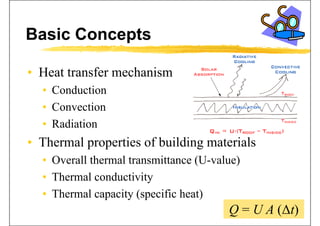
• Heat transfer mechanismHeat transfer mechanism
• Conduction
• Convection
• RadiationRadiation
• Thermal properties of building materials
• Overall thermal transmittance (U-value)
• Thermal conductivity• Thermal conductivity
• Thermal capacity (specific heat)
Q = U A (Δt)
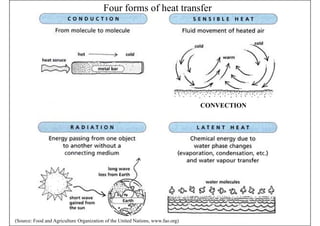
Four forms of heat transfer
CONVECTION
(Source: Food and Agriculture Organization of the United Nations, www.fao.org)
Basic Concepts
• Heat transfer basic relationships (for air at seaHeat transfer basic relationships (for air at sea
level)
• Sensible heat transfer rate:
• qsensible = 1.23 (Flow rate, L/s) (Δt)qsensible ( , ) ( )
• Latent heat transfer rate:
3010 (Fl t L/ ) (Δ )• qlatent = 3010 (Flow rate, L/s) (Δw)
• Total heat transfer rate:
• qtotal = 1.2 (Flow rate, L/s) (Δh)
• q = q + q• qtotal = qsensible + qlatent
Basic Concepts
• Thermal loadThermal load
• The amount of heat that must be added or removed
f h i i hfrom the space to maintain the proper temperature
in the space
• When thermal loads push conditions outside
f th f t HVAC t dof the comfort range, HVAC systems are used
to bring the thermal conditions back tog
comfort conditions
Basic Concepts
• Purpose of HVAC load estimationPurpose of HVAC load estimation
• Calculate peak design loads (cooling/heating)
• Estimate likely plant/equipment capacity or size
• Provide info for HVAC design e g load profilesProvide info for HVAC design e.g. load profiles
• Form the basis for building energy analysis
• Cooling load is our main target
• Important for warm climates & summer design• Important for warm climates & summer design
• Affect building performance & its first cost
Basic Concepts
• General procedure for cooling load calculationsp g
• Obtain the characteristics of the building, building
materials components etc from building plans andmaterials, components, etc. from building plans and
specifications
• Determine the building location orientation external• Determine the building location, orientation, external
shading (like adjacent buildings)
• Obtain appropriate weather data and select outdoor design• Obtain appropriate weather data and select outdoor design
conditions
S l t i d d i diti (i l d i ibl• Select indoor design conditions (include permissible
variations and control limits)
Basic Concepts
• General procedure for cooling load calculationsp g
(cont’d)
• Obtain a proposed schedule of lighting occupants internal• Obtain a proposed schedule of lighting, occupants, internal
equipment appliances and processes that would contribute
to internal thermal loadto internal thermal load
• Select the time of day and month for the cooling load
calculationcalculation
• Calculate the space cooling load at design conditions
• Assess the cooling loads at several different time or a
design day to find out the peak design load
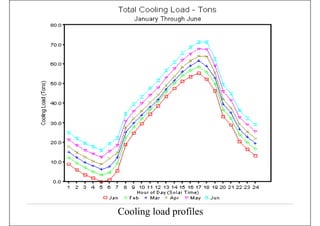
Cooling load profiles
Basic Concepts
• A building survey will help us achieve ag y p
realistic estimate of thermal loads
• Orientation of the building• Orientation of the building
• Use of spaces
• Physical dimensions of spaces
• Ceiling heightCeiling height
• Columns and beams
C i i l• Construction materials
• Surrounding conditions
• Windows, doors, stairways
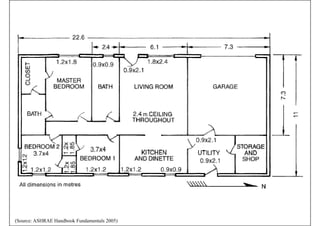
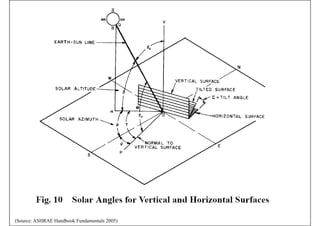
(Source: ASHRAE Handbook Fundamentals 2005)
Basic Concepts
• Key info for load estimationKey info for load estimation
• People (number or density, duration of occupancy,
f i i )nature of activity)
• Lighting (W/m2, type)g g ( , yp )
• Appliances (wattage, location, usage)
il i ( i i i )• Ventilation (criteria, requirements)
• Thermal storage (if any)g ( y)
• Continuous or intermittent operation
Basic Concepts
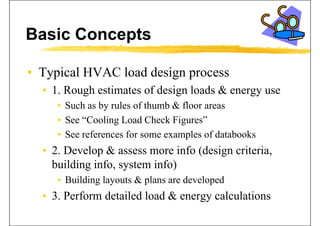
• Typical HVAC load design processTypical HVAC load design process
• 1. Rough estimates of design loads & energy use
• Such as by rules of thumb & floor areas
• See “Cooling Load Check Figures”
• See references for some examples of databooks
• 2 Develop & assess more info (design criteria• 2. Develop & assess more info (design criteria,
building info, system info)
• Building layouts & plans are developed
• 3. Perform detailed load & energy calculationsgy
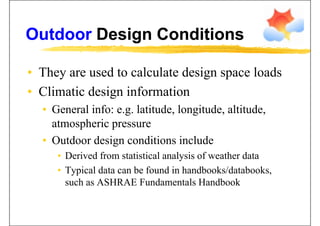
Outdoor Design ConditionsOutdoor Design Conditions
• They are used to calculate design space loadsThey are used to calculate design space loads
• Climatic design information
• General info: e.g. latitude, longitude, altitude,
atmospheric pressureatmospheric pressure
• Outdoor design conditions include
• Derived from statistical analysis of weather data
• Typical data can be found in handbooks/databooks,
such as ASHRAE Fundamentals Handbook
Outdoor Design ConditionsOutdoor Design Conditions
• Climatic design info from ASHRAEg
• Previous data & method (before 1997)
• For Summer (Jun to Sep) & Winter (Dec Jan Feb)• For Summer (Jun to Sep) & Winter (Dec, Jan, Feb)
• Based on 1%, 2.5% & 5% nos. hours of occurrence
N h d (ASHRAE F d l 2001 )• New method (ASHRAE Fundamentals 2001+):
• Based on annual percentiles and cumulative frequency
f 0 4% 1% 2% ( f h l )of occurrence, e.g. 0.4%, 1%, 2% (of whole year)
• More info on coincident conditions
• Findings obtained from ASHRAE research projects
• Data can be found on a relevant CD-ROM
Outdoor Design ConditionsOutdoor Design Conditions
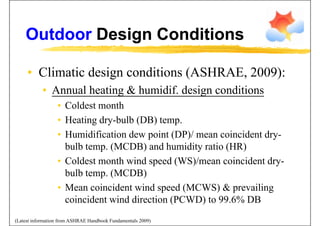
• Climatic design conditions (ASHRAE, 2009):Climatic design conditions (ASHRAE, 2009):
• Annual heating & humidif. design conditions
• Coldest month
• Heating dry-bulb (DB) temp.
• Humidification dew point (DP)/ mean coincident dry-
bulb temp. (MCDB) and humidity ratio (HR)p ( ) y ( )
• Coldest month wind speed (WS)/mean coincident dry-
bulb temp. (MCDB)bulb temp. (MCDB)
• Mean coincident wind speed (MCWS) & prevailing
coincident wind direction (PCWD) to 99 6% DBcoincident wind direction (PCWD) to 99.6% DB
(Latest information from ASHRAE Handbook Fundamentals 2009)
Outdoor Design ConditionsOutdoor Design Conditions
• Climatic design conditions (ASHRAE, 2009):Climatic design conditions (ASHRAE, 2009):
• Cooling and dehumidification design conditions
• Hottest month and DB range
• Cooling DB/MCWB: Dry-bulb temp. (DB) + Mean
coincident wet-bulb temp. (MCWB)
• Evaporation WB/MCDB: Web-bulb temp. (WB) +p p ( )
Mean coincident dry-bulb temp. (MCDB)
• MCWS/PCWD to 0.4% DBMCWS/PCWD to 0.4% DB
• Dehumidification DP/MCDB and HR: Dew-point temp.
(DP) + MDB + Humidity ratio (HR)(DP) + MDB + Humidity ratio (HR)
• Enthalpy/MCDB
Outdoor Design ConditionsOutdoor Design Conditions
• Climatic design conditions (ASHRAE, 2009):Climatic design conditions (ASHRAE, 2009):
• Extreme annual design conditions
• Monthly climatic design conditions
• Temperature, degree-days and degree-hoursTemperature, degree days and degree hours
• Monthly design DB and mean coincident WB
• Monthly design WB and mean coincident DB• Monthly design WB and mean coincident DB
• Mean daily temperature range
• Clear sky solar irradiance
Outdoor Design ConditionsOutdoor Design Conditions
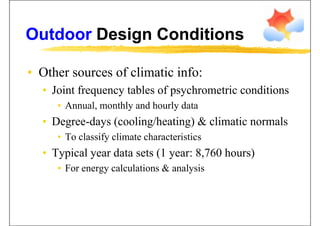
• Other sources of climatic info:Other sources of climatic info:
• Joint frequency tables of psychrometric conditions
• Annual, monthly and hourly data
• Degree-days (cooling/heating) & climatic normalsg y ( g g)
• To classify climate characteristics
T i l d t t (1 8 760 h )• Typical year data sets (1 year: 8,760 hours)
• For energy calculations & analysis
Recommended Outdoor Design Conditions for Hong Kong
L i H K (l i d 22° 18’ N l i d 114° 10’ E l i 33 )Location Hong Kong (latitude 22° 18’ N, longitude 114° 10’ E, elevation 33 m)
Weather station Royal Observatory Hong Kong
Summer months June to September (four hottest months), total 2928 hours
Winter months December, January & February (three coldest months), total 2160 hours
Design For comfort HVAC (based on For critical processes (based ong
temperatures:
(
summer 2.5% or annualised 1% and
winter 97.5% or annualised 99.3%)
p (
summer 1% or annualised 0.4% and
winter 99% or annualised 99.6%)
Summer Winter Summer Winter
DDB / CWB 32.0 oC / 26.9 oC 9.5 oC / 6.7 oC 32.6 oC / 27.0 oC 8.2 oC / 6.0 oC
CDB / DWB 31.0 oC / 27.5 oC 10.4 oC / 6.2 oC 31.3 oC / 27.8 oC 9.1 oC / 5.0 oC
Note: 1. DDB is the design dry-bulb and CWB is the coincident wet-bulb temperature with
it; DWB is the design wet-bulb and CDB is the coincident dry-bulb with it.
2. The design temperatures and daily ranges were determined based on hourly data
for the 35 year period from 1960 to 1994; extreme temperatures were determined
(Source: Research findings from Dr. Sam C M Hui)
for the 35-year period from 1960 to 1994; extreme temperatures were determined
based on extreme values between 1884-1939 and 1947-1994.
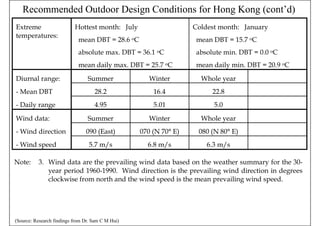
Recommended Outdoor Design Conditions for Hong Kong (cont’d)
E H h J l C ld h JExtreme
temperatures:
Hottest month: July
mean DBT = 28.6 oC
b l DBT 36 1 C
Coldest month: January
mean DBT = 15.7 oC
b l i DBT 0 0 Cabsolute max. DBT = 36.1 oC
mean daily max. DBT = 25.7 oC
absolute min. DBT = 0.0 oC
mean daily min. DBT = 20.9 oC
Diurnal range: Summer Winter Whole year
- Mean DBT 28.2 16.4 22.8
- Daily range 4.95 5.01 5.0
Wind data: Summer Winter Whole year
- Wind direction 090 (East) 070 (N 70° E) 080 (N 80° E)
- Wind speed 5.7 m/s 6.8 m/s 6.3 m/s
Note: 3. Wind data are the prevailing wind data based on the weather summary for the 30-
year period 1960-1990. Wind direction is the prevailing wind direction in degrees
clockwise from north and the wind speed is the mean prevailing wind speed.
(Source: Research findings from Dr. Sam C M Hui)
Indoor Design ConditionsIndoor Design Conditions
• Basic design parameters: (for thermal comfort)g p ( )
• Air temp. & air movement
• Typical: summer 24 26 oC; winter 21 23 oC• Typical: summer 24-26 oC; winter 21-23 oC
• Air velocity: summer < 0.25 m/s; winter < 0.15 m/s
R l i h idi• Relative humidity
• Summer: 40-50% (preferred), 30-65 (tolerable)
• Winter: 25-30% (with humidifier); not specified (w/o
humidifier)
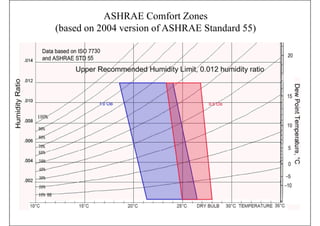
• See also ASHRAE Standard 55-2004
• ASHRAE comfort zone
ASHRAE Comfort Zones
(b d 2004 i f ASHRAE S d d 55)(based on 2004 version of ASHRAE Standard 55)
Indoor Design ConditionsIndoor Design Conditions
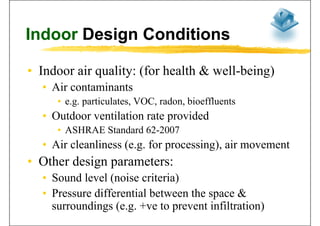
• Indoor air quality: (for health & well-being)q y ( g)
• Air contaminants
• e g particulates VOC radon bioeffluents• e.g. particulates, VOC, radon, bioeffluents
• Outdoor ventilation rate provided
• ASHRAE Standard 62-2007
• Air cleanliness (e.g. for processing), air movement( g p g)
• Other design parameters:
S d l l ( i it i )• Sound level (noise criteria)
• Pressure differential between the space &
surroundings (e.g. +ve to prevent infiltration)
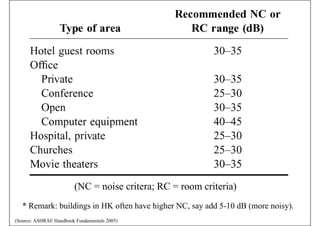
(NC = noise critera; RC = room criteria)
(Source: ASHRAE Handbook Fundamentals 2005)
* Remark: buildings in HK often have higher NC, say add 5-10 dB (more noisy).
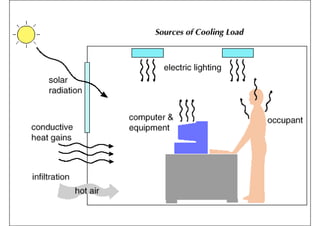
Cooling Load Components
• ExternalExternal
• 1. Heat gain through exterior walls and roofs
• 2. Solar heat gain through fenestrations (windows)
• 3 Conductive heat gain through fenestrations3. Conductive heat gain through fenestrations
• 4. Heat gain through partitions & interior doors
• Internal
• 1 People• 1. People
• 2. Electric lights
• 3. Equipment and appliances
Cooling Load Components
• InfiltrationInfiltration
• Air leakage and moisture migration, e.g.
flow of outdoor air into a building through
cracks unintentional openings normal usecracks, unintentional openings, normal use
of exterior doors for entrance
• System (HVAC)
• Outdoor ventilation air
• System heat gain: duct leakage & heat gain• System heat gain: duct leakage & heat gain,
reheat, fan & pump energy, energy recovery
Cooling Load Components
• Total cooling loadTotal cooling load
• Sensible cooling load + Latent cooling loadg g
• = Σ(sensible items) + Σ(latent items)
Whi h h l l d ? Whi h• Which components have latent loads? Which
only have sensible load? Why?y y
• Three major parts for load calculation
• External cooling load
• Internal cooling load• Internal cooling load
• Ventilation and infiltration air
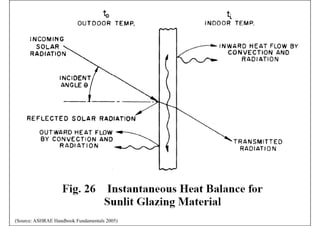
(Source: ASHRAE Handbook Fundamentals 2005)
Cooling Load Components
• Cooling load calculation methodCooling load calculation method
• Example: CLTD/SCL/CLF method
• It is a one-step, simple calculation procedure developed
by ASHRAE
• CLTD = cooling load temperature difference
• SCL = solar cooling loadg
• CLF = cooling load factor
• See ASHRAE Handbook Fundamentals for details• See ASHRAE Handbook Fundamentals for details
• Tables for CLTD, SCL and CLF
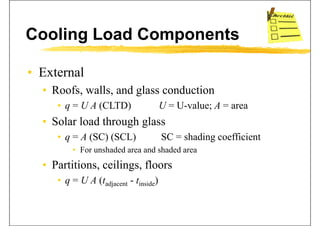
Cooling Load Components
• ExternalExternal
• Roofs, walls, and glass conduction
• q = U A (CLTD) U = U-value; A = area
• Solar load through glassg g
• q = A (SC) (SCL) SC = shading coefficient
• For unshaded area and shaded area• For unshaded area and shaded area
• Partitions, ceilings, floors
• q = U A (tadjacent - tinside)
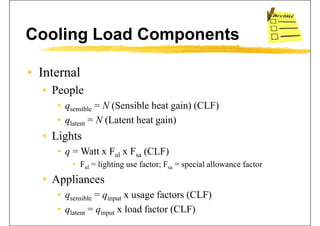
Cooling Load Components
• InternalInternal
• People
• qsensible = N (Sensible heat gain) (CLF)
• qlatent = N (Latent heat gain)latent
• Lights
• q = Watt x F x F (CLF)• q = Watt x Ful x Fsa (CLF)
• Ful = lighting use factor; Fsa = special allowance factor
A li• Appliances
• qsensible = qinput x usage factors (CLF)p
• qlatent = qinput x load factor (CLF)
Cooling Load Components
• Ventilation and infiltration airVentilation and infiltration air
• qsensible = 1.23 Q (toutside - tinside)
• qlatent = 3010 Q (woutside - winside)
• q l = 1 2 Q (h id - hi id )qtotal 1.2 Q (houtside hinside)
• System heat gain
• Fan heat gain
• Duct heat gain and leakage• Duct heat gain and leakage
• Ceiling return air plenum
Schematic diagram of typical return air plenumSchematic diagram of typical return air plenum
(Source: ASHRAE Handbook Fundamentals 2005)
Cooling Load Principles
• Terminology:Terminology:
• Space – a volume w/o a partition, or a partitioned
froom, or group of rooms
• Room – an enclosed space (a single load)p ( g )
• Zone – a space, or several rooms, or units of space
having some sort of coincident loads or similarhaving some sort of coincident loads or similar
operating characteristics
• Thermal zoning
Cooling Load Principles
• Definitions
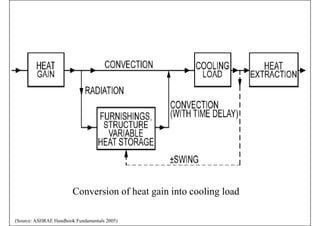
• Space heat gain: instantaneous rate of heat gain
that enters into or is generated within a spacethat enters into or is generated within a space
• Space cooling load: the rate at which heat must be
d f th t i t i t tremoved from the space to maintain a constant
space air temperature
• Space heat extraction rate: the actual rate of heat
removal when the space air temp. may swing
• Cooling coil load: the rate at which energy is
removed at a cooling coil serving the spaceg g p
Conversion of heat gain into cooling load
(Source: ASHRAE Handbook Fundamentals 2005)
Cooling Load Principles
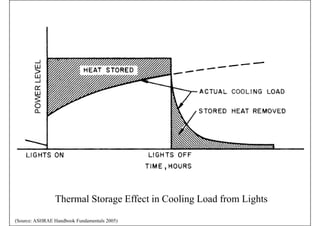
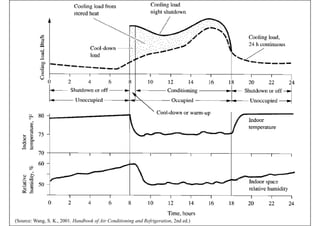
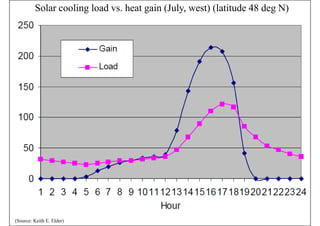
• Instantaneous heat gain vs space cooling loadsg p g
• They are NOT the same
Eff t f h t t• Effect of heat storage
• Night shutdown periodg p
• HVAC is switched off. What happens to the space?
• Cool-down or warm-up periodCool down or warm up period
• When HVAC system begins to operate
• Need to cool or warm the building fabric• Need to cool or warm the building fabric
• Conditioning period
• Space air temperature within the limits
Thermal Storage Effect in Cooling Load from LightsThermal Storage Effect in Cooling Load from Lights
(Source: ASHRAE Handbook Fundamentals 2005)
Cooling Load Principles
• Space load and equipment loadp q p
• Space heat gain (sensible, latent, total)
S li / h ti l d [ t b ildi ]• Space cooling / heating load [at building]
• Space heat extraction rate
• Cooling / heating coil load [at air-side system]
• Refrigeration load [at the chiller plant]Refrigeration load [at the chiller plant]
• Instantaneous heat gain
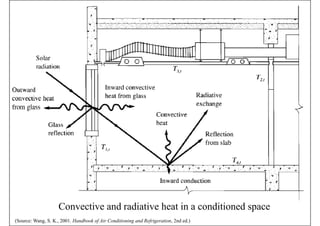
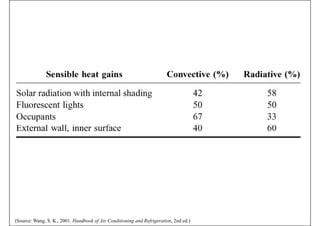
• Convective heat
• Radiative heat (heat absorption)Radiative heat (heat absorption)
Convective and radiative heat in a conditioned space
(Source: Wang, S. K., 2001. Handbook of Air Conditioning and Refrigeration, 2nd ed.)
Cooling Load Principles
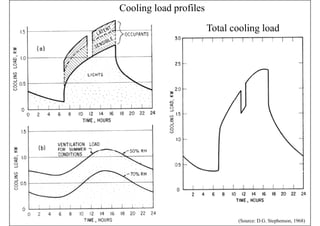
• Cooling load profilesCooling load profiles
• Shows the variation of space cooling load
• Such as 24-hr cycle
• Useful for building operation & energy analysisUseful for building operation & energy analysis
• What factors will affect load profiles?
• Peak load and block load
• Peak load = max cooling load• Peak load = max. cooling load
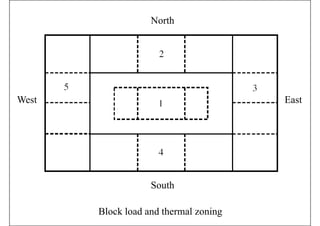
• Block load = sum of zone loads at a specific time
Cooling load profiles
T l li l dTotal cooling load
(Source: D.G. Stephenson, 1968)
North
West EastWest East
South
Block load and thermal zoning
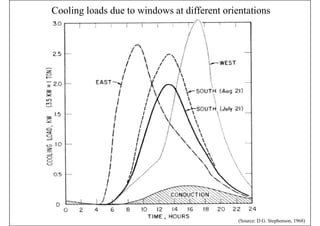
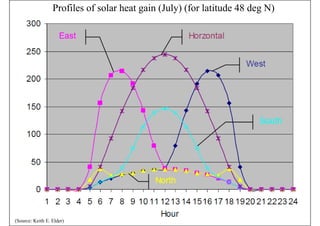
Cooling loads due to windows at different orientations
(Source: D.G. Stephenson, 1968)
Profiles of solar heat gain (July) (for latitude 48 deg N)
(Source: Keith E. Elder)
Solar cooling load vs. heat gain (July, west) (latitude 48 deg N)
(Source: Keith E. Elder)
Cooling Load Principles
• Moisture transferMoisture transfer
• Two paths:
• Moisture migrates in building envelope
• Air leakage (infiltration or exfiltration)
• If slight RH variation is acceptable, then storage
effect of moisture can be ignoredeffect of moisture can be ignored
• Latent heat gain = latent cooling load (instantaneously)
• What happens if both temp. & RH need to be
controlled?controlled?
Cooling Coil Load
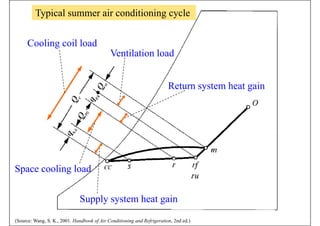
• Cooling coil load consists of:Cooling coil load consists of:
• Space cooling load (sensible & latent)
• Supply system heat gain (fan + air duct)
• Return system heat gain (plenum + fan + air duct)Return system heat gain (plenum + fan + air duct)
• Load due to outdoor ventilation rates (or
il i l d)ventilation load)
• Do you know how to construct a summer airDo you know how to construct a summer air
conditioning cycle on a psychrometric chart?
• See also notes in Psychrometrics
Typical summer air conditioning cycle
Cooling coil load
V il i l dVentilation load
Return system heat gain
Space cooling load
Supply system heat gainSupply system heat gain
(Source: Wang, S. K., 2001. Handbook of Air Conditioning and Refrigeration, 2nd ed.)
Cooling Coil Load
• Space cooling load t1.2
(kW)loadSensible
(L/s)airflowSupply


Space cooling load
• To determine supply air flow rate & size of air
d i l diff
t1.2 
system, ducts, terminals, diffusers
• It is a component of cooling coil loadp g
• Infiltration heat gain is an instant. cooling load
• Cooling coil load
• To determine the size of cooling coil &To determine the size of cooling coil &
refrigeration system
b il i l d i il l d• Remember, ventilation load is a coil load
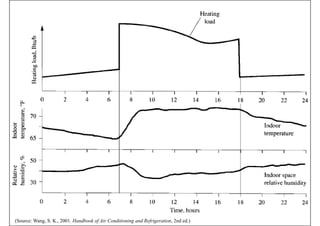
Heating Load
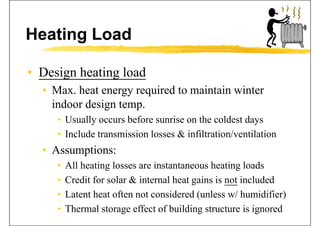
• Design heating loadDesign heating load
• Max. heat energy required to maintain winter
i d d iindoor design temp.
• Usually occurs before sunrise on the coldest days
• Include transmission losses & infiltration/ventilation
• Assumptions:• Assumptions:
• All heating losses are instantaneous heating loads
• Credit for solar & internal heat gains is not included
• Latent heat often not considered (unless w/ humidifier)
• Thermal storage effect of building structure is ignored
Heating Load
• A simplified approach to evaluate worst-caseA simplified approach to evaluate worst case
conditions based on
• Design interior and exterior conditions
• Including infiltration and/or ventilationIncluding infiltration and/or ventilation
• No solar effect (at night or on cloudy winter days)
• Before the presence of people, light, and
appliances has an offsetting effectpp g
• Also, a warm-up/safety allowance of 20-25%
i f i lis fairly common
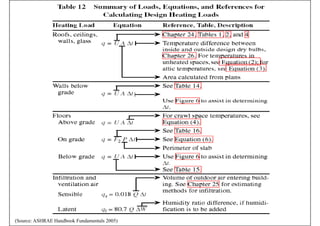
(Source: ASHRAE Handbook Fundamentals 2005)
Software Applications
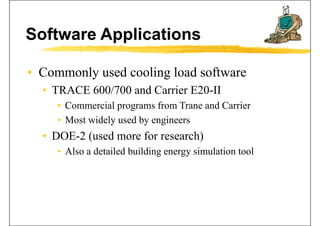
• Commonly used cooling load softwareCommonly used cooling load software
• TRACE 600/700 and Carrier E20-II
• Commercial programs from Trane and Carrier
• Most widely used by engineers
• DOE-2 (used more for research)
• Also a detailed building energy simulation tool• Also a detailed building energy simulation tool
Software Applications
• Software demonstrationSoftware demonstration
• TRACE 700
• TRACE = Trane Air Conditioning Economics
• Building load and energy analysis software• Building load and energy analysis software
• Demon version can be downloaded
htt // t / i l/• http://www.trane.com/commercial/
References
• Air Conditioning and Refrigeration Engineeringg g g g
(Wang and Norton, 2000)
• Chapter 6 Load Calculations• Chapter 6 – Load Calculations
• ASHRAE Handbook Fundamentals (2009 edition)
• Chapter 14 – Climatic Design Information
• Chapter 15 – Fenestrationp
• Chapter 17 – Residential Cooling and Heating Load
CalculationsCalculations
• Chapter 18 – Nonresidential Cooling and Heating Load
CalculationsCalculations
References
• Remarks:Remarks:
• “Load & Energy Calculations” in ASHRAE
H db k F d lHandbook Fundamentals
• The following previous cooling load calculationsg p g
are described in earlier editions of the ASHRAE
Handbook (1997 and 2001 versions)Handbook (1997 and 2001 versions)
• CLTD/SCL/CLF method
TETD/TA h d• TETD/TA method
• TFM method

Mebs6006 0910 04-load

  • 1.
    MEBS6006 Environmental ServicesI http://www.hku.hk/bse/MEBS6006/ Load Estimation Dr. Sam C M Hui Department of Mechanical EngineeringDepartment of Mechanical Engineering The University of Hong Kong E-mail: cmhui@hku hkE mail: cmhui@hku.hk Sep 2009
  • 2.
    Contents • Basic Conceptsp •Outdoor Design Conditions • Indoor Design Conditions • Cooling Load ComponentsCooling Load Components • Cooling Load Principles • Cooling Coil Load • Heating LoadHeating Load • Software Applications
  • 3.
    Basic Concepts • Heattransfer mechanismHeat transfer mechanism • Conduction • Convection • RadiationRadiation • Thermal properties of building materials • Overall thermal transmittance (U-value) • Thermal conductivity• Thermal conductivity • Thermal capacity (specific heat) Q = U A (Δt)
  • 4.
    Four forms ofheat transfer CONVECTION (Source: Food and Agriculture Organization of the United Nations, www.fao.org)
  • 5.
    Basic Concepts • Heattransfer basic relationships (for air at seaHeat transfer basic relationships (for air at sea level) • Sensible heat transfer rate: • qsensible = 1.23 (Flow rate, L/s) (Δt)qsensible ( , ) ( ) • Latent heat transfer rate: 3010 (Fl t L/ ) (Δ )• qlatent = 3010 (Flow rate, L/s) (Δw) • Total heat transfer rate: • qtotal = 1.2 (Flow rate, L/s) (Δh) • q = q + q• qtotal = qsensible + qlatent
  • 6.
    Basic Concepts • ThermalloadThermal load • The amount of heat that must be added or removed f h i i hfrom the space to maintain the proper temperature in the space • When thermal loads push conditions outside f th f t HVAC t dof the comfort range, HVAC systems are used to bring the thermal conditions back tog comfort conditions
  • 7.
    Basic Concepts • Purposeof HVAC load estimationPurpose of HVAC load estimation • Calculate peak design loads (cooling/heating) • Estimate likely plant/equipment capacity or size • Provide info for HVAC design e g load profilesProvide info for HVAC design e.g. load profiles • Form the basis for building energy analysis • Cooling load is our main target • Important for warm climates & summer design• Important for warm climates & summer design • Affect building performance & its first cost
  • 8.
    Basic Concepts • Generalprocedure for cooling load calculationsp g • Obtain the characteristics of the building, building materials components etc from building plans andmaterials, components, etc. from building plans and specifications • Determine the building location orientation external• Determine the building location, orientation, external shading (like adjacent buildings) • Obtain appropriate weather data and select outdoor design• Obtain appropriate weather data and select outdoor design conditions S l t i d d i diti (i l d i ibl• Select indoor design conditions (include permissible variations and control limits)
  • 9.
    Basic Concepts • Generalprocedure for cooling load calculationsp g (cont’d) • Obtain a proposed schedule of lighting occupants internal• Obtain a proposed schedule of lighting, occupants, internal equipment appliances and processes that would contribute to internal thermal loadto internal thermal load • Select the time of day and month for the cooling load calculationcalculation • Calculate the space cooling load at design conditions • Assess the cooling loads at several different time or a design day to find out the peak design load
  • 10.
  • 11.
    Basic Concepts • Abuilding survey will help us achieve ag y p realistic estimate of thermal loads • Orientation of the building• Orientation of the building • Use of spaces • Physical dimensions of spaces • Ceiling heightCeiling height • Columns and beams C i i l• Construction materials • Surrounding conditions • Windows, doors, stairways
  • 12.
    (Source: ASHRAE HandbookFundamentals 2005)
  • 13.
    Basic Concepts • Keyinfo for load estimationKey info for load estimation • People (number or density, duration of occupancy, f i i )nature of activity) • Lighting (W/m2, type)g g ( , yp ) • Appliances (wattage, location, usage) il i ( i i i )• Ventilation (criteria, requirements) • Thermal storage (if any)g ( y) • Continuous or intermittent operation
  • 14.
    Basic Concepts • TypicalHVAC load design processTypical HVAC load design process • 1. Rough estimates of design loads & energy use • Such as by rules of thumb & floor areas • See “Cooling Load Check Figures” • See references for some examples of databooks • 2 Develop & assess more info (design criteria• 2. Develop & assess more info (design criteria, building info, system info) • Building layouts & plans are developed • 3. Perform detailed load & energy calculationsgy
  • 15.
    Outdoor Design ConditionsOutdoorDesign Conditions • They are used to calculate design space loadsThey are used to calculate design space loads • Climatic design information • General info: e.g. latitude, longitude, altitude, atmospheric pressureatmospheric pressure • Outdoor design conditions include • Derived from statistical analysis of weather data • Typical data can be found in handbooks/databooks, such as ASHRAE Fundamentals Handbook
  • 16.
    Outdoor Design ConditionsOutdoorDesign Conditions • Climatic design info from ASHRAEg • Previous data & method (before 1997) • For Summer (Jun to Sep) & Winter (Dec Jan Feb)• For Summer (Jun to Sep) & Winter (Dec, Jan, Feb) • Based on 1%, 2.5% & 5% nos. hours of occurrence N h d (ASHRAE F d l 2001 )• New method (ASHRAE Fundamentals 2001+): • Based on annual percentiles and cumulative frequency f 0 4% 1% 2% ( f h l )of occurrence, e.g. 0.4%, 1%, 2% (of whole year) • More info on coincident conditions • Findings obtained from ASHRAE research projects • Data can be found on a relevant CD-ROM
  • 17.
    Outdoor Design ConditionsOutdoorDesign Conditions • Climatic design conditions (ASHRAE, 2009):Climatic design conditions (ASHRAE, 2009): • Annual heating & humidif. design conditions • Coldest month • Heating dry-bulb (DB) temp. • Humidification dew point (DP)/ mean coincident dry- bulb temp. (MCDB) and humidity ratio (HR)p ( ) y ( ) • Coldest month wind speed (WS)/mean coincident dry- bulb temp. (MCDB)bulb temp. (MCDB) • Mean coincident wind speed (MCWS) & prevailing coincident wind direction (PCWD) to 99 6% DBcoincident wind direction (PCWD) to 99.6% DB (Latest information from ASHRAE Handbook Fundamentals 2009)
  • 18.
    Outdoor Design ConditionsOutdoorDesign Conditions • Climatic design conditions (ASHRAE, 2009):Climatic design conditions (ASHRAE, 2009): • Cooling and dehumidification design conditions • Hottest month and DB range • Cooling DB/MCWB: Dry-bulb temp. (DB) + Mean coincident wet-bulb temp. (MCWB) • Evaporation WB/MCDB: Web-bulb temp. (WB) +p p ( ) Mean coincident dry-bulb temp. (MCDB) • MCWS/PCWD to 0.4% DBMCWS/PCWD to 0.4% DB • Dehumidification DP/MCDB and HR: Dew-point temp. (DP) + MDB + Humidity ratio (HR)(DP) + MDB + Humidity ratio (HR) • Enthalpy/MCDB
  • 19.
    Outdoor Design ConditionsOutdoorDesign Conditions • Climatic design conditions (ASHRAE, 2009):Climatic design conditions (ASHRAE, 2009): • Extreme annual design conditions • Monthly climatic design conditions • Temperature, degree-days and degree-hoursTemperature, degree days and degree hours • Monthly design DB and mean coincident WB • Monthly design WB and mean coincident DB• Monthly design WB and mean coincident DB • Mean daily temperature range • Clear sky solar irradiance
  • 20.
    Outdoor Design ConditionsOutdoorDesign Conditions • Other sources of climatic info:Other sources of climatic info: • Joint frequency tables of psychrometric conditions • Annual, monthly and hourly data • Degree-days (cooling/heating) & climatic normalsg y ( g g) • To classify climate characteristics T i l d t t (1 8 760 h )• Typical year data sets (1 year: 8,760 hours) • For energy calculations & analysis
  • 21.
    Recommended Outdoor DesignConditions for Hong Kong L i H K (l i d 22° 18’ N l i d 114° 10’ E l i 33 )Location Hong Kong (latitude 22° 18’ N, longitude 114° 10’ E, elevation 33 m) Weather station Royal Observatory Hong Kong Summer months June to September (four hottest months), total 2928 hours Winter months December, January & February (three coldest months), total 2160 hours Design For comfort HVAC (based on For critical processes (based ong temperatures: ( summer 2.5% or annualised 1% and winter 97.5% or annualised 99.3%) p ( summer 1% or annualised 0.4% and winter 99% or annualised 99.6%) Summer Winter Summer Winter DDB / CWB 32.0 oC / 26.9 oC 9.5 oC / 6.7 oC 32.6 oC / 27.0 oC 8.2 oC / 6.0 oC CDB / DWB 31.0 oC / 27.5 oC 10.4 oC / 6.2 oC 31.3 oC / 27.8 oC 9.1 oC / 5.0 oC Note: 1. DDB is the design dry-bulb and CWB is the coincident wet-bulb temperature with it; DWB is the design wet-bulb and CDB is the coincident dry-bulb with it. 2. The design temperatures and daily ranges were determined based on hourly data for the 35 year period from 1960 to 1994; extreme temperatures were determined (Source: Research findings from Dr. Sam C M Hui) for the 35-year period from 1960 to 1994; extreme temperatures were determined based on extreme values between 1884-1939 and 1947-1994.
  • 22.
    Recommended Outdoor DesignConditions for Hong Kong (cont’d) E H h J l C ld h JExtreme temperatures: Hottest month: July mean DBT = 28.6 oC b l DBT 36 1 C Coldest month: January mean DBT = 15.7 oC b l i DBT 0 0 Cabsolute max. DBT = 36.1 oC mean daily max. DBT = 25.7 oC absolute min. DBT = 0.0 oC mean daily min. DBT = 20.9 oC Diurnal range: Summer Winter Whole year - Mean DBT 28.2 16.4 22.8 - Daily range 4.95 5.01 5.0 Wind data: Summer Winter Whole year - Wind direction 090 (East) 070 (N 70° E) 080 (N 80° E) - Wind speed 5.7 m/s 6.8 m/s 6.3 m/s Note: 3. Wind data are the prevailing wind data based on the weather summary for the 30- year period 1960-1990. Wind direction is the prevailing wind direction in degrees clockwise from north and the wind speed is the mean prevailing wind speed. (Source: Research findings from Dr. Sam C M Hui)
  • 23.
    Indoor Design ConditionsIndoorDesign Conditions • Basic design parameters: (for thermal comfort)g p ( ) • Air temp. & air movement • Typical: summer 24 26 oC; winter 21 23 oC• Typical: summer 24-26 oC; winter 21-23 oC • Air velocity: summer < 0.25 m/s; winter < 0.15 m/s R l i h idi• Relative humidity • Summer: 40-50% (preferred), 30-65 (tolerable) • Winter: 25-30% (with humidifier); not specified (w/o humidifier) • See also ASHRAE Standard 55-2004 • ASHRAE comfort zone
  • 24.
    ASHRAE Comfort Zones (bd 2004 i f ASHRAE S d d 55)(based on 2004 version of ASHRAE Standard 55)
  • 25.
    Indoor Design ConditionsIndoorDesign Conditions • Indoor air quality: (for health & well-being)q y ( g) • Air contaminants • e g particulates VOC radon bioeffluents• e.g. particulates, VOC, radon, bioeffluents • Outdoor ventilation rate provided • ASHRAE Standard 62-2007 • Air cleanliness (e.g. for processing), air movement( g p g) • Other design parameters: S d l l ( i it i )• Sound level (noise criteria) • Pressure differential between the space & surroundings (e.g. +ve to prevent infiltration)
  • 26.
    (NC = noisecritera; RC = room criteria) (Source: ASHRAE Handbook Fundamentals 2005) * Remark: buildings in HK often have higher NC, say add 5-10 dB (more noisy).
  • 27.
    Cooling Load Components •ExternalExternal • 1. Heat gain through exterior walls and roofs • 2. Solar heat gain through fenestrations (windows) • 3 Conductive heat gain through fenestrations3. Conductive heat gain through fenestrations • 4. Heat gain through partitions & interior doors • Internal • 1 People• 1. People • 2. Electric lights • 3. Equipment and appliances
  • 28.
    Cooling Load Components •InfiltrationInfiltration • Air leakage and moisture migration, e.g. flow of outdoor air into a building through cracks unintentional openings normal usecracks, unintentional openings, normal use of exterior doors for entrance • System (HVAC) • Outdoor ventilation air • System heat gain: duct leakage & heat gain• System heat gain: duct leakage & heat gain, reheat, fan & pump energy, energy recovery
  • 30.
    Cooling Load Components •Total cooling loadTotal cooling load • Sensible cooling load + Latent cooling loadg g • = Σ(sensible items) + Σ(latent items) Whi h h l l d ? Whi h• Which components have latent loads? Which only have sensible load? Why?y y • Three major parts for load calculation • External cooling load • Internal cooling load• Internal cooling load • Ventilation and infiltration air
  • 31.
    (Source: ASHRAE HandbookFundamentals 2005)
  • 32.
    (Source: ASHRAE HandbookFundamentals 2005)
  • 33.
    (Source: ASHRAE HandbookFundamentals 2005)
  • 34.
    Cooling Load Components •Cooling load calculation methodCooling load calculation method • Example: CLTD/SCL/CLF method • It is a one-step, simple calculation procedure developed by ASHRAE • CLTD = cooling load temperature difference • SCL = solar cooling loadg • CLF = cooling load factor • See ASHRAE Handbook Fundamentals for details• See ASHRAE Handbook Fundamentals for details • Tables for CLTD, SCL and CLF
  • 35.
    Cooling Load Components •ExternalExternal • Roofs, walls, and glass conduction • q = U A (CLTD) U = U-value; A = area • Solar load through glassg g • q = A (SC) (SCL) SC = shading coefficient • For unshaded area and shaded area• For unshaded area and shaded area • Partitions, ceilings, floors • q = U A (tadjacent - tinside)
  • 36.
    Cooling Load Components •InternalInternal • People • qsensible = N (Sensible heat gain) (CLF) • qlatent = N (Latent heat gain)latent • Lights • q = Watt x F x F (CLF)• q = Watt x Ful x Fsa (CLF) • Ful = lighting use factor; Fsa = special allowance factor A li• Appliances • qsensible = qinput x usage factors (CLF)p • qlatent = qinput x load factor (CLF)
  • 37.
    Cooling Load Components •Ventilation and infiltration airVentilation and infiltration air • qsensible = 1.23 Q (toutside - tinside) • qlatent = 3010 Q (woutside - winside) • q l = 1 2 Q (h id - hi id )qtotal 1.2 Q (houtside hinside) • System heat gain • Fan heat gain • Duct heat gain and leakage• Duct heat gain and leakage • Ceiling return air plenum
  • 38.
    Schematic diagram oftypical return air plenumSchematic diagram of typical return air plenum (Source: ASHRAE Handbook Fundamentals 2005)
  • 39.
    Cooling Load Principles •Terminology:Terminology: • Space – a volume w/o a partition, or a partitioned froom, or group of rooms • Room – an enclosed space (a single load)p ( g ) • Zone – a space, or several rooms, or units of space having some sort of coincident loads or similarhaving some sort of coincident loads or similar operating characteristics • Thermal zoning
  • 40.
    Cooling Load Principles •Definitions • Space heat gain: instantaneous rate of heat gain that enters into or is generated within a spacethat enters into or is generated within a space • Space cooling load: the rate at which heat must be d f th t i t i t tremoved from the space to maintain a constant space air temperature • Space heat extraction rate: the actual rate of heat removal when the space air temp. may swing • Cooling coil load: the rate at which energy is removed at a cooling coil serving the spaceg g p
  • 41.
    Conversion of heatgain into cooling load (Source: ASHRAE Handbook Fundamentals 2005)
  • 42.
    Cooling Load Principles •Instantaneous heat gain vs space cooling loadsg p g • They are NOT the same Eff t f h t t• Effect of heat storage • Night shutdown periodg p • HVAC is switched off. What happens to the space? • Cool-down or warm-up periodCool down or warm up period • When HVAC system begins to operate • Need to cool or warm the building fabric• Need to cool or warm the building fabric • Conditioning period • Space air temperature within the limits
  • 43.
    Thermal Storage Effectin Cooling Load from LightsThermal Storage Effect in Cooling Load from Lights (Source: ASHRAE Handbook Fundamentals 2005)
  • 44.
    Cooling Load Principles •Space load and equipment loadp q p • Space heat gain (sensible, latent, total) S li / h ti l d [ t b ildi ]• Space cooling / heating load [at building] • Space heat extraction rate • Cooling / heating coil load [at air-side system] • Refrigeration load [at the chiller plant]Refrigeration load [at the chiller plant] • Instantaneous heat gain • Convective heat • Radiative heat (heat absorption)Radiative heat (heat absorption)
  • 45.
    Convective and radiativeheat in a conditioned space (Source: Wang, S. K., 2001. Handbook of Air Conditioning and Refrigeration, 2nd ed.)
  • 46.
    (Source: Wang, S.K., 2001. Handbook of Air Conditioning and Refrigeration, 2nd ed.)
  • 47.
    (Source: Wang, S.K., 2001. Handbook of Air Conditioning and Refrigeration, 2nd ed.)
  • 48.
    (Source: Wang, S.K., 2001. Handbook of Air Conditioning and Refrigeration, 2nd ed.)
  • 49.
    (Source: Wang, S.K., 2001. Handbook of Air Conditioning and Refrigeration, 2nd ed.)
  • 50.
    Cooling Load Principles •Cooling load profilesCooling load profiles • Shows the variation of space cooling load • Such as 24-hr cycle • Useful for building operation & energy analysisUseful for building operation & energy analysis • What factors will affect load profiles? • Peak load and block load • Peak load = max cooling load• Peak load = max. cooling load • Block load = sum of zone loads at a specific time
  • 51.
    Cooling load profiles Tl li l dTotal cooling load (Source: D.G. Stephenson, 1968)
  • 52.
    North West EastWest East South Blockload and thermal zoning
  • 53.
    Cooling loads dueto windows at different orientations (Source: D.G. Stephenson, 1968)
  • 54.
    Profiles of solarheat gain (July) (for latitude 48 deg N) (Source: Keith E. Elder)
  • 55.
    Solar cooling loadvs. heat gain (July, west) (latitude 48 deg N) (Source: Keith E. Elder)
  • 56.
    Cooling Load Principles •Moisture transferMoisture transfer • Two paths: • Moisture migrates in building envelope • Air leakage (infiltration or exfiltration) • If slight RH variation is acceptable, then storage effect of moisture can be ignoredeffect of moisture can be ignored • Latent heat gain = latent cooling load (instantaneously) • What happens if both temp. & RH need to be controlled?controlled?
  • 57.
    Cooling Coil Load •Cooling coil load consists of:Cooling coil load consists of: • Space cooling load (sensible & latent) • Supply system heat gain (fan + air duct) • Return system heat gain (plenum + fan + air duct)Return system heat gain (plenum + fan + air duct) • Load due to outdoor ventilation rates (or il i l d)ventilation load) • Do you know how to construct a summer airDo you know how to construct a summer air conditioning cycle on a psychrometric chart? • See also notes in Psychrometrics
  • 58.
    Typical summer airconditioning cycle Cooling coil load V il i l dVentilation load Return system heat gain Space cooling load Supply system heat gainSupply system heat gain (Source: Wang, S. K., 2001. Handbook of Air Conditioning and Refrigeration, 2nd ed.)
  • 59.
    Cooling Coil Load •Space cooling load t1.2 (kW)loadSensible (L/s)airflowSupply   Space cooling load • To determine supply air flow rate & size of air d i l diff t1.2  system, ducts, terminals, diffusers • It is a component of cooling coil loadp g • Infiltration heat gain is an instant. cooling load • Cooling coil load • To determine the size of cooling coil &To determine the size of cooling coil & refrigeration system b il i l d i il l d• Remember, ventilation load is a coil load
  • 60.
    Heating Load • Designheating loadDesign heating load • Max. heat energy required to maintain winter i d d iindoor design temp. • Usually occurs before sunrise on the coldest days • Include transmission losses & infiltration/ventilation • Assumptions:• Assumptions: • All heating losses are instantaneous heating loads • Credit for solar & internal heat gains is not included • Latent heat often not considered (unless w/ humidifier) • Thermal storage effect of building structure is ignored
  • 61.
    Heating Load • Asimplified approach to evaluate worst-caseA simplified approach to evaluate worst case conditions based on • Design interior and exterior conditions • Including infiltration and/or ventilationIncluding infiltration and/or ventilation • No solar effect (at night or on cloudy winter days) • Before the presence of people, light, and appliances has an offsetting effectpp g • Also, a warm-up/safety allowance of 20-25% i f i lis fairly common
  • 62.
    (Source: ASHRAE HandbookFundamentals 2005)
  • 63.
    Software Applications • Commonlyused cooling load softwareCommonly used cooling load software • TRACE 600/700 and Carrier E20-II • Commercial programs from Trane and Carrier • Most widely used by engineers • DOE-2 (used more for research) • Also a detailed building energy simulation tool• Also a detailed building energy simulation tool
  • 64.
    Software Applications • SoftwaredemonstrationSoftware demonstration • TRACE 700 • TRACE = Trane Air Conditioning Economics • Building load and energy analysis software• Building load and energy analysis software • Demon version can be downloaded htt // t / i l/• http://www.trane.com/commercial/
  • 65.
    References • Air Conditioningand Refrigeration Engineeringg g g g (Wang and Norton, 2000) • Chapter 6 Load Calculations• Chapter 6 – Load Calculations • ASHRAE Handbook Fundamentals (2009 edition) • Chapter 14 – Climatic Design Information • Chapter 15 – Fenestrationp • Chapter 17 – Residential Cooling and Heating Load CalculationsCalculations • Chapter 18 – Nonresidential Cooling and Heating Load CalculationsCalculations
  • 66.
    References • Remarks:Remarks: • “Load& Energy Calculations” in ASHRAE H db k F d lHandbook Fundamentals • The following previous cooling load calculationsg p g are described in earlier editions of the ASHRAE Handbook (1997 and 2001 versions)Handbook (1997 and 2001 versions) • CLTD/SCL/CLF method TETD/TA h d• TETD/TA method • TFM method