

Frank O’Connor 
Working Well, Mental Health Foundation 
BSSNZ Fitness for Work Services, Instep Limited
We are told 
THE WORKPLACE MUST BE SAFE
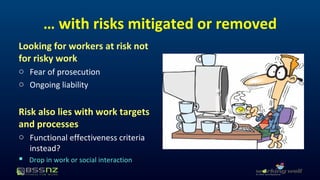
… with risks mitigated or removed 
Looking for workers at risk not 
for risky work 
o Fear of prosecution 
o Ongoing liability 
Risk also lies with work targets 
and processes 
o Functional effectiveness criteria 
instead? 
 Drop in work or social interaction
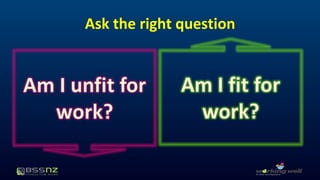
Ask the right question
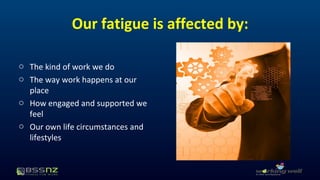
Our fatigue is affected by: 
o The kind of work we do 
o The way work happens at our 
place 
o How engaged and supported we 
feel 
o Our own life circumstances and 
lifestyles
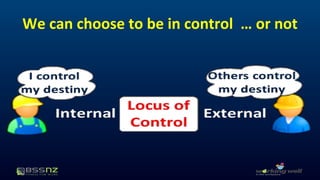
We can choose to be in control … or not
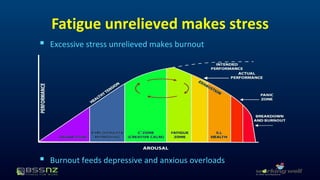
Fatigue unrelieved makes stress 
 Excessive stress unrelieved makes burnout 
 Burnout feeds depressive and anxious overloads
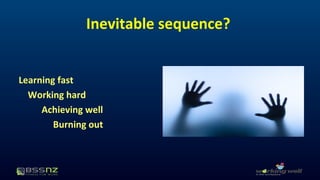
Inevitable sequence? 
Learning fast 
Working hard 
Achieving well 
Burning out
So how do we know before 
FATIGUE CHANGES THINGS 
9
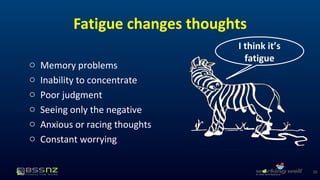
Fatigue changes thoughts 
o Memory problems 
o Inability to concentrate 
o Poor judgment 
o Seeing only the negative 
o Anxious or racing thoughts 
o Constant worrying 
10 
I think it’s 
fatigue
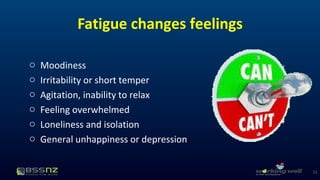
Fatigue changes feelings 
o Moodiness 
o Irritability or short temper 
o Agitation, inability to relax 
o Feeling overwhelmed 
o Loneliness and isolation 
o General unhappiness or depression 
11
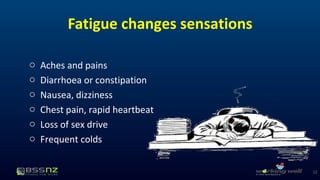
Fatigue changes sensations 
o Aches and pains 
o Diarrhoea or constipation 
o Nausea, dizziness 
o Chest pain, rapid heartbeat 
o Loss of sex drive 
o Frequent colds 
12
Fatigue changes behaviour 
o Eating more or eating less 
o Sleeping too much or too little 
o Withdrawing from others 
o Neglecting responsibilities 
o Relaxing only with drink, drugs, 
smokes 
o Nervous habits – nail biting, pacing 
13
Earlier indications 
Use of self-report on the sensations of fatigue 
o regular basis 
o individual overload states 
o contributing behaviours such as 
 resting and sleeping 
 eating and drinking 
 activity and play 
Condition report: how well I am 
and am likely to be?
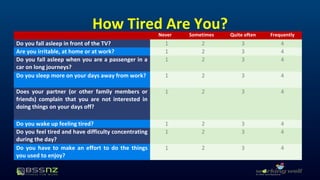
How Tired Are You? 
Never Sometimes Quite often Frequently 
Do you fall asleep in front of the TV? 1 2 3 4 
Are you irritable, at home or at work? 1 2 3 4 
Do you fall asleep when you are a passenger in a 
1 2 3 4 
car on long journeys? 
Do you sleep more on your days away from work? 1 2 3 4 
Does your partner (or other family members or 
friends) complain that you are not interested in 
doing things on your days off? 
1 2 3 4 
Do you wake up feeling tired? 1 2 3 4 
Do you feel tired and have difficulty concentrating 
1 2 3 4 
during the day? 
Do you have to make an effort to do the things 
you used to enjoy? 
1 2 3 4
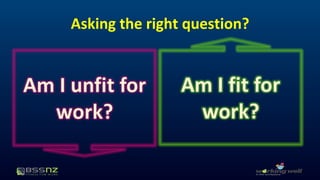
Asking the right question?
A special interest 
HIGH FLIERS
Destination burnout? 
Something’s not right — 
physical exhaustion is feeding 
mental fatigue and on and on it 
goes 
18
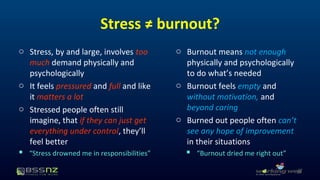
Stress ≠ burnout? 
o Stress, by and large, involves too 
much demand physically and 
psychologically 
o It feels pressured and full and like 
it matters a lot 
o Stressed people often still 
imagine, that if they can just get 
everything under control, they’ll 
feel better 
 “Stress drowned me in responsibilities” 
o Burnout means not enough 
physically and psychologically 
to do what’s needed 
o Burnout feels empty and 
without motivation, and 
beyond caring 
o Burned out people often can’t 
see any hope of improvement 
in their situations 
 “Burnout dried me right out” 
19
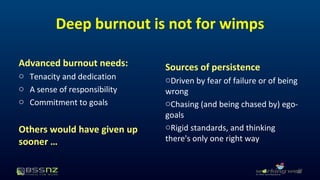
Deep burnout is not for wimps 
Advanced burnout needs: 
o Tenacity and dedication 
o A sense of responsibility 
o Commitment to goals 
Others would have given up 
sooner … 
Sources of persistence 
oDriven by fear of failure or of being 
wrong 
oChasing (and being chased by) ego-goals 
oRigid standards, and thinking 
there's only one right way 
20
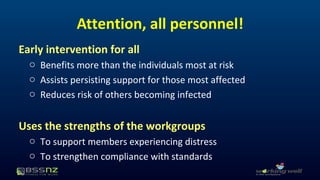
Attention, all personnel! 
Early intervention for all 
o Benefits more than the individuals most at risk 
o Assists persisting support for those most affected 
o Reduces risk of others becoming infected 
Uses the strengths of the workgroups 
o To support members experiencing distress 
o To strengthen compliance with standards
A special interest 
LOW LIARS
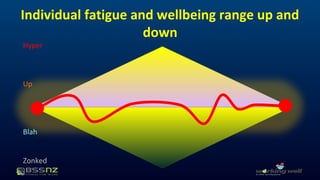
Individual fatigue and wellbeing range up and 
down 
Hyper 
Up 
Blah 
Zonked
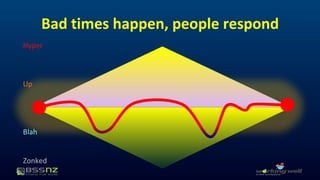
Bad times happen, people respond 
Hyper 
Up 
Blah 
Zonked
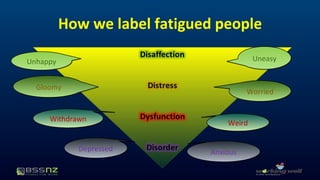
How we label fatigued people 
WWeeiirrdd 
AAnnxxiioouuss 
WWoorrrriieedd 
UUnnhhaappppyy 
GGlloooommyy 
WWiitthhddrraawwnn 
DDeepprreesssseedd 
UUnneeaassyy
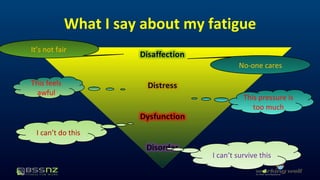
What I say about my fatigue 
This pressure is 
too much 
I can’t survive this 
This feels 
awful 
I can’t do this 
No-one cares 
It’s not fair
Asking the right question?
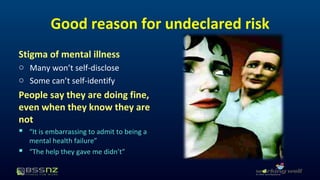
Good reason for undeclared risk 
Stigma of mental illness 
o Many won’t self-disclose 
o Some can’t self-identify 
People say they are doing fine, 
even when they know they are 
not 
 “It is embarrassing to admit to being a 
mental health failure” 
 “The help they gave me didn’t”
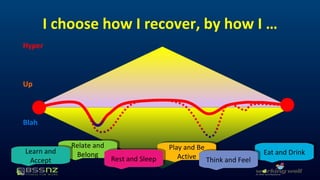
I choose how I recover, by how I … 
Hyper 
Up 
Blah 
Zonked 
Play and Be 
Active 
Play and Be 
Active 
Relate and 
Belong 
Relate and 
Belong 
Learn and 
Accept 
Learn and 
Accept 
EEaatt a anndd D Drrininkk 
RReesstt a anndd S Sleleeepp TThhininkk a anndd F Feeeel l
A matter of process 
WELLBEING IN TEAMS
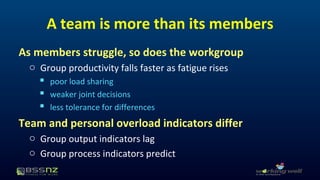
A team is more than its members 
As members struggle, so does the workgroup 
o Group productivity falls faster as fatigue rises 
 poor load sharing 
 weaker joint decisions 
 less tolerance for differences 
Team and personal overload indicators differ 
o Group output indicators lag 
o Group process indicators predict
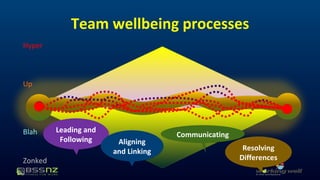
Team wellbeing processes 
Hyper 
Up 
Blah 
Zonked 
Leading and 
Following 
Resolving 
Differences 
CCoommmmuunniiccaattiinngg 
Aligning 
and Linking
IN CONCLUSION
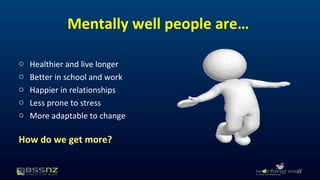
Mentally well people are… 
o Healthier and live longer 
o Better in school and work 
o Happier in relationships 
o Less prone to stress 
o More adaptable to change 
How do we get more? 
34
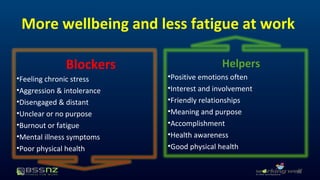
More wellbeing and less fatigue at work 
Blockers 
•Feeling chronic stress 
•Aggression & intolerance 
•Disengaged & distant 
•Unclear or no purpose 
•Burnout or fatigue 
•Mental illness symptoms 
•Poor physical health 
35 
Helpers 
•Positive emotions often 
•Interest and involvement 
•Friendly relationships 
•Meaning and purpose 
•Accomplishment 
•Health awareness 
•Good physical health
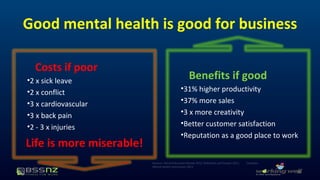
Good mental health is good for business 
Costs if poor 
•2 x sick leave 
•2 x conflict 
•3 x cardiovascular 
•3 x back pain 
•2 - 3 x injuries 
Life is more miserable! 
Benefits if good 
•31% higher productivity 
•37% more sales 
•3 x more creativity 
•Better customer satisfaction 
•Reputation as a good place to work 
36 
Sources: Harvard Business Review 2012; Robertson and Cooper 2011; Canadian 
Mental Health Commission 2013

Fatigue management strategies

  • 1.
    Frank O’Connor WorkingWell, Mental Health Foundation BSSNZ Fitness for Work Services, Instep Limited
  • 2.
    We are told THE WORKPLACE MUST BE SAFE
  • 3.
    … with risksmitigated or removed Looking for workers at risk not for risky work o Fear of prosecution o Ongoing liability Risk also lies with work targets and processes o Functional effectiveness criteria instead?  Drop in work or social interaction
  • 4.
    Ask the rightquestion
  • 5.
    Our fatigue isaffected by: o The kind of work we do o The way work happens at our place o How engaged and supported we feel o Our own life circumstances and lifestyles
  • 6.
    We can chooseto be in control … or not
  • 7.
    Fatigue unrelieved makesstress  Excessive stress unrelieved makes burnout  Burnout feeds depressive and anxious overloads
  • 8.
    Inevitable sequence? Learningfast Working hard Achieving well Burning out
  • 9.
    So how dowe know before FATIGUE CHANGES THINGS 9
  • 10.
    Fatigue changes thoughts o Memory problems o Inability to concentrate o Poor judgment o Seeing only the negative o Anxious or racing thoughts o Constant worrying 10 I think it’s fatigue
  • 11.
    Fatigue changes feelings o Moodiness o Irritability or short temper o Agitation, inability to relax o Feeling overwhelmed o Loneliness and isolation o General unhappiness or depression 11
  • 12.
    Fatigue changes sensations o Aches and pains o Diarrhoea or constipation o Nausea, dizziness o Chest pain, rapid heartbeat o Loss of sex drive o Frequent colds 12
  • 13.
    Fatigue changes behaviour o Eating more or eating less o Sleeping too much or too little o Withdrawing from others o Neglecting responsibilities o Relaxing only with drink, drugs, smokes o Nervous habits – nail biting, pacing 13
  • 14.
    Earlier indications Useof self-report on the sensations of fatigue o regular basis o individual overload states o contributing behaviours such as  resting and sleeping  eating and drinking  activity and play Condition report: how well I am and am likely to be?
  • 15.
    How Tired AreYou? Never Sometimes Quite often Frequently Do you fall asleep in front of the TV? 1 2 3 4 Are you irritable, at home or at work? 1 2 3 4 Do you fall asleep when you are a passenger in a 1 2 3 4 car on long journeys? Do you sleep more on your days away from work? 1 2 3 4 Does your partner (or other family members or friends) complain that you are not interested in doing things on your days off? 1 2 3 4 Do you wake up feeling tired? 1 2 3 4 Do you feel tired and have difficulty concentrating 1 2 3 4 during the day? Do you have to make an effort to do the things you used to enjoy? 1 2 3 4
  • 16.
  • 17.
    A special interest HIGH FLIERS
  • 18.
    Destination burnout? Something’snot right — physical exhaustion is feeding mental fatigue and on and on it goes 18
  • 19.
    Stress ≠ burnout? o Stress, by and large, involves too much demand physically and psychologically o It feels pressured and full and like it matters a lot o Stressed people often still imagine, that if they can just get everything under control, they’ll feel better  “Stress drowned me in responsibilities” o Burnout means not enough physically and psychologically to do what’s needed o Burnout feels empty and without motivation, and beyond caring o Burned out people often can’t see any hope of improvement in their situations  “Burnout dried me right out” 19
  • 20.
    Deep burnout isnot for wimps Advanced burnout needs: o Tenacity and dedication o A sense of responsibility o Commitment to goals Others would have given up sooner … Sources of persistence oDriven by fear of failure or of being wrong oChasing (and being chased by) ego-goals oRigid standards, and thinking there's only one right way 20
  • 21.
    Attention, all personnel! Early intervention for all o Benefits more than the individuals most at risk o Assists persisting support for those most affected o Reduces risk of others becoming infected Uses the strengths of the workgroups o To support members experiencing distress o To strengthen compliance with standards
  • 22.
  • 23.
    Individual fatigue andwellbeing range up and down Hyper Up Blah Zonked
  • 24.
    Bad times happen,people respond Hyper Up Blah Zonked
  • 25.
    How we labelfatigued people WWeeiirrdd AAnnxxiioouuss WWoorrrriieedd UUnnhhaappppyy GGlloooommyy WWiitthhddrraawwnn DDeepprreesssseedd UUnneeaassyy
  • 26.
    What I sayabout my fatigue This pressure is too much I can’t survive this This feels awful I can’t do this No-one cares It’s not fair
  • 27.
  • 28.
    Good reason forundeclared risk Stigma of mental illness o Many won’t self-disclose o Some can’t self-identify People say they are doing fine, even when they know they are not  “It is embarrassing to admit to being a mental health failure”  “The help they gave me didn’t”
  • 29.
    I choose howI recover, by how I … Hyper Up Blah Zonked Play and Be Active Play and Be Active Relate and Belong Relate and Belong Learn and Accept Learn and Accept EEaatt a anndd D Drrininkk RReesstt a anndd S Sleleeepp TThhininkk a anndd F Feeeel l
  • 30.
    A matter ofprocess WELLBEING IN TEAMS
  • 31.
    A team ismore than its members As members struggle, so does the workgroup o Group productivity falls faster as fatigue rises  poor load sharing  weaker joint decisions  less tolerance for differences Team and personal overload indicators differ o Group output indicators lag o Group process indicators predict
  • 32.
    Team wellbeing processes Hyper Up Blah Zonked Leading and Following Resolving Differences CCoommmmuunniiccaattiinngg Aligning and Linking
  • 33.
  • 34.
    Mentally well peopleare… o Healthier and live longer o Better in school and work o Happier in relationships o Less prone to stress o More adaptable to change How do we get more? 34
  • 35.
    More wellbeing andless fatigue at work Blockers •Feeling chronic stress •Aggression & intolerance •Disengaged & distant •Unclear or no purpose •Burnout or fatigue •Mental illness symptoms •Poor physical health 35 Helpers •Positive emotions often •Interest and involvement •Friendly relationships •Meaning and purpose •Accomplishment •Health awareness •Good physical health
  • 36.
    Good mental healthis good for business Costs if poor •2 x sick leave •2 x conflict •3 x cardiovascular •3 x back pain •2 - 3 x injuries Life is more miserable! Benefits if good •31% higher productivity •37% more sales •3 x more creativity •Better customer satisfaction •Reputation as a good place to work 36 Sources: Harvard Business Review 2012; Robertson and Cooper 2011; Canadian Mental Health Commission 2013