Summer Safety
Covering Some of the Hazards of
      the Summer Months
What are the Hazards of
            Summer?
   Sun exposure          Allergies
   Heat related          Wildfires
    illnesses             Poisonous Plants
   Severe Storms         Poisonous Animals
   Tornadoes             Interference with
   Lightning Storms       PPE
   Insects               Fatigue and
   Stinging Insects       Exhaustion
The Rising Temperatures
 As temperatures rise, so does the
  stress on your body.
 Two critical actions can help you battle
  the heat.
   – Acclimation to the heat.
   – Consumption of water.
 These two actions can help the most.
Your Body is a Good
        Regulator of Heat
 Your body reacts to heat by circulating
  blood and raising your skin's
  temperature. The excess heat is then
  released through the skin by sweating.
 Physical activity can limit the amount of
  blood that flows to the skin to release
  heat.
Your Body is a Good
        Regulator of Heat
 Sweating can also maintain a stable
  body temperature if the humidity level is
  low enough to permit evaporation and if
  the fluids and salts you lose are
  adequately replaced.
 When your body cannot release heat, it
  stores it. This raises your core
  temperature and heart rate putting your
  health at risk.
Interfering with the Regulator
   Many factors can cause unbalances in
    your body’s ability to handle heat.
     – Age
     – Weight
     – Fitness
     – Medical condition
     – Diet
Summer Heat
   Heat stress is a serious hazard in the workplace as
    well as at home.
   Excessive heat can place an abnormal stress on
    your body.
   When your body temperature rises even a few
    degrees above normal (which is about 98.6
    degrees Fahrenheit) you can experience
     – muscle cramps
     – become weak
     – disoriented
     – dangerously ill
Six Factors of Heat Stress
 Temperature
 Humidity
 Movement of Air or lack of air
  movement
 The radiant temperature of the
  surroundings
 Clothing
 Physical activity
Heat Stress-Early Sign of
            Trouble
 Heat Stress will reduce your work
  capacity and efficiency.
 Signs of heat stress include:
   – Tiredness
   – Irritability
   – Inattention
   – Muscular cramps.
Heat Stress-Early Sign of
          Trouble (Cont.)
 If you are:
   – Overweight
   – Physically unfit
   – Suffer from heart conditions
   – Drink too much alcohol
   – Are not used summer temperatures
 You may be at greater risk of heat
  stress and should seek and follow
  medical advice.
Heat Rash- Another Early
         Sign of Trouble
 Also known as prickly heat, occurs
  when people are constantly exposed to
  hot and humid air, causing a rash that
  can substantially reduce the ability to
  sweat.
 Heat rash is not just a nuisance
  because of discomfort, but by reducing
  the ability to sweat, the ability to tolerate
  heat is reduced.
Heat Rash and Heat Stress
 First Aid for Heat Rash
   – Cleanse the affected area thoroughly
     and dry completely.
   – Calamine or other soothing lotion
     may help relieve the discomfort.
 First Aid for Heat Stress
   – Good nutrition
   – Become Heat acclimated
   – Drink lots of fluids
Heat Cramps- Final Warning
 May occur after prolonged exposure to
  heat.
 They are the painful intermittent
  spasms of the abdomen and other
  voluntary muscles.
 Heat Cramps usually occur after heavy
  sweating and may begin towards the
  end of the workday.
Heat Cramps- First Aid
   First aid for heat cramps will vary. The
    best care is:
     – Rest
     – Move to a cool environment
     – Drink plenty of water- No pop,
       sparkling water, or Alcohol.
     – Electrolyte fluids such as Gatorade or
       Sqwincher may also be used.
Heat Exhaustion- Time Running
             Out
 May result from physical   exertion in hot
  environments.
 Symptoms may include:
                           – Dizziness
   – Profuse sweating
                           – Nausea
   – Weakness
                           – Headache
   – Paleness of the skin
                           – Vomiting
   – Rapid pulse
                           – Unconsciousness.
 The skin is cool and clammy with sweat.
  Body temperature may be normal or
  subnormal.
Heat Exhaustion- What
          Happened
 Heat exhaustion develops when a
  person fails to replace fluids and salt
  that are lost through sweating.
 You may start to experience extreme
  weakness, fatigue, giddiness, nausea or
  a headache as heat exhaustion
  progresses.
Heat Exhaustion- First Aid
 Rest in the shade or cool place.
 Drink plenty of water (preferred) or
  electrolyte fluids.
 Loosen clothing to allow for your body
  to cool.
 Use cool wet rags to aid cooling.
Heat Stroke- Your Out of
             Time
 This is a serious medical condition that
  urgently requires medical attention.
 Sweating is diminished or absent, which
  makes the skin hot and dry.
 Body temperature is very high (106
  degrees F. and rising).
Heat Stroke- Signs and
             Symptoms
   Mental confusion      Convulsions or
   Delirium               coma
   Chills                A body temperature
   Dizziness              of 105 degrees F or
                           higher
   Loss of
    consciousness         Hot, dry skin that
                           may be red, mottled
                           or bluish
                          A strong fast pulse.
Heat Stroke- Rapid Response
 If you suspect someone is suffering
  from heat stroke, call an ambulance
  immediately.
 Their condition will rapidly deteriorate.
 You must make a provide care
  immediately.
Heat Stroke- First Aid
 This is a Medical Emergency!!
 Brain damage and death are possible.
 Until medical help arrives, move the
  victim from the heat and into a cool
  place.


     Call 9-1-1
Heat Stroke- First Aid
 You must use extreme caution when
  soaking clothing or applying water to a
  victim. Shock may occur if done to
  quickly or with too cool of water
 Soak his or her clothes with water and
  use a fan or ice packs.
 Douse the body continuously with a
  cool liquid and summon medical aid
  immediately.
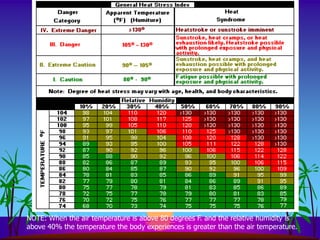
The Heat Index
   The heat index table was developed by
    the Weather Service.
NOTE: When the air temperature is above 80 degrees F. and the relative humidity is
above 40% the temperature the body experiences is greater than the air temperature.
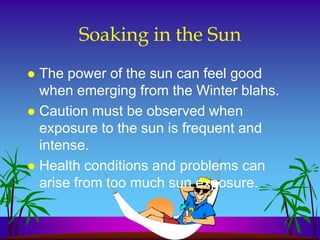
Soaking in the Sun
 The power of the sun can feel good
  when emerging from the Winter blahs.
 Caution must be observed when
  exposure to the sun is frequent and
  intense.
 Health conditions and problems can
  arise from too much sun exposure.
Common Sun Related Health
  Problems- Skin Cancer
 Exposure to UV radiation can lead to
  skin cancer. The three most common:
   – Basal Cell
   – Squamous Cell
   – Melanoma
 Receiving one or two blistering
  sunburns before the age of 18 at least
  doubles an individual's risk for
  developing melanoma. (AAD, 1994).
Common Sun Related Health
  Problems- Eye Damage
 Eye Damage from UV radiation
 Long exposure to sunlight can lead to
  eye problems later in life, such as
  cataracts.
 Another potential effect of UV radiation
  is a "burning" of the eye surface, called
  "snow blindness" or photokeratitis from
  sunlight.
Common Sun Related Health
  Problems- Eye Damage
   Snow Blindness effects usually
    disappear within a couple of days, but
    may lead to further complications later
    in life.
   UVB damage to the eyes is also
    cumulative, so it is never too late for
    people to start protecting their eyes.
Common Sun Related Health
Problems- Premature Aging
 Repeated exposure to the sun can
  cause premature aging effects.
 Sun-induced skin damage causes
  wrinkles and furrows, easy bruising,
  brown or “liver spots” on the skin.
   Because this exposure in cumulative,
    protection can never be to late.
Common Sun Related Health
 Problems- Immune System
   Scientists believe sunburns can alter the
    distribution and function of disease-fighting
    white blood cells in humans for up to 24
    hours after exposure to the sun.
   Repeated overexposure to UV radiation can
    cause more damage to the body's immune
    system.
   Mild sunburns can directly suppress the
    immune functions of human skin where the
    sunburn occurred, even in people with dark
    skin. (http://www.nsc.org/ehc/sunwise/health.htm#skin)
Let’s Talk About The Sting of
           Summer
 With increased temperatures, many
  insects become very active.
 Often these insects are just a nuisance,
  but these insects can cause many
  health related problems.
The Stinging Insects
   Common Ones:            Some Uncommon
    – Bees                   Ones in this area:
    – Wasps                  – Caterpillers
    – Hornets                – Centipedes
    – Yellow Jackets         – Black Widow
    – Fire Ants (in            Spider
      southeastern US)       – Brown Recluse or
                               Fiddleback Spider
The Common Problems
 Over 2 million people are allergic to
  stinging insects.
 An allergic reaction to an insect sting
  can occur immediately, within minutes,
  or even hours after the sting (although
  never more than 24 hrs).
 People who have experienced a
  systemic allergic reaction to an insect
  sting have a 60% chance of a similar (or
  worse) reaction if stung again.
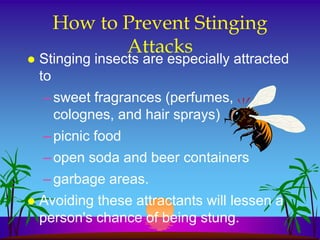
How to Prevent Stinging
             Attacks
   Stinging insects are especially attracted
    to
    – sweet fragrances (perfumes,
      colognes, and hair sprays)
    – picnic food
    – open soda and beer containers
    – garbage areas.
   Avoiding these attractants will lessen a
    person's chance of being stung.
The Sting of Anaphylaxis
   Anaphylaxis is the medical term for an
    allergic reaction.
   The only treatment to an allergic reaction is
    the use of epinephrine and other treatments.
    – Epinephrine can be self-injected or
      administered by a doctor.
   Often intravenous fluids, oxygen, and other
    treatments are necessary as well.
   It is very important to call for medical
    assistance immediately, even if the person
    says “I am okay” after administering
    epinephrine.
First Aid May Not Be Enough
 Once stabilized you may be required to
  stay overnight at the hospital under
  close observation.
 People who have had previous allergic
  reactions and rely on the protection of
  epinephrine must remember to carry it
  with them wherever they go.
 Also, because one dose may not be
  enough to reverse the reaction,
  immediate medical attention following
  an insect sting is recommended.
Some Symptoms of an
       Allergic Reaction
 Hives, itching, and swelling in areas
  other than the sting site.
 Tightness in the chest and difficulty in
  breathing.
 Hoarse voice or swelling of the tongue.
 Dizziness or a sharp drop in blood
  pressure.
 Unconsciousness or cardiac arrest.
Basic First Aid for Stings
 Bees will sting only once leaving the
  barbed stinger in the flesh.
   – To remove the stinger scrap with a
     credit card or other object.
   – DO NOT pinch and pull out the
     stinger, this will inject more venom.
 Wasps, hornets and yellow jackets
  repeatedly sting leaving no stinger
  behind.
Basic First Aid for Stings
 If breathing difficulties develop, or if the
  person appears to be having an
  adverse reaction, DIAL 9-1-1. Get
  Prompt medical care.
 Wash bite/sting area well with soap and
  water.
 If stung or bitten on the fingers or hand,
  remove any rings or jewelry in case of
  swelling.
 Apply a cold compress.
Other Animal or Insect
           Hazards
 Poisonous Animals such as
  – Snakes
  – Scorpions
 Are also prevalent during the Summer
  Months
 Also disease carrying insects such as
  mosquitoes and ticks are prevalent.
A Little about Ticks
 Can carry a wide variety of diseases.
 Ticks contract these diseases from the
  host they attach to.
 Some common diseases are:
   – Lyme Disease
   – Rocky Mountain Spotted Fever
 Most diseases are common to specific
  species of tick.
Insect Protection
   Two primary repellants are used by
    most insect repellants. They are:
    – Insecticide permethrin
    – Insect repellent deet (N, N-diethyl-m-
      tiluarnide)
   It is important that each individual be
    carefully monitored when using either of
    these products.
   As with any chemical, allergic reactions
    can develop from the protectant.
How DEET Works
 Deet repellents works by evaporation,
  creating a shield a few inches above the
  area of application.
 The presence of the repellent vapor
  confuses insects so they can’t locate a
  target host.
 In most cases it usually requires less
  than 1% of the repellent to form this
  protective barrier.
How Permethrin Works
   Permethrin is actually a contact
    insecticide.
   Permethrin is considered ideal because
    it is applied to clothing, gear, mosquito
    nets and bedding and is not applied
    directly on the body.
   Where ticks are a concern, permethrin
    on clothing or gear will kill ticks that
    travel across as little as 10" of treated
    fabric.
Some Natural Defenses
   There are well over       Canola
    150 natural
                              Rosemary
    repellents while the
    most common are:          Pennyroyal
   Citronella                Cajeput
   Eucalyptus                Generally the EPA
                               considers these oils
   Lemon Leaves
                               safe to use in low
   Peppermint                 dosage but overall
   Lavender                   their effectiveness is
                               limited to less than
   Cedar Oil
                               30 minutes.
Additional Sources of
    Information on insects and
            repellants
 http://www.tickinfo.com
 http://allergy.mcg.edu/ALK/fact.html
 http://www.emeraldcoast.com/governme
  nt/emergency/poison.htm
 http://www.uos.harvard.edu/ehs/hot_top
  ics/pom_yellowjacket.html
Let’s Have Fun In the Sun
 With everything, moderation is best.
 Avoid those beehives and hornet nests.
 Keep waste containers, beverages and
  food in enclosed containers.
 Wear protective clothing from ticks,
  mosquitoes.
 Wear proper sunscreens when out in the
  sun.
Let’s Have Fun In the Sun
 If you are sensitive to sunburns avoid
  being in the sun from 10 AM to 2 PM
  when the sun is at its peak.
 Consume lots of water to stay hydrated.
 Cool down in air conditioned rooms or
  near fans.
 Wear light colored, natural fiber
  clothing to help your body to repel heat
  absorption and cool easier.
 Pace yourself during strenuous
  activities.
Any
Questions

Summer Heat Safety

  • 1.
    Summer Safety Covering Someof the Hazards of the Summer Months
  • 2.
    What are theHazards of Summer?  Sun exposure  Allergies  Heat related  Wildfires illnesses  Poisonous Plants  Severe Storms  Poisonous Animals  Tornadoes  Interference with  Lightning Storms PPE  Insects  Fatigue and  Stinging Insects Exhaustion
  • 3.
    The Rising Temperatures As temperatures rise, so does the stress on your body.  Two critical actions can help you battle the heat. – Acclimation to the heat. – Consumption of water.  These two actions can help the most.
  • 4.
    Your Body isa Good Regulator of Heat  Your body reacts to heat by circulating blood and raising your skin's temperature. The excess heat is then released through the skin by sweating.  Physical activity can limit the amount of blood that flows to the skin to release heat.
  • 5.
    Your Body isa Good Regulator of Heat  Sweating can also maintain a stable body temperature if the humidity level is low enough to permit evaporation and if the fluids and salts you lose are adequately replaced.  When your body cannot release heat, it stores it. This raises your core temperature and heart rate putting your health at risk.
  • 6.
    Interfering with theRegulator  Many factors can cause unbalances in your body’s ability to handle heat. – Age – Weight – Fitness – Medical condition – Diet
  • 7.
    Summer Heat  Heat stress is a serious hazard in the workplace as well as at home.  Excessive heat can place an abnormal stress on your body.  When your body temperature rises even a few degrees above normal (which is about 98.6 degrees Fahrenheit) you can experience – muscle cramps – become weak – disoriented – dangerously ill
  • 8.
    Six Factors ofHeat Stress  Temperature  Humidity  Movement of Air or lack of air movement  The radiant temperature of the surroundings  Clothing  Physical activity
  • 9.
    Heat Stress-Early Signof Trouble  Heat Stress will reduce your work capacity and efficiency.  Signs of heat stress include: – Tiredness – Irritability – Inattention – Muscular cramps.
  • 10.
    Heat Stress-Early Signof Trouble (Cont.)  If you are: – Overweight – Physically unfit – Suffer from heart conditions – Drink too much alcohol – Are not used summer temperatures  You may be at greater risk of heat stress and should seek and follow medical advice.
  • 11.
    Heat Rash- AnotherEarly Sign of Trouble  Also known as prickly heat, occurs when people are constantly exposed to hot and humid air, causing a rash that can substantially reduce the ability to sweat.  Heat rash is not just a nuisance because of discomfort, but by reducing the ability to sweat, the ability to tolerate heat is reduced.
  • 12.
    Heat Rash andHeat Stress  First Aid for Heat Rash – Cleanse the affected area thoroughly and dry completely. – Calamine or other soothing lotion may help relieve the discomfort.  First Aid for Heat Stress – Good nutrition – Become Heat acclimated – Drink lots of fluids
  • 13.
    Heat Cramps- FinalWarning  May occur after prolonged exposure to heat.  They are the painful intermittent spasms of the abdomen and other voluntary muscles.  Heat Cramps usually occur after heavy sweating and may begin towards the end of the workday.
  • 14.
    Heat Cramps- FirstAid  First aid for heat cramps will vary. The best care is: – Rest – Move to a cool environment – Drink plenty of water- No pop, sparkling water, or Alcohol. – Electrolyte fluids such as Gatorade or Sqwincher may also be used.
  • 15.
    Heat Exhaustion- TimeRunning Out  May result from physical exertion in hot environments.  Symptoms may include: – Dizziness – Profuse sweating – Nausea – Weakness – Headache – Paleness of the skin – Vomiting – Rapid pulse – Unconsciousness.  The skin is cool and clammy with sweat. Body temperature may be normal or subnormal.
  • 16.
    Heat Exhaustion- What Happened  Heat exhaustion develops when a person fails to replace fluids and salt that are lost through sweating.  You may start to experience extreme weakness, fatigue, giddiness, nausea or a headache as heat exhaustion progresses.
  • 17.
    Heat Exhaustion- FirstAid  Rest in the shade or cool place.  Drink plenty of water (preferred) or electrolyte fluids.  Loosen clothing to allow for your body to cool.  Use cool wet rags to aid cooling.
  • 18.
    Heat Stroke- YourOut of Time  This is a serious medical condition that urgently requires medical attention.  Sweating is diminished or absent, which makes the skin hot and dry.  Body temperature is very high (106 degrees F. and rising).
  • 19.
    Heat Stroke- Signsand Symptoms  Mental confusion  Convulsions or  Delirium coma  Chills  A body temperature  Dizziness of 105 degrees F or higher  Loss of consciousness  Hot, dry skin that may be red, mottled or bluish  A strong fast pulse.
  • 20.
    Heat Stroke- RapidResponse  If you suspect someone is suffering from heat stroke, call an ambulance immediately.  Their condition will rapidly deteriorate.  You must make a provide care immediately.
  • 21.
    Heat Stroke- FirstAid  This is a Medical Emergency!!  Brain damage and death are possible.  Until medical help arrives, move the victim from the heat and into a cool place. Call 9-1-1
  • 22.
    Heat Stroke- FirstAid  You must use extreme caution when soaking clothing or applying water to a victim. Shock may occur if done to quickly or with too cool of water  Soak his or her clothes with water and use a fan or ice packs.  Douse the body continuously with a cool liquid and summon medical aid immediately.
  • 23.
    The Heat Index  The heat index table was developed by the Weather Service.
  • 24.
    NOTE: When theair temperature is above 80 degrees F. and the relative humidity is above 40% the temperature the body experiences is greater than the air temperature.
  • 25.
    Soaking in theSun  The power of the sun can feel good when emerging from the Winter blahs.  Caution must be observed when exposure to the sun is frequent and intense.  Health conditions and problems can arise from too much sun exposure.
  • 26.
    Common Sun RelatedHealth Problems- Skin Cancer  Exposure to UV radiation can lead to skin cancer. The three most common: – Basal Cell – Squamous Cell – Melanoma  Receiving one or two blistering sunburns before the age of 18 at least doubles an individual's risk for developing melanoma. (AAD, 1994).
  • 27.
    Common Sun RelatedHealth Problems- Eye Damage  Eye Damage from UV radiation  Long exposure to sunlight can lead to eye problems later in life, such as cataracts.  Another potential effect of UV radiation is a "burning" of the eye surface, called "snow blindness" or photokeratitis from sunlight.
  • 28.
    Common Sun RelatedHealth Problems- Eye Damage  Snow Blindness effects usually disappear within a couple of days, but may lead to further complications later in life.  UVB damage to the eyes is also cumulative, so it is never too late for people to start protecting their eyes.
  • 29.
    Common Sun RelatedHealth Problems- Premature Aging  Repeated exposure to the sun can cause premature aging effects.  Sun-induced skin damage causes wrinkles and furrows, easy bruising, brown or “liver spots” on the skin.  Because this exposure in cumulative, protection can never be to late.
  • 30.
    Common Sun RelatedHealth Problems- Immune System  Scientists believe sunburns can alter the distribution and function of disease-fighting white blood cells in humans for up to 24 hours after exposure to the sun.  Repeated overexposure to UV radiation can cause more damage to the body's immune system.  Mild sunburns can directly suppress the immune functions of human skin where the sunburn occurred, even in people with dark skin. (http://www.nsc.org/ehc/sunwise/health.htm#skin)
  • 31.
    Let’s Talk AboutThe Sting of Summer  With increased temperatures, many insects become very active.  Often these insects are just a nuisance, but these insects can cause many health related problems.
  • 32.
    The Stinging Insects  Common Ones:  Some Uncommon – Bees Ones in this area: – Wasps – Caterpillers – Hornets – Centipedes – Yellow Jackets – Black Widow – Fire Ants (in Spider southeastern US) – Brown Recluse or Fiddleback Spider
  • 33.
    The Common Problems Over 2 million people are allergic to stinging insects.  An allergic reaction to an insect sting can occur immediately, within minutes, or even hours after the sting (although never more than 24 hrs).  People who have experienced a systemic allergic reaction to an insect sting have a 60% chance of a similar (or worse) reaction if stung again.
  • 34.
    How to PreventStinging Attacks  Stinging insects are especially attracted to – sweet fragrances (perfumes, colognes, and hair sprays) – picnic food – open soda and beer containers – garbage areas.  Avoiding these attractants will lessen a person's chance of being stung.
  • 35.
    The Sting ofAnaphylaxis  Anaphylaxis is the medical term for an allergic reaction.  The only treatment to an allergic reaction is the use of epinephrine and other treatments. – Epinephrine can be self-injected or administered by a doctor.  Often intravenous fluids, oxygen, and other treatments are necessary as well.  It is very important to call for medical assistance immediately, even if the person says “I am okay” after administering epinephrine.
  • 36.
    First Aid MayNot Be Enough  Once stabilized you may be required to stay overnight at the hospital under close observation.  People who have had previous allergic reactions and rely on the protection of epinephrine must remember to carry it with them wherever they go.  Also, because one dose may not be enough to reverse the reaction, immediate medical attention following an insect sting is recommended.
  • 37.
    Some Symptoms ofan Allergic Reaction  Hives, itching, and swelling in areas other than the sting site.  Tightness in the chest and difficulty in breathing.  Hoarse voice or swelling of the tongue.  Dizziness or a sharp drop in blood pressure.  Unconsciousness or cardiac arrest.
  • 38.
    Basic First Aidfor Stings  Bees will sting only once leaving the barbed stinger in the flesh. – To remove the stinger scrap with a credit card or other object. – DO NOT pinch and pull out the stinger, this will inject more venom.  Wasps, hornets and yellow jackets repeatedly sting leaving no stinger behind.
  • 39.
    Basic First Aidfor Stings  If breathing difficulties develop, or if the person appears to be having an adverse reaction, DIAL 9-1-1. Get Prompt medical care.  Wash bite/sting area well with soap and water.  If stung or bitten on the fingers or hand, remove any rings or jewelry in case of swelling.  Apply a cold compress.
  • 40.
    Other Animal orInsect Hazards  Poisonous Animals such as – Snakes – Scorpions  Are also prevalent during the Summer Months  Also disease carrying insects such as mosquitoes and ticks are prevalent.
  • 41.
    A Little aboutTicks  Can carry a wide variety of diseases.  Ticks contract these diseases from the host they attach to.  Some common diseases are: – Lyme Disease – Rocky Mountain Spotted Fever  Most diseases are common to specific species of tick.
  • 42.
    Insect Protection  Two primary repellants are used by most insect repellants. They are: – Insecticide permethrin – Insect repellent deet (N, N-diethyl-m- tiluarnide)  It is important that each individual be carefully monitored when using either of these products.  As with any chemical, allergic reactions can develop from the protectant.
  • 43.
    How DEET Works Deet repellents works by evaporation, creating a shield a few inches above the area of application.  The presence of the repellent vapor confuses insects so they can’t locate a target host.  In most cases it usually requires less than 1% of the repellent to form this protective barrier.
  • 44.
    How Permethrin Works  Permethrin is actually a contact insecticide.  Permethrin is considered ideal because it is applied to clothing, gear, mosquito nets and bedding and is not applied directly on the body.  Where ticks are a concern, permethrin on clothing or gear will kill ticks that travel across as little as 10" of treated fabric.
  • 45.
    Some Natural Defenses  There are well over  Canola 150 natural  Rosemary repellents while the most common are:  Pennyroyal  Citronella  Cajeput  Eucalyptus  Generally the EPA considers these oils  Lemon Leaves safe to use in low  Peppermint dosage but overall  Lavender their effectiveness is limited to less than  Cedar Oil 30 minutes.
  • 46.
    Additional Sources of Information on insects and repellants  http://www.tickinfo.com  http://allergy.mcg.edu/ALK/fact.html  http://www.emeraldcoast.com/governme nt/emergency/poison.htm  http://www.uos.harvard.edu/ehs/hot_top ics/pom_yellowjacket.html
  • 47.
    Let’s Have FunIn the Sun  With everything, moderation is best.  Avoid those beehives and hornet nests.  Keep waste containers, beverages and food in enclosed containers.  Wear protective clothing from ticks, mosquitoes.  Wear proper sunscreens when out in the sun.
  • 48.
    Let’s Have FunIn the Sun  If you are sensitive to sunburns avoid being in the sun from 10 AM to 2 PM when the sun is at its peak.  Consume lots of water to stay hydrated.  Cool down in air conditioned rooms or near fans.  Wear light colored, natural fiber clothing to help your body to repel heat absorption and cool easier.  Pace yourself during strenuous activities.
  • 49.