General Features in Knowledge Tracing
Applications to Multiple Subskills,
Temporal IRT & Expert Knowledge
* First authors
Yun Huang, University of Pittsburgh*
José P. González-Brenes, Pearson*
Peter Brusilovsky, University of Pittsburgh
This talk…
•  What? Determine student mastery of a skill
•  How? Novel algorithm called FAST
–  Enables features in Knowledge Tracing
•  Why? Better and faster student modeling
–  25% better AUC, a classification metric
–  300 times faster than popular general purpose
student modeling techniques (BNT-SM)
Outline
•  Introduction
•  FAST – Feature-Aware Student Knowledge Tracing
•  Experimental Setup
•  Applications
1.  Multiple subskills
2.  Temporal Item Response Theory
3.  Paper exclusive: Expert knowledge
•  Execution time
•  Conclusion
Motivation
•  Personalize learning of students
– For example, teach students new material as
they learn, so we don’t teach students
material they know
•  How? Typically with Knowledge Tracing
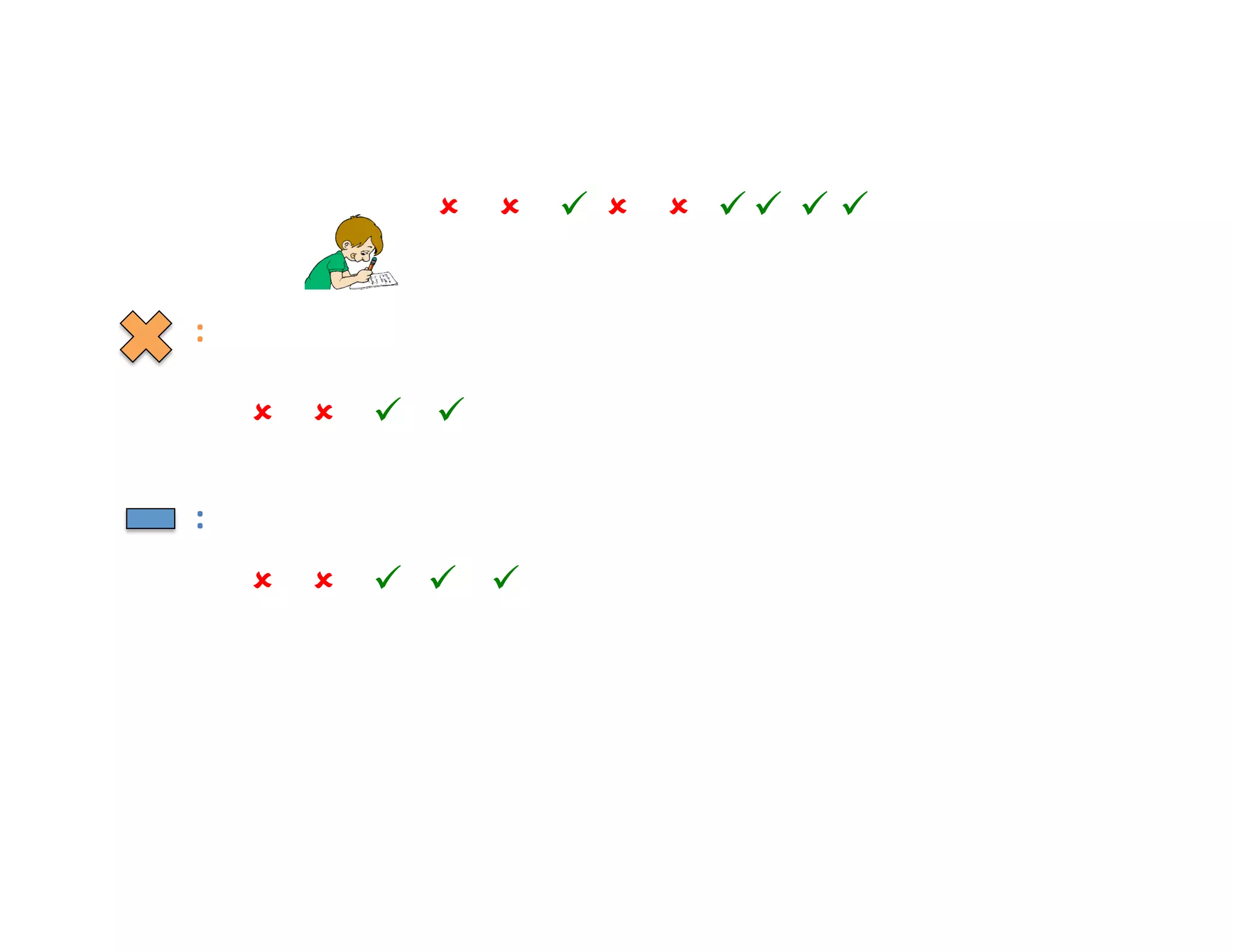
:	
  
û û 	
  	
  	
  ü	
  	
  ü	
  û û ü	
  	
   ü	


  ü	
  
û û ü	
  	
  	
  ü	


  ü	
  
û û ü	


  ü	
  
:	
  
:	
  
:	
  
û û ü	
  	
  	
  ü	


  ü	
  
û û ü	
  	
  ü	
  
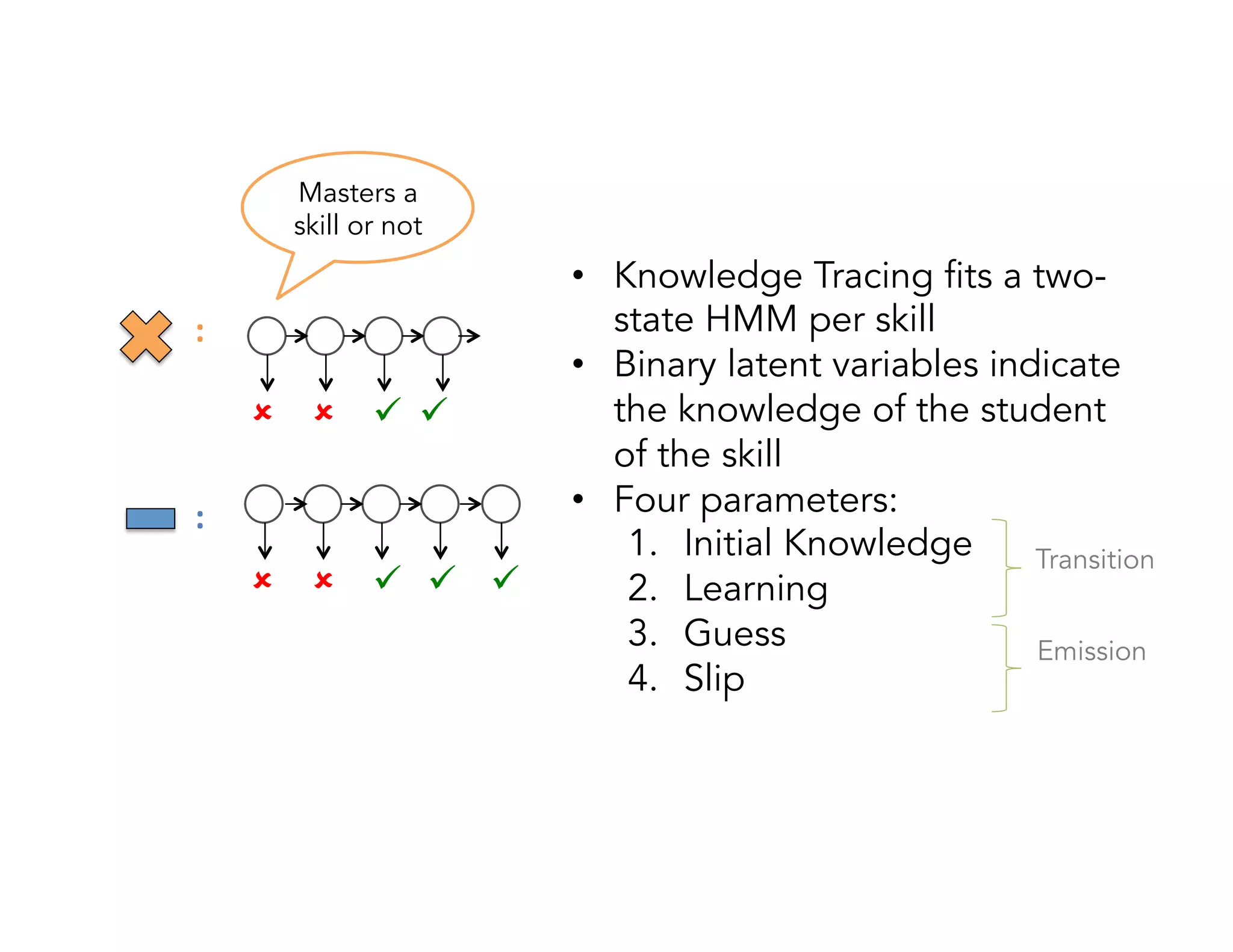
Masters a
skill or not
•  Knowledge Tracing fits a two-
state HMM per skill
•  Binary latent variables indicate
the knowledge of the student
of the skill
•  Four parameters:
1.  Initial Knowledge
2.  Learning
3.  Guess
4.  Slip
Transition
Emission
What’s wrong?
•  Only uses performance data
(correct or incorrect)
•  We are now able to capture feature rich data
–  MOOCs & intelligent tutoring systems are able to
log fine-grained data
–  Used a hint, watched video, after hours practice…
•  … these features can carry information or
intervene on learning
What’s a researcher gotta do?
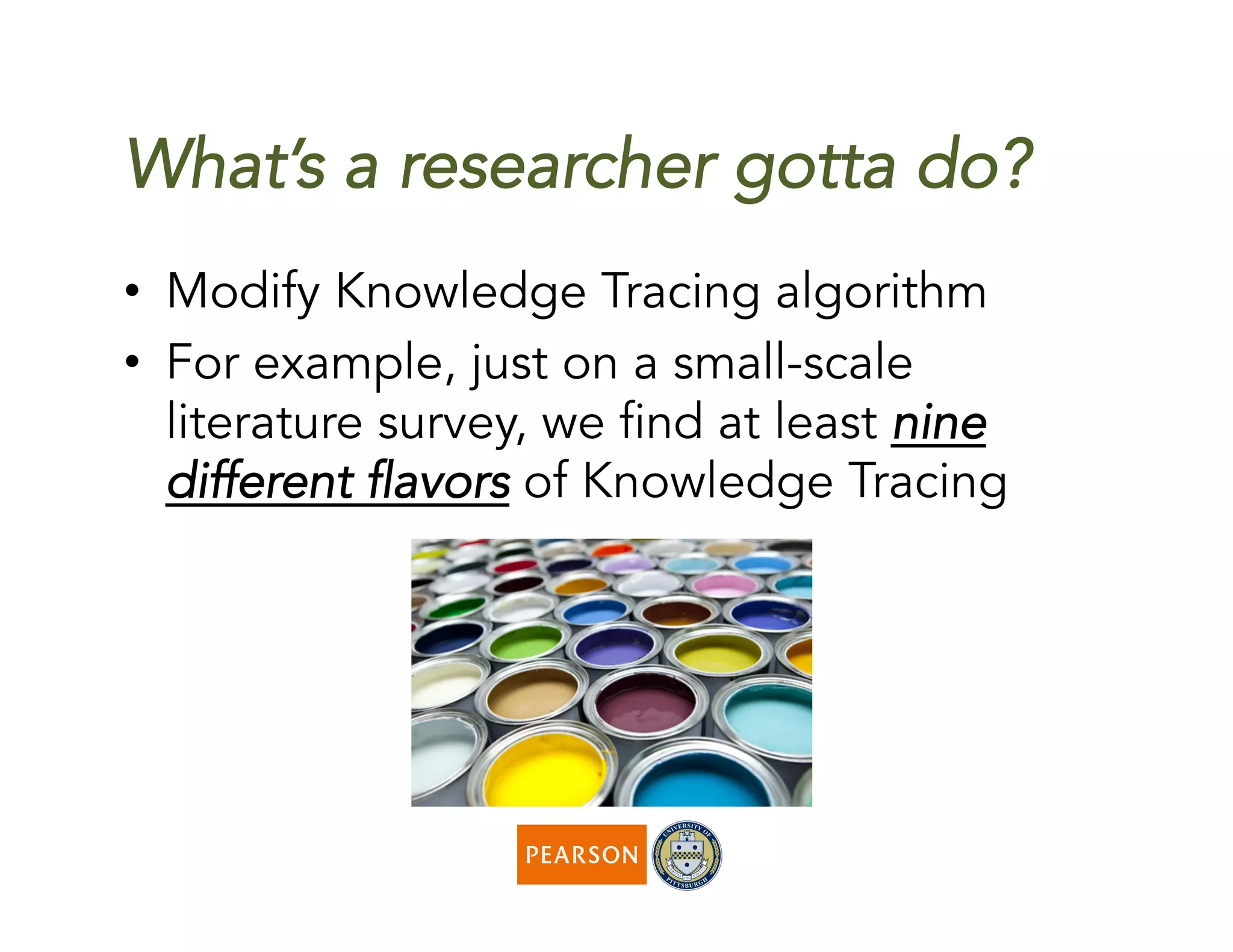
•  Modify Knowledge Tracing algorithm
•  For example, just on a small-scale
literature survey, we find at least nine
different flavors of Knowledge Tracing
So you want to publish in EDM?
1.  Think of a feature (e.g., from a MOOC)
2.  Modify Knowledge Tracing
3.  Write Paper
4.  Publish
5.  Loop!
Are all of those models sooooo
different?
•  No! we identify three main variants
•  We call them the “Knowledge Tracing
Family”
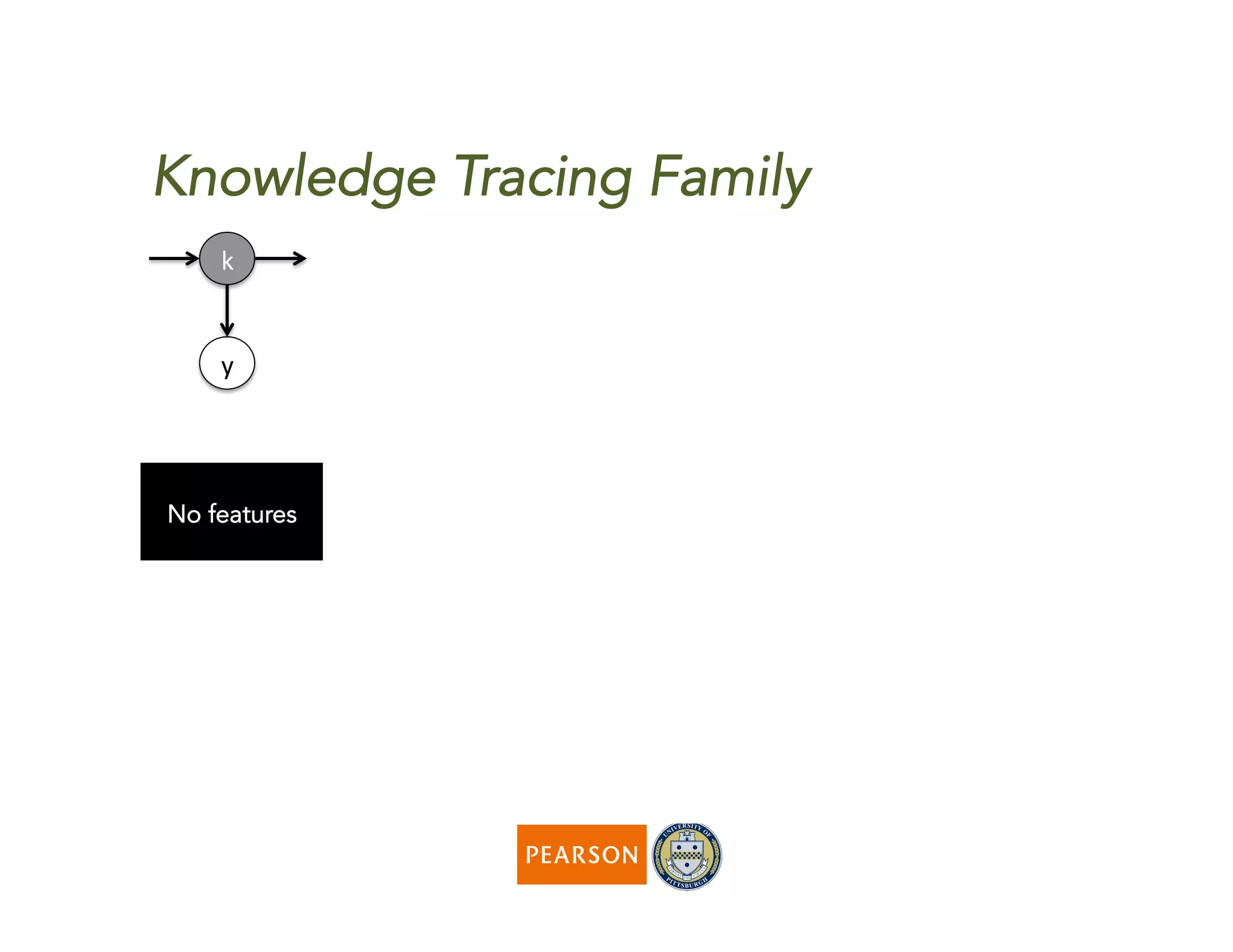
Knowledge Tracing Family
No features
Emission
(guess/slip)
Transition
(learning)
Both
(guess/slip and
learning)
•  Item	
  difficulty	
  
(Gowda	
  et	
  al	
  ’11;	
  
Pardos	
  et	
  al	
  ’11)	
  
•  Student	
  ability	
  
(Pardos	
  et	
  al	
  	
  
’10)	
  
•  Subskills	
  (Xu	
  et	
  
al	
  ’12)	
  
•  Help	
  (Sao	
  Pedro	
  
et	
  al	
  ’13)	
  
•  Student	
  ability	
  
(Lee	
  et	
  al	
  ’12;	
  
Yudelson	
  et	
  al	
  ’13)	
  
•  Item	
  difficulty	
  
(Schultz	
  et	
  al	
  ’13)	
  
•  Help	
  (Becker	
  	
  et	
  al	
  
’08)	
  
k	
  
y	
  
k	
  
y	
  
f	
  
k	
  
y	
  
f	
  
k	
  
y	
  
f	
  f	
  
•  Each model is successful for
an ad hoc purpose only
– Hard to compare models
– Doesn’t help to build a
cognition theory
•  Learning scientists have to
worry about both features
and modeling
•  These models are not
scalable:
– Rely on Bayes Net’s
conditional probability tables
– Memory performance grows
exponentially with number of
features
– Runtime performance grows
exponentially with number of
features (with exact
inference)
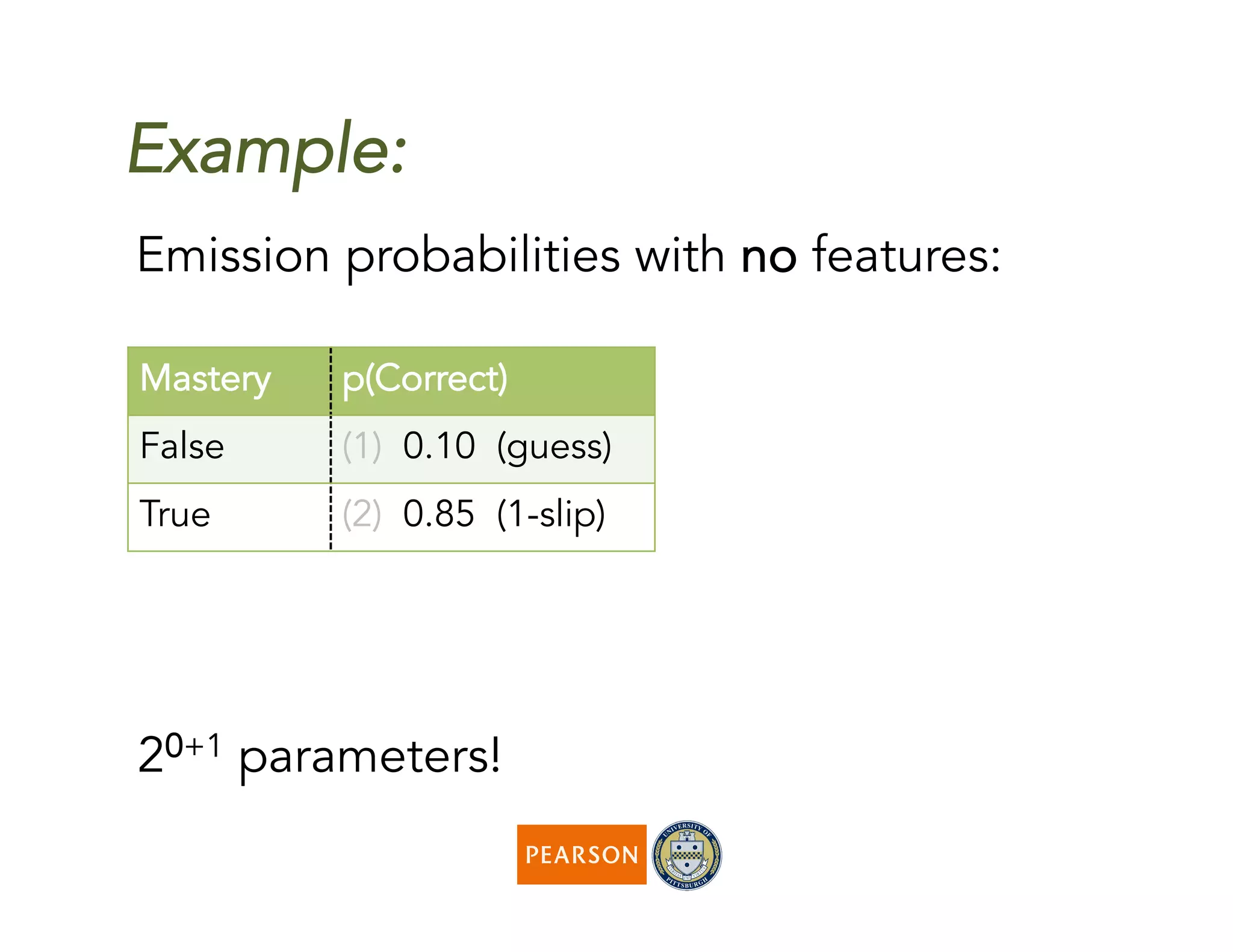
Example:
Mastery p(Correct)
False (1) 0.10 (guess)
True (2) 0.85 (1-slip)
20+1 parameters!
Emission probabilities with no features:
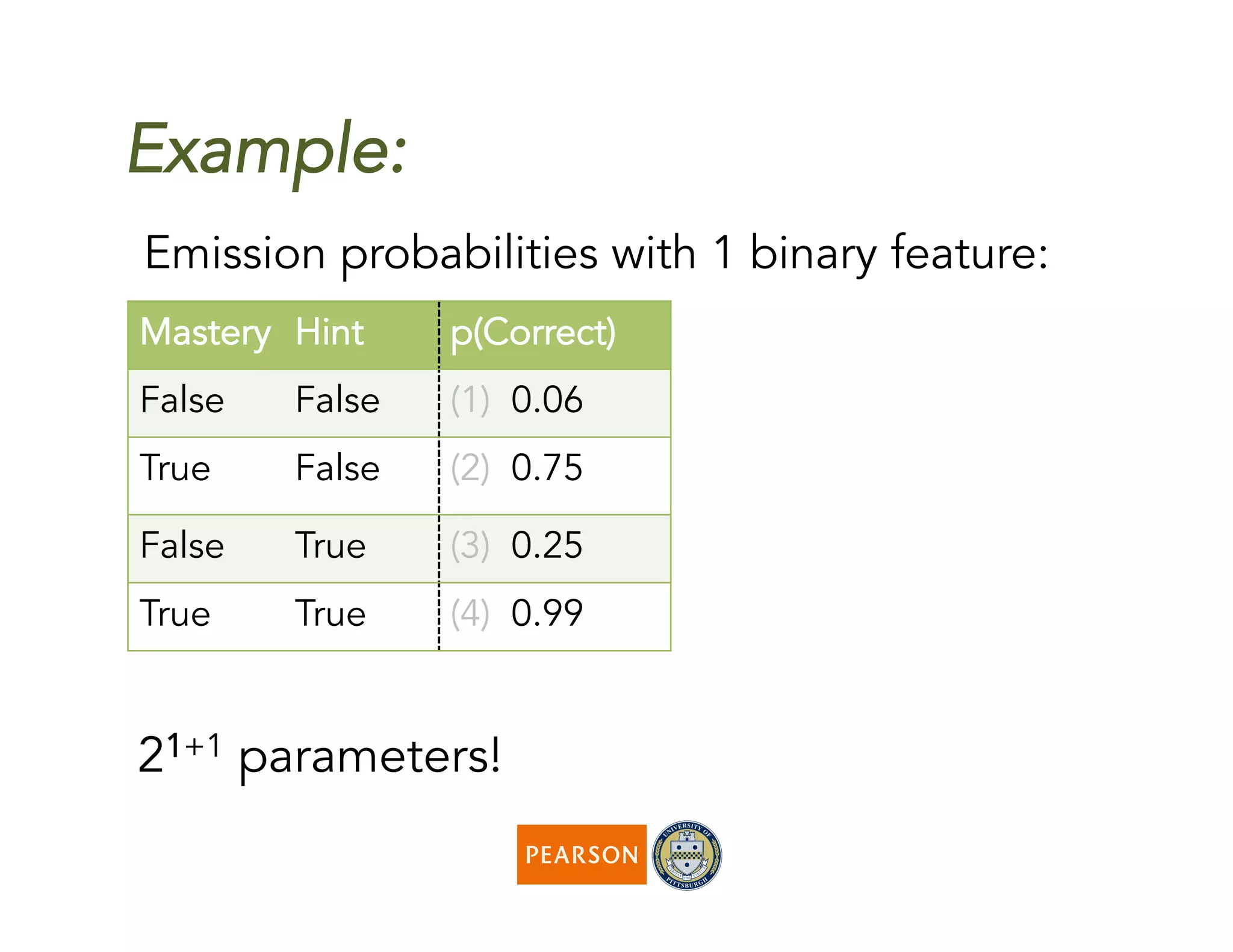
Example:
Emission probabilities with 1 binary feature:
Mastery Hint p(Correct)
False False (1) 0.06
True False (2) 0.75
False True (3) 0.25
True True (4) 0.99
21+1 parameters!
Example:
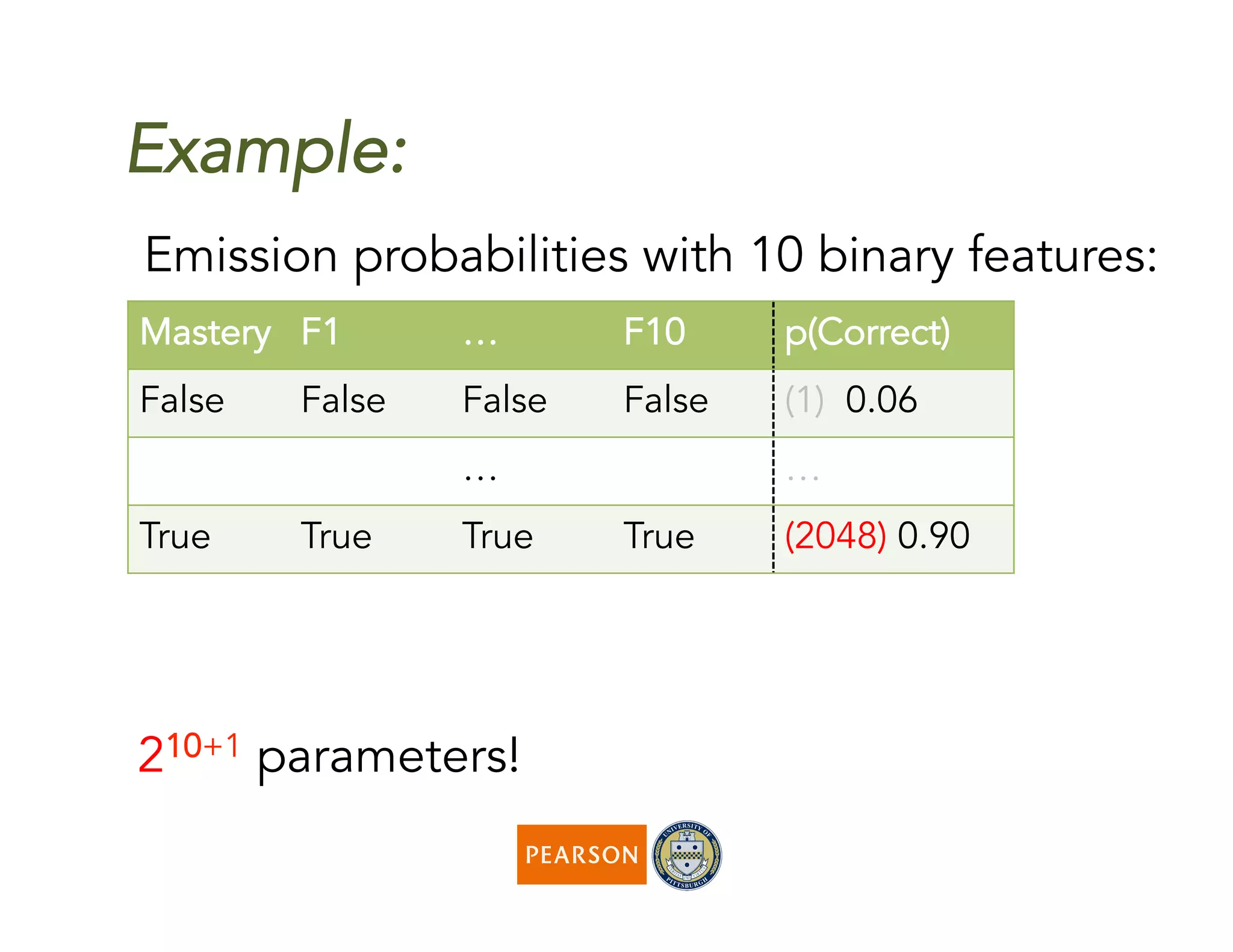
Emission probabilities with 10 binary features:
Mastery F1 … F10 p(Correct)
False False False False (1) 0.06
… …
True True True True (2048) 0.90
210+1 parameters!
Outline
•  Introduction
•  FAST – Feature-Aware Student Knowledge Tracing
•  Experimental Setup
•  Applications
– Multiple subskills
– Temporal IRT
•  Execution time
•  Conclusion
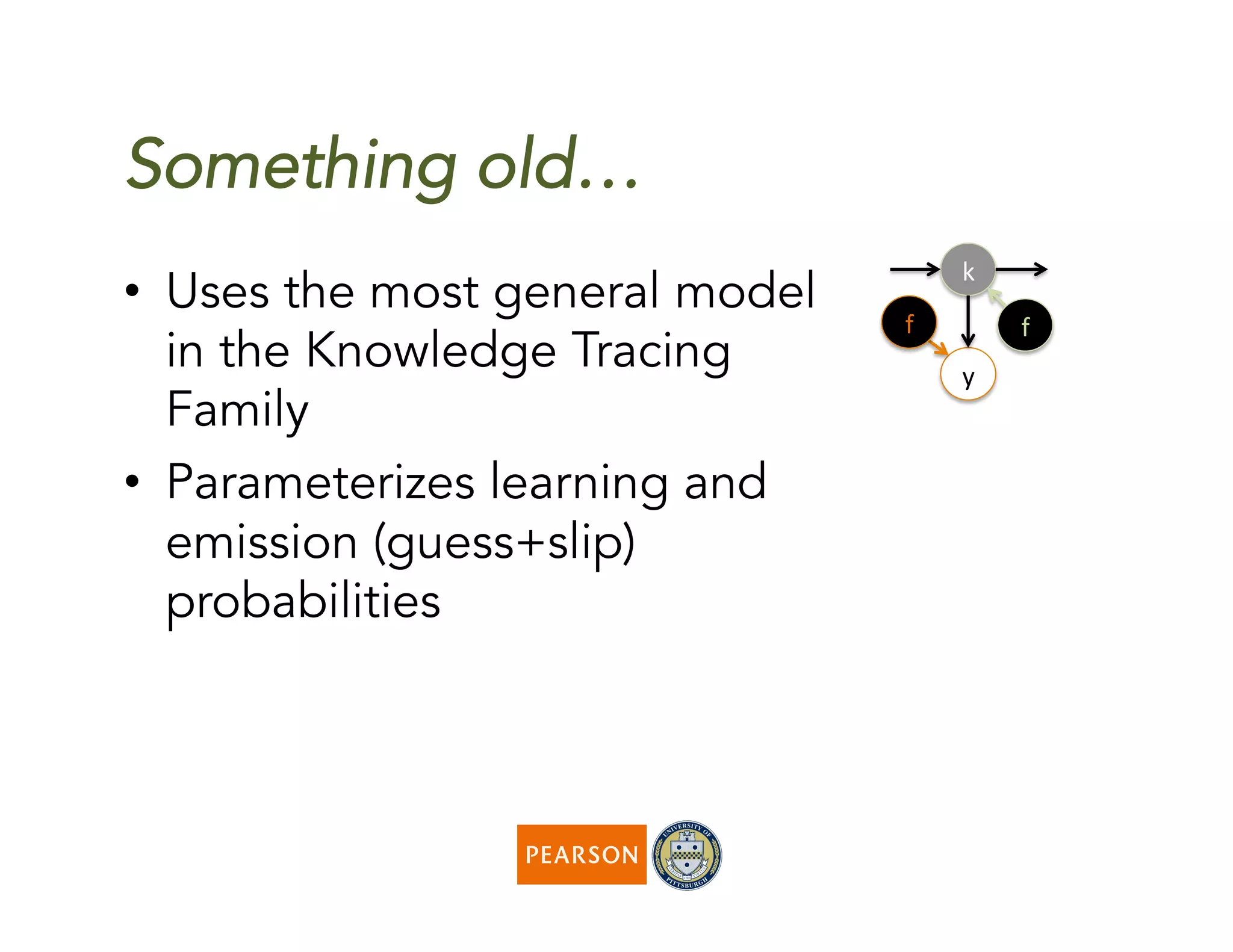
Something old…
k	
  
y	
  
f	
  f	
  
•  Uses the most general model
in the Knowledge Tracing
Family
•  Parameterizes learning and
emission (guess+slip)
probabilities
Something new…
k	
  
y	
  
f	
  f	
  
•  Instead of using inefficient
conditional probability tables,
we use logistic regression
[Berg-Kirkpatrick et al’10 ]
•  Exponential complexity ->
linear complexity
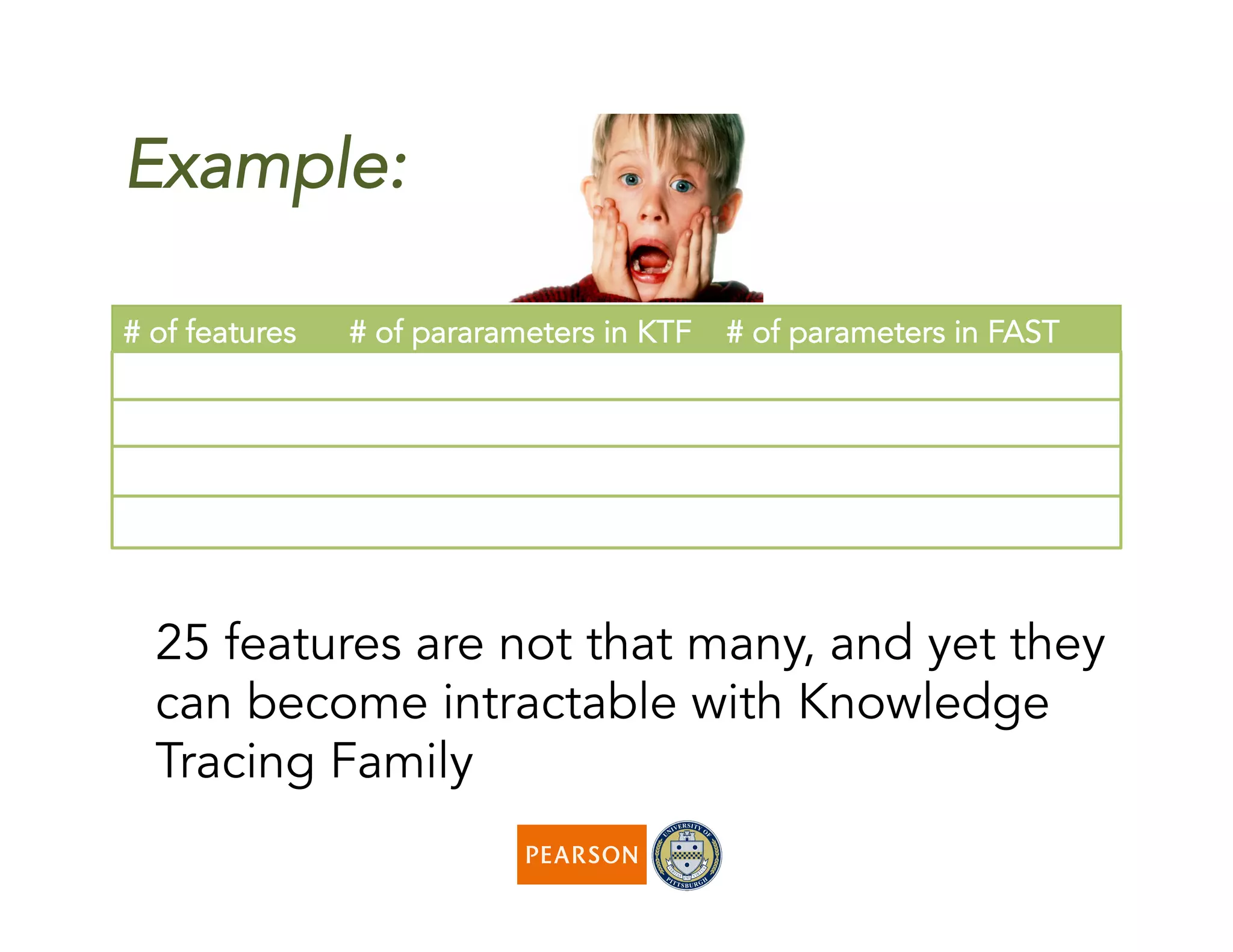
Example:
# of features # of pararameters in KTF # of parameters in FAST
0 2 2
1 4 3
10 2048 12
25 67,108,864 27
25 features are not that many, and yet they
can become intractable with Knowledge
Tracing Family
Something blue?
k	
  
y	
  
f	
  f	
  
•  Not a lot of changes to
implement prediction
•  Training requires quite a bit of
changes
– We use a recent modification of
the Expectation-Maximization
algorithm proposed for
Computational Linguistics
problems
[Berg-Kirkpatrick et al’10 ]
(A parenthesis)
•  Jose’s corollary: Each
equation in a presentation
would send to sleep half the
audience
•  Equations are in the paper!
“Each	
  equaMon	
  I	
  
include	
  in	
  the	
  book	
  
would	
  halve	
  the	
  sales”	


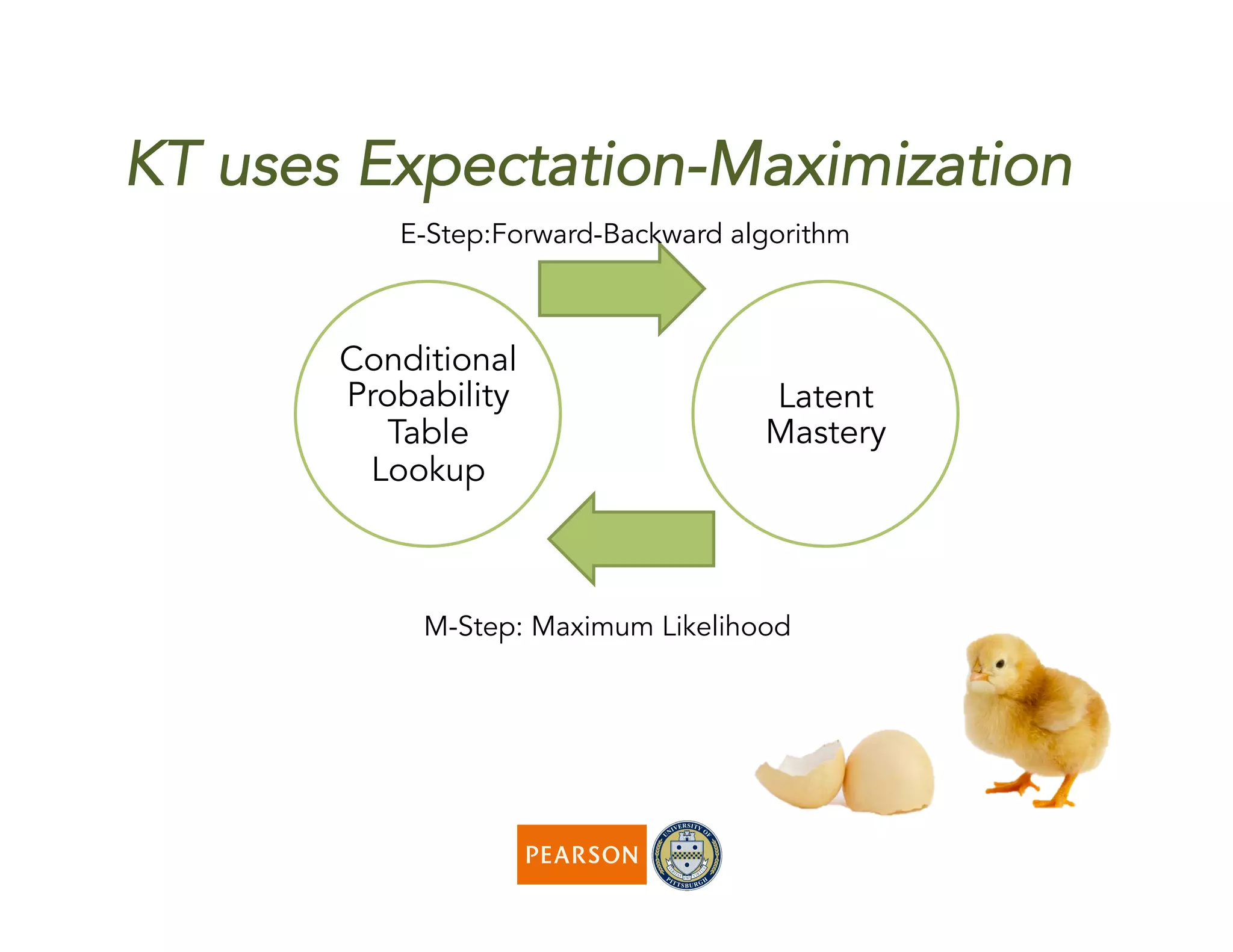
KT uses Expectation-Maximization
Conditional
Probability
Table
Lookup
Latent
Mastery
E-Step:Forward-Backward algorithm
M-Step: Maximum Likelihood
“Conditional
Probability
Table”
Lookup
Latent
Mastery
Logistic
regression
weights
FAST uses a recent E-M algorithm
[Berg-Kirkpatrick et al’10 ]
E-step
Slip/guess lookup:
Mastery p(Correct)
False (1)
True (2)
Use the multiple
parameters of logistic
regression to fill the
values of a “no-
features”conditional
probability table!
[Berg-Kirkpatrick et al’10 ]
“Conditional
Probability
Table”
Lookup
Latent
Mastery
Logistic
regression
weights
FAST uses a recent E-M algorithm
[Berg-Kirkpatrick et al’10 ]
observation 1
observation 2
observation n
...
feature1feature2
featurekfeature1feature2
featurek
... ... ...
observation 1
observation 2
observation n
...
{
{
{
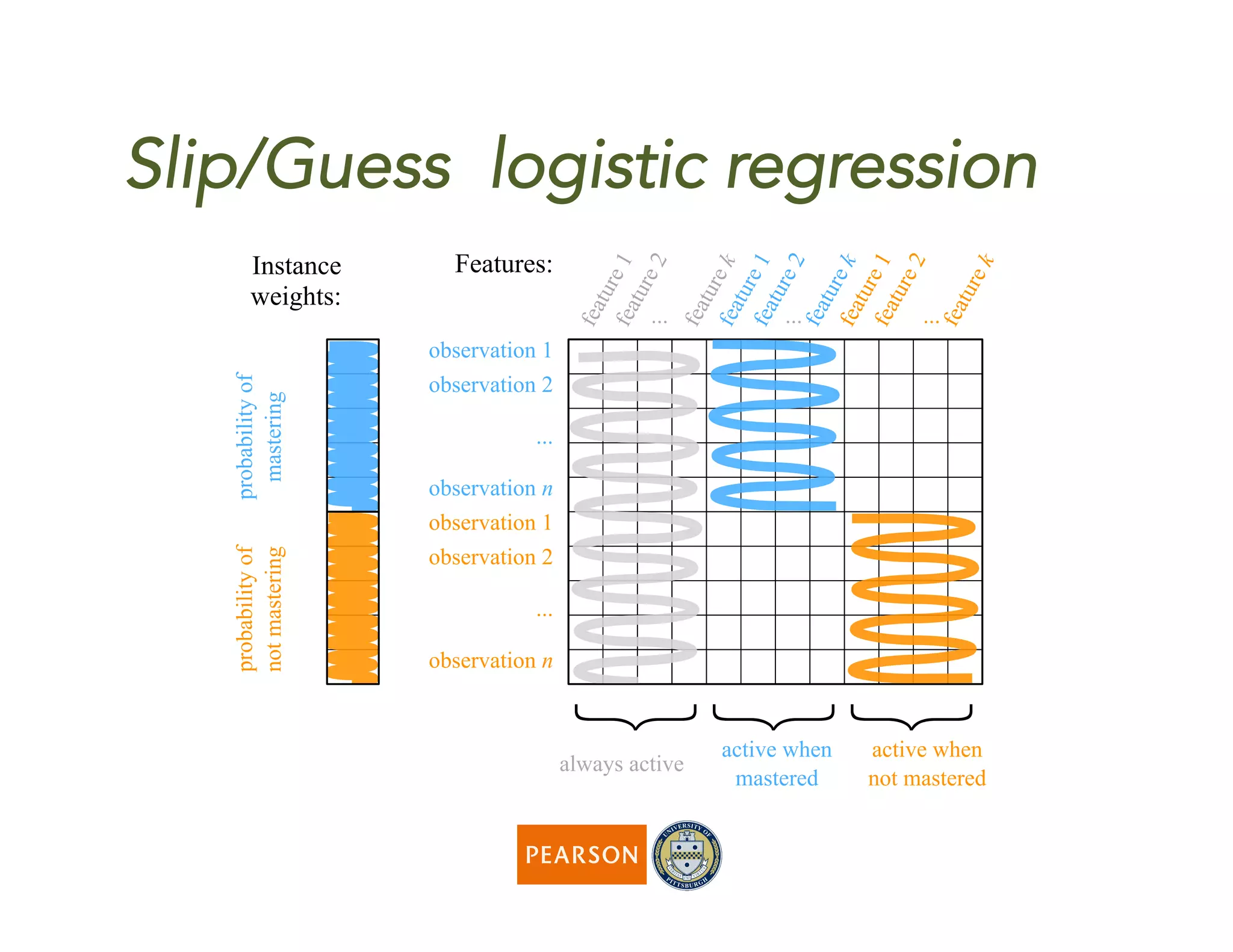
active when
mastered
active when
not mastered
always active
Features:Instance
weights:
probabilityof
notmastering
probabilityof
mastering
Slip/Guess logistic regression
observation 1
observation 2
observation n
...
feature1feature2
featurekfeature1feature2
featurek
... ... ...
observation 1
observation 2
observation n
...
{
{
{
active when
mastered
active when
not mastered
always active
Features:Instance
weights:
probabilityof
notmastering
probabilityof
mastering
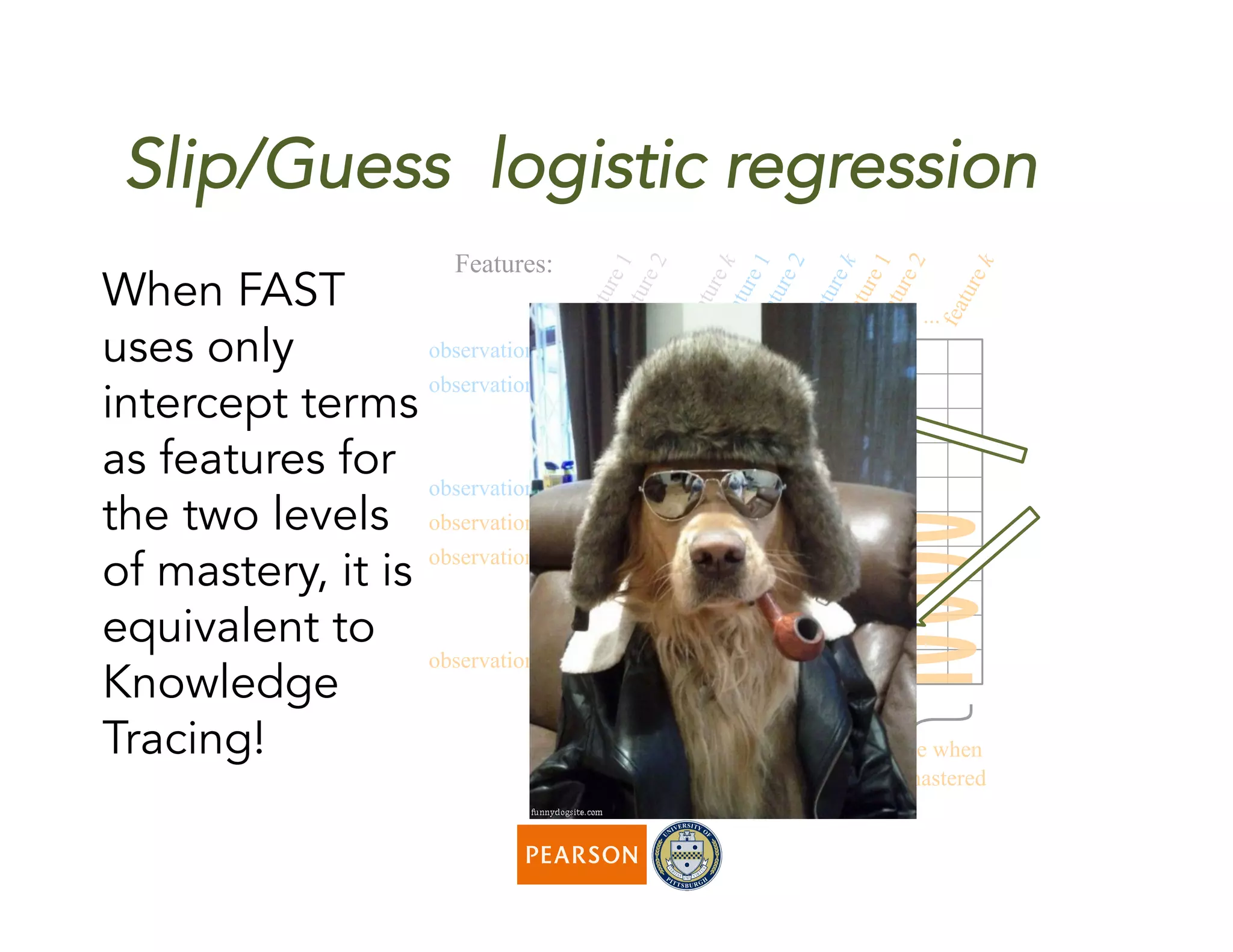
Slip/Guess logistic regression
When FAST
uses only
intercept terms
as features for
the two levels
of mastery, it is
equivalent to
Knowledge
Tracing!
Outline
•  Introduction
•  FAST – Feature-Aware Student Knowledge Tracing
•  Experimental Setup
•  Examples
– Multiple subskills
– Temporal IRT
– Expert knowledge
•  Conclusion
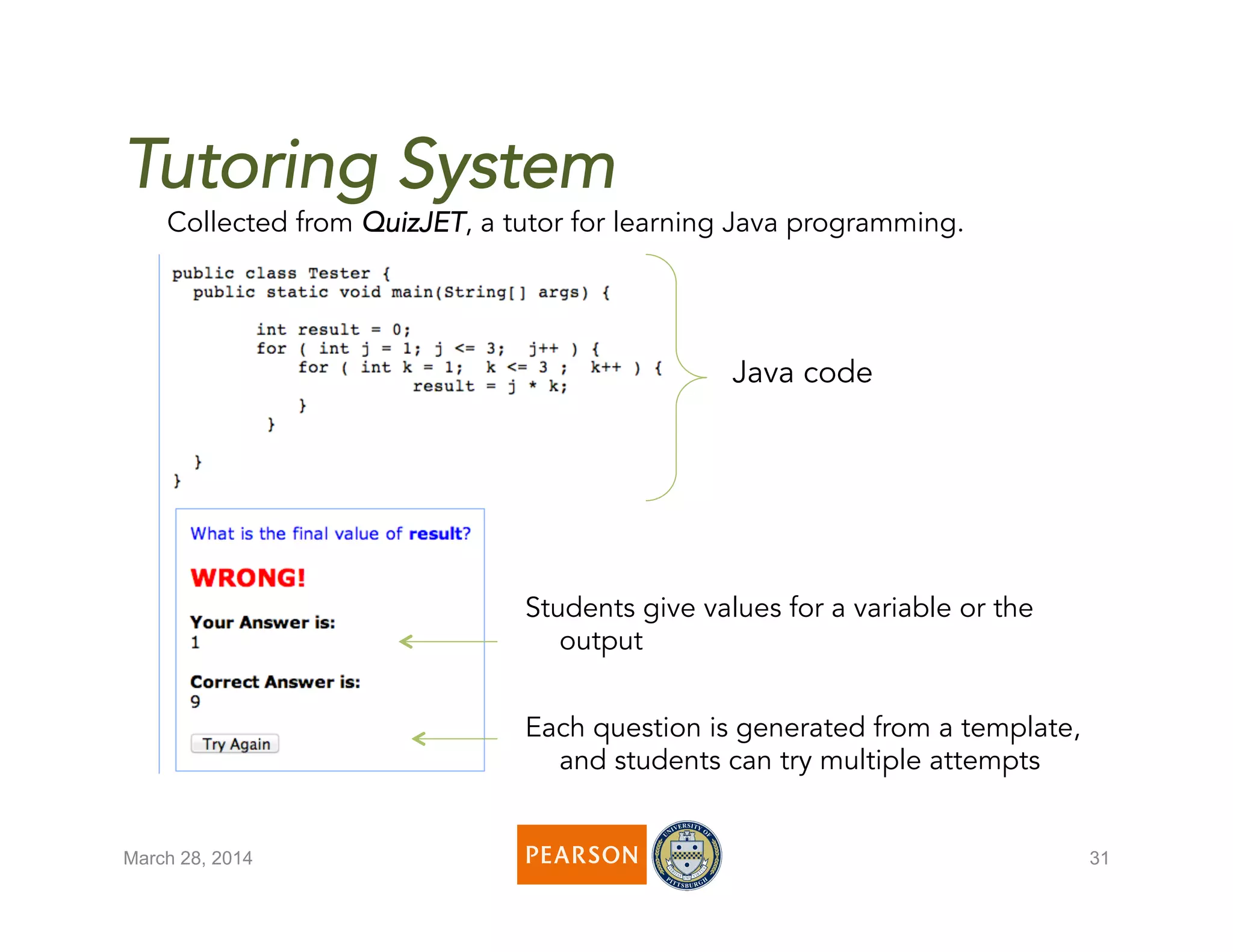
Collected from QuizJET, a tutor for learning Java programming.
March 28, 2014 31
Each question is generated from a template,
and students can try multiple attempts
Students give values for a variable or the
output
Java code
Tutoring System
March 28, 2014 32
Data
•  Smaller dataset:
– ~21,000 observations
– First attempt: ~7,000 observations
– 110 students
•  Unbalanced: 70% correct
•  95 question templates
•  “Hierarchical” cognitive model:
19 skills, 99 subskills
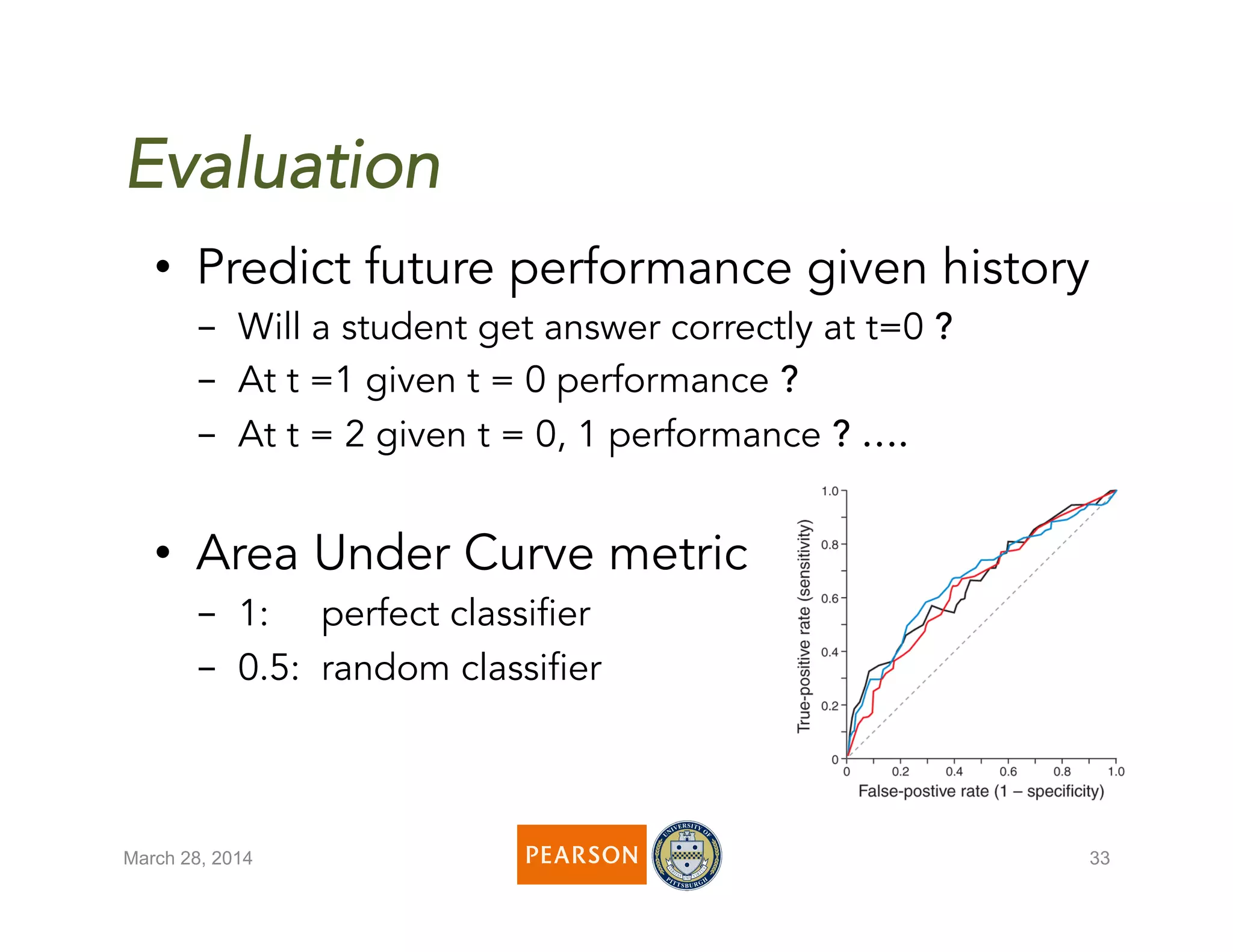
•  Predict future performance given history
-  Will a student get answer correctly at t=0 ?
-  At t =1 given t = 0 performance ?
-  At t = 2 given t = 0, 1 performance ? ….
•  Area Under Curve metric
-  1: perfect classifier
-  0.5: random classifier
March 28, 2014 33
Evaluation
Outline
•  Introduction
•  FAST – Feature-Aware Student Knowledge Tracing
•  Experimental Setup
•  Applications
–  Multiple subskills
–  Temporal IRT
–  Expert knowledge
•  Execution time
•  Conclusion
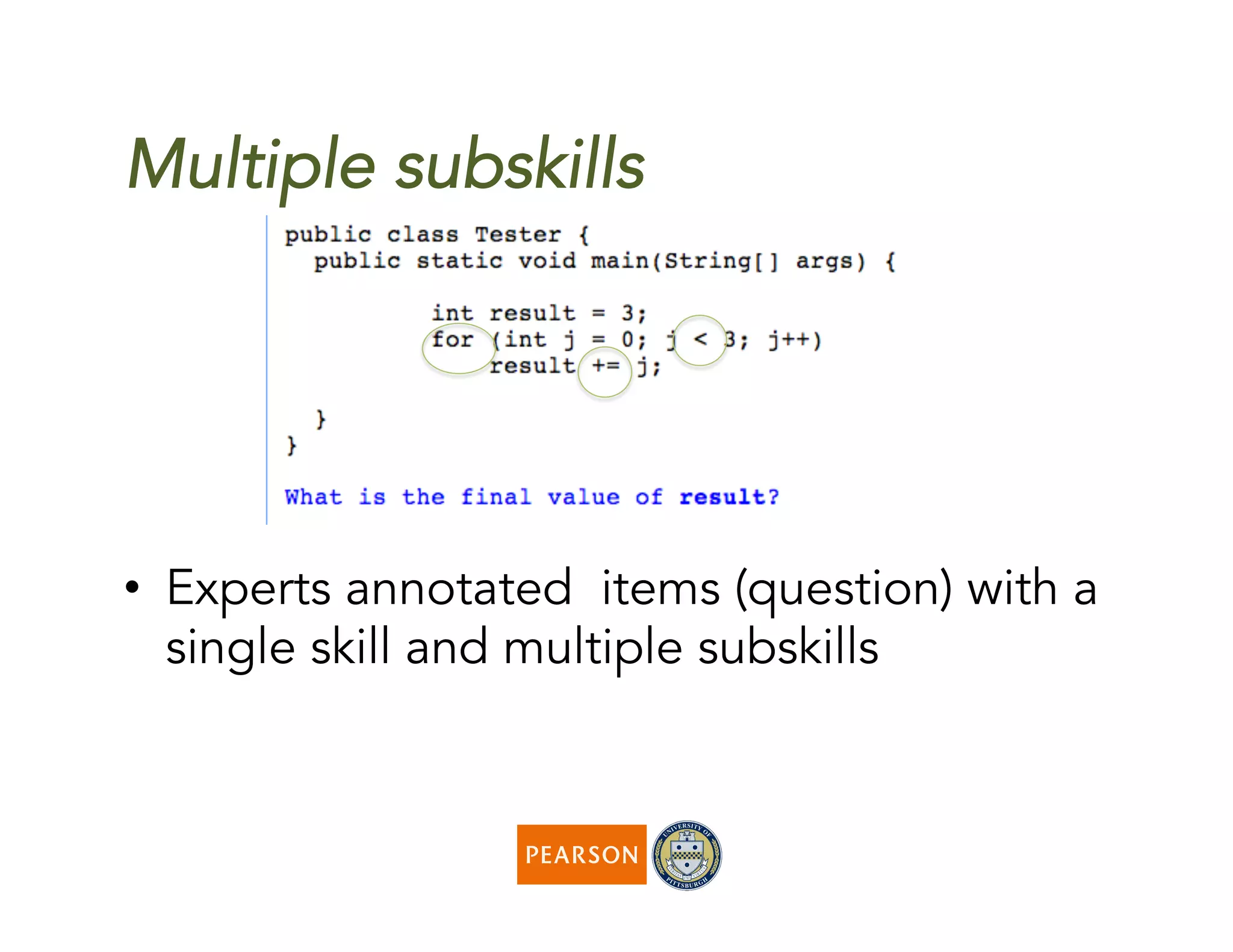
Multiple subskills
•  Experts annotated items (question) with a
single skill and multiple subskills
Multiple subskills &
KnowledgeTracing
•  Original Knowledge Tracing can not
model multiple subskills
•  Most Knowledge Tracing variants assume
equal importance of subskills during
training (and then adjust it during testing)
•  State of the art method, LR-DBN [Xu and
Mostow ’11] assigns importance in both
training and testing
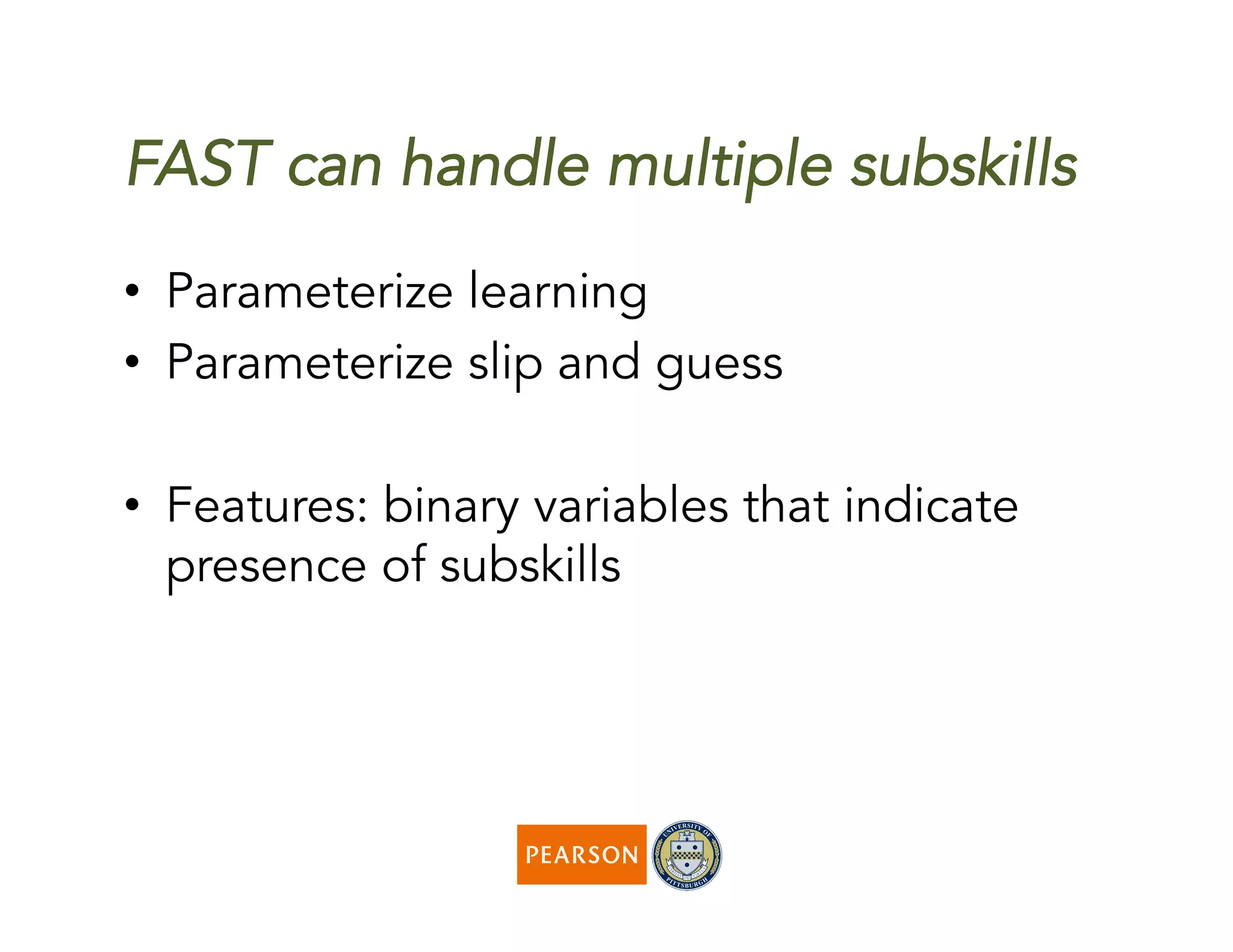
FAST can handle multiple subskills
•  Parameterize learning
•  Parameterize slip and guess
•  Features: binary variables that indicate
presence of subskills
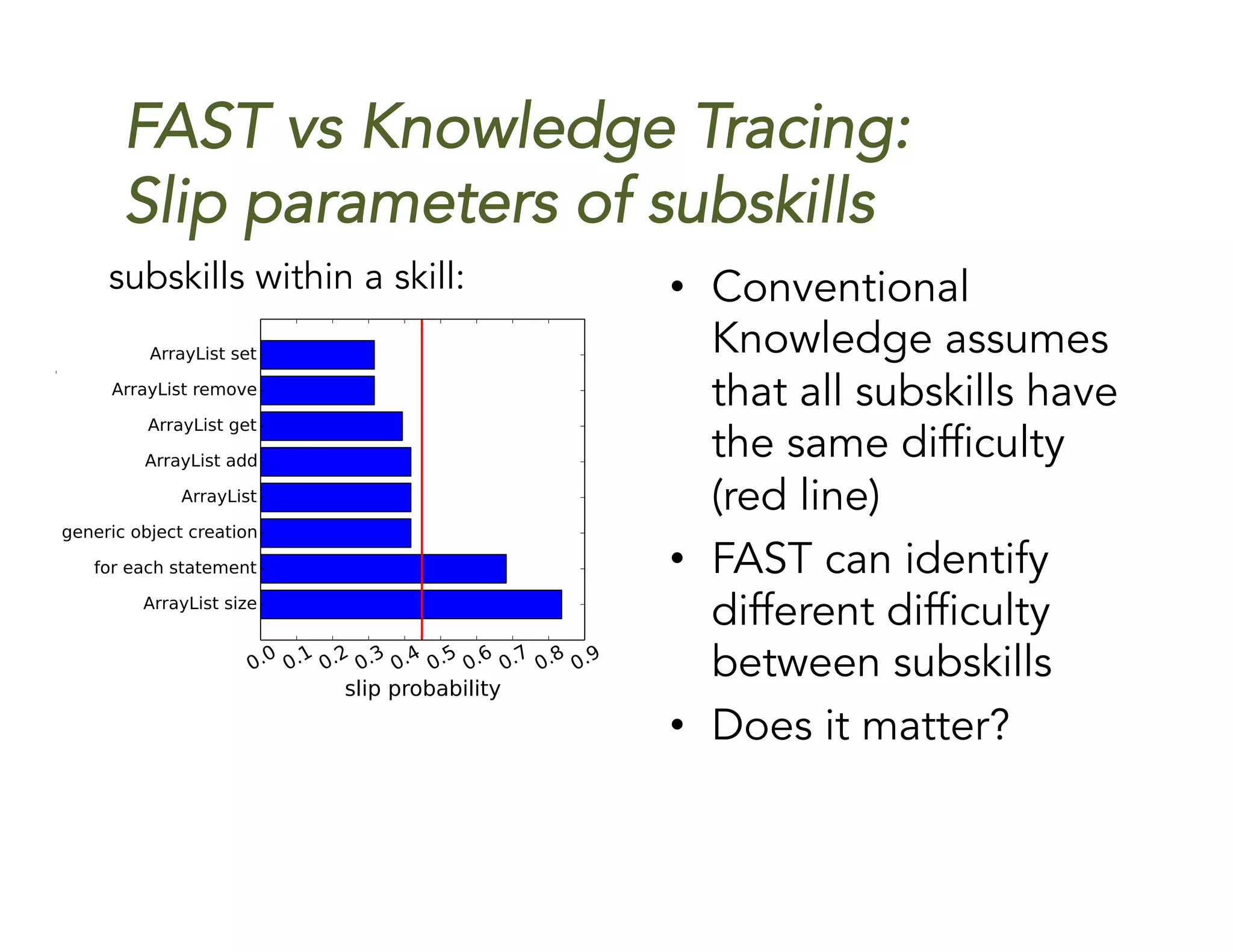
FAST vs Knowledge Tracing:
Slip parameters of subskills
•  Conventional
Knowledge assumes
that all subskills have
the same difficulty
(red line)
•  FAST can identify
different difficulty
between subskills
•  Does it matter?
subskills within a skill:
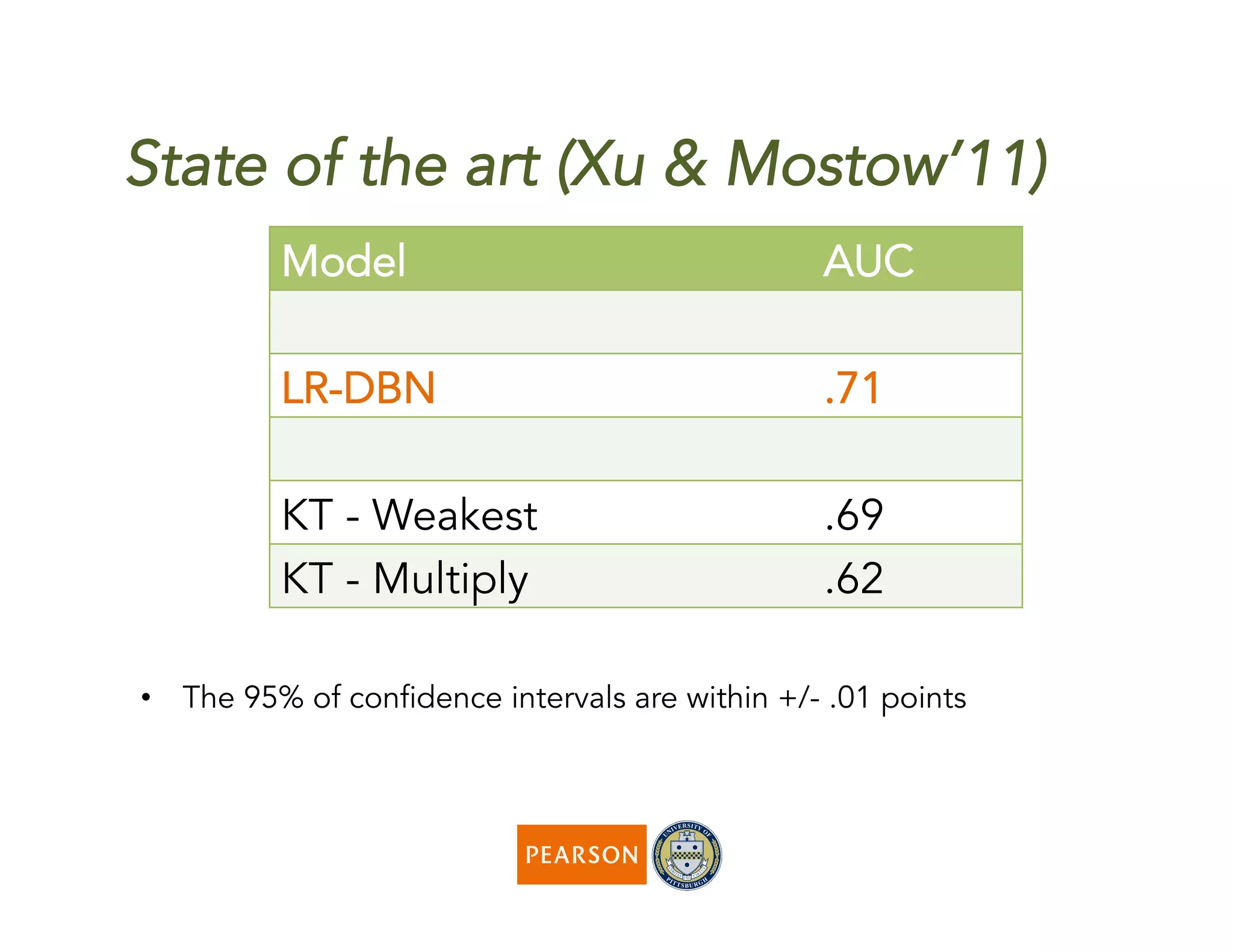
State of the art (Xu & Mostow’11)
•  The 95% of confidence intervals are within +/- .01 points
Model AUC
LR-DBN .71
KT - Weakest .69
KT - Multiply .62
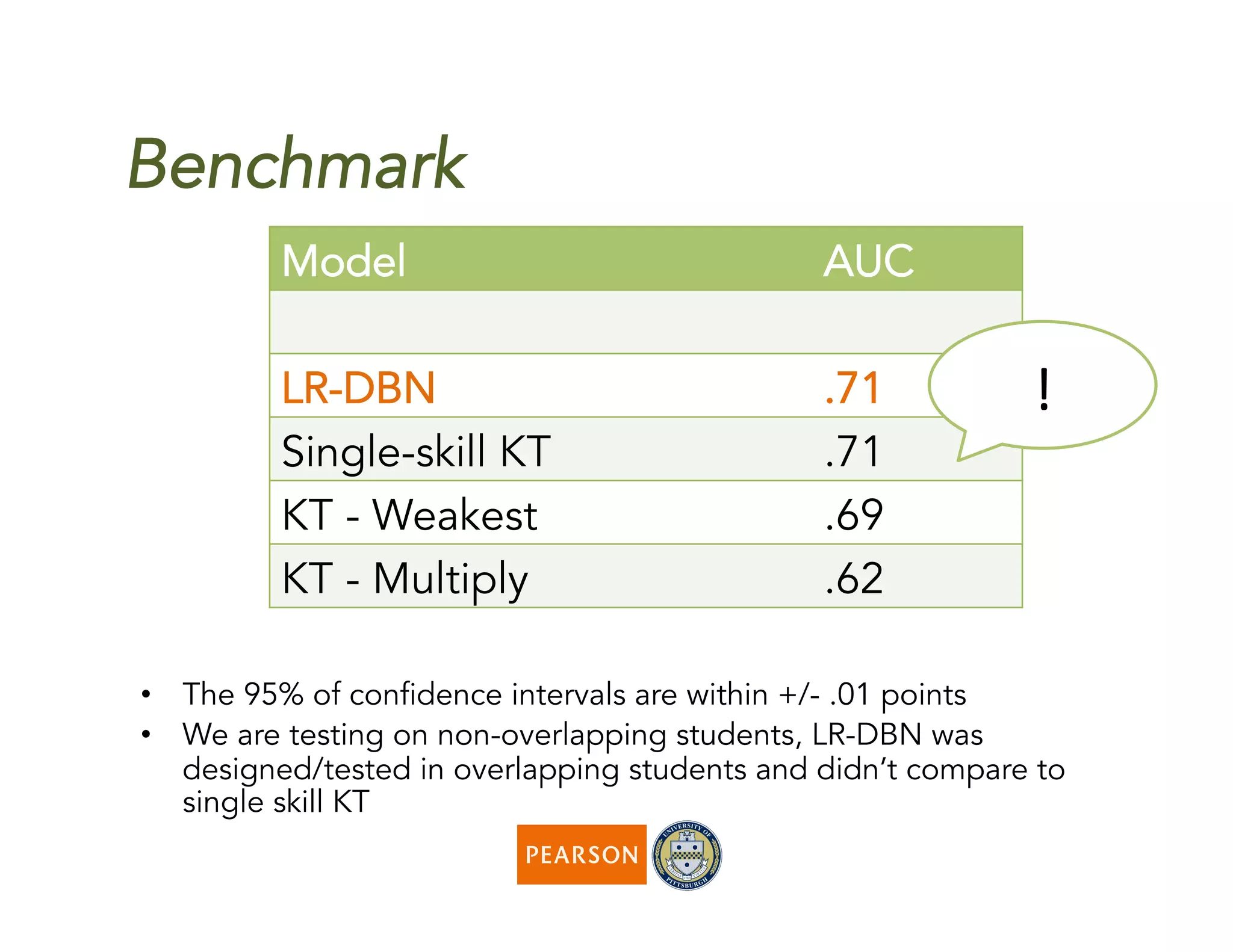
Benchmark
Model AUC
LR-DBN .71
Single-skill KT .71
KT - Weakest .69
KT - Multiply .62
•  The 95% of confidence intervals are within +/- .01 points
•  We are testing on non-overlapping students, LR-DBN was
designed/tested in overlapping students and didn’t compare to
single skill KT
!	
  
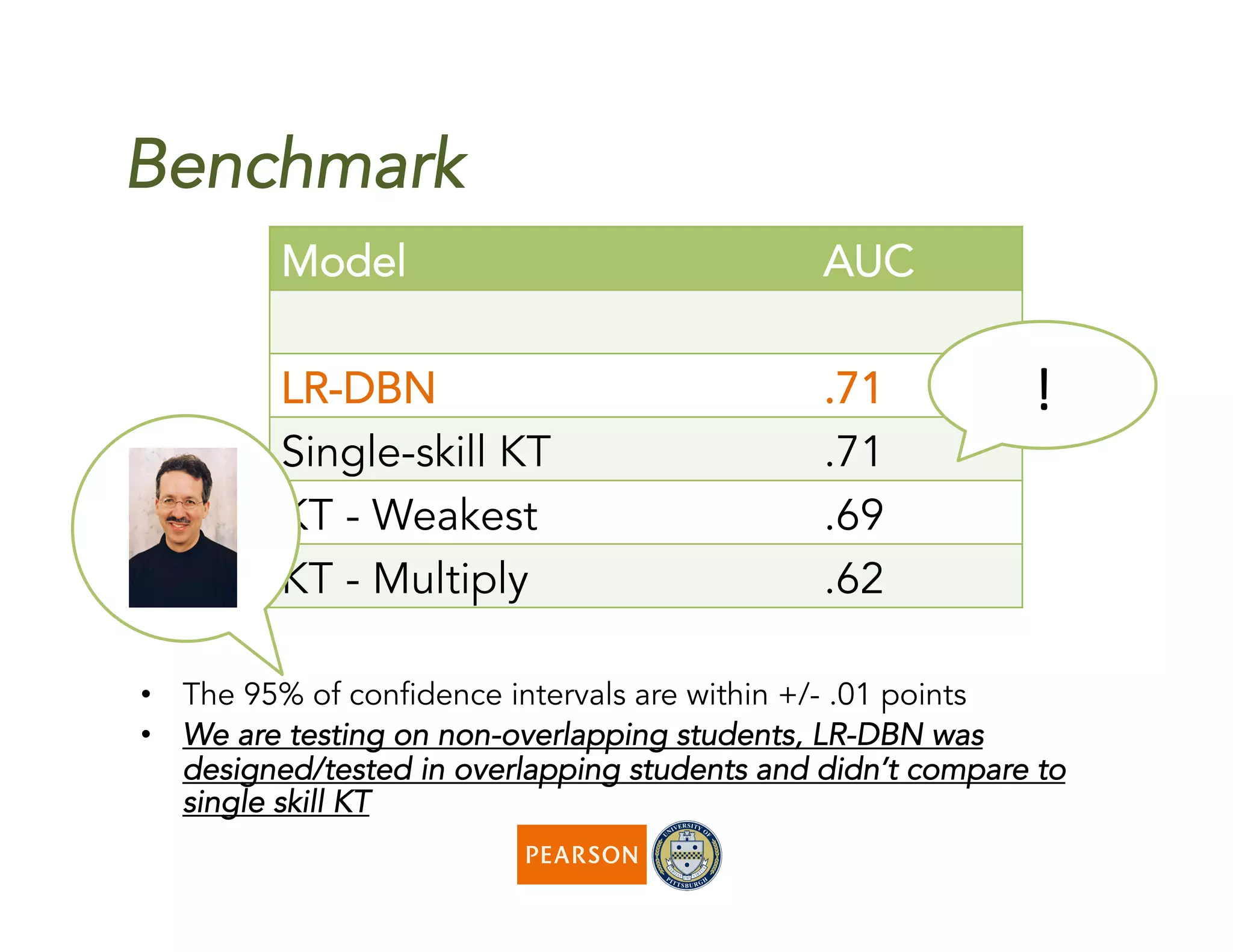
Benchmark
Model AUC
LR-DBN .71
Single-skill KT .71
KT - Weakest .69
KT - Multiply .62
•  The 95% of confidence intervals are within +/- .01 points
•  We are testing on non-overlapping students, LR-DBN was
designed/tested in overlapping students and didn’t compare to
single skill KT
!	
  
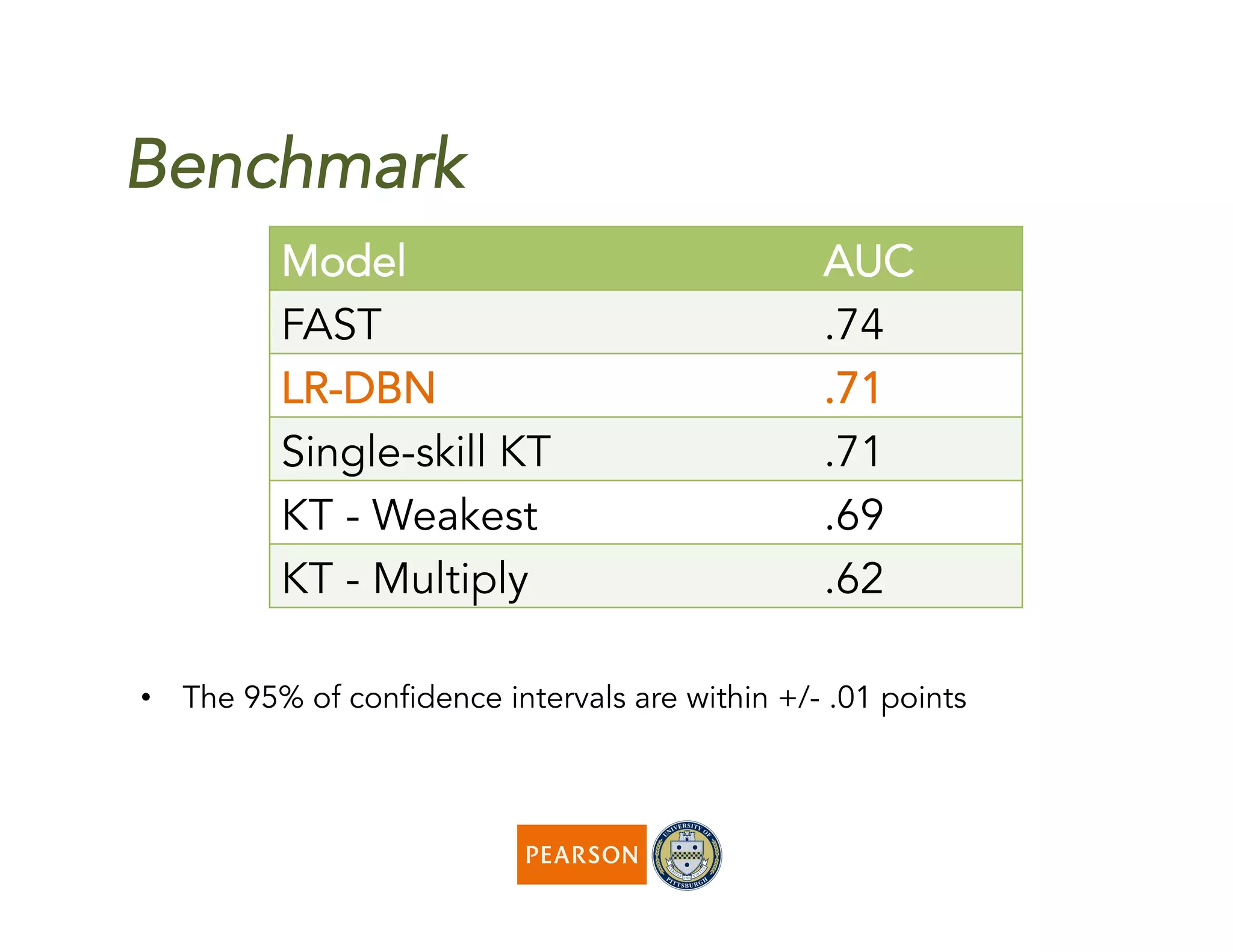
Benchmark
•  The 95% of confidence intervals are within +/- .01 points
Model AUC
FAST .74
LR-DBN .71
Single-skill KT .71
KT - Weakest .69
KT - Multiply .62
Outline
•  Introduction
•  FAST – Feature-Aware Student Knowledge Tracing
•  Experimental Setup
•  Applications
– Multiple subskills
– Temporal IRT
•  Execution time
•  Conclusion
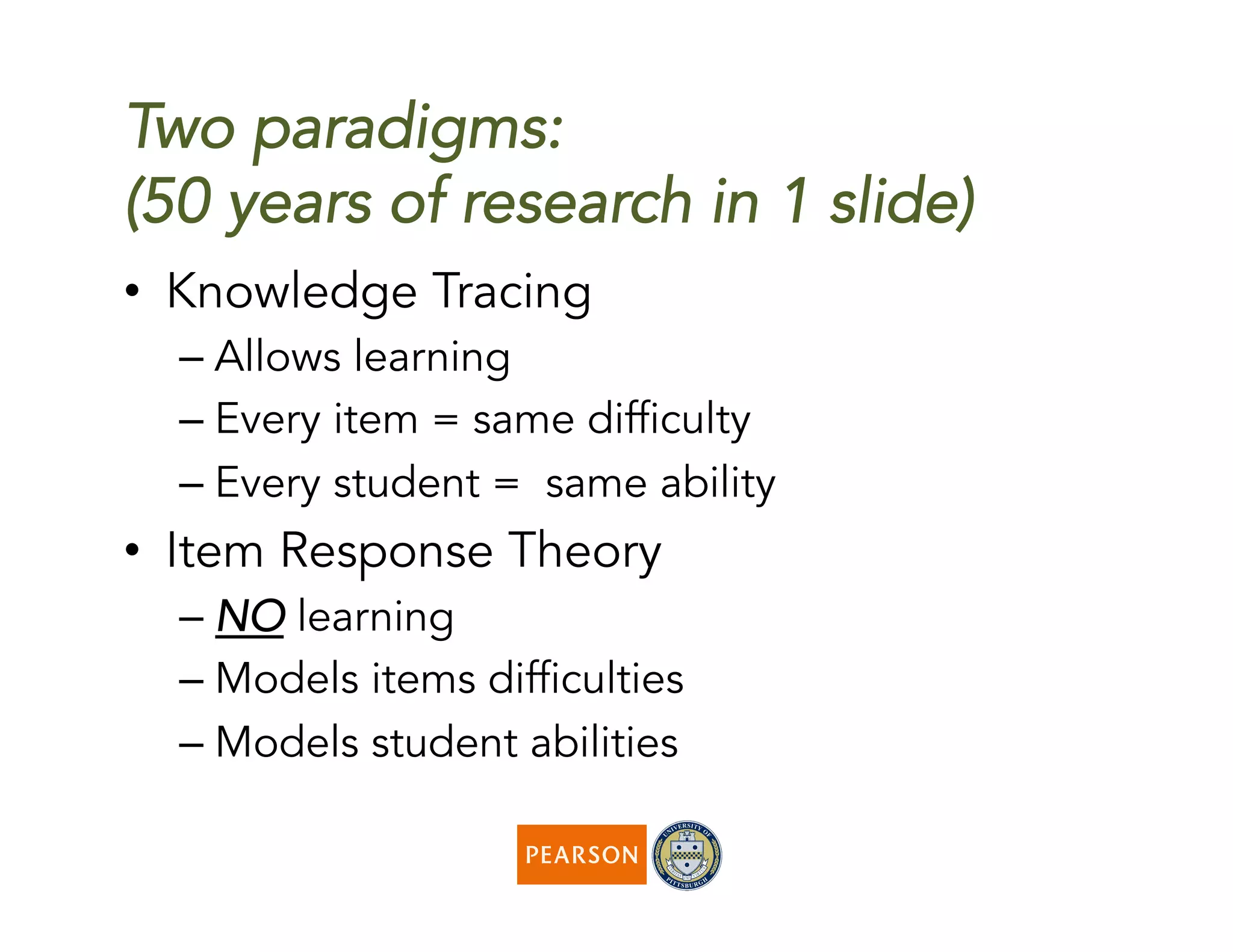
Two paradigms:
(50 years of research in 1 slide)
•  Knowledge Tracing
– Allows learning
– Every item = same difficulty
– Every student = same ability
•  Item Response Theory
– NO learning
– Models items difficulties
– Models student abilities
Can FAST help merging the
paradigms?
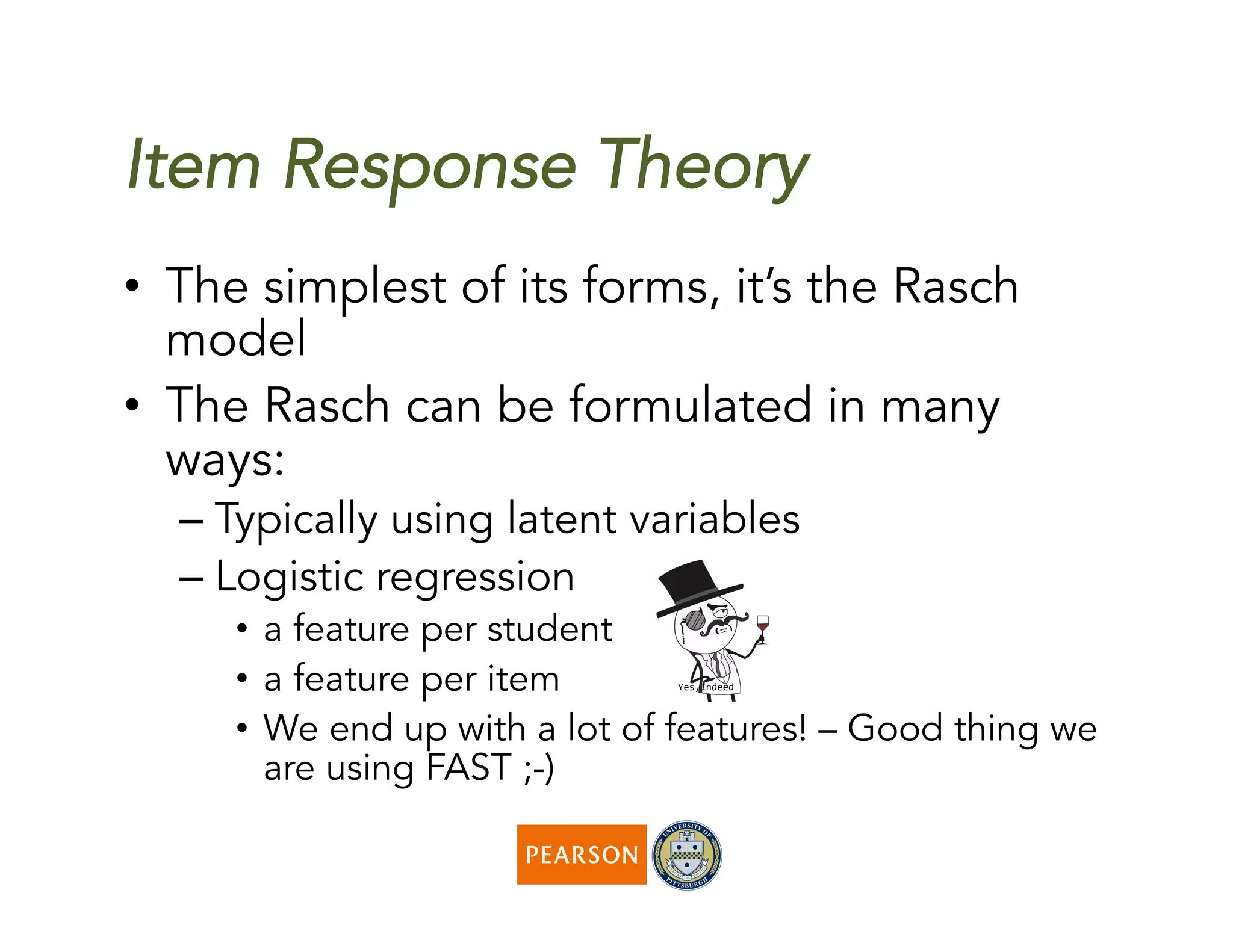
Item Response Theory
•  The simplest of its forms, it’s the Rasch
model
•  The Rasch can be formulated in many
ways:
– Typically using latent variables
– Logistic regression
•  a feature per student
•  a feature per item
•  We end up with a lot of features! – Good thing we
are using FAST ;-)
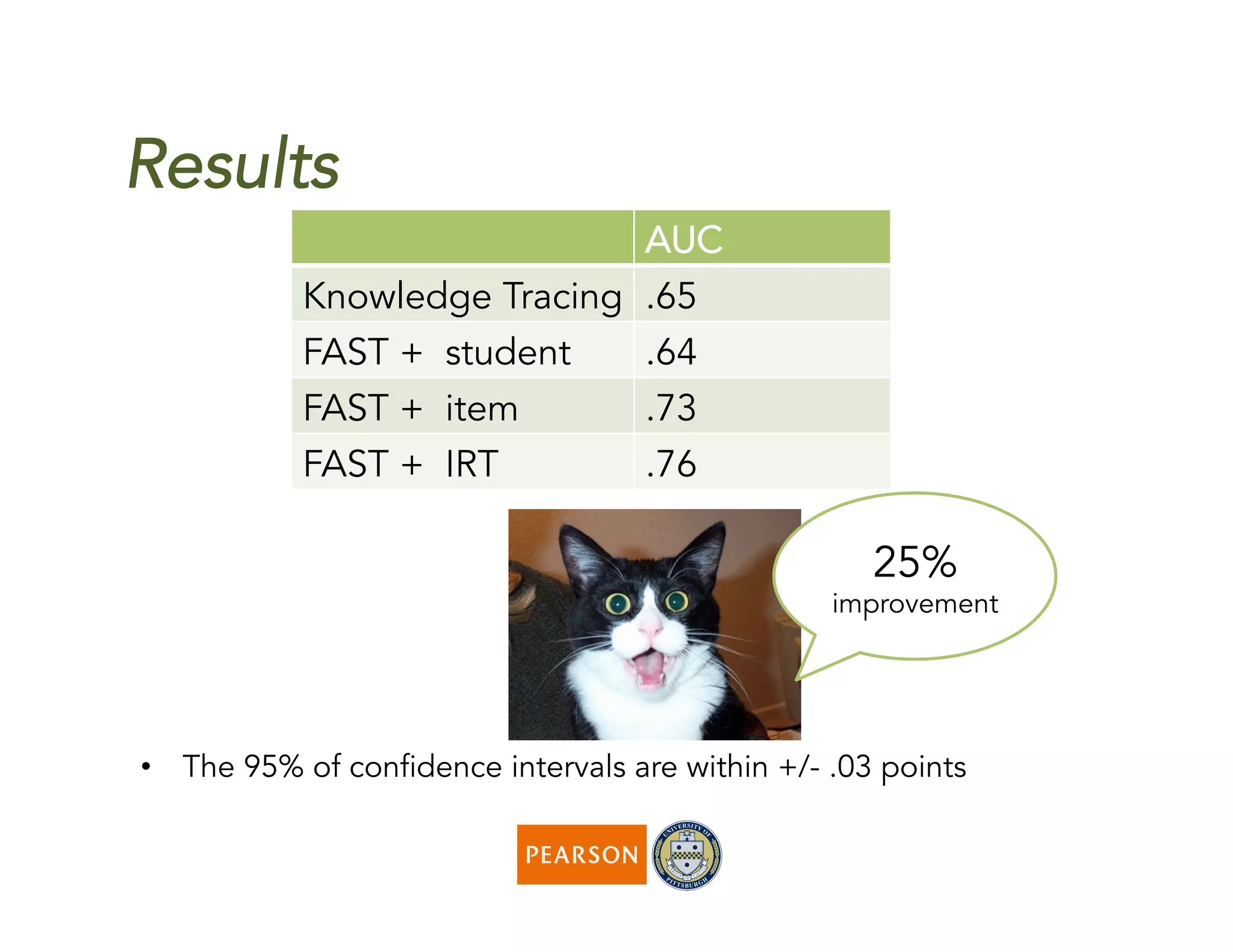
Results
AUC
Knowledge Tracing .65
FAST + student .64
FAST + item .73
FAST + IRT .76
•  The 95% of confidence intervals are within +/- .03 points
25%
improvement
Disclaimer
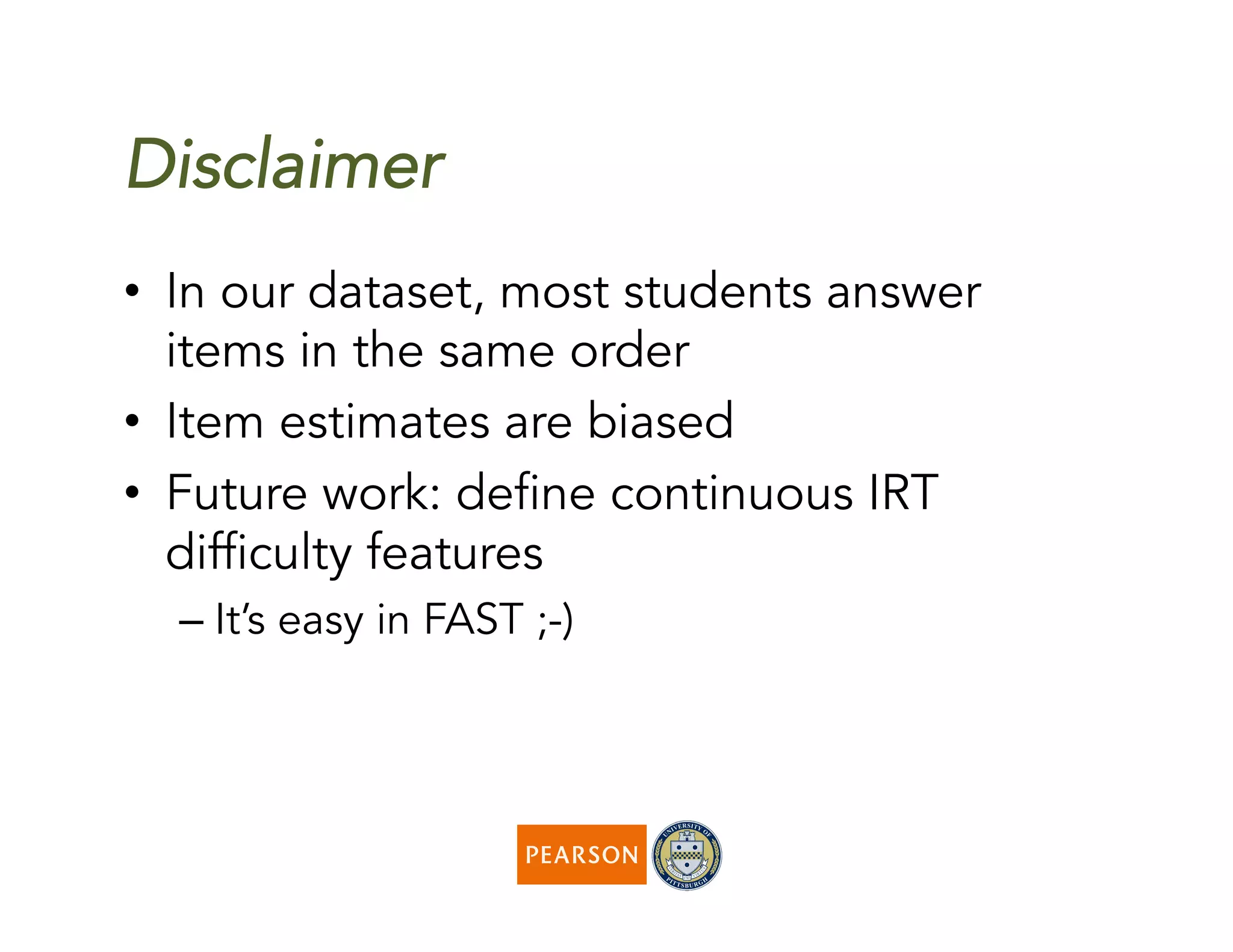
•  In our dataset, most students answer
items in the same order
•  Item estimates are biased
•  Future work: define continuous IRT
difficulty features
– It’s easy in FAST ;-)
Outline
•  Introduction
•  FAST – Feature-Aware Student Knowledge Tracing
•  Experimental Setup
•  Applications
– Multiple subskills
– Temporal IRT
•  Execution time
•  Conclusion
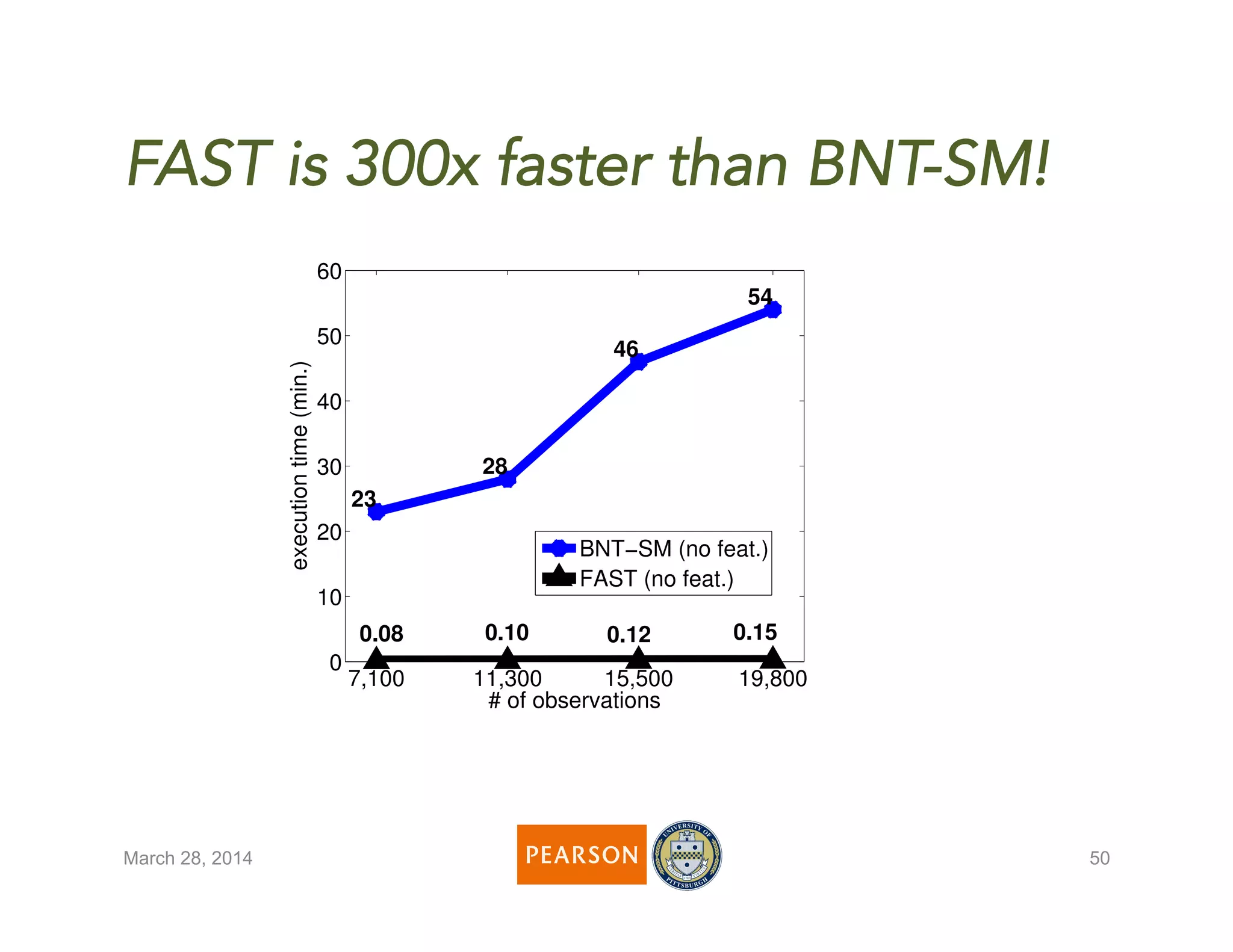
March 28, 2014 50
7,100 11,300 15,500 19,800
0
10
20
30
40
50
60
23
28
46
54
0.08 0.10 0.12 0.15
# of observations
executiontime(min.)
BNT−SM (no feat.)
FAST (no feat.)
FAST is 300x faster than BNT-SM!
LR-DBN vs FAST
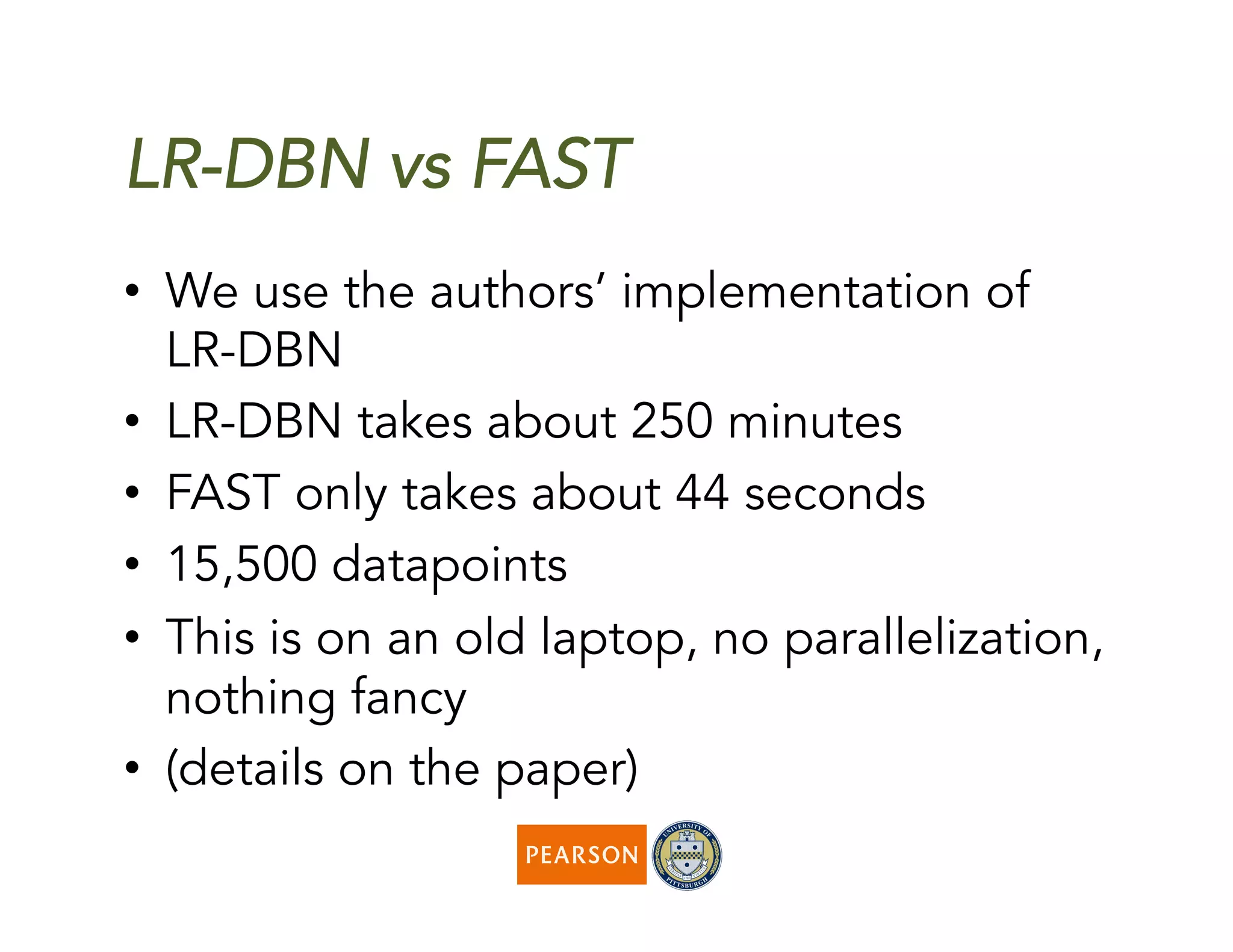
•  We use the authors’ implementation of
LR-DBN
•  LR-DBN takes about 250 minutes
•  FAST only takes about 44 seconds
•  15,500 datapoints
•  This is on an old laptop, no parallelization,
nothing fancy
•  (details on the paper)
Outline
•  Introduction
•  FAST – Feature-Aware Student Knowledge Tracing
•  Experimental Setup
•  Examples
– Multiple subskills
– Temporal IRT
•  Conclusion
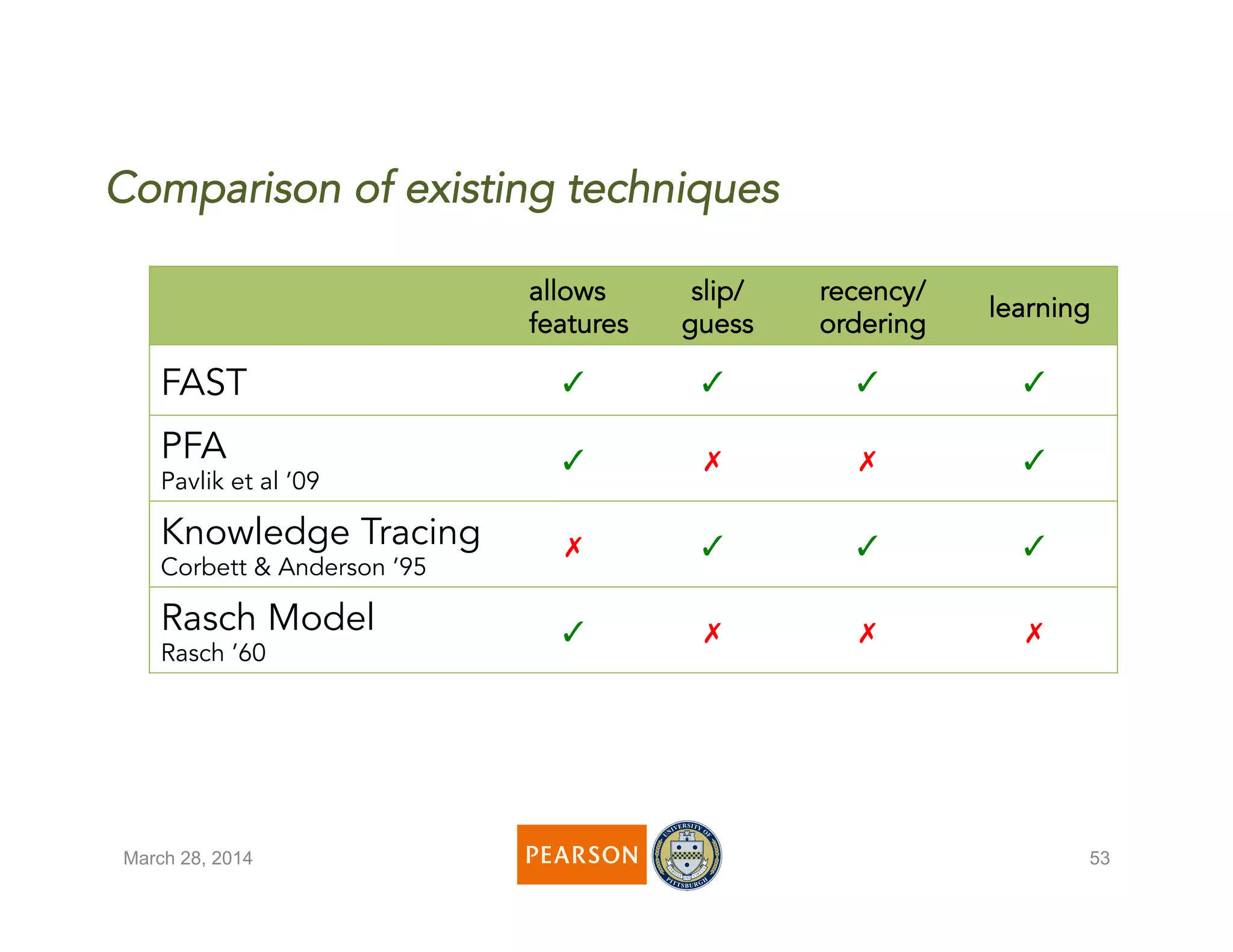
Comparison of existing techniques
March 28, 2014 53
allows
features
slip/
guess
recency/
ordering
learning
FAST ✓	
   ✓	
   ✓	
   ✓	
  
PFA
Pavlik et al ’09
✓	
   ✗	
   ✗	
   ✓	
  
Knowledge Tracing
Corbett & Anderson ’95
✗	
   ✓	
   ✓	
   ✓	
  
Rasch Model
Rasch ’60
✓	
   ✗	
   ✗	
   ✗	
  
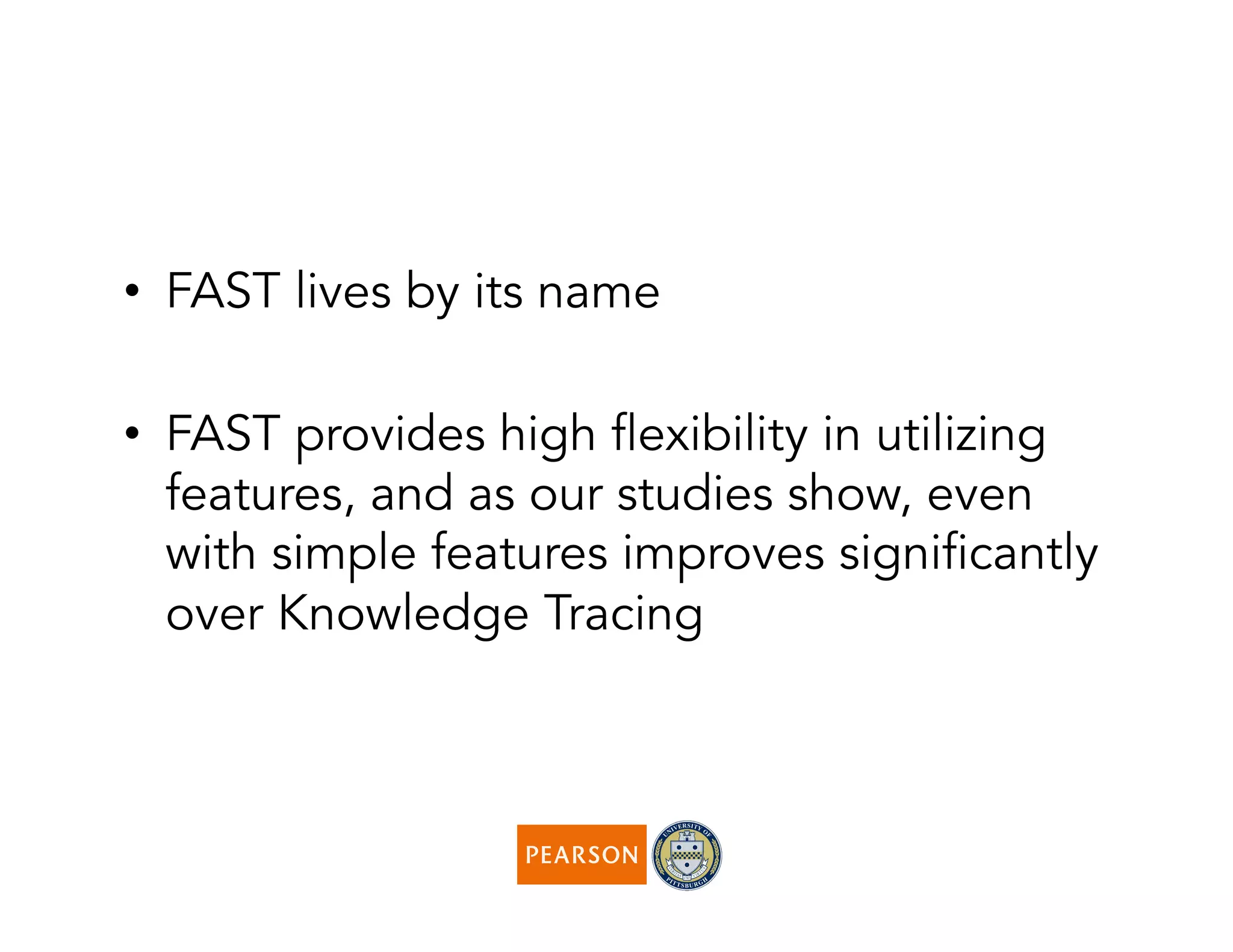
•  FAST lives by its name
•  FAST provides high flexibility in utilizing
features, and as our studies show, even
with simple features improves significantly
over Knowledge Tracing
•  The effect of features depends on how
smartly they are designed and on the
dataset
•  I am looking forward for more clever uses
of feature engineering for FAST in the
community
EDM2014 paper: General Features in Knowledge Tracing to Model Multiple Subskills, Temporal Item Response Theory, and Expert Knowledge

EDM2014 paper: General Features in Knowledge Tracing to Model Multiple Subskills, Temporal Item Response Theory, and Expert Knowledge

  • 1.
    General Features inKnowledge Tracing Applications to Multiple Subskills, Temporal IRT & Expert Knowledge * First authors Yun Huang, University of Pittsburgh* José P. González-Brenes, Pearson* Peter Brusilovsky, University of Pittsburgh
  • 2.
    This talk… •  What?Determine student mastery of a skill •  How? Novel algorithm called FAST –  Enables features in Knowledge Tracing •  Why? Better and faster student modeling –  25% better AUC, a classification metric –  300 times faster than popular general purpose student modeling techniques (BNT-SM)
  • 3.
    Outline •  Introduction •  FAST– Feature-Aware Student Knowledge Tracing •  Experimental Setup •  Applications 1.  Multiple subskills 2.  Temporal Item Response Theory 3.  Paper exclusive: Expert knowledge •  Execution time •  Conclusion
  • 4.
    Motivation •  Personalize learningof students – For example, teach students new material as they learn, so we don’t teach students material they know •  How? Typically with Knowledge Tracing
  • 5.
    :   û û      ü    ü  û û ü     ü                      ü   û û ü      ü        ü   û û ü        ü   :  
  • 6.
    :   :   ûû ü      ü        ü   û û ü    ü   Masters a skill or not •  Knowledge Tracing fits a two- state HMM per skill •  Binary latent variables indicate the knowledge of the student of the skill •  Four parameters: 1.  Initial Knowledge 2.  Learning 3.  Guess 4.  Slip Transition Emission
  • 7.
    What’s wrong? •  Onlyuses performance data (correct or incorrect) •  We are now able to capture feature rich data –  MOOCs & intelligent tutoring systems are able to log fine-grained data –  Used a hint, watched video, after hours practice… •  … these features can carry information or intervene on learning
  • 8.
    What’s a researchergotta do? •  Modify Knowledge Tracing algorithm •  For example, just on a small-scale literature survey, we find at least nine different flavors of Knowledge Tracing
  • 9.
    So you wantto publish in EDM? 1.  Think of a feature (e.g., from a MOOC) 2.  Modify Knowledge Tracing 3.  Write Paper 4.  Publish 5.  Loop!
  • 10.
    Are all ofthose models sooooo different? •  No! we identify three main variants •  We call them the “Knowledge Tracing Family”
  • 11.
    Knowledge Tracing Family Nofeatures Emission (guess/slip) Transition (learning) Both (guess/slip and learning) •  Item  difficulty   (Gowda  et  al  ’11;   Pardos  et  al  ’11)   •  Student  ability   (Pardos  et  al     ’10)   •  Subskills  (Xu  et   al  ’12)   •  Help  (Sao  Pedro   et  al  ’13)   •  Student  ability   (Lee  et  al  ’12;   Yudelson  et  al  ’13)   •  Item  difficulty   (Schultz  et  al  ’13)   •  Help  (Becker    et  al   ’08)   k   y   k   y   f   k   y   f   k   y   f  f  
  • 12.
    •  Each modelis successful for an ad hoc purpose only – Hard to compare models – Doesn’t help to build a cognition theory
  • 13.
    •  Learning scientistshave to worry about both features and modeling
  • 14.
    •  These modelsare not scalable: – Rely on Bayes Net’s conditional probability tables – Memory performance grows exponentially with number of features – Runtime performance grows exponentially with number of features (with exact inference)
  • 15.
    Example: Mastery p(Correct) False (1)0.10 (guess) True (2) 0.85 (1-slip) 20+1 parameters! Emission probabilities with no features:
  • 16.
    Example: Emission probabilities with1 binary feature: Mastery Hint p(Correct) False False (1) 0.06 True False (2) 0.75 False True (3) 0.25 True True (4) 0.99 21+1 parameters!
  • 17.
    Example: Emission probabilities with10 binary features: Mastery F1 … F10 p(Correct) False False False False (1) 0.06 … … True True True True (2048) 0.90 210+1 parameters!
  • 18.
    Outline •  Introduction •  FAST– Feature-Aware Student Knowledge Tracing •  Experimental Setup •  Applications – Multiple subskills – Temporal IRT •  Execution time •  Conclusion
  • 19.
    Something old… k   y   f  f   •  Uses the most general model in the Knowledge Tracing Family •  Parameterizes learning and emission (guess+slip) probabilities
  • 20.
    Something new… k   y   f  f   •  Instead of using inefficient conditional probability tables, we use logistic regression [Berg-Kirkpatrick et al’10 ] •  Exponential complexity -> linear complexity
  • 21.
    Example: # of features# of pararameters in KTF # of parameters in FAST 0 2 2 1 4 3 10 2048 12 25 67,108,864 27 25 features are not that many, and yet they can become intractable with Knowledge Tracing Family
  • 22.
    Something blue? k   y   f  f   •  Not a lot of changes to implement prediction •  Training requires quite a bit of changes – We use a recent modification of the Expectation-Maximization algorithm proposed for Computational Linguistics problems [Berg-Kirkpatrick et al’10 ]
  • 23.
    (A parenthesis) •  Jose’scorollary: Each equation in a presentation would send to sleep half the audience •  Equations are in the paper! “Each  equaMon  I   include  in  the  book   would  halve  the  sales”    
  • 24.
  • 25.
  • 26.
    Slip/guess lookup: Mastery p(Correct) False(1) True (2) Use the multiple parameters of logistic regression to fill the values of a “no- features”conditional probability table! [Berg-Kirkpatrick et al’10 ]
  • 27.
  • 28.
    observation 1 observation 2 observationn ... feature1feature2 featurekfeature1feature2 featurekfeature1feature2 featurek ... ... ... observation 1 observation 2 observation n ... { { { active when mastered active when not mastered always active Features:Instance weights: probabilityof notmastering probabilityof mastering Slip/Guess logistic regression
  • 29.
    observation 1 observation 2 observationn ... feature1feature2 featurekfeature1feature2 featurekfeature1feature2 featurek ... ... ... observation 1 observation 2 observation n ... { { { active when mastered active when not mastered always active Features:Instance weights: probabilityof notmastering probabilityof mastering Slip/Guess logistic regression When FAST uses only intercept terms as features for the two levels of mastery, it is equivalent to Knowledge Tracing!
  • 30.
    Outline •  Introduction •  FAST– Feature-Aware Student Knowledge Tracing •  Experimental Setup •  Examples – Multiple subskills – Temporal IRT – Expert knowledge •  Conclusion
  • 31.
    Collected from QuizJET,a tutor for learning Java programming. March 28, 2014 31 Each question is generated from a template, and students can try multiple attempts Students give values for a variable or the output Java code Tutoring System
  • 32.
    March 28, 201432 Data •  Smaller dataset: – ~21,000 observations – First attempt: ~7,000 observations – 110 students •  Unbalanced: 70% correct •  95 question templates •  “Hierarchical” cognitive model: 19 skills, 99 subskills
  • 33.
    •  Predict futureperformance given history -  Will a student get answer correctly at t=0 ? -  At t =1 given t = 0 performance ? -  At t = 2 given t = 0, 1 performance ? …. •  Area Under Curve metric -  1: perfect classifier -  0.5: random classifier March 28, 2014 33 Evaluation
  • 34.
    Outline •  Introduction •  FAST– Feature-Aware Student Knowledge Tracing •  Experimental Setup •  Applications –  Multiple subskills –  Temporal IRT –  Expert knowledge •  Execution time •  Conclusion
  • 35.
    Multiple subskills •  Expertsannotated items (question) with a single skill and multiple subskills
  • 36.
    Multiple subskills & KnowledgeTracing • Original Knowledge Tracing can not model multiple subskills •  Most Knowledge Tracing variants assume equal importance of subskills during training (and then adjust it during testing) •  State of the art method, LR-DBN [Xu and Mostow ’11] assigns importance in both training and testing
  • 37.
    FAST can handlemultiple subskills •  Parameterize learning •  Parameterize slip and guess •  Features: binary variables that indicate presence of subskills
  • 38.
    FAST vs KnowledgeTracing: Slip parameters of subskills •  Conventional Knowledge assumes that all subskills have the same difficulty (red line) •  FAST can identify different difficulty between subskills •  Does it matter? subskills within a skill:
  • 39.
    State of theart (Xu & Mostow’11) •  The 95% of confidence intervals are within +/- .01 points Model AUC LR-DBN .71 KT - Weakest .69 KT - Multiply .62
  • 40.
    Benchmark Model AUC LR-DBN .71 Single-skillKT .71 KT - Weakest .69 KT - Multiply .62 •  The 95% of confidence intervals are within +/- .01 points •  We are testing on non-overlapping students, LR-DBN was designed/tested in overlapping students and didn’t compare to single skill KT !  
  • 41.
    Benchmark Model AUC LR-DBN .71 Single-skillKT .71 KT - Weakest .69 KT - Multiply .62 •  The 95% of confidence intervals are within +/- .01 points •  We are testing on non-overlapping students, LR-DBN was designed/tested in overlapping students and didn’t compare to single skill KT !  
  • 42.
    Benchmark •  The 95%of confidence intervals are within +/- .01 points Model AUC FAST .74 LR-DBN .71 Single-skill KT .71 KT - Weakest .69 KT - Multiply .62
  • 43.
    Outline •  Introduction •  FAST– Feature-Aware Student Knowledge Tracing •  Experimental Setup •  Applications – Multiple subskills – Temporal IRT •  Execution time •  Conclusion
  • 44.
    Two paradigms: (50 yearsof research in 1 slide) •  Knowledge Tracing – Allows learning – Every item = same difficulty – Every student = same ability •  Item Response Theory – NO learning – Models items difficulties – Models student abilities
  • 45.
    Can FAST helpmerging the paradigms?
  • 46.
    Item Response Theory • The simplest of its forms, it’s the Rasch model •  The Rasch can be formulated in many ways: – Typically using latent variables – Logistic regression •  a feature per student •  a feature per item •  We end up with a lot of features! – Good thing we are using FAST ;-)
  • 47.
    Results AUC Knowledge Tracing .65 FAST+ student .64 FAST + item .73 FAST + IRT .76 •  The 95% of confidence intervals are within +/- .03 points 25% improvement
  • 48.
    Disclaimer •  In ourdataset, most students answer items in the same order •  Item estimates are biased •  Future work: define continuous IRT difficulty features – It’s easy in FAST ;-)
  • 49.
    Outline •  Introduction •  FAST– Feature-Aware Student Knowledge Tracing •  Experimental Setup •  Applications – Multiple subskills – Temporal IRT •  Execution time •  Conclusion
  • 50.
    March 28, 201450 7,100 11,300 15,500 19,800 0 10 20 30 40 50 60 23 28 46 54 0.08 0.10 0.12 0.15 # of observations executiontime(min.) BNT−SM (no feat.) FAST (no feat.) FAST is 300x faster than BNT-SM!
  • 51.
    LR-DBN vs FAST • We use the authors’ implementation of LR-DBN •  LR-DBN takes about 250 minutes •  FAST only takes about 44 seconds •  15,500 datapoints •  This is on an old laptop, no parallelization, nothing fancy •  (details on the paper)
  • 52.
    Outline •  Introduction •  FAST– Feature-Aware Student Knowledge Tracing •  Experimental Setup •  Examples – Multiple subskills – Temporal IRT •  Conclusion
  • 53.
    Comparison of existingtechniques March 28, 2014 53 allows features slip/ guess recency/ ordering learning FAST ✓   ✓   ✓   ✓   PFA Pavlik et al ’09 ✓   ✗   ✗   ✓   Knowledge Tracing Corbett & Anderson ’95 ✗   ✓   ✓   ✓   Rasch Model Rasch ’60 ✓   ✗   ✗   ✗  
  • 54.
    •  FAST livesby its name •  FAST provides high flexibility in utilizing features, and as our studies show, even with simple features improves significantly over Knowledge Tracing
  • 55.
    •  The effectof features depends on how smartly they are designed and on the dataset •  I am looking forward for more clever uses of feature engineering for FAST in the community