FASHION TERMINOLOGY
LEARNING TO SKETCH
BASICFASHIONTERMINOLOGY
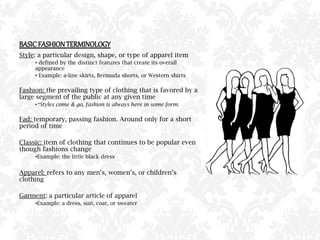
Style: a particular design, shape, or type of apparel item
• defined by the distinct features that create its overall
appearance
• Example: a-line skirts, Bermuda shorts, or Western shirts
Fashion: the prevailing type of clothing that is favored by a
large segment of the public at any given time
•
Fad: temporary, passing fashion. Around only for a short
period of time
Classic: item of clothing that continues to be popular even
though fashions change
•Example: the little black dress
Apparel: refers to any men’s, women’s, or children’s
clothing
Garment: a particular article of apparel
•Example: a dress, suit, coat, or sweater
BASICSKETCHINGTERMINOLOGY
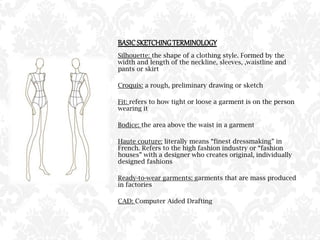
Silhouette: the shape of a clothing style. Formed by the
width and length of the neckline, sleeves, ,waistline and
pants or skirt
Croquis: a rough, preliminary drawing or sketch
Fit: refers to how tight or loose a garment is on the person
wearing it
Bodice: the area above the waist in a garment
Haute couture: literally means “finest dressmaking” in
French. Refers to the high fashion industry or “fashion
houses” with a designer who creates original, individually
designed fashions
Ready-to-wear garments: garments that are mass produced
in factories
CAD: Computer Aided Drafting
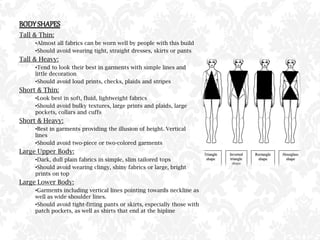
BODYSHAPES
Tall & Thin:
•Almost all fabrics can be worn well by people with this build
•Should avoid wearing tight, straight dresses, skirts or pants
Tall & Heavy:
•Tend to look their best in garments with simple lines and
little decoration
•Should avoid loud prints, checks, plaids and stripes
Short & Thin:
•Look best in soft, fluid, lightweight fabrics
•Should avoid bulky textures, large prints and plaids, large
pockets, collars and cuffs
Short & Heavy:
•Best in garments providing the illusion of height. Vertical
lines
•Should avoid two-piece or two-colored garments
Large Upper Body:
•Dark, dull plain fabrics in simple, slim tailored tops
•Should avoid wearing clingy, shiny fabrics or large, bright
prints on top
Large Lower Body:
•Garments including vertical lines pointing towards neckline as
well as wide shoulder lines.
•Should avoid tight-fitting pants or skirts, especially those with
patch pockets, as well as shirts that end at the hipline
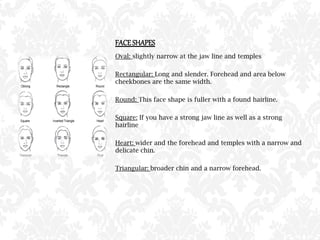
FACESHAPES
Oval: slightly narrow at the jaw line and temples
Rectangular: Long and slender. Forehead and area below
cheekbones are the same width.
Round: This face shape is fuller with a found hairline.
Square: If you have a strong jaw line as well as a strong
hairline
Heart: wider and the forehead and temples with a narrow and
delicate chin.
Triangular: broader chin and a narrow forehead.

Fashion terminology (1)

  • 1.
  • 2.
    BASICFASHIONTERMINOLOGY Style: a particulardesign, shape, or type of apparel item • defined by the distinct features that create its overall appearance • Example: a-line skirts, Bermuda shorts, or Western shirts Fashion: the prevailing type of clothing that is favored by a large segment of the public at any given time • Fad: temporary, passing fashion. Around only for a short period of time Classic: item of clothing that continues to be popular even though fashions change •Example: the little black dress Apparel: refers to any men’s, women’s, or children’s clothing Garment: a particular article of apparel •Example: a dress, suit, coat, or sweater
  • 3.
    BASICSKETCHINGTERMINOLOGY Silhouette: the shapeof a clothing style. Formed by the width and length of the neckline, sleeves, ,waistline and pants or skirt Croquis: a rough, preliminary drawing or sketch Fit: refers to how tight or loose a garment is on the person wearing it Bodice: the area above the waist in a garment Haute couture: literally means “finest dressmaking” in French. Refers to the high fashion industry or “fashion houses” with a designer who creates original, individually designed fashions Ready-to-wear garments: garments that are mass produced in factories CAD: Computer Aided Drafting
  • 4.
    BODYSHAPES Tall & Thin: •Almostall fabrics can be worn well by people with this build •Should avoid wearing tight, straight dresses, skirts or pants Tall & Heavy: •Tend to look their best in garments with simple lines and little decoration •Should avoid loud prints, checks, plaids and stripes Short & Thin: •Look best in soft, fluid, lightweight fabrics •Should avoid bulky textures, large prints and plaids, large pockets, collars and cuffs Short & Heavy: •Best in garments providing the illusion of height. Vertical lines •Should avoid two-piece or two-colored garments Large Upper Body: •Dark, dull plain fabrics in simple, slim tailored tops •Should avoid wearing clingy, shiny fabrics or large, bright prints on top Large Lower Body: •Garments including vertical lines pointing towards neckline as well as wide shoulder lines. •Should avoid tight-fitting pants or skirts, especially those with patch pockets, as well as shirts that end at the hipline
  • 5.
    FACESHAPES Oval: slightly narrowat the jaw line and temples Rectangular: Long and slender. Forehead and area below cheekbones are the same width. Round: This face shape is fuller with a found hairline. Square: If you have a strong jaw line as well as a strong hairline Heart: wider and the forehead and temples with a narrow and delicate chin. Triangular: broader chin and a narrow forehead.