Dire Dawa University Institute of
Technology (DDIT)
Prepared by: Dereje . D
School of Textile, Apparel and Fashion Design,
Apparel and Fashion Design Department
 Anatomy
 Human anatomy
 Why study anatomy
 Role of study human anatomy for artist
 Study human anatomy for fashion designer
Chapter outline
 Introduction
 Anatomy is the branch of science concerned with the bodily
structure of humans, animals, and other living organisms
 Anatomy is the identification and description of the structures
of living things.
 The study of anatomy dates back more than 2,000 years, to the
Ancient Greeks.
There are three broad areas:
 human anatomy
 animal anatomy
 plant anatomy
Human Anatomy
 Human anatomy is the study of the structures of the
human body.
 focuses on the description of form, or how body
structures at different levels look.

Human anatomy
knowing the anatomy and proportions of the body will boost
your creativity.
1. Not slave to your reference
When we understand human anatomy we able to change
our reference so you are not longer to your reference
2. Design pattern to make change
You can design what you can excaudate change, what to
eliminate, what to add that is not presented on reference.
Why study anatomy
3. To crate new pattern
With high level of understanding and some creativity
we have the power of create what a pattern we want
4. Draw the pattern to feel natural
Knowledge of anatomy also help you to draw the body to
feel natural to be believable, and feel a live.
if you Copy from reference you my miss interpreted the
information,
You may not save many things that are actually
important
Cont. …
 to understand incredibly complex and dynamic
structure of the human body
 to understand how the body moves and functions
 to design and draw the figure without reference.
 to draw the body to feel natural and alive.
 to sketch and try out different figure designs and play
with different compositions
Importance of Anatomy for Artists
 As a fashion designer It is important to gain some
understanding of the structure and proportions of the
human body that clothes are made to be worn by real
people
 Structures that encase the body need to respond to the
pliability of muscles and the rigidity of bones.
 Athletic garments, medical garments, and
undergarments take advantage of textile technology
and engineering to address the issues associated with
mobility.
Study human anatomy for fashion designer
 Help to understanding the body and how it works
 To Know what happens when a muscle contracts,
relaxes, or extends
 Understanding the mechanics of the body
 to eliminate unnecessary padding, interlinings, zippers,
and fasteners
 Comfort is one of the primary concerns for the
contemporary consumer.
 Beyond range of motion, the same tools can be applied
to compressing the body to protect or reshape it.
Cont.…
 A good comprehension of the body and how it works
also allows the designer.
to isolate aspects of the design process
to address specific areas of the body
with each zone offering its own advantages and
disadvantages.
 The human body is such an inspiration and can provide
you with an infinite source of ideas.
 To get a better idea of what is possible to be sewn and
manufactured.
 Understand what type of clothing feels comfortable and
why?
Cont.…
 you do not need to study anatomy in as much depth as a
doctor
 it is enough to just study the front, side and back forms of
the figure.
 You need to really understand the function of the muscles
so that you will be able to draw the figure in any kind of
motion you can imagine.
 Thus, you need to have a 3 dimensional understanding of
anatomy.
 The bones and muscles of the human body make up a
very complex system.
 A small change can affect the entire equilibrium of the
body.
Cont.….
 Mastering the figure is about more than just shapes and
muscles and bones.
 It’s about movement, weight, balance, and tension. It’s
about studying
model’s weight-bearing leg or
how they position their hips to hold a certain pose.
Cont. …
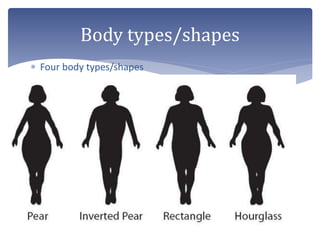
 Four body types/shapes
Body types/shapes
 To dress right for your body, we have to know body
types/shapes, not just guess.
 your body shape determined by:-
The bone structure,
 age,
pregnancy,
fat distribution,
genetic permutation, and
 hormonal combination
Cont. ..
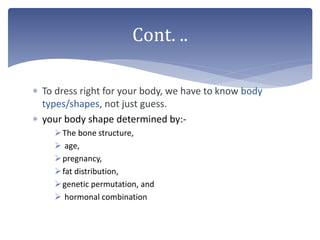
 Is also called the straight or ruler body type.
 The waist measurements are less than 9
inches smaller than the bust or hip
measurements.
 rectangle body shape are not particularly
curvy,
their waist is not well-defined, and
their weight is evenly distributed everywhere in
the body.
1. Rectangle Shape
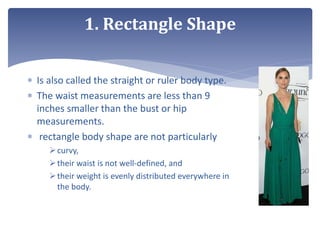
 characterized by the hips that are wider
than the bust.
 Also characterized by well-defined waist,
and proportionately delicate shoulders and
slim arms.
 Extra weight is distributed more into the
bottom and legs, rather than the upper
body
2. Pear/Triangle Shape
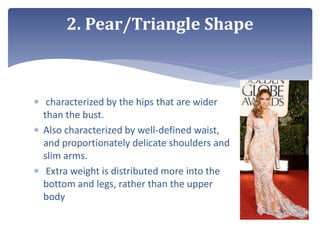
 Hip and bust measurements that are nearly
equal in size, with a smaller waist
measurement.
 shoulders are round
 the legs are in proportion with the upper
body.
3. Hourglass Shape
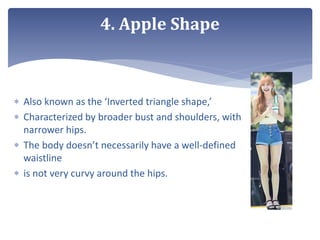
 Also known as the ‘Inverted triangle shape,’
 Characterized by broader bust and shoulders, with
narrower hips.
 The body doesn’t necessarily have a well-defined
waistline
 is not very curvy around the hips.
4. Apple Shape
Common Body Types
 Tall and Thin:
 Things that would be good to wear:
 Gathered or pleated skirts and pants
 Flared or wide leg pants
 Horizontal stripes
 Things to avoid:
 Tight fitting dresses, skirts or pants
 Small patterns
 Bold verticals
Common Body Types
 Short and Heavy
 Things that would be good to wear:
 Vertical lines
 Empire, A-line, narrow silhouettes
 Asymmetrical closings
 Things to Avoid:
 Two-piece or Two-colored outfits
 Horizontal Stripes
Common Body Types
 Top Heavy
 Things that would be good to wear:
 Simple, slim tailored shirts
 V necklines
 Slim sleeves
 Things to Avoid:
 Clingy or shiny things on top
 High necklines and large collars
 Ruffles, bows, trims above the waist
Common Body Types
 Thick Middle
 Things that would be good to wear:
 Unfitted, but not full garments
 Tubular Silhouettes
 Details above the waist
 Things to Avoid:
 Fitted waistlines or tight belts
 Baggy or bulky fits at waistline
Common Body Types
 Hip Heavy
 Things that would be good to wear:
 Attractive collars
 Wide shoulder lines, yokes
 Light colored tops with dark bottoms
 Things to Avoid:
 Tight fitting pants or skirts
 Belts or horizontal bands at hips
 Shiny, clingy fabric or bold prints below the waist
The
end

Human anatomy

  • 1.
    Dire Dawa UniversityInstitute of Technology (DDIT) Prepared by: Dereje . D School of Textile, Apparel and Fashion Design, Apparel and Fashion Design Department
  • 2.
     Anatomy  Humananatomy  Why study anatomy  Role of study human anatomy for artist  Study human anatomy for fashion designer Chapter outline
  • 3.
     Introduction  Anatomyis the branch of science concerned with the bodily structure of humans, animals, and other living organisms  Anatomy is the identification and description of the structures of living things.  The study of anatomy dates back more than 2,000 years, to the Ancient Greeks. There are three broad areas:  human anatomy  animal anatomy  plant anatomy Human Anatomy
  • 4.
     Human anatomyis the study of the structures of the human body.  focuses on the description of form, or how body structures at different levels look.  Human anatomy
  • 5.
    knowing the anatomyand proportions of the body will boost your creativity. 1. Not slave to your reference When we understand human anatomy we able to change our reference so you are not longer to your reference 2. Design pattern to make change You can design what you can excaudate change, what to eliminate, what to add that is not presented on reference. Why study anatomy
  • 6.
    3. To cratenew pattern With high level of understanding and some creativity we have the power of create what a pattern we want 4. Draw the pattern to feel natural Knowledge of anatomy also help you to draw the body to feel natural to be believable, and feel a live. if you Copy from reference you my miss interpreted the information, You may not save many things that are actually important Cont. …
  • 7.
     to understandincredibly complex and dynamic structure of the human body  to understand how the body moves and functions  to design and draw the figure without reference.  to draw the body to feel natural and alive.  to sketch and try out different figure designs and play with different compositions Importance of Anatomy for Artists
  • 8.
     As afashion designer It is important to gain some understanding of the structure and proportions of the human body that clothes are made to be worn by real people  Structures that encase the body need to respond to the pliability of muscles and the rigidity of bones.  Athletic garments, medical garments, and undergarments take advantage of textile technology and engineering to address the issues associated with mobility. Study human anatomy for fashion designer
  • 9.
     Help tounderstanding the body and how it works  To Know what happens when a muscle contracts, relaxes, or extends  Understanding the mechanics of the body  to eliminate unnecessary padding, interlinings, zippers, and fasteners  Comfort is one of the primary concerns for the contemporary consumer.  Beyond range of motion, the same tools can be applied to compressing the body to protect or reshape it. Cont.…
  • 10.
     A goodcomprehension of the body and how it works also allows the designer. to isolate aspects of the design process to address specific areas of the body with each zone offering its own advantages and disadvantages.  The human body is such an inspiration and can provide you with an infinite source of ideas.  To get a better idea of what is possible to be sewn and manufactured.  Understand what type of clothing feels comfortable and why? Cont.…
  • 11.
     you donot need to study anatomy in as much depth as a doctor  it is enough to just study the front, side and back forms of the figure.  You need to really understand the function of the muscles so that you will be able to draw the figure in any kind of motion you can imagine.  Thus, you need to have a 3 dimensional understanding of anatomy.  The bones and muscles of the human body make up a very complex system.  A small change can affect the entire equilibrium of the body. Cont.….
  • 12.
     Mastering thefigure is about more than just shapes and muscles and bones.  It’s about movement, weight, balance, and tension. It’s about studying model’s weight-bearing leg or how they position their hips to hold a certain pose. Cont. …
  • 13.
     Four bodytypes/shapes Body types/shapes
  • 14.
     To dressright for your body, we have to know body types/shapes, not just guess.  your body shape determined by:- The bone structure,  age, pregnancy, fat distribution, genetic permutation, and  hormonal combination Cont. ..
  • 15.
     Is alsocalled the straight or ruler body type.  The waist measurements are less than 9 inches smaller than the bust or hip measurements.  rectangle body shape are not particularly curvy, their waist is not well-defined, and their weight is evenly distributed everywhere in the body. 1. Rectangle Shape
  • 16.
     characterized bythe hips that are wider than the bust.  Also characterized by well-defined waist, and proportionately delicate shoulders and slim arms.  Extra weight is distributed more into the bottom and legs, rather than the upper body 2. Pear/Triangle Shape
  • 17.
     Hip andbust measurements that are nearly equal in size, with a smaller waist measurement.  shoulders are round  the legs are in proportion with the upper body. 3. Hourglass Shape
  • 18.
     Also knownas the ‘Inverted triangle shape,’  Characterized by broader bust and shoulders, with narrower hips.  The body doesn’t necessarily have a well-defined waistline  is not very curvy around the hips. 4. Apple Shape
  • 19.
    Common Body Types Tall and Thin:  Things that would be good to wear:  Gathered or pleated skirts and pants  Flared or wide leg pants  Horizontal stripes  Things to avoid:  Tight fitting dresses, skirts or pants  Small patterns  Bold verticals
  • 20.
    Common Body Types Short and Heavy  Things that would be good to wear:  Vertical lines  Empire, A-line, narrow silhouettes  Asymmetrical closings  Things to Avoid:  Two-piece or Two-colored outfits  Horizontal Stripes
  • 21.
    Common Body Types Top Heavy  Things that would be good to wear:  Simple, slim tailored shirts  V necklines  Slim sleeves  Things to Avoid:  Clingy or shiny things on top  High necklines and large collars  Ruffles, bows, trims above the waist
  • 22.
    Common Body Types Thick Middle  Things that would be good to wear:  Unfitted, but not full garments  Tubular Silhouettes  Details above the waist  Things to Avoid:  Fitted waistlines or tight belts  Baggy or bulky fits at waistline
  • 23.
    Common Body Types Hip Heavy  Things that would be good to wear:  Attractive collars  Wide shoulder lines, yokes  Light colored tops with dark bottoms  Things to Avoid:  Tight fitting pants or skirts  Belts or horizontal bands at hips  Shiny, clingy fabric or bold prints below the waist
  • 24.