Got Academic or Behavior
    Problems: What’s FASD got
          to do with it?

Cheryl A. Wissick, Ph.D. University of South Carolina

      Presentation adapted from information from
Dan Dubovsky, FASD Specialist, FASD Center CFE, SAMHSA
     Roger Zoorob, M.D., Meharry Medical College
                    & Support from
           South Carolina Collaborative FASD
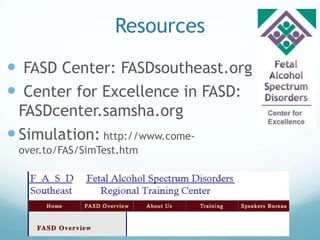
Resources
 FASD Center: FASDsoutheast.org
 Center for Excellence in FASD:
  FASDcenter.samsha.org
 Simulation: http://www.come-
 over.to/FAS/SimTest.htm
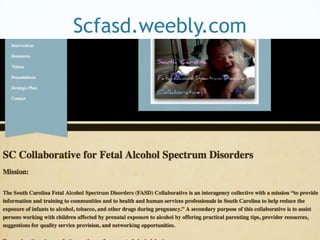
Scfasd.weebly.com
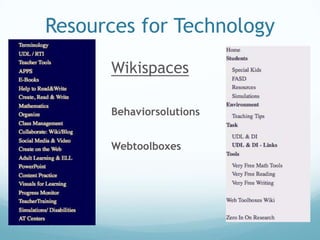
Resources for Technology
      Wikispaces

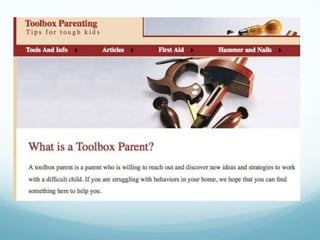
      Behaviorsolutions


      Webtoolboxes
Objectives
 What do you know? Pre evaluation
 What do you want to know?
 Establish a goal for today

 FASD: overview and misconceptions
 Academic Solutions
 Behavioral Solutions
FASD: Fast Facts
 FASD – 100% preventable, 0% curable
 If you are pregnant, don’t drink.
 If you drink, don’t get pregnant.
 Exposure to alcohol can affect the
  brain development at any time
  during pregnancy.
 FASD leading preventable cause of
  ID in Western World
FASD
 Fetal Alcohol Spectrum Disorders is
  not a diagnostic category, but
  rather an umbrella term describing
  the effects that can occur in a
  person whose mother drank alcohol
  during pregnancy.
 FASD is what a person has not what
  a person is.
Misconception #1
You know a child has been affected by
  alcohol by the way he/she looks.

 Facial effects decrease as children age
 Full facial effects are only required for a
  diagnosis if one cannot substantiate that
  the mother drank during pregnancy.
 FASD is much broader than just FAS
 FAS has dysmorphic facial features, growth
  deficit and CNS abnormality
Misconception #2
Students with a FASD all have severe
  intellectual disabilities
 Students with a FASD can have a range of
  abilities from severe intellectual
  disabilities to learning disabilities (IQ
  range 20-110)
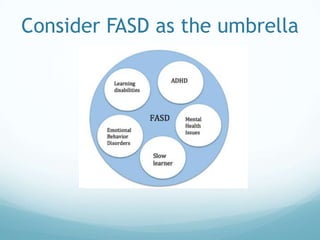
 Students with a FASD can be labeled as
  having ADHD, ODD, Personality
  disorder, Learning Disability, Depression
  but FASD is the umbrella
 Leading cause of ID but only 25% have ID
Misconception #3
FASD is not as prevalent as Autism

 More children are affected by alcohol
  than the number of students identified as
  having autism spectrum disorders
 FASD is not as publicized due to stigma
 Good data are not collected on the
  incidence of FASD – only birth records of
  mothers “known” to drink are recorded.
Misconception #4
Alcohol does not cause as much
 damage as cocaine or heroin.

 Alcohol has long range effects on
  behavior and brain functioning.
 FASD is a lifelong disorder.
Misconception #5
If there is no cure, then why bother
  with identification.
 Early identification helps provide
 structure and a stable environment.
 Early identification can assist with
 strategies for instruction
Misconception #6
Only women who are alcoholics give
 birth to babies with a FASD.

 We cannot predict how much alcohol
  exposure will lead to a FASD.
 What constitutes one drink is much
  smaller than what we usually consider.
 FASD is more prevalent in middle to
  upper class situations than lower class.
Misconception #7
If I use evidence based practices the
  student will respond, otherwise the
  student is not trying.
 Students do not respond to typical
  language-based approaches.
 We have to shift thinking to what is
  wrong with the curriculum and not
  what what is wrong with the
  student.
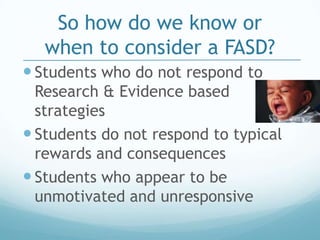
So how do we know or
   when to consider a FASD?
 Students who do not respond to
  Research & Evidence based
  strategies
 Students do not respond to typical
  rewards and consequences
 Students who appear to be
  unmotivated and unresponsive
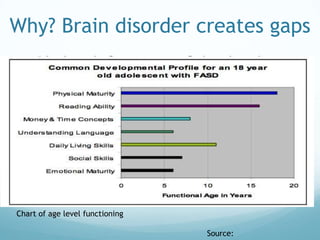
Why? Brain disorder creates gaps


Chart of age level functioning

                                 Source:
Consider FASD as the umbrella
Use Strengths Based Approach
 What do they do well?
 What do they like to do?
 What are their best qualities?
 What are your funniest experiences
  with them?
 Identify strengths in family,
  teachers, community, school
 Always focus on the individual first
“Typical” strengths

 Friendly       Determined
 Likeable       Have points of
 Verbal         insight
 Helpful        Good with younger
                 children or elderly
 Caring
 Hard Worker
UDL* Model
 Paradigm shift: Move from viewing the
  individual as failing to viewing the
  program as not providing what the
  individuals need. (Dubovsky)
 Identify Barriers to learning and then
  list possible solutions to those barriers.
 Identify specific barriers in your
  classroom
 Link technology tools to assist students
                          * Universal Design for Learning
Barrier to learning
Verbal expressive ability is much more
advanced than verbal receptive skills or
ability to produce written products.

 Students can talk the talk but not walk the
  walk.
 Do not assume that what they say is
  indicative of what they know
 Allow them to provide verbal explanation
  and interpretation of what something
  means or have them demonstrate
Barrier to learning
Can’t process several directions at once

 Provide one direction at a time.
 Student with ODD still won’t comply but a
 child with FASD will complete task.
 Create visual task analysis charts
 -Interactive Excel chart
 Provide a checklist
Barrier to learning
Cannot keep track of multiple plans,
each with several goals and a number
of steps per goals
 Students take part in IEP but they do not
 understand all the aspects, provide
 positive feedback, provide checklist.
 Students cannot be responsible to follow
 their own behavior plan
 Work on one goal at a time.
Barrier to learning
Can’t remember what they were
supposed to do when (whether its an
hour, day or week after being told)
 Working and short term memory ideas
 Reduce Cognitive Load
 Use of texting to remind young adults.
 Set alarms or reminders
Barrier to learning
Cannot understand abstract concepts
 Teach underlying skills
 Provide manipulatives
 Use concrete examples
 Role play to act out concepts
 Provide Examples & NOT-examples of
 concepts
Barrier to learning
Cannot filter what they are thinking
 Support points of insight
 Foster their creative ideas,
 Model journaling without censorship or
 grading
 They don’t mean to be rude or intrusive,
 just say what they think.
 Model good ways to speak your mind
Barrier to learning
Say they know what they need to do
but they cannot show they can do it


 Have them act out what to do
 Have them complete an example
 Provide guided practice
Barrier to learning
  Literal thinking
 Be careful of specific directions, they will do
 what they are told.
 Do not use sarcasm, joking, similes,
 metaphors, proverbs, idiomatic expressions.
 Do a task analysis of a skill, do not assume
 that the students will fill in a step
 Explain & consider misinterpretations of
 words
Barrier to learning
Difficulty with number concepts:
time, money, measurement
 Provide direct instruction for time & money
 Provide schedules for month, mark off each
 day.
 Provide support for shopping with a peer to
 help with money
 Set alarms or timer
Barrier to Behavior Management
Try to “go along with the crowd” so
that they have friends.
 Model their peers, so provide positive ones
 Provide Social skills training
 Work on Strengths
 Identify positive role models and foster
  those relationships as they won’t thrive on
  their own
 Do better in 1-to-1 situation
Barrier to Behavior Management
 Does not learn by experiencing
consequences of their behavior
 Short term consequences –no more than 1 day
 Do not use natural consequences
 USE positive reinforcement - immediately
 Use repeated role playing
 Do not take away what they like to do as a
 consequence for their behavior.
Barrier to Behavior Management
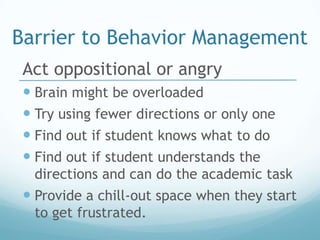
 Act oppositional or angry
  Brain might be overloaded
  Try using fewer directions or only one
  Find out if student knows what to do
  Find out if student understands the
  directions and can do the academic task
  Provide a chill-out space when they start
  to get frustrated.
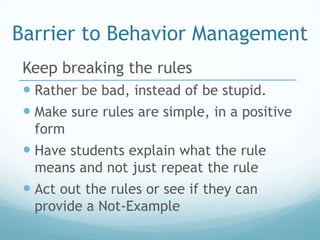
Barrier to Behavior Management
 Keep breaking the rules
  Rather be bad, instead of be stupid.
  Make sure rules are simple, in a positive
  form
  Have students explain what the rule
  means and not just repeat the rule
  Act out the rules or see if they can
  provide a Not-Example
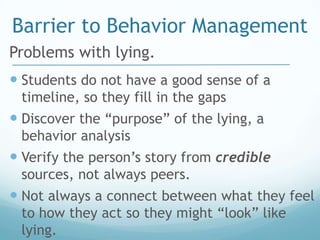
Barrier to Behavior Management
Problems with lying.
 Students do not have a good sense of a
 timeline, so they fill in the gaps
 Discover the “purpose” of the lying, a
 behavior analysis
 Verify the person’s story from credible
 sources, not always peers.
 Not always a connect between what they feel
 to how they act so they might “look” like
 lying.
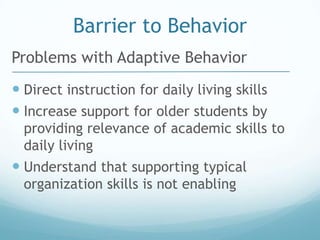
Barrier to Behavior
Problems with Adaptive Behavior
 Direct instruction for daily living skills
 Increase support for older students by
  providing relevance of academic skills to
  daily living
 Understand that supporting typical
  organization skills is not enabling
Barrier to Behavior Management
Difficulty making & maintaining friends.
 Provide positive mentors
 Foster relationships through strengths &
  interests
 Social skill training so that others do not see
  them as weird, strange, being inappropriate
 Find something that student likes to do and
  let them do that regardless of their behavior
 Be careful about their attitudes about death
  (people who die get lots of attention, death be at peace)
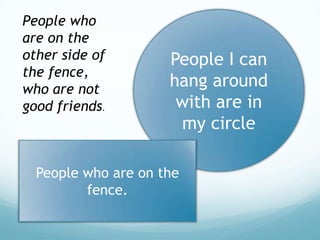
People who
are on the
other side of        People I can
the fence,
who are not
                     hang around
good friends.         with are in
                      my circle

  People who are on the
         fence.
Overall Strategies
 Simplify the individual’s environment
 Use of a lot of repetition, more than
  what we think based on their intellect
  & verbal behavior.
 Provide one direction or rule at a time.
 De-stress situations as it creates
  cortisol in their brain.
 Do not use ZERO Tolerance policies- add
  in the IEP considerations
Technology Tools: Organization
 Start with tools EARLY so by middle
  school they are automatic and not
  an add on
 Livescribe Pen
 Todo lists:
 Jing: video and screenshots
 Excel interactive chart
 Visual models
Take home information
 Modify approaches to meet needs based
  on brain damage
 Simplify the environment and add
  structure.
 Listen when they tell you that they
  cannot do something but they are trying
  as they learn differently
 They do get frustrated: like trying to
  put together something from IKEA daily
Resource Reminders
 Wikispaces for Technology tools
 SCFASD Collaborative Weebly
   Prevention, Intervention & Videos
 Consider joining the Collaborative
 Contact speakers
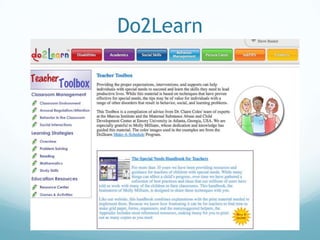
Do2Learn
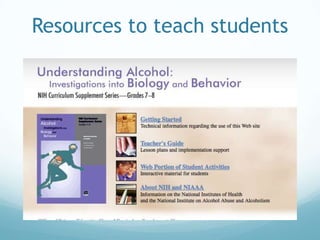
Resources to teach students
FASD

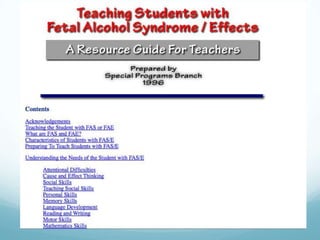
FASD

  • 1.
    Got Academic orBehavior Problems: What’s FASD got to do with it? Cheryl A. Wissick, Ph.D. University of South Carolina Presentation adapted from information from Dan Dubovsky, FASD Specialist, FASD Center CFE, SAMHSA Roger Zoorob, M.D., Meharry Medical College & Support from South Carolina Collaborative FASD
  • 2.
    Resources  FASD Center:FASDsoutheast.org  Center for Excellence in FASD: FASDcenter.samsha.org  Simulation: http://www.come- over.to/FAS/SimTest.htm
  • 3.
  • 4.
    Resources for Technology Wikispaces Behaviorsolutions Webtoolboxes
  • 5.
    Objectives  What doyou know? Pre evaluation  What do you want to know?  Establish a goal for today  FASD: overview and misconceptions  Academic Solutions  Behavioral Solutions
  • 6.
    FASD: Fast Facts FASD – 100% preventable, 0% curable  If you are pregnant, don’t drink.  If you drink, don’t get pregnant.  Exposure to alcohol can affect the brain development at any time during pregnancy.  FASD leading preventable cause of ID in Western World
  • 7.
    FASD  Fetal AlcoholSpectrum Disorders is not a diagnostic category, but rather an umbrella term describing the effects that can occur in a person whose mother drank alcohol during pregnancy.  FASD is what a person has not what a person is.
  • 8.
    Misconception #1 You knowa child has been affected by alcohol by the way he/she looks.  Facial effects decrease as children age  Full facial effects are only required for a diagnosis if one cannot substantiate that the mother drank during pregnancy.  FASD is much broader than just FAS  FAS has dysmorphic facial features, growth deficit and CNS abnormality
  • 9.
    Misconception #2 Students witha FASD all have severe intellectual disabilities  Students with a FASD can have a range of abilities from severe intellectual disabilities to learning disabilities (IQ range 20-110)  Students with a FASD can be labeled as having ADHD, ODD, Personality disorder, Learning Disability, Depression but FASD is the umbrella  Leading cause of ID but only 25% have ID
  • 10.
    Misconception #3 FASD isnot as prevalent as Autism  More children are affected by alcohol than the number of students identified as having autism spectrum disorders  FASD is not as publicized due to stigma  Good data are not collected on the incidence of FASD – only birth records of mothers “known” to drink are recorded.
  • 11.
    Misconception #4 Alcohol doesnot cause as much damage as cocaine or heroin.  Alcohol has long range effects on behavior and brain functioning.  FASD is a lifelong disorder.
  • 12.
    Misconception #5 If thereis no cure, then why bother with identification.  Early identification helps provide structure and a stable environment.  Early identification can assist with strategies for instruction
  • 13.
    Misconception #6 Only womenwho are alcoholics give birth to babies with a FASD.  We cannot predict how much alcohol exposure will lead to a FASD.  What constitutes one drink is much smaller than what we usually consider.  FASD is more prevalent in middle to upper class situations than lower class.
  • 14.
    Misconception #7 If Iuse evidence based practices the student will respond, otherwise the student is not trying.  Students do not respond to typical language-based approaches.  We have to shift thinking to what is wrong with the curriculum and not what what is wrong with the student.
  • 15.
    So how dowe know or when to consider a FASD?  Students who do not respond to Research & Evidence based strategies  Students do not respond to typical rewards and consequences  Students who appear to be unmotivated and unresponsive
  • 16.
    Why? Brain disordercreates gaps Chart of age level functioning Source:
  • 17.
    Consider FASD asthe umbrella
  • 18.
    Use Strengths BasedApproach  What do they do well?  What do they like to do?  What are their best qualities?  What are your funniest experiences with them?  Identify strengths in family, teachers, community, school  Always focus on the individual first
  • 19.
    “Typical” strengths  Friendly  Determined  Likeable  Have points of  Verbal insight  Helpful  Good with younger children or elderly  Caring  Hard Worker
  • 20.
    UDL* Model  Paradigmshift: Move from viewing the individual as failing to viewing the program as not providing what the individuals need. (Dubovsky)  Identify Barriers to learning and then list possible solutions to those barriers.  Identify specific barriers in your classroom  Link technology tools to assist students * Universal Design for Learning
  • 21.
    Barrier to learning Verbalexpressive ability is much more advanced than verbal receptive skills or ability to produce written products.  Students can talk the talk but not walk the walk.  Do not assume that what they say is indicative of what they know  Allow them to provide verbal explanation and interpretation of what something means or have them demonstrate
  • 22.
    Barrier to learning Can’tprocess several directions at once  Provide one direction at a time.  Student with ODD still won’t comply but a child with FASD will complete task.  Create visual task analysis charts -Interactive Excel chart  Provide a checklist
  • 23.
    Barrier to learning Cannotkeep track of multiple plans, each with several goals and a number of steps per goals  Students take part in IEP but they do not understand all the aspects, provide positive feedback, provide checklist.  Students cannot be responsible to follow their own behavior plan  Work on one goal at a time.
  • 24.
    Barrier to learning Can’tremember what they were supposed to do when (whether its an hour, day or week after being told)  Working and short term memory ideas  Reduce Cognitive Load  Use of texting to remind young adults.  Set alarms or reminders
  • 25.
    Barrier to learning Cannotunderstand abstract concepts  Teach underlying skills  Provide manipulatives  Use concrete examples  Role play to act out concepts  Provide Examples & NOT-examples of concepts
  • 26.
    Barrier to learning Cannotfilter what they are thinking  Support points of insight  Foster their creative ideas,  Model journaling without censorship or grading  They don’t mean to be rude or intrusive, just say what they think.  Model good ways to speak your mind
  • 27.
    Barrier to learning Saythey know what they need to do but they cannot show they can do it  Have them act out what to do  Have them complete an example  Provide guided practice
  • 28.
    Barrier to learning Literal thinking  Be careful of specific directions, they will do what they are told.  Do not use sarcasm, joking, similes, metaphors, proverbs, idiomatic expressions.  Do a task analysis of a skill, do not assume that the students will fill in a step  Explain & consider misinterpretations of words
  • 29.
    Barrier to learning Difficultywith number concepts: time, money, measurement  Provide direct instruction for time & money  Provide schedules for month, mark off each day.  Provide support for shopping with a peer to help with money  Set alarms or timer
  • 30.
    Barrier to BehaviorManagement Try to “go along with the crowd” so that they have friends.  Model their peers, so provide positive ones  Provide Social skills training  Work on Strengths  Identify positive role models and foster those relationships as they won’t thrive on their own  Do better in 1-to-1 situation
  • 31.
    Barrier to BehaviorManagement Does not learn by experiencing consequences of their behavior  Short term consequences –no more than 1 day  Do not use natural consequences  USE positive reinforcement - immediately  Use repeated role playing  Do not take away what they like to do as a consequence for their behavior.
  • 32.
    Barrier to BehaviorManagement Act oppositional or angry  Brain might be overloaded  Try using fewer directions or only one  Find out if student knows what to do  Find out if student understands the directions and can do the academic task  Provide a chill-out space when they start to get frustrated.
  • 33.
    Barrier to BehaviorManagement Keep breaking the rules  Rather be bad, instead of be stupid.  Make sure rules are simple, in a positive form  Have students explain what the rule means and not just repeat the rule  Act out the rules or see if they can provide a Not-Example
  • 34.
    Barrier to BehaviorManagement Problems with lying.  Students do not have a good sense of a timeline, so they fill in the gaps  Discover the “purpose” of the lying, a behavior analysis  Verify the person’s story from credible sources, not always peers.  Not always a connect between what they feel to how they act so they might “look” like lying.
  • 35.
    Barrier to Behavior Problemswith Adaptive Behavior  Direct instruction for daily living skills  Increase support for older students by providing relevance of academic skills to daily living  Understand that supporting typical organization skills is not enabling
  • 36.
    Barrier to BehaviorManagement Difficulty making & maintaining friends.  Provide positive mentors  Foster relationships through strengths & interests  Social skill training so that others do not see them as weird, strange, being inappropriate  Find something that student likes to do and let them do that regardless of their behavior  Be careful about their attitudes about death (people who die get lots of attention, death be at peace)
  • 37.
    People who are onthe other side of People I can the fence, who are not hang around good friends. with are in my circle People who are on the fence.
  • 38.
    Overall Strategies  Simplifythe individual’s environment  Use of a lot of repetition, more than what we think based on their intellect & verbal behavior.  Provide one direction or rule at a time.  De-stress situations as it creates cortisol in their brain.  Do not use ZERO Tolerance policies- add in the IEP considerations
  • 39.
    Technology Tools: Organization Start with tools EARLY so by middle school they are automatic and not an add on  Livescribe Pen  Todo lists:  Jing: video and screenshots  Excel interactive chart  Visual models
  • 40.
    Take home information Modify approaches to meet needs based on brain damage  Simplify the environment and add structure.  Listen when they tell you that they cannot do something but they are trying as they learn differently  They do get frustrated: like trying to put together something from IKEA daily
  • 41.
    Resource Reminders  Wikispacesfor Technology tools  SCFASD Collaborative Weebly  Prevention, Intervention & Videos  Consider joining the Collaborative  Contact speakers
  • 42.
  • 46.

Editor's Notes

  • #21 Remember that the students need access and direct instruction on how to use technology tools. Many may help but they have to use them daily.