Lesson	
  on	
  Opposites	
  

1.	
  PrePlanning:	


Objective:	
  
     Given a word processed document with certain words underlined, the student will
     highlight each word and change the word to a word with an opposite meaning at
     100% accuracy. Depending on the student’s skill level, students will be presented
     with different documents and number of words underlined.

Materials:	
  
     Computer with projection of the paragraphs for editing
     Smartboard- notebook activity with opposites Or PowerPoint show with opposites –
     focus on using the words and not pictures


2.	
  Lesson	
  Opening:	


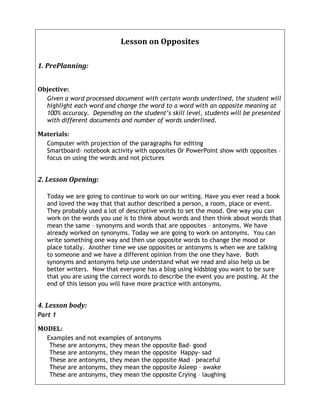
     Today we are going to continue to work on our writing. Have you ever read a book
     and loved the way that that author described a person, a room, place or event.
     They probably used a lot of descriptive words to set the mood. One way you can
     work on the words you use is to think about words and then think about words that
     mean the same – synonyms and words that are opposites – antonyms. We have
     already worked on synonyms. Today we are going to work on antonyms. You can
     write something one way and then use opposite words to change the mood or
     place totally. Another time we use opposites or antonyms is when we are talking
     to someone and we have a different opinion from the one they have. Both
     synonyms and antonyms help use understand what we read and also help us be
     better writers. Now that everyone has a blog using kidsblog you want to be sure
     that you are using the correct words to describe the event you are posting. At the
     end of this lesson you will have more practice with antonyms.


4.	
  Lesson	
  body:	
  	
  
Part 1

MODEL:	
  	
  
     Examples and not examples of antonyms
      These are antonyms, they mean the opposite Bad- good
      These are antonyms, they mean the opposite Happy- sad
      These are antonyms, they mean the opposite Mad – peaceful
      These are antonyms, they mean the opposite Asleep – awake
      These are antonyms, they mean the opposite Crying – laughing
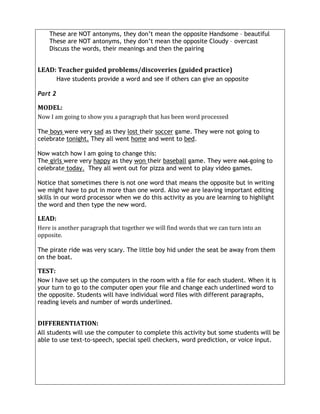
These are NOT antonyms, they don’t mean the opposite Handsome – beautiful
        These are NOT antonyms, they don’t mean the opposite Cloudy – overcast
        Discuss the words, their meanings and then the pairing


LEAD:	
  Teacher	
  guided	
  problems/discoveries	
  (guided	
  practice)	
  
              Have students provide a word and see if others can give an opposite

Part 2

MODEL:	
  	
  
Now	
  I	
  am	
  going	
  to	
  show	
  you	
  a	
  paragraph	
  that	
  has	
  been	
  word	
  processed	
  

The boys were very sad as they lost their soccer game. They were not going to
celebrate tonight. They all went home and went to bed.

Now watch how I am going to change this:
The girls were very happy as they won their baseball game. They were not going to
celebrate today. They all went out for pizza and went to play video games.

Notice that sometimes there is not one word that means the opposite but in writing
we might have to put in more than one word. Also we are leaving important editing
skills in our word processor when we do this activity as you are learning to highlight
the word and then type the new word.

LEAD:	


Here	
  is	
  another	
  paragraph	
  that	
  together	
  we	
  will	
  find	
  words	
  that	
  we	
  can	
  turn	
  into	
  an	
  
opposite.	
  

The pirate ride was very scary. The little boy hid under the seat be away from them
on the boat.

TEST:	


Now I have set up the computers in the room with a file for each student. When it is
your turn to go to the computer open your file and change each underlined word to
the opposite. Students will have individual word files with different paragraphs,
reading levels and number of words underlined.


DIFFERENTIATION:	
  
All students will use the computer to complete this activity but some students will be
able to use text-to-speech, special spell checkers, word prediction, or voice input.
5.	
  Lesson	
  closing:	


Remember that we are working on opposites or antonyms today. When it is your turn
today you will complete your paragraph and print it to turn in to me.

          Example: We went to the amusement park. I like to scream on rides. Some
          rides go around. Some rides go high. The roller coaster is my favorite.

7.	
  Evaluation:	


During the next week you will be reading my blog post and then creating a response
by taking my paragraph and changing some words to opposites. I will record each
student and the number of words changed and the number of correct opposites.
Objectives will be evaluated based on the IEP goals for each student.	
  

Barebones lesson for 750 ela example

  • 1.
    Lesson  on  Opposites   1.  PrePlanning:     Objective:   Given a word processed document with certain words underlined, the student will highlight each word and change the word to a word with an opposite meaning at 100% accuracy. Depending on the student’s skill level, students will be presented with different documents and number of words underlined. Materials:   Computer with projection of the paragraphs for editing Smartboard- notebook activity with opposites Or PowerPoint show with opposites – focus on using the words and not pictures 2.  Lesson  Opening:     Today we are going to continue to work on our writing. Have you ever read a book and loved the way that that author described a person, a room, place or event. They probably used a lot of descriptive words to set the mood. One way you can work on the words you use is to think about words and then think about words that mean the same – synonyms and words that are opposites – antonyms. We have already worked on synonyms. Today we are going to work on antonyms. You can write something one way and then use opposite words to change the mood or place totally. Another time we use opposites or antonyms is when we are talking to someone and we have a different opinion from the one they have. Both synonyms and antonyms help use understand what we read and also help us be better writers. Now that everyone has a blog using kidsblog you want to be sure that you are using the correct words to describe the event you are posting. At the end of this lesson you will have more practice with antonyms. 4.  Lesson  body:     Part 1 MODEL:     Examples and not examples of antonyms These are antonyms, they mean the opposite Bad- good These are antonyms, they mean the opposite Happy- sad These are antonyms, they mean the opposite Mad – peaceful These are antonyms, they mean the opposite Asleep – awake These are antonyms, they mean the opposite Crying – laughing
  • 2.
    These are NOTantonyms, they don’t mean the opposite Handsome – beautiful These are NOT antonyms, they don’t mean the opposite Cloudy – overcast Discuss the words, their meanings and then the pairing LEAD:  Teacher  guided  problems/discoveries  (guided  practice)   Have students provide a word and see if others can give an opposite Part 2 MODEL:     Now  I  am  going  to  show  you  a  paragraph  that  has  been  word  processed   The boys were very sad as they lost their soccer game. They were not going to celebrate tonight. They all went home and went to bed. Now watch how I am going to change this: The girls were very happy as they won their baseball game. They were not going to celebrate today. They all went out for pizza and went to play video games. Notice that sometimes there is not one word that means the opposite but in writing we might have to put in more than one word. Also we are leaving important editing skills in our word processor when we do this activity as you are learning to highlight the word and then type the new word. LEAD:       Here  is  another  paragraph  that  together  we  will  find  words  that  we  can  turn  into  an   opposite.   The pirate ride was very scary. The little boy hid under the seat be away from them on the boat. TEST:       Now I have set up the computers in the room with a file for each student. When it is your turn to go to the computer open your file and change each underlined word to the opposite. Students will have individual word files with different paragraphs, reading levels and number of words underlined. DIFFERENTIATION:   All students will use the computer to complete this activity but some students will be able to use text-to-speech, special spell checkers, word prediction, or voice input.
  • 3.
    5.  Lesson  closing:     Remember that we are working on opposites or antonyms today. When it is your turn today you will complete your paragraph and print it to turn in to me. Example: We went to the amusement park. I like to scream on rides. Some rides go around. Some rides go high. The roller coaster is my favorite. 7.  Evaluation:     During the next week you will be reading my blog post and then creating a response by taking my paragraph and changing some words to opposites. I will record each student and the number of words changed and the number of correct opposites. Objectives will be evaluated based on the IEP goals for each student. Â