ATTENTION DEFICIT HYPERACTIVITY DISORDER
(ADHD)
• PRESENTED BY:
LINAH AL ISSA 213410286
MARAM AL NEMER
MUNEERA AL YAHYA 213410035
MAIMOONA AL BASSAM 213410851
SHADEN AL MUJALLI 213410116
• INTRUCTOR: DR.SEEMA GUL
• COURSE: INTRODUCTION INTO PSYCHOLOGY
OUTLINE
 What is ADHD? (definition, explanation, ADHD cases percentages),
Presented by Shaden
 Symptoms, Presented by Linah
 Diagnosis, Presented by Maimoona
 Causes, Presented by Muneera
 Treatments and side effects, Presented by Maram
 Behavior therapy by Shaden
WHAT IS
ADHD?
PRESENTED BY:
SHADEN AL MUJALLI
WHAT IS ADHD?
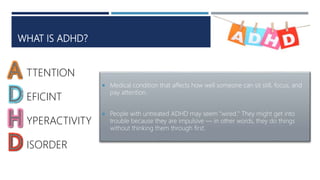
 Medical condition that affects how well someone can sit still, focus, and
pay attention.
 People with untreated ADHD may seem "wired." They might get into
trouble because they are impulsive — in other words, they do things
without thinking them through first.
TTENTION
EFICINT
YPERACTIVITY
ISORDER
People with ADHD have differences in the parts of their brains
that control attention and activity. This means that they may have
trouble focusing on some tasks and subjects.
ADHD used to be called attention deficit disorder, or ADD for
short. In 1994, it was renamed ADHD. People might still use the
term ADD to describe a type of ADHD that doesn't involve
hyperactivity.
• 15% of men suffers from ADHD,
• but only 6.7% of women suffers from ADHD
ADHD
SYMPTOMS
PRESENTED BY:
LINAH AL ISSA
SYMPTOMS AND SIGNS OF ADHD:
There are three groups of symptoms:
INATTENTION:
This kind of symptom appears when:
 Child: starts going to school
 Adults: noticed easer in work environments or in social
communications.
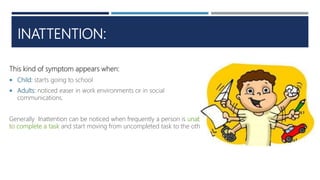
Generally Inattention can be noticed when frequently a person is unable
to complete a task and start moving from uncompleted task to the other.
OTHER SIGNS OF INATTENTION:
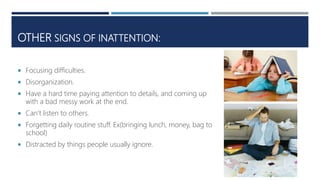
 Focusing difficulties.
 Disorganization.
 Have a hard time paying attention to details, and coming up
with a bad messy work at the end.
 Can’t listen to others.
 Forgetting daily routine stuff. Ex(bringing lunch, money, bag to
school)
 Distracted by things people usually ignore.
HYPERACTIVITY:
Sign of hyperactivity:
 Can’t stay still even while setting.
 Move around frequently without a serous reason.
 Cannot stay quiet, talk excessively
This kind of symptoms shows up before middle school.
IMPULSIVITY
Sign of impulsivity:
 Fast reaction
 Interrupting people
 Start conversation at inappropriate time
Individuals with impulsive tendencies can be reckless and
appear impatient, and are often disinhibited in social
situations.
APPROXIMATE PREVALENCE DISTRIBUTION OF THE SYMPTOMS
OF ADHD
Approximate Prevalance Distribution of the subtypes of ADHD (Children)
Hyperactivity Type Inattentive Type Combined Type
Approximate Prevalance Distribution of the subtypes of ADHD
(Adolescent)
Hyperactivity Type Inattentive Type Combined Type
(Cincinnati Children's Hospital Medical
Center Researches, 2007)
WHAT IT FEELS LIKE TO HAVE ADHD
https://www.youtube.com/watch?v=VIcGRffuMLg
ADHD DIAGNOSIS
PRESENTED BY MAIMOONA AL ABASSAM
 Primarily Inattentive
 Primarily Hyperactive
 Combined subtype.
ADHD cannot be diagnosed through one test it can be only
diagnosed after seeing some of its symptoms on a regular basis
continuously for more than six months.
Based on the number/ types of symptoms, a person will go with
one of three subtypes of ADHD:
Diagnosing ADHD
• Physical examination, that includes vision and hearing
screenings.
• Noninvasive brain scans to measure theta & beta waves
ADHD in
children
• A history of the adult's behavior as a child
• An interview with the adult's life partner, parent,
close friend, or other close associate
• A Physical exam that may include neurological
testing
• Psychological testing
ADHD in
adults
CAUSES
PRESENTED BY:
MUNEERA AL YAHYA
CAUSES
 the main factors that are related to its
occurrence:
 Heredity ( Children with parent with ADD or ADHD)
If a parent has ADHD, a child has more than a
50% chance of having it. If an older sibling has it,
a child has more than a 30% chance.
CAUSES
 Pregnancy Problems
• Studies show that pregnant women
who smoke or drink alcohol may
have a higher risk of having a child
with ADHD.
• Children exposed to tobacco
smoke prenatally are 2 to 4 times
as likely to have ADHD as those
who are not.
CAUSES
 Children born with a low
birth weight
• born premature, (before the 37th
week of pregnancy) or whose
mothers had difficult pregnancies
have a higher risk of having ADHD.
CAUSES
 Head injuries
• head injuries to the frontal lobe of
the brain, the area that controls
impulses and emotions.
• Research suggests that when a baby's
brain is damaged or negatively affected
before or after birth, this could make
the baby more likely to develop ADHD
later on.
TREATMENTS
& SIDE
EFFECTS
PRESENTED BY:
MARAM AL NEMER
• Psychotherapy
Interventions.
(For both the child and the parents; or the adult
with ADHD)
• Medication.
TREATMENT
There is a significant amount of research demonstrating that
medication alone won’t help address all of a patient’s attention
and hyperactivity issues.
The specific class of medication most commonly prescribed for ADHD is
stimulants.
Stimulant medications commonly prescribed for attention deficit disorder
include methylphenidate (Ritalin, Concerta, Metadate, Methylin)
and certain amphetamines (Dexedrine, Dextrostat, Adderall).
Methylphenidate is a short acting drug, and in older forms, had to be
taken multiple times a day. Longer-acting versions of the drug are
now available for once-daily use.
Stimulant drugs are often beneficial in curbing hyperactivity and
impulsivity, and helping the individual to focus, work, and learn.
Sometimes the drugs will also help with coordination problems
which may hinder sports and handwriting.
MEDICATION SIDE EFFECTS
For most medications prescribed for attention deficit
disorder, the most commonly observed side effects are:
1. Sleep problems
2. Rapid heart beats
3. Decreased appetite
4. Delayed growth
5. Headaches and stomachaches
6. Rebound (irritability when the medication wears off)
7. Tics
8. Moodiness and irritability
Some of the famous artists:
Dali, Picasso, Van Gogh, and Rodin.
Some of the authors:
Emily Dickenson, and Edgar Allan Poe.
Some of the entrepreneurs and leaders in business:
Bill Gates (Microsoft), and Walt Disney.
Some of the entertainers with ADHD:
Jim Carrey, Robin Williams, Justin Timberlake, Tom Cruise, Will Smith, and
Stevie Wonder.
Some of the inventors are:
Thomas Edison, Benjamin Franklin, Sir Isaac newton, and Albert Einstein.
BEHAVIOR
THERAPY
BY:
SHADEN ALMUJALLI
Research shows that behavior therapy is an important part of treatment for children with ADHD.
ADHD affects not only a child’s ability to pay attention or sit still at school, it also affects
relationships with family and other children.
The goals of behavior therapy are to learn or strengthen positive behaviors and eliminate
unwanted or problem behaviors.
Behavior therapy can include behavior therapy training for:
• Parents
• Children
• Combination of parents & children
• Teachers can also use behavior therapy to help reduce problem behaviors in the classroom.
What is behavior therapy?
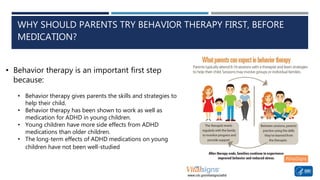
WHY SHOULD PARENTS TRY BEHAVIOR THERAPY FIRST, BEFORE
MEDICATION?
• Behavior therapy is an important first step
because:
• Behavior therapy gives parents the skills and strategies to
help their child.
• Behavior therapy has been shown to work as well as
medication for ADHD in young children.
• Young children have more side effects from ADHD
medications than older children.
• The long-term effects of ADHD medications on young
children have not been well-studied
TIPS FOR PARENTS
• Create a routine
• Get organized
• Manage distractions
• Limit choices
• Be clear and specific when you talk with your child
• Help your child plan
• Use goals and praise or other rewards
• Discipline effectively
• Create positive opportunities
• Provide a healthy lifestyle
ADHD AND THE CLASSROOM
Inability to pay attention, difficulty sitting still, difficulty controlling impulses, can make it particularly hard for children with
ADHD to do well in school. It is important for teachers to have the needed skills to help children manage their ADHD.
However, since the majority of children with ADHD are not enrolled in special education classes, their teachers will most
likely be regular education teachers who might know very little about ADHD and could benefit from assistance and
guidance.
Here are some tips to share with teachers for classroom success:
• Make assignments clear – check with the student to see if they understood what they need to do
• Give positive reinforcement and attention to positive behavior
• Make sure assignments are not long and repetitive. Shorter assignments that provide a little challenge
without being too hard are best.
• Allow time for movement and exercise
• Communicate with parents on a regular basis
• Use a homework folder to limit the number of things the child has to track
• Be sensitive to self-esteem issues
• Minimize distractions in the classroom
• Involve the school counselor or psychologist
REFERENCES
 ADHD: Inattentive Type. (n.d.). Retrieved April 19, 2017, from http://www.webmd.com/add-
adhd/guide/adhd-inattentive-type#1
 ADHD in adults, really? (n.d.). Retrieved April 19, 2017, from https://www.adhdadulthood.com/en/adhd-
help/adhd-diagnosis
 Caroline Miller is the editorial director of the Child Mind Institute. (n.d.). ADHD Behavioral Treatment |
Therapy for ADHD. Retrieved April 19, 2017, from https://childmind.org/article/behavioral-treatments-kids-
adhd/
 Treatment for Attention Deficit Hyperactivity Disorder (ADHD). (2017, February 04). Retrieved April 19, 2017,
from https://psychcentral.com/disorders/adhd/treatment-for-attention-deficit-hyperactivity-disorder-adhd/
 Symptoms of ADHD. (n.d.). Retrieved April 19, 2017, from http://www.webmd.com/add-adhd/guide/adhd-
symptoms#1
 Treatment. (2017, April 11). Retrieved April 19, 2017, from
https://www.cdc.gov/ncbddd/adhd/treatment.html

ADHD

  • 1.
    ATTENTION DEFICIT HYPERACTIVITYDISORDER (ADHD) • PRESENTED BY: LINAH AL ISSA 213410286 MARAM AL NEMER MUNEERA AL YAHYA 213410035 MAIMOONA AL BASSAM 213410851 SHADEN AL MUJALLI 213410116 • INTRUCTOR: DR.SEEMA GUL • COURSE: INTRODUCTION INTO PSYCHOLOGY
  • 2.
    OUTLINE  What isADHD? (definition, explanation, ADHD cases percentages), Presented by Shaden  Symptoms, Presented by Linah  Diagnosis, Presented by Maimoona  Causes, Presented by Muneera  Treatments and side effects, Presented by Maram  Behavior therapy by Shaden
  • 3.
  • 4.
    WHAT IS ADHD? Medical condition that affects how well someone can sit still, focus, and pay attention.  People with untreated ADHD may seem "wired." They might get into trouble because they are impulsive — in other words, they do things without thinking them through first. TTENTION EFICINT YPERACTIVITY ISORDER
  • 5.
    People with ADHDhave differences in the parts of their brains that control attention and activity. This means that they may have trouble focusing on some tasks and subjects. ADHD used to be called attention deficit disorder, or ADD for short. In 1994, it was renamed ADHD. People might still use the term ADD to describe a type of ADHD that doesn't involve hyperactivity. • 15% of men suffers from ADHD, • but only 6.7% of women suffers from ADHD
  • 6.
  • 7.
    SYMPTOMS AND SIGNSOF ADHD: There are three groups of symptoms:
  • 8.
    INATTENTION: This kind ofsymptom appears when:  Child: starts going to school  Adults: noticed easer in work environments or in social communications. Generally Inattention can be noticed when frequently a person is unable to complete a task and start moving from uncompleted task to the other.
  • 9.
    OTHER SIGNS OFINATTENTION:  Focusing difficulties.  Disorganization.  Have a hard time paying attention to details, and coming up with a bad messy work at the end.  Can’t listen to others.  Forgetting daily routine stuff. Ex(bringing lunch, money, bag to school)  Distracted by things people usually ignore.
  • 10.
    HYPERACTIVITY: Sign of hyperactivity: Can’t stay still even while setting.  Move around frequently without a serous reason.  Cannot stay quiet, talk excessively This kind of symptoms shows up before middle school.
  • 11.
    IMPULSIVITY Sign of impulsivity: Fast reaction  Interrupting people  Start conversation at inappropriate time Individuals with impulsive tendencies can be reckless and appear impatient, and are often disinhibited in social situations.
  • 12.
    APPROXIMATE PREVALENCE DISTRIBUTIONOF THE SYMPTOMS OF ADHD Approximate Prevalance Distribution of the subtypes of ADHD (Children) Hyperactivity Type Inattentive Type Combined Type Approximate Prevalance Distribution of the subtypes of ADHD (Adolescent) Hyperactivity Type Inattentive Type Combined Type (Cincinnati Children's Hospital Medical Center Researches, 2007)
  • 13.
    WHAT IT FEELSLIKE TO HAVE ADHD https://www.youtube.com/watch?v=VIcGRffuMLg
  • 14.
    ADHD DIAGNOSIS PRESENTED BYMAIMOONA AL ABASSAM
  • 15.
     Primarily Inattentive Primarily Hyperactive  Combined subtype. ADHD cannot be diagnosed through one test it can be only diagnosed after seeing some of its symptoms on a regular basis continuously for more than six months. Based on the number/ types of symptoms, a person will go with one of three subtypes of ADHD: Diagnosing ADHD
  • 16.
    • Physical examination,that includes vision and hearing screenings. • Noninvasive brain scans to measure theta & beta waves ADHD in children • A history of the adult's behavior as a child • An interview with the adult's life partner, parent, close friend, or other close associate • A Physical exam that may include neurological testing • Psychological testing ADHD in adults
  • 17.
  • 18.
    CAUSES  the mainfactors that are related to its occurrence:  Heredity ( Children with parent with ADD or ADHD) If a parent has ADHD, a child has more than a 50% chance of having it. If an older sibling has it, a child has more than a 30% chance.
  • 19.
    CAUSES  Pregnancy Problems •Studies show that pregnant women who smoke or drink alcohol may have a higher risk of having a child with ADHD. • Children exposed to tobacco smoke prenatally are 2 to 4 times as likely to have ADHD as those who are not.
  • 20.
    CAUSES  Children bornwith a low birth weight • born premature, (before the 37th week of pregnancy) or whose mothers had difficult pregnancies have a higher risk of having ADHD.
  • 21.
    CAUSES  Head injuries •head injuries to the frontal lobe of the brain, the area that controls impulses and emotions. • Research suggests that when a baby's brain is damaged or negatively affected before or after birth, this could make the baby more likely to develop ADHD later on.
  • 22.
  • 23.
    • Psychotherapy Interventions. (For boththe child and the parents; or the adult with ADHD) • Medication.
  • 24.
    TREATMENT There is asignificant amount of research demonstrating that medication alone won’t help address all of a patient’s attention and hyperactivity issues. The specific class of medication most commonly prescribed for ADHD is stimulants. Stimulant medications commonly prescribed for attention deficit disorder include methylphenidate (Ritalin, Concerta, Metadate, Methylin) and certain amphetamines (Dexedrine, Dextrostat, Adderall). Methylphenidate is a short acting drug, and in older forms, had to be taken multiple times a day. Longer-acting versions of the drug are now available for once-daily use. Stimulant drugs are often beneficial in curbing hyperactivity and impulsivity, and helping the individual to focus, work, and learn. Sometimes the drugs will also help with coordination problems which may hinder sports and handwriting.
  • 25.
    MEDICATION SIDE EFFECTS Formost medications prescribed for attention deficit disorder, the most commonly observed side effects are: 1. Sleep problems 2. Rapid heart beats 3. Decreased appetite 4. Delayed growth 5. Headaches and stomachaches 6. Rebound (irritability when the medication wears off) 7. Tics 8. Moodiness and irritability
  • 26.
    Some of thefamous artists: Dali, Picasso, Van Gogh, and Rodin. Some of the authors: Emily Dickenson, and Edgar Allan Poe. Some of the entrepreneurs and leaders in business: Bill Gates (Microsoft), and Walt Disney. Some of the entertainers with ADHD: Jim Carrey, Robin Williams, Justin Timberlake, Tom Cruise, Will Smith, and Stevie Wonder. Some of the inventors are: Thomas Edison, Benjamin Franklin, Sir Isaac newton, and Albert Einstein.
  • 27.
  • 28.
    Research shows thatbehavior therapy is an important part of treatment for children with ADHD. ADHD affects not only a child’s ability to pay attention or sit still at school, it also affects relationships with family and other children. The goals of behavior therapy are to learn or strengthen positive behaviors and eliminate unwanted or problem behaviors. Behavior therapy can include behavior therapy training for: • Parents • Children • Combination of parents & children • Teachers can also use behavior therapy to help reduce problem behaviors in the classroom. What is behavior therapy?
  • 29.
    WHY SHOULD PARENTSTRY BEHAVIOR THERAPY FIRST, BEFORE MEDICATION? • Behavior therapy is an important first step because: • Behavior therapy gives parents the skills and strategies to help their child. • Behavior therapy has been shown to work as well as medication for ADHD in young children. • Young children have more side effects from ADHD medications than older children. • The long-term effects of ADHD medications on young children have not been well-studied
  • 30.
    TIPS FOR PARENTS •Create a routine • Get organized • Manage distractions • Limit choices • Be clear and specific when you talk with your child • Help your child plan • Use goals and praise or other rewards • Discipline effectively • Create positive opportunities • Provide a healthy lifestyle
  • 31.
    ADHD AND THECLASSROOM Inability to pay attention, difficulty sitting still, difficulty controlling impulses, can make it particularly hard for children with ADHD to do well in school. It is important for teachers to have the needed skills to help children manage their ADHD. However, since the majority of children with ADHD are not enrolled in special education classes, their teachers will most likely be regular education teachers who might know very little about ADHD and could benefit from assistance and guidance. Here are some tips to share with teachers for classroom success: • Make assignments clear – check with the student to see if they understood what they need to do • Give positive reinforcement and attention to positive behavior • Make sure assignments are not long and repetitive. Shorter assignments that provide a little challenge without being too hard are best. • Allow time for movement and exercise • Communicate with parents on a regular basis • Use a homework folder to limit the number of things the child has to track • Be sensitive to self-esteem issues • Minimize distractions in the classroom • Involve the school counselor or psychologist
  • 32.
    REFERENCES  ADHD: InattentiveType. (n.d.). Retrieved April 19, 2017, from http://www.webmd.com/add- adhd/guide/adhd-inattentive-type#1  ADHD in adults, really? (n.d.). Retrieved April 19, 2017, from https://www.adhdadulthood.com/en/adhd- help/adhd-diagnosis  Caroline Miller is the editorial director of the Child Mind Institute. (n.d.). ADHD Behavioral Treatment | Therapy for ADHD. Retrieved April 19, 2017, from https://childmind.org/article/behavioral-treatments-kids- adhd/  Treatment for Attention Deficit Hyperactivity Disorder (ADHD). (2017, February 04). Retrieved April 19, 2017, from https://psychcentral.com/disorders/adhd/treatment-for-attention-deficit-hyperactivity-disorder-adhd/  Symptoms of ADHD. (n.d.). Retrieved April 19, 2017, from http://www.webmd.com/add-adhd/guide/adhd- symptoms#1  Treatment. (2017, April 11). Retrieved April 19, 2017, from https://www.cdc.gov/ncbddd/adhd/treatment.html