
SO2: Make Agriculture, Forestry and
Fisheries More Productive and
Sustainable
Clayton Campanhola
Strategic Objective Coordinator
12th Meeting – CGIAR/ ISPC
Sep 2015, Rome
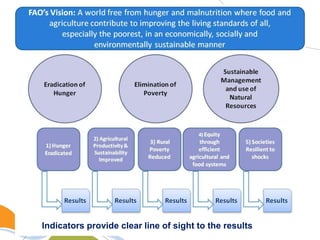
Indicators provide clear line of sight to the results
challenge of increased production requires innovative
approaches  benefit people and conserve the natural
resource base
what is new/different about SO2?
• multi-disciplinary approach, working across all sectors to
ensure sustainability
• the integration of the three “pillars” of sustainable
development (environmental, economic and social); and
• ways to generate the needed wide-scale transition to more
sustainable practices/ adoption of more sustainable practices.
Context and Rationale: Why SO2?
5
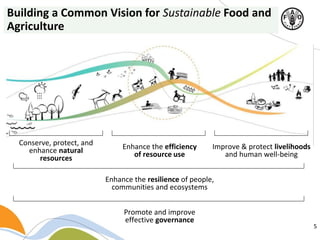
Building a Common Vision for Sustainable Food and
Agriculture
Enhance the efficiency
of resource use
Conserve, protect, and
enhance natural
resources
Improve & protect livelihoods
and human well-being
Enhance the resilience of people,
communities and ecosystems
Promote and improve
effective governance
6
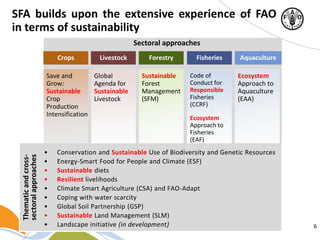
SFA builds upon the extensive experience of FAO
in terms of sustainability
Crops Livestock Forestry Fisheries Aquaculture
Save and
Grow:
Sustainable
Crop
Production
Intensification
Global
Agenda for
Sustainable
Livestock
Sustainable
Forest
Management
(SFM)
Code of
Conduct for
Responsible
Fisheries
(CCRF)
Ecosystem
Approach to
Fisheries
(EAF)
Ecosystem
Approach to
Aquaculture
(EAA)
• Conservation and Sustainable Use of Biodiversity and Genetic Resources
• Energy-Smart Food for People and Climate (ESF)
• Sustainable diets
• Resilient livelihoods
• Climate Smart Agriculture (CSA) and FAO-Adapt
• Coping with water scarcity
• Global Soil Partnership (GSP)
• Sustainable Land Management (SLM)
• Landscape initiative (in development)
Thematicandcross-
sectoralapproaches
Sectoral approaches
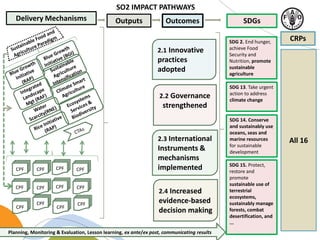
Delivery Mechanisms Outcomes SDGs
SDG 2. End hunger,
achieve Food
Security and
Nutrition, promote
sustainable
agriculture
Planning, Monitoring & Evaluation, Lesson learning, ex ante/ex post, communicating results
Outputs
SDG 13. Take urgent
action to address
climate change
SDG 14. Conserve
and sustainably use
oceans, seas and
marine resources
for sustainable
development
CPF
CPF
CPFCPF
CPF
CPF
2.1 Innovative
practices
adopted
2.3 International
Instruments &
mechanisms
implemented
2.2 Governance
strengthened
2.4 Increased
evidence-based
decision making
CPF
CPF
CPF
CPF
CPF
CPF
SO2 IMPACT PATHWAYS
SDG 15. Protect,
restore and
promote
sustainable use of
terrestrial
ecosystems,
sustainably manage
forests, combat
desertification, and
...
CRPs
All 16
COLLABORATION WITH CGIAR RESEARCH
CENTERS IN SUPPORT TO STRATEGIC
OBJECTIVE 2
9
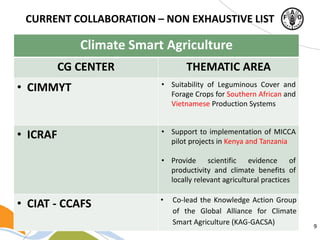
CURRENT COLLABORATION – NON EXHAUSTIVE LIST
Climate Smart Agriculture
CG CENTER THEMATIC AREA
• CIMMYT • Suitability of Leguminous Cover and
Forage Crops for Southern African and
Vietnamese Production Systems
• ICRAF • Support to implementation of MICCA
pilot projects in Kenya and Tanzania
• Provide scientific evidence of
productivity and climate benefits of
locally relevant agricultural practices
• CIAT - CCAFS • Co-lead the Knowledge Action Group
of the Global Alliance for Climate
Smart Agriculture (KAG-GACSA)
10
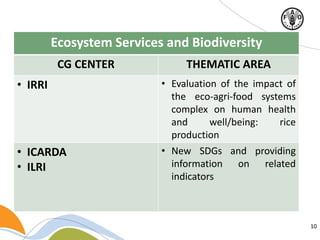
Ecosystem Services and Biodiversity
CG CENTER THEMATIC AREA
• IRRI • Evaluation of the impact of
the eco-agri-food systems
complex on human health
and well/being: rice
production
• ICARDA
• ILRI
• New SDGs and providing
information on related
indicators
11
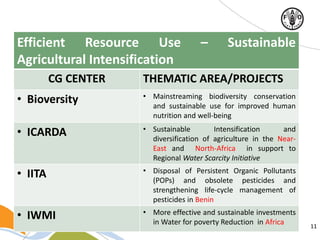
Efficient Resource Use – Sustainable
Agricultural Intensification
CG CENTER THEMATIC AREA/PROJECTS
• Bioversity • Mainstreaming biodiversity conservation
and sustainable use for improved human
nutrition and well-being
• ICARDA • Sustainable Intensification and
diversification of agriculture in the Near-
East and North-Africa in support to
Regional Water Scarcity Initiative
• IITA • Disposal of Persistent Organic Pollutants
(POPs) and obsolete pesticides and
strengthening life-cycle management of
pesticides in Benin
• IWMI • More effective and sustainable investments
in Water for poverty Reduction in Africa
12
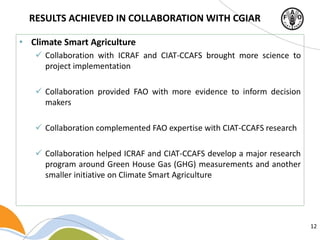
• Climate Smart Agriculture
 Collaboration with ICRAF and CIAT-CCAFS brought more science to
project implementation
 Collaboration provided FAO with more evidence to inform decision
makers
 Collaboration complemented FAO expertise with CIAT-CCAFS research
 Collaboration helped ICRAF and CIAT-CCAFS develop a major research
program around Green House Gas (GHG) measurements and another
smaller initiative on Climate Smart Agriculture
RESULTS ACHIEVED IN COLLABORATION WITH CGIAR
13
• Save & Grow in practice: Maize, Rice and Wheat
 Collaboration with CIMMYT, IRRI and ICARDA
RESULTS ACHIEVED IN COLLABORATION WITH CGIAR
14
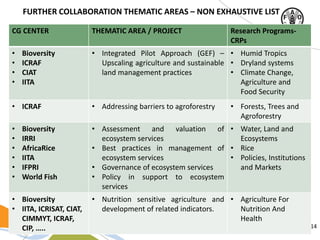
CG CENTER THEMATIC AREA / PROJECT Research Programs-
CRPs
• Bioversity
• ICRAF
• CIAT
• IITA
• Integrated Pilot Approach (GEF) –
Upscaling agriculture and sustainable
land management practices
• Humid Tropics
• Dryland systems
• Climate Change,
Agriculture and
Food Security
• ICRAF • Addressing barriers to agroforestry • Forests, Trees and
Agroforestry
• Bioversity
• IRRI
• AfricaRice
• IITA
• IFPRI
• World Fish
• Assessment and valuation of
ecosystem services
• Best practices in management of
ecosystem services
• Governance of ecosystem services
• Policy in support to ecosystem
services
• Water, Land and
Ecosystems
• Rice
• Policies, Institutions
and Markets
• Bioversity
• IITA, ICRISAT, CIAT,
CIMMYT, ICRAF,
CIP, …..
• Nutrition sensitive agriculture and
development of related indicators.
• Agriculture For
Nutrition And
Health
FURTHER COLLABORATION THEMATIC AREAS – NON EXHAUSTIVE LIST
15
Thank you !

FAO SO2 - Clayton Campanhola

  • 1.
    SO2: Make Agriculture,Forestry and Fisheries More Productive and Sustainable Clayton Campanhola Strategic Objective Coordinator 12th Meeting – CGIAR/ ISPC Sep 2015, Rome
  • 2.
    Indicators provide clearline of sight to the results
  • 4.
    challenge of increasedproduction requires innovative approaches  benefit people and conserve the natural resource base what is new/different about SO2? • multi-disciplinary approach, working across all sectors to ensure sustainability • the integration of the three “pillars” of sustainable development (environmental, economic and social); and • ways to generate the needed wide-scale transition to more sustainable practices/ adoption of more sustainable practices. Context and Rationale: Why SO2?
  • 5.
    5 Building a CommonVision for Sustainable Food and Agriculture Enhance the efficiency of resource use Conserve, protect, and enhance natural resources Improve & protect livelihoods and human well-being Enhance the resilience of people, communities and ecosystems Promote and improve effective governance
  • 6.
    6 SFA builds uponthe extensive experience of FAO in terms of sustainability Crops Livestock Forestry Fisheries Aquaculture Save and Grow: Sustainable Crop Production Intensification Global Agenda for Sustainable Livestock Sustainable Forest Management (SFM) Code of Conduct for Responsible Fisheries (CCRF) Ecosystem Approach to Fisheries (EAF) Ecosystem Approach to Aquaculture (EAA) • Conservation and Sustainable Use of Biodiversity and Genetic Resources • Energy-Smart Food for People and Climate (ESF) • Sustainable diets • Resilient livelihoods • Climate Smart Agriculture (CSA) and FAO-Adapt • Coping with water scarcity • Global Soil Partnership (GSP) • Sustainable Land Management (SLM) • Landscape initiative (in development) Thematicandcross- sectoralapproaches Sectoral approaches
  • 7.
    Delivery Mechanisms OutcomesSDGs SDG 2. End hunger, achieve Food Security and Nutrition, promote sustainable agriculture Planning, Monitoring & Evaluation, Lesson learning, ex ante/ex post, communicating results Outputs SDG 13. Take urgent action to address climate change SDG 14. Conserve and sustainably use oceans, seas and marine resources for sustainable development CPF CPF CPFCPF CPF CPF 2.1 Innovative practices adopted 2.3 International Instruments & mechanisms implemented 2.2 Governance strengthened 2.4 Increased evidence-based decision making CPF CPF CPF CPF CPF CPF SO2 IMPACT PATHWAYS SDG 15. Protect, restore and promote sustainable use of terrestrial ecosystems, sustainably manage forests, combat desertification, and ... CRPs All 16
  • 8.
    COLLABORATION WITH CGIARRESEARCH CENTERS IN SUPPORT TO STRATEGIC OBJECTIVE 2
  • 9.
    9 CURRENT COLLABORATION –NON EXHAUSTIVE LIST Climate Smart Agriculture CG CENTER THEMATIC AREA • CIMMYT • Suitability of Leguminous Cover and Forage Crops for Southern African and Vietnamese Production Systems • ICRAF • Support to implementation of MICCA pilot projects in Kenya and Tanzania • Provide scientific evidence of productivity and climate benefits of locally relevant agricultural practices • CIAT - CCAFS • Co-lead the Knowledge Action Group of the Global Alliance for Climate Smart Agriculture (KAG-GACSA)
  • 10.
    10 Ecosystem Services andBiodiversity CG CENTER THEMATIC AREA • IRRI • Evaluation of the impact of the eco-agri-food systems complex on human health and well/being: rice production • ICARDA • ILRI • New SDGs and providing information on related indicators
  • 11.
    11 Efficient Resource Use– Sustainable Agricultural Intensification CG CENTER THEMATIC AREA/PROJECTS • Bioversity • Mainstreaming biodiversity conservation and sustainable use for improved human nutrition and well-being • ICARDA • Sustainable Intensification and diversification of agriculture in the Near- East and North-Africa in support to Regional Water Scarcity Initiative • IITA • Disposal of Persistent Organic Pollutants (POPs) and obsolete pesticides and strengthening life-cycle management of pesticides in Benin • IWMI • More effective and sustainable investments in Water for poverty Reduction in Africa
  • 12.
    12 • Climate SmartAgriculture  Collaboration with ICRAF and CIAT-CCAFS brought more science to project implementation  Collaboration provided FAO with more evidence to inform decision makers  Collaboration complemented FAO expertise with CIAT-CCAFS research  Collaboration helped ICRAF and CIAT-CCAFS develop a major research program around Green House Gas (GHG) measurements and another smaller initiative on Climate Smart Agriculture RESULTS ACHIEVED IN COLLABORATION WITH CGIAR
  • 13.
    13 • Save &Grow in practice: Maize, Rice and Wheat  Collaboration with CIMMYT, IRRI and ICARDA RESULTS ACHIEVED IN COLLABORATION WITH CGIAR
  • 14.
    14 CG CENTER THEMATICAREA / PROJECT Research Programs- CRPs • Bioversity • ICRAF • CIAT • IITA • Integrated Pilot Approach (GEF) – Upscaling agriculture and sustainable land management practices • Humid Tropics • Dryland systems • Climate Change, Agriculture and Food Security • ICRAF • Addressing barriers to agroforestry • Forests, Trees and Agroforestry • Bioversity • IRRI • AfricaRice • IITA • IFPRI • World Fish • Assessment and valuation of ecosystem services • Best practices in management of ecosystem services • Governance of ecosystem services • Policy in support to ecosystem services • Water, Land and Ecosystems • Rice • Policies, Institutions and Markets • Bioversity • IITA, ICRISAT, CIAT, CIMMYT, ICRAF, CIP, ….. • Nutrition sensitive agriculture and development of related indicators. • Agriculture For Nutrition And Health FURTHER COLLABORATION THEMATIC AREAS – NON EXHAUSTIVE LIST
  • 15.