Feasibility of Low Emissions Development
Interventions in the Kenyan Livestock Sector
Polly Ericksen (SLS program leader) and Todd Crane
ILRI
SAIRLASecondNationalLearningAllianceWorkshop
ILRI,AddisAbaba,23November2017
Why LED and SI?
Livestock production is significant source of
emissions from agriculture
• High intensity of emissions per unit of product
• Countries have now committed to reductions in NDCs
Low productivity of livestock in much of Africa both
an opportunity and a concern
• Improving productivity will reduce emissions
intensities
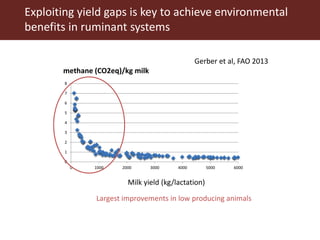
Exploiting yield gaps is key to achieve environmental
benefits in ruminant systems
0
1
2
3
4
5
6
7
8
0 1000 2000 3000 4000 5000 6000
methane (CO2eq)/kg milk
Milk yield (kg/lactation)
Largest improvements in low producing animals
Gerber et al, FAO 2013
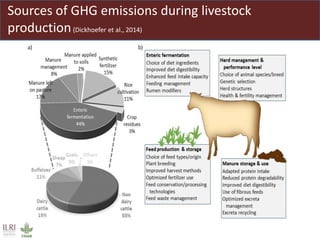
Sources of GHG emissions during livestock
production(Dickhoefer et al., 2014)
Interventions to reduce emissions
intensities
• Improvements in Feed Quality to increase
productivity
• Supplemental fodder from improved forage
species – Mixed crop-livestock
• Supplemental feeding with concentrates –dairy
• Managed grazing – extensive pastoral
Interventions to reduce emissions
intensities
• Manure management
• Biodigesters for methane capture – (zero grazing)
dairy
• Manure storage in covered heaps – mixed crop-
livestock
Interventions to reduce emissions
intensities
• Improved animal husbandry
• Reduce chronic disease burden of intestinal
parasites – all systems
• Reduce age at slaughter – pastoral systems
Technical Mitigation Potential
• Improved feed quality: Opio et al (2016) suggest
26-28% reductions in intensities for lactating
cattle;
• Concentrates 20-27% reductions in dairy (Opio)
• Managed grazing: similar to improved feed
quality (?)
Technical Mitigation Potential
• Biodigesters – can avoid 60 to 80% of methane
emissions
• Manure storage – highly dependent on
management but can reduce N2O and methane
emissions significantly
• Reduce parasite burden – 10% (Kenyon et al
Scotland)
• AI – one estimate of 24%
Cross Cutting Themes
• Degree of market orientation is major
precondition for upgrading
• Even with market orientation, low milk prices
inhibit investment in upgrading
• Small land size as major limitation
• Low trust and accountability of input services
Improved Forages
• Barriers
– Low availability of land (B) – paddocks?
– Diversified cropping strategies (M, I?)
– Low accessibility of improved planting material (M)
• Potential incentives?
– Field trials to improve farmer awareness
– Investments to stimulate fodder seed
– Financial evaluation of specialization vs diversification
• NB: AI and dairy meal become more attractive
when basal diet improves
Biodigestors
• Barriers
– High upfront cost (M)
– Maintenance requirements (I)
– Slurry transport (B)
• Incentives
– Household energy source (direct benefit)
– Improved household health (direct benefit)
– Farmer innovation on slurry transport
– ?
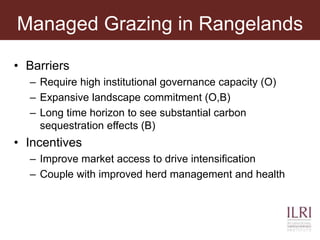
Managed Grazing in Rangelands
• Barriers
– Require high institutional governance capacity (O)
– Expansive landscape commitment (O,B)
– Long time horizon to see substantial carbon
sequestration effects (B)
• Incentives
– Improve market access to drive intensification
– Couple with improved herd management and health
Donor acknowledgement
• Funded from USAID through CCAFS
This presentation is licensed for use under the Creative Commons Attribution 4.0 International Licence.
better lives through livestock
ilri.org
ILRI thanks all donors and organizations which globally support its work through their contributions to
the CGIAR system

Feasibility of low emissions development interventions in the Kenyan livestock sector

  • 1.
    Feasibility of LowEmissions Development Interventions in the Kenyan Livestock Sector Polly Ericksen (SLS program leader) and Todd Crane ILRI SAIRLASecondNationalLearningAllianceWorkshop ILRI,AddisAbaba,23November2017
  • 2.
    Why LED andSI? Livestock production is significant source of emissions from agriculture • High intensity of emissions per unit of product • Countries have now committed to reductions in NDCs Low productivity of livestock in much of Africa both an opportunity and a concern • Improving productivity will reduce emissions intensities
  • 3.
    Exploiting yield gapsis key to achieve environmental benefits in ruminant systems 0 1 2 3 4 5 6 7 8 0 1000 2000 3000 4000 5000 6000 methane (CO2eq)/kg milk Milk yield (kg/lactation) Largest improvements in low producing animals Gerber et al, FAO 2013
  • 4.
    Sources of GHGemissions during livestock production(Dickhoefer et al., 2014)
  • 5.
    Interventions to reduceemissions intensities • Improvements in Feed Quality to increase productivity • Supplemental fodder from improved forage species – Mixed crop-livestock • Supplemental feeding with concentrates –dairy • Managed grazing – extensive pastoral
  • 6.
    Interventions to reduceemissions intensities • Manure management • Biodigesters for methane capture – (zero grazing) dairy • Manure storage in covered heaps – mixed crop- livestock
  • 7.
    Interventions to reduceemissions intensities • Improved animal husbandry • Reduce chronic disease burden of intestinal parasites – all systems • Reduce age at slaughter – pastoral systems
  • 8.
    Technical Mitigation Potential •Improved feed quality: Opio et al (2016) suggest 26-28% reductions in intensities for lactating cattle; • Concentrates 20-27% reductions in dairy (Opio) • Managed grazing: similar to improved feed quality (?)
  • 9.
    Technical Mitigation Potential •Biodigesters – can avoid 60 to 80% of methane emissions • Manure storage – highly dependent on management but can reduce N2O and methane emissions significantly • Reduce parasite burden – 10% (Kenyon et al Scotland) • AI – one estimate of 24%
  • 10.
    Cross Cutting Themes •Degree of market orientation is major precondition for upgrading • Even with market orientation, low milk prices inhibit investment in upgrading • Small land size as major limitation • Low trust and accountability of input services
  • 11.
    Improved Forages • Barriers –Low availability of land (B) – paddocks? – Diversified cropping strategies (M, I?) – Low accessibility of improved planting material (M) • Potential incentives? – Field trials to improve farmer awareness – Investments to stimulate fodder seed – Financial evaluation of specialization vs diversification • NB: AI and dairy meal become more attractive when basal diet improves
  • 12.
    Biodigestors • Barriers – Highupfront cost (M) – Maintenance requirements (I) – Slurry transport (B) • Incentives – Household energy source (direct benefit) – Improved household health (direct benefit) – Farmer innovation on slurry transport – ?
  • 13.
    Managed Grazing inRangelands • Barriers – Require high institutional governance capacity (O) – Expansive landscape commitment (O,B) – Long time horizon to see substantial carbon sequestration effects (B) • Incentives – Improve market access to drive intensification – Couple with improved herd management and health
  • 14.
    Donor acknowledgement • Fundedfrom USAID through CCAFS
  • 15.
    This presentation islicensed for use under the Creative Commons Attribution 4.0 International Licence. better lives through livestock ilri.org ILRI thanks all donors and organizations which globally support its work through their contributions to the CGIAR system

Editor's Notes

  • #2 There MUST be a CGIAR logo or a CRP logo. You can copy and paste the logo you need from the final slide of this presentation. Then you can delete that final slide   To replace a photo above, copy and paste this link in your browser: http://www.flickr.com/photos/ilri/sets/72157632057087650/detail/   Find a photo you like and the right size, copy and paste it in the block above.