1 | P a g e
A PROJECT REPORT
ON
Induced Draft Fans & False Air Calculation
BY
AKASH AGRAWAL
RAJ RANJAN SINGH
2014A1PS499H
2014A1PS469H
Prepared in fulfilment of
Practice School-I Course No.
BITS C221
AT
RAWAN CEMENT WORKS RAIPUR
A Practice School-1 of
BIRLA INSTITUTE OF TECHNOLOGY & SCIENCE,
PILANI
(MAY-JULY,2016)
CHEMICAL
CHEMICAL
2 | P a g e
Acknowledgement
We are thankful to the Department Head, Section Head and several Engineers of
our unit who gave all their support and guided us in completion of our project work.
They have been very kind and patient while explaining the concepts and clearing
our doubts.
In particular we are indebted to our Instructor, Dr.Sunil Kumar Dubey whose words
of encouragement and helpful suggestions from time to time, kept us motivated.
Special thanks to our HOD, Mr. G.S. Virdi and our mentor Mr. M.K.Panda, without
whom this project would not have been completed.
We are also grateful to HR Department and all staffs of Rawan Cement Works for
organizing multiple learning sessions and providing us the required basic facilities
and support.
And finally we would like to thank our parents for their blessings that worked
beyond science in successful completion of our project effectively.
3 | P a g e
Table of Contents
1. Pre-Heater……………………………………………..5
2. Fans……………………………………………………….6
3. Types……………………………………………………..6
3.1 Centrifugal
3.1.1 Centrifugal Fan Types
3.1.2 Axial
4. Basic Fan Laws…………………………………….….8
4.1 Effect of Fan Speed
4.2 Effect of Air Density
4.3 Effect of Diameter
5. Basic Terminologies…………………………….….9
6. Equipments……………………………………….…..9
6.1 Pitot Tube
6.2 Manometer
6.3 Thermocouple
6.4 Gas Analyzer
7. Calculations Involved…………………..………..11
7.1 Density
7.2 Velocity
7.3 Volumetric air Flow
7.4 Dynamic Pressure
7.5 Power
7.6 Efficiency
8. Improving Fan Performance ………………….14
9. False Air Calculation……………………………….17
10. Department wise Recommendations……..22
10.1 Raw Mill
10.2 Thermal Power Plant
10.3 DM Plant
10.4 Pre-heater Tower
10.5 Equipment Yard
11. References………………………………………………26
4 | P a g e
Abstract
The title of this project report is “Induced Draft Fans and False air Calculation”. The
purpose of our report is to learn about different industrial fans, factors affecting fans'
performance, false air circulating in ducts, ways to minimize it and its impact on
clinker production. The procedure involved taking flow measurements from
different ducts.
Apart from our project work, this report also emphasizes on current plant problems,
encountered during our various department visits and interaction. It ends with
recommendations solely based on our self-understanding.
5 | P a g e
1. PRE-HEATER
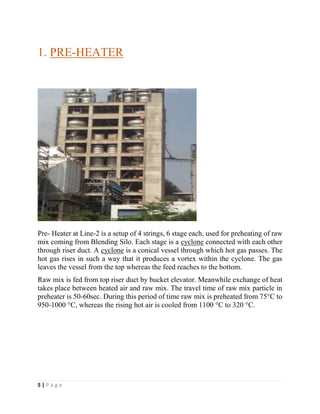
Pre- Heater at Line-2 is a setup of 4 strings, 6 stage each, used for preheating of raw
mix coming from Blending Silo. Each stage is a cyclone connected with each other
through riser duct. A cyclone is a conical vessel through which hot gas passes. The
hot gas rises in such a way that it produces a vortex within the cyclone. The gas
leaves the vessel from the top whereas the feed reaches to the bottom.
Raw mix is fed from top riser duct by bucket elevator. Meanwhile exchange of heat
takes place between heated air and raw mix. The travel time of raw mix particle in
preheater is 50-60sec. During this period of time raw mix is preheated from 75°C to
950-1000 °C, whereas the rising hot air is cooled from 1100 °C to 320 °C.
6 | P a g e
2. FANS
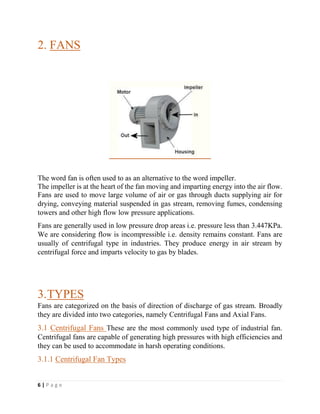
The word fan is often used to as an alternative to the word impeller.
The impeller is at the heart of the fan moving and imparting energy into the air flow.
Fans are used to move large volume of air or gas through ducts supplying air for
drying, conveying material suspended in gas stream, removing fumes, condensing
towers and other high flow low pressure applications.
Fans are generally used in low pressure drop areas i.e. pressure less than 3.447KPa.
We are considering flow is incompressible i.e. density remains constant. Fans are
usually of centrifugal type in industries. They produce energy in air stream by
centrifugal force and imparts velocity to gas by blades.
3.TYPES
Fans are categorized on the basis of direction of discharge of gas stream. Broadly
they are divided into two categories, namely Centrifugal Fans and Axial Fans.
3.1 Centrifugal Fans These are the most commonly used type of industrial fan.
Centrifugal fans are capable of generating high pressures with high efficiencies and
they can be used to accommodate in harsh operating conditions.
3.1.1 Centrifugal Fan Types
7 | P a g e
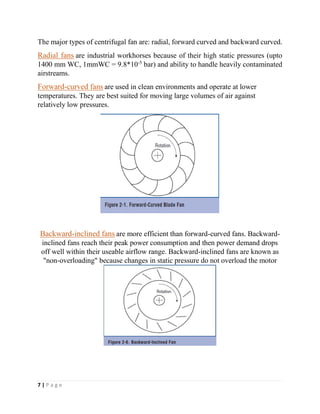
The major types of centrifugal fan are: radial, forward curved and backward curved.
Radial fans are industrial workhorses because of their high static pressures (upto
1400 mm WC, 1mmWC = 9.8*10-5
bar) and ability to handle heavily contaminated
airstreams.
Forward-curved fans are used in clean environments and operate at lower
temperatures. They are best suited for moving large volumes of air against
relatively low pressures.
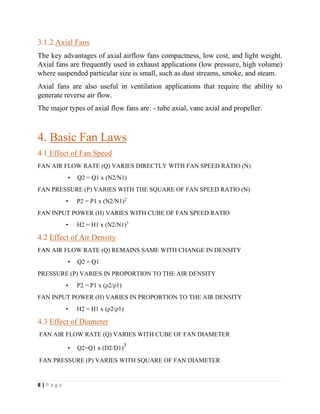
Backward-inclined fans are more efficient than forward-curved fans. Backward-
inclined fans reach their peak power consumption and then power demand drops
off well within their useable airflow range. Backward-inclined fans are known as
"non-overloading" because changes in static pressure do not overload the motor
8 | P a g e
3.1.2 Axial Fans
The key advantages of axial airflow fans compactness, low cost, and light weight.
Axial fans are frequently used in exhaust applications (low pressure, high volume)
where suspended particular size is small, such as dust streams, smoke, and steam.
Axial fans are also useful in ventilation applications that require the ability to
generate reverse air flow.
The major types of axial flow fans are: - tube axial, vane axial and propeller.
4. Basic Fan Laws
4.1 Effect of Fan Speed
FAN AIR FLOW RATE (Q) VARIES DIRECTLY WITH FAN SPEED RATIO (N)
• Q2 = Q1 x (N2/N1)
FAN PRESSURE (P) VARIES WITH THE SQUARE OF FAN SPEED RATIO (N)
• P2 = P1 x (N2/N1)2
FAN INPUT POWER (H) VARIES WITH CUBE OF FAN SPEED RATIO
• H2 = H1 x (N2/N1)3
4.2 Effect of Air Density
FAN AIR FLOW RATE (Q) REMAINS SAME WITH CHANGE IN DENSITY
• Q2 = Q1
PRESSURE (P) VARIES IN PROPORTION TO THE AIR DENSITY
• P2 = P1 x (ρ2/ρ1)
FAN INPUT POWER (H) VARIES IN PROPORTION TO THE AIR DENSITY
• H2 = H1 x (ρ2/ρ1)
4.3 Effect of Diameter
FAN AIR FLOW RATE (Q) VARIES WITH CUBE OF FAN DIAMETER
• Q2=Q1 x (D2/D1)3
FAN PRESSURE (P) VARIES WITH SQUARE OF FAN DIAMETER
9 | P a g e
• P2=P1 x (D2/D1)
2
FAN INPUT POWER (H) VARIES WITH FIFTH POWER OF FAN DIAMETER
• H2=H1 x (D2/D1)
5
5. Basic Terminologies
Static Pressure P(s) – The pressure exerted by fluid if it was not moving at any point
from all directions. When a fan blows air through a duct, the air counters resistance
from this pressure which is known as static pressure. It is also known as 'wall
pressure'.
Dynamic Pressure P(d) – The pressure exerted by fluid due to its motion or in other
words, kinetic energy per unit volume of a fluid particle.
Total pressure P(t) – It is sum of static and dynamic pressure. Dynamic and static
pressure can change as the air flows though different size ducts with changing
velocity but total pressure stays constant, on ignoring the frictional losses.
6. Equipments
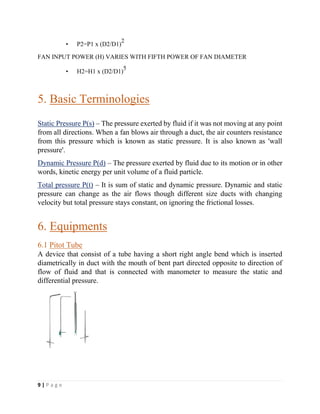
6.1 Pitot Tube
A device that consist of a tube having a short right angle bend which is inserted
diametrically in duct with the mouth of bent part directed opposite to direction of
flow of fluid and that is connected with manometer to measure the static and
differential pressure.
10 | P a g e
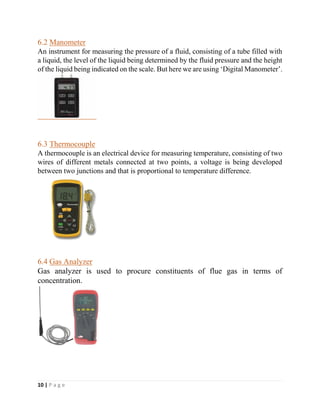
6.2 Manometer
An instrument for measuring the pressure of a fluid, consisting of a tube filled with
a liquid, the level of the liquid being determined by the fluid pressure and the height
of the liquid being indicated on the scale. But here we are using ‘Digital Manometer’.
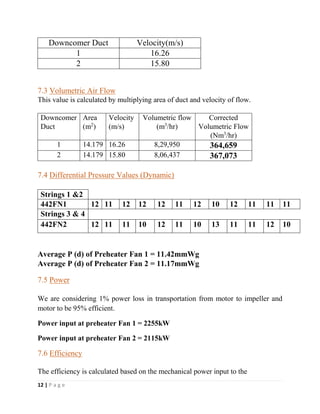
6.3 Thermocouple
A thermocouple is an electrical device for measuring temperature, consisting of two
wires of different metals connected at two points, a voltage is being developed
between two junctions and that is proportional to temperature difference.
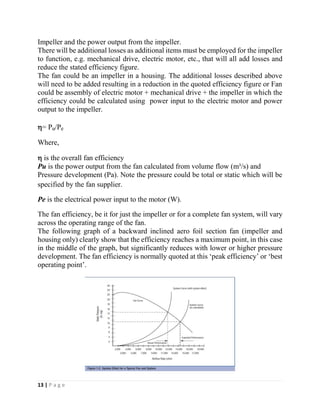
6.4 Gas Analyzer
Gas analyzer is used to procure constituents of flue gas in terms of
concentration.
11 | P a g e
7. Calculations Involved
7.1 Density
Here we use two types of density, given normal density [normal] and corrected
density [corrected]. Normal density is calculated by analyzing flue gas.
Gas % Mole
Fraction
Density at STP
CO2 28 0.201 1.964
N2 67.29 0.760 1.25
O2 3.90 0.037 1.428
H2O 0 0 0.80
CO Negligible 0 1.25
Density of mixture= 0.201*1.964 + 0.760*1.25 + 0.037*1.428
= 1.39 Kg/Nm^3.
Corrected density
corrected = normal * Tc * Pc
Where Tc = 273/ (273+T (flue gas))
Pc = (9986 + P(s))/10330
Duct Density(kg/m3
) Tc Pc Corrected Density(kg/m3
)
1 1.39 0.48 0.91 0.607
2 1.39 0.50 0.91 0.632
7.2 Velocity
Velocity of air in duct is calculated by
= ½*corrected*V2
= Avg.P(d)
Vel = K*((2*9.81*avP(d))/(s))0.5
Where k is pitot constant provided by manufacturer, here its 0.8490
12 | P a g e
Downcomer Duct Velocity(m/s)
1 16.26
2 15.80
7.3 Volumetric Air Flow
This value is calculated by multiplying area of duct and velocity of flow.
Downcomer
Duct
Area
(m2
)
Velocity
(m/s)
Volumetric flow
(m3
/hr)
Corrected
Volumetric Flow
(Nm3
/hr)
1 14.179 16.26 8,29,950 364,659
2 14.179 15.80 8,06,437 367,073
7.4 Differential Pressure Values (Dynamic)
Average P (d) of Preheater Fan 1 = 11.42mmWg
Average P (d) of Preheater Fan 2 = 11.17mmWg
7.5 Power
We are considering 1% power loss in transportation from motor to impeller and
motor to be 95% efficient.
Power input at preheater Fan 1 = 2255kW
Power input at preheater Fan 2 = 2115kW
7.6 Efficiency
The efficiency is calculated based on the mechanical power input to the
Strings 1 &2
442FN1 12 11 12 12 12 11 12 10 12 11 11 11
Strings 3 & 4
442FN2 12 11 11 10 12 11 10 13 11 11 12 10
13 | P a g e
Impeller and the power output from the impeller.
There will be additional losses as additional items must be employed for the impeller
to function, e.g. mechanical drive, electric motor, etc., that will all add losses and
reduce the stated efficiency figure.
The fan could be an impeller in a housing. The additional losses described above
will need to be added resulting in a reduction in the quoted efficiency figure or Fan
could be assembly of electric motor + mechanical drive + the impeller in which the
efficiency could be calculated using power input to the electric motor and power
output to the impeller.
= Pu/Pe
Where,
 is the overall fan efficiency
Pu is the power output from the fan calculated from volume flow (m³/s) and
Pressure development (Pa). Note the pressure could be total or static which will be
specified by the fan supplier.
Pe is the electrical power input to the motor (W).
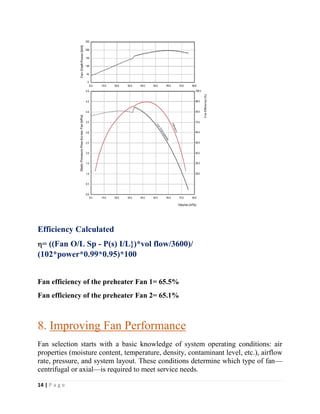
The fan efficiency, be it for just the impeller or for a complete fan system, will vary
across the operating range of the fan.
The following graph of a backward inclined aero foil section fan (impeller and
housing only) clearly show that the efficiency reaches a maximum point, in this case
in the middle of the graph, but significantly reduces with lower or higher pressure
development. The fan efficiency is normally quoted at this ‘peak efficiency’ or ‘best
operating point’.
14 | P a g e
Efficiency Calculated
= ((Fan O/L Sp - P(s) I/L})*vol flow/3600)/
(102*power*0.99*0.95)*100
Fan efficiency of the preheater Fan 1= 65.5%
Fan efficiency of the preheater Fan 2= 65.1%
8. Improving Fan Performance
Fan selection starts with a basic knowledge of system operating conditions: air
properties (moisture content, temperature, density, contaminant level, etc.), airflow
rate, pressure, and system layout. These conditions determine which type of fan—
centrifugal or axial—is required to meet service needs.
15 | P a g e
Axial fans move air along the direction of the fan’s rotating axis, much like a
0propeller. Axial fans tend to be light and compact. Centrifugal fans accelerate air
radially, changing the direction of the airflow. They are sturdy, quiet, reliable, and
capable of operating over a wide range of conditions. Many factors are used to
determine whether axial or centrifugal fans are more appropriate for certain
applications.
After deciding which fan type is appropriate, the right size must be determined. Fans
are usually selected on a “best-fit” basis rather than designed specifically for a
particular application. A fan is chosen from a wide range of models based on its
ability to meet the anticipated demands of a system. Fans have two mutually
dependent outputs: airflow and pressure. The variability of these outputs and other
factors, such as efficiency, operating life, and maintenance, complicate the fan
selection process.
However, purchasing an oversized fan/motor assembly creates operating problems
such as excess airflow noise and inefficient fan operation.
The incremental energy costs of operating oversized fans can be significant.
Engineers often include a margin of safety in sizing fans to compensate for
uncertainties in the design process. Anticipated system capacity expansions and
potential fouling effects add to the tendency to specify fans that are one size greater
than those that meet the system requirements.
The problems that accompany the selection of oversized fans are outlined below.
Unfortunately, many of the costs and operating problems that result from oversized
fans are overlooked during the equipment specification process. The problems that
accompany the selection of oversized fans are outlined below.
High Capital Costs. Large fans typically cost more than small ones, and large fans
also require larger and more costly motors. Consequently, specifying oversized fans
results in higher-than-necessary initial system costs.
High Energy Costs. Oversized fans increase system operating costs both in terms
of energy and maintenance requirements. Higher energy costs can be attributed to
two basic causes. The fan may operate inefficiently because the system curve
intersects the fan curve at a point that is not near
The fan’s best efficiency point (BEP). Alternately, even if an oversized fan operates
near its BEP, by generating more airflow than necessary, it uses
16 | P a g e
More energy and increases stress on the system.
Poor Performance. Oversized fans tend to operate with one or more of the
indications of poor performance including noisy, inefficient, or unstable fan
operation. High airflow noise often results from the excess flow energy imparted to
the airstream. In addition, oversized fans are more likely to operate in their stall
regions, which can result in surging flow and vibrations that damage the fans and
degrade fan systems. Indications of stall include pulsing airflow noise, system ducts
that seem to “breathe” in response to the pressure variations, and vibrating fan and
duct supports.
Frequent Maintenance. When oversized fans operate away from their BEP, they
may experience cyclic bearing and drivetrain stresses. This is particularly applicable
when a fan operates in its stall region, which is typically on the left side of the fan
performance curve. Also, cyclic bearing loads tend to increase the stress on other
drivetrain components such as belts and motors. Oversized fans also tend to create
high system pressures, which increase stress on the ductwork and promote leakage.
High Noise/Vibration Levels. Fans that operate inefficiently tend to create high
airborne and structure-borne vibration levels. Airborne vibrations are often
perceptible as noise, while structure borne vibrations are felt by the system
equipment, ductwork, and duct supports. Oversized fans often create high airflow
noise. Workers acclimate to ambient acoustic levels and do not express discomfort.
However, high noise levels promote fatigue, which reduces worker productivity.
High levels of structure-borne vibrations can create problems in welds and
mechanical joints over time. High vibration levels create fatigue loads that
eventually crack welds and loosen fittings. In severe cases, the integrity of the system
suffers and leaks occur further degrading system efficiency. The location of the
operating point on the fan curve can provide an indication of how appropriately the
fan is sized. If possible, compare the pressure required by the end uses to the pressure
generated by the fan. If the fan is oversized, it will generate more total pressure for
the same airflow than a correctly sized fan.
17 | P a g e
9. False Air Calculation
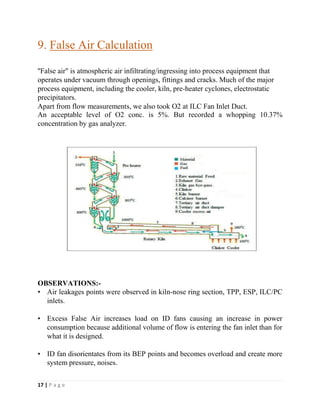
''False air" is atmospheric air infiltrating/ingressing into process equipment that
operates under vacuum through openings, fittings and cracks. Much of the major
process equipment, including the cooler, kiln, pre-heater cyclones, electrostatic
precipitators.
Apart from flow measurements, we also took O2 at ILC Fan Inlet Duct.
An acceptable level of O2 conc. is 5%. But recorded a whopping 10.37%
concentration by gas analyzer.
OBSERVATIONS:-
• Air leakages points were observed in kiln-nose ring section, TPP, ESP, ILC/PC
inlets.
• Excess False Air increases load on ID fans causing an increase in power
consumption because additional volume of flow is entering the fan inlet than for
what it is designed.
• ID fan disorientates from its BEP points and becomes overload and create more
system pressure, noises.
18 | P a g e
• Excess False Air, particularly at the kiln and preheaters, where fuel is consumed
for heat generation, will lead to artificially exaggerated fuel consumption.
• This has directly impact on thermal efficiency.
• Daily maintenance is an option. Leaks found can be fixed immediately.
• A leak detection survey should be conducted immediately if O2 conc. at top
cyclone reaches above 3%.
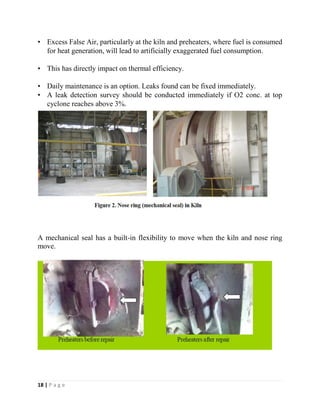
A mechanical seal has a built-in flexibility to move when the kiln and nose ring
move.
19 | P a g e
Results:-
The financial and environmental benefits of the implementation of these measures
can be measured by comparing a mass balance before implementation (i.e. indicating
the fuel and thus the potential savings) with a mass balance after implementation
(i.e. indicating the actual fuel).
Heat Balance:-
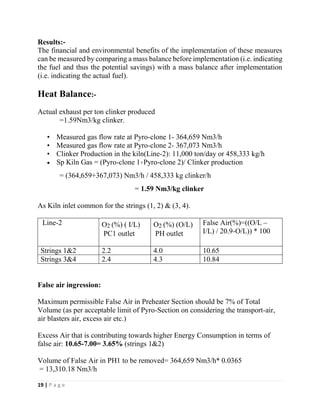
Actual exhaust per ton clinker produced
=1.59Nm3/kg clinker.
• Measured gas flow rate at Pyro-clone 1- 364,659 Nm3/h
• Measured gas flow rate at Pyro-clone 2- 367,073 Nm3/h
• Clinker Production in the kiln(Line-2): 11,000 ton/day or 458,333 kg/h
 Sp Kiln Gas = (Pyro-clone 1+Pyro-clone 2)/ Clinker production
= (364,659+367,073) Nm3/h / 458,333 kg clinker/h
= 1.59 Nm3/kg clinker
As Kiln inlet common for the strings (1, 2) & (3, 4).
Line-2 O2 (%) ( I/L)
PC1 outlet
O2 (%) (O/L)
PH outlet
False Air(%)=((O/L –
I/L) / 20.9-O/L)) * 100
Strings 1&2 2.2 4.0 10.65
Strings 3&4 2.4 4.3 10.84
False air ingression:
Maximum permissible False Air in Preheater Section should be 7% of Total
Volume (as per acceptable limit of Pyro-Section on considering the transport-air,
air blasters air, excess air etc.)
Excess Air that is contributing towards higher Energy Consumption in terms of
false air: 10.65-7.00= 3.65% (strings 1&2)
Volume of False Air in PH1 to be removed= 364,659 Nm3/h* 0.0365
= 13,310.18 Nm3/h
20 | P a g e
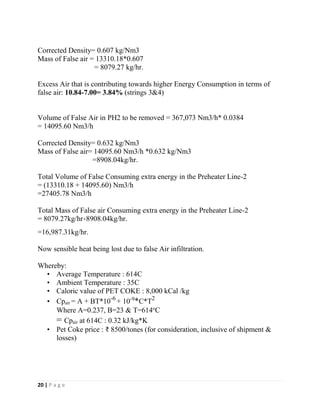
Corrected Density= 0.607 kg/Nm3
Mass of False air = 13310.18*0.607
= 8079.27 kg/hr.
Excess Air that is contributing towards higher Energy Consumption in terms of
false air: 10.84-7.00= 3.84% (strings 3&4)
Volume of False Air in PH2 to be removed = 367,073 Nm3/h* 0.0384
= 14095.60 Nm3/h
Corrected Density= 0.632 kg/Nm3
Mass of False air= 14095.60 Nm3/h *0.632 kg/Nm3
=8908.04kg/hr.
Total Volume of False Consuming extra energy in the Preheater Line-2
= (13310.18 + 14095.60) Nm3/h
=27405.78 Nm3/h
Total Mass of False air Consuming extra energy in the Preheater Line-2
= 8079.27kg/hr+8908.04kg/hr.
=16,987.31kg/hr.
Now sensible heat being lost due to false Air infiltration.
Whereby:
• Average Temperature : 614C
• Ambient Temperature : 35C
• Caloric value of PET COKE : 8,000 kCal /kg
• Cpair = A + BT*10-6
+ 10-9
*C*T2
Where A=0.237, B=23 & T=614o
C
= Cpair at 614C : 0.32 kJ/kg*K
• Pet Coke price : ₹ 8500/tones (for consideration, inclusive of shipment &
losses)
21 | P a g e
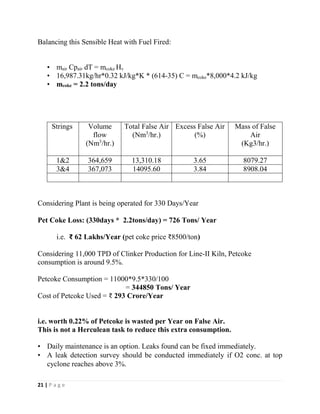
Balancing this Sensible Heat with Fuel Fired:
• mair Cpair dT = mcoke Hv
• 16,987.31kg/hr*0.32 kJ/kg*K * (614-35) C = mcoke*8,000*4.2 kJ/kg
• mcoke = 2.2 tons/day
Strings Volume
flow
(Nm3
/hr.)
Total False Air
(Nm3
/hr.)
Excess False Air
(%)
Mass of False
Air
(Kg3/hr.)
1&2 364,659 13,310.18 3.65 8079.27
3&4 367,073 14095.60 3.84 8908.04
Considering Plant is being operated for 330 Days/Year
Pet Coke Loss: (330days * 2.2tons/day) = 726 Tons/ Year
i.e. ₹ 62 Lakhs/Year (pet coke price ₹8500/ton)
Considering 11,000 TPD of Clinker Production for Line-II Kiln, Petcoke
consumption is around 9.5%.
Petcoke Consumption = 11000*9.5*330/100
= 344850 Tons/ Year
Cost of Petcoke Used = ₹ 293 Crore/Year
i.e. worth 0.22% of Petcoke is wasted per Year on False Air.
This is not a Herculean task to reduce this extra consumption.
• Daily maintenance is an option. Leaks found can be fixed immediately.
• A leak detection survey should be conducted immediately if O2 conc. at top
cyclone reaches above 3%.
22 | P a g e
• Payback time is less.
Financial benefits (potential)
• Investment: purchasing Equipments for the mechanical seal and installation
costs.
• Can purchase VFDs from the savings.
• Plant Equipments maintenance.
• CSR contribution.
Environmental benefits (potential)
• Annual pet coke savings: 726.0 tons
• Annual Green House Gas (CO2) emission reduction: 726.0*3= 2178.0 tons.
10. Department wise Recommendations
In this section we have tried to highlight few points whi1ch were observed during
our various department visits and information collected through interaction.
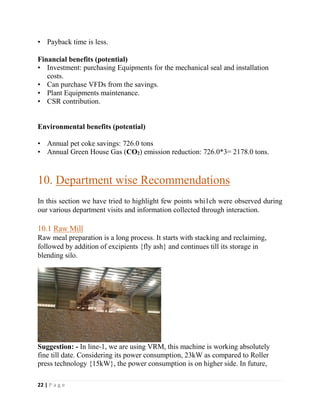
10.1 Raw Mill
Raw meal preparation is a long process. It starts with stacking and reclaiming,
followed by addition of excipients {fly ash} and continues till its storage in
blending silo.
Suggestion: - In line-1, we are using VRM, this machine is working absolutely
fine till date. Considering its power consumption, 23kW as compared to Roller
press technology {15kW}, the power consumption is on higher side. In future,
23 | P a g e
electricity production will definitely be more costly, why we don’t switch to latest
technology. Eventually, it might take few years to compensate for switching cost.
10.2 Thermal Power Plant
In this department, we have learned that how electricity is produced for factory and
township with two sets of turbine. The only objective is to run turbine at 3000rpm
by impact of dry steam. And to carry out same, a sequential process is followed.
Problem: - Recently, Line 1 unit was intentionally shut down but at time of start-
up, boiler tube cracked.
Interpretation: - Boiler tubes have become thin, occasional puncture forces to shut
down. Again it takes lots of fuel to light up [reach up to 550'C].
Solution: - Thickness of tubes should be regularly checked. Identification of old
tubes and its replacement would solve the problem.
Apart from this, a back turbine can be installed which could utilize low pressure
steam and generate few Megawatts of energy. Although its feasibility can only be
analyzed by experts.
24 | P a g e
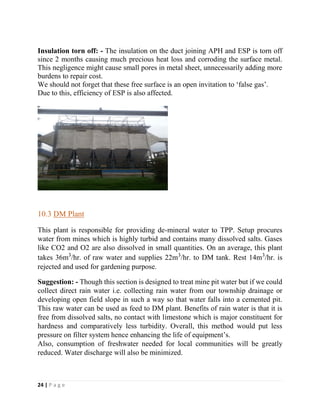
Insulation torn off: - The insulation on the duct joining APH and ESP is torn off
since 2 months causing much precious heat loss and corroding the surface metal.
This negligence might cause small pores in metal sheet, unnecessarily adding more
burdens to repair cost.
We should not forget that these free surface is an open invitation to ‘false gas’.
Due to this, efficiency of ESP is also affected.
10.3 DM Plant
This plant is responsible for providing de-mineral water to TPP. Setup procures
water from mines which is highly turbid and contains many dissolved salts. Gases
like CO2 and O2 are also dissolved in small quantities. On an average, this plant
takes 36m3
/hr. of raw water and supplies 22m3
/hr. to DM tank. Rest 14m3
/hr. is
rejected and used for gardening purpose.
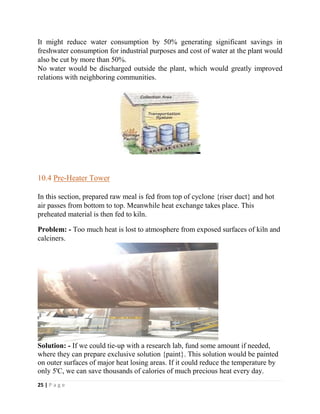
Suggestion: - Though this section is designed to treat mine pit water but if we could
collect direct rain water i.e. collecting rain water from our township drainage or
developing open field slope in such a way so that water falls into a cemented pit.
This raw water can be used as feed to DM plant. Benefits of rain water is that it is
free from dissolved salts, no contact with limestone which is major constituent for
hardness and comparatively less turbidity. Overall, this method would put less
pressure on filter system hence enhancing the life of equipment’s.
Also, consumption of freshwater needed for local communities will be greatly
reduced. Water discharge will also be minimized.
25 | P a g e
It might reduce water consumption by 50% generating significant savings in
freshwater consumption for industrial purposes and cost of water at the plant would
also be cut by more than 50%.
No water would be discharged outside the plant, which would greatly improved
relations with neighboring communities.
10.4 Pre-Heater Tower
In this section, prepared raw meal is fed from top of cyclone {riser duct} and hot
air passes from bottom to top. Meanwhile heat exchange takes place. This
preheated material is then fed to kiln.
Problem: - Too much heat is lost to atmosphere from exposed surfaces of kiln and
calciners.
Solution: - If we could tie-up with a research lab, fund some amount if needed,
where they can prepare exclusive solution {paint}. This solution would be painted
on outer surfaces of major heat losing areas. If it could reduce the temperature by
only 5'C, we can save thousands of calories of much precious heat every day.
26 | P a g e
Also optical temperature sensor should be used to measure temperatures at kiln
surfaces instead of infrared sensors as it is more accurate.
10.5 Equipment Yard
Learned about all critical equipment’s whose failure would stop the clinker
manufacturing e.g. Preheater ID fans.
Suggestion: - Spare equipment’s body is getting rusted. All are exposed to open
atmosphere.
Individual plastic covers should be put on them. At least atmospheric depreciation
expenditure can be saved.
11. References
1. www.thecementgrindingoffice.com
2. www.fluegasknowhow.com
3. www.ohio.edu
4. www.cemnet.com
5. www.understanding-cement.com

2014A1PS499H_AKASHAGRAWAL_final project

  • 1.
    1 | Pa g e A PROJECT REPORT ON Induced Draft Fans & False Air Calculation BY AKASH AGRAWAL RAJ RANJAN SINGH 2014A1PS499H 2014A1PS469H Prepared in fulfilment of Practice School-I Course No. BITS C221 AT RAWAN CEMENT WORKS RAIPUR A Practice School-1 of BIRLA INSTITUTE OF TECHNOLOGY & SCIENCE, PILANI (MAY-JULY,2016) CHEMICAL CHEMICAL
  • 2.
    2 | Pa g e Acknowledgement We are thankful to the Department Head, Section Head and several Engineers of our unit who gave all their support and guided us in completion of our project work. They have been very kind and patient while explaining the concepts and clearing our doubts. In particular we are indebted to our Instructor, Dr.Sunil Kumar Dubey whose words of encouragement and helpful suggestions from time to time, kept us motivated. Special thanks to our HOD, Mr. G.S. Virdi and our mentor Mr. M.K.Panda, without whom this project would not have been completed. We are also grateful to HR Department and all staffs of Rawan Cement Works for organizing multiple learning sessions and providing us the required basic facilities and support. And finally we would like to thank our parents for their blessings that worked beyond science in successful completion of our project effectively.
  • 3.
    3 | Pa g e Table of Contents 1. Pre-Heater……………………………………………..5 2. Fans……………………………………………………….6 3. Types……………………………………………………..6 3.1 Centrifugal 3.1.1 Centrifugal Fan Types 3.1.2 Axial 4. Basic Fan Laws…………………………………….….8 4.1 Effect of Fan Speed 4.2 Effect of Air Density 4.3 Effect of Diameter 5. Basic Terminologies…………………………….….9 6. Equipments……………………………………….…..9 6.1 Pitot Tube 6.2 Manometer 6.3 Thermocouple 6.4 Gas Analyzer 7. Calculations Involved…………………..………..11 7.1 Density 7.2 Velocity 7.3 Volumetric air Flow 7.4 Dynamic Pressure 7.5 Power 7.6 Efficiency 8. Improving Fan Performance ………………….14 9. False Air Calculation……………………………….17 10. Department wise Recommendations……..22 10.1 Raw Mill 10.2 Thermal Power Plant 10.3 DM Plant 10.4 Pre-heater Tower 10.5 Equipment Yard 11. References………………………………………………26
  • 4.
    4 | Pa g e Abstract The title of this project report is “Induced Draft Fans and False air Calculation”. The purpose of our report is to learn about different industrial fans, factors affecting fans' performance, false air circulating in ducts, ways to minimize it and its impact on clinker production. The procedure involved taking flow measurements from different ducts. Apart from our project work, this report also emphasizes on current plant problems, encountered during our various department visits and interaction. It ends with recommendations solely based on our self-understanding.
  • 5.
    5 | Pa g e 1. PRE-HEATER Pre- Heater at Line-2 is a setup of 4 strings, 6 stage each, used for preheating of raw mix coming from Blending Silo. Each stage is a cyclone connected with each other through riser duct. A cyclone is a conical vessel through which hot gas passes. The hot gas rises in such a way that it produces a vortex within the cyclone. The gas leaves the vessel from the top whereas the feed reaches to the bottom. Raw mix is fed from top riser duct by bucket elevator. Meanwhile exchange of heat takes place between heated air and raw mix. The travel time of raw mix particle in preheater is 50-60sec. During this period of time raw mix is preheated from 75°C to 950-1000 °C, whereas the rising hot air is cooled from 1100 °C to 320 °C.
  • 6.
    6 | Pa g e 2. FANS The word fan is often used to as an alternative to the word impeller. The impeller is at the heart of the fan moving and imparting energy into the air flow. Fans are used to move large volume of air or gas through ducts supplying air for drying, conveying material suspended in gas stream, removing fumes, condensing towers and other high flow low pressure applications. Fans are generally used in low pressure drop areas i.e. pressure less than 3.447KPa. We are considering flow is incompressible i.e. density remains constant. Fans are usually of centrifugal type in industries. They produce energy in air stream by centrifugal force and imparts velocity to gas by blades. 3.TYPES Fans are categorized on the basis of direction of discharge of gas stream. Broadly they are divided into two categories, namely Centrifugal Fans and Axial Fans. 3.1 Centrifugal Fans These are the most commonly used type of industrial fan. Centrifugal fans are capable of generating high pressures with high efficiencies and they can be used to accommodate in harsh operating conditions. 3.1.1 Centrifugal Fan Types
  • 7.
    7 | Pa g e The major types of centrifugal fan are: radial, forward curved and backward curved. Radial fans are industrial workhorses because of their high static pressures (upto 1400 mm WC, 1mmWC = 9.8*10-5 bar) and ability to handle heavily contaminated airstreams. Forward-curved fans are used in clean environments and operate at lower temperatures. They are best suited for moving large volumes of air against relatively low pressures. Backward-inclined fans are more efficient than forward-curved fans. Backward- inclined fans reach their peak power consumption and then power demand drops off well within their useable airflow range. Backward-inclined fans are known as "non-overloading" because changes in static pressure do not overload the motor
  • 8.
    8 | Pa g e 3.1.2 Axial Fans The key advantages of axial airflow fans compactness, low cost, and light weight. Axial fans are frequently used in exhaust applications (low pressure, high volume) where suspended particular size is small, such as dust streams, smoke, and steam. Axial fans are also useful in ventilation applications that require the ability to generate reverse air flow. The major types of axial flow fans are: - tube axial, vane axial and propeller. 4. Basic Fan Laws 4.1 Effect of Fan Speed FAN AIR FLOW RATE (Q) VARIES DIRECTLY WITH FAN SPEED RATIO (N) • Q2 = Q1 x (N2/N1) FAN PRESSURE (P) VARIES WITH THE SQUARE OF FAN SPEED RATIO (N) • P2 = P1 x (N2/N1)2 FAN INPUT POWER (H) VARIES WITH CUBE OF FAN SPEED RATIO • H2 = H1 x (N2/N1)3 4.2 Effect of Air Density FAN AIR FLOW RATE (Q) REMAINS SAME WITH CHANGE IN DENSITY • Q2 = Q1 PRESSURE (P) VARIES IN PROPORTION TO THE AIR DENSITY • P2 = P1 x (ρ2/ρ1) FAN INPUT POWER (H) VARIES IN PROPORTION TO THE AIR DENSITY • H2 = H1 x (ρ2/ρ1) 4.3 Effect of Diameter FAN AIR FLOW RATE (Q) VARIES WITH CUBE OF FAN DIAMETER • Q2=Q1 x (D2/D1)3 FAN PRESSURE (P) VARIES WITH SQUARE OF FAN DIAMETER
  • 9.
    9 | Pa g e • P2=P1 x (D2/D1) 2 FAN INPUT POWER (H) VARIES WITH FIFTH POWER OF FAN DIAMETER • H2=H1 x (D2/D1) 5 5. Basic Terminologies Static Pressure P(s) – The pressure exerted by fluid if it was not moving at any point from all directions. When a fan blows air through a duct, the air counters resistance from this pressure which is known as static pressure. It is also known as 'wall pressure'. Dynamic Pressure P(d) – The pressure exerted by fluid due to its motion or in other words, kinetic energy per unit volume of a fluid particle. Total pressure P(t) – It is sum of static and dynamic pressure. Dynamic and static pressure can change as the air flows though different size ducts with changing velocity but total pressure stays constant, on ignoring the frictional losses. 6. Equipments 6.1 Pitot Tube A device that consist of a tube having a short right angle bend which is inserted diametrically in duct with the mouth of bent part directed opposite to direction of flow of fluid and that is connected with manometer to measure the static and differential pressure.
  • 10.
    10 | Pa g e 6.2 Manometer An instrument for measuring the pressure of a fluid, consisting of a tube filled with a liquid, the level of the liquid being determined by the fluid pressure and the height of the liquid being indicated on the scale. But here we are using ‘Digital Manometer’. 6.3 Thermocouple A thermocouple is an electrical device for measuring temperature, consisting of two wires of different metals connected at two points, a voltage is being developed between two junctions and that is proportional to temperature difference. 6.4 Gas Analyzer Gas analyzer is used to procure constituents of flue gas in terms of concentration.
  • 11.
    11 | Pa g e 7. Calculations Involved 7.1 Density Here we use two types of density, given normal density [normal] and corrected density [corrected]. Normal density is calculated by analyzing flue gas. Gas % Mole Fraction Density at STP CO2 28 0.201 1.964 N2 67.29 0.760 1.25 O2 3.90 0.037 1.428 H2O 0 0 0.80 CO Negligible 0 1.25 Density of mixture= 0.201*1.964 + 0.760*1.25 + 0.037*1.428 = 1.39 Kg/Nm^3. Corrected density corrected = normal * Tc * Pc Where Tc = 273/ (273+T (flue gas)) Pc = (9986 + P(s))/10330 Duct Density(kg/m3 ) Tc Pc Corrected Density(kg/m3 ) 1 1.39 0.48 0.91 0.607 2 1.39 0.50 0.91 0.632 7.2 Velocity Velocity of air in duct is calculated by = ½*corrected*V2 = Avg.P(d) Vel = K*((2*9.81*avP(d))/(s))0.5 Where k is pitot constant provided by manufacturer, here its 0.8490
  • 12.
    12 | Pa g e Downcomer Duct Velocity(m/s) 1 16.26 2 15.80 7.3 Volumetric Air Flow This value is calculated by multiplying area of duct and velocity of flow. Downcomer Duct Area (m2 ) Velocity (m/s) Volumetric flow (m3 /hr) Corrected Volumetric Flow (Nm3 /hr) 1 14.179 16.26 8,29,950 364,659 2 14.179 15.80 8,06,437 367,073 7.4 Differential Pressure Values (Dynamic) Average P (d) of Preheater Fan 1 = 11.42mmWg Average P (d) of Preheater Fan 2 = 11.17mmWg 7.5 Power We are considering 1% power loss in transportation from motor to impeller and motor to be 95% efficient. Power input at preheater Fan 1 = 2255kW Power input at preheater Fan 2 = 2115kW 7.6 Efficiency The efficiency is calculated based on the mechanical power input to the Strings 1 &2 442FN1 12 11 12 12 12 11 12 10 12 11 11 11 Strings 3 & 4 442FN2 12 11 11 10 12 11 10 13 11 11 12 10
  • 13.
    13 | Pa g e Impeller and the power output from the impeller. There will be additional losses as additional items must be employed for the impeller to function, e.g. mechanical drive, electric motor, etc., that will all add losses and reduce the stated efficiency figure. The fan could be an impeller in a housing. The additional losses described above will need to be added resulting in a reduction in the quoted efficiency figure or Fan could be assembly of electric motor + mechanical drive + the impeller in which the efficiency could be calculated using power input to the electric motor and power output to the impeller. = Pu/Pe Where,  is the overall fan efficiency Pu is the power output from the fan calculated from volume flow (m³/s) and Pressure development (Pa). Note the pressure could be total or static which will be specified by the fan supplier. Pe is the electrical power input to the motor (W). The fan efficiency, be it for just the impeller or for a complete fan system, will vary across the operating range of the fan. The following graph of a backward inclined aero foil section fan (impeller and housing only) clearly show that the efficiency reaches a maximum point, in this case in the middle of the graph, but significantly reduces with lower or higher pressure development. The fan efficiency is normally quoted at this ‘peak efficiency’ or ‘best operating point’.
  • 14.
    14 | Pa g e Efficiency Calculated = ((Fan O/L Sp - P(s) I/L})*vol flow/3600)/ (102*power*0.99*0.95)*100 Fan efficiency of the preheater Fan 1= 65.5% Fan efficiency of the preheater Fan 2= 65.1% 8. Improving Fan Performance Fan selection starts with a basic knowledge of system operating conditions: air properties (moisture content, temperature, density, contaminant level, etc.), airflow rate, pressure, and system layout. These conditions determine which type of fan— centrifugal or axial—is required to meet service needs.
  • 15.
    15 | Pa g e Axial fans move air along the direction of the fan’s rotating axis, much like a 0propeller. Axial fans tend to be light and compact. Centrifugal fans accelerate air radially, changing the direction of the airflow. They are sturdy, quiet, reliable, and capable of operating over a wide range of conditions. Many factors are used to determine whether axial or centrifugal fans are more appropriate for certain applications. After deciding which fan type is appropriate, the right size must be determined. Fans are usually selected on a “best-fit” basis rather than designed specifically for a particular application. A fan is chosen from a wide range of models based on its ability to meet the anticipated demands of a system. Fans have two mutually dependent outputs: airflow and pressure. The variability of these outputs and other factors, such as efficiency, operating life, and maintenance, complicate the fan selection process. However, purchasing an oversized fan/motor assembly creates operating problems such as excess airflow noise and inefficient fan operation. The incremental energy costs of operating oversized fans can be significant. Engineers often include a margin of safety in sizing fans to compensate for uncertainties in the design process. Anticipated system capacity expansions and potential fouling effects add to the tendency to specify fans that are one size greater than those that meet the system requirements. The problems that accompany the selection of oversized fans are outlined below. Unfortunately, many of the costs and operating problems that result from oversized fans are overlooked during the equipment specification process. The problems that accompany the selection of oversized fans are outlined below. High Capital Costs. Large fans typically cost more than small ones, and large fans also require larger and more costly motors. Consequently, specifying oversized fans results in higher-than-necessary initial system costs. High Energy Costs. Oversized fans increase system operating costs both in terms of energy and maintenance requirements. Higher energy costs can be attributed to two basic causes. The fan may operate inefficiently because the system curve intersects the fan curve at a point that is not near The fan’s best efficiency point (BEP). Alternately, even if an oversized fan operates near its BEP, by generating more airflow than necessary, it uses
  • 16.
    16 | Pa g e More energy and increases stress on the system. Poor Performance. Oversized fans tend to operate with one or more of the indications of poor performance including noisy, inefficient, or unstable fan operation. High airflow noise often results from the excess flow energy imparted to the airstream. In addition, oversized fans are more likely to operate in their stall regions, which can result in surging flow and vibrations that damage the fans and degrade fan systems. Indications of stall include pulsing airflow noise, system ducts that seem to “breathe” in response to the pressure variations, and vibrating fan and duct supports. Frequent Maintenance. When oversized fans operate away from their BEP, they may experience cyclic bearing and drivetrain stresses. This is particularly applicable when a fan operates in its stall region, which is typically on the left side of the fan performance curve. Also, cyclic bearing loads tend to increase the stress on other drivetrain components such as belts and motors. Oversized fans also tend to create high system pressures, which increase stress on the ductwork and promote leakage. High Noise/Vibration Levels. Fans that operate inefficiently tend to create high airborne and structure-borne vibration levels. Airborne vibrations are often perceptible as noise, while structure borne vibrations are felt by the system equipment, ductwork, and duct supports. Oversized fans often create high airflow noise. Workers acclimate to ambient acoustic levels and do not express discomfort. However, high noise levels promote fatigue, which reduces worker productivity. High levels of structure-borne vibrations can create problems in welds and mechanical joints over time. High vibration levels create fatigue loads that eventually crack welds and loosen fittings. In severe cases, the integrity of the system suffers and leaks occur further degrading system efficiency. The location of the operating point on the fan curve can provide an indication of how appropriately the fan is sized. If possible, compare the pressure required by the end uses to the pressure generated by the fan. If the fan is oversized, it will generate more total pressure for the same airflow than a correctly sized fan.
  • 17.
    17 | Pa g e 9. False Air Calculation ''False air" is atmospheric air infiltrating/ingressing into process equipment that operates under vacuum through openings, fittings and cracks. Much of the major process equipment, including the cooler, kiln, pre-heater cyclones, electrostatic precipitators. Apart from flow measurements, we also took O2 at ILC Fan Inlet Duct. An acceptable level of O2 conc. is 5%. But recorded a whopping 10.37% concentration by gas analyzer. OBSERVATIONS:- • Air leakages points were observed in kiln-nose ring section, TPP, ESP, ILC/PC inlets. • Excess False Air increases load on ID fans causing an increase in power consumption because additional volume of flow is entering the fan inlet than for what it is designed. • ID fan disorientates from its BEP points and becomes overload and create more system pressure, noises.
  • 18.
    18 | Pa g e • Excess False Air, particularly at the kiln and preheaters, where fuel is consumed for heat generation, will lead to artificially exaggerated fuel consumption. • This has directly impact on thermal efficiency. • Daily maintenance is an option. Leaks found can be fixed immediately. • A leak detection survey should be conducted immediately if O2 conc. at top cyclone reaches above 3%. A mechanical seal has a built-in flexibility to move when the kiln and nose ring move.
  • 19.
    19 | Pa g e Results:- The financial and environmental benefits of the implementation of these measures can be measured by comparing a mass balance before implementation (i.e. indicating the fuel and thus the potential savings) with a mass balance after implementation (i.e. indicating the actual fuel). Heat Balance:- Actual exhaust per ton clinker produced =1.59Nm3/kg clinker. • Measured gas flow rate at Pyro-clone 1- 364,659 Nm3/h • Measured gas flow rate at Pyro-clone 2- 367,073 Nm3/h • Clinker Production in the kiln(Line-2): 11,000 ton/day or 458,333 kg/h  Sp Kiln Gas = (Pyro-clone 1+Pyro-clone 2)/ Clinker production = (364,659+367,073) Nm3/h / 458,333 kg clinker/h = 1.59 Nm3/kg clinker As Kiln inlet common for the strings (1, 2) & (3, 4). Line-2 O2 (%) ( I/L) PC1 outlet O2 (%) (O/L) PH outlet False Air(%)=((O/L – I/L) / 20.9-O/L)) * 100 Strings 1&2 2.2 4.0 10.65 Strings 3&4 2.4 4.3 10.84 False air ingression: Maximum permissible False Air in Preheater Section should be 7% of Total Volume (as per acceptable limit of Pyro-Section on considering the transport-air, air blasters air, excess air etc.) Excess Air that is contributing towards higher Energy Consumption in terms of false air: 10.65-7.00= 3.65% (strings 1&2) Volume of False Air in PH1 to be removed= 364,659 Nm3/h* 0.0365 = 13,310.18 Nm3/h
  • 20.
    20 | Pa g e Corrected Density= 0.607 kg/Nm3 Mass of False air = 13310.18*0.607 = 8079.27 kg/hr. Excess Air that is contributing towards higher Energy Consumption in terms of false air: 10.84-7.00= 3.84% (strings 3&4) Volume of False Air in PH2 to be removed = 367,073 Nm3/h* 0.0384 = 14095.60 Nm3/h Corrected Density= 0.632 kg/Nm3 Mass of False air= 14095.60 Nm3/h *0.632 kg/Nm3 =8908.04kg/hr. Total Volume of False Consuming extra energy in the Preheater Line-2 = (13310.18 + 14095.60) Nm3/h =27405.78 Nm3/h Total Mass of False air Consuming extra energy in the Preheater Line-2 = 8079.27kg/hr+8908.04kg/hr. =16,987.31kg/hr. Now sensible heat being lost due to false Air infiltration. Whereby: • Average Temperature : 614C • Ambient Temperature : 35C • Caloric value of PET COKE : 8,000 kCal /kg • Cpair = A + BT*10-6 + 10-9 *C*T2 Where A=0.237, B=23 & T=614o C = Cpair at 614C : 0.32 kJ/kg*K • Pet Coke price : ₹ 8500/tones (for consideration, inclusive of shipment & losses)
  • 21.
    21 | Pa g e Balancing this Sensible Heat with Fuel Fired: • mair Cpair dT = mcoke Hv • 16,987.31kg/hr*0.32 kJ/kg*K * (614-35) C = mcoke*8,000*4.2 kJ/kg • mcoke = 2.2 tons/day Strings Volume flow (Nm3 /hr.) Total False Air (Nm3 /hr.) Excess False Air (%) Mass of False Air (Kg3/hr.) 1&2 364,659 13,310.18 3.65 8079.27 3&4 367,073 14095.60 3.84 8908.04 Considering Plant is being operated for 330 Days/Year Pet Coke Loss: (330days * 2.2tons/day) = 726 Tons/ Year i.e. ₹ 62 Lakhs/Year (pet coke price ₹8500/ton) Considering 11,000 TPD of Clinker Production for Line-II Kiln, Petcoke consumption is around 9.5%. Petcoke Consumption = 11000*9.5*330/100 = 344850 Tons/ Year Cost of Petcoke Used = ₹ 293 Crore/Year i.e. worth 0.22% of Petcoke is wasted per Year on False Air. This is not a Herculean task to reduce this extra consumption. • Daily maintenance is an option. Leaks found can be fixed immediately. • A leak detection survey should be conducted immediately if O2 conc. at top cyclone reaches above 3%.
  • 22.
    22 | Pa g e • Payback time is less. Financial benefits (potential) • Investment: purchasing Equipments for the mechanical seal and installation costs. • Can purchase VFDs from the savings. • Plant Equipments maintenance. • CSR contribution. Environmental benefits (potential) • Annual pet coke savings: 726.0 tons • Annual Green House Gas (CO2) emission reduction: 726.0*3= 2178.0 tons. 10. Department wise Recommendations In this section we have tried to highlight few points whi1ch were observed during our various department visits and information collected through interaction. 10.1 Raw Mill Raw meal preparation is a long process. It starts with stacking and reclaiming, followed by addition of excipients {fly ash} and continues till its storage in blending silo. Suggestion: - In line-1, we are using VRM, this machine is working absolutely fine till date. Considering its power consumption, 23kW as compared to Roller press technology {15kW}, the power consumption is on higher side. In future,
  • 23.
    23 | Pa g e electricity production will definitely be more costly, why we don’t switch to latest technology. Eventually, it might take few years to compensate for switching cost. 10.2 Thermal Power Plant In this department, we have learned that how electricity is produced for factory and township with two sets of turbine. The only objective is to run turbine at 3000rpm by impact of dry steam. And to carry out same, a sequential process is followed. Problem: - Recently, Line 1 unit was intentionally shut down but at time of start- up, boiler tube cracked. Interpretation: - Boiler tubes have become thin, occasional puncture forces to shut down. Again it takes lots of fuel to light up [reach up to 550'C]. Solution: - Thickness of tubes should be regularly checked. Identification of old tubes and its replacement would solve the problem. Apart from this, a back turbine can be installed which could utilize low pressure steam and generate few Megawatts of energy. Although its feasibility can only be analyzed by experts.
  • 24.
    24 | Pa g e Insulation torn off: - The insulation on the duct joining APH and ESP is torn off since 2 months causing much precious heat loss and corroding the surface metal. This negligence might cause small pores in metal sheet, unnecessarily adding more burdens to repair cost. We should not forget that these free surface is an open invitation to ‘false gas’. Due to this, efficiency of ESP is also affected. 10.3 DM Plant This plant is responsible for providing de-mineral water to TPP. Setup procures water from mines which is highly turbid and contains many dissolved salts. Gases like CO2 and O2 are also dissolved in small quantities. On an average, this plant takes 36m3 /hr. of raw water and supplies 22m3 /hr. to DM tank. Rest 14m3 /hr. is rejected and used for gardening purpose. Suggestion: - Though this section is designed to treat mine pit water but if we could collect direct rain water i.e. collecting rain water from our township drainage or developing open field slope in such a way so that water falls into a cemented pit. This raw water can be used as feed to DM plant. Benefits of rain water is that it is free from dissolved salts, no contact with limestone which is major constituent for hardness and comparatively less turbidity. Overall, this method would put less pressure on filter system hence enhancing the life of equipment’s. Also, consumption of freshwater needed for local communities will be greatly reduced. Water discharge will also be minimized.
  • 25.
    25 | Pa g e It might reduce water consumption by 50% generating significant savings in freshwater consumption for industrial purposes and cost of water at the plant would also be cut by more than 50%. No water would be discharged outside the plant, which would greatly improved relations with neighboring communities. 10.4 Pre-Heater Tower In this section, prepared raw meal is fed from top of cyclone {riser duct} and hot air passes from bottom to top. Meanwhile heat exchange takes place. This preheated material is then fed to kiln. Problem: - Too much heat is lost to atmosphere from exposed surfaces of kiln and calciners. Solution: - If we could tie-up with a research lab, fund some amount if needed, where they can prepare exclusive solution {paint}. This solution would be painted on outer surfaces of major heat losing areas. If it could reduce the temperature by only 5'C, we can save thousands of calories of much precious heat every day.
  • 26.
    26 | Pa g e Also optical temperature sensor should be used to measure temperatures at kiln surfaces instead of infrared sensors as it is more accurate. 10.5 Equipment Yard Learned about all critical equipment’s whose failure would stop the clinker manufacturing e.g. Preheater ID fans. Suggestion: - Spare equipment’s body is getting rusted. All are exposed to open atmosphere. Individual plastic covers should be put on them. At least atmospheric depreciation expenditure can be saved. 11. References 1. www.thecementgrindingoffice.com 2. www.fluegasknowhow.com 3. www.ohio.edu 4. www.cemnet.com 5. www.understanding-cement.com