FAMILY ADOPTION
PROGRAMME
INTRODUCTION
The Alma-Ata Declaration on 12th September, 1978
‘Health for all’, by all developing and developed countries of the
world by year 2000
Community Health worker (CHW) scheme and Village Health Guide
(VHG) 1977
Accredited Social Health Activists (ASHA)
Equitable health distribution through well-trained allopathic doctors
Rural population remained deprived of general medical treatment
AIM
To provide an experiential learning opportunity to Indian Medical
graduates community based health care and thereby enhance equity
in health.
OBJECTIVES OF THE PROGRAM
During the Medical UG training program, the learner should be able to
:
 Orient the learner towards primary health care
 Create health related awareness within the community
 Function as a first point of contact for any health issues within the community
 Act as a conduit between the population and relevant health care facility
 Generate and analyse related data for improving health outcomes and Evidence
based clinical practices.
TARGET
1st Professional Year
Learning communication skills and inspire confidence amongst
families
Understand the dynamics of rural set-up of that region
Screening programs and education about ongoing government
sponsored health related programs
Learn to analyse the data collected from their families
Identify diseases/ ill-health/ malnutrition of allotted families and try
to improve the standards
TARGETS
2nd Professional Year
 Inspire active participation of community through families allotted
 Continue active involvement to become the first doctor /reference point of the
family by continued active interaction
 Start compiling the outcome targets achieved
TARGET
3rd Professional Year
 Analysis of their involvement and impact on existing socio-politico-economic dynamics in addition
to improvement in health conditions
Final Professional Year
prepare a report to be submitted to department addressing:
 Improvement in general health
 Immunization
 Sanitation
 De-addiction
 Improvement in anemia, tuberculosis control
 Sanitation awareness
 Any other issues
 Role of the student in supporting family during illness/ medical emergency
 Social responsibility in the form of environment protection programme in form of plantation drive
(medicinal plants/trees), cleanliness and sanitation drives with the initiative of the medical student
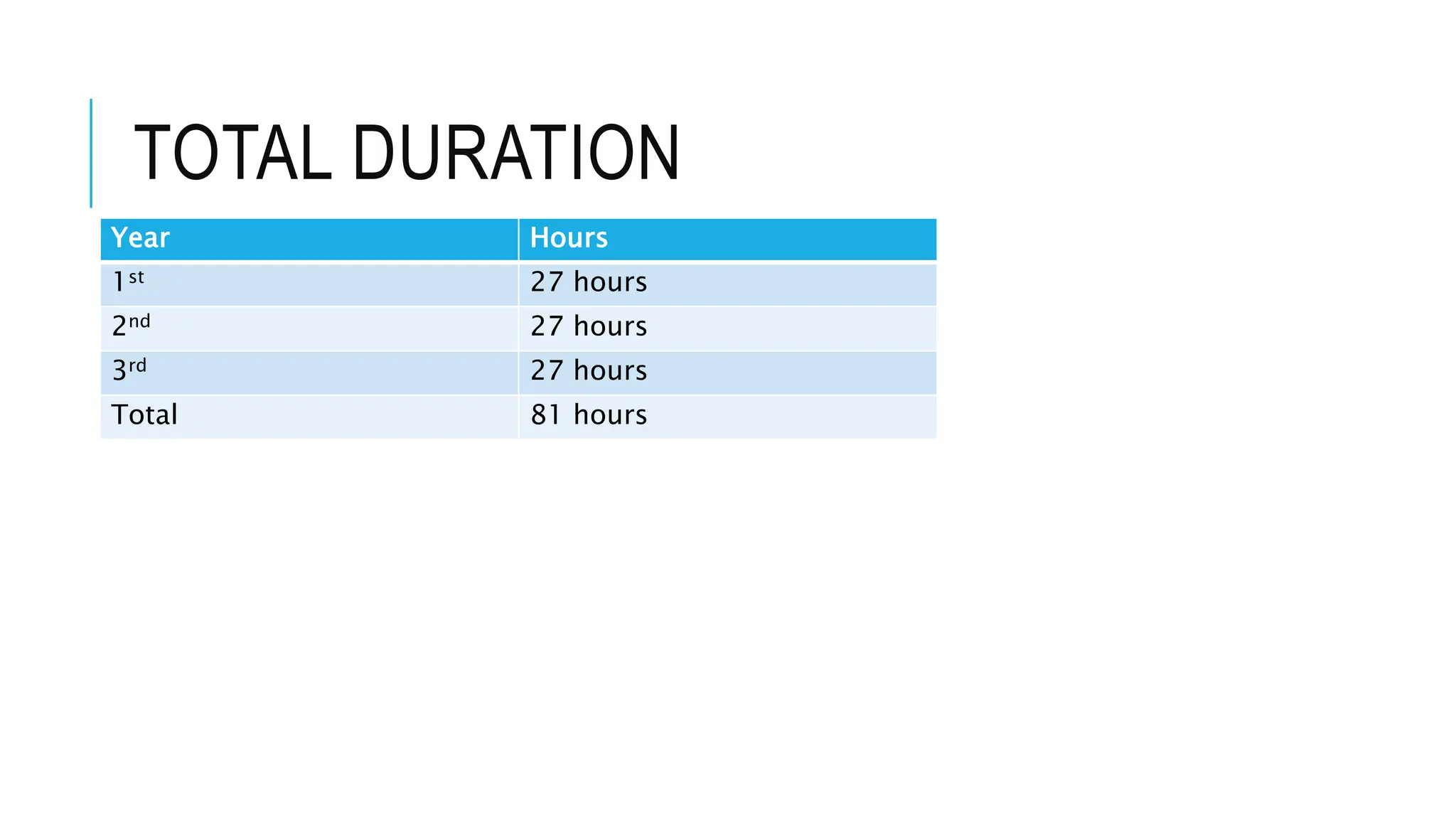
TOTAL DURATION
Year Hours
1st 27 hours
2nd 27 hours
3rd 27 hours
Total 81 hours
PROCESS
Every new batch, allotted a village, not covered under RHTC.
An average of 5-7 house-holds to every student.
Students can adopt more house-holds.
Assistant Professor, senior resident (SR) will mentor 25 students.
PROCESS
Introduction to the families by the mentors during the induction
course.
In the induction course, a special visit to the village may be organized
twice a week after deciding suitable time with the village head/
mukhiya.
Introduction of village outreach, FAP should be done by addressing
Gram Sabhas Head of the department/ senior faculty and medico
social worker
Sensitize the villagers and gain their acceptance and confidence
DATA TO BE COLLECTED
Names of every member, age (preferably with birth dates if available),
sex, address of the house-hold, education of each member,
employment data, size of living space and surrounding.
History taking for the purpose of health records under the guidance
of mentors and senior residents.
Any illness (physical/mental), addictions may be recorded including
the habit of smoking, tobacco chewing, playing of cards/ chess any
other games as pass-time, and any interesting facts relating to health
about the house-hold.
DATA TO BE COLLECTED
Height, weight, vitals, general and oral hygiene status of every
member must be recorded in the initial first month visit.
In the second month, haemoglobin, blood sugar and urine dipstick be
recorded.
Support from department of Physiology/ Pathology can be taken for
carrying out these tests.
These data be updated every year.
Vaccination programme also be included in data sheet.
DATA TO BE COLLECTED
Student Primary contact in case of medical emergency / illness in the
household.
The student in turn should consult his/her mentor for further
management of the patient.
The hospital to which the college is attached must provide treatment
facilities to the patient.
Government schemes may be utilized for optimal management.
Follow-up records must be maintained by the student.
These must be periodically evaluated by mentors with the help of
senior residents.
FOLLOW UP
The entire data sheet may be prepared by every student and
submitted by the end of 6th semester for evaluation.
Progress notes must include every demographic point and history
recorded.
These should include the positive effect of visit in the form of
improvement in general health, sanitation, de-addiction, whether
healthy lifestyles like reading good books, sports/ yoga activities
have been inculcated in the house-holds.
IMPACT
Improvement in health, including anemia, tuberculosis control and
sanitation awareness and any other issues will reflect the impact.
Social responsibility in the form of environment protection
programme in form of plantation drive (medicinal plants/trees),
cleanliness and sanitation drives with the initiative of the medical
student in the house-hold, may be followed and recorded.
EXPECTED OUTCOMES FOR
STUDENTS
The FAP is expected to
 hone communication skills which are the back-bone of the profession;
 learning to be humane
 empathize with the rural population
 understanding their customs and limitations
 many positive aspects of community unity.
The aim of imparting education to the students
 team leaders for health care,
 primary consultants and learn the basic skills of diagnosing
 Basic practical skills like administering intravenous fluids/ medicines, drawing blood, dressing of
wounds, etc.
The practical field training from the beginning will make them better doctors.
Importance in training in Preventive Medicine
knowledge of methods of implementation of various health care related
schemes.
EXPECTED OUTCOMES – STUDENTS
Understand the disease profile in a rural setting
Understand local beliefs and faith in various methods of disease
management other than allopathy.
It is expected this will widen their vision of holistic health care
Management of common ailments encountered in these settings by a
Family Physician.
Collection and analysis of data will be another advantage.
Students may be given credit points for their performance.
CHALLENGES
Final visit, end of three years be recorded with special programme
Plan the longitudinal health care of the adopted families at the end of
the students’ batch.
No village is repeated under the FAP.
Incentives- presentation of this work at international fora,
conferences, publications
Awards for students and young faculty
Logistic support for the visit by students, faculty, and other staff to
these village/s- provided by college
CONCLUSION
Thus the family adoption programme through village outreach needs
to be adopted as a part of curriculum for MBBS students.
Advantages
 MBBS students as ‘complete doctors’ with humane approach and confidence to be
leaders in socio-medical fronts.
 The neglected rural population will be enriched and the results for the country will
be seen in next few years.
THANK YOU

Family Adoption Programme first year mbbs.pptx

  • 1.
  • 2.
    INTRODUCTION The Alma-Ata Declarationon 12th September, 1978 ‘Health for all’, by all developing and developed countries of the world by year 2000 Community Health worker (CHW) scheme and Village Health Guide (VHG) 1977 Accredited Social Health Activists (ASHA) Equitable health distribution through well-trained allopathic doctors Rural population remained deprived of general medical treatment
  • 3.
    AIM To provide anexperiential learning opportunity to Indian Medical graduates community based health care and thereby enhance equity in health.
  • 4.
    OBJECTIVES OF THEPROGRAM During the Medical UG training program, the learner should be able to :  Orient the learner towards primary health care  Create health related awareness within the community  Function as a first point of contact for any health issues within the community  Act as a conduit between the population and relevant health care facility  Generate and analyse related data for improving health outcomes and Evidence based clinical practices.
  • 5.
    TARGET 1st Professional Year Learningcommunication skills and inspire confidence amongst families Understand the dynamics of rural set-up of that region Screening programs and education about ongoing government sponsored health related programs Learn to analyse the data collected from their families Identify diseases/ ill-health/ malnutrition of allotted families and try to improve the standards
  • 6.
    TARGETS 2nd Professional Year Inspire active participation of community through families allotted  Continue active involvement to become the first doctor /reference point of the family by continued active interaction  Start compiling the outcome targets achieved
  • 7.
    TARGET 3rd Professional Year Analysis of their involvement and impact on existing socio-politico-economic dynamics in addition to improvement in health conditions Final Professional Year prepare a report to be submitted to department addressing:  Improvement in general health  Immunization  Sanitation  De-addiction  Improvement in anemia, tuberculosis control  Sanitation awareness  Any other issues  Role of the student in supporting family during illness/ medical emergency  Social responsibility in the form of environment protection programme in form of plantation drive (medicinal plants/trees), cleanliness and sanitation drives with the initiative of the medical student
  • 8.
    TOTAL DURATION Year Hours 1st27 hours 2nd 27 hours 3rd 27 hours Total 81 hours
  • 9.
    PROCESS Every new batch,allotted a village, not covered under RHTC. An average of 5-7 house-holds to every student. Students can adopt more house-holds. Assistant Professor, senior resident (SR) will mentor 25 students.
  • 10.
    PROCESS Introduction to thefamilies by the mentors during the induction course. In the induction course, a special visit to the village may be organized twice a week after deciding suitable time with the village head/ mukhiya. Introduction of village outreach, FAP should be done by addressing Gram Sabhas Head of the department/ senior faculty and medico social worker Sensitize the villagers and gain their acceptance and confidence
  • 11.
    DATA TO BECOLLECTED Names of every member, age (preferably with birth dates if available), sex, address of the house-hold, education of each member, employment data, size of living space and surrounding. History taking for the purpose of health records under the guidance of mentors and senior residents. Any illness (physical/mental), addictions may be recorded including the habit of smoking, tobacco chewing, playing of cards/ chess any other games as pass-time, and any interesting facts relating to health about the house-hold.
  • 12.
    DATA TO BECOLLECTED Height, weight, vitals, general and oral hygiene status of every member must be recorded in the initial first month visit. In the second month, haemoglobin, blood sugar and urine dipstick be recorded. Support from department of Physiology/ Pathology can be taken for carrying out these tests. These data be updated every year. Vaccination programme also be included in data sheet.
  • 13.
    DATA TO BECOLLECTED Student Primary contact in case of medical emergency / illness in the household. The student in turn should consult his/her mentor for further management of the patient. The hospital to which the college is attached must provide treatment facilities to the patient. Government schemes may be utilized for optimal management. Follow-up records must be maintained by the student. These must be periodically evaluated by mentors with the help of senior residents.
  • 14.
    FOLLOW UP The entiredata sheet may be prepared by every student and submitted by the end of 6th semester for evaluation. Progress notes must include every demographic point and history recorded. These should include the positive effect of visit in the form of improvement in general health, sanitation, de-addiction, whether healthy lifestyles like reading good books, sports/ yoga activities have been inculcated in the house-holds.
  • 15.
    IMPACT Improvement in health,including anemia, tuberculosis control and sanitation awareness and any other issues will reflect the impact. Social responsibility in the form of environment protection programme in form of plantation drive (medicinal plants/trees), cleanliness and sanitation drives with the initiative of the medical student in the house-hold, may be followed and recorded.
  • 16.
    EXPECTED OUTCOMES FOR STUDENTS TheFAP is expected to  hone communication skills which are the back-bone of the profession;  learning to be humane  empathize with the rural population  understanding their customs and limitations  many positive aspects of community unity. The aim of imparting education to the students  team leaders for health care,  primary consultants and learn the basic skills of diagnosing  Basic practical skills like administering intravenous fluids/ medicines, drawing blood, dressing of wounds, etc. The practical field training from the beginning will make them better doctors. Importance in training in Preventive Medicine knowledge of methods of implementation of various health care related schemes.
  • 17.
    EXPECTED OUTCOMES –STUDENTS Understand the disease profile in a rural setting Understand local beliefs and faith in various methods of disease management other than allopathy. It is expected this will widen their vision of holistic health care Management of common ailments encountered in these settings by a Family Physician. Collection and analysis of data will be another advantage. Students may be given credit points for their performance.
  • 18.
    CHALLENGES Final visit, endof three years be recorded with special programme Plan the longitudinal health care of the adopted families at the end of the students’ batch. No village is repeated under the FAP. Incentives- presentation of this work at international fora, conferences, publications Awards for students and young faculty Logistic support for the visit by students, faculty, and other staff to these village/s- provided by college
  • 19.
    CONCLUSION Thus the familyadoption programme through village outreach needs to be adopted as a part of curriculum for MBBS students. Advantages  MBBS students as ‘complete doctors’ with humane approach and confidence to be leaders in socio-medical fronts.  The neglected rural population will be enriched and the results for the country will be seen in next few years.
  • 20.