concept_and_Principle_FM.pptx management and target
1.
Concept & Principlesof
FM
Dr. Ahmed H. Bakhiet
DTM&H, MTM, FRCGP,FRCP (Edin )
Consultant and Senior Trainer, Dept. of FCM (PSMMC)
2.
History of PHC
The WHO and several nations in the world more than 25 years
ago expressed concern about the poor state of health of the
people despite large amounts of money being spent on health
service
In response to this situation, the world health assembly (WHA)
decided in 1977 that the main social target of the government
and the WHO in the decades a head would be attainment of;
“health of all by year 2000”.
That is , the attainment by all people in the world “ a level of
health that will permit them to lead a socially and
economically productive life”
3.
History of PHC
Currently, the health for all (HFA) process is
continuing in the 21st
century with new
opportunities and approaches for meeting the
new targets and goals set for the year 2020.
4.
Almata Declaration (1978)
was adopted at the International Conference on Primary Health Care
(PHC), Almaty (formerly Alma-Ata), Kazakhstan, 6-12 September 1978.
It expressed the need for urgent action by all governments, all health
and development workers, and the world community to protect and
promote the health of all the people of the world.
It was the first international declaration underlining the importance
of primary health care.
The primary health care approach has since then been accepted by
member countries of WHO as the key to achieving the goal of "Health
for All".
5.
Major barriers toequitable health
care - WHO
Unequal access to disease prevention & care
Rising cost of health care
Inefficient health care system
Lack of emphasis on Generalists’ (Family
Medicine) training
6.
How to overcomethese barriers
?
The WHO also states, that the best option to
overcome these barriers is to utilize the
services of trained Family Physicians
7.
Family medicine
“itis the medical specialty which provides
continuing and comprehensive health care
for the individual and the family. In breadth it is
the specialty which integrate the biological,
clinical & behavioral sciences .The scope of
FM encompasses all ages ,sexes ,each
organ ,system & every disease entity”
(
American Academy of Family Physicians
)
8.
Concepts of FamilyMedicine
Definition : Family Medicine is a medical
specialty of first contact with the patient
and is devoted to providing preventive,
promotive, rehabilitative and curative care
with emphasis on the physical,
psychological and social aspects, for the
patient, his family and community.
The scope is not limited by system, organ,
disease entity, age or sex.
9.
The Need ForTrained Family
Physicians
The central role of a trained Family
Physician in health care is well recognized
in:
Developed countries -- UK, USA and
Canada
Oil rich countries -- Saudi Arabia and
Kuwait?
Developing countries -- ? ? ? ? ?
The need is even greater in all less
developed countries.
11.
The Principles ofFM
1. The family physician is a skilled clinician.
2. Family medicine is a community-based
discipline.
3. The family physician is a resource to a
defined practice population.
4. The patient-physician relationship is central
to the role of the family physician.
[Adapted from “The Postgraduate Family Medicine Curriculum: An Integrated Approach” and the “Standards
for Accreditation of Residency Training Programs” of the College of Family Physicians of Canada]
12.
The family physicianis a skilled clinician
FPs demonstrate competence in the patient-centered clinical
method:
• They integrate a sensitive, skillful, and appropriate search
for disease and are adept at working with patients to reach
common ground on the definition of problems, goals of
treatment, and roles of physician and patient in management.
• They demonstrate an understanding of patients’ experience
of illness (particularly their ideas, feelings, and expectations)
and of the impact of illness on patients’ lives.
• They are skilled at providing information to patients in a
manner that respects their autonomy.
13.
They usetheir understanding of human
development and family and other social systems to
develop a comprehensive approach to the
management of disease and illness in patients and
their families.
F.P have an expert knowledge of the wide range of
common problems of patients in the community,
and of less common, but life threatening and
treatable emergencies in patients in all age groups.
Their approach to health care is based on the best
scientific evidence available.
14.
Family medicine isa community-based discipline
Family practice is based in the community and is
significantly influenced by community factors;
FP identify and respond to the needs of communities and
populations.
FP have an important role in the effective use of community
resources and consultants.
The settings in which patients are cared for include office,
hospital, home and others.
Clinical problems presenting to FP are not pre-selected and
are commonly encountered at an undifferentiated stage;
FP are skilled at dealing with ambiguity and uncertainty.
15.
Knowledge ofethical and medical-legal issues is
important to family practice.
FPs have a responsibility to advocate public
policy that promotes their patients’ health.
FPs accept their responsibility in the health care
system for wise stewardship of scarce resources
16.
The family physicianis a resource to a defined
practice population
The FP has a systematic approach to his/her
practice as a group for whom he/she bears
responsibility, whether or not they are visiting
the office. Such an approach requires a number
of skills:
• the ability to evaluate new information and its
relevance to the practice
• the knowledge and skills to assess the
effectiveness of care provided by the practice,
• the appropriate use of medical records and/or
other information systems
17.
• efficient managementof the
organizational or business aspects of practice
• the ability to plan and implement policies
that will enhance patients’ health, including
health promotion, screening and preventive
care.
Self-assessment and effective strategies for self-
directed, lifelong learning are part of family
practice.
18.
The patient-physician relationshipis central to the role
of the family physician
FM is defined by the continuity and
comprehensiveness of the care provided by the
physician to his/her patient rather than the
presence of a particular disease.
The patient-physician relationship has the
qualities of a covenant: a promise, by physicians,
to be faithful to their commitment to patients’
well-being, whether or not patients are able to
follow through on their commitments.
FP are advocates for their patients.
19.
FPs havean understanding and appreciation of
the human condition, especially the nature of
suffering and patients’ response to sickness.
FPs are aware of their strengths and limitations
and recognize when their own personal issues
interfere with effective care.
FPs are aware of the power imbalance between
doctors and patients and the potential for abuse
of this power.
20.
There are 11characteristics of Family Practice (The European Society of General
Practice/Family Medicine):
1. Is normally the point of first medical contact within the
health care system, providing open and unlimited access to
its users, dealing with all health problems regardless of the
age, sex, or any other characteristic of the person concerned.
2. Makes efficient use of health care resources through co-
coordinating care, working with other professionals in the
primary care setting, and by managing the interface with
other specialties taking an advocacy role for the patient when
needed.
21.
3. Develops aperson-centered approach, orientated to
the individual, his/her family, and their community.
4. Has a unique consultation process, which
establishes a relationship over time, through
effective communication between doctor and
patient
5. Is responsible for the provision of longitudinal
continuity of care as determined by the needs of the
patient.
22.
6. Has aspecific decision making process determined
by the prevalence and incidence of illness in the
community.
7. Manages simultaneously both acute and chronic
health problems of individual patients.
8. Manages illness which presents in an
undifferentiated way at an early stage in its
development, which may require urgent
intervention.
23.
9. Promotes healthand well being both by
appropriate and effective intervention.
10. Has a specific responsibility for the health of
the community.
11. Deals with health problems in their physical,
psychological, social, cultural and existential
dimensions.
25.
Why is FamilyMedicine Important
?
Gatekeepers to the medical field, primary care
physicians serve as coordinators of care.
improved health outcomes
lower mortality rates
reduced emergency department use
26.
Why is FamilyMedicine Important
?
decreased rates of preventable hospital
admissions
less invasive, lower cost care
no differences in quality of care when compared
to sub-specialist care
higher patient satisfaction
27.
Health outcome indicators
Barbra Starfield study confirmed that the Central
Role of Family Medicine in the health care
system of a country results in better health
outcome indicators
28.
Problems in thecommunity
75% Self care
25% Consult FP
2.5
%
Hosp
29.
Family medicine practicedin
:
Primary health care center
Hospital: secondary and tertiary care
Specialized hospital
Emergency departments
Satellite setting
Private clinic
Care on demand
30.
Accessibility
Geographical proximity:
A health center should be within a 5 km radius of
the catchment area (WHO)
A health center should be accessible within half
hour of travel by the most common mode of
transport available in the area.
31.
Accessibility
Social accessibility:
Denote easy access to the entire population
irrespective of socio-economic or cultural barriers
Functional accessibility:
mean that the right kind of care is available on
continuous basis for a health need
33.
PHC Principles
Equityin distribution
Appropriate technology
Multi-sectorial approach
Community participation
34.
Element of PHC
A package containing :
Rehabilitatio
n
Disease
prevention
Health
promotion
Curative
service
35.
Element of PHC
1.Education concerning prevailing health
problems & the methods of preventing &
controlling them
2. Promotion of food supply and proper
nutrition
3. An adequate supply of safe water and basic
sanitation
4. Provision comprehensive maternal and
child health care
36.
Element of PHC
5.Immunization against major infectious
diseases
6. Prevention and control of locally endemic
diseases
7. Appropriate treatment of common
diseases and injuries
8. Provision of essential drugs
37.
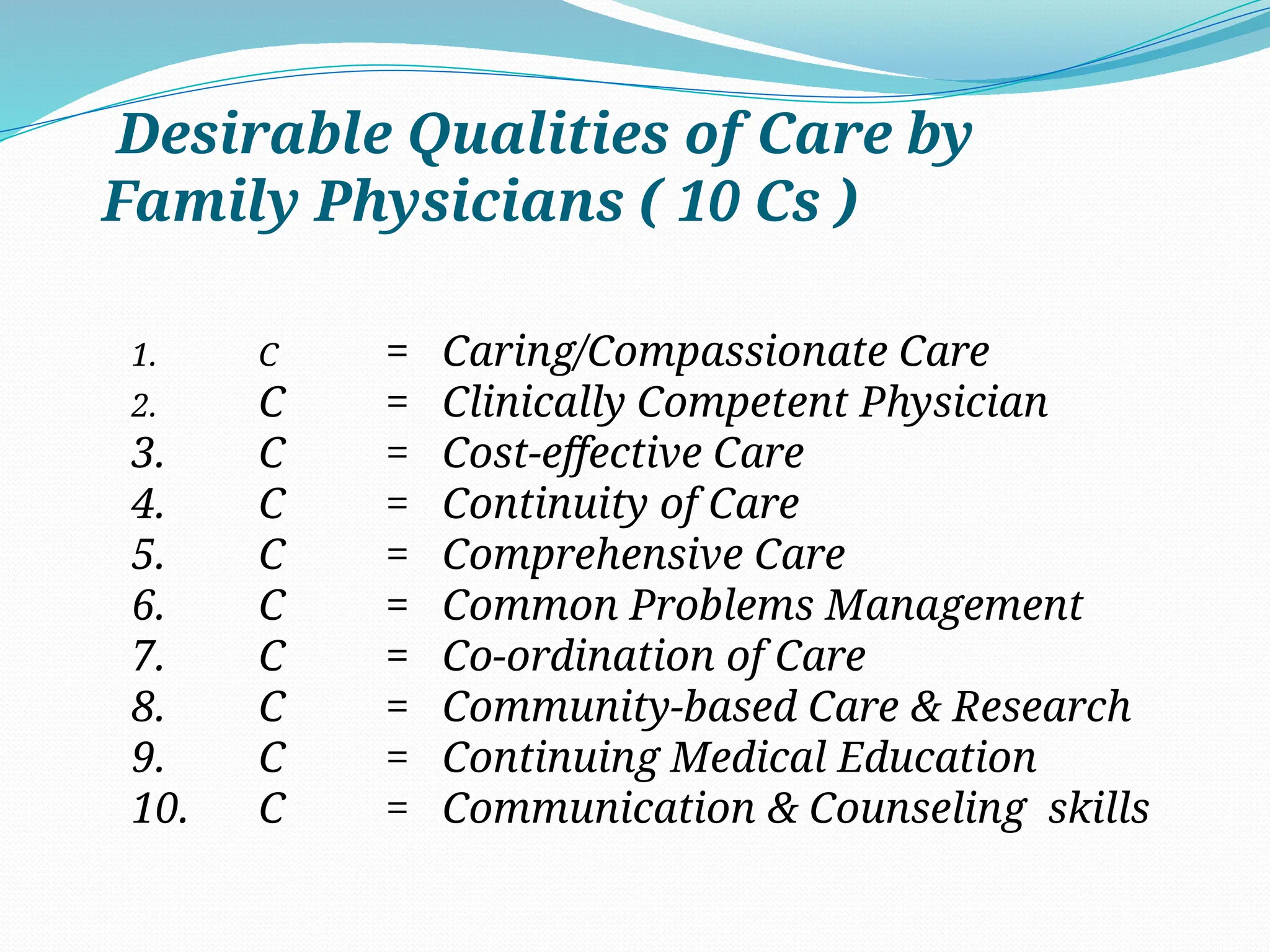
Desirable Qualities ofCare by
Family Physicians ( 10 Cs )
1. C = Caring/Compassionate Care
2. C = Clinically Competent Physician
3. C = Cost-effective Care
4. C = Continuity of Care
5. C = Comprehensive Care
6. C = Common Problems Management
7. C = Co-ordination of Care
8. C = Community-based Care & Research
9. C = Continuing Medical Education
10. C = Communication & Counseling skills
38.
1. C =Caring
Caring/Compassionate care
An essential quality in a Family
Physician
Personal Care
39.
2. C =Clinically Competent
Only caring is not enough
Need for vocational ( 4
years )training after graduation and
internship
40.
3. C =Cost-effective Care
In time and money
Gate keeper- Appropriate resources
use
Use of time as a diagnostic tool
41.
4. Continuity ofCare
For acute, chronic, from childhood
to old age, and terminal care
patients and those requiring
rehabilitation.
Preventive care/ Promotion of health
Care from cradle to grave
42.
5. C =Comprehensive Care
Responsibility for every problem a
patient presents with
Physical, Psychological & Social
Holistic approach with triple
diagnosis
43.
6. C =Common Problems
Management Expertise
e.g. Hypertension, Diabetes,
Asthma, Depression, Anemia,
Allergic Rhinitis, Urinary Tract
Infection
Common problems in children and
women
8. Coordination ofCare
Patient’s advocate
Organizing multiple sources of
help
46.
9. Community BasedCare
Care nearer patients’ home
Preventive, promotive, rehabilitative
and curative care in patients own
environment.
Relevant research within the patient’s
own surroundings
47.
10. C =Communication and
Counseling Skills
Essential for compliance of advice
and treatment/sharing
understanding
Confidentiality and safety netting
Needed for patient satisfaction
Involving patient in the
management
48.
Conclusions
The principles andcompetencies
required for the practice of Family
Medicine are universal.
They are applicable to all cultures and
all social groups, from richest to the
poorest in the community.


![The Principles of FM
1. The family physician is a skilled clinician.
2. Family medicine is a community-based
discipline.
3. The family physician is a resource to a
defined practice population.
4. The patient-physician relationship is central
to the role of the family physician.
[Adapted from “The Postgraduate Family Medicine Curriculum: An Integrated Approach” and the “Standards
for Accreditation of Residency Training Programs” of the College of Family Physicians of Canada]](https://image.slidesharecdn.com/conceptandprinciplefm-250226165102-d7a95a26/75/concept_and_Principle_FM-pptx-management-and-target-11-2048.jpg)