family health care settings home visit - unit 6 - chn 1 - gnm 1st year.pptx
1.
FAMILY HEALTH CARE
SETTINGS:HOME VISIT
Priyanshu Anand
(Nursing Tutor)
UNIT
06
COMMUNITY HEALTH NURSING – I
(G.N.M. 1ST
YEAR)
2.
CONTENT :-
• Purposes,Principles of Home Visit
• Planning and evaluation
• Bag technique
• Clinic : Purposes, type of clinics and their functions
• Function of Health personnel in clinics
3.
HOME VISIT
A homevisit is a purposeful visit made by a community
health nurse or health worker to a family’s home to assess
health needs, provide care, educate the family, and ensure
continuity of health services in a natural living environment.
Defintion According to WHO:
“Home visiting is a service given by health workers to
individuals and families in their own home to promote,
maintain, or restore health, or to minimize the effects of
illness and disability.”
4.
Purposes of HomeVisit
• To assess the health and living conditions of the family.
• To provide preventive, promotive, curative, and rehabilitative
services in the home environment.
• To ensure continuity of care after hospital discharge.
• To deliver health education and counseling.
• To build trust and develop a nurse-family relationship.
• To identify health problems early and intervene appropriately.
• To promote community participation in health care.
5.
Principles of HomeVisit
• Need-based & Purposeful: Visit only when there's a defined health need.
• Planned and Regular: Visits should be well-prepared and follow a
schedule.
• Respect for Family Culture: Respect traditions, customs, and beliefs.
• Privacy and Confidentiality: Maintain the family’s privacy.
• Effective Communication: Use simple language and culturally sensitive
communication.
• Participation of Family Members: Encourage family involvement in care.
• Safe and Clean Nursing Practices: Practice proper handwashing and
infection control.
• Use of Teaching Aids: Use appropriate charts, models, or flipbooks.
• Proper Documentation: Maintain accurate and up-to-date family health
records.
• Follow-up: Continue care and reassess outcomes on future visits.
6.
PLANNING & EVALUATIONOF
HOME VISIT
Planning
• Identify the need for the visit (maternal, child care,
chronic illness, etc.).
• Collect background information about the family.
• Prepare materials and equipment (bag, forms, charts).
• Decide the objectives and expected outcomes of the visit.
• Schedule the time and day of the visit (in coordination with
the family).
7.
Evaluation
• Check ifthe visit met its objectives.
• Assess family response and involvement.
• Evaluate improvements or changes in health
status.
• Plan for follow-up visits or referrals if needed.
8.
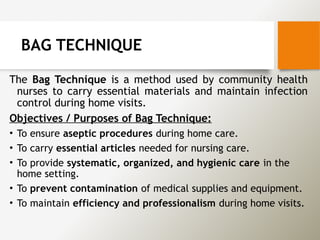
BAG TECHNIQUE
The BagTechnique is a method used by community health
nurses to carry essential materials and maintain infection
control during home visits.
Objectives / Purposes of Bag Technique:
• To ensure aseptic procedures during home care.
• To carry essential articles needed for nursing care.
• To provide systematic, organized, and hygienic care in the
home setting.
• To prevent contamination of medical supplies and equipment.
• To maintain efficiency and professionalism during home visits.
9.
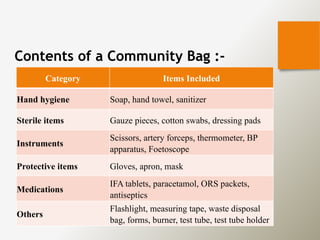
Contents of aCommunity Bag :-
Category Items Included
Hand hygiene Soap, hand towel, sanitizer
Sterile items Gauze pieces, cotton swabs, dressing pads
Instruments
Scissors, artery forceps, thermometer, BP
apparatus, Foetoscope
Protective items Gloves, apron, mask
Medications
IFA tablets, paracetamol, ORS packets,
antiseptics
Others
Flashlight, measuring tape, waste disposal
bag, forms, burner, test tube, test tube holder
10.
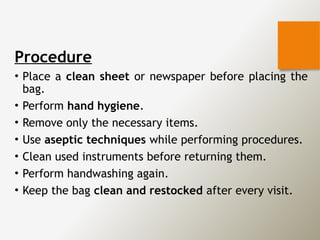
Procedure
• Place aclean sheet or newspaper before placing the
bag.
• Perform hand hygiene.
• Remove only the necessary items.
• Use aseptic techniques while performing procedures.
• Clean used instruments before returning them.
• Perform handwashing again.
• Keep the bag clean and restocked after every visit.
11.
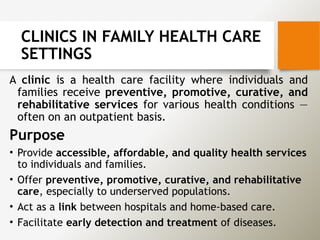
CLINICS IN FAMILYHEALTH CARE
SETTINGS
A clinic is a health care facility where individuals and
families receive preventive, promotive, curative, and
rehabilitative services for various health conditions —
often on an outpatient basis.
Purpose
• Provide accessible, affordable, and quality health services
to individuals and families.
• Offer preventive, promotive, curative, and rehabilitative
care, especially to underserved populations.
• Act as a link between hospitals and home-based care.
• Facilitate early detection and treatment of diseases.
12.
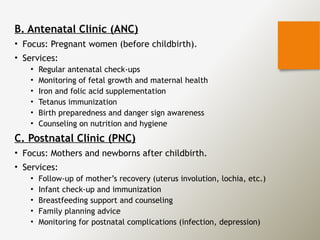
B. Antenatal Clinic(ANC)
• Focus: Pregnant women (before childbirth).
• Services:
• Regular antenatal check-ups
• Monitoring of fetal growth and maternal health
• Iron and folic acid supplementation
• Tetanus immunization
• Birth preparedness and danger sign awareness
• Counseling on nutrition and hygiene
C. Postnatal Clinic (PNC)
• Focus: Mothers and newborns after childbirth.
• Services:
• Follow-up of mother’s recovery (uterus involution, lochia, etc.)
• Infant check-up and immunization
• Breastfeeding support and counseling
• Family planning advice
• Monitoring for postnatal complications (infection, depression)
13.
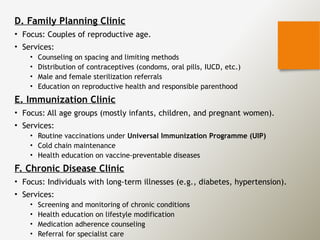
D. Family PlanningClinic
• Focus: Couples of reproductive age.
• Services:
• Counseling on spacing and limiting methods
• Distribution of contraceptives (condoms, oral pills, IUCD, etc.)
• Male and female sterilization referrals
• Education on reproductive health and responsible parenthood
E. Immunization Clinic
• Focus: All age groups (mostly infants, children, and pregnant women).
• Services:
• Routine vaccinations under Universal Immunization Programme (UIP)
• Cold chain maintenance
• Health education on vaccine-preventable diseases
F. Chronic Disease Clinic
• Focus: Individuals with long-term illnesses (e.g., diabetes, hypertension).
• Services:
• Screening and monitoring of chronic conditions
• Health education on lifestyle modification
• Medication adherence counseling
• Referral for specialist care
14.
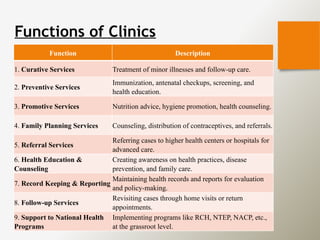
Functions of Clinics
FunctionDescription
1. Curative Services Treatment of minor illnesses and follow-up care.
2. Preventive Services
Immunization, antenatal checkups, screening, and
health education.
3. Promotive Services Nutrition advice, hygiene promotion, health counseling.
4. Family Planning Services Counseling, distribution of contraceptives, and referrals.
5. Referral Services
Referring cases to higher health centers or hospitals for
advanced care.
6. Health Education &
Counseling
Creating awareness on health practices, disease
prevention, and family care.
7. Record Keeping & Reporting
Maintaining health records and reports for evaluation
and policy-making.
8. Follow-up Services
Revisiting cases through home visits or return
appointments.
9. Support to National Health
Programs
Implementing programs like RCH, NTEP, NACP, etc.,
at the grassroot level.
15.
FUNCTIONS OF HEALTH
PERSONNELIN CLINICS
Health personnel play a crucial role in ensuring smooth operation of
clinics and delivery of preventive, promotive, curative, and
rehabilitative services.
These personnel include:
• Community Health Nurse (CHN)
• ANM (Auxiliary Nurse Midwife)
• Medical Officer
• Lady Health Visitor (LHV)
• Multipurpose Health Worker (MPHW)
• ASHA workers
Each plays a specific role in the functioning of clinics.
16.
1. Community HealthNurse (CHN)
• Assess family and community health needs.
• Assist in planning and conducting clinics (ANC, PNC, under-five).
• Provide nursing care, immunization, and health education.
• Maintain records and prepare reports.
• Conduct follow-up home visits.
• Refer patients to higher centers if needed.
• Guide ANMs and supervise their work.
2. Auxiliary Nurse Midwife (ANM)
• Conduct antenatal checkups and monitor pregnant women.
• Distribute iron-folic acid (IFA) and calcium tablets.
• Administer TT injections and routine immunizations.
• Educate mothers about breastfeeding, nutrition, and hygiene.
• Counsel couples for family planning.
• Assist in deliveries (if needed at sub-centres).
• Maintain health records and register eligible couples.
17.
3. Medical Officer
•Conduct clinical examination and diagnosis.
• Prescribe treatment and refer complex cases.
• Supervise all clinical and public health activities.
• Coordinate with health workers and other departments.
• Ensure implementation of national health programs.
• Attend review meetings and training sessions.
4. Lady Health Visitor (LHV)
• Supervise ANMs and MPHWs.
• Provide on-the-spot guidance and technical support.
• Ensure correct procedures during clinics.
• Help in conducting health education sessions.
• Review records and reports prepared by field staff.
18.
5. Multipurpose HealthWorker (MPHW)
• Support in immunization drives and sample collection.
• Distribute ORS, contraceptives, and basic medicines.
• Help maintain equipment and ensure availability of supplies.
• Assist in managing logistics during camps/clinics.
• Perform follow-up checks for chronic cases (e.g., TB, leprosy).
6. ASHA (Accredited Social Health Activist)
• Mobilize community to attend clinics.
• Identify pregnant women and newborns needing care.
• Promote institutional deliveries and immunization.
• Act as a link between the family and the health system.
• Distribute basic medicines (ORS, iron tablets, condoms).
• Assist in behavior change communication.
 Most read
 Most read
 Most read