THE CORE
PRINCIPLES OF
FAMILY MEDICINE
NPMCN 2020 REVISION
COURSE
DR SALAM T.O
MBBS, FWACP(FM), MPH(HPM)
CONSULTANT FAMILY PHYSICIAN,
UNIVERSITY COLLEGE HOSPITAL, IBADAN.
2
× History of Family Medicine
× Family Medicine as a specialty
× Domains of Family Medicine
× Core Principles of Family Medicine
× Tools used in Family Medicine
× Skills of a Family Physician
× Relevance of a Family Physician in Healthcare
delivery
3
 The development of family practice as a specialty occurred
at the end of a long period of decline in general practice in
US.
 Efforts to eliminate factors contributing to this decline led
to the establishment of the American Medical Association
Section on General Practice in 1946 and the American
Academy of General Practice in 1947 and culminated with
the final approval of the new discipline as a medical
specialty in 1969.
4
 According to the Flexner Report of 1910, there was
no standard guideline for medical training. It was
suggested that medical education should be
conducted solely at university-affiliated centers,
with a curricular focus on specialized care.
 The board of Opthalmology was the first specialty
board in America, and since then American Medical
Association has recognized many specialties.
5
 This resulted in the limited privileges of the General
Practitioners who were gradually replaced with the
specialist at the University Medical Centres, for medical
training and research.
 Medical students often passed through medical training
without been given the chance to view the actual
comprehensive primary care by a General Practitioner.
 Wingate Johnson publicly commented on the declined of
General Practitioners. He emphasized the competence,
efficiency of GP and the cost effectiveness of the general
medical practice.
6
 Emphasis was not only on diagnoses and treatment
of major diseases, but also on management of minor
complaints, and on the physicians’ relationship with
the patient, his family and other physicians.
 In 1946, there was a final approval for Family
Practice as the 20th specialty and the American
Academy of General Practice (AAGP) was
established in 1947.
7
 In 1949, AAGP proposed that the department of General
Practice be added to the medical schools.
 Ward Darley who was a private practitioner and internist,
made a strong endorsement of the concepts of the family
medicine, and declared that “fragmentation of medicine in
specialties continues to increase fragmentation of patient
care”.
 In 1962, WHO made a report on shortage of Family
Physicians, stressed the need for a designed postgraduate
study for more researches in the field of Family Medicine.
8
 Millis Report (1966) emphasized comprehensive patient’s
care and the need for training of FP as comparable in time
with that of other specialists.
 Folsom Report (1966) emphasized comprehensive and
continuity of care by the ‘personal Physicians’ and such
Doctors should be board certified, and accorded status and
income comparable to other specialists.
 Willard Report (1966) endorsed board certification for FP,
defines FP and concluded that the specialty has a body of
knowledge and a function which is significantly different
from other specialties.
9
 The development of Family Medicine as a specialty in
Nigeria can be traced to the activities of the Association of
General Medical Practitioners of Nigeria (AGMPN), and
the then Nigerian Medical and Dental Council (NMDC)
 There was rural-urban migration of Doctors, and the
AGMPN saw the need for CME programmes which was
recognised by the NMDC, and become the Faculty of
General Medical Practice(GMP) in the National Post-
Graduate Medical of College of Nigeria (NPMCN), with
statutory rights to train postgraduate doctors in Family
Medicine
10
 Postgraduate training in GMP commenced in Nigeria in
1979, and the curriculum for postgraduate training was
adopted by the NPMCN in 1980, with guidance by the
RCGMP.
 The faculty in the WACP and NPMCN changed name from
GMP to the faculty of Family Medicine in 2002 and 2006
respectively.
 The undergraduate Family Medicine curriculum of the new
integrated undergraduate medical education was formed in
2010 and adopted by the Nigerian University Commission
in 2012.
11
 Family Medicine is the medical specialty that provides
continuing and comprehensive health care for the
individual, in a holistic manner within the context of his
family and environment. It encompasses all ages, both
sexes and every disease entity, integrating biological,
clinical and behavioural science (Rackel)
 Family medicine is defined as that specialty of medicine
which is concerned with providing comprehensive care to
individuals and families and integrating biomedical,
behavioural and social sciences (WHO 2003)
12
 General Practice / Family Medicine is an academic and
scientific discipline, with its own educational content,
research, evidence base and clinical activity, and a clinical
specialty orientated to primary care (The European definitions
2011).
 Family Medicine is the speciality of first contact with the
patient, with an emphasis on providing comprehensive
physical, psychological and social care for the patient and
his family. (Riaz Qureshi ( Division of Family Medicine, The Aga Khan
University, Karachi).
13
 In Africa and the US, the term ‘Family Physician’ is used
unlike in the UK where ‘General Practitioner’ is used. A “GP”
in Africa is most of the time a ‘medical officer’ working in
private or public practice without any further training after the
undergraduate medical training.
 In Nigeria, a Family Physician has been trained in an
accredited postgraduate medical institution (National
Postgraduate Medical College of Nigeria and/or West African
College of Physicians) using an approved curriculum and
certified after passing a Fellowship examination (SOFPON).
14
 A specialist trained to provide health care services
for all individuals, regardless of age, sex or type of
health problem.
 A doctor who provides primary and continuing care
for entire families within their communities;
addresses physical, psychological and social
problems; and coordinates comprehensive health
care services with other specialists as needed
(WHO 2003).
15
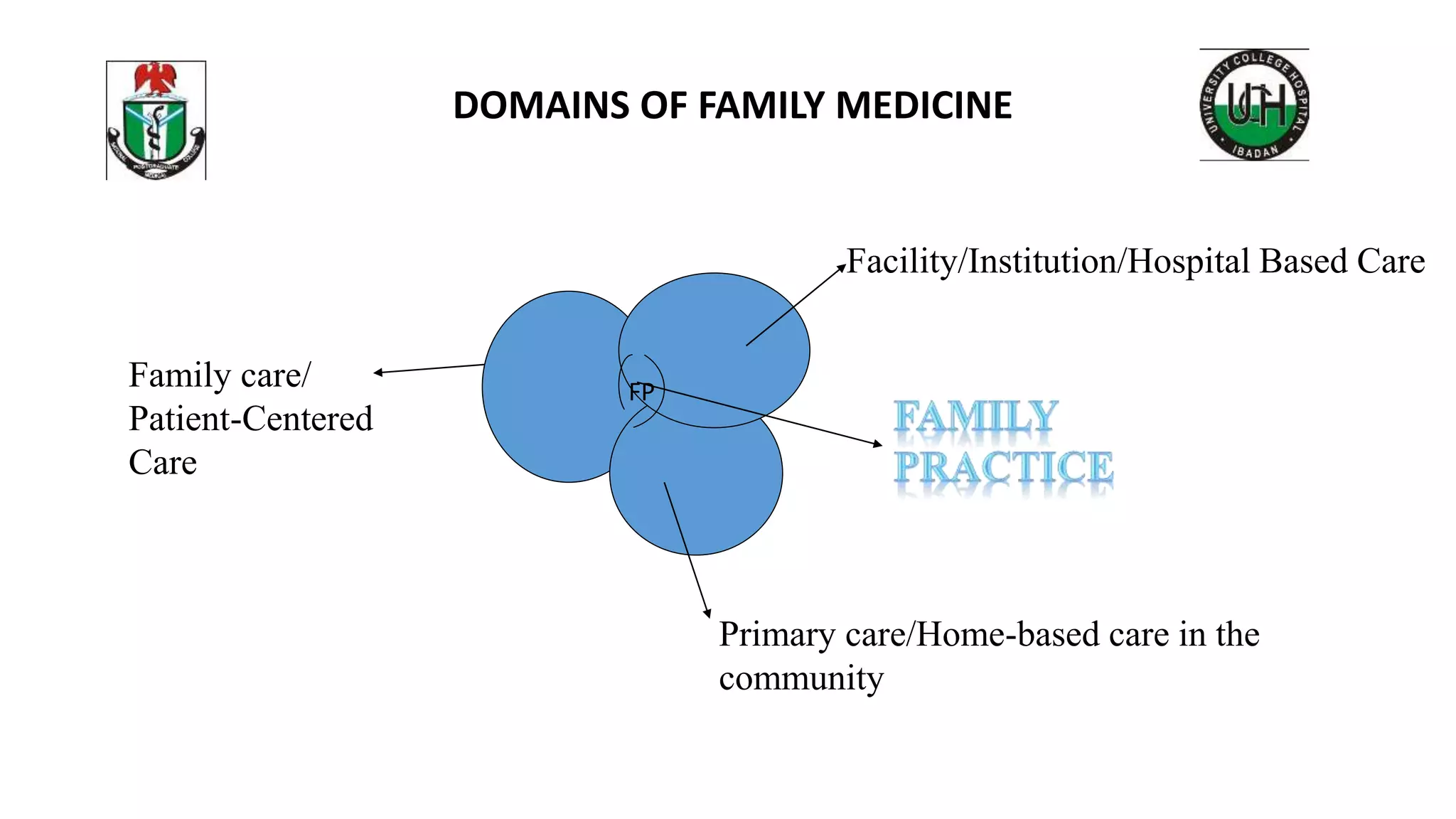
DOMAINS OF FAMILY MEDICINE
Family care/
Patient-Centered
Care
FP
Primary care/Home-based care in the
community
Facility/Institution/Hospital Based Care
Family Care: Is governed by the concept of family dynamics
in health and disease plus the concept of family system theory.
 Individuals cannot be understood in isolation, rather as a
part of their family (emotional unit). Families are systems
of interconnected and interdependent individuals.
 Health care that includes an assessment of the health of an
entire family, identification of factors that might influence
the health of its members, and implementation of
interventions needed to maintain or improve the health of
the unit and its members.
.
17
Hospital Care: health care provided for patients who need
other services including admission.
Primary Care: This is the provision of integrated, accessible
healthcare services by clinicians who are accountable for
addressing a large majority of personal healthcare needs,
developing a sustained partnership with patients, and practicing
in the context of family and community.
18
 Integrated care is the provision of comprehensive,
coordinated, and continuous services that provide a
seamless process of care.
 Comprehensive care addresses any health problem at any
given stage of a patient’s life cycle.
 Coordinated care is the provision of a combination of
health services and information to meet a patient’s needs.
19
 Continuous care refers to care over time by a single
individual or team of healthcare professionals (clinician
continuity) as well as effective and timely maintenance and
communication of health information (events, risks,
advice, and patient preferences –record continuity).
 Accessible care refers to the ease with which a patient can
initiate an interaction for any health problem with a
clinician and includes efforts to eliminate barriers such as
those posed by geography, administrative hurdles,
financing, culture, and language.
20
THE WONCA TREE: CORE COMPETENCIES &
CHARACTERISTICS OF FAMILY MEDICINE
1. Primary care management
2. Person-centred care
3. Specific problem solving skills
4. Community orientation
5. Comprehensive approach
6. Holistic modelling
22
Includes the ability to:
 manage primary contact with patients, dealing with unselected
problems
 cover the full range of health conditions
 co-ordinate care with other professionals in primary care and with
other specialists
 master effective and appropriate care provision and health service
utilisation
 make available to the patient the appropriate services within the
health care system
 act as advocate for the patient
23
Includes the ability to:
 adopt a person-centred approach in dealing with patients and
problems within the context of patient’s circumstances
 develop and apply the general practice consultation to bring
about an effective doctor- patient relationship, with respect for
the patient’s autonomy
 communicate, set priorities and act in partnership
 provide continuity of care as determined by the needs of the
patient, referring to others longitudinally and vertically
 provide continuing and co-ordinated care management
24
Includes the ability to:
 relate specific decision making processes to the prevalence and
incidence of illness in the community
 selectively gather and interpret information from history-taking,
physical examination, and investigations and apply it to an
appropriate management plan in collaboration with the patient
 adopt appropriate working principles. e.g. using time as a tool
 intervene urgently when necessary
 manage conditions which may present early and in an
undifferentiated way
 make effective and efficient use of diagnostic and therapeutic
interventions.
25
Includes the ability to:
 reconcile the health needs of individual patients and the
health needs of the community in which they live in
balance with available resources.
26
Includes the ability to:
 manage simultaneously multiple complaints and
pathologies, both acute and chronic health problems in
the individual
 promote health and well being by applying health
promotion and disease prevention strategies
appropriately
 manage and co-ordinate health promotion, prevention,
cure, care and palliation and rehabilitation.
27
Includes the ability to:
 use a bio-psycho-social model taking into account cultural
and existential (an approach that emphasizes the existence
of the individual patient as a free and responsible agent
determining their own care through acts of the will and
participation in decision making.) dimensions.
 assess the reason behind a patient’s visit and the specific
aspect of the complaint they would like to address.
FIFE: Function, Ideas, Fears and Expectations
28
29
The biopsychosocial model of health. Source: http://perspectivesclinic.com/health-psychology/. JAPA Vol. 26, No. 4, 2018
 It is the point of first medical contact within the health care
system, providing open and unlimited access to its users,
dealing with all health problems regardless of the age, sex,
or any other characteristic of the person concerned.
 It makes efficient use of health care resources through co-
ordinating care, working with other professionals in the
primary care setting, and by managing the interface with
other specialties taking an advocacy role for the patient
when needed.
 It develops a person-centred approach, orientated to the
individual, the family, and their community.
30
 It promotes patient empowerment
 It has a unique consultation process, which establishes a
relationship over time, through effective communication
between doctor and patient
 It is responsible for the provision of longitudinal continuity
of care as determined by the needs of the patient.
 It has a specific decision making process determined by
the prevalence and incidence of illness in the community.
 It manages simultaneously both acute and chronic health
problems of individual patients.
31
 It manages illness which presents in an undifferentiated
way at an early stage in its development, which may
require urgent intervention.
 It promotes health and well being both by appropriate and
effective intervention.
 It has a specific responsibility for the health of the
community.
 It deals with health problems in their physical,
psychological, social, cultural and existential dimensions.
32
33
 Family genogram/pedigree
 Family circle
 Family cycle/model/spiral/stage
 Time line
 Ecomap
 Home visit
 Family counselling/conferencing/therapy
 Family APGAR/SCREEM
34
 Diagnostic skills
 Preventive skills
 Therapeutic skills
 Resource management skills
 Research skills
 Ancillary skills (communication, project
management, writing and presentation skills)
35
36
ROLES OF FAMILY
PHYSICIANS
 Front-line/First contact
 Care provider
 Decision maker
 Communicator
 Coordinator
 Advocate
 Health Administrator
 Researcher
37
 In this age of sub-specialization, Family Medicine
is emerging throughout the world.
 Family Medicine is identified by all its principles
and models of care, that can be applied in
delivering quality and patient-centred care to
patients irrespective of the disease, sex or age.
 The Family Physicians are trained to acquire skills
to occupy strategic positions in health care system.
38
REFERENCES
 The European Definition of General Practice / Family Medicine Wonca Europe 2011 Edition
 WHO, Family Medicine Report of a Regional Scientific Working Group Meeting on Core
Curriculum Colombo, Sri Lanka, 9-13 July 2003. http://apps.searo.who.int/pds_docs/B3426.pdf
 http://www.sofpon.org/role-family-medicine-family-physicians-nigerian-health-sector/
 Canfield, P. R. (1976). Family medicine. Academic Medicine, 51(11), 904–
11. doi:10.1097/00001888-197611000-00003
 Seiyefa Fun-Akpa Brisibe,19 Inaugural Lecture Family Medicine: The complexities of
differentiating undifferentiated diseases in a differentiated profession. 2016
 AV Inem, OO Ayankogbe, M Obazee, MM Ladipo, NE Udonwa, Kofo Odusote. What Constitutes
The Domain of Family Medicine in West Africa. 2004
 Older Adults’ Needs and Preferences for Open Space and Physical Activity In and Near Parks: A
Systematic Review - Scientific Figure on ResearchGate. Available from:
https://www.researchgate.net/figure/The-biopsychosocial-model-of-health-
Source_fig2_321893403 [accessed 1 Jan, 2020]
39
ANY
QUESTIONS ?
40

Core Principles of Family Medicine.pptx

  • 1.
    THE CORE PRINCIPLES OF FAMILYMEDICINE NPMCN 2020 REVISION COURSE
  • 2.
    DR SALAM T.O MBBS,FWACP(FM), MPH(HPM) CONSULTANT FAMILY PHYSICIAN, UNIVERSITY COLLEGE HOSPITAL, IBADAN. 2
  • 3.
    × History ofFamily Medicine × Family Medicine as a specialty × Domains of Family Medicine × Core Principles of Family Medicine × Tools used in Family Medicine × Skills of a Family Physician × Relevance of a Family Physician in Healthcare delivery 3
  • 4.
     The developmentof family practice as a specialty occurred at the end of a long period of decline in general practice in US.  Efforts to eliminate factors contributing to this decline led to the establishment of the American Medical Association Section on General Practice in 1946 and the American Academy of General Practice in 1947 and culminated with the final approval of the new discipline as a medical specialty in 1969. 4
  • 5.
     According tothe Flexner Report of 1910, there was no standard guideline for medical training. It was suggested that medical education should be conducted solely at university-affiliated centers, with a curricular focus on specialized care.  The board of Opthalmology was the first specialty board in America, and since then American Medical Association has recognized many specialties. 5
  • 6.
     This resultedin the limited privileges of the General Practitioners who were gradually replaced with the specialist at the University Medical Centres, for medical training and research.  Medical students often passed through medical training without been given the chance to view the actual comprehensive primary care by a General Practitioner.  Wingate Johnson publicly commented on the declined of General Practitioners. He emphasized the competence, efficiency of GP and the cost effectiveness of the general medical practice. 6
  • 7.
     Emphasis wasnot only on diagnoses and treatment of major diseases, but also on management of minor complaints, and on the physicians’ relationship with the patient, his family and other physicians.  In 1946, there was a final approval for Family Practice as the 20th specialty and the American Academy of General Practice (AAGP) was established in 1947. 7
  • 8.
     In 1949,AAGP proposed that the department of General Practice be added to the medical schools.  Ward Darley who was a private practitioner and internist, made a strong endorsement of the concepts of the family medicine, and declared that “fragmentation of medicine in specialties continues to increase fragmentation of patient care”.  In 1962, WHO made a report on shortage of Family Physicians, stressed the need for a designed postgraduate study for more researches in the field of Family Medicine. 8
  • 9.
     Millis Report(1966) emphasized comprehensive patient’s care and the need for training of FP as comparable in time with that of other specialists.  Folsom Report (1966) emphasized comprehensive and continuity of care by the ‘personal Physicians’ and such Doctors should be board certified, and accorded status and income comparable to other specialists.  Willard Report (1966) endorsed board certification for FP, defines FP and concluded that the specialty has a body of knowledge and a function which is significantly different from other specialties. 9
  • 10.
     The developmentof Family Medicine as a specialty in Nigeria can be traced to the activities of the Association of General Medical Practitioners of Nigeria (AGMPN), and the then Nigerian Medical and Dental Council (NMDC)  There was rural-urban migration of Doctors, and the AGMPN saw the need for CME programmes which was recognised by the NMDC, and become the Faculty of General Medical Practice(GMP) in the National Post- Graduate Medical of College of Nigeria (NPMCN), with statutory rights to train postgraduate doctors in Family Medicine 10
  • 11.
     Postgraduate trainingin GMP commenced in Nigeria in 1979, and the curriculum for postgraduate training was adopted by the NPMCN in 1980, with guidance by the RCGMP.  The faculty in the WACP and NPMCN changed name from GMP to the faculty of Family Medicine in 2002 and 2006 respectively.  The undergraduate Family Medicine curriculum of the new integrated undergraduate medical education was formed in 2010 and adopted by the Nigerian University Commission in 2012. 11
  • 12.
     Family Medicineis the medical specialty that provides continuing and comprehensive health care for the individual, in a holistic manner within the context of his family and environment. It encompasses all ages, both sexes and every disease entity, integrating biological, clinical and behavioural science (Rackel)  Family medicine is defined as that specialty of medicine which is concerned with providing comprehensive care to individuals and families and integrating biomedical, behavioural and social sciences (WHO 2003) 12
  • 13.
     General Practice/ Family Medicine is an academic and scientific discipline, with its own educational content, research, evidence base and clinical activity, and a clinical specialty orientated to primary care (The European definitions 2011).  Family Medicine is the speciality of first contact with the patient, with an emphasis on providing comprehensive physical, psychological and social care for the patient and his family. (Riaz Qureshi ( Division of Family Medicine, The Aga Khan University, Karachi). 13
  • 14.
     In Africaand the US, the term ‘Family Physician’ is used unlike in the UK where ‘General Practitioner’ is used. A “GP” in Africa is most of the time a ‘medical officer’ working in private or public practice without any further training after the undergraduate medical training.  In Nigeria, a Family Physician has been trained in an accredited postgraduate medical institution (National Postgraduate Medical College of Nigeria and/or West African College of Physicians) using an approved curriculum and certified after passing a Fellowship examination (SOFPON). 14
  • 15.
     A specialisttrained to provide health care services for all individuals, regardless of age, sex or type of health problem.  A doctor who provides primary and continuing care for entire families within their communities; addresses physical, psychological and social problems; and coordinates comprehensive health care services with other specialists as needed (WHO 2003). 15
  • 16.
    DOMAINS OF FAMILYMEDICINE Family care/ Patient-Centered Care FP Primary care/Home-based care in the community Facility/Institution/Hospital Based Care
  • 17.
    Family Care: Isgoverned by the concept of family dynamics in health and disease plus the concept of family system theory.  Individuals cannot be understood in isolation, rather as a part of their family (emotional unit). Families are systems of interconnected and interdependent individuals.  Health care that includes an assessment of the health of an entire family, identification of factors that might influence the health of its members, and implementation of interventions needed to maintain or improve the health of the unit and its members. . 17
  • 18.
    Hospital Care: healthcare provided for patients who need other services including admission. Primary Care: This is the provision of integrated, accessible healthcare services by clinicians who are accountable for addressing a large majority of personal healthcare needs, developing a sustained partnership with patients, and practicing in the context of family and community. 18
  • 19.
     Integrated careis the provision of comprehensive, coordinated, and continuous services that provide a seamless process of care.  Comprehensive care addresses any health problem at any given stage of a patient’s life cycle.  Coordinated care is the provision of a combination of health services and information to meet a patient’s needs. 19
  • 20.
     Continuous carerefers to care over time by a single individual or team of healthcare professionals (clinician continuity) as well as effective and timely maintenance and communication of health information (events, risks, advice, and patient preferences –record continuity).  Accessible care refers to the ease with which a patient can initiate an interaction for any health problem with a clinician and includes efforts to eliminate barriers such as those posed by geography, administrative hurdles, financing, culture, and language. 20
  • 21.
    THE WONCA TREE:CORE COMPETENCIES & CHARACTERISTICS OF FAMILY MEDICINE
  • 22.
    1. Primary caremanagement 2. Person-centred care 3. Specific problem solving skills 4. Community orientation 5. Comprehensive approach 6. Holistic modelling 22
  • 23.
    Includes the abilityto:  manage primary contact with patients, dealing with unselected problems  cover the full range of health conditions  co-ordinate care with other professionals in primary care and with other specialists  master effective and appropriate care provision and health service utilisation  make available to the patient the appropriate services within the health care system  act as advocate for the patient 23
  • 24.
    Includes the abilityto:  adopt a person-centred approach in dealing with patients and problems within the context of patient’s circumstances  develop and apply the general practice consultation to bring about an effective doctor- patient relationship, with respect for the patient’s autonomy  communicate, set priorities and act in partnership  provide continuity of care as determined by the needs of the patient, referring to others longitudinally and vertically  provide continuing and co-ordinated care management 24
  • 25.
    Includes the abilityto:  relate specific decision making processes to the prevalence and incidence of illness in the community  selectively gather and interpret information from history-taking, physical examination, and investigations and apply it to an appropriate management plan in collaboration with the patient  adopt appropriate working principles. e.g. using time as a tool  intervene urgently when necessary  manage conditions which may present early and in an undifferentiated way  make effective and efficient use of diagnostic and therapeutic interventions. 25
  • 26.
    Includes the abilityto:  reconcile the health needs of individual patients and the health needs of the community in which they live in balance with available resources. 26
  • 27.
    Includes the abilityto:  manage simultaneously multiple complaints and pathologies, both acute and chronic health problems in the individual  promote health and well being by applying health promotion and disease prevention strategies appropriately  manage and co-ordinate health promotion, prevention, cure, care and palliation and rehabilitation. 27
  • 28.
    Includes the abilityto:  use a bio-psycho-social model taking into account cultural and existential (an approach that emphasizes the existence of the individual patient as a free and responsible agent determining their own care through acts of the will and participation in decision making.) dimensions.  assess the reason behind a patient’s visit and the specific aspect of the complaint they would like to address. FIFE: Function, Ideas, Fears and Expectations 28
  • 29.
    29 The biopsychosocial modelof health. Source: http://perspectivesclinic.com/health-psychology/. JAPA Vol. 26, No. 4, 2018
  • 30.
     It isthe point of first medical contact within the health care system, providing open and unlimited access to its users, dealing with all health problems regardless of the age, sex, or any other characteristic of the person concerned.  It makes efficient use of health care resources through co- ordinating care, working with other professionals in the primary care setting, and by managing the interface with other specialties taking an advocacy role for the patient when needed.  It develops a person-centred approach, orientated to the individual, the family, and their community. 30
  • 31.
     It promotespatient empowerment  It has a unique consultation process, which establishes a relationship over time, through effective communication between doctor and patient  It is responsible for the provision of longitudinal continuity of care as determined by the needs of the patient.  It has a specific decision making process determined by the prevalence and incidence of illness in the community.  It manages simultaneously both acute and chronic health problems of individual patients. 31
  • 32.
     It managesillness which presents in an undifferentiated way at an early stage in its development, which may require urgent intervention.  It promotes health and well being both by appropriate and effective intervention.  It has a specific responsibility for the health of the community.  It deals with health problems in their physical, psychological, social, cultural and existential dimensions. 32
  • 33.
  • 34.
     Family genogram/pedigree Family circle  Family cycle/model/spiral/stage  Time line  Ecomap  Home visit  Family counselling/conferencing/therapy  Family APGAR/SCREEM 34
  • 35.
     Diagnostic skills Preventive skills  Therapeutic skills  Resource management skills  Research skills  Ancillary skills (communication, project management, writing and presentation skills) 35
  • 36.
  • 37.
    ROLES OF FAMILY PHYSICIANS Front-line/First contact  Care provider  Decision maker  Communicator  Coordinator  Advocate  Health Administrator  Researcher 37
  • 38.
     In thisage of sub-specialization, Family Medicine is emerging throughout the world.  Family Medicine is identified by all its principles and models of care, that can be applied in delivering quality and patient-centred care to patients irrespective of the disease, sex or age.  The Family Physicians are trained to acquire skills to occupy strategic positions in health care system. 38
  • 39.
    REFERENCES  The EuropeanDefinition of General Practice / Family Medicine Wonca Europe 2011 Edition  WHO, Family Medicine Report of a Regional Scientific Working Group Meeting on Core Curriculum Colombo, Sri Lanka, 9-13 July 2003. http://apps.searo.who.int/pds_docs/B3426.pdf  http://www.sofpon.org/role-family-medicine-family-physicians-nigerian-health-sector/  Canfield, P. R. (1976). Family medicine. Academic Medicine, 51(11), 904– 11. doi:10.1097/00001888-197611000-00003  Seiyefa Fun-Akpa Brisibe,19 Inaugural Lecture Family Medicine: The complexities of differentiating undifferentiated diseases in a differentiated profession. 2016  AV Inem, OO Ayankogbe, M Obazee, MM Ladipo, NE Udonwa, Kofo Odusote. What Constitutes The Domain of Family Medicine in West Africa. 2004  Older Adults’ Needs and Preferences for Open Space and Physical Activity In and Near Parks: A Systematic Review - Scientific Figure on ResearchGate. Available from: https://www.researchgate.net/figure/The-biopsychosocial-model-of-health- Source_fig2_321893403 [accessed 1 Jan, 2020] 39
  • 40.