Failure of Mars Climate
Orbiter
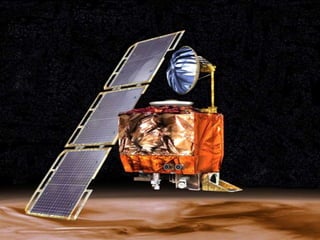
 Mars climate orbiter is also called Mars Surveyor ‘98
Orbiter.
 Manufactured by Lockheed Martin which is industrial
partner of NASA.
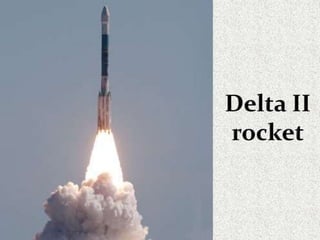
 It was launched by NASA by Delta II 7425 rocket from
Cape Canaveral.
 Launched on December 11, 1998.
 Weight: 338 Kilograms
 Cost of mission $193.25 million.
 To determine existence of water on Mars.
 Monitor weather and atmospheric conditions on Mars.
 Determining temperature and surface changes on
Mars.
 Monitor water vapour and dust contents in
atmosphere.
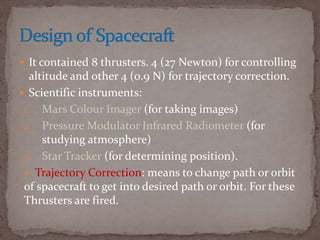
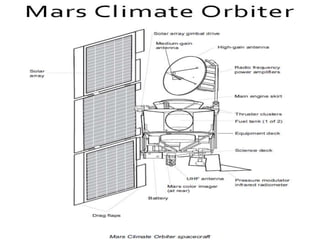
 It contained 8 thrusters. 4 (27 Newton) for controlling
altitude and other 4 (0.9 N) for trajectory correction.
 Scientific instruments:
1. Mars Colour Imager (for taking images)
2. Pressure Modulator Infrared Radiometer (for
studying atmosphere)
3. Star Tracker (for determining position).
 Trajectory Correction: means to change path or orbit
of spacecraft to get into desired path or orbit. For these
Thrusters are fired.
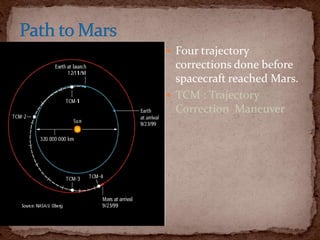
 Four trajectory
corrections done before
spacecraft reached Mars.
 TCM : Trajectory
Correction Maneuver
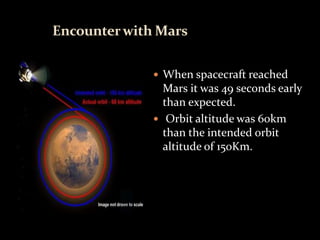
 When spacecraft reached
Mars it was 49 seconds early
than expected.
 Orbit altitude was 60km
than the intended orbit
altitude of 150Km.
Encounterwith Mars
 Nov. 10,1999, Mars Climate Orbiter Mishap
Investigation Board released a report of failure.
 According to report on Sept 15 trajectory correction
was done to bring orbiter at 226Km altitude.
 But it was found that orbiter was in much lower orbit
than 150Km. 80Km was minimum altitude that the
orbiter could survive.
 On Sept 23,
1. 9am: Main engine was started and fired for 16
minutes for entering orbit of Mars.
2. After few minutes it lost contact with ground.
3. On Sept 25 mission was declared a loss.
 Team of engineers of Lockheed developed a software
whose results were in English units (Pound, foot,
inch).
 Mission navigation team of NASA used these results
for its system ,expecting it to be in SI units.
 During mission, the software of thrusters calculated
force in English units.
 Results of that software were used in trajectory
corrections expecting it to be in SI.
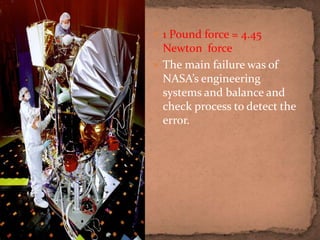
 1 Pound force = 4.45
Newton force
 The main failure was of
NASA’s engineering
systems and balance and
check process to detect the
error.
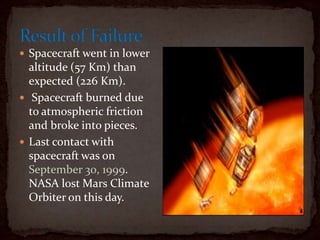
 Spacecraft went in lower
altitude (57 Km) than
expected (226 Km).
 Spacecraft burned due
to atmospheric friction
and broke into pieces.
 Last contact with
spacecraft was on
September 30, 1999.
NASA lost Mars Climate
Orbiter on this day.
Failure of Mars Climate Orbiter

Failure of Mars Climate Orbiter

  • 1.
    Failure of MarsClimate Orbiter
  • 3.
     Mars climateorbiter is also called Mars Surveyor ‘98 Orbiter.  Manufactured by Lockheed Martin which is industrial partner of NASA.  It was launched by NASA by Delta II 7425 rocket from Cape Canaveral.  Launched on December 11, 1998.  Weight: 338 Kilograms  Cost of mission $193.25 million.
  • 5.
     To determineexistence of water on Mars.  Monitor weather and atmospheric conditions on Mars.  Determining temperature and surface changes on Mars.  Monitor water vapour and dust contents in atmosphere.
  • 6.
     It contained8 thrusters. 4 (27 Newton) for controlling altitude and other 4 (0.9 N) for trajectory correction.  Scientific instruments: 1. Mars Colour Imager (for taking images) 2. Pressure Modulator Infrared Radiometer (for studying atmosphere) 3. Star Tracker (for determining position).  Trajectory Correction: means to change path or orbit of spacecraft to get into desired path or orbit. For these Thrusters are fired.
  • 8.
     Four trajectory correctionsdone before spacecraft reached Mars.  TCM : Trajectory Correction Maneuver
  • 9.
     When spacecraftreached Mars it was 49 seconds early than expected.  Orbit altitude was 60km than the intended orbit altitude of 150Km. Encounterwith Mars
  • 10.
     Nov. 10,1999,Mars Climate Orbiter Mishap Investigation Board released a report of failure.  According to report on Sept 15 trajectory correction was done to bring orbiter at 226Km altitude.  But it was found that orbiter was in much lower orbit than 150Km. 80Km was minimum altitude that the orbiter could survive.  On Sept 23, 1. 9am: Main engine was started and fired for 16 minutes for entering orbit of Mars. 2. After few minutes it lost contact with ground. 3. On Sept 25 mission was declared a loss.
  • 11.
     Team ofengineers of Lockheed developed a software whose results were in English units (Pound, foot, inch).  Mission navigation team of NASA used these results for its system ,expecting it to be in SI units.  During mission, the software of thrusters calculated force in English units.  Results of that software were used in trajectory corrections expecting it to be in SI.
  • 12.
     1 Poundforce = 4.45 Newton force  The main failure was of NASA’s engineering systems and balance and check process to detect the error.
  • 13.
     Spacecraft wentin lower altitude (57 Km) than expected (226 Km).  Spacecraft burned due to atmospheric friction and broke into pieces.  Last contact with spacecraft was on September 30, 1999. NASA lost Mars Climate Orbiter on this day.