Overview of faecal sludge management challenges and practices
The document discusses the critical challenges and practices surrounding faecal sludge management (FSM) globally, highlighting that 2.6 billion people relying on onsite sanitation methods require improved management services. Key challenges include limited regulatory frameworks, environmental impacts of poor sanitation systems, and the need for innovative business models for productive reuse of faecal sludge. The need for effective FSM spans rural, small town, and urban contexts, with urban areas facing the most significant hurdles.
In this document
Powered by AI
Introduction to the need for improved faecal sludge management (FSM) and overview of challenges faced.
FSM underlines the neglect in sanitation management; 2.6 billion require services, with significant impacts on health and environment.
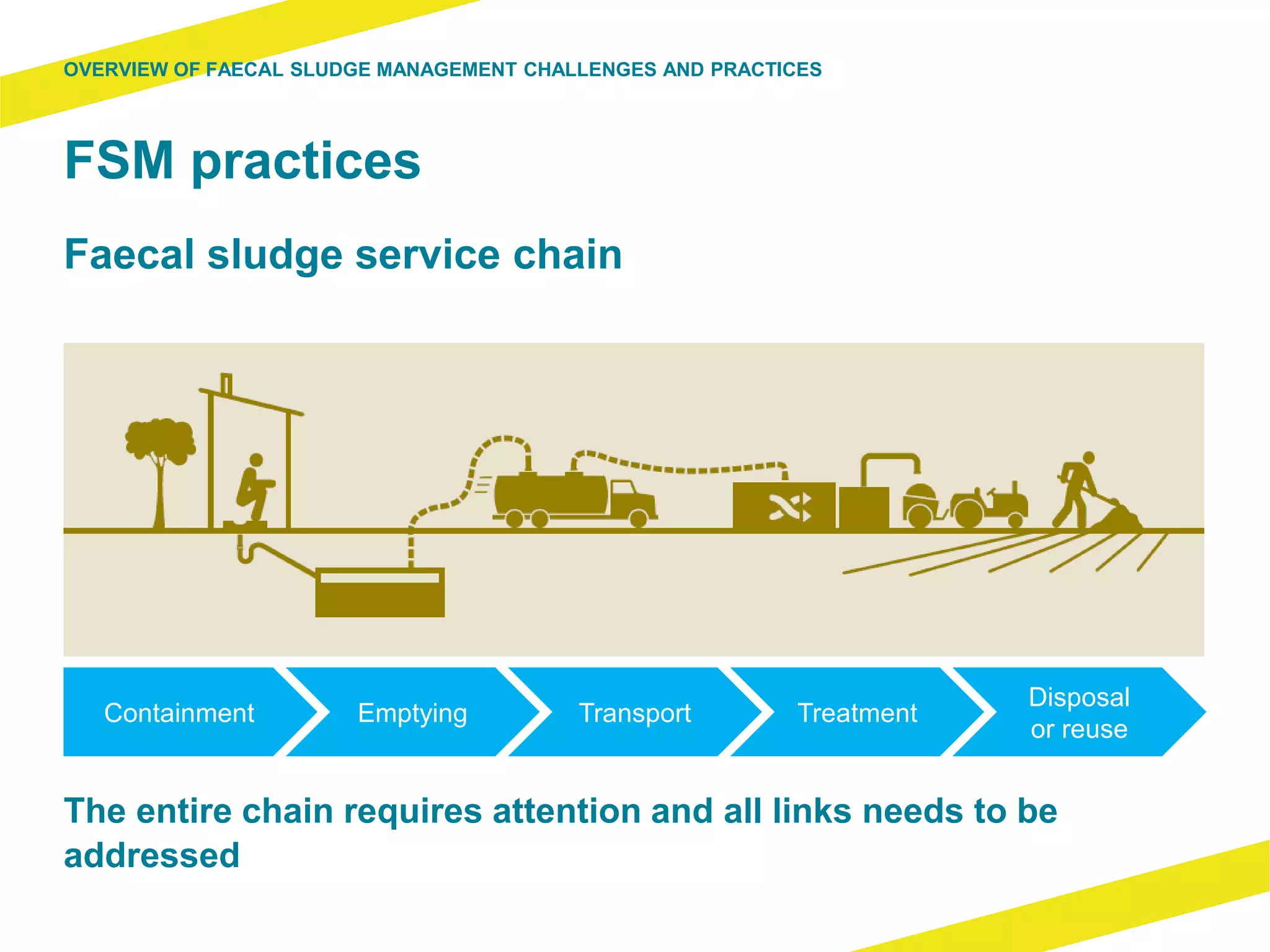
The faecal sludge service chain needs attention across containment, emptying, transport, treatment, disposal.
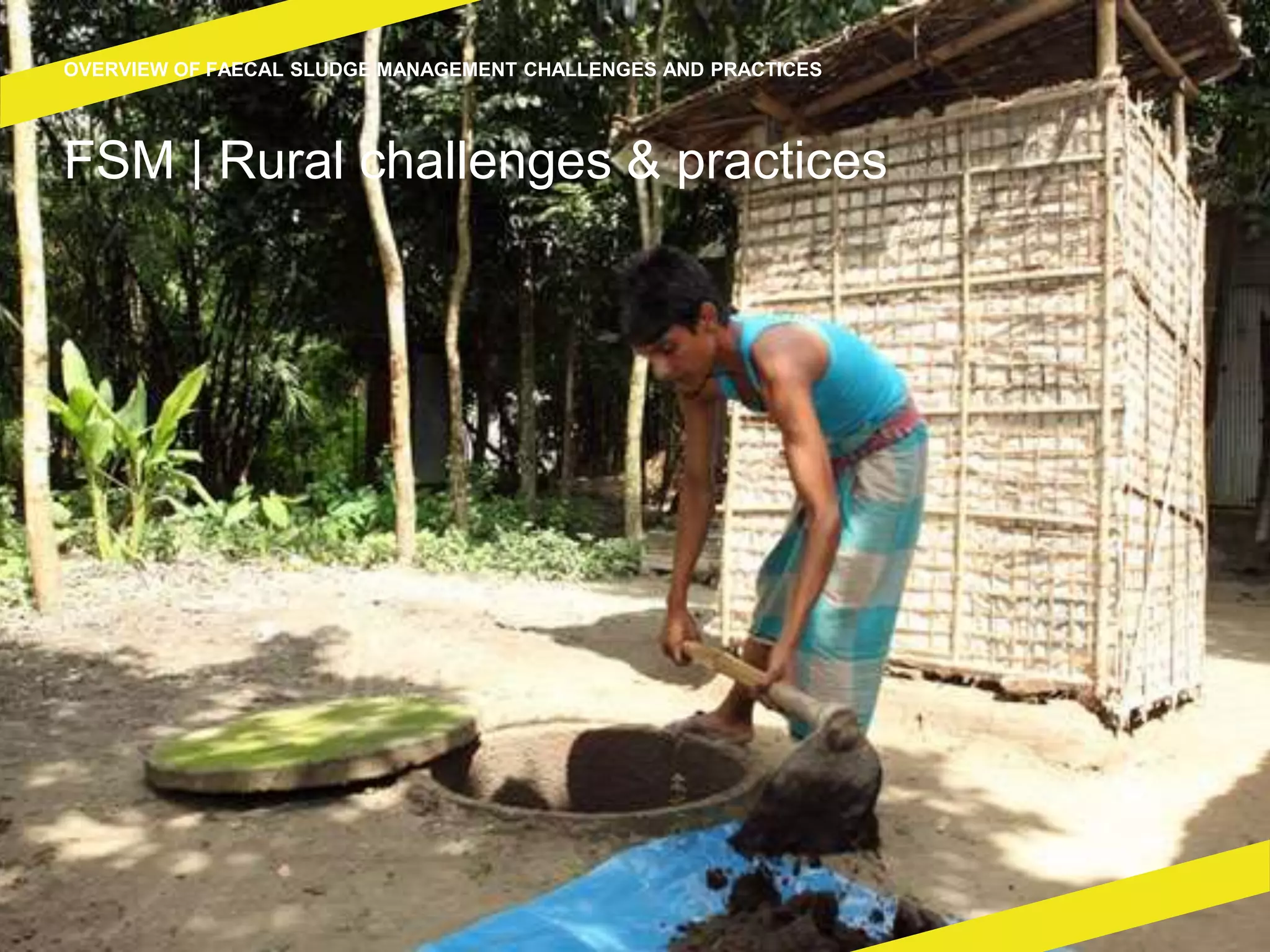
Rural FSM is often ignored; manual emptying dominates. Solutions include viable business models for waste reuse.
Similar characteristics as rural areas but need for appropriate sanitation technology as density increases.
Urban areas face the most severe challenges with poor containment, emptying, treatment, and limited business interest in profitable models.
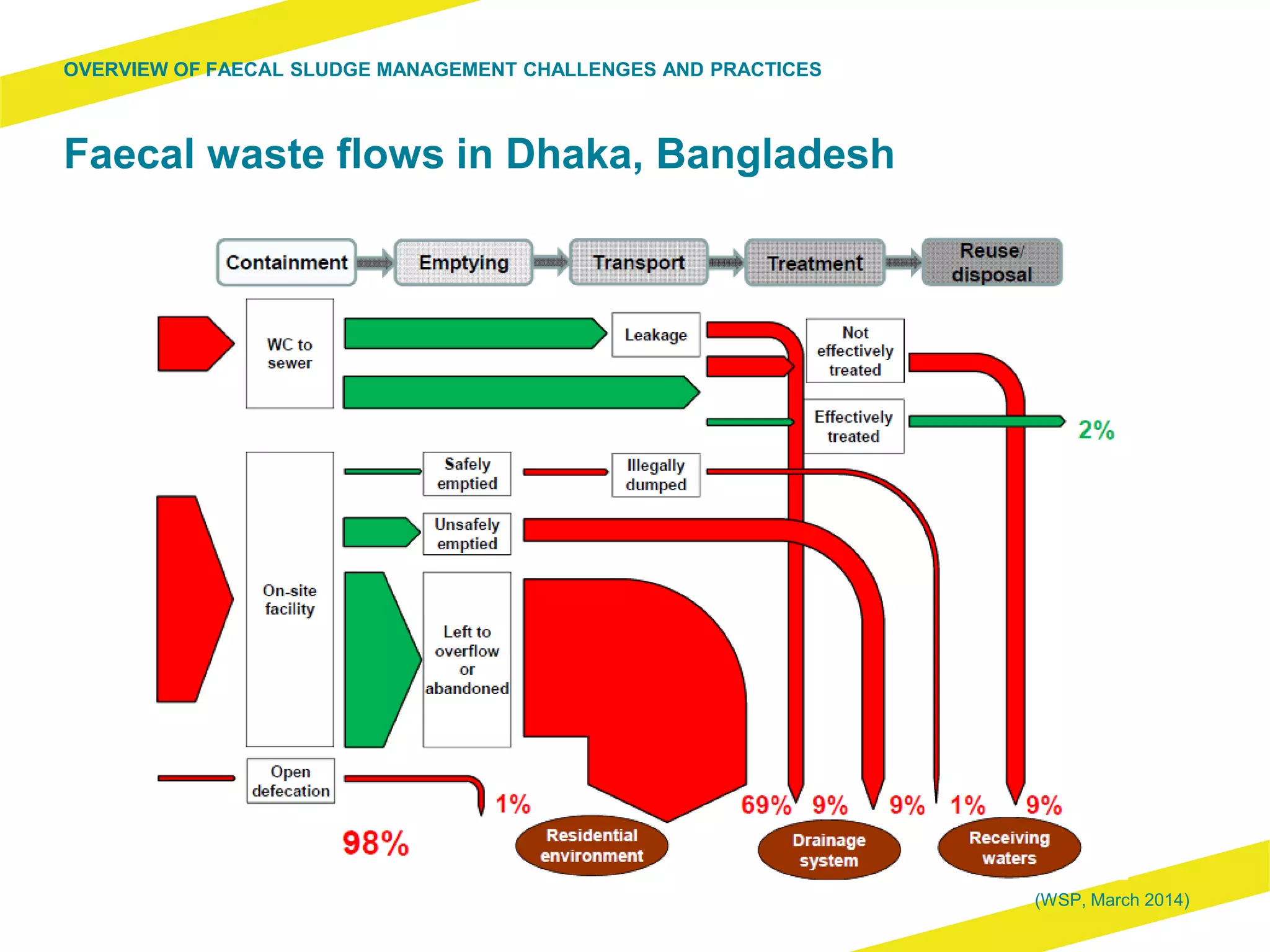
Case study of faecal waste in Dhaka, along with references for further reading.
Overview of faecal sludge management challenges and practices
1.
Supporting water sanitation
andhygiene services for life
The Hague, The Netherlands
Thursday 17 April 2014
Overview of faecal sludge
management challenges
and practices
Erick Baetings
IRC
2.
Index
• Context
• RuralFSM challenges and practices
• Small town FSM challenges and
practices
• Urban FSM challenges and practices
OVERVIEW OF FAECAL SLUDGE MANAGEMENT CHALLENGES AND PRACTICES
3.
Putting it incontext | FSM challenges
• Most programs focus(ed) on increasing access to
sanitation facilities by investing in onsite sanitation
systems.
• The management of onsite sanitation remains a neglected
component of urban (and rural) sanitation.
• Result: onsite facilities have become major sources of
groundwater and surface water pollution, with
significant environmental, public health, and
economic impacts.
OVERVIEW OF FAECAL SLUDGE MANAGEMENT CHALLENGES AND PRACTICES
4.
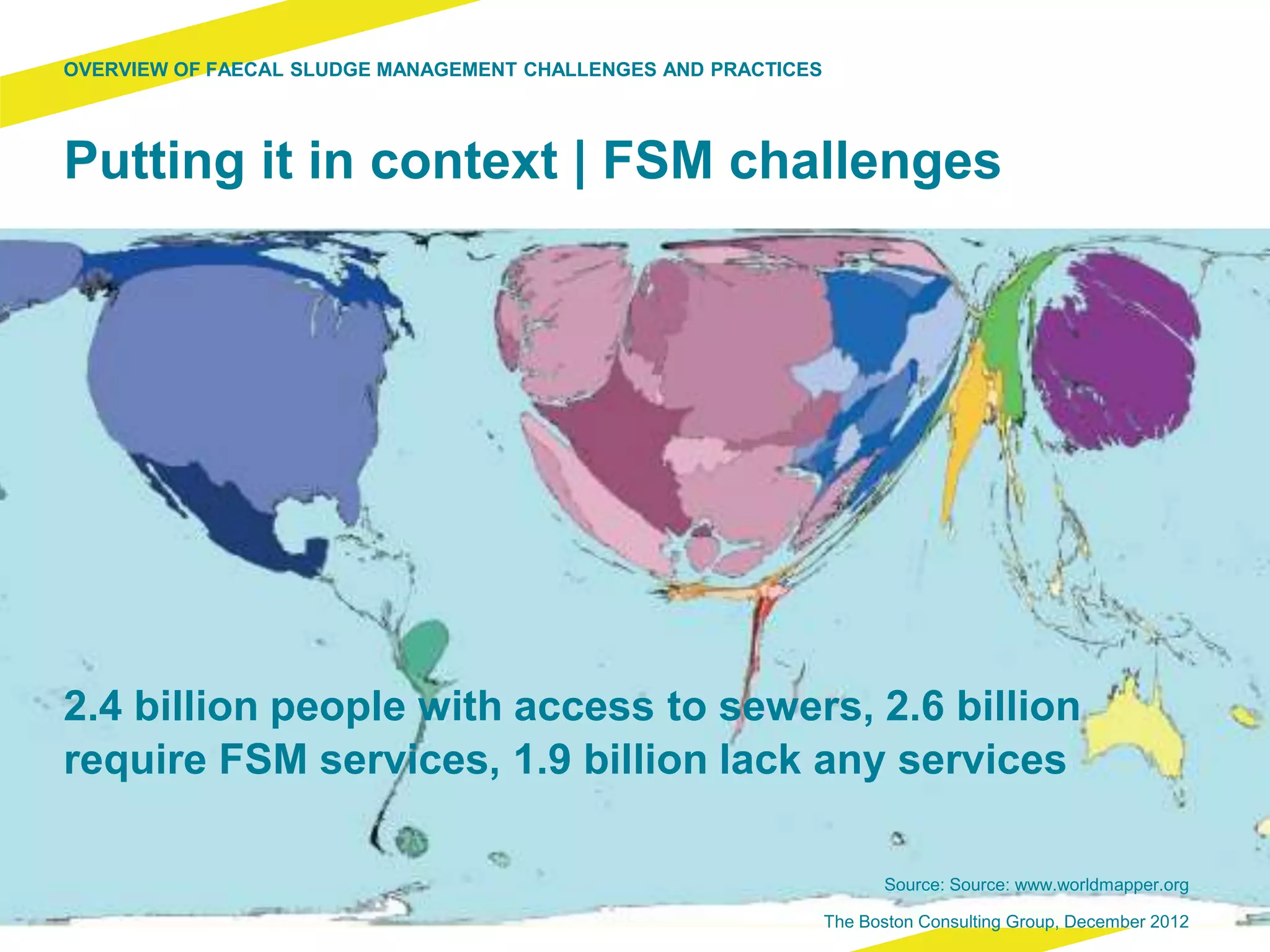
2.4 billion peoplewith access to sewers, 2.6 billion
require FSM services, 1.9 billion lack any services
Putting it in context | FSM challenges
OVERVIEW OF FAECAL SLUDGE MANAGEMENT CHALLENGES AND PRACTICES
Source: Source: www.worldmapper.org
The Boston Consulting Group, December 2012
5.
Putting it incontext | FSM challenges
Today, ~2.6 billion people worldwide are served by
(onsite) sanitation methods1 that need faecal sludge
management
If current trends persist, by 2030, FSM services may
be required by some 4.9 billion people
Estimated volume of faecal sludge comes to some 245
billion litres per year with a market potential of $2.3
billion per year
(The Boston Consulting Group, December 2012)
OVERVIEW OF FAECAL SLUDGE MANAGEMENT CHALLENGES AND PRACTICES
1Septic tanks, flush/pour-flush pits, and dry pit latrines
6.
Putting it incontext | FSM challenges
Key challenges:
• Limited awareness of policymakers on FSM
• Lack of legal and regulatory framework for FSM resulting in
informal and unregulated service provision
• Limited performance of existing sanitation technologies
• Limited capacity to design, construct, and operate FSM
infrastructure
• Ignorance on potential of faecal sludge for productive use in
agriculture and energy sectors
OVERVIEW OF FAECAL SLUDGE MANAGEMENT CHALLENGES AND PRACTICES
7.
FSM practices
Faecal sludgeservice chain
The entire chain requires attention and all links needs to be
addressed
OVERVIEW OF FAECAL SLUDGE MANAGEMENT CHALLENGES AND PRACTICES
Containment Emptying Transport Treatment
Disposal
or reuse
8.
FSM | Ruralchallenges & practices
OVERVIEW OF FAECAL SLUDGE MANAGEMENT CHALLENGES AND PRACTICES
9.
FSM practices |Rural challenges & practices
• Still relatively problem free but FSM can not be ignored much
longer
• Manual pit emptying is most common as access to
mechanised pit emptying services is limited
• Currently there are basically only three options when pit is full:
1) Abandon toilet altogether
2) Empty pit (manually) and dispose sludge in another pit or directly
in the environment (fields, open water bodies, etc.)
3) Dig a new pit and build new toilet
• Need for compost is high to improve organic composition and
structure of the soil BUT sludge is hardly reused
OVERVIEW OF FAECAL SLUDGE MANAGEMENT CHALLENGES AND PRACTICES
FSM | Ruralchallenges & practices
• Limited attention to develop viable business models
• BRAC WASH programme in Bangladesh is developing and
testing faecal sludge productive use business models:
Small-scale businesses: local production of organic
fertiliser by making use of micro-enterprises
Large-scale business proposition: digestion of a mix of
agricultural waste, chicken manure and faecal sludge to
produce 3,000 MWh electricity and about 1,500 tons of
organic fertiliser
OVERVIEW OF FAECAL SLUDGE MANAGEMENT CHALLENGES AND PRACTICES
12.
FSM | Smalltown challenges & practices
OVERVIEW OF FAECAL SLUDGE MANAGEMENT CHALLENGES AND PRACTICES
13.
FSM | Smalltown challenges & practices
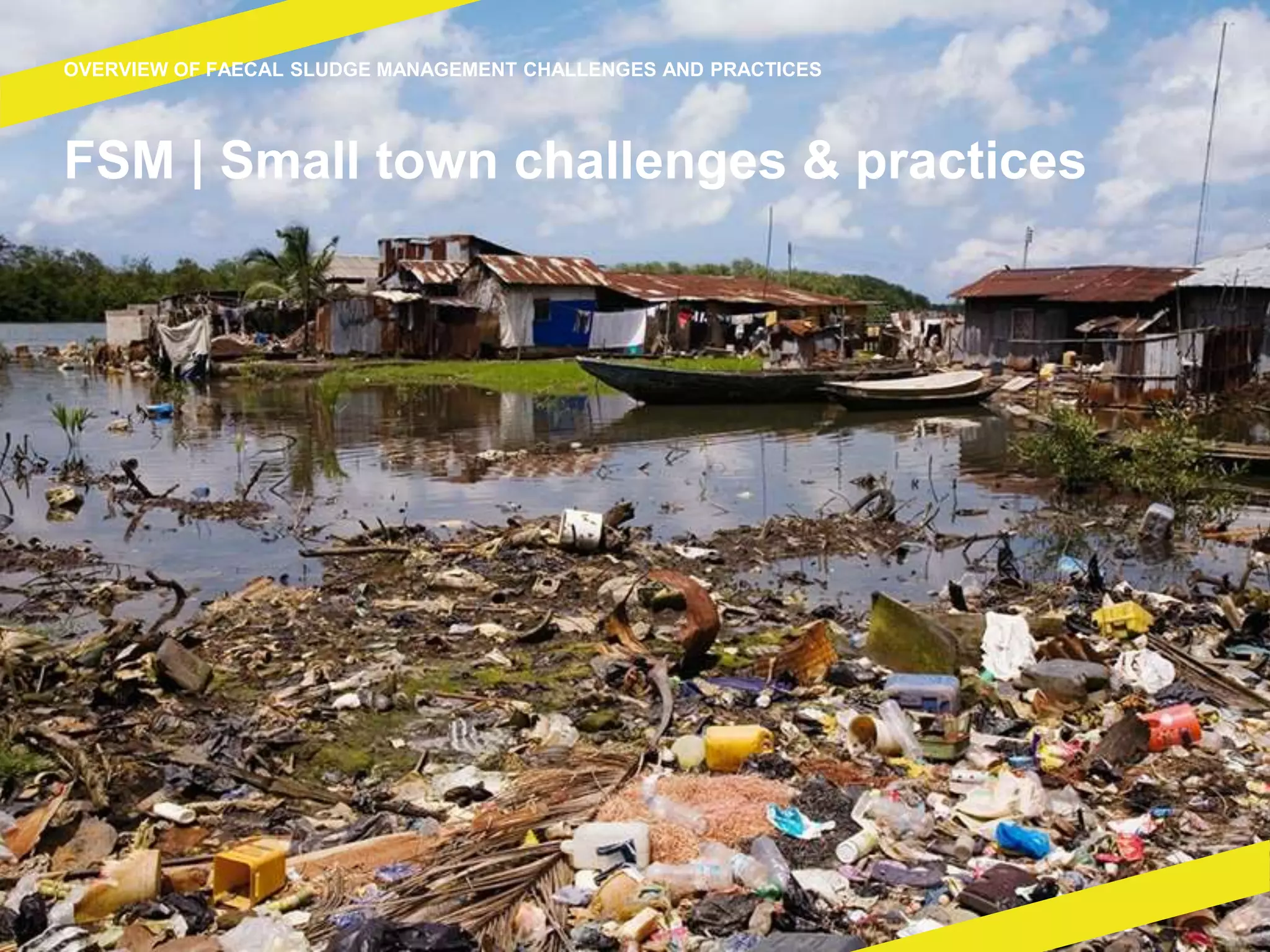
Smaller towns are likely to have rural characteristics with
the same challenges and solutions
Alternative sanitation technologies need to be promoted if
population density increases:
Individual septic tanks
Communal septic tanks (e.g. Borda’s DEWATS)
Other?
BMGF’s ‘Reinvent the toilet’ programme is expected to
come up with appropriate technologies that are safe
(100% removal of pathogens), affordable ($
0.05/person/day), appealing, user-centred, and
sustainable (service providers can recoup all lifecycle
costs)
OVERVIEW OF FAECAL SLUDGE MANAGEMENT CHALLENGES AND PRACTICES
14.
FSM | Urbanchallenges & practices
OVERVIEW OF FAECAL SLUDGE MANAGEMENT CHALLENGES AND PRACTICES
15.
FSM | Urbanchallenges & practices
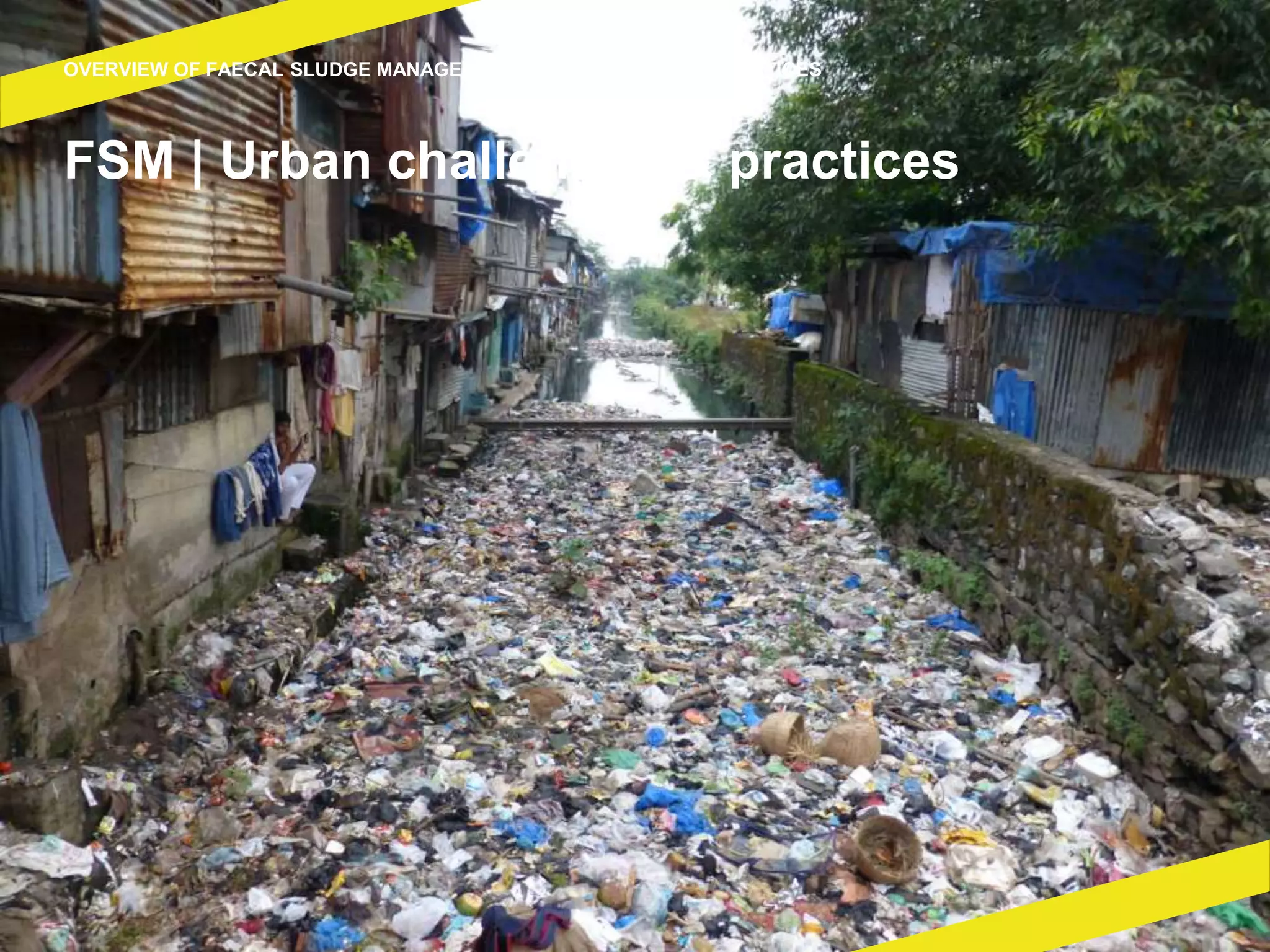
• Cities face the biggest problems – biggest challenges!
• Problems are most severe in low-income settlements and
slums:
Limited space to build individual toilets
Limited access to mechanised pit emptying services
Land tenure issues
Financial constraints
Lack of pro-poor financing mechanisms
Etc.
OVERVIEW OF FAECAL SLUDGE MANAGEMENT CHALLENGES AND PRACTICES
16.
FSM | Urbanchallenges & practices
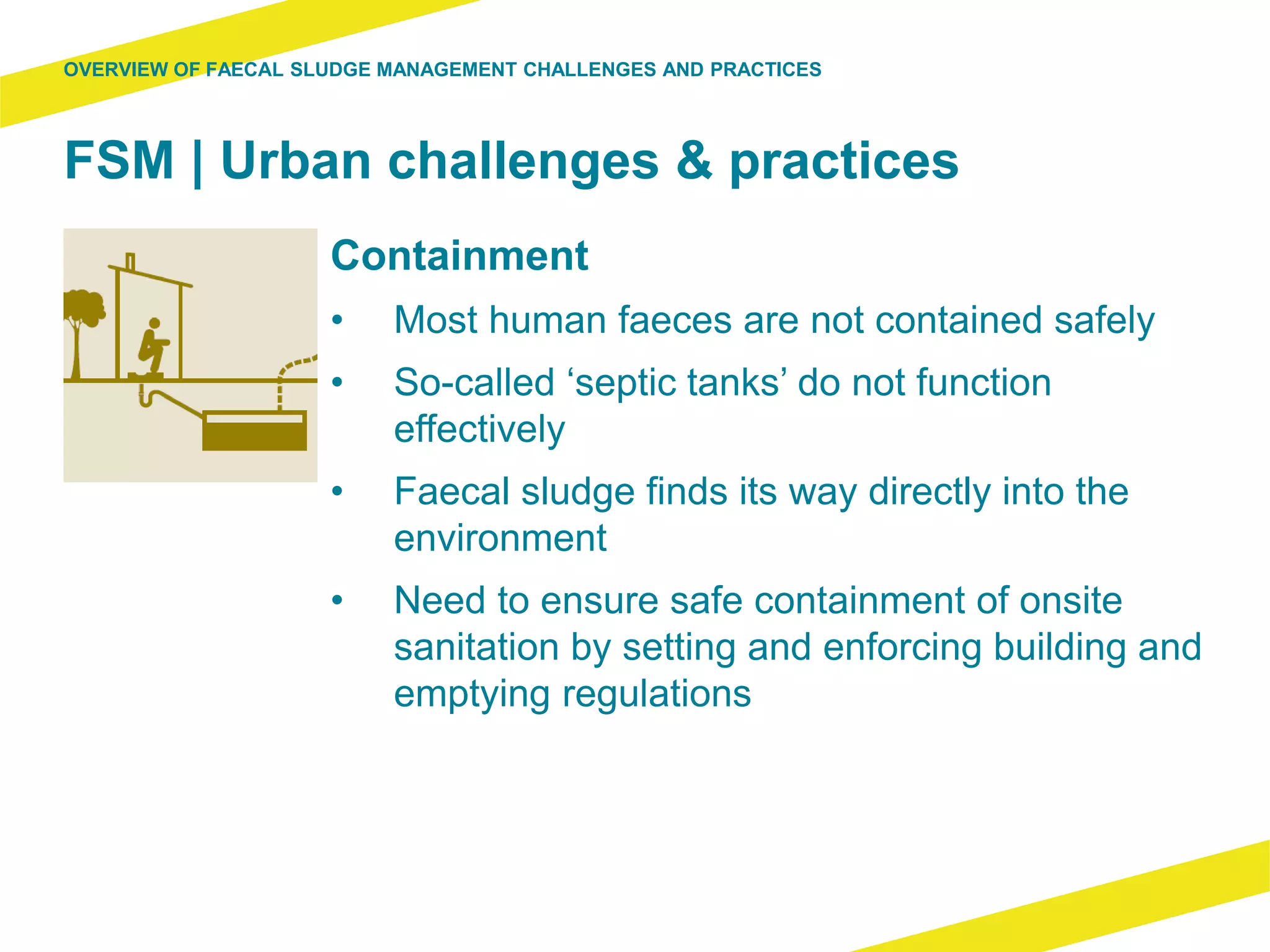
Containment
• Most human faeces are not contained safely
• So-called ‘septic tanks’ do not function
effectively
• Faecal sludge finds its way directly into the
environment
• Need to ensure safe containment of onsite
sanitation by setting and enforcing building and
emptying regulations
OVERVIEW OF FAECAL SLUDGE MANAGEMENT CHALLENGES AND PRACTICES
17.
FSM | Urbanchallenges & practices
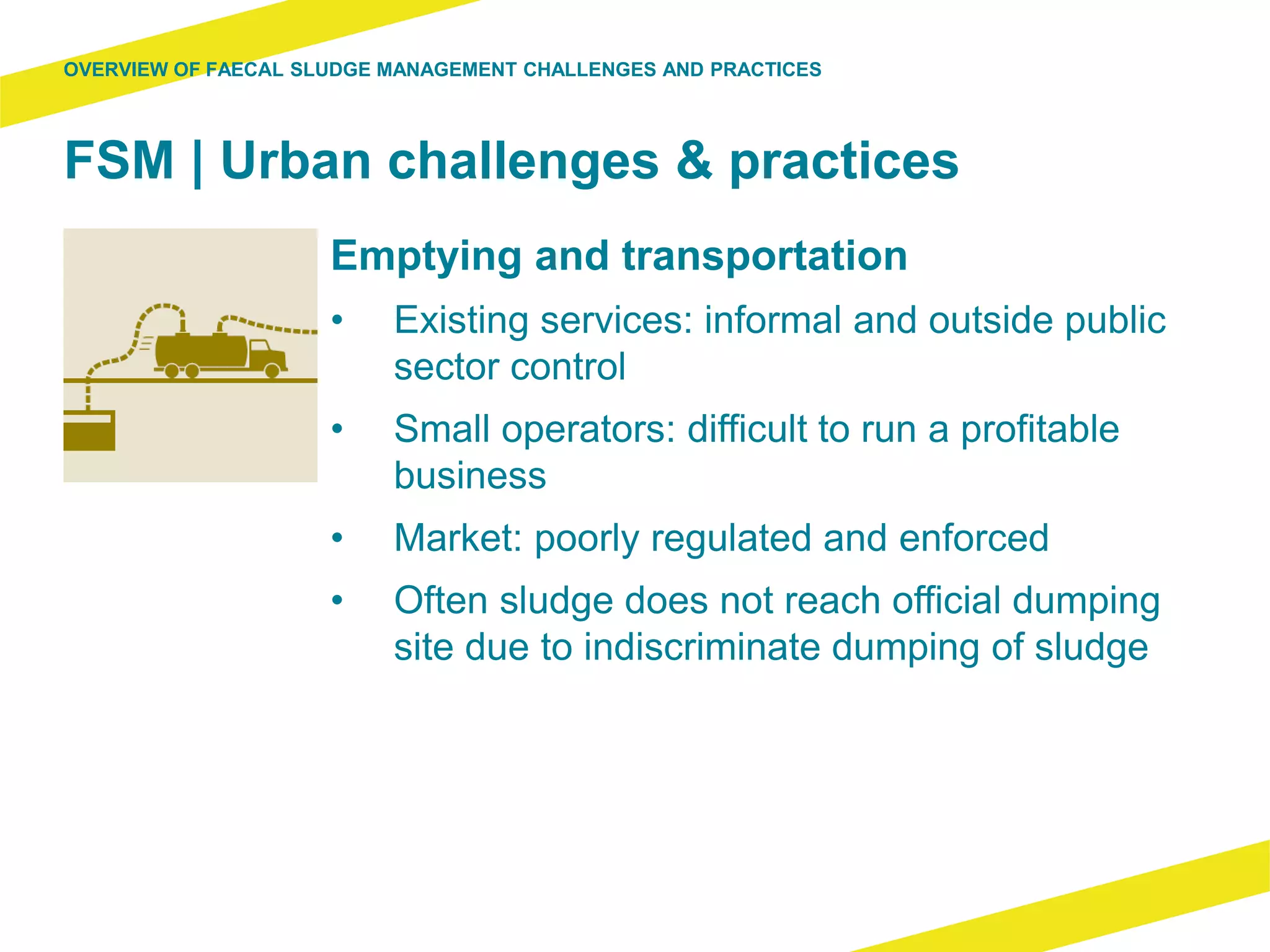
Emptying and transportation
• Existing services: informal and outside public
sector control
• Small operators: difficult to run a profitable
business
• Market: poorly regulated and enforced
• Often sludge does not reach official dumping
site due to indiscriminate dumping of sludge
OVERVIEW OF FAECAL SLUDGE MANAGEMENT CHALLENGES AND PRACTICES
18.
FSM | Urbanchallenges & practices
Treatment and disposal
• Only a small % is being treated due to lack of
dedicated facilities
• Western-style treatment facilities require
massive investments
• Appropriate sludge treatment plants are
needed to ensure a complete and effective
sanitation value chain
• Limited sludge disposal options
OVERVIEW OF FAECAL SLUDGE MANAGEMENT CHALLENGES AND PRACTICES
19.
FSM | Urbanchallenges & practices
Productive use of faecal sludge
• Limited successful examples of models that
can work at scale
• Limited interest from private sector due to lack
of profitable business models
• Potential business models are being
developed to convert human waste (mixed with
other waste) to fuel, fertilisers or electricity
OVERVIEW OF FAECAL SLUDGE MANAGEMENT CHALLENGES AND PRACTICES
20.
Faecal waste flowsin Dhaka, Bangladesh
OVERVIEW OF FAECAL SLUDGE MANAGEMENT CHALLENGES AND PRACTICES
(WSP, March 2014)
21.
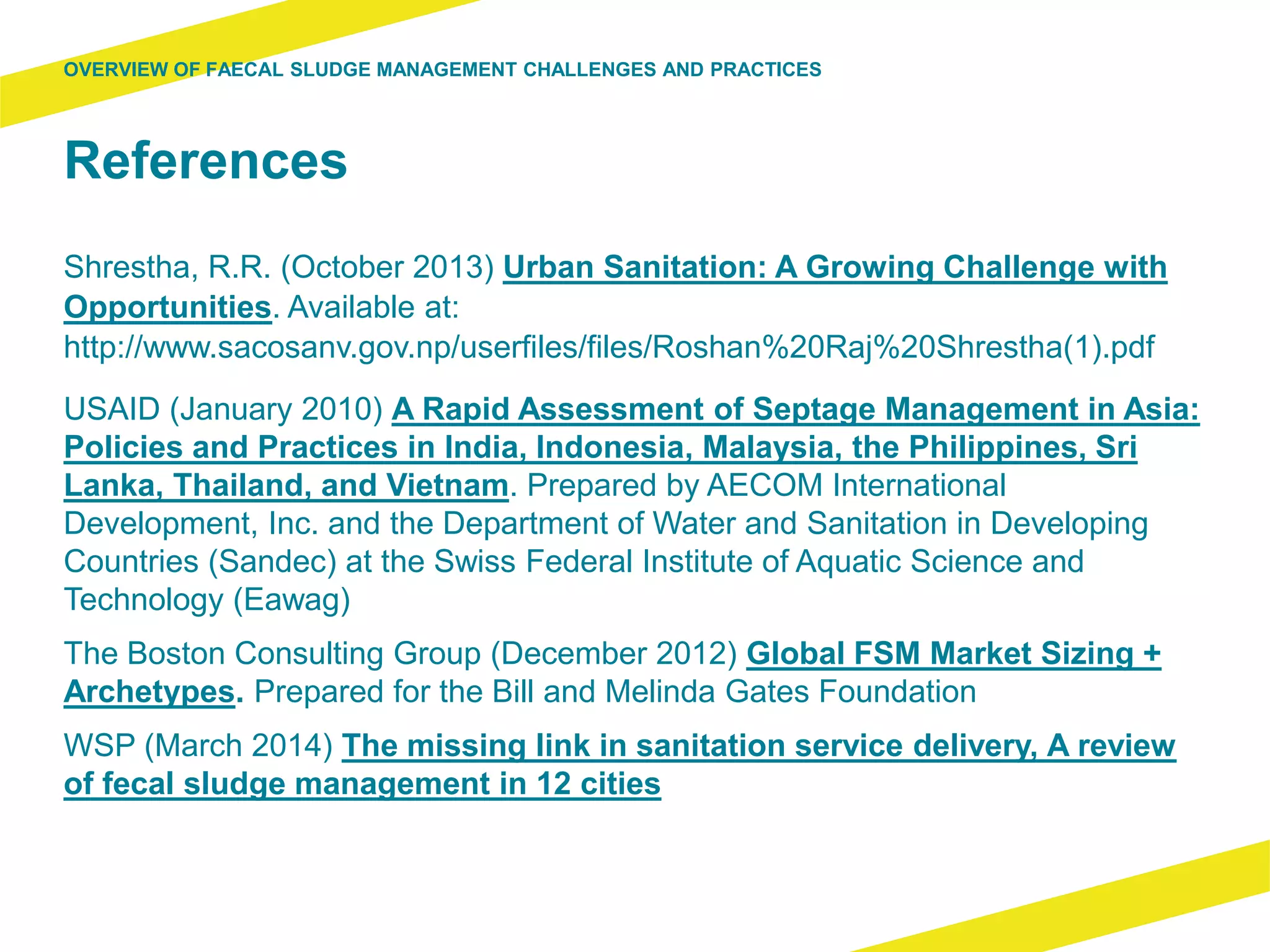
References
Shrestha, R.R. (October2013) Urban Sanitation: A Growing Challenge with
Opportunities. Available at:
http://www.sacosanv.gov.np/userfiles/files/Roshan%20Raj%20Shrestha(1).pdf
USAID (January 2010) A Rapid Assessment of Septage Management in Asia:
Policies and Practices in India, Indonesia, Malaysia, the Philippines, Sri
Lanka, Thailand, and Vietnam. Prepared by AECOM International
Development, Inc. and the Department of Water and Sanitation in Developing
Countries (Sandec) at the Swiss Federal Institute of Aquatic Science and
Technology (Eawag)
The Boston Consulting Group (December 2012) Global FSM Market Sizing +
Archetypes. Prepared for the Bill and Melinda Gates Foundation
WSP (March 2014) The missing link in sanitation service delivery, A review
of fecal sludge management in 12 cities
OVERVIEW OF FAECAL SLUDGE MANAGEMENT CHALLENGES AND PRACTICES
22.
Visiting address
Bezuidenhoutseweg 2
2594AV The Hague
The Netherlands
Postal address
P.O. Box 82327
2508 EH The Hague
The Netherlands
T +31 70 3044000
info@ircwash.org
www.ircwash.org
Supporting water sanitation
and hygiene services for life