Reaching Students in an
Information World:
Information Literacy in
the Classroom
Mandi Goodsett,
Reference Librarian
mandi.goodsett@gsw.edu
What do your students struggle
with when it comes to research?
What is information
literacy?
Information literacy is a set of abilities requiring
individuals to “recognize when information is
needed and have the ability to locate, evaluate,
and use effectively the needed information.”
American Library Association. Presidential Committee on Information
Literacy. Final Report.(Chicago: American Library Association, 1989.)
What is information
literacy?
An information literate person can
…
1) Recognize when information is
needed
2) Locate information
3) Evaluate information
4) Use the information for a
specific purpose
5) Understand how to use
information ethically
Why include information
literacy in your classroom?
Why include information
literacy in your classroom?
• Age of information -> information
overload and greater need for information
skills
Why include information
literacy in your classroom?
• Age of information -> information
overload and greater need for information
skills
• Students need to know about the
resources in their discipline.
Why include information
literacy in your classroom?
• Age of information -> information
overload and greater need for information
skills
• Students need to know about the
resources in their discipline.
• Information literacy supports critical
thinking and professional achievement.
Why include information
literacy in your classroom?
Information literate students can deal
with information and conduct research
much more effectively, efficiently, and
confidently.
Incorporating IL in Your
Classroom
Activities and classroom procedures
Based on the IL standards,
what IL activities do you
already include in your
teaching?
2 minute brainstorm
Incorporating IL in Your
Classroom
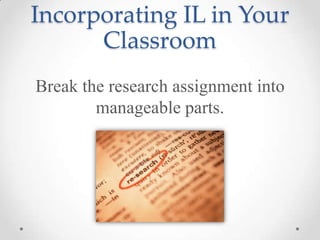
Break the research assignment into
manageable parts.
Incorporating IL in Your
Classroom
Direct students towards a
variety of library resources
including print, electronic, and
multimedia sources.
Incorporating IL in Your
Classroom
Direct students towards a
variety of library resources
including print, electronic, and
multimedia sources.
Some source types will be less
familiar to them (i.e. print).
Incorporating IL in Your
Classroom
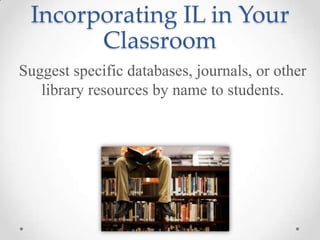
Suggest specific databases, journals, or other
library resources by name to students.
Incorporating IL in Your
Classroom
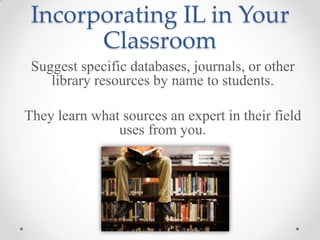
Suggest specific databases, journals, or other
library resources by name to students.
They learn what sources an expert in their field
uses from you.
Incorporating IL in Your
Classroom
Review criteria for evaluating
sources.
Emphasize that sources should
be relevant, authoritative,
and accurate.
Incorporating IL in Your
Classroom
Discuss what constitutes plagiarism as
well as the consequences.
Incorporating IL in Your
Classroom
Encourage students to consult a librarian.
Incorporating IL in Your
Classroom
Encourage students to consult a librarian.
Encourage them to …
… visit the library.
… email a librarian at libref@gsw.edu.
… call me at 229-931-2850.
Incorporating IL in Your
Classroom
Embed a subject
guide
in GeorgiaVIEW
or request a
course library
guide from your
librarian.
Incorporating IL in Your
Classroom
Collaborate with a librarian to design
library instruction for your class or to
create a research assignment that
employs critical thinking.
Incorporating IL in Your
Classroom

http://gsw.edu/Library/Library-Tutorials/library-tutorials
Activity
Choose an IL standard and brainstorm a
potential assignment you could use to
strengthen that skill in your students.
1)
2)
3)
4)
5)

Recognize when information is needed
Locate information
Evaluate information
Use the information for a specific purpose
Understand how to use information ethically
Based on the IL standards,
what IL activities do you
already include in your
teaching?
Sharing time
Questions?
Please see the library guide at
http://libguides.gsw.edu/ILintheclassroom
for more information.
mandi.goodsett@gsw.edu
References
• ACRL Information Literacy Task Force. "Information Literacy
Competency Standards for Higher Education." Information
Literacy Competency Standards for Higher Education.
American Library Association, 18 Jan. 2000. Web. 23 Jan.
2014.
• "Ideas and Strategies for Incorporating Information Literacy
into the Classroom | UCLA Library." Resources for Faculty.
University of California Los Angeles Library, n.d. Web. 23
Jan. 2014.
• "What Is Information Literacy?" Faculty Toolkit for Teaching
Information Literacy. University of Notre Dame Hesburgh
Libraries, 19 June 2013. Web. 23 Jan. 2014.

Information Literacy in the Classroom

  • 1.
    Reaching Students inan Information World: Information Literacy in the Classroom Mandi Goodsett, Reference Librarian mandi.goodsett@gsw.edu
  • 2.
    What do yourstudents struggle with when it comes to research?
  • 3.
    What is information literacy? Informationliteracy is a set of abilities requiring individuals to “recognize when information is needed and have the ability to locate, evaluate, and use effectively the needed information.” American Library Association. Presidential Committee on Information Literacy. Final Report.(Chicago: American Library Association, 1989.)
  • 4.
    What is information literacy? Aninformation literate person can … 1) Recognize when information is needed 2) Locate information 3) Evaluate information 4) Use the information for a specific purpose 5) Understand how to use information ethically
  • 5.
  • 6.
    Why include information literacyin your classroom? • Age of information -> information overload and greater need for information skills
  • 7.
    Why include information literacyin your classroom? • Age of information -> information overload and greater need for information skills • Students need to know about the resources in their discipline.
  • 8.
    Why include information literacyin your classroom? • Age of information -> information overload and greater need for information skills • Students need to know about the resources in their discipline. • Information literacy supports critical thinking and professional achievement.
  • 9.
    Why include information literacyin your classroom? Information literate students can deal with information and conduct research much more effectively, efficiently, and confidently.
  • 10.
    Incorporating IL inYour Classroom Activities and classroom procedures
  • 11.
    Based on theIL standards, what IL activities do you already include in your teaching? 2 minute brainstorm
  • 12.
    Incorporating IL inYour Classroom Break the research assignment into manageable parts.
  • 13.
    Incorporating IL inYour Classroom Direct students towards a variety of library resources including print, electronic, and multimedia sources.
  • 14.
    Incorporating IL inYour Classroom Direct students towards a variety of library resources including print, electronic, and multimedia sources. Some source types will be less familiar to them (i.e. print).
  • 15.
    Incorporating IL inYour Classroom Suggest specific databases, journals, or other library resources by name to students.
  • 16.
    Incorporating IL inYour Classroom Suggest specific databases, journals, or other library resources by name to students. They learn what sources an expert in their field uses from you.
  • 17.
    Incorporating IL inYour Classroom Review criteria for evaluating sources. Emphasize that sources should be relevant, authoritative, and accurate.
  • 18.
    Incorporating IL inYour Classroom Discuss what constitutes plagiarism as well as the consequences.
  • 19.
    Incorporating IL inYour Classroom Encourage students to consult a librarian.
  • 20.
    Incorporating IL inYour Classroom Encourage students to consult a librarian. Encourage them to … … visit the library. … email a librarian at libref@gsw.edu. … call me at 229-931-2850.
  • 21.
    Incorporating IL inYour Classroom Embed a subject guide in GeorgiaVIEW or request a course library guide from your librarian.
  • 22.
    Incorporating IL inYour Classroom Collaborate with a librarian to design library instruction for your class or to create a research assignment that employs critical thinking.
  • 23.
    Incorporating IL inYour Classroom http://gsw.edu/Library/Library-Tutorials/library-tutorials
  • 24.
    Activity Choose an ILstandard and brainstorm a potential assignment you could use to strengthen that skill in your students. 1) 2) 3) 4) 5) Recognize when information is needed Locate information Evaluate information Use the information for a specific purpose Understand how to use information ethically
  • 25.
    Based on theIL standards, what IL activities do you already include in your teaching? Sharing time
  • 26.
    Questions? Please see thelibrary guide at http://libguides.gsw.edu/ILintheclassroom for more information. mandi.goodsett@gsw.edu
  • 27.
    References • ACRL InformationLiteracy Task Force. "Information Literacy Competency Standards for Higher Education." Information Literacy Competency Standards for Higher Education. American Library Association, 18 Jan. 2000. Web. 23 Jan. 2014. • "Ideas and Strategies for Incorporating Information Literacy into the Classroom | UCLA Library." Resources for Faculty. University of California Los Angeles Library, n.d. Web. 23 Jan. 2014. • "What Is Information Literacy?" Faculty Toolkit for Teaching Information Literacy. University of Notre Dame Hesburgh Libraries, 19 June 2013. Web. 23 Jan. 2014.

Editor's Notes

  • #5 How do these standards relate to the brainstormed list that we made?