Adding Up to Success? 
Assessing Freshman Skills in Information Literacy 
Susan Gardner Archambault 
Loyola Marymount University, USA 
ECIL 2014
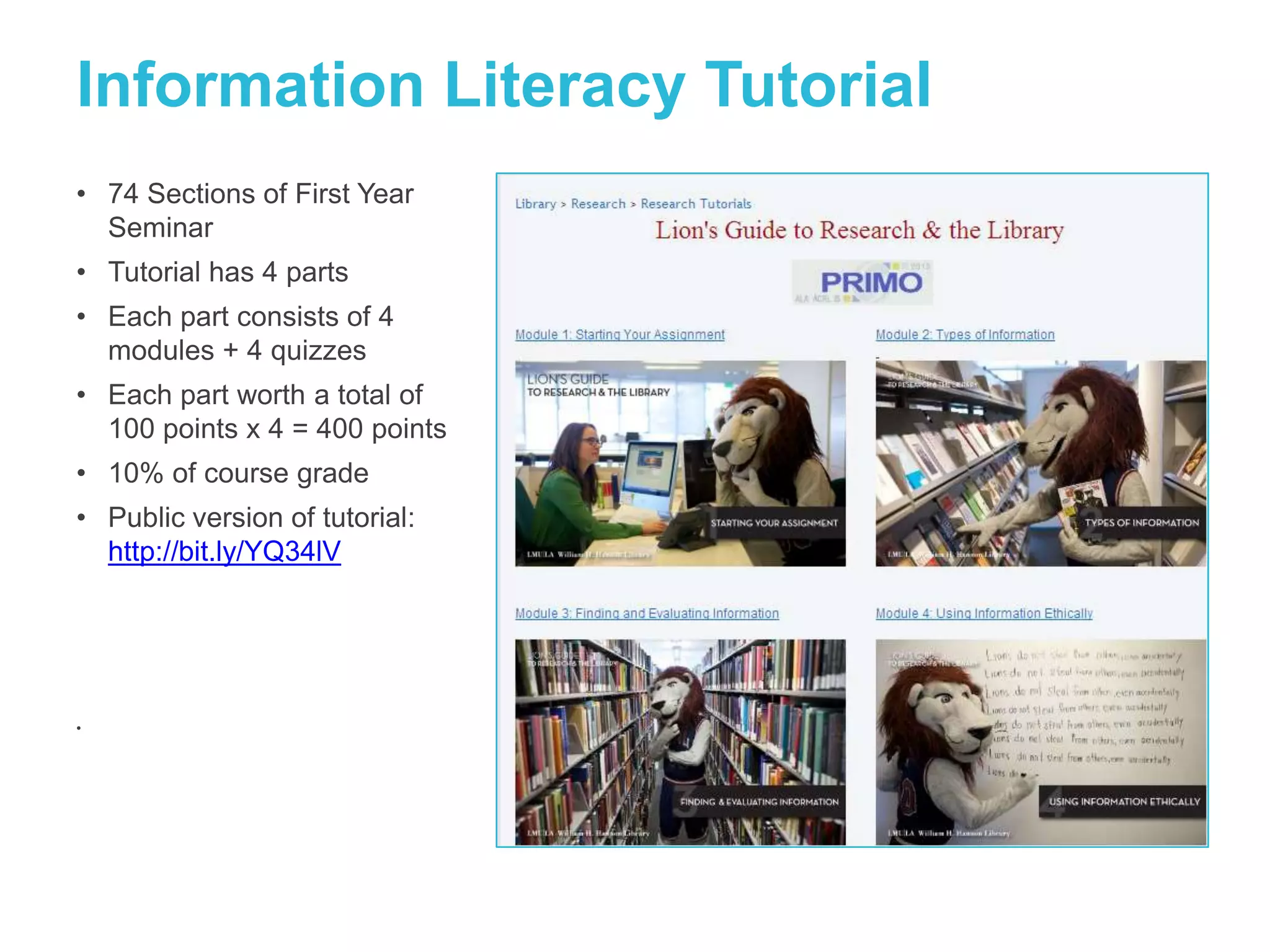
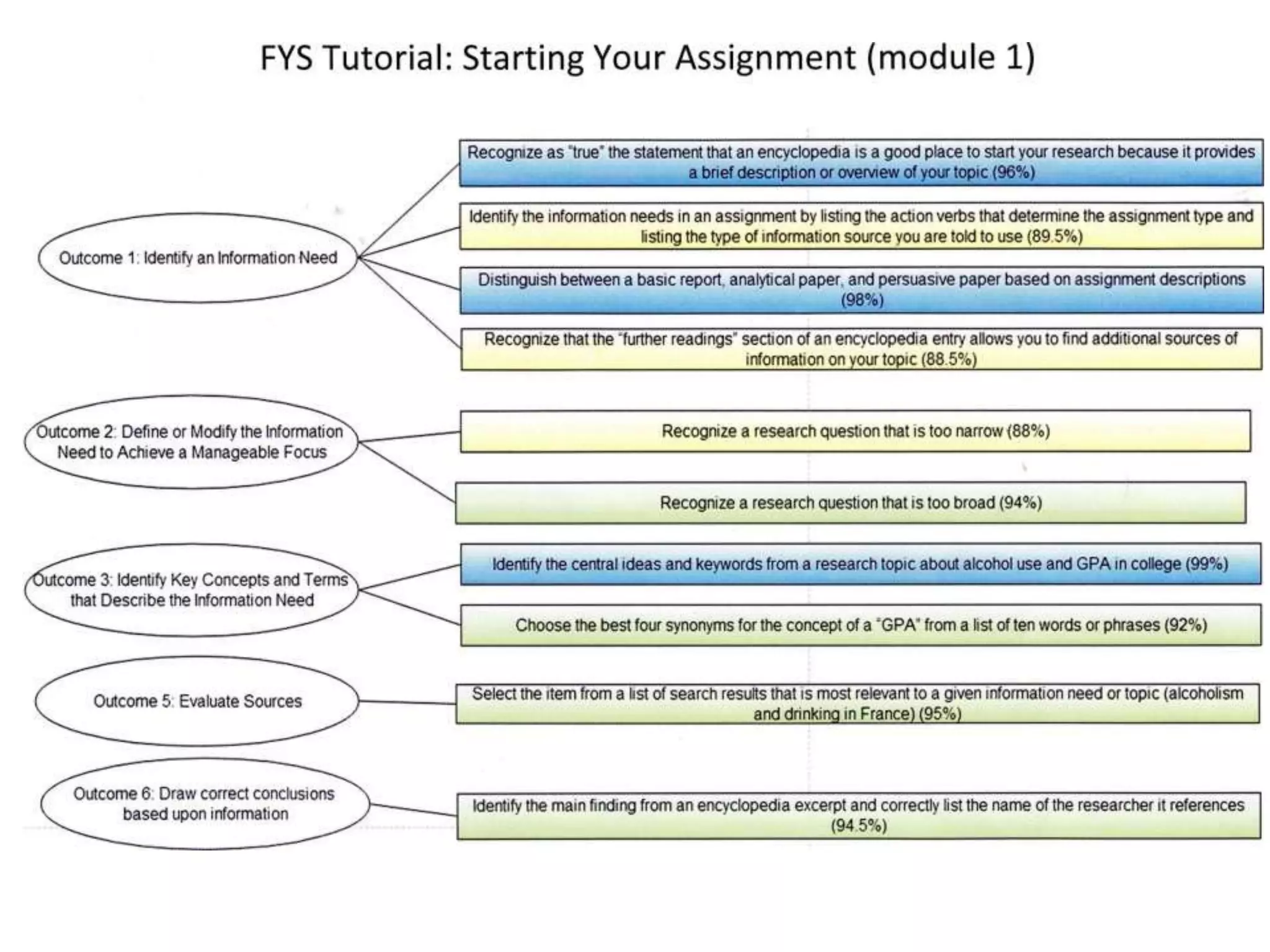
Information Literacy Tutorial 
• 74 Sections of First Year 
Seminar 
• Tutorial has 4 parts 
• Each part consists of 4 
modules + 4 quizzes 
• Each part worth a total of 
100 points x 4 = 400 points 
• 10% of course grade 
• Public version of tutorial: 
http://bit.ly/YQ34lV 
•
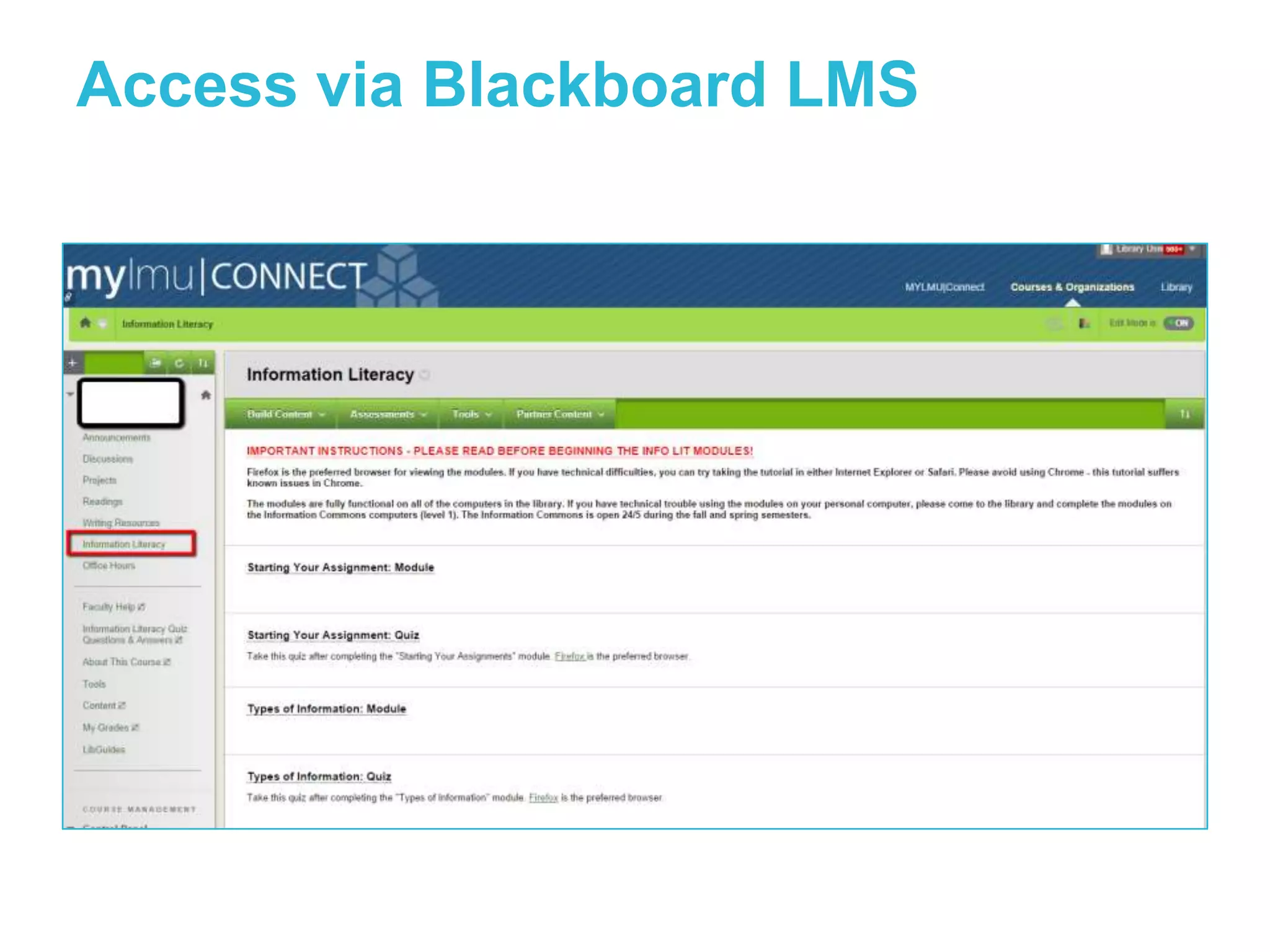
Access via Blackboard LMS
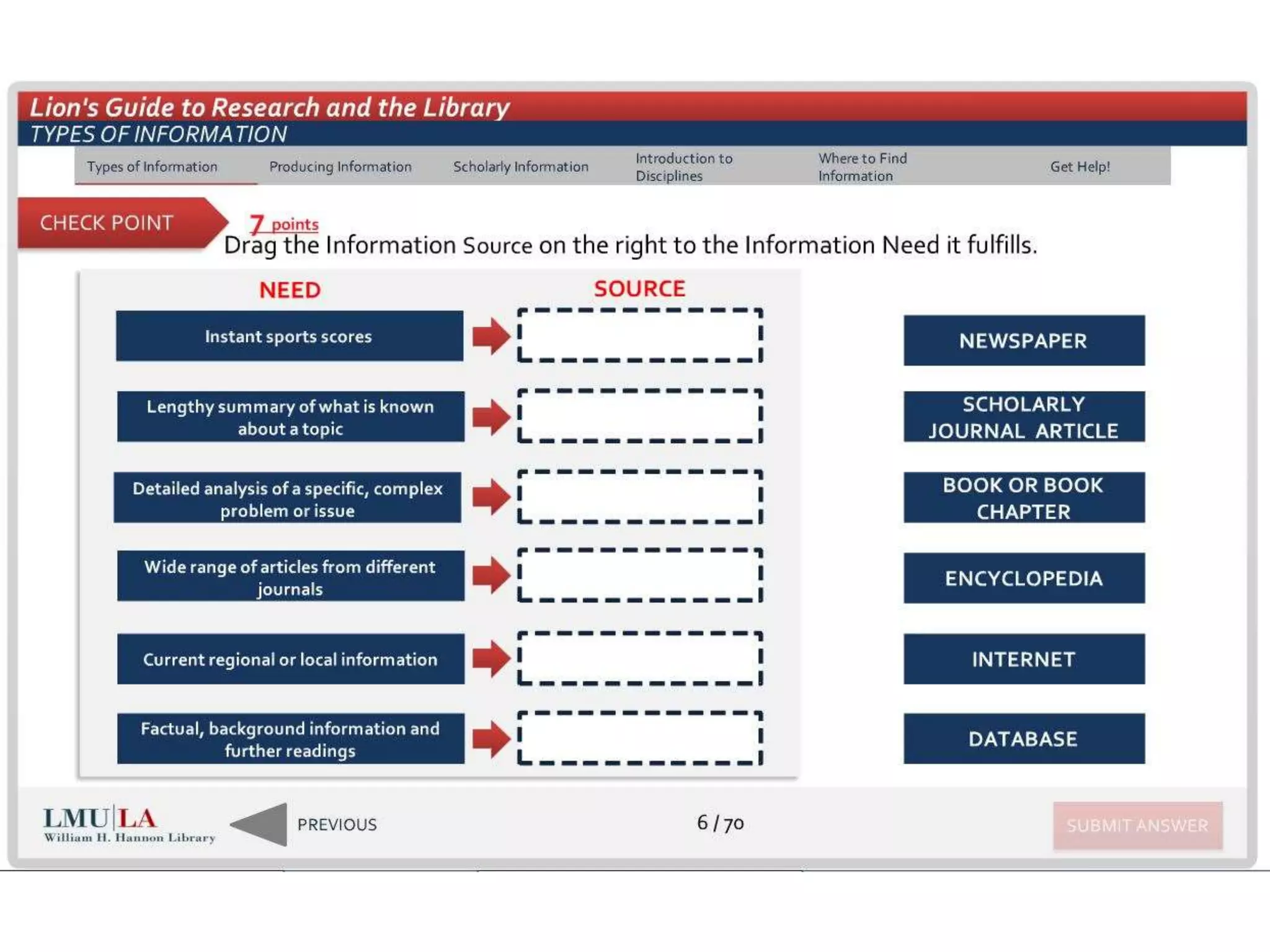
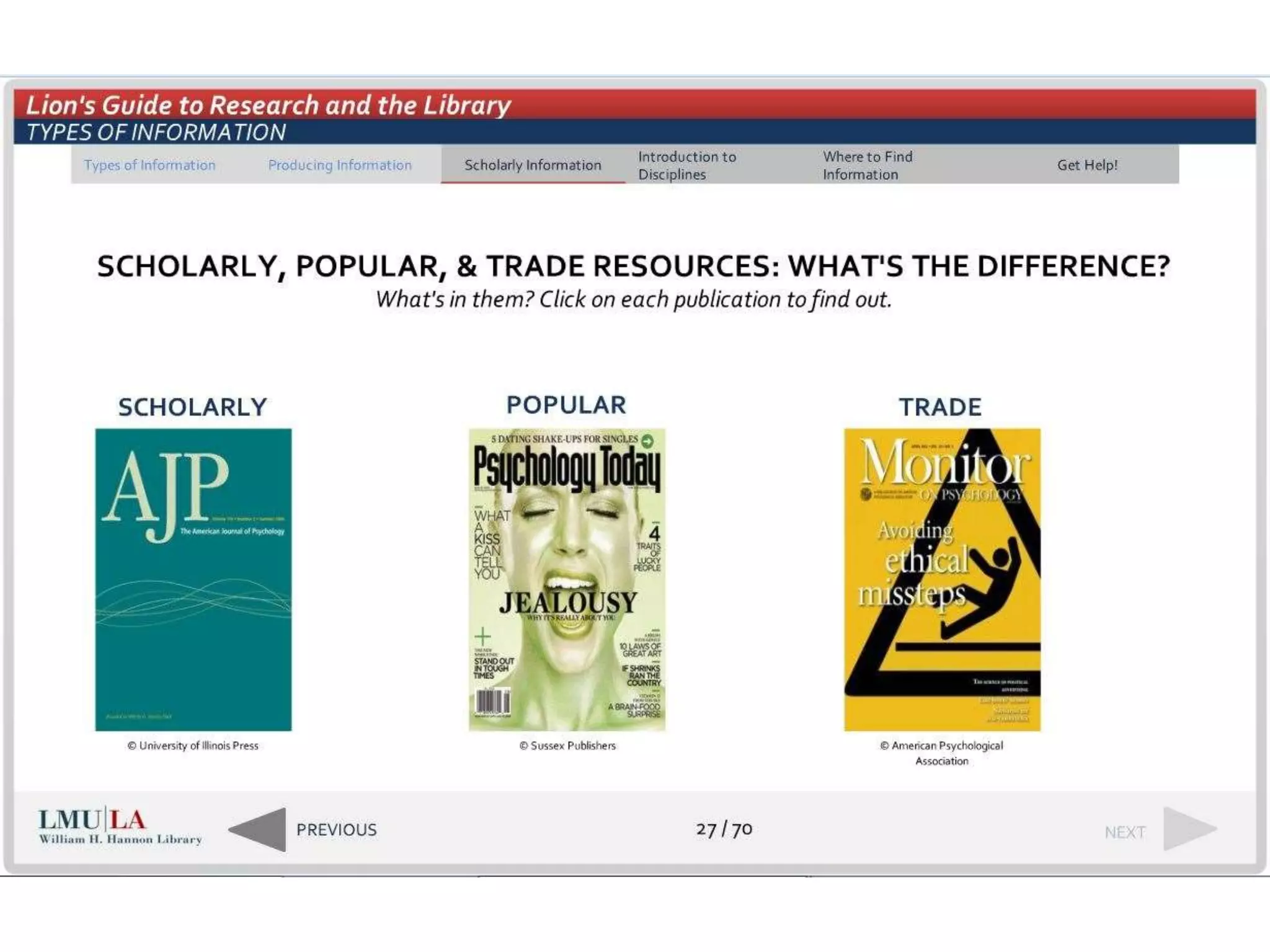
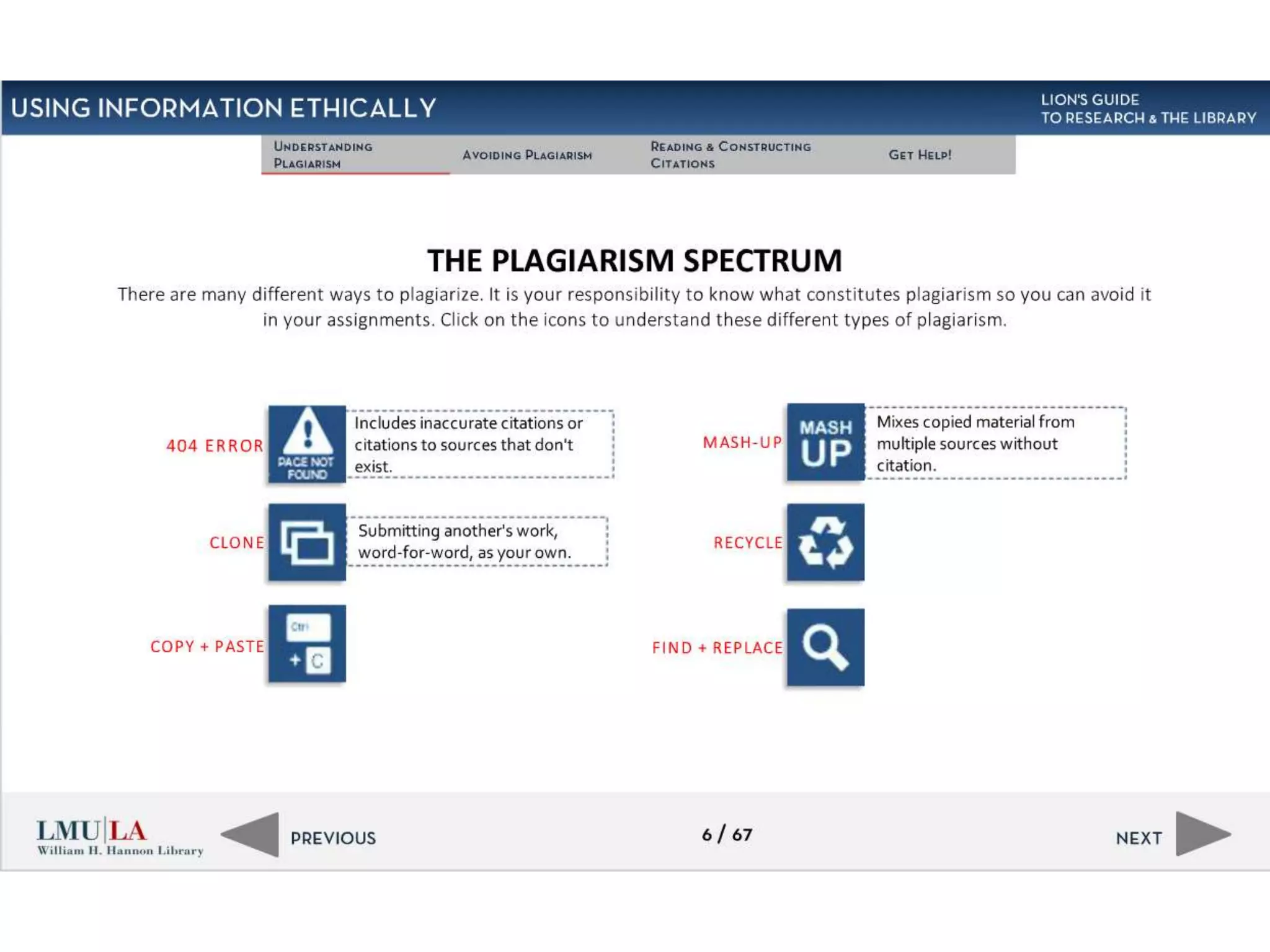
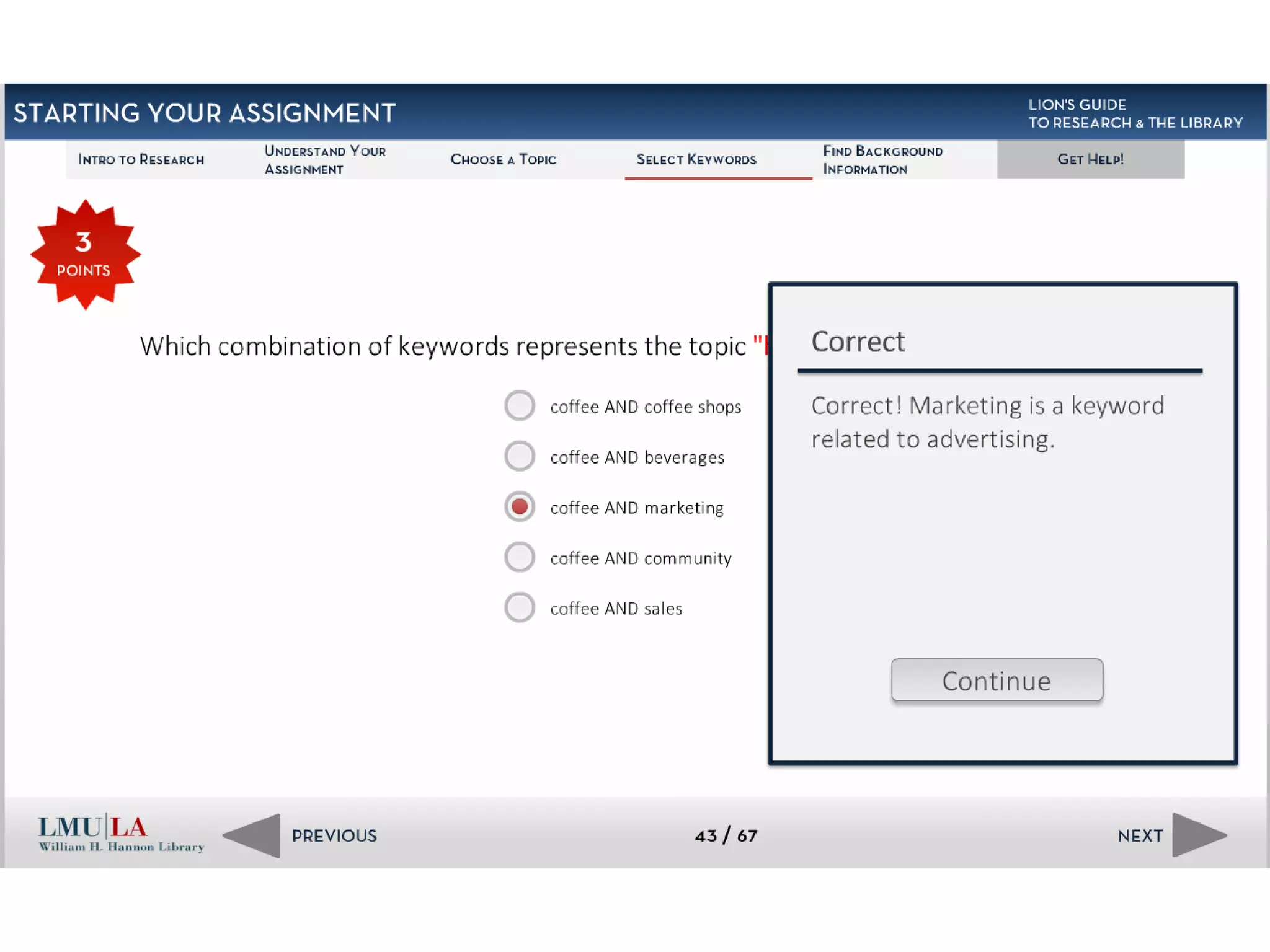
Tutorial Excerpts
Research Question: 
How effective was the tutorial at 
meeting the information literacy 
learning outcomes?
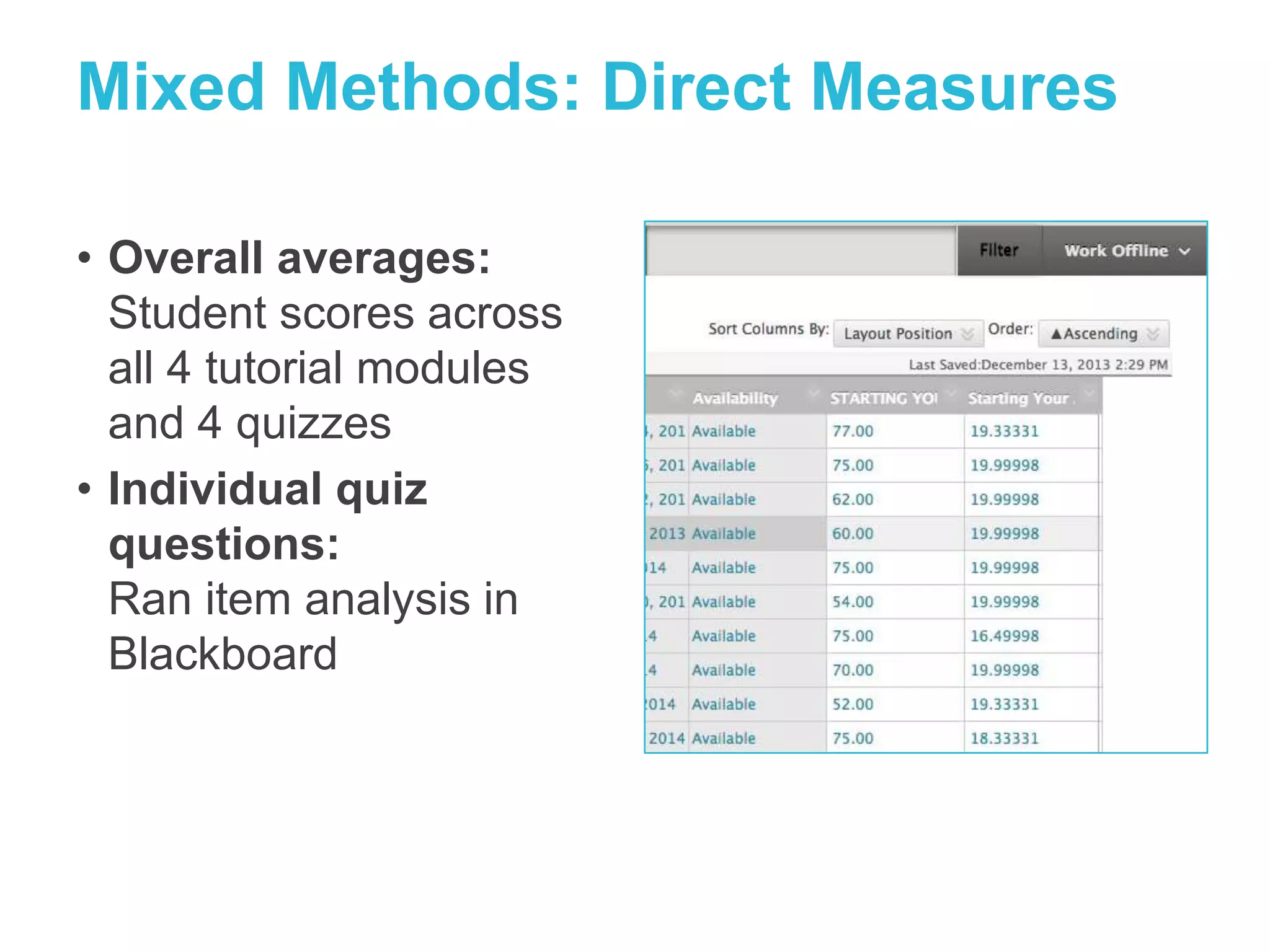
Mixed Methods: Direct Measures 
• Overall averages: 
Student scores across 
all 4 tutorial modules 
and 4 quizzes 
• Individual quiz 
questions: 
Ran item analysis in 
Blackboard
Mixed Methods: Indirect Measures 
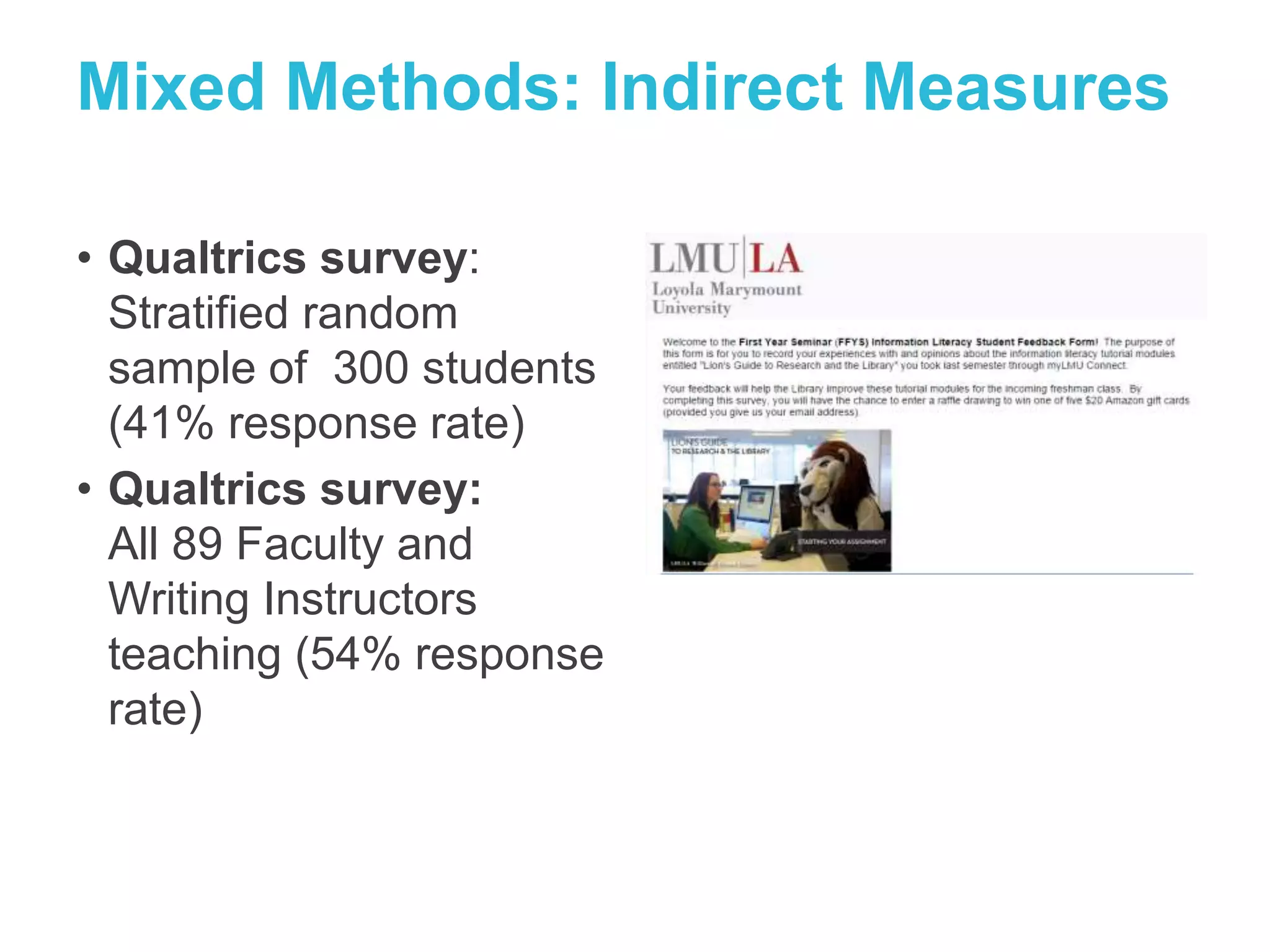
• Qualtrics survey: 
Stratified random 
sample of 300 students 
(41% response rate) 
• Qualtrics survey: 
All 89 Faculty and 
Writing Instructors 
teaching (54% response 
rate)
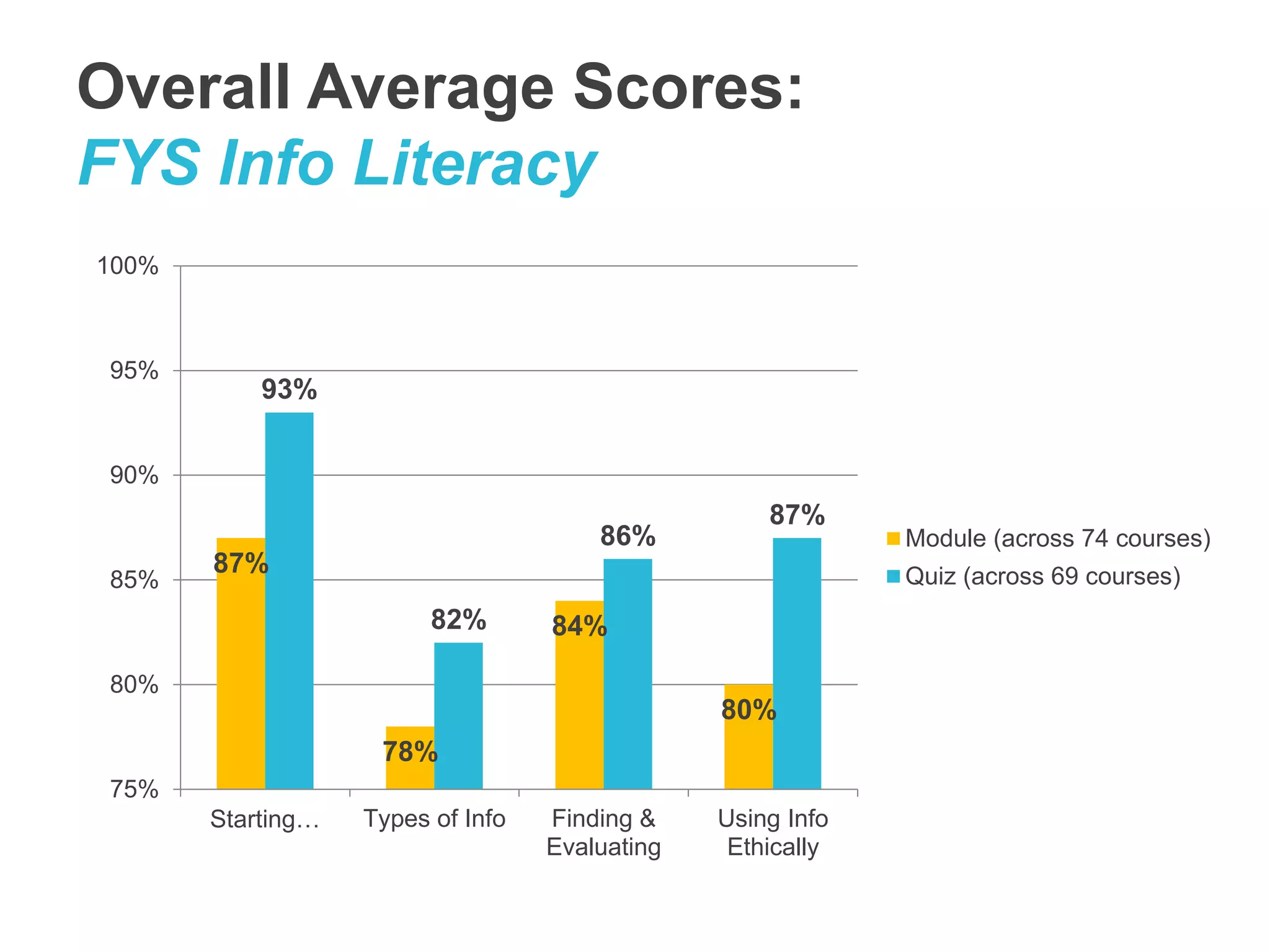
Overall Average Scores: 
FYS Info Literacy 
87% 
78% 
84% 
80% 
93% 
82% 
86% 
87% 
100% 
95% 
90% 
85% 
80% 
75% 
Starting… Types of Info Finding & 
Evaluating 
Using Info 
Ethically 
Module (across 74 courses) 
Quiz (across 69 courses)
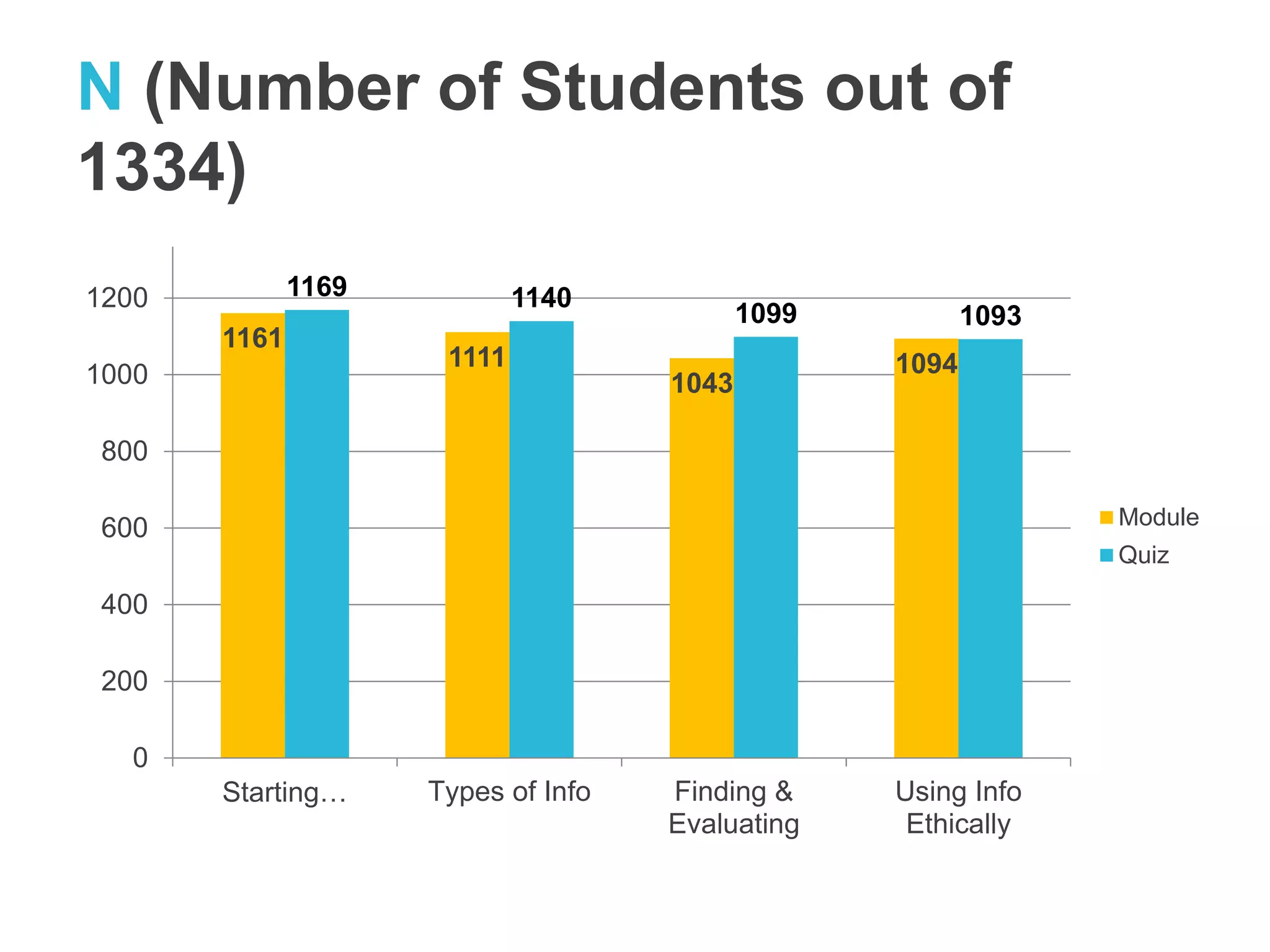
N (Number of Students out of 
1334) 
1161 
1111 
1043 
1094 
1169 1140 
1099 1093 
1200 
1000 
800 
600 
400 
200 
0 
Starting… Types of Info Finding & 
Evaluating 
Using Info 
Ethically 
Module 
Quiz
Student Quiz 
RESULTS
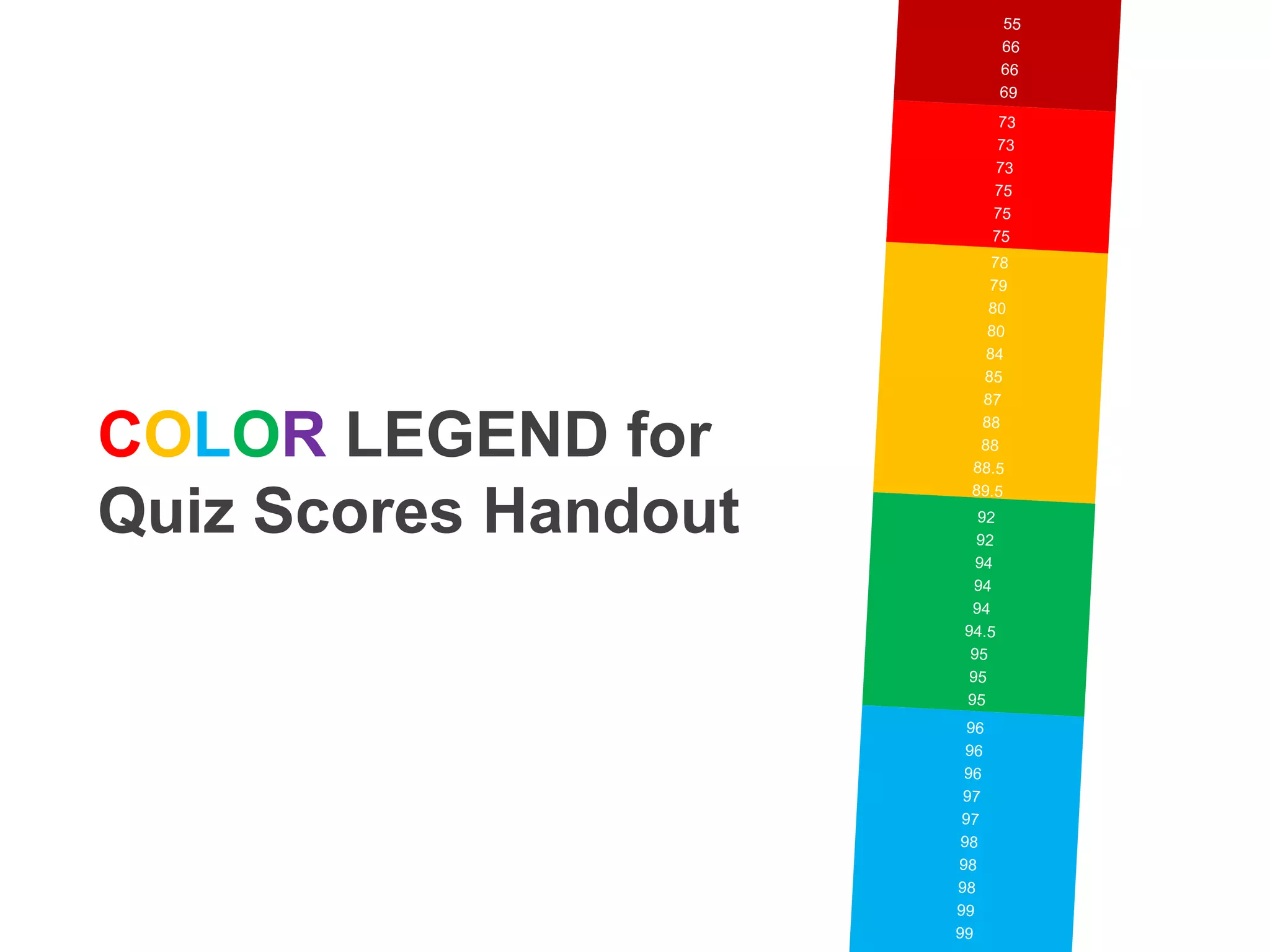
COLOR LEGEND for 
Quiz Scores Handout
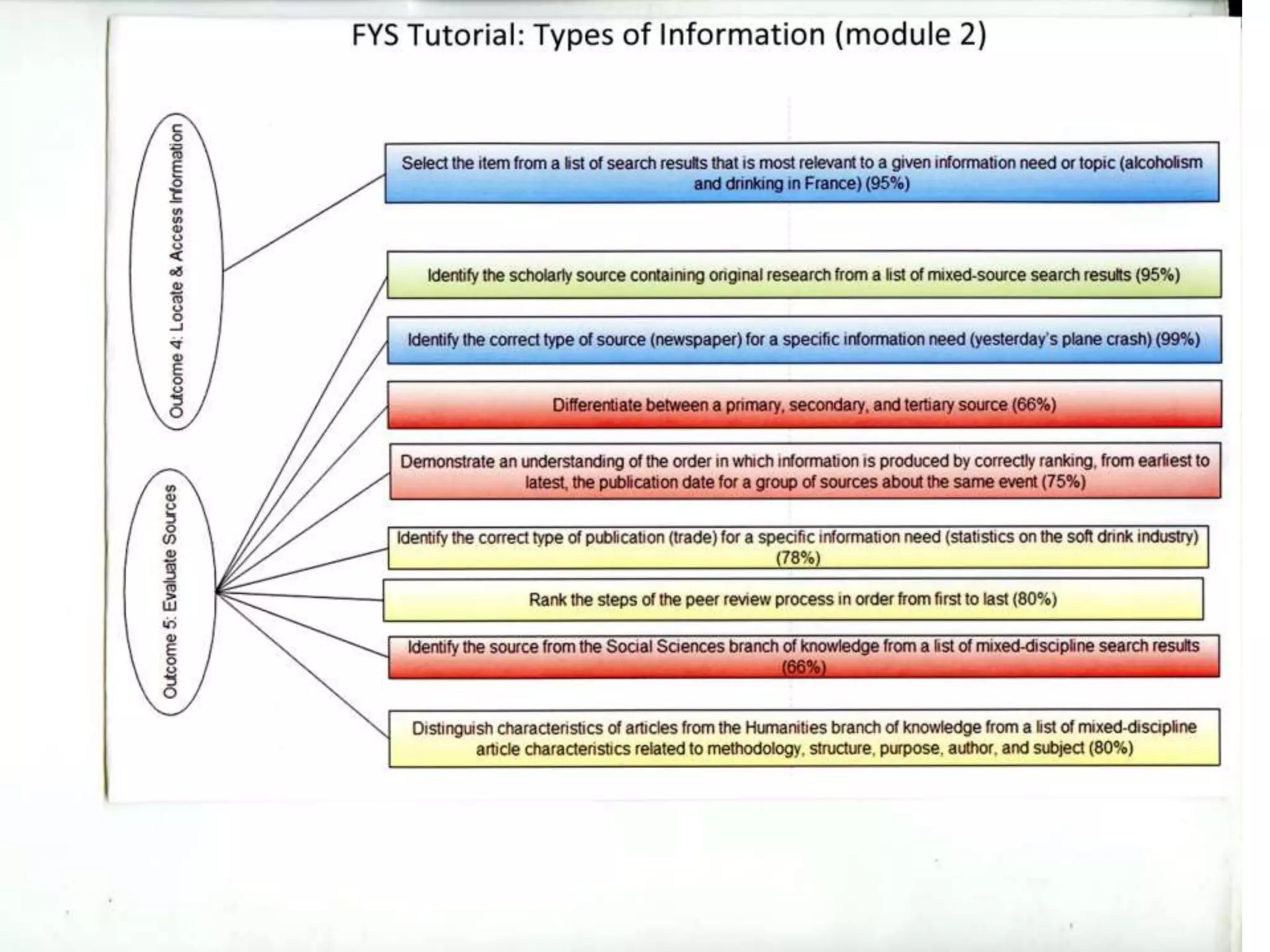
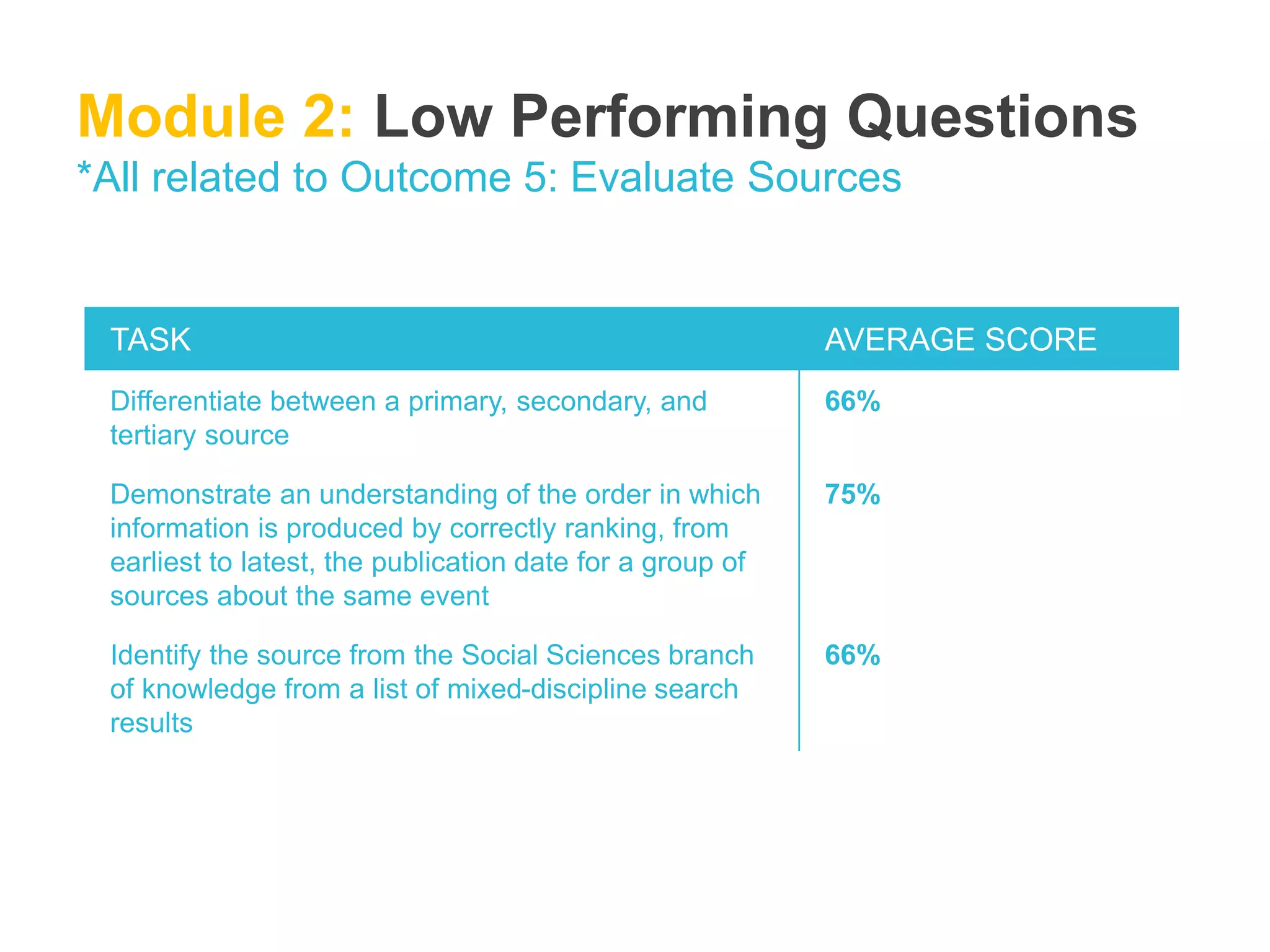
Module 2: Low Performing Questions 
*All related to Outcome 5: Evaluate Sources 
TASK AVERAGE SCORE 
Differentiate between a primary, secondary, and 
tertiary source 
66% 
Demonstrate an understanding of the order in which 
information is produced by correctly ranking, from 
earliest to latest, the publication date for a group of 
sources about the same event 
75% 
Identify the source from the Social Sciences branch 
of knowledge from a list of mixed-discipline search 
results 
66%
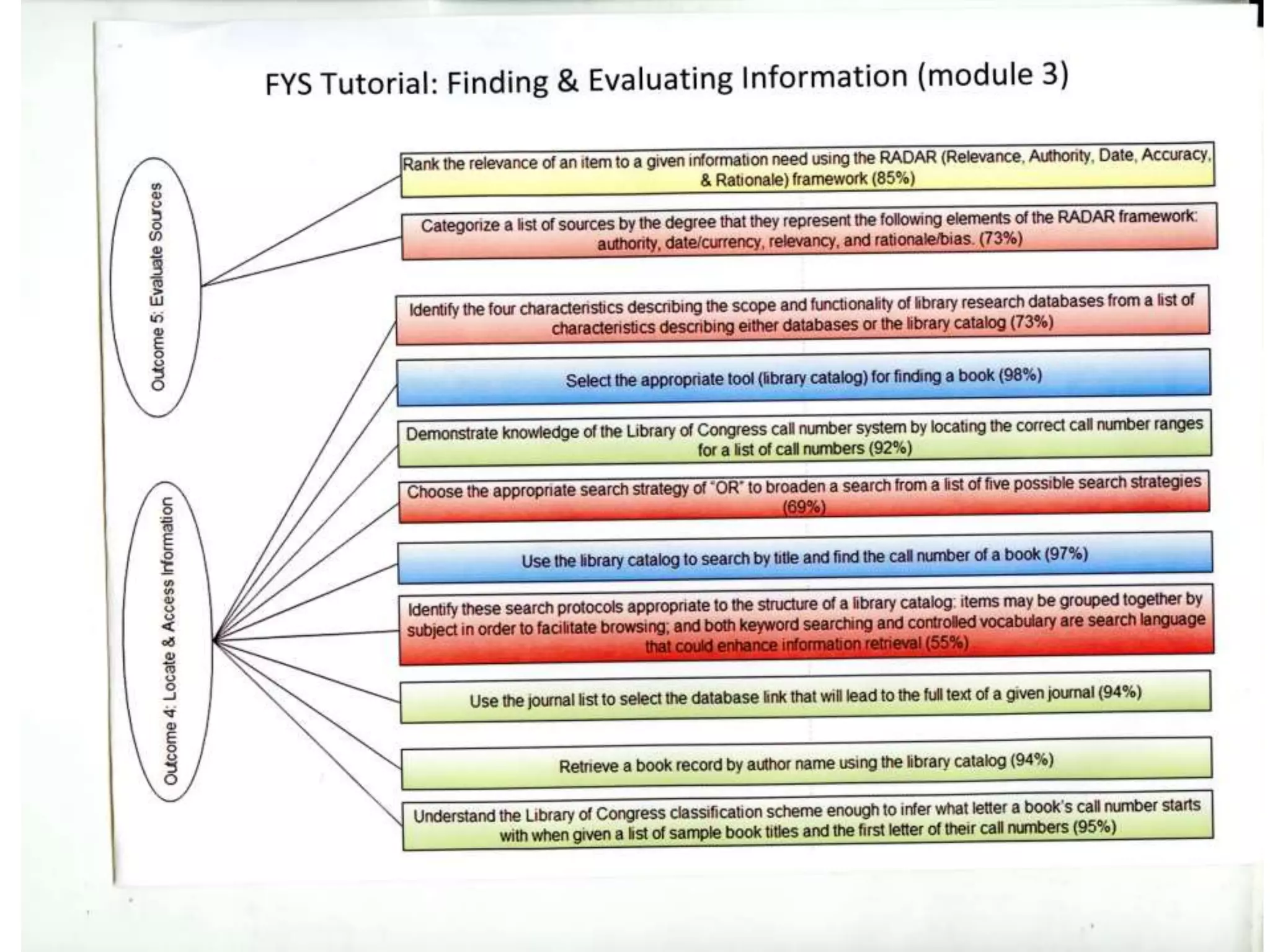
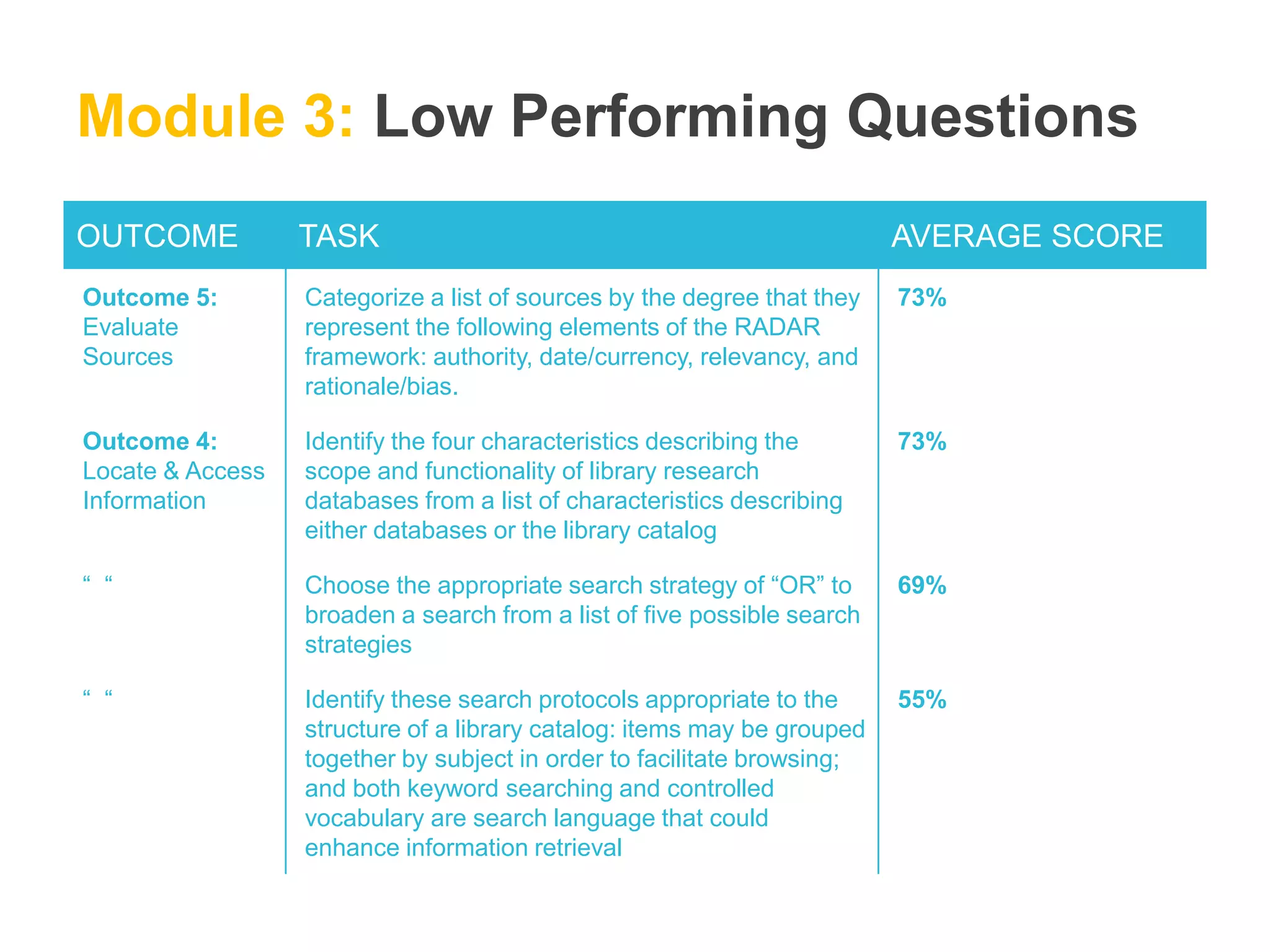
Module 3: Low Performing Questions 
OUTCOME TASK AVERAGE SCORE 
Outcome 5: 
Evaluate 
Sources 
Categorize a list of sources by the degree that they 
represent the following elements of the RADAR 
framework: authority, date/currency, relevancy, and 
rationale/bias. 
73% 
Outcome 4: 
Locate & Access 
Information 
Identify the four characteristics describing the 
scope and functionality of library research 
databases from a list of characteristics describing 
either databases or the library catalog 
73% 
“ “ Choose the appropriate search strategy of “OR” to 
broaden a search from a list of five possible search 
strategies 
69% 
“ “ Identify these search protocols appropriate to the 
structure of a library catalog: items may be grouped 
together by subject in order to facilitate browsing; 
and both keyword searching and controlled 
vocabulary are search language that could 
enhance information retrieval 
55%
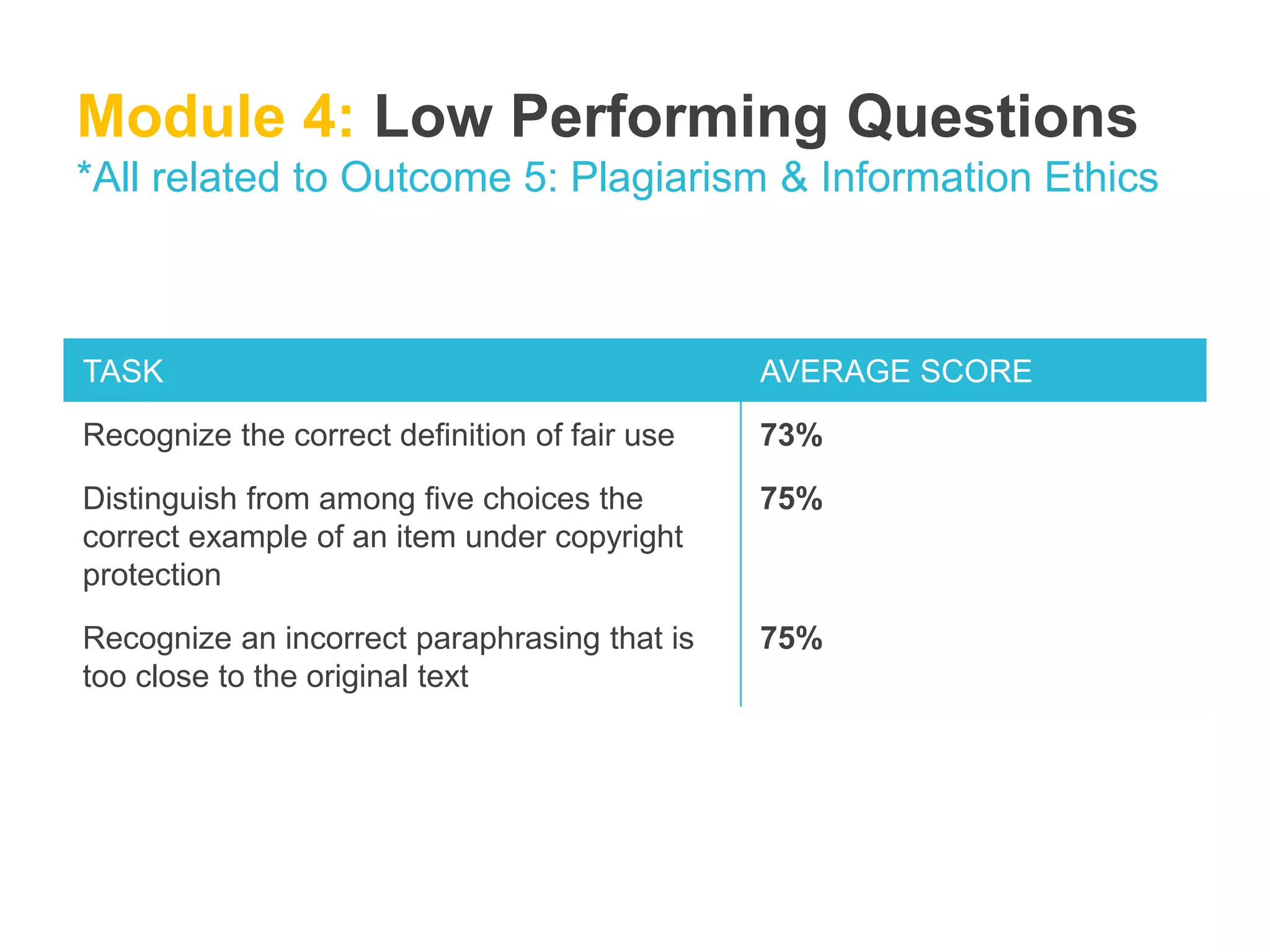
Module 4: Low Performing Questions 
*All related to Outcome 5: Plagiarism & Information Ethics 
TASK AVERAGE SCORE 
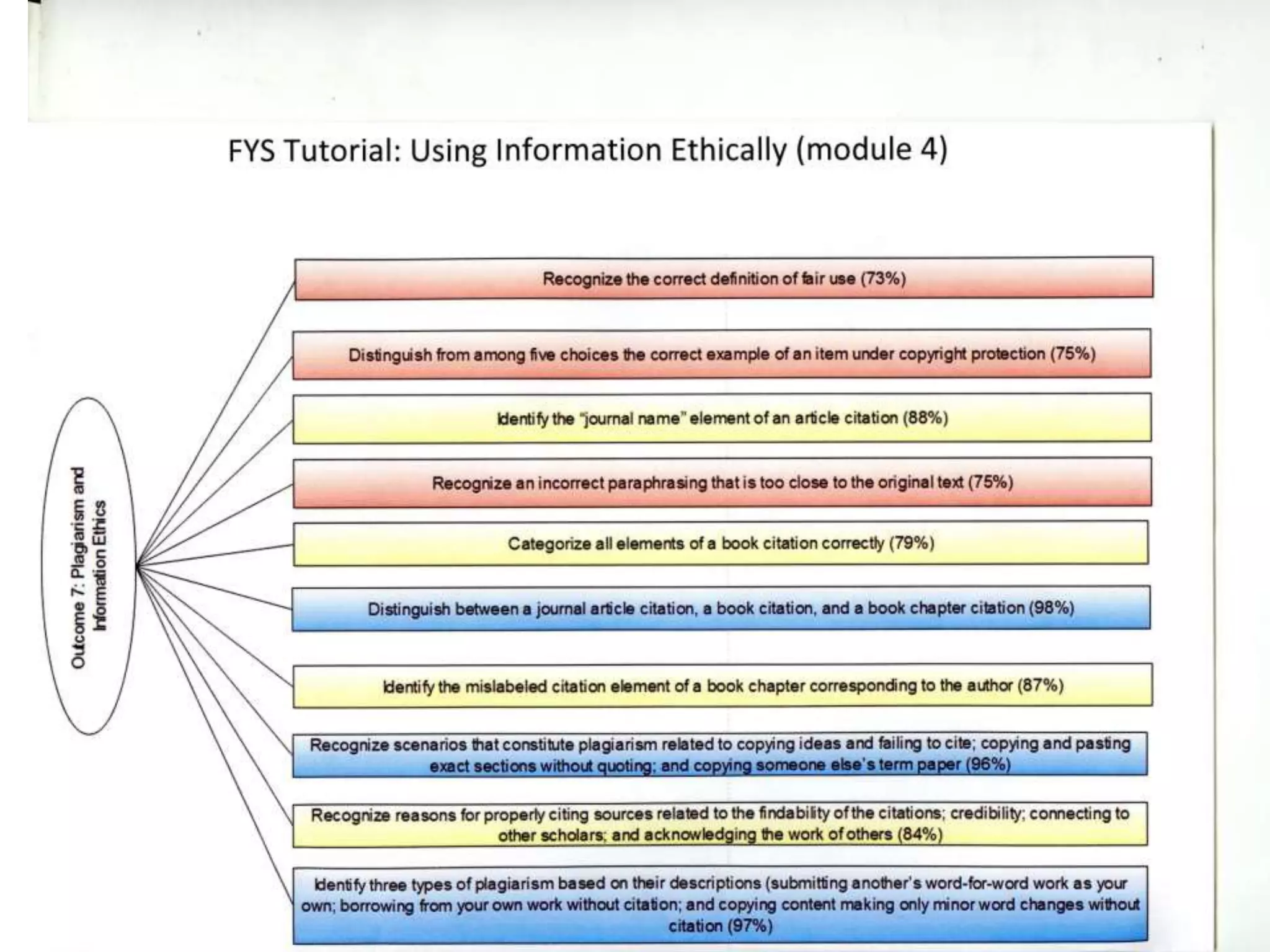
Recognize the correct definition of fair use 73% 
Distinguish from among five choices the 
correct example of an item under copyright 
protection 
75% 
Recognize an incorrect paraphrasing that is 
too close to the original text 
75%
Student & Faculty/Writing Instructor 
SURVEY RESULTS
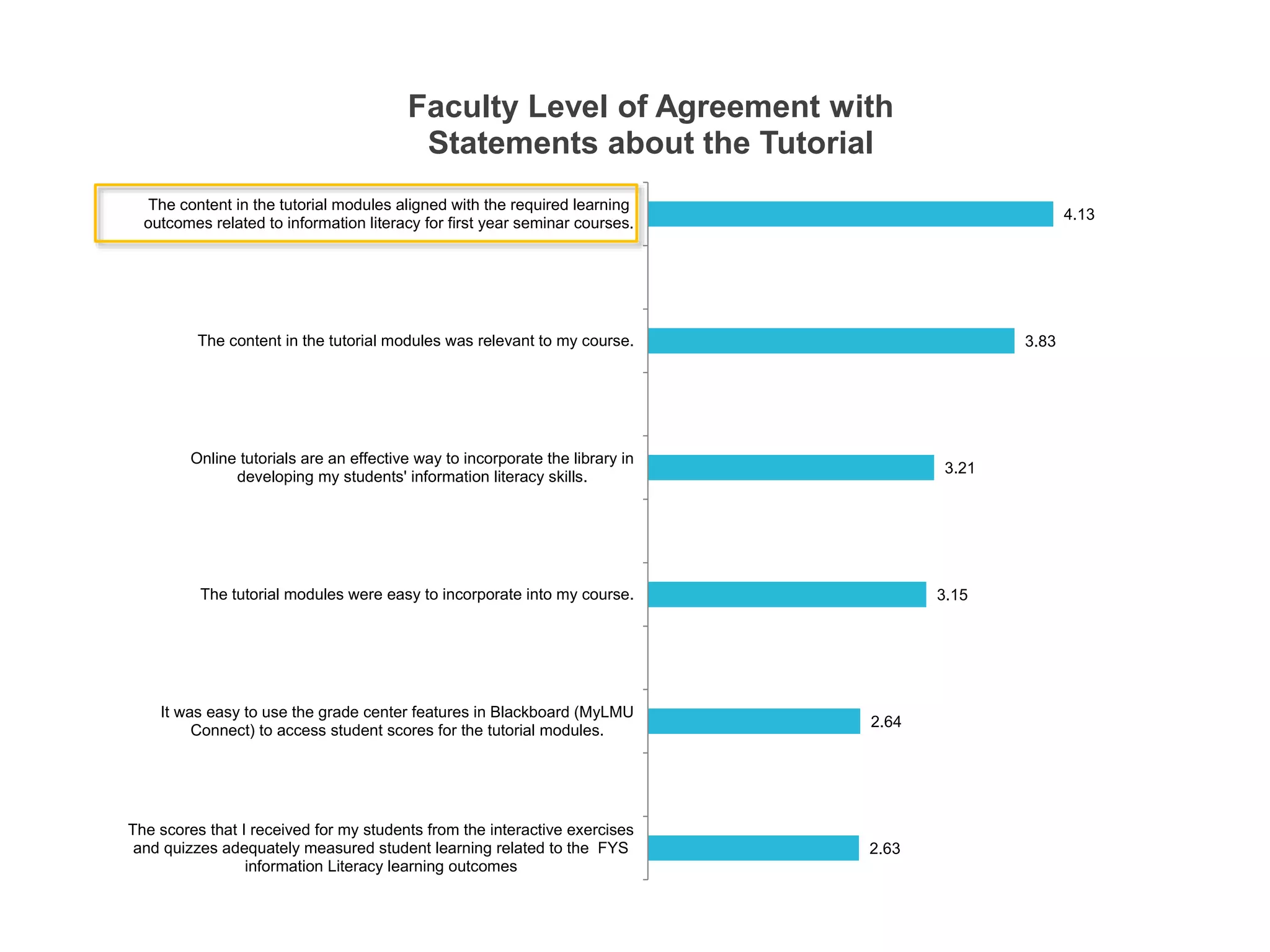
4.13 
3.83 
3.21 
3.15 
Faculty Level of Agreement with 
Statements about the Tutorial 
2.64 
2.63 
The content in the tutorial modules aligned with the required learning 
outcomes related to information literacy for first year seminar courses. 
The content in the tutorial modules was relevant to my course. 
Online tutorials are an effective way to incorporate the library in 
developing my students' information literacy skills. 
The tutorial modules were easy to incorporate into my course. 
It was easy to use the grade center features in Blackboard (MyLMU 
Connect) to access student scores for the tutorial modules. 
The scores that I received for my students from the interactive exercises 
and quizzes adequately measured student learning related to the FYS 
information Literacy learning outcomes
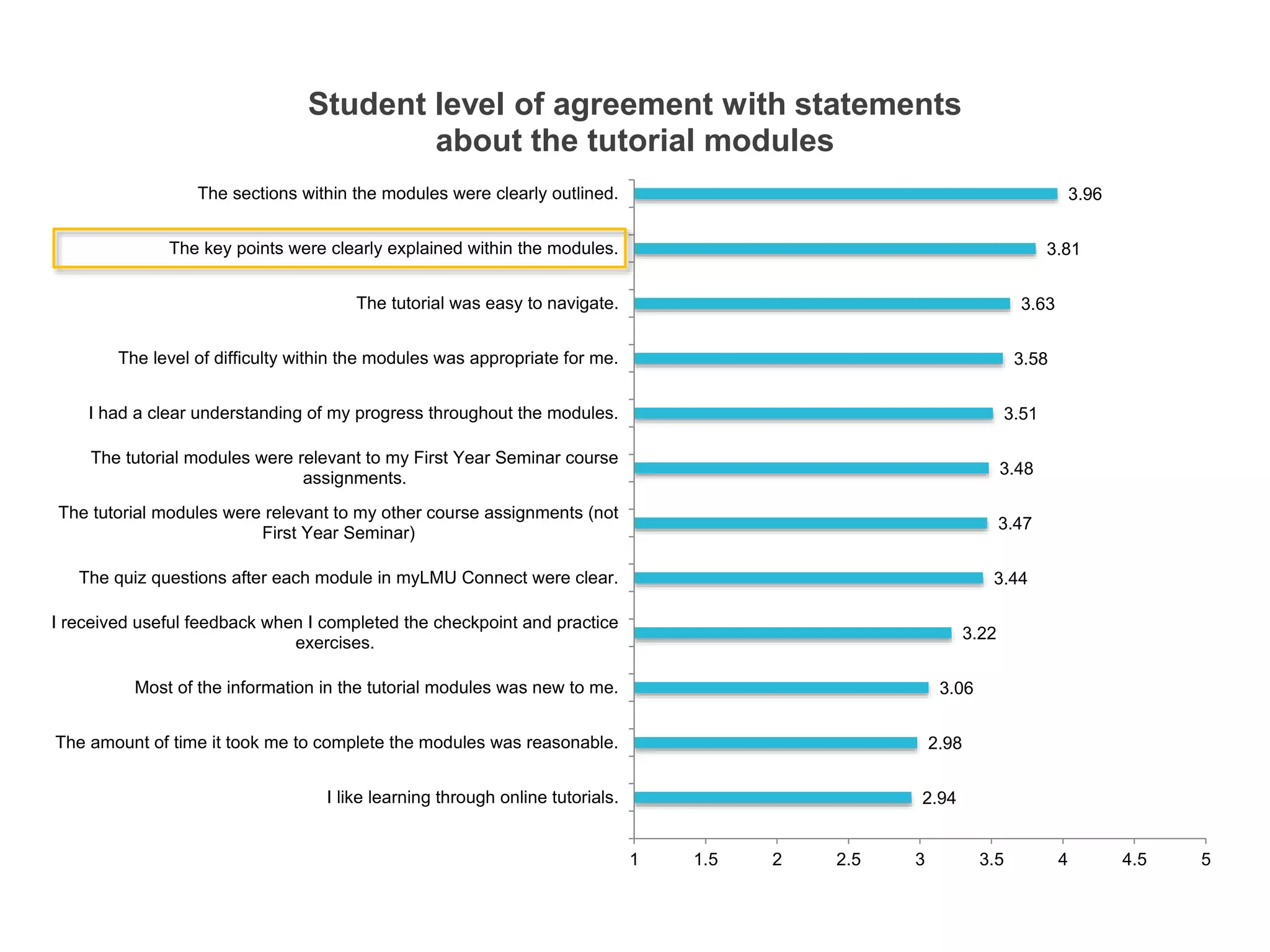
3.96 
3.81 
3.63 
3.58 
3.51 
3.48 
3.47 
3.44 
3.22 
Student level of agreement with statements 
3.06 
2.98 
2.94 
about the tutorial modules 
1 1.5 2 2.5 3 3.5 4 4.5 5 
The sections within the modules were clearly outlined. 
The key points were clearly explained within the modules. 
The tutorial was easy to navigate. 
The level of difficulty within the modules was appropriate for me. 
I had a clear understanding of my progress throughout the modules. 
The tutorial modules were relevant to my First Year Seminar course 
assignments. 
The tutorial modules were relevant to my other course assignments (not 
First Year Seminar) 
The quiz questions after each module in myLMU Connect were clear. 
I received useful feedback when I completed the checkpoint and practice 
exercises. 
Most of the information in the tutorial modules was new to me. 
The amount of time it took me to complete the modules was reasonable. 
I like learning through online tutorials.
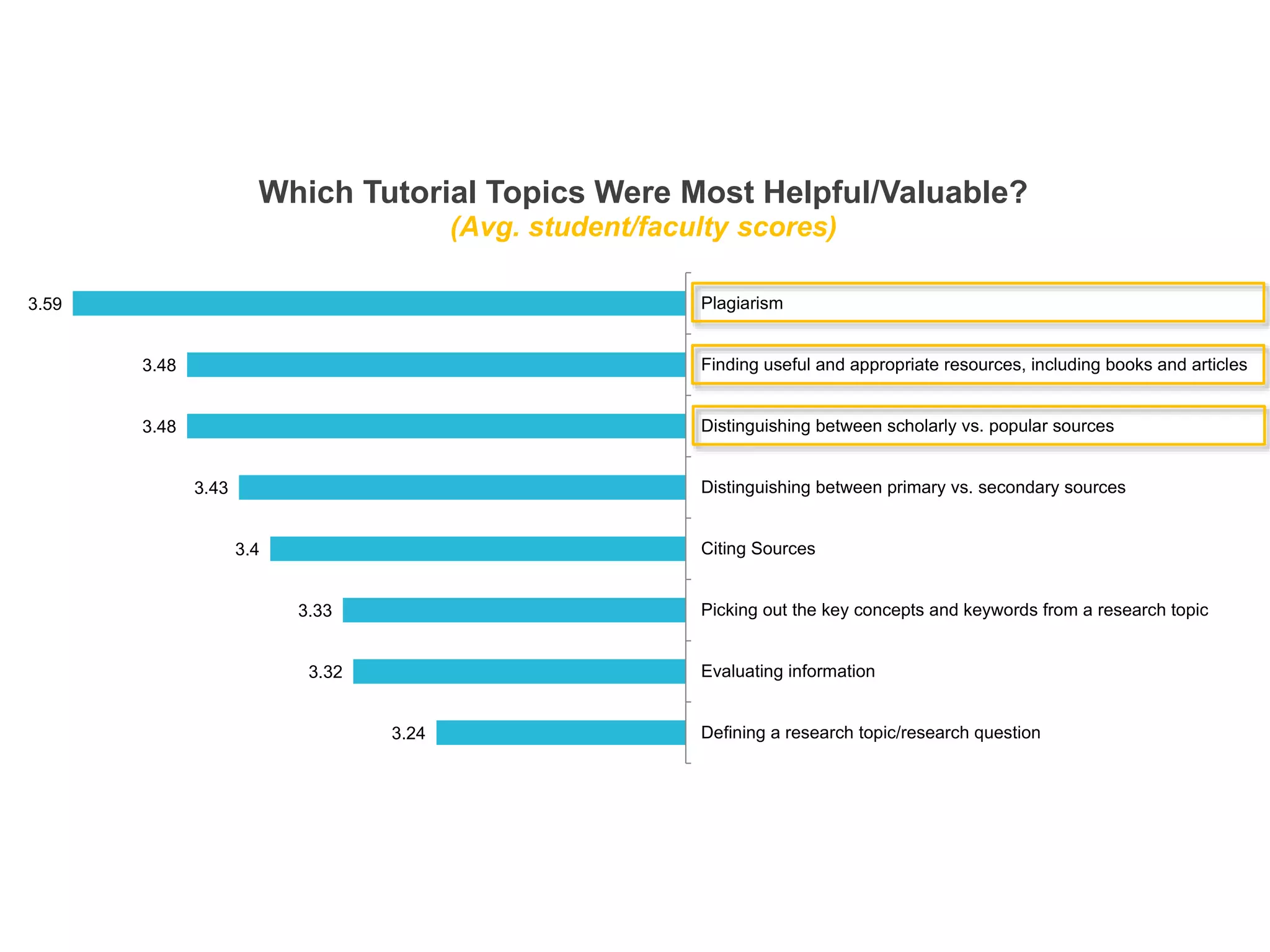
3.59 
3.48 
3.48 
3.43 
Which Tutorial Topics Were Most Helpful/Valuable? 
3.4 
3.33 
3.32 
3.24 
(Avg. student/faculty scores) 
Plagiarism 
Finding useful and appropriate resources, including books and articles 
Distinguishing between scholarly vs. popular sources 
Distinguishing between primary vs. secondary sources 
Citing Sources 
Picking out the key concepts and keywords from a research topic 
Evaluating information 
Defining a research topic/research question
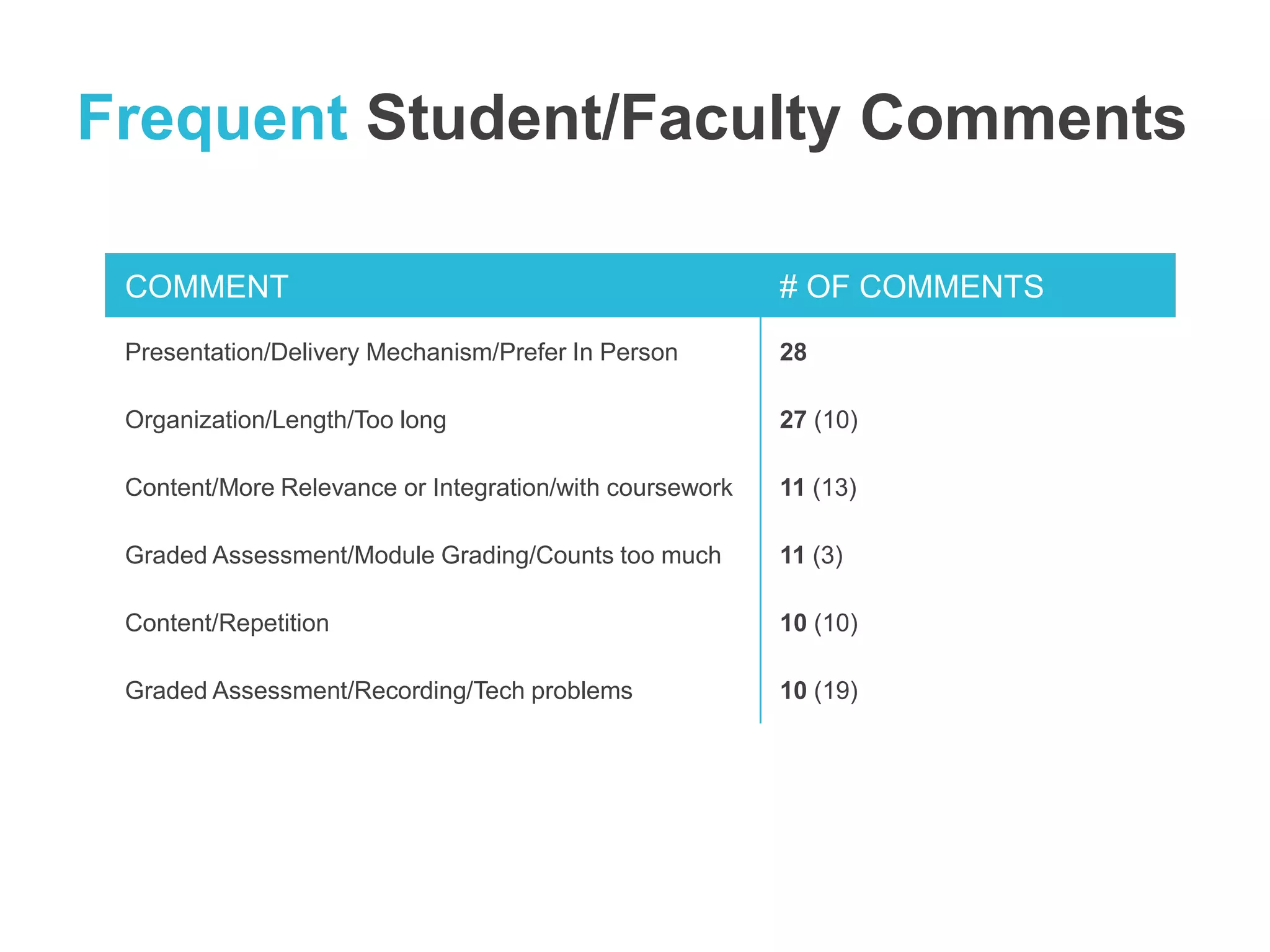
Frequent Student/Faculty Comments 
COMMENT # OF COMMENTS 
Presentation/Delivery Mechanism/Prefer In Person 28 
Organization/Length/Too long 27 (10) 
Content/More Relevance or Integration/with coursework 11 (13) 
Graded Assessment/Module Grading/Counts too much 11 (3) 
Content/Repetition 10 (10) 
Graded Assessment/Recording/Tech problems 10 (19)
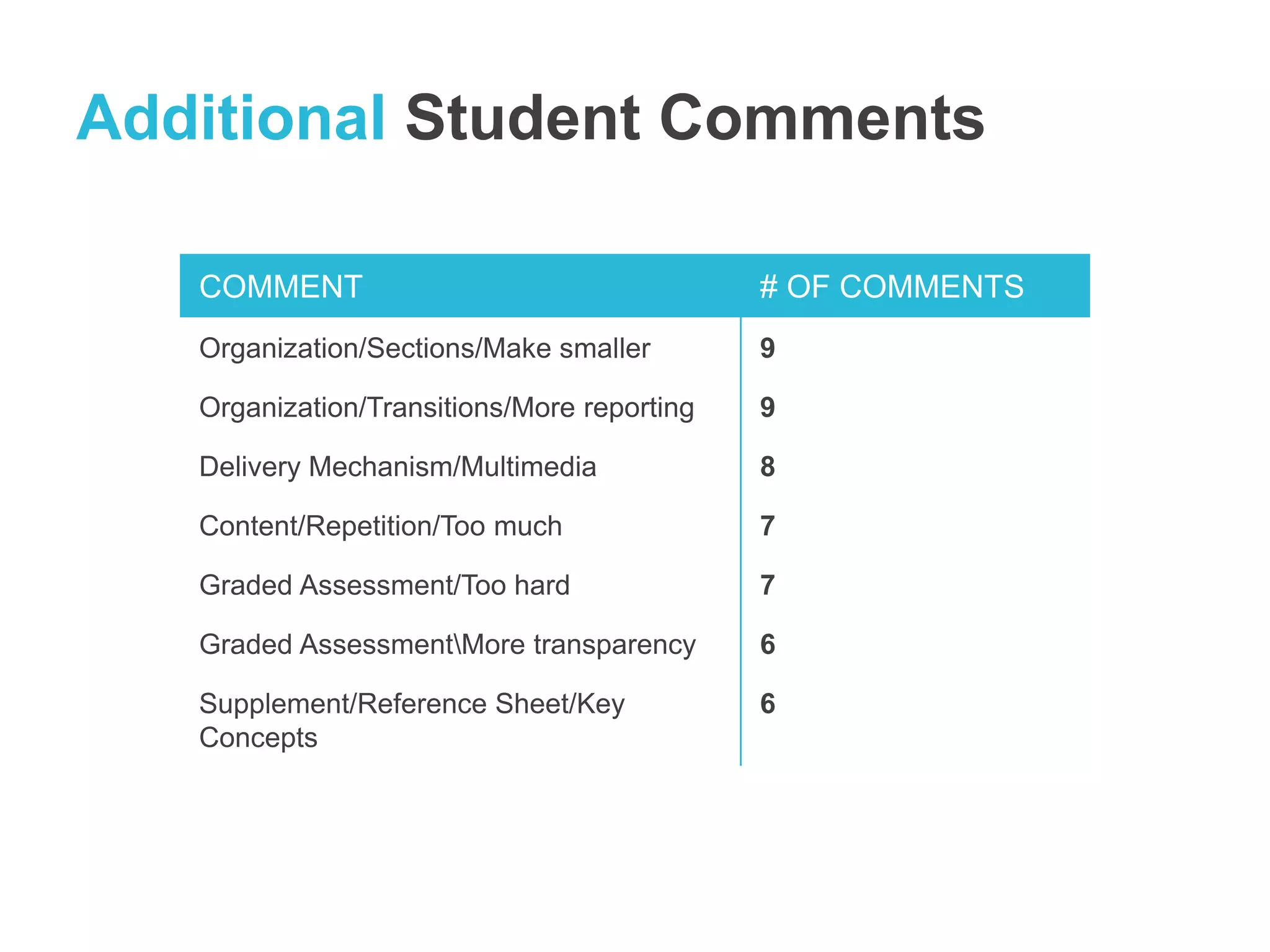
Additional Student Comments 
COMMENT # OF COMMENTS 
Organization/Sections/Make smaller 9 
Organization/Transitions/More reporting 9 
Delivery Mechanism/Multimedia 8 
Content/Repetition/Too much 7 
Graded Assessment/Too hard 7 
Graded AssessmentMore transparency 6 
Supplement/Reference Sheet/Key 
Concepts 
6
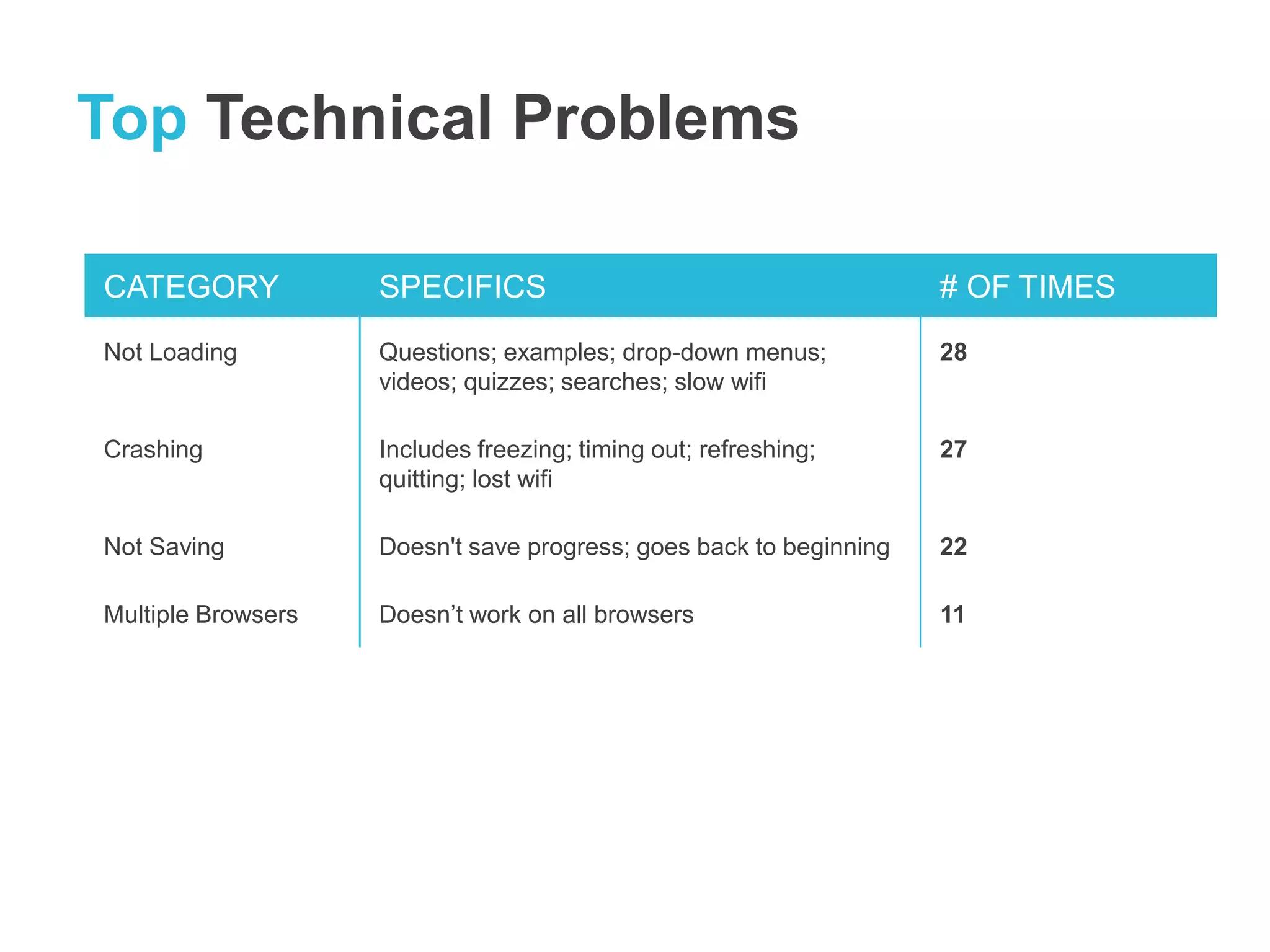
Top Technical Problems 
CATEGORY SPECIFICS # OF TIMES 
Not Loading Questions; examples; drop-down menus; 
videos; quizzes; searches; slow wifi 
28 
Crashing Includes freezing; timing out; refreshing; 
quitting; lost wifi 
27 
Not Saving Doesn't save progress; goes back to beginning 22 
Multiple Browsers Doesn’t work on all browsers 11
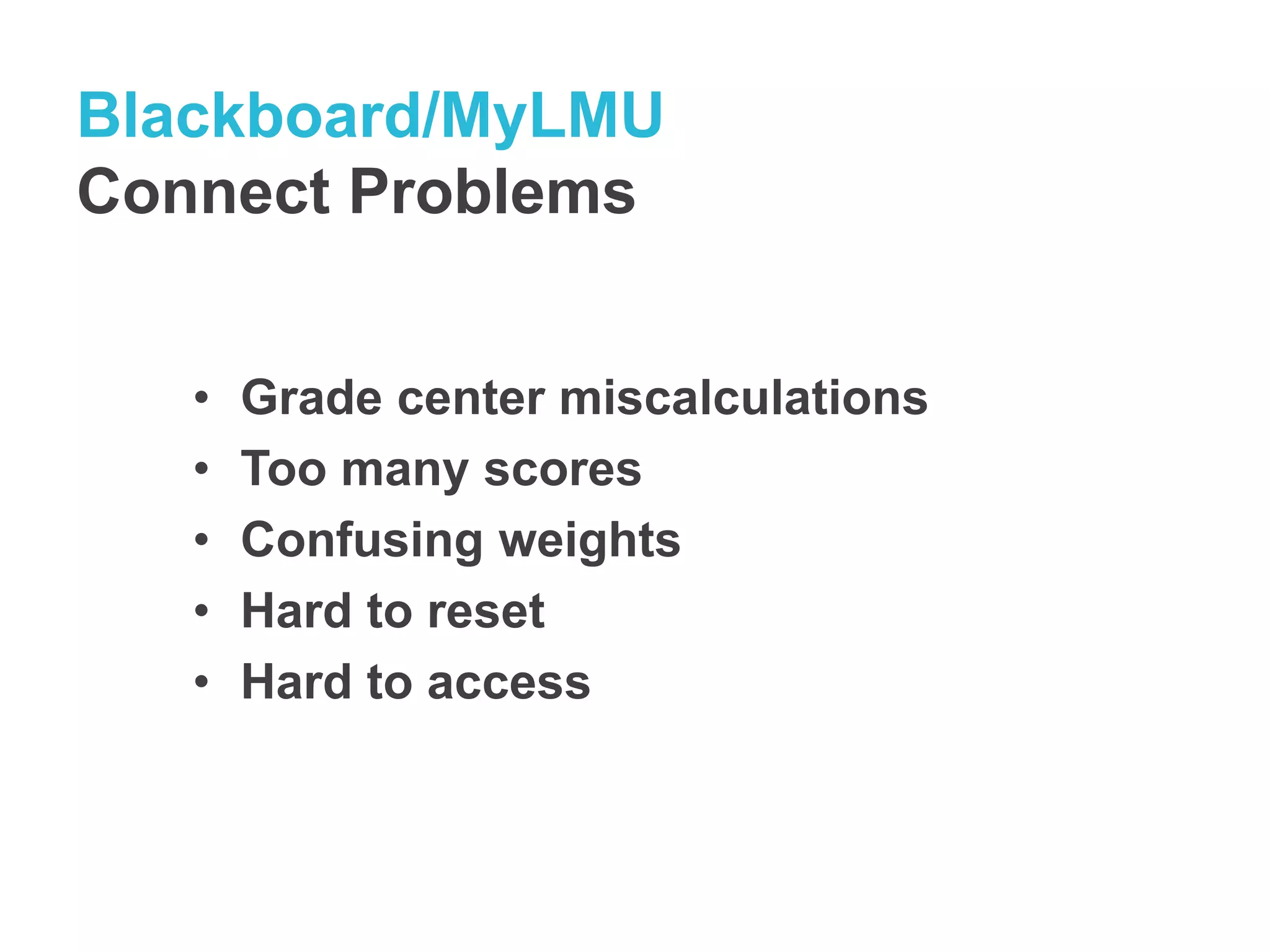
Blackboard/MyLMU 
Connect Problems 
• Grade center miscalculations 
• Too many scores 
• Confusing weights 
• Hard to reset 
• Hard to access
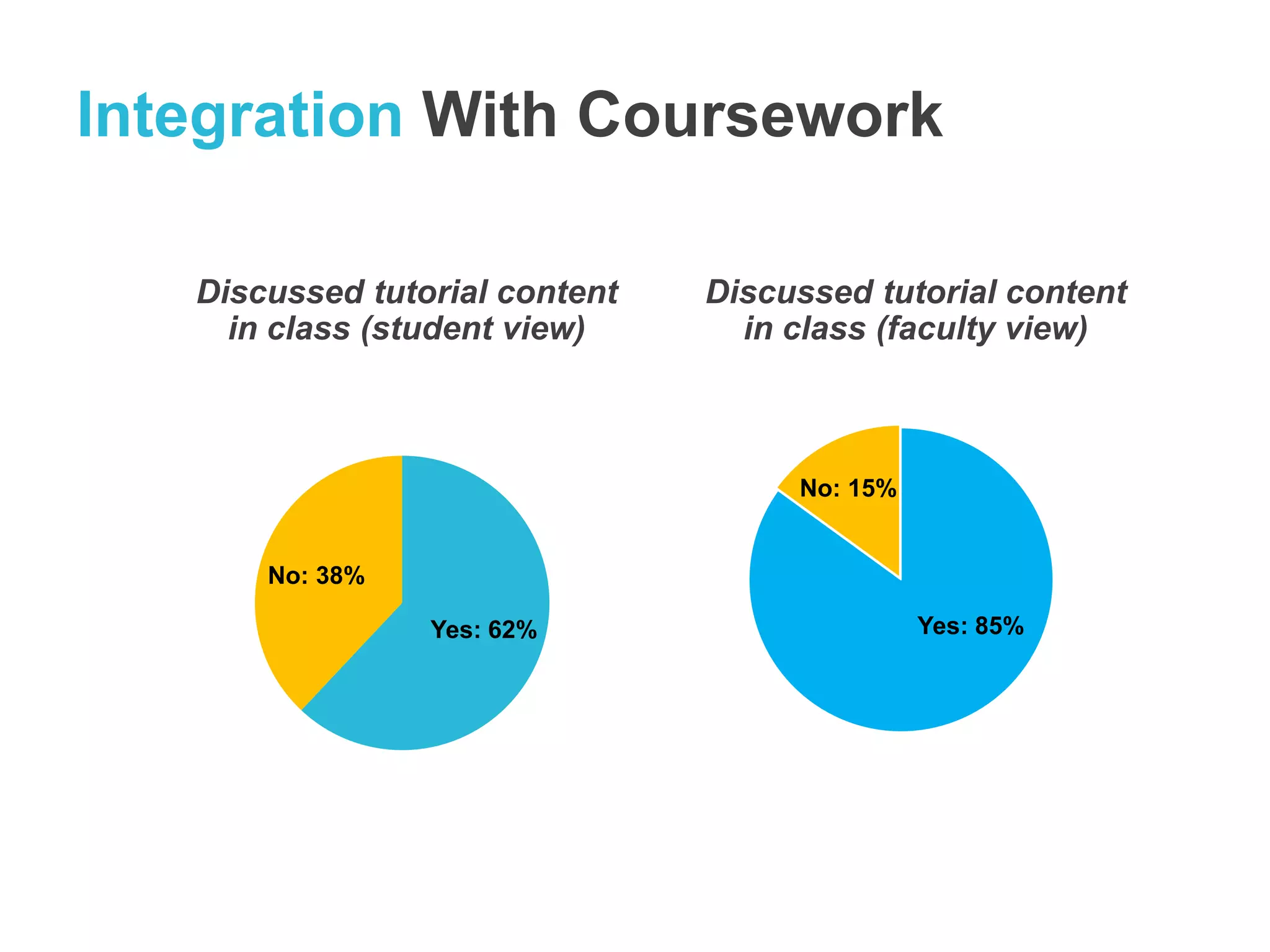
Integration With Coursework 
Discussed tutorial content 
in class (student view) 
Discussed tutorial content 
in class (faculty view) 
Yes: 62% 
No: 38% 
Yes: 85% 
No: 15%
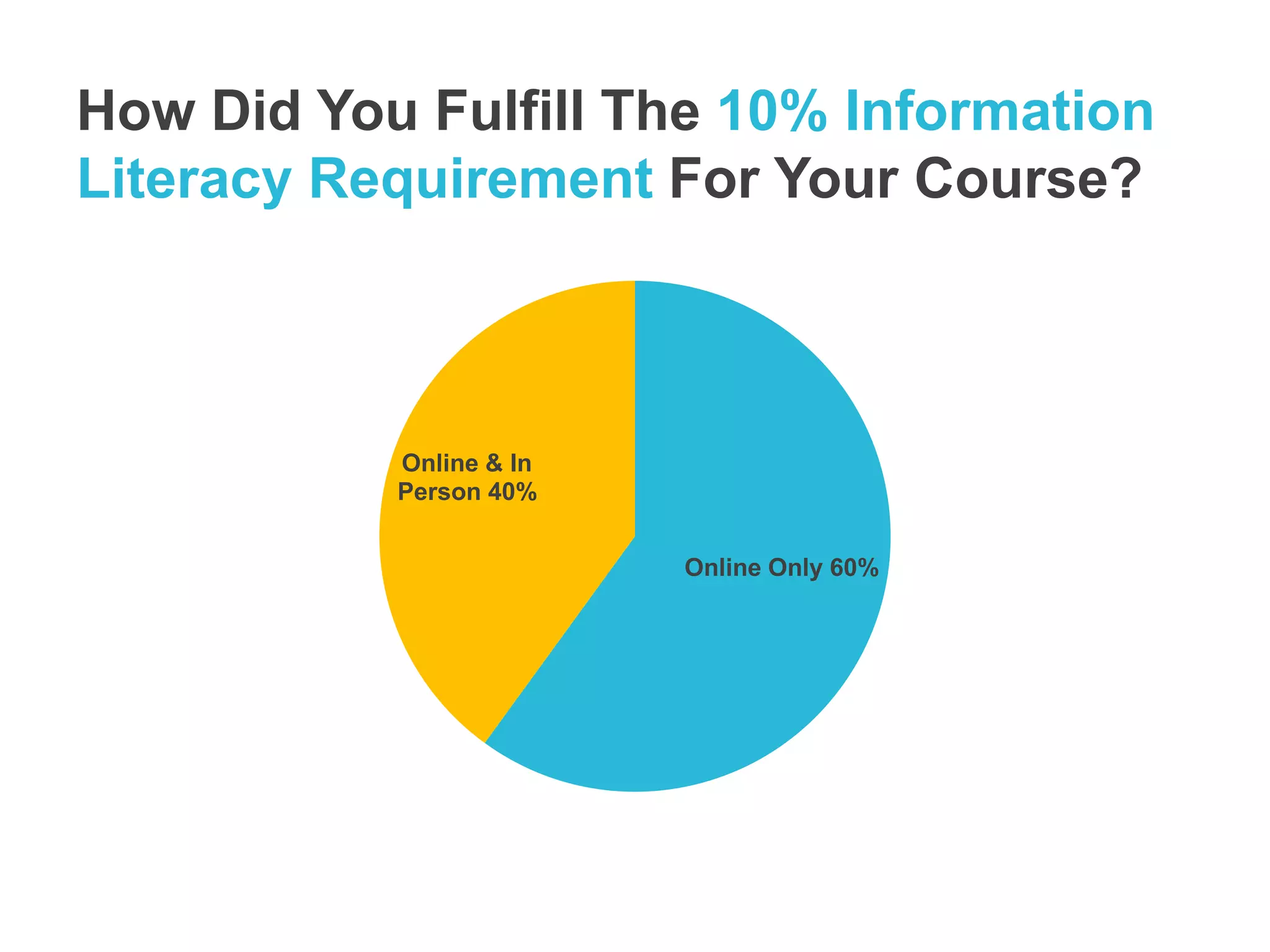
How Did You Fulfill The 10% Information 
Literacy Requirement For Your Course? 
Online Only 60% 
Online & In 
Person 40%
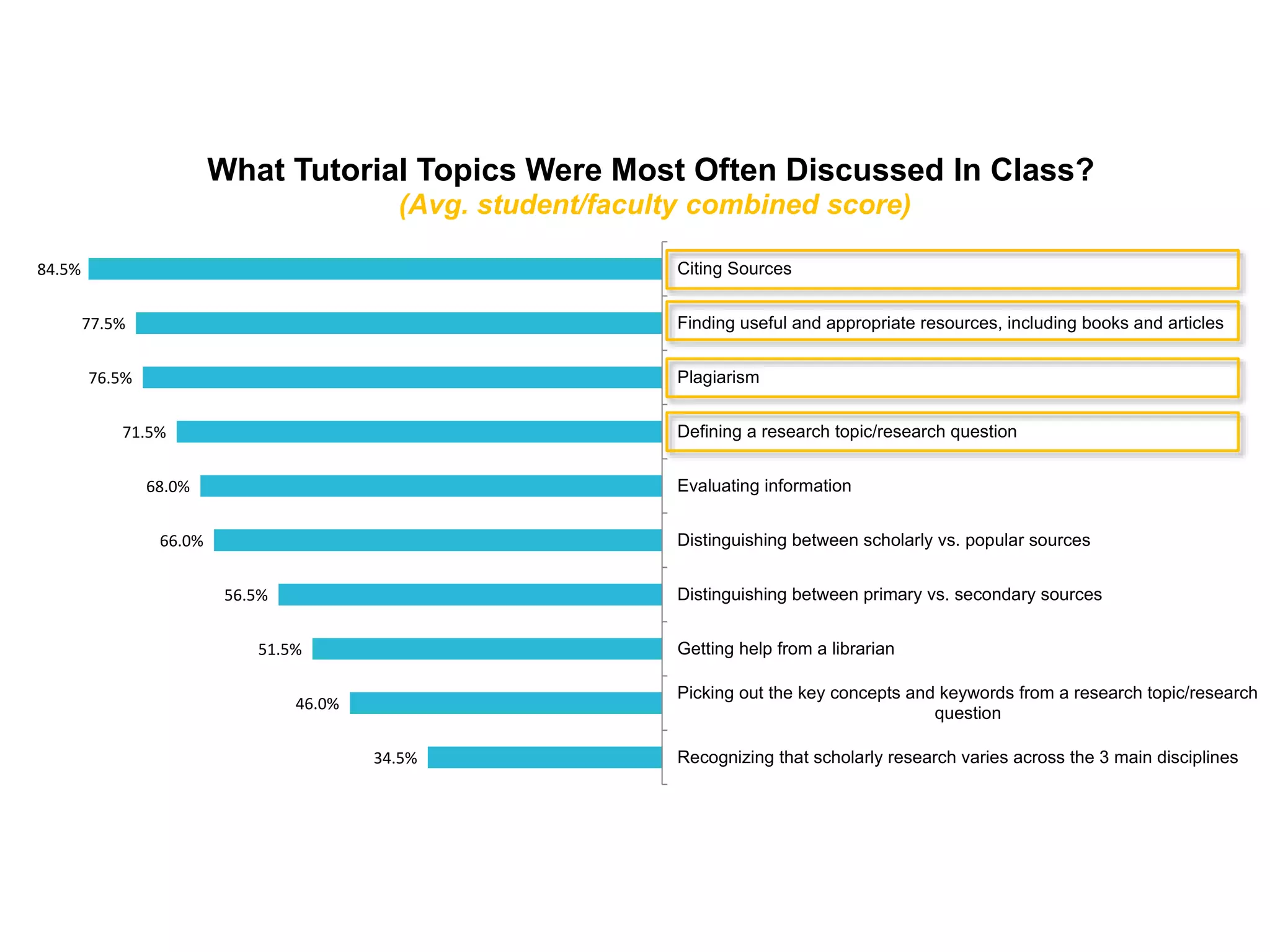
84.5% 
77.5% 
76.5% 
71.5% 
68.0% 
66.0% 
What Tutorial Topics Were Most Often Discussed In Class? 
56.5% 
51.5% 
46.0% 
(Avg. student/faculty combined score) 
34.5% 
Citing Sources 
Finding useful and appropriate resources, including books and articles 
Plagiarism 
Defining a research topic/research question 
Evaluating information 
Distinguishing between scholarly vs. popular sources 
Distinguishing between primary vs. secondary sources 
Getting help from a librarian 
Picking out the key concepts and keywords from a research topic/research 
question 
Recognizing that scholarly research varies across the 3 main disciplines
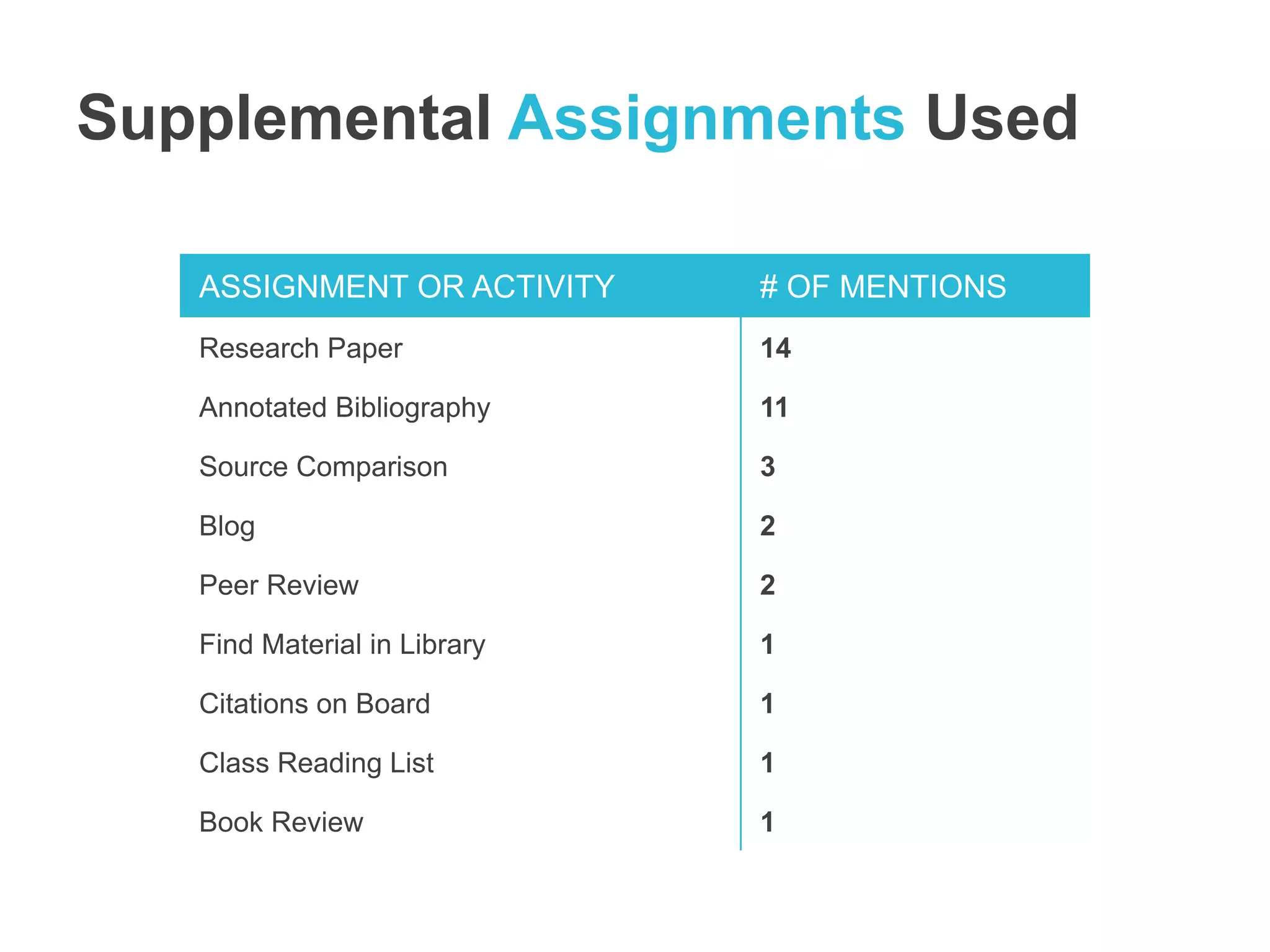
Supplemental Assignments Used 
ASSIGNMENT OR ACTIVITY # OF MENTIONS 
Research Paper 14 
Annotated Bibliography 11 
Source Comparison 3 
Blog 2 
Peer Review 2 
Find Material in Library 1 
Citations on Board 1 
Class Reading List 1 
Book Review 1
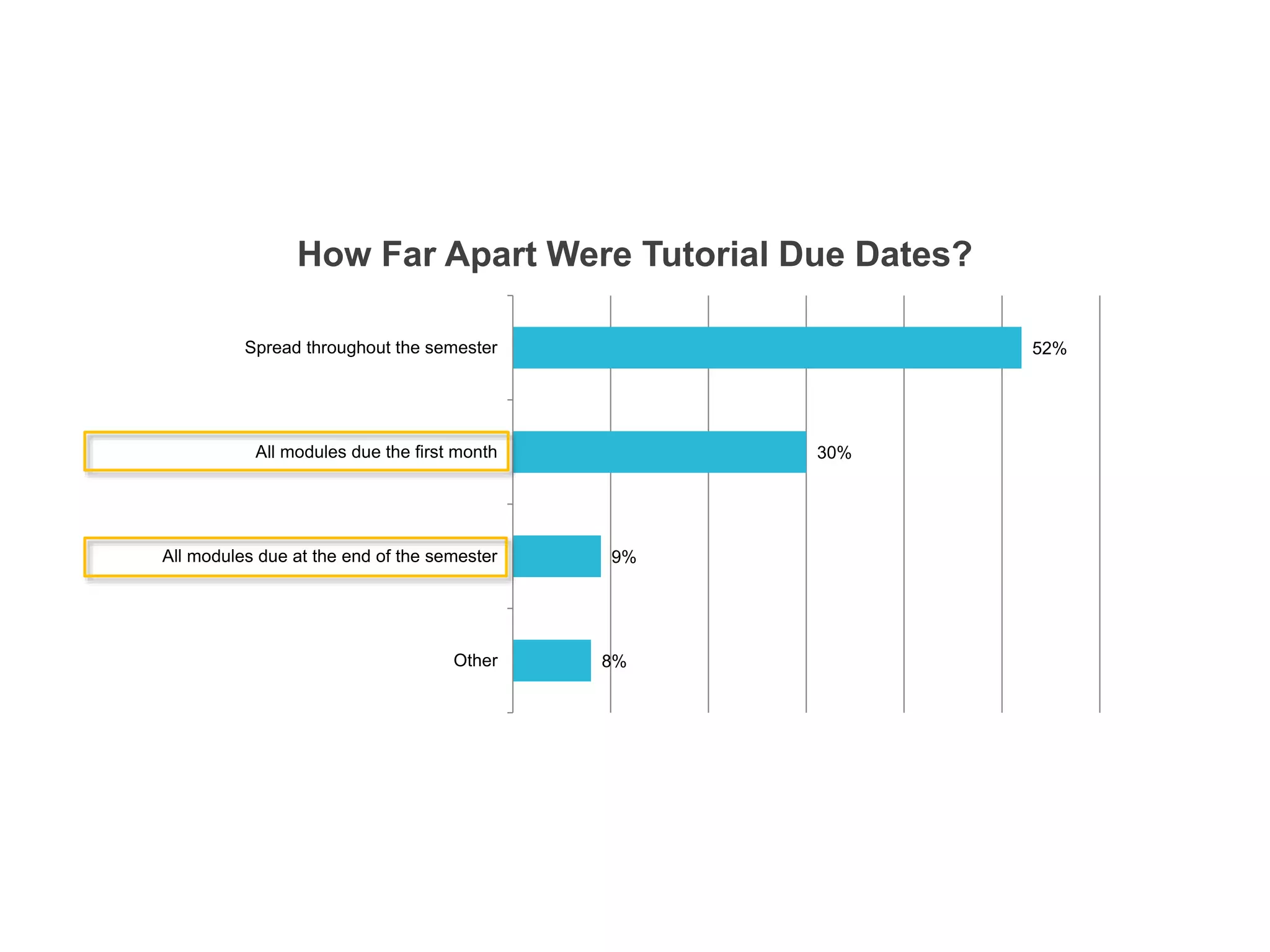
52% 
How Far Apart Were Tutorial Due Dates? 
30% 
9% 
8% 
Spread throughout the semester 
All modules due the first month 
All modules due at the end of the semester 
Other
2014 
Improvements 
• Break down content into 
smaller, shorter chunks 
[5 modules] 
• Offer workarounds for 
student technical 
problems with the grade 
center [printable certificates] 
• Greater transparency in 
scoring [for both instructors and 
students]
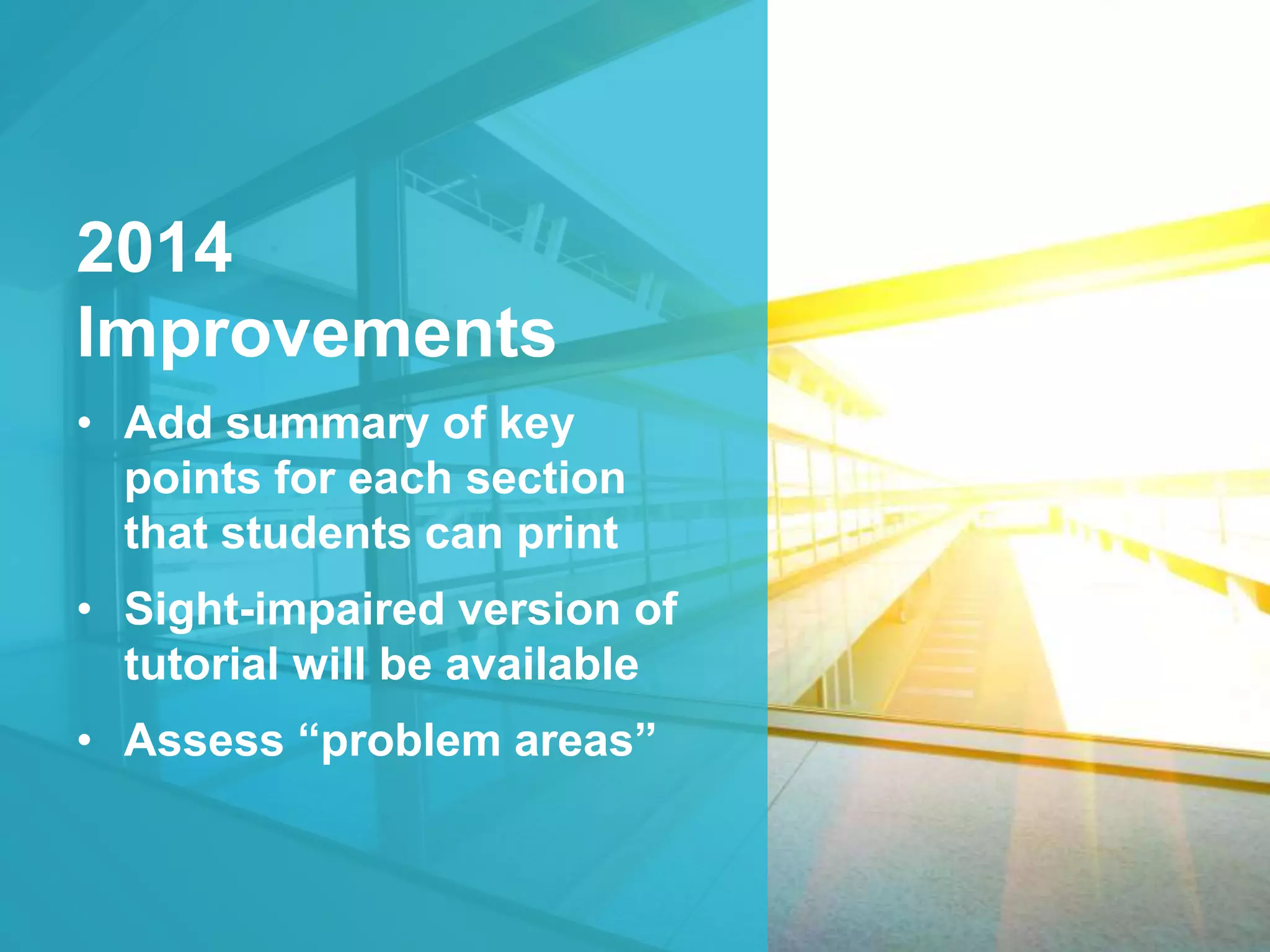
2014 
Improvements 
• Add summary of key 
points for each section 
that students can print 
• Sight-impaired version of 
tutorial will be available 
• Assess “problem areas”
2014 
Improvements 
• Encourage more integration of 
content into FYS course [embed 
assignment or activity suggestions into 
tutorial] 
• Create a “Handbook” for 
faculty with supporting 
materials 
• Offer option of having student 
scores emailed from the 
Library
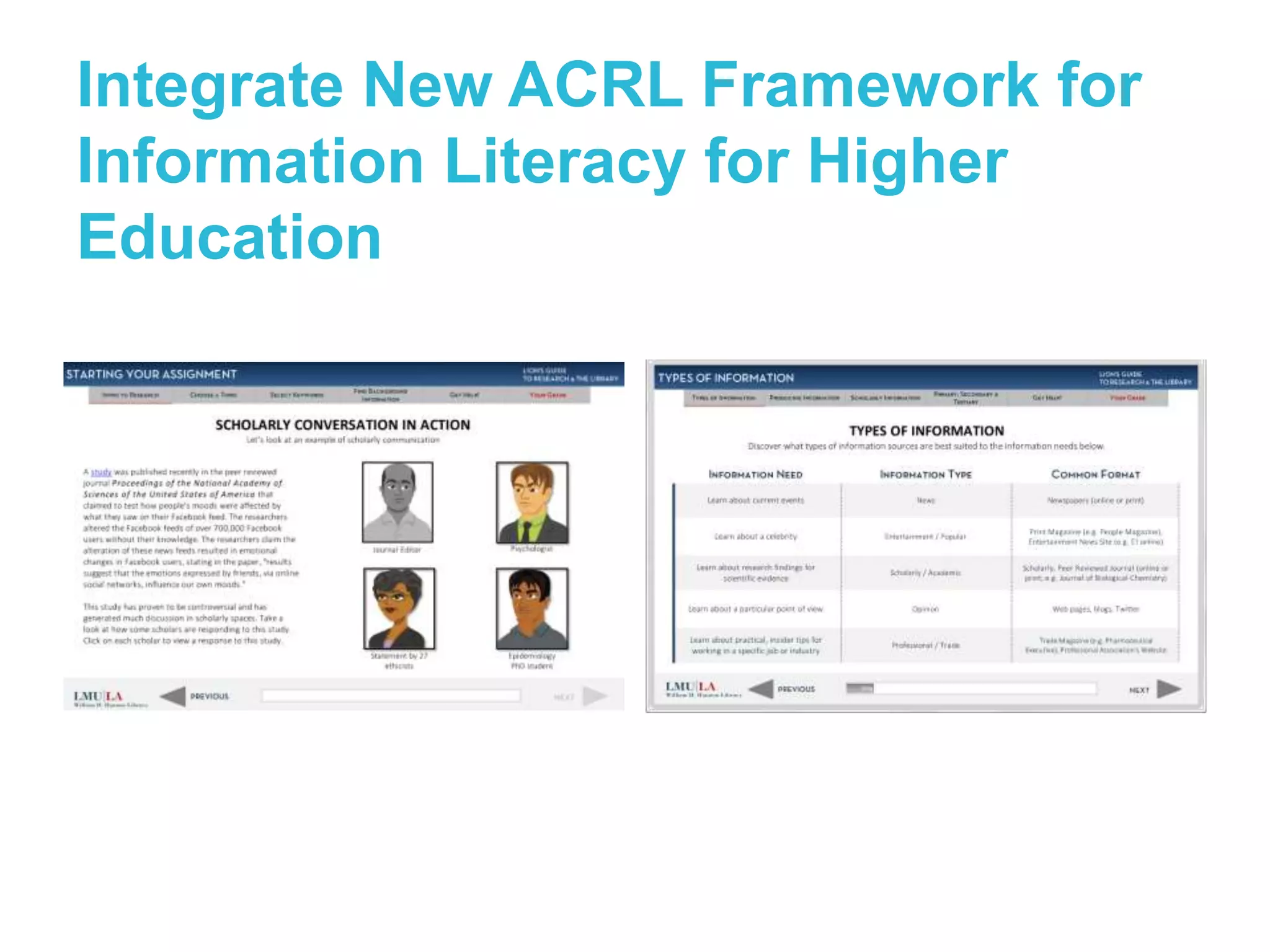
Integrate New ACRL Framework for 
Information Literacy for Higher 
Education
Thank You: 
William H. Hannon Library 
Research Incentive Travel Grant 
Susan Gardner Archambault 
susan.archambault@lmu.edu 
@susanarcham

Adding Up to Success? Assessing Freshman Skills in Information Literacy

  • 1.
    Adding Up toSuccess? Assessing Freshman Skills in Information Literacy Susan Gardner Archambault Loyola Marymount University, USA ECIL 2014
  • 2.
    Information Literacy Tutorial • 74 Sections of First Year Seminar • Tutorial has 4 parts • Each part consists of 4 modules + 4 quizzes • Each part worth a total of 100 points x 4 = 400 points • 10% of course grade • Public version of tutorial: http://bit.ly/YQ34lV •
  • 3.
  • 4.
  • 9.
    Research Question: Howeffective was the tutorial at meeting the information literacy learning outcomes?
  • 10.
    Mixed Methods: DirectMeasures • Overall averages: Student scores across all 4 tutorial modules and 4 quizzes • Individual quiz questions: Ran item analysis in Blackboard
  • 11.
    Mixed Methods: IndirectMeasures • Qualtrics survey: Stratified random sample of 300 students (41% response rate) • Qualtrics survey: All 89 Faculty and Writing Instructors teaching (54% response rate)
  • 12.
    Overall Average Scores: FYS Info Literacy 87% 78% 84% 80% 93% 82% 86% 87% 100% 95% 90% 85% 80% 75% Starting… Types of Info Finding & Evaluating Using Info Ethically Module (across 74 courses) Quiz (across 69 courses)
  • 13.
    N (Number ofStudents out of 1334) 1161 1111 1043 1094 1169 1140 1099 1093 1200 1000 800 600 400 200 0 Starting… Types of Info Finding & Evaluating Using Info Ethically Module Quiz
  • 14.
  • 15.
    COLOR LEGEND for Quiz Scores Handout
  • 20.
    Module 2: LowPerforming Questions *All related to Outcome 5: Evaluate Sources TASK AVERAGE SCORE Differentiate between a primary, secondary, and tertiary source 66% Demonstrate an understanding of the order in which information is produced by correctly ranking, from earliest to latest, the publication date for a group of sources about the same event 75% Identify the source from the Social Sciences branch of knowledge from a list of mixed-discipline search results 66%
  • 21.
    Module 3: LowPerforming Questions OUTCOME TASK AVERAGE SCORE Outcome 5: Evaluate Sources Categorize a list of sources by the degree that they represent the following elements of the RADAR framework: authority, date/currency, relevancy, and rationale/bias. 73% Outcome 4: Locate & Access Information Identify the four characteristics describing the scope and functionality of library research databases from a list of characteristics describing either databases or the library catalog 73% “ “ Choose the appropriate search strategy of “OR” to broaden a search from a list of five possible search strategies 69% “ “ Identify these search protocols appropriate to the structure of a library catalog: items may be grouped together by subject in order to facilitate browsing; and both keyword searching and controlled vocabulary are search language that could enhance information retrieval 55%
  • 22.
    Module 4: LowPerforming Questions *All related to Outcome 5: Plagiarism & Information Ethics TASK AVERAGE SCORE Recognize the correct definition of fair use 73% Distinguish from among five choices the correct example of an item under copyright protection 75% Recognize an incorrect paraphrasing that is too close to the original text 75%
  • 23.
    Student & Faculty/WritingInstructor SURVEY RESULTS
  • 24.
    4.13 3.83 3.21 3.15 Faculty Level of Agreement with Statements about the Tutorial 2.64 2.63 The content in the tutorial modules aligned with the required learning outcomes related to information literacy for first year seminar courses. The content in the tutorial modules was relevant to my course. Online tutorials are an effective way to incorporate the library in developing my students' information literacy skills. The tutorial modules were easy to incorporate into my course. It was easy to use the grade center features in Blackboard (MyLMU Connect) to access student scores for the tutorial modules. The scores that I received for my students from the interactive exercises and quizzes adequately measured student learning related to the FYS information Literacy learning outcomes
  • 25.
    3.96 3.81 3.63 3.58 3.51 3.48 3.47 3.44 3.22 Student level of agreement with statements 3.06 2.98 2.94 about the tutorial modules 1 1.5 2 2.5 3 3.5 4 4.5 5 The sections within the modules were clearly outlined. The key points were clearly explained within the modules. The tutorial was easy to navigate. The level of difficulty within the modules was appropriate for me. I had a clear understanding of my progress throughout the modules. The tutorial modules were relevant to my First Year Seminar course assignments. The tutorial modules were relevant to my other course assignments (not First Year Seminar) The quiz questions after each module in myLMU Connect were clear. I received useful feedback when I completed the checkpoint and practice exercises. Most of the information in the tutorial modules was new to me. The amount of time it took me to complete the modules was reasonable. I like learning through online tutorials.
  • 26.
    3.59 3.48 3.48 3.43 Which Tutorial Topics Were Most Helpful/Valuable? 3.4 3.33 3.32 3.24 (Avg. student/faculty scores) Plagiarism Finding useful and appropriate resources, including books and articles Distinguishing between scholarly vs. popular sources Distinguishing between primary vs. secondary sources Citing Sources Picking out the key concepts and keywords from a research topic Evaluating information Defining a research topic/research question
  • 27.
    Frequent Student/Faculty Comments COMMENT # OF COMMENTS Presentation/Delivery Mechanism/Prefer In Person 28 Organization/Length/Too long 27 (10) Content/More Relevance or Integration/with coursework 11 (13) Graded Assessment/Module Grading/Counts too much 11 (3) Content/Repetition 10 (10) Graded Assessment/Recording/Tech problems 10 (19)
  • 28.
    Additional Student Comments COMMENT # OF COMMENTS Organization/Sections/Make smaller 9 Organization/Transitions/More reporting 9 Delivery Mechanism/Multimedia 8 Content/Repetition/Too much 7 Graded Assessment/Too hard 7 Graded AssessmentMore transparency 6 Supplement/Reference Sheet/Key Concepts 6
  • 29.
    Top Technical Problems CATEGORY SPECIFICS # OF TIMES Not Loading Questions; examples; drop-down menus; videos; quizzes; searches; slow wifi 28 Crashing Includes freezing; timing out; refreshing; quitting; lost wifi 27 Not Saving Doesn't save progress; goes back to beginning 22 Multiple Browsers Doesn’t work on all browsers 11
  • 30.
    Blackboard/MyLMU Connect Problems • Grade center miscalculations • Too many scores • Confusing weights • Hard to reset • Hard to access
  • 31.
    Integration With Coursework Discussed tutorial content in class (student view) Discussed tutorial content in class (faculty view) Yes: 62% No: 38% Yes: 85% No: 15%
  • 32.
    How Did YouFulfill The 10% Information Literacy Requirement For Your Course? Online Only 60% Online & In Person 40%
  • 33.
    84.5% 77.5% 76.5% 71.5% 68.0% 66.0% What Tutorial Topics Were Most Often Discussed In Class? 56.5% 51.5% 46.0% (Avg. student/faculty combined score) 34.5% Citing Sources Finding useful and appropriate resources, including books and articles Plagiarism Defining a research topic/research question Evaluating information Distinguishing between scholarly vs. popular sources Distinguishing between primary vs. secondary sources Getting help from a librarian Picking out the key concepts and keywords from a research topic/research question Recognizing that scholarly research varies across the 3 main disciplines
  • 34.
    Supplemental Assignments Used ASSIGNMENT OR ACTIVITY # OF MENTIONS Research Paper 14 Annotated Bibliography 11 Source Comparison 3 Blog 2 Peer Review 2 Find Material in Library 1 Citations on Board 1 Class Reading List 1 Book Review 1
  • 35.
    52% How FarApart Were Tutorial Due Dates? 30% 9% 8% Spread throughout the semester All modules due the first month All modules due at the end of the semester Other
  • 36.
    2014 Improvements •Break down content into smaller, shorter chunks [5 modules] • Offer workarounds for student technical problems with the grade center [printable certificates] • Greater transparency in scoring [for both instructors and students]
  • 37.
    2014 Improvements •Add summary of key points for each section that students can print • Sight-impaired version of tutorial will be available • Assess “problem areas”
  • 38.
    2014 Improvements •Encourage more integration of content into FYS course [embed assignment or activity suggestions into tutorial] • Create a “Handbook” for faculty with supporting materials • Offer option of having student scores emailed from the Library
  • 39.
    Integrate New ACRLFramework for Information Literacy for Higher Education
  • 40.
    Thank You: WilliamH. Hannon Library Research Incentive Travel Grant Susan Gardner Archambault susan.archambault@lmu.edu @susanarcham