The Planning Program @
CEPT
Faculty of Planning
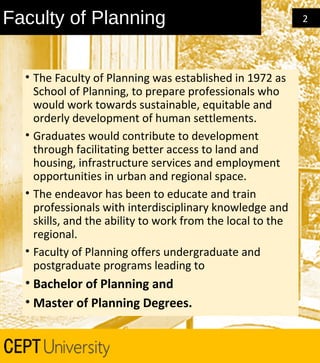
• The Faculty of Planning was established in 1972 as
School of Planning, to prepare professionals who
would work towards sustainable, equitable and
orderly development of human settlements.
• Graduates would contribute to development
through facilitating better access to land and
housing, infrastructure services and employment
opportunities in urban and regional space.
• The endeavor has been to educate and train
professionals with interdisciplinary knowledge and
skills, and the ability to work from the local to the
regional.
• Faculty of Planning offers undergraduate and
postgraduate programs leading to

• Bachelor of Planning and
• Master of Planning Degrees.

2
Visiting the current planning
issues

4

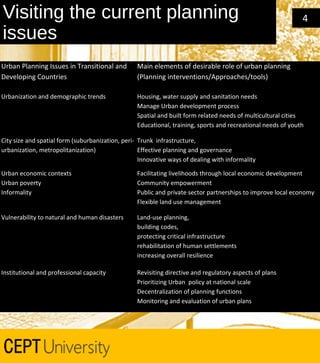
Urban Planning Issues in Transitional and
Developing Countries

Main elements of desirable role of urban planning
(Planning interventions/Approaches/tools)

Urbanization and demographic trends

Housing, water supply and sanitation needs
Manage Urban development process
Spatial and built form related needs of multicultural cities
Educational, training, sports and recreational needs of youth

City size and spatial form (suburbanization, peri- Trunk infrastructure,
urbanization, metropolitanization)
Effective planning and governance
Innovative ways of dealing with informality
Urban economic contexts
Urban poverty
Informality

Facilitating livelihoods through local economic development
Community empowerment
Public and private sector partnerships to improve local economy
Flexible land use management

Vulnerability to natural and human disasters

Land-use planning,
building codes,
protecting critical infrastructure
rehabilitation of human settlements
increasing overall resilience

Institutional and professional capacity

Revisiting directive and regulatory aspects of plans
Prioritizing Urban policy at national scale
Decentralization of planning functions
Monitoring and evaluation of urban plans
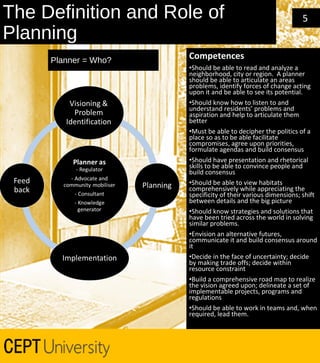
The Definition and Role of
Planning
Planner = Who?

5

Competences
•Should be able to read and analyze a
neighborhood, city or region. A planner
should be able to articulate an areas
problems, identify forces of change acting
upon it and be able to see its potential.
•Should know how to listen to and
understand residents’ problems and
aspiration and help to articulate them
better
•Must be able to decipher the politics of a
place so as to be able facilitate
compromises, agree upon priorities,
formulate agendas and build consensus
•Should have presentation and rhetorical
skills to be able to convince people and
build consensus
•Should be able to view habitats
comprehensively while appreciating the
specificity of their various dimensions; shift
between details and the big picture
•Should know strategies and solutions that
have been tried across the world in solving
similar problems.
•Envision an alternative futures,
communicate it and build consensus around
it
•Decide in the face of uncertainty; decide
by making trade offs; decide within
resource constraint
•Build a comprehensive road map to realize
the vision agreed upon; delineate a set of
implementable projects, programs and
regulations
•Should be able to work in teams and, when
required, lead them.
6

The Bachelors Program
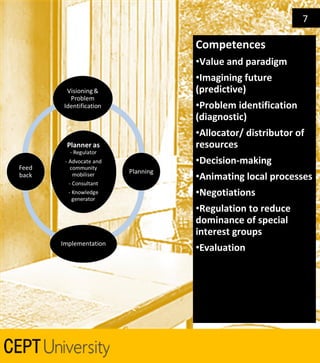
7

Competences
•Value and paradigm
•Imagining future
(predictive)
•Problem identification
(diagnostic)
•Allocator/ distributor of
resources
•Decision-making
•Animating local processes
•Negotiations
•Regulation to reduce
dominance of special
interest groups
•Evaluation
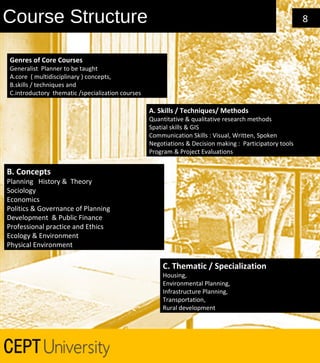
Course Structure

8

Genres of Core Courses

Generalist Planner to be taught
A.core ( multidisciplinary ) concepts,
B.skills / techniques and
C.introductory thematic /specialization courses

A. Skills / Techniques/ Methods

Quantitative & qualitative research methods
Spatial skills & GIS
Communication Skills : Visual, Written, Spoken
Negotiations & Decision making : Participatory tools
Program & Project Evaluations

B. Concepts

Planning History & Theory
Sociology
Economics
Politics & Governance of Planning
Development & Public Finance
Professional practice and Ethics
Ecology & Environment
Physical Environment

C. Thematic / Specialization
Housing,
Environmental Planning,
Infrastructure Planning,
Transportation,
Rural development
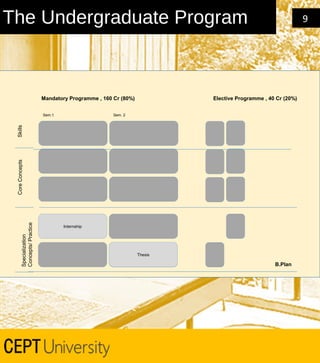
The Undergraduate Program

Mandatory Programme , 160 Cr (80%)

Elective Programme , 40 Cr (20%)

Sem. 2

Specialization
Concepts/ Practice

Core Concepts

Skills

Sem.1

9

Internship

Thesis

B.Plan
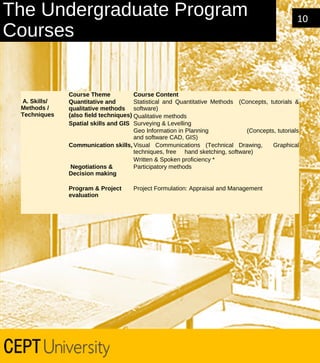
The Undergraduate Program
Courses

 
 A. Skills/ 
Methods / 
Techniques

10

Course Theme
Course Content
Quantitative and 
Statistical and Quantitative Methods (Concepts, tutorials &
qualitative methods  software)
(also field techniques) Qualitative methods
Spatial skills and GIS Surveying & Levelling
Geo Information in Planning
(Concepts, tutorials
and software CAD, GIS)
Communication skills, Visual Communications (Technical Drawing,
Graphical
techniques, free hand sketching, software)
Written & Spoken proficiency *
 Negotiations & 
Participatory methods
Decision making
Program & Project 
evaluation

Project Formulation: Appraisal and Management
The Undergraduate Program
Courses

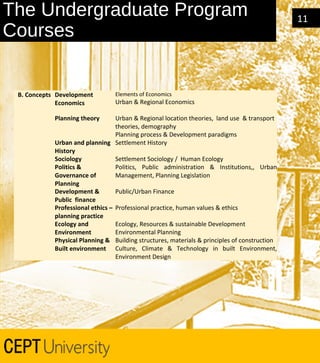
B. Concepts Development
Economics
Planning theory

Elements of Economics

Urban & Regional Economics

Urban & Regional location theories, land use & transport
theories, demography
Planning process & Development paradigms
Urban and planning Settlement History
History
Sociology
Settlement Sociology / Human Ecology
Politics &
Politics, Public administration & Institutions,, Urban
Governance of
Management, Planning Legislation
Planning
Development &
Public/Urban Finance
Public finance
Professional ethics – Professional practice, human values & ethics
planning practice
Ecology and
Ecology, Resources & sustainable Development
Environmental Planning
Environment
Physical Planning & Building structures, materials & principles of construction
Built environment Culture, Climate & Technology in built Environment,
Environment Design

11
The Undergraduate Program
Courses

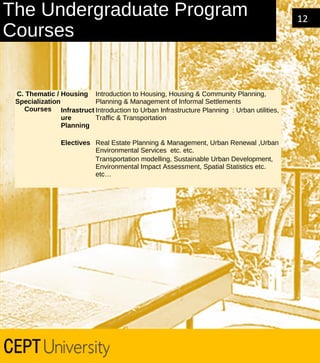
C. Thematic / Housing Introduction to Housing, Housing & Community Planning,
Specialization 
Planning & Management of Informal Settlements
Courses Infrastruct Introduction to Urban Infrastructure Planning : Urban utilities,
 
ure 
Traffic & Transportation
Planning
Electives  Real Estate Planning & Management, Urban Renewal ,Urban
Environmental Services etc. etc.
 
Transportation modelling, Sustainable Urban Development,
Environmental Impact Assessment, Spatial Statistics etc.
etc…

12
13

The Masters Program
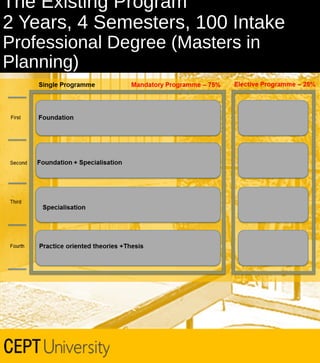
The Existing Program
2 Years, 4 Semesters, 100 Intake
Professional Degree (Masters in
Planning)
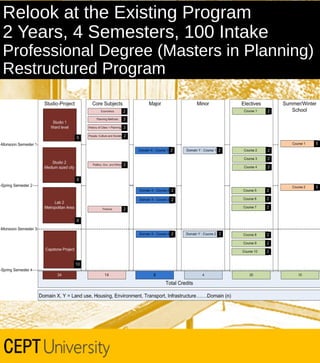
Relook at the Existing Program
2 Years, 4 Semesters, 100 Intake

Professional Degree (Masters in Planning)
Restructured Program
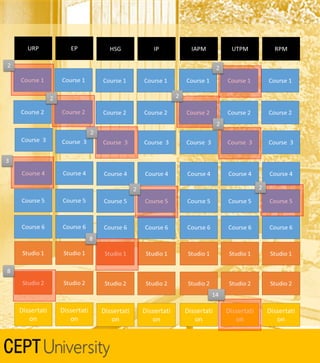
The Student gets

Masters in Planning with a Major in Urban and
Regional Planning
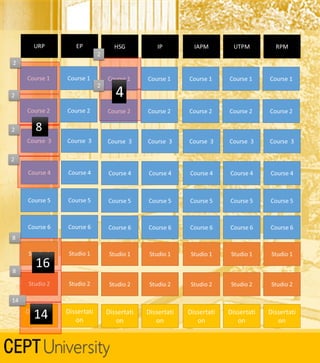
The Student gets

Only Masters in Planning Degree
The Student gets

• Only M. Plan Degree Major in URP and Minor in
Housing
Urban and Regional Planning
Domain Courses
1Urban & Regional Infrastructure System2Built Form and Land Use planning3Urban and Regional TransportationA urban planning Studio- (Development
planning & Strategies at city scale)- 8
Credits

1 Regional Planning & Development
2 Rural Development
3 Political science & governance

B Regional planning Studio( planning & Strategies at Regional scale)8 Credits

28
Environment Domain Courses


Environmental Planning and Science (Sem II)


Energy, Climate Change and Development (Sem III)



Environment and Quality of Life (Sem III)



Natural Resources Management (Sem II)



Environmental Economics (Sem III)


Environment and Social Impact Assessment (Sem III)

Environmental Legislation, Administration and Governance (Sem II)

29
Housing Domain Courses
Fundamentals of Housing
Built Form and Land Use Planning
Housing Economics and Finance
Housing Programme and Project Development & Evaluation

Land Development and Management Practices

Urban Development and Real Estate

30
Housing Domain Courses


Environmental Planning and Science (Sem II)


Energy, Climate Change and Development (Sem III)



Environment and Quality of Life (Sem III)



Natural Resources Management (Sem II)



Environmental Economics (Sem III)


Environment and Social Impact Assessment (Sem III)

Environmental Legislation, Administration and Governance (Sem II)

31
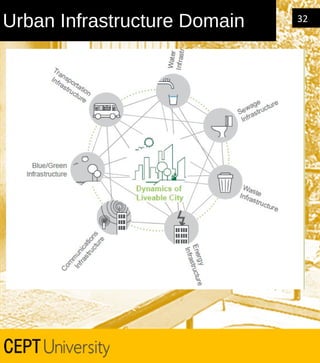
Urban Infrastructure Domain

32
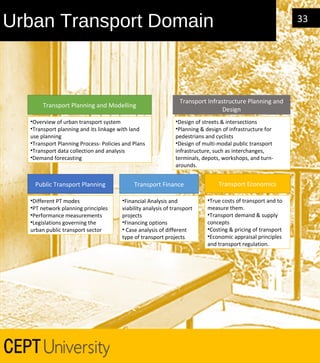
Urban Transport Domain

Transport Planning and Modelling
•Overview of urban transport system
•Transport planning and its linkage with land
use planning
•Transport Planning Process- Policies and Plans
•Transport data collection and analysis
•Demand forecasting

33

Transport Infrastructure Planning and
Design
•Design of streets & intersections
•Planning & design of infrastructure for
pedestrians and cyclists
•Design of multi-modal public transport
infrastructure, such as interchanges,
terminals, depots, workshops, and turnarounds.

Public Transport Planning

Transport Finance

•Different PT modes
•PT network planning principles
•Performance measurements
•Legislations governing the
urban public transport sector

•Financial Analysis and
viability analysis of transport
projects
•Financing options
• Case analysis of different
type of transport projects

Transport Economics
•True costs of transport and to
measure them.
•Transport demand & supply
concepts
•Costing & pricing of transport
•Economic appraisal principles
and transport regulation.

Faculty of Planning

  • 1.
  • 2.
    Faculty of Planning •The Faculty of Planning was established in 1972 as School of Planning, to prepare professionals who would work towards sustainable, equitable and orderly development of human settlements. • Graduates would contribute to development through facilitating better access to land and housing, infrastructure services and employment opportunities in urban and regional space. • The endeavor has been to educate and train professionals with interdisciplinary knowledge and skills, and the ability to work from the local to the regional. • Faculty of Planning offers undergraduate and postgraduate programs leading to • Bachelor of Planning and • Master of Planning Degrees. 2
  • 3.
    Visiting the currentplanning issues 4 Urban Planning Issues in Transitional and Developing Countries Main elements of desirable role of urban planning (Planning interventions/Approaches/tools) Urbanization and demographic trends Housing, water supply and sanitation needs Manage Urban development process Spatial and built form related needs of multicultural cities Educational, training, sports and recreational needs of youth City size and spatial form (suburbanization, peri- Trunk infrastructure, urbanization, metropolitanization) Effective planning and governance Innovative ways of dealing with informality Urban economic contexts Urban poverty Informality Facilitating livelihoods through local economic development Community empowerment Public and private sector partnerships to improve local economy Flexible land use management Vulnerability to natural and human disasters Land-use planning, building codes, protecting critical infrastructure rehabilitation of human settlements increasing overall resilience Institutional and professional capacity Revisiting directive and regulatory aspects of plans Prioritizing Urban policy at national scale Decentralization of planning functions Monitoring and evaluation of urban plans
  • 4.
    The Definition andRole of Planning Planner = Who? 5 Competences •Should be able to read and analyze a neighborhood, city or region. A planner should be able to articulate an areas problems, identify forces of change acting upon it and be able to see its potential. •Should know how to listen to and understand residents’ problems and aspiration and help to articulate them better •Must be able to decipher the politics of a place so as to be able facilitate compromises, agree upon priorities, formulate agendas and build consensus •Should have presentation and rhetorical skills to be able to convince people and build consensus •Should be able to view habitats comprehensively while appreciating the specificity of their various dimensions; shift between details and the big picture •Should know strategies and solutions that have been tried across the world in solving similar problems. •Envision an alternative futures, communicate it and build consensus around it •Decide in the face of uncertainty; decide by making trade offs; decide within resource constraint •Build a comprehensive road map to realize the vision agreed upon; delineate a set of implementable projects, programs and regulations •Should be able to work in teams and, when required, lead them.
  • 5.
  • 6.
    7 Competences •Value and paradigm •Imaginingfuture (predictive) •Problem identification (diagnostic) •Allocator/ distributor of resources •Decision-making •Animating local processes •Negotiations •Regulation to reduce dominance of special interest groups •Evaluation
  • 7.
    Course Structure 8 Genres ofCore Courses Generalist Planner to be taught A.core ( multidisciplinary ) concepts, B.skills / techniques and C.introductory thematic /specialization courses A. Skills / Techniques/ Methods Quantitative & qualitative research methods Spatial skills & GIS Communication Skills : Visual, Written, Spoken Negotiations & Decision making : Participatory tools Program & Project Evaluations B. Concepts Planning History & Theory Sociology Economics Politics & Governance of Planning Development & Public Finance Professional practice and Ethics Ecology & Environment Physical Environment C. Thematic / Specialization Housing, Environmental Planning, Infrastructure Planning, Transportation, Rural development
  • 8.
    The Undergraduate Program MandatoryProgramme , 160 Cr (80%) Elective Programme , 40 Cr (20%) Sem. 2 Specialization Concepts/ Practice Core Concepts Skills Sem.1 9 Internship Thesis B.Plan
  • 9.
    The Undergraduate Program Courses    A. Skills/  Methods /  Techniques 10 Course Theme Course Content Quantitative and  Statisticaland Quantitative Methods (Concepts, tutorials & qualitative methods  software) (also field techniques) Qualitative methods Spatial skills and GIS Surveying & Levelling Geo Information in Planning (Concepts, tutorials and software CAD, GIS) Communication skills, Visual Communications (Technical Drawing, Graphical techniques, free hand sketching, software) Written & Spoken proficiency *  Negotiations &  Participatory methods Decision making Program & Project  evaluation Project Formulation: Appraisal and Management
  • 10.
    The Undergraduate Program Courses B.Concepts Development Economics Planning theory Elements of Economics Urban & Regional Economics Urban & Regional location theories, land use & transport theories, demography Planning process & Development paradigms Urban and planning Settlement History History Sociology Settlement Sociology / Human Ecology Politics & Politics, Public administration & Institutions,, Urban Governance of Management, Planning Legislation Planning Development & Public/Urban Finance Public finance Professional ethics – Professional practice, human values & ethics planning practice Ecology and Ecology, Resources & sustainable Development Environmental Planning Environment Physical Planning & Building structures, materials & principles of construction Built environment Culture, Climate & Technology in built Environment, Environment Design 11
  • 11.
    The Undergraduate Program Courses C. Thematic / HousingIntroduction to Housing, Housing & Community Planning, Specialization  Planning & Management of Informal Settlements Courses Infrastruct Introduction to Urban Infrastructure Planning : Urban utilities,   ure  Traffic & Transportation Planning Electives  Real Estate Planning & Management, Urban Renewal ,Urban Environmental Services etc. etc.   Transportation modelling, Sustainable Urban Development, Environmental Impact Assessment, Spatial Statistics etc. etc… 12
  • 12.
  • 13.
    The Existing Program 2Years, 4 Semesters, 100 Intake Professional Degree (Masters in Planning)
  • 14.
    Relook at theExisting Program 2 Years, 4 Semesters, 100 Intake Professional Degree (Masters in Planning) Restructured Program
  • 16.
    The Student gets Mastersin Planning with a Major in Urban and Regional Planning
  • 18.
    The Student gets OnlyMasters in Planning Degree
  • 20.
    The Student gets •Only M. Plan Degree Major in URP and Minor in Housing
  • 21.
    Urban and RegionalPlanning Domain Courses 1Urban & Regional Infrastructure System2Built Form and Land Use planning3Urban and Regional TransportationA urban planning Studio- (Development planning & Strategies at city scale)- 8 Credits 1 Regional Planning & Development 2 Rural Development 3 Political science & governance B Regional planning Studio( planning & Strategies at Regional scale)8 Credits 28
  • 22.
    Environment Domain Courses  EnvironmentalPlanning and Science (Sem II)  Energy, Climate Change and Development (Sem III)  Environment and Quality of Life (Sem III)  Natural Resources Management (Sem II)  Environmental Economics (Sem III)  Environment and Social Impact Assessment (Sem III) Environmental Legislation, Administration and Governance (Sem II) 29
  • 23.
    Housing Domain Courses Fundamentalsof Housing Built Form and Land Use Planning Housing Economics and Finance Housing Programme and Project Development & Evaluation Land Development and Management Practices Urban Development and Real Estate 30
  • 24.
    Housing Domain Courses  EnvironmentalPlanning and Science (Sem II)  Energy, Climate Change and Development (Sem III)  Environment and Quality of Life (Sem III)  Natural Resources Management (Sem II)  Environmental Economics (Sem III)  Environment and Social Impact Assessment (Sem III) Environmental Legislation, Administration and Governance (Sem II) 31
  • 25.
  • 26.
    Urban Transport Domain TransportPlanning and Modelling •Overview of urban transport system •Transport planning and its linkage with land use planning •Transport Planning Process- Policies and Plans •Transport data collection and analysis •Demand forecasting 33 Transport Infrastructure Planning and Design •Design of streets & intersections •Planning & design of infrastructure for pedestrians and cyclists •Design of multi-modal public transport infrastructure, such as interchanges, terminals, depots, workshops, and turnarounds. Public Transport Planning Transport Finance •Different PT modes •PT network planning principles •Performance measurements •Legislations governing the urban public transport sector •Financial Analysis and viability analysis of transport projects •Financing options • Case analysis of different type of transport projects Transport Economics •True costs of transport and to measure them. •Transport demand & supply concepts •Costing & pricing of transport •Economic appraisal principles and transport regulation.