Emotional Intelligence:
Emotional Intelligence:
Concept,Theory and Applications
Concept, Theory and Applications
Dr. Rabindra Kumar Pradhan
Professor
Dept of Humanities and Social Sciences
Indian Institute of Technology Kharagpur
Kharagpur-721302
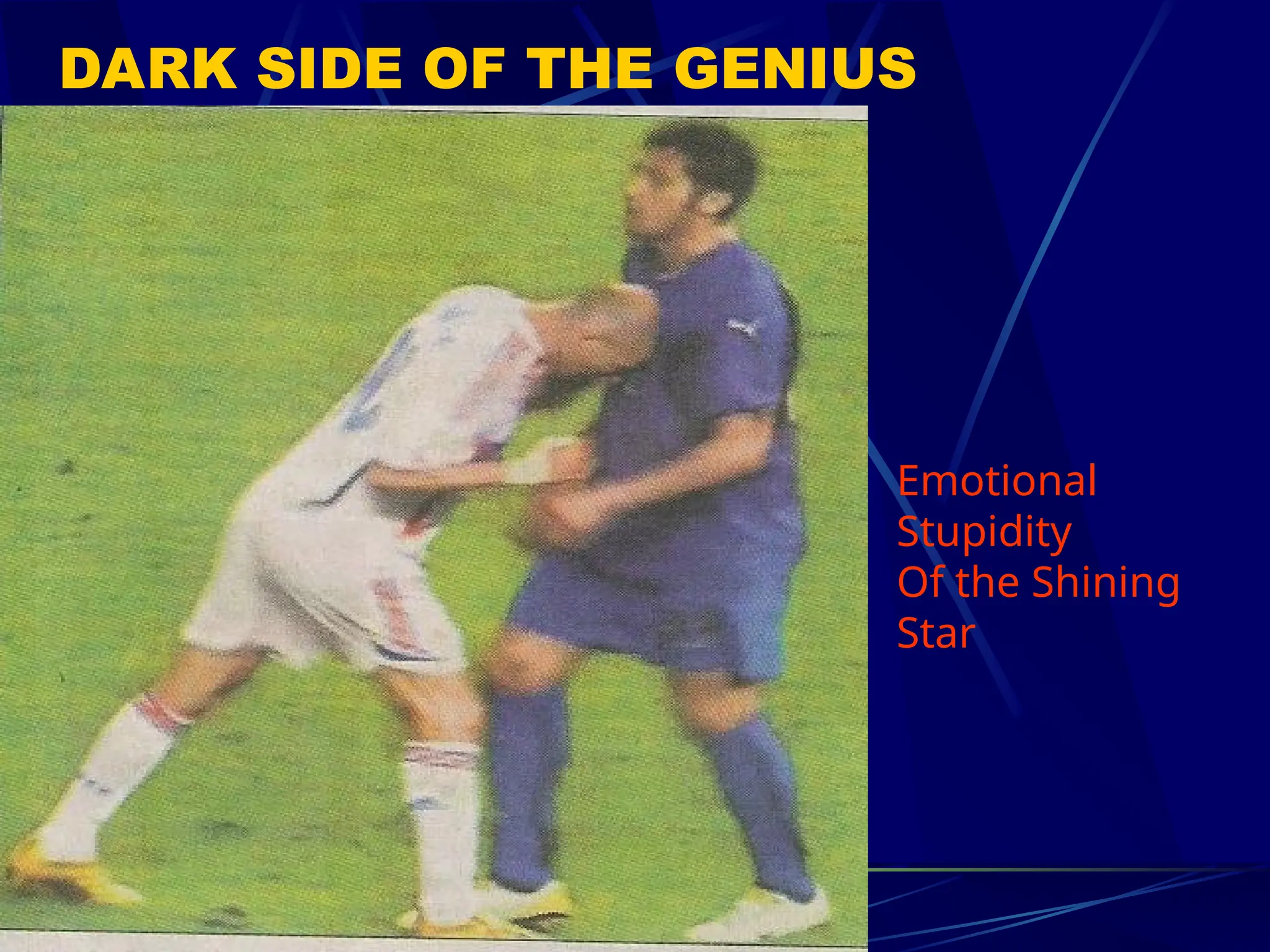
DARK SIDE OFTHE GENIUS
Emotional
Stupidity
Of the Shining
Star
4.
EI : Anexample
When someone you respect humiliates you by making a
joke in front of others about a mistake you’ve made, you
• Go home & vow never to put yourself in such situation
• You get hangover about the incident
•Make a sharp comeback
• Go home & write a letter to defend your position
• Make light of it, if you can and then privately tell the
person how you felt
5.
Myths about emotions
Emotionis inferior than reason
Emotion is harmful to body and mind
Self-control comes from suppression of
feelings
There are good emotions and bad
emotions
Emotion influences judgment
6.
What is EmotionalIntelligence?
Emotional intelligence is the ability to perceive, understand
and regulate emotions in self and other to promote emotional
and intellectual growth
Theory of EI:
1. Ability based Approach, Mayer and Salovey
2. Performance Based Approach, D. Goleman
3. Personality based Approach, R. Bar-On
4. Mixed Approach, Cooper and Sawaf
7.
Goleman- EI asthe capacity for recognizing our own
emotion and of others , for motivating ourselves, and for
managing emotion well in us and in our Relationship.
(1998)
Bar-On- EI is concerned with understanding oneself and
others, relating to people, and adapting to and coping
with the immediate surroundings, which increases one’s
ability to be more successful in dealing with one’s
environmental demands. (1997),
Mayer and Salovey defines EI in terms of four major
componets as mentioned below.
8.
FOUR BRANCHES OFEMOTIONAL
INTELLIGENCE
1. EMOTIONAL IDENTIFICATION, PERCEPTION AND
EXPRESSION
THE ABILITY TO PERCEIVE AND IDENTIFY EMOTIONS IN
FACES, TONE OF VOICE, AND BODY LANGUAGE.
THE CAPACITY FOR SELF- AWARENESS : BEING AWARE OF YOUR
OWN FEELINGS AS THEY ARE OCCURING.
THE CAPACITY FOR EMOTIONAL LITERACY: BEING ABLE TO LABEL
SPECIFIC FEELINGS IN YOURSELF AND OTHERS; BEING ABLE TO
DISCUSS EMOTIONS AND COMMUNICATE CLEARLY AND DIRECTLY.
9.
2. EMOTIONAL FACILITATIONOF THOUGHTS
The ability to incorporate feelings into
analysis, reasoning, problem solving and
decision making.
The potential of your feelings to guide you to
what is important to think about.
10.
The ability tosolve emotional problems
The ability to identify and understand the inter-
relationship between emotions, thoughts and behavior.
For example, to see cause and effect relationship such as
how thoughts can affect emotions or how emotions can
affect thoughts, and how your emotions can lead to the
behavior in yourself and others.
The ability to understand the value of emotions to the
survival of The species
3. EMOTIONAL UNDERSTANDING
11.
4. EMOTIONAL MANAGEMENT
The ability to take responsibility for one’s
own emotions and happiness
The ability to turn negative emotions into
positive learning and growing opportunities
The ability to help others identify and benefit
from their emotions
12.
SUM UP
Emotional intelligenceis the ability to experience and
express emotion in self and others appropriately.
In other words, it is simply the way of knowing how to
separate healthy from unhealthy feelings and how to
turn negative feelings into positive ones.
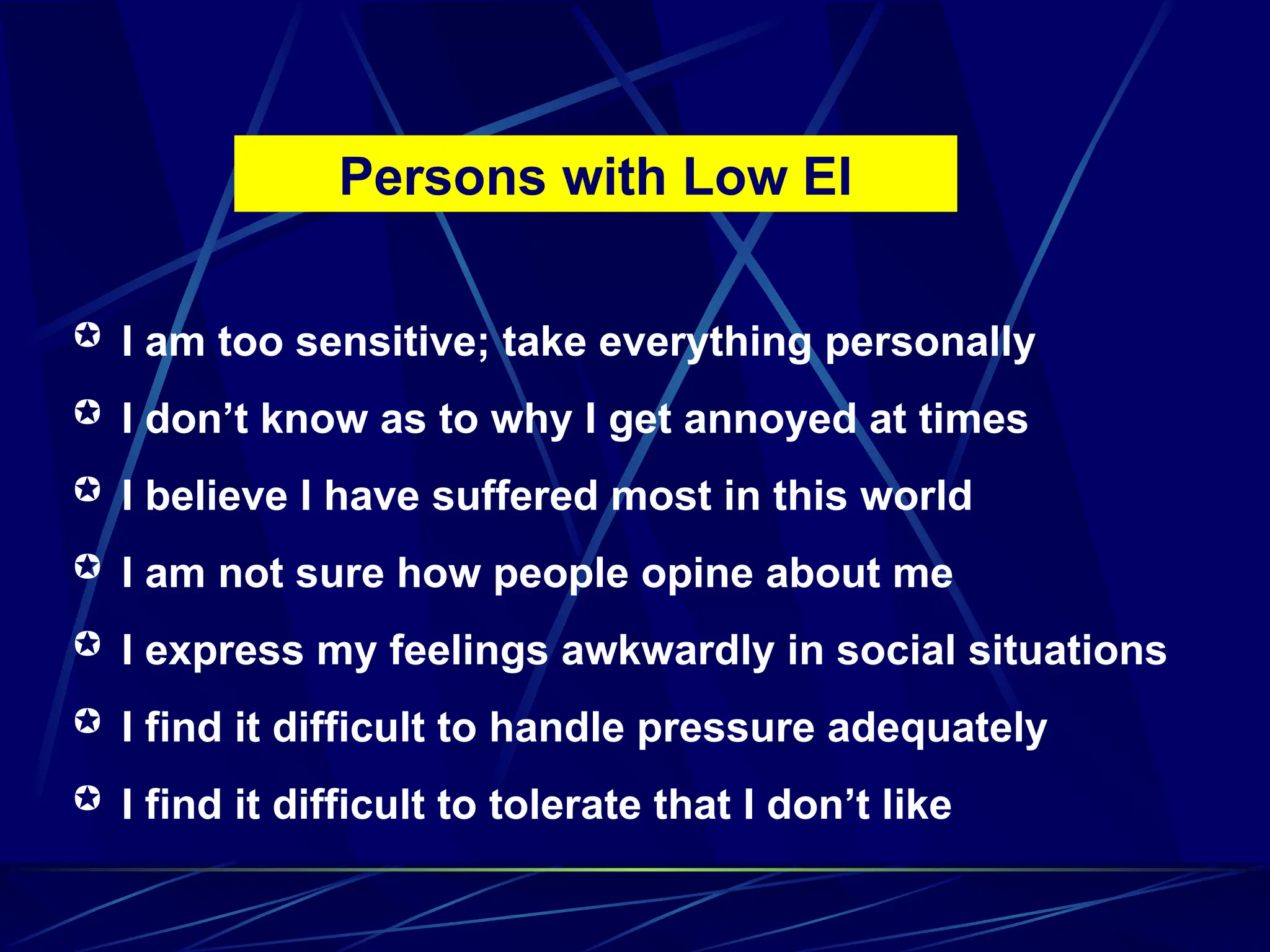
I amtoo sensitive; take everything personally
I don’t know as to why I get annoyed at times
I believe I have suffered most in this world
I am not sure how people opine about me
I express my feelings awkwardly in social situations
I find it difficult to handle pressure adequately
I find it difficult to tolerate that I don’t like
Persons with Low EI
15.
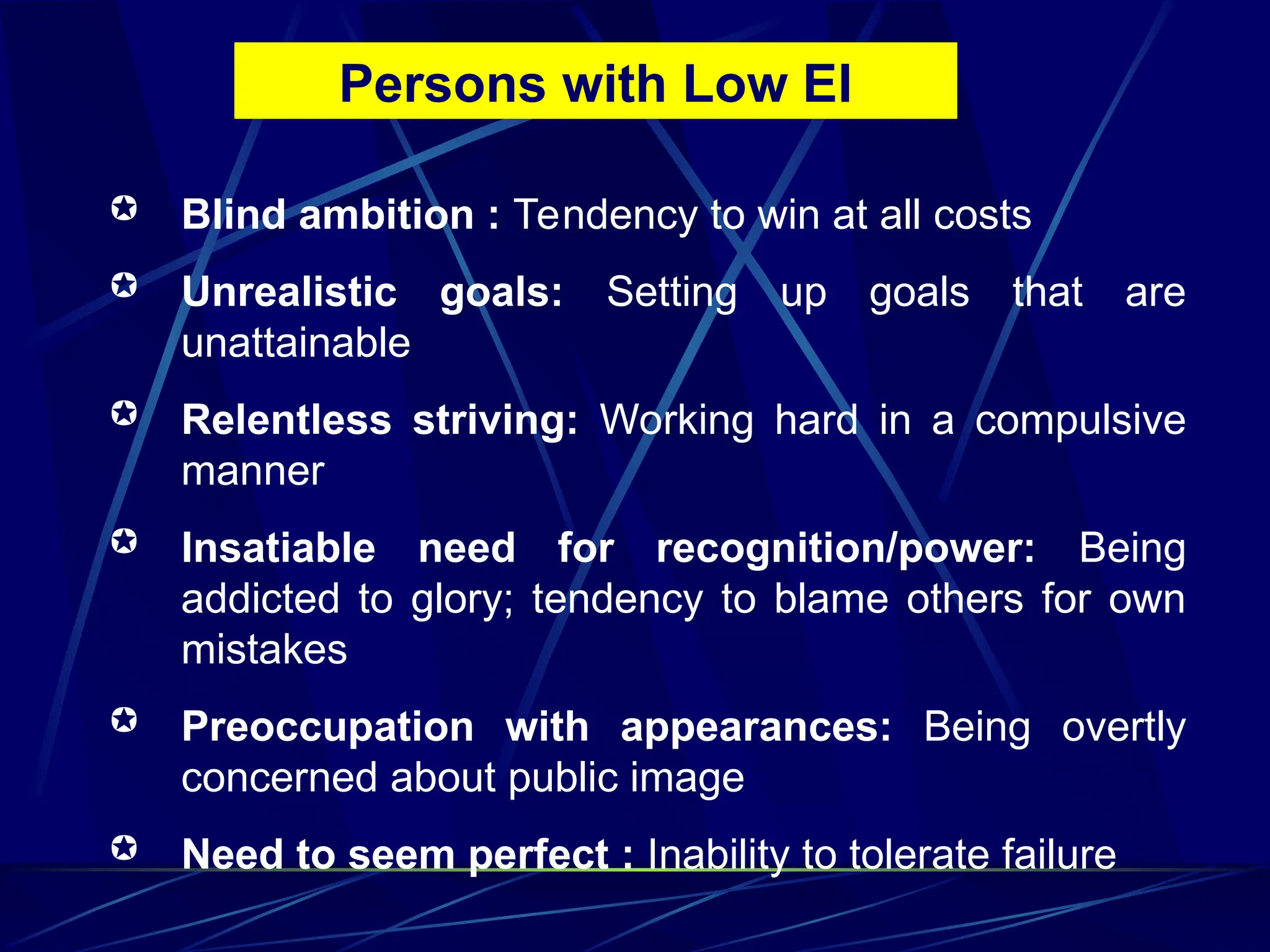
Blind ambition: Tendency to win at all costs
Unrealistic goals: Setting up goals that are
unattainable
Relentless striving: Working hard in a compulsive
manner
Insatiable need for recognition/power: Being
addicted to glory; tendency to blame others for own
mistakes
Preoccupation with appearances: Being overtly
concerned about public image
Need to seem perfect : Inability to tolerate failure
Persons with Low EI
16.
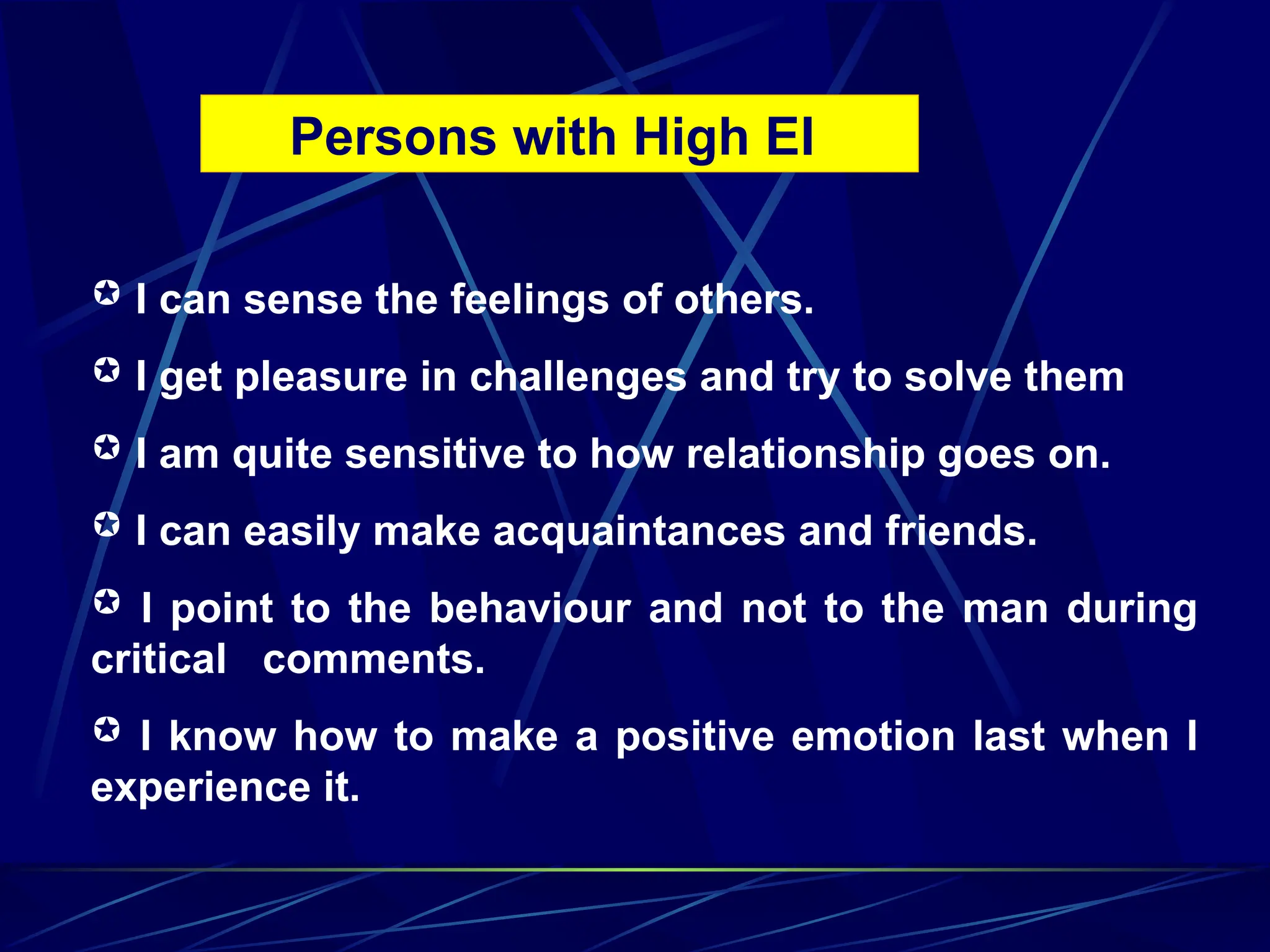
Persons with HighEI
I can sense the feelings of others.
I get pleasure in challenges and try to solve them
I am quite sensitive to how relationship goes on.
I can easily make acquaintances and friends.
I point to the behaviour and not to the man during
critical comments.
I know how to make a positive emotion last when I
experience it.
17.
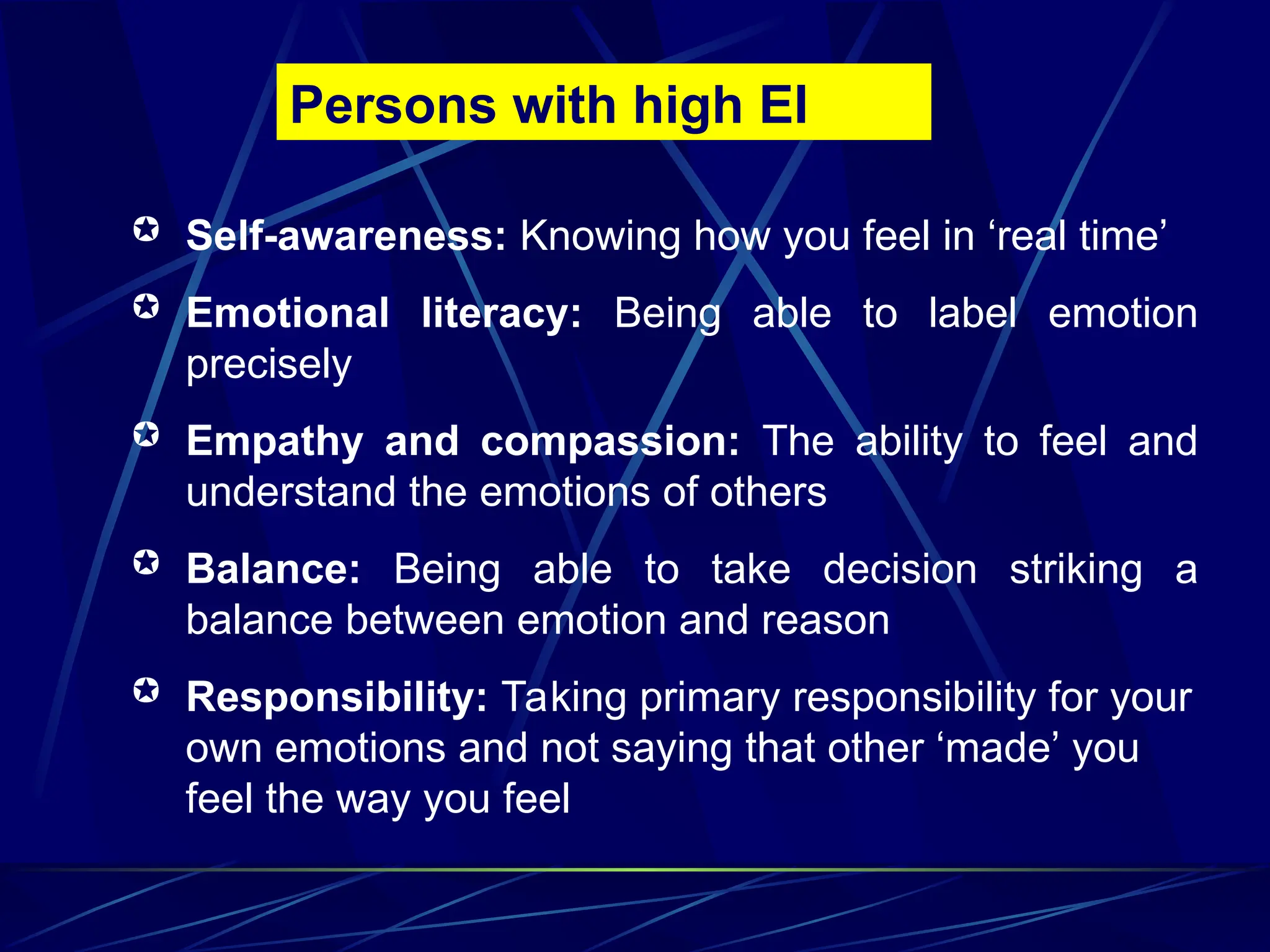
Self-awareness: Knowinghow you feel in ‘real time’
Emotional literacy: Being able to label emotion
precisely
Empathy and compassion: The ability to feel and
understand the emotions of others
Balance: Being able to take decision striking a
balance between emotion and reason
Responsibility: Taking primary responsibility for your
own emotions and not saying that other ‘made’ you
feel the way you feel
Persons with high EI
18.
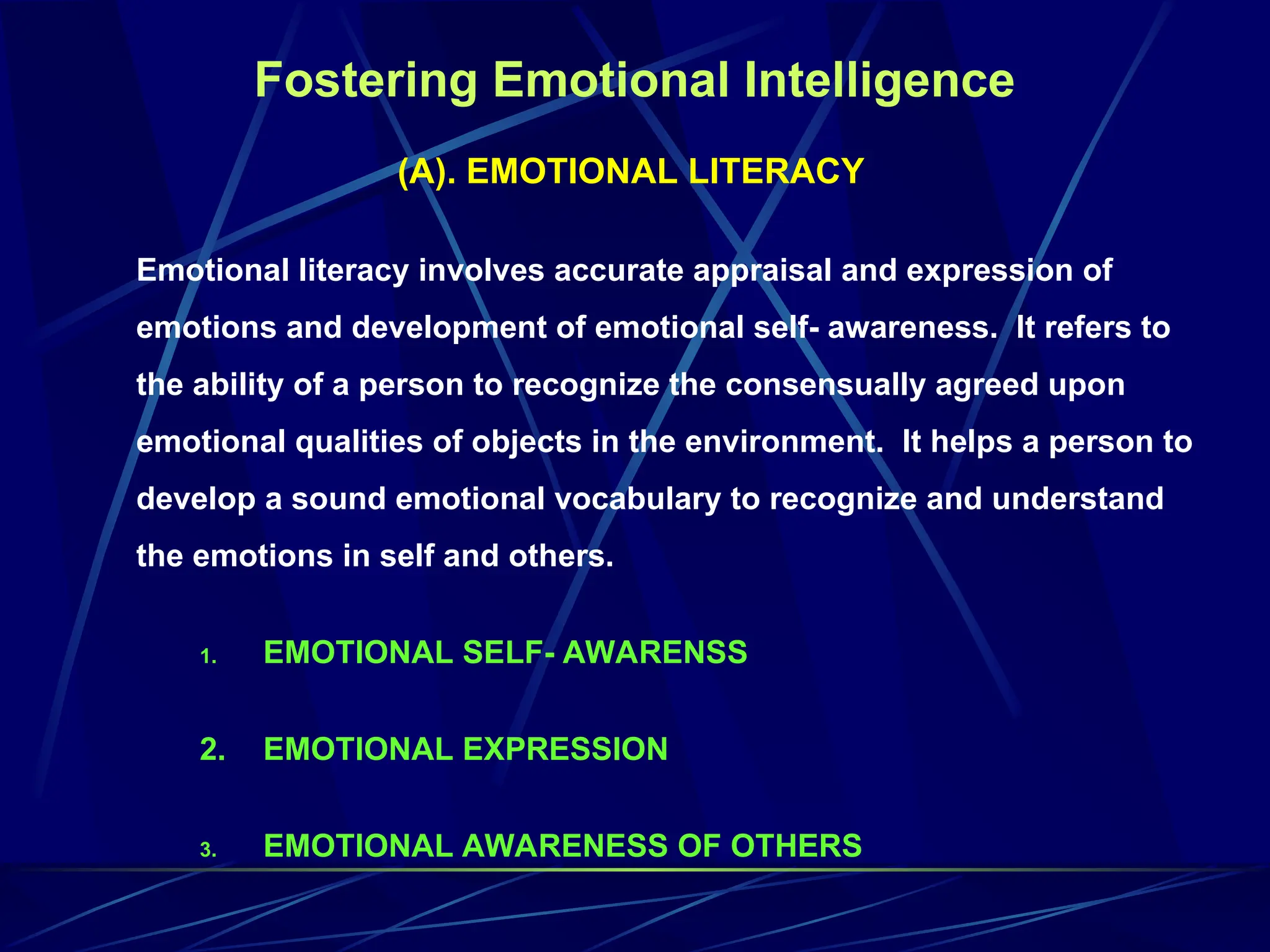
Fostering Emotional Intelligence
(A).EMOTIONAL LITERACY
Emotional literacy involves accurate appraisal and expression of
emotions and development of emotional self- awareness. It refers to
the ability of a person to recognize the consensually agreed upon
emotional qualities of objects in the environment. It helps a person to
develop a sound emotional vocabulary to recognize and understand
the emotions in self and others.
1. EMOTIONAL SELF- AWARENSS
2. EMOTIONAL EXPRESSION
3. EMOTIONAL AWARENESS OF OTHERS
(C). EMOTIONAL VALUESAND BELIEFS
1. COMPASSION
2. OUTLOOK
3. INTUITION
4. TRUST RADIUS (obligation arising out of responsibility)
5. PERSONAL POWER
6. INTEGRITY (acting openly, honestly and consistently)
22.
EMOTIONAL IMPACT
Events, PressureAnd Satisfaction
1. Life Events
2. Work Satisfaction
3. Work Pressure
4. Personal Pressure
5. Personal Satisfaction
23.
Some of theactual life situations, which resulted in
sorrow ending of precious lives
1. One person was appointed as the Vice President of a
prestigious software company died the night after his
father’s death.
2. A company forcibly retired its President and on his
way to airport he died of cardiac arrest.
3. A 38 years old father collapsed and died when he
failed in his efforts to revive his two year old daughter
who had fallen into a pool
24.
Some of theactual life situations, which resulted in
sorrow ending of precious lives
4. A 49 years old man died two hours after hearing that
his 22 years old daughter had been killed and his two
grandchildren seriously injured in a traffic accident.
5. A 55 years old man died of over joy as he met his 88
years old father after a 20 years separation
6. A 75 years old woman died suddenly after a happy
week of renewing ties with her family, which she had
left behind 60 years earlier.
25.
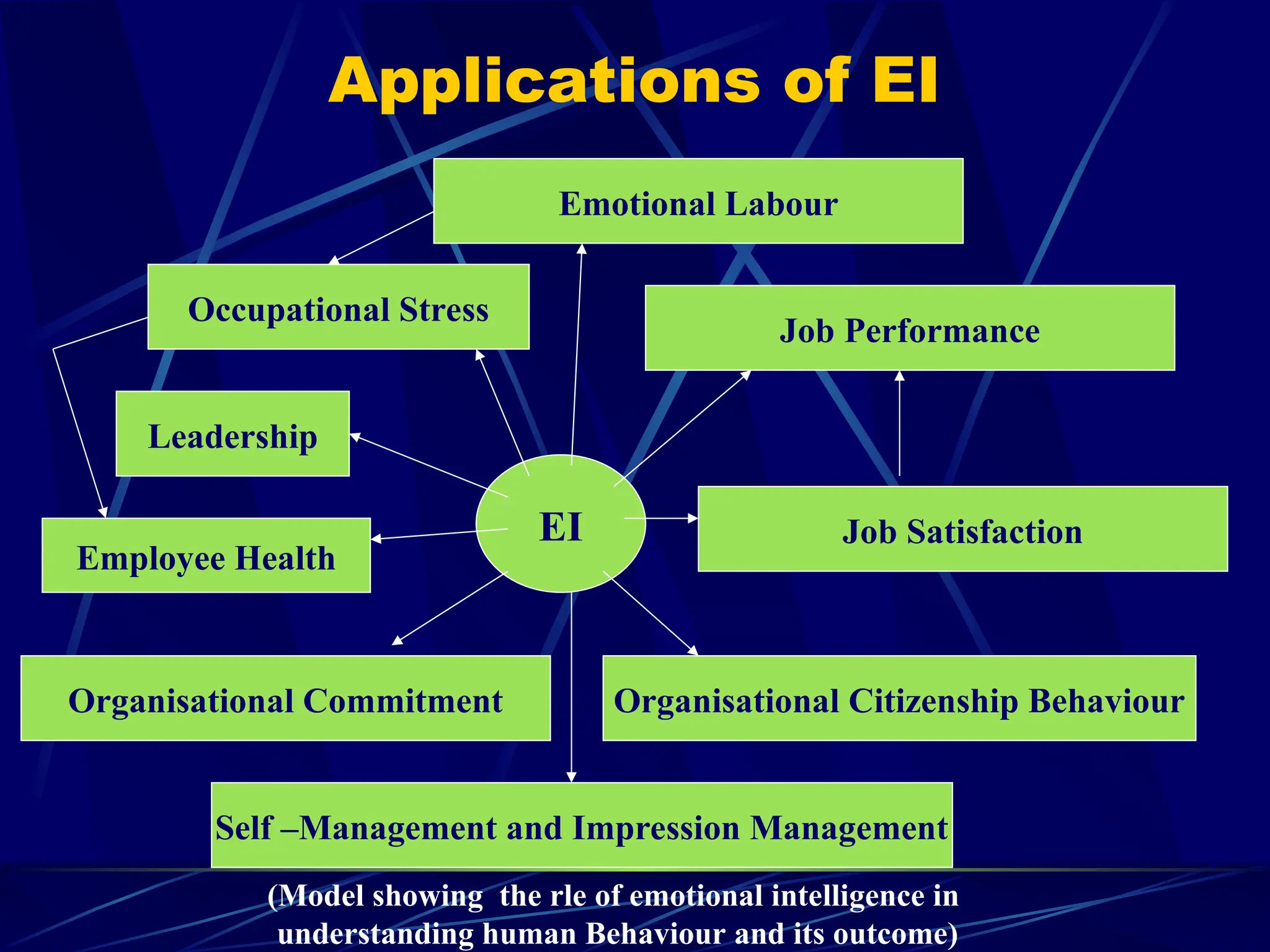
Applications of EI
EI
OccupationalStress
Leadership
Employee Health
Organisational Commitment Organisational Citizenship Behaviour
Job Satisfaction
Job Performance
Self –Management and Impression Management
Emotional Labour
(Model showing the rle of emotional intelligence in
understanding human Behaviour and its outcome)
26.
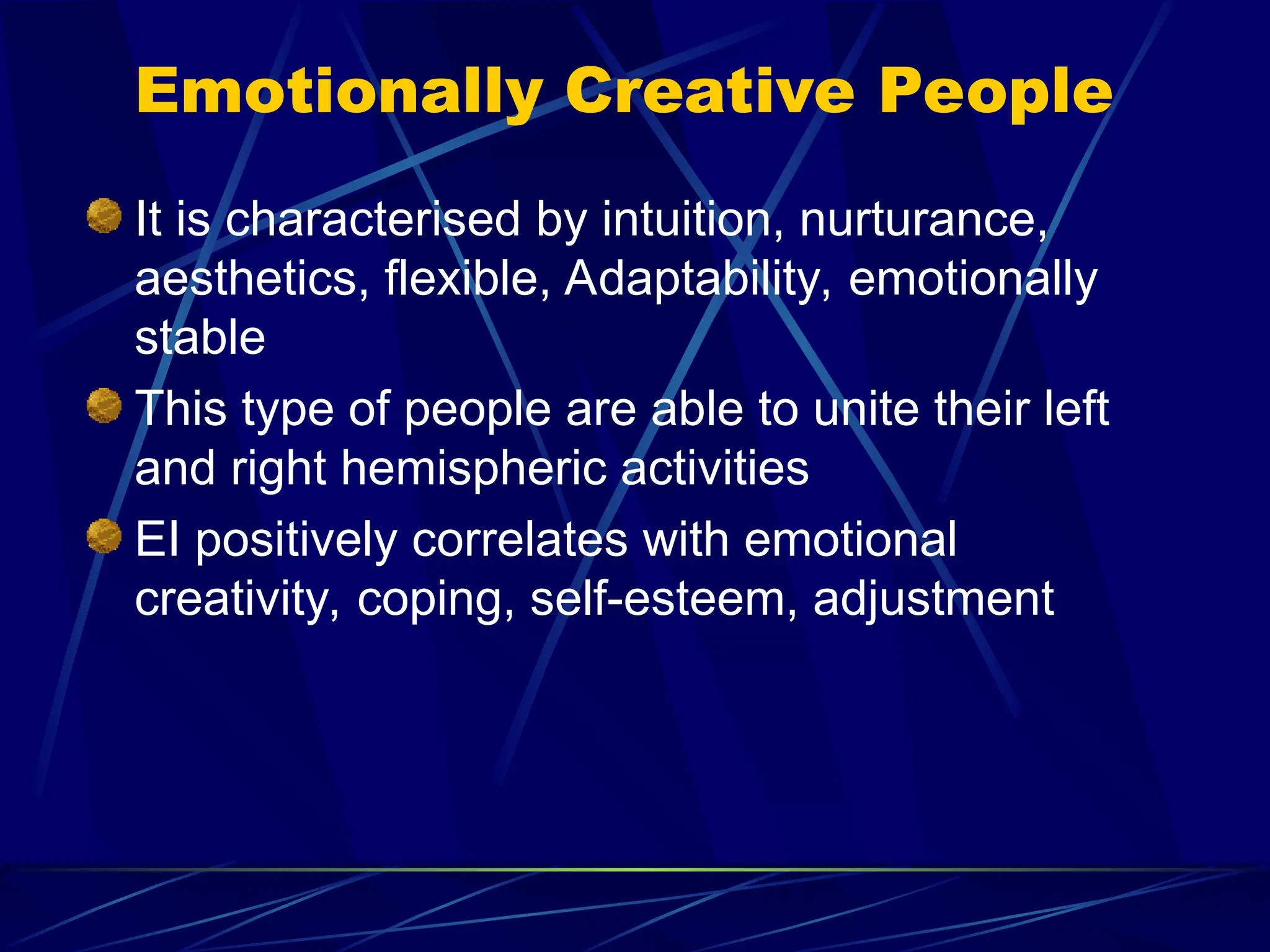
Emotionally Creative People
Itis characterised by intuition, nurturance,
aesthetics, flexible, Adaptability, emotionally
stable
This type of people are able to unite their left
and right hemispheric activities
EI positively correlates with emotional
creativity, coping, self-esteem, adjustment
27.
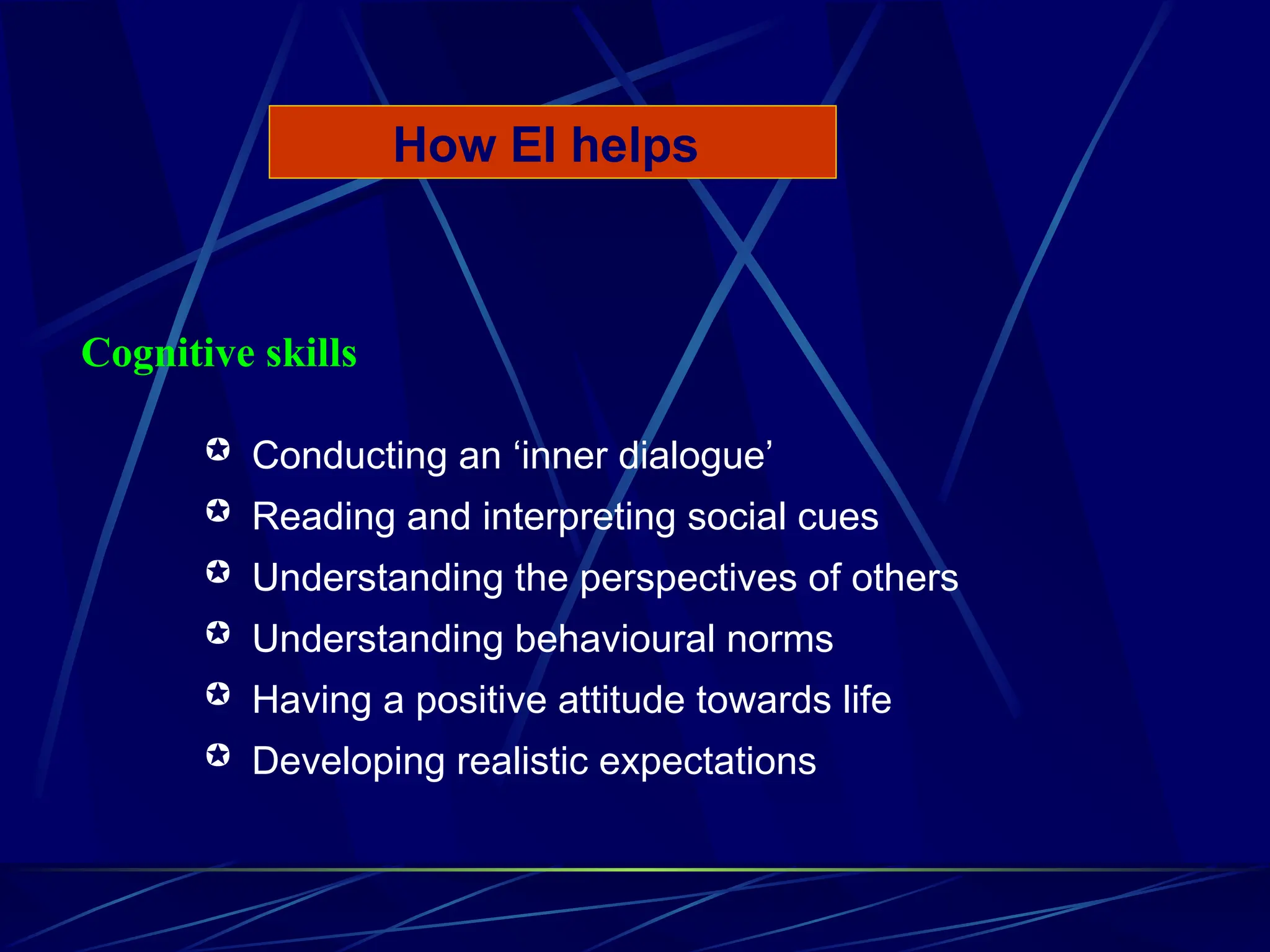
Conducting an‘inner dialogue’
Reading and interpreting social cues
Understanding the perspectives of others
Understanding behavioural norms
Having a positive attitude towards life
Developing realistic expectations
How EI helps
Cognitive skills
28.
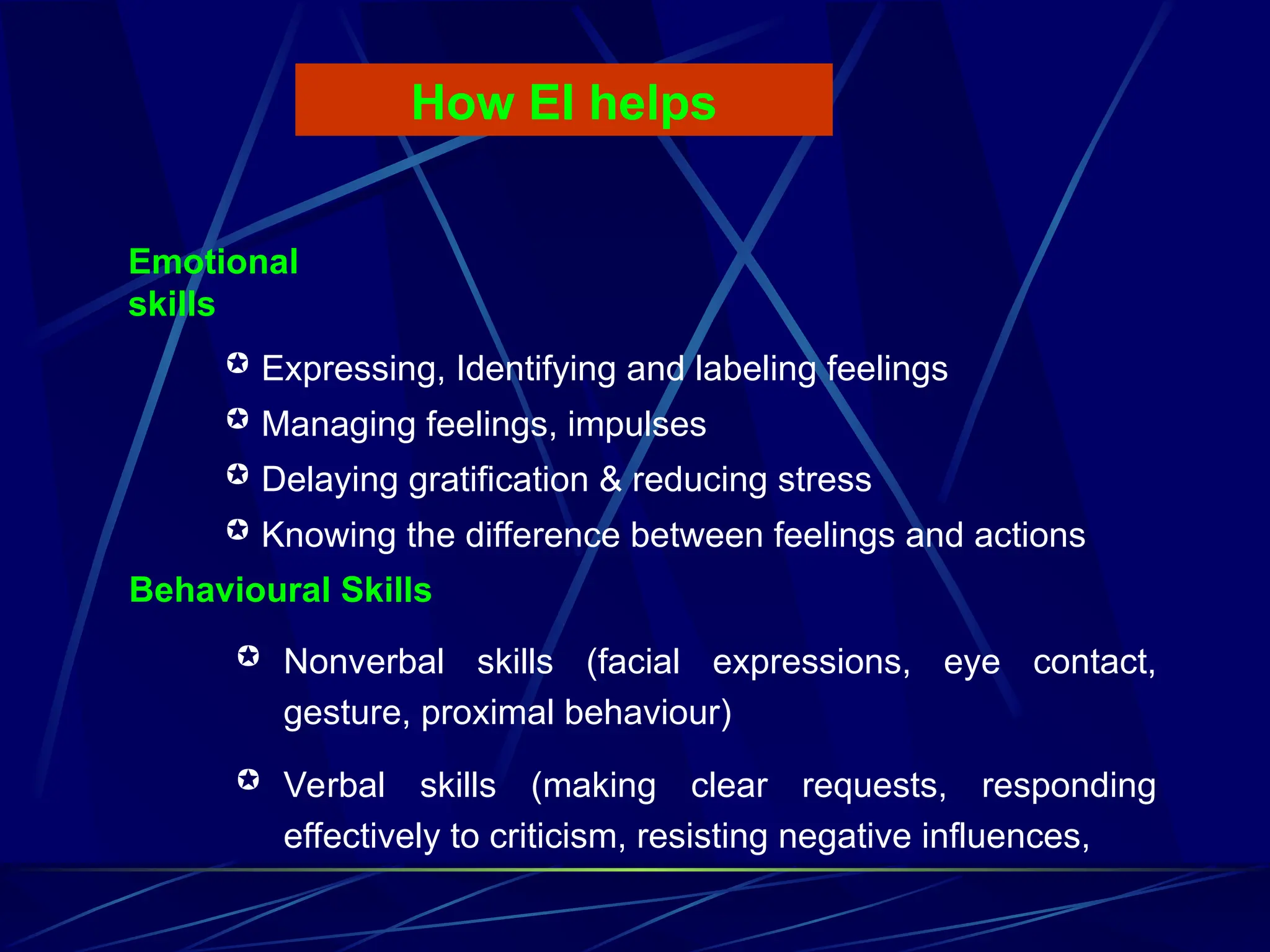
Nonverbal skills(facial expressions, eye contact,
gesture, proximal behaviour)
Verbal skills (making clear requests, responding
effectively to criticism, resisting negative influences,
Behavioural Skills
Expressing, Identifying and labeling feelings
Managing feelings, impulses
Delaying gratification & reducing stress
Knowing the difference between feelings and actions
Emotional
skills
How EI helps
29.
IMPLICATIONS
FOR INDIVIDUAL
PersonalEffectiveness
Better Performance
Effective Interpersonal Relations
Better Coping Skills
Health and Happiness
Improving Quality of Life
30.
FOR ORGANIZATION
1. DevelopingCompetency
2. Resource Mobilization
3. Moderating Organizational Role Stress
4. Organizational Health and Effectiveness
5. Improving Productivity
31.
Some Common Methodsfor Enhancing EI
Good role models -- teachers, trainers, parents,
leaders, inspirational people (which could
include politicians especially our freedom
fighters) By observing these role models,
children, students as well as adults learn
gradually how to analyze and cope with life.
32.
Direct readingclasses on personality development, value education, etc
By reading personality improvements books, articles are quite helpful
One can learn from his/her own life experiences if s(he) is introspective
Attending workshop and seminar on personality development and the like.
Media programmes (for children) can be very informative and educative
The positive aspect of religion can offer a lot of solace and guidance
According to Karen F. Stone and Harold Q. Dillehunt, in "Self
Science: The subject Is Me", the EQ can be developed by developing the
following ingredients: such as self awareness,
Some Common Methods for Enhancing EI
33.
The Voice ofEmotionally Intelligent Person
Do Not Fear, Fear
“I feared the truth until
I saw the ugliness in lies”
“I feared success until
I realized that I had to try in order to be happy with myself
“I feared being alone until
I learned to like myself”
“I feared rejection until
I learned to have faith in myself”
34.
The Voice ofEmotionally Intelligent Person
Do Not Fear, Fear
“I feared failure until I realized that I only fail when
I don’t try”.
“I feared people’s opinions until
I learned that people would have opinions about me anyway”
“I feared pain until
I learned that it’s necessary for growth”
35.
Look inward notoutward for anger control
Habits take time and effort to change
Anyone can improve with effort!
Lets Do it