Factors Leading to Forgetting
Dr Rajesh Verma
Assistant Professor in Psychology
Govt. College Adampur, Hisar (Haryana)
Meaning
Literary meaning – Fails to remember.
Meaning in psychological parlance – Inability to
recall stored
information in
to the present
state of mind.
Definition
According to Bhatia, “Forgetting is the failure of
the individual to revive in consciousness an idea or group
of ideas without the help of the original stimuli”.
According to Drever (1952) “Forgetting means
failure at any time
to recall experience,
when attempting to
do so, or to perform
an action previously
learnt”.
Introduction
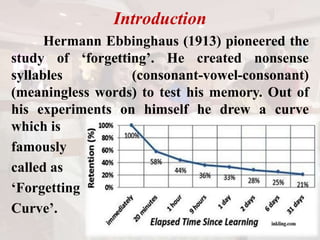
Hermann Ebbinghaus (1913) pioneered the
study of ‘forgetting’. He created nonsense
syllables (consonant-vowel-consonant)
(meaningless words) to test his memory. Out of
his experiments on himself he drew a curve
which is
famously
called as
‘Forgetting
Curve’.
Factors Leading to Forgetting
Forgetting is not caused by an individual factor
rather it is the handiwork of collective effort of several
factors.
(i) Psychological
factors,
(ii) Biological factors,
(iii) Social factors,
(iv) Factors related to
nature of Information,
(v) Environmental
factors.
(i) Psychological Factors – Most of the forgetting
occurs due to psychological factors. The forgetting that
occurs due to psychological factors is termed as
Psychological Amnesia. These are: -
(a) Encoding failure,
(b) Storage failure,
(c) Motivational
forgetting (Suppression
is conscious form of
forgetting while
Repression is
unconscious form),
(d) Dearth of adequate cognitive processing, attention,
focus,
(e) Disuse,
(f) Lack & Delay
in rehearsal,
(g) Interference,
(h) Improper or
lack of consolidation,
(i) Lack of
Context.
(ii) Biological factors – Memory is subdomain of
cognitive system which is maintained and managed by
neural networks. The obstruction of any type in these
neural networks can leads to forgetting. The obstructions
can be of following types: -
(a) Damage due
to injury,
(b) Damage due
to infection or
disease,
(c) Obstruction due to mental health issues,
(d) Damage due to drug overdose,
(e) Damage due to trauma,
(f) Natural decay
due to aging,
(g) Lack of
physical activity
and proper diet.
(iii) Social factors – Forgetting is opposite to memory
where memory is social process and social interaction
influences memory (Barber & Mather, 2013).
Therefore, social factors also facilitate forgetting.
(a) Level of interpersonal relations,
(b) Level of social interaction,
(c) Interaction and
gender (interaction with
same gender facilitate
forgetting while with
different gender inhibits
forgetting (Barber &
Mathra, 2013),
(d) Collective forgetting.
(iv) Factors related to nature of Information – The nature
of information learned also influences forgetting. The
meaningful items are likely to be remembered longer than
the meaningless information.
(a) Information of
non-interest,
(b) Information learned
forcefully,
(c) Meaninglessness of
information,
(d) Novelty of information,
(e) Emotion provoking ability of information,
(f) Autobiographical Information,
(g) Level of abstractness in information,
(h) Style of presentation of information [written, spoken,
sung etc.].
(v) Environmental factors – The forgetting is
also influenced by the factors of immediate
environment [physical surroundings].
(a) External context such as place, smell,
situations, sound etc.
(b) Shifting of
physical locations
(Radvansky et al.
2010).
References:
1. NCERT, XI Psychology Text book.
2. Beiner, Guy (2018). Forgetful Remembrance: Social
Forgetting and Vernacular Historiography of a Rebellion in
Ulster. Oxford University Press. ISBN 9780198749356.
3. Brown, J. (1958).
Some tests of the decay
theory of immediate memory.
Quarterly Journal of
Experimental psychology,
10, 12-21.
vermasujit@yahoo.com
Next Discussion
Mnemonics

factors leading to forgetting

  • 1.
    Factors Leading toForgetting Dr Rajesh Verma Assistant Professor in Psychology Govt. College Adampur, Hisar (Haryana)
  • 2.
    Meaning Literary meaning –Fails to remember. Meaning in psychological parlance – Inability to recall stored information in to the present state of mind.
  • 3.
    Definition According to Bhatia,“Forgetting is the failure of the individual to revive in consciousness an idea or group of ideas without the help of the original stimuli”. According to Drever (1952) “Forgetting means failure at any time to recall experience, when attempting to do so, or to perform an action previously learnt”.
  • 4.
    Introduction Hermann Ebbinghaus (1913)pioneered the study of ‘forgetting’. He created nonsense syllables (consonant-vowel-consonant) (meaningless words) to test his memory. Out of his experiments on himself he drew a curve which is famously called as ‘Forgetting Curve’.
  • 5.
    Factors Leading toForgetting Forgetting is not caused by an individual factor rather it is the handiwork of collective effort of several factors. (i) Psychological factors, (ii) Biological factors, (iii) Social factors, (iv) Factors related to nature of Information, (v) Environmental factors.
  • 6.
    (i) Psychological Factors– Most of the forgetting occurs due to psychological factors. The forgetting that occurs due to psychological factors is termed as Psychological Amnesia. These are: - (a) Encoding failure, (b) Storage failure, (c) Motivational forgetting (Suppression is conscious form of forgetting while Repression is unconscious form),
  • 7.
    (d) Dearth ofadequate cognitive processing, attention, focus, (e) Disuse, (f) Lack & Delay in rehearsal, (g) Interference, (h) Improper or lack of consolidation, (i) Lack of Context.
  • 8.
    (ii) Biological factors– Memory is subdomain of cognitive system which is maintained and managed by neural networks. The obstruction of any type in these neural networks can leads to forgetting. The obstructions can be of following types: - (a) Damage due to injury, (b) Damage due to infection or disease,
  • 9.
    (c) Obstruction dueto mental health issues, (d) Damage due to drug overdose, (e) Damage due to trauma, (f) Natural decay due to aging, (g) Lack of physical activity and proper diet.
  • 10.
    (iii) Social factors– Forgetting is opposite to memory where memory is social process and social interaction influences memory (Barber & Mather, 2013). Therefore, social factors also facilitate forgetting. (a) Level of interpersonal relations, (b) Level of social interaction, (c) Interaction and gender (interaction with same gender facilitate forgetting while with different gender inhibits forgetting (Barber & Mathra, 2013), (d) Collective forgetting.
  • 11.
    (iv) Factors relatedto nature of Information – The nature of information learned also influences forgetting. The meaningful items are likely to be remembered longer than the meaningless information. (a) Information of non-interest, (b) Information learned forcefully, (c) Meaninglessness of information, (d) Novelty of information, (e) Emotion provoking ability of information, (f) Autobiographical Information, (g) Level of abstractness in information, (h) Style of presentation of information [written, spoken, sung etc.].
  • 12.
    (v) Environmental factors– The forgetting is also influenced by the factors of immediate environment [physical surroundings]. (a) External context such as place, smell, situations, sound etc. (b) Shifting of physical locations (Radvansky et al. 2010).
  • 13.
    References: 1. NCERT, XIPsychology Text book. 2. Beiner, Guy (2018). Forgetful Remembrance: Social Forgetting and Vernacular Historiography of a Rebellion in Ulster. Oxford University Press. ISBN 9780198749356. 3. Brown, J. (1958). Some tests of the decay theory of immediate memory. Quarterly Journal of Experimental psychology, 10, 12-21.
  • 14.