MEAT PROCESSING PRINCIPLES
By
K.Vimalraj
BTP12019
 Mincing
 Milling
 Flaking
 Chopping
 Curing
 Tumbling
 Massaging
 smoking
MEAT PROCESSING PRINCIPLES
CONT….
MINCER OR GRINDER
 A meat grinder is a machine used to force meat or meat trimmings by means
of a feeding worm (auger) under pressure through a
horizontally mounted cylinder (barrel).
 At the end of the barrel there is a cutting system consisting of star-shaped
knives rotating with the feeding worm and stationary perforated discs
(grinding plates).
 The perforations of the grinding plates normally range from 1 to 13mm.
 The meat is compressed by the rotating feeding auger, pushed through the
cutting system and extrudes through the holes in the grinding plates after
being cut by the revolving star knives.
 Simple equipment has only one star knife and grinder plate, but normally a
series of plates and rotary knives is used.
 The degree of mincing is determined by the size of the holes in the last
grinding plate.
CONT….
 Two different types of cutting systems are available, the “Enterprise System”
and the “Unger System”:
 The “Enterprise System” is mainly used in smaller meat grinders with orifice
diameters up to 98 mm and consists of one star knife, sharpened only on the
side facing the disc, and one grinder plate. Hole diameters can vary from 13 to
5 mm.
 The “Unger System” is used in meat grinders with orifice diameters up to 440
mm and consists of the kidney plate, one or two star knives sharpened on both
edges and one or two grinder plates.
Types of grinder
– manual grinder
– Stuffing grinder
– industrial meat grinders
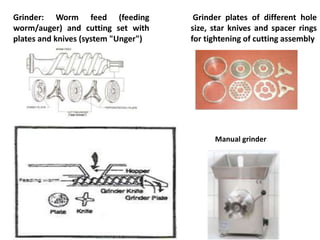
Grinder: Worm feed (feeding
worm/auger) and cutting set with
plates and knives (system "Unger")
Grinder plates of different hole
size, star knives and spacer rings
for tightening of cutting assembly
Manual grinder
CONT….
Milling:
 Milling is a general trade name which normally means reduction of food grain
into various end products like meal, flour, splitted products etc.
 Milling includes; cleaning, grading, separating, mixing, pearling, polishing, de-
husking, size reduction etc.
 and also refers to extraction of juice, oil or separation of fibre etc.
Principles of size reduction:
 Crushers and grinders are the equipment mostly used for size reduction.
 Small power input requirement per unit of product handled and
 Easy and trouble free operation
 Amount of power required to create smaller particles is one of the parameters
of the efficiency of operation. Second parameter is the desired uniformity of
size.
CONT….
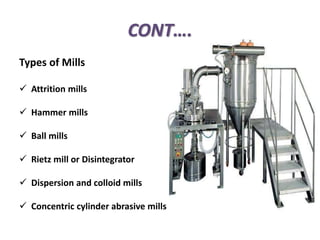
Types of Mills
 Attrition mills
 Hammer mills
 Ball mills
 Rietz mill or Disintegrator
 Dispersion and colloid mills
 Concentric cylinder abrasive mills
CONT….
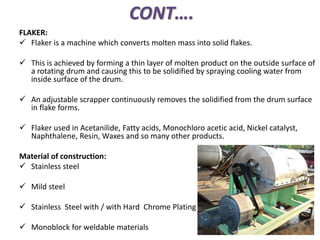
FLAKER:
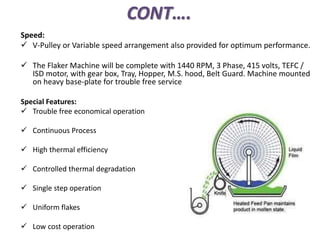
 Flaker is a machine which converts molten mass into solid flakes.
 This is achieved by forming a thin layer of molten product on the outside surface of
a rotating drum and causing this to be solidified by spraying cooling water from
inside surface of the drum.
 An adjustable scrapper continuously removes the solidified from the drum surface
in flake forms.
 Flaker used in Acetanilide, Fatty acids, Monochloro acetic acid, Nickel catalyst,
Naphthalene, Resin, Waxes and so many other products.
Material of construction:
 Stainless steel
 Mild steel
 Stainless Steel with / with Hard Chrome Plating
 Monoblock for weldable materials
CONT….
Speed:
 V-Pulley or Variable speed arrangement also provided for optimum performance.
 The Flaker Machine will be complete with 1440 RPM, 3 Phase, 415 volts, TEFC /
ISD motor, with gear box, Tray, Hopper, M.S. hood, Belt Guard. Machine mounted
on heavy base-plate for trouble free service
Special Features:
 Trouble free economical operation
 Continuous Process
 High thermal efficiency
 Controlled thermal degradation
 Single step operation
 Uniform flakes
 Low cost operation
CONT….
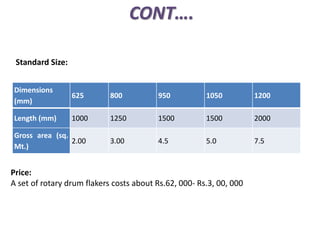
Dimensions
(mm)
625 800 950 1050 1200
Length (mm) 1000 1250 1500 1500 2000
Gross area (sq.
Mt.)
2.00 3.00 4.5 5.0 7.5
Standard Size:
Price:
A set of rotary drum flakers costs about Rs.62, 000- Rs.3, 00, 000
CONT….
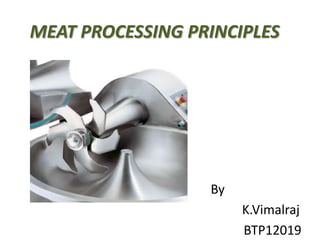
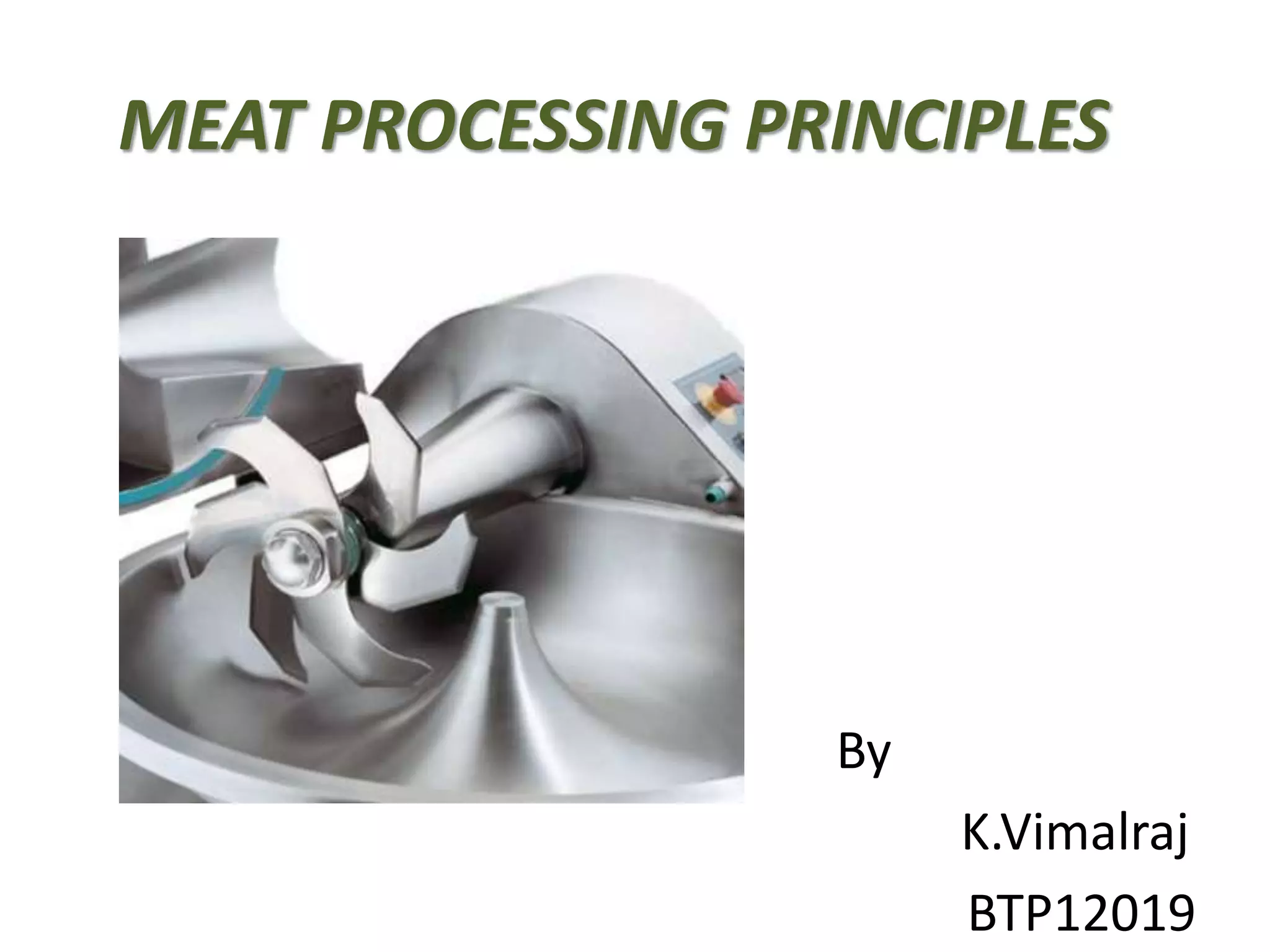
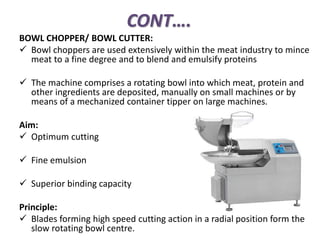
BOWL CHOPPER/ BOWL CUTTER:
 Bowl choppers are used extensively within the meat industry to mince
meat to a fine degree and to blend and emulsify proteins
 The machine comprises a rotating bowl into which meat, protein and
other ingredients are deposited, manually on small machines or by
means of a mechanized container tipper on large machines.
Aim:
 Optimum cutting
 Fine emulsion
 Superior binding capacity
Principle:
 Blades forming high speed cutting action in a radial position form the
slow rotating bowl centre.
Construction:
 18" stainless steel bowl rotates at 22 RPM with 1 HP motor
 Stainless steel twin blades (3768 cuts per minute)
 O/A dimensions: 34 1/2" W x 23 1/2" L x 21" H (876 x 597 x 533 mm)
 Bowl cover swing: 37 1/2" (953 mm)
 Removable and reversible cutting board (12 1/2" x 9 1/2")
 Polished and anodized aluminum body
 Simple operation; Illuminated momentary start / stop push button
 Electrical: 115 V / 60 Hz / 1 Ø
 Drive: Knife shaft, ball bearing mounted, driven by a ribbed poly "V" belt
 ALMFC12 meat grinder (includes cylinder, ring, worm, stainless steel pan,
plunger, 3/16" plate and grinder knife, cover (heavy-duty clear plastic cover)
CONT….
Operator:
 Temperature controlled is much more important while running the
chopper.
 High speed gear is used for running bowl chopper.
Products:
 Emulsion based meat products like sausages, nuggets, patties, etc...
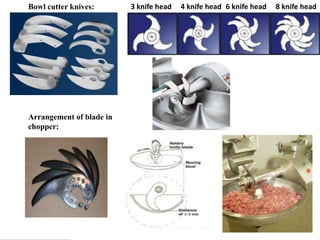
Bowl cutter knives:
 must be sharp always and balanced
 3 to 10 blades on a single shaft for faster, more efficient cutting and
change over
Price:
 A bowl chopper of capacity 8L or productivity of 120 kg/h costs about
Rs.60, 000- Rs.67, 000
Benefits:
 Maximum yield from emulsion
 No purge in finished product
 More efficient
Arrangement of blade in
chopper:
3 knife head 4 knife head 6 knife head 8 knife headBowl cutter knives:
CONT….
Curing
 Consumers associate the majority of processed meat products like
hams, bacon, and most sausages with an attractive pink or red colour after
heat treatment.
 However experience shows that meat or meat mixes, after kitchen-style
cooking or frying, turn brownish-grey or grey.
 In order to achieve the desired red or pink colour, meat or meat mixes
are salted with common salt (sodium chloride NaCl), which contains a
small quantity of the curing agent sodium nitrite (NaNO2).
 Sodium nitrite has the ability to react with the red meat pigment to form
the heat stable red curing colour
 Only very small amounts of the nitrite are needed for this purpose.
 Nitrite Level – 150 mg/kg in the meat product, which is 0.015%, are
normally sufficient.
CONT….
 To reduce the risk of overdosing of nitrite salt to add the
proportion 0.5% nitrite and the balance of sodium chloride (99.5%).
 This mixture is called nitrite curing salt.
 At a common dosage level of 1.5-3% added to the meat product
Types of curing
 Dry curing is exclusively used for the fabrication of cured raw fermented
products, in particular those with a long ripening period.
 Wet curing by immersion of meat pieces in brine is primarily used for
the fabrication of cured raw fermented products with shorter ripening
periods
CONT….
TUMBLER
 It is carried out in a relatively large rotating drum with paddles / baffles.
 As the meat tumbles & impacts against the paddles, side of the drum, &
other meat chunks kinetic energy is transferred into the muscle tissue
 which increases the temperature of the tissue & disrupts the cellular
structure
 allowing the weak salt solution of the curing brines to interact more
directly with the muscle proteins & bring about solubilization.
Vacuum Tumbler
SERIES VT Vacuum Tumbler
MODEL VT-1200/1500/2500
DESCRIPTION Massaging and Marinating
CONT….
General:
1. Maximum tumbler load is 40 L.
2. Advised product temperature range 5° - 8°C. At higher
temperatures, product moisture and liquids are likely to boil when under
vacuum.
3. Recommended vacuum during operation is -0.04 to -0.08 MPa (-40
to -80 kPa).
4. Tumbling speed is adjustable from 3 to 9.5 rpm.
5. If vacuum is not generated when the pump is turned on and the
vacuum hose is connected to the tumbler, have an electrician check that
the vacuum pump is rotating in the correct direction.
Advantages:
• Improves cure distribution,
• Improves tenderness,
• Improves water retention in finished products,
• Improves juiceness,
• Improves binding of meat chunks,
• Allows removal of ham seam fat.
CONT….
Smoking
 Smoke for treatment of meat products is produced from raw wood.
 Smoke is generated through the thermal destruction of the wood
components lignin and cellulose.
 The thermal destruction sets free more than 1000 desirable or
undesirable firm, liquid or gaseous components of wood.
 These useful components contribute to the development of the
following desirable effects on processed meat products:
 anti-microbial effect – Meat preservation through aldehydes, phenols
and acids
 retarding fat oxidation – Antioxidant impact through phenols and
aldehydes
CONT….
 smoking taste – Smoke flavour through phenols, carbonyls and others
 attractive colour – Smoke colour formation through carbonyls and
aldehydes
 rigid structure of the casing – Surface hardening of sausages/casings
through aldehydes
 The most known undesirable effect of smoking is the risk of residues of
benzopyrene in smoked products which can be carcinogenic if the
intake is in high doses over long periods.
Two methods of smoking
 Cold smoking
 Hot smoking
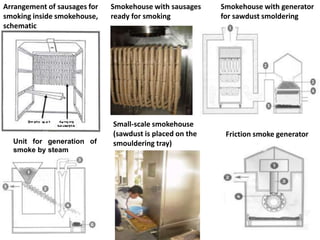
Arrangement of sausages for
smoking inside smokehouse,
schematic
Small-scale smokehouse
(sawdust is placed on the
smouldering tray)
Smokehouse with generator
for sawdust smoldering
Friction smoke generator
Unit for generation of
smoke by steam
Smokehouse with sausages
ready for smoking
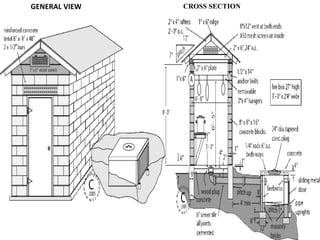
GENERAL VIEW CROSS SECTION
THANK YOU (LEGENDS’12)

Meat processing principles

  • 1.
  • 2.
     Mincing  Milling Flaking  Chopping  Curing  Tumbling  Massaging  smoking MEAT PROCESSING PRINCIPLES
  • 3.
    CONT…. MINCER OR GRINDER A meat grinder is a machine used to force meat or meat trimmings by means of a feeding worm (auger) under pressure through a horizontally mounted cylinder (barrel).  At the end of the barrel there is a cutting system consisting of star-shaped knives rotating with the feeding worm and stationary perforated discs (grinding plates).  The perforations of the grinding plates normally range from 1 to 13mm.  The meat is compressed by the rotating feeding auger, pushed through the cutting system and extrudes through the holes in the grinding plates after being cut by the revolving star knives.  Simple equipment has only one star knife and grinder plate, but normally a series of plates and rotary knives is used.  The degree of mincing is determined by the size of the holes in the last grinding plate.
  • 4.
    CONT….  Two differenttypes of cutting systems are available, the “Enterprise System” and the “Unger System”:  The “Enterprise System” is mainly used in smaller meat grinders with orifice diameters up to 98 mm and consists of one star knife, sharpened only on the side facing the disc, and one grinder plate. Hole diameters can vary from 13 to 5 mm.  The “Unger System” is used in meat grinders with orifice diameters up to 440 mm and consists of the kidney plate, one or two star knives sharpened on both edges and one or two grinder plates. Types of grinder – manual grinder – Stuffing grinder – industrial meat grinders
  • 5.
    Grinder: Worm feed(feeding worm/auger) and cutting set with plates and knives (system "Unger") Grinder plates of different hole size, star knives and spacer rings for tightening of cutting assembly Manual grinder
  • 6.
    CONT…. Milling:  Milling isa general trade name which normally means reduction of food grain into various end products like meal, flour, splitted products etc.  Milling includes; cleaning, grading, separating, mixing, pearling, polishing, de- husking, size reduction etc.  and also refers to extraction of juice, oil or separation of fibre etc. Principles of size reduction:  Crushers and grinders are the equipment mostly used for size reduction.  Small power input requirement per unit of product handled and  Easy and trouble free operation  Amount of power required to create smaller particles is one of the parameters of the efficiency of operation. Second parameter is the desired uniformity of size.
  • 7.
    CONT…. Types of Mills Attrition mills  Hammer mills  Ball mills  Rietz mill or Disintegrator  Dispersion and colloid mills  Concentric cylinder abrasive mills
  • 8.
    CONT…. FLAKER:  Flaker isa machine which converts molten mass into solid flakes.  This is achieved by forming a thin layer of molten product on the outside surface of a rotating drum and causing this to be solidified by spraying cooling water from inside surface of the drum.  An adjustable scrapper continuously removes the solidified from the drum surface in flake forms.  Flaker used in Acetanilide, Fatty acids, Monochloro acetic acid, Nickel catalyst, Naphthalene, Resin, Waxes and so many other products. Material of construction:  Stainless steel  Mild steel  Stainless Steel with / with Hard Chrome Plating  Monoblock for weldable materials
  • 9.
    CONT…. Speed:  V-Pulley orVariable speed arrangement also provided for optimum performance.  The Flaker Machine will be complete with 1440 RPM, 3 Phase, 415 volts, TEFC / ISD motor, with gear box, Tray, Hopper, M.S. hood, Belt Guard. Machine mounted on heavy base-plate for trouble free service Special Features:  Trouble free economical operation  Continuous Process  High thermal efficiency  Controlled thermal degradation  Single step operation  Uniform flakes  Low cost operation
  • 10.
    CONT…. Dimensions (mm) 625 800 9501050 1200 Length (mm) 1000 1250 1500 1500 2000 Gross area (sq. Mt.) 2.00 3.00 4.5 5.0 7.5 Standard Size: Price: A set of rotary drum flakers costs about Rs.62, 000- Rs.3, 00, 000
  • 11.
    CONT…. BOWL CHOPPER/ BOWLCUTTER:  Bowl choppers are used extensively within the meat industry to mince meat to a fine degree and to blend and emulsify proteins  The machine comprises a rotating bowl into which meat, protein and other ingredients are deposited, manually on small machines or by means of a mechanized container tipper on large machines. Aim:  Optimum cutting  Fine emulsion  Superior binding capacity Principle:  Blades forming high speed cutting action in a radial position form the slow rotating bowl centre.
  • 12.
    Construction:  18" stainlesssteel bowl rotates at 22 RPM with 1 HP motor  Stainless steel twin blades (3768 cuts per minute)  O/A dimensions: 34 1/2" W x 23 1/2" L x 21" H (876 x 597 x 533 mm)  Bowl cover swing: 37 1/2" (953 mm)  Removable and reversible cutting board (12 1/2" x 9 1/2")  Polished and anodized aluminum body  Simple operation; Illuminated momentary start / stop push button  Electrical: 115 V / 60 Hz / 1 Ø  Drive: Knife shaft, ball bearing mounted, driven by a ribbed poly "V" belt  ALMFC12 meat grinder (includes cylinder, ring, worm, stainless steel pan, plunger, 3/16" plate and grinder knife, cover (heavy-duty clear plastic cover)
  • 13.
    CONT…. Operator:  Temperature controlledis much more important while running the chopper.  High speed gear is used for running bowl chopper. Products:  Emulsion based meat products like sausages, nuggets, patties, etc... Bowl cutter knives:  must be sharp always and balanced  3 to 10 blades on a single shaft for faster, more efficient cutting and change over Price:  A bowl chopper of capacity 8L or productivity of 120 kg/h costs about Rs.60, 000- Rs.67, 000 Benefits:  Maximum yield from emulsion  No purge in finished product  More efficient
  • 14.
    Arrangement of bladein chopper: 3 knife head 4 knife head 6 knife head 8 knife headBowl cutter knives:
  • 15.
    CONT…. Curing  Consumers associatethe majority of processed meat products like hams, bacon, and most sausages with an attractive pink or red colour after heat treatment.  However experience shows that meat or meat mixes, after kitchen-style cooking or frying, turn brownish-grey or grey.  In order to achieve the desired red or pink colour, meat or meat mixes are salted with common salt (sodium chloride NaCl), which contains a small quantity of the curing agent sodium nitrite (NaNO2).  Sodium nitrite has the ability to react with the red meat pigment to form the heat stable red curing colour  Only very small amounts of the nitrite are needed for this purpose.  Nitrite Level – 150 mg/kg in the meat product, which is 0.015%, are normally sufficient.
  • 16.
    CONT….  To reducethe risk of overdosing of nitrite salt to add the proportion 0.5% nitrite and the balance of sodium chloride (99.5%).  This mixture is called nitrite curing salt.  At a common dosage level of 1.5-3% added to the meat product Types of curing  Dry curing is exclusively used for the fabrication of cured raw fermented products, in particular those with a long ripening period.  Wet curing by immersion of meat pieces in brine is primarily used for the fabrication of cured raw fermented products with shorter ripening periods
  • 17.
    CONT…. TUMBLER  It iscarried out in a relatively large rotating drum with paddles / baffles.  As the meat tumbles & impacts against the paddles, side of the drum, & other meat chunks kinetic energy is transferred into the muscle tissue  which increases the temperature of the tissue & disrupts the cellular structure  allowing the weak salt solution of the curing brines to interact more directly with the muscle proteins & bring about solubilization. Vacuum Tumbler SERIES VT Vacuum Tumbler MODEL VT-1200/1500/2500 DESCRIPTION Massaging and Marinating
  • 18.
    CONT…. General: 1. Maximum tumblerload is 40 L. 2. Advised product temperature range 5° - 8°C. At higher temperatures, product moisture and liquids are likely to boil when under vacuum. 3. Recommended vacuum during operation is -0.04 to -0.08 MPa (-40 to -80 kPa). 4. Tumbling speed is adjustable from 3 to 9.5 rpm. 5. If vacuum is not generated when the pump is turned on and the vacuum hose is connected to the tumbler, have an electrician check that the vacuum pump is rotating in the correct direction. Advantages: • Improves cure distribution, • Improves tenderness, • Improves water retention in finished products, • Improves juiceness, • Improves binding of meat chunks, • Allows removal of ham seam fat.
  • 19.
    CONT…. Smoking  Smoke fortreatment of meat products is produced from raw wood.  Smoke is generated through the thermal destruction of the wood components lignin and cellulose.  The thermal destruction sets free more than 1000 desirable or undesirable firm, liquid or gaseous components of wood.  These useful components contribute to the development of the following desirable effects on processed meat products:  anti-microbial effect – Meat preservation through aldehydes, phenols and acids  retarding fat oxidation – Antioxidant impact through phenols and aldehydes
  • 20.
    CONT….  smoking taste– Smoke flavour through phenols, carbonyls and others  attractive colour – Smoke colour formation through carbonyls and aldehydes  rigid structure of the casing – Surface hardening of sausages/casings through aldehydes  The most known undesirable effect of smoking is the risk of residues of benzopyrene in smoked products which can be carcinogenic if the intake is in high doses over long periods. Two methods of smoking  Cold smoking  Hot smoking
  • 21.
    Arrangement of sausagesfor smoking inside smokehouse, schematic Small-scale smokehouse (sawdust is placed on the smouldering tray) Smokehouse with generator for sawdust smoldering Friction smoke generator Unit for generation of smoke by steam Smokehouse with sausages ready for smoking
  • 22.
  • 23.