BY
ULHAS
Contents
PARTIES
WHAT
WHY
HOW
TYPES OF FACTORING
FUNCTIONS
FUNCTINING PROCESS
ADVANTAGES
DISADVANTAGES
CASE STUDY
CONCLUSION
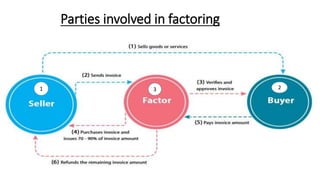
Parties involved in factoring
1 3 2
 Factoring is a financial transaction in which a business sells its
accounts receivable to a third party at a discount.
 Fast way for companies to raise money
 Shortens the collections process
 It allows companies to bring in money without taking on new debt
 No need to have any collection department
 Transfer of risk
Recourse factoring
Non Recource Factoring
Maturity Factoring
Cross-border Factoring
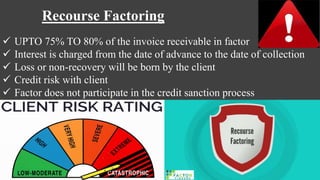
Recourse Factoring
 UPTO 75% TO 80% of the invoice receivable in factor
 Interest is charged from the date of advance to the date of collection
 Loss or non-recovery will be born by the client
 Credit risk with client
 Factor does not participate in the credit sanction process
Non-Recourse Factoring
Credit risk is with the factor
Higher commission is charged
Factor participates in credit sanction process and approves credit limit to the
client to the customer
Loss or non-recovery will be born by the factor
Factor
Maturity Factoring
Factor does not make any advance payment t client
Pay on guaranteed payment date or on collection of receivables
Payment date is fixed by client
Nominal commission is charged
No risk to factor
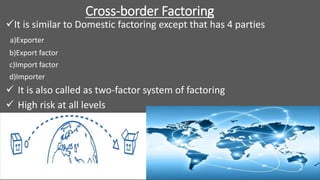
Cross-border Factoring
It is similar to Domestic factoring except that has 4 parties
a)Exporter
b)Export factor
c)Import factor
d)Importer
 It is also called as two-factor system of factoring
 High risk at all levels
Functions of factoring
Finance for the supplier
Maintenence of the receivables account
collection of receivables
protection aganist the payment dafault
 “Full service” factoring offers all the above functions
 Rendering consultancy services
 Provision of finance aganist debts
 Sales Ledger management
ADVANTAGES
• Cost saving
• Liquidity
• Cash flow
• Credit certification
• Infromation flow
DISADVANTAGES
• High risk for both the seller and Factor
• Costly process for seller
• Buyers may refuse to pay back
• Misleading of funds
Case study
Conclusion

Factoring

  • 1.
  • 2.
    Contents PARTIES WHAT WHY HOW TYPES OF FACTORING FUNCTIONS FUNCTININGPROCESS ADVANTAGES DISADVANTAGES CASE STUDY CONCLUSION
  • 3.
    Parties involved infactoring 1 3 2
  • 5.
     Factoring isa financial transaction in which a business sells its accounts receivable to a third party at a discount.
  • 6.
     Fast wayfor companies to raise money  Shortens the collections process  It allows companies to bring in money without taking on new debt  No need to have any collection department  Transfer of risk
  • 8.
    Recourse factoring Non RecourceFactoring Maturity Factoring Cross-border Factoring
  • 9.
    Recourse Factoring  UPTO75% TO 80% of the invoice receivable in factor  Interest is charged from the date of advance to the date of collection  Loss or non-recovery will be born by the client  Credit risk with client  Factor does not participate in the credit sanction process
  • 10.
    Non-Recourse Factoring Credit riskis with the factor Higher commission is charged Factor participates in credit sanction process and approves credit limit to the client to the customer Loss or non-recovery will be born by the factor Factor
  • 11.
    Maturity Factoring Factor doesnot make any advance payment t client Pay on guaranteed payment date or on collection of receivables Payment date is fixed by client Nominal commission is charged No risk to factor
  • 12.
    Cross-border Factoring It issimilar to Domestic factoring except that has 4 parties a)Exporter b)Export factor c)Import factor d)Importer  It is also called as two-factor system of factoring  High risk at all levels
  • 13.
    Functions of factoring Financefor the supplier Maintenence of the receivables account collection of receivables protection aganist the payment dafault  “Full service” factoring offers all the above functions  Rendering consultancy services  Provision of finance aganist debts  Sales Ledger management
  • 15.
    ADVANTAGES • Cost saving •Liquidity • Cash flow • Credit certification • Infromation flow
  • 16.
    DISADVANTAGES • High riskfor both the seller and Factor • Costly process for seller • Buyers may refuse to pay back • Misleading of funds
  • 17.
  • 18.