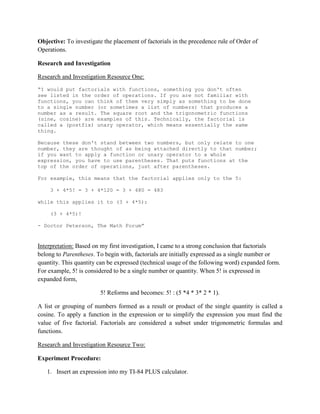
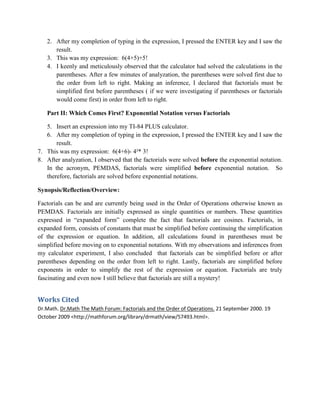
Objective: To investigate the placement of factorials in the precedence rule of Order of                     Operations.Research and InvestigationResearch and Investigation Resource One:“I would put factorials with functions, something you don't often see listed in the order of operations. If you are not familiar with functions, you can think of them very simply as something to be done to a single number (or sometimes a list of numbers) that produces a number as a result. The square root and the trigonometric functions (sine, cosine) are examples of this. Technically, the factorial is called a (postfix) unary operator, which means essentially the same thing.Because these don't stand between two numbers, but only relate to one number, they are thought of as being attached directly to that number; if you want to apply a function or unary operator to a whole expression, you have to use parentheses. That puts functions at the top of the order of operations, just after parentheses.For example, this means that the factorial applies only to the 5:    3 + 4*5! = 3 + 4*120 = 3 + 480 = 483while this applies it to (3 + 4*5):    (3 + 4*5)!- Doctor Peterson, The Math Forum”Interpretation: Based on my first investigation, I came to a strong conclusion that factorials belong to Parentheses. To begin with, factorials are initially expressed as a single number or quantity. This quantity can be expressed (technical usage of the following word) expanded form. For example, 5! is considered to be a single number or quantity. When 5! is expressed in expanded form, 5! Reforms and becomes: 5! : (5 *4 * 3* 2 * 1).A list or grouping of numbers formed as a result or product of the single quantity is called a cosine. To apply a function in the expression or to simplify the expression you must find the value of five factorial. Factorials are considered a subset under trigonometric formulas and functions.Research and Investigation Resource Two:Experiment Procedure:Insert an expression into my TI-84 PLUS calculator.
After my completion of typing in the expression, I pressed the ENTER key and I saw the result.

Factorial Investigation

  • 1.
    Objective: To investigatethe placement of factorials in the precedence rule of Order of Operations.Research and InvestigationResearch and Investigation Resource One:“I would put factorials with functions, something you don't often see listed in the order of operations. If you are not familiar with functions, you can think of them very simply as something to be done to a single number (or sometimes a list of numbers) that produces a number as a result. The square root and the trigonometric functions (sine, cosine) are examples of this. Technically, the factorial is called a (postfix) unary operator, which means essentially the same thing.Because these don't stand between two numbers, but only relate to one number, they are thought of as being attached directly to that number; if you want to apply a function or unary operator to a whole expression, you have to use parentheses. That puts functions at the top of the order of operations, just after parentheses.For example, this means that the factorial applies only to the 5: 3 + 4*5! = 3 + 4*120 = 3 + 480 = 483while this applies it to (3 + 4*5): (3 + 4*5)!- Doctor Peterson, The Math Forum”Interpretation: Based on my first investigation, I came to a strong conclusion that factorials belong to Parentheses. To begin with, factorials are initially expressed as a single number or quantity. This quantity can be expressed (technical usage of the following word) expanded form. For example, 5! is considered to be a single number or quantity. When 5! is expressed in expanded form, 5! Reforms and becomes: 5! : (5 *4 * 3* 2 * 1).A list or grouping of numbers formed as a result or product of the single quantity is called a cosine. To apply a function in the expression or to simplify the expression you must find the value of five factorial. Factorials are considered a subset under trigonometric formulas and functions.Research and Investigation Resource Two:Experiment Procedure:Insert an expression into my TI-84 PLUS calculator.
  • 2.
    After my completionof typing in the expression, I pressed the ENTER key and I saw the result.