A First Book of ANSI C Fourth Edition Chapter 4 Selection
Objectives Relational Expressions The  if  and  if-else  Statements The  if-else  Chain The  switch  Statement Case Study: Data Validation Common Programming and Compiler Errors
Introduction Flow of control  refers to the order in which a program’s statements are executed Any algorithm can be built using combinations of four standardized flow of control structures: Normal flow of control for all programs is  sequential Selection  is   used to select which statements are performed next based on a condition Repetition  is used to repeat a set of statements Invocation  is used to invoke a sequence of instructions using a single statement, as in calling a function
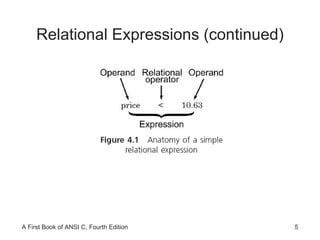
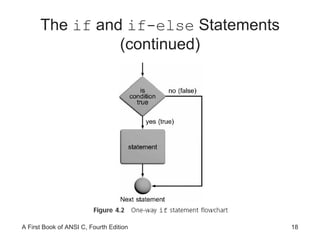
Relational Expressions Simplest decision structure: if (condition) statement executed if condition is true The condition is evaluated to determine its numerical value, which is interpreted as either true (non-zero) or false (0)  If condition is “true” the statement following the  if  is executed; otherwise, statement is not executed The condition used in all of C’s  if  statements can be any valid C expression Most commonly, a  relational expression  (can yield only 0 or 1)
Relational Expressions (continued)
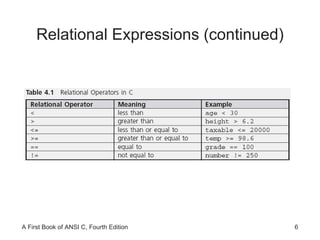
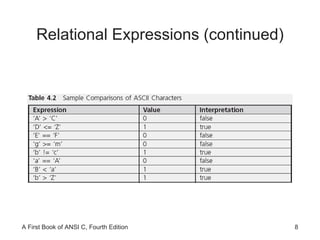
Relational Expressions (continued) Relational expressions are also known as  conditions A relational expression evaluates to 1 (true) or 0 (false) The expression 3 < 4 has a value of 1 The expression 2.0 > 3.3 has a value of 0 The value of  hours  > 0 depends on the value of  hours Character data can also be compared using relational operators
Relational Expressions (continued)
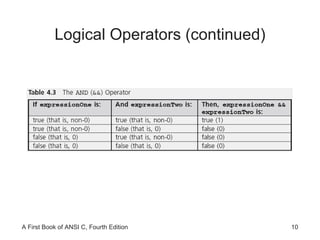
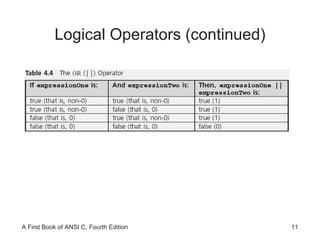
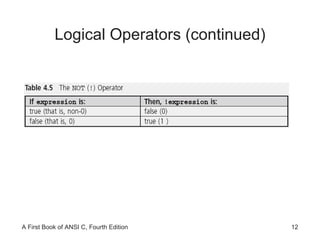
Logical Operators More complex conditions can be created using the logical operations AND (&&), OR (||), and NOT (!) When the && is used with two expressions, the condition is true only if both expressions are true by themselves
Logical Operators (continued)
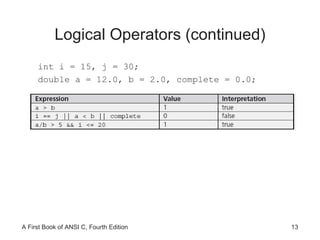
Logical Operators (continued) int i = 15, j = 30; double a = 12.0, b = 2.0, complete = 0.0;
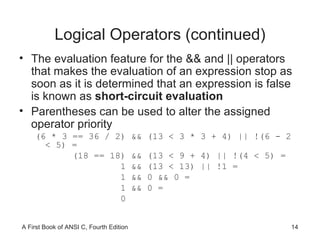
Logical Operators (continued) The evaluation feature for the && and || operators that makes the evaluation of an expression stop as soon as it is determined that an expression is false is known as  short-circuit evaluation Parentheses can be used to alter the assigned operator priority (6 * 3 == 36 / 2) && (13 < 3 * 3 + 4) || !(6 - 2 < 5) = (18 == 18) && (13 < 9 + 4) || !(4 < 5) = 1 && (13 < 13) || !1 = 1 && 0 && 0 = 1 && 0 = 0
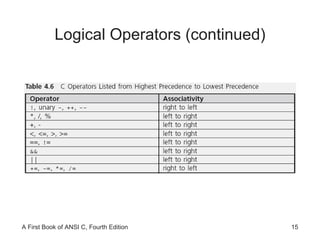
Logical Operators (continued)
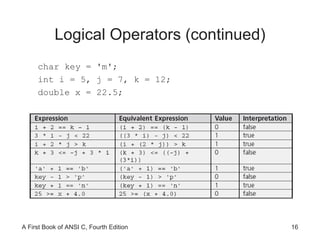
Logical Operators (continued) char key = 'm'; int i = 5, j = 7, k = 12; double x = 22.5;
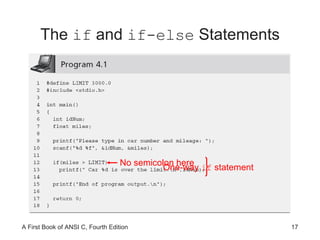
The  if  and  if-else  Statements No semicolon here One-way  if  statement
The  if  and  if-else  Statements (continued)
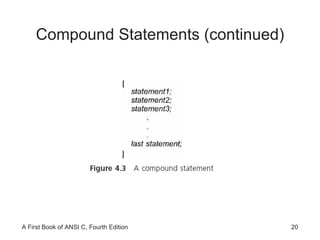
Compound Statements Although only a single statement is permitted in an  if  statement, this statement can be a single  compound statement
Compound Statements (continued)
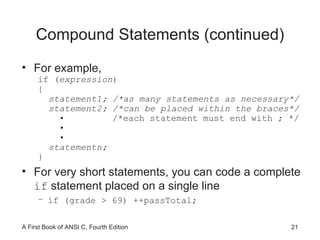
Compound Statements (continued) For example, if ( expression ) { statement1; /*as many statements as necessary*/ statement2; /*can be placed within the braces*/ •  /*each statement must end with ; */ • • statementn; } For very short statements, you can code a complete  if  statement placed on a single line if (grade > 69) ++passTotal;
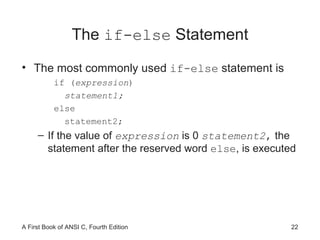
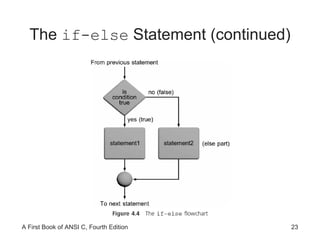
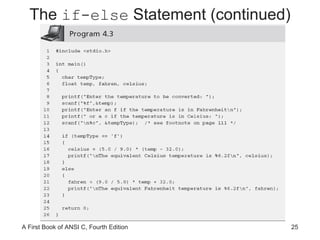
The  if-else  Statement The most commonly used  if-else  statement is if ( expression ) statement1; else statement2; If the value of  expression  is 0  statement2 ,  the statement after the reserved word  else , is executed
The  if-else  Statement (continued)
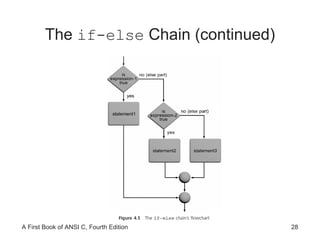
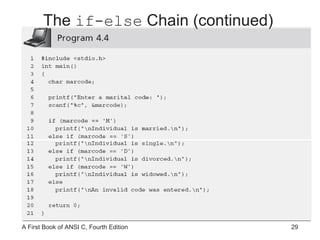
The  if-else  Chain Nested  if  statement: if ( expression1 ) statement1; else if ( expression2 ) statement2; else statement3; Whether the indentation exists or not, the compiler will, by default, associate an  else  with the closest previous unpaired  if , unless braces are used to alter this default pairing
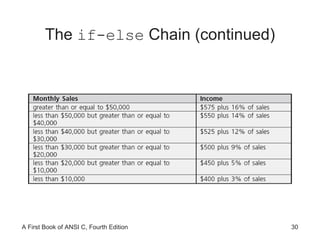
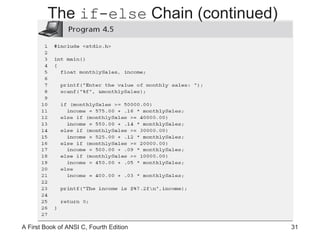
The  if-else  Chain (continued) if-else  chain: if ( expression1 ) statement1; else if ( expression2 ) statement2; else statement3;
The  if-else  Chain (continued)
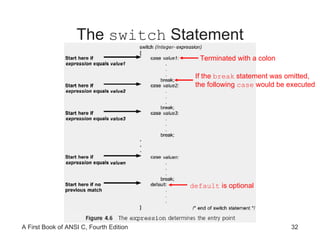
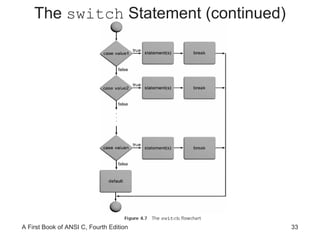
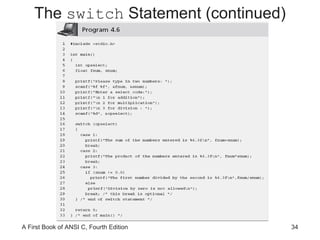
The  switch  Statement Terminated with a colon default  is optional If the  break  statement was omitted, the following  case  would be executed
The  switch  Statement (continued)
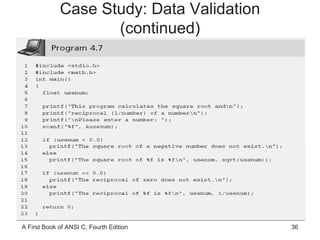
Case Study: Data Validation Defensive programming  is a technique where the program includes code to check for improper data before an attempt is made to process it further Checking user input data for erroneous or unreasonable data is called  input data validation Requirements: Write a program to calculate the square root and the reciprocal of a user-entered number. Validate that the number is not negative before attempting to take its square root, and that the number is not 0 before calculating the number’s reciprocal value.
Case Study: Data Validation (continued)
Common Programming Errors Using the assignment operator, =, in place of the relational operator, == Letting the  if-else  statement appear to select an incorrect choice Nesting  if  statements without including braces to clearly indicate the desired structure Using a single & or | in place of the logical && and logical || operators, respectively
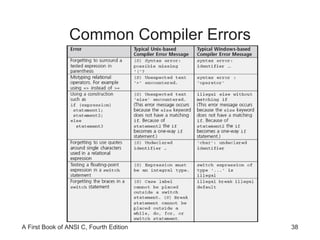
Common Compiler Errors
Summary Relational expressions, which are also called simple conditions, are used to compare operands Conditions can be constructed from relational expressions using C’s logical operators, &&, ||, and ! A one-way  if  statement has the general form if ( expression ) statement; A compound statement consists of any number of individual statements enclosed within braces An  if-else  selects between two alternative statements based on the value of an expression
Summary (continued) An  if-else  statement can contain other  if-else  statements The  if-else  chain is a multiway selection statement The  switch  statement is a multiway selection statement; program execution is transferred to the first matching  case  and continues through the end of the  switch  statement unless an optional  break  statement is encountered

Ch04

  • 1.
    A First Bookof ANSI C Fourth Edition Chapter 4 Selection
  • 2.
    Objectives Relational ExpressionsThe if and if-else Statements The if-else Chain The switch Statement Case Study: Data Validation Common Programming and Compiler Errors
  • 3.
    Introduction Flow ofcontrol refers to the order in which a program’s statements are executed Any algorithm can be built using combinations of four standardized flow of control structures: Normal flow of control for all programs is sequential Selection is used to select which statements are performed next based on a condition Repetition is used to repeat a set of statements Invocation is used to invoke a sequence of instructions using a single statement, as in calling a function
  • 4.
    Relational Expressions Simplestdecision structure: if (condition) statement executed if condition is true The condition is evaluated to determine its numerical value, which is interpreted as either true (non-zero) or false (0) If condition is “true” the statement following the if is executed; otherwise, statement is not executed The condition used in all of C’s if statements can be any valid C expression Most commonly, a relational expression (can yield only 0 or 1)
  • 5.
  • 6.
  • 7.
    Relational Expressions (continued)Relational expressions are also known as conditions A relational expression evaluates to 1 (true) or 0 (false) The expression 3 < 4 has a value of 1 The expression 2.0 > 3.3 has a value of 0 The value of hours > 0 depends on the value of hours Character data can also be compared using relational operators
  • 8.
  • 9.
    Logical Operators Morecomplex conditions can be created using the logical operations AND (&&), OR (||), and NOT (!) When the && is used with two expressions, the condition is true only if both expressions are true by themselves
  • 10.
  • 11.
  • 12.
  • 13.
    Logical Operators (continued)int i = 15, j = 30; double a = 12.0, b = 2.0, complete = 0.0;
  • 14.
    Logical Operators (continued)The evaluation feature for the && and || operators that makes the evaluation of an expression stop as soon as it is determined that an expression is false is known as short-circuit evaluation Parentheses can be used to alter the assigned operator priority (6 * 3 == 36 / 2) && (13 < 3 * 3 + 4) || !(6 - 2 < 5) = (18 == 18) && (13 < 9 + 4) || !(4 < 5) = 1 && (13 < 13) || !1 = 1 && 0 && 0 = 1 && 0 = 0
  • 15.
  • 16.
    Logical Operators (continued)char key = 'm'; int i = 5, j = 7, k = 12; double x = 22.5;
  • 17.
    The if and if-else Statements No semicolon here One-way if statement
  • 18.
    The if and if-else Statements (continued)
  • 19.
    Compound Statements Althoughonly a single statement is permitted in an if statement, this statement can be a single compound statement
  • 20.
  • 21.
    Compound Statements (continued)For example, if ( expression ) { statement1; /*as many statements as necessary*/ statement2; /*can be placed within the braces*/ • /*each statement must end with ; */ • • statementn; } For very short statements, you can code a complete if statement placed on a single line if (grade > 69) ++passTotal;
  • 22.
    The if-else Statement The most commonly used if-else statement is if ( expression ) statement1; else statement2; If the value of expression is 0 statement2 , the statement after the reserved word else , is executed
  • 23.
    The if-else Statement (continued)
  • 24.
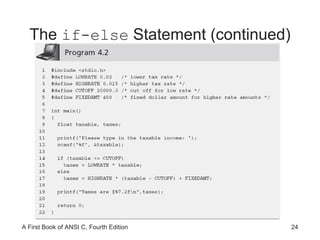
    The if-else Statement (continued)
  • 25.
    The if-else Statement (continued)
  • 26.
    The if-else Chain Nested if statement: if ( expression1 ) statement1; else if ( expression2 ) statement2; else statement3; Whether the indentation exists or not, the compiler will, by default, associate an else with the closest previous unpaired if , unless braces are used to alter this default pairing
  • 27.
    The if-else Chain (continued) if-else chain: if ( expression1 ) statement1; else if ( expression2 ) statement2; else statement3;
  • 28.
    The if-else Chain (continued)
  • 29.
    The if-else Chain (continued)
  • 30.
    The if-else Chain (continued)
  • 31.
    The if-else Chain (continued)
  • 32.
    The switch Statement Terminated with a colon default is optional If the break statement was omitted, the following case would be executed
  • 33.
    The switch Statement (continued)
  • 34.
    The switch Statement (continued)
  • 35.
    Case Study: DataValidation Defensive programming is a technique where the program includes code to check for improper data before an attempt is made to process it further Checking user input data for erroneous or unreasonable data is called input data validation Requirements: Write a program to calculate the square root and the reciprocal of a user-entered number. Validate that the number is not negative before attempting to take its square root, and that the number is not 0 before calculating the number’s reciprocal value.
  • 36.
    Case Study: DataValidation (continued)
  • 37.
    Common Programming ErrorsUsing the assignment operator, =, in place of the relational operator, == Letting the if-else statement appear to select an incorrect choice Nesting if statements without including braces to clearly indicate the desired structure Using a single & or | in place of the logical && and logical || operators, respectively
  • 38.
  • 39.
    Summary Relational expressions,which are also called simple conditions, are used to compare operands Conditions can be constructed from relational expressions using C’s logical operators, &&, ||, and ! A one-way if statement has the general form if ( expression ) statement; A compound statement consists of any number of individual statements enclosed within braces An if-else selects between two alternative statements based on the value of an expression
  • 40.
    Summary (continued) An if-else statement can contain other if-else statements The if-else chain is a multiway selection statement The switch statement is a multiway selection statement; program execution is transferred to the first matching case and continues through the end of the switch statement unless an optional break statement is encountered