P.E.M.D.A.S  What does it stand for??? Paretheses, Exponents, Multiplication, Division, Addition, & Subtraction In this lesson you will learn about using P.E.M.D.A.S to solve an order of operations math problem!!
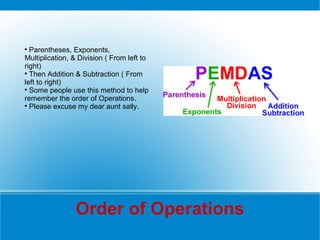
Order of Operations Parentheses, Exponents, Multiplication, & Division ( From left to right) Then Addition & Subtraction ( From left to right) Some people use this method to help remember the order of Operations. Please excuse my dear aunt sally.
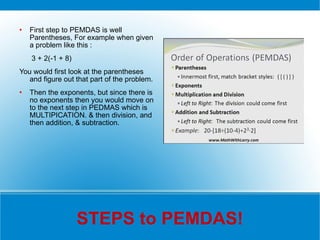
STEPS to PEMDAS! First step to PEMDAS is well Parentheses, For example when given a problem like this : 3 + 2(-1 + 8) You would first look at the parentheses and figure out that part of the problem. Then the exponents, but since there is no exponents then you would move on to the next step in PEDMAS which is MULTIPICATION. & then division, and then addition, & subtraction.
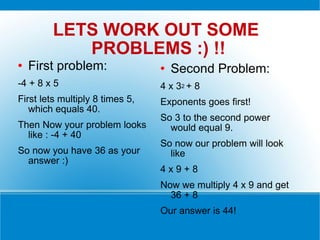
LETS WORK OUT SOME  PROBLEMS :) !! First problem:  -4 + 8 x 5  First lets multiply 8 times 5, which equals 40. Then Now your problem looks like : -4 + 40 So now you have 36 as your answer :) Second Problem: 4 x 3 2  + 8  Exponents goes first! So 3 to the second power would equal 9. So now our problem will look like 4 x 9 + 8 Now we multiply 4 x 9 and get 36 + 8 Our answer is 44!
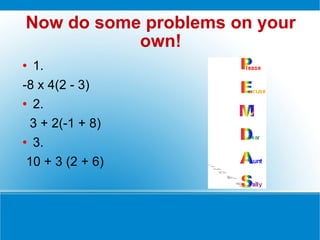
Now do some problems on your own! 1 .  -8 x 4(2 - 3)  2.  3 + 2(-1 + 8) 3. 10 + 3 (2 + 6)
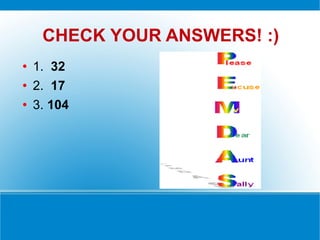
CHECK YOUR ANSWERS! :) 1.  32 2.  17 3.  104
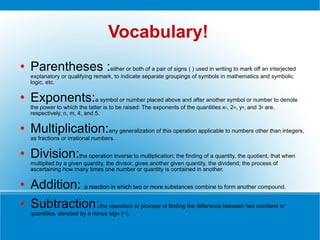
Vocabulary!  Parentheses : either or both of a pair of signs ( ) used in writing to mark off an interjected explanatory or qualifying remark, to indicate separate groupings of symbols in mathematics and symbolic logic, etc. Exponents: a symbol or number placed above and after another symbol or number to denote the power to which the latter is to be raised: The exponents of the quantities x n , 2 m , y 4 , and 3 5  are, respectively, n, m, 4, and 5.  Multiplication: any generalization of this operation applicable to numbers other than integers, as fractions or irrational numbers. Division: the operation inverse to multiplication; the finding of a quantity, the quotient, that when multiplied by a given quantity, the divisor, gives another given quantity, the dividend; the process of ascertaining how many times one number or quantity is contained in another. Addition:  a reaction in which two or more substances combine to form another compound. Subtraction: the operation or process of finding the difference between two numbers or quantities, denoted by a minus sign (−).
GREAT JOB!!!!

PEDMAS ppt. For Mrs. Ewart

  • 1.
    P.E.M.D.A.S Whatdoes it stand for??? Paretheses, Exponents, Multiplication, Division, Addition, & Subtraction In this lesson you will learn about using P.E.M.D.A.S to solve an order of operations math problem!!
  • 2.
    Order of OperationsParentheses, Exponents, Multiplication, & Division ( From left to right) Then Addition & Subtraction ( From left to right) Some people use this method to help remember the order of Operations. Please excuse my dear aunt sally.
  • 3.
    STEPS to PEMDAS!First step to PEMDAS is well Parentheses, For example when given a problem like this : 3 + 2(-1 + 8) You would first look at the parentheses and figure out that part of the problem. Then the exponents, but since there is no exponents then you would move on to the next step in PEDMAS which is MULTIPICATION. & then division, and then addition, & subtraction.
  • 4.
    LETS WORK OUTSOME PROBLEMS :) !! First problem: -4 + 8 x 5 First lets multiply 8 times 5, which equals 40. Then Now your problem looks like : -4 + 40 So now you have 36 as your answer :) Second Problem: 4 x 3 2 + 8 Exponents goes first! So 3 to the second power would equal 9. So now our problem will look like 4 x 9 + 8 Now we multiply 4 x 9 and get 36 + 8 Our answer is 44!
  • 5.
    Now do someproblems on your own! 1 . -8 x 4(2 - 3) 2. 3 + 2(-1 + 8) 3. 10 + 3 (2 + 6)
  • 6.
    CHECK YOUR ANSWERS!:) 1. 32 2. 17 3. 104
  • 7.
    Vocabulary! Parentheses: either or both of a pair of signs ( ) used in writing to mark off an interjected explanatory or qualifying remark, to indicate separate groupings of symbols in mathematics and symbolic logic, etc. Exponents: a symbol or number placed above and after another symbol or number to denote the power to which the latter is to be raised: The exponents of the quantities x n , 2 m , y 4 , and 3 5 are, respectively, n, m, 4, and 5. Multiplication: any generalization of this operation applicable to numbers other than integers, as fractions or irrational numbers. Division: the operation inverse to multiplication; the finding of a quantity, the quotient, that when multiplied by a given quantity, the divisor, gives another given quantity, the dividend; the process of ascertaining how many times one number or quantity is contained in another. Addition: a reaction in which two or more substances combine to form another compound. Subtraction: the operation or process of finding the difference between two numbers or quantities, denoted by a minus sign (−).
  • 8.