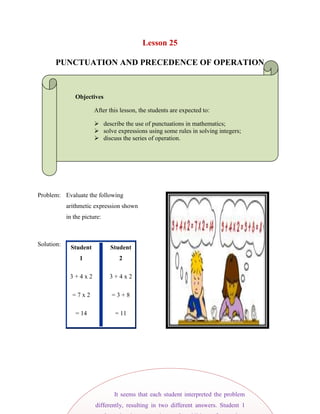
Lesson 25<br />PUNCTUATION AND PRECEDENCE OF OPERATION<br />Objectives<br />After this lesson, the students are expected to:<br />describe the use of punctuations in mathematics;<br />solve expressions using some rules in solving integers;<br />discuss the series of operation.<br />Problem:  Evaluate the following arithmetic expression shown in the picture: Solution:  Student 1   Student 23 + 4 x 23 + 4 x 2= 7 x 2= 3 + 8= 14= 11It seems that each student interpreted the problem differently, resulting in two different answers. Student 1 performed the operation of addition first, then multiplication; whereas student 2 performed multiplication first, then addition. When performing arithmetic operations there can be only one correct answer. We need a set of rules in order to avoid this kind of confusion. Mathematicians have devised a standard order of operations for calculations involving more than one arithmetic operation.Rule 1:   First perform any calculations inside parentheses.Rule 2:   Next perform all multiplications and divisions, working from left to right.Rule 3:   Lastly, perform all additions and subtractions, working from left to right.<br />1282065373126015603355109061The above problem was solved correctly by Student 2 since she followed Rules 2 and 3. Let's look at some examples of solving arithmetic expressions using these rules.<br />Example 1:   Evaluate each expression using the rules for order of operations. Solution:   Order of OperationsExpressionEvaluationOperation6 + 7 x 8= 6 + 7 x 8Multiplication= 6 + 56Addition= 62 16 ÷ 8 - 2= 16 ÷ 8 - 2Division= 2 - 2Subtraction= 0 (25 - 11) x 3= (25 - 11) x 3Parentheses= 14 x 3Multiplication= 42 <br />In Example 1, each problem involved only 2 operations. Let's look at some examples that involve more than two operations.<br />Example 2:  Evaluate 3 + 6 x (5 + 4) ÷ 3 - 7 using the order of operations.Solution:  Step 1:  3 + 6 x (5 + 4) ÷ 3 - 7 = 3 + 6 x 9 ÷ 3 - 7ParenthesesStep 2:  3 + 6 x 9 ÷- 7 = 3 + 54 ÷ 3 - 7MultiplicationStep 3:  3 + 54 ÷ 3 - 7 = 3 + 18 - 7DivisionStep 4:  3 + 18 - 7 = 21 - 7AdditionStep 5:  21 - 7= 14Subtraction<br />Example 3:  Evaluate 9 - 5 ÷ (8 - 3) x 2 + 6 using the order of operations.Solution:  Step 1:    9 - 5 ÷ (8 - 3) x 2 + 6 = 9 - 5 ÷ 5 x 2 + 6ParenthesesStep 2:  9 - 5 ÷ 5 x 2 + 6 = 9 - 1 x 2 + 6DivisionStep 3:  9 - 1 x 2 + 6 = 9 - 2 + 6MultiplicationStep 4:  9 - 2 + 6 = 7 + 6SubtractionStep 5:  7 + 6 = 13Addition<br />In Examples 2 and 3, you will notice that multiplication and division were evaluated from left to right according to Rule 2. Similarly, addition and subtraction were evaluated from left to right, according to Rule 3.<br />When two or more operations occur inside a set of parentheses, these operations should be evaluated according to Rules 2 and 3. This is done in Example 4 below.<br />Example 4:  Evaluate 150 ÷ (6 + 3 x 8) - 5 using the order of operations.Solution:  Step 1:  150 ÷ (6 + 3 x 8) - 5 = 150 ÷ (6 + 24) - 5Multiplication inside ParenthesesStep 2:  150 ÷ (6 + 24) - 5 = 150 ÷ 30 - 5Addition inside ParenthesesStep 3:  150 ÷ 30 - 5 = 5 - 5DivisionStep 4:  5 - 5 = 0Subtraction<br />Example 5:  Evaluate the arithmetic expression below: Solution:   This problem includes a fraction bar (also called a vinculum), which means we must divide the numerator by the denominator. However, we must first perform all calculations above and below the fraction bar BEFORE dividing.  Thus Evaluating this expression, we get: <br />Example 6:   Write an arithmetic expression for this problem. Then evaluate the expression using the order of operations.  Mr. Smith charged Jill $32 for parts and $15 per hour for labor to repair her bicycle. If he spent 3 hours repairing her bike, how much does Jill owe him? Solution:  32 + 3 x 15   =   32 + 3 x 15    =   32 + 45 =   77  Jill owes Mr. Smith $77. <br />         SUMMARY:  When evaluating arithmetic expressions, the order of operations is:Simplify all operations inside parentheses.Perform all multiplications and divisions, working from left to right.Perform all additions and subtractions, working from left to right.-513470-99939<br />WORKSHEET NO. 25<br />NAME: ___________________________________DATE: _____________ <br />YEAR & SECTION: ________________________RATING: ___________<br />Try to solve the following then explain.<br />Solution<br />109918504635543+5786-57=______________<br />(6754-65+64)(7)=___________<br />78÷39+5-65=______________<br />-4221798200026234x3-56+8=______________<br />(136-56+65)÷5=____________<br />343-65=___________________<br />1234+(-87)x8=______________<br />84-8+54(6)= _______________<br />4638-870=_________________<br />543+(-8)+(-78)(8)= __________<br />
037 lesson 25
037 lesson 25
037 lesson 25
037 lesson 25
037 lesson 25
037 lesson 25

037 lesson 25

  • 1.
    Lesson 25<br />PUNCTUATIONAND PRECEDENCE OF OPERATION<br />Objectives<br />After this lesson, the students are expected to:<br />describe the use of punctuations in mathematics;<br />solve expressions using some rules in solving integers;<br />discuss the series of operation.<br />Problem:  Evaluate the following arithmetic expression shown in the picture: Solution:  Student 1   Student 23 + 4 x 23 + 4 x 2= 7 x 2= 3 + 8= 14= 11It seems that each student interpreted the problem differently, resulting in two different answers. Student 1 performed the operation of addition first, then multiplication; whereas student 2 performed multiplication first, then addition. When performing arithmetic operations there can be only one correct answer. We need a set of rules in order to avoid this kind of confusion. Mathematicians have devised a standard order of operations for calculations involving more than one arithmetic operation.Rule 1:   First perform any calculations inside parentheses.Rule 2:   Next perform all multiplications and divisions, working from left to right.Rule 3:   Lastly, perform all additions and subtractions, working from left to right.<br />1282065373126015603355109061The above problem was solved correctly by Student 2 since she followed Rules 2 and 3. Let's look at some examples of solving arithmetic expressions using these rules.<br />Example 1:   Evaluate each expression using the rules for order of operations. Solution:   Order of OperationsExpressionEvaluationOperation6 + 7 x 8= 6 + 7 x 8Multiplication= 6 + 56Addition= 62 16 ÷ 8 - 2= 16 ÷ 8 - 2Division= 2 - 2Subtraction= 0 (25 - 11) x 3= (25 - 11) x 3Parentheses= 14 x 3Multiplication= 42 <br />In Example 1, each problem involved only 2 operations. Let's look at some examples that involve more than two operations.<br />Example 2:  Evaluate 3 + 6 x (5 + 4) ÷ 3 - 7 using the order of operations.Solution:  Step 1:  3 + 6 x (5 + 4) ÷ 3 - 7 = 3 + 6 x 9 ÷ 3 - 7ParenthesesStep 2:  3 + 6 x 9 ÷- 7 = 3 + 54 ÷ 3 - 7MultiplicationStep 3:  3 + 54 ÷ 3 - 7 = 3 + 18 - 7DivisionStep 4:  3 + 18 - 7 = 21 - 7AdditionStep 5:  21 - 7= 14Subtraction<br />Example 3:  Evaluate 9 - 5 ÷ (8 - 3) x 2 + 6 using the order of operations.Solution:  Step 1:    9 - 5 ÷ (8 - 3) x 2 + 6 = 9 - 5 ÷ 5 x 2 + 6ParenthesesStep 2:  9 - 5 ÷ 5 x 2 + 6 = 9 - 1 x 2 + 6DivisionStep 3:  9 - 1 x 2 + 6 = 9 - 2 + 6MultiplicationStep 4:  9 - 2 + 6 = 7 + 6SubtractionStep 5:  7 + 6 = 13Addition<br />In Examples 2 and 3, you will notice that multiplication and division were evaluated from left to right according to Rule 2. Similarly, addition and subtraction were evaluated from left to right, according to Rule 3.<br />When two or more operations occur inside a set of parentheses, these operations should be evaluated according to Rules 2 and 3. This is done in Example 4 below.<br />Example 4:  Evaluate 150 ÷ (6 + 3 x 8) - 5 using the order of operations.Solution:  Step 1:  150 ÷ (6 + 3 x 8) - 5 = 150 ÷ (6 + 24) - 5Multiplication inside ParenthesesStep 2:  150 ÷ (6 + 24) - 5 = 150 ÷ 30 - 5Addition inside ParenthesesStep 3:  150 ÷ 30 - 5 = 5 - 5DivisionStep 4:  5 - 5 = 0Subtraction<br />Example 5:  Evaluate the arithmetic expression below: Solution:   This problem includes a fraction bar (also called a vinculum), which means we must divide the numerator by the denominator. However, we must first perform all calculations above and below the fraction bar BEFORE dividing.  Thus Evaluating this expression, we get: <br />Example 6:   Write an arithmetic expression for this problem. Then evaluate the expression using the order of operations.  Mr. Smith charged Jill $32 for parts and $15 per hour for labor to repair her bicycle. If he spent 3 hours repairing her bike, how much does Jill owe him? Solution:  32 + 3 x 15   =   32 + 3 x 15    =   32 + 45 =   77  Jill owes Mr. Smith $77. <br /> SUMMARY:  When evaluating arithmetic expressions, the order of operations is:Simplify all operations inside parentheses.Perform all multiplications and divisions, working from left to right.Perform all additions and subtractions, working from left to right.-513470-99939<br />WORKSHEET NO. 25<br />NAME: ___________________________________DATE: _____________ <br />YEAR & SECTION: ________________________RATING: ___________<br />Try to solve the following then explain.<br />Solution<br />109918504635543+5786-57=______________<br />(6754-65+64)(7)=___________<br />78÷39+5-65=______________<br />-4221798200026234x3-56+8=______________<br />(136-56+65)÷5=____________<br />343-65=___________________<br />1234+(-87)x8=______________<br />84-8+54(6)= _______________<br />4638-870=_________________<br />543+(-8)+(-78)(8)= __________<br />