A First Book of ANSI C Fourth Edition Chapter 6 Modularity Using Functions: Part I
Objectives Function and Parameter Declarations Returning a Value Case Study: Calculating Age Norms Standard Library Functions Common Programming and Compiler Errors
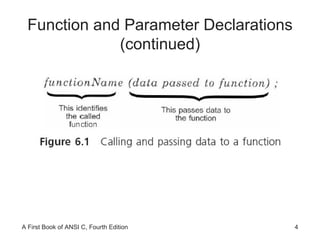
Function and Parameter Declarations A function that is called into action by its reference in another function is a  called function A function that calls another function is referred to as the  calling function
Function and Parameter Declarations (continued)
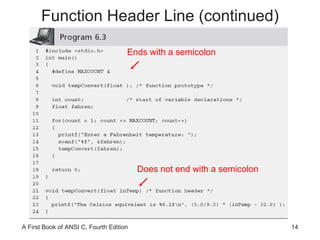
Function Prototypes The declaration statement for a function is referred to as a  function prototype Declares the data type of the value that will be directly returned by the function Declares the data type of the values that need to be transmitted to the called function when it is invoked returnDataType functionName(argument data types); Function prototypes allow the compiler to check for data type errors If the function prototype does not agree with data types specified when the function is written, an error message (typically TYPE MISMATCH) will occur
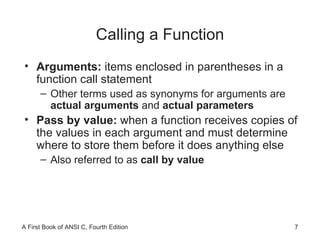
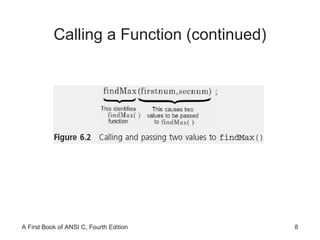
Calling a Function Arguments:  items enclosed in parentheses in a function call statement Other terms used as synonyms for arguments are  actual arguments  and  actual parameters Pass by value:  when a function receives copies of the values in each argument and must determine where to store them before it does anything else Also referred to as  call by value
Calling a Function (continued)
Function Header Line Function header:  identifies the data type of the return value, provides the function with a name, and specifies the number, order, and type of values expected by the function Function body:  operates on the passed data and returns, at most, one value The argument names in the header line are known as  parameters  or  formal parameters  and  formal arguments
Function Header Line (continued)
Function Header Line (continued) main()  must adhere to the rules required for constructing all C functions Some programmers prefer to put all called functions at the top of a program and make  main()  the last function listed Each C function is a separate and independent entity with its own parameters and variables Nested functions are not permitted The function’s prototype, along with pre- and postconditions should provide all the information necessary to call the function successfully
Ends with a semicolon Does not end with a semicolon Function Header Line (continued)
Placement of Statements All preprocessor directives, variables, named constants, and functions, except  main() , must be either declared or defined  before  they can be used Basic (good) programming structure: preprocessor directives symbolic constants function prototypes can be placed here int main() { function prototypes can be placed here variable declarations; other executable statements; return value; }
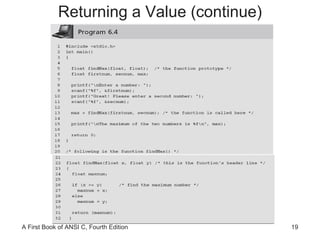
Returning a Value From its side of the return transaction, the called function must provide: Data type of the returned value, which is specified in the function’s header line Actual value being returned, which is specified by a return statement
Returning a Value (continue)
Returning a Value (continue) To return a value, use a  return  statement return ( expression ); //or, return  expression ; The  expression   is evaluated first; its value is then automatically converted to the return value’s data type as specified in the function’s header line before being sent back to the calling function Failure to exactly match the return value with the function’s declared data type can lead to undesired results Return value is converted to the data type declared in the function’s header line
Returning a Value (continue)
Value is automatically converted from  double  to  float  (it may also generate a compiler warning message) Returning a Value (continue) printf("The Celsius equivalent is %5.2f\n", tempConvert(fahren));
Function Stubs A  stub  is the beginning of a final function, used as a placeholder until the final function is completed float findMax(float x, float y) { printf("In findMax()\n"); printf("The value of x is %f\n", x); printf("The value of x is %f\n ", y); return 1.0; } A stub must compile and link with its calling module Stub should display a message that it has been entered successfully and the value(s) of its received arguments
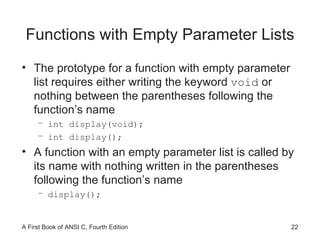
Functions with Empty Parameter Lists The prototype for a function with empty parameter list requires either writing the keyword  void  or nothing between the parentheses following the function’s name int display(void); int display(); A function with an empty parameter list is called by its name with nothing written in the parentheses following the function’s name display();
Case Study: Calculating Age Norms
Requirements Specification A fairly common procedure in child development is to establish normal ranges for height and weight as they relate to a child’s age These normal ranges are frequently referred to as  age norms In this case study, we develop a program for calculating both the expected height of a child between the ages of 6 and 11 and the deviation of this height norm to an actual child’s height
Requirements Specification (continued)
Standard Library Functions The standard library consists of 15 header files Before using these functions, you must know The name of each available function The arguments required by each function The data type of the result (if any) returned by each function A description of what each function does How to include the library containing the desired function #include <header-file-name>
Mathematical Library Functions
Mathematical Library Functions (continued)
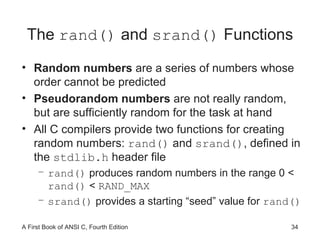
The  rand()  and  srand()  Functions Random numbers  are a series of numbers whose order cannot be predicted Pseudorandom numbers  are not really random, but are sufficiently random for the task at hand All C compilers provide two functions for creating random numbers:  rand()  and  srand() , defined in the  stdlib.h  header file rand()  produces random numbers in the range 0 <  rand()  <  RAND_MAX srand()  provides a starting “seed” value for  rand()
The  rand()  and  srand()  Functions (continued)
Scaling The method for adjusting the random numbers produced by a random-number generator to reside within a specified range is called  scaling To scale a random number as an integer value between 1 and  N: 1 + (int)rand() % N To produce a random integer between the numbers  a  and  b : a + (int)(rand() % (b - a + 1))
Coin Toss Simulation
Coin Toss Simulation (continued)
Input/Output Library Functions getchar()  can be used for single character input int getchar() The reason for returning characters in integer format is to allow the End-Of-File (EOF) sentinel to be returned putchar()  expects a single character argument and displays the character passed to it on the terminal For example,  putchar('a')
Character Processing Functions
Character Processing Functions (continued)
Conversion Functions
Conversion Functions (continued)
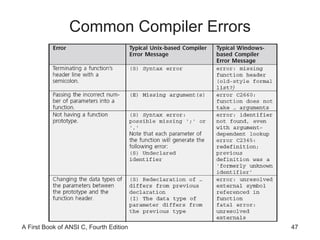
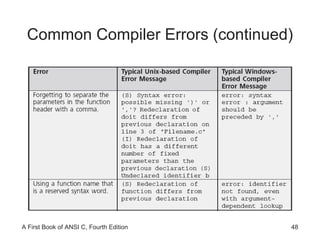
Common Programming Errors Passing incorrect data types Omitting a called function’s prototype Terminating a function’s header line with a semicolon Forgetting to include a data type for each parameter listed in a function’s header line Returning a different data type from a function than the data type specified in the function’s header line
Common Compiler Errors
Common Compiler Errors (continued)
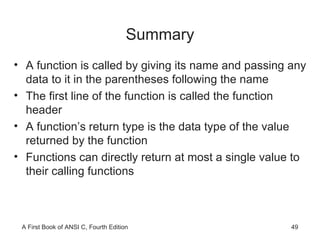
Summary A function is called by giving its name and passing any data to it in the parentheses following the name The first line of the function is called the function header A function’s return type is the data type of the value returned by the function Functions can directly return at most a single value to their calling functions
Summary (continued) Functions can be declared to all calling functions with a function prototype Arguments passed to a function provide a means of evaluating any valid C expression A set of preprogrammed functions for mathematical calculations, character input and output, character processing, and numerical conversions are included in the standard library provided with each C compiler

Ch06

  • 1.
    A First Bookof ANSI C Fourth Edition Chapter 6 Modularity Using Functions: Part I
  • 2.
    Objectives Function andParameter Declarations Returning a Value Case Study: Calculating Age Norms Standard Library Functions Common Programming and Compiler Errors
  • 3.
    Function and ParameterDeclarations A function that is called into action by its reference in another function is a called function A function that calls another function is referred to as the calling function
  • 4.
    Function and ParameterDeclarations (continued)
  • 5.
    Function and ParameterDeclarations (continued)
  • 6.
    Function Prototypes Thedeclaration statement for a function is referred to as a function prototype Declares the data type of the value that will be directly returned by the function Declares the data type of the values that need to be transmitted to the called function when it is invoked returnDataType functionName(argument data types); Function prototypes allow the compiler to check for data type errors If the function prototype does not agree with data types specified when the function is written, an error message (typically TYPE MISMATCH) will occur
  • 7.
    Calling a FunctionArguments: items enclosed in parentheses in a function call statement Other terms used as synonyms for arguments are actual arguments and actual parameters Pass by value: when a function receives copies of the values in each argument and must determine where to store them before it does anything else Also referred to as call by value
  • 8.
    Calling a Function(continued)
  • 9.
    Calling a Function(continued)
  • 10.
    Function Header LineFunction header: identifies the data type of the return value, provides the function with a name, and specifies the number, order, and type of values expected by the function Function body: operates on the passed data and returns, at most, one value The argument names in the header line are known as parameters or formal parameters and formal arguments
  • 11.
  • 12.
  • 13.
    Function Header Line(continued) main() must adhere to the rules required for constructing all C functions Some programmers prefer to put all called functions at the top of a program and make main() the last function listed Each C function is a separate and independent entity with its own parameters and variables Nested functions are not permitted The function’s prototype, along with pre- and postconditions should provide all the information necessary to call the function successfully
  • 14.
    Ends with asemicolon Does not end with a semicolon Function Header Line (continued)
  • 15.
    Placement of StatementsAll preprocessor directives, variables, named constants, and functions, except main() , must be either declared or defined before they can be used Basic (good) programming structure: preprocessor directives symbolic constants function prototypes can be placed here int main() { function prototypes can be placed here variable declarations; other executable statements; return value; }
  • 16.
    Returning a ValueFrom its side of the return transaction, the called function must provide: Data type of the returned value, which is specified in the function’s header line Actual value being returned, which is specified by a return statement
  • 17.
  • 18.
    Returning a Value(continue) To return a value, use a return statement return ( expression ); //or, return expression ; The expression is evaluated first; its value is then automatically converted to the return value’s data type as specified in the function’s header line before being sent back to the calling function Failure to exactly match the return value with the function’s declared data type can lead to undesired results Return value is converted to the data type declared in the function’s header line
  • 19.
  • 20.
    Value is automaticallyconverted from double to float (it may also generate a compiler warning message) Returning a Value (continue) printf(&quot;The Celsius equivalent is %5.2f\n&quot;, tempConvert(fahren));
  • 21.
    Function Stubs A stub is the beginning of a final function, used as a placeholder until the final function is completed float findMax(float x, float y) { printf(&quot;In findMax()\n&quot;); printf(&quot;The value of x is %f\n&quot;, x); printf(&quot;The value of x is %f\n &quot;, y); return 1.0; } A stub must compile and link with its calling module Stub should display a message that it has been entered successfully and the value(s) of its received arguments
  • 22.
    Functions with EmptyParameter Lists The prototype for a function with empty parameter list requires either writing the keyword void or nothing between the parentheses following the function’s name int display(void); int display(); A function with an empty parameter list is called by its name with nothing written in the parentheses following the function’s name display();
  • 23.
  • 24.
    Requirements Specification Afairly common procedure in child development is to establish normal ranges for height and weight as they relate to a child’s age These normal ranges are frequently referred to as age norms In this case study, we develop a program for calculating both the expected height of a child between the ages of 6 and 11 and the deviation of this height norm to an actual child’s height
  • 25.
  • 26.
  • 27.
  • 28.
  • 29.
  • 30.
  • 31.
    Standard Library FunctionsThe standard library consists of 15 header files Before using these functions, you must know The name of each available function The arguments required by each function The data type of the result (if any) returned by each function A description of what each function does How to include the library containing the desired function #include <header-file-name>
  • 32.
  • 33.
  • 34.
    The rand() and srand() Functions Random numbers are a series of numbers whose order cannot be predicted Pseudorandom numbers are not really random, but are sufficiently random for the task at hand All C compilers provide two functions for creating random numbers: rand() and srand() , defined in the stdlib.h header file rand() produces random numbers in the range 0 < rand() < RAND_MAX srand() provides a starting “seed” value for rand()
  • 35.
    The rand() and srand() Functions (continued)
  • 36.
    Scaling The methodfor adjusting the random numbers produced by a random-number generator to reside within a specified range is called scaling To scale a random number as an integer value between 1 and N: 1 + (int)rand() % N To produce a random integer between the numbers a and b : a + (int)(rand() % (b - a + 1))
  • 37.
  • 38.
  • 39.
  • 40.
    Input/Output Library Functionsgetchar() can be used for single character input int getchar() The reason for returning characters in integer format is to allow the End-Of-File (EOF) sentinel to be returned putchar() expects a single character argument and displays the character passed to it on the terminal For example, putchar('a')
  • 41.
  • 42.
  • 43.
  • 44.
  • 45.
  • 46.
    Common Programming ErrorsPassing incorrect data types Omitting a called function’s prototype Terminating a function’s header line with a semicolon Forgetting to include a data type for each parameter listed in a function’s header line Returning a different data type from a function than the data type specified in the function’s header line
  • 47.
  • 48.
  • 49.
    Summary A functionis called by giving its name and passing any data to it in the parentheses following the name The first line of the function is called the function header A function’s return type is the data type of the value returned by the function Functions can directly return at most a single value to their calling functions
  • 50.
    Summary (continued) Functionscan be declared to all calling functions with a function prototype Arguments passed to a function provide a means of evaluating any valid C expression A set of preprogrammed functions for mathematical calculations, character input and output, character processing, and numerical conversions are included in the standard library provided with each C compiler