X-ray Emission
By : Sohail Ahmad Khan
NWIHS
Radiology
OUTLINE
 X-ray Quantity
 X-ray Intensity
 Factors That Affect X-ray Quantity
Milliampere Seconds (mAs)
Kilovolt Peak (kVp)
Distance
Filtration
 X-rays are emitted through a window in the glass or metal
enclosure of the x-ray tube in the form of a spectrum of energies.
 The x-ray beam is characterized by quantity (the number of x-
rays in the beam) and quality (the penetrability of the beam).
X-ray Intensity
 The intensity of the x-ray beam of an x-ray imaging system is measured
in milligray in air (mGya) [formerly milliroentgen (mR)] and is called
the x-ray quantity.
 Another term, radiation exposure, is also often used. All have the same
meaning, and all are measured in mGya (mR).
 The mGya (mR) is a measure of the number of ion pairs produced in air
by a quantity of x-rays.
 Ionization of air increases as the number of x-rays in the beam
increases.
 The relationship between the x-ray quantity as measured in mGya
(mR) and the number of x-rays in the beam is not always one to
one.
 Some small variations are related to the effective x-ray energy.
 Radiation exposure rate expressed as mGya/s, mGya/ min, mGya/mAs
(mR/s, mR/min, or mR/mAs) can also be used to express x-ray
intensity.
 X-ray quantity is the number of x-rays in the useful beam.
 Most general-purpose radiographic tubes, when operated at
approximately 70 kVp, produce x-ray intensities of approximately 50
μGya/mAs (5 mR/mAs) at a 100-cm source-to-image receptor distance
(SID).
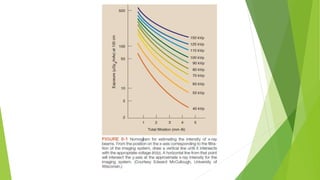
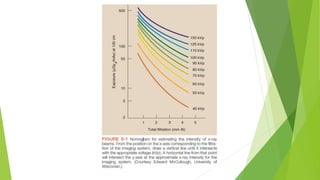
 Figure 8-1 is a nomogram for estimating x-ray intensity for a wide
range of techniques.
 These curves apply only for single-phase, full-wave–rectified
apparatus.
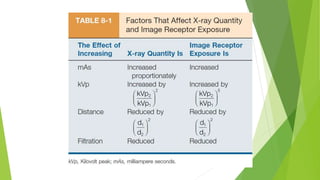
Factors That Affect X-ray Quantity
 Milliampere Seconds (mAs)
 Kilovolt Peak (kVp)
 Distance
 Filtration
Milliampere Seconds (mAs)
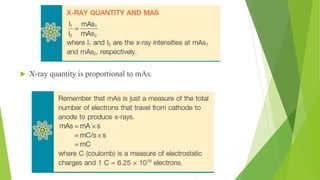
 X-ray quantity is directly proportional to the milliampere
seconds (mAs).
 When mAs is doubled, the number of electrons striking the tube
target is doubled,
 and therefore the number of x-rays emitted is doubled.
 X-ray quantity is proportional to mAs.
Kilovolt Peak (kVp)
 X-ray quantity varies rapidly with changes in kilovolt peak
(kVp).
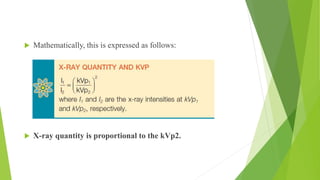
 The change in x-ray quantity is proportional to the square of the
ratio of the kVp;
 in other words, if kVp were doubled, the x-ray intensity would
increase by a factor of 4.
 Mathematically, this is expressed as follows:
 X-ray quantity is proportional to the kVp2.
 Theoretically, doubling the x-ray intensity by kVp manipulation
alone requires an increase of 40% in kVp.
 This relationship is not adopted clinically because as kVp is
increased, the penetrability of the x-ray beam is increased,
 and relatively fewer x-rays are absorbed in the patient.
 More x-rays go through the patient and interact with the image
receptor.
 Consequently, to maintain a constant exposure of the image
receptor, an increase of 15% in kVp should be accompanied by a
reduction of one half in mAs.
 Note that by increasing kVp and reducing mAs so that image
receptor exposure remains constant, the patient dose is reduced
significantly.
 The disadvantage of such a technique adjustment is reduced
image contrast when screen-film is the image receptor.
 There is little change in contrast when using digital image
receptors.
Distance
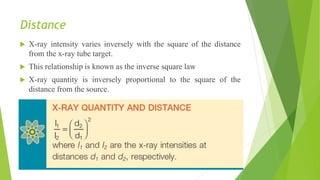
 X-ray intensity varies inversely with the square of the distance
from the x-ray tube target.
 This relationship is known as the inverse square law
 X-ray quantity is inversely proportional to the square of the
distance from the source.
 When SID is increased, mAs must be increased by SID2 to maintain constant
exposure to the image receptor.
 Compensating for a change in SID by changing mAs by the factor SID2 is
known as the square law, a corollary to the inverse square law.
Filtration
 Adding filtration to the useful x-ray beam reduces patient
dose.
 X-ray imaging systems have metal filters, usually 1 to 5 mm of
aluminum (Al), positioned in the useful beam.
 The purpose of filtration is to reduce the number of low-energy
x-rays.
 Low-energy x-rays contribute nothing useful to the image.
 They only increase the patient radiation dose unnecessarily
because they are absorbed in superficial tissues and do not
penetrate to reach the image receptor.
 When filtration is added to the x-ray beam, patient dose is
reduced because fewer low-energy x-rays are in the useful beam.
 An estimate of exposure reduction can be made from the
nomogram in Figure 8-1,
 where it is shown that the reduction is not proportional to the
thickness of the added filter but is related in a complex way.
 The disadvantage of x-ray beam filtration can be reduced image
contrast when using screen-film caused by x-ray beam hardening.
 X-ray beam hardening increases the number of high energy x-
rays in the beam by removing the lower-energy non penetrating
x-rays.
Thank
You

Factor affecting the quantity of Xray.pptx

  • 1.
    X-ray Emission By :Sohail Ahmad Khan NWIHS Radiology
  • 2.
    OUTLINE  X-ray Quantity X-ray Intensity  Factors That Affect X-ray Quantity Milliampere Seconds (mAs) Kilovolt Peak (kVp) Distance Filtration
  • 3.
     X-rays areemitted through a window in the glass or metal enclosure of the x-ray tube in the form of a spectrum of energies.  The x-ray beam is characterized by quantity (the number of x- rays in the beam) and quality (the penetrability of the beam).
  • 4.
    X-ray Intensity  Theintensity of the x-ray beam of an x-ray imaging system is measured in milligray in air (mGya) [formerly milliroentgen (mR)] and is called the x-ray quantity.  Another term, radiation exposure, is also often used. All have the same meaning, and all are measured in mGya (mR).  The mGya (mR) is a measure of the number of ion pairs produced in air by a quantity of x-rays.
  • 5.
     Ionization ofair increases as the number of x-rays in the beam increases.  The relationship between the x-ray quantity as measured in mGya (mR) and the number of x-rays in the beam is not always one to one.  Some small variations are related to the effective x-ray energy.
  • 6.
     Radiation exposurerate expressed as mGya/s, mGya/ min, mGya/mAs (mR/s, mR/min, or mR/mAs) can also be used to express x-ray intensity.  X-ray quantity is the number of x-rays in the useful beam.  Most general-purpose radiographic tubes, when operated at approximately 70 kVp, produce x-ray intensities of approximately 50 μGya/mAs (5 mR/mAs) at a 100-cm source-to-image receptor distance (SID).  Figure 8-1 is a nomogram for estimating x-ray intensity for a wide range of techniques.  These curves apply only for single-phase, full-wave–rectified apparatus.
  • 8.
    Factors That AffectX-ray Quantity  Milliampere Seconds (mAs)  Kilovolt Peak (kVp)  Distance  Filtration
  • 10.
    Milliampere Seconds (mAs) X-ray quantity is directly proportional to the milliampere seconds (mAs).  When mAs is doubled, the number of electrons striking the tube target is doubled,  and therefore the number of x-rays emitted is doubled.
  • 11.
     X-ray quantityis proportional to mAs.
  • 12.
    Kilovolt Peak (kVp) X-ray quantity varies rapidly with changes in kilovolt peak (kVp).  The change in x-ray quantity is proportional to the square of the ratio of the kVp;  in other words, if kVp were doubled, the x-ray intensity would increase by a factor of 4.
  • 13.
     Mathematically, thisis expressed as follows:  X-ray quantity is proportional to the kVp2.
  • 14.
     Theoretically, doublingthe x-ray intensity by kVp manipulation alone requires an increase of 40% in kVp.  This relationship is not adopted clinically because as kVp is increased, the penetrability of the x-ray beam is increased,  and relatively fewer x-rays are absorbed in the patient.  More x-rays go through the patient and interact with the image receptor.  Consequently, to maintain a constant exposure of the image receptor, an increase of 15% in kVp should be accompanied by a reduction of one half in mAs.
  • 15.
     Note thatby increasing kVp and reducing mAs so that image receptor exposure remains constant, the patient dose is reduced significantly.  The disadvantage of such a technique adjustment is reduced image contrast when screen-film is the image receptor.  There is little change in contrast when using digital image receptors.
  • 16.
    Distance  X-ray intensityvaries inversely with the square of the distance from the x-ray tube target.  This relationship is known as the inverse square law  X-ray quantity is inversely proportional to the square of the distance from the source.
  • 17.
     When SIDis increased, mAs must be increased by SID2 to maintain constant exposure to the image receptor.  Compensating for a change in SID by changing mAs by the factor SID2 is known as the square law, a corollary to the inverse square law.
  • 18.
    Filtration  Adding filtrationto the useful x-ray beam reduces patient dose.  X-ray imaging systems have metal filters, usually 1 to 5 mm of aluminum (Al), positioned in the useful beam.  The purpose of filtration is to reduce the number of low-energy x-rays.  Low-energy x-rays contribute nothing useful to the image.  They only increase the patient radiation dose unnecessarily because they are absorbed in superficial tissues and do not penetrate to reach the image receptor.
  • 19.
     When filtrationis added to the x-ray beam, patient dose is reduced because fewer low-energy x-rays are in the useful beam.  An estimate of exposure reduction can be made from the nomogram in Figure 8-1,  where it is shown that the reduction is not proportional to the thickness of the added filter but is related in a complex way.
  • 21.
     The disadvantageof x-ray beam filtration can be reduced image contrast when using screen-film caused by x-ray beam hardening.  X-ray beam hardening increases the number of high energy x- rays in the beam by removing the lower-energy non penetrating x-rays.
  • 22.