ICT in Education
Lesson 3: Digital content, information evaluation and licensing
Oriol Borrás Gené
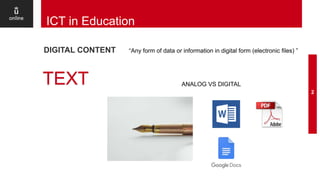
DIGITAL CONTENT
2
ICT in Education
“Any form of data or information in digital form (electronic files) ”
TEXT ANALOG VS DIGITAL
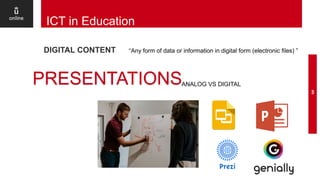
DIGITAL CONTENT
3
ICT in Education
“Any form of data or information in digital form (electronic files) ”
PRESENTATIONSANALOG VS DIGITAL
DIGITAL CONTENT
4
ICT in Education
“Any form of data or information in digital form (electronic files) ”
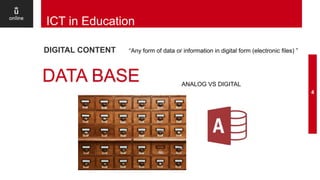
DATA BASE ANALOG VS DIGITAL
DIGITAL CONTENT
5
ICT in Education
“Any form of data or information in digital form (electronic files) ”
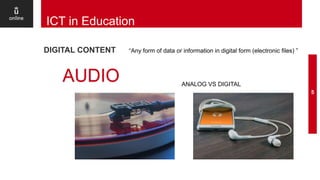
AUDIO ANALOG VS DIGITAL
DIGITAL CONTENT
6
ICT in Education
“Any form of data or information in digital form (electronic files) ”
VIDEO, IMAGES, …
SOFTWARE
7
ICT in Education
FREE / PRIVATE
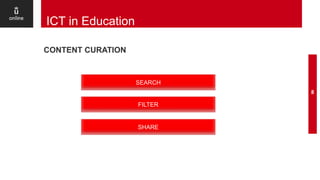
CONTENT CURATION
8
ICT in Education
SEARCH
FILTER
SHARE
9
ICT in Education
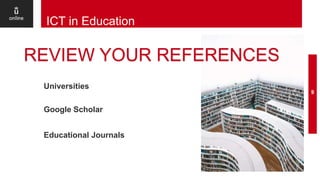
REVIEW YOUR REFERENCES
Universities
Google Scholar
Educational Journals
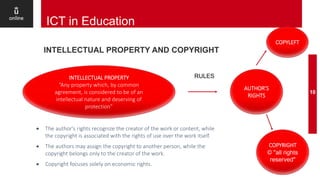
INTELLECTUAL PROPERTY AND COPYRIGHT
10
ICT in Education
INTELLECTUAL PROPERTY
“Any property which, by common
agreement, is considered to be of an
intellectual nature and deserving of
protection”
AUTHOR’S
RIGHTS
RULES
 The author's rights recognize the creator of the work or content, while
the copyright is associated with the rights of use over the work itself.
 The authors may assign the copyright to another person, while the
copyright belongs only to the creator of the work.
 Copyright focuses solely on economic rights.
COPYRIGHT
© "all rights
reserved"
COPYLEFT
11
ICT in Education
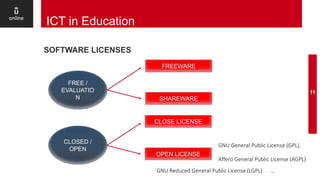
SOFTWARE LICENSES
FREE /
EVALUATIO
N
CLOSED /
OPEN
FREEWARE
SHAREWARE
CLOSE LICENSE
OPEN LICENSE
GNU General Public License (GPL),
GNU Reduced General Public License (LGPL)
Affero General Public License (AGPL)
…
12
ICT in Education
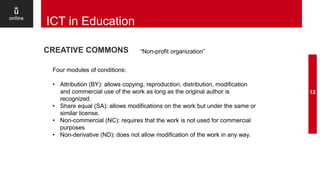
CREATIVE COMMONS “Non-profit organization”
Four modules of conditions:
• Attribution (BY): allows copying, reproduction, distribution, modification
and commercial use of the work as long as the original author is
recognized.
• Share equal (SA): allows modifications on the work but under the same or
similar license.
• Non-commercial (NC): requires that the work is not used for commercial
purposes
• Non-derivative (ND): does not allow modification of the work in any way.
13
ICT in Education
https://creativecommons.org/choose/
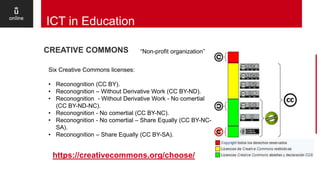
CREATIVE COMMONS “Non-profit organization”
Six Creative Commons licenses:
• Reconognition (CC BY).
• Reconognition – Without Derivative Work (CC BY-ND).
• Reconognition - Without Derivative Work - No comertial
(CC BY-ND-NC).
• Reconognition - No comertial (CC BY-NC).
• Reconognition - No comertial – Share Equally (CC BY-NC-
SA).
• Reconognition – Share Equally (CC BY-SA).
14
ICT in Education
CREATIVE COMMONS
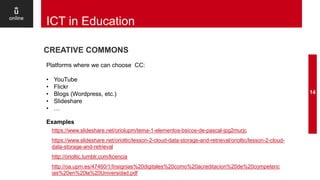
Platforms where we can choose CC:
• YouTube
• Flickr
• Blogs (Wordpress, etc.)
• Slideshare
• …
https://www.slideshare.net/orioltic/lesson-2-cloud-data-storage-and-retrieval/orioltic/lesson-2-cloud-
data-storage-and-retrieval
Examples
http://orioltic.tumblr.com/licencia
http://oa.upm.es/47460/1/Insignias%20digitales%20como%20acreditacion%20de%20competenc
ias%20en%20la%20Universidad.pdf
https://www.slideshare.net/oriolupm/tema-1-elementos-bsicos-de-pascal-ipg2murjc
CLASS EXERCISE
15
ICT in Education
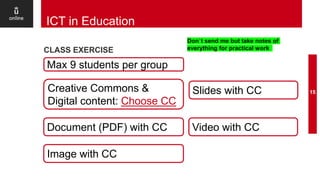
Max 9 students per group
Creative Commons &
Digital content: Choose CC
Don`t send me but take notes of
everything for practical work
Document (PDF) with CC
Image with CC
Slides with CC
Video with CC
FREE IMAGES
16
ICT in Education
PUBLIC DOMAIN
CC
https://unsplash.com
https://www.flickr.com/creativecommons/
https://ccsearch.creativecommons.org
Images from unsplash

Lesson 3: digital content, information evaluation and licensing

  • 1.
    ICT in Education Lesson3: Digital content, information evaluation and licensing Oriol Borrás Gené
  • 2.
    DIGITAL CONTENT 2 ICT inEducation “Any form of data or information in digital form (electronic files) ” TEXT ANALOG VS DIGITAL
  • 3.
    DIGITAL CONTENT 3 ICT inEducation “Any form of data or information in digital form (electronic files) ” PRESENTATIONSANALOG VS DIGITAL
  • 4.
    DIGITAL CONTENT 4 ICT inEducation “Any form of data or information in digital form (electronic files) ” DATA BASE ANALOG VS DIGITAL
  • 5.
    DIGITAL CONTENT 5 ICT inEducation “Any form of data or information in digital form (electronic files) ” AUDIO ANALOG VS DIGITAL
  • 6.
    DIGITAL CONTENT 6 ICT inEducation “Any form of data or information in digital form (electronic files) ” VIDEO, IMAGES, …
  • 7.
  • 8.
    CONTENT CURATION 8 ICT inEducation SEARCH FILTER SHARE
  • 9.
    9 ICT in Education REVIEWYOUR REFERENCES Universities Google Scholar Educational Journals
  • 10.
    INTELLECTUAL PROPERTY ANDCOPYRIGHT 10 ICT in Education INTELLECTUAL PROPERTY “Any property which, by common agreement, is considered to be of an intellectual nature and deserving of protection” AUTHOR’S RIGHTS RULES  The author's rights recognize the creator of the work or content, while the copyright is associated with the rights of use over the work itself.  The authors may assign the copyright to another person, while the copyright belongs only to the creator of the work.  Copyright focuses solely on economic rights. COPYRIGHT © "all rights reserved" COPYLEFT
  • 11.
    11 ICT in Education SOFTWARELICENSES FREE / EVALUATIO N CLOSED / OPEN FREEWARE SHAREWARE CLOSE LICENSE OPEN LICENSE GNU General Public License (GPL), GNU Reduced General Public License (LGPL) Affero General Public License (AGPL) …
  • 12.
    12 ICT in Education CREATIVECOMMONS “Non-profit organization” Four modules of conditions: • Attribution (BY): allows copying, reproduction, distribution, modification and commercial use of the work as long as the original author is recognized. • Share equal (SA): allows modifications on the work but under the same or similar license. • Non-commercial (NC): requires that the work is not used for commercial purposes • Non-derivative (ND): does not allow modification of the work in any way.
  • 13.
    13 ICT in Education https://creativecommons.org/choose/ CREATIVECOMMONS “Non-profit organization” Six Creative Commons licenses: • Reconognition (CC BY). • Reconognition – Without Derivative Work (CC BY-ND). • Reconognition - Without Derivative Work - No comertial (CC BY-ND-NC). • Reconognition - No comertial (CC BY-NC). • Reconognition - No comertial – Share Equally (CC BY-NC- SA). • Reconognition – Share Equally (CC BY-SA).
  • 14.
    14 ICT in Education CREATIVECOMMONS Platforms where we can choose CC: • YouTube • Flickr • Blogs (Wordpress, etc.) • Slideshare • … https://www.slideshare.net/orioltic/lesson-2-cloud-data-storage-and-retrieval/orioltic/lesson-2-cloud- data-storage-and-retrieval Examples http://orioltic.tumblr.com/licencia http://oa.upm.es/47460/1/Insignias%20digitales%20como%20acreditacion%20de%20competenc ias%20en%20la%20Universidad.pdf https://www.slideshare.net/oriolupm/tema-1-elementos-bsicos-de-pascal-ipg2murjc
  • 15.
    CLASS EXERCISE 15 ICT inEducation Max 9 students per group Creative Commons & Digital content: Choose CC Don`t send me but take notes of everything for practical work Document (PDF) with CC Image with CC Slides with CC Video with CC
  • 16.
    FREE IMAGES 16 ICT inEducation PUBLIC DOMAIN CC https://unsplash.com https://unsplash.com https://www.flickr.com/creativecommons/ https://ccsearch.creativecommons.org Images from unsplash

Editor's Notes

  • #11 Los derechos de autor son un conjunto de normas y principios que regulan los derechos de los autores, por el simple hecho de crear una obra, esté publicada o inédita. Esto significa que desde el momento en que un autor crea su obra (construye un texto, dispara una fotografía, etc.) posee una serie de derechos sobre la misma.   Estos derechos incluyen los denominados derechos morales y los derechos patrimoniales. Los primeros son a los que más referencia hace la legislación española e incluyen aspectos como el reconocimiento de la condición de autor de la obra o el reconocimiento del nombre del artista sobre sus interpretaciones o ejecuciones. También, tal y como aparece en la página del Ministerio de Cultura, el derecho de exigir el respeto a la integridad de la obra y a la no alteración de las mismas. Por otro lado, los derechos patrimoniales son aquellos susceptibles de tener un valor económico y suelen estar asociados al concepto anglosajón de Copyright o derecho de copia.  en los últimos años han aparecido intentos por eliminar o reducir las barreras legales que limitan el flujo libre y la reutilización del conocimiento. Conceptos como Copyleft