Maxillofacial, Ophthalmic & Dental Trauma www.hi-dentfinishingschool.blogspot.com
Morbidity & Mortality Mortality Primarily associated with brain and spine injury Severe Facial fractures may interfere with airway and breathing Morbidity Disability concerns Cosmetic concerns
Maxillofacial Trauma Causes MVC, home accidents, athletic injuries, animal bites, violence, industrial accidents Soft tissue lacerations, abrasions, avulsions vascular area supplied by internal and external carotids Management -  Seldom life-threatening unless in the airway consider spinal precautions have suction available and in control of conscious patients control bleeding
Anatomy & Physiology Review Arteries temporal artery mandibular artery maxillary artery Nerves trigeminal (cranial nerve V) facial (cranial nerve VII)
Anatomy & Physiology Review Bones nasal zygoma / zygomatic arch maxilla mandible
Facial Fractures Fx to the mandible, maxilla, nasal bones, zygoma & rarely the frontal bone S/S - pain, swelling, deep lacerations, limited ocular movement, facial asymmetry, crepitus, deviated nasal septum, bleeding, depression on palpation, malocclusion, blurred vision, diplopia, broken or missing teeth
Facial Fractures Mandibular Fx -   numbness, inability to open or close the mouth, excessive salivation, malocclusion Anterior dislocation may be caused by extensive dental work, yawning Condylar heads move forward and muscles spasm
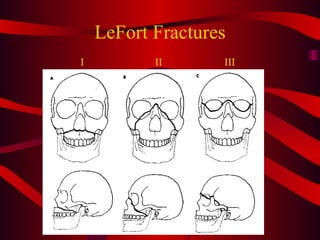
LeFort Fractures Specially named facial fractures Usually requires significant forces especially for LeFort II and III LeFort I - Maxillary fracture with “free-floating” maxilla LeFort II - Maxilla, zygoma, floor of orbit and nose LeFort III - Lower 2/3 of the face
LeFort Fractures I   II   III
Signs and Symptoms Often associated with orbital fractures risk of serious airway compromise (bleeding & edema) contraindication to NG tube or nasotracheal intubation Present with: Edema, Epistaxis, Numb upper teeth Unstable maxilla, CSF rhinorrhea Unusual facial appearance “ donkey face” (lengthening) “ pumpkin face” (edema) nasal flattening
Management Spinal motion restriction Airway is the most difficult and most critical priority Consider Early Intubation Surgical Airway may be the only alternative but NEVER the first consideration Suction & Control Bleeding Critical trauma patient - Transport accordingly
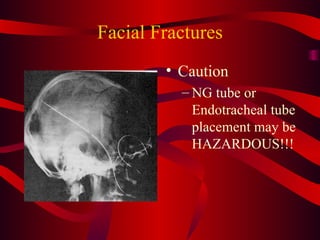
Facial Fractures Caution NG tube or Endotracheal tube placement may be HAZARDOUS!!!
Ear Trauma External injuries lacerations, avulsions, amputations, frostbite Control bleeding with direct pressure Internal injuries Spontaneous rupture of eardrum will usually heal spontaneously penetrating objects should be stabilized, not removed!  Removal may cause deafness or facial paralysis Hearing loss may be result of otic nerve damage in basilar skull fracture
Anatomy & Physiology Review Ear Outer Ear (Pinna) Cartilage little blood supply External Ear canal mucous membrane that secretes wax for protection Middle Ear separated from external canal by ear drum delicate structure needed for hearing
Ear Injuries Separation of ear cartilage treat as an avulsion dress and bandage consider disability and cosmetic concerns Bleeding from ear canal cover with loose dressing only
Barotitis Changes in pressure cause pressure buildup and/or rupture of tympanic membrane Boyle’s Law, at constant temperature, the volume of gas is inversely proportionate to the pressure s/s - pain, blocked feeling in ears, severe pain equalize pressure by yawning, chewing, moving mandible, swallowing (open Eustachian tubes allowing gas to release)
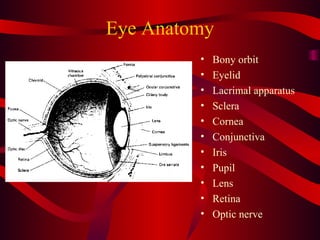
Eye Anatomy Bony orbit Eyelid Lacrimal apparatus Sclera Cornea Conjunctiva Iris Pupil Lens Retina Optic nerve
Eye Injuries Penetrating Abrasions Foreign bodies (deep,  superficial, impaled) Lacerations (deep or superficial, eyelid) Burns flash acid/alkali Blunt Swelling Conjunctival hemorrhage Hyphema Ruptured globe Blow-out fracture of orbit Retinal detachment
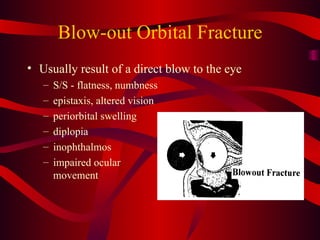
Blow-out Orbital Fracture Usually result of a direct blow to the eye S/S - flatness, numbness epistaxis, altered vision periorbital swelling diplopia inophthalmos impaired ocular movement
Foreign Bodies S/S - sensation of something in eye, excessive tearing, burning Inspect inner surface of upper lid as well as sclera Flush with copious normal saline away from opposite eye
Corneal Abrasion Caused by foreign body objects, eye rubbing, contact lenses S/S - pain, feeling of something in eye, photophobia, tearing, decreased visual acuity irrigate, patch both eyes Usually heals in 24 to 48 hours if not infected or toxic from antibiotics
Other Globe Injuries Contusion, laceration, hyphema, globe or scleral rupture S/S - Loss of visual acuity, blood in anterior chamber, dilation or constriction of pupil, pain, soft eye, pupil irregularity Management Consider C-spine precautions due to forces required for injury No pressure to globe for dressing, cover both eyes Avoid activities that increase intra-ocular pressure
Mouth Injuries Usually result from MVCs Blunt injury to the mouth or chin Penetrating injury due to GSW, lacerations, or punctures
Anatomy & Physiology Review Muscles Tongue Masseter muscles Nerves Hypoglossal Glossopharyngeal Trigeminal Facial Bones Mandible Maxilla Hyoid Palate Teeth
Mouth Injuries Primary concerns Airway compromise secondary to bleeding FBAO secondary to broken or avulsed teeth Impaled object Management ABCs Suction prn Stabilize impaled object Collect tissue: tongue or tooth
Dental Trauma 32 teeth in normal adult Associated with facial fractures May aspirate broken tooth Avulsed teeth can be replaced so find them! Early hospital notification to find dentist < 15 minutes, may be asked to replace the tooth in socket do not rinse or scrub (removes periodontal membrane and ligament) preserve in fresh whole milk Saline OK for less than 1 hour
Nasal Injuries Variety of mechanisms including blunt or penetrating trauma Most common injury Adults - Epistaxis Children - Foreign bodies
Anatomy & Physiology Review Nasal bone between the eyes Nasal cartilage provides shape to nose Internal septum turbinates sinuses
Nasal Injuries Epistaxis anterior bleeding from septum usually venous posterior bleeding often drains to airway may be associated with sphenoid and/or ethmoid fractures basilar skull fracture
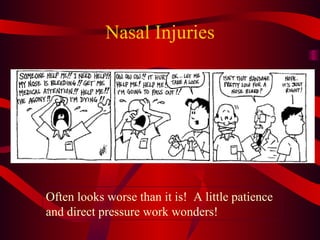
Nasal Injuries Often looks worse than it is!  A little patience and direct pressure work wonders!
Nasal Injuries Foreign Bodies Variety of objects food toys Often can be left alone and removed later
Nasal Injury Management Epistaxis Direct pressure over septum Upright position, leaning forward or in lateral recumbent position If CSF present, do not apply direct pressure allow to drain
Neck Trauma Neck - 3 zones 1 = sternal notch to top of clavicles (highest mortality) 2 = clavicles or cricoid cartilage to angle of the mandible (contains major vasculature and airway) 3 = above angle of mandible (distal carotid, salivary, pharynx)
Neck Trauma Transected Trachea Larynx separated from trachea or fractured vocal cord swelling altered airway landmarks soft tissue edema Vessel lacerated or torn severe bleeding (large vessels) airway compromise risk of air emboli, hypoxia, or ischemia
Neck Trauma Signs & Symptoms pale or cyanotic face obvious external injury frothy blood or sputum from wound SQ air voice change feeling of fullness in throat Signs of stroke with air emboli
Esophageal Injury Especially common in penetrating trauma S/S may include subcutaneous emphysema neck hematoma, blood in the NG tube or posterior nasopharynx high mortality rate from mediastinal infection secondary to gastric reflux through the perforation Consider Semi-fowler’s vs. supine position unless contraindicated by MOI.
Neck Trauma Management ABCs Suction Intubate EARLY!!! May require cricothyrotomy stop bleeding as best as possible Occlude large blood vessel quickly Left lateral position with occlusive dressing to wound Consider spinal motion restriction Stabilize impaled objects Transport to trauma center
Cranial Nerve Hints May not be helpful in unconscious patients, but if they happen to wake up: Cranial nerve I - loss of smell, taste (basilar skull fracture hallmark) Cranial nerve II - blindness, visual defects Cranial nerve III - Ipsilateral, dilated fixed pupil Cranial nerve VII - immediate or delayed facial paralysis (basilar skull or LeFort) Cranial nerve VIII - deafness (basilar skull fx)

Face Eye Trauma

  • 1.
    Maxillofacial, Ophthalmic &Dental Trauma www.hi-dentfinishingschool.blogspot.com
  • 2.
    Morbidity & MortalityMortality Primarily associated with brain and spine injury Severe Facial fractures may interfere with airway and breathing Morbidity Disability concerns Cosmetic concerns
  • 3.
    Maxillofacial Trauma CausesMVC, home accidents, athletic injuries, animal bites, violence, industrial accidents Soft tissue lacerations, abrasions, avulsions vascular area supplied by internal and external carotids Management - Seldom life-threatening unless in the airway consider spinal precautions have suction available and in control of conscious patients control bleeding
  • 4.
    Anatomy & PhysiologyReview Arteries temporal artery mandibular artery maxillary artery Nerves trigeminal (cranial nerve V) facial (cranial nerve VII)
  • 5.
    Anatomy & PhysiologyReview Bones nasal zygoma / zygomatic arch maxilla mandible
  • 6.
    Facial Fractures Fxto the mandible, maxilla, nasal bones, zygoma & rarely the frontal bone S/S - pain, swelling, deep lacerations, limited ocular movement, facial asymmetry, crepitus, deviated nasal septum, bleeding, depression on palpation, malocclusion, blurred vision, diplopia, broken or missing teeth
  • 7.
    Facial Fractures MandibularFx - numbness, inability to open or close the mouth, excessive salivation, malocclusion Anterior dislocation may be caused by extensive dental work, yawning Condylar heads move forward and muscles spasm
  • 8.
    LeFort Fractures Speciallynamed facial fractures Usually requires significant forces especially for LeFort II and III LeFort I - Maxillary fracture with “free-floating” maxilla LeFort II - Maxilla, zygoma, floor of orbit and nose LeFort III - Lower 2/3 of the face
  • 9.
  • 10.
    Signs and SymptomsOften associated with orbital fractures risk of serious airway compromise (bleeding & edema) contraindication to NG tube or nasotracheal intubation Present with: Edema, Epistaxis, Numb upper teeth Unstable maxilla, CSF rhinorrhea Unusual facial appearance “ donkey face” (lengthening) “ pumpkin face” (edema) nasal flattening
  • 11.
    Management Spinal motionrestriction Airway is the most difficult and most critical priority Consider Early Intubation Surgical Airway may be the only alternative but NEVER the first consideration Suction & Control Bleeding Critical trauma patient - Transport accordingly
  • 12.
    Facial Fractures CautionNG tube or Endotracheal tube placement may be HAZARDOUS!!!
  • 13.
    Ear Trauma Externalinjuries lacerations, avulsions, amputations, frostbite Control bleeding with direct pressure Internal injuries Spontaneous rupture of eardrum will usually heal spontaneously penetrating objects should be stabilized, not removed! Removal may cause deafness or facial paralysis Hearing loss may be result of otic nerve damage in basilar skull fracture
  • 14.
    Anatomy & PhysiologyReview Ear Outer Ear (Pinna) Cartilage little blood supply External Ear canal mucous membrane that secretes wax for protection Middle Ear separated from external canal by ear drum delicate structure needed for hearing
  • 15.
    Ear Injuries Separationof ear cartilage treat as an avulsion dress and bandage consider disability and cosmetic concerns Bleeding from ear canal cover with loose dressing only
  • 16.
    Barotitis Changes inpressure cause pressure buildup and/or rupture of tympanic membrane Boyle’s Law, at constant temperature, the volume of gas is inversely proportionate to the pressure s/s - pain, blocked feeling in ears, severe pain equalize pressure by yawning, chewing, moving mandible, swallowing (open Eustachian tubes allowing gas to release)
  • 17.
    Eye Anatomy Bonyorbit Eyelid Lacrimal apparatus Sclera Cornea Conjunctiva Iris Pupil Lens Retina Optic nerve
  • 18.
    Eye Injuries PenetratingAbrasions Foreign bodies (deep, superficial, impaled) Lacerations (deep or superficial, eyelid) Burns flash acid/alkali Blunt Swelling Conjunctival hemorrhage Hyphema Ruptured globe Blow-out fracture of orbit Retinal detachment
  • 19.
    Blow-out Orbital FractureUsually result of a direct blow to the eye S/S - flatness, numbness epistaxis, altered vision periorbital swelling diplopia inophthalmos impaired ocular movement
  • 20.
    Foreign Bodies S/S- sensation of something in eye, excessive tearing, burning Inspect inner surface of upper lid as well as sclera Flush with copious normal saline away from opposite eye
  • 21.
    Corneal Abrasion Causedby foreign body objects, eye rubbing, contact lenses S/S - pain, feeling of something in eye, photophobia, tearing, decreased visual acuity irrigate, patch both eyes Usually heals in 24 to 48 hours if not infected or toxic from antibiotics
  • 22.
    Other Globe InjuriesContusion, laceration, hyphema, globe or scleral rupture S/S - Loss of visual acuity, blood in anterior chamber, dilation or constriction of pupil, pain, soft eye, pupil irregularity Management Consider C-spine precautions due to forces required for injury No pressure to globe for dressing, cover both eyes Avoid activities that increase intra-ocular pressure
  • 23.
    Mouth Injuries Usuallyresult from MVCs Blunt injury to the mouth or chin Penetrating injury due to GSW, lacerations, or punctures
  • 24.
    Anatomy & PhysiologyReview Muscles Tongue Masseter muscles Nerves Hypoglossal Glossopharyngeal Trigeminal Facial Bones Mandible Maxilla Hyoid Palate Teeth
  • 25.
    Mouth Injuries Primaryconcerns Airway compromise secondary to bleeding FBAO secondary to broken or avulsed teeth Impaled object Management ABCs Suction prn Stabilize impaled object Collect tissue: tongue or tooth
  • 26.
    Dental Trauma 32teeth in normal adult Associated with facial fractures May aspirate broken tooth Avulsed teeth can be replaced so find them! Early hospital notification to find dentist < 15 minutes, may be asked to replace the tooth in socket do not rinse or scrub (removes periodontal membrane and ligament) preserve in fresh whole milk Saline OK for less than 1 hour
  • 27.
    Nasal Injuries Varietyof mechanisms including blunt or penetrating trauma Most common injury Adults - Epistaxis Children - Foreign bodies
  • 28.
    Anatomy & PhysiologyReview Nasal bone between the eyes Nasal cartilage provides shape to nose Internal septum turbinates sinuses
  • 29.
    Nasal Injuries Epistaxisanterior bleeding from septum usually venous posterior bleeding often drains to airway may be associated with sphenoid and/or ethmoid fractures basilar skull fracture
  • 30.
    Nasal Injuries Oftenlooks worse than it is! A little patience and direct pressure work wonders!
  • 31.
    Nasal Injuries ForeignBodies Variety of objects food toys Often can be left alone and removed later
  • 32.
    Nasal Injury ManagementEpistaxis Direct pressure over septum Upright position, leaning forward or in lateral recumbent position If CSF present, do not apply direct pressure allow to drain
  • 33.
    Neck Trauma Neck- 3 zones 1 = sternal notch to top of clavicles (highest mortality) 2 = clavicles or cricoid cartilage to angle of the mandible (contains major vasculature and airway) 3 = above angle of mandible (distal carotid, salivary, pharynx)
  • 34.
    Neck Trauma TransectedTrachea Larynx separated from trachea or fractured vocal cord swelling altered airway landmarks soft tissue edema Vessel lacerated or torn severe bleeding (large vessels) airway compromise risk of air emboli, hypoxia, or ischemia
  • 35.
    Neck Trauma Signs& Symptoms pale or cyanotic face obvious external injury frothy blood or sputum from wound SQ air voice change feeling of fullness in throat Signs of stroke with air emboli
  • 36.
    Esophageal Injury Especiallycommon in penetrating trauma S/S may include subcutaneous emphysema neck hematoma, blood in the NG tube or posterior nasopharynx high mortality rate from mediastinal infection secondary to gastric reflux through the perforation Consider Semi-fowler’s vs. supine position unless contraindicated by MOI.
  • 37.
    Neck Trauma ManagementABCs Suction Intubate EARLY!!! May require cricothyrotomy stop bleeding as best as possible Occlude large blood vessel quickly Left lateral position with occlusive dressing to wound Consider spinal motion restriction Stabilize impaled objects Transport to trauma center
  • 38.
    Cranial Nerve HintsMay not be helpful in unconscious patients, but if they happen to wake up: Cranial nerve I - loss of smell, taste (basilar skull fracture hallmark) Cranial nerve II - blindness, visual defects Cranial nerve III - Ipsilateral, dilated fixed pupil Cranial nerve VII - immediate or delayed facial paralysis (basilar skull or LeFort) Cranial nerve VIII - deafness (basilar skull fx)