ATC-air traffic control
Presented by
Anwer m. ali
4/25/2021
ATC
1
Contents
 Defining ATC
 Extended Services
 History
 Operations linked with ATC
 Radar Coverage
 Problems
 Call signs
4/25/2021
ATC
2
What is Air Traffic Control..?
 Air traffic control (ATC) is a service provided by ground based Controllers who
direct the Aircraft on the ground and through controlled Air Space and can provide
advisory Services to aircraft in non-controlled Air Space.
 To prevent collisions ATC enforces Traffic Separation Rules, which Ensure each
aircraft Maintains a Minimum amount of Empty space around it all times.
4/25/2021
ATC
3
Extended Services
 In many Countries, ATC provides services to all private , military and commercial
aircraft operating within it’s Air space.
 Many Aircrafts also have Collision avoidance systems , which provide additional
safety by warning pilots when other aircrafts gets close.
 The Pilot in Command is the final Authority for the Safe operation of Aircraft and
in an emergency he may Deviate from ATC instructions to maintain Safe
operation of Aircraft.
4/25/2021
ATC
4
History
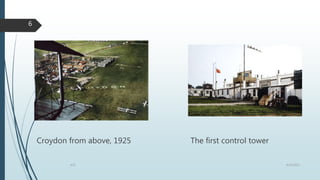
 In 1921, Croydon Airport, London was the first airport in the world to introduce Air
Traffic Control.
 The first ATC tower regulating all activities of aircraft at a specific airport , opened
in Cleveland in 1930
 Approach/departure control facilities were created after adoption of RADAR in the
1950s to monitor and control the busy airspace around larger airports.
4/25/2021
ATC
5
Croydon from above, 1925 The first control tower
4/25/2021
ATC
6
Operations Linked with ATC
 Airport Control
 Ground Control
 Local Control / Air Control
 Approach and Terminal Control
4/25/2021
ATC
7
Airport Control
 Air Traffic Controllers are responsible for the separation and efficient movement
of aircraft , and also vehicles operating on the taxiways and runways of the
airport itself, and aircraft in the air near the airport, generally 5 to10 nautical miles
(9 to 18 km) depending on the airport procedures.
 Controllers may use a radar system called Secondary surveillance RADAR for
airborne traffic approaching and departing.
4/25/2021
ATC
8
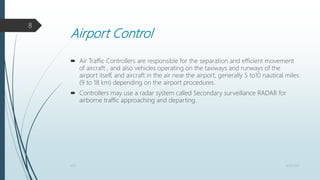
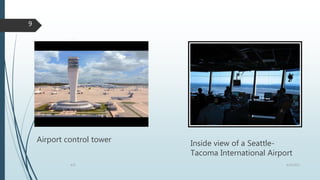
Airport control tower Inside view of a Seattle-
Tacoma International Airport
4/25/2021
ATC
9
4/25/2021
ATC
10
Runway taxiway apron
Ground Control
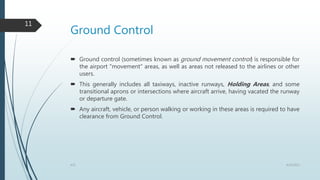
 Ground control (sometimes known as ground movement control) is responsible for
the airport "movement" areas, as well as areas not released to the airlines or other
users.
 This generally includes all taxiways, inactive runways, Holding Areas, and some
transitional aprons or intersections where aircraft arrive, having vacated the runway
or departure gate.
 Any aircraft, vehicle, or person walking or working in these areas is required to have
clearance from Ground Control.
4/25/2021
ATC
11
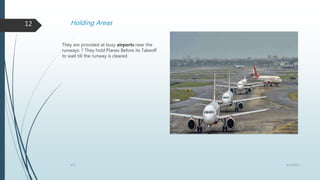
Holding Areas
They are provided at busy airports near the
runways. ? They hold Planes Before its Takeoff
to wait till the runway is cleared.
4/25/2021
ATC
12
Local control / Air control..
 If local control detects any unsafe condition, a landing aircraft may be told to “Go-
Around" and be re-sequenced into the landing pattern by the approach or terminal
area controller.
 Ground control must request and gain approval from local control to cross any
active runway with any aircraft or vehicle.
4/25/2021
ATC
13
Approach & Terminal Control
 Many airports have a radar control facility that is associated with the airport. In
most countries, this is referred to as Terminal Control. In the U.S., it is referred to
as a TRACON (Terminal Radar Approach Control). While every airport varies,
terminal controllers usually handle traffic in a 30-50 nautical mile (56-93 km) radius
from the airport.
 Terminal controllers are responsible for providing all ATC services within their
airspace
 Traffic flow is broadly divided into departures, arrivals, and Over –flights
 Terminal control is responsible for ensuring that aircraft are at an appropriate
altitude when they are handed off, and that aircraft arrive at a suitable rate for
landing.
4/25/2021
ATC
14
RADAR coverage
 Long Range Radars are used and are Capable Enough at higher altitudes, to see
aircraft within 200 nautical miles (370 km) of the radar antenna.
 A Radar Archive System (RAS) keeps an electronic record of all radar information,
preserving it for a few weeks.
 When an aircraft has 'disappeared' from radar screens, a controller can review the
last radar returns from the aircraft to determine its likely position.
4/25/2021
ATC
15
Problems Faced by ATC
 Two Major Problems :
1. Traffic
2. Weather
4/25/2021
ATC
16
Aircraft Traffic & Weather
Traffic at Airport
 Arrivals of Flights
 Departures
 Hopping Aircrafts
 Layovers
 Availability of Aero Bridges
 Vacant Runways
Weather Conditions
 Heavy Rains
 Low visibility of Runway and aircraft
 Thunderstorms
 Turbulence
 Crosswinds at Airport
 Heavy Snow Fall
4/25/2021
ATC
17
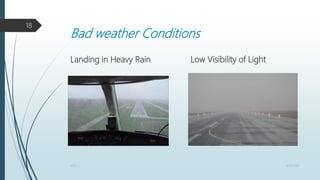
Bad weather Conditions
Landing in Heavy Rain Low Visibility of Light
4/25/2021
ATC
18
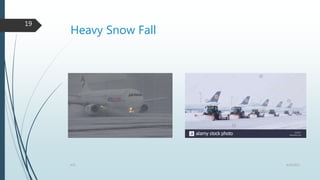
Heavy Snow Fall
4/25/2021
ATC
19
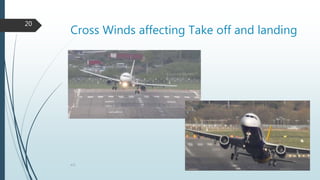
Cross Winds affecting Take off and landing
4/25/2021
ATC
20
Call Signs
 In order to ensure safe Air Traffic separation Call signs are Used by Air Traffic
Controllers
 These are permanently allocated by ICAO (International Civil Aviation
Organization) on request usually to Scheduled Flights and some air forces for
Military Flights.
4/25/2021
ATC
21
4/25/2021
ATC
22

Atc air traffic control

  • 1.
    ATC-air traffic control Presentedby Anwer m. ali 4/25/2021 ATC 1
  • 2.
    Contents  Defining ATC Extended Services  History  Operations linked with ATC  Radar Coverage  Problems  Call signs 4/25/2021 ATC 2
  • 3.
    What is AirTraffic Control..?  Air traffic control (ATC) is a service provided by ground based Controllers who direct the Aircraft on the ground and through controlled Air Space and can provide advisory Services to aircraft in non-controlled Air Space.  To prevent collisions ATC enforces Traffic Separation Rules, which Ensure each aircraft Maintains a Minimum amount of Empty space around it all times. 4/25/2021 ATC 3
  • 4.
    Extended Services  Inmany Countries, ATC provides services to all private , military and commercial aircraft operating within it’s Air space.  Many Aircrafts also have Collision avoidance systems , which provide additional safety by warning pilots when other aircrafts gets close.  The Pilot in Command is the final Authority for the Safe operation of Aircraft and in an emergency he may Deviate from ATC instructions to maintain Safe operation of Aircraft. 4/25/2021 ATC 4
  • 5.
    History  In 1921,Croydon Airport, London was the first airport in the world to introduce Air Traffic Control.  The first ATC tower regulating all activities of aircraft at a specific airport , opened in Cleveland in 1930  Approach/departure control facilities were created after adoption of RADAR in the 1950s to monitor and control the busy airspace around larger airports. 4/25/2021 ATC 5
  • 6.
    Croydon from above,1925 The first control tower 4/25/2021 ATC 6
  • 7.
    Operations Linked withATC  Airport Control  Ground Control  Local Control / Air Control  Approach and Terminal Control 4/25/2021 ATC 7
  • 8.
    Airport Control  AirTraffic Controllers are responsible for the separation and efficient movement of aircraft , and also vehicles operating on the taxiways and runways of the airport itself, and aircraft in the air near the airport, generally 5 to10 nautical miles (9 to 18 km) depending on the airport procedures.  Controllers may use a radar system called Secondary surveillance RADAR for airborne traffic approaching and departing. 4/25/2021 ATC 8
  • 9.
    Airport control towerInside view of a Seattle- Tacoma International Airport 4/25/2021 ATC 9
  • 10.
  • 11.
    Ground Control  Groundcontrol (sometimes known as ground movement control) is responsible for the airport "movement" areas, as well as areas not released to the airlines or other users.  This generally includes all taxiways, inactive runways, Holding Areas, and some transitional aprons or intersections where aircraft arrive, having vacated the runway or departure gate.  Any aircraft, vehicle, or person walking or working in these areas is required to have clearance from Ground Control. 4/25/2021 ATC 11
  • 12.
    Holding Areas They areprovided at busy airports near the runways. ? They hold Planes Before its Takeoff to wait till the runway is cleared. 4/25/2021 ATC 12
  • 13.
    Local control /Air control..  If local control detects any unsafe condition, a landing aircraft may be told to “Go- Around" and be re-sequenced into the landing pattern by the approach or terminal area controller.  Ground control must request and gain approval from local control to cross any active runway with any aircraft or vehicle. 4/25/2021 ATC 13
  • 14.
    Approach & TerminalControl  Many airports have a radar control facility that is associated with the airport. In most countries, this is referred to as Terminal Control. In the U.S., it is referred to as a TRACON (Terminal Radar Approach Control). While every airport varies, terminal controllers usually handle traffic in a 30-50 nautical mile (56-93 km) radius from the airport.  Terminal controllers are responsible for providing all ATC services within their airspace  Traffic flow is broadly divided into departures, arrivals, and Over –flights  Terminal control is responsible for ensuring that aircraft are at an appropriate altitude when they are handed off, and that aircraft arrive at a suitable rate for landing. 4/25/2021 ATC 14
  • 15.
    RADAR coverage  LongRange Radars are used and are Capable Enough at higher altitudes, to see aircraft within 200 nautical miles (370 km) of the radar antenna.  A Radar Archive System (RAS) keeps an electronic record of all radar information, preserving it for a few weeks.  When an aircraft has 'disappeared' from radar screens, a controller can review the last radar returns from the aircraft to determine its likely position. 4/25/2021 ATC 15
  • 16.
    Problems Faced byATC  Two Major Problems : 1. Traffic 2. Weather 4/25/2021 ATC 16
  • 17.
    Aircraft Traffic &Weather Traffic at Airport  Arrivals of Flights  Departures  Hopping Aircrafts  Layovers  Availability of Aero Bridges  Vacant Runways Weather Conditions  Heavy Rains  Low visibility of Runway and aircraft  Thunderstorms  Turbulence  Crosswinds at Airport  Heavy Snow Fall 4/25/2021 ATC 17
  • 18.
    Bad weather Conditions Landingin Heavy Rain Low Visibility of Light 4/25/2021 ATC 18
  • 19.
  • 20.
    Cross Winds affectingTake off and landing 4/25/2021 ATC 20
  • 21.
    Call Signs  Inorder to ensure safe Air Traffic separation Call signs are Used by Air Traffic Controllers  These are permanently allocated by ICAO (International Civil Aviation Organization) on request usually to Scheduled Flights and some air forces for Military Flights. 4/25/2021 ATC 21
  • 22.