IOSR Journal of Electrical and Electronics Engineering (IOSR-JEEE)
e-ISSN: 2278-1676,p-ISSN: 2320-3331, Volume 11, Issue 2 Ver. III (Mar. – Apr. 2016), PP 35-40
www.iosrjournals.org
DOI: 10.9790/1676-1102033540 www.iosrjournals.org 35 | Page
Designing and Modelling of Solar Photovoltaic Cell and Array
Ravi Prakash1
, Sandeep Singh2
1
(Faculty of Technology/Uttarakhand Technical University, Dehradun, India)
2
(Faculty of Technology/Uttarakhand Technical University, Dehradun, India)
Abstract: This paper presents the simulation model of PV-cell in MATLAB/Simulink; further performance of
PV module/array is analyzed by simulation results. Equivalent circuit of solar cell and mathematical model for
solar cell and array are examined in this paper. Further V-I and P-V output characteristic of solar PV-cell are
representing a maximum power point (MPP) for further analysis. Output effects by weather condition,
irradiance and temperature are analyzed completely in this paper.
Keywords: PV Cell, MPP, Equivalent circuit, modeling.
I. INTRODUCTION
The use of renewable energy resources like solar energy and wind energy is increasing rapidly for
electricity generation purpose. Solar energy can be converted in to electricity by using photovoltaic cell. A PV
cell can convert photon energy in to the form of electrical signals, this method of power generation do not harm
to ecosystem hence PV power generation systems are becoming popular for generation in small scale as well as
in large scale production [1]. PV micro-power plant installation and maintenance is easy and its power can be
feed to local substations. Hence small scale power plant business is becoming increasingly popular. This paper
is presenting a mathematical model of solar array and accomplishes a simulation model in MATLAB/Simulink.
Output V-I and P-V characteristic and performance at different irradiance and temperature are analyzed. Thus,
this research work is helpful to understand the behavior of the solar cell and array [2][3].
II. MODELLING OF SOLAR CELL AND ARRAY
Modeling of solar cell can be expressed by many ways in software packages like MATLAB & P-
SPICE etc. and there are many methods to represent a model as like Mathematical block modeling, Embedded
MATLAB Programming and Physical block modeling. Here physical block of solar cells are used for the
modeling of PV module. The behavior and characteristic of solar cell can be well understood by the
mathematical expression or formulas [3] [4].
MATHEMATICAL MODEL OF SPV CELL
Figure 1: Equivalent circuit solar cell
The practical model of single solar cell is shown in figure 1. In this circuit Rs represents series
resistance of PN junction cell and Rsh represents shunt resistance which is inversely in relation with leakage
current to the ground. Series resistor has great impact on the I-V characteristic of solar cell. Id and Ish are diode
current and shunt leakage current where output terminal current I is evaluate by applying KCL in equivalent
circuit of solar cell [3][5]:
I = Iph – (Id + Ish)
This equation is simplified by taking sum of saturation current and shunt leakage current as Io and hence
simplified equation is [3]:
I = Iph – Io
Photon current is generated on absorption of solar radiation by solar cell hence photocurrent value is directly
related to variation in solar irradiance and temperature and that is [3]:
Designing And Modelling Of Solar Photovoltaic Cell And Array
DOI: 10.9790/1676-1102033540 www.iosrjournals.org 36 | Page
Iph = Iscr + ki ∆T
G
Gr
Where in this equation Iscr is rated solar current at nominal weather conditions (250
C and 1000w/m2
), ki is short
circuit temperature coefficient. G is solar irradiance in W/m2
and Gr is nominal irradiance in normal weather
conditions (250
C and 1000w/m2
). ∆T is difference of operating temperature and nominal temperature (T – Tref).
On the other hand, solar cell reverse saturation current will be calculated by[7]:
Io = Irs
𝑇
𝑇 𝑟𝑒𝑓
3
exp
q Ego
A K
∆T
Tref T
Where Irs is reverse saturation current of cell for nominal temperature and irradiance values and Ego is band-gap
energy of semiconductor material. The values of Iph and Io will expand the value of I and it will be as follows
[5][6]:
Ipv = Iph − Io exp
q Vpv + Ipv Rs
AKT
− 1 –
Vpv + Ipv Rs
Rp
MATHEMATICAL MODEL OF SOLAR MODULE AND ARRAY
Since a typical PV cell produces less than 3.5 W at 0.6V approximately, then high power can achieve
by connecting many solar cells in series-parallel configuration. This configuration can be setup by connecting
PV module in series and parallel connections and this group of several PV modules assembled in a PV tray is
called as Solar array. Configuration of PV arrays depends on required rated voltage and current of a power
plant. If Ns cells are connected in series and Np cells are connected in parallel then equation of Ipv can be
expressed as[7][8][9]:
Ipv = Np Iph – Np Io exp q
Vpv + Ipv Rs
Ns A K T
– 1 −
Np Vpv + Ipv Rs Ns
Rp Ns
Efficiency of PV module is highly sensitive to the small changes in series resistance (Rs) and poorly sensitive to
the variation in parallel resistance (Rp). Therefore shunt resistance is assumed to be open and we can obtain a
revised equation of Ipv by putting the value of shunt resistance is infinity (Rsh =∞)[9]:
Ipv = Np Iph – Io exp q
Vpv + Ipv Rs
Ns A K T
– 1
We know that series resistance is very small (around 0.005 to 0.01) then for an ideal solar cell there is no series
resistance (no series losses) and no leakage to ground (no shunt resistance) therefore Rs and Rsh are neglected by
putting Rs= 0 and Rsh = ∞. The expression for ideal cell is simplified for I-V characteristic of solar cell and
expression of ideal single cell is as follows:
Ipv = Iph – Io exp
qVpv
N K T
– 1
III. SIMULATION MODEL OF PV SYSTEM
Simulation of PV cell has performed in MATLAB Simulink and MATLAB M-file software system.
Parameters of physical solar blocks are defined by short circuit current and open circuit voltage preset values.
The parameters and their input values are mentioned in the table given below:
Table 1: Parameter Specification of solar cell:
Parameters Value
Short circuit current(Isc) 7.34 A
Open circuit voltage(Voc) 0.6 V
Irradiance (G) 1000 W/m2
Quality factor (N) 1.5
Series resistance (Rs) 0 Ω
.
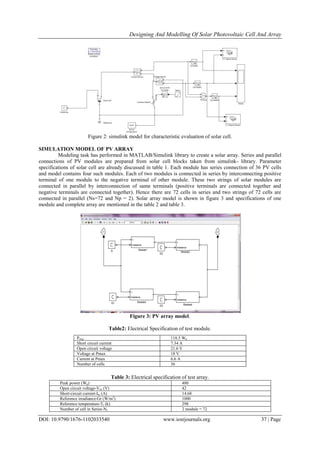
V-I characteristic and PV characteristic of solar cell at nominal temperature and irradiance are evaluated by
using simulink model shown in fig 2. Varying resistive load is connected at the output and output power is
depends on the parameter value of load. If resistive load is very small then I-V curve is in saturation
region(almost equivalent to short circuit current) and when varying resistive load is large then output voltage is
at maximum value(almost open circuit voltage). The output waveform of current, voltage and power with
respect to time are evaluated by using this simulink model in the figure 2. This represents non-linear behavior of
solar cell and results are mentioned later in this paper.
Designing And Modelling Of Solar Photovoltaic Cell And Array
DOI: 10.9790/1676-1102033540 www.iosrjournals.org 37 | Page
Figure 2: simulink model for characteristic evaluation of solar cell.
SIMULATION MODEL OF PV ARRAY
Modeling task has performed in MATLAB/Simulink library to create a solar array. Series and parallel
connections of PV modules are prepared from solar cell blocks taken from simulink- library. Parameter
specifications of solar cell are already discussed in table 1. Each module has series connection of 36 PV cells
and model contains four such modules. Each of two modules is connected in series by interconnecting positive
terminal of one module to the negative terminal of other module. These two strings of solar modules are
connected in parallel by interconnection of same terminals (positive terminals are connected together and
negative terminals are connected together). Hence there are 72 cells in series and two strings of 72 cells are
connected in parallel (Ns=72 and Np = 2). Solar array model is shown in figure 3 and specifications of one
module and complete array are mentioned in the table 2 and table 3.
Figure 3: PV array model.
Table2: Electrical Specification of test module.
Table 3: Electrical specification of test array.
Peak power (Wp) 480
Open circuit voltage-Voc (V) 42
Short-circuit current-Isc (A) 14.68
Reference irradiance-Gr (W/m2
) 1000
Reference temperature-Tr (k) 298
Number of cell in Series-Ns 2 module = 72
Pmax 118.5 Wp
Short circuit current 7.34 A
Open circuit voltage 21.6 V
Voltage at Pmax 18 V
Current at Pmax 6.6 A
Number of cells 36
Designing And Modelling Of Solar Photovoltaic Cell And Array
DOI: 10.9790/1676-1102033540 www.iosrjournals.org 38 | Page
Number of cell in Parallel-Np 2 string = 2
Series resistance (Ω) 0.17
Ideality factor-n 1.35
Band-gap Energy-Vg (eV) 1.11-1.12
IV. RESULTS AND DISCUSSION
The behavior of this proposed model has been evaluated by mathematical equation and implemented in
matlab environment. The P-V and V-I characteristics are describing character of PV cell. Open circuit voltage,
short circuit current and maximum power point defines to remarkable point [10][11] for getting the maximum
power point at any input irradiance to solar cell.
Figure 4 : I-V characteristic of solar cell.
Figure 5: P-V characteristic of solar cell.
The output waveform of current, voltage and power with respect to time for a single solar cell are
resulted by using simulink model represented in figure 2. This represents non-linear behavior of solar cell as
shown in figure 6. Value of maximum current is 7.36 Ampere is decaying exponentially, maximum value of
voltage is 0.6 volt and maximum power output is 3.5 WP. This signal waveform is received by using a variable
type resistive load with ramp input.
Figure 6: Current, Voltage and Power waveform of solar cell.
Designing And Modelling Of Solar Photovoltaic Cell And Array
DOI: 10.9790/1676-1102033540 www.iosrjournals.org 39 | Page
Simulation result for array is mentioned below and it verifies to the specifications mentioned above in the table
2 and 3.
Figure 7: Electrical characteristic of solar array.
Output power is affected by weather parameter variations that are temperature and shading. If solar
temperature increases above nominal value then voltage losses is from 0.022 to 0.056 volts per degree. Partial
shading on modules is causes of heating up the solar cells. Although thin film modules are not much affected by
temperature and shading than mono-crystalline and poly-crystalline solar module. P-V and V-I waveform for
different irradiance and temperature are described below [12]:
Figure 8: MATLAB Model I-V characteristic for constant temperature and varying irradiance.
Figure 9: MATLAB Model I-V characteristic for constant irradiance and varying temperature and for
varying temperature and irradiance.
Designing And Modelling Of Solar Photovoltaic Cell And Array
DOI: 10.9790/1676-1102033540 www.iosrjournals.org 40 | Page
V. CONCLUSION
The generalized model of PV cell and module has been presented in MATLAB/Simulink and results
are validated within this paper. Results are executing that this test module has achieve the performance level
with commercial models. Different irradiance and temperature explains about their affect clearly. Hence this
model and research work is expected to characterize and exhibit the behavior of solar cell completely.
REFERENCES
[1]. Sayran A. Abdulgafar, “Improving The Efficiency Of Polycrystalline Solar Panel Via Water Immersion Method”, IJIRSET, Vol. 3,
issue 1, January 2014.
[2]. M. Ganga Prasanna, “Financial Analysis of Solar Photovoltaic Power plant in India”, IOSR-JEF, e-ISSN: 2321-5933, p-ISSN:
2321-5925.
[3]. Farhan A. Salem, “Modeling and Simulation issues on Photovoltaic systems, for Mechatronics design of solar electric applications”,
Volume 2, Issue 8, August 2014.
[4]. Dr. Jayashri Vajpai, “Mathematical Modeling and Experimental validation of performance characteristic of solar photovoltaic
modules”, IJAIEM, Volume 2, Issue 11, November 2013.
[5]. Shivananda Pukhrem, “A photovoltaic panel model in MATLAB/Simulink”, ResearchGate.net/publication/255721161.
[6]. Ami Shukla, “Modeling and simulation of solar PV Module on MATLAB/ Simulink”, IJIRSET, Vol.4, Issue 1, January 2015.
[7]. Tarak Salmi, “MATLAB/Simulink based modeling of solar photovoltaic cell”, International Journal of Renewable Energy
Research, Vol.2, No.2, 2012.
[8]. Rasool Feiz Kerendian, “ Evaluation and simulation of solar cell by using MATLAB”, IJMEC, Vol. 4 (10), Jan, 2014, pp, 138-145,
ISSN: 2305-0543.
[9]. O.Wasynczuk, “Modeling and dynamic performance of a line commutated photovoltaic inverter system”, IEEE Transactions on
Energy Conversion, Vol. 4, No. 3, 1989, pp. 337-343.
[10]. Andrew Knight,(2000), “Basics of MATLAB and Beyond”, CRC Press LLC, 2000.
[11]. The Mathworks, (2004), “MATLAB The Language of Technical and computing”, Programmin, Version 7, June 2004.
[12]. Francisco M. Gonzalez-Longatt, “Model of Photovoltaic Module in MatlabTM
”, 2DO CONGRESO IBEROAMERICANO AND DE
ESTUDIANTES DE INGENIERIA ELECTRICA, ELECTRONICA Y COMPUTACION (II CIBELEC 2005).

F1102033540

  • 1.
    IOSR Journal ofElectrical and Electronics Engineering (IOSR-JEEE) e-ISSN: 2278-1676,p-ISSN: 2320-3331, Volume 11, Issue 2 Ver. III (Mar. – Apr. 2016), PP 35-40 www.iosrjournals.org DOI: 10.9790/1676-1102033540 www.iosrjournals.org 35 | Page Designing and Modelling of Solar Photovoltaic Cell and Array Ravi Prakash1 , Sandeep Singh2 1 (Faculty of Technology/Uttarakhand Technical University, Dehradun, India) 2 (Faculty of Technology/Uttarakhand Technical University, Dehradun, India) Abstract: This paper presents the simulation model of PV-cell in MATLAB/Simulink; further performance of PV module/array is analyzed by simulation results. Equivalent circuit of solar cell and mathematical model for solar cell and array are examined in this paper. Further V-I and P-V output characteristic of solar PV-cell are representing a maximum power point (MPP) for further analysis. Output effects by weather condition, irradiance and temperature are analyzed completely in this paper. Keywords: PV Cell, MPP, Equivalent circuit, modeling. I. INTRODUCTION The use of renewable energy resources like solar energy and wind energy is increasing rapidly for electricity generation purpose. Solar energy can be converted in to electricity by using photovoltaic cell. A PV cell can convert photon energy in to the form of electrical signals, this method of power generation do not harm to ecosystem hence PV power generation systems are becoming popular for generation in small scale as well as in large scale production [1]. PV micro-power plant installation and maintenance is easy and its power can be feed to local substations. Hence small scale power plant business is becoming increasingly popular. This paper is presenting a mathematical model of solar array and accomplishes a simulation model in MATLAB/Simulink. Output V-I and P-V characteristic and performance at different irradiance and temperature are analyzed. Thus, this research work is helpful to understand the behavior of the solar cell and array [2][3]. II. MODELLING OF SOLAR CELL AND ARRAY Modeling of solar cell can be expressed by many ways in software packages like MATLAB & P- SPICE etc. and there are many methods to represent a model as like Mathematical block modeling, Embedded MATLAB Programming and Physical block modeling. Here physical block of solar cells are used for the modeling of PV module. The behavior and characteristic of solar cell can be well understood by the mathematical expression or formulas [3] [4]. MATHEMATICAL MODEL OF SPV CELL Figure 1: Equivalent circuit solar cell The practical model of single solar cell is shown in figure 1. In this circuit Rs represents series resistance of PN junction cell and Rsh represents shunt resistance which is inversely in relation with leakage current to the ground. Series resistor has great impact on the I-V characteristic of solar cell. Id and Ish are diode current and shunt leakage current where output terminal current I is evaluate by applying KCL in equivalent circuit of solar cell [3][5]: I = Iph – (Id + Ish) This equation is simplified by taking sum of saturation current and shunt leakage current as Io and hence simplified equation is [3]: I = Iph – Io Photon current is generated on absorption of solar radiation by solar cell hence photocurrent value is directly related to variation in solar irradiance and temperature and that is [3]:
  • 2.
    Designing And ModellingOf Solar Photovoltaic Cell And Array DOI: 10.9790/1676-1102033540 www.iosrjournals.org 36 | Page Iph = Iscr + ki ∆T G Gr Where in this equation Iscr is rated solar current at nominal weather conditions (250 C and 1000w/m2 ), ki is short circuit temperature coefficient. G is solar irradiance in W/m2 and Gr is nominal irradiance in normal weather conditions (250 C and 1000w/m2 ). ∆T is difference of operating temperature and nominal temperature (T – Tref). On the other hand, solar cell reverse saturation current will be calculated by[7]: Io = Irs 𝑇 𝑇 𝑟𝑒𝑓 3 exp q Ego A K ∆T Tref T Where Irs is reverse saturation current of cell for nominal temperature and irradiance values and Ego is band-gap energy of semiconductor material. The values of Iph and Io will expand the value of I and it will be as follows [5][6]: Ipv = Iph − Io exp q Vpv + Ipv Rs AKT − 1 – Vpv + Ipv Rs Rp MATHEMATICAL MODEL OF SOLAR MODULE AND ARRAY Since a typical PV cell produces less than 3.5 W at 0.6V approximately, then high power can achieve by connecting many solar cells in series-parallel configuration. This configuration can be setup by connecting PV module in series and parallel connections and this group of several PV modules assembled in a PV tray is called as Solar array. Configuration of PV arrays depends on required rated voltage and current of a power plant. If Ns cells are connected in series and Np cells are connected in parallel then equation of Ipv can be expressed as[7][8][9]: Ipv = Np Iph – Np Io exp q Vpv + Ipv Rs Ns A K T – 1 − Np Vpv + Ipv Rs Ns Rp Ns Efficiency of PV module is highly sensitive to the small changes in series resistance (Rs) and poorly sensitive to the variation in parallel resistance (Rp). Therefore shunt resistance is assumed to be open and we can obtain a revised equation of Ipv by putting the value of shunt resistance is infinity (Rsh =∞)[9]: Ipv = Np Iph – Io exp q Vpv + Ipv Rs Ns A K T – 1 We know that series resistance is very small (around 0.005 to 0.01) then for an ideal solar cell there is no series resistance (no series losses) and no leakage to ground (no shunt resistance) therefore Rs and Rsh are neglected by putting Rs= 0 and Rsh = ∞. The expression for ideal cell is simplified for I-V characteristic of solar cell and expression of ideal single cell is as follows: Ipv = Iph – Io exp qVpv N K T – 1 III. SIMULATION MODEL OF PV SYSTEM Simulation of PV cell has performed in MATLAB Simulink and MATLAB M-file software system. Parameters of physical solar blocks are defined by short circuit current and open circuit voltage preset values. The parameters and their input values are mentioned in the table given below: Table 1: Parameter Specification of solar cell: Parameters Value Short circuit current(Isc) 7.34 A Open circuit voltage(Voc) 0.6 V Irradiance (G) 1000 W/m2 Quality factor (N) 1.5 Series resistance (Rs) 0 Ω . V-I characteristic and PV characteristic of solar cell at nominal temperature and irradiance are evaluated by using simulink model shown in fig 2. Varying resistive load is connected at the output and output power is depends on the parameter value of load. If resistive load is very small then I-V curve is in saturation region(almost equivalent to short circuit current) and when varying resistive load is large then output voltage is at maximum value(almost open circuit voltage). The output waveform of current, voltage and power with respect to time are evaluated by using this simulink model in the figure 2. This represents non-linear behavior of solar cell and results are mentioned later in this paper.
  • 3.
    Designing And ModellingOf Solar Photovoltaic Cell And Array DOI: 10.9790/1676-1102033540 www.iosrjournals.org 37 | Page Figure 2: simulink model for characteristic evaluation of solar cell. SIMULATION MODEL OF PV ARRAY Modeling task has performed in MATLAB/Simulink library to create a solar array. Series and parallel connections of PV modules are prepared from solar cell blocks taken from simulink- library. Parameter specifications of solar cell are already discussed in table 1. Each module has series connection of 36 PV cells and model contains four such modules. Each of two modules is connected in series by interconnecting positive terminal of one module to the negative terminal of other module. These two strings of solar modules are connected in parallel by interconnection of same terminals (positive terminals are connected together and negative terminals are connected together). Hence there are 72 cells in series and two strings of 72 cells are connected in parallel (Ns=72 and Np = 2). Solar array model is shown in figure 3 and specifications of one module and complete array are mentioned in the table 2 and table 3. Figure 3: PV array model. Table2: Electrical Specification of test module. Table 3: Electrical specification of test array. Peak power (Wp) 480 Open circuit voltage-Voc (V) 42 Short-circuit current-Isc (A) 14.68 Reference irradiance-Gr (W/m2 ) 1000 Reference temperature-Tr (k) 298 Number of cell in Series-Ns 2 module = 72 Pmax 118.5 Wp Short circuit current 7.34 A Open circuit voltage 21.6 V Voltage at Pmax 18 V Current at Pmax 6.6 A Number of cells 36
  • 4.
    Designing And ModellingOf Solar Photovoltaic Cell And Array DOI: 10.9790/1676-1102033540 www.iosrjournals.org 38 | Page Number of cell in Parallel-Np 2 string = 2 Series resistance (Ω) 0.17 Ideality factor-n 1.35 Band-gap Energy-Vg (eV) 1.11-1.12 IV. RESULTS AND DISCUSSION The behavior of this proposed model has been evaluated by mathematical equation and implemented in matlab environment. The P-V and V-I characteristics are describing character of PV cell. Open circuit voltage, short circuit current and maximum power point defines to remarkable point [10][11] for getting the maximum power point at any input irradiance to solar cell. Figure 4 : I-V characteristic of solar cell. Figure 5: P-V characteristic of solar cell. The output waveform of current, voltage and power with respect to time for a single solar cell are resulted by using simulink model represented in figure 2. This represents non-linear behavior of solar cell as shown in figure 6. Value of maximum current is 7.36 Ampere is decaying exponentially, maximum value of voltage is 0.6 volt and maximum power output is 3.5 WP. This signal waveform is received by using a variable type resistive load with ramp input. Figure 6: Current, Voltage and Power waveform of solar cell.
  • 5.
    Designing And ModellingOf Solar Photovoltaic Cell And Array DOI: 10.9790/1676-1102033540 www.iosrjournals.org 39 | Page Simulation result for array is mentioned below and it verifies to the specifications mentioned above in the table 2 and 3. Figure 7: Electrical characteristic of solar array. Output power is affected by weather parameter variations that are temperature and shading. If solar temperature increases above nominal value then voltage losses is from 0.022 to 0.056 volts per degree. Partial shading on modules is causes of heating up the solar cells. Although thin film modules are not much affected by temperature and shading than mono-crystalline and poly-crystalline solar module. P-V and V-I waveform for different irradiance and temperature are described below [12]: Figure 8: MATLAB Model I-V characteristic for constant temperature and varying irradiance. Figure 9: MATLAB Model I-V characteristic for constant irradiance and varying temperature and for varying temperature and irradiance.
  • 6.
    Designing And ModellingOf Solar Photovoltaic Cell And Array DOI: 10.9790/1676-1102033540 www.iosrjournals.org 40 | Page V. CONCLUSION The generalized model of PV cell and module has been presented in MATLAB/Simulink and results are validated within this paper. Results are executing that this test module has achieve the performance level with commercial models. Different irradiance and temperature explains about their affect clearly. Hence this model and research work is expected to characterize and exhibit the behavior of solar cell completely. REFERENCES [1]. Sayran A. Abdulgafar, “Improving The Efficiency Of Polycrystalline Solar Panel Via Water Immersion Method”, IJIRSET, Vol. 3, issue 1, January 2014. [2]. M. Ganga Prasanna, “Financial Analysis of Solar Photovoltaic Power plant in India”, IOSR-JEF, e-ISSN: 2321-5933, p-ISSN: 2321-5925. [3]. Farhan A. Salem, “Modeling and Simulation issues on Photovoltaic systems, for Mechatronics design of solar electric applications”, Volume 2, Issue 8, August 2014. [4]. Dr. Jayashri Vajpai, “Mathematical Modeling and Experimental validation of performance characteristic of solar photovoltaic modules”, IJAIEM, Volume 2, Issue 11, November 2013. [5]. Shivananda Pukhrem, “A photovoltaic panel model in MATLAB/Simulink”, ResearchGate.net/publication/255721161. [6]. Ami Shukla, “Modeling and simulation of solar PV Module on MATLAB/ Simulink”, IJIRSET, Vol.4, Issue 1, January 2015. [7]. Tarak Salmi, “MATLAB/Simulink based modeling of solar photovoltaic cell”, International Journal of Renewable Energy Research, Vol.2, No.2, 2012. [8]. Rasool Feiz Kerendian, “ Evaluation and simulation of solar cell by using MATLAB”, IJMEC, Vol. 4 (10), Jan, 2014, pp, 138-145, ISSN: 2305-0543. [9]. O.Wasynczuk, “Modeling and dynamic performance of a line commutated photovoltaic inverter system”, IEEE Transactions on Energy Conversion, Vol. 4, No. 3, 1989, pp. 337-343. [10]. Andrew Knight,(2000), “Basics of MATLAB and Beyond”, CRC Press LLC, 2000. [11]. The Mathworks, (2004), “MATLAB The Language of Technical and computing”, Programmin, Version 7, June 2004. [12]. Francisco M. Gonzalez-Longatt, “Model of Photovoltaic Module in MatlabTM ”, 2DO CONGRESO IBEROAMERICANO AND DE ESTUDIANTES DE INGENIERIA ELECTRICA, ELECTRONICA Y COMPUTACION (II CIBELEC 2005).