This paper presents a generalized photovoltaic model developed using MATLAB/Simulink that allows for the simulation and analysis of PV cell and module dynamics. The model accounts for factors such as sunlight irradiance and cell temperature while producing output characteristics. It enables easy integration into power electronics simulations and is designed to be user-friendly with a graphical interface.
![International Journal of Power Electronics and Drive System (IJPEDS)
Vol. 6, No. 4, December 2015, pp. 703~711
ISSN: 2088-8694 703
Journal homepage: http://iaesjournal.com/online/index.php/IJPEDS
Development and Simulation of Stand Alone Photovoltaic
Model Using Matlab/Simulink
Himanshu Sharma, Nitai Pal, Yaduvir Singh, Pradip Kumar Sadhu
Department of Electrical Engineering, Indian School of Mines (under MHRD, Govt. of India)
Dhanbad, Jharkhand – 826004, India
Article Info ABSTRACT
Article history:
Received Jan 31, 2015
Revised Aug 16, 2015
Accepted Sep 10, 2015
This paper presents the implementation of a generalized photovoltaic model
using Matlab/Simulink software package, which can be representative of PV
cell, module for easy use on simulation platform. The proposed model is
designed with a user-friendly icon and a dialog box like Simulink block
libraries which makes the generalized PV model easily simulated and
analyzed in conjunction with power electronics. Taking the effect of sunlight
irradiance and cell temperature into consideration, the output current and
power characteristics of PV model are simulated and optimized using the
proposed model. The proposed model enables the dynamics of PV power
system to be easily simulated, analyzed and optimized.
Keyword:
Array
Matlab/Simulink
Module
Photovoltaic
Photovoltaic Copyright © 2015 Institute of Advanced Engineering and Science.
All rights reserved.
Corresponding Author:
Himanshu Sharma,
Junior Research Fellow, Department of Electrical Engineering,
Indian School of Mines (under MHRD, Govt. of India),
Dhanbad, Jharkhand – 826004, India.
Email: himanshu26sharma@gmail.com
1. INTRODUCTION
With increasing concerns about fossil fuel deficit, skyrocketing oil prices, global warming and
damage to environment and ecosystem, the promising incentives to develop alternative energy resources with
high efficiency and low emission are of great importance [1]. Among the renewable energy resources, the
energy through the photovoltaic (PV) can be considered the most essential and prerequisite sustainable
resource because of the ubiquity, abundance and sustainability of solar radiant energy. Regardless of the
intermittency of sunlight, solar energy is widely available and completely free of cost. Recently, photovoltaic
array system is likely recognized and widely utilized to the forefront in electric power applications [1]. It can
generate direct current electricity without environmental impact and contamination when is exposed to solar
radiation. Being a semiconductor device, the PV system is static, quite, and free of moving parts, and these
make it have little operation and maintenance costs [2],[3]. Even though the PV system is posed to its high
capital fabrication cost and low conversion efficiency, the skyrocketing oil prices make solar energy naturally
viable energy supply with potentially long-term benefits.
PV module represents the fundamental power conversion unit of a PV generator system. The output
characteristics of PV module depends on the solar insolation, the cell temperature and output voltage of PV
module. Since PV module has nonlinear characteristics, it is necessary to model it for the design and
simulation of maximum power point tracking (MPPT) PV system applications [4]-[6]. The mathematical PV
models used in computer simulation have been built for over the past four decades. Almost all well-
developed PV models describe the output characteristics mainly affected by the solar insolation, cell
temperature, and load voltage. However, the equivalent circuit models are implemented on simulation
platforms of power electronics, such as SPICE. Recently, a number of powerful component-based electronics](https://image.slidesharecdn.com/0416aug154aug27apr7443revisededit-171217154920/75/Development-and-Simulation-of-Stand-Alone-Photovoltaic-Model-Using-Matlab-Simulink-1-2048.jpg)
![ ISSN: 2088-8694
IJPEDS Vol. 6, No. 4, December 2015 : 703 – 711
704
simulation software package have become popular in the design and development of power electronics
applications. However, the SimPowerSystem tool in Matlab/Simulink package offers wind turbine models
but no PV model to integrate with current electronics simulation technology. Thus, it is difficult to simulate
and analyze in the generic modeling of PV power system [7]. This motivates me to develop a generalized
stand-alone model for PV cell, module using Matlab/Simulink.
The main contribution of this paper is the implementation of a generalized stand-alone PV model in
the form of masked block, which has a user-friendly icon and dialog in the same way of Matlab/Simulink
block libraries or other component-based electronics simulation software packages, such as Caspoc. The
remainder of this paper is organized as follows. For easy presentation, the traditional PV models are
addressed in Section II. And the nonlinearity of PV current versus voltage (I-V) and power versus voltage (P-
V) characteristics are shown as well. Section III demonstrates the implementation and simulation results for
the proposed model using Matlab/Simulink software package.
2. THE PROPOSED DESIGNED OF PHOTOVOLTAIC MODELS
Solar cell is basically a p-n junction fabricated in a thin wafer or layer of semiconductor. The
electromagnetic radiation of solar energy can be directly converted electricity through photovoltaic effect.
Being exposed to the sunlight, photons with energy greater than the band-gap energy of the semiconductor
are absorbed and create some electron-hole pairs proportional to the incident irradiation [8]. Under the
influence of the internal electric fields of the p-n junction, these carriers are swept apart and create a
photocurrent which is directly proportional to solar insolation. PV system naturally exhibits a nonlinear I-V
and P-V characteristics which vary with the radiant intensity and cell temperature [9].
A general mathematical description of I-V and P-V output characteristics for a PV cell has been
studied for over the past four decades. Such an equivalent circuit based model is mainly used for the MPPT
algorithms [10],[11]. The equivalent circuit of general model which consist of a photo current a diode, a
parallel resistor expressing a leakage current and a series resistor describing an internal resistance to the
current flow, is shown in Figure 1.
Figure 1. Single diode equivalent circuit of solar cell
The voltage- current characteristics equation of a solar cell is given as
( )
[exp( ) 1]S PV S PV
PV PH S
c SH
q V R I V R I
I I I
AkT R
(1)
where, IPH is a light-generated current or photocurrent, IS is the cell saturation of dark current, q (= 1.6
×10−19
C) is an electron charge, k (= 1.38 ×10⁻²³
J/K) is a Boltzmann constant, TC is the cell’s working
temperature, A is an ideal factor, RSH is a shunt resistance and RS is a series resistance [12],[13]. The
photocurrent mainly depends on the solar insolation and cell’s working temperature, which is described as
Re[ ( )]PH SC I C fI I K T T (2)](https://image.slidesharecdn.com/0416aug154aug27apr7443revisededit-171217154920/75/Development-and-Simulation-of-Stand-Alone-Photovoltaic-Model-Using-Matlab-Simulink-2-2048.jpg)
![IJPEDS ISSN: 2088-8694
Development and Simulation of Stand Alone Photovoltaic Model Using .... (Himanshu Sharma)
705
where, Isc is the cell’s short-circuit current at a 25o
C and 1kW/m2
, KI is the cell’s short-circuit current
temperature coefficient, TRef is the solar insolation in kW/m2
. On the other hand, the cell’s saturation current
varies with the cell temperature, which is described as
(3)
Where IRS is the cell’s reverse saturation current at a reference temperature and a solar radiation, EG is the
band-gap energy of the semiconductor used in the cell. The ideal factor A is dependent on PV technology. An
even more exact mathematical description of a solar cell, which is called the double exponential model as in
Figure 2, is derived from the physical behavior of solar cell constructed from polycrystalline silicon. This
model is composed of a light-generated current source, two diodes, a series resistance and a parallel
resistance. However, there are some limitations to develop expressions for the V-I to curve parameters
subject the implicit and nonlinear nature of the model. Therefore, this model is rarely used in the subsequent
literatures and is not taken into consideration for the generalized PV model.
Figure 2. Double diode equivalent circuit of solar cell
Figure 3. Single diode equivalent circuit with RSH = ∞ of solar cell
The shunt resistance RSH is inversely related with shunt leakage current to the ground. In general, the
PV efficiency is incentive to variation in RSH and the shunt-leakage resistance can be assumed to approach
infinity without leakage current to ground. On the other hand, a small variation in RS will significantly affect
the PV output power. The appropriate model of PV solar cell with suitable complexity is shown in Figure 3.
Equation (1) can be rewritten as
( )
[exp( ) 1]s
PV PH S
c
q V R I
I I I
AkT
(4)](https://image.slidesharecdn.com/0416aug154aug27apr7443revisededit-171217154920/75/Development-and-Simulation-of-Stand-Alone-Photovoltaic-Model-Using-Matlab-Simulink-3-2048.jpg)
![ ISSN: 2088-8694
IJPEDS Vol. 6, No. 4, December 2015 : 703 – 711
706
Figure 4. Single diode equivalent circuit with RSH = ∞ and RS=0 of the solar cell
For an ideal PV cell, there is no series loss and no leakage to ground, i.e., RS = 0 and RSH = ∞. The
above equivalent circuit of PV solar cell can be simplified as shown in Figure 4. The Equation (1) can be
rewritten to be
[exp( ) 1]PV PH S
c
qV
I I I
AkT
(5)
The Fig 1 to Fig 4 explains with and without series loss and leakage loss equivalent circuit based
model of the PV cell. Such an equivalent circuit based model is mainly used to find the maximum power
point in the experiment.
3. RESEARCH METHOD FOR BUILDING OF SOLAR PV MODEL
Stand-alone photovoltaic power systems are electricity generating photovoltaic systems that are not
connected to the electrical grid. This type of PV system may exclusively use solar panels or use them in
conjunction with other electricity supplying devices, such as diesel generators and wind turbines [14].
The Matlab/Simulink model of standalone PV module illustrates and verifies the nonlinear voltage-
current and power-voltage output characteristics of an arbitrary module using a one-diode equivalent circuit.
Model inputs are the irradiance intensity and ambient temperature. Simulink is a simulation program, which
provides a graphical interphase for building models as block diagrams [15]. It offers the advantage of
building hierarchical models, namely to have the possibility to view the system at different levels.
Figure 5. Basic model solar PV system
A model of PV module as shown Figure 5 with moderate complexity which includes the
temperature independence of the photocurrent source, the saturation current of the diode and a series](https://image.slidesharecdn.com/0416aug154aug27apr7443revisededit-171217154920/75/Development-and-Simulation-of-Stand-Alone-Photovoltaic-Model-Using-Matlab-Simulink-4-2048.jpg)
![IJPEDS ISSN: 2088-8694
Development and Simulation of Stand Alone Photovoltaic Model Using .... (Himanshu Sharma)
707
resistance is considered based on the Shockley diode equation. It is important to build a generalized model
suitable for all of the PV cell, module and array, which is used to design and analyze a maximum power point
tracker. Bing illuminated with radiation of sunlight, PV cell converts part of the photovoltaic potential
directly into electricity with both I-V and P-V output characteristics [16].
Figure 6. Current through the load, IPV
A generalized PV model is built using Matlab/Simulink to illustrate and verify the nonlinear I-V and
P-V output characteristics of PV module. The proposed model is implemented and shown in Figure 6, 7, 8
and 9 respectively. The Figure 6 is drawn with the help of the Equation (1). The display in the Figure 6
shows the value of the different parts of the Equation 3. The values of IS and IPH and going into the function
Fcn3 to give the value of IPV. The IPV is also using as a feedback as showing the Equation (3). Two constant
blocks are using in the circuit showing in the Figure 6 which are q (= 1.6 ×10⁻¹⁹
C) and NSAkT.
Figure 7. Input current, IPH](https://image.slidesharecdn.com/0416aug154aug27apr7443revisededit-171217154920/75/Development-and-Simulation-of-Stand-Alone-Photovoltaic-Model-Using-Matlab-Simulink-5-2048.jpg)
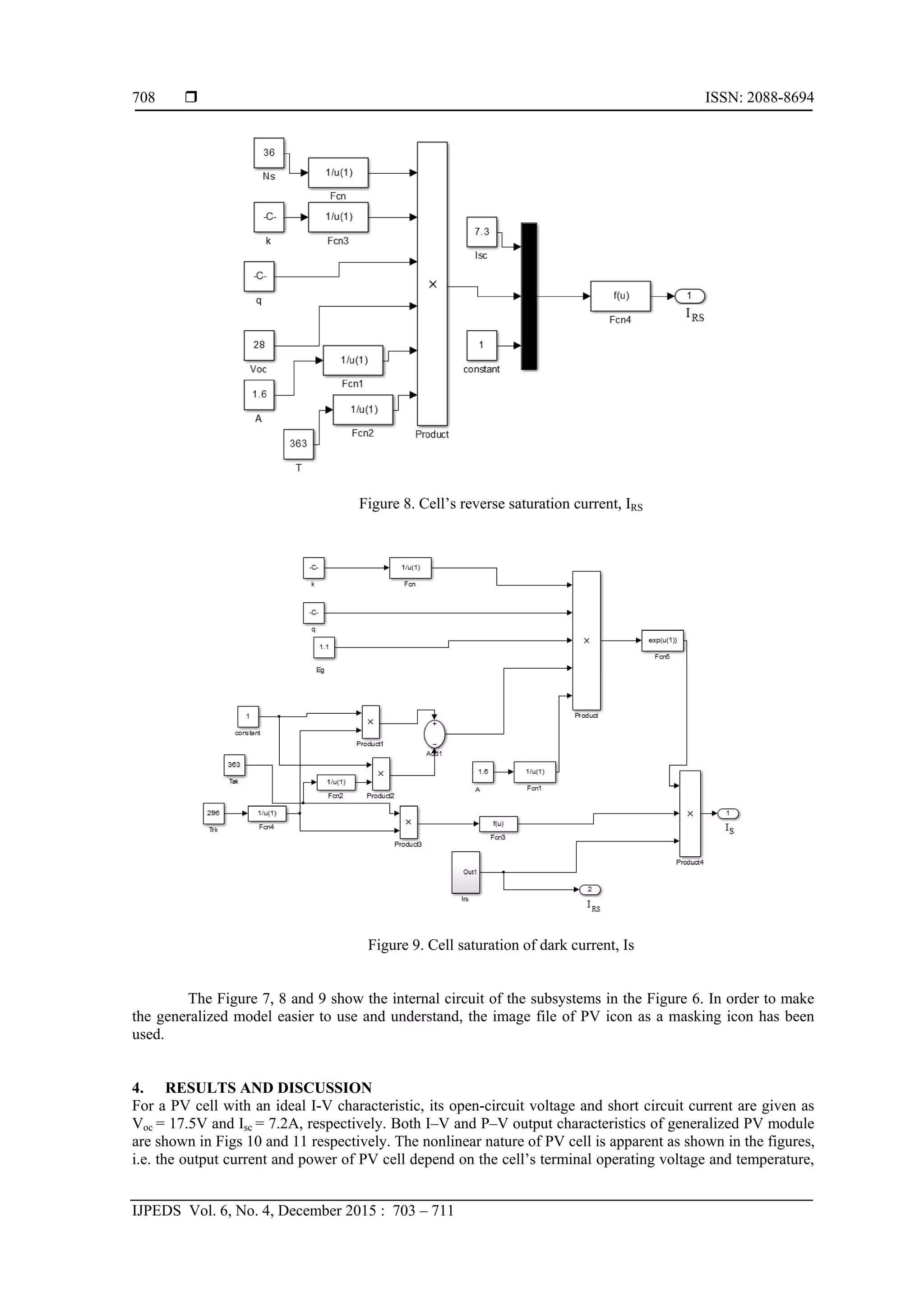
![IJPEDS ISSN: 2088-8694
Development and Simulation of Stand Alone Photovoltaic Model Using .... (Himanshu Sharma)
709
and solar insolation as well. It is been observed that with increase of working temperature, the short-circuit
current of the PV cell increases, whereas the maximum power output decreases. As much as the increase in
the output current is much less than the decrease in the voltage, the net power decreases at high temperatures.
On the other hand, with increase of solar insolation, the short-circuit current of the PV module increases and
the maximum power output increases as well. The reason is the open-circuit voltage is dependent on the solar
irradiance, yet the short-circuit current is directly proportional to the radiant intensity. Both I-V and P-V
output characteristics of PV module at various insolation and temperature are carried out. It also see that the
increase of working temperature, the short-circuit current of the PV module increases, whereas the maximum
power output decreases. The increase in the short-circuit current is much less than the decrease in the open-
circuit voltage and the effect makes maximum power decreasing by about 0.45%/o
C at high temperatures.
Furthermore, it is also been observed that with increase of solar insolation, the short- current and the
maximum power output of the PV module increases [16]. The reason is that the open-circuit voltage is
logarithmically dependent on the solar irradiance, though the short-circuit current is directly proportional to
the radiant intensity.
Figure 10. I – V output characteristics across the load
Figure 11. P – V output characteristics across the load](https://image.slidesharecdn.com/0416aug154aug27apr7443revisededit-171217154920/75/Development-and-Simulation-of-Stand-Alone-Photovoltaic-Model-Using-Matlab-Simulink-7-2048.jpg)
![ ISSN: 2088-8694
IJPEDS Vol. 6, No. 4, December 2015 : 703 – 711
710
5. CONCLUSION
A generalized PV model which is representative of the all PV cell, module, and array has been
developed with Matlab/Simulink and been verified with a PV cell and a commercial module. The proposed
model takes sunlight irradiance and cell temperature as input parameters and outputs the I-V and P-V
characteristics under various conditions. This model has also been designed in the form of Simulink block
libraries. The masked icon makes the block model more user-friendly and a dialog box lets the users easily
configure the PV model. Such a generalized PV model is easy to be used for the implementation on
Matlab/Simulink modeling and simulation platform. Especially, in the context of the SimPowerSystem tool,
there is now a generalized PV model which can be used for the model and analysis in the field of solar PV
power conversion system.
ACKNOWLEDGEMENTS
Authors are thankful to the Indian School of Mines, Dhanbad and UNIVERSITY GRANTS
COMMISSION, Bahadurshah Zafar Marg, New Delhi, India for granting financial support under Major
Research Project entitled “Development of Hybrid Off-grid Power Supply System for Remote Areas [UGC
Project: F. No. 42 152/2013(SR), w.e.f. 01/04/2013]” and also grateful to the Under Secretary and Joint
Secretary of UGC, India for their active co-operation.
REFERENCES
[1] O. Wasynczuk, “Dynamic behavior of a class of photovoltaic power systems”, IEEE Transactions on Power
Apparatus and Systems, vol/issue: PAS-102(9), pp. 3031-3037, 1983.
[2] Zvonimir Glasnovic, Jure Margeta, “A model for optimal sizing of photovoltaic irrigation water pumping systems”,
Solar Energy, vol/issue: 81(7), pp. 904-916, 2007.
[3] JCH. Phang, DSH. Chan, JR. Philips, “Accurate analytical method for the extraction of solar cell model
parameters”, Electronics Letters, vol/issue: 20(10), pp. 406-408, 1984.
[4] M. Veerachary, T. Senjyu, K. Uezato, “Voltage-based maximum power point tracking control of PV system”, IEEE
Transactions on Aerospace and Electronic Systems, vol/issue: 38(1), pp. 262-270, 2002.
[5] J. Surya Kumari, Ch. Saibabu, “Maximum Power Point Tracking Algorithms for Grid-Connected Photovoltaic
Energy Conversion System”, International Journal of Power Electronics and Drive Systems (IJPEDS, ISSN: 2088-
8694, a SCOPUS indexed Journal), vol/issue: 3(4), pp. 424-43, 2013.
[6] CC. Hua, CM. Shen, “Study of maximum power tracking techniques and control of dc-dc converters for
photovoltaic power system”, Proceedings of 29th annual IEEE Power Electronics Specialists Conference, vol. 1,
pp. 86-93, 1998.
[7] Kodanda Ram RBPUSB, Venu Gopala Rao Mannam, “Operation and Control of Grid Connected Hybrid AC/DC
Microgrid using various RES”, International Journal of Power Electronics and Drive Systems (IJPEDS, ISSN:
2088-8694, a SCOPUS indexed Journal), vol/issue: 5(2), pp. 195-202, 2014.
[8] JA. Gow, CD. Manning, “Development of a photovoltaic array model for use in power-electronics simulation
studies”, IEEE Proceedings- Electric Power Applications, vol/issue: 146(2), pp. 193-199, 1999.
[9] Himanshu Sharma, Nitai Pal, Pradip Kumar Sadhu, “Modeling and Simulation of Off-grid Power Generation
System using Photovoltaic”, TELKOMNIKA Indonesian Journal of Electrical Engineering (ISSN: 2302-4046, e-
ISSN: 2087-278X), vol/issue: 13(3), 2015.
[10] Shagar, BM., Vinod, S., Lakshmi, S., “Design of DC-DC converter for hybrid wind solar energy system”,
Computing, Electronics and Electrical Technologies (ICCEET), 2012 International Conference, pp. 429 – 435,
2012.
[11] Jeya Selvan Renius, K. Vinoth Kumar, Arnold Fredderics, Raja Guru, Sree Lakshmi Nair, “Modelling and
Simulation of Variable Frequency Synchronous DC-DC Buck Converter”, International Journal of Power
Electronics and Drive Systems (IJPEDS, ISSN: 2088-8694, a SCOPUS indexed Journal), vol/issue: 5(2), pp. 237-
243, 2014.
[12] Seul-Ki Kim, Eung-Sang Kim, Jong-Bo Ahn, “Modeling and Control of a Grid-connected Wind/PV Hybrid
Generation System”, Transmission and Distribution Conference and Exhibition, 2005/2006 IEEE PES, pp. 1202 –
1207, 2006.
[13] O. Wasynczuk, “Modeling and dynamic performance of a line commutated photovoltaic inverter system”, IEEE
Transactions on Energy Conversion, vol/issue: 4(3), pp. 337-343, 1989.
[14] Omid Palizban, MA. Rezaei, Saad Mekhilef, “Active and Reactive Power Control for a Hybrid System with
Photovoltaic Panel, Wind Turbine, Fuel Cells, Electrolyzer and Super Capacitor in Off-grid Mode”, IEEE
International Conference on Control System, Computing and Engineering, pp. 404–408, 2011.
[15] Qi Zhiyuan, Liu Yongxin, Liu Haijiang, Hao Zhengqing, “Power Control for Off-grid Wind Power System
Basedon Fuzzy PID Controller”, Power and Energy Engineering Conference (APPEEC), Asia-Pacific, pp. 1–4,
2010.](https://image.slidesharecdn.com/0416aug154aug27apr7443revisededit-171217154920/75/Development-and-Simulation-of-Stand-Alone-Photovoltaic-Model-Using-Matlab-Simulink-8-2048.jpg)
![IJPEDS ISSN: 2088-8694
Development and Simulation of Stand Alone Photovoltaic Model Using .... (Himanshu Sharma)
711
[16] Hamadi, A., Rahmani, S., Addoweesh, K., Al-Haddad, K., “A modeling and control of DFIG wind and PV solar
energy source generation feed”, Industrial Electronics Society, IECON 2013 - 39th Annual Conference of the
IEEE, pp. 7778 – 7783, 2013.
BIOGRAPHIES OF AUTHORS
Himanshu Sharma completed his B.Tech. Degree in Electrical and Electronics Engineering
from NIEC, GGSIP University, New Delhi and Masters Degree in Electrical and Electronic
Engineering from University of Greenwich, London, UK in 2007 and 2010 respectively. He
is presently pursuing Ph.D. Programme at the Department of Electrical Engineering, Indian
School of Mines, Dhanbad – 826004, India. His research interests include Hybridisation of
Solar and Wind energy production, Smart-Grids, Micro-Grids.
Nitai Pal received his B.Tech. and M.Tech. degrees in Electrical Engineering from
University of Calcutta, West Bengal, India. He received his Ph.D. (Engineering) from
Jadavpur University, West Bengal, India. He has total experience of 15 years in teaching. He
is currently working as an Associate Professor in the Department of Electrical Engineering,
Indian School of Mines, Dhanbad, Jharkhand, India. He has several publications in repued
Journals, International & National conferences. Also, he has published one book and two
book chapter. He has published four patents in the journal of Patent, Government of India.
He is the Investigator of Govt funded project. Many students are pursuing doctoral study
under him. Power electronics application, application of high frequency converters, energy
efficient devices, energy efficient drives, lighting and communication systems for
underground mines etc.
Yaduvir Singh received his B.E. degrees, Electrical Engineering from NIT, Kurukshetra,
Haryana, India in 2001. He received his M. Tech. from UPTU, Lucknow, Uttar Pradesh in
2008. He has total experience of 13 years in teaching. He is currently working as an
Associate Professor in the Department of Electrical & Electronics Engineering, Krishna
Institute of Engineering & Technology, Ghaziabad (Uttar Pradesh) India. He has published
two books. He has filled two patents which are under process. He is presently pursuing Part
Time Ph.D. Programme at the Department of Electrical Engineering, Indian School of
Mines, Dhanbad – 826004, India. His research interests include Distributed Generation and
power systems.
Pradip Kumar Sadhu received his Bachelor, Post-Graduate and Ph.D.(Engineering) degrees
in 1997, 1999 and 2002 respectively in Electrical Engg. from Jadavpur University, West
Bengal, India. Currently, he is working as a Professor in Electrical Engineering Department
of Indian School of Mines, Dhanbad, India. He has total experience of 22 years in teaching
and industry. He has four Patents and two patents are under process. He has several journal
and conference publications in national and international level. Also, he has published one
book and one book chapter. He is principal investigator of few Govt. funded projects. He has
guided a large no. of Doctoral Candidates and M.Tech students. His current areas of interest
are power electronics applications, application of high frequency converter, energy efficient
devices, energy efficient drives, computer aided power system analysis, condition
monitoring, lighting and communication systems for underground coal mines.](https://image.slidesharecdn.com/0416aug154aug27apr7443revisededit-171217154920/75/Development-and-Simulation-of-Stand-Alone-Photovoltaic-Model-Using-Matlab-Simulink-9-2048.jpg)


