International Journal of Engineering Research and Development 
e-ISSN: 2278-067X, p-ISSN: 2278-800X, www.ijerd.com 
Volume 10, Issue 9 (September 2014), PP.44-53 
Characterization of Temperature and Time Staying on Updraft 
Fixed Continuous Incinerator for Burning of Household Organic 
Waste with Tar Removal by Condensatin 
Subagiyoa; Eko Naryonob; Sandra Santosac 
aDepartment of Mechanical Engineering, Polytechnic of Malang 
b, cDepartment of Chemical Engineering, Polytechnic of Malang 
Abstract:- The combustion process is an alternative waste treatment methods used in the effective treatment of 
household organic waste . In designing incinerators require a dwell time of data and products of combustion 
characteristics. Product characteristics can be predicted based on temperature combustion process. 
Characterization of temperature and residence time can be done by using models or simulations based on 
experimental measurements. This study aims to obtain a characterization of temperature and residence time in 
the combustion of household organic waste by means of experiments. Based on visual observation and 
temperature measurement, combustion of household organic waste can produce continuous combustion using 
waste water content of 15.1 % , 7.5 m3 of air puffs / min and the rate of time bins 0.15 kg / min in the 
combustion chamber 1000 CC ( D = 35 cm and t = 11 cm ) , the steady temperature obtained at 455oC in 50 
minutes and the resulting flue gas CO , CO2 and HC well below the allowable limit is 0.11 % CO , 7 % CO2 
and 70 ppm HC 
Keywords:- Updraft Fixed incinerators , organic household waste , residence time , continuous combustion. 
I. PREFACE 
The combustion process is an alternative waste treatment methods are effectively used. This system has 
the advantage, among others, can generate heat energy and requires a short time compared with the degradation 
of system processing composting, landfills and open dumping. The combustion process is able to reduce the 
volume of waste to 90% while composting, landfills and open dumping can only reduce the volume by 40%. 
The resulting product of this system in the form of heat energy that can be harnessed as an energy source. 
In thermal processing application has the disadvantage of potentially produce exhaust gases that are 
categorized as hazardous waste material ( B3 ) is particulate matter ( PM ) , SO2 , CO , CO2 , HC , dioxins , 
furans and heavy metals . The formation of these materials influenced the type of waste component , incomplete 
combustion processes ( Chang , 2007) and combustion systems are used . Conventional combustion systems 
produce 10-30 % of the initial amount in the form of particulate matter , fly ash and bottom ash . The solid 
particles containing various metals include Pb , Cr , Cu , Zn , Na , K and organic pollutants dioxins and furans. 
In the formation of thermal processing of materials in the exhaust gases need B3 minimized to achieve the 
allowable threshold . Several methods can be done to lower the electoral system B3 include combustion 
gasification , pyrolysis ) . Gasification and pyrolysis processes garbage or biomass is usually performed on two 
kinds of reactors ( Bridgwater , 2006) : fluidized and fixed bed reactors . Fluidized reactor equipment and 
systems have complex operation , usually applied on a large scale ( Warnecke , 2000) . When compared to fixed 
bed reactors , fluidized reactor requires a larger investment so that the use of small-scale fixed bed reactor is 
more appropriate . 
Application of fixed bed reactor for sewage treatment requires evaluation and understanding of the 
behavior of both processes at the design phase as well as in the operation . Phenomena that occur in this process 
is very complex due to the interaction of the reaction ( homogeneous , heterogeneous ) , the gas flow patterns in 
a pile of garbage and the pattern of heat transfer occur simultaneously . In order to understand this phenomena 
has been widely developed various mathematical models correlation interaction of these variables . However, 
still requires further development , especially the method validation ( Blasi , 2008) to improve the validity of the 
model . 
Several experimental approaches have been made to study the behavior of combustion systems in the 
fixed bed reactor ( Blasi) , among others , in 2004 developed a gasification models that include all the 
phenomena that occur during the process . This model was further validated by means of experiments using a 
reactor that was given accessories instrument to measure the temperature profile and the various processes of 
transformation that occurs , Globe at all conducted experiments on two- stage coal gasification reactor for 
44
Characterization of Temperature and Time Staying on Updraft Fixed Continuous Incinerator for 
optimization and control the operation of a pilot plant operated . The data obtained are profiles of temperature 
and concentrations of combustion gases are then used to characterize the operation of the fixed bed reactor . 
Another study conducted by Steene et al , 2010 on a fixed bed reactor models for the characterization of the 
results of charcoal gasification process . The experimental results are then validated using mass balance and 
energy gasification process . Pyrolysis process above three studies entirely using dry ingradients . Until now 
difficult to obtain data on the temperature profile and the concentration of exhaust gas incineration of organic 
waste products that households have a high water content of the open source reference source. 
This study aims to obtain a temperature profile and composition of the exhaust gas incineration of 
household organic waste in a continuous fixed bed incinerators . The study was conducted by means of 
experiments using a model of a fixed bed incinerator equipment operated continuously . The application of these 
techniques to understand the behavior of organic household waste incineration that can be utilized to obtain data 
supporting the design of the reactor. 
In the design of the reactor system of household organic waste burning requiring a data characteristic 
residence time process that takes place , time and speed steady state combustion and better characterization of 
the resulting products of combustion gases and solids ( ash ) combustion . Residence time data , time and speed 
steady state combustion reactor dimensions required for the calculation whereas combustion product 
characterization results for the evaluation of the environmental feasibility. 
II. METHODS AND MATERIALS RESEARCH 
Research carried out by using continuous incinerator equipment with a capacity of 5 kg / h, sekema 
piece of equipment is shown in Figure 2. Waste material taken from TPS Tlogomas, Malang. garbage 
compositin proximate shown in Table 1. 
Table 1. Proximate composition of garbage component Composition 
Component Composition 
45 
Water 
Ash 
Volatile 
Fixed Carbon 
53,7 
10,7 
16,83 
20,03 
Fig. 1. Various zones in the updraft fixed bed incinerator
Characterization of Temperature and Time Staying on Updraft Fixed Continuous Incinerator for 
Fig. 2. Schemes of work equipment incinerator 
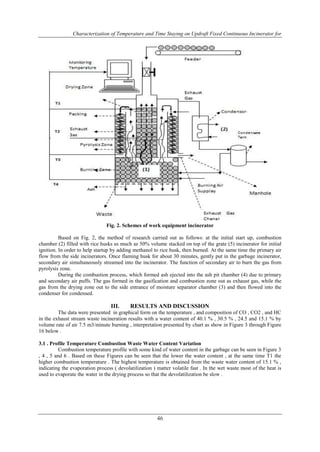
Based on Fig. 2, the method of research carried out as follows: at the initial start up, combustion 
chamber (2) filled with rice husks as much as 50% volume stacked on top of the grate (5) incinerator for initial 
ignition. In order to help startup by adding methanol to rice husk, then burned. At the same time the primary air 
flow from the side incinerators. Once flaming husk for about 30 minutes, gently put in the garbage incinerator, 
secondary air simultaneously streamed into the incinerator. The function of secondary air to burn the gas from 
pyrolysis zone. 
During the combustion process, which formed ash ejected into the ash pit chamber (4) due to primary 
and secondary air puffs. The gas formed in the gasification and combustion zone out as exhaust gas, while the 
gas from the drying zone out to the side entrance of moisture separator chamber (3) and then flowed into the 
condenser for condensed. 
III. RESULTS AND DISCUSSION 
The data were presented in graphical form on the temperature , and composition of CO , CO2 , and HC 
in the exhaust stream waste incineration results with a water content of 40.1 % , 30.5 % , 24.5 and 15.1 % by 
volume rate of air 7.5 m3/minute burning , interpretation presented by chart as show in Figure 3 through Figure 
16 below . 
3.1 . Profile Temperature Combustion Waste Water Content Variation 
Combustion temperature profile with some kind of water content in the garbage can be seen in Figure 3 
, 4 , 5 and 6 . Based on these Figures can be seen that the lower the water content , at the same time T1 the 
higher combustion temperature . The highest temperature is obtained from the waste water content of 15.1 % , 
indicating the evaporation process ( devolatilization ) matter volatile fast . In the wet waste most of the heat is 
used to evaporate the water in the drying process so that the devolatilization be slow . 
46
Characterization of Temperature and Time Staying on Updraft Fixed Continuous Incinerator for 
Fig. 3. Waste incineration temperature profile water content 40.1% 
Fig. 4. Waste incineration temperature profile water content 30.5% 
Fig. 5 Temperature Profile burning waste water content of 24.5% 
47
Characterization of Temperature and Time Staying on Updraft Fixed Continuous Incinerator for 
Fig 6. Waste incineration temperature profile water content of 15.1% 
At temperature T2 (pyrolysis area) and T3 (drying area) has the same trend as the T1 (combustion 
zone), ie the higher the water content at the same time the lower temperature, this is due to the water coming out 
of the trash before it evaporates cooling effect. 
3.2 Profile Temperature Combustion Combustion air volume rate variation 
For waste incineration with combustion air volume rate variation used the garbage with water content 
of 15.1%, the temperature profile can be seen in Figure 7, 8, 9 and 10, from the picture it appears that all 
obtainable towards the steady combustion temperature, the greater the rate of air volume the faster increase in 
combustion temperatures T1, T2, T3. (temperature combustion zone, perolysis and drying), On the use of the air 
volume rate of 7.5 m3/minute seen already at temperatures of 445o C profile in about 50 minutes, it can be used 
assess the heat energy from burning waste to be used for heating or the use of aircraft other, but still consider 
environmental aspects. 
Fig. 7 .Profile of temperature combustion water content of 15.1% by air 4 m3/minute 
48
Characterization of Temperature and Time Staying on Updraft Fixed Continuous Incinerator for 
Fig. 8 Profile of temperature combustion with a water content of 15.1% air 5 m3/minute 
Fig. 9 Profile of temperature combustion water content of 15.1% with 6 air m3/minute 
Fig. 10 Combustion temperature profile water content of 15.1% with 7.5 air m3/minute 
49
Characterization of Temperature and Time Staying on Updraft Fixed Continuous Incinerator for 
3.3 Composition of flue gas waste burning results with variations of water content 
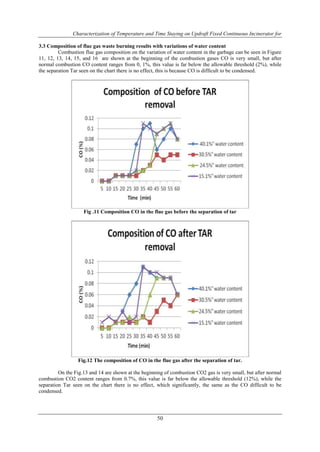
Combustion flue gas composition on the variation of water content in the garbage can be seen in Figure 
11, 12, 13, 14, 15, and 16 are shown at the beginning of the combustion gases CO is very small, but after 
normal combustion CO content ranges from 0, 1%, this value is far below the allowable threshold (2%), while 
the separation Tar seen on the chart there is no effect, this is because CO is difficult to be condensed. 
Fig .11 Composition CO in the flue gas before the separation of tar 
Fig.12 The composition of CO in the flue gas after the separation of tar. 
On the Fig.13 and 14 are shown at the beginning of combustion CO2 gas is very small, but after normal 
combustion CO2 content ranges from 0.7%, this value is far below the allowable threshold (12%), while the 
separation Tar seen on the chart there is no effect, which significantly, the same as the CO difficult to be 
condensed. 
50
Characterization of Temperature and Time Staying on Updraft Fixed Continuous Incinerator for 
Fig.13 Composition of CO2 in the flue gas before the separation of tar 
Fig. 14 Composition of CO2 in the flue gas after the separation of tar 
The composition of the HC in the exhaust gases of combustion results are shown in Figure 15 and 16 is at its 
initial value is small, but the normal combustion hover around 70 ppm, and after separation Tar decrease to 60 
ppm, due partly condensed H, and the value is well below the threshold allowable limit, which is 400 ppm. 
Fig. 15 Composition of HC in the exhaust gases before the separation of tar 
51
Characterization of Temperature and Time Staying on Updraft Fixed Continuous Incinerator for 
Fig. 16 Composition of HC in the exhaust gases after separation of tar 
52 
3.4 Analysis of Tar Distillate 
The analysis was performed by means of qualitative and quantitative , qualitative method using GC - 
MS and AAS , being a quantitative way using Gravimetry . The analysis showed the Tar organic components 
are hexane , cyclopentan , phenol and gulakol , while the inorganic components are metals Na , Ca ( trace ) 
while the negative Cd and Ash. 
Quantitatively every kilogram of waste can produce tar mixed with water ( pyrolitic water ) in this 
study the average concentration of 203.50 grams of 4.30 % tar , ash is entrained in tar 0.45 %. . 
Based on the above data , it can be predicted that the separation of tar in the flue gas is condensed 
manner can reduce the potential for pollutants , either organic or inorganic. 
With the data that reaches a steady temperature profile and composition of the exhaust gases after 
separation of tar and tar distillates analysis can be used as a basis for further research, which examines the 
feasibility of utilization of heat energy domestic combustion products with care for the environment ( Minimal 
pollutants ) . 
IV. CONCLUSION 
In this study was to evaluate the characteristics of the temperature system of continuous outcomes 
waste incineration , garbage flow rate , and volume flow rate of air , and keep separate the tar from the flue gas 
to reduce pollutants . The evaluation focused on the characterization of temperature with variable water content 
danvolume trash combustion air volume flow rate , the feed rate about 0.15 kg / min . 
Based on research data and analysis are presented in graphical form correlation variables studied , it 
can be concluded 
1. The higher the water content the lower the temperature is achieved , this is due to the water coming out 
of the trash before it evaporates cooling effect . 
2. The higher the air flow rate achieved the faster the steady temperature is reached , and the higher the 
temperature 
3. With the separation of tar CO and CO2 in the flue gas has no effect because it is difficult condensed , but 
the CO content of 0.11 % and 0.70 % of its value is far from the value of the allowable limit of 2% for 
CO and 12 % for CO2 , while the HC after the separation of tar decreased from 70 ppm to 60 ppm as 
anther as a condensation . 
4. The results of the analysis of tar distillate , organic component content contained hexane , cyclopentan , 
phenol and gulakol , as well as components anorgani klogam Na , Ca and ash , with a ratio of 1 kg of 
waste produce 203.5 grams of tar with a concentration of 4.3 % , ash on tar 0 , 45 % . 
5. In general, the separation of tar can reduce pollutants in the exhaust gas , and the temperature can be 
achieved steady combustion can be taken to be used as alternative energy , ie heat energy from the 
burning garbage 
ACKNOWLEDGEMENTS 
This work was financially supported by Director General of Higer Education (DIKTI) Ministry of 
Education and Culture (KEMENDIKBUD).
Characterization of Temperature and Time Staying on Updraft Fixed Continuous Incinerator for 
REFERENCES 
[1]. Bridgwater; 1980. Waste Incineration and Pyrolysis. Resource Recovery and Conservation. 5; 99-115 
[2]. Blasi C.D; 2008.Modeling chemical and physical processes of wood and biomass pyrolysis. Progress in 
53 
Energy and Combustion Science. 34: 47–90 
[3]. Barrio M, Fossum M, Hustad J.E; 2001. A small-scale stratified downdraft gasifiercoupled to a gas 
engine for combined heat and power production. Progress in thermochemical biomass conversion. 426- 
440 
[4]. Caballero, J.A., Marcilla, A., Front, R., Conesa, JA., 1997. Characterisation of sludges primary and 
secondary pyrolysis. J. Anal. Applied Pyrolysis. 4041 : 433-450 
[5]. De Steene, L.V., Tagutchou, J.P., Mermoud, F., Martin, E., Salvadorb, F,, 2010.. Continuous Fixed 
Bed Reactor to characterise wood char gasification.Fuel 89: 3320–3329 
[6]. Hen, C, Yu-Qi, J., Jian-hua, Y., Chi, Y 2011. “Simulation of municipal solid waste gasification in two 
different types of fixed bed reactors. Fuel 
[7]. Jeng-ChyanMuti Lin, 2006, Development of an updraft fixed bed gasifierwith an embedded combustor 
fed by solid biomass, Journal of the Chinese Institute of Engineers. 29 (3): 557-562. 
[8]. Liu, Y.A., Liu, Y.U., 2005. “Novel incineration technology integrated with drying, pyrolysis, 
gasification, and combustion of MSW and ashes vitrivication. Environmental Science Technology. 39: 
3855- 3863. 
[9]. Lee, C.C., Lin, S.D., 2007. Handbook of environmental engineering calculations. second edition. 39, 
Mc. Graw- Hill Compa.

International Journal of Engineering Research and Development

  • 1.
    International Journal ofEngineering Research and Development e-ISSN: 2278-067X, p-ISSN: 2278-800X, www.ijerd.com Volume 10, Issue 9 (September 2014), PP.44-53 Characterization of Temperature and Time Staying on Updraft Fixed Continuous Incinerator for Burning of Household Organic Waste with Tar Removal by Condensatin Subagiyoa; Eko Naryonob; Sandra Santosac aDepartment of Mechanical Engineering, Polytechnic of Malang b, cDepartment of Chemical Engineering, Polytechnic of Malang Abstract:- The combustion process is an alternative waste treatment methods used in the effective treatment of household organic waste . In designing incinerators require a dwell time of data and products of combustion characteristics. Product characteristics can be predicted based on temperature combustion process. Characterization of temperature and residence time can be done by using models or simulations based on experimental measurements. This study aims to obtain a characterization of temperature and residence time in the combustion of household organic waste by means of experiments. Based on visual observation and temperature measurement, combustion of household organic waste can produce continuous combustion using waste water content of 15.1 % , 7.5 m3 of air puffs / min and the rate of time bins 0.15 kg / min in the combustion chamber 1000 CC ( D = 35 cm and t = 11 cm ) , the steady temperature obtained at 455oC in 50 minutes and the resulting flue gas CO , CO2 and HC well below the allowable limit is 0.11 % CO , 7 % CO2 and 70 ppm HC Keywords:- Updraft Fixed incinerators , organic household waste , residence time , continuous combustion. I. PREFACE The combustion process is an alternative waste treatment methods are effectively used. This system has the advantage, among others, can generate heat energy and requires a short time compared with the degradation of system processing composting, landfills and open dumping. The combustion process is able to reduce the volume of waste to 90% while composting, landfills and open dumping can only reduce the volume by 40%. The resulting product of this system in the form of heat energy that can be harnessed as an energy source. In thermal processing application has the disadvantage of potentially produce exhaust gases that are categorized as hazardous waste material ( B3 ) is particulate matter ( PM ) , SO2 , CO , CO2 , HC , dioxins , furans and heavy metals . The formation of these materials influenced the type of waste component , incomplete combustion processes ( Chang , 2007) and combustion systems are used . Conventional combustion systems produce 10-30 % of the initial amount in the form of particulate matter , fly ash and bottom ash . The solid particles containing various metals include Pb , Cr , Cu , Zn , Na , K and organic pollutants dioxins and furans. In the formation of thermal processing of materials in the exhaust gases need B3 minimized to achieve the allowable threshold . Several methods can be done to lower the electoral system B3 include combustion gasification , pyrolysis ) . Gasification and pyrolysis processes garbage or biomass is usually performed on two kinds of reactors ( Bridgwater , 2006) : fluidized and fixed bed reactors . Fluidized reactor equipment and systems have complex operation , usually applied on a large scale ( Warnecke , 2000) . When compared to fixed bed reactors , fluidized reactor requires a larger investment so that the use of small-scale fixed bed reactor is more appropriate . Application of fixed bed reactor for sewage treatment requires evaluation and understanding of the behavior of both processes at the design phase as well as in the operation . Phenomena that occur in this process is very complex due to the interaction of the reaction ( homogeneous , heterogeneous ) , the gas flow patterns in a pile of garbage and the pattern of heat transfer occur simultaneously . In order to understand this phenomena has been widely developed various mathematical models correlation interaction of these variables . However, still requires further development , especially the method validation ( Blasi , 2008) to improve the validity of the model . Several experimental approaches have been made to study the behavior of combustion systems in the fixed bed reactor ( Blasi) , among others , in 2004 developed a gasification models that include all the phenomena that occur during the process . This model was further validated by means of experiments using a reactor that was given accessories instrument to measure the temperature profile and the various processes of transformation that occurs , Globe at all conducted experiments on two- stage coal gasification reactor for 44
  • 2.
    Characterization of Temperatureand Time Staying on Updraft Fixed Continuous Incinerator for optimization and control the operation of a pilot plant operated . The data obtained are profiles of temperature and concentrations of combustion gases are then used to characterize the operation of the fixed bed reactor . Another study conducted by Steene et al , 2010 on a fixed bed reactor models for the characterization of the results of charcoal gasification process . The experimental results are then validated using mass balance and energy gasification process . Pyrolysis process above three studies entirely using dry ingradients . Until now difficult to obtain data on the temperature profile and the concentration of exhaust gas incineration of organic waste products that households have a high water content of the open source reference source. This study aims to obtain a temperature profile and composition of the exhaust gas incineration of household organic waste in a continuous fixed bed incinerators . The study was conducted by means of experiments using a model of a fixed bed incinerator equipment operated continuously . The application of these techniques to understand the behavior of organic household waste incineration that can be utilized to obtain data supporting the design of the reactor. In the design of the reactor system of household organic waste burning requiring a data characteristic residence time process that takes place , time and speed steady state combustion and better characterization of the resulting products of combustion gases and solids ( ash ) combustion . Residence time data , time and speed steady state combustion reactor dimensions required for the calculation whereas combustion product characterization results for the evaluation of the environmental feasibility. II. METHODS AND MATERIALS RESEARCH Research carried out by using continuous incinerator equipment with a capacity of 5 kg / h, sekema piece of equipment is shown in Figure 2. Waste material taken from TPS Tlogomas, Malang. garbage compositin proximate shown in Table 1. Table 1. Proximate composition of garbage component Composition Component Composition 45 Water Ash Volatile Fixed Carbon 53,7 10,7 16,83 20,03 Fig. 1. Various zones in the updraft fixed bed incinerator
  • 3.
    Characterization of Temperatureand Time Staying on Updraft Fixed Continuous Incinerator for Fig. 2. Schemes of work equipment incinerator Based on Fig. 2, the method of research carried out as follows: at the initial start up, combustion chamber (2) filled with rice husks as much as 50% volume stacked on top of the grate (5) incinerator for initial ignition. In order to help startup by adding methanol to rice husk, then burned. At the same time the primary air flow from the side incinerators. Once flaming husk for about 30 minutes, gently put in the garbage incinerator, secondary air simultaneously streamed into the incinerator. The function of secondary air to burn the gas from pyrolysis zone. During the combustion process, which formed ash ejected into the ash pit chamber (4) due to primary and secondary air puffs. The gas formed in the gasification and combustion zone out as exhaust gas, while the gas from the drying zone out to the side entrance of moisture separator chamber (3) and then flowed into the condenser for condensed. III. RESULTS AND DISCUSSION The data were presented in graphical form on the temperature , and composition of CO , CO2 , and HC in the exhaust stream waste incineration results with a water content of 40.1 % , 30.5 % , 24.5 and 15.1 % by volume rate of air 7.5 m3/minute burning , interpretation presented by chart as show in Figure 3 through Figure 16 below . 3.1 . Profile Temperature Combustion Waste Water Content Variation Combustion temperature profile with some kind of water content in the garbage can be seen in Figure 3 , 4 , 5 and 6 . Based on these Figures can be seen that the lower the water content , at the same time T1 the higher combustion temperature . The highest temperature is obtained from the waste water content of 15.1 % , indicating the evaporation process ( devolatilization ) matter volatile fast . In the wet waste most of the heat is used to evaporate the water in the drying process so that the devolatilization be slow . 46
  • 4.
    Characterization of Temperatureand Time Staying on Updraft Fixed Continuous Incinerator for Fig. 3. Waste incineration temperature profile water content 40.1% Fig. 4. Waste incineration temperature profile water content 30.5% Fig. 5 Temperature Profile burning waste water content of 24.5% 47
  • 5.
    Characterization of Temperatureand Time Staying on Updraft Fixed Continuous Incinerator for Fig 6. Waste incineration temperature profile water content of 15.1% At temperature T2 (pyrolysis area) and T3 (drying area) has the same trend as the T1 (combustion zone), ie the higher the water content at the same time the lower temperature, this is due to the water coming out of the trash before it evaporates cooling effect. 3.2 Profile Temperature Combustion Combustion air volume rate variation For waste incineration with combustion air volume rate variation used the garbage with water content of 15.1%, the temperature profile can be seen in Figure 7, 8, 9 and 10, from the picture it appears that all obtainable towards the steady combustion temperature, the greater the rate of air volume the faster increase in combustion temperatures T1, T2, T3. (temperature combustion zone, perolysis and drying), On the use of the air volume rate of 7.5 m3/minute seen already at temperatures of 445o C profile in about 50 minutes, it can be used assess the heat energy from burning waste to be used for heating or the use of aircraft other, but still consider environmental aspects. Fig. 7 .Profile of temperature combustion water content of 15.1% by air 4 m3/minute 48
  • 6.
    Characterization of Temperatureand Time Staying on Updraft Fixed Continuous Incinerator for Fig. 8 Profile of temperature combustion with a water content of 15.1% air 5 m3/minute Fig. 9 Profile of temperature combustion water content of 15.1% with 6 air m3/minute Fig. 10 Combustion temperature profile water content of 15.1% with 7.5 air m3/minute 49
  • 7.
    Characterization of Temperatureand Time Staying on Updraft Fixed Continuous Incinerator for 3.3 Composition of flue gas waste burning results with variations of water content Combustion flue gas composition on the variation of water content in the garbage can be seen in Figure 11, 12, 13, 14, 15, and 16 are shown at the beginning of the combustion gases CO is very small, but after normal combustion CO content ranges from 0, 1%, this value is far below the allowable threshold (2%), while the separation Tar seen on the chart there is no effect, this is because CO is difficult to be condensed. Fig .11 Composition CO in the flue gas before the separation of tar Fig.12 The composition of CO in the flue gas after the separation of tar. On the Fig.13 and 14 are shown at the beginning of combustion CO2 gas is very small, but after normal combustion CO2 content ranges from 0.7%, this value is far below the allowable threshold (12%), while the separation Tar seen on the chart there is no effect, which significantly, the same as the CO difficult to be condensed. 50
  • 8.
    Characterization of Temperatureand Time Staying on Updraft Fixed Continuous Incinerator for Fig.13 Composition of CO2 in the flue gas before the separation of tar Fig. 14 Composition of CO2 in the flue gas after the separation of tar The composition of the HC in the exhaust gases of combustion results are shown in Figure 15 and 16 is at its initial value is small, but the normal combustion hover around 70 ppm, and after separation Tar decrease to 60 ppm, due partly condensed H, and the value is well below the threshold allowable limit, which is 400 ppm. Fig. 15 Composition of HC in the exhaust gases before the separation of tar 51
  • 9.
    Characterization of Temperatureand Time Staying on Updraft Fixed Continuous Incinerator for Fig. 16 Composition of HC in the exhaust gases after separation of tar 52 3.4 Analysis of Tar Distillate The analysis was performed by means of qualitative and quantitative , qualitative method using GC - MS and AAS , being a quantitative way using Gravimetry . The analysis showed the Tar organic components are hexane , cyclopentan , phenol and gulakol , while the inorganic components are metals Na , Ca ( trace ) while the negative Cd and Ash. Quantitatively every kilogram of waste can produce tar mixed with water ( pyrolitic water ) in this study the average concentration of 203.50 grams of 4.30 % tar , ash is entrained in tar 0.45 %. . Based on the above data , it can be predicted that the separation of tar in the flue gas is condensed manner can reduce the potential for pollutants , either organic or inorganic. With the data that reaches a steady temperature profile and composition of the exhaust gases after separation of tar and tar distillates analysis can be used as a basis for further research, which examines the feasibility of utilization of heat energy domestic combustion products with care for the environment ( Minimal pollutants ) . IV. CONCLUSION In this study was to evaluate the characteristics of the temperature system of continuous outcomes waste incineration , garbage flow rate , and volume flow rate of air , and keep separate the tar from the flue gas to reduce pollutants . The evaluation focused on the characterization of temperature with variable water content danvolume trash combustion air volume flow rate , the feed rate about 0.15 kg / min . Based on research data and analysis are presented in graphical form correlation variables studied , it can be concluded 1. The higher the water content the lower the temperature is achieved , this is due to the water coming out of the trash before it evaporates cooling effect . 2. The higher the air flow rate achieved the faster the steady temperature is reached , and the higher the temperature 3. With the separation of tar CO and CO2 in the flue gas has no effect because it is difficult condensed , but the CO content of 0.11 % and 0.70 % of its value is far from the value of the allowable limit of 2% for CO and 12 % for CO2 , while the HC after the separation of tar decreased from 70 ppm to 60 ppm as anther as a condensation . 4. The results of the analysis of tar distillate , organic component content contained hexane , cyclopentan , phenol and gulakol , as well as components anorgani klogam Na , Ca and ash , with a ratio of 1 kg of waste produce 203.5 grams of tar with a concentration of 4.3 % , ash on tar 0 , 45 % . 5. In general, the separation of tar can reduce pollutants in the exhaust gas , and the temperature can be achieved steady combustion can be taken to be used as alternative energy , ie heat energy from the burning garbage ACKNOWLEDGEMENTS This work was financially supported by Director General of Higer Education (DIKTI) Ministry of Education and Culture (KEMENDIKBUD).
  • 10.
    Characterization of Temperatureand Time Staying on Updraft Fixed Continuous Incinerator for REFERENCES [1]. Bridgwater; 1980. Waste Incineration and Pyrolysis. Resource Recovery and Conservation. 5; 99-115 [2]. Blasi C.D; 2008.Modeling chemical and physical processes of wood and biomass pyrolysis. Progress in 53 Energy and Combustion Science. 34: 47–90 [3]. Barrio M, Fossum M, Hustad J.E; 2001. A small-scale stratified downdraft gasifiercoupled to a gas engine for combined heat and power production. Progress in thermochemical biomass conversion. 426- 440 [4]. Caballero, J.A., Marcilla, A., Front, R., Conesa, JA., 1997. Characterisation of sludges primary and secondary pyrolysis. J. Anal. Applied Pyrolysis. 4041 : 433-450 [5]. De Steene, L.V., Tagutchou, J.P., Mermoud, F., Martin, E., Salvadorb, F,, 2010.. Continuous Fixed Bed Reactor to characterise wood char gasification.Fuel 89: 3320–3329 [6]. Hen, C, Yu-Qi, J., Jian-hua, Y., Chi, Y 2011. “Simulation of municipal solid waste gasification in two different types of fixed bed reactors. Fuel [7]. Jeng-ChyanMuti Lin, 2006, Development of an updraft fixed bed gasifierwith an embedded combustor fed by solid biomass, Journal of the Chinese Institute of Engineers. 29 (3): 557-562. [8]. Liu, Y.A., Liu, Y.U., 2005. “Novel incineration technology integrated with drying, pyrolysis, gasification, and combustion of MSW and ashes vitrivication. Environmental Science Technology. 39: 3855- 3863. [9]. Lee, C.C., Lin, S.D., 2007. Handbook of environmental engineering calculations. second edition. 39, Mc. Graw- Hill Compa.