
FUTURE OF HRSUBMITTED TO:-	        SUBMITTED BY:-Ms. SHWETA KHANNA   DIKSHA CHAUHAN					         DIVYABHAN SINGH					         RAJESH SAINI				         VIJAY YADAV				         VIKAS GARG				         VIKAS SEHRAWAT				         VINOD KUMAR				         VISHAL SISODIA
WHAT IS HRMHuman Resource Management (HRM) is the function within an organization that focuses on recruitment of, management of, and providing direction for the people who work in the organization.
Human Resource Management ("HRM") is a way of management that links people-related activities to the strategy of a business or organization.FUNCTION OF HRI. Managerial Functions: a. Planningb. OrganizingC. Directingd. ControllingII. Operative Functions:a. Procurement b. Development c. Compensation d. Integration e. Maintenance
OBJECTIVE OF HR	      • To help the organization reach its goals                  • To ensure effective utilization and maximum                                       development of human resources. • To ensure respect for human beings. To identify and satisfy the needs of individuals.     • To achieve and maintain high morale among        employees.• To provide the organization with well-trained and well-motivated employees    • To inculcate the sense of team spirit, team work
SCOPE  OF HR1. Personnel aspect-This is concerned with manpower planning, recruitment, selection, placement, transfer, promotion, training and development, layoff and retrenchment, remuneration, incentives, productivity etc.2. Welfare aspect-It deals with working conditions and amenities such as canteens, creches, rest and lunch rooms, housing, transport, medical assistance, education, health and safety, recreation facilities, etc.3. Industrial relations aspect-This covers union-management relations, joint consultation, collective bargaining, grievance and disciplinary procedures, settlement of disputes, etc
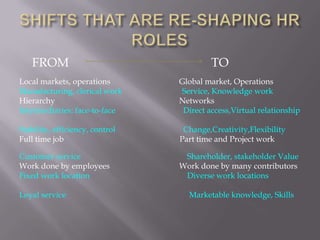
SHIFTS THAT ARE RE-SHAPING HR ROLES FROM  TOLocal markets, operations 			Global market, OperationsManufacturing, clerical work                              Service, Knowledge workHierarchy				NetworksIntermediaries; face-to-face		  Direct access,Virtual relationship Stability, efficiency, control		  Change,Creativity,FlexibilityFull time job                                                          Part time and Project work				Customer service				    Shareholder, stakeholder ValueWork done by employees			Work done by many contributorsFixed work location			    Diverse work locationsLoyal service				     Marketable knowledge, Skills
EMERING LEAGL ISSUE AT WORKNEW TECHNOLOGY ISSUESAGE CONSCIOUSNESS IN THE WORKPLACEGLOBALISATION OF EMPLOYMENT LAWTRAINING FOR LEGAL COMPLIANCEWORKPLACE SAFETY
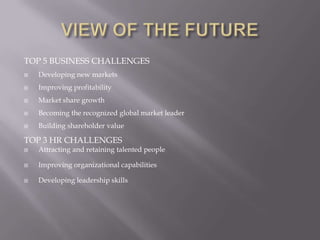
VIEW OF THE FUTURETOP 5 BUSINESS CHALLENGESDeveloping new marketsImproving profitabilityMarket share growthBecoming the recognized global market leaderBuilding shareholder valueTOP 3 HR CHALLENGESAttracting and retaining talented peopleImproving organizational capabilitiesDeveloping leadership skills
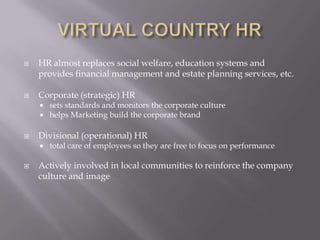
VIRTUAL COUNTRY HRHR almost replaces social welfare, education systems and provides financial management and estate planning services, etc.Corporate (strategic) HRsets standards and monitors the corporate culturehelps Marketing build the corporate brandDivisional (operational) HRtotal care of employees so they are free to focus on performanceActively involved in local communities to reinforce the company culture and image
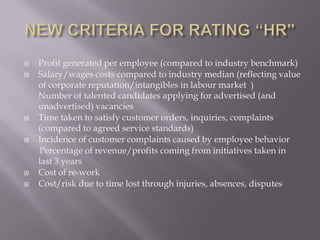
NEW CRITERIA FOR RATING “HR"Profit generated per employee (compared to industry benchmark)Salary/wages costs compared to industry median (reflecting value of corporate reputation/intangibles in labour market  )Number of talented candidates applying for advertised (and unadvertised) vacanciesTime taken to satisfy customer orders, inquiries, complaints (compared to agreed service standards)Incidence of customer complaints caused by employee behavior       Percentage of revenue/profits coming from initiatives taken in last 3 yearsCost of re-workCost/risk due to time lost through injuries, absences, disputes
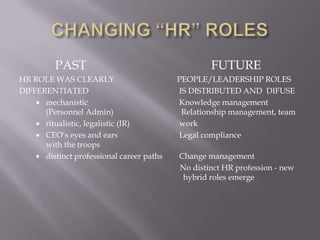
CHANGING “HR” ROLES          PAST				FUTUREHR ROLE WAS CLEARLY		               PEOPLE/LEADERSHIP ROLES DIFFERENTIATED			IS DISTRIBUTED AND  DIFUSEmechanistic 			Knowledge management (Personnel Admin)			 Relationship management, team ritualistic, legalistic (IR)		workCEO’s eyes and ears 		Legal compliancewith the troopsdistinct professional career paths	Change management                                                                        No distinct HR profession - new                					  hybrid roles emerge
PARTS OF HRSTRATEGIC MANAGEMENT:-The ongoing process companies use to form a vision, analyze their external environment and their internal environment, and select one or more strategies to use to create value for customers and other stakeholders, especially shareholdersStrategic management is:Performance orientedOngoing in natureDynamic rather than staticOriented to the present and the futureConcerned with conditions both outside and inside the firmConcerned with performing well and satisfying stakeholders
HUMAN RESOURCE PLANNINGDefinition: It is the process by which management determines how an organization should move from its current manpower position to its desired manpower position.Objectives of HRP:-To ensure optimum use of existing HRTo forecast future requirements for HRTo provide control measuresTo link HRP with Organizational PlanningTo determine levels of Recruitment and Training
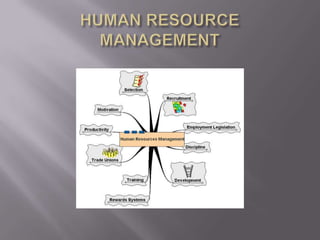
HUMAN RESOURCE MANAGEMENT
CONCLUSION      So on the basis of this presentation we can say that HR profession is the very important function of any organization.      Without the help of HR people organization cannot achieve their desired goals.
THANK YOU

F U T U R E O F H R

  • 1.
    FUTURE OF HRSUBMITTEDTO:- SUBMITTED BY:-Ms. SHWETA KHANNA DIKSHA CHAUHAN DIVYABHAN SINGH RAJESH SAINI VIJAY YADAV VIKAS GARG VIKAS SEHRAWAT VINOD KUMAR VISHAL SISODIA
  • 2.
    WHAT IS HRMHumanResource Management (HRM) is the function within an organization that focuses on recruitment of, management of, and providing direction for the people who work in the organization.
  • 3.
    Human Resource Management("HRM") is a way of management that links people-related activities to the strategy of a business or organization.FUNCTION OF HRI. Managerial Functions: a. Planningb. OrganizingC. Directingd. ControllingII. Operative Functions:a. Procurement b. Development c. Compensation d. Integration e. Maintenance
  • 4.
    OBJECTIVE OF HR • To help the organization reach its goals • To ensure effective utilization and maximum development of human resources. • To ensure respect for human beings. To identify and satisfy the needs of individuals. • To achieve and maintain high morale among employees.• To provide the organization with well-trained and well-motivated employees • To inculcate the sense of team spirit, team work
  • 5.
    SCOPE OFHR1. Personnel aspect-This is concerned with manpower planning, recruitment, selection, placement, transfer, promotion, training and development, layoff and retrenchment, remuneration, incentives, productivity etc.2. Welfare aspect-It deals with working conditions and amenities such as canteens, creches, rest and lunch rooms, housing, transport, medical assistance, education, health and safety, recreation facilities, etc.3. Industrial relations aspect-This covers union-management relations, joint consultation, collective bargaining, grievance and disciplinary procedures, settlement of disputes, etc
  • 6.
    SHIFTS THAT ARERE-SHAPING HR ROLES FROM TOLocal markets, operations Global market, OperationsManufacturing, clerical work Service, Knowledge workHierarchy NetworksIntermediaries; face-to-face Direct access,Virtual relationship Stability, efficiency, control Change,Creativity,FlexibilityFull time job Part time and Project work Customer service Shareholder, stakeholder ValueWork done by employees Work done by many contributorsFixed work location Diverse work locationsLoyal service Marketable knowledge, Skills
  • 7.
    EMERING LEAGL ISSUEAT WORKNEW TECHNOLOGY ISSUESAGE CONSCIOUSNESS IN THE WORKPLACEGLOBALISATION OF EMPLOYMENT LAWTRAINING FOR LEGAL COMPLIANCEWORKPLACE SAFETY
  • 8.
    VIEW OF THEFUTURETOP 5 BUSINESS CHALLENGESDeveloping new marketsImproving profitabilityMarket share growthBecoming the recognized global market leaderBuilding shareholder valueTOP 3 HR CHALLENGESAttracting and retaining talented peopleImproving organizational capabilitiesDeveloping leadership skills
  • 9.
    VIRTUAL COUNTRY HRHRalmost replaces social welfare, education systems and provides financial management and estate planning services, etc.Corporate (strategic) HRsets standards and monitors the corporate culturehelps Marketing build the corporate brandDivisional (operational) HRtotal care of employees so they are free to focus on performanceActively involved in local communities to reinforce the company culture and image
  • 10.
    NEW CRITERIA FORRATING “HR"Profit generated per employee (compared to industry benchmark)Salary/wages costs compared to industry median (reflecting value of corporate reputation/intangibles in labour market )Number of talented candidates applying for advertised (and unadvertised) vacanciesTime taken to satisfy customer orders, inquiries, complaints (compared to agreed service standards)Incidence of customer complaints caused by employee behavior Percentage of revenue/profits coming from initiatives taken in last 3 yearsCost of re-workCost/risk due to time lost through injuries, absences, disputes
  • 11.
    CHANGING “HR” ROLES PAST FUTUREHR ROLE WAS CLEARLY PEOPLE/LEADERSHIP ROLES DIFFERENTIATED IS DISTRIBUTED AND DIFUSEmechanistic Knowledge management (Personnel Admin) Relationship management, team ritualistic, legalistic (IR) workCEO’s eyes and ears Legal compliancewith the troopsdistinct professional career paths Change management No distinct HR profession - new hybrid roles emerge
  • 12.
    PARTS OF HRSTRATEGICMANAGEMENT:-The ongoing process companies use to form a vision, analyze their external environment and their internal environment, and select one or more strategies to use to create value for customers and other stakeholders, especially shareholdersStrategic management is:Performance orientedOngoing in natureDynamic rather than staticOriented to the present and the futureConcerned with conditions both outside and inside the firmConcerned with performing well and satisfying stakeholders
  • 13.
    HUMAN RESOURCE PLANNINGDefinition:It is the process by which management determines how an organization should move from its current manpower position to its desired manpower position.Objectives of HRP:-To ensure optimum use of existing HRTo forecast future requirements for HRTo provide control measuresTo link HRP with Organizational PlanningTo determine levels of Recruitment and Training
  • 14.
  • 15.
    CONCLUSION So on the basis of this presentation we can say that HR profession is the very important function of any organization. Without the help of HR people organization cannot achieve their desired goals.
  • 16.