
 Introduction
 HR department & its role
 Steps for organizational development in apparel
industry
 Contribution of HRM
 Conclusion

 Human resource management (HRM) in garment industry has
been defined as the function in garment factory that facilitates
the most effective utilization of human resource to achieve the
objectives of both the garment factory and the employee.
 HRM is known by different names – Personal management,
personal administration, man power management.
 The successful functioning of apparel industry is determined by
the factors like men, material, money and market.
 Among all these factors, manpower assumes greater significance.
 Therefore, the way people are directed, motivated, or utilized
will be decided on whether the organization will be prosperous
and survive or fail.

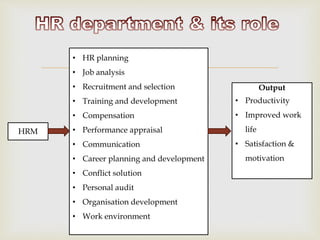
HRM
• HR planning
• Job analysis
• Recruitment and selection
• Training and development
• Compensation
• Performance appraisal
• Communication
• Career planning and development
• Conflict solution
• Personal audit
• Organisation development
• Work environment
Output
• Productivity
• Improved work
life
• Satisfaction &
motivation
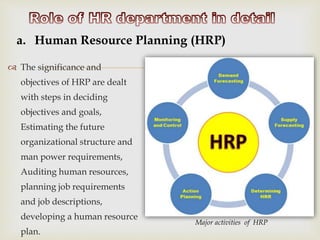
 The significance and
objectives of HRP are dealt
with steps in deciding
objectives and goals,
Estimating the future
organizational structure and
man power requirements,
Auditing human resources,
planning job requirements
and job descriptions,
developing a human resource
plan.
a. Human Resource Planning (HRP)
Major activities of HRP

 Right person in a Right place is the key factor of
succeeding the HRP in Apparel industry.
 It is in fact an important economic resource covering all
human resources organized or unorganized, employed or
capable of employment working at all levels supervisors,
executives, sewing section production master, cutting
section master, finishing section master, fabric section
executives and technical employees, sewing machine
operators, Helpers are involved in the Apparel Industry.
 Majority of the Garment sectors always recruiting 70% of
the women employees and 30% of the men employees.

 In apparel industry, constant true factor is considered to be
25% of the women employees’ absenteeism. This is due to
poor health condition or their family situations.
Steps in HRP:
 It may be rightly regarded as a multi-step process including
various issues, such as: Deciding objectives and goals
 Estimating future organisational structure and man power
requirements.
 Auditing human resources
 Planning job requirements and job descriptions.
 Developing a human resource plan.

b) Recruitment
 Textile industries promote the work of fashion designing,
product pattern and styles, so your human resources
strategy should focus on recruiting suitable skilled
manpower for the production function as well as sales and
marketing departments. Personnel in these areas are crucial
to the productivity, performance and bottom line of the
company.
c) Training
 Human resources personnel have to develop programs to
train employees to adapt to new technology that improves
production operations in a changing garment market.
 Typically, such training courses help employees enhance
their career growth and update new products for
competitiveness

 . Human resources should have a qualification system for
existing and new employees to determine their respective
training needs.
 For best results, align the training programs in home and
overseas subsidiaries with company’s strategic goals and
objectives.
d) Compensation Policy
 Human resources strategy should establish a salary and
compensation policy to encourage existing workforce to stay
and attract qualified candidates to your firm.
 Perform periodic reviews of salary levels and bonuses to
ensure workers satisfaction.

e) Work Environment
 Human resources should ensure a favorable working
environment. Implement safety and security measures,
such as having fire alarms, first aid and monitoring systems
in place.
 Establish a professional working environment. Spell out job
descriptions to avoid confusion. An open door policy can
improve communication and productivity when
implemented correctly.

 HR should find ways to align its aims and objectives with
the organizational mission and goals, for example,
proactive participation in addressing the quality and
productivity issues in various departments.
 HR functions should develop smart, user-friendly, and
effective staffing, development and compensation
procedures to support objectives of each functional area,
for example, production,merchandising, and R&D
(research and development).

 Helping the organization to search its goal.
 Employing the skills and the activities of the workforce
efficiently.
 Providing the organization with well trained and well
motivated employee.
 Increasing to the fullest the employee’s job satisfaction.
 Developing and maintaining quality of work life
 Communication
 Helping to other department and function

 The Textile Industries are not so attractive .But it can be made
more attractive and profit making with proper vision, mission
and strategic planning’s. Starting from the recruitments, the
talents and merits are to be given preferences and the people are
to be trained with feels of responsibility, ethical values and
discipline.
 The awareness and work culture are to be taught at all level.
Proper compensation to be paid at all level with zeal and the
transparency should be maintained. Feedbacks, suggestions,
relationship at all levels are to be maintained. Thick pay packet
cannot give 100% satisfaction but value addition, respect,
important, uniform code of conduct will bring the cheers among
the employees and that will a path for the progress.

Thank you!

Human Resource department

  • 2.
      Introduction  HRdepartment & its role  Steps for organizational development in apparel industry  Contribution of HRM  Conclusion
  • 3.
      Human resourcemanagement (HRM) in garment industry has been defined as the function in garment factory that facilitates the most effective utilization of human resource to achieve the objectives of both the garment factory and the employee.  HRM is known by different names – Personal management, personal administration, man power management.  The successful functioning of apparel industry is determined by the factors like men, material, money and market.  Among all these factors, manpower assumes greater significance.  Therefore, the way people are directed, motivated, or utilized will be decided on whether the organization will be prosperous and survive or fail.
  • 4.
     HRM • HR planning •Job analysis • Recruitment and selection • Training and development • Compensation • Performance appraisal • Communication • Career planning and development • Conflict solution • Personal audit • Organisation development • Work environment Output • Productivity • Improved work life • Satisfaction & motivation
  • 5.
     The significanceand objectives of HRP are dealt with steps in deciding objectives and goals, Estimating the future organizational structure and man power requirements, Auditing human resources, planning job requirements and job descriptions, developing a human resource plan. a. Human Resource Planning (HRP) Major activities of HRP
  • 6.
      Right personin a Right place is the key factor of succeeding the HRP in Apparel industry.  It is in fact an important economic resource covering all human resources organized or unorganized, employed or capable of employment working at all levels supervisors, executives, sewing section production master, cutting section master, finishing section master, fabric section executives and technical employees, sewing machine operators, Helpers are involved in the Apparel Industry.  Majority of the Garment sectors always recruiting 70% of the women employees and 30% of the men employees.
  • 7.
      In apparelindustry, constant true factor is considered to be 25% of the women employees’ absenteeism. This is due to poor health condition or their family situations. Steps in HRP:  It may be rightly regarded as a multi-step process including various issues, such as: Deciding objectives and goals  Estimating future organisational structure and man power requirements.  Auditing human resources  Planning job requirements and job descriptions.  Developing a human resource plan.
  • 8.
     b) Recruitment  Textileindustries promote the work of fashion designing, product pattern and styles, so your human resources strategy should focus on recruiting suitable skilled manpower for the production function as well as sales and marketing departments. Personnel in these areas are crucial to the productivity, performance and bottom line of the company. c) Training  Human resources personnel have to develop programs to train employees to adapt to new technology that improves production operations in a changing garment market.  Typically, such training courses help employees enhance their career growth and update new products for competitiveness
  • 9.
      . Humanresources should have a qualification system for existing and new employees to determine their respective training needs.  For best results, align the training programs in home and overseas subsidiaries with company’s strategic goals and objectives. d) Compensation Policy  Human resources strategy should establish a salary and compensation policy to encourage existing workforce to stay and attract qualified candidates to your firm.  Perform periodic reviews of salary levels and bonuses to ensure workers satisfaction.
  • 10.
     e) Work Environment Human resources should ensure a favorable working environment. Implement safety and security measures, such as having fire alarms, first aid and monitoring systems in place.  Establish a professional working environment. Spell out job descriptions to avoid confusion. An open door policy can improve communication and productivity when implemented correctly.
  • 11.
      HR shouldfind ways to align its aims and objectives with the organizational mission and goals, for example, proactive participation in addressing the quality and productivity issues in various departments.  HR functions should develop smart, user-friendly, and effective staffing, development and compensation procedures to support objectives of each functional area, for example, production,merchandising, and R&D (research and development).
  • 12.
      Helping theorganization to search its goal.  Employing the skills and the activities of the workforce efficiently.  Providing the organization with well trained and well motivated employee.  Increasing to the fullest the employee’s job satisfaction.  Developing and maintaining quality of work life  Communication  Helping to other department and function
  • 13.
      The TextileIndustries are not so attractive .But it can be made more attractive and profit making with proper vision, mission and strategic planning’s. Starting from the recruitments, the talents and merits are to be given preferences and the people are to be trained with feels of responsibility, ethical values and discipline.  The awareness and work culture are to be taught at all level. Proper compensation to be paid at all level with zeal and the transparency should be maintained. Feedbacks, suggestions, relationship at all levels are to be maintained. Thick pay packet cannot give 100% satisfaction but value addition, respect, important, uniform code of conduct will bring the cheers among the employees and that will a path for the progress.
  • 14.