Ethics in HR and IT
Why and how human resources are superior to physical
resources?
 HR alone appreciates over a period.
 HR achieves higher performance output than its actual input.
 HR brings value to all other assets.
 Operational flexibility is possible with HR.
Human Resource Management: Meaning
 Human resources mean the collection of people and their characteristics at work. These
are distinct and unique to an organization in several ways.
 Human resource management is concerned with policies and practices that ensure the
best
use of human resources for fulfilling organizational and individual goals.
 Personnel management: The personnel function is concerned with procurement,
compensation, integration, and maintenance of the personnel of the organization for the
purpose of contributing towards the accomplishment of the organization’s major goals or
objectives.
 HRM: HRM is the planning, organizing, directing, and controlling of the procurement,
development, compensation, integration, maintenance, and separation of human resources to
the end that individual, organizational and social objectives are accomplished.
 Human capital: Human capital management is the management of human capital which
refers to processes that relate to training, education, and other professional initiatives in
order to increase the level of knowledge, skills, abilities, and competencies embodied in
individuals that facilitate personal, organizational, social and economic well-being.
Meaning and Definition
Meaning and Definition of
HRD: HRD aims at developing competence of an employee which helps in meeting out the
requirements of not only his/her current job but also of the job(s) that he/she is likely to
undertake in not so distant future.
 SHRM: SHRM means formulation and execution of HR policies and practices that create
and develop human capital the organisation requires to accomplish strategic objectives.
Key Words
 PM - procurement, compensation, integration and maintenance, and
Organizational Objectives
HRM - planning, organizing, directing, and controlling of the procurement,
development, compensation, integration, maintenance, and separation –
Individual, Organizational and Societal Objectives.
HCM - Training, education, and other professional initiatives in order to
increase the level of knowledge, skills, abilities, and competencies - Personal,
organizational, social, and economic well-being.
Nature of HRM
 Pervasive Force
 Action-Oriented
 Individual-Oriented
 People-Oriented
 Development-Oriented
 Integrating Mechanism
 Challenging Function
 Auxiliary Service
 Inter-Disciplinary Function
 Continuous Function
Objectives of HRM
Four types of Objectives:
1. Societal Objectives
2. Organizational Objectives
3. Personal Objectives
4. Labor Union Objectives
Societal Objectives
Since the organization is part of society, the main objective of HRM is to be responsive to the needs and challenges of society
 To provide more employment opportunities
 To provide maximum productivity
 To help to maintain ethical policies and socially responsible behavior
 To encourage healthy human relations and social welfare
 To ensure compliance with legal and ethical standards.
 To minimize the negative impact of societal demands upon the organization.
Organizational Objectives
 To help the organizations to reach their goals
 To provide well-trained and well-motivated employees to the organization
 To develop and maintain a quality of work life that makes employment in
the organization desirable.
Personal Objectives
 To provide adequate remuneration to the employees
 To provide job security
 To provide facilities for proper training and development
 To increase the employees’job satisfaction and self-actualization
 To provide congenial working environment
Labor Union Objectives
 To recognize the labor unions
 To establish the personnel policies in consultation with unions
 To create congenial atmosphere with unions so as to maintain the
spirit of self-discipline and co-operation with the management.
Roles of the Human Resource Department
 Business Role (Operational , Managerial & Strategic Level)
 Enabler Role – Change
 Monitoring Role
 Innovator Role
 Adapter Role
Role of Human Resource Manager
1. Business Person:
 Shows concerns for organization’s growth
 Knows the market and what business is
 Has long-term vision of where business is headed
2. Shaper of change in accordance with business:
 Can create change in strategy
 Can think conceptually and articulate thoughts
Role of Human Resource Manager
3. Consultant to the organization:
 Has the ability to build commitment into action
 Responds to the organization’s needs
 Recognizes the importance of teamwork
4. Strategy/business planner:
 Knows the plan of top executives
 Develops and sells own plans and ideas
Role of Human Resource Manager
5. Talent Manager:
 Is capable of educating management
 Knows high-potential people and anticipates their concerns
6. HR asset manager/cost controller:
 Initiates action
 Can educate and sell management
 Can creatively measure effectiveness
Role of HR Managers (Today)
 Humanitarian Role: Reminding moral and ethical obligations to employees
 Counselor: Consultations to employees about marital, health, mental, physical and career problems.
 Mediator: Playing the role of a peacemaker during disputes, conflicts between individuals and groups and management.
 Spokesman: To represent of the company because he has better overall picture of his company’s operations.
 Problem Solver: Solving problems of overall human resource management and long-term organizational planning.
 Change Agent: Introducing and implementing institutional changes and installing organizational development programs
 Management of Manpower Resources: Broadly concerned with leadership both in the group and individual relationships and labor-
management relations.
Role of HR Managers (Future)
 Protection and enhancement of human and non-human resources
 Finding the best way of using people to accomplish organizational goals
 Improve organizational performance
 Integration of techniques of information technology with the human resources
 Utilizing behavioral scientists in the best way for his people
 Meeting challenges of increasing organizational effectiveness
 Managing diverse workforce and inclusion
Qualities of an HR Manager
 Knowledge
 Intelligence
 Communication skills
 Objectivity and fairness
 Leadership and motivational qualities
 Emotional maturity and
 Empathy
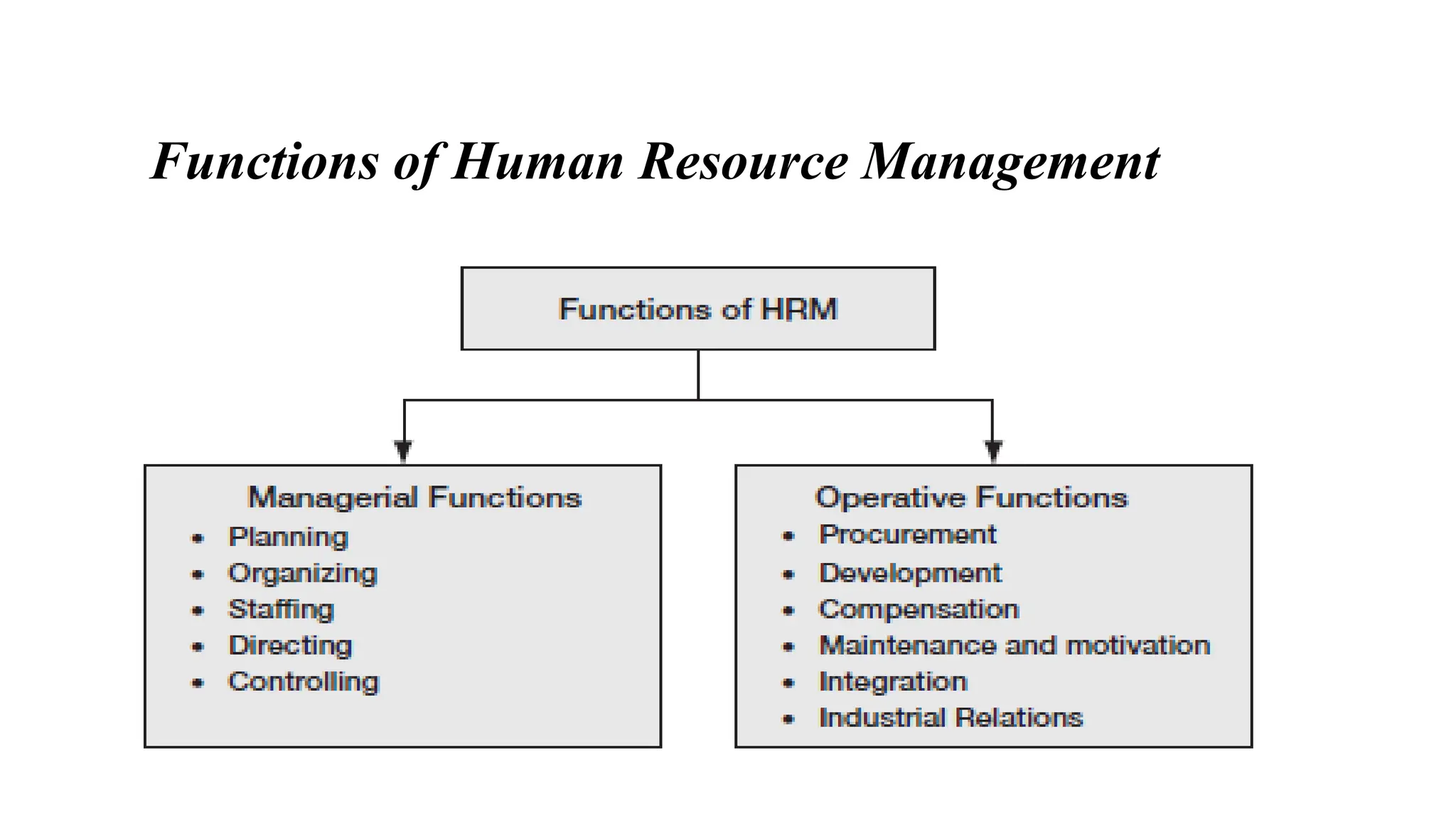
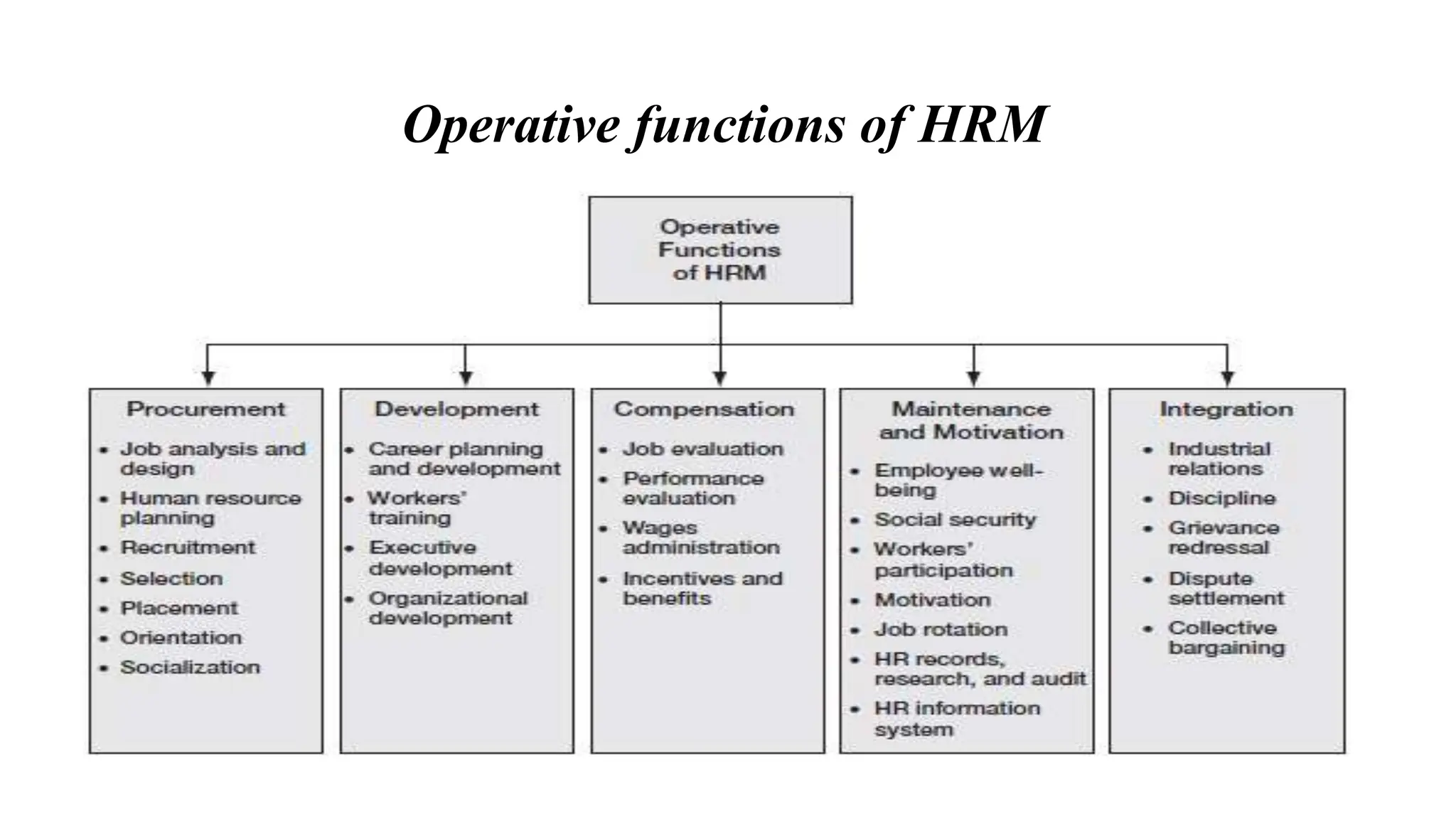
Functions of Human Resource Management
Operative functions of HRM
Scope of HRM
 The personnel or labor aspect deals with HR planning, recruitment, selection, placement,
training and development, remuneration, etc.
 The welfare aspect deals with working conditions and amenities such as the canteen,
restrooms, etc.
 The industrial relations aspect deals with union–management relations like collective
bargaining, grievance, and disciplinary actions, etc.
Factors that shape the HRM environment
The external environmental factors are
 Social environment factors
 Demographics
 Educational status
 Technological environment factors
 Political environment factors
 Nature of political organization and system
 Political stability
 Prevailing political ideologies
Factors that shape the HRM environment
 Legal environment factors
 Economic environment factors
 Labour market
 Globalization
 Competitors
 Trade unions
 Customers
 Shareholders
Factors that shape the HRM environment
Internal environmental factors
 The vision and mission of the organization
 Business strategy
 Organizational culture
 Organizational structure
 HR system
Changing Environment of HRM
 Technological challenges
 Empowerment of front-line employees
 Explosion of knowledge-based industries
 Basis of power in changing
 Workforce diversity
 Globalisation
 Trade unions
 Changing nature of jobs
 Statutory obligations – Sustainability – 17 Goals
 Others
HRM Challenges
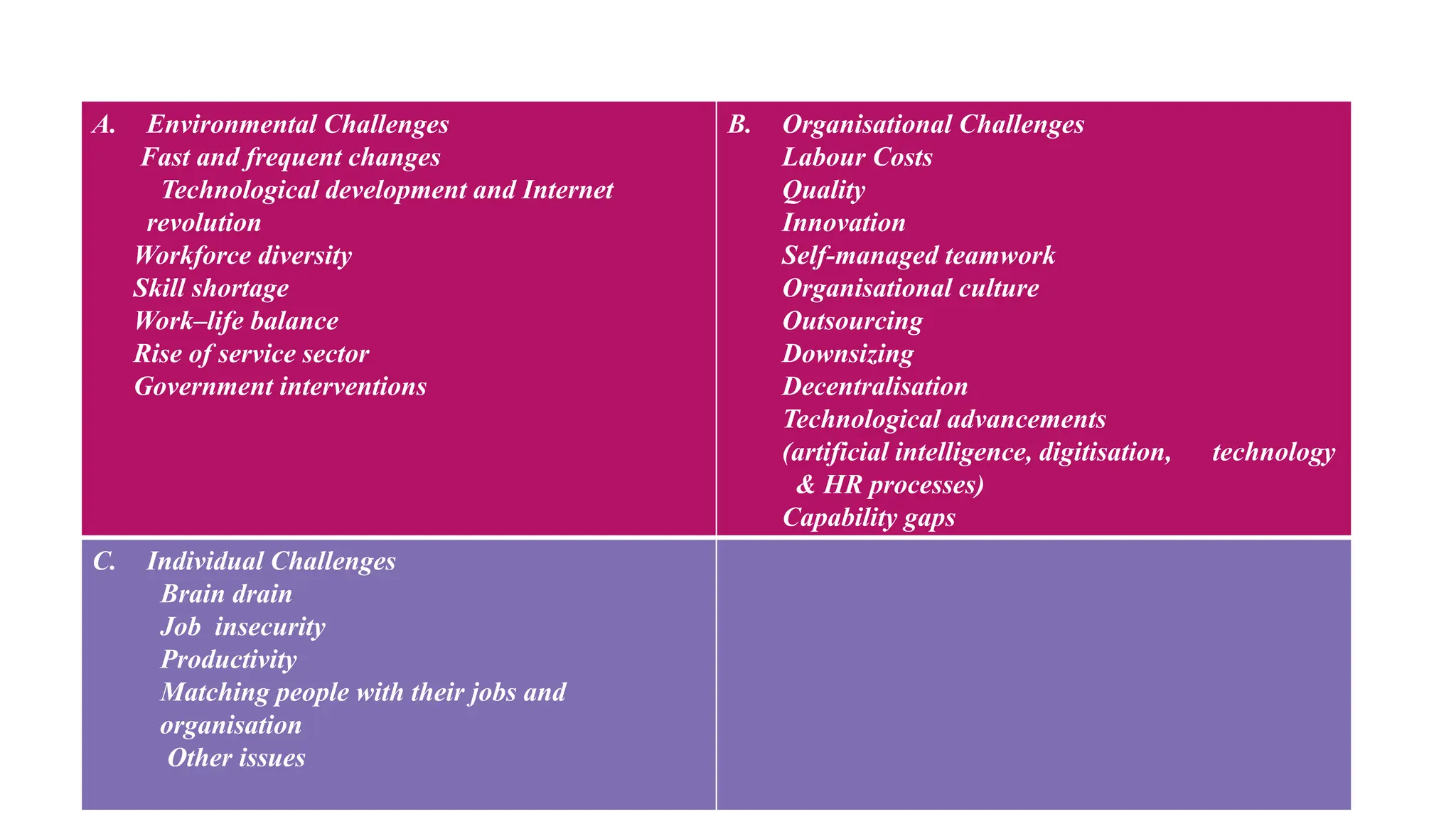
A. Environmental Challenges
Fast and frequent changes
Technological development and Internet
revolution
Workforce diversity
Skill shortage
Work–life balance
Rise of service sector
Government interventions
B. Organisational Challenges
Labour Costs
Quality
Innovation
Self-managed teamwork
Organisational culture
Outsourcing
Downsizing
Decentralisation
Technological advancements
(artificial intelligence, digitisation, technology
& HR processes)
Capability gaps
C. Individual Challenges
Brain drain
Job insecurity
Productivity
Matching people with their jobs and
organisation
Other issues
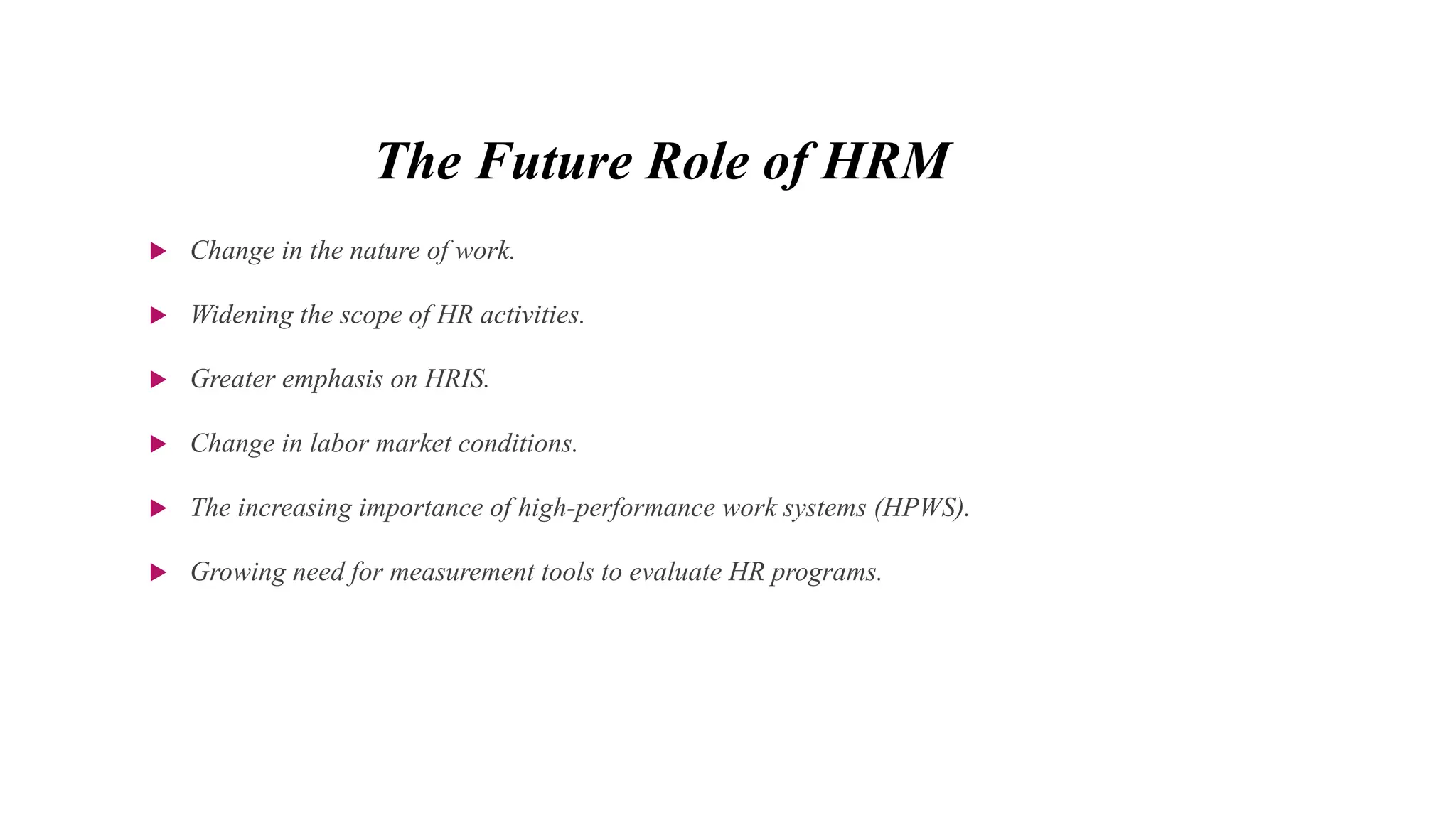
The Future Role of HRM
 Change in the nature of work.
 Widening the scope of HR activities.
 Greater emphasis on HRIS.
 Change in labor market conditions.
 The increasing importance of high-performance work systems (HPWS).
 Growing need for measurement tools to evaluate HR programs.
The HR Competencies
 Personal credibility: models the values of the organization, builds a trust-based relationship, and
demonstrates a conviction, based on evidence, about how business can win.
 Change management: leads change, able to diagnose problems, build client relations, articulate a vision,
and set a leadership agenda.
 Manage culture: custodian of the culture creates culture congruent with the strategy and vision, enrols
employees, and describes behaviour specific to the culture.
 Delivers human resource practices: expert in state-of-the-art innovative HR practices.
 Business knowledge: understands strategy, market, competitors, finance, IT, and so on.
Ethics in HRM
 Treatment of Employees
 Moral Obligations
 Compensation
 Development
 Industrial Relations
 Safety and Health Issues
Areas of Ethics
 Recruiting
 ERP Systems
 The Payroll Management
 Skills Management
 Discrimination
INTRODUCTION
 Management ethics is the ethical treatment of ; employees, stockholders, owners
and public by company.
 4 levels of organizational ethics; social responsibility – co decides to concentrate
on its long term goals for the benefit of society in general.
 Social disregard - co. shows carelessness for the consequences of its actions
 Social responsiveness – co adjusts its policies according to the social conditions,
demands, and pressures.
 Social obligation – co. does not wish to extend its activity any further than just
meeting its legal responsibilities.
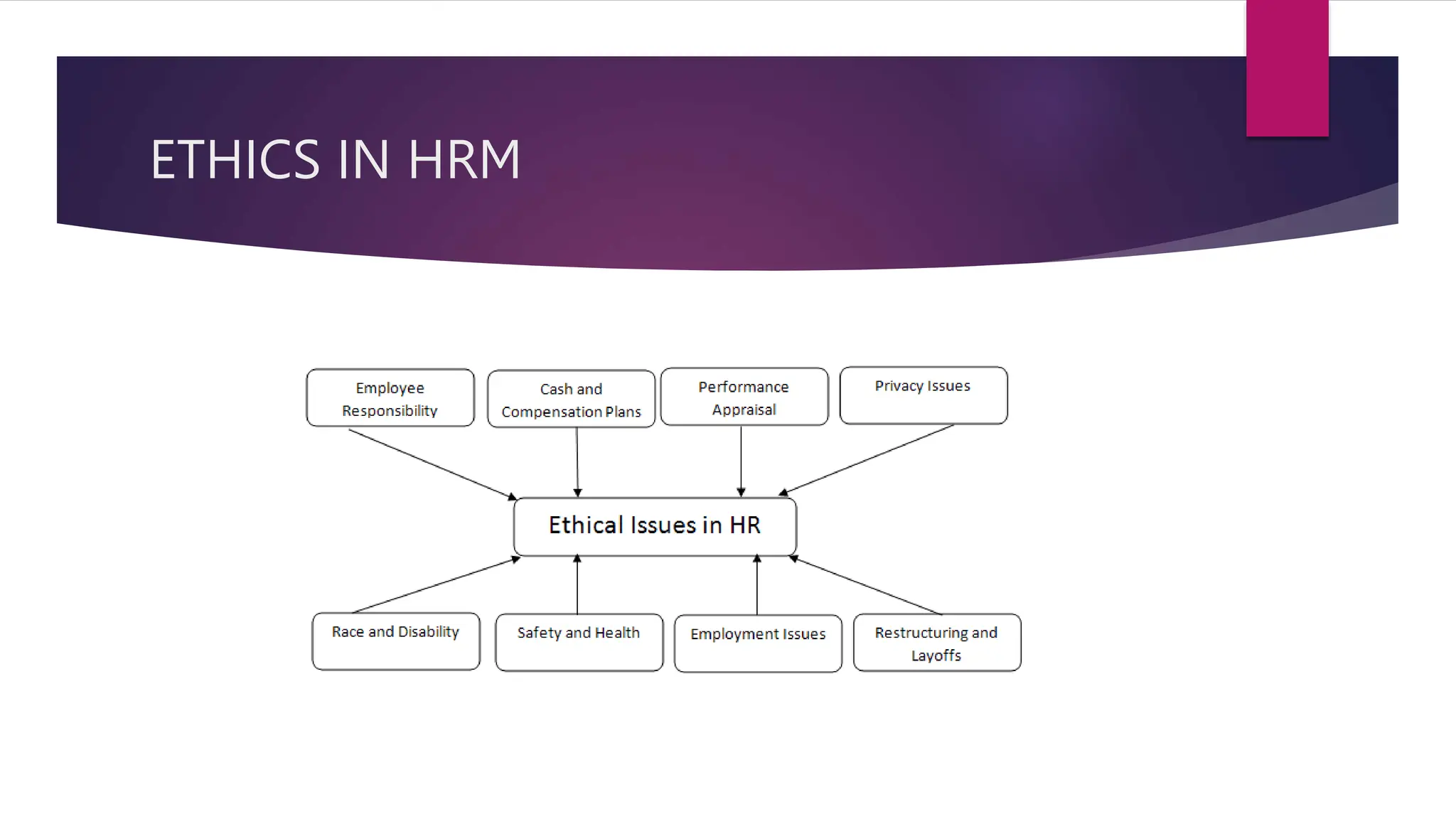
ETHICS IN HRM
NEED OF ETHICS IN HR
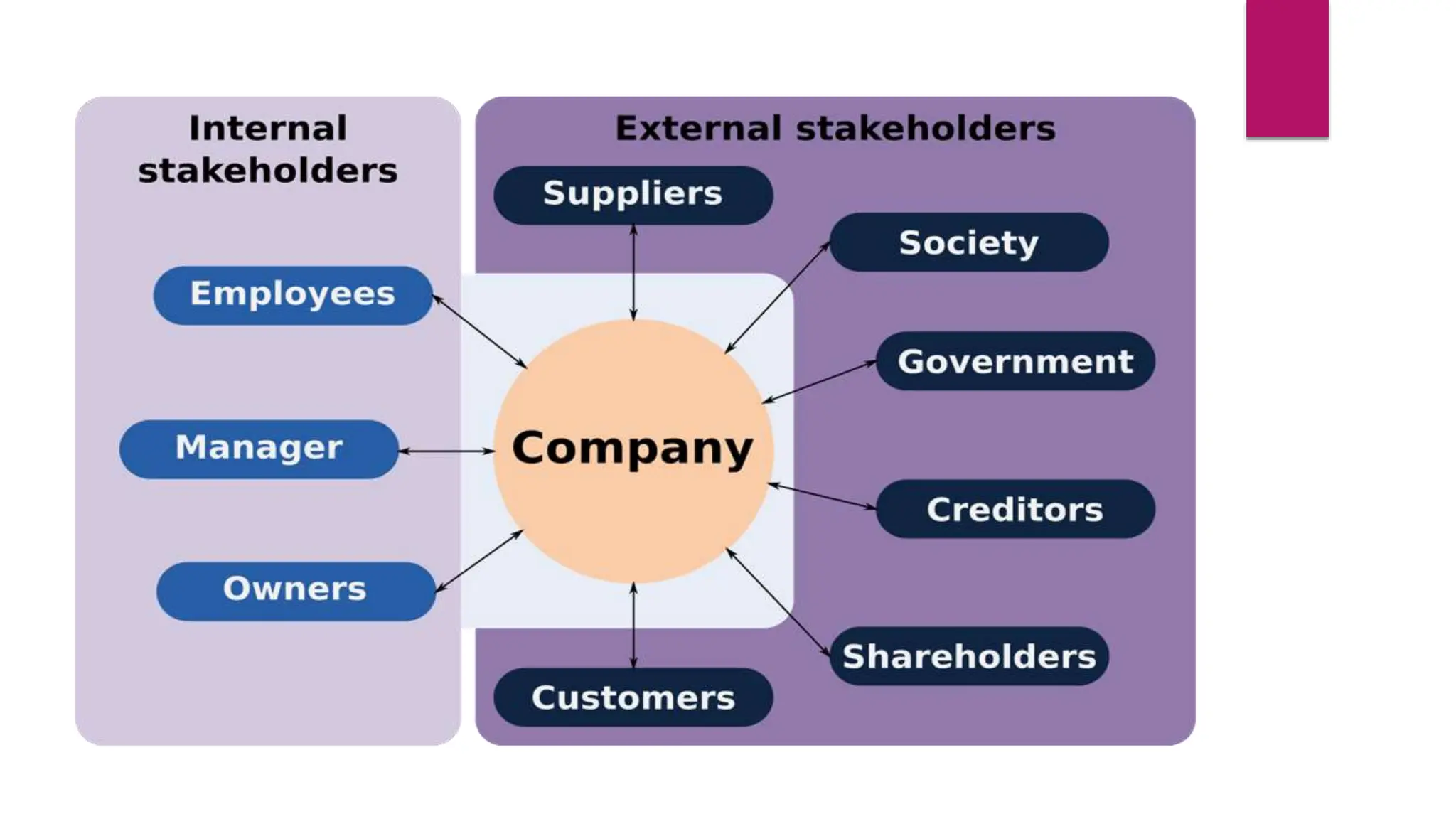
 Public image balancing all stakeholders
 Values
 Facilitates decision making
 Ethics and walk goes together
 Low limits, ethics stimulates
 Contribution to human welfare
 Protection of social interest.
 Recognition of neighbors and competitors
 Respect to employees
ETHICS/UNETHICS IN RECRUITMENT
 Placing misleading advertisement for jobs
 Misrepresenting the requirements of particular position.
 Responding to hiring manager who asked you to find a way around not hiring a
qualified candidates for discriminatory purposes.
 Not reviewing candidates based on their merits
 Matching a job with person or vice versa
 Role of outside pressure in selecting right candidates
 Selecting more than required no. of people
TRAINING
 Ethical issues arises: need identified based on one or nebulous factors
 Absence of training purpose and output.
 Trainee considering attending program merely for pleasure or just for a change
 Absence of training feedback
 Considered instrument of individual growth by employees.
 Training finished not completed
 No utilization of training infrastructure
 Unprepared trainer and completes without proper instruction
 Dull or monotonous feedback
PERFORMANCE APPRAISAL/ WAGES
 Central tendency, halo effect, mirror personality
 Improper appraisal system
 Unfair and unjust practices
 Same salary to sincere/hardworking to one whose contribution is least
 Loss suffering company expected to declare bonus
 Paying different salary to man /women working for same job
 Getting employee signing on full pay whereas paying less.
PRIVACY
 Not disclose publicly:
 Back ground information
 medical testing reports
 Monitoring on/off job
 Employee records
 Effective dismissal:
 Without legal or valid reason
 Explain the reason be firm with decision
 Process: informal action, disciplinary meeting, first written warning, second written
warning
WORKING CONDITIONS
 Health and safety
 Free from hazards; mechanical injury, burns, radiation, noisy machinery, rock dust, dust,
chemical fumes, skin irritants.
 Job satisfaction
 Horizontal / vertical
SEXUAL HARASSMENT
 Unwanted conduct of a sexual nature or other behaviors based on sex that affects the dignity of men or
women at work.
 This may include:
 touching
 remarks
 looks
 jokes
 attitude
 use of sexually explicitly languages
 sexual comments
 innuendos with a sexual connotation
 comment on dress
MEASURE TO CONTROL
 Establish ethical codes
 Improved remuneration
 Administrative reforms
 Disclosure of assets and gifts
 Policy and program rationalization
 Core values and competencies
 Ethical conducts by public servants
 Increasing and enforcing ethical awareness
 Taking actions against unethical conduct.
Unethical Practices in HRM
 Misusing Company Time
 Abusive Behaviour
 Employee Theft
 Lying to Employees
 Violating Company’s Internet PRactices
Workplace Ethics
 Ethics in the workplace refers to the moral code that guides the behaviour of
employees with respect to what is right and wrong in regard to conduct and
decision making.
 It refers to set of behavioural rules that create a positive environment at work.

 A strong work ethics can lead to employees being fairly treated, which in turn
motivates them and develops a sense of loyalty towards the organization.
Basic Workplace Ethics
 Rules and Regulations should be the same
 Company’s policy should be communicated clearly
 Respect the Employees
 Not Exploiting the Employees
 Give Space to Employees
 Do not be so strict with employees.
Importance of Workplace Ethics
 Superior Productivity
 Ethics Breeds Team Spirit
 Brand Value and Public Perception
 Embracing Change
 Smooth Implementation of Decisions and Policies
 Friction less Working
 Greater Success for the Business
How to Manage Ethics at Workplace?
 Understand the benefits of Ethical Conduct
 Focus on Ethical Conduct
 Develop a code of Ethical Conduct
 Promote Process
 Link Ethics to Other Management Practices
 Demonstrate Ethical Practices
Role of Management in Inculcating Ethics:
 Act as a source of Inspiration
 Constant Communication
 Don’t pressurize Employees
Factors Shaping Ethical Behaviour at
Workplace
 Personal Code of Ethics
 Legislation
 Government Rules and Regulations
 Ethical code of Company
 Social Pressure
 Ethical Climate of the Industry
Code of Conduct:
Set of principles, characterizes describes how an organization workers should behave in
premises
Individual Human Rights
 The right to healthy life and work safety.
 The right to privacy
 The right to private intellectual property.
 The right to descent.
 The right to fair treatment and no discrimination.
 The right to be treated by just due process.
Ethics in IT
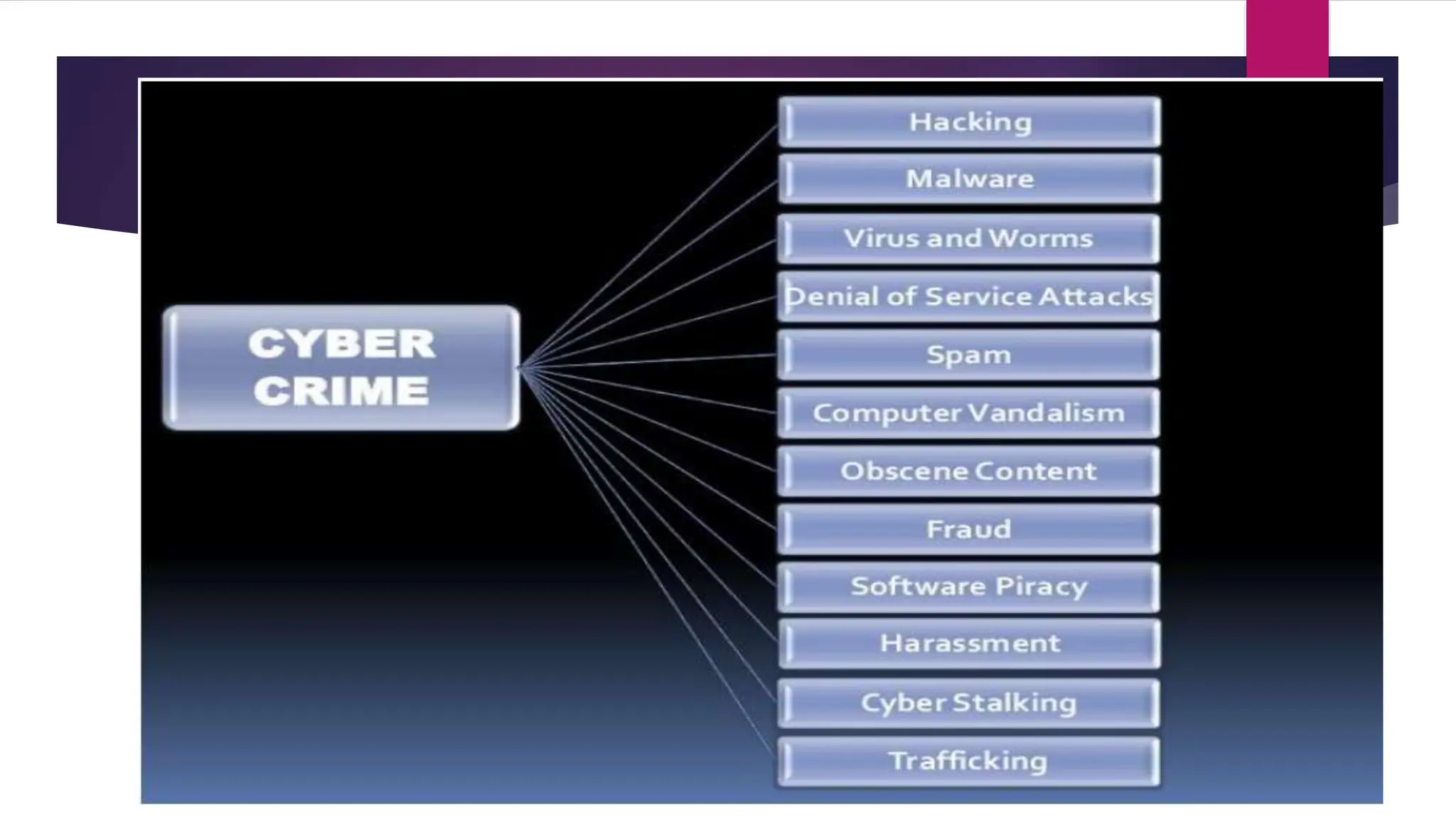
Public concern about the ethical use of information technology includes:
 E-mail and Internet access monitoring
 Peer-to-peer networks violation of copyright
 Unsolicited e-mail
 Hackers and identify theft
 Plagiarism
 Cookies and spyware
50
Ethics in IT
• The general public has not realized the critical importance of ethics
as applied to IT
• Important technical decisions are often left to technical experts
• General business managers must assume greater responsibility for
these decisions
• They must be able to make broad-minded, objective, ethical
decisions based on technical savvy, business know-how, and a sense
of ethics
• They must also try to create a working environment in which ethical
dilemmas can be discussed openly, objectively, and constructively
51
INFORMATION TECHNOLOGY
 Ethical dilemmas – hacking testing/immoral activity, genetical – testing/destroying
 Plagiarism is where the work of others is copied, but the author presents it as his or her own work.
 Piracy illegal copy of s/w Expert systems
 Hacking break or hack into system data collection/storage and access
 Computer crime illegal act /fraud/embezzlement
 Viruses vendor client issue
 Ergonomics/health issues not comply with screen resolution
 Job displacement/work pressure
 Digital divided gaps in terms of access to use and usage
 Gender female discrimination
 Nano tech various dangers to environment
COMPUTER CRIME
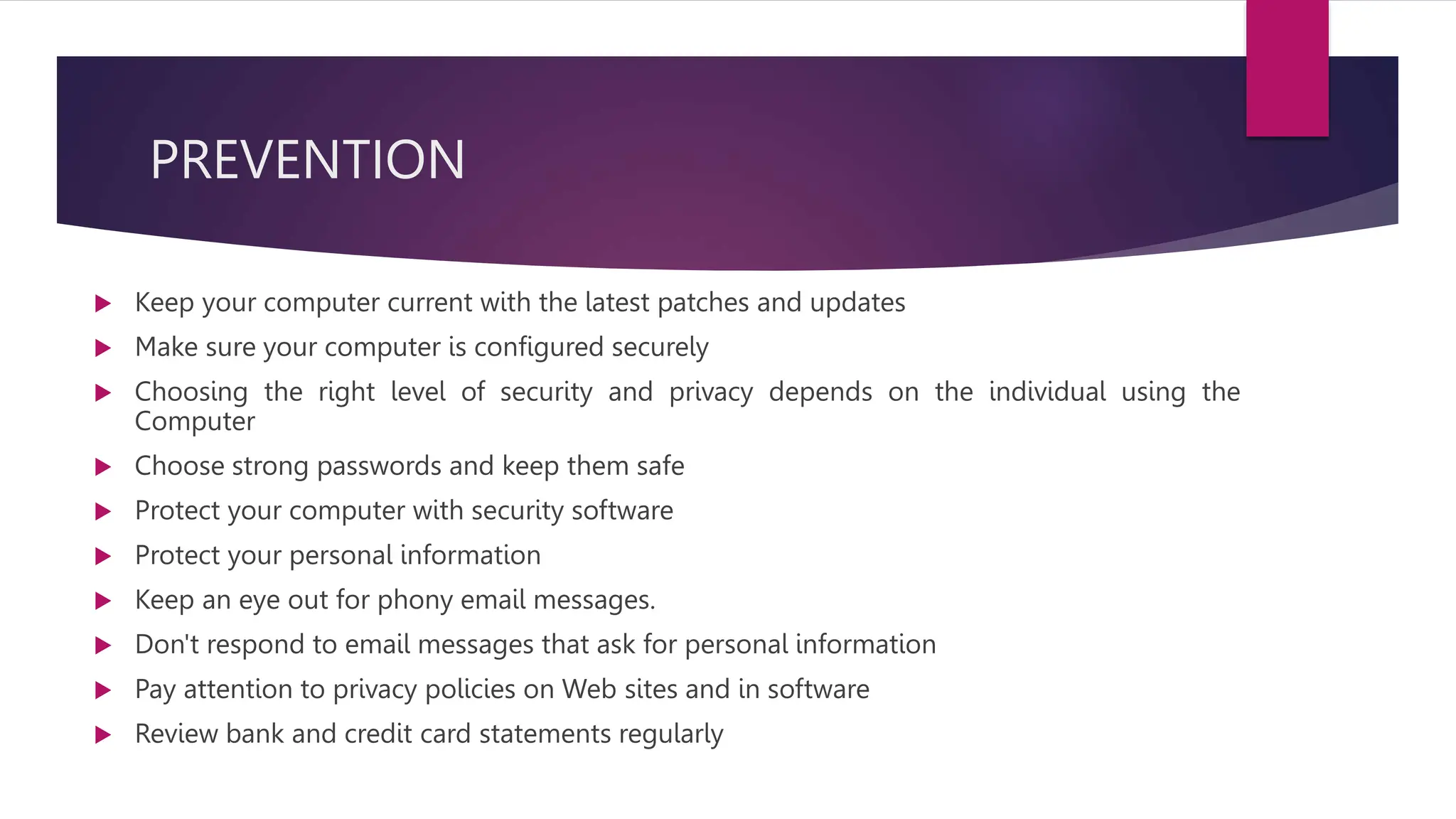
PREVENTION
 Keep your computer current with the latest patches and updates
 Make sure your computer is configured securely
 Choosing the right level of security and privacy depends on the individual using the
Computer
 Choose strong passwords and keep them safe
 Protect your computer with security software
 Protect your personal information
 Keep an eye out for phony email messages.
 Don't respond to email messages that ask for personal information
 Pay attention to privacy policies on Web sites and in software
 Review bank and credit card statements regularly

Ethics in HR and IT a brief not about how human resource is managed

  • 1.
  • 2.
    Why and howhuman resources are superior to physical resources?  HR alone appreciates over a period.  HR achieves higher performance output than its actual input.  HR brings value to all other assets.  Operational flexibility is possible with HR.
  • 3.
    Human Resource Management:Meaning  Human resources mean the collection of people and their characteristics at work. These are distinct and unique to an organization in several ways.  Human resource management is concerned with policies and practices that ensure the best use of human resources for fulfilling organizational and individual goals.
  • 4.
     Personnel management:The personnel function is concerned with procurement, compensation, integration, and maintenance of the personnel of the organization for the purpose of contributing towards the accomplishment of the organization’s major goals or objectives.  HRM: HRM is the planning, organizing, directing, and controlling of the procurement, development, compensation, integration, maintenance, and separation of human resources to the end that individual, organizational and social objectives are accomplished.  Human capital: Human capital management is the management of human capital which refers to processes that relate to training, education, and other professional initiatives in order to increase the level of knowledge, skills, abilities, and competencies embodied in individuals that facilitate personal, organizational, social and economic well-being. Meaning and Definition
  • 5.
    Meaning and Definitionof HRD: HRD aims at developing competence of an employee which helps in meeting out the requirements of not only his/her current job but also of the job(s) that he/she is likely to undertake in not so distant future.  SHRM: SHRM means formulation and execution of HR policies and practices that create and develop human capital the organisation requires to accomplish strategic objectives.
  • 6.
    Key Words  PM- procurement, compensation, integration and maintenance, and Organizational Objectives HRM - planning, organizing, directing, and controlling of the procurement, development, compensation, integration, maintenance, and separation – Individual, Organizational and Societal Objectives. HCM - Training, education, and other professional initiatives in order to increase the level of knowledge, skills, abilities, and competencies - Personal, organizational, social, and economic well-being.
  • 7.
    Nature of HRM Pervasive Force  Action-Oriented  Individual-Oriented  People-Oriented  Development-Oriented  Integrating Mechanism  Challenging Function  Auxiliary Service  Inter-Disciplinary Function  Continuous Function
  • 8.
    Objectives of HRM Fourtypes of Objectives: 1. Societal Objectives 2. Organizational Objectives 3. Personal Objectives 4. Labor Union Objectives
  • 9.
    Societal Objectives Since theorganization is part of society, the main objective of HRM is to be responsive to the needs and challenges of society  To provide more employment opportunities  To provide maximum productivity  To help to maintain ethical policies and socially responsible behavior  To encourage healthy human relations and social welfare  To ensure compliance with legal and ethical standards.  To minimize the negative impact of societal demands upon the organization.
  • 10.
    Organizational Objectives  Tohelp the organizations to reach their goals  To provide well-trained and well-motivated employees to the organization  To develop and maintain a quality of work life that makes employment in the organization desirable.
  • 11.
    Personal Objectives  Toprovide adequate remuneration to the employees  To provide job security  To provide facilities for proper training and development  To increase the employees’job satisfaction and self-actualization  To provide congenial working environment
  • 12.
    Labor Union Objectives To recognize the labor unions  To establish the personnel policies in consultation with unions  To create congenial atmosphere with unions so as to maintain the spirit of self-discipline and co-operation with the management.
  • 13.
    Roles of theHuman Resource Department  Business Role (Operational , Managerial & Strategic Level)  Enabler Role – Change  Monitoring Role  Innovator Role  Adapter Role
  • 14.
    Role of HumanResource Manager 1. Business Person:  Shows concerns for organization’s growth  Knows the market and what business is  Has long-term vision of where business is headed 2. Shaper of change in accordance with business:  Can create change in strategy  Can think conceptually and articulate thoughts
  • 15.
    Role of HumanResource Manager 3. Consultant to the organization:  Has the ability to build commitment into action  Responds to the organization’s needs  Recognizes the importance of teamwork 4. Strategy/business planner:  Knows the plan of top executives  Develops and sells own plans and ideas
  • 16.
    Role of HumanResource Manager 5. Talent Manager:  Is capable of educating management  Knows high-potential people and anticipates their concerns 6. HR asset manager/cost controller:  Initiates action  Can educate and sell management  Can creatively measure effectiveness
  • 17.
    Role of HRManagers (Today)  Humanitarian Role: Reminding moral and ethical obligations to employees  Counselor: Consultations to employees about marital, health, mental, physical and career problems.  Mediator: Playing the role of a peacemaker during disputes, conflicts between individuals and groups and management.  Spokesman: To represent of the company because he has better overall picture of his company’s operations.  Problem Solver: Solving problems of overall human resource management and long-term organizational planning.  Change Agent: Introducing and implementing institutional changes and installing organizational development programs  Management of Manpower Resources: Broadly concerned with leadership both in the group and individual relationships and labor- management relations.
  • 18.
    Role of HRManagers (Future)  Protection and enhancement of human and non-human resources  Finding the best way of using people to accomplish organizational goals  Improve organizational performance  Integration of techniques of information technology with the human resources  Utilizing behavioral scientists in the best way for his people  Meeting challenges of increasing organizational effectiveness  Managing diverse workforce and inclusion
  • 19.
    Qualities of anHR Manager  Knowledge  Intelligence  Communication skills  Objectivity and fairness  Leadership and motivational qualities  Emotional maturity and  Empathy
  • 20.
    Functions of HumanResource Management
  • 21.
  • 22.
    Scope of HRM The personnel or labor aspect deals with HR planning, recruitment, selection, placement, training and development, remuneration, etc.  The welfare aspect deals with working conditions and amenities such as the canteen, restrooms, etc.  The industrial relations aspect deals with union–management relations like collective bargaining, grievance, and disciplinary actions, etc.
  • 23.
    Factors that shapethe HRM environment The external environmental factors are  Social environment factors  Demographics  Educational status  Technological environment factors  Political environment factors  Nature of political organization and system  Political stability  Prevailing political ideologies
  • 24.
    Factors that shapethe HRM environment  Legal environment factors  Economic environment factors  Labour market  Globalization  Competitors  Trade unions  Customers  Shareholders
  • 25.
    Factors that shapethe HRM environment Internal environmental factors  The vision and mission of the organization  Business strategy  Organizational culture  Organizational structure  HR system
  • 26.
    Changing Environment ofHRM  Technological challenges  Empowerment of front-line employees  Explosion of knowledge-based industries  Basis of power in changing  Workforce diversity  Globalisation  Trade unions  Changing nature of jobs  Statutory obligations – Sustainability – 17 Goals  Others
  • 27.
    HRM Challenges A. EnvironmentalChallenges Fast and frequent changes Technological development and Internet revolution Workforce diversity Skill shortage Work–life balance Rise of service sector Government interventions B. Organisational Challenges Labour Costs Quality Innovation Self-managed teamwork Organisational culture Outsourcing Downsizing Decentralisation Technological advancements (artificial intelligence, digitisation, technology & HR processes) Capability gaps C. Individual Challenges Brain drain Job insecurity Productivity Matching people with their jobs and organisation Other issues
  • 28.
    The Future Roleof HRM  Change in the nature of work.  Widening the scope of HR activities.  Greater emphasis on HRIS.  Change in labor market conditions.  The increasing importance of high-performance work systems (HPWS).  Growing need for measurement tools to evaluate HR programs.
  • 29.
    The HR Competencies Personal credibility: models the values of the organization, builds a trust-based relationship, and demonstrates a conviction, based on evidence, about how business can win.  Change management: leads change, able to diagnose problems, build client relations, articulate a vision, and set a leadership agenda.  Manage culture: custodian of the culture creates culture congruent with the strategy and vision, enrols employees, and describes behaviour specific to the culture.  Delivers human resource practices: expert in state-of-the-art innovative HR practices.  Business knowledge: understands strategy, market, competitors, finance, IT, and so on.
  • 31.
    Ethics in HRM Treatment of Employees  Moral Obligations  Compensation  Development  Industrial Relations  Safety and Health Issues
  • 32.
    Areas of Ethics Recruiting  ERP Systems  The Payroll Management  Skills Management  Discrimination
  • 33.
    INTRODUCTION  Management ethicsis the ethical treatment of ; employees, stockholders, owners and public by company.  4 levels of organizational ethics; social responsibility – co decides to concentrate on its long term goals for the benefit of society in general.  Social disregard - co. shows carelessness for the consequences of its actions  Social responsiveness – co adjusts its policies according to the social conditions, demands, and pressures.  Social obligation – co. does not wish to extend its activity any further than just meeting its legal responsibilities.
  • 34.
  • 35.
    NEED OF ETHICSIN HR  Public image balancing all stakeholders  Values  Facilitates decision making  Ethics and walk goes together  Low limits, ethics stimulates  Contribution to human welfare  Protection of social interest.  Recognition of neighbors and competitors  Respect to employees
  • 36.
    ETHICS/UNETHICS IN RECRUITMENT Placing misleading advertisement for jobs  Misrepresenting the requirements of particular position.  Responding to hiring manager who asked you to find a way around not hiring a qualified candidates for discriminatory purposes.  Not reviewing candidates based on their merits  Matching a job with person or vice versa  Role of outside pressure in selecting right candidates  Selecting more than required no. of people
  • 37.
    TRAINING  Ethical issuesarises: need identified based on one or nebulous factors  Absence of training purpose and output.  Trainee considering attending program merely for pleasure or just for a change  Absence of training feedback  Considered instrument of individual growth by employees.  Training finished not completed  No utilization of training infrastructure  Unprepared trainer and completes without proper instruction  Dull or monotonous feedback
  • 38.
    PERFORMANCE APPRAISAL/ WAGES Central tendency, halo effect, mirror personality  Improper appraisal system  Unfair and unjust practices  Same salary to sincere/hardworking to one whose contribution is least  Loss suffering company expected to declare bonus  Paying different salary to man /women working for same job  Getting employee signing on full pay whereas paying less.
  • 39.
    PRIVACY  Not disclosepublicly:  Back ground information  medical testing reports  Monitoring on/off job  Employee records  Effective dismissal:  Without legal or valid reason  Explain the reason be firm with decision  Process: informal action, disciplinary meeting, first written warning, second written warning
  • 40.
    WORKING CONDITIONS  Healthand safety  Free from hazards; mechanical injury, burns, radiation, noisy machinery, rock dust, dust, chemical fumes, skin irritants.  Job satisfaction  Horizontal / vertical
  • 41.
    SEXUAL HARASSMENT  Unwantedconduct of a sexual nature or other behaviors based on sex that affects the dignity of men or women at work.  This may include:  touching  remarks  looks  jokes  attitude  use of sexually explicitly languages  sexual comments  innuendos with a sexual connotation  comment on dress
  • 42.
    MEASURE TO CONTROL Establish ethical codes  Improved remuneration  Administrative reforms  Disclosure of assets and gifts  Policy and program rationalization  Core values and competencies  Ethical conducts by public servants  Increasing and enforcing ethical awareness  Taking actions against unethical conduct.
  • 43.
    Unethical Practices inHRM  Misusing Company Time  Abusive Behaviour  Employee Theft  Lying to Employees  Violating Company’s Internet PRactices
  • 44.
    Workplace Ethics  Ethicsin the workplace refers to the moral code that guides the behaviour of employees with respect to what is right and wrong in regard to conduct and decision making.  It refers to set of behavioural rules that create a positive environment at work.   A strong work ethics can lead to employees being fairly treated, which in turn motivates them and develops a sense of loyalty towards the organization.
  • 45.
    Basic Workplace Ethics Rules and Regulations should be the same  Company’s policy should be communicated clearly  Respect the Employees  Not Exploiting the Employees  Give Space to Employees  Do not be so strict with employees.
  • 46.
    Importance of WorkplaceEthics  Superior Productivity  Ethics Breeds Team Spirit  Brand Value and Public Perception  Embracing Change  Smooth Implementation of Decisions and Policies  Friction less Working  Greater Success for the Business
  • 47.
    How to ManageEthics at Workplace?  Understand the benefits of Ethical Conduct  Focus on Ethical Conduct  Develop a code of Ethical Conduct  Promote Process  Link Ethics to Other Management Practices  Demonstrate Ethical Practices Role of Management in Inculcating Ethics:  Act as a source of Inspiration  Constant Communication  Don’t pressurize Employees
  • 48.
    Factors Shaping EthicalBehaviour at Workplace  Personal Code of Ethics  Legislation  Government Rules and Regulations  Ethical code of Company  Social Pressure  Ethical Climate of the Industry Code of Conduct: Set of principles, characterizes describes how an organization workers should behave in premises
  • 49.
    Individual Human Rights The right to healthy life and work safety.  The right to privacy  The right to private intellectual property.  The right to descent.  The right to fair treatment and no discrimination.  The right to be treated by just due process.
  • 50.
    Ethics in IT Publicconcern about the ethical use of information technology includes:  E-mail and Internet access monitoring  Peer-to-peer networks violation of copyright  Unsolicited e-mail  Hackers and identify theft  Plagiarism  Cookies and spyware 50
  • 51.
    Ethics in IT •The general public has not realized the critical importance of ethics as applied to IT • Important technical decisions are often left to technical experts • General business managers must assume greater responsibility for these decisions • They must be able to make broad-minded, objective, ethical decisions based on technical savvy, business know-how, and a sense of ethics • They must also try to create a working environment in which ethical dilemmas can be discussed openly, objectively, and constructively 51
  • 52.
    INFORMATION TECHNOLOGY  Ethicaldilemmas – hacking testing/immoral activity, genetical – testing/destroying  Plagiarism is where the work of others is copied, but the author presents it as his or her own work.  Piracy illegal copy of s/w Expert systems  Hacking break or hack into system data collection/storage and access  Computer crime illegal act /fraud/embezzlement  Viruses vendor client issue  Ergonomics/health issues not comply with screen resolution  Job displacement/work pressure  Digital divided gaps in terms of access to use and usage  Gender female discrimination  Nano tech various dangers to environment
  • 53.
  • 54.
    PREVENTION  Keep yourcomputer current with the latest patches and updates  Make sure your computer is configured securely  Choosing the right level of security and privacy depends on the individual using the Computer  Choose strong passwords and keep them safe  Protect your computer with security software  Protect your personal information  Keep an eye out for phony email messages.  Don't respond to email messages that ask for personal information  Pay attention to privacy policies on Web sites and in software  Review bank and credit card statements regularly