Did you know that
extinction isn’t
something that
happens in the
natural World?
Extinction in
Psychology
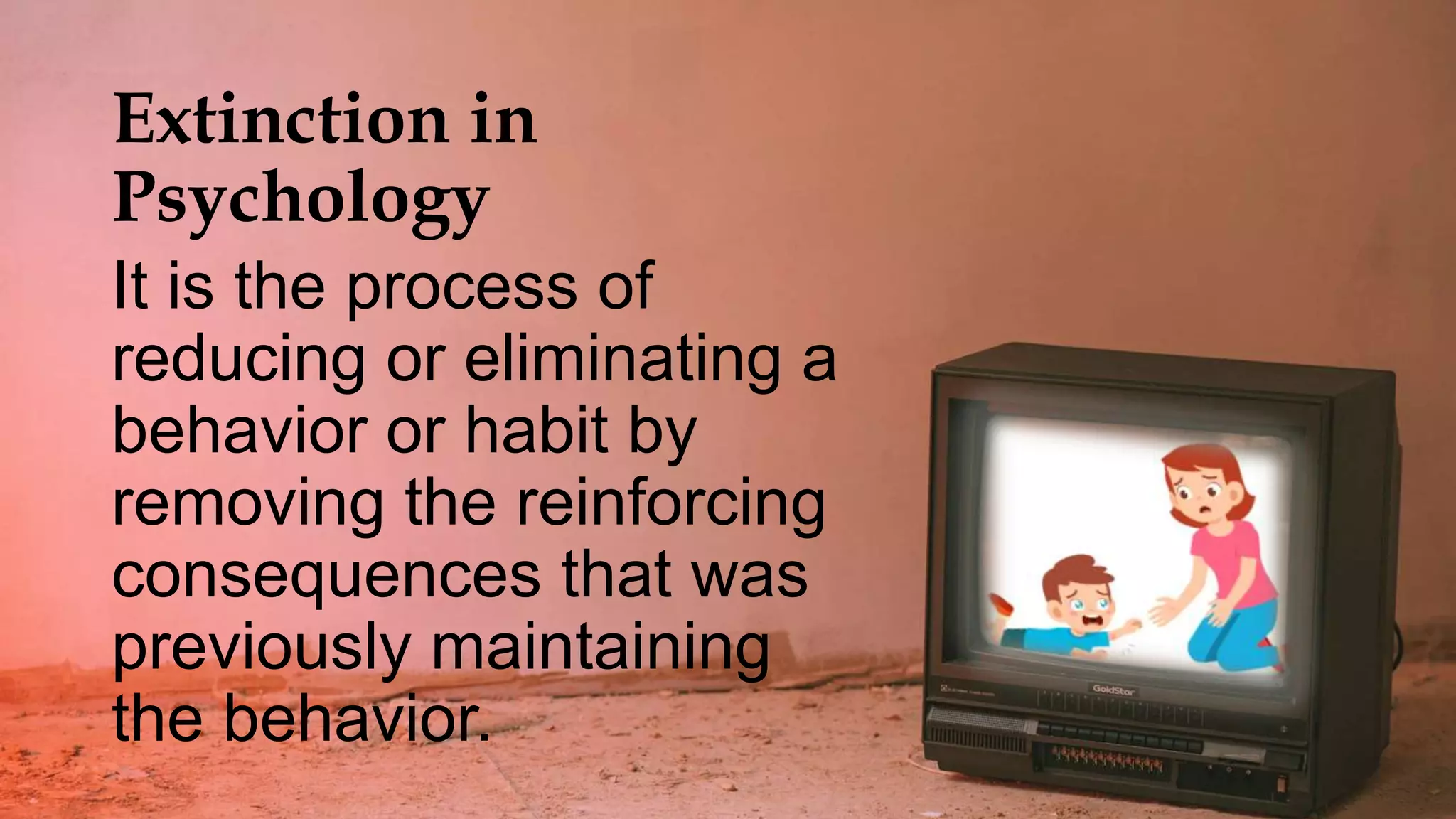
It is the process of
reducing or eliminating a
behavior or habit by
removing the reinforcing
consequences that was
previously maintaining
the behavior.
Why do we study
extinction?
• Helps to understand
how behaviors are
acquired and
maintained.
• Helps individuals
eliminate unwanted
behaviors.
• Helps to understand the
Real-Life Applications of
Extinction.
• Animal Training
• Marketing
• Parenting
• Phobia Treatment
• Behavior Modification
Classical Conditioning
• Classical conditioning is a
form of unconscious learning
that was popularized by Ivan
Pavlov , a Russian
physiologist.
• Classical conditioning (also
called Pavlovian
conditioning) refers to the
Classical Conditioning
• This explains how
extinction can occur in
classical conditioning
when the conditioned
stimulus is no longer
presented with the
unconditioned
stimulus.
Classical Conditioning
Classical conditioning
theory states that
behaviors are learned by
connecting a neutral
stimulus with a positive
one, such as Pavlov’s
dog hearing a
bell(neutral) and
expecting
Types of Stimulated
Responses
1.Unconditioned stimulus
(UCS):
naturally and automatically
triggers a response.
2.Unconditioned
response (UCR):
A response which occurs
automatically when the
unconditioned stimulus is
Types of Stimulated
Responses
3. Conditioned stimulus
(CS):
Is a previously neutral
stimulus that, through
repeated pairings with an
UCS, now causes a
conditioned response.
4.Conditioned Response
(CR):
Classical Conditioning
• It is often used a s a
therapeutic technique
to change or modify
negative behaviors
such as substance
use.
Classical Conditioning
Examples of how classical conditioning may work
differently in certain situations:
 Timing of the stimuli
 Nature of the unconditioned stimulus
 Previous experiences
 Novel stimuli
 Attention and arousal
Classical Conditioning
Challenging basic assumption
of classical conditioning:
1.Role of cognition
2.Biological factors
3.Context-dependent learning
4.Role of social learning
5.Complex learning
Principles of Classical
Conditioning
1. Acquisition:
Response happens
gradually.
2.Extinction:
Gradual disappearance of
a conditioned response.
Principles of Classical
Conditioning
3. Spontaneous
Recovery:
Reappearance of a
conditioned response to
conditioned stimulus.
Graphical
Representation
• This is the curve of acquisition,
extinction, and spontaneous
recovery.
• The rising curve shows the
conditioned response quickly
getting stronger through the
repeated pairing of the
conditioned stimulus and the
unconditioned stimulus
(acquisition).
• Then the curve decreases,
which shows how the
conditioned response
Example
When a child hears the
music of the ice cream
truck, they run to the door
because their parent
usually buys them ice
cream. After a few weeks of
not getting ice cream, the
child stops running to the
door. A month later, they
Generalization
• The process of adapting
knowledge to new,
similar circumstances is
known as
generalization.
Generalization
• For instance, a
youngster who gets
bitten by a dog can grow
afraid of all dogs, not
just the one who bit
them.
Discrimination
• The ability to distinguish
between similar stimuli
is known as
discrimination.
Discrimination
• A child might pet the
friendly dog while
avoiding the threatening
dog, for instance, if they
learn that one dog is
nice and the other one is
aggressive.
Overgeneralization
• A sort of generalization
called
overgeneralization
occurs when the
previously learned
response is used
excessively.
Overgeneralization
• For instance, someone
who fears spiders might
also avoid other harmless
insects with a similar
appearance, like
ladybirds.
• Overgeneralization may
cause unwanted anxiety
What is cue extinction in drug
addiction?
• Extinction is a term commonly
used in the field of drug
addiction to refer to the
process of reducing or
eliminating drug-seeking
behavior.
• Extinction typically involves
exposing an individual to cues
Importance of Treating Drug
Addiction
• Here are some key points
highlighting the importance
of treating drug addiction:
• Addiction is a chronic
disease that can have
devastating consequences
Importance of Treating Drug
Addiction
• Substance abuse and
addiction contribute to a range
of societal problems, including
crime, poverty, and
homelessness.
• Investing in addiction
treatment can ultimately save
How cue extinction is used in the
treatment of drug addiction?
• Cue extinction is a
behavioral therapy
technique that involves
exposing an individual to
cues or triggers associated
with their drug use in a safe
How cue extinction is used in the
treatment of drug addiction?
• The goal of cue extinction
is to reduce the individual's
conditioned response to
these cues and weaken the
association between the
cues and drug use.
How cue extinction is used in the
treatment of drug addiction?
• Extinction learning: During
cue exposure therapy, the
individual is repeatedly
exposed to drug-related cues
in the absence of the drug.
This process leads to a
gradual reduction in the
How cue extinction is used in the
treatment of drug addiction?
• Maintenance: Cue
extinction therapy may
require ongoing
maintenance to prevent
relapse.
Importance of Understanding
Extinction
• It provides insight into the
mechanisms of learning
and behavior.
• It offers a powerful tool for
modifying maladaptive
behaviors and promoting
Importance of Understanding
Extinction
• It can inform the
development of effective
treatments for psychological
disorders.
• Understanding extinction
can help individuals better
Essential Points of Extinction in
Psychology
• Extinction involves the
weakening and eventual
cessation of a learned
behavior.
• It occurs when a behavior
that was previously
Essential Points of Extinction in
Psychology
• Extinction is not the same as
forgetting or unlearning a
behavior; rather, it involves
the suppression of a
behavior due to lack of
reinforcement.
Essential Points of Extinction in
Psychology
• Extinction can result in the
emergence of new behaviors
or the resurgence of
previously extinct behaviors.
Implications of Extinction
• The use of extinction in
behavior therapy requires
careful consideration of several
factors.
• Spontaneous Recovery:
Extinction does not guarantee
Implications of Extinction
• Complex Behaviors: Extinction
can be difficult to apply to complex
behaviors that have multiple
reinforcing factors or are shaped
by multiple variables.
• Ethical Concerns: The use of
extinction in certain contexts, such
Evaluation of Extinction Principles in
Various Contexts
• Extinction in behavior
therapy reduces
problematic behaviors,
but can cause bursts
and ethical concerns by
withholding
Evaluation of Extinction Principles in
Various Contexts
• Extinction in animal
training can teach new
behaviors or eliminate
undesirable ones, but
incorrect implementation
may cause frustration
Evaluation of Extinction Principles in
Various Contexts
• Extinction in education
can promote positive
behavior and discourage
negative behavior, but
may also lead to the
unintended extinction of
desirable behaviors.
Extinction Presentation.pptx

Extinction Presentation.pptx

  • 3.
    Did you knowthat extinction isn’t something that happens in the natural World?
  • 4.
    Extinction in Psychology It isthe process of reducing or eliminating a behavior or habit by removing the reinforcing consequences that was previously maintaining the behavior.
  • 5.
    Why do westudy extinction? • Helps to understand how behaviors are acquired and maintained. • Helps individuals eliminate unwanted behaviors. • Helps to understand the
  • 6.
    Real-Life Applications of Extinction. •Animal Training • Marketing • Parenting • Phobia Treatment • Behavior Modification
  • 8.
    Classical Conditioning • Classicalconditioning is a form of unconscious learning that was popularized by Ivan Pavlov , a Russian physiologist. • Classical conditioning (also called Pavlovian conditioning) refers to the
  • 9.
    Classical Conditioning • Thisexplains how extinction can occur in classical conditioning when the conditioned stimulus is no longer presented with the unconditioned stimulus.
  • 10.
    Classical Conditioning Classical conditioning theorystates that behaviors are learned by connecting a neutral stimulus with a positive one, such as Pavlov’s dog hearing a bell(neutral) and expecting
  • 11.
    Types of Stimulated Responses 1.Unconditionedstimulus (UCS): naturally and automatically triggers a response. 2.Unconditioned response (UCR): A response which occurs automatically when the unconditioned stimulus is
  • 12.
    Types of Stimulated Responses 3.Conditioned stimulus (CS): Is a previously neutral stimulus that, through repeated pairings with an UCS, now causes a conditioned response. 4.Conditioned Response (CR):
  • 13.
    Classical Conditioning • Itis often used a s a therapeutic technique to change or modify negative behaviors such as substance use.
  • 14.
    Classical Conditioning Examples ofhow classical conditioning may work differently in certain situations:  Timing of the stimuli  Nature of the unconditioned stimulus  Previous experiences  Novel stimuli  Attention and arousal
  • 15.
    Classical Conditioning Challenging basicassumption of classical conditioning: 1.Role of cognition 2.Biological factors 3.Context-dependent learning 4.Role of social learning 5.Complex learning
  • 17.
    Principles of Classical Conditioning 1.Acquisition: Response happens gradually. 2.Extinction: Gradual disappearance of a conditioned response.
  • 18.
    Principles of Classical Conditioning 3.Spontaneous Recovery: Reappearance of a conditioned response to conditioned stimulus.
  • 19.
    Graphical Representation • This isthe curve of acquisition, extinction, and spontaneous recovery. • The rising curve shows the conditioned response quickly getting stronger through the repeated pairing of the conditioned stimulus and the unconditioned stimulus (acquisition). • Then the curve decreases, which shows how the conditioned response
  • 20.
    Example When a childhears the music of the ice cream truck, they run to the door because their parent usually buys them ice cream. After a few weeks of not getting ice cream, the child stops running to the door. A month later, they
  • 22.
    Generalization • The processof adapting knowledge to new, similar circumstances is known as generalization.
  • 23.
    Generalization • For instance,a youngster who gets bitten by a dog can grow afraid of all dogs, not just the one who bit them.
  • 24.
    Discrimination • The abilityto distinguish between similar stimuli is known as discrimination.
  • 25.
    Discrimination • A childmight pet the friendly dog while avoiding the threatening dog, for instance, if they learn that one dog is nice and the other one is aggressive.
  • 26.
    Overgeneralization • A sortof generalization called overgeneralization occurs when the previously learned response is used excessively.
  • 27.
    Overgeneralization • For instance,someone who fears spiders might also avoid other harmless insects with a similar appearance, like ladybirds. • Overgeneralization may cause unwanted anxiety
  • 29.
    What is cueextinction in drug addiction? • Extinction is a term commonly used in the field of drug addiction to refer to the process of reducing or eliminating drug-seeking behavior. • Extinction typically involves exposing an individual to cues
  • 30.
    Importance of TreatingDrug Addiction • Here are some key points highlighting the importance of treating drug addiction: • Addiction is a chronic disease that can have devastating consequences
  • 31.
    Importance of TreatingDrug Addiction • Substance abuse and addiction contribute to a range of societal problems, including crime, poverty, and homelessness. • Investing in addiction treatment can ultimately save
  • 32.
    How cue extinctionis used in the treatment of drug addiction? • Cue extinction is a behavioral therapy technique that involves exposing an individual to cues or triggers associated with their drug use in a safe
  • 33.
    How cue extinctionis used in the treatment of drug addiction? • The goal of cue extinction is to reduce the individual's conditioned response to these cues and weaken the association between the cues and drug use.
  • 34.
    How cue extinctionis used in the treatment of drug addiction? • Extinction learning: During cue exposure therapy, the individual is repeatedly exposed to drug-related cues in the absence of the drug. This process leads to a gradual reduction in the
  • 35.
    How cue extinctionis used in the treatment of drug addiction? • Maintenance: Cue extinction therapy may require ongoing maintenance to prevent relapse.
  • 37.
    Importance of Understanding Extinction •It provides insight into the mechanisms of learning and behavior. • It offers a powerful tool for modifying maladaptive behaviors and promoting
  • 38.
    Importance of Understanding Extinction •It can inform the development of effective treatments for psychological disorders. • Understanding extinction can help individuals better
  • 39.
    Essential Points ofExtinction in Psychology • Extinction involves the weakening and eventual cessation of a learned behavior. • It occurs when a behavior that was previously
  • 40.
    Essential Points ofExtinction in Psychology • Extinction is not the same as forgetting or unlearning a behavior; rather, it involves the suppression of a behavior due to lack of reinforcement.
  • 41.
    Essential Points ofExtinction in Psychology • Extinction can result in the emergence of new behaviors or the resurgence of previously extinct behaviors.
  • 42.
    Implications of Extinction •The use of extinction in behavior therapy requires careful consideration of several factors. • Spontaneous Recovery: Extinction does not guarantee
  • 43.
    Implications of Extinction •Complex Behaviors: Extinction can be difficult to apply to complex behaviors that have multiple reinforcing factors or are shaped by multiple variables. • Ethical Concerns: The use of extinction in certain contexts, such
  • 44.
    Evaluation of ExtinctionPrinciples in Various Contexts • Extinction in behavior therapy reduces problematic behaviors, but can cause bursts and ethical concerns by withholding
  • 45.
    Evaluation of ExtinctionPrinciples in Various Contexts • Extinction in animal training can teach new behaviors or eliminate undesirable ones, but incorrect implementation may cause frustration
  • 46.
    Evaluation of ExtinctionPrinciples in Various Contexts • Extinction in education can promote positive behavior and discourage negative behavior, but may also lead to the unintended extinction of desirable behaviors.

Editor's Notes

  • #4 Extinction in the natural world: termination of a species of organisms. The word extinction is not only limited to the natura world. General meaning of extinction: the process of a particular thing ceasing to exist.
  • #5 In context of psychology, extinction is the reduction of human behavior or habit. READ THE DEFINITION Example: A child throwing a tantrum (zid) for something that he wants in front of his parents. The parent gives in to his tantrums and gets the child what they want. This reinforces the behavior of throwing tantrums when you don’t get what you want. But when the parent stops giving in to the child’s tantrums, the child stops throwing tantrums as it is no longer giving the desired outcome. Now how do you reduce or eliminate a habit or behavior? READ THE FULL DEFINITION Behavior: throwing tantrums Consequences: Parents getting the child what they want.
  • #6 Behaviors are acquired by getting a desired outcome repeatedly, and are reinforced every time that behavior results in the desired outcome. Eliminate unwanted behaviors: for example: if a person has developed a fear of dogs, extinction therapy can help them overcome that fear by gradually exposing them to dogs without any negative consequences. Punishment is the process of applying negative consequences to a behavior with the aim of decreasing the possibility of that the behavior will occur again in the future. Effects of punishment may vary, depending on factors such as consistency of the punishment. It is a complex process as it may actually increase the frequency of the unwanted behavior if the punishment is not consistent or perceived as unjust. Extinction tells us that the punishment is more effective when it is consistent and delivered right after the behavior occurs.
  • #7 BEHAVIOUR MODIFICATION: NAIL BITING BEHAVIOR: For example a person’s nail biting behavior is reinforced by the physical sensation and reduction in anxiety or boredom. The reinforcement must be stopped by withholding the physical sensation and finding alternative ways to reduce anxiety or boredom. The individual could wear gloves, and engage in other activities to manage their anxiety and boredom, such as drawing, breathing exercises etc. After a while the person will learn nail-biting is no longer giving the desired outcome of the physical sensation, and learn new ways of reducing their anxiety and boredom. The habit of nail biting will be gradually reduced. PHOBIA TREATMENT: FEAR OF DOGS: Suppose a person has a fear of dogs due to a traumatic experience with a dog in the past. A therapist might gradually expose the individual dogs in a safe and controlled environment. Keeping the individual safe from the negative consequences. Overtime the individual will learn that dogs are not as dangerous as they initially believed through the process of extinction. PARENTING: CHILD THROWING TANTRUMS: MARKETING: DISCOUNTS: If a company offers discounts regularly, the consumers may wait for the discounts before purchasing the product. If the company reduces the frequency of discounts, the consumers may purchase the product without waiting for discounts. ANIMAL TRAINING: DOG BARKING: If you want to teach a dog to stop barking, identify what the dog is trying to get out from barking. It maybe to get attention. If the dog is barking for attention, you should ignore he barking and provide attention only when the dog is not barking.
  • #12 The dog responds to the food in a natural way. Salvation is response to the food.
  • #13 The dog learns to connect light or chime with the desired reaction. Salvation in reaction to light or bell, because the dog learns to link that response to the conditioned stimulus.
  • #18 ACQUISITION It is the initial stage of learning in classical conditioning. During which an organism learns to link a benign signal and an unconditioned stimulus. In the course of learning, the neutral stimulus starts to cause the conditioned response. Ultimately it develops into a conditioned stimulus that can cause the conditioned response on its own. EXTINCTION When the conditioned stimulus is no longer associated with an unconditioned stimulus. It leads to a decrease or complete disappearance of the conditioned response.
  • #19 SPONTANEOUS RECOVERY Even after extinction has occurred, the conditioned response may not be gone forever. After a pause, when the conditioned stimulus is again presented alone, the behavior may again occur. And then again show extinction.
  • #38 Understanding extinction in psychology is crucial for several reasons.
  • #39 It can also promote empathy and compassion by highlighting the importance of reinforcement and its role in shaping behavior.
  • #40 There are several key points to consider when discussing extinction in psychology.
  • #41 such as the frequency and consistency of reinforcement, the timing and type of reinforcement, and the presence of alternative sources of reinforcement.
  • #43 The implications of extinction in psychology and behavior therapy are significant. It can be used to reduce or eliminate problematic behaviors, such as substance abuse, aggression, and phobias.
  • #44 extinction bursts (temporary increases in the frequency or intensity of the behavior), the ethical implications of withholding reinforcement, and the need for alternative sources of reinforcement.
  • #45 The use of extinction principles in various contexts has both potential benefits and drawbacks.