UNIT-2
EXTERNALITIES
Public and Environemtal goods
◦In economics, a public good refers to a commodity or service that is
made available to all members of a society.
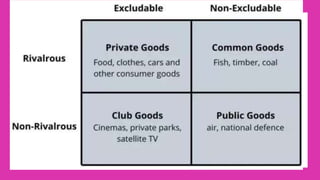
◦Pure public goods have two defining features. One is ‘non‐rivalry,’
meaning that one person’s enjoyment of a good does not diminish the
ability of other people to enjoy the same good.
◦The other is ‘non‐excludability,’ meaning that people cannot be
prevented from enjoying the good.
Public and Environemtal goods
◦Air quality is an important environmental example of a public good.
Under most circumstances, one person’s breathing of fresh air does
not reduce air quality for others to enjoy, and people cannot be
prevented from breathing the air.
◦Public goods are defined in contrast to private goods, which are, by
definition, both rival and excludable.
◦Examples of public goods- national defence, Clean air, water quality,
open space, biodiversity, stable climate etc.
◦However, sometimes the evironmental goods are questioned to be pure
public goods or not.
Public and Environemtal goods
◦Environmental goods are typically non-market goods, including clean
air, clean water, landscape, green transport infrastructure (footpaths,
cycleways, greenways, etc.), public parks, urban parks, rivers, mountains,
forests, and beaches. Environmental goods are a sub-category of public
goods.
◦These environmental goods turn into 'Bads' when they have externalities
which are negative.
Positive and Negative Externalities
◦An externality is a cost or benefit caused by a producer that is not
financially incurred or received by that producer. An externality can be
both positive or negative and can stem from either the production or
consumption of a good or service. The costs and benefits can be both
private—to an individual or an organization—or social, meaning it can
affect society as a whole.
◦Externalities occur in an economy when the production or consumption
of a specific good or service impacts a third party that is not directly
related to the production or consumption of that good or service.
Sources to refer
◦ https://resources.environment.yale.edu/kotchen/pubs/pgchap.pdf

Externalities in Environmental Economics

  • 1.
  • 2.
    Public and Environemtalgoods ◦In economics, a public good refers to a commodity or service that is made available to all members of a society. ◦Pure public goods have two defining features. One is ‘non‐rivalry,’ meaning that one person’s enjoyment of a good does not diminish the ability of other people to enjoy the same good. ◦The other is ‘non‐excludability,’ meaning that people cannot be prevented from enjoying the good.
  • 3.
    Public and Environemtalgoods ◦Air quality is an important environmental example of a public good. Under most circumstances, one person’s breathing of fresh air does not reduce air quality for others to enjoy, and people cannot be prevented from breathing the air. ◦Public goods are defined in contrast to private goods, which are, by definition, both rival and excludable. ◦Examples of public goods- national defence, Clean air, water quality, open space, biodiversity, stable climate etc. ◦However, sometimes the evironmental goods are questioned to be pure public goods or not.
  • 6.
    Public and Environemtalgoods ◦Environmental goods are typically non-market goods, including clean air, clean water, landscape, green transport infrastructure (footpaths, cycleways, greenways, etc.), public parks, urban parks, rivers, mountains, forests, and beaches. Environmental goods are a sub-category of public goods. ◦These environmental goods turn into 'Bads' when they have externalities which are negative.
  • 7.
    Positive and NegativeExternalities ◦An externality is a cost or benefit caused by a producer that is not financially incurred or received by that producer. An externality can be both positive or negative and can stem from either the production or consumption of a good or service. The costs and benefits can be both private—to an individual or an organization—or social, meaning it can affect society as a whole. ◦Externalities occur in an economy when the production or consumption of a specific good or service impacts a third party that is not directly related to the production or consumption of that good or service.
  • 8.
    Sources to refer ◦https://resources.environment.yale.edu/kotchen/pubs/pgchap.pdf