1 
THEORETICAL BASES OF NATURAL SCIENCE 
EDUCATION - II 
ONLINE 
ASSIGNMEMNT 
TOPIC: PISCICULTURE 
Submitted to 
NasiyaM, 
Sabarigiri College of 
Teachers Education, 
Anchal 
Submitted By 
Ajeesh Kumar. N 
Natural Science 
Reg No: 13379001 
Submitted on : 29/08/2014
2 
SL. NO 
CONTENT 
PAGE NO 
1. 
2. 
3. 
4. 
5. 
INTRODUCTION 
MAJOR CATEGORIES 
TYPES OF FISH FARMS 
CONCLUSION 
REFERENCE 
3 
3-4 
4-6 
6 
7
3 
INTRODUCTION 
Fish farming is the principal form of aquaculture, while other methods may fall 
under mariculture. Fish farming involves raising fish commercially in tanks or 
enclosures, usually for food. A facility that releases juvenile fish into the wild for 
recreational fishing or to supplement a species' natural numbers is generally referred 
to as a fish hatchery. Worldwide, the most important fish species used in fish farming 
are carp, salmon, tilapia and catfish. 
There is an increasing demand for fish and fish protein, which has resulted in 
widespread overfishing in wild fisheries. Fish farming offers fish marketers another 
source. However, farming carnivorous fish, such as salmon, does not always reduce 
pressure on wild fisheries, since carnivorous farmed fish are usually fed fishmeal and 
fish oil extracted from wild forage fish. The global returns for fish farming recorded 
by the FAO in 2008 totalled 33.8 million tonnes worth about $US 60 billion. 
Majorcategories of fish aquaculture 
There are two kinds of aquaculture: extensive aquaculture based on local 
photosyntheticalproduction and intensive aquaculture, in which the fish are fed 
with external food supply. 
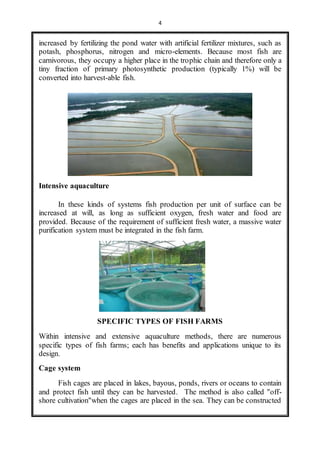
Extensive aquaculture 
Limiting for growth here is the available food supply by natural sources, 
commonly zooplankton feeding on pelagic algae or benthic animals, such as 
crustaceans and mollusks. Tilapia species filter feed directly on phytoplankton, 
which makes higher production possible. The photosynthetic production can be
4 
increased by fertilizing the pond water with artificial fertilizer mixtures, such as 
potash, phosphorus, nitrogen and micro-elements. Because most fish are 
carnivorous, they occupy a higher place in the trophic chain and therefore only a 
tiny fraction of primary photosynthetic production (typically 1%) will be 
converted into harvest-able fish. 
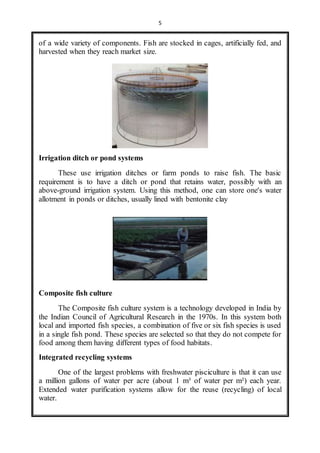
Intensive aquaculture 
In these kinds of systems fish production per unit of surface can be 
increased at will, as long as sufficient oxygen, fresh water and food are 
provided. Because of the requirement of sufficient fresh water, a massive water 
purification system must be integrated in the fish farm. 
SPECIFIC TYPES OF FISH FARMS 
Within intensive and extensive aquaculture methods, there are numerous 
specific types of fish farms; each has benefits and applications unique to its 
design. 
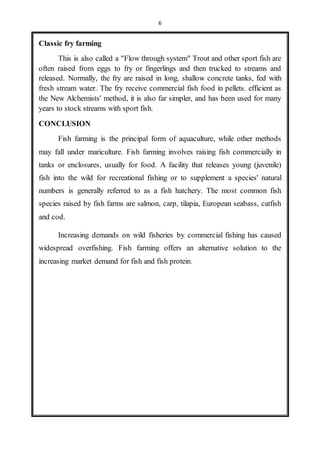
Cage system 
Fish cages are placed in lakes, bayous, ponds, rivers or oceans to contain 
and protect fish until they can be harvested. The method is also called "off-shore 
cultivation"when the cages are placed in the sea. They can be constructed
5 
of a wide variety of components. Fish are stocked in cages, artificially fed, and 
harvested when they reach market size. 
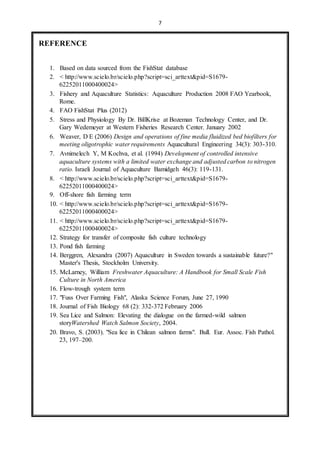
Irrigation ditch or pond systems 
These use irrigation ditches or farm ponds to raise fish. The basic 
requirement is to have a ditch or pond that retains water, possibly with an 
above-ground irrigation system. Using this method, one can store one's water 
allotment in ponds or ditches, usually lined with bentonite clay 
Composite fish culture 
The Composite fish culture system is a technology developed in India by 
the Indian Council of Agricultural Research in the 1970s. In this system both 
local and imported fish species, a combination of five or six fish species is used 
in a single fish pond. These species are selected so that they do not compete for 
food among them having different types of food habitats. 
Integrated recycling systems 
One of the largest problems with freshwater pisciculture is that it can use 
a million gallons of water per acre (about 1 m³ of water per m²) each year. 
Extended water purification systems allow for the reuse (recycling) of local 
water.
6 
Classic fry farming 
This is also called a "Flow through system" Trout and other sport fish are 
often raised from eggs to fry or fingerlings and then trucked to streams and 
released. Normally, the fry are raised in long, shallow concrete tanks, fed with 
fresh stream water. The fry receive commercial fish food in pellets. efficient as 
the New Alchemists' method, it is also far simpler, and has been used for many 
years to stock streams with sport fish. 
CONCLUSION 
Fish farming is the principal form of aquaculture, while other methods 
may fall under mariculture. Fish farming involves raising fish commercially in 
tanks or enclosures, usually for food. A facility that releases young (juvenile) 
fish into the wild for recreational fishing or to supplement a species' natural 
numbers is generally referred to as a fish hatchery. The most common fish 
species raised by fish farms are salmon, carp, tilapia, European seabass, catfish 
and cod. 
Increasing demands on wild fisheries by commercial fishing has caused 
widespread overfishing. Fish farming offers an alternative solution to the 
increasing market demand for fish and fish protein.
7 
REFERENCE 
1. Based on data sourced from the FishStat database 
2. < http://www.scielo.br/scielo.php?script=sci_arttext&pid=S1679- 
62252011000400024> 
3. Fishery and Aquaculture Statistics: Aquaculture Production 2008 FAO Yearbook, 
Rome. 
4. FAO FishStat Plus (2012) 
5. Stress and Physiology By Dr. BiIlKrise at Bozeman Technology Center, and Dr. 
Gary Wedemeyer at Western Fisheries Research Center. January 2002 
6. Weaver, D E (2006) Design and operations of fine media fluidized bed biofilters for 
meeting oligotrophic water requirements Aquacultural Engineering 34(3): 303-310. 
7. Avnimelech Y, M Kochva, et al. (1994) Development of controlled intensive 
aquaculture systems with a limited water exchange and adjusted carbon to nitrogen 
ratio. Israeli Journal of Aquaculture Bamidgeh 46(3): 119-131. 
8. < http://www.scielo.br/scielo.php?script=sci_arttext&pid=S1679- 
62252011000400024> 
9. Off-shore fish farming term 
10. < http://www.scielo.br/scielo.php?script=sci_arttext&pid=S1679- 
62252011000400024> 
11. < http://www.scielo.br/scielo.php?script=sci_arttext&pid=S1679- 
62252011000400024> 
12. Strategy for transfer of composite fish culture technology 
13. Pond fish farming 
14. Berggren, Alexandra (2007) Aquaculture in Sweden towards a sustainable future?" 
Master's Thesis, Stockholm University. 
15. McLarney, William Freshwater Aquaculture: A Handbook for Small Scale Fish 
Culture in North America 
16. Flow-trough system term 
17. "Fuss Over Farming Fish", Alaska Science Forum, June 27, 1990 
18. Journal of Fish Biology 68 (2): 332-372 February 2006 
19. Sea Lice and Salmon: Elevating the dialogue on the farmed-wild salmon 
storyWatershed Watch Salmon Society, 2004. 
20. Bravo, S. (2003). "Sea lice in Chilean salmon farms". Bull. Eur. Assoc. Fish Pathol. 
23, 197–200.

Online Assignment - Ajeesh Kumar N

  • 1.
    1 THEORETICAL BASESOF NATURAL SCIENCE EDUCATION - II ONLINE ASSIGNMEMNT TOPIC: PISCICULTURE Submitted to NasiyaM, Sabarigiri College of Teachers Education, Anchal Submitted By Ajeesh Kumar. N Natural Science Reg No: 13379001 Submitted on : 29/08/2014
  • 2.
    2 SL. NO CONTENT PAGE NO 1. 2. 3. 4. 5. INTRODUCTION MAJOR CATEGORIES TYPES OF FISH FARMS CONCLUSION REFERENCE 3 3-4 4-6 6 7
  • 3.
    3 INTRODUCTION Fishfarming is the principal form of aquaculture, while other methods may fall under mariculture. Fish farming involves raising fish commercially in tanks or enclosures, usually for food. A facility that releases juvenile fish into the wild for recreational fishing or to supplement a species' natural numbers is generally referred to as a fish hatchery. Worldwide, the most important fish species used in fish farming are carp, salmon, tilapia and catfish. There is an increasing demand for fish and fish protein, which has resulted in widespread overfishing in wild fisheries. Fish farming offers fish marketers another source. However, farming carnivorous fish, such as salmon, does not always reduce pressure on wild fisheries, since carnivorous farmed fish are usually fed fishmeal and fish oil extracted from wild forage fish. The global returns for fish farming recorded by the FAO in 2008 totalled 33.8 million tonnes worth about $US 60 billion. Majorcategories of fish aquaculture There are two kinds of aquaculture: extensive aquaculture based on local photosyntheticalproduction and intensive aquaculture, in which the fish are fed with external food supply. Extensive aquaculture Limiting for growth here is the available food supply by natural sources, commonly zooplankton feeding on pelagic algae or benthic animals, such as crustaceans and mollusks. Tilapia species filter feed directly on phytoplankton, which makes higher production possible. The photosynthetic production can be
  • 4.
    4 increased byfertilizing the pond water with artificial fertilizer mixtures, such as potash, phosphorus, nitrogen and micro-elements. Because most fish are carnivorous, they occupy a higher place in the trophic chain and therefore only a tiny fraction of primary photosynthetic production (typically 1%) will be converted into harvest-able fish. Intensive aquaculture In these kinds of systems fish production per unit of surface can be increased at will, as long as sufficient oxygen, fresh water and food are provided. Because of the requirement of sufficient fresh water, a massive water purification system must be integrated in the fish farm. SPECIFIC TYPES OF FISH FARMS Within intensive and extensive aquaculture methods, there are numerous specific types of fish farms; each has benefits and applications unique to its design. Cage system Fish cages are placed in lakes, bayous, ponds, rivers or oceans to contain and protect fish until they can be harvested. The method is also called "off-shore cultivation"when the cages are placed in the sea. They can be constructed
  • 5.
    5 of awide variety of components. Fish are stocked in cages, artificially fed, and harvested when they reach market size. Irrigation ditch or pond systems These use irrigation ditches or farm ponds to raise fish. The basic requirement is to have a ditch or pond that retains water, possibly with an above-ground irrigation system. Using this method, one can store one's water allotment in ponds or ditches, usually lined with bentonite clay Composite fish culture The Composite fish culture system is a technology developed in India by the Indian Council of Agricultural Research in the 1970s. In this system both local and imported fish species, a combination of five or six fish species is used in a single fish pond. These species are selected so that they do not compete for food among them having different types of food habitats. Integrated recycling systems One of the largest problems with freshwater pisciculture is that it can use a million gallons of water per acre (about 1 m³ of water per m²) each year. Extended water purification systems allow for the reuse (recycling) of local water.
  • 6.
    6 Classic fryfarming This is also called a "Flow through system" Trout and other sport fish are often raised from eggs to fry or fingerlings and then trucked to streams and released. Normally, the fry are raised in long, shallow concrete tanks, fed with fresh stream water. The fry receive commercial fish food in pellets. efficient as the New Alchemists' method, it is also far simpler, and has been used for many years to stock streams with sport fish. CONCLUSION Fish farming is the principal form of aquaculture, while other methods may fall under mariculture. Fish farming involves raising fish commercially in tanks or enclosures, usually for food. A facility that releases young (juvenile) fish into the wild for recreational fishing or to supplement a species' natural numbers is generally referred to as a fish hatchery. The most common fish species raised by fish farms are salmon, carp, tilapia, European seabass, catfish and cod. Increasing demands on wild fisheries by commercial fishing has caused widespread overfishing. Fish farming offers an alternative solution to the increasing market demand for fish and fish protein.
  • 7.
    7 REFERENCE 1.Based on data sourced from the FishStat database 2. < http://www.scielo.br/scielo.php?script=sci_arttext&pid=S1679- 62252011000400024> 3. Fishery and Aquaculture Statistics: Aquaculture Production 2008 FAO Yearbook, Rome. 4. FAO FishStat Plus (2012) 5. Stress and Physiology By Dr. BiIlKrise at Bozeman Technology Center, and Dr. Gary Wedemeyer at Western Fisheries Research Center. January 2002 6. Weaver, D E (2006) Design and operations of fine media fluidized bed biofilters for meeting oligotrophic water requirements Aquacultural Engineering 34(3): 303-310. 7. Avnimelech Y, M Kochva, et al. (1994) Development of controlled intensive aquaculture systems with a limited water exchange and adjusted carbon to nitrogen ratio. Israeli Journal of Aquaculture Bamidgeh 46(3): 119-131. 8. < http://www.scielo.br/scielo.php?script=sci_arttext&pid=S1679- 62252011000400024> 9. Off-shore fish farming term 10. < http://www.scielo.br/scielo.php?script=sci_arttext&pid=S1679- 62252011000400024> 11. < http://www.scielo.br/scielo.php?script=sci_arttext&pid=S1679- 62252011000400024> 12. Strategy for transfer of composite fish culture technology 13. Pond fish farming 14. Berggren, Alexandra (2007) Aquaculture in Sweden towards a sustainable future?" Master's Thesis, Stockholm University. 15. McLarney, William Freshwater Aquaculture: A Handbook for Small Scale Fish Culture in North America 16. Flow-trough system term 17. "Fuss Over Farming Fish", Alaska Science Forum, June 27, 1990 18. Journal of Fish Biology 68 (2): 332-372 February 2006 19. Sea Lice and Salmon: Elevating the dialogue on the farmed-wild salmon storyWatershed Watch Salmon Society, 2004. 20. Bravo, S. (2003). "Sea lice in Chilean salmon farms". Bull. Eur. Assoc. Fish Pathol. 23, 197–200.